20 Books of Summer, 11–12 (Victoriana): Edward Carey & George Grossmith
Neither of these appeared on my initial list, but I thought a middle-grade novel and a classic would be good for variety. Though I have an MA in Victorian Literature, I don’t often read from the period anymore because I’m allergic to wordy triple-deckers, so it was a delight to encounter something short and lighthearted. I’ve always been partial to a contemporary Victorian pastiche, though.
Heap House (Iremonger, #1) by Edward Carey (2013)
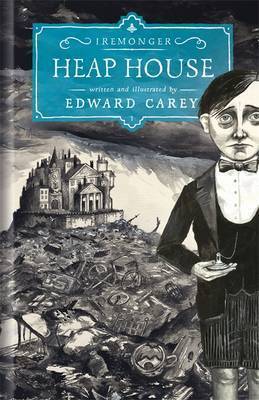 The Iremonger family wealth came from salvaging treasure from the rubbish heaps surrounding their London mansion. Every Iremonger has a birth object (like a daemon?) associated with them. Clodius Iremonger, adolescent descendant of the great family, has a special skill: he hears each birth object speaking its name. His own bath plug, for instance, cries out, “James Henry Hayward.” These objects house enchanted souls; people can change back into objects and vice versa. The narration alternates between Clod and plucky Lucy Pennant, who arrives from a local orphanage to work as a house servant. All staff and heap-workers are called “Iremonger,” but Lucy refuses to cede her identity and wants justice for the oppressed workers. She and Clod form a bond against the odds and there’s an upstairs–downstairs tinge to their ensuing adventures in the house and on the heaps.
Carey’s trademark twisted combination of Dickensian charm and Gothic gloom is certainly on display here. All the other names are slightly off-kilter: Rosamud, Moorcus, Aliver, Pinalippy and so on. I laughed out loud at a passage about the dubious purpose of doilies. Little truly won me over, but all my experiences with Carey’s work since then (also including The Swallowed Man, B: A Year in Plagues and Pencils, and Edith Holler) have been a slight letdown. This was highly readable and I galloped through the midsection, but I found the whole thing overlong; I’m undecided about reading the other books, though they do have higher average ratings on Goodreads. I got the second, Foulsham, from the Little Free Library and it’s significantly shorter. Shall I continue? (Secondhand – Awesomebooks.com) 
The Diary of a Nobody by George Grossmith; illus. Weedon Grossmith (1892)
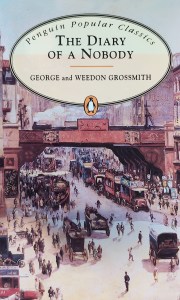 It must be rare for a fictional character to be memorialized in the dictionary. I was vaguely aware of the word “Pooterism” but thought it referred to small-minded, pompous, fussy individuals, so my preconception of City clerk Charles Pooter was probably more negative than is warranted. (In fact, “Pooterish” means taking oneself too seriously.) He’s actually a lovable, hapless Everyman who tries desperately to keep up with middle-class society but often gets it wrong. He can’t handle his champagne; and he wants so much to be funny – his are definite dad jokes avant la lettre – but only sometimes pulls it off. He regularly offends tradesmen, servants and neighbours alike, and tries but fails to ingratiate himself with his betters. Luckily, his mistakes are mild and just leave him out of favour – or pocket.

Charles and Lupin Pooter, as depicted by
Weedon Grossmith. Public domain, via Wikimedia Commons.
Originally serialized in Punch, the book is in short entries of one paragraph to a few pages, recounting the Pooters’ first 15 months in their new home. Events range from the mundane – home repairs and decoration – to the great excitement of being invited to the mayor’s ball. Charles and Carrie’s young adult son, Lupin (surely a partial inspiration for Roger Mortimer’s Dear Lupin and its sequels?), who comes back to live with them partway through, is a feckless bounder always being taken in by new money-making schemes and unsuitable ladies. Charles hopes to find Lupin steady employment and steer him away from his infatuation with Daisy Mutlar.
It’s well worth reading for its own sake, but also for the window onto daily Victorian life, including things that aren’t always recorded, such as fashion and slang. And it’s clever how Pooter’s pretensions get punctured by the others around him: longsuffering Carrie (“He tells me his stupid dreams every morning nearly”), insolent Lupin (“Look here, Guv.; excuse me saying so, but you’re a bit out of date”), and testy Gowing – that’s right, the neighbours are named Cummings and Gowing (“I would add, you’re a bigger fool than you look, only that’s absolutely impossible”). All very amusing. (Free from mall bookshop c. 2020) 
Never fear, I’m still on track to finish the challenge by the 31st!
September Releases, Part I: Berzinska, Falomo, Fubini
September is always a big month for new releases. I reviewed a load for Shelf Awareness this month (excerpts and links in tomorrow’s post, along with one more full review) and I’m awaiting library holds of some other big-name titles.
As often seems to be the case, my main roundup features one book each from fiction, poetry and nonfiction. Today I have short reviews of a set of sweetly fantastical Latvian short stories for middle grade readers, a Nigerian American’s autobiography in verse, and a short book about how prioritizing flavour might be the key to fixing a broken globalized food system.
The Skeleton in the Cupboard by Lilija Berzinska (2018; 2024)
[Translated from the Latvian by Žanete Vēvere Pasqualini and Sara Smith]
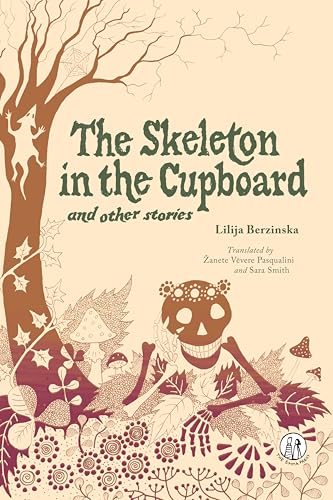 Something a bit different that still fit my September short stories focus: these nine linked fairytales feature sentient animals and fantastical creatures learning relatable life lessons. In the title story, Squishbod airs his closet once a year, which requires taking out the skeleton – a symbol of shameful secrets one holds close. Newfound friendship shades into obsession in “The Sea Wolf and the Hare” before the hare’s epiphany that love requires freedom. Characters wrestle with greed, fear and feelings of inadequacy or incompleteness. In “The End of the World,” which can be interpreted as a subtle climate fable, a thick fog induces panic. A puffin entertains thoughts of piracy. Spendthrift is compelled to have the latest in home décor while Mousekin frets over his lack of ambition. This is perfect for Moomins fans, who will embrace the blend of domesticity and adventure, melancholy and reassurance. I was also reminded of another European children’s novel-in-stories I’ve reviewed, Scary Fairy in Wicked Wood by Jana Bauer (translated from the Slovenian). The book is illustrated with whimsical drawings by the author, and a translators’ note explains how they assigned the creatures punning names. This is meant for children aged eight and up, but I loved it, too.
With thanks to The Emma Press for the free copy for review.
In September-released short stories, I also recently reviewed A New Day by Sue Mell.
Autobiomythography Of by Ayokunle Falomo
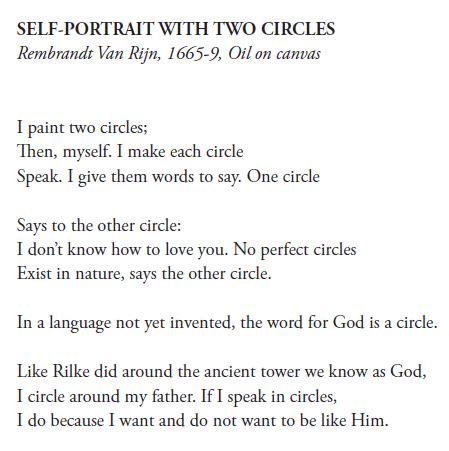
 The title is adapted from Audre Lorde’s term for Zami, “biomythography” (Kim Coleman Foote also borrowed it for Coleman Hill). This collection reminded me most of Jason Allen-Paisant’s multi-award-winning Self-Portrait as Othello. Both books pair an investigation of identity with musings on history and art, and six of Falomo’s poem titles begin with “Self-Portrait.” Another nine open with “Lugard & I,” referencing the early-1900s white high commissioner/governor/governor-general who effectively created Nigeria. Falomo contrasts his childhood understanding of his country with the more complicated postcolonial vision that has emerged in later decades.
Drawing on the Bible and mythology, the poet spins meditations on genealogy and describes himself as if from the outside, via others’ perceptions (“If Found,”) and erasure of official forms. “To You in Your Dark Lake Moving Darkly Now” is addressed to his child in utero, and a major theme is figuring out how to be a father differently from one’s own father (on which, see also Raymond Antrobus’s Signs, Music; I’ll link to my review tomorrow). The form varies a lot, from fragmented stanzas to paragraphs. I was impressed. A favourite passage (and a sample poem below):
The past will remain
what it is—a pastiche
of regrets and joys—
but lest I be accused of being
tethered to it, here is the snail-
sized horse I’ve named
Forgive. No, Forget.
Remind me.
I have forgotten who I was.
I have forgiven who I was supposed to be.
(from “Autobiography Of”)
With thanks to Alice James Books for the advanced e-copy for review.
In Search of the Perfect Peach: Why flavour holds the answer to fixing our food system by Franco Fubini
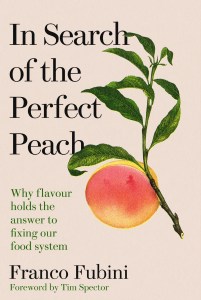 Fubini is the CEO of Natoora, which supplies produce to world-class restaurants. He is passionate about restoring seasonal patterns of eating; just because we can purchase strawberries year-round doesn’t mean we should. Supermarkets (which control 85% or more of food stock in the USA and UK) are to blame, Fubini explains, because after the Second World War they “tricked families with feelings of value and convenience, yet what they really wanted was for them to consume more of this unhealthy, flavour-engineered food [i.e. ultra-processed foods], which is cheap to produce and easy to transport because of its industrial nature.” He gives a few examples of fruits that have been selected for flavour rather than shelf life, such as the winter tomato varieties he popularized via River Café, green citrus, and the divine Greta white peach that set him off on this journey in 2011. This is a concise and readable introduction to modern food issues.
While it didn’t contain a lot that was new to me and I found the prose only serviceable, I’d still recommend it to anyone wanting a quick and thought-provoking read about where food comes from. Fubini’s is a wise voice we would do well to heed; I saw him quoted in the Guardian the other day on how to choose ripe fruit.
With thanks to Chelsea Green Publishing for the proof copy for review.
Reading the Meow, Part II: Books by Bernardine Bishop and Matt Haig
This is my second contribution to the Reading the Meow challenge, hosted by Mallika of Literary Potpourri, after yesterday’s review of Sleeping with Cats by Marge Piercy. One of the below novels is obviously cat-themed; the other less so, but the cover and blurb convinced me to take a chance on a new-to-me author and I discovered a hidden gem.

The Street by Bernardine Bishop (2015)
Prices are so cheap at my local charity warehouse (3/£1 paperbacks) that I recently did something I almost never do: bought a book I’d never heard of, by an author I’d never heard of, and then (something I definitely never do!) read it almost right away instead of letting it gather dust on my shelves for years. Bishop’s biography is wild. As a new Cambridge graduate, she was the youngest witness in the Lady Chatterley trial in 1960, then published two novels in her early twenties. She married twice, had two sons and a psychotherapy career, and returned to writing fiction after 50 years – prompted by a cancer diagnosis. Unexpected Lessons in Love was shortlisted for the Costa Novel Award in 2013, while this and Hidden Knowledge were both published posthumously, after Bishop’s death in 2015.
So: there is a cat on the cover and the blurb mentions it, too: “a beloved cat achieves immortality.” (I should have realized that was a euphemism, but never mind.) The novel opens with news of the death at 90 of formidable Brenda Byfleet, who’d been a Greenham Common woman and taken part in peace protests right into old age. Neighbours quickly realize someone will need to care for her cat Benn (named for Tony Benn), and the duty falls to Anne and Eric, who have also taken in their grandson while his parents are in Canada.
 What follows is a low-key ensemble story that moves with ease between several key residences of Palmerston Street, London, introducing us to a couple struggling with infertility, a war veteran with dementia, an underemployed actor who rescues his wife from her boss’s unwanted attentions, and so on. Most touching is the relationship between Anne and Georgia, a lesbian snail researcher who paints Anne’s portrait. Their friendship shades into quiet, middle-aged love.
There are secrets and threats and climactic moments here, but always the reassuring sense that neighbours are a kind of second family and so someone will be there for you to rely on no matter what you face. (I can think of a certain soap opera theme that expresses a similar sentiment…) Bishop’s style reminds me most of Tessa Hadley’s. She is equally skilled at drawing children and the elderly, and clearly feels love and compassion for her flawed characters: “Everything and everyone in the street was bathed in a blessed ordinariness.”
From Brenda onward, Georgia’s rhetorical question hangs over the short novel: “What is a life?” The implied partial answer is: what is remembered by those left behind. The opening paragraph is perfect –
“Sometimes it is impossible to turn even a short London street into a village. But sometimes it can be easily done. It all depends on one or two personalities.”
… and the last page has kittens. This was altogether a lovely read. Dangit, why didn’t I also buy the other Bishop novel that was on shelf at the charity warehouse?! I’ll have to hope it’s still around the next time I go there. (Secondhand – Community Furniture Project, Newbury) 
To Be a Cat by Matt Haig (2012)
 This was a reasonably cute middle-grade fantasy and careful-what-you-wish-for cautionary tale. On his twelfth birthday, Barney Willow thinks life couldn’t get worse. His parents are divorced, his dad has recently disappeared, he’s bullied by Gavin Needle, and evil head teacher Miss Whipmire seems to have a personal vendetta against him. His only friend is Rissa Fairweather, who lives on a barge. Little does he know that an idle wish to switch places with a cat he pets on the street will set a dangerous adventure in motion. Now he’s a cat and Maurice the cat has his body. Soon Barney realizes there’s a whole subset of cats who are former humans (alongside “swipers,” proper fighting street cats; and “firesides,” who prefer to stay indoors), including Miss Whipmire, who used to be a Siamese cat and has an escape plan that involves Barney. I felt the influence of Roald Dahl and Terry Pratchett, but Haig doesn’t have their writing chops. Apart from Rissa, the characterization is too clichéd. I’m sure I would have enjoyed this at age eight, though. (Little Free Library)
Autumnal Children’s and YA Books
Browsing through old magazines, I found a fun BookPage reading list from October 2019 entitled “Pumpkin spice latte literature.” It asks, “what if autumn were distilled into a book? The mixture of crispness and warmth, the thrill of possibility, the bittersweetness of change—these books are pure pumpkin spice.” I love the lateral thinking that came up with
 The Art of Fielding by Chad Harbach (back to school in the Midwest)
- I Remember Nothing by Nora Ephron (wry reflections from the autumn of a life)
- Possession by A.S. Byatt (bookish geeking out)
- Calling a Wolf a Wolf by Kaveh Akbar (taking comfort from a vision of recovery from alcoholism)
- An Enchantment of Ravens by Margaret Rogerson (wit and magic)
I’ve read the first three, and am keen to catch up on Akbar’s debut poetry collection after loving Pilgrim Bell this summer. I’m only unlikely to pick up Rogerson’s fantasy. In any case, I enjoyed seeing how the editors came up with their selections.
I tend to be rather more literal with my seasonal reading recommendations. Does it have autumn in the title or as a setting?! Is it about pumpkins or Halloween?
This year I happen to have amassed all children’s and YA selections.
October, October by Katya Balen (2020)
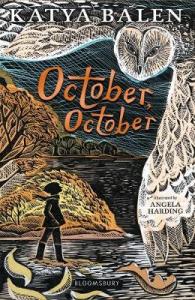 I’ll admit it: it was Angela Harding’s gorgeous cover illustration that drew me to this one. But I found a story that lived up to it, too. October, who has just turned 11 and is named after her birth month, lives in the woods with her father. Their shelter and their ways are fairly primitive, but it’s what October knows and loves. When her father has an accident and she’s forced into joining her mother’s London life, her only consolations are her rescued barn owl chick, Stig, and the mudlarking hobby she takes up with her new friend, Yusuf.
The child’s perspective is well rendered through artful run-on sentences. Balen is careful to show the consequences of October’s decisions and to present advantages as well as disadvantages so it’s not just countryside = good, city = bad. I thought the father’s recovery a bit too quick, but overall, this middle grade novel was a great read for any age, as well as one to get kids thinking about illness and loss. And how about these heart-tugging last lines? “There are stories everywhere and I want to tell them all. And all the world is wild and waiting for me.” (Public library) 
Autumn Story by Jill Barklem (1980)
 The second in the quartet of seasonal “Brambly Hedge” stories. Autumn is a time for stocking the pantry shelves with preserves, so the mice are out gathering berries, fruit and mushrooms. Young Primrose wanders off, inadvertently causing alarm – though all she does is meet a pair of elderly harvest mice and stay for tea and cake in their round nest amid the cornstalks. I love all the little touches in the illustrations: the patchwork tea cosy matches the quilt on the bed one floor up, and nearly every page is adorned with flowers and other foliage. After we get past the mild peril that seems to be de rigueur for any children’s book, all is returned to a comforting normal. Time to get the Winter volume out from the library. (Public library)
Une Chanson d’ours by Benjamin Chaud (2011)
 The first whole book I’ve read in French in many a year. I just about coped, given that it’s a picture book with not all that many words on a page; any vocabulary I didn’t know offhand, I could understand in context. It’s late into the autumn and Papa Bear is ready to start hibernating for the year, but Little Bear spies a late-flying bee and follows it out of the woods and all the way to the big city. Papa Bear, realizing his lad isn’t beside him in the cave, sets out in pursuit and bee, cub and bear all end up at the opera hall, to the great surprise of the audience. What will Papa do with his moment in the spotlight? This is a lovely book that, despite the whimsy, still teaches about the seasons and parent–child bonds as it offers a vision of how humans and animals could coexist. I’ve since found out that this was made into a series of four books, all available in English translation. (Little Free Library)
Pumpkinheads by Rainbow Rowell; illus. Faith Erin Hicks (2019)
 This YA graphic novel is set on a Nebraska pumpkin patch that’s more like Disney World than a simple field down the road. Josiah and Deja have worked together at the Succotash Hut for the last three autumns. Today they’re aware that it’s their final Halloween before leaving for college. Deja’s goal is to try every culinary delicacy the patch has to offer – a smorgasbord of foodstuffs that are likely to be utterly baffling to non-American readers: candy apples, Frito pie (even I hadn’t heard of this one), kettle corn, s’mores, and plenty of other saccharine confections.
Josiah’s goal, by contrast, is to catch the eye of Marcy, the beauty who works at the fudge stand. Deja convinces him to desert the Succotash Hut and go in pursuit of Marcy via as many food stands as possible. She’s willing to indulge his unrealistic fantasy even though, as a bisexual who’s dated just about everyone at the patch, she knows romance is sometimes not all it’s cracked up to be. Meanwhile, there’s an angry billy goat on the loose.
This is a fun and quick romp, and the ending genuinely surprised me. I liked the story better than the art, though – my main problem was that these teen characters look more like they’re 30 (Josiah, especially, looks almost haggard what with the sharp lines down the sides of his face – I guess they’re to give him a ‘chiselled’ jaw?), similar to that weird phenomenon of much older actors playing high schoolers. So, I laughed to see in an afterword conversation between Rowell and Hicks that one of the major things they changed from early mock-ups was making the protagonists look older. (Public library) 
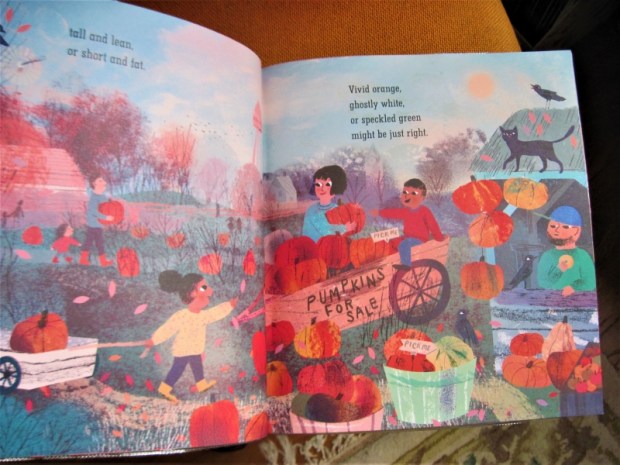
Pick a Pumpkin by Patricia Toht; illus. Jarvis (2019)
 From picking the best pumpkin at the patch to going out trick-or-treating, this is a great introduction to Halloween traditions. It even gives step-by-step instructions for carving a jack-o’-lantern. The drawing style – generally 2D, and looking like it could be part cut paper collages, with some sponge painting – reminds me of Ezra Jack Keats and most of the characters are not white, which is refreshing. There are lots of little autumnal details to pick out in the two-page spreads, with a black cat and crows on most pages and a set of twins and a mouse on some others. The rhymes are either in couplets or ABCB patterns. Perfect October reading. (Public library)
 Any super-autumnal reading for you this year?
Do you read children’s picture books and YA novels even if you (and any children) are well past that age – or is it just me?
This Year’s “Snow” and “Winter” Reads
Longtime readers will know how much I enjoy reading with the seasons. Although it’s just starting to feel like there’s a promise of spring here in the south of England, I understand that much of North America is still cold and snowy, so I hope these recent reads of mine will feel topical to some of you – and the rest of you might store some ideas away for next winter.
(The Way Past Winter has already gone back to the library.)
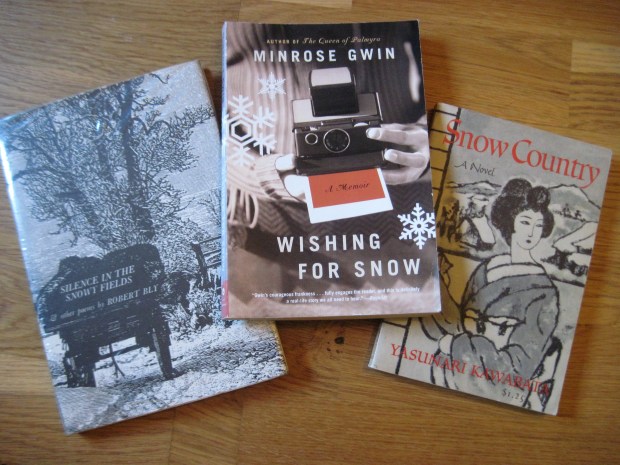
Silence in the Snowy Fields and Other Poems by Robert Bly (1967)
 Even when they’re in stanza form, these don’t necessarily read like poems; they’re often more like declaratory sentences, with the occasional out-of-place exclamation. But Bly’s eye is sharp as he describes the signs of the seasons, the sights and atmosphere of places he visits or passes through on the train (Ohio and Maryland get poems; his home state of Minnesota gets a whole section), and the small epiphanies of everyday life, whether alone or with friends. And the occasional short stanza hits like a wisdom-filled haiku, such as “There are palaces, boats, silence among white buildings, / Iced drinks on marble tops among cool rooms; / It is good also to be poor, and listen to the wind” (from “Poem against the British”).
Favorite wintry passages:
How strange to think of giving up all ambition!
Suddenly I see with such clear eyes
The white flake of snow
That has just fallen in the horse’s mane!
(“Watering the Horse” in its entirety)
The grass is half-covered with snow.
It was the sort of snowfall that starts in late afternoon,
And now the little houses of the grass are growing dark.
(the first stanza of “Snowfall in the Afternoon”)
My rating: 
Wishing for Snow: A Memoir by Minrose Gwin (2004)
 One of the more inventive and surprising memoirs I’ve read. Growing up in Mississippi in the 1920s–30s, Gwin’s mother wanted nothing more than for it to snow. That wistfulness, a nostalgia tinged with bitterness, pervades the whole book. By the time her mother, Erin Clayton Pitner, a published though never particularly successful poet, died of ovarian cancer in the late 1980s, their relationship was a shambles. Erin’s mental health was shakier than ever – she stole flowers from the church altar, frequently ran her car off the road, and lived off canned green beans – and she never forgave Minrose for having had her committed to a mental hospital. Poring over Erin’s childhood diaries and adulthood vocabulary notebook, photographs, the letters and cards that passed between them, remembered and imagined conversations and monologues, and Erin’s darkly observant unrhyming poems (“No place to hide / from the leer of the sun / searching out every pothole, / every dream denied”), Gwin asks of her late mother, “When did you reach the point that everything was in pieces?”
My rating:
The Way Past Winter by Kiran Millwood Hargrave (2018)
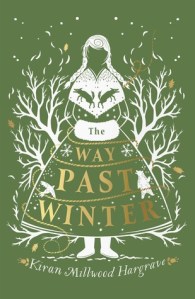 It has been winter for five years, and Sanna, Mila and Pípa are left alone in their little house in the forest – with nothing but cabbages to eat – when their brother Oskar is lured away by the same evil force that took their father years ago and has been keeping spring from coming. Mila, the brave middle daughter, sets out on a quest to rescue Oskar and the village’s other lost boys and to find the way past winter. Clearly inspired by the Chronicles of Narnia and especially Katherine Arden’s Winternight trilogy, this middle grade novel is set in an evocative, if slightly vague, Russo-Finnish past and has more than a touch of the fairy tale about it. I enjoyed it well enough, but wouldn’t seek out anything else by the author.
Favorite wintry passage:
“It was a winter they would tell tales about. A winter that arrived so sudden and sharp it stuck birds to branches, and caught the rivers in such a frost their spray froze and scattered down like clouded crystals on the stilled water. A winter that came, and never left.”
My rating:
Snow Country by Yasunari Kawabata (1937; English translation, 1956)
[Translated from the Japanese by Edward G. Seidensticker]
 The translator’s introduction helped me understand the book better than I otherwise might have. I gleaned two key facts: 1) The mountainous west coast of Japan is snowbound for months of the year, so the title is fairly literal. 2) Hot springs were traditionally places where family men travelled without their wives to enjoy the company of geishas. Such is the case here with the protagonist, Shimamura, who is intrigued by the geisha Komako. Her flighty hedonism seems a good match for his, but they fail to fully connect. His attentions are divided between Komako and Yoko, and a final scene that is surprisingly climactic in a novella so low on plot puts the three and their relationships in danger. I liked the appropriate atmosphere of chilly isolation; the style reminded me of what little I’ve read from Marguerite Duras. I also thought of Silk by Alessandro Baricco and Memoirs of a Geisha by Arthur Golden – perhaps those were to some extent inspired by Kawabata?
Favorite wintry passage:
“From the gray sky, framed by the window, the snow floated toward them in great flakes, like white peonies. There was something quietly unreal about it.”
My rating:
I’ve also been slowly working my way through The Snow Leopard by Peter Matthiessen, a spiritual quest memoir with elements of nature and travel writing, and skimming Francis Spufford’s dense book about the history of English exploration in polar regions, I May Be Some Time (“Heat and cold probably provide the oldest metaphors for emotion that exist.”).

On next year’s docket: The Library of Ice by Nancy Campbell (on my Kindle) and Snow Falling on Cedars by David Guterson
Last year I had a whole article on perfect winter reads published in the Nov/Dec issue of Bookmarks magazine. Buried in Print spotted it and sent this tweet. If you have access to the magazine via your local library, be sure to have a look!

 Bookish Beck = Rebecca Foster. American transplant to England. Freelance proofreader and book reviewer.
 Bookish Beck