Weatherglass Books’ Second Annual Novella Prize Shortlist (#NovNov25)
Last year I attended an event at Foyles in London introducing the two joint winners of the inaugural Weatherglass Novella Prize, as chosen by Ali Smith. I later reviewed both Astraea by Kate Kruimink and Aerth by Deborah Tomkins, and interviewed Weatherglass Books co-founder and novelist Neil Griffiths. With his permission, I’m reproducing below the partial text of the Substack post in which he announced the shortlist for this second year of the award. Out of 170+ submissions, he and co-publisher Damian Lanigan chose a shortlist of four novellas, which have again been sent to Ali Smith for her to choose a winner in the new year. The winner will be published by Weatherglass Books. It’s clear that all four are publishable, though!
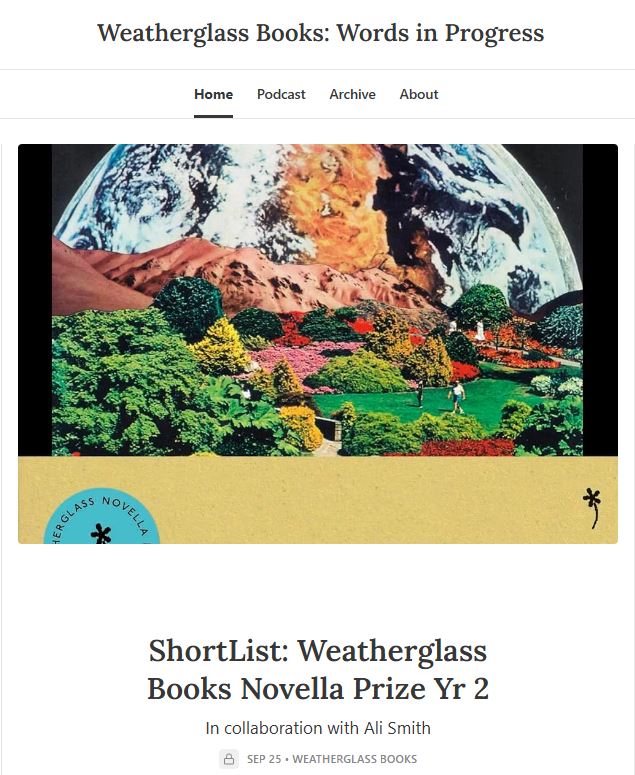
The shortlist is … in no particular order:
A BRIEF HISTORY OF WAR by Selma Carvalho is a piece of sensuous magnetic power and aliveness. It deals with questions of class, ethnicity and nationalism so close to the contemporary that this book almost shakes in your hands.
Two people sit by chance near each other on a bus in a world where the rise of political divisions is physical, palpable. They’re unalike in every way. Their attraction fizzes like a lit fuse. “What does it mean to be foreign, to think of another human being as foreign? Foreign from what?” It examines the closeness and distance between people, families, tribes, and the hair-trigger, hair-on-the-back-of-the-neck negotiations between people’s bodies.
Wise and contemporary, uncompromising and true, its edginess, and the fallout from desires, personal and social, is brilliantly conjured and conveyed.
FROM THE SMALLEST THINGS by Jupiter Jones tells the far-too-untold story of a c19th sisterhood, that of the daughters of Mary Wollstonecraft: Fanny Imlay and Mary Shelley, the famed writer of Frankenstein, plus their step-sister Claire Clairmont. Are they the three graces? The fates? They’re women, as alive and breathing and rebellious and analytical as you and me, and well aware and critical of the hemmed-in nature they’re expected to accept as women of their time, a time of “a new way of thinking, a new-world independence, a revolutionary world.”
It features their connection to Percy Bysshe Shelley – “how could we not love him, with his lofty ethics and words that flew like birds?” – and many of the other contemporary poets and thinkers of the time. Pacy and assured, it turns its history to life from fragment to sensuous fragment. If the dead brought to life is to be Mary Shelley’s theme, this novella asks what the real source of life spirit is, the vital spark. This book, full of detail and richesse, is a piece of vitality in itself.
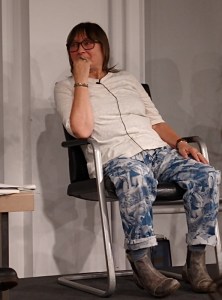
Ali Smith at the Weatherglass event in September 2024.
SHOUGANI by Anju Gaston – what does it mean? “I ask the internet the difference between something being too close to the bone and something being too close to home.” This funny and terrifying book is a study of what and how things mean, and don’t, in our latest machine age. In it something unforgiveable has happened. The main character in this novella, seemingly numbed but bristling with blade-sharp understanding, is only just holding things together and trying to work out how to heal. So she travels to Japan in a search for the other half of a fragmented family. Or is it the world itself that has fragmented?
Shougani examines the massive everyday pressures we’re all under with real wit and style. It is pristine, brilliant, smart beyond belief. I sense it becoming as much a classic for now as Plath’s The Bell Jar has been for the decades behind us.
THE MARVELLOUS DINNER by Polly Tuckett
“A massacre of things just to produce a single dish”: this novella charts the terrible coming-apart of a marriage. A wife prepares a dinner for her husband on an important anniversary, a meal so laboured and elaborate that something’s wrong, something’s definitely up – more, something’s got to give.
This novella is a story of the fictions we call true in our lives, even though we know they’re hollow ceremonials. There’s a Mike Leigh touch to this unsettling book. Every mouthful is dangerous, precarious. It anatomises fuss and ceremony, examines the ritual and the real bullying in a relationship. It deals with madness and the mundane truth of fantasy. Is it love itself that’s a delusion in this tale of the ties that bind?
“So there we have it. Our four shortlisted titles,” Neil writes. “They are all extraordinary, all deserve to win, to be well published. It’s now down to Ali. Thank you to everyone who submitted. We’ve enjoyed reading all the entries. But especial thanks to Ali Smith for agreeing to be our judge in year one and now on-goingly; it’s a real privilege to have one the world’s most original writers helping us select what we commission.”
Which of the synopses entice you? I especially like the sound of From the Smallest Things and The Marvellous Dinner.
Interview with Neil Griffiths of Weatherglass Books (#NovNov24)
 Back in September, I attended a great “The Future of the Novella” event in London, hosted by Weatherglass. I wrote about it here, and earlier this month I reviewed the first of the two winners of the inaugural Weatherglass Novella Prize, Astraea by Kate Kruimink*. Weatherglass Books co-founder and novelist Neil Griffiths kindly sent review copies of both winning books, and agreed to answer some questions over e-mail.
Samantha Harvey’s 136-page Orbital won the Booker Prize, the film adaptation of Claire Keegan’s Small Things Like These is in cinemas: Is the novella having a moment? If so, how do you account for its fresh prominence? Or has it always been a powerful form and we’re realizing it anew?
 I do wonder whether Orbital is a novella, by which I mean, number of pages can be deceptive – there are a lot of words per page! I think it probably sneaks in under our Novella Prize max word count: under 40K. Also, I wonder whether Small Things like These would make it over our minimum 20K. I don’t think so. But what I think we can say is that there is something happening around length.
My co-founder of Weatherglass, Damian Lanigan, says this: “the novella is the form for our times: befitting our short attention spans, but also with its tight focus, with its singular atmosphere – it’s the ideal form for glimpsing something essential about the world and ourselves in an increasingly chaotic world.”
But then if we look over the history of the prose fiction over the last 200 hundred years, there are so many novellas that have defined an era: Turgenev’s Love, Conrad’s Heart of Darkness, Carr’s A Month in the Country, Orwell’s Animal Farm, Solzhenitsyn’s One Day in the Life of Ivan Denisovich.
Why did Weatherglass choose to focus on short books? Do economic and environmental factors come into it (short books = less paper = lower printing costs as well as fewer trees cut down)?
 Economic and environmental factors play a role, but there is also craft. Writers need to ask themselves the question: does this story need to be this length, and the answer is, more often than not: no. I think constraints bring the best out of writers. If a novel comes in at 70K words, our first thought is to cut 10K. (I should say, my last novel, very kindly reviewed by yourself, was a whooping 190K words. It should have been 150K! Since then I’ve written two pieces of fiction, both under 35K.)
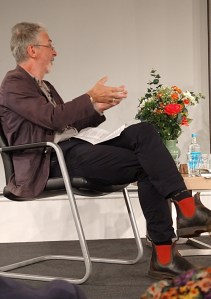
Neil Griffiths
We’ve heard about the bloating of films, that they’re something like 20% longer on average than they were 40 years ago; will books take the opposite trajectory? Can a one-sitting read compete with a film?
I don’t think I’ve ever read even the shortest novella in one sitting. I need time to reflect. I don’t think comparing the two forms is helpful because they require different things of us. Take music: Morton Feldman’s 2nd String Quartet is 5 hours long, without a break. I’d commit to that in the concert hall, but I couldn’t read for 5 hours without a break or sit through a film.
How did you bring Ali Smith on board as the judge for the first two years of the Weatherglass Novella Prize? There was a blind judging process and you ended up with an all-female shortlist in the inaugural year. Do you have a theory as to why?
Ali Smith
Damian kept saying Ali Smith would be the best judge and I kept saying “but how do we get to her?” Then someone told me they had her email address. I didn’t expect to get an answer. A ‘Yes’ came an hour later. She’s been wonderful to work with. And she’s enjoyed it so much she’s agreed to do it ongoingly.
I do think the shortlist question is an important one. Certainly we don’t have to ask ourselves any questions when it’s an all-female short list, but we would if it was all-male. What does that say? I don’t know why the strongest were by women.
Do you have any personal favourite novellas?
 A Month in the Country might be the exemplar of the form for me. But there is a little-read novella by Tolstoy, Hadji Murat, which is also close to perfect. More contemporaneously, Gerald Murnane’s Border Districts. And I’m pleased to say: all three novellas we’re publishing from our inaugural prize are up there: Astraea, Aerth and We Hexed the Moon.
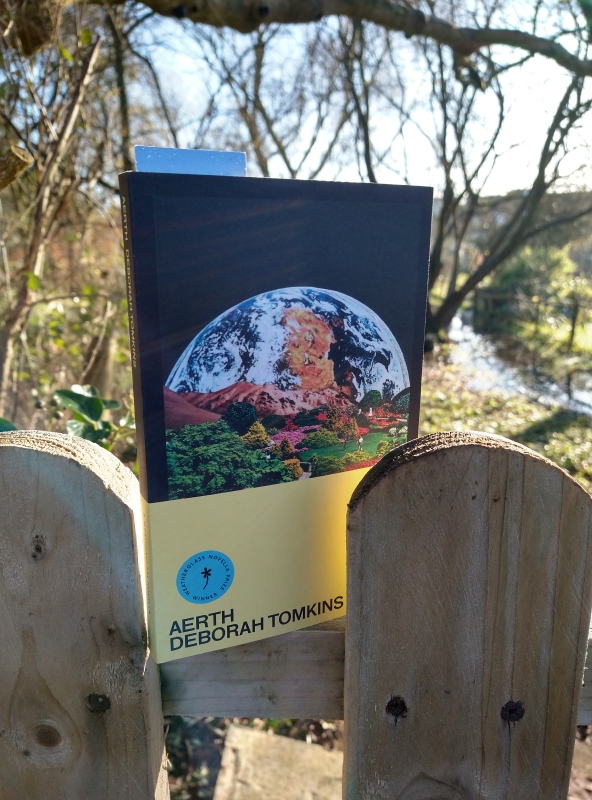
*Though it won’t be published until 25 January, I have a finished copy of the other winner, Aerth by Deborah Tomkins, a novella-in-flash set on alternative earths and incorporating second- and third-person narration and various formats. I’ve been enjoying it so far and hope to review it soon as my first recommendation for 2025.
Get Ready for Novellas in November!
Novellas: “all killer, no filler,” as Joe Hill said. Hard to believe, but it’s now the FIFTH year that Cathy of 746 Books and I have been co-hosting Novellas in November as a month-long blogger/social media challenge celebrating the art of the short book. A novella is a book of 20,000 to 40,000 words, but because that’s hard for a reader to gauge, we tend to say anything under 200 pages (even nonfiction). I’m going to make it a personal challenge to limit myself to books of ~150 pages or less.

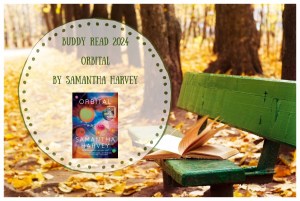
We’re keeping it simple this year with just the one buddy read, Orbital by Samantha Harvey. (Though we chose it weeks ago, its shortlisting for the Booker Prize is all the more reason to read it!) The UK hardback has 144 pages. Here’s part of the blurb to entice you:
“Six astronauts rotate in their spacecraft above the earth. … Together they watch their silent blue planet, circling it sixteen times, spinning past continents and cycling through seasons, taking in glaciers and deserts, the peaks of mountains and the swells of oceans. Endless shows of spectacular beauty witnessed in a single day. Yet although separated from the world they cannot escape its constant pull. News reaches them of the death of a mother, and with it comes thoughts of returning home. … They begin to ask, what is life without earth? What is earth without humanity?”

Please join us in reading it at any time between now and the end of November!
We won’t have any official themes or prompts, but you might want to start off the month with a My Year in Novellas retrospective looking at any novellas you have read since last NovNov, and finish it with a New to My TBR list based on what novellas others have tempted you to try in the future.
It’s always a busy month in the blogging world, what with Nonfiction November, German Literature Month, Margaret Atwood Reading Month and SciFi Month. Why not search your shelves and/or local library for novellas that could count towards multiple challenges?
From 1 November there will be a pinned post on my site from which you can join the link-up. Keep in touch via Twitter (@bookishbeck / @cathy746books) and Instagram (@bookishbeck / @cathy_746books), and feel free to use the terrific feature images Cathy has made plus our new hashtag, #NovNov24.
“The Future of the Novella”
On the 11th, at Foyles in London, I attended a perfect event to get me geared up for Novellas in November. Indie publisher Weatherglass Books and judge Ali Smith introduced us to the two winners she chose for the inaugural Weatherglass Novella Prize: Kate Kruimink’s Astraea (set on a 19th-century Australian convict ship), out now, and Deborah Tomkins’ Aerth (a sci-fi novella in flash set on alternative earths), coming out in January.

Ali Smith
We heard readings from both novellas, and Neil Griffiths and Damian Lanigan of Weatherglass told us some more about what they publish and the process of reading the prize submissions (blind!). Lanigan called the novella “a form for our times” and put this down not just to modern attention spans but to focus – the glimpse of something essential. He and Smith mentioned F. Scott Fitzgerald, Claire Keegan, Françoise Sagan and Muriel Spark as some of the masters of the novella form.
The effortlessly cool Smith spoke about the delight of spending weekend mornings – she writes during the week but gives herself the weekends off to read – in bed with a pot of coffee and a Weatherglass novella. She particularly enjoyed going into each book from the shortlist without any context and lamented that blurbs mean the story has to be, to some extent, given away to the reader. She said the ending of a novella has to land “like a cat, on its feet” (Griffiths then appended that it must also be ambiguous).
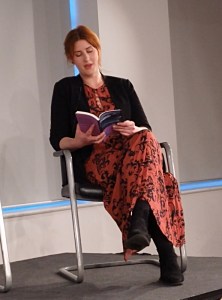
Kate Kruimink
Kruimink, who edits short stories for a magazine, explained that she thinks of Astraea as a long short story. She wrote it especially for this prize, within two months and for Ali Smith, as it were (she mentioned how formative How to Be Both was for her as a writer). Due to time and word limit constraints, she deliberately crafted a small character arc and didn’t do loads of research, though she had been looking into ships’ surgeons’ journals at the time. She has Irish convict ancestry but noted that this is not uncommon in Tasmania. Astraea is a “sneaky prequel” to her first novel, which has been published in Australia.
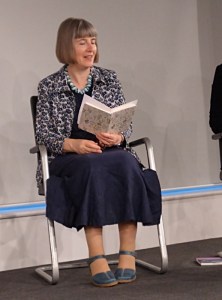
Deborah Tomkins
Aerth was originally titled First, Do No Harm, which had the potential to confuse those looking for a medical read. Aerth and Urth are different planets with parallels to our own. The novella tells the story of Magnus, an Everyman on a deeply forested planet heading into an Ice Age. Tomkins first wrote it for the Bath Prize in 2018 and was longlisted, then added to it. She initially sent the book to sci-fi publishers but was told it was not ‘sci-fi enough’.
Griffiths remarked that the shortlist was all-female and that the two winners show how a novella can do many different things: Astraea is at the low end of the word count at 22,000 words and takes place over just 36 hours; Aerth is towards the upper limit at 36,000 words and spans about 40 years.
Neil Griffiths
All the panellists dismissed the idea of a hierarchy with the full-length novel at the top. Griffiths said that the constraints of the novella, to need to discard and discard, make it stand out.
A further title from the 2024 shortlist, We Hexed the Moon by Mollyhall Seeley, will also be published by Weatherglass next year, and submissions are now open for the Weatherglass Novella Prize 2025.
Many thanks for my free ticket to a great event. Weatherglass has also kindly offered to send Cathy and me copies of the two novellas to review over the course of #NovNov. I’m looking forward to reading both winners!
Doorstopper of the Month: The Stillness The Dancing (1985) by Wendy Perriam
When she read my review of As a God Might Be by Neil Griffiths, Liz Dexter suggested Wendy Perriam’s books as readalikes and very kindly sent me one to try: The Stillness The Dancing – a title whose lack of punctuation confused me until I discovered that it’s taken from a line of T. S. Eliot’s “East Coker”: “So the darkness shall be the light, and the stillness the dancing.” It took me nearly a year and a half to get around to it, but I’ve finally read my first Perriam (fairly autobiographical, it seems) and found it very striking and worthwhile.
 The comparison with the Griffiths turned out to be apt: both are hefty, religion-saturated novels dwelling on themes of purpose, mysticism, asceticism, and the connection between the mind and body, especially when it comes to sex. Perriam’s protagonist is Morna Gordon, a 41-year-old translator. The end of her marriage was nearly as disorienting for her as the loss of her Catholic faith. Occasional chapters spotlight the perspective of the other women in this family line: Morna’s mother, Bea, who’s been a widow for as long as Morna has been alive and finally finds a vocation at an age when most people are retiring; and Morna’s daughter Chris, who’s tasting freedom before starting uni and settling down with her diver boyfriend, Martin.
When Morna accompanies Bea on a week-long religious retreat in the countryside, she meets David Anthony, a younger man she initially assumes is a priest. Here to deliver a lecture on miracles, he’s a shy scholar researching a seventh-century Celtic saint, Abban, who led an austere life on a remote Scottish island. Morna is instantly captivated by David’s intellectual passion, and in lieu of flirting offers to help him with his medieval translations. Still bruised by her divorce, she longs to make a move yet doesn’t want to scare David off. After 14 years of Neil telling her she was frigid, she’s startled to find herself in the role of sexual temptress.
Staid suburban England is contrasted with two very different locales: Saint Abban’s island and the outskirts of Los Angeles, where Morna and Chris travel for a few weeks in January so Chris can spend time with her father and meet his new family: (younger) wife Bunny and Chris’s four-year-old half-brother, Dean. California is “another world completely,” a fever dream of consumerism and excess, and Morna does things that are completely outside her comfort zone, like spending hours submerged in a sensory deprivation tank and breaking down in tears in the middle of Bunny’s women’s consciousness-raising circle.
The differences between England and California are exaggerated for comic effect in a way that reminded me of David Lodge’s Changing Places – but if for Chris it’s all about hedonistic self-expression, for Morna America is more of an existential threat, and she rushes back to be with David. There are several such pivotal moments when Morna flees one existence for another, often accompanied by a time of brain fog: alcohol, sleeping pills or grief disrupt her normal thought processes, as reflected in choppy, repetitive sentences.
I bristled slightly at the melodramatic nature of the final 60 pages, unsure to what extent the ending should be seen as altering the book’s overall message: Morna is denied a full transformation, but it seems she’s still on the spiritual path towards detachment from material things. Though still a lapsed Catholic, she finds some fresh meaning in the Church’s history and rituals. As her mother and daughter both embark on their new lives, her ongoing task is to figure out who she is apart from the connections that have defined her for so many years.
My favorite parts of the novel, not surprisingly, were Morna’s internal monologue – and her conversations with David – about faith and doubt. Perhaps I wasn’t wholeheartedly convinced that all the separately enjoyable components fit together, or that all the strands were fully followed through, but it’s an exuberant as well as a meditative work and I will certainly seek out more from Perriam.
Some favorite lines:
(Morna thinks) “If one had been exhorted all one’s girlhood to live for God alone, then how could one have purpose if He vanished?”
David: “I know our society shies away from any type of self-denial, regards it as neurotic or obsessional, but I disagree with that. Anything worth having is worth suffering for.”
Morna: “Are you still a Catholic? I know you said you believed in God, but that’s not the same, is it?” / David: “I’m still redefining all my terms. That can take a lifetime.”
Author note: Wendy Perriam’s name was completely new to me, though this was her 11th novel. Now in her 70s, she is still publishing fiction, with a crime novel released in 2017.
Page count: 536
My rating: 
2017’s Runners-Up and Other Superlatives
The choices below are in alphabetical order by author, with any previously published reviews linked in (many of these books have already appeared on the blog in some way over the course of the year). You know the drill by now: to keep it simple for myself as well as for all of you who are figuring out whether you’re interested in these books or not, I’m limiting myself to two sentences per title. The first is a potted summary; the second tells you why you should read it. Across these three best-of posts (see also my Top Nonfiction and Best Fiction posts), I’ve spotlighted roughly the top 15% of my year’s reading.
Runners-Up:
 As a God Might Be by Neil Griffiths: The themes and central characters were strong enough to keep me powering through this 600-page novel of ideas about encounters with God and the nature of evil. This turned out to be just my sort of book: big and brazen, a deep well of thought that will only give up its deeper meanings upon discussion and repeat readings.
 Spaceman of Bohemia by Jaroslav Kalfař: The story of Jakub Procházka, a Czech astronaut who leaves his wife behind to undertake a noble research mission but soon realizes he can never escape his family history or the hazards of his own mind. A terrific blend of the past and the futuristic, Earth and space.
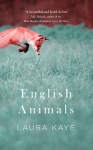 English Animals by Laura Kaye: A young Slovakian becomes a housekeeper for a volatile English couple and discovers a talent for taxidermy. A fresh take on themes of art, sex, violence and belonging, this is one of the more striking debut novels I’ve encountered in recent years.
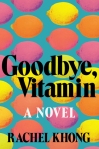 Goodbye, Vitamin by Rachel Khong: Reeling from a broken engagement, Ruth Young returns to her childhood home in California for a year to help look after her father, who has Alzheimer’s. This is a delightfully quirky little book, but you may well read it with a lump in your throat, too.
 Midwinter Break by Bernard MacLaverty: In MacLaverty’s quietly beautiful fifth novel, a retired couple faces up to past trauma and present incompatibility during a short vacation in Amsterdam. My overall response was one of admiration for what this couple has survived and sympathy for their current situation – with hope that they’ll make it through this, too. (Reviewed for BookBrowse.)
 Conversations with Friends by Sally Rooney: An Irish college student navigates friendships and an affair with a married man. This is much more about universals than it is about particulars: realizing you’re stuck with yourself, exploring your sexuality and discovering sex is its own kind of conversation, and deciding whether ‘niceness’ is really the same as morality; a book I was surprised to love, but love it I did.
 Lincoln in the Bardo by George Saunders: The residents of Georgetown cemetery limbo don’t know they’re dead – or at least won’t accept it. An entertaining and truly original treatment of life’s transience; I know it’s on every other best-of-year list out there, but it really is a must-read.
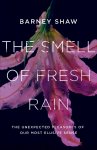 The Smell of Fresh Rain by Barney Shaw: Shaw travels through space, time and literature as he asks why we don’t have the vocabulary to talk about the smells we encounter every day. If you’re interested in exploring connections between smell and memory, discovering what makes the human sense of smell unique, and learning some wine-tasting-style tips for describing odors, this is a perfect introduction.
 A Life of My Own by Claire Tomalin: Tomalin is best known as a biographer of literary figures including Mary Wollstonecraft, Samuel Pepys and Charles Dickens, but her memoir is especially revealing about the social and cultural history of the earlier decades her life covers. A dignified but slightly aloof book – well worth reading for anyone interested in spending time in London’s world of letters in the second half of the twentieth century.
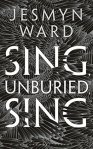 Sing, Unburied, Sing by Jesmyn Ward: The story of a mixed-race family haunted – both literally and figuratively – by the effects of racism, drug abuse and incarceration in Bois Sauvage, a fictional Mississippi town. Beautiful language; perfect for fans of Toni Morrison and Cynthia Bond.
I’ve really struggled with short stories this year, but here are four collections I can wholeheartedly recommend:
 What It Means when a Man Falls from the Sky by Lesley Nneka Arimah (Reviewed for Shiny New Books.)
- Unruly Creatures: Stories by Jennifer Caloyeras
- Bad Dreams and Other Stories by Tessa Hadley
- The Great Profundo and Other Stories by Bernard MacLaverty (1987)
The Best 2017 Books You Probably Never Heard of (Unless You Heard about Them from Me!):
 The Education of a Coroner by John Bateson: The coroner’s career is eventful no matter what, but Marin County, California has its fair share of special interest, what with Golden Gate Bridge suicides, misdeeds at San Quentin Prison, and various cases involving celebrities (e.g. Harvey Milk, Jerry Garcia and Tupac) in addition to your everyday sordid homicides. Ken Holmes was a death investigator and coroner in Marin County for 36 years; Bateson successfully recreates Holmes’ cases with plenty of (sometimes gory) details.
 Cork Dork by Bianca Bosker: Tasting notes: gleeful, ebullient, learned, self-deprecating; suggested pairings: Sweetbitter by Stephanie Danler; Top Chef, The Great British Bake Off. A delightful blend of science, memoir and encounters with people who are deadly serious about wine.
 A Paris All Your Own: Bestselling Women Writers on the City of Light, edited by Eleanor Brown: A highly enjoyable set of 18 autobiographical essays that celebrate what’s wonderful about the place but also acknowledge disillusionment; highlights are from Maggie Shipstead, Paula McLain, Therese Anne Fowler, Jennifer Coburn, Julie Powell and Michelle Gable. If you have a special love for Paris, have always wanted to visit, or just enjoy armchair traveling, this collection won’t disappoint you.
 Ashland & Vine by John Burnside: Essentially, it’s about the American story, individual American stories, and how these are constructed out of the chaos and violence of the past – all filtered through a random friendship that forms between a film student and an older woman in the Midwest. This captivated me from the first page.
 Tragic Shores: A Memoir of Dark Travel, Thomas H. Cook: In 28 non-chronological chapters, Cook documents journeys he’s made to places associated with war, massacres, doomed lovers, suicides and other evidence of human suffering. This is by no means your average travel book and it won’t suit those who seek high adventure and/or tropical escapism; instead, it’s a meditative and often melancholy picture of humanity at its best and worst. (Reviewed for Nudge.)
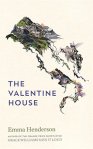 The Valentine House by Emma Henderson: This is a highly enjoyable family saga set mostly between 1914 and 1976 at an English clan’s summer chalet in the French Alps near Geneva, with events seen from the perspective of a local servant girl. You can really imagine yourself into all the mountain scenes and the book moves quickly –a great one to take on vacation.

The year’s runners-up and superlatives that I happen to have around in print.
Various Superlatives, Good and Bad:
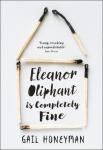 The 2017 Book Everybody Else Loved but I Didn’t: Eleanor Oliphant Is Completely Fine by Gail Honeyman. (See my Goodreads review for why.)
The Year’s Biggest Disappointments: All Grown Up by Jami Attenberg, Future Home of the Living God by Louise Erdrich, Between Them by Richard Ford and George and Lizzie by Nancy Pearl.
The Worst Book I Read This Year: Books by Charlie Hill (ironic, that). My only one-star review of the year.
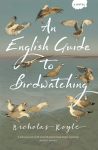 The Downright Strangest Book I Read This Year: An English Guide to Birdwatching by Nicholas Royle.
My Best Discoveries of the Year: Beryl Bainbridge, Saul Bellow, Bernard MacLaverty and Haruki Murakami. I’ve read two books by each of these authors this year and look forward to trying more from them.
The Debut Authors Whose Next Work I’m Most Looking Forward to: Lesley Nneka Arimah, Laura Kaye, Carmen Marcus, Julianne Pachico and Sally Rooney.
 The Best First Line of the Year: “History has failed us, but no matter.” (Pachinko, Min Jin Lee)
The Best Last Line of the Year: “If she was an instance of the goodness in this world then passing through by her side was miracle enough.” (Midwinter Break, Bernard MacLaverty)
Coming tomorrow: Some early recommendations for 2018.
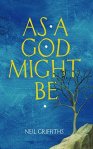
As a God Might Be by Neil Griffiths
[Note: A shortened, edited version of this review appeared in the June 15th, 2018 issue of the Church Times.]
Proctor McCullough isn’t a churchgoer. He’s not even particularly religious. Yet somehow he senses that God is calling him to build a chapel, with a little house beside it, on a cliff in the southwest of England. It’s a source of bewilderment for his partner, Holly, and their London friends. Is Mac mentally ill, or having a particularly acute midlife crisis? He’s handed off from a minister to a therapist to a neurologist, but no one knows what to make of him. This forty-four-year-old father of two, an otherwise entirely rational-seeming advisor to the government on disaster situations, won’t be deterred from his mission.
It’s important to get a sense of the way this character speaks:
I want a structure that will move people to contemplate something other than all the obvious stuff … to be confronted with a sense of something and only be able to define it as Other.
God is the transcendent Other for whom creation, what we know as life, is a gratuitous act of love, a dispossession of a portion of His infinite creativity given over to our thriving. It is a gift from His infinite excess. That we can know Him at all is because of the possibility of this excess within us, which we experience as love, art, great feats of the mind. Our bounty is Him.
Down at the project site, Mac acquires four young workers/disciples: Rebecca, Nathaniel, Terry and Rich. Rebecca is a sarcastic, voluptuous teenager who will be off to Cambridge in a few months. She perhaps represents vanity, temptation and judgment, while the other three are more difficult to slot into symbolic roles. Terry is a dreadlocked lager lout who takes care of a mother with early dementia; contrary to appearances, he’s also a thinker, and takes to carrying around a Bible along with a collection of other theological works. Nat and Rich are more sketch-like figures, just ciphers really, which became problematic for me later on.
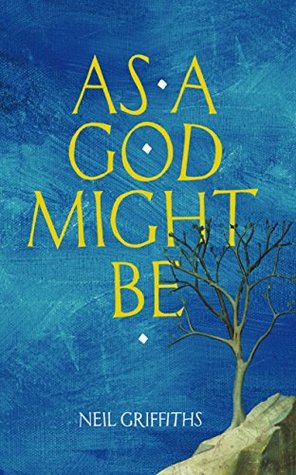 With Mac we shuttle between the building site and his home in London for weeks at a time. The idea of incorporating Pascal’s mystical hexagon into the church design captivates him, and the costs – initially set at £100,000 – balloon. Meanwhile, his relationship with Holly is strained almost to the breaking point as they each turn to alternative confidants, and there’s a renegotiation process as they decide whether their actions have torn them apart for good.
Like Sarah Moss, Neil Griffiths realistically blends serious concepts with everyday domestic tasks: sure, there may be a God-ordained chapel to build, but Mac also has to do the shopping and get his six-year-old twins fed and in bed at a decent hour. If Mac is meant to be a Messiah figure here, he’s a deeply flawed one; he can even be insufferable, especially when delivering his monologues on religion. If you’re like me, you’ll occasionally get incensed with him – particularly when, at the midpoint, he concocts a Clintonian justification for his behavior.
All the same, the themes and central characters were strong enough to keep me powering through this 600-page novel of ideas. Mac’s violent encounters with God and with the nature of evil are compelling, and although some of the events of the last third push the boundaries of credibility, it’s worth sticking with it to see where Griffiths takes the plot. There’s no getting past the fact that this is a dense theological treatise, but overlaid on it is a very human story of incidental families and how love sustains us through the unbearable.
If I had to point to the novel’s forebears, I’d mention Hamlet, A.S. Byatt’s The Virgin in the Garden, Michael Arditti’s Easter, and even Ayn Rand’s The Fountainhead. If you’ve read any Dostoevsky (I haven’t, yet) or Iris Murdoch, you’ll likely spot philosophical echoes. The title itself is from Wallace Stevens. It’s all unabashedly highbrow, and a greater than average familiarity with the Christian tradition is probably key. For the wary, I’d suggest not trying too hard to read metaphorical significance into character names or chapter and section titles – I’m sure those meanings are in there, but better to let the story carry you along rather than waste time trying to work it all out.
While reading this novel I was bitterly regretting the demise of Third Way magazine; it would have been a perfect place for me to engage with Griffiths’ envelope-pushing theology. I was also wishing I was still involved with Greenbelt Festival’s literature programming, as this would make a perfect Big Read. (Though however would we get people to read 600 pages?! In my experience of book clubs, it’s hard enough to get them to read 200.)
I’m grateful to Dodo Ink (“an independent UK publisher publishing daring and difficult fiction”) for stepping into the breach and taking a chance on a book that will divide Christians and the nonreligious alike, and to publicist Nicci Praça for the surprise copy that turned up on my doorstep. This turned out to be just my sort of book: big and brazen, a deep well of thought that will only give up its deeper meanings upon discussion and repeat readings.
My rating:
As a God Might Be was published in the UK by Dodo Ink on October 26th. This is Neil Griffiths’ third novel, after Betrayal in Naples (2004) and Saving Caravaggio (2006). He says that this most recent book took him seven years to write.
Omnibuses, Built-in Bookmarks, Deckle Edge: Book Traits I Love/Loathe
My reading has tipped more towards physical books than e-books recently, and my book acquisitions have been getting rather out of hand after some cheeky charity shopping and an influx of review copies. Plus this afternoon we’re off to Bookbarn International, one of my favorite secondhand bookstores, for an evening event – and naturally, we’ll fit in some shopping beforehand. It would be rude not to after traveling all that way.
With all this tempting reading material piling up, I’ve been thinking about some of the traits I most appreciate in books…
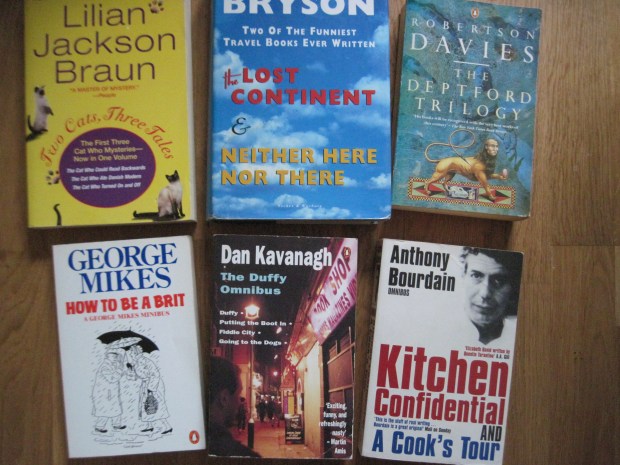
Omnibus editions: two to four books for the price of one. What could be better?
Built-in ribbon bookmarks: elegant as well as helpful. I also love how Peirene Press releases come with a matching paper bookmark for every three-book series.

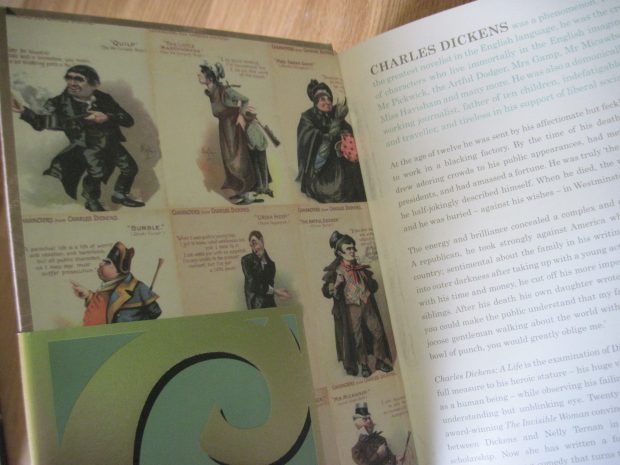
Everything about the hardback edition of Claire Tomalin’s Dickens biography is gorgeous, in fact. I especially love the vintage illustrations on the endpapers and the half-size dustjacket.
Deckle edge is one of my special loves. For the most part it’s unique to American books (over here I’ve heard it complained about as looking “unfinished”), and always makes me think nostalgically about borrowing books from the public library in my parents’ town.

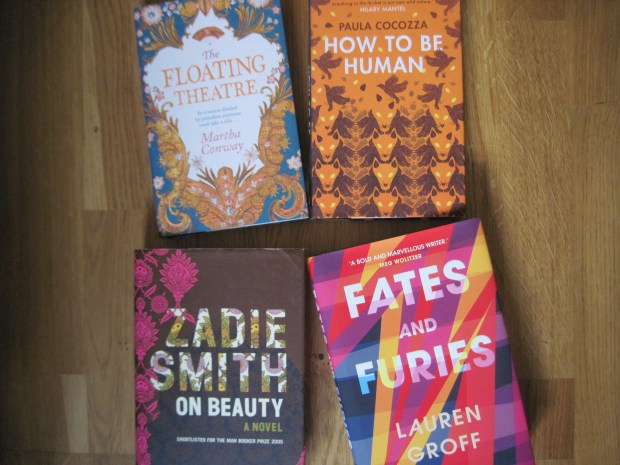
It may sound shallow, but I love these four novels almost as much for their colorful covers as for their contents. (Is it any wonder one of my favorite tags to use on Instagram is #prettycovers?) Several of these covers have raised lettering as well.
The History of Bees is one of the most attractive physical books I’ve acquired recently. The dustjacket has an embossed image; underneath it the book itself is just as striking, with a gold honeycomb pattern. There are also black-and-white bees dotted through the pages.


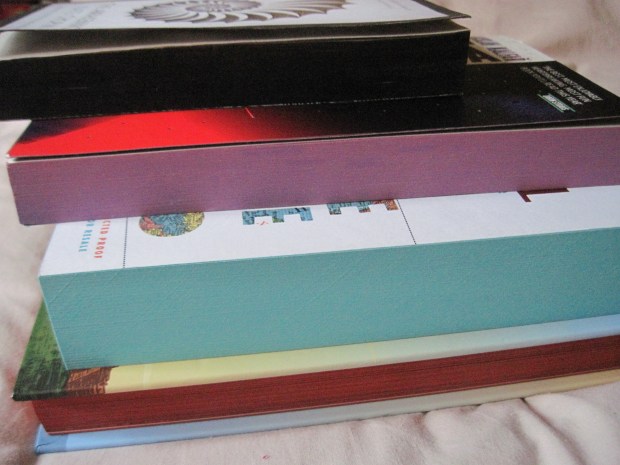
Colored text blocks (also called sprayed edges) are so unexpected and stylish.
And now for a few physical book traits I’m not as fond of. Perhaps my biggest pet peeve, impossible to photograph, is those matte covers that get permanent fingerprints on them no matter how gingerly you try to handle them.
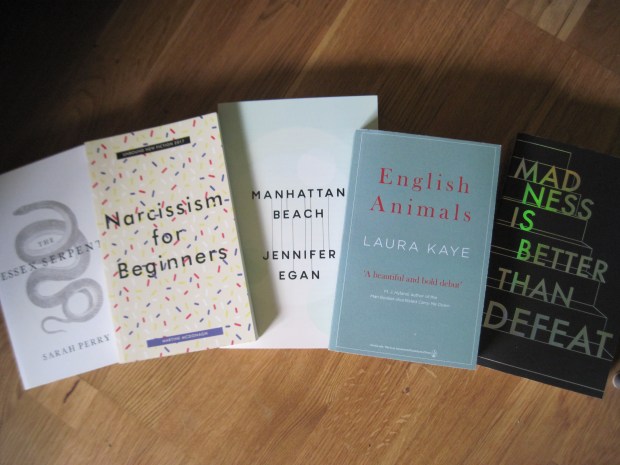
I wish proof copies didn’t often come in nondescript covers that don’t give a sense of what the finished book will look like. (No ice cream cone on Narcissism for Beginners; no leaping fox on English Animals.) However, keeping in mind that I’m lucky to be reading all these books early, I mustn’t be a greedy so-and-so.
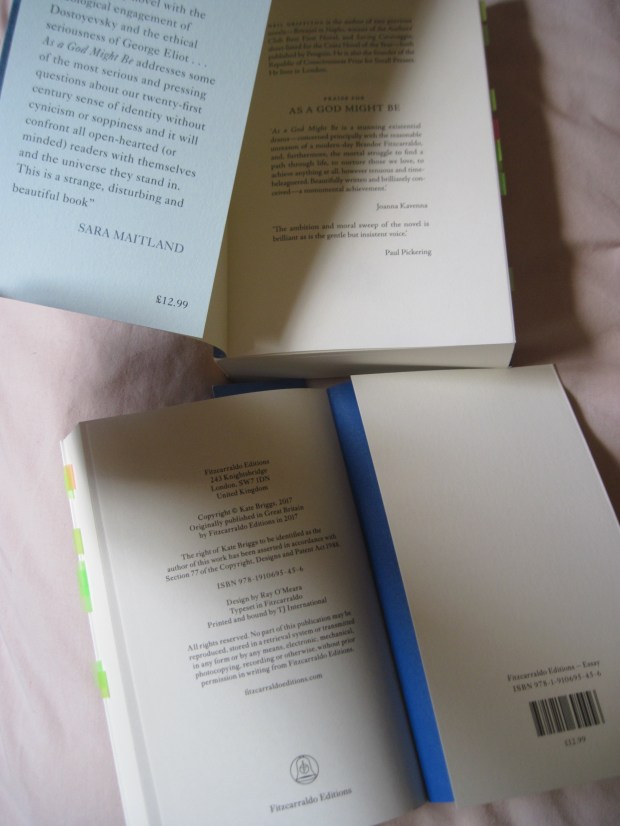
All Fitzcarraldo Editions books are paperbacks with French flaps. Another book I’m reading at the moment, As a God Might Be by Neil Griffiths (from Dodo Ink), also has French flaps. It’s not that I dislike them per se. I just wonder, what’s the point?
(See also two related posts: Books as Objects of Beauty and My (Tiny) Collection of Signed Copies.)
 Bookish Beck = Rebecca Foster. American transplant to England. Freelance proofreader and book reviewer.
 Bookish Beck