Four for #NonfictionNovember and #NovNov25: Hanff, Humphrey, Kimmerer & Steinbeck
I’ll be doubling up posts most days for the rest of this month to cram everything in!


Today I have a cosy companion story to a beloved bibliophiles’ classic, a comprehensive account of my favourite beverage, a refreshing Indigenous approach to economics, and a journalistic exposé that feels nearly as relevant now as it did 90 years ago.
Q’s Legacy by Helene Hanff (1985)
 Of course we all know and love 84, Charing Cross Road, about Hanff’s epistolary friendship with the staff of Marks & Co. Antiquarian Booksellers in London in the 1950s. This gives a bit of background to the writing and publication of that book, responds to its unexpected success, and follows up on a couple of later trips to England for the TV and stage adaptations. Hanff lived in a tiny New York City apartment and worked behind the scenes in theatre and television. Even authoring a cult classic didn’t change the facts of being a creative in one of the world’s most expensive cities: paying the bills between royalty checks was a scramble. The title is a little odd and refers to Hanff’s self-directed education after she had to leave Temple University after a year. When she stumbled on Cambridge professor Sir Arthur Quiller-Couch’s books of lectures at the library, she decided to make them the basis of her classical education. I most liked the diary from a 1970s trip to London on which she stayed in her UK publisher André Deutsch’s mother’s apartment! This is pleasant and I appreciated Hanff’s humble delight in her unexpected later-life accomplishments, but it does feel rather like a collection of scraps. I also have to wonder to what extent this repeats content from the 84 sequel, The Duchess of Bloomsbury Street. But if you’ve liked her other books, you may as well read this one, too. (Free – The Book Thing of Baltimore) [177 pages]
Gin by Shonna Milliken Humphrey (2020)
 Picking up something from the Bloomsbury Object Lessons series (or any of these other series of nonfiction books) is a splendid way to combine two challenges. Humphrey was introduced to gin at 16 when the manager of the movie theater where she worked gave her Pepsi cups of gin and grapefruit juice. Luckily, that didn’t precede any kind of misconduct and she’s been fond of gin ever since. She takes readers through the etymology of gin (from the Dutch genever; I startled the bartender by ordering a glass of neat vieux ginèvre at a bar in Brussels in September), the single necessary ingredient (juniper), the distillation process, the varieties (single- or double-distilled; Old Tom with sugar added), the different neutral spirits or grain bases that can be used (at a recent tasting I had gins made from apples and potatoes), and appearances in popular culture from William Hogarth’s preachy prints through The African Queen and James Bond to rap music. I found plenty of interesting tidbits – Samuel Pepys mentions gin (well, “strong water made of juniper,” anyway) in his diary as a constipation cure – but the writing is nothing special, I knew a lot of technical details from distillery tours, and I would have liked more exploration of the modern gin craze. “Gin is, in many ways, how I see myself: comfortable, but evolving,” Humphrey writes. “Gin has always interested a younger generation of drinker, as well as commitment from the older crowd, while maintaining a reputation among the middle aged. It is unique that way.” That checks out from my experience of tastings and the fact that it’s my mother-in-law’s tipple of choice as well. (Birthday gift from my Bookshop wish list) [134 pages]
The Serviceberry: An Economy of Gifts and Abundance by Robin Wall Kimmerer (2024)
 Serviceberries (aka saskatoons or juneberries) are Kimmerer’s chosen example of nature’s bounty, freely offered and reliable. When her farmer neighbours invite people to come and pick pails of them for nothing, they’re straying from the prevailing economic reasoning that commodifies food. Instead of focusing on the “transactional,” they’re “banking goodwill, so-called social capital.” Kimmerer would disdain the term “ecosystem services,” arguing that turning nature into a commodity has diminished people’s sense of responsibility and made them feel more justified in taking whatever they want and hoarding it. Capitalism’s reliance on scarcity (sometimes false or forced) is anathema to her; in an Indigenous gift-based economy, there is sufficient for all to share: “You can store meat in your own pantry or in the belly of your brother.” I love that she refers to Little Free Libraries and other community initiatives such as farm stands of free produce, swap shops, and online giveaway forums. I volunteer with our local Repair Café, I curate my neighbourhood Little Free Library, and I’m lucky to live in a community where people are always giving away quality items. These are all win-win situations where unwanted or broken items get a new lease on life. Save landfill space, resources, and money at the same time! Compared to Braiding Sweetgrass, this is thin (but targeted) and sometimes feels overly optimistic about human nature. I was glad I didn’t buy the bite-sized hardback with gift money last year, but I was happy to have a chance to read the book anyway. (New purchase – Kindle 99p deal) [124 pages]
The Harvest Gypsies: On the Road to The Grapes of Wrath by John Steinbeck (1936; 1988)
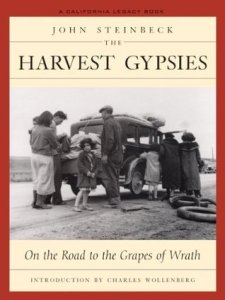 This lucky find is part of the “California Legacy” collection published by Heyday and Santa Clara University. In October 1936, Steinbeck produced a series of seven articles for The San Francisco News about the plight of Dust Bowl-era migrant workers. His star was just starting to rise but he wouldn’t achieve true fame until 1939 with the Pulitzer Prize-winning The Grapes of Wrath, which was borne out of his travels as a journalist. Some 150,000 transient workers traveled the length of California looking for temporary employment in the orchards and vegetable fields. Squatters’ camps were places of poor food and hygiene where young children often died of disease or malnutrition. Women in their thirties were worn out by annual childbirth and frequent miscarriage and baby loss. Dignity was hard to maintain without proper toilet facilities. Because workers moved around, they could not establish state residency and so had no access to healthcare or unemployment benefits. This distressing material is captured through dispassionate case studies. Steinbeck gives particular attention to the state’s poor track record for the treatment of foreign workers – Chinese, Japanese and Filipino as well as Mexican. He recounts disproportionate police brutality in response to workers’ attempts to organize. (Has anything really changed?!) In the final article, he offers solutions: the right to unionize, and blocks of subsistence farms on federal land. Charles Wollenberg’s introduction about Steinbeck and his tour guide, camp manager Tom Collins, is illuminating and Dorothea Lange’s photographs are the perfect accompaniment. Now I’m hankering to reread The Grapes of Wrath. (Secondhand – Gifted by a friend as part of a trip to Community Furniture Project, Newbury last year) [62 pages]
Check out Kris Drever’s folk song “Harvest Gypsies” (written by Boo Hewerdine) here.
Three Object Lessons Books for #NovNov24 & #NonfictionNovember (Frith, Hanna, Lobdell)
Bloomsbury’s Object Lessons series “is a series of concise, collectable, beautifully designed books about the hidden lives of ordinary things.” (I have previously reviewed Doctor, Dust, Grave, Pregnancy Test, and Recipe.) I love how interdisciplinary these short nonfiction works are, combining history and pop culture and often incorporating science or medicine, too. Here are my thoughts on three 2024 additions to the series.
 Barcode by Jordan Frith: The barcode was patented in 1952 but didn’t come into daily use until 1974. It was developed for use by supermarkets – the Universal Product Code or UPC. (These days a charity shop is the only place you might have a shopping experience that doesn’t rely on barcodes.) A grocery industry committee chose between seven designs, two of which were round. IBM’s design won and became the barcode as we know it. “Barcodes are a bit of a paradox,” Frith, a communications professor with previous books on RFID and smartphones to his name, writes. “They are ignored yet iconic. They are a prime example of the learned invisibility of infrastructure yet also a prominent symbol of cultural critique in everything from popular science fiction to tattoos.” In 1992, President Bush was considered to be out of touch when he expressed amazement at barcode scanning technology. I was most engaged with the chapter on the Bible – Evangelicals, famously, panicked that the Mark of the Beast heralded by the book of Revelation would be an obligatory barcode tattooed on every individual. While I’m not interested enough in technology to have read the whole thing, which does skew dry, I found interesting tidbits by skimming. (Public library) [152 pages]
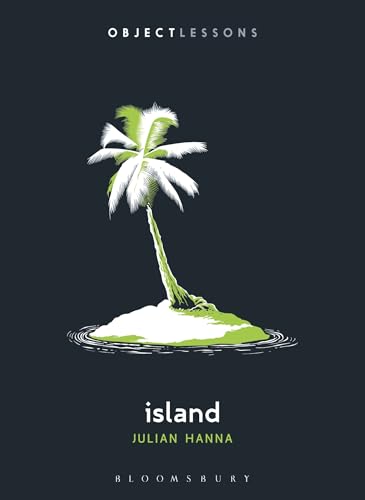 Island by Julian Hanna: The most autobiographical, loosest and least formulaic of these three, and perhaps my favourite in the series to date. Hanna grew up on Vancouver Island and has lived on Madeira; his genealogy stretches back to another island nation, Ireland. Through disparate travels he comments on islands that have long attracted expats: Hawaii, Ibiza, and Hong Kong. From sweltering Crete to the polar night, from family legend to Virginia Woolf’s To the Lighthouse, the topics are as various as the settings. Although Hanna is a humanities lecturer, he even gets involved in designing a gravity battery for Eday in the Orkneys (fully powered by renewables), having won funding through a sustainable energy prize, and is part of a team that builds one in situ there in three days. I admired the honest exploration of the positives and negatives of islands. An island can promise paradise, a time out of time, “a refuge for eccentrics.” Equally, it can be a site of isolation, of “domination and exploitation of fellow humans and of nature.” We may think that with the Internet the world has gotten smaller, but islands are still bastions of distinct culture. In an era of climate crisis, though, some will literally cease to exist. Written primarily during the Covid years, the book contrasts the often personal realities of death, grief and loneliness with idyllic desert-island visions. Whimsically, Hanna presents each chapter as a message in a bottle. What a different book this would have been if written by, say, a geographer. (Read via Edelweiss) [180 pages]
 X-Ray by Nicole Lobdell: X-ray technology has been with us since 1895, when it was developed by German physicist Wilhelm Roentgen. He received the first Nobel Prize in physics but never made any money off of his discovery and died in penury of a cancer that likely resulted from his work. From the start, X-rays provoked concerns about voyeurism. People were right to be wary of X-rays in those early days, but radiation was more of a danger than the invasion of privacy. Lobdell, an English professor, tends to draw slightly simplistic metaphorical messages about the secrets of the body. But X-rays make so many fascinating cultural appearances that I could forgive the occasional lack of subtlety. There’s an in-depth discussion of H.G. Wells’s The Invisible Man, and Superman was only one of the comic-book heroes to boast X-ray vision. The technology has been used to measure feet for shoes, reveal the hidden history of paintings, and keep air travellers safe. I went in for a hospital X-ray of my foot not long after reading this. It was such a quick and simple process, as you’ll find at the dentist’s office as well, and safe enough that my radiographer was pregnant. (Read via Edelweiss) [152 pages]

Short Nonfiction Series for Novellas in November + Nonfiction November
Most Novellas in November participants focus on fiction, which is understandable and totally fine; I also like to incorporate works of short nonfiction during the month, which is a great opportunity to combine challenges with Nonfiction November.
Building on this list I wrote in 2021 (all the recommendations stand, but I’d update it by adding Weatherglass Books to the list of UK publishers), here are some nonfiction series that publish brief, intriguing works:
404 Ink’s Inklings series bears the tagline “big ideas to carry in your pocket.”
 I have reviewed Happy Death Club.
Biteback Publishing’s Provocations series “is a groundbreaking new series of short polemics composed by some of the most intriguing voices in contemporary culture.”
- I have reviewed Last Rights. I spied a pair of books by John Sutherland on youth and ageing at my library.

Bloomsbury’s Object Lessons series “is a series of concise, collectable, beautifully designed books about the hidden lives of ordinary things.”
- I have reviewed Doctor, Dust, Grave, Pregnancy Test, and Recipe.
Bloomsbury’s 33 1/3 is “a series of short books about popular music.”
- I have reviewed Jesus Freak.
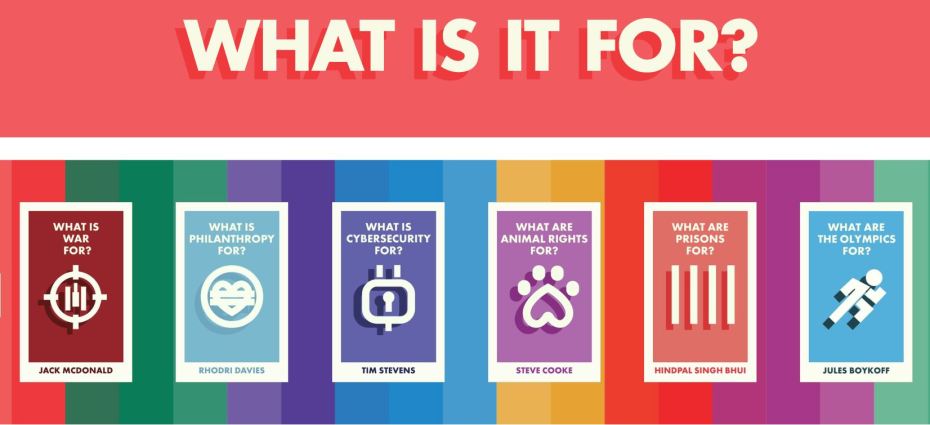
Bristol University Press’s What Is It For series is edited by George Miller, creator of the OUP Very Short Introductions (see below). Miller believes “short, affordable books can, and should, be intelligent and thought-provoking”; he hopes these will “be an agent for positive change,” addressing “tough questions about purpose and fitness for purpose: what has to change for the future to be better?”
A number of Fitzcarraldo Editions’ Essays are significantly under 200 pages.
 I have reviewed Intervals, A Very Easy Death, Happening, I Remain in Darkness, A Woman’s Story, and Alphabetical Diaries (plus others that are longer).
[Edited:] Thanks so much to Liz for letting me know about Jacaranda Books’ A Quick Ting On series, “the first ever non-fiction book series dedicated to Black British culture,” with books on plantains, Grime music, Black hair, and more.
[Edited:] There are three books so far in the Leaping Hare Press Find Your Path self-help series. I have just downloaded Find Your Path through Imposter Syndrome from Edelweiss.
Little Toller Books publishes mostly short nature and travel monographs and reprints.
- I have reviewed Deer Island, Aurochs and Auks, Orison for a Curlew, Herbaceous, The Ash Tree, and Snow.

From the Little Toller website
[Edited:] Thanks so much to Annabel for making me aware of Melville House’s The FUTURES series, which gives “imaginative future visions on a wide range of subjects, written by experts, academics, journalists and leading pop-culture figures.”
MIT Press’s Essential Knowledge series “offers accessible, concise, beautifully produced books on topics of current interest.” I spotted the Plastics book at my library.
Oxford University Press’s Very Short Introductions now cover a whopping 867 subjects!
- I had a couple of them assigned in my college days, including Judaism.
Penguin’s 100-book Great Ideas series reprints essays that introduce readers to “history’s most important and game-changing theories, philosophies and discoveries in accessible, concise editions.”
A number of Profile’s health-themed Wellcome Collection Books are well under 200 pages.
- I have reviewed Recovery, Free for All, Chasing the Sun, An Extra Pair of Hands, and After the Storm (plus others that are longer).


Saraband’s In the Moment series contains “portable, accessible books … exploring the role of both mind and body in movement, purpose, and reflection, finding ways of being fully present in our activities and environment.”
- I’m interested in Writing Landscape by Linda Cracknell and On Community by Casey Plett.
 Most of the original School of Life books are around 150 pages long. Their newer Essential Ideas series of three titles also promises “pocket books.”
- I have reviewed How to Develop Emotional Health, How to Age, How to Be Alone, and How to Think about Exercise.
Why not see if your local library has any selections from one or more of these series? #LoveYourLibrary

If you’re a reluctant nonfiction reader, choosing a short book could be a great way to engage with a topic that interests you – without a major time commitment. #NonfictionNovember
Keep in touch via X (@bookishbeck / @cathy746books) and Instagram (@bookishbeck / @cathy_746books). Add any related posts to the link-up. Don’t forget the hashtag #NovNov24.
Any suitable short nonfiction on your shelves?
Preposterous #NovNov23 Catch-Up Post
I have a big pile of novellas I read last month but never wrote about, plus a few more I’ve sneaked in by finishing them over the past couple of days. I tweaked my shoulder last weekend and the discomfort has moved into my neck, making daily life, and sleep, difficult. A taste of what it’s like to live with chronic pain, I suppose. Add in the freezing temperatures of recent days and I’ve been feeling pretty sorry for myself and haven’t succeeded in sitting at a computer for the time required to write at least a bit about these short books. But as today is the day our link-up finishes, I’m tucked up in bed with laptop, electric blanket, heater, cat, cup of tea and ice pack, ready to do all 16 the best justice I can through a paragraph each.
Fiction:
In the Sweep of the Bay by Cath Barton (2020)
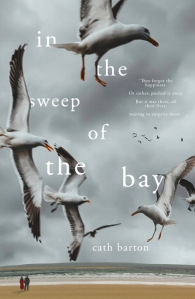 Susan put this on my radar and I bought it in publisher Louise Walters Books’ closing-down sale. Set in Morecambe, this bittersweet story of a half-century marriage and the figures on its margins – co-workers, children, even strangers – is both ambitious and intimate. Ted and Rene Marshall marry in the 1950s and soon drift into drudgery and traditional gender roles; “They forgot the happiness. Or rather, they pushed it away.” While Ted becomes a celebrated ceramics designer in the family company, Rene stagnates at home. It is not so much suspected infidelity as simply taking each other for granted that threatens their relationship. Barton moves through the decades and varies the perspective, letting us hear from one of the Marshalls’ daughters and giving kind attention to a gay couple. Strictly Come Dancing fans and those familiar with the northwest might take particular pleasure, but I enjoyed this quiet book reminiscent of Anne Tyler’s French Braid and (though less political) Jonathan Coe’s Bournville. (New purchase) [104 pages]
The Visitor by Maeve Brennan (2000)
 This posthumous novella was written in the 1940s but never published in Brennan’s lifetime. From Dublin, she was a longtime New Yorker staff member and wrote acclaimed short stories. After her mother’s death, Anastasia King travels from Paris, where the two set up residence after leaving her father, to Ireland to stay in the family home with her grandmother. Anastasia considers it a return, a homecoming, but her spiteful grandmother makes it clear that she is an unwelcome interloper. Mrs King can’t forgive the wrong done to her son, and so won’t countenance Anastasia’s plan to repatriate her mother’s remains. Rejection and despair eat away at Anastasia’s mental health (“She saw the miserable gate of her defeat already open ahead. There only remained for her to come up to it and pass through it and be done with it”) but she pulls herself together for an act of defiance. Most affecting for me was a scene in which we learn that Anastasia is so absorbed in her own drama that she does not fulfill the simple last wish of a dying friend. This brought to mind James Joyce’s The Dead. (Secondhand purchase – The Bookshop, Wigtown) [81 pages]
Bear by Marian Engel (1976)
 If you’ve heard of this, it’ll be for the fact that the main character – Lou, a librarian sent to archive the holdings of an octagonal house on an island one summer – has sex with a bear. That makes it sound much more repulsive and/or titillating than it actually is. The further I read the more I started to think of it as an allegory for women’s awakening; perhaps the strategy inspired Melissa Broder’s The Pisces (stuffed full of sex with a merman). “I have an odd sense of being reborn,” Lou writes to her boss, the Institute director, with whom she’d been having an affair. The bear lives in an outbuilding and at first Lou is indifferent, only feeding him as necessary. Then he becomes a friend, joining her for swims. Then he comes into the house. Bestiality is a taboo for a reason, but what mostly bothers me is the lack of mutuality, the sense of taking advantage. I’m also wary of stories in which animals have a primarily instrumental or metaphorical role. Still, this was a solid read, offbeat and nearly as shocking today as when it first appeared. (Secondhand purchase online) [167 pages]
So Late in the Day by Claire Keegan (2023)
 Several of us reviewed this for #NovNov though unsure it counts: in the UK the title story (originally for the New Yorker) was published in a standalone volume by Faber, while the U.S. release includes two additional earlier stories; I read the latter. The title story has Cathal spending what should have been his wedding weekend moping about Sabine calling off their engagement at the last minute. It’s no mystery why she did: his misogyny, though not overt, runs deep, most evident in the terms in which he thinks about women. And where did he learn it? From his father. (“The Long and Painful Death” is from Keegan’s second collection, Walk the Blue Fields, and concerns a woman on a writing residency at an author’s historic house in Ireland. She makes a stand for her own work by refusing to cede place to an entitled male scholar. The final story is “Antarctica,” the lead story in that 1999 volume and a really terrific one I’d already experienced before. It’s as dark and surprising as an early Ian McEwan novel.) Keegan proves, as ever, to be a master at portraying emotions and relationships, but the one story is admittedly slight on its own, and its point obvious. (Read via Edelweiss) [64 pages]
Swallowing Geography by Deborah Levy (1993)
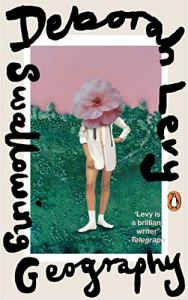 “She is Europe’s eerie child, and she is part of the storm.” J.K. is a young woman who totes her typewriter around different European locations, sleeps with various boyfriends, hears strangers’ stories, and so on. Many of the people she meets are only designated by an initial. By contrast, the most fully realized character is her mother, Lillian Strauss. The chapters feel unconnected and the encounters within them random, building to nothing. Though a bit like Crudo, this has very little detail to latch onto and so was pretentious in its opacity. I’ve generally gotten on much better with Levy’s nonfiction (see below) than her fiction. This, along with the Keegan (above), was my chosen train entertainment for the Booker Prize evening. I got so little out of it that it seemed like wasted reading time. Here’s a decent excerpted passage: “The arrogance of metaphor when facts save people’s lives. The succour of metaphor when facts inadequately describe people’s lives.” (Public library) [83 pages]
Nonfiction:
Starting with two from the Bloomsbury Object Lessons series, a great source of short monographs. These have been among my favourites so far.
Grave by Allison C. Meier (2023)
 Meier is a cemetery tour guide in Brooklyn, where she lives. She surveys American burial customs in particular, noting the lack of respect for Black and Native American burial grounds, the Civil War-era history of embalming, the increasing popularity of cremation, and the rise of garden cemeteries such as Mount Auburn in Cambridge, Massachusetts, which can serve as wildlife havens. The mass casualties and fear of infection associated with Covid-19 brought back memories of the AIDS epidemic, especially for those in New York City. Meier travels to a wide range of resting places, from potter’s fields for unclaimed bodies to the most manicured cemeteries. She also talks about newer options such as green burial, body composting, and the many memorial objects ashes can be turned into. I’m a dedicated reader of books about death and so found this fascinating, with the perfect respectful and just-shy-of-melancholy tone. It’s political and philosophical in equal measures. (Read via NetGalley) [168 pages]
Pregnancy Test by Karen Weingarten (2023)
 Laboratory pregnancy tests have been available since the 1930s and home pregnancy tests – the focus here – since the 1970s. All of them work by testing urine for the hormone hCG (human chorionic gonadotropin). What is truly wild is that pregnancy used to be verifiable only with laboratory animals – female mice and rabbits had to be sacrificed to see if their ovaries had swelled after the injection of a woman’s urine; later, female Xenopus toads were found to lay eggs in response, so didn’t need to be killed. Home pregnancy kits were controversial and available in Canada before the USA because it was thought that they could be unreliable or that they would encourage early abortions. Weingarten brings together the history, laypeople-friendly science, and cultural representations (taking a pregnancy test is excellent TV shorthand) in a readable narrative and makes a clear feminist statement: “the home pregnancy test gave back to women what should have always been theirs: first-hand knowledge about how their bodies worked” and thus “had the potential to upend a paternalistic culture.” (Read via NetGalley) [160 pages]
And from a different Bloomsbury series for monographs about seminal albums, 33 1/3:
Jesus Freak by Will Stockton and D. Gilson (2019)
 The dc Talk album Jesus Freak (1995) is the first CD I ever owned. My best friend and I listened to it (along with Bloom by Audio Adrenaline and Take Me to Your Leader by Newsboys) so many times that we knew every word and note by heart. So it’s hard for me to be objective rather than nostalgic; I was intrigued to see what two secular academics would have to say. Crucially, they were teenage dc Talk fans, now ex-Evangelicals and homosexual partners. As English professors, their approach is to spot musical influences (Nirvana on the title track; R&B and gospel elsewhere), critically analyse lyrics (with “Colored People” proving problematic for its “neoliberal multiculturalism and its potential for post-racial utopianism”), and put a queer spin on things. For those who don’t know, dc Talk were essentially a boy band with three singers, one Black and two white – one of these a rapper. Stockton and Gilson chronicle the confusion of living with a same-sex attraction they couldn’t express as teens, and cheekily suggest there may have been something going on between dc Talk members Toby McKeehan and Michael Tait, who were roommates at Liberty University and apparently dismantled their bunk beds so they could sleep side by side. Hmmm! I was interested enough in the subject matter to overlook the humanities jargon. (Birthday gift from my wish list last year) [132 pages]
And the rest:
Fifty Days of Solitude by Doris Grumbach (1994)
 Grumbach died last year at age 104. This was my third of her books; I read two previous memoirs, Extra Innings and The Presence of Absence, when they were brought back into print as Open Road Media e-books. I knew of Grumbach through her association with May Sarton, and the two in fact had a lot in common, including lesbianism, living in Maine and writing about older age. I was expecting something on a par with Sarton’s Journal of a Solitude, one of my favourite books, but this fell short in comparison. Grumbach spent a month and a half alone in Maine during the winter of 1993 while her partner, Sybil, was away amassing stock for their bookstore. The book is a collection of unconnected meditations about nature, the cold, creativity and so on. She finds herself writing fiction so the characters can keep her company, and notes “how much more I was aware of my vices.” Although she tries to avoid the news, word reaches her of acquaintances’ demises, and she recalls the recent death from AIDS of a young local man. Amusingly, she rereads Bear (see above) during the 50 days. Some atmosphere, but low on insight. (Secondhand purchase – Wonder Book and Video, Hagerstown) [114 pages]
Things I Don’t Want to Know: On Writing by Deborah Levy (2013)
 It feels like I made an error by reading Levy’s “Living Autobiography,” out of order. I picked up the middle volume of the trilogy, The Cost of Living, for #NovNov in 2021 and it ended up being my favourite nonfiction read of that year. I then read part of the third book, Real Estate, last year but set it aside. And now I’ve read the first because it was the shortest. It’s loosely structured around George Orwell’s four reasons for writing: political purpose, historical impulse, sheer egoism and aesthetic enthusiasm. The frame story has her flying to Majorca at a time when she was struggling with her mental health. She vaguely follows in the footsteps of George Sand and then pauses to tell a Chinese shopkeeper the story of her upbringing in apartheid-era South Africa and the family’s move to London. Although I generally admire recreations of childhood and there are some strong pen portraits of minor characters, overall there was little that captivated me here and I was too aware of the writerly shaping. (Secondhand purchase – 2nd & Charles, Hagerstown) [111 pages]
The Private Life of the Hare by John Lewis-Stempel (2019)
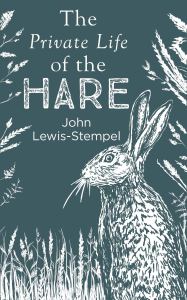 I reviewed a couple of JLS’s species-specific monographs for #NovNov in 2018: The Secret Life of the Owl and The Glorious Life of the Oak. There’s a similar range of material here: anatomy, natural history and cultural significance, including in poetry. There are chapters on hunting, the hare as food, and its appearances in myth and religion. I was engaged about half of the time; I tended to skip over longer excerpts from historical documents. The reliance on lengthy quotations and use of bullet points make it feel like a half-finished research project, with the kind of information you could find anywhere else. Too many of his recent books have felt like they were rushed into print. I would only pick this up if you’re particularly fascinated by hares. (Public library) [99 pages]
The Cancer Journals by Audre Lorde (1980)
 I’ve read so many cancer stories that it takes a lot to make one stand out. This feels like a random collection of documents rather than a coherent memoir. One of the three essays was originally a speech, and two were previously printed in another of her books. Lorde was diagnosed with breast cancer in 1978 and had a mastectomy. A Black lesbian feminist, she resisted wearing prostheses and spoke up about the potential environmental causes of breast cancer that need to be addressed in research (“I may be a casualty in the cosmic war against radiation, animal fat, air pollution, McDonald’s hamburgers and Red Dye No. 2”). Her actual journal entries make up little of the text, which is for the best because fear and pain can bring out the cliches in us – but occasionally a great quote like “if bitterness were a whetstone, I could be sharp as grief.” Another favourite line: “Pain does not mellow you, nor does it ennoble, in my experience.” I’m keen to read her memoir Zami. (University library) [77 pages]
A Month in Siena by Hisham Matar (2019)
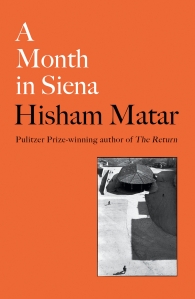 I’d not read Matar before I spotted this art book-cum-memoir and thought, why not. A Libyan American novelist who lives in London, Matar had long been fascinated by the Sienese School of painting (13th to 15th centuries), many of whose artists depicted biblical scenes or religious allegories – even though he’s not a Christian. He spent a month in Italy immersed in the art he loves; there are 15 colour reproductions here. His explications of art history are generalist enough to be accessible to all readers, but I engaged more with the glimpses into his own life. For instance, he meets a fellow Arabic speaker and they quickly form a brotherly attachment, and a Paradise scene gives him fanciful hope of being reunited with his missing father – the subject of his Folio Prize-winning memoir The Return, which I’d like to read soon. His prose is beautiful as he reflects on history, death and how memories occupy ‘rooms’ in the imagination. A little more interest in the art would have helped, though. (Little Free Library) [118 pages]
A Childhood in Scotland by Christian Miller (1981)
 I had high hopes for this childhood memoir that originally appeared in the New Yorker and was reprinted as part of the Canongate Classics series. But I soon resorted to skimming as her recollections of her shabby upper-class upbringing in a Highlands castle are full of page after page of description and dull recounting of events, with few scenes and little dialogue. This would be of high historical value for someone wanting to understand daily life for a certain fraction of society at the time, however. When Miller’s father died, she was only 10 and they had to leave the castle. I was intrigued to learn from her bio that she lived in Newbury for a time. (Secondhand purchase – Barter Books) [98 pages]
Here and Now: Living in the Spirit by Henri J.M. Nouwen (1994)
 This collection of micro-essays under themed headings like “Living in the Present” and “Suffering” was a perfect introduction to Nouwen’s life and theology. The Dutch Catholic priest lived in an Ontario community serving the physically and mentally disabled, and died of a heart attack just two years after this was published. I marked out many reassuring or thought-provoking passages. Here’s a good pre-Christmas one:
“God became a little child in the midst of a violent world. Are we surprised by joy or do we keep saying: ‘How nice and sweet, but the reality is different.’ What if the child reveals to us what is really real?”
I was taken by the ideas that the life of compassion is one of “downward mobility” and that inner freedom only comes when you don’t judge anyone. He encourages readers to not live in a past of shame and regret, but to be grateful for opportunities for God’s mercy and guidance. Very peaceful and readable; a good bedside devotional book. (Free from my stepfather) [175 pages] 
De Profundis by Oscar Wilde (1897)
 My only reread for the month. Wilde wrote this from prison. No doubt he had a miserable time there, but keeping in mind that he was a flamboyant dramatist and had an eye to this being published someday, this time around I found it more exaggerated and self-pitying than I had before. “Suffering is one very long moment. … Where there is sorrow there is holy ground,” he writes, stating that he has found “harmony with the wounded, broken, and great heart of the world.” He says he’s not going to try to defend his behaviour … but what is this but one extended apologia and humble brag, likening himself to a Greek tragic hero (“The gods had given me almost everything. But I let myself be lured into long spells of senseless and sensual ease. I amused myself with being a flâneur, a dandy, a man of fashion”) and even to Christ in his individuality as well as in his suffering at the hands of those who don’t understand him (the scene where he was pilloried consciously mimics a crucifixion tableau). As a literary document, it’s extraordinary, but I didn’t buy his sincerity. He feigns remorse but, really, wasn’t sorry about anything, merely sorry he got caught. (Free from a neighbour) [151 pages]
Original rating (2011):
Rating now:
Average:
Which of these have you read?
And which do you want to read? (You may choose no more than 4!)
In total, I read 27 novellas this November – close to my 2021 record of 29. The highlights included the Barton, Meier, Nouwen and Weingarten above plus Train Dreams by Denis Johnson and Western Lane by Chetna Maroo, but the best of the lot was Absolutely and Forever by Rose Tremain.
Coming right up, final statistics on the month’s participants and posts!
10 Days in the USA and What I Read (Plus a Book Haul)
On October 29th, I went to an evening drinks party at a neighbour’s house around the corner. A friend asked me about whether the UK or the USA is “home” and I replied that the States feels less and less like home every time I go, that the culture and politics are ever more foreign to me and the UK’s more progressive society is where I belong. I even made an offhand comment to the effect of: once my mother passed, I didn’t think I’d fly back there often, if at all. I was thinking about 5–10 years into the future; instead, a few hours after I got home from the party, we were awoken by the middle-of-the-night phone call saying my mother had suffered a nonrecoverable brain bleed. The next day she was gone.
I haven’t reflected a lot on the irony of that timing, probably because it feels like too much, but it turns out I was completely wrong: in fact, I’m now returning to the States more often. With our mom gone and our dad not really in our lives, my sister and I have gotten closer. Since October I’ve flown back twice and she’s visited here once. There are 7.5 years between us and we’ve always been at different stages of life, with separate preoccupations and priorities; I was also lazy and let my mom be the go-between, passing family news back and forth. Now there’s a sense that we are all we have, and we have to stick together.


So it was doubly important for me to be there for my sister’s graduation from nursing school last week. If we follow each other on Facebook or Instagram, you will have already seen that she finished at the top of her cohort and was one of just two students recognized for academic excellence out of the college’s over 200 graduates – and all of this while raising four children and coping with the disruption of Mom’s death seven months ago. There were many times when she thought she would have to pause or give up her studies, but she persisted and will start work as a hospice nurse soon. We’re all as proud as could be, on our mom’s behalf, too.
The trip was a mixture of celebratory moments and sad duties. We started the process of going through our mom’s belongings and culling what we can, but the files, photos and mementoes are the real challenge and had to wait for another time. There were dozens of books I’d given her for birthdays and holidays, mostly by her favourite gentle writers – Gerald Durrell, Jan Karon, Gervase Phinn – invariably annotated with her name, the date and occasion. I looked back through them and then let them go.


Between my two suitcases I managed to bring back the rest of her first box of journals (there are 150 of them in total, spanning 1989 to 2022), and I’m halfway through #4 at the moment. We moved out of my first home when I was nine, and I don’t have a lot of vivid memories of those early years. But as I read her record of everyday life it’s like I’m right back in those rooms. I get new glimpses of myself, my dad, my sister, but especially of her – not as my mother, but as a whole person. As a child I never realized she was depressed: distressed about her job situation, worried over conflicts with her siblings and my sister, coping with ill health (she was later diagnosed with fibromyalgia) and resisting ageing. For as strong as her Christian faith was, she was really struggling in ways I couldn’t appreciate then.

I hope that later journals will introduce hindsight, now that she’s not around to give a more circumspect view. In any case, they’re an incredible legacy, a chance for me to relive much of my life that I otherwise would only remember in fragments through photographs, and perhaps have a preview of what I can expect from the course of our shared kidney disease.
What I Read
 The Housekeepers by Alex Hay – A historical heist novel with shades of Downton Abbey, this comes out in July. Reviewed for Shelf Awareness.

Cowboys Are My Weakness by Pam Houston – Terrific: stark, sexy stories about women who live out West and love cowboys and hunters (as well as dogs and horses). Ten of the stories are in the first person, voiced by women in their twenties and thirties who are looking for romance and adventure and anxiously pondering motherhood (“by the time you get to be thirty, freedom has circled back on itself to mean something totally different from what it did at twenty-one”). The remaining two are in the second person, which I always enjoy. The occasional Montana setting reminded me of stories I’ve read by Maile Meloy and Maggie Shipstead, while the relationship studies made me think of Amy Bloom’s work. 

The Harpy by Megan Hunter – Read for Literary Wives club. Review coming up on Monday.

The Lake Shore Limited by Sue Miller – A solid set of narratives alternating between the POVs of four characters whose lives converge around a play inspired by the playwright’s loss of her boyfriend on one of the hijacked planes on 9/11. Her mixed feelings about him towards the end of his life and about being shackled to his legacy as his ‘widow’ reverberate in other sections: one about the lead actor, whose wife has ALS; and one about a widower the playwright is being set up with on a date. Fitting for a book about a play, the scenes feel very visual. A little underpowered, but subtlety is to be expected from a Miller novel. She, Anne Tyler and Elizabeth Berg write easy reads with substance, just the kind of book I want to take on an airplane, as indeed I did with this one. I read the first 2/3 on my travel day (although with the 9/11 theme this maybe wasn’t the best choice!).
 For apposite plane reading, I also started Fly Girl by Ann Hood, her memoir of being a TWA flight attendant in the 1970s, the waning glory days of air travel. I’ve read 10 or so of Hood’s books before from various genres, but lost interest in the minutiae of her job applications and interviews. Another writer would probably have made a bigger deal of the inherent sexism of the profession, too. I read 30%.
 Hello Beautiful by Ann Napolitano – I knew I wanted to read this even before it was Oprah’s 100th book club pick. It’s a family story spanning three decades and focusing on the Padavanos, a working-class Italian American Chicago clan with four daughters: Julia, Sylvie, and twins Cecilia and Emeline. Julia meets melancholy basketball player William Waters while at Northwestern in the late 1970s and they marry and have a daughter; Sylvie, a budding librarian, makes out with boys in the stacks until her great romance comes along; Cecilia is an artist and Emeline loves babies and manages a nursery. More than once a character think of their collective story as a “soap opera,” and there’s plenty of melodrama here – an out-of-wedlock pregnancy, estrangements, a suicide attempt, a coming out, stealing another’s man – as well as far-fetched coincidences, including the two major deaths falling on the same day as a birth and a reconciliation.
There is such warmth and intensity to the telling, and brave reckoning with mental illness, prejudice and trauma, that I excused flaws such as dwelling overly much in characters’ heads through close third person narration, to the detriment of scenes and dialogue. I love sister stories in general, and the subtle echoes of Leaves of Grass and Little Women (the connections aren’t one to one and you’re kept guessing for most of the book who will be the Beth) add heft. I especially appreciated how a late parent is still remembered in daily life after 30 years have passed. This is, believe it or not, the second basketball novel I’ve loved this year, after Tell the Rest by Lucy Jane Bledsoe.
I always try to choose thematically appropriate reads, so I also started:
 Circling My Mother by Mary Gordon – A memoir she began after her nonagenarian mother’s death with dementia. Intriguingly, the structure is not chronological but topic by topic, built around key relationships: so far I’ve read “My Mother and Her Bosses” and “My Mother: Words and Music.”
Grave by Allison C. Meier – My sister and I made a day trip up to my mother’s grave for the first time since her burial. She has a beautiful spot in a rural cemetery dating back to the 1780s, but it’s in full sun and very dry, so we tried to cheer up the dusty plot with some extra topsoil and grass seed, marigolds, and a butterfly flag.


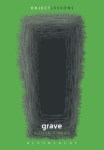 Meier is a cemetery tour guide in Brooklyn, where she lives. In the third of the e-book I’ve read so far, she looks at American burial customs, the lack of respect for Black and Native American burial sites, and the rise of garden cemeteries such as Mount Auburn in Cambridge, Massachusetts. I’ve been reading death-themed books for over a decade and have delighted in exploring cemeteries (including Mount Auburn, as part of my New England honeymoon) for even longer, so this is right up my street and one of the better Object Lessons monographs.
What I Bought
I traded in most of my mother’s books at 2nd & Charles and Wonder Book and Video but, no surprise, promptly spent the store credit on more secondhand books. Thanks to clearance shelves at both stores, I only had to chip in another $12.25 for the below haul, which also covered two Dollar Tree purchases (I felt bad for Susan Minot having signed editions end up remaindered!). Some tried and true authors here, as well as novelties to test out, with a bunch of short stories and novellas to read later in the year.


Two for #NovNov22 and #NonFicNov: Recipe and Shameless
Contrary to my usual habit of leaving new books on the shelf for years before actually reading them, these two are ones I just got as birthday gifts last month. They were great choices from my wish list from my best friend and reflect our mutual interests (foodie lit) and experiences (ex-Evangelicals raised in the Church).
Recipe by Lynn Z. Bloom (2022)
This is part of the Bloomsbury Object Lessons series of short nonfiction works (I’ve only read a few of the other releases, but I’d also recommend Fat by Hanne Blank). Bloom, an esteemed academic based in Connecticut, envisions a recipe as being like a jazz piece: it arises from a clear tradition, yet offers a lot of scope for creativity and improvisation.
A recipe is a paradoxical construct, a set of directions that specify precision but—baking excepted—anticipate latitude. A recipe is an introduction to the logic of a dish, a scaffold bringing order to the often casual process of making it.
A recipe supplies the bridge between hope and fulfilment, for a recipe offers innumerable opportunities to review, revise, adapt, and improve, to make the dish the cook’s and eater’s own.
 She considers the typical recipe template, the spread of international dishes, how particular chefs incorporate stories in their cookbooks, and the role that food plays in celebrations. To illustrate her points, she traces patterns via various go-to recipes: for chicken noodle soup, crepes, green salad, mac and cheese, porridge, and melting-middle chocolate pots.
I most enjoyed the sections on comfort food (“a platterful of stability in a turbulent, ever-changing world beset by traumas and tribulations”) and Thanksgiving – coming up on Thursday for Americans. Best piece of trivia: in 1909, President Taft, known for being a big guy, served a 26-pound opossum as well as a 30-pound turkey for the White House holiday dinner. (Who knew possums came that big?!)
Bloom also has a social conscience: in Chapters 5 and 6, she writes about the issues of food insecurity, and child labour in the chocolate production process. As important as these are to draw attention to, it did feel like these sections take away from the main focus of the book. Recipe also feels like it was hurriedly put together – with more typos than I’m used to seeing in a published work. Still, it was an engaging read. [136 pages]
Shameless: A Sexual Reformation by Nadia Bolz-Weber (2019)
“Shame is the lie someone told you about yourself.” ~Anaïs Nin
Bolz-Weber, founding Lutheran pastor of House for All Sinners and Saints in Denver, Colorado, was a mainstay on the speaker programme at Greenbelt Festival in the years I attended. Her main arguments here: people matter more than doctrines, sex (like alcohol, food, work, and anything else that can become the object of addiction) is morally neutral, and Evangelical/Religious Right teachings on sexuality are not biblical.
 She believes that purity culture – familiar to any Church kid of my era – did a whole generation a disservice; that teaching young people to view sex as amazing-but-deadly unless you’re a) cis-het and b) married led instead to “a culture of secrecy, hypocrisy, and double standards.”
Purity most often leads to pride or to despair, not to holiness. … Holiness happens when we are integrated as physical, spiritual, sexual, emotional, and political beings.
A number of chapters are built around anecdotes about her parishioners, many of them queer or trans, and about her own life. “The Rocking Chair” is an excellent essay about her experience of pregnancy and parenthood, which includes having an abortion at age 24 before later becoming a mother of two. She knows she would have loved that baby, yet she doesn’t regret her choice at all. She was not ready.
This chapter is followed by an explanation of how abortion became the issue for the political right wing in the USA. Spoiler alert: it had nothing to do with morality; it was all about increasing the voter base. In most Judeo-Christian theology prior to the 1970s, by contrast, it was believed that life started with breath (i.e., at birth, rather than at conception, as the pro-life lobby contends). In other between-chapter asides, she retells the Creation story and proffers an alternative to the Nashville Statement on marriage and gender roles.
Bolz-Weber is a real badass, but it’s not just bravado: she has the scriptures to back it all up. This was a beautiful and freeing book. [198 pages]

 Bookish Beck = Rebecca Foster. American transplant to England. Freelance proofreader and book reviewer.
 Bookish Beck