March Releases by Emily Haworth-Booth, Roz Morris, Catherine Redford & Joann Sfar
Autofiction about beloved animals and ambivalence over motherhood, a witty memoir of house-hunting in the South of England, a poetry collection reflecting on bereavement and queer parenthood, and a graphic novel adaptation of a 20th-century classic: I had a real variety this month.
Mare by Emily Haworth-Booth
Is the entire novel built around a pun? The French for mother, mère, is a homophone for mare. Like Motherhood by Sheila Heti, this is a work of autofiction that circles the question of becoming a mother and posits the writing life and other relationships as partial substitutes for parenthood. But yes, there is also a literal horse. The narrator lives in London with her husband and scrapes together a living by teaching creative writing on Zoom and writing children’s books. They’ve recently lost their dearly loved dog and are friendly with the neighbours whose garden they share and whose noise they hear the other side of a wall – so much so that she thinks of the two girls as “not-my-daughter” and “also-not-my-daughter.” The narrator is contracted to write a book about plastics for children but can’t seem to land on the right tone somewhere between alarm and false cheer. Approaching age 40, she’s finally coming to terms with the fact that she won’t be a mother due to premature ovarian failure.
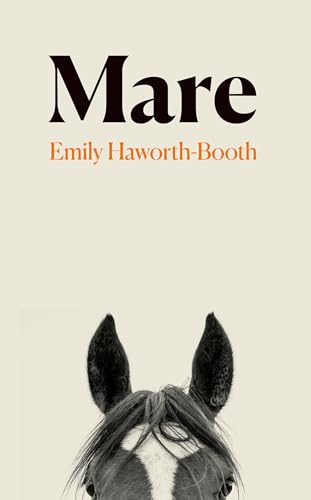 Into all this comes the love of a horse. She finds a stable two miles away and spends three days a week there riding and tending to a black and white mare. As a child she’d been horse-crazy, so this isn’t “a new feeling … but a resurgence. Deeply familiar. Lust and tenderness and hope mingled.” Time with the horse reminds her to be present, to live in her body despite its flaws, to take joy in the everyday. “Being with the horse has come to feel more and more like an exercise in metaphor.”
Haworth-Booth makes caring for an animal analogous with motherhood, but doesn’t stop at easy symbolism. The mare might stand in for female fear and vulnerability, but is also flesh and blood. Cultivating bodily bonds with other creatures is part of how we find purpose when life is threatened by chronic illness and climate breakdown.
This is Haworth-Booth’s adult debut and I hope it will be submitted for next year’s McKitterick Prize. Its wry honesty appealed to me, as did the narrator’s interactions with her mother (who forwards her “Childfree and fabulous” e-newsletters) and not-my-daughter, who share her interest in horses. There’s also the meta angle of the narrator assembling an “H folder” that eventually becomes this book. Hard to tell in my Kindle file, but some passages seem to be aligned like poetry. “The boundaries are blurring … this is the age of the non-binary, the hybrid, … the uncategorisable,” the narrator says to her students. “What about a collection of thoughts themed around a subject, themed around, for example, a horse?” I can see how some would find this insufferable, but it really worked for me. (Read via NetGalley)
Turn Right at the Rainbow: A Memoir of Househunting, Happenstance and Home by Roz Morris
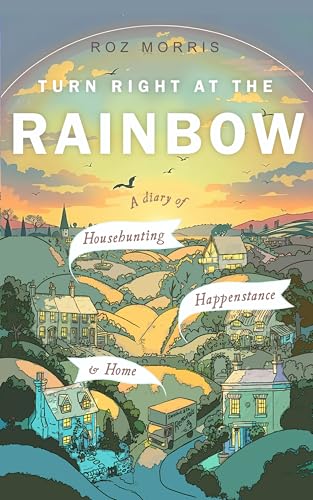 Now that we’re four years on from the purchase of our first property, I can read about house-hunting without finding it too depressing! When Morris and her husband Dave decided to move out of London, securing a buyer for their house was a cinch, but finding a new place that they loved as much as their home of twenty-plus years seemed like an insurmountable challenge. She wrings much humour from the process by comparing house viewings with first dates – as in a romcom, you’re always looking out for “The One,” but all the potential suitors have various issues – and employing jokey nicknames (“the Rusty Tractor house,” “The Aardvark House”), and a financial shorthand of arms and legs.
Estate agents, potential buyers, and sellers alike are maddening in their quirks. There are so many inexplicable features in otherwise normal suburban Surrey properties: more toilets than bedrooms, giant air-conditioning units, a long bench that looks like it belongs in a bus station waiting room, and so on. In between details of the search, Morris remembers her upbringing in mining country made famous by Alan Garner and how she and Dave met and made a life together as childfree writers. This is a warm and funny read whose short chapters fly by, but it also made me ponder what is essential in a home. Though I was mildly taken aback by the ending, I came to think of it as fitting, in a T.S. Eliot knowing the place for the first time sort of way.
With thanks to the author for the free e-copy for review. (Published by Spark Furnace.)
The Way the Water Held Me by Catherine Redford
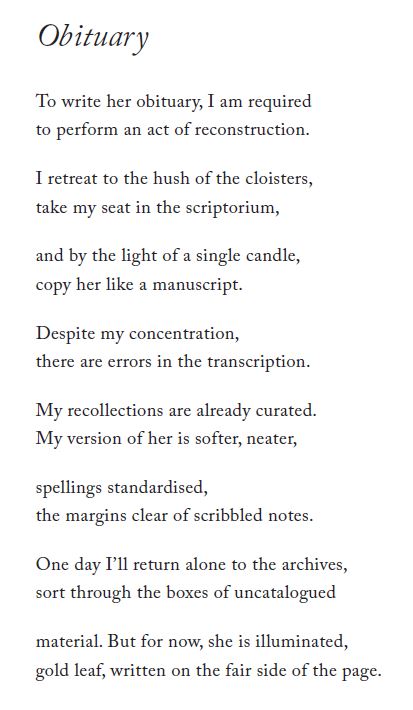
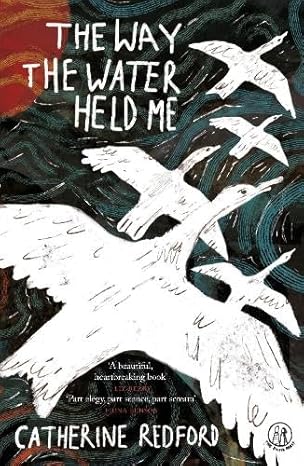 This isn’t your average bereavement story: Redford was only 35 and had a young child at the time that her wife died of cancer. We don’t hear so much about being widowed early, or in a same-sex partnership. Redford interrogates the expectations of widowhood (“If not Victoria, I can be Jackie O”) through biographical poems about Mary Shelley’s writings in the wake of Percy Bysshe Shelley’s untimely death. There’s a found/collage poem pieced together from one of Shelley’s letters; others quote from her Frankenstein and The Last Man. Elsewhere, Redford alludes to Woolf, Wordsworth and Wuthering Heights. Redford recalls feeling bombarded by people’s sympathy (“The flowers arrive like a tsunami”) and having no idea how to respond when asked how she’s doing. She relives moments from their carefree courtship days, lists the elements of “Her Last Day,” and documents the rituals that enshrine memory. I loved the archival vocabulary of “Obituary” (below) and how belongings left behind take on outsize significance: “I cross-examine every page of her notebooks, lay out the contents / of each drawer in a crescent on the floor as if they are grave goods // selected for her journey to the afterlife” (from “Circles”). The alliteration and nature (especially seaside) imagery were just right for me. From the hardest of circumstances came something tender and lovely.
With thanks to The Emma Press for the advanced e-copy for review.
The Little Prince by Antoine de Saint-Exupéry (1943)
Graphic novel adaptation by Joann Sfar (2008); colours by Brigitte Findakly
[Translated from French by Sarah Ardizzone, 2010]
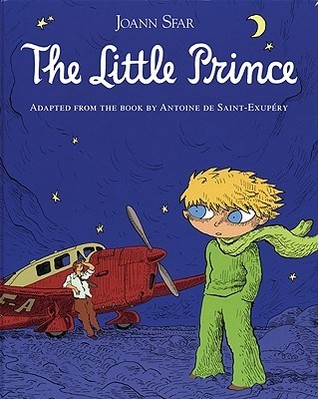 Reading The Little Prince in the original French was a long-term project in my high school French curriculum. I can still remember snippets such as “Dessine-moi un mouton” (“Draw me a sheep”) and apprivoiser (to tame) – it was good for learning such random vocabulary words. You are probably familiar with this fable of a pilot who crashes in the desert and meets a strange, possibly alien boy and talks with him about his interplanetary journeys as well as a flower, a snake, a fox, and so on. Before he landed on earth, he alighted on six other planets where he met a king, a vain man, a drunk, a businessman, a lamplighter, and a geographer, all of whom appeared to be trapped in destructive patterns of their own making.
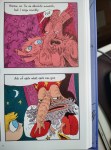
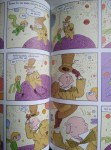
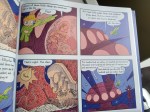
I had a few issues. The main one is that, these days, the story falls for me in the same category as other intolerably twee stuff like Jonathan Livingston Seagull and The Boy, the Mole, the Fox and the Horse. Granted, “You can only see clearly with the heart. What matters is invisible to the eye” is profound in its simplicity. But much of the rest had me rolling my eyes. As for the adaptation, why was it deemed necessary? The original The Little Prince is illustrated. Plus the drawing style is rather grotesque. (I don’t remember this from the only other book I’ve read by Sfar, The Rabbi’s Cat.) I guess the idea was to contrast the boy’s innocence and blue-pool eyes with the essential ugliness of much of what he encounters. But what’s with most of the planets’ residents having noses like penises? (Unsolicited review copy from SelfMadeHero)
Weatherglass Books’ Second Annual Novella Prize Shortlist (#NovNov25)
Last year I attended an event at Foyles in London introducing the two joint winners of the inaugural Weatherglass Novella Prize, as chosen by Ali Smith. I later reviewed both Astraea by Kate Kruimink and Aerth by Deborah Tomkins, and interviewed Weatherglass Books co-founder and novelist Neil Griffiths. With his permission, I’m reproducing below the partial text of the Substack post in which he announced the shortlist for this second year of the award. Out of 170+ submissions, he and co-publisher Damian Lanigan chose a shortlist of four novellas, which have again been sent to Ali Smith for her to choose a winner in the new year. The winner will be published by Weatherglass Books. It’s clear that all four are publishable, though!
The shortlist is … in no particular order:
A BRIEF HISTORY OF WAR by Selma Carvalho is a piece of sensuous magnetic power and aliveness. It deals with questions of class, ethnicity and nationalism so close to the contemporary that this book almost shakes in your hands.
Two people sit by chance near each other on a bus in a world where the rise of political divisions is physical, palpable. They’re unalike in every way. Their attraction fizzes like a lit fuse. “What does it mean to be foreign, to think of another human being as foreign? Foreign from what?” It examines the closeness and distance between people, families, tribes, and the hair-trigger, hair-on-the-back-of-the-neck negotiations between people’s bodies.
Wise and contemporary, uncompromising and true, its edginess, and the fallout from desires, personal and social, is brilliantly conjured and conveyed.
FROM THE SMALLEST THINGS by Jupiter Jones tells the far-too-untold story of a c19th sisterhood, that of the daughters of Mary Wollstonecraft: Fanny Imlay and Mary Shelley, the famed writer of Frankenstein, plus their step-sister Claire Clairmont. Are they the three graces? The fates? They’re women, as alive and breathing and rebellious and analytical as you and me, and well aware and critical of the hemmed-in nature they’re expected to accept as women of their time, a time of “a new way of thinking, a new-world independence, a revolutionary world.”
It features their connection to Percy Bysshe Shelley – “how could we not love him, with his lofty ethics and words that flew like birds?” – and many of the other contemporary poets and thinkers of the time. Pacy and assured, it turns its history to life from fragment to sensuous fragment. If the dead brought to life is to be Mary Shelley’s theme, this novella asks what the real source of life spirit is, the vital spark. This book, full of detail and richesse, is a piece of vitality in itself.
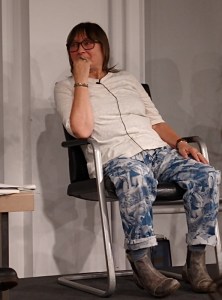
Ali Smith at the Weatherglass event in September 2024.
SHOUGANI by Anju Gaston – what does it mean? “I ask the internet the difference between something being too close to the bone and something being too close to home.” This funny and terrifying book is a study of what and how things mean, and don’t, in our latest machine age. In it something unforgiveable has happened. The main character in this novella, seemingly numbed but bristling with blade-sharp understanding, is only just holding things together and trying to work out how to heal. So she travels to Japan in a search for the other half of a fragmented family. Or is it the world itself that has fragmented?
Shougani examines the massive everyday pressures we’re all under with real wit and style. It is pristine, brilliant, smart beyond belief. I sense it becoming as much a classic for now as Plath’s The Bell Jar has been for the decades behind us.
THE MARVELLOUS DINNER by Polly Tuckett
“A massacre of things just to produce a single dish”: this novella charts the terrible coming-apart of a marriage. A wife prepares a dinner for her husband on an important anniversary, a meal so laboured and elaborate that something’s wrong, something’s definitely up – more, something’s got to give.
This novella is a story of the fictions we call true in our lives, even though we know they’re hollow ceremonials. There’s a Mike Leigh touch to this unsettling book. Every mouthful is dangerous, precarious. It anatomises fuss and ceremony, examines the ritual and the real bullying in a relationship. It deals with madness and the mundane truth of fantasy. Is it love itself that’s a delusion in this tale of the ties that bind?
“So there we have it. Our four shortlisted titles,” Neil writes. “They are all extraordinary, all deserve to win, to be well published. It’s now down to Ali. Thank you to everyone who submitted. We’ve enjoyed reading all the entries. But especial thanks to Ali Smith for agreeing to be our judge in year one and now on-goingly; it’s a real privilege to have one the world’s most original writers helping us select what we commission.”
Which of the synopses entice you? I especially like the sound of From the Smallest Things and The Marvellous Dinner.
Thinking about the Future with David Farrier & Roman Krznaric (Hay Festival)
My last of three digital Hay Festival* talks this year was by Roman Krznaric, a School of Life philosopher with a background in politics and gardening. I discovered him through Greenbelt Festival eight years ago and have since enjoyed several of his books on the topics of empathy, finding purposeful work, and models for living well. His talk on his upcoming book, The Good Ancestor: How to Think Long Term in a Short Term World, was an ideal follow-up to one of the top three 2020 nonfiction works I’ve read so far:
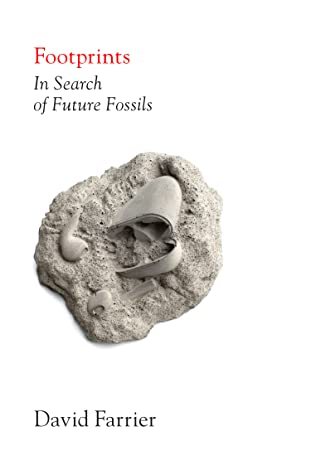
Footprints: In Search of Future Fossils by David Farrier
Look on my Works, ye Mighty, and despair!
Nothing beside remains. Round the decay
Of that colossal Wreck, boundless and bare
The lone and level sands stretch far away.
~from “Ozymandias” by Percy Bysshe Shelley
In May 2013 a set of fossil human footprints was found at Happisburgh in Norfolk. At 850,000 years old, they were the oldest outside of Africa. In the same month, atmospheric CO2 passed 400 ppm for the first time. It’s via such juxtapositions of past and future, and longevity versus precariousness, that Farrier’s book – a sophisticated lattice of human and planetary history, environmental realism and literary echoes – tells the story of the human impact on the Earth.
Unusually, Farrier is not a historian or a climate scientist, but a senior lecturer in English literature at the University of Edinburgh specializing in nature and place writing, especially in relation to the Anthropocene. That humanities focus allowed him to craft a truly unique, interdisciplinary work in which the canon both foreshadows and responds to environmental collapse. On a sabbatical in Australia, he also gets to hold an ice core taken by an icebreaker, swim above coral reefs and visit a uranium mine exempted from protection in a national park.
 He travels not just through space, but also through time, tracing a plastic bottle from algal bloom to oil to factory to river/landfill to ocean; he thinks about how cultural memory can preserve vanished landscapes; he imagines propitiatory rites arising around radioactive waste to explain poisoned lakes and zinc-lined coffins; and he wonders how to issue appropriate warnings to the future when we don’t even know if English, or language in general, will persist (a nuclear waste storage site in Carlsbad uses a combination of multilingual signs, symbols, monoliths and planned oral tradition, while one in Finland is unmarked).
Each chapter is an intricate blend of fact, experience and story. For example, “The Insatiable Road” is about cars and the concrete landscapes they zip through – all made possible by oil. Farrier wins a chance to be among the first to cross the new Forth Bridge on foot and finds himself awed by the human achievement. Yet he knows that, in a car, the bridge will be crossed in seconds and soon taken for granted. Whether as a driver or a passenger, we have become detached from the journey and from the places we are travelling through. The road trip, a standard element of twentieth-century art and literature, has lost its lustre. “Really, we have conceded so much,” he writes. “Most of us live and wander only where road networks permit us to, creeping along their edges and lulled into deafness by their constant roar.” Ben Okri’s legend provides the metaphor of a famished road that swallows all in its path.
What will the human species leave behind? “The entire atmosphere now bears the marks of our passage … Perhaps no one will be around to read our traces, but nonetheless we are, everywhere, constantly, and with the most astonishing profligacy, leaving a legacy that will endure for hundreds of thousands or even hundreds of millions of years to come.” That legacy includes the concrete foundations of massive road networks, the remnants of megacities on coastal plains, plastics that will endure for many centuries, carbon and methane locked up in permafrost, the 2300-km fossil of the dead Great Barrier Reef, nuclear waste in isolation plants, jellyfish-dominated oceans and decimated microbial life.
Thinking long term doesn’t come naturally. In the same way that multiple books of 2019 (Time Song, Surfacing, Underland) helped us think about the place of humanity in reference to deep time, Footprints offers an invaluable window onto the deep future. Its dichotomies of hubris and atonement, and culpability versus indifference, are essential to ponder. It was always going to be sobering to read about how we have damaged our only home, but I never found this to be a needlessly depressing book; it is clear-eyed and forthright, but also meditative and beautifully constructed. Life on the planet continues in spite of our alterations, but all the diminishment was unavoidable, and perhaps some of it is remediable still.
My rating: 
 Related reading: Notes from an Apocalypse by Mark O’Connell. I’m only up to page 36 and at the moment it’s just him watching loads of crackpot preppers’ videos on YouTube, but already I think that Footprints should have had this book’s spot on the Wainwright Prize for Writing on Global Conservation longlist (a new prize run in addition to the standard UK nature writing one) for being more directly engaged with conservation issues rather than just humorously commenting on the end-of-the-world mindset.
Roman Krznaric at Hay Festival
 Krznaric’s discussion of being a “good ancestor” resonated in connection with the long-term thinking of Farrier’s book. “This is the age of the tyranny of the now,” he began, but “humankind has colonized the future” as well, treating it as a tempus nullius where we can dump our ecological waste and tech failures. Yet long-termism is needed more than ever as a way of planning for environmental challenges (and pandemics and the like). Future generations have no say in the decisions we make now that will affect them. To put this in perspective, he showed an image of three spheres, proportionally sized: one represented the 100 billion dead, one was the 7.7 billion currently living, and one was the 6.75 trillion in unborn generations (if the current birth rate continues).
It was Jonas Salk, creator of the polio vaccine, who asked, “Are we being good ancestors?” Krznaric invited the audience to come up with examples (in the chat window on the sidebar) of long-term projects through which people are trying to help future generations, such as the Svalbard Seed Depository, the Green New Deal, the 10,000-Year Clock (inside a mountain in the Texas desert), the Long Play piece of music to last 1,000 years, rewilding, archives and libraries, and tree planting. He had also opened the talk with his own modest contribution: he and his partner ‘gave’ their 11-year-old twins their votes in the latest election.
Krznaric elaborated on four of his book’s six ways of thinking about the future: 1) Rethink human nature by using the “acorn brain” (long-term thinking) rather than the “marshmallow brain” (instant gratification). 2) Embark on projects with long time horizons (“cathedral thinking”). 3) Think in terms of legacies, whether familial or transcendent – leaving a gift to the citizens of the future (e.g. The Future Library of 100 books not published or read until 2114). 4) Create a politics for the future, e.g. the citizen assembly movement.
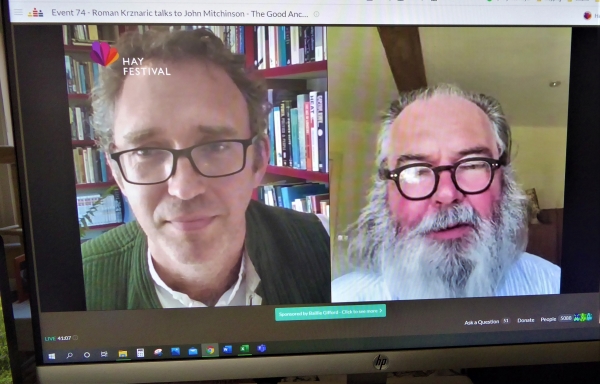
Roman Krznaric at the digital Hay Festival. Q&A led by John Mitchinson (right).
In the case of the UK, Krznaric advocates abolishing the House of Lords, replacing it with a citizens’ assembly and a Minister for the Future, and establishing legal rights for future generations. He noted that globally we’re at a “devil’s fork” where there’s a danger of authoritarian regulations continuing around the world after quarantine ends, endangering the future of social democracy. Instead, we need grassroots activism and “doughnut economics.” He pictures devolution of power away from central governments, with progressive cities becoming new loci of power. Individual actions like vowing not to fly and installing solar panels can inspire peers, but only collective action can tackle environmental breakdown.
 Related reading: I’ll be reviewing Eric Holthaus’s forthcoming book The Future Earth: A Radical Vision for What’s Possible in the Age of Warming for BookBrowse later this month. The meteorologist and science journalist fleshes out some of Krznaric’s ideas, such as a citizen assembly and the cyclical economy, in his proposal for the drastic changes needed over the next three decades.
*You can access the recorded Hay Festival talks by paying a £10 annual subscription here.
Have you read anything about the deep future?
Two Mother–Daughter Author Pairs for Mother’s Day
This coming Sunday is Mother’s Day in the USA. (Mothering Sunday generally falls in March here in the UK, so every year I have to buy a card early to send to my mother back in the States, but I still associate Mother’s Day with May.) Earlier in the year I got over halfway through a Goodreads giveaway book, Beyond the Pale by Emily Urquhart, before I realized its author was the daughter of a Canadian novelist I’d read before, Jane Urquhart. That got me thinking about other mother–daughter pairs that might be on my shelves. I found one in the form of Sue Monk Kidd’s The Secret Life of Bees plus an advance e-copy of her daughter Ann Kidd Taylor’s upcoming debut novel, The Shark Club. (I’ve previously reviewed their joint memoir, Traveling with Pomegranates.) And, as a bonus, I have a mini-review of Graham Swift’s novella Mothering Sunday: A Romance.
The Whirlpool, Jane Urquhart
 From 1986, this was Urquhart’s first novel. Overall it reminded me of A. S. Byatt (especially The Virgin in the Garden) and John Fowles’s The French Lieutenant’s Woman. Set in 1889 on the Canadian side of Niagara Falls, it features characters who, each in their separate ways, are stuck in the past and obsessed with death and its symbolic stand-in, the whirlpool. Maud Grady, the local undertaker’s widow, takes possession of the corpses of those who’ve tried to swim the Falls. Her creepy young son starts off mute and becomes an expert mimic. Major David McDougal is fixated on the War of 1812, while his wife Fleda camps out in a tent reading Victorian poetry, especially Robert Browning, and awaiting a house that may never be built. Local poet Patrick sees Fleda from afar and develops romanticized ideas about her.
Each of these narratives is entertaining, but I was less convinced by their intersections – except for the brilliant scenes when Patrick and Maud’s son engage in wordplay. In particular, I was unsure what the prologue and epilogue (in which Robert Browning, dying in Venice, is visited by images of Shelley’s death by drowning) were meant to add. This is the second Urquhart novel I’ve read, after Sanctuary Line. I admire her writing but her plots don’t always come together. However, I’m sure to try more of her work: I have a copy of Away on the shelf, and Changing Heaven (1990) sounds unmissable – it features the ghost of Emily Brontë! [Bought from a Lambeth charity shop for 20p.]
My rating: 
Beyond the Pale: Folklore, Family and the Mystery of Our Hidden Genes, Emily Urquhart
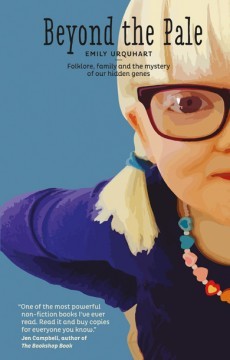 In December 2010, the author’s first child, Sadie, was born with white hair. It took weeks to confirm that Sadie had albinism, a genetic condition associated with extreme light sensitivity and poor eyesight. A Canadian folklorist, Urquhart is well placed to trace the legends that have arisen about albinos through time and across the world, ranging from the Dead Sea Scroll story of Noah being born with blinding white skin and hair to the enduring superstition that accounts for African albinos being maimed or killed to use their body parts in folk medicine.
She attends a NOAH (America’s National Organization for Albinism and Hypopigmentation) conference, discovers potential evidence of a family history of albinism, and even makes a pilgrimage to Tanzania to meet some victims. It’s all written up in as engaging present-tense narrative of coming to terms with disability: to start with Urquhart is annoyed at people reassuring her “it could be worse,” but by the end she’s ever so slightly disappointed to learn that her second child, a boy, will not be an albino like his sister. [Goodreads giveaway copy]
My rating: 
The Secret Life of Bees, Sue Monk Kidd
 It’s hard to believe it was 15 years ago that this debut novel was an It book, and harder to believe that I’d never managed to get around to it until now. However, in some ways it felt familiar because I’d read a fair bit of background via Kidd’s chapter in Why We Write about Ourselves and Traveling with Pomegranates, in which she and her daughter explored the Black Madonna tradition in Europe.
It joins unusual elements you wouldn’t expect to find in fiction – beekeeping and the divine feminine – with more well-trodden territory: the Civil Rights movement in the South in the 1960s, unhappy family relationships, secrets, and a teenage girl’s coming of age. Fourteen-year-old Lily is an appealing narrator who runs away from her memories of her mother’s death and her angry father, peach farmer T. Ray. You can’t help but fall in love with the rest of her new African-American, matriarchal clan, including their housekeeper, Rosaleen, who scandalizes the town by registering to vote, and the bee-keeping Boatwright sisters, August, June, and May, who give Lily and Rosaleen refuge when they skip town.
Although this crams in a lot of happenings and emotional ups and downs, it’s a charming story that draws you into the brutal heat of a South Carolina summer and keeps you hoping Lily will forgive herself and slip into the rhythms of a purposeful life of sisterhood. [Secondhand purchase in America]
A favorite line: “The way people lived their lives, settling for grits and cow shit, made me sick.”
My rating:
The Shark Club, Ann Kidd Taylor
 Dr. Maeve Donnelly loves sharks even though she was bitten by one as a child. She’s now a leading researcher with a Florida conservancy and travels around the world to gather data. Her professional life goes from strength to strength, but her personal life is another matter. Aged 30, she’s smarting from a broken engagement to her childhood sweetheart, Daniel, and isn’t ready to open her heart to Nicholas, a British colleague going through a divorce.
Things get complicated when Daniel returns to their southwest Florida island to work as the chef at her grandmother’s hotel – with his six-year-old daughter in tow. Maeve is soon taken with precocious Hazel, who founds the title club (pledge: “With this fin, I do swear. To love sharks even when they bite. When they lose their teeth, I will find them. When I catch one, I will let it go”), but isn’t sure she can pick up where she left off with Daniel. Meanwhile, evidence has surfaced of a local shark finning operation, and she’s determined to get to the bottom of it.
This is a little bit romance and a little bit mystery, and Taylor brings the Florida Keys setting to vibrant life. It took a while to suspend disbelief about Maeve’s background – an orphan and a twin and a shark bite survivor and a kid brought up in a hotel? – but I enjoyed the sweet yet unpredictable story line. Nothing earth-shattering, but great light reading for a summer day at the beach. Releases June 6th from Viking. [Edelweiss download]
My rating: 
Mothering Sunday: A Romance, Graham Swift
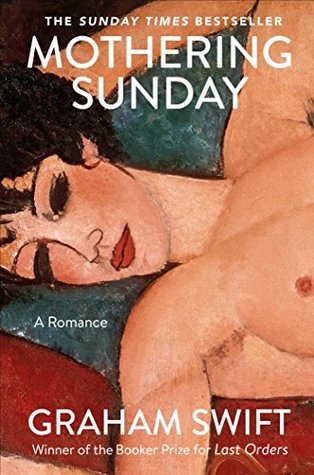 If you’re expecting a cozy tale of maternal love, let the Modigliani nude on the U.K. cover wipe that notion out of your mind. Part of me was impressed by Swift’s compact picture of one sexy, fateful day in 1924 and the reverberations it had for a budding writer even decades later. Interesting class connotations, too. But another part of me thought, isn’t this what you would get if Ian McEwan directed a middling episode of Downton Abbey? It has undeniable similarities to Atonement and On Chesil Beach, after all, and unlike those novels it’s repetitive; it keeps cycling round to restate its main events and points. There’s some good lines, but overall this felt like a strong short story stretched out to try to achieve book length. [Library read]
My rating: 
Six from My Shelves
My resolution to read just my own books for the summer largely fell by the wayside, but I did manage to get through another handful of print books from the shelves. Below I give brief write-ups of what I’ve finished lately and recall how these books came to be in my collection.
 In Fond Remembrance of Me by Howard Norman: A strange, short book that blends memoir and Inuit legends. In 1977 Norman travelled to Churchill, Manitoba to transcribe an oral storyteller’s folktales. Most of these were about Noah coming into contact with the peoples of the far north and displeasing them by refusing to give over the exotic animals of his ark as food. Helen Tanizaki, a scholar in her late thirties who tried half-heartedly to hide the fact that she was dying of stomach cancer, was also there to translate stories into Japanese. It’s easy to see why she impressed Norman with her mystical stoicism. She was a keen birdwatcher, and declared she wanted to be reincarnated as a seabird. The portrait of Helen is compelling, but the book doesn’t hang together well, especially because the interspersed legends are so repetitive. [From my Amazon wish list last Christmas.]
 An Anthology of Animal Poetry, ed. Kenneth A. Mason: This was assembled in 1940 by a 19-year-old, and it shows. The choices are obvious and old-fashioned; too many of the poems are long and insist on rhyming. However, I discovered some real gems. Three poems in a row are about skylarks – by Gerard Manley Hopkins, Wordsworth and Shelley – and they’re all brilliant, using the bird as an emblem of freedom. Shelley’s “To a Skylark,” in particular, I can’t believe I’ve never encountered before. Its 21 stanzas praise the bird’s pure joy and wonder how careworn humans might emulate it: “We look before and after, / And pine for what is not … Teach me half the gladness / That thy brain must know.” My vintage Pelican copy has ads for chocolate and cigarettes that made me laugh. [Bought from a secondhand bookstore in Tunbridge Wells for 10 pence.]


 The Mistress’s Daughter by A.M. Homes: This grew out of a New Yorker article Homes published about meeting her biological parents in her early 30s. Her mother carried on an affair with her married boss, starting when she was just a teenager – Homes learned that she was the mistress’s daughter. This is the story of how her birth mother tried to get involved in her life, in a really rather stalker-ish way, and the occasional contact she had from her birth father. The blow-by-blow gets a little boring, especially when it’s Homes and her father only communicating via lawyers. Homes doesn’t really make much of a contribution to the literature of adoption, though this is a pleasant enough read. “I am an amalgam. I will always be something glued together, something slightly broken.” [Bought from a library book sale in America for $1.]
 Summertime by Vanessa Lafaye: An enjoyable historical novel based on several true-life elements: a work camp of army veterans based at the Florida Keys, segregation and lynching, and a massive hurricane that hit in 1935. Main characters Missy and Henry are well drawn, but beyond them I thought Lafaye splits the perspective too far: I didn’t need to see through the eyes of lots of the veterans, the shopkeeper, or the policeman investigating the brutal beating of a local white woman. As for this crime, I knew whodunit pretty much right away, so there wasn’t any suspense regarding that plot point. However, Lafaye does do a great job of building tension in the novel’s final third as the storm approaches. The U.S. title (Under a Dark Summer Sky) is much better; “Summertime” evokes strangely rosy images and so is inappropriate. [I won a copy in a Goodreads giveaway.]
 So Many Books, So Little Time: A Year of Passionate Reading by Sara Nelson: Nelson is forthright about what she likes and doesn’t like; she also ruefully reflects on the gap between what she meant to read and what she actually read in 2002. Her reading diary tells a lot about her personal life too: having a non-reading spouse and a novelist sister; memories of her late father; and the struggle to instill a love of reading into her young son. Inevitably a little dated as it engages with ‘It’ books of the time like A Million Little Pieces and Kitchen Confidential, the book has staying power because in each chapter Nelson broadens out from her discussion of one or more books to craft a thematic essay. This was meant to be my bedside book for the second half of the year, but I devoured it in less than seven weeks. It’s full of lines bibliophiles can relate to. [Free from The Book Thing of Baltimore.]
 The Debt to Pleasure by John Lanchester: Tarquin Winot, the snobby Francophile who narrates Lanchester’s debut novel, has a voice reminiscent of Oliver in Julian Barnes’s Talking It Over and Love etc. His opinionated, verbose speech provides much of the book’s wit. “This is not a conventional cookbook,” the first line warns, but a foodie’s tribute to traditional English and French dishes that compose the best seasonal menus. As we travel with Tarquin from Portsmouth to Provence we learn more about this peculiar character through the memories dishes elicit: about his Irish nanny, his sculptor brother’s boarding school years, etc. Lanchester subtly introduces notes of doubt about the narrator’s reliability, until we have to wonder how much his tale resembles Perfume or The Talented Mr. Ripley. Deliciously clever and sinuous. [Bought from a London charity shop for 20 pence.]
I spent much of the summer bogged down in several very good but not particularly page-turning works of nonfiction. I’ll review those in due course.
Up next, though, are a few Booker Prize longlist mini-reviews in advance of the shortlist announcement on Tuesday.
Autumn Is Here, in Poetry and Prose
“The trees are undressing, and fling in many places –
On the gray road, the roof, the window-sill –
Their radiant robes and ribbons and yellow laces”
~from “Last Week in October,” Thomas Hardy (1928)
I recently learned that there are two different official start dates for autumn. The meteorological beginning of the season was on September 1st, while the astronomical opening is not until the 22nd. For the purposes of this review I’ll incline towards the former. I’ve been watching leaves fall since early last month, after all, but now – after a weekend spent taking a chilly boat ride down the canal, stocking the freezer with blackberries and elderberries, and setting hops to dry in the shed – it truly feels like autumn is here in southern England. Luckily, I had just the right book in hand to read over the last couple of weeks as I’ve been settling into our new place, Autumn: An anthology for the changing seasons.
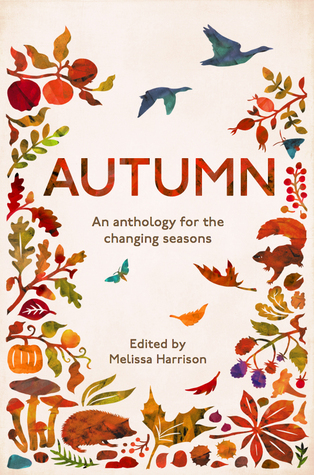 This is the third of four seasonal volumes issued this year by the UK’s Wildlife Trusts, in partnership with London-based publisher Elliott & Thompson and edited by Melissa Harrison (see also my review of Summer). The format of all the books is roughly the same: pieces range from one to a few pages and run the gamut from recurring phenological records (Gilbert White and Thomas Furly Forster) and extracts from classic literature (poems by Shelley, Tennyson and Yeats) to recent nature writers (an excerpt from Helen Macdonald’s H is for Hawk; new work from Amy Liptrot and John Lewis-Stempel). Perhaps half the content has been contributed by talented amateurs, about 10 of them repeats from the first volumes.
This collection was slightly less memorable for me than Summer. A few pieces seem like school assignments, overly reliant on clichés of blackberry picking and crunching leaves underfoot. The best ones don’t attempt too much; they zero in on one species or experience and give a complete, self-contained story rather than general musings. A few stand-outs in this respect are Jo Cartnell chancing upon bank voles, Julian Jones on his obsession with eels, Laurence Arnold telling of his reptile surveying at London Wetland Center, and Lucy McRobert having a magic moment with dolphins off the Scilly Isles. I also enjoyed Kate Blincoe’s account of foraging for giant puffball mushrooms and Janet Willoner on pressing apples into juice – I’m looking forward to watching this at our town’s Apple Day in October.
I think all the contemporary writers would agree that you don’t have to live or go somewhere ‘special’ to commune with nature; there are marvels everywhere, even on your own tiny patch, if you will just go out and find them. For instance, South London seems an unlikely place for wildlife encounters, yet Will Harper-Penrose meets up with one of the country’s most strikingly exotic species (an introduced one), the ring-necked parakeet. Jane Adams comes across a persistent gang of wood mice in her very own attic, while Daphne Pleace spots red deer stags from the safety of her motorhome when on vacation in northwest Scotland.

A Japanese maple near the National Cathedral in Washington, D.C. Photo by Chris Foster.
Remarkably, the book’s disparate pieces together manage to convey a loose chronological progression, from the final days of lingering summer to the gradual onset of winter. Here’s Annie Worsley’s lovely portrayal of autumn’s approach: “In the woodlands the first trees to betray summer are silver birches: splashes of yellow dapple their fine, shimmering greenery. Here and there, long wavering larch tresses begin to change from deep green to orange and ochre.” At the other end of the autumnal continuum, David Gwilym Anthony’s somber climate change poem, “Warming,” provides a perfect close to the anthology: “These days I’ll take what Nature sends / to hoard for dour December: / a glow of warmth as autumn ends.”
A few more favorite lines:
- “Dusk, when the edges of all things blur. A time of mauve and moonlight, of shapeshiftings and stirrings, of magic.” (Alexi Francis)
- “Go down the village street on a late September afternoon and the warm burnt smell of jam-making oozes out of open cottage doors.” (Clare Leighton, 1933)
- “There are miniature Serengetis like this under most logs, if you take the time to look.” (Ryan Clark)
- “Ah, the full autumn Bisto bouquet comes powering to the nose: mouldering leaves, decaying mushrooms, rusting earth.” (John Lewis-Stempel)
My favorite essay of all, though, is by Jon Dunn: playful yet ultimately elegiac, it’s about returning to his croft on a remote Shetland island to find that an otter has been picking off his chickens.
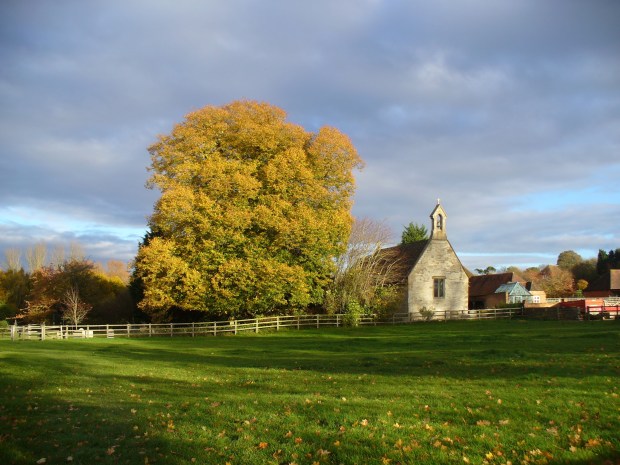
All Saint’s Church in Woolstone, Oxfordshire. Photo by Chris Foster.
Like Summer, this gives a good sense of autumn as a whole, including its metaphorical associations. As Harrison puts it in her introduction, autumn “makes tangible a suite of emotions – wistfulness, nostalgia, a comfortable kind of melancholy – that are, at other times of the year, just out of reach.” It’s been my favorite season since childhood, probably because it combines the start of the school year, my birthday, and American holidays like Halloween and Thanksgiving. Whatever your own experience of autumn – whether it’s a much loved season or not; even if you call it “fall” instead – I can highly recommend this anthology’s chorus of voices old and new. There’s no better way for a book lover to usher in the season.
With thanks to Jennie Condell at Elliott & Thompson for the free copy for review.
My rating:
 Bookish Beck = Rebecca Foster. American transplant to England. Freelance proofreader and book reviewer.
 Bookish Beck