August Releases: Fiction Advocate, Kingsolver Poetry, Sarah Moss & More
My five new releases for August include two critical responses to contemporary classics; two poetry books, one a debut collection from Carcanet Press and the other by an author better known for fiction; and a circadian novel by one of my favorite authors.
I start with two of the latest releases from Fiction Advocate’s “Afterwords” series. The tagline is “Essential Readings of the New Canon,” and the idea is that “acclaimed writers investigate the contemporary classics.” (I reviewed the monographs on Blood Meridian, Fun Home, and The Year of Magical Thinking in this post.)
Dear Knausgaard: Karl Ove Knausgaard’s My Struggle by Kim Adrian
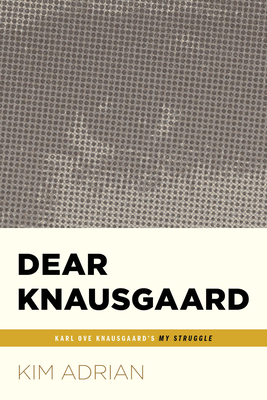 Karl Ove Knausgaard turned his pretty ordinary life into thousands of pages of autofiction that many readers have found addictive. Adrian valiantly grapples with his six-volume exploration of identity, examining the treatment of time and the dichotomies of intellect versus emotions, self versus other, and life versus fiction. She marvels at the ego that could sustain such a project, and at the seemingly rude decision to use all real names (whereas in her own family memoir she assigned aliases to most major figures). At many points she finds the character of “Karl Ove” insufferable, especially when he’s a teenager in Book 4, and the books’ prose dull. Knausgaard’s focus on male novelists and his stereotypical treatment of feminine qualities, here and in his other work, frequently madden her.
So why is My Struggle compelling nonetheless? It occupies her mind and her conversations for years. Is it something about the way that Knausgaard extracts meaning from seemingly inconsequential details? About how he stretches and compresses time in a Proustian manner to create a personal highlights reel? She frames her ambivalent musings as a series of letters written as if to Knausgaard himself (or “KOK,” as she affectionately dubs him) between February and September 2019. Cleverly, she mimics his style in both the critical enquiry and the glimpses into her own life, including all its minutiae – the weather, daily encounters, what she sees out the window and what she thinks about it all. It’s bold, playful and funny, and, all told, I enjoyed it more than Knausgaard’s own writing.
(I myself have only read Book 1, A Death in the Family, and wasn’t planning on continuing with My Struggle, but I think I will make an exception for Book 3 because of my recent fascination with childhood memoirs. I had better luck with Knausgaard’s Seasons Quartet, of which I’ve read all but Spring. I’ve reviewed Summer and Winter.)
My rating: 
My thanks to Fiction Advocate for the free e-copy for review.
The Wanting Was a Wilderness: Cheryl Strayed’s Wild and the Art of Memoir by Alden Jones
Hiking is boring, yet Cheryl Strayed turned it into a beloved memoir. Jones explores how Wild works: how Strayed the author creates “Cheryl,” likeable despite her drug use and promiscuity; how the fixation on the boots and the backpack that carry her through her quest reflect the obsession over the loss of her mother; how the flashbacks break up the narrative and keep you guessing about whether she’ll reach her literal and emotional destinations.
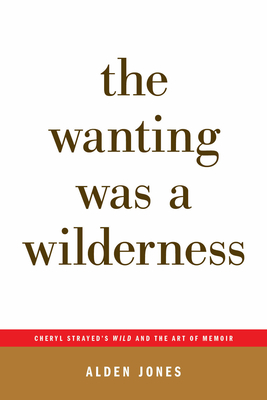 Jones also considers the precedents of wilderness literature and the 1990s memoir boom that paved the way for Wild. I most enjoyed this middle section, which, like Mary Karr’s The Art of Memoir, surveys some of the key publications from a burgeoning genre. Another key point of reference is Vivian Gornick, who draws a distinction between “the situation” (the particulars or context) and “the story” (the message) – sometimes the map or message comes first, and sometimes you only discover it as you go along.
I was a bit less interested in Jones’s reminiscences of her own three-month wilderness experience during college, when, with Outward Bound, she went to North Carolina and Mexico and hiked part of the Appalachian Trail and a volcano. This was the trip on which she faced up to her sexuality and had a short-lived relationship with a fellow camper, Melissa. But working out that she was bisexual and marrying a woman were both, as presented here, false endings. The real ending was her decision to leave her marriage – even though they had three children; even though the relationship was often fine. She attributes her courage to go, believing something better was possible, to Strayed’s work. And that’s the point of this series: rereading a contemporary classic until it becomes part of your own story.
My rating: 
My thanks to Fiction Advocate for the free e-copy for review.
Two poetry releases:
Growlery by Katherine Horrex
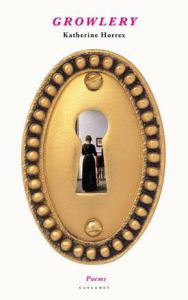 As in Red Gloves by Rebecca Watts, released by Carcanet in June, I noted the juxtaposition of natural and industrial scenes. Horrex’s “Four Muses” include a power plant and a steelworks, and she writes about pottery workers and the Manchester area, but she also explores Goat Fell on foot. Two of my favorite poems were nature-based: “Omen,” about corpse flowers, and “Wood Frog.” Alliteration, metaphors and smells are particularly effective in the former. Though I quailed at the sight of an entry called “Brexit,” it’s a subtle offering that depicts mistrust and closed minds – “People personable as tents zipped shut”. By contrast, “House of Other Tongues” revels in the variety of languages and foods in an international student dorm. A few poems circle around fertility and pregnancy. The linking themes aren’t very strong across the book, but there are a few gems.
My rating: 
My thanks to Carcanet Press for the free e-copy for review.
How to Fly (in Ten Thousand Easy Lessons) by Barbara Kingsolver
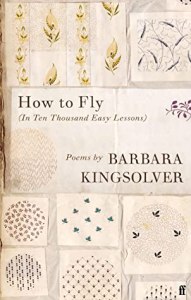 Kingsolver may not be well known for her poetry, but this is actually her second collection of verse after the bilingual Another America/Otra America (1992). The opening segment, “How to Fly,” is full of folk wisdom from nature and the body’s intuitive knowledge. “Pellegrinaggio” is a set of travel poems about accompanying her Italian mother-in-law back to her homeland. “This Is How They Come Back to Us” is composed of elegies for the family’s dead; four shorter remaining sections are inspired by knitting, literature, daily life, and concern for the environment. As with The Undying by Michel Faber, the book’s themes are stronger than its poetic techniques, but Kingsolver builds striking natural imagery and entrancing rhythms.
Two favorite passages to whet your appetite:
How to drink water when there is wine— / Once I knew all these brick-shaped things, / took them for the currency of survival. / Now I have lived long and I know better.
Tiptoe past the dogs of the apocalypse / asleep in the shade of your future. / Pay at the window. You’ll be surprised: you / can pass off hope like a bad check. You still / have time, that’s the thing. To make it good.
(To be reviewed in full, in conjunction with other recent/upcoming poetry releases, including Dearly by Margaret Atwood, for Shiny New Books.)
My rating:
I read an advanced e-copy via Edelweiss. (I’m unsure of the line breaks above because of the formatting.)
And finally, a much-anticipated release – bonus points for it having “Summer” in the title!
Summerwater by Sarah Moss
This is nearly as compact as Moss’s previous novella, Ghost Wall, yet contains a riot of voices. Set on one long day at a Scottish holiday park, it moves between the minds of 12 vacationers disappointed by the constant rain – “not that you come to Scotland expecting sun but this is a really a bit much, day after day of it, torrential” – and fed up with the loud music and partying that’s come from the Eastern Europeans’ chalet several nights this week. In the wake of Brexit, the casual xenophobia espoused by several characters is not surprising, but still sobering, and paves the way for a climactic finale that was not what I expected after some heavy foreshadowing involving a teenage girl going off to the pub through the woods.
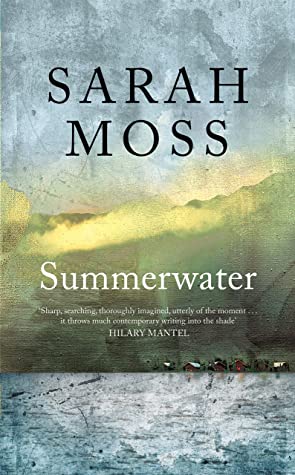 The day starts at 5 a.m. with Justine going for a run, despite a recent heart health scare, and spends time with retirees, an engaged couple spending most of their time in bed, a 16-year-old kayaker, a woman with dementia, and more. We see different aspects of family dynamics as we revisit a previous character’s child, spouse or sibling. I had to laugh at Milly picturing Don Draper during sex with Josh, and at Claire getting an hour to herself without the kids and having no idea what to do with it beyond clean up and make a cup of tea. Moss gets each stream-of-consciousness internal monologue just right, from a frantic mum to a sarcastic teen.
Yet I had to wonder what it all added up to; this feels like a creative writing student exercise, with the ending not worth waiting for. Cosmic/nature interludes are pretentious à la Reservoir 13. It’s not the first time this year that I’ve been disappointed by the latest from a favorite author (see also Hamnet). But my previous advice stands: If you haven’t read Sarah Moss, do so immediately.
My rating:
My thanks to Picador for the free copy for review.
What August releases can you recommend?
Recommended July Releases: Donoghue, Maizes, Miller, Parikian, Trethewey
My five new releases for July include historical pandemic fiction, a fun contemporary story about a father-and-daughter burglar team, a new poetry collection from Carcanet Press, a lighthearted nature/travel book, and a poetic bereavement memoir about a violent death.
The Pull of the Stars by Emma Donoghue
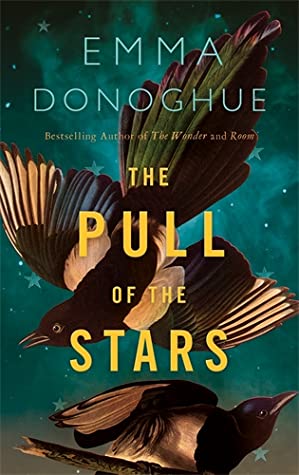 Donoghue’s last two novels, The Wonder and Akin, were big hits with me. Less than a year after the contemporary-set Akin, she’s back to a historical setting – and an uncannily pertinent pandemic theme – with her latest. In 1918, Julia Power is a nurse on a Dublin maternity ward. It’s Halloween and she is about to turn 30, making her a spinster for her day; she lives with her mute, shell-shocked veteran brother, Tim, and his pet magpie.
Because she’s already had “the grip” (influenza), she is considered immune and is one of a few staff members dealing with the flu-ridden expectant mothers in quarantine in her overcrowded hospital. Each patient serves as a type, and Donoghue whirls through all the possible complications of historical childbirth: stillbirth, obstructed labor, catheterization, forceps, blood loss, transfusion, maternal death, and so on.
It’s not for the squeamish, and despite my usual love of medical reads, I felt it was something of a box-ticking exercise, with too much telling about medical procedures and recent Irish history. Because of the limited time frame – just three days – the book is far too rushed. We simply don’t have enough time to get to know Julia through and through, despite her first-person narration; the final 20 pages, in particular, are so far-fetched and melodramatic it’s hard to believe in a romance you’d miss if you blinked. And the omission of speech marks just doesn’t work – it’s downright confusing with so many dialogue-driven scenes.
Donoghue must have been writing this well before Covid-19, but I wouldn’t be surprised if the publication was hurried forward to take advantage of the story’s newfound relevance. It shows: what I read in May and June felt like an unpolished draft, with threads prematurely tied up to meet a deadline. This was an extremely promising project that, for me, was let down by the execution, but it’s still a gripping read that I wouldn’t steer you away from if you find the synopsis appealing. (Some more spoiler-y thoughts here.)
Prescient words about pandemics:
“All over the globe … some flu patients are dropping like flies while others recover, and we can’t solve the puzzle, nor do a blasted thing about it. … There’s no rhyme or reason to who’s struck down.”
“Doctor Lynn went on, As for the authorities, I believe the epidemic will have run its course before they’ve agreed to any but the most feeble action. Recommending onions and eucalyptus oil! Like sending beetles to stop a steamroller.”
Why the title?
Flu comes from the phrase “influenza delle stelle” – medieval Italians thought that illness was fated by the stars. There’s also one baby born a “stargazer” (facing up) and some literal looking up at the stars in the book.
My rating:
My thanks to Picador for the proof copy for review.
Other People’s Pets by R.L. Maizes
 This is Maizes’ debut novel, after her 2019 short story collection We Love Anderson Cooper. Louise “La La” Fine and her father, Zev, share an unusual profession: While outwardly they are a veterinary student and a locksmith, respectively, for many years they broke into homes and sold the stolen goods. Despite close shaves, they’ve always gotten away with it – until now. When Zev is arrested, La La decides to return to her criminal ways just long enough to raise the money to post bail for him. But she doesn’t reckon on a few complications, like her father getting fed up with house arrest, her fiancé finding out about her side hustle, and her animal empathy becoming so strong that when she goes into a house she not only pilfers valuables but also cares for the needs of ailing pets inside.
Flashbacks to La La’s growing-up years, especially her hurt over her mother leaving, take this deeper than your average humorous crime caper. The way the plot branches means that for quite a while Zev and La La are separated, and I grew a bit weary of extended time in Zev’s company, but this was a great summer read – especially for animal lovers – that never lost my attention. The magic realism of the human‒pet connection is believable and mild enough not to turn off readers who avoid fantasy. Think The Twelve Lives of Samuel Hawley meets Hollow Kingdom.
My rating:
My thanks to the author and Celadon Books for the free e-copy for review.
The Long Beds by Kate Miller
 Here and there; now and then: the poems in Miller’s second collection enlarge such dichotomies by showcasing the interplay of the familiar and the foreign. A scientist struggles to transcribe birdsong, and a poppy opens in slow motion. “Flag” evokes the electric blue air and water of a Greek island, while “The Quarters” is set in the middle of the night in a French village. A few commissions, including “Waterloo Sunrise,” stick close to home in London or other southern England locales.
Various poems, including the multi-part “Album Without Photographs,” are about ancestor Muriel Miller’s experiences in India and Britain in the 1910s-20s. “Keepers of the States of Sleep and Wakefulness, fragment from A Masque,” patterned after “The Second Masque” by Ben Jonson, is an up-to-the-minute one written in April that names eight nurses from the night staff at King’s College Hospital (and the short YouTube film based on it is dedicated to all NHS nurses).
My two favorites were “Outside the Mind Shop,” in which urban foxes tear into bags of donations outside a charity shop one night while the speaker lies awake, and “Knapsack of Parting Gifts” a lovely elegy to a lost loved one. I spotted a lot of alliteration and assonance in the former, especially. Thematically, the collection is a bit scattered, but there are a lot of individual high points.
My rating:
My thanks to Carcanet Press for the free e-copy for review.
Into the Tangled Bank: In Which Our Author Ventures Outdoors to Consider the British in Nature by Lev Parikian
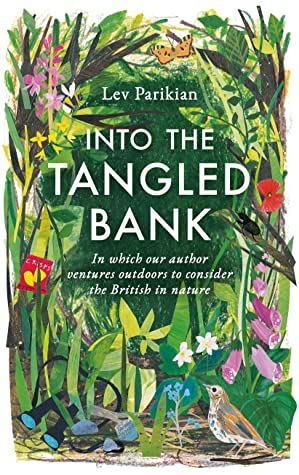 In the same way that kids sometimes write their address by going from the specific to the cosmic (street, city, country, continent, hemisphere, planet, galaxy), this book, a delightfully Bryson-esque tour, moves ever outwards, starting with the author’s own home and garden and proceeding to take in his South London patch and his journeys around the British Isles before closing with the wonders of the night sky. By slowing down to appreciate what is all around us, he proposes, we might enthuse others to engage with nature.
With the zeal of a recent convert, he guides readers through momentous sightings and everyday moments of connection. As they were his gateway, many of these memories involve birds: looking for the year’s first swifts, trying to sketch a heron and realizing he’s never looked at one properly before, avoiding angry terns on the Farne Islands, ringing a storm petrel on Skokholm, and seeing white-tailed eagles on the Isle of Skye. He brings unique places to life, and pays tribute to British naturalists who paved the way for today’s nature-lovers by visiting the homes of Charles Darwin, Gilbert White, Peter Scott, and more.
I was on the blog tour for Parikian’s previous book, Why Do Birds Suddenly Disappear?, in 2018. While the books are alike in levity (pun intended!), being full of self-deprecation and witty asides along with the astute observations, I think I enjoyed this one that little bit more for its all-encompassing approach to the experience of nature. I fully expect to see it on next year’s Wainwright Prize longlist (speaking of the Wainwright Prize, in yesterday’s post I correctly predicted four on the UK nature shortlist and two on the global conservation list!).
Readalikes (that happen to be from the same publisher): Under the Stars by Matt Gaw and The Seafarers by Stephen Rutt
My rating:
My thanks to Elliott & Thompson for the free copy for review.
Memorial Drive: A Daughter’s Memoir by Natasha Trethewey
 Trethewey grew up in 1960s Mississippi with a Black mother and a white Canadian father, at a time when interracial marriage remained illegal in parts of the South. After her parents’ divorce, she and her mother, Gwen, moved to Georgia to start a new life, but her stepfather Joel was physically and psychologically abusive. Gwen’s murder opens and closes the book. Trethewey only returned to that Atlanta apartment on Memorial Drive after 30 years had passed. The blend of the objective (official testimonies and transcripts) and the subjective (interpreting photographs, and rendering dream sequences in poetic language) makes this a striking memoir, as delicate as it is painful. I recommend it highly to readers of Elizabeth Alexander and Dani Shapiro. (Full review forthcoming at Shiny New Books.)
My rating: 
My thanks to Bloomsbury for the proof copy for review.

 I’m reading two more July releases, Mostly Dead Things by Kristen Arnett (Corsair, 2 July; for Shiny New Books review), about a family taxidermy business in Florida, and The Liar’s Dictionary by Eley Williams (William Heinemann, 2 July), about an unusual dictionary being compiled in the Victorian period and digitized in the present day.
What July releases can you recommend?
Writers & Lovers by Lily King
(This was meant to be one entry in a roundup of mini-reviews, but I found that I had far too much to say about it. On Sunday I’ll feature three more May releases I’ve read.)
1997. Following a breakup and her mother’s sudden death, Casey Peabody is drowning in grief and debt. At 31, she lives in a tiny studio apartment off of her brother’s friend’s house and cycles everywhere. Between shifts waitressing at Iris, a trendy restaurant above a Harvard social club, she chips away at the Cuba-set novel she’s been writing for six years.
Through her writer friend Muriel she meets two love interests at a book launch for Oscar Kolton, a former Boston University professor and novelist who’s been leading a fiction workshop since his wife’s death a few years ago. One is the fortysomething Oscar himself; the other, who initially seems more promising, is Silas, a would-be writer from the workshop. But before they have a chance to see if this will go somewhere, Silas is off. He leaves Casey a voicemail saying he needs to get away for a while. Oh well; just another flake, she thinks.
After he and his adorable young sons come in to the restaurant for brunch one day, her interest is squarely in Oscar. Or, that is, until Silas comes back and she finds herself dating two men at the same time. A museum trip with Silas here, a dinner out with Oscar there. As if her love life isn’t complication enough, before long she finds herself looking for a new job, a place to live, a literary agent, and reassurance that she’ll be okay when she takes advantage of her short-lived health insurance to get some minor medical issues checked out.

I almost passed on reading this one because I’d gotten it in my head that it was nothing more than a romantic comedy with a love triangle. I’m so glad that Kate’s review convinced me to give it a try after all. On the face of it this could hardly be more different from King’s previous novel, Euphoria, about anthropologists doing field work in Papua New Guinea in the 1930s, but King’s attention to the intricacies of human relationships links the two. When I read Euphoria in late 2014, I noted the natives’ practice of cutting off a finger for every close relative lost. Here you also get the sense that everyone has lost someone, and that these losses are as visible as physical traits. Casey is only on her second conversation with Silas when she thinks, “I can tell he lost someone close somehow. You can feel that in people, an openness, or maybe it’s an opening that you’re talking into. With other people, people who haven’t been through something like that, you feel the solid wall. Your words go scattershot off of it.”
There are so many things to love about this novel, including the wonderful/terrible scenes where she rattles off her mother’s story to two doctors and her awful father and stepmother show up for lunch. Count the rest: The Boston-area setting, the restaurant bustle, that feeling we’ve all had of wasting our talents while stuck in the wrong job and the wrong living situation. Casey’s confiding first-person, present-tense narration, the little observations on writers (when John Updike comes into the restaurant she touches his loafer for luck; she nearly swoons when Jayne Anne Phillips is at one of her tables—“Black Tickets is like a prayer book to me”; she thinks she’s blown a high school English teacher interview when she states a dislike for Cormac McCarthy—“he seemed to be alternating between imitating Hemingway and imitating Faulkner”), and even the choice between Silas and Oscar (“Fireworks or coffee in bed”). She doesn’t make the ‘right’ choice I was expecting, but if you’ve been following the clues closely you’ll realize it’s the only one she could have made.
What I loved most, though, was that we see this character at rock bottom but also when things start to go well at long last. “There’s a particular feeling in your body when something goes right after a long time of things going wrong. It feels warm and sweet and loose.” I felt I knew Casey through and through, and I cheered for her as I did for Ana in Dominicana by Angie Cruz. Those who have tried writing a book will probably get even more out of this than I did, but it will resonate for anyone who’s ever felt lost and uncertain about life’s direction. “Isn’t our whole life just one long improvisation?” Casey hears at a writing festival.
Think of this as an older, sadder Sweetbitter, perhaps as written by Elizabeth Strout. It gives you all the feels, as they say.
A real standout and one of my few early favorites from 2020.
My rating: 
With thanks to Picador for the unsolicited copy for review.
Five Nonfiction Review Books: Hammond, Iorio, Rault, Riley & Rutt
A diagnosis of motor neurone disease; a father’s dispiriting experience of censorship trials. An illustrated history of fonts; an essay on grief; a cold weather-appropriate record of geese-watching. I gear up for Nonfiction November by catching up on five nonfiction review books I’ve been sent over the last couple of months. You can’t say that I don’t read a variety, even within nonfiction! See if one or more of these tempts you.
A Short History of Falling: Everything I Observed about Love whilst Dying by Joe Hammond
 Hammond, a playwright, takes a wry, clear-eyed approach to his diagnosis of motor neurone disease (ALS) and the knowledge that his physical capacities will only deteriorate from here on out. “New items arrive almost daily and I am unexpectedly becoming the curator of the Museum of my own Decline.” Yet he also freezes funnier moments, like blowing his nose on a slice of bread because he couldn’t reach a tissue box, or spending “six hours of my fiftieth birthday sat on this hospice toilet, with a bottle of good Scotch wedged between my knees.”
Still, Hammond regrets that he’s become like a third small child for his wife Gill to look after, joining his sons Tom and Jimmy, and that he won’t see his boys grow up. (This book arose from an article he wrote for the Guardian in 2018 about making 33 birthday cards for his sons to open in the years after his death.) Although I wasn’t as interested in the details of Hammond’s earlier life, or his relationship with his narcissistic father, I appreciated his quiet acceptance of disability, help and impending death. 
Favorite lines:
“I’ve waited all my life to know this peace. To know that I am nothing more than this body.”
“my place in all of this is becoming smaller, historic and just the right size of important.”
With thanks to 4th Estate for the free copy for review.
An Author on Trial: The Story of a Forgotten Writer by Luciano Iorio
 The author’s father, Giuseppe Jorio, was a journalist and schoolteacher who wrote an infamous novel based on an affair he had in the 1930s. Using italicized passages from his father’s diary and letters to Tina, who was 19 when their affair started, Iorio reconstructs the sordid events and unexpected aftermath in fairly vivid detail. Tina fell pregnant and decided to abort the baby. Meanwhile, Giuseppe’s wife, Bruna, got the truth out of him and responded with more grace than might be expected. Giuseppe was devastated at the loss of his potential offspring, and realized he wanted to have a child with Bruna. He bid Tina farewell and the family moved to Rome, where the author was born in 1937.
Giuseppe’s novel inspired by the affair, Il Fuoco del Mondo (The Fire of the World) was rejected by all major publishers and accused of obscenity in a series of five trials that threatened his reputation and morale. It’s a less familiar echo of the Lady Chatterley’s Lover trial, and a poignant portrait of a man who felt he never lived up to his potential because of bad luck and societal disapproval. I enjoyed learning a bit about Italian literature. However, inconsistent use of tenses and shaky colloquial English (preposition issues, etc.) suggest that a co-writer or translator was needed to bring this self-published work up to scratch.
With thanks to the publicist for the free copy to review as part of a blog tour.
ABC of Typography by David Rault
[Translated from the French by Edward Gauvin]
 From cuneiform to Gutenberg to Comic Sans, this history of typography is delightful. Graphic designer David Rault wrote the whole thing, but each chapter has a different illustrator, so the resulting book is like a taster course in comics styles. As such, I would highly recommend it to those who are fairly new to graphic novels and want to see whose work appeals to them, as well as to anyone who enjoyed Simon Garfield’s book about fonts, Just My Type.
I found it fascinating to explore the technical characteristics (serif vs. sans serif, etc.) and aesthetic associations of various fonts. For instance, I didn’t realize that my mainstay – Times New Roman – is now seen as a staid choice: “Highly readable, but overexposed in the early days of the Internet, it took on a reputation for drabness that it hasn’t shed since the ’90s.” Nowadays, some newspapers and brands pay typeface creators to make a font for their exclusive use. Can you name the typeface that is used on German road signs, or in Barack Obama’s campaign materials? (You’ll be able to after you read this.) 


With thanks to SelfMadeHero for the free copy for review.
Time Lived, Without Its Flow by Denise Riley
 What Virginia Woolf’s essay “On Being Ill” does for sickness, this does for bereavement. Specifically, Riley, whose son Jake died suddenly of a heart condition, examines how the experience of time changes during grief. “I’ll not be writing about death, but about an altered condition of life,” she opens. In short vignettes written from two weeks to three years after her son’s death, she reflects on how her thinking and feelings have morphed over time. She never rests with an easy answer when a mystery will do instead. “What if” questions and “as if” imaginings proliferate. Poetry – she has also written an exquisite book of poems, Say Something Back, responding to the loss of Jake – has a role to play in the acceptance of this new reality: “rhyme may do its minute work of holding time together.”
Max Porter provides a fulsome introduction to this expanded version of Riley’s essay, which first appeared in 2012. This small volume meant a lot more to him than it did to me; I preferred Riley’s poetic take on the same events. Still, this is sure to be a comfort for the bereaved.
Favorite passages:
“I’ll try to incorporate J’s best qualities of easy friendliness, warmth, and stoicism, and I shall carry him on in that way. Which is the only kind of resurrection of the dead that I know about.”
“I don’t experience him as in the least dead, but simply as ‘away’. Even if he’ll be away for my remaining lifetime. My best hope’s to have a hallucination of his presence when I’m dying myself.”
With thanks to Picador for the free copy for review.
Wintering: A Season with Geese by Stephen Rutt
 Rutt’s The Seafarers: A Journey among Birds, one of my favorite recent nature/travel books, came out in May. What have we done to deserve another publication from this talented young author just four months later?! I didn’t enjoy this as much as The Seafarers, yet it does a lot of the same things well: it provides stunning word portraits of individual bird species, explores the interaction between nature and one’s mental state, and gathers evidence of the cultural importance of birds through legends and classical writings.
Here the focus is on geese, which the author had mostly overlooked until the year he moved to southern Scotland. Suddenly they were impossible to ignore, and as he became accustomed to his new home these geese sightings were a way of marking the seasons’ turn. Ethical issues like hunting, foie gras and down production come into play, and, perhaps ironically, the author eats goose for Christmas dinner!
Rutt’s points of reference include Paul Gallico (beware plot spoilers!), Aldo Leopold, Mary Oliver and Peter Scott. The writing in this short book reminded me most of Horatio Clare (especially The Light in the Dark) and Jim Crumley (who’s written many short seasonal and single-species nature books) this time around.
A favorite passage (I sympathize with the feelings of nomadism and dislocation):
“I envy the geese their certainty, their habits of home. I am forever torn between multiple places that feel like home. Scotland where I live or Suffolk, Essex, Norfolk: the flatlands of golden evenings and reeds, mud and water and sand. The distant horizon and all the space in between I grew up with, which seems to lurk somewhere, subconsciously calling me back.”
[Neat aside: My husband and I both got quotes (about The Seafarers) on the press release for this book!]

With thanks to Elliott & Thompson for the free copy.
Would you be interested in reading one or more of these?
Four Recent Review Books: Ernaux, Nunez, Rubin & Scharer
Two nonfiction books: a frank account of an abortion; clutter-busting techniques.
Two novels: amusing intellectual fare featuring a big dog or the Parisian Surrealists.
Happening by Annie Ernaux (2000; English translation, 2019)
[Translated from the French by Tanya Leslie]
 “I believe that any experience, whatever its nature, has the inalienable right to be chronicled,” Ernaux writes. In 1963, when she was 23 and living in a student residence in Rouen, she realized she was pregnant. An appointment with a gynecologist set out the facts starkly: “Pregnancy certificate of: Mademoiselle Annie Duchesne. Date of delivery: 8 July, 1964. I saw summer, sunshine. I tore up the certificate.” Abortion was illegal in France at that time. Ernaux tried to take things into her own hands – “plunging a knitting needle into a womb weighed little next to ruining one’s career” – but couldn’t go through with it. Instead she went to the home of a middle-aged nurse she’d heard about…
This very short book (just 60-some pages) is told in a matter-of-fact style – apart from the climactic moment when her pregnancy ends: “It burst forth like a grenade, in a spray of water that splashed the door. I saw a baby doll dangling from my loins at the end of a reddish cord.” It’s such a garish image, almost cartoonish, that I didn’t know whether to laugh or be horrified. Mostly, Ernaux reflects on memory and the reconstruction of events. I haven’t read many nonfiction accounts of abortion/miscarriage and for that reason found this interesting, but it was perhaps too brief and detached for me to be fully engaged.
My rating:
With thanks to Fitzcarraldo Editions for the free copy for review.
The Friend by Sigrid Nunez (2018)
 “Does something bad happen to the dog?” We animal lovers are wary when approaching a book about a pet. Nunez playfully anticipates that question as she has her unnamed female narrator reflect on her duty of care to her dead friend’s dog. The narrator is a writer and academic – like her late friend, a Bellovian womanizer who recently committed suicide, leaving behind two ex-wives, a widow, and Apollo the aging Great Dane. She addresses the friend directly as “you” for almost the whole book, which unfolds – in a similar style to Jenny Offill’s Department of Speculation – via quotations, aphorisms, and stories from literary history as well as mini-incidents from a life.
This won the 2018 National Book Award in the USA and is an unashamedly high-brow work whose intertextuality comes through in direct allusions to many classic works of autofiction (Coetzee, Knausgaard and Lessing) and/or doggy lit (Ackerley; Coetzee again – Disgrace). As Apollo starts to take up more physical, mental and emotional space in the narrator’s life, she waits for a miracle that will allow her to keep him despite an eviction notice and muses on lots of questions: Is all writing autobiographical? Why does animal suffering pain us so much (especially compared to human suffering)? I was impressed: it feels like Nunez has encapsulated everything she’s ever known or thought about, all in just over 200 pages, and alongside a heart-warming little plot. (Animal lovers need not fear.)
My rating:
With thanks to Virago for the free copy for review.
Outer Order, Inner Calm: Declutter and Organize to Make More Room for Happiness by Gretchen Rubin (2019)
 What with all the debate over Marie Kondo’s clutter-reducing tactics, the timing is perfect for this practical guide to culling and organizing all the stuff that piles up around us at home and at work. Unlike the rest of Rubin’s self-help books, this is not a narrative but a set of tips – 150 of them! It’s not so much a book to read straight through as one to keep at your bedside and read a few pages to summon up motivation for the next tidying challenge.
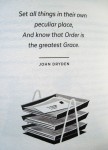 Famously, Kondo advises one to ask whether an item sparks joy. Rubin’s central questions are more down-to-earth: Do I need it? Do I love it? Do I use it? With no index, the book is a bit difficult to navigate; you just have to flip through until you find what you want. The advice seems in something of a random order and can be slightly repetitive. But since this is really meant as a book of inspiration, I think it will be a useful jumping-off point for anyone trying to get on top of clutter. I plan to work through the closet checklist before I pass the book to my sister – who’s dealing with a basement full of stuff after she and her second husband merged their households. If I could add one page, it would be a flowchart of what to do with unwanted stuff that corresponds to the latest green recommendations.
My rating:
With thanks to Two Roads for the free copy for review.
The Age of Light by Whitney Scharer (2019)
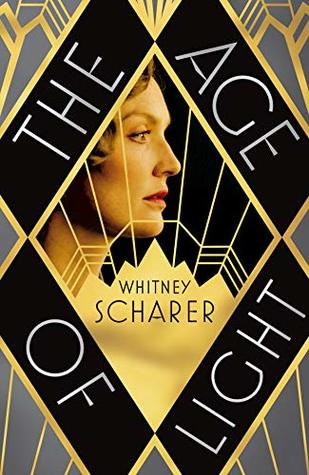 This novel about Lee Miller’s relationship with Man Ray is in the same vein as The Paris Wife, Z, Loving Frank and Frieda: all of these have sought to rescue a historical woman from the shadow of a celebrated, charismatic male and tell her own fascinating life story. Scharer captures the bohemian atmosphere of 1929–30 Paris in elegant but accessible prose. Along with the central pair we meet others from the Dada group plus Jean Cocteau, and get a glimpse of Josephine Baker. The novel is nearly 100 pages too long, I think, such that my interest in the politics of the central relationship – Man becomes too possessive and Lee starts to act out, longing for freedom again – started to wane.
Miller was a photographer as well as a model and journalist, and this is an appropriately visual novel that’s interested in appearances, lighting and what gets preserved for posterity. It’s also fairly sexually explicit for literary fiction, sometimes unnecessarily so, so keep that in mind if it’s likely to bother you. I especially enjoyed the brief flashes of Lee at other points in her life: in London during the Blitz, photographing the aftermath of the war in Germany (there’s a famous image of her in Hitler’s bathtub), and hoping she’s more than just a washed-up alcoholic in the 1960s. It would be a boon to have a prior interest in or some knowledge of the Surrealists.
My rating:
With thanks to Picador for the free copy for review.
Would you be interested in reading one or more of these?
This Really Isn’t About You by Jean Hannah Edelstein
This was the book I wanted Places I Stopped on the Way Home to be: a wry, bittersweet look at the unpredictability of life as an idealistic young woman in the world’s major cities. Edelstein’s memoir also fits into several of my favorite subgenres: it’s a family memoir, a medical memoir and a bereavement memoir all at once. The story opens in Brooklyn in February 2014 as Edelstein, age 32, is trying to build an adult life back in America after 14 years in London and Berlin. Two years earlier her father had told her via Skype from Baltimore that he had lung cancer, and she returned to the States to be closer to help. But when the moment came, she was still unprepared: “if someone had said to me: What would you like to be doing when your father dies? I would not have said, I would like to be looking for love on OKCupid. But I did not have the luxury to make that decision. Who does?”
 Her father never smoked yet died of lung cancer; his mother had colon cancer and died at 42. Both had Lynch syndrome, a genetic disease that predisposes people to various cancers. Six months after her father’s death, Edelstein took a genetic test, as he had wanted her to, and learned that she was positive for the Lynch syndrome mutation. The book’s structure (“Between” – “Before” – “After”) plunges readers right into the middle of the family mess, then pulls back to survey her earlier life, everything from childhood holidays in her mother’s native Scotland to being a secretary to a London literary agent who hated her, before returning to the turning point of that diagnosis. How is she going to live with this knowledge hanging over her? Doctors want her to have a prophylactic hysterectomy, but how can she rule out children when she doesn’t yet have a partner in her life?
So many aspects of this book resonated for me, especially moving between countries and having a genetic disease in the family. Beyond those major themes, there were tiny moments that felt uncannily familiar to me, like when she’s helping her mother prepare for an online auction of the contents of the family home in Maryland, or comparing the average cleanliness and comfort of rental properties in England and the States. There are so many little memorable scenes in this memoir: having an allergic reaction to shellfish two days after her arrival in the States, getting locked out of her sublet and having to call an Uzbek/Israeli locksmith at 3 a.m., and subsisting on oatmeal three times a day in London versus going on all-expenses-paid trips to Estonia and Mauritius for a conference travel magazine.
This is a clear-eyed look at life in all its irony (such as the fact that she’s claustrophobic and dreads getting MRI tests when it was her own father, a nuclear physicist, who built the world’s first full-body MRI scanner at Aberdeen) and disappointment. I’m prizing this as a prime example of life writing that’s not comprehensive or strictly chronological yet gives a clear sense of the self in the context of a family and in the face of an uncertain future.
My rating:
Readalikes:
The Family Gene by Joselin Linder
My Salinger Year by Joanna Rakoff
Mrs Gaskell & Me by Nell Stevens
Favorite lines:
“when I was in London, … I wondered if the problem of having my whole life ahead of me, free and clear and open for anything, was that having an unlimited number of options made the chance of choosing the wrong thing so high.”
“I was not yet old enough to realize that I’d never really know, that there would never be a time when I could think: I am here. This is me, without becoming uncertain again a moment later.”
“When I lived in England I drank a lot of tea, many cups a day, even though I didn’t like it. I learned quite fast after I arrived in London that drinking tea was an important way to connect with people: when I went over to their homes, or if we worked together in an office. Being offered a cup of tea meant that you were being offered an entry to something, and accepting it was important.”
This Really Isn’t About You was published by Picador on August 23rd. My thanks to the publisher for the free copy for review.
Two Memoirs of Women’s Freedom: Lara Feigel and Rebecca Loncraine
I have read some truly phenomenal memoirs this year, most of them by women. These two have rather different starting points – frustration with the constraints of marriage and motherhood, and breast cancer treatment – but I’ve paired them because both are journeys of self-discovery in which the author commits to determining how to live a free and true life.
Free Woman: Life, Liberation and Doris Lessing by Lara Feigel
 It started with a spate of weddings one summer. Lara Feigel, a literature lecturer at King’s College London, found herself strangely irked at all this capitulation to marital convention, even though she herself had married in her twenties and had a young son. What did her mild outrage signify? At the same time, she was rereading the works of Doris Lessing, whom she found simultaneously admirable and vexing: Lessing lived by her ideals of free love and Communism, but it came at the price of abandoning her children. Feigel could identify with Lessing in some ways but not in others, and as she entered a rocky time in her mid-thirties – a miscarriage followed by IVF, which was a strain on her marriage; the death of a close friend; and ongoing worry over how motherhood might affect her academic career – she set out to find what Lessing could teach her about how to be free.
Throughout, Feigel holds up her own experiences of marriage and motherhood in parallel to Lessing’s. She maintains a delicate balance between biographical and autobiographical information and brings in references to other writers – everyone from Rachel Cusk to D.H. Lawrence – to explore various opinions on maternal ambivalence and sexual fulfillment. I could relate to the bookworm’s impulse to turn to literature for comfort and direction – “the most enduring novelists … illuminate our lives,” and “we live differently as a result of reading them,” Feigel insists. Lessing seemed to her the perfect “writer to discover in your thirties; a writer who wrote about the lives of grown-up women with an honesty and fullness I had not found in any novelist before or since.”
And yet a familiarity with or fondness of the works of Doris Lessing is not a prerequisite to enjoying this book. I’ve only ever read The Golden Notebook (1962) and Alfred and Emily (2008), a fictionalized biography of Lessing’s parents, both during my mid-twenties. The former I almost certainly read before I could fully appreciate it. It’s about the ways in which women compartmentalize their lives and the struggle to bring various strands into harmony; that’s what Free Woman is all about as well. Feigel often looks for clues in Lessing’s heavily autobiographical Martha Quest novels, which I’d like to read, and also travels to California to meet one of Lessing’s lovers and to Zimbabwe to see the farm where Lessing grew up.
Like Samantha Ellis’s How to Be a Heroine and Rebecca Mead’s My Life in Middlemarch, this is a richly satisfying hybrid of biography, literary criticism and memoir. I would also recommend it to readers of Alexandra Fuller’s Don’t Let’s Go to the Dogs Tonight, Nancy Horan’s Loving Frank, and Adrienne Rich’s Of Woman Born. Feigel’s is a particularly brave and forthright book. I feel proud of her in an oddly personal way: during my years as a library assistant at King’s, I saw her chair countless literature and life writing events. She seemed impossibly young for a professor type, and wore her navy blue shift dress and string of pearls like it was her grown-up’s uniform. I can tell that the years since, including the difficult experiences she recounts here, have both softened and toughened her, sandpapering away what she calls her “diffident angularity” and replacing it with womanly wisdom.
My rating: 
Free Woman was published by Bloomsbury UK on March 8th. My thanks to the publisher for the free copy for review.
Skybound: A Journey in Flight by Rebecca Loncraine
 In 2016 it was When Breath Becomes Air by Paul Kalanithi; in 2017 it was The Bright Hour by Nina Riggs. And now Skybound. Each year seems to bring one exquisite posthumous memoir about facing a death from cancer with dignity. For Rebecca Loncraine, after treatment for breast cancer in her early thirties, taking flying lessons in an unpowered glider was her way of rediscovering joy and experiencing freedom by facing her fears in the sky.
She was a freelance writer based on her parents’ farm in the Black Mountains of Wales, an area that’s familiar to me from trips to Hay-on-Wye and from my reading of Bruce Chatwin’s On the Black Hill. The history and geography of the region, as revealed from the air, weave through the book, as do childhood memories and recollections of chemotherapy. Loncraine discovered a particular love for flying alongside birds: the red kites in Wales, and later vultures in Nepal. The most remarkable passages of the book are the exhilarating descriptions of being thousands of feet up in the air and the reflections on why humans are drawn to flight and what it does for our bodies and spirits. She learned from a British Airways pilot that 500,000 people are airborne at any one moment! We take for granted what should still be acknowledged as a miraculous feat.
“There’s no road in the sky. Each individual glider pilot finds a new pathless way through the air, a unique scribble. We locate a bit of ridge lift, here; fly out to a thermal, there; we wind and manoeuvre over the curving land. We never take the same route twice, so flight offers me a new perspective each time I fly.”
“Influenced by the ancient seam of human thought that associates the sky with the imagination, weaving and circling in the sky begins to feel like sailing through the realm of the subconscious itself.”
This hobby-turned-obsession was not without its inconveniences and dangers. Even when it’s warm at ground level it’s frigid at 13,000 feet, so you have to bundle up. Meanwhile, the strength of the sun means you keep guzzling water and have to wear either a urine-collecting device or adult diapers. The earliest attempts at unpowered flight were generally fatal, and when Loncraine went to New Zealand for a bonus season of flying to replace the Welsh winter, one of her fellow flyers died in a crash. Her instructor told her she’d become fearless, even reckless. But when she met one of the pioneers of gliding, then in his nineties, in New Zealand he spoke an aphorism that perfectly captures the role flying played for Loncraine: “The antidote to fear is fascination.”
There’s a brief afterword by Loncraine’s mother, Trisha. Her daughter had virtually finished this manuscript when the cancer returned, and underwent another 14 grueling months of treatment before her death in September 2016. This is a simply wonderful book; what a shame that we won’t get another.
My rating:
Skybound was published by Picador on April 19th. My thanks to the publisher for a proof copy for review.
Better Late than Never: The Nix by Nathan Hill
I was wary of Nathan Hill’s debut novel, The Nix, as I always am of big ol’ books. Six hundred and twenty pages of small print: was it going to be worth it? Luckily, the answer was a resounding yes. If you’ve loved The World According to Garp, City on Fire, The Goldfinch, and/or Your Heart Is a Muscle the Size of a Fist, you should pick this one up right away. From the first few pages onwards, I was impressed by Hill’s carefully honed sentences. He mixes up the paragraph arrangement in a particularly effective way, such that long thoughts are punctuated by a killer one-liner given a paragraph of its own. Here’s one: “How easily a simple façade can become your life, can become the truth of your life.”
In 2011 Samuel Anderson and his estranged mother, Faye, find themselves in strange situations. Samuel is an assistant English professor at a small suburban Chicago college. Once the Next Big Thing, feted by Granta for a brilliant short story, he has never delivered his contracted novel and spends more time in the World of Elfscape online game than he does engaging in real life. Now Laura Pottsdam, a student he caught plagiarizing a Hamlet essay, is on a mission to take Samuel down. Meanwhile Faye is awaiting trial for throwing rocks at Governor Packer, a conservative presidential hopeful from Wyoming. It’s been 23 years since Faye walked out on Samuel and his father, but her lawyer still hopes Samuel will be willing to write a character reference to be used in her defense, prompting their awkward reunion.
 This is a rich, multi-layered story about family curses and failure, and how to make amends for a life full of mistakes. Along with 2011, the two main time periods are 1968, when Faye was a would-be radical caught up in student violence; and 1988, the summer before Faye left, when Samuel met twins Bishop and Bethany Fall, two friends who would still be having an impact on his life decades later even though they moved away after a few months. Although most of the action takes place in Iowa and Chicago, there’s also a brief interlude set in Norway when Faye tries to track down the ghosts of her father’s homeland. He’d told her stories of the nisse and the Nix, a house spirit and a water spirit in the form of a giant horse: both lead greedy children to their doom, a terrifying prospect for an anxious girl like Faye.
Political protest is a thread running all through the novel, though it never drowns out the centrality of the mother–son relationship: the 1968 Grant Park protest Faye attends in Chicago, the anti-Iraq War march Samuel and Bethany go on in 2004, the Occupy demonstrations taking place in 2011, and Faye’s odd transformation into the Packer Attacker. Hill makes cogent comments on contemporary America, where the “pastime is no longer baseball. Now it’s sanctimony.” Young people parcel emotions into easy categories for social media, which also markets ready-made heroes (pop singer Molly Miller) and villains (Faye).
Hill is a funny and inventive writer; a few of his more virtuosic moments include an argument with headings indicating its logical fallacies, a relationship presented as a Choose Your Own Adventure story, and a nearly-eleven-page sentence in which a character has a health crisis. These sections are almost too long – Come now, you’re just showing off, I thought. But changing up the structure like that does mean that the novel is never boring, and its reflections on self-knowledge and how we get lost, stuck in patterns of our own creating, made me think deeply. This is one debut that really does live up to the hype; look out for it, and for the upcoming television adaptation directed by J.J. Abrams and starring Meryl Streep.
My rating:
First published in August 2016, The Nix was released in the UK in paperback on September 21st. My thanks to Picador for the free copy for review.
My Salinger Year and Hotel Alpha
My Salinger Year by Joanna Rakoff
“Publishing, books, life. … It seemed possible to get one right. But not all three.”
 I’ve hardly read any Salinger, but that’s okay – neither had Joanna Rakoff until about two-thirds of the way through her year working for the legendary recluse’s literary agency in New York City. One long weekend she gorged on his complete works and found – in a man she’d previously encountered only as a shouting elderly voice on the phone – a kindred spirit.
This was 1996, and Rakoff was 23 years old, living with a boyfriend who didn’t appreciate her in a crummy apartment and harboring secret literary ambitions. On the cusp of the digital world, the Agency still resisted computers. Rakoff did most of her work on a typewriter and read manuscripts from the slush pile, extracting a couple of promising ones and getting a colleague to read her boyfriend Don’s unpublishable novel in turn. She had heavy student loans after graduate studies in London, and could barely afford a daily deli salad for lunch.
Mostly Rakoff spent her time typing form letters to Salinger’s fans, informing correspondents that he had asked not to have his letters forwarded. Believing she might make a difference, she went off-piste and started writing personal replies to some of the more wrenching letters: war veterans, struggling students, and a quiet young man who didn’t know what to do with his emotions. Alas, it backfired: more often than not she’d get an angry response, with the writer objecting to her presuming to take the place of Salinger and dispense life advice.
It’s remarkable how, at a distance of nearly 20 years, Rakoff makes this all seem like it happened yesterday: she adds in just the right amount of what Mary Karr, in The Art of Memoir, calls “carnal detail” to make her story seem timely and believable. The tone is nostalgic but also bittersweet – while it was a precious year, Rakoff also realizes what she could have done better (chiefly, ditching Don sooner).
Especially for female readers, this will instantly take you back to your own immediate post-college days of trying to figure out what life is about and who you wanted to be. “Was it possible, too, that one could be complicated, intellectual, awake to the world, that one could be an artist, and also be rosy and filled with light? Was it possible that one could be all those things and also be happy?”
With thanks to Bloomsbury for my free copy, won in a Facebook giveaway.
My rating: 
Hotel Alpha by Mark Watson
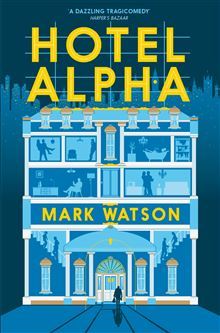 You may be unsurprised to learn there’s a touch of The Grand Budapest Hotel to this one. Hotel founder Howard York, though he sounds an awful lot like an Ayn Rand creation (i.e. Howard Roark, the architect-hero of The Fountainhead), is most like the Ralph Fiennes character. He uses his influence to finagle anything for a guest; “you could believe, sitting here in his castle, that he really did mean to live a couple of centuries and that everything he had built would still be standing around him.” But even he can’t stop tragedy; a fire at the hotel in the 1980s orphaned and blinded a small boy named Chas, who Howard then adopted.
The novel is told in alternating first-person chapters from Chas and Graham, the hotel concierge. Graham reminded me of Stevens in The Remains of the Day: very proper, even uptight, but with a hidden passion. Technology’s advance helps Chas immensely, but makes Graham feel superseded; “I have lived a great part of my own life in homage to my own past,” he acknowledges.
Key events take place between 2001 and 2005, with a historical backdrop including 9/11, the Olympic bid, and the 7/7 bombings. Chas works in PR and is involved with Kathleen, a journalist who’s opposed to the Iraq War. Howard, on the other hand, always supports the winning team and status quo. He is also a man of secrets. Why did Chas’s tutor, Ella, and Graham’s assistant, Agatha, both suddenly leave the hotel for America years ago? It all has to do with the legend of what happened the night of the fire, the truth of which will be exposed in time.
Watson is a stand-up comedian as well as the author of several novels. I like how he shows both the good and bad sides of technology here. My favorite part was Chas’s visit to China with Kathleen; even though he’s mostly stuck in a hotel, he still experiences extreme culture shock.
There are another 100 stories about the Hotel Alpha on the website, eight of which are printed as an appendix to the paperback edition. Much as I liked the main characters (especially Agatha), I didn’t think the two voices were distinctive enough – I wish Watson had incorporated more of the stories’ narrative variety (some first-person and some third-person) into the novel itself.
My rating: 
With thanks to Picador for my free copy, won in a newsletter giveaway.
 Bookish Beck = Rebecca Foster. American transplant to England. Freelance proofreader and book reviewer.
 Bookish Beck