“Cat Poems” & Other Cats I’ve Encountered in Books Recently
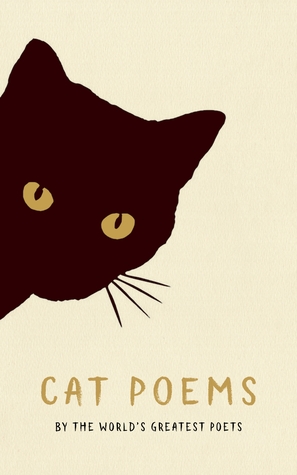 Cat Poems: An enjoyable selection of verse about our feline friends, nicely varied in terms of the time period, original language of composition, and outlook on cats’ contradictory qualities. I was unaware that Angela Carter and Muriel Spark had ever written poetry. There are perhaps too many poems by Stevie Smith – six in total! – though I did enjoy their jokey rhymes.
Some favorite lines:
“Cat sentimentality is a human thing. Cats / are indifferent, their minds can’t comprehend / the concept ‘I shall die’, they just go on living.” (from “Sonnet: Cat Logic” by Gavin Ewart)
“For every house is incomplete without him and a blessing is lacking in the spirit.” (from “Jubilate Agno” by Christopher Smart)
“These adorable things. When my life gives out, they’d eat me up in a second.” (from “I’ll Call Those Things My Cats” by Kim Hyesoon)
My rating: 
Cat Poems was published in the UK on October 4th. My thanks to Serpent’s Tail for the free copy for review.
Even when it’s not a book specifically about cats, cats often turn up in my reading. Maybe it’s simply that I look out for them more since I became a cat owner several years ago. Here are some of the quotes, scenes or whole books featuring cats that I’ve come across this year.
Cats real and imaginary
 Stranger on a Train by Jenni Diski: “I find myself astonished that a creature of another species, utterly different to me, honours me with its presence and trust by sitting on me and allowing me to stroke it. This mundane domestic moment is as enormous, I feel at such moments, as making contact across a universe with another intelligence. This creature with its own and other consciousness and I with mine can sit in silence and enjoy each other’s presence. … This is a perfectly everyday scene but sometimes it takes my breath away that another living thing has allowed me into its life.”
 Certain American States by Catherine Lacey: “This cat wants to destroy beauty—I can tell. He is more than animal, he is evil, a plain enemy of the world. I wish him ill. I do. Almost daily I find a mess of feathers in the dirt. Some mornings there are whole bird carcasses left on my porch—eyes shocked open, brilliant blue wings, ripped and bloody. I have thought often of what it would take to kill a cat, quietly and quickly, with my bare hands. I have thought of this often. In fact I am thinking of it right now.” (from the story “Because You Have To”)
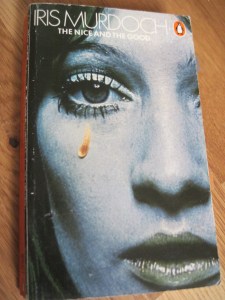 The Nice and the Good by Iris Murdoch: “Montrose was a large cocoa-coloured tabby animal with golden eyes, a square body, rectangular legs and an obstinate self-absorbed disposition, concerning whose intelligence fierce arguments raged among the children. Tests of Montrose’s sagacity were constantly being devised, but there was some uncertainty about the interpretation of the resultant data since the twins were always ready to return to first principles and discuss whether cooperation with the human race was a sign of intelligence at all. Montrose had one undoubted talent, which was that he could at will make his sleek hair stand up on end, and transform himself from a smooth stripey cube into a fluffy sphere. This was called ‘Montrose’s bird look’.”
 Four Bare Legs in a Bed and Other Stories by Helen Simpson: “They found it significant that I called my cat Felony. I argued that I had chosen her name for its euphonious qualities. She used to sink her incisors into the hell of my hand and pause a fraction of a millimeter from breaking the skin, staring at me until her eyes were reduced to sadistic yellow semibreves. She murdered without a qualm. She toyed with her victims, smiling broadly at their squeaks and death throes.
‘Why isn’t she a criminal?’ I asked. …
‘The difference is,’ said Mr Pringle, that we must assume your cat commits her crimes without mischievous discretion.’” (from the story “Escape Clauses”)
 In Delia Owens’s Where the Crawdads Sing, Sunday Justice is the name of the courthouse cat. He sits grooming on the courtroom windowsill during the trial and comes in and curls up to sleep in the cell of a particular prisoner we’ve come to care about.
A recommended picture book
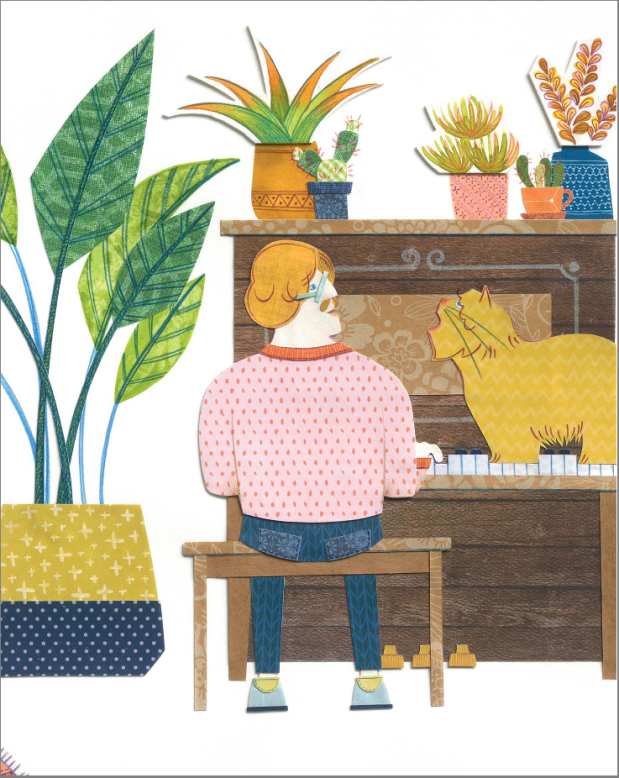
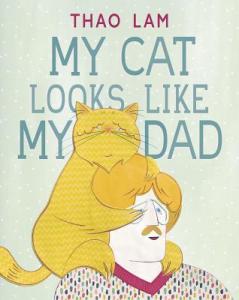 My Cat Looks Like My Dad by Thao Lam: I absolutely loved the papercut collage style of this kids’ book. The narrator explains all the ways in which the nerdy-cool 1970s-styled dad resembles the family cat, who is more like a sibling than a pet. “Family is what you make it.” There’s something of a twist ending, too. (Out on April 15, 2019.)
My rating: 
Later today I’m off to America for two weeks, but I’ll be scheduling plenty of posts, including the usual multi-part year-end run-down of my best reads, to go up while I’m away. Forgive me if I’m less responsive than usual to comments and to your own blogs!
New Networks for Nature 2018
This past weekend was my fourth time attending part of Nature Matters, the annual New Networks for Nature conference. I’ve written about it here a couple of times, once when there was a particular focus on nature poetry and another time when it was held in Cambridge. This year it was back in Stamford for a last time for the 10th anniversary. Next year: York.
What’s so special about the conference is its interdisciplinary nature: visual artists, poets, musicians, writers, politicians, academics and conservationists alike attend and present. So although the event might seem geared more towards my biologist husband, there’s always plenty to interest me, too. The roster is a who’s who of British nature writing: Mark Avery, Tim Birkhead, Mark Cocker, Mary Colwell, Miriam Darlington, Richard Kerridge, Peter Marren, Michael McCarthy, Stephen Moss, Adam Nicolson, Katharine Norbury, Ruth Padel, Laurence Rose and Mike Toms were all there this year. I also appreciate the atmosphere of friendly disagreement about what nature is and how best to go about conserving it.
I attended on Friday, a jam-packed day of sessions that began with Bob Gibbons presenting on the flowers and wildlife of Transylvania, a landscape and culture that are still almost medieval in character. Then Jeremy Mynott interviewed Mark Cocker about his latest book, Our Place: Can We Save Britain’s Wildlife before It Is Too Late? I’ve read other Cocker books, but not this one yet. Its main point seems to be that the country’s environmental organizations need to work together. Individuals and NGOs are doing passionate and wonderful things towards nature conservation, Cocker said, but overall “we ain’t getting there.” Bad news doesn’t sell, though, he noted: his book has sold just 6,000 copies compared to 30,000 for Wilding, Isabella Tree’s story of the rewilding success at Knepp.
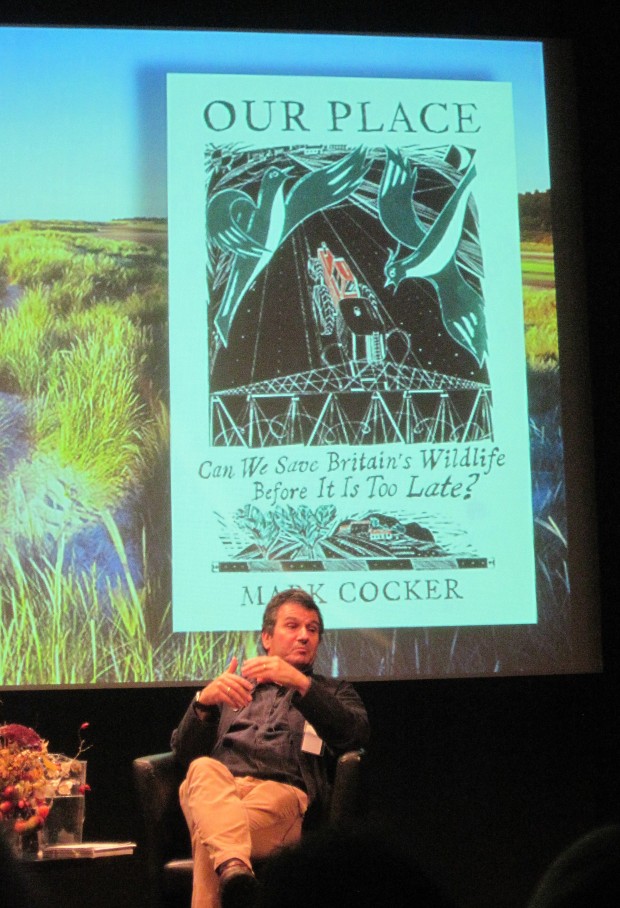
Mark Cocker
Cocker refused to define nature in a one-sentence soundbite, but argued that we have to consider ourselves a part of it rather than thinking about it as a victim ‘out there’ (the closest he came to a definition was “the totality of the system we are a part of”). “Our responsibility, terrifyingly, is unending,” he said – every time you open a new plastic toothbrush, you can’t forget that the old one you throw away will effectively be around forever. Our Place isn’t just composed of polemic, though: it’s structured around six beloved landscapes and finds moments of transcendence in being out in nature. You find hope by walking out the door, feeling the wind on your face and hearing the starling singing, Cocker remarked. He closed by reading a description from the book of the north Norfolk coast.
Either side of lunch were panels on how social media (mostly Twitter, plus smartphone apps) can serve nature and the role that poetry might play in environmental activism, with a brief interlude from visual artist Derek Robertson, who responded to the refugee crisis by traveling to Calais and Jordan and painting human figures alongside migratory birds. In the poetry session I especially enjoyed hearing from Ben Smith, a University of Plymouth lecturer and poet with a debut novel coming out in April 2019 (Doggerland, from Fourth Estate). He recently collaborated with Dr. Lee de Mora on a set of poems inspired by the Earth System Model, which provides the data for the International Panel on Climate Change. Climate modeling might seem an odd subject for poetry, but it provides excellent metaphors for failure and hope in “Spinning Up,” “Data Sets” and “Alternate Histories.”
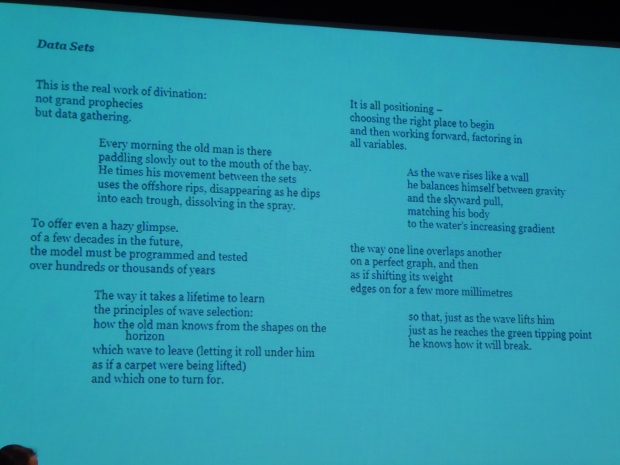
Ben Smith’s poem links unlikely subjects: surfing and climate modeling. Photo by Chris Foster.
Birmingham lecturer Isabel Galleymore, whose debut collection Significant Other is coming out from Carcanet Press in March, talked about how she uses the tropes of love poetry (praise, intimacy, pursuit and loss) when writing about environmental crisis. This shift in her focus began at university when she studied Wordsworth through an ecocritical lens, she said. Jos Smith and Luke Thompson were the other two poets on a panel chaired by Matt Howard. Howard quoted Keats – “We hate poetry that has a design on us” – and asked the poets for reactions. Smith agreed that polemic and poetry don’t mix well, yet said it’s good to have a reason for writing. He thinks it’s best when you can hold two or more ideas in play at a time.
After tea and a marvelous cake spread, it was time for a marathon of three sessions in a row, starting with three short presentations on seabirds: one by a researcher, one by a nature reserve manager, and one by a young artist who produced Chinese-style scroll paintings of the guillemot breeding colonies on Skomer and exhibited them in Sheffield Cathedral.
Next up was a highlight of the weekend: Green Party MP Caroline Lucas and Labour peer Baroness Barbara Young conversed with Michael McCarthy on the topic “Can Conventional Politics Save the Environment?” Both decried short-term thinking, the influence of corporations and the media, and government departments not working together. No one was ever elected on the promise of “less,” McCarthy suggested, but in reply Lucas talked about redefining terms: less of what? more of what? If we think in terms of quality of life, things like green energy and the sharing economy will become more appealing. She also believes that more people care about green issues than we think, but, e.g., a London mum might speak out about air quality without ever using the word “environment.” Baroness Young concluded that “adversarial politics, flip-flopping between parties, isn’t working” and we must get beyond it, at the local level if nothing else. That rang true for me for American politics, too.
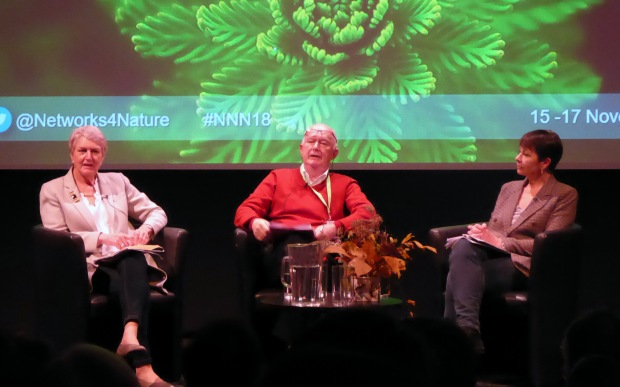
Young, McCarthy and Lucas. Photo by Chris Foster.
Before the day ended with a drinks reception, we were treated to a completely different presentation by Lloyd Buck, who raises and trains birds, mostly for television footage. So, for instance, the greylag geese flying in formation alongside the boat in David Attenborough’s 2012 Sixty Years in the Wild TV special had imprinted on Lloyd’s wife, Rose. Buck spoke about bonding with birds of very different personalities, and introduced the audience to five starlings (who appeared in Poldark), a peregrine, a gyrfalcon, a golden eagle, and Bran the raven, who showed his intelligence by solving several puzzles to find hidden chunks of meat.


I purchased two books of poetry from the bookstall – I had no idea Darlington had written poetry before her nature books – and the conference brochure itself is a wonderful 75-page collection of recent artwork and short nature writing pieces, including most of the presenters but also Patrick Barkham, Tim Dee, Paul Evans, Philip Hoare, Richard Mabey, Helen Macdonald and Chris Packham – a keynote speaker announced for next year. I’ve been skipping through the booklet and have most enjoyed the pieces by Melissa Harrison and Helen Scales so far. Altogether, an inspiring and worthwhile weekend.
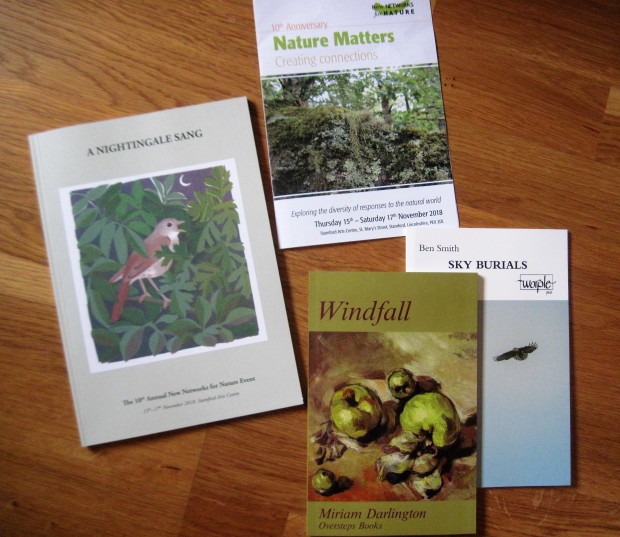
Would any of the conference’s themes or events have interested you?
Novellas in November, Part 1: 3 Fiction, 3 Nonfiction
This is my third year of prioritizing novellas for my November reading. I have plenty more on the go that I’ll try to write up as the month progresses. For this first installment I review three each of my recent fiction and nonfiction reads, all of them 150 pages or fewer.

Fiction:
Lady into Fox by David Garnett (1922)
[53 pages]
 I accidentally did things the wrong way round: a few months back I read Sarah Hall’s Madame Zero, which includes the BBC National Short Story Prize 2013 winner “Mrs Fox,” clearly modeled on Garnett’s half-charming, half-horrible fable. In both, an upper-middle-class marriage is derailed when the wife turns into a fox. Here Mr. Tebrick sends away the servants and retreats from the world to look after Silvia, who grows increasingly feral. To start with the vixen will wear clothing, sleep in a bed, play cards and eat table scraps, but soon she’s hunting birds outdoors. Before long she’s effectively a wild creature, though she still shows affection to Tebrick when he comes to visit her den.
Anyone in a partnership will experience a bittersweet sense of recognition at how Tebrick and Silvia try to accommodate each other’s differences and make compromises to maintain a relationship in defiance of the world’s disapproval and danger. Beware unsentimental animal peril throughout. I downloaded it from Project Gutenberg. 
The Old Man and the Sea by Ernest Hemingway (1952)
[99 pages]
 It’s a wonder I never read this Pulitzer winner in high school. Like that other syllabus favorite, Steinbeck’s The Pearl, it’s a Great American novella praised for spare prose and weighty symbolism. My two decades’ worth of preconceptions were proven accurate insomuch as this is a gloomy story about the nobility but ultimate futility of human striving. After 84 days without a catch, Santiago returns to the waters off of Havana and finally gets a bite. Even after the harrowing process of reeling in the 18-foot marlin, his struggle isn’t over.
This is my third experience with Hemingway’s fiction; I remain unconvinced. I appreciated some of the old man’s solitary ruminations on purpose and determination – “My big fish must be somewhere,” “Now is no time to think of what you do not have. Think of what you can do with what there is” – though they sound rather like sound bites. And I kept almost falling asleep while reading this (until the sharks showed up), which almost never happens. Take that as you will. 
Ghost Wall by Sarah Moss (2018)
[149 pages]
 It’s the late 1980s and teenager Silvie Hampton and her parents have joined a university-run residential archaeology course in the North of England, near bogs where human sacrifice once took place. Her father is a Rochdale-area bus driver, but British prehistory is his all-consuming hobby. They’ll skin rabbits with stone tools and forage for roots and berries. What could be better?! As it turns out, it’s a stifling summer, and the students can’t sneak off to civilization often enough. Mocked for her family’s accent, Silvie is uncomfortably aware of her class. And, always, she must tread carefully to avoid angering her father, who punishes perceived offenses with his belt or his fists.
Women’s bodies and what can be done to them is central; as the climax approaches, the tricksy matter of consent arises. Though I enjoyed Silvie’s sarcastic voice, I was underwhelmed for much of the book, yet ended up impressed by how much is conveyed in so few pages. If you haven’t read anything by Sarah Moss, do so immediately.
Nonfiction:
Losing Susan: Brain Disease, the Priest’s Wife, and the God Who Gives and Takes Away by Victor Lee Austin (2016)
[146 pages]
 Austin, an Episcopal priest and academic, met his wife Susan at St. John’s College in Santa Fe, New Mexico. She was his companion for nearly 40 years. Unusually for a cancer story, it wasn’t the beginning of the end when Susan was diagnosed with an astrocytoma brain tumor in 1993; surgery was successful and she lived for another 19 years, but white-matter disease, a side effect of radiation, meant that her brain function was continually diminishing.
The book gives a clear sense of Susan’s personality despite the progression of her illness, and of the challenges of being a caregiver while holding down a career. I enjoyed the details of the human story of coping with suffering, but in overlaying a spiritual significance on it Austin lost me somewhat. “God, who had given us so much, now gave us this evil,” he writes. While once this kind of language would have meant something to me, now it alienates me. I valued this more as a straightforward bereavement memoir than as a theological treatise.
The Secret Life of the Owl by John Lewis-Stempel (2017)
[84 pages]
 “There is something about owls. More than any other family of birds they produce a reaction in us, and have done so across time and continents.” Some species-specific natural/cultural histories can be long-winded, giving significantly more information than your averagely interested lay reader needs (Foxes Unearthed, for instance), but Lewis-Stempel’s short book about Britain’s owls gets it just right.
He gives some general information about the family, surveys the native species and occasional visitors, gives tips for telling them apart – I’m going to photograph a page on the difference between the five major species’ pellets for future reference – and shares legends and poems that feature owls (including a jaunty little Tennyson piece that reads like a folk song; I’ll suggest that my husband turn it into one). The black-and-white illustrations by Beci Kelly are charming, too. It’s a shame I missed this when it first came out, but it would still make a great gift for a bird lover this Christmas.
Pages from a Nature-Lover’s Diary by Kathleen A. Renninger (2013)
[72 pages]
 These are lovely excerpts from nature sketchbooks Renninger kept between 1987 and 2013. My mother bought the self-published book from the author at a craft fair, and I enjoyed spotting lots of familiar place names from southern central Pennsylvania, where my mother and sister used to live. In the past I’ve unfairly considered the area devoid of natural beauty, but it’s clear from Renninger’s encounters that the wildlife is out there if you’re patient and lucky enough to find it – mostly birds and insects, but even larger mammals like foxes and bears.
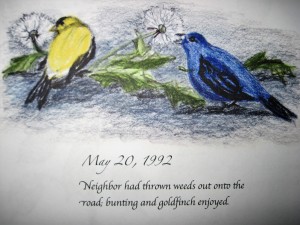 Many of her sightings are by chance: near her feeders or clothesline, or while driving past fields or down a residential street. Each month ends with a poem; these are slightly florid, but so earnest that they won me over. There are plentiful punctuation issues and the cursive font is a challenge to read, but the captured moments and the sense of the seasons’ passing make for a sweet book I’d recommend to anyone with a local interest.
Have you read any of these novellas? Which one takes your fancy?
Rebecca Stott, Duke Special & More at Greenbelt 2018
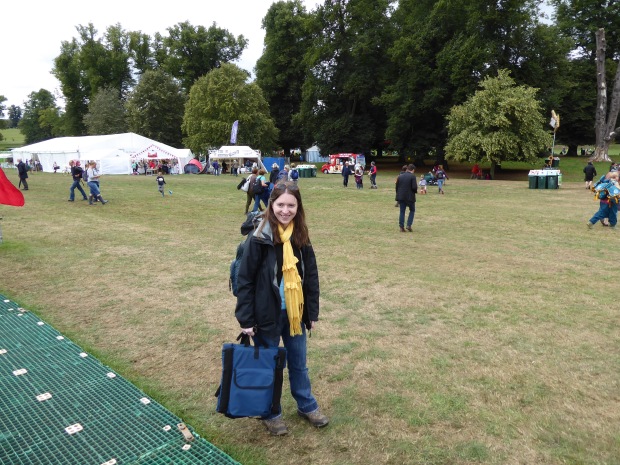
After five years away, we finally made it back to Greenbelt, a progressive Christian summer arts festival held on the grounds of Boughton House, on the Bank Holiday. The festival is a mixture of talks, music, performances and more, and given how much we’d paid and how far we’d traveled just for the one day, we tried to pack in as much as possible.
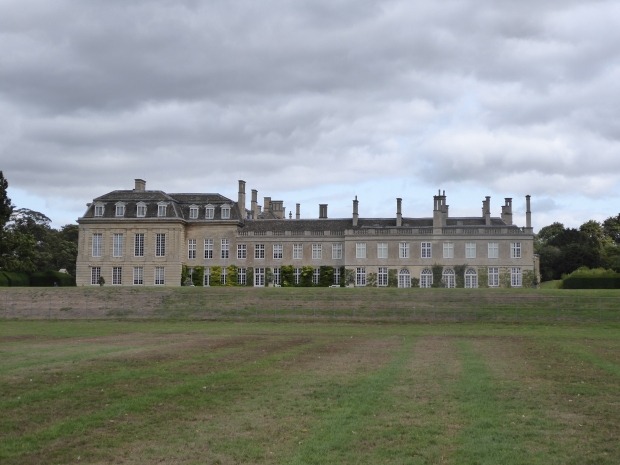
We started the day with “Beyond Forgiveness,” a presentation by Jo Berry and Pat Magee. Berry’s father, a Tory MP, was killed when the IRA bombed the Conservative Party conference in Brighton in 1984. Magee spent 14 years in prison for his role in the bombing. When he got out of jail, he met Berry at her request and they talked and listened to each other for several hours. For the first time, Magee said, he could see her father as a real person and realized that the IRA had been just as guilty of dehumanizing and misrepresenting people as the English were. Berry, too, felt that “I’d met my enemy and seen his humanity.” The two have now shared a stage more than 200 times, speaking about the value of empathy in healing broken relationships while also addressing imbalances of power that lead to violence.
To my surprise, cookery displays and musical comedy seemed to be the order of the day. A model kitchen is a new addition to the festival, giving celebrity chefs hour-long sessions to demonstrate a particular dish. Jack Monroe, promoting her new book Cooking on a Bootstrap, cooked a sausage lasagna. She made us all laugh with her idea of “the inverse sausage fallacy” – the cheaper a sausage is, the better it tastes because of all the salt, sugar and spices added to cheaper bits of meat. She started writing recipes when she was a single mother on the dole, and so she encouraged audience members to donate nice things you would like to eat, as well as everyday hygiene products, to food banks. For a “What Vegans Eat” session, Brett Cobley (aka EpiVegan) made a pea and asparagus risotto and answered questions about protein sources, egg replacements, plant milks and harder-to-find ingredients.
Uproarious musical comedy came in the form of Harry & Chris, who made up impromptu raps about New Year’s Day, the Teletubbies and phobias, and Flo & Joan, who sang about divorce statistics, unnecessary inventions for women, and sex robots (the show was fairly crude and came with an 18+ warning). The overall musical highlight of the day was Duke Special, a Greenbelt favorite we’ve seen play quite a number of times now. His pop combines his smooth Belfast tenor with music hall and Big Band stylings, and his songs are often drawn from poetry and 1920s–40s songbooks. His latest project, Hallow, is a beautiful set of Michael Longley poems set to music. He played “Another Wren” and “Emily Dickinson” from that album, various covers (including two bizarre ditties by Ivor Cutler), and crowd favorites “Last Night I Nearly Died,” “Freewheel” and “Our Love Goes Deeper than This.” We also sampled performances by Martyn Joseph, Wallis Bird and CC Smugglers.
Duke Special was a good bridge between music and literature. From the literature program I also saw Rabbi Jonathan Wittenberg speak on “Things My Dog Has Taught Me about Being a Better Human,” the title of his recent book. (His dog Mitzpah had a special dispensation to join him on stage; no animals are allowed on site otherwise!) The rabbi spoke about lessons in listening, attention, trust and seizing the moment. Mitzi and his previous dog Safi have also given him a connection with the rest of creation. Although he lives in the London suburbs and has an inner-city synagogue, they have accompanied him on long walks in Scotland and Germany. Wittenberg was a warm and witty speaker and I very much liked the sound of his book. It could make a good follow-up to The Power of Dog.
My other festival highlight was Rebecca Stott, in conversation with Radio 4 presenter Malcolm Doney. I read her Costa Prize-winning memoir In the Days of Rain: A daughter. A father. A cult in April and it’s been one of my stand-out reads of the year so far. The book conveys a huge amount of information about the Exclusive Brethren and Stott’s family history but never loses sight of what is most important: what it was like to be in a cult and have your life defined by its rules and its paranoia about the outside world. Stott remembers 6 a.m. Sunday communion services and her constant terror of being left behind in the Rapture.
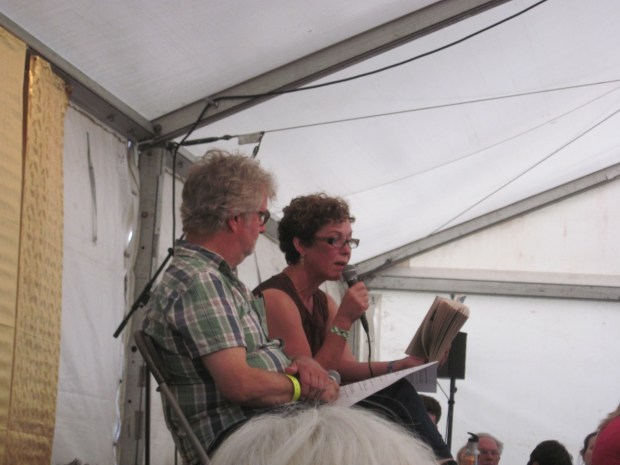
Rebecca Stott reading from In the Days of Rain.
Unfortunately, the talk didn’t add much to my experience of reading her book. The interviewer, catering to those who haven’t read the book yet, led her through her whole story bit by bit, and because I’d read it fairly recently it was all familiar. However, Stott spoke wonderfully and was full of wry compassion for her younger self. I was most interested to hear about the book’s aftermath: she’s received 300 letters from ex-Brethren that her daughter is transcribing to send to a Brethren Church archive in Manchester. When asked during a Q&A where she sees cult tendencies today, she mentioned Trump supporters!


Whereas I read In the Days of Rain from the library, I happen to own two Stott books I haven’t read yet, so I cheekily brought along my paperback of Ghostwalk for signing. She was intrigued to see the older cover design and told me she thinks the prose style in her debut novel is much richer than in Rain, and she hopes I’ll like it. I thanked her for the talk, told her how much I’d enjoyed her memoir, and recommended her two books vaguely about cults: Educated by Tara Westover, which she already knew well, having done some events with Westover, and The Incendiaries by R.O. Kwon, which was new to her (my blog tour review is coming up on Monday). I caught myself using the word “brilliant” three times in speaking about Stott’s work and these other books – nuance and vocabulary alike clearly go out the window when nervously speaking to admired authors!
Some readers of this blog would have been delighted by the event I rushed to straight after Stott’s talk: Jon McGregor giving readings from Reservoir 13, with Sigur Rós-esque backing and interlude music from Haiku Salut. I heard about the police reconstruction with actors from Manchester, and collecting bilberries on the heath in August. Unfortunately, I found it just as dull read aloud as I did when I tried the book last year, and I left early.
During bits of down time I pulled out a Katherine Mansfield story collection I found in a charity shop last week and read “Bank Holiday” and “The Garden Party.” The former is a very short piece whose carnival atmosphere rises to a note of indeterminate striving:
“And up, up the hill come the people, with ticklers and golliwogs, and roses and feathers. Up, up they thrust into the light and heat, shouting, laughing, squealing, as though they were being pushed by something, far below, and by the sun, far ahead of them – drawn up into the full, bright, dazzling radiance to…what?”
 It was my first time reading the famous “The Garden Party,” which likewise moves from a blithe holiday mood into something weightier. The Sheridans are making preparations for a lavish garden party dripping with flowers and food. Daughter Laura is dismayed when news comes that a man from the cottages has been thrown from his horse and killed, and thinks they should cancel the event. Everyone tells her not to be silly; of course it will go on as planned. The story ends when, after visiting his widow to hand over leftover party food, she unwittingly sees the man’s body and experiences an epiphany about the simultaneous beauty and terror of life. “Don’t cry,” her brother says. “Was it awful?” “No,” she replies. “It was simply marvellous.” Mansfield is especially good at first and last paragraphs. I’ll read more by her someday.
How did you all spend your Bank Holiday? / How do you plan to spend Labor Day?
Did any reading get done?
Hurled into Gettysburg: Poems by Theresa Wyatt
 Today marks the start of the 155th anniversary of the Battle of Gettysburg, which took place on July 1–3, 1863. Theresa Wyatt was so kind as to send her terrific book of commemorative poems all the way to England for me. She pays tribute to forgotten and fringe players of the Civil War, such as Elizabeth C. Thorn, who served as the gatekeeper of Gettysburg’s Evergreen Cemetery from 1862 to 1865 while her husband was off fighting, and Jennie Wade, the only civilian killed by a war sniper. “Jennie & Jack” includes fragments of letters written by Jennie and her childhood friend and sweetheart Johnston Skelly, who died of an infection just nine days after her; neither was aware of the other’s demise. Another great story is that of poet and abolitionist John Greenleaf Whittier, whose colorblindness may have been a disadvantage growing up on a farm but was a metaphorical boon in the days of slavery.
The poems are also peopled by immigrant settlers, Underground Railroad passengers (“divinity squeezing / into dark tight spaces”) on the run from slave hunters, and brothers fighting on opposite sides. On a recent visit to Gettysburg Wyatt imagines herself into the position of General Buford, “descending these stairs in flawless summer light, / uplifted by a cyclorama of clear view, fortified” – a clever reference to the famous Gettysburg Cyclorama.
In “Visiting Gettysburg” she captures the sense of overwhelmed helplessness one experiences in relation to great historical tragedies: “trying to take it all in as if I knew anything at all / about horses, cannons or bloodshed.” The imagery ranges from grisly through innocuous to lovely, so that “buckets full of gangrene – a country’s highest price” contrast with “drops of ruby blood / invisible to sight or touch / [that] have mingled into blooms” on a farm that once comprised part of the battlefield. Especially if you’ve visited Gettysburg or another military site recently, you’ll find these poems truly resonate. It’s hard not to devour them within one sitting.
Another favorite passage: “Some people like their heroes loud / and let them talk, but sometimes history / picks off the scabs of arrogance / when setting records straight.” (from “At the Jennie Wade Monument”)
Readalikes:
March by Geraldine Brooks
Into the Cyclorama by Annie Kim
The Underground Railroad by Colson Whitehead
Recommended May Releases
May and June are HUGE months for new releases. I’ve been doing enough early reading via NetGalley and Edelweiss that I’ve found plenty to recommend to you for next month. From a novel voiced by one of Hemingway’s wives to a physicist’s encouragement to waste more time, I hope there will be something here for everyone.
The Pisces by Melissa Broder
[Coming from Hogarth Press (USA) on the 1st and Bloomsbury (UK) on the 3rd]
 At first I thought this was one of those funny, quirky but somewhat insubstantial novels about a thirtysomething stuck with a life she isn’t sure she wants – something along the lines of Goodbye, Vitamin, The Portable Veblen, or All Grown Up. Then I thought it was just a crass sex comedy. But the further I read the deeper it all seemed to become: tropes from Greek myth and the fluidity of gender roles made me think of You Too Can Have a Body Like Mine, another debut novel that surprised me for its profundity. Lucy, a thirty-eight-year-old PhD student, agrees to spend a summer dog-sitting for her yoga entrepreneur sister in Venice Beach, California while she undertakes therapy for the twin problems of low self-esteem and love addiction. If you know one thing about this book, it’s that there’s sex with a merman. Ultimately, though, I’d say it’s about “the prison of the body” and choosing which of the different siren voices calling us to listen to. I found it outrageous but rewarding.
My rating:
How to Be a Perfect Christian by Adam Ford and Kyle Mann
[Coming from Multnomah (USA) on the 1st]
 The Babylon Bee is a Christian version of The Onion, so you know what you’re getting here: a very clever, pitch-perfect satire of evangelical Christianity today. If, like me, you grew up in a nondenominational church and bought into the subculture hook, line and sinker (Awana club, youth group, courtship, dc Talk albums, the whole shebang), you will find that so much of this rings true. The book is set up as a course for achieving superficial perfection through absolute “conformity to the status quo of the modern church.” Sample advice: find an enormous church that meets your needs, has a great coffee bar and puts on a laser-lit worship performance to rival “an amusement park for cats or a Def Leppard concert”; master the language of Christianese (“Keeping it in prayer” pretty much covers your bases); and bring as little as you can to the church potluck (a 25-pack of napkins) but consume as much as is anatomically possible. So, a lot of fun, just a little overlong because you get the joke early on.
My rating:
The Ensemble by Aja Gabel
[Coming from Riverhead (USA) on the 15th]
 In May 1994, the members of the Van Ness String Quartet are completing their final graduate recital at a San Francisco conservatory and preparing for the Esterhazy quartet competition in the Canadian Rockies. These four talented musicians – Jana, first violin; Brit, second violin; Henry, viola; and Daniel, cello – have no idea what the next 15 years will hold for them: a cross-country move, romances begun and lost, and career successes and failures. Drawing on her own history as a violinist and cellist, Aja Gabel infuses her debut novel with the simultaneous uncertainty and euphoria of both the artistic life and early adulthood in general. An alternating close third-person perspective gives glimpses into the main characters’ inner lives, and there are evocative descriptions of classical music. I think The Ensemble will mean even more to those readers who are involved in music, but anyone can relate to the slow fade from youth into middle age and the struggle to integrate art with the rest of life.
My rating:
Tropic of Squalor by Mary Karr
[Coming from Harper (USA) on the 8th]
 Mary Karr is mostly known as a memoirist, but this is actually her fifth poetry collection. Death is a major theme, with David Foster Wallace’s suicide and 9/11 getting multiple mentions. Karr also writes self-deprecatingly about her Texas childhood. Best of all is the multi-part “The Less Holy Bible”: a sort of Devil’s Dictionary based loosely around the books of the Bible, it bounces between Texas and New York City and twists biblical concepts into commonsense advice. Not one for those who are quick to cry heresy, perhaps, but I enjoyed it very much, especially “VI. Wisdom: The Voice of God”: “Ninety percent of what’s wrong with you could be cured with a hot bath, / says God through the manhole covers, but you want magic, to win / the lottery you never bought a ticket for. … Don’t look for initials in the geese honking / overhead or to see through the glass even darkly. It says the most obvious shit, / i.e. Put down that gun, you need a sandwich.”
My rating:
In Praise of Wasting Time by Alan Lightman
[Coming from Simon & Schuster / TED (USA and UK) on the 15th]
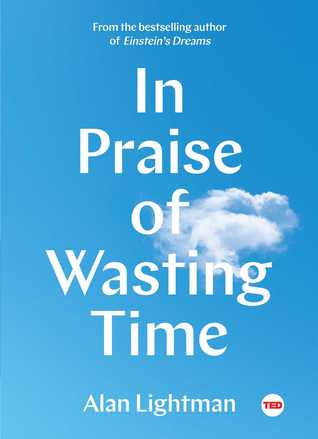 Lightman, a physicist and MIT professor, argues that only in unstructured time can we rediscover our true identity and recover our carefree childhood creativity. This work-as-play model goes against the modern idea that time is money and every minute must be devoted to a project. “For any unexpected opening of time that appears during the day, I rush to patch it, as if a tear in my trousers. … I feel compelled to find a project, to fill up the hole.” Yet there is another way of approaching time, as he discovered when doing research in a village in Cambodia. He realized that the women he talked to didn’t own watches and thus had no real sense of how long any task took them. This sharp, concise treatise ruminates on the cultural forces that have enslaved us in the West to productivity. (In short, he blames the Internet, but specifically smartphones.) Lightman insists on the spiritual benefits of free time and solitude. “With a little determination, each of us can find a half hour a day to waste time,” he asserts.
My rating:
Love and Ruin by Paula McLain
[Coming from Ballantine Books (USA) and Fleet (UK) on the 1st]
 This is the weakest of the three McLain novels I’ve read, but when we’re talking about a writer of this caliber that isn’t much of a criticism. It’s strange to me that, having written a novel from the perspective of Hadley Richardson, Ernest Hemingway’s first wife, McLain would choose to tell the story of another Hemingway wife – this time Martha Gellhorn, a war reporter and author in her own right. If I set aside this misgiving, though, and just assess the quality of the writing, there are definitely things to praise, such as the vivid scenes set during the Spanish Civil War, the dialogues between Martha and Hem, the way he perhaps fills in for her dead father, her fondness for his sons, and her jealousy over his growing success while her books sink like stones. I especially liked their first meeting in a bar in Key West, and the languid pace of their life in Cuba. I read such books because I’m intrigued about the appeal of a great man, but here I got a little bogged down with the many settings and events.
My rating:
What May books do you have on the docket? Have you already read any that you can recommend?
Dubiously Thematic Easter Reading
In 2015 and 2017 I came up with some appropriately theological reading recommendations for Easter. This year I’m going for a more tongue-in-cheek approach, as befits the unfortunate conjunction of Easter with April Fools’ Day.
Currently reading or reviewing:
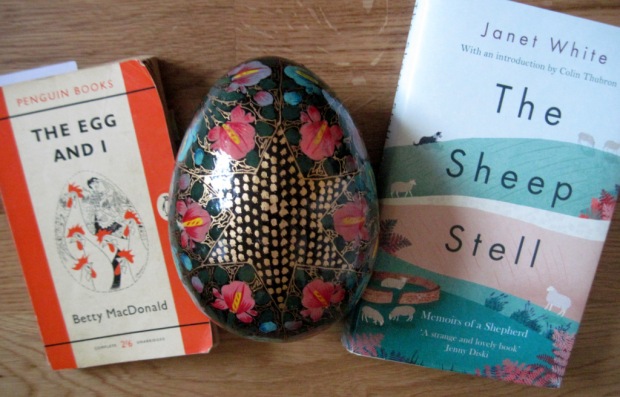
The Egg and I by Betty MacDonald
I bought this on a whim from a local charity shop, based on the title, cover and blurb. I’m about one-third of the way through so far. MacDonald and her husband started a chicken farm in a mountainous area of the Pacific Northwest in the 1940s. Her account of her failure to become the perfect farm wife is rather hilarious. My only hesitation is about her terrible snobbishness towards rednecks and “Indians.”


A representative passage: “Gathering eggs would be like one continual Easter morning if the hens would just be obliging and get off the nests. Co-operation, however, is not a chickenly characteristic and so at egg-gathering time every nest was overflowing with hen, feet planted, and a shoot-if-you-must-this-old-grey-head look in her eye.”
The Sheep Stell by Janet White
 I’m reviewing this reissued memoir for the TLS. It’s a delightful story of finding contentment in the countryside, whether on her own or with family. White, now in her eighties, has been a shepherd for six decades in the British Isles and in New Zealand. While there’s some darker material here about being stalked by a spurned suitor, the tone is mostly lighthearted. I’d recommend it to anyone who’s enjoyed books by Gerald Durrell, James Herriot and Doreen Tovey.
Representative passages: “Shepherding is a strange mixture of tremendous physical work alternating with periods of calm, quiet indolence.” & “A dare, a dream and a challenge. I could have hunted the whole world over and never in a lifetime found anywhere so right: warm, high, pastoral and severed by the sea.”
Read recently:
The Trouble with Goats and Sheep by Joanna Cannon
 Mrs. Creasy disappears one Monday in June 1976, and ten-year-old Grace Bennett and her friend Tilly are determined to figure out what happened. I have a weakness for precocious child detectives (from Harriet the Spy to Flavia de Luce), so I enjoyed Grace’s first-person sections, but it always feels like cheating to me when an author realizes they can’t reveal everything from a child’s perspective so add in third-person narration and flashbacks. These fill in the various neighbors’ sad stories and tell of a rather shocking act of vigilante justice they together undertook nine years ago.
Sheep are a metaphor here for herd behavior and a sense of belonging, but also for good versus evil. Grace and Tilly become obsessed with a Bible passage the vicar reads about Jesus separating the sheep from the goats. But how can he, or they, know who’s truly righteous? As Grace says, “I think that’s the trouble, it’s not always that easy to tell the difference.” It’s a simplistic message about acknowledging the complexity of other lives and situations rather than being judgmental, and matches the undemanding prose.
Reminiscent of Rachel Joyce, but not as good.
My rating:
Vita Nova by Louise Glück
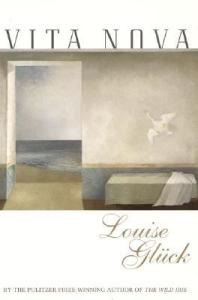 My first collection from the prolific Pulitzer winner. Some of the poems are built around self-interrogation, with a question and answer format; several reflect on the myth of Orpheus and Eurydice. The first and last poems are both entitled “Vita Nova,” while another in the middle is called “The New Life.” I enjoyed the language of spring in the first “Vita Nova” and in “The Nest,” but I was unconvinced by much of what Glück writes about love and self-knowledge, some of it very clichéd indeed, e.g. “I found the years of the climb upward / difficult, filled with anxiety” (from “Descent to the Valley”) and “My life took me many places, / many of them very dark” (from “The Mystery”).
Best lines about spring:
“The spring of the year; young men buying tickets for the ferryboats. / Laughter, because the air is full of apple blossoms.” (from “Vita Nova”)
“Spring / descended. Or should one say / rose? … yellow-green of forsythia, the Commons / planted with new grass— // the new / protected always” (from “Ellsworth Avenue”)
My rating: 
Plucked off the shelf for their dubious thematic significance!

To Rise Again at a Decent Hour by Joshua Ferris
Animal, Vegetable, Miracle by Barbara Kingsolver
Wise Blood by Flannery O’Connor
So You’ve Been Publicly Shamed by Jon Ronson
The Resurrection of Joan Ashby by Cherise Wolas
Happy Easter to all those who mark it, and have a good week. I have a few review-based posts scheduled for while we’re in Wigtown, a trip I hope to report on next Monday, when I will also attempt to catch up on blogs and comments.
A Publisher Party and a One-Man Play
I was a veritable social butterfly this past week: I went out two evenings in a row! (Believe me, that’s rare.) On Tuesday I met up with bloggers Annabel, Eric and Kim at the Faber Spring Party held at Crypt on the Green in London, and on Wednesday my husband and I attended a performance at the University of Reading of Michael Mears’s one-man play on the plight of Britain’s conscientious objectors during World War I, This Evil Thing.
Faber Spring Party
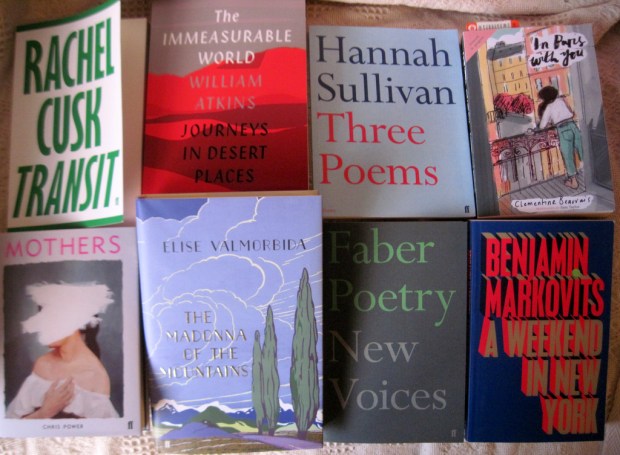
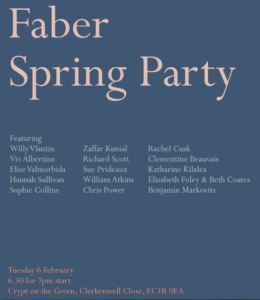 I’ve never been to an event quite like this. Publisher Faber & Faber, which will be celebrating its 90th birthday in 2019, previewed its major releases through to September. Most of the attendees seemed to be booksellers and publishing insiders. Drinks were on a buffet table at the back; books were on a buffet table along the side. Glass of champagne in hand, it was time to plunder the free books on offer. I ended up taking one of everything, with the exception of Rachel Cusk’s trilogy: I couldn’t make it through Outline and am not keen enough on her writing to get an advanced copy of Kudos, but figured I might give her another try with the middle book, Transit.

For the evening’s presentation, each featured author had a few minutes to introduce their new book and/or give a short reading.
Rachel Cusk opened the evening with a reading from Kudos. If you’re familiar with her recent work, you won’t be surprised at this synopsis: a man on a plane recounts having his dog put to sleep. (Out on May 3rd.)
William Atkins’s book on deserts, The Immeasurable World, is based on three years of travel and is, he is not ashamed to say, in the old-fashioned travel writing tradition. (Out on June 7th.)
Hannah Sullivan’s Three Poems is a hybrid work of poem-essays. #2 is more philosophical, she said; #3 is about her father’s death and her son’s birth. She read sonnet 3.21. (Out now.)
Clémentine Beauvais’s In Paris with You is a YA romance in free verse, loosely based on Eugene Onegin. I don’t know the source text but started this on the train ride home and it’s enjoyable thus far. I’m in awe at how translator Sam Taylor has taken the French of her Songe à la douceur and turned it into English poetry. (Out on June 7th.)
Chris Power’s Mothers is a book of linked short stories, three of which are about a character named Eva. He read a portion of a story about her having an encounter with an unpleasant man in Innsbruck. (Out on March 1st.)
Elise Valmorbida’s The Madonna of the Mountains, set in 1923–50, is a saga that resembles “an Italian Mother Courage,” she says. She read a scene in which a character comes across a madwoman. (Out on April 5th.)
Zaffar Kunial read the poem “Spark Hill” from his forthcoming collection Us. It’s about a childhood fight in the area of Birmingham where he grew up. He had a folder open in front of him but, impressively, recited the long poem completely from memory. (Out on July 5th.)
American novelist Benjamin Markovits was a professional basketball player in Germany for six months. Like the tennis-playing protagonist of his upcoming book, A Weekend in New York, he got tired of being measured. After 15 years, his hero is eager to escape a life of being constantly ranked. This is the first in a quartet of novels that inevitably invites comparison with John Updike’s “Rabbit” books. (Out on June 7th.)
I confess I didn’t previously know the name Viv Albertine; she was the guitarist for the female punk band The Slits, and To Throw Away Unopened is her second memoir. Albertine realized that it was her mother who had made her an angry rebel; the title is the label on a bag she found in her mother’s room after her death. (Out on April 5th.)
Sophie Collins incorporates hybrid forms in her poetry – what she calls “lyric essays.” The theme of her book Who Is Mary Sue? is perceptions of women’s writing (with “Mary Sue” as a metonym for the stereotypical good girl). She read from “Engine.” (Out now.)
Katharine Kilalea’s debut novel Ok, Mr Field is about an injured concert pianist who becomes obsessed with a house he buys in South Africa. (Out on June 7th.)
Elizabeth Foley and Beth Coates are the authors of two Homework for Grown-Ups books. Their new book, What Would Boudicca Do?, is about lessons we can draw from the women of history. For instance, the sampler booklet has pieces called “Dorothy Parker and Handling Jerks” and “Frida Kahlo and Finding Your Style.” There’s a heck of a lot of books like this out this year, though, and I’m not so sure this one will stand out. (Out on September 6th.)
Richard Scott read two amazingly intimate poems from his upcoming collection, Soho. One, “cover-boys,” was about top-shelf gay porn; the other was about mutilated sculptures of male bodies in the Athens archaeological museum. If you appreciated Andrew McMillan’s Physical, you need to get hold of this the second it comes out. I went back and read “cover-boys” in the sampler booklet and it wasn’t nearly as powerful as it was aloud; Scott’s reading really brought it to life, in contrast to some other authors’ dull delivery. (Out on April 5th.)
Sue Prideaux’s forthcoming biography of Friedrich Nietzsche is entitled I Am Dynamite! She encountered her subject when she wrote her first biography, of Edvard Munch. Although Nietzsche has been embraced by far-right groups in America, he was in fact against racism, nationalism, and anti-semitism, so he has important messages for us today. I’ll be keen to get hold of this one. (Out on September 6th.)
Guitar in hand, Willy Vlautin closed the evening with a performance of the title track from the soundtrack album to his fifth novel, Don’t Skip Out on Me – he was the singer in Portland, Oregon alt-country band Richmond Fontaine, which has recently stopped touring. He said the novel asks, “can you make the scars of broken people bearable?” (Out now.)

Now that I’ve got this terrific stack of books, wherever do I start?! I’m currently reading the Beauvais; from there I’ll focus on ones that have already been released, starting with Vlautin and the two poetry collections. The titles that aren’t out until June can probably wait – though it’s tempting to be one of the privileged few who get to read them nearly four months early. One Faber book per week should see me getting through all these by the final release date.
This Evil Thing
Michael Mears plays about 50 different characters in this one-man production. He’s an actor and pacifist who has written a number of solo pieces over 20 years. In this commemorative year of the end of the First World War, he knew we would hear a lot about battles, soldiers, and their families back home. But conscientious objectors weren’t likely to be remembered: theirs is a “story that’s rarely told,” he realized. This Evil Thing sets out to correct that omission. The title phrase refers not to war in general but specifically to conscription.
 The two main characters Mears keeps coming back to in the course of the play are Bert Brocklesby, a Yorkshire preacher, and philosopher Bertrand Russell. Brocklesby refused to fight and, when he and other COs were shipped off to France anyway, resisted doing any work that supported the war effort, even peeling the potatoes that would be fed to soldiers. He and his fellow COs were beaten, placed in solitary confinement, and threatened with execution. Meanwhile, Russell and others in the No-Conscription Fellowship fought for their rights back in London. There’s a wonderful scene in the play where Russell, clad in nothing but a towel after a skinny dip, pleads with Prime Minister Asquith.
As in solo shows I’ve seen before (e.g. A Christmas Carol with Patrick Stewart), Mears had to find subtle ways to distinguish between characters: he used a myriad different voices, including regional accents; he quickly donned a jacket, hat, or pair of glasses. Russell was identified by his ever-present pipe. The most challenging scene, Mears said in the Q&A at the end, was one with four characters in a French street café.
Mears reveals during the play that his grandfather fought in WWI and his father in WWII, but he has never had to put his own pacifist views to the test. What about Hitler? people always ask. Mears is honest and humble enough to admit that he doesn’t know what he would have done had he been called on to fight Hitler, or had he faced persecution as a CO in WWI. Ultimately, what Mears hopes audiences take from his play, which won acclaim at the Edinburgh Festival Fringe, is that “this is not an irrelevant piece of history.” Standing up for what you believe in, especially if it goes against the spirit of the times, is always valuable.
Five Perfect Winter Reads
When possible I enjoy reading with the seasons. As the holidays approached last year I picked out a pile of wintry reads that would see me through the dark, cold days of January. I’ve had a chance to read five of them so far, and give review extracts below. I may report back later on in the winter about a few books I plan to read with “snow” in the title.

In the Grip of Winter by Colin Dann
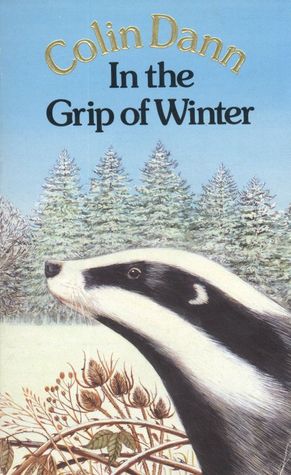 In this second book of the Farthing Wood series, the animals endure a harsh winter in their new home, the White Deer Park. When Badger falls down a slope and injures his leg, he’s nursed back to health at the Warden’s cottage, where Ginger Cat tempts him to join in a life of comfort and plenty. Meanwhile, Fox, Tawny Owl and the others are near starvation, and resort to leaving the park and stealing food from farms and rubbish bins. They have to band together and use their cunning to survive. This was a sweet book that reminded me of my childhood love of anthropomorphized animal stories (like Watership Down and the Redwall series). I doubt I’ll read another from the series, but this was a quaint read for the season.
My husband received this book for free from his school for some reason. Even early on his tastes turned towards wildlife. [One annoyance: the author always referred to Badger’s “set” instead of his “sett”; although it appears this may actually be a permissible variant, it wasn’t cool with me!]


Favorite wintry passage:
“‘Every winter is hard for some,’ Badger answered. ‘The weakest among us always suffer the most. The small creatures: the mice, the shrews, the voles and, particularly, the small birds – every winter takes its toll [on] them. But yes – I sense that this winter will be one to reckon with. There’s something in that wind…’”
My rating:
This Cold Heaven: Seven Seasons in Greenland by Gretel Ehrlich
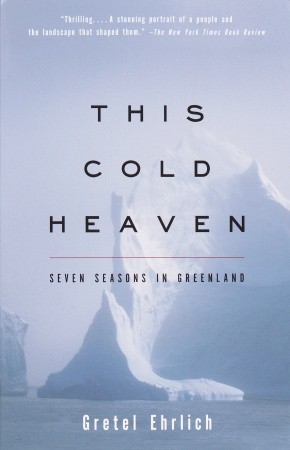 Once a year or so I encounter a book that’s so flawlessly written you could pick out just about any sentence and marvel at its construction. That’s certainly the case here. I never want to go to Greenland; English winters are quite dark and cold enough for me, and I don’t know if I could stomach seal meat at all, let alone for most meals and often raw. But that’s okay: I don’t need to book a flight to Qaanaaq, because through reading this I’ve already been in Greenland in every season, and I thoroughly enjoyed my armchair trek. Impressively, Ehrlich is always describing the same sorts of scenery, and yet every time finds a fresh way to write about ice and sun glare and frigid temperatures. I’ll be looking into her other books for sure.
Favorite wintry passage:
“The ice cap itself was a siren singing me back to Greenland, its walls of blue sapphire and sheer immensity always beguiling. Part jewel, part eye, part lighthouse, part recumbent monolith, the ice is a bright spot on the upper tier of the globe where the world’s purse strings have been pulled tight, nudging the tops of three continents together. Summers, it burns in the sun, and in the dark it hoards moonlight.”
My rating:
Further reading on Greenland: A Wilder Time: Notes from a Geologist at the Edge of the Greenland Ice by William E. Glassley (see my Foreword review) and The Prophets of Eternal Fjord by Kim Leine, an epic novel about an unconventional priest, set in late-eighteenth-century Denmark and Greenland (see my Nudge review). Also Sinéad Morrissey’s multi-part poem “Whitelessness.” You can read the first stanza of it here.
The Short Day Dying by Peter Hobbs
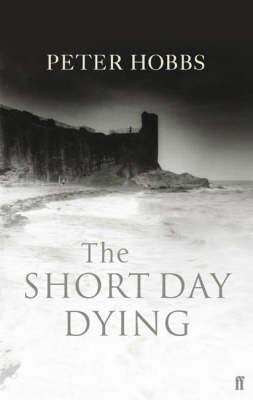 This short novel from 2005 deserves to be better known. It reminded me of Days Without End and On the Black Hill, but most of all of Francis Kilvert’s diary, perhaps as voiced by a rustic from Poldark. We journey through 1870 with Charles Wenmoth, a twenty-seven-year-old blacksmith’s apprentice and Methodist lay preacher in Cornwall mining country. Very little happens; the focus is on atmosphere and voice. The major struggle is with his melancholy spirit, which causes him to doubt his salvation. As winter circles round, the days grow shorter just as he senses life growing shorter. The short chapters are like undated diary entries (apparently based on the author’s great-great-grandfather’s); the sentences are almost completely unpunctuated, which at first had me twitching for my pencil to add commas to the run-on sentences, but eventually I gave myself over to the flow.
Favorite wintry passage:
“It is a shame we cannot stay children for ever and remain blind to the slow death of the land. How different it will all be in a few months the bare trees revealed as dark gnarled bodies. Something inside them though lives through the yearly famine and they always find new colour. I trust it is the same for us all.”
My rating:
Winter by Karl Ove Knausgaard
 This is my favorite of the three Knausgaard books I’ve read so far, and miles better than his Autumn. These short essays successfully evoke the sensations of winter and the conflicting emotions elicited by family life and childhood memories. The series is, loosely speaking, a set of instruction manuals for his unborn daughter, who is born a month premature in the course of this volume. So in the first book he starts with the basics of bodily existence – orifices, bodily fluids and clothing – and now he’s moving on to slightly more advanced but still everyday things she’ll encounter, like coins, stuffed animals, a messy house, toothbrushes, and the moon. I’ll see out this series, and see afterwards if I have the nerve to return to My Struggle.
Favorite wintry passage:
“winter not only muffles some sounds and intensifies others, it also has sounds that are entirely its own, unique to the season, and some of them are among the most beautiful of all. The low boom of ice-covered waters as they freeze, for instance, which can be heard on perfectly clear days or nights when the cold deepens, and which has something menacing or mighty about it, since it isn’t connected to an visible movement”
My rating:
Available Light by Marge Piercy
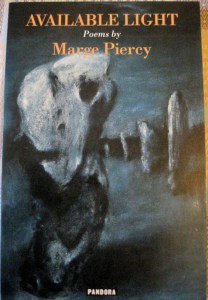 Many poetry volumes get a middling rating from me because some of the poems are memorable but others do nothing for me. This is on the longer side for a collection at 120+ pages, but only a handful of its poems fell flat. The subjects are diverse: travels in Europe (my cover depicts the Avebury stone circle in the gloom), menstruation, identifying as a Jew as well as a feminist, scattering her father’s ashes, the stresses of daily life, and being in love. The title poem, which appears first, has a slightly melancholy tone with its focus on the short days of winter, but the poet defiantly asserts meaning despite the mood: “Even the dead of winter: it seethes with more / than I can ever live to name and speak.” Piercy was a great discovery, and I’ll be trying lots more of her books from various genres.
Favorite wintry passage:
(from “Available light”)
In winter the light is red and short.
The sun hangs its wizened rosehip in the oaks.
By midafternoon night is folding in.
The ground is locked against us like a door.
Yet faces shine so the eyes stretch for them
and tracks in the snow are etched, calligraphy
My rating:
(And one book that didn’t quite work for me; I ended up abandoning it at 14%.
 The Bear and the Nightingale by Katherine Arden: Some striking turns of phrase, an enchanting wintry atmosphere … but a little Disney-fied for me. I got this free for Kindle so may come back to it at some point.
Favorite wintry passage:
“The years slipped by like leaves. …The clouds lay like wet wool above the trees.”)
Have you read any wintry books this year?
Biography of the Month: Ali: A Life by Jonathan Eig
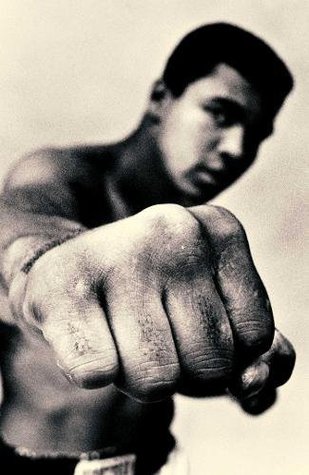 The first book I ever reviewed on this blog, nearly three years ago, happened to be Jonathan Eig’s The Birth of the Pill. It was the strength of the writing in that offbeat work of history, as well as rave reviews for this 2017 biography of Muhammad Ali (1942–2016), that led me to pick up a sport-themed book. I’m the furthest thing from a sports fan you could imagine, but I approached this as a book about a cultural icon and read it with a spirit of curiosity about how Eig would shape this life story and separate the facts from the legend. It’s a riveting account of outliving segregation and developing a personal style and world-beating confidence; it’s a sobering tale of facing consequences and having your own body fail you. I loved it.
Today would have been Ali’s 76th birthday, so in honor of the occasion – and his tendency to spout off-the-cuff rhymes about his competitors’ shortfalls and his own greatness – I’ve turned his life story into a book review of sorts, in rhyming couplets.
Born into 1940s Kentucky,
this fine boy had decent luck – he
surpassed his angry, cheating father
though he shared his name; no bother –
he’d not be Cassius Clay much longer.
He knew he was so much stronger
than all those other boys. Racing
the bus with Rudy; embracing
the help of a white policeman,
his first boxing coach – this guardian
prepared him for Olympic gold
(the last time Cassius did as told?).

Ali in 1967. By Ira Rosenberg [Public domain], via Wikimedia Commons.
was no scholar but won hearts; he
hogged every crowd’s full attention
but his faults are worth a mention:
he hoarded Caddys and Royces
and made bad financial choices;
he went through one, two, three, four wives
and lots of other dames besides;
his kids – no closer than his fans –
hardly even got a chance.
Cameos from bin Laden, Trump,
Toni Morrison and more: jump
ahead and you’ll see an actor,
envoy, entrepreneur, preacher,
recognized-all-round-the-world brand
(though maybe things got out of hand).
Ali was all things to all men
and fitted in the life of ten
but though he tested a lot of walks,
mostly he just wanted to box.
The fights: Frazier, Foreman, Liston –
they’re all here, and the details stun.
Eig gives a vivid blow-by-blow
such that you will feel like you know
what it’s like to be in the ring:
dodge, jab, weave; hear that left hook sing
past your ear. Catch rest at the ropes
but don’t stay too long like a dope.
If, like Ali, you sting and float,
keep an eye on your age and bloat –
the young, slim ones will catch you out.
Bow out before too many bouts.
Ignore the signs if you so choose
(ain’t got many brain cells to lose –
these blows to the head ain’t no joke);
retirement talk ain’t foolin’ folk,
can’t you give up on earning dough
and think more about your own soul?

1968 Esquire cover. By George Lois (Esquire Magazine) [CC BY-SA 4.0 (https://creativecommons.org/licenses/by-sa/4.0)%5D, via Wikimedia Commons.
Allah laid a call on your head:
To raise up the black man’s status
and ask white men why they hate us;
to resist the Vietnam draft
though that nearly got you the shaft
and lost you your name, your title
and (close) your rank as an idol.
Was it all real, your piety?
Was it worth it in society?
Nation of Islam was your crew
but sure did leave you in the stew
with that Vietcong kerfuffle
and Malcolm/Muhammad shuffle.
Through U.S. missions (after 9/11)
you explained it ain’t about heaven
and who you’ll kill to get you there;
it’s about peace, being God’s heir.
Is this story all about race?
Eig believes it deserves its place
as the theme of Ali’s life: he
was born in segregation, see,
a black fighter in a white world,
but stereotypes he hurled
right back in their faces: Uncle
Tom Negro? Naw, even punch-drunk he’ll
smash your categories and crush
your expectations. You can flush
that flat dismissal down the john;
don’t think you know what’s going on.
Dupe, ego, clown, greedy, hero:
larger than life, Jesus or Nero?
How to see both, that’s the kicker;
Eig avoids ‘good’ and ‘bad’ stickers
but shows a life laid bare and
how win and lose ain’t fair and
history is of our making
and half of legacy is faking
and all you got to do is spin
the world round ’till it lets you in.

Ali in 2004.
Biography’s all ’bout the arc
and though this story gets real dark,
there’s a glister to it all the same.
A man exists beyond the fame.
What do you know beneath the name?
Less, I’d make a bet, than you think.
Come over here and take a drink:
this is long, deep, satisfying;
you won’t escape without crying.
Based on 600 interviews,
this fresh account is full of news
and fit for all, not just sports fans.
Whew, let’s give it up for Eig, man.
My rating:
 Bookish Beck = Rebecca Foster. American transplant to England. Freelance proofreader and book reviewer.
