Four for #NonfictionNovember and #NovNov25: Hanff, Humphrey, Kimmerer & Steinbeck
I’ll be doubling up posts most days for the rest of this month to cram everything in!


Today I have a cosy companion story to a beloved bibliophiles’ classic, a comprehensive account of my favourite beverage, a refreshing Indigenous approach to economics, and a journalistic exposé that feels nearly as relevant now as it did 90 years ago.
Q’s Legacy by Helene Hanff (1985)
 Of course we all know and love 84, Charing Cross Road, about Hanff’s epistolary friendship with the staff of Marks & Co. Antiquarian Booksellers in London in the 1950s. This gives a bit of background to the writing and publication of that book, responds to its unexpected success, and follows up on a couple of later trips to England for the TV and stage adaptations. Hanff lived in a tiny New York City apartment and worked behind the scenes in theatre and television. Even authoring a cult classic didn’t change the facts of being a creative in one of the world’s most expensive cities: paying the bills between royalty checks was a scramble. The title is a little odd and refers to Hanff’s self-directed education after she had to leave Temple University after a year. When she stumbled on Cambridge professor Sir Arthur Quiller-Couch’s books of lectures at the library, she decided to make them the basis of her classical education. I most liked the diary from a 1970s trip to London on which she stayed in her UK publisher André Deutsch’s mother’s apartment! This is pleasant and I appreciated Hanff’s humble delight in her unexpected later-life accomplishments, but it does feel rather like a collection of scraps. I also have to wonder to what extent this repeats content from the 84 sequel, The Duchess of Bloomsbury Street. But if you’ve liked her other books, you may as well read this one, too. (Free – The Book Thing of Baltimore) [177 pages]
Gin by Shonna Milliken Humphrey (2020)
 Picking up something from the Bloomsbury Object Lessons series (or any of these other series of nonfiction books) is a splendid way to combine two challenges. Humphrey was introduced to gin at 16 when the manager of the movie theater where she worked gave her Pepsi cups of gin and grapefruit juice. Luckily, that didn’t precede any kind of misconduct and she’s been fond of gin ever since. She takes readers through the etymology of gin (from the Dutch genever; I startled the bartender by ordering a glass of neat vieux ginèvre at a bar in Brussels in September), the single necessary ingredient (juniper), the distillation process, the varieties (single- or double-distilled; Old Tom with sugar added), the different neutral spirits or grain bases that can be used (at a recent tasting I had gins made from apples and potatoes), and appearances in popular culture from William Hogarth’s preachy prints through The African Queen and James Bond to rap music. I found plenty of interesting tidbits – Samuel Pepys mentions gin (well, “strong water made of juniper,” anyway) in his diary as a constipation cure – but the writing is nothing special, I knew a lot of technical details from distillery tours, and I would have liked more exploration of the modern gin craze. “Gin is, in many ways, how I see myself: comfortable, but evolving,” Humphrey writes. “Gin has always interested a younger generation of drinker, as well as commitment from the older crowd, while maintaining a reputation among the middle aged. It is unique that way.” That checks out from my experience of tastings and the fact that it’s my mother-in-law’s tipple of choice as well. (Birthday gift from my Bookshop wish list) [134 pages]
The Serviceberry: An Economy of Gifts and Abundance by Robin Wall Kimmerer (2024)
 Serviceberries (aka saskatoons or juneberries) are Kimmerer’s chosen example of nature’s bounty, freely offered and reliable. When her farmer neighbours invite people to come and pick pails of them for nothing, they’re straying from the prevailing economic reasoning that commodifies food. Instead of focusing on the “transactional,” they’re “banking goodwill, so-called social capital.” Kimmerer would disdain the term “ecosystem services,” arguing that turning nature into a commodity has diminished people’s sense of responsibility and made them feel more justified in taking whatever they want and hoarding it. Capitalism’s reliance on scarcity (sometimes false or forced) is anathema to her; in an Indigenous gift-based economy, there is sufficient for all to share: “You can store meat in your own pantry or in the belly of your brother.” I love that she refers to Little Free Libraries and other community initiatives such as farm stands of free produce, swap shops, and online giveaway forums. I volunteer with our local Repair Café, I curate my neighbourhood Little Free Library, and I’m lucky to live in a community where people are always giving away quality items. These are all win-win situations where unwanted or broken items get a new lease on life. Save landfill space, resources, and money at the same time! Compared to Braiding Sweetgrass, this is thin (but targeted) and sometimes feels overly optimistic about human nature. I was glad I didn’t buy the bite-sized hardback with gift money last year, but I was happy to have a chance to read the book anyway. (New purchase – Kindle 99p deal) [124 pages]
The Harvest Gypsies: On the Road to The Grapes of Wrath by John Steinbeck (1936; 1988)
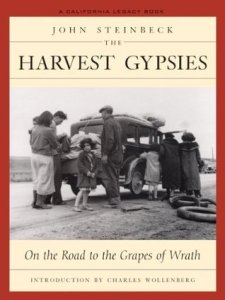 This lucky find is part of the “California Legacy” collection published by Heyday and Santa Clara University. In October 1936, Steinbeck produced a series of seven articles for The San Francisco News about the plight of Dust Bowl-era migrant workers. His star was just starting to rise but he wouldn’t achieve true fame until 1939 with the Pulitzer Prize-winning The Grapes of Wrath, which was borne out of his travels as a journalist. Some 150,000 transient workers traveled the length of California looking for temporary employment in the orchards and vegetable fields. Squatters’ camps were places of poor food and hygiene where young children often died of disease or malnutrition. Women in their thirties were worn out by annual childbirth and frequent miscarriage and baby loss. Dignity was hard to maintain without proper toilet facilities. Because workers moved around, they could not establish state residency and so had no access to healthcare or unemployment benefits. This distressing material is captured through dispassionate case studies. Steinbeck gives particular attention to the state’s poor track record for the treatment of foreign workers – Chinese, Japanese and Filipino as well as Mexican. He recounts disproportionate police brutality in response to workers’ attempts to organize. (Has anything really changed?!) In the final article, he offers solutions: the right to unionize, and blocks of subsistence farms on federal land. Charles Wollenberg’s introduction about Steinbeck and his tour guide, camp manager Tom Collins, is illuminating and Dorothea Lange’s photographs are the perfect accompaniment. Now I’m hankering to reread The Grapes of Wrath. (Secondhand – Gifted by a friend as part of a trip to Community Furniture Project, Newbury last year) [62 pages]
Check out Kris Drever’s folk song “Harvest Gypsies” (written by Boo Hewerdine) here.
August Releases: Sarah Manguso (Fiction), Sarah Moss (Memoir), and Carl Phillips (Poetry)
Today I feature a new-to-me poet and two women writers whose careers I’ve followed devotedly but whose latest books – forthright yet slippery; their genre categories could easily be reversed – I found very emotionally difficult to read. Gruelling, almost, but admirable. Many rambling thoughts ensue. Then enjoy a nice poem.
Liars by Sarah Manguso
As part of a profile of Manguso and her oeuvre for Bookmarks magazine, I wrote a synopsis and surveyed critical opinion; what follow are additional subjective musings. I’ve read six of her nine books (all but the poetry and an obscure flash fiction collection) and I esteem her fragmentary, aphoristic prose, but on balance I’m fonder of her nonfiction. Had Liars been marketed as a diary of her marriage and divorce, Manguso might have been eviscerated for the indulgence and one-sided presentation. With the thinnest of autofiction layers, is it art?
Jane recounts her doomed marriage, from the early days of her relationship with John Bridges to the aftermath of his affair and their split. She is a writer and academic who sacrifices her career for his financially risky artistic pursuits. Especially once she has a baby, every domestic duty falls to her, while he keeps living like a selfish stag and gaslights her if she tries to complain, bringing up her history of mental illness. The concise vignettes condense 14+ years into 250 pages, which is a relief because beneath the sluggish progression is such repetition of type of experiences that it could feel endless. John’s last name might as well be Doe: The novel presents him – and thus all men – as despicable and useless, while women are effortlessly capable and, by exhausting themselves, achieve superhuman feats. This is what heterosexual marriage does to anyone, Manguso is arguing. Indeed, in a Guardian interview she characterized this as a “domestic abuse novel,” and elsewhere she has said that motherhood can be unlinked from patriarchy, but not marriage.
Let’s say I were to list my every grievance against my husband from the last 17+ years: every time he left dirty clothes on the bedroom floor (which is every day); every time he loaded the dishwasher inefficiently (which is every time, so he leaves it to me); every time he failed to seal a packet or jar or Tupperware properly (which – yeah, you get the picture) – and he’s one of the good guys, bumbling rather than egotistical! And he’d have his own list for me, too. This is just what we put up with to live with other people, right? John is definitely worse (“The difference between John and a fascist despot is one of degree, not type”). But it’s not edifying, for author or reader. There may be catharsis to airing every single complaint, but how does it help to stew in bitterness? Look at everything I went through and validate my anger.
There are bright spots: Jane’s unexpected transformation into a doting mother (but why must their son only ever be called “the child”?), her dedication to her cat, and the occasional dark humour:
So at his worst, my husband was an arrogant, insecure, workaholic, narcissistic bully with middlebrow taste, who maintained power over me by making major decisions without my input or consent. It could still be worse, I thought.
Manguso’s aphoristic style makes for many quotably mordant sentences. My feelings vacillated wildly, from repulsion to gung-ho support; my rating likewise swung between extremes and settled in the middle. I felt that, as a feminist, I should wholeheartedly support a project of exposing wrongs. It’s easy to understand how helplessness leads to rage, and how, considering sunk costs, a partner would irrationally hope for a situation to improve. So I wasn’t as frustrated with Jane as some readers have been. But I didn’t like the crass sexual language, and on the whole I agreed with Parul Sehgal’s brilliant New Yorker review that the novel is so partial and the tone so astringent that it is impossible to love.
With thanks to Picador for the proof copy for review.
And a quote from the Moss memoir (below) to link the two books: “Homes are places where vulnerable people are subject to bullying, violence and humiliation behind closed doors. Homes are places where a woman’s work is never done and she is always guilty.”
20 Books of Summer, #19:
My Good Bright Wolf by Sarah Moss
I’ve reviewed this memoir for Shelf Awareness (it’s coming out in the USA from Farrar, Straus and Giroux on October 22nd) so will only give impressions, in rough chronological order:
Sarah Moss returns to nonfiction – YES!!!
Oh no, it’s in the second person. I’ve read too much of that recently. Fine for one story in a collection. A whole book? Not so sure. (Kirsty Logan got away with it, but only because The Unfamiliar is so short and meant to emphasize how matrescence makes you other.)
 The constant second-guessing of memory via italicized asides that question or refute what has just been said; the weird nicknames (her father is “the Owl” and her mother “the Jumbly Girl”) – in short, the deliberate artifice – at first kept me from becoming submerged. This must be deliberate and yet meant it was initially a chore to pick up. It almost literally hurt to read. And yet there are some breathtakingly brilliant set pieces. Oh! when her mother’s gay friend Keith buys her a chocolate éclair and she hides it until it goes mouldy.
Once she starts discussing her childhood reading – what it did for her then and how she views it now – the book really came to life for me. And she very effectively contrasts the would-be happily ever after of generally getting better after eight years of disordered eating with her anorexia returning with a vengeance at age 46 – landing her in A&E in Dublin. (Oh! when she reads War and Peace over and over on a hospital bed and defiantly uses the clean toilets on another floor.) This crisis is narrated in the third person before a return to second person.
The tone shifts throughout the book, so that what threatens to be slightly cloying in the childhood section turns academically curious and then, somehow, despite the distancing pronouns, intimate. So much so that I found myself weeping through the last chapters over this lovely, intelligent woman’s ongoing struggles. As an overly cerebral person who often thinks it’s pesky to have to live in a body, I appreciated her probing of the body/mind divide; and as she tracks where her food issues came from, I couldn’t help but think about my sister’s years of eating disorders and my mother’s fear that it was all her fault.
Beyond Moss’s usual readers, I’d also recommend this to fans of Laura Freeman’s The Reading Cure and Noreen Masud’s A Flat Place.
Overall: shape-shifting, devastating, staunchly pragmatic. I’m not convinced it all hangs together (and I probably would have ended it at p. 255), but it’s still a unique model for transmuting life into art. 
With thanks to Picador for the free copy for review.
Scattered Snows, to the North by Carl Phillips
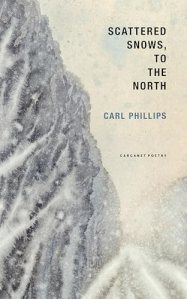 Phillips is a prolific poet I’d somehow never heard of. In fact, he won the Pulitzer Prize last year for his selected poetry volume. He’s gay and African American, and in his evocative verse he summons up landscapes and a variety of weather, including as a metaphor for emotions – guilt, shame, and regret. Looking back over broken relationships, he questions his memory.
Will I remember individual poems? Unlikely. But the sense of chilly, clear-eyed reflection, yes. (Sample poem below) 
With thanks to Carcanet for the advanced e-copy for review.
Record of Where a Wind Was
Wave-side, snow-side,
little stutter-skein of plovers
lifting, like a mind
of winter—
We’d been walking
the beach, its unevenness
made our bodies touch,
now and then, at
the shoulders mostly,
with that familiarity
that, because it sometimes
includes love, can
become confused with it,
though they remain
different animals. In my
head I played a game with
the waves called Weapon
of Choice, they kept choosing
forgiveness, like the only
answer, as to them
it was, maybe. It’s a violent
world. These, I said, I choose
these, putting my bare hands
through the air in front of me.
Any other August releases you’d recommend?
Constructing a Nervous System by Margo Jefferson
I’ve had mixed feelings about the online nature of life recently. On Sunday I avoided the Internet altogether so as not to be bombarded with (UK) Mother’s Day memes and notifications. Yesterday our home broadband dropped out completely, such that I couldn’t do any freelance work or post about the Folio Prize poetry shortlist as I’d meant to do on World Poetry Day. Too much connectivity or not enough. Today – just as a line engineer is due to arrive; that usual irony – all is normal and I’m back in the swing of working and blogging.
Using my husband’s phone as a hotspot, I was at least still able to watch yesterday evening’s free 5×15 event with the Rathbones Folio Prize, featuring Amy Bloom, NoViolet Bulawayo, Sheila Heti, Margo Jefferson and Elizabeth Strout and hosted by interviewer Alex Clark. Over the next couple of days I’ll review Heti and Strout’s novels and the entire poetry shortlist, but for now I’ll weave some of the insight I gained last night into a review of Constructing a Nervous System by Margo Jefferson (2022), the new-to-me book from the nonfiction shortlist that I was most interested in reading.
Although the subtitle is “A Memoir,” this experimental text does such novel things with the genre that it bears little resemblance to most memoirs I’ve read. For that reason alone, I can see why the judges shortlisted it. During the 5×15 event, Jefferson described her book as “an assemblage of ideas, memories, sensations, feelings, and other people’s words—not just my own.” It’s also a reckoning with culture – particularly jazz music and dance by African Americans, but also particular examples from the white literary canon.
Jefferson was a long-time theatre and book critic for Newsweek and The New York Times and won a Pulitzer Prize for her criticism in 1995; she now teaches writing at Columbia University. She has previously published another memoir, Negroland, and a biography of Michael Jackson. Here she blends her chosen genres of life writing and cultural criticism. Her aim, she said, was to craft “criticism with the intensities and intimacies of memoir” and “memoir with the range of criticism.”

Jefferson mentioned that the deaths of her mother and older sister (who was like her muse) left her an orphan and, strangely, “cleared the stage for me to step out and speak my lines.” Indeed, the book is loosely structured as a play, opening with the metaphor of an empty stage and ending with the direction “BLACKOUT.” In between there are many imagined dialogues with herself or between historical figures, such as the bizarre pairing of George Eliot and W.E.B. Du Bois. Some quotations and definitions appear in italics or bold face. Ella Fitzgerald and Josephine Baker play major roles, but there’s also a surprisingly long section devoted to Willa Cather’s The Song of the Lark, which Jefferson loves and has often taught, yet finds problematic for how it enshrines whiteness (“Confederate Southern mythmaking”).
I don’t feel that I got much of a sense of the sweep of Jefferson’s life from the book, just a vague impression of an upper-middle-class Black upbringing. (Perhaps Negroland is a more straightforward memoir?) To be sure, she was keen to avoid “slogging through chronology,” as she explained, instead welcoming onto the page “a repertory company of myself as I encounter all the materials of my life—the factual and historical as well as the creative.” And so I do feel I have met her as an industrious mind, drawing connections between disparate aspects of experience and cultural consumption. This is a model of how a critic (like myself) might incorporate a body of work into a record of life. Yet when so many of her touchstones do not overlap with mine, I could only observe and admire from afar, not be truly drawn in.
Some lines I loved:
“Remember: Memoir is your present negotiating with versions of your past for a future you’re willing to show up in.”
“Older women’s tales— ‘Une femme d’un certain âge’ tales—are hard to pull off. They risk being arch.”
(of Ella Fitzgerald) “You turned the maw of black female labor into the wonderland of black female art.”
“Women’s anger needs to be honored—celebrated and protected—the way virginity used to be! … I’ve spent my adult years working on an assemblage of black feminist anger modes.”
With thanks to FMcM Associates and Granta Books for the free copy for review.
I was very impressed with both Amy Bloom and Margo Jefferson ‘in person’ (on Zoom): elegant, intellectual, well-spoken; authors at the top of their game. I reviewed Amy Bloom’s affecting memoir In Love, about her husband Brian’s early-onset Alzheimer’s and the decision to end his life at Dignitas in Zurich, last year. She told Alex Clark that the book started as a caregiver’s notes, but Brian made it clear that he wanted her to write about the experience, to inform people about end-of-life options. She believes that ultimately the memoir is about what it means to be a person and the decisions that make up a life. Her children joke that her only four subjects – in fiction or otherwise – are love, sex, family and death. Well, what else is there, really?
I know only the barest facts about the other three books on the Folio nonfiction shortlist but none of them screams ‘must read’ to me:
- The Passengers by Will Ashon – oral narratives from contemporary Britain
- The Escape Artist by Jonathan Freedland – biography of an Auschwitz whistle-blower
- The Social Distance Between Us by Darren McGarvey – a rapper’s book about inequality and antisocial behaviour
Have you read, or would you read, anything from the Folio nonfiction shortlist?
Tomorrow: Five poetry shortlist reviews
Friday: Two fiction shortlist reviews; my predictions for the category winners and overall prize winner
Three on a Theme for Valentine’s Day: “Love” Books by Natalie Diaz, Maile Meloy and Jane Smiley
This post is an annual tradition for me, somehow.* Love, whether erotic, romantic or familial, turns up in the titles of these three works by women writers: poems, short stories and a novella.
Postcolonial Love Poem by Natalie Diaz (2020)
Diaz, raised on a Mojave reservation in California, won a Pulitzer Prize for this honey-thick exploration of queer Native American identity. There are lustful moments aplenty here—
My lover comes to me like darkfall—long,
and through my open window. Mullion, transom. […]
I keep time on the hematite clocks of her shoulders.
(from “Like Church”)
 —but the mineral-heavy imagery (“the agate cups of your palms …the bronzed lamp of my breast”) is so weirdly archaic and the vocabulary so technical that I kept thinking of the Song of Solomon. Not that there’s anything wrong with that; it’s just not the model I expected to find.
So I ended up preferring the forthright political poems about contemporary Native American life. Police shootings, pipeline protests: it’s a fact that her people are disproportionately persecuted (see “American Arithmetic”). Her brother’s drug abuse and mental illness also form a repeating subject (e.g., “It Was the Animals”).
The collection is as much of a love poem to land as it is to a woman, with water bodies described as affectionately as female bodies. “The Colorado River is the most endangered river in the United States—also, it is a part of my body” is the opening line of “The First Water Is the Body”; see also “exhibits from the American Water Museum.”
My favourite single poem, “If I Should Come Upon Your House Lonely in the West Texas Desert,” is sexy but also, charmingly, features echoes of “Goldilocks and the Three Bears”:
I will swing my lasso of headlights
across your front porch,
let it drop like a rope of knotted light
at your feet.
While I put the car in park,
you will tie and tighten the loop
of light around your waist—
and I will be there with the other end
wrapped three times
around my hips horned with loneliness.
[…]
I will lie down in you.
Eat my meals at the red table of your heart.
Each steaming bowl will be, Just right.
I will eat it all up,
break all your chairs to pieces.
(New purchase, Awesomebooks.com) 
Half in Love by Maile Meloy (2002)
Meloy’s was a new name for me when I picked this up as part of a bargain secondhand book haul last year, but she’s actually published 10 books and is esteemed in literary circles; Ann Patchett even dedicated her latest release, These Precious Days, to her.
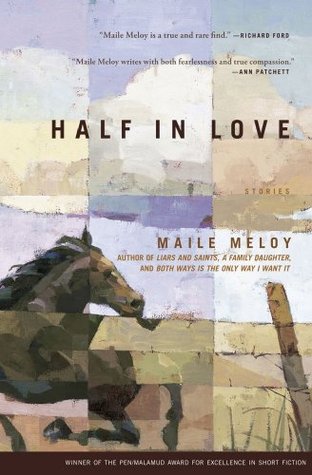 Meloy is from Montana and most of the 14 stories in this, her debut collection, are set in the contemporary American West among those who make their living from the outdoors, diving to work on hydroelectric dams or keeping cattle and horses. However, one of the more memorable stories, “Aqua Boulevard,” is set in Paris, where a geriatric father can’t tamp down his worries for his offspring.
The few historical stories have a melancholy air, with protagonists whose star has faded. There’s the brief, touching portrait of an outmoded career in “The Ice Harvester” and the secondhand reminiscences of being in late-colonial diplomatic service in the Middle East in “Last of the White Slaves”; “Red” is about an American soldier stationed in London during the Second World War.
Crime and its consequences recur. I loved the opening story, “Tome,” about a lawyer whose client wants her to keep in touch after he goes to jail. Teenage girls are the title characters in a couple of stories; “Ranch Girl” is in the second person. “Kite Whistler Aquamarine” is a heartbreaker about a filly born premature one winter. “Paint” was the standout for me: it’s pretty terrifying what a wife’s temporary attitude of neglect leads to when her luckless husband undertakes some DIY.
As is usual with a collection, a few of the stories left little impression on me. But there’s sufficient range and depth here to induce me to seek out more of Meloy’s work. I can recommend this to readers of Claire Boyles, David Guterson, Lily King, Jane Smiley (see below!) and David Vann. (Secondhand purchase, 2nd & Charles) 
Favourite passages:
“Be interesting in your twenties,” Suzy says. “Otherwise you’ll want to do it in your thirties or forties, when it wreaks all kinds of havoc, and you’ve got a husband and kids.”
Eugénie invited my husband to Greece every summer because she wanted him to publish her memoir. She had lived a remarkable life but didn’t have a remarkable book, and it dragged through slow ghostwritten revisions. Every year, at work in the hot city, I thought of blue water and white bougainvillea and forgot how exhausting it was to be her guest, to stay in favor and say the right things. So each summer we would arrive, look at the new draft, give careful suggestions that would not be taken, and find ourselves on the terrace waiting for her to trip mercifully off to bed.
Ordinary Love by Jane Smiley (1990)
 This is one of Smiley’s earlier works and feels a little generic, like she hadn’t yet developed a signature voice or themes. One summer, a 52-year-old mother of five prepares for her adult son Michael’s return from India after two years of teaching. His twin brother, Joe, will pick him up from the airport later on. Through conversations over dinner and a picnic in the park, the rest of the family try to work out how Michael has changed during his time away. “I try to accept the mystery of my children, of the inexplicable ways they diverge from parental expectations, of how, however much you know or remember of them, they don’t quite add up.” The narrator recalls her marriage-ending affair and how she coped afterwards. Michael drops a bombshell towards the end of the 91-page novella. Readable yet instantly forgettable, alas. I bought it as part of a dual volume with Good Will, which I don’t expect I’ll read. (Secondhand purchase, Bookbarn International)
If you read just one … It’s got to be Postcolonial Love Poem, the most Eros-appropriate of the three by far.
*I’m really not a Valentine’s Day person, yet this is the sixth year in a row that I’ve put together a themed post featuring books that have “Love” or a similar word in the title in the run-up to mid-February (2017, 2018, 2019, 2020, and 2021).
Read any books about love lately?
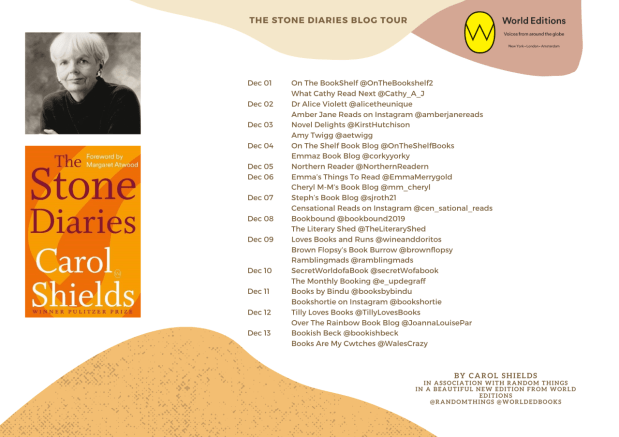
The Stone Diaries by Carol Shields (Blog Tour Review)
Is it possible to capture the complete course of a life, whether looking from the outside or telling it from the inside? What is set in stone and what is fleeting? These are questions Carol Shields addresses in her 1995 Pulitzer Prize winner, which plays with perspective and forms of storytelling as it conveys the extra/ordinary life of Daisy Stone Goodwill Flett. What with the family tree and section of black-and-white photographs, you might expect this to be a family saga; with the chronological chapters proceeding from “Birth” in 1905 to “Death” in the 1990s, you might expect an objective faux-biography. But The Stone Diaries is neither.
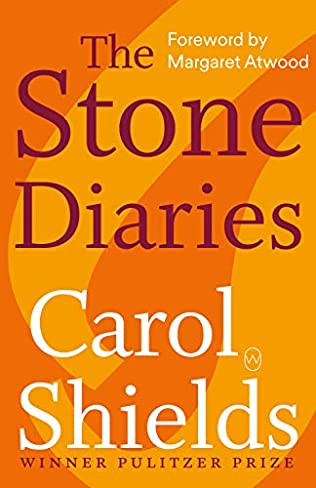 The facts are these. Daisy’s mother, Mercy, dies giving birth to her in rural Manitoba. Raised by a neighbor, Daisy later moves to Indiana with her stonecutter father, Cuyler. After a disastrously short first marriage, Daisy returns to Canada to marry Barker Flett. Their three children and Ottawa garden become her life. She temporarily finds purpose in her empty-nest years by writing a “Mrs. Green Thumb” column for a local newspaper, but her retirement in Florida is plagued by illness and the feeling that she has missed out on what matters most.
What makes this surprising life story so remarkable is its unpicking of (auto)biographical authenticity: Shields switches between the first and third person, between Daisy’s point of view and a feigned omniscience. Some sections foreground others’ opinions: Chapter 6 is composed entirely of letters Daisy receives, while Chapter 7 collects short first-person narratives from her children and friends as they speculate on why she has fallen into a depression.
As in Shields’s Happenstance and Larry’s Party, which I’ve also reread this year, I was struck by the role that chance plays in any life:
History indeed! As though this paltry slice of time deserves such a name. Accident, not history, has called us together, and what an assembly we make. What confusion, what a clamor of inadequacy and portent.
Talk of bias, gaps and unreliability undermines the narrative:
Well, a childhood is what anyone wants to remember of it. It leaves behind no fossils, except perhaps in fiction. Which is why you want to take Daisy’s representation of events with a grain of salt, a bushel of salt.
Daisy herself almost disappears from the parts of the book where she is voiceless, consumed by her roles – by the end she is universally known as “Grandma Flett.” This meant that other characters stood out as more memorable to me: Cuyler for his obsessive building of stone monuments and streams of words, Barker for his love of plants and long-deferred sexual fulfillment, Daisy’s friend Fraidy Hoyt for her careful chronicling of fast living, and Magnus, Barker’s father, who lives long past his 100th birthday after his return to the Orkney Islands.
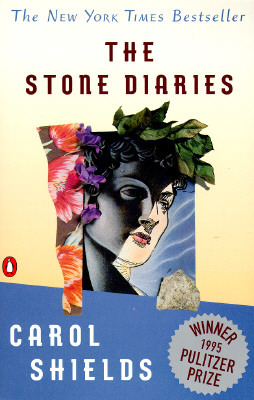 As in Moon Tiger, one of my absolute favorites, the author explores how events and memories turn into artifacts. The meta approach also, I suspect, tips the hat to other works of Canadian literature: in her introduction, Margaret Atwood mentions that the poet whose story inspired Shields’s Mary Swann had a collection entitled A Stone Diary, and surely the title’s similarity to Margaret Laurence’s The Stone Angel (1964) can’t be pure coincidence.
Experiencing the novel again after 14 years, I was impressed by the experimentation but ultimately somewhat detached from the story. It was admiration rather than love; I enjoyed earlier chapters more than the last few. But isn’t that just like life, to keep going past the point where it’s fun? And isn’t that the point, that the meaning you long for may not be there at all?
Marcie (Buried in Print) and I have reread – or, in my case for half of them, read for the first time – six Shields novels together in 2020. I hope I’ll find time to respond to the rest of them in the next few weeks. It has been so rewarding to observe how her themes recur and interlock. How heartening to see that, 17 years after her death, Shields is still being read and remembered, through the World Editions reissues (three more are coming in 2021) and through the Carol Shields Prize for Fiction, a new $100,000 annual award for North American women’s writing.
The Stone Diaries was reissued in the UK by World Editions on December 3rd. My thanks to the publisher for the free copy for review.
I was delighted to be invited to help close out the blog tour for The Stone Diaries. See below for details of where other reviews have appeared.
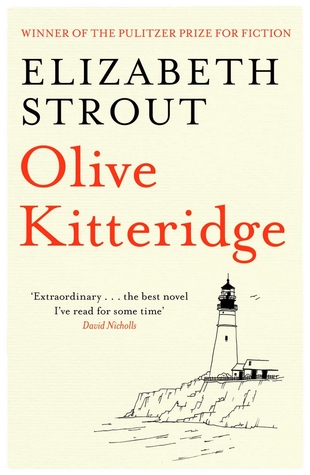
Olive Kitteridge and Olive, Again
Although I’ve confessed to being generally wary of sequels, and I am scrupulously avoiding this autumn’s other high-profile sequel (you know the one!), I loved Olive Kitteridge enough to continue straight on to Elizabeth Strout’s sequel, Olive, Again, which I thought even better.
Olive Kitteridge (2008)
I have a soft spot for literature’s curmudgeons – the real-life ones like J. R. Ackerley, Shaun Bythell and Geoff Dyer as well as the fictional protagonists like Dr. James Darke in Rick Gekoski’s debut novel, Cassandra Darke in Posy Simmonds’s graphic novel, Hagar Shipley in The Stone Angel, Hendrik Groen in his two titular Dutch diaries, and Frederick Lothian in Josephine Wilson’s Extinctions. So it’s no surprise that I warmed immediately to Olive Kitteridge, a grumpy retired math teacher in Crosby, Maine. She’s seen and heard it all, and will bluntly say just what she thinks. She has no time for anyone else’s nonsense.
 I love our first introduction to her, three pages into the opening piece of this linked short story collection: she dismisses her pharmacist husband Henry’s new employee as “mousy,” and when Henry suggests inviting the girl and her husband over for dinner, snaps, Bartleby-like, “Not keen on it.” The great sadness of Olive’s life is the death of a fellow teacher she never quite had an affair with, but loved in her early forties. The great failure of Olive’s life is not connecting with her only son, Christopher, a podiatrist who marries a woman Olive dislikes and moves to California, then remarries a single mother of two and settles in New York City.
I started this in February and didn’t finish it until this month. I lost momentum after “A Different Road,” in which Olive and Henry are in a hostage situation in the local hospital. This was a darker turn than I was prepared for from Strout – I thought unrequited love and seasonal melancholy was as bleak as she’d go. But I hadn’t read “Tulips” yet, in which we learn that a local boy is in prison for stabbing a woman 29 times.
My least favorite stories were the ones that are about other locals and only mention Olive in passing, perhaps via advice she once gave a student. It almost feels like Strout wrote these as stand-alone stories and then, at her publisher’s behest, inserted a sentence or two so they could fit into a book about Olive. I much prefer the stories that are all about Olive, whether she’s engaging in a small act of rebellion on her son’s wedding day, visiting his new family in New York, or entertaining the prospect of romance some time after Henry’s death.
Olive is a sort of Everywoman; in her loneliness, frustrated desire and occasional depression she’s like us all. I wrote an article on linked short story collections some months ago and pretty much everyone I consulted mentioned Olive as the epitome. I didn’t love the book quite as much as I expected to, but I was very glad to have read it. It won the Pulitzer Prize in 2009.
[Apropos of nothing: this book contains the worst possible nickname for my name that I’ve ever encountered: Bicka-Beck.]
My rating: 
Olive, Again (2019)
(Coming from Random House [USA] on October 15th and Viking [UK] on October 31st)
 I liked this that little bit more than Olive Kitteridge for a number of reasons:
1) I read it over a matter of days rather than months, so the characters and happenings stayed fresher in my mind and I experienced it more as a novel-in-stories than as a set of discrete stories.
2) Olive, our Everywoman protagonist, approaches widowhood, decrepitude and death with her usual mixture of stoicism and bad temper. You may hear more about her bowels than you’d like to, but at least Strout is being realistic about the indignities of ageing.
3) Crucially, Olive has started, very late in life, to take a genuine interest in other people, such as her son’s second wife; a local girl who becomes Poet Laureate; and the carers who look after her following a heart attack. “Tell me what it’s like to be you,” she says one day to the Somali nurse who comes over from Shirley Falls. Comparing others’ lives with her own, she realizes she’s been lucky in many ways. Yet that doesn’t make understanding herself, or preparing for death, any easier.
4) There are connections to other Strout novels that made me intrigued to read further in her work. In “Exiles,” Bob and Jim Burgess of The Burgess Boys are reunited in Maine, while in the final story, “Friend,” Olive befriends a new fellow nursing home resident, Isabelle Daignault of Amy and Isabelle.
5) Olive delivers a baby!
As with the previous volume, I most liked the stories that stuck close to Olive, and least liked those that are primarily about others in Crosby or Shirley Falls and only mention Olive in passing, such as via a piece of advice she gave to one of her math students several decades ago. Twice Strout goes sexually explicit – a voyeurism situation, and a minor character who is a dominatrix; I felt these touches were unnecessary. Overall, though, these stories are of very high quality. The two best ones, worth seeking out whether you think you want to read the whole book or not, are “The Poet” and “Heart.”
My rating: 
I read an advanced e-copy via NetGalley.
Are you a fan of Elizabeth Strout’s work? Do you plan to read Olive, Again?
America Reading & Book Haul, Etc.
The wedding of a college friend – who I calculated I’ve known at least half my life – was the excuse we needed to book a trip back to the States for the last two weeks of May. Along with the classy nuptials in the Fell’s Point area of Baltimore, we enjoyed a day’s sightseeing in Philadelphia, a couple of outings to watch birds and other wildlife on Cape May (a migration hotspot in New Jersey), two meet-ups with other friends, and plenty of relaxation time with my mom and sister, including a Memorial Day picnic at my mom’s retirement community and a tour of Antietam Battlefield. It was much hotter than anticipated, including some days in the high 80s or even 90s, and the hayfever, ticks and mosquitoes were bad, too, but we survived.


While back in Maryland I continued the intermittent downsizing process I’ve been going through for a while now. After being on the market for nearly a year, my family home finally sold and went to closing while we were over there. So that provided a scrap of closure, but my current estrangement from my father (we don’t even know where he’s living) means there’s a lot of continuing uncertainty.
In any case, I managed to reduce the number of boxes I’m storing with my sister from 29 to 20 by recycling lots of my old schoolwork, consolidating my mementos, reselling one box of books and donating another, donating a box of figurines and decorative bottles to a thrift store, displaying some at my mom’s place, giving away a few trinkets to a friend’s kids, and packing a bunch of stuff – photo albums and decorations as well as 64 books – in our various suitcases and hand luggage to take back to the UK.


And I also acquired more books, of course! A whopping 46 of these were free: eight review copies were waiting for me at my mom’s place; three were from the outdoor free bin at 2nd & Charles, a secondhand bookstore; one was found in a Little Free Library near our friends’ place in New Jersey (Emerald City by Jennifer Egan, not pictured); and the rest were from The Book Thing of Baltimore, a legendary volunteer-run free bookshop. I mostly raided the biography section for an excellent selection of women’s life writing; the fiction is unalphabetized so harder to find anything in, but I picked up a few novels, too. My only purchases were new (remainder) copies of one novel and one memoir from Dollar Tree. Total book spending on the trip: just $2.12.
What I Read:
Two that I’d already started but finished on the plane ride over:
 The Florist’s Daughter by Patricia Hampl: (As featured in my spring reading list.) “Love and flowers, death and flowers.” Poetic writing about small-town Minnesota life, a tense relationship with her late mother, and her late father’s flower shop.
 - The Girls by Lori Lansens: I love reading about sister relationships, and the Darlen girls’ situation is an extreme case of love and jealousy given that they literally can’t get away from each other. Not as good as the two other conjoined-twin novels I’ve read, Chang and Eng by Darin Strauss and Cutting for Stone by Abraham Verghese, but I would read more from Lansens, a solid Oprah Book Club sort of author.
Three review books that will be featuring here in the near future:
- Goulash by Brian Kimberling

- Sorry I’m Late, I Didn’t Want to Come: An Introvert’s Year of Living Dangerously by Jessica Pan
- Mother Ship by Francesca Segal
A few quick reads:
 A Certain Loneliness: A Memoir by Sandra Gail Lambert: (A proof copy passed on by an online book reviewing friend.) A memoir in 29 essays about living with the effects of severe polio. Most of the pieces were previously published in literary magazines. While not all are specifically about the author’s disability, the challenges of life in a wheelchair seep in whether she’s writing about managing a feminist bookstore or going on camping and kayaking adventures in Florida’s swamps. I was reminded at times of Constellations by Sinéad Gleeson.
  No Happy Endings: A Memoir by Nora McInerny: (Borrowed from my sister.) I didn’t appreciate this as much as the author’s first memoir, It’s Okay to Laugh, though it’s in the same style: lots of short, witty but bittersweet essays reflecting on life’s losses. Within a year of being widowed by cancer, she met a new partner and soon was – surprise! – pregnant with his baby. Together they formed a blended family of four children ranging from 0 to 15 and two wounded adults. McInerny also writes about her newfound spirituality and feminism. The problem with the essay format is that she cycles through aspects of the same stories multiple times.
  Native Guard by Natasha Trethewey: (Free from 2nd & Charles.) Trethewey writes beautifully disciplined verse about her mixed-race upbringing in Mississippi, her mother’s death and the South’s legacy of racial injustice. She occasionally rhymes, but more often employs forms that involve repeated lines or words. The title sequence concerns a black Civil War regiment in Louisiana. Two favorites from this Pulitzer-winning collection by a former U.S. poet laureate were “Letter” and “Miscegenation”; stand-out passages include “In my dream, / the ghost of history lies down beside me, // rolls over, pins me beneath a heavy arm” (from “Pilgrimage”) and “I return / to Mississippi, state that made a crime // of me — mulatto, half-breed” (from “South”).
 I also read the first half or more of: The Music Shop by Rachel Joyce, my June book club book; Hungry by Jeff Gordinier, a journalist’s travelogue of his foodie journeys with René Redzepi of Noma fame, coming out in July; and the brand-new novel In West Mills by De’Shawn Charles Winslow – these last two are for upcoming BookBrowse reviews.
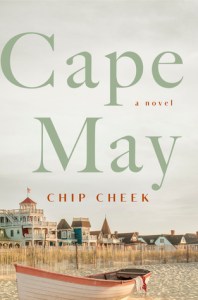
But the book I was most smug to have on my reading list for the trip was the recent novel Cape May by Chip Cheek. What could be more perfect for reading on location? I asked myself. Unfortunately, it stood out for the wrong reasons. In October 1957 a young pair of virgins, Effie and Henry, travel from Georgia to New Jersey for an off-season honeymoon in her uncle’s vacation home. They’re happy enough with each other but underwhelmed with the place (strangely, this matched my experience of Cape May), and even consider going home early until they fall in with Clara, a friend of Effie’s cousin; Clara’s lover, Max; and Max’s younger sister, Alma. Effie and Henry join the others for nightly drunken revelry.
[SPOILERS!] As the weeks pass Effie, ill and dejected, almost seems to disappear as Cheek delves into Henry’s besotted shenanigans, described in unnecessarily explicit sexual detail. When Effie makes a bid or two for her own sexual freedom late on, it only emphasizes the injustice of spending so much time foregrounding Henry’s perspective. Despite the strength of the period atmosphere and seaside location, this ends up being dull and dated. If you’re after a typically ‘trashy’ beach read and don’t mind lots of sex scenes, you may get on with it better than I did. 

Reading a few pages of Cape May over an ice-cold G&T at the wedding reception.
Bonus bookishness:
Vineland, New Jersey was on the way from our friends’ house to Cape May, so we stopped to take my proof copy of Barbara Kingsolver’s Unsheltered to its spiritual home. Alas, Vineland is an utterly boring small American town. However, Mary Treat at least appears on a painted mural on a building on the main street. The Historical Society, where Kingsolver did her research, was closed, but we photographed the outside.


What’s the last book you read ‘on location’? Did it work out well for you?
Classics and Doorstoppers of the Month
April was something of a lackluster case for my two monthly challenges: two slightly disappointing books were partially read (and partially skimmed), and two more that promise to be more enjoyable were not finished in time to review in full.
Classics
Wise Blood by Flannery O’Connor (1952)
 When Hazel Motes, newly released from the Army, arrives back in Tennessee, his priorities are to get a car and to get laid. In contrast to his preacher grandfather, “a waspish old man who had ridden over three counties with Jesus hidden in his head like a stinger,” he founds “The Church Without Christ.” Heaven, hell and sin are meaningless concepts for Haze; “I don’t have to run from anything because I don’t believe in anything,” he declares. But his vociferousness belies his professed indifference. He’s particularly invested in exposing Asa Hawkes, a preacher who vowed to blind himself, but things get complicated when Haze is seduced by Hawkes’s 15-year-old illegitimate daughter, Sabbath – and when his groupie, eighteen-year-old Enoch Emery, steals a shrunken head from the local museum and decides it’s just the new Jesus this anti-religion needs. O’Connor is known for her very violent and very Catholic vision of life. In a preface she refers to this, her debut, as a comic novel, but I found it bizarre and unpleasant and only skimmed the final two-thirds after reading the first 55 pages.
In progress: Cider with Rosie by Laurie Lee (1959) – I love to read ‘on location’ when I can, so this was a perfect book to start during a weekend when I visited Stroud, Gloucestershire for the first time.* Lee was born in Stroud and grew up there and in the neighboring village of Slad. I’m on page 65 and it’s been a wonderfully evocative look at a country childhood. The voice reminds me slightly of Gerald Durrell’s in his autobiographical trilogy.
*We spent one night in Stroud on our way home from a short holiday in Devon so that I could see The Bookshop Band and member Beth Porter’s other band, Marshes (formerly Beth Porter and The Availables) live at the Prince Albert pub. It was a terrific night of new songs and old favorites. I also got to pick up my copy of the new Marshes album, When the Lights Are Bright, which I supported via an Indiegogo campaign, directly from Beth.


Doorstoppers
The Resurrection of Joan Ashby by Cherise Wolas (2017)
Joan Ashby’s short story collection won a National Book Award when she was 21 and was a bestseller for a year; her second book, a linked story collection, was nominated for a Pulitzer Prize. In contravention of her childhood promise to devote herself to her art, she marries Martin Manning, an eye surgeon, and is soon a mother of two stuck in the Virginia suburbs. Two weeks before Daniel’s birth, she trashes a complete novel. Apart from a series of “Rare Babies” stories that never circulate outside the family, she doesn’t return to writing until both boys are in full-time schooling. When younger son Eric quits school at 13 to start a computer programming business, she shoves an entire novel in a box in the garage and forgets about it.
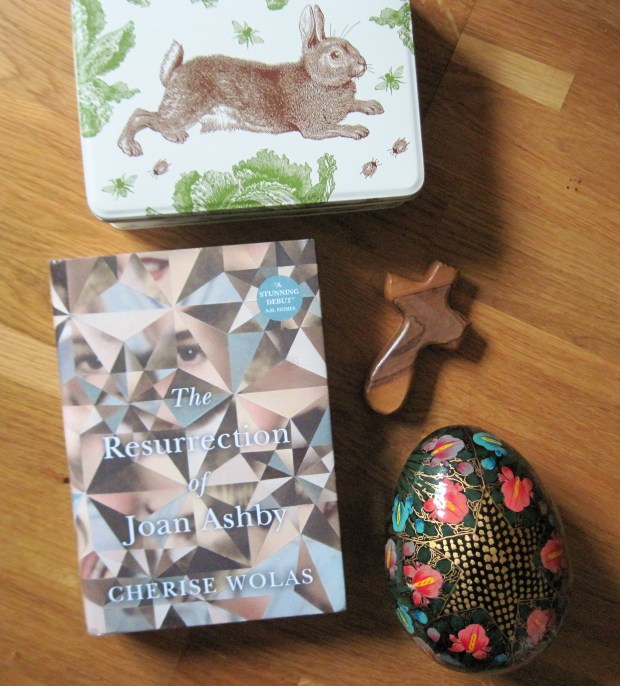
I chose this for April based on the Easter-y title (it’s a stretch, I know!).
Queasy feelings of regret over birthing parasitic children – Daniel turns out to be a fellow writer (of sorts) whose decisions sap Joan’s strength – fuel the strong Part I, which reminded me somewhat of Doris Lessing’s The Golden Notebook in that the protagonist is trying, and mostly failing, to reconcile the different parts of her identity. However, this debut novel is indulgently long, and I lost interest by Part III, in which Joan travels to Dharamshala, India to reassess her relationships and career. I skimmed most of the last 200 pages, and also skipped pretty much all of the multi-page excerpts from Joan’s fiction. At a certain point it became hard to sympathize with Joan’s decisions, and the narration grew overblown (“arc of tragedy,” “tortured irony,” etc.) [Read instead: Forty Rooms by Olga Grushin]
Page count: 523
In progress: Mary Ann Sate, Imbecile by Alice Jolly, a 613-page historical novel in verse narrated by a semi-literate servant from Stroud, then a cloth mill town. I’d already committed to read it for a Nudge/New Books magazine review, having had my interest redoubled by its shortlisting for the Rathbones Folio Prize, but it was another perfect choice for a weekend that involved a visit to that part of Gloucestershire. Once you’re in the zone, and so long as you can guarantee no distractions, this is actually a pretty quick read. I easily got through the first 75 pages in a couple of days.
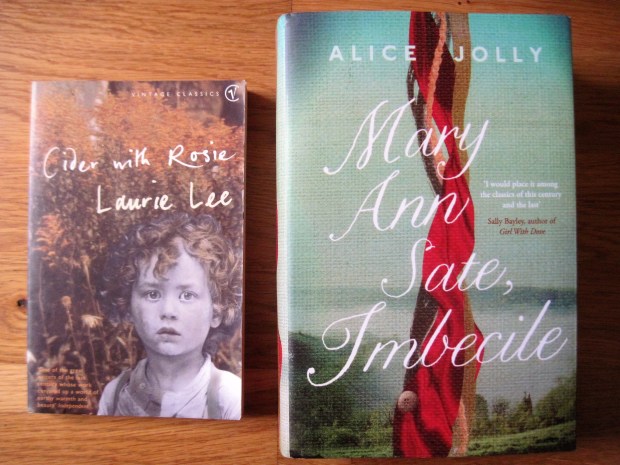
My Stroud-themed reading.
Next month’s plan: As a doorstopper Annabel and I are going to read The Amazing Adventures of Kavalier & Clay by Michael Chabon (636 pages, or roughly 20 pages a day for the whole month of May). Join us if you like! I’m undecided about a classic, but might choose between George Eliot, William Faulkner, Robert Louis Stevenson and Emile Zola.
Recent Poetry Reads
I love interspersing poetry with my other reading, and this year it seems like I’m getting to more of it than ever. Although I try to have a poetry collection on the go at all times, I still consider myself a novice and enjoy discovering new-to-me poets. However, I know many readers who totally avoid poetry because they assume they won’t understand it or it would feel too much like hard work.
Sinking into poems is certainly a very different experience from opening up a novel or a nonfiction narrative. Often I read parts of a poem two or three times – to make sure I’ve taken it in properly, or just to savor the language. I try to hear the lines aloud in my head so I can appreciate the sonic techniques at work, whether rhyming or alliteration. Reading or listening to poetry engages a different part of the brain, and it may be best to experience it in something of a dreamlike state.
I hope you’ll find a book or two that appeals from the selection below.
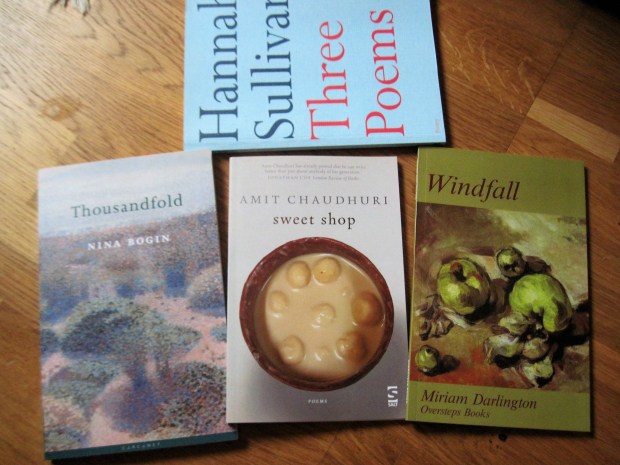
Thousandfold by Nina Bogin (2019)
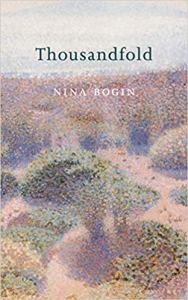 This is a lovely collection whose poems devote equal time to interactions with nature and encounters with friends and family. Birds – along with their eggs and feathers – are a frequent presence. Often a particular object will serve as a totem as the poet remembers the most important people in her life: her father’s sheepskin coat, her grandmother’s pink bathrobe, and the slippers her late husband shuffled around in – a sign of how diminished he’d become due to dementia. Elsewhere Bogin greets a new granddaughter and gives thanks for the comforting presence of her cat. Gentle rhymes and half-rhymes lend a playful or incantatory nature. I’d recommend this to fans of Linda Pastan.
My rating:
Thousandfold will be published by Carcanet Press on January 31st. My thanks to the publisher for the free copy for review.
Sweet Shop by Amit Chaudhuri (2019)
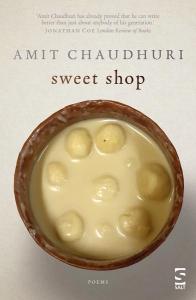 I was previously unfamiliar with Chaudhuri’s work, and unfortunately this insubstantial book about his beloved Indian places and foods hasn’t lured me into trying any more. The one poem I liked best was “Creek Row,” about a Calcutta lane used as a shortcut: “you are a thin, short-lived, / decaying corridor” and an “oesophageal aperture”. I also liked, as stand-alone lines go, “Refugees are periodic / like daffodils.” Nothing else stood out for me in terms of language, sound or theme. Poetry is so subjective; all I can say is that some poets will click with you and others don’t. In any case, the atmosphere is similar to what I found in Korma, Kheer and Kismet: Five Seasons in Old Delhi by Pamela Timms.
My rating: 
My thanks to Salt Publishing for the free copy for review.
Windfall by Miriam Darlington (2008)
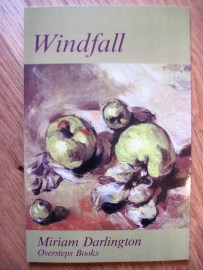 Before I picked this up from the bookstall at the New Networks for Nature conference in November, I had no idea that Darlington had written poetry before she turned to nature writing (Otter Country and Owl Sense). These poems are rooted in the everyday: flipping pancakes, sitting down to coffee, tending a garden, smiling at a dog. Multiple poems link food and erotic pleasure; others make nature the source of exaltation. I loved her descriptions of a heron (“a standing stone / perched in silt / a wrap of grey plumage”) and a blackbird (“the first bird / a glockenspiel in C / an improvisation on morning / a blue string of notes”), Lots of allusions and delicious alliteration. Pick this up if you’re missing Mary Oliver.
My rating:
A Responsibility to Awe by Rebecca Elson (2018)
 Elson, an astronomer who worked on the Hubble Space Telescope, died of breast cancer; this is a reprint of her posthumous 2001 publication. Along with a set of completed poems, the volume includes an autobiographical essay and extracts from her notebooks. Her impending mortality has a subtle presence in the book. I focused on the finished poems, which take their metaphors from physics (“Dark Matter”), mathematics (“Inventing Zero”) and evolution (indeed, “Evolution” was my favorite). In the essay that closes the book, Elson remembers long summers of fieldwork and road trips across Canada with her geologist father (I was reminded of Margaret Atwood’s Cat’s Eye), and traces her academic career as she bounced between the United States and Great Britain.
My rating:
My thanks to Carcanet Press for the free copy for review.
These next two were on the Costa Prize for Poetry shortlist, along with Hannah Sullivan’s Three Poems, which was one of my top poetry collections of 2018 and recently won the T. S. Eliot Prize. I first encountered the work of all three poets at last year’s Faber Spring Party.
Us by Zaffar Kunial (2018)
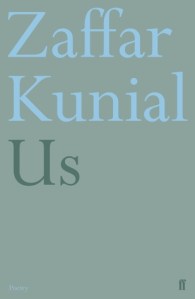 Many of these poems are about split loyalties and a composite identity – Kunial’s father was Kashmiri and his mother English – and what the languages we use say about us. He also writes about unexpectedly developing a love for literature, and devotes one poem to Jane Austen and another to Shakespeare. My favorites were “Self Portrait as Bottom,” about doing a DNA test (“O I am translated. / The speech of numbers. / Here’s me in them / and them in me. … What could be more prosaic? / I am split. 50% Europe. / 50% Asia.”), and the title poem, a plea for understanding and common ground.
My rating:
Soho by Richard Scott (2018)
 When I saw him live, Scott read two of the amazingly intimate poems from this upcoming collection. One, “cover-boys,” is about top-shelf gay porn and what became of the models; the other, “museum,” is, on the face of it, about mutilated sculptures of male bodies in the Athens archaeological museum, but also, more generally, about “the vulnerability of / queer bodies.” If you appreciate the erotic verse of Mark Doty and Andrew McMillan, you need to pick this one up immediately. Scott channels Verlaine in a central section of gritty love poems and Whitman in the final, multi-part “Oh My Soho!”
My rating:
Don’t Call Us Dead by Danez Smith (2017)
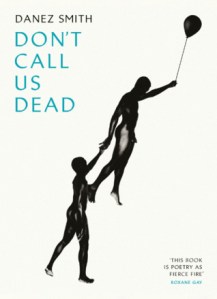 Like Claudia Rankine’s Citizen, this is a book whose aims I can admire even though I didn’t particularly enjoy reading it. It’s about being black and queer in an America where both those identifiers are dangerous, where guns and HIV are omnipresent threats. “reader, what does it / feel like to be safe? white?” Smith asks. “when i was born, i was born a bull’s-eye.” The narrator and many of the other characters are bruised and bloody, with blood used literally but also metaphorically for kinship and sexual encounters. By turns tender and biting, exultant and uncomfortable, these poems are undeniably striking, and a necessary wake-up call for readers who may never have considered the author’s perspective.
My rating:
Up next: This Pulitzer-winning collection from the late Mary Oliver, whose work I’ve had mixed success with before (Dream Work is by far her best that I’ve read so far). We lost two great authors within a week! RIP Diana Athill, too, who was 101.
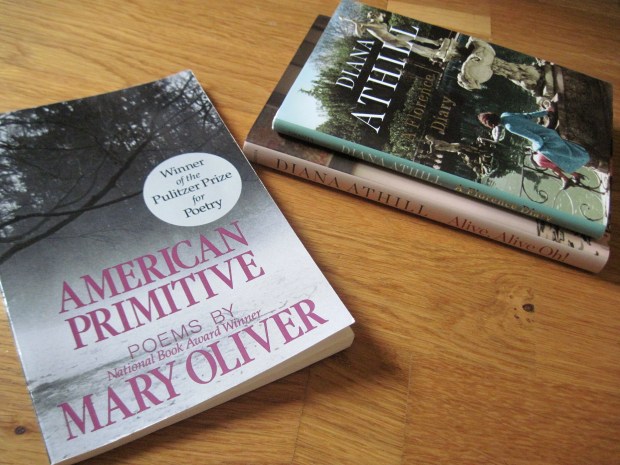
Any recent poetry reads you can recommend to me?
20 Books of Summer, #1–3: Hadley, Timms & Tyler
I’ve been reading sophisticated short stories, a food/travel memoir, and a prize-winning slice of cozy Americana.
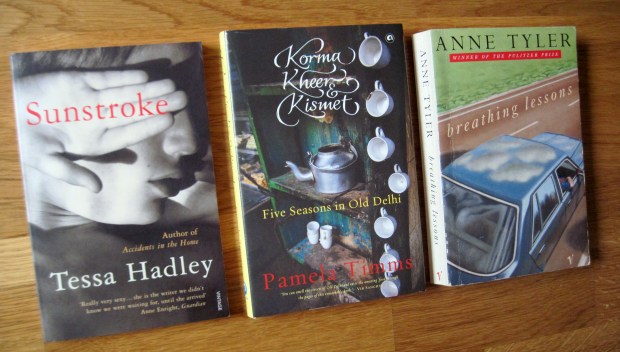
Sunstroke and Other Stories by Tessa Hadley (2007)
Everything is running away so fast; your deepest responsibility is to snatch at all the living you can.
Here’s a little something I wrote as an introduction to a review of Hadley’s most recent short story collection: “When I think of Tessa Hadley’s books, I picture a certain quality of light. I see piercing yellow shafts of sunlight filling airy, wood-floored rooms and lowering over suburban English gardens to create languid summer evenings. I think of childhood’s sense of possibility and adolescence’s gently scary feeling of new freedoms opening up. And, even when the story lines are set in the present day, I imagine the calm sophistication of 1950s–70s fashions: smart sweater sets and skirts, or flowing hippie dresses.” This volume is from a decade earlier and is not quite as strong, but that distinct atmosphere is still there.
 Each story pivots on a particular relationship: A mother fends off her son’s spurned lover; a teenager helps her older sister recover from a miscarriage; a woman hosts her former brother-in-law. Several stories revisit the same place or situation decades later. Claudia flirted with Graham when he was a teenager and she a grown woman; in “Phosphorescence” he tests whether there’s still any power in that connection 25 years later. In “A Card Trick” Gina goes back to a writer’s home she visited with family friends 25 years ago and reflects on how life has failed to live up to expectations. In “Matrilineal” Nia shares the comfort of a bed with her mother twice: once as a little girl the night they run away from her father, and again 40 years later in a hotel in New York City.
My two favorites were “The Surrogate,” in which a young woman falls for her professor – and for a pub customer who happens to look like him; and “Exchanges,” about two women on the cusp of middle age whose lives have diverged.
Korma, Kheer and Kismet: Five Seasons in Old Delhi by Pamela Timms (2014)
The only diary I’ve ever religiously maintained is my food journal.
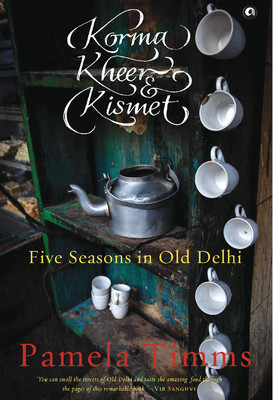 Timms is a Scottish journalist and food blogger who moved to India in 2005 when her husband got a job as a foreign correspondent. She delights in the street food stalls of Old Delhi, where you can get a hearty and delicious meal of mutton curry or fried vegetable dumplings for very little money. Often the snacks are simple – the first roasted sweet potatoes of the season or a big bowl of rice pudding made with buffalo milk and flavored with cardamom – but something about snatching sustenance while you’re on the go can make it the best thing you’ve ever tasted. It takes some searching to avoid the “pizza-fication” of Indian cuisine and discover an authentic hole-in-the-wall. Timms relies on local knowledge to locate hidden treasures and probes the owners until she gets recipes to recreate at home.
There isn’t a strong narrative to the book, but the food descriptions are certainly mouth-watering. Timms also captures the “magnificent mayhem of the spice market” and the extremes of the climate – a Delhi summer is like “being trapped inside a tandoor for three months of the year.” I reckon “Mr Naseem’s Sheer Khurma” will be fairly easy and so worth trying as a light dessert to follow a curry feast. Made with whole milk, ground rice, dried fruits and nuts, it’s a sweet custard traditionally used to break the Ramadan fast.
Breathing Lessons by Anne Tyler (1988)
“Was there a certain conscious point in your life when you decided to settle for being ordinary?”
Tyler won the Pulitzer Prize for this one. I’d rate it third out of the seven of her novels I’ve read so far, after Dinner at the Homesick Restaurant and The Accidental Tourist. (In general I seem to like her 1980s work the best.) The main action takes place all on one day, as Maggie Moran and her husband Ira travel from Baltimore up to Pennsylvania to attend the funeral of her childhood friend’s husband and pay a visit to their son’s ex-wife and their granddaughter.
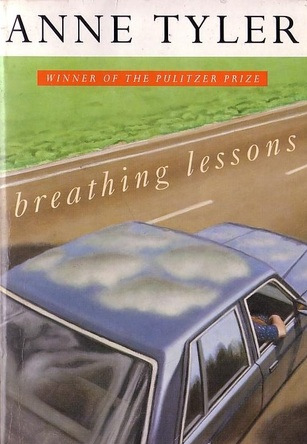 Of course, circadian narratives are so clever because they manage to interleave sufficient flashbacks to fill in the background. So we learn how 48-year-old Maggie – a precursor of Rebecca Davitch from Back When We Were Grown-ups and Abby Whitshank from A Spool of Blue Thread and the epitome of the exuberant, slightly ditzy, do-gooding heroine – has always meant well but through a combination of misunderstandings and fibs has botched things. She settled on Ira almost out of embarrassment: she’d heard a rumor he’d been killed in military training and sent his father an effusive condolence letter. When their son Jesse got Fiona pregnant, Maggie convinced Fiona to give him a chance based on a sentimental story about him that she perhaps half believed, and now, years later, she’s trying to do the same.
I loved the funeral scene itself – Serena is determined to recreate her wedding to Max, note for note – but I wearied of a sequence in which Maggie and Ira help an older African-American gentleman with car trouble. This is very much the Maggie show, so your reaction to the novel will largely depend on how well you’re able to tolerate her irksome habits. (Really, does she have to confuse the brake and the accelerator TWICE in one day?) Ira is the usual Tylerian standoffish husband, and Jesse the standard layabout progeny. What I found strangest was how little Tyler bothers to develop the character of the Moran daughter, Daisy.
Still, I enjoyed this. It’s a story about the mistakes we make, the patterns we get stuck in, and the ways we try to put things right. Sometimes it works; sometimes it doesn’t. Ultimately, we’re all making up this life business as we go along.
(I’ll also be reviewing Anne Tyler’s new novel, Clock Dance, on July 12th.)
 Bookish Beck = Rebecca Foster. American transplant to England. Freelance proofreader and book reviewer.
 Bookish Beck