Final Reading Statistics for 2025 & Goals for 2026
Happy New Year! We went to a neighbours’ party again this year and played silly games and chased their kittens until 1:30 a.m. It was a fun, low-key way to see in 2026.
I read 313 books last year. (2024’s total of 352 will never be topped!) Initially, I set a goal of 350, but by midyear I downgraded it to 300 and it was easy to reach. I can’t pinpoint a particular reason for the decline. In general, I felt like I was chasing my tail all year, despite having less work on than ever (but increased volunteering commitments). Often, I struggled with fatigue or being on the verge of illness. What a fun guessing game: is it long Covid or perimenopause?
Goodreads was glitchy for me all year, randomly counting books two or three times and falsely inflating my total by a whole extra 33 books at one point. It also has a lot of annoying, automatically generated book records that duplicate ISBNs or add the publisher to the title field. So I’m thinking about moving over to StoryGraph this year – I just imported my Goodreads library – though I always quail at learning new online systems. It would also be the next logical step in divesting from Am*zon.
The year that was…
2025’s notable happenings:
- Twice assessing the ‘proper’ (published) books as a McKitterick Prize judge
- Adopting crazy Benny (though that was after losing our precious Alfie)
- Acquiring a secondhand electric car for the household
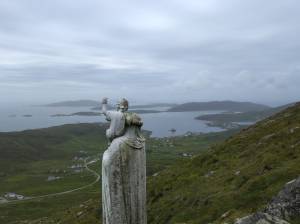
- Holidays in Hay-on-Wye; the Outer Hebrides; Suffolk; Berlin and Lübeck, Germany
- A summer visit from my sister and brother-in-law
- Having the windows and door replaced in the back of our house; and the hall and stairwell/landing redecorated
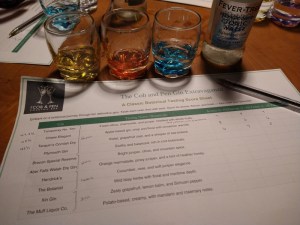
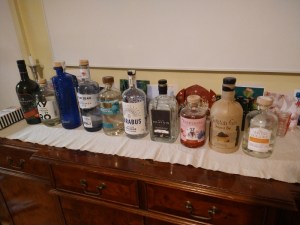
- I got ever more into gin and cocktails, with tastings in Abingdon and Wantage (and in December I led two informal tastings for friends). I also acquired the taste for rum!






The reading statistics, as compared to 2024:
Fiction: 54.7% (↑3.3%)
Nonfiction: 31.6% (↓0.2%)
Poetry: 13.7% (↓3.1%)
Female author: 67.7% (↓0.2%)
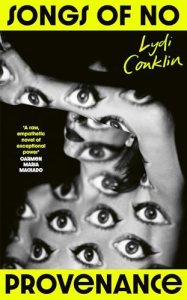
Lydi Conklin was one of 10 nonbinary authors I read from this year. Had I read their novel earlier, this would have made it into my Cover Love post!
Nonbinary author: 3.2% (↑2.1%)
BIPOC author: 18.5% (↑0.1%)
How to get it to 25% or more??
LGBTQ: 20.4% (↓1.1%)
(Author’s identity or a major theme in the work.) It’s the first time this has decreased since 2021, but I’m still pleased with the figure overall.
Work in translation: 9.6% (↑3.6%)
Going the right way with this trend! 10% seems like a good minimum to aim for. I find I have to make a conscious effort by accepting translated review copies or picking them off my shelves to tie in with particular reading challenges.
German (6) – mainly because of our trip in September
French (5)
Swedish (4)
Korean (3)
 Italian (2)
Japanese (2)
Spanish (2)
Chinese (1)
Dutch (1)
Norwegian (1)
Polish (1)
Portuguese (1)
Russian (1)
2025 (or pre-release 2026) books: 55.6% (↑3.2%)
Backlist: 44.4%
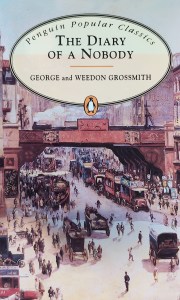
But a lot of that ‘backlist’ stuff was still from the 2020s; I only read eight pre-1950 books, the oldest being Diary of a Nobody from 1892.
E-books: 35.5% (↑3.4%)
Print books: 64.5%
I almost exclusively read e-books for BookBrowse, Foreword and Shelf Awareness reviews. The number of overall Shelf Awareness reviews will be decreasing because of changes to their publishing model, so this figure may well change by next year.
Rereads: 11, vs. last year’s 18
I managed nearly one a month. Like last year, three of my rereads ended up being among my most memorable reading experiences of the year, so I should really reread more often.
And, courtesy of Goodreads:
- 69,616 pages read
- Average book length: 221 pages (just one off of last year’s 220; in previous years it has always been 217–225, driven downward by poetry collections and novellas)
- Average rating for 2025: 6 (identical to the last three years)
Where my books came from for the whole year, compared to 2024:
- Free print or e-copy from publisher: 33.9% (↓10.9%)
- Public library: 18.8% (↑0.4%)
- Free (gifts, giveaways, Little Free Library/free bookshop, from friends or neighbours): 15.3% (↑2.9%)
- Downloaded from NetGalley, Edelweiss or BookSirens: 15% (↑7.2%)
- Secondhand purchase: 12.8% (↑1.3%)
- New purchase (often at a bargain price; includes Kindle purchases): 2.6% (↓0.5%)
- University library: 1.3% (↓0.7%)
- Other (church theological library): 0.3% (↑0.3%)


I’m pleased that 30.3% of my reading was from my own shelves, versus last year’s 24%. It looks like I mainly achieved this through a reduction in review copies. In 2026, I’d like to read even more backlist material from my own shelves (including rereads). This will be a particular focus in January, and then I’ll plan how to incorporate it for the rest of the year.
I have an absurd number of review books to catch up on (42), some stretching back to 2022 – the year of my mother’s death, which put me off my stride in many ways – as well as part-read books (116) to get real about and either finish or call DNFs and clear from my shelves. Dealing with these can be part of the reading-from-my-shelves initiative.
What trends did you see in your year’s reading? What is your plan for 2026?
20 Books of Summer 2025 Plans
It’s my eighth year participating in the 20 Books of Summer challenge, this year co-hosted by Annabel and Emma after Cathy stepped down. #20BooksofSummer2025 starts on 1 June and runs through 31 August. In some previous years I have chosen a theme, even something as simple as “books by women.” Last year I combined two criteria and managed to get through 20 hardback books I owned by women. The problem with setting even simple boundaries like that is that I seem to almost immediately lose interest. Even more dangerous to pick 20 specific books, lest I go off them right away. Nonetheless, that’s what I’ve done. Expect substitutions galore, however; most years I read only half (or less) of what I’ve earmarked.

My only firm rule is that all 20 books must be from my own shelves. Ideally, they wouldn’t overlap with my usual reviewing commitments, book club reads, or other themed challenges (e.g., June: Reading the Meow, Father’s Day, Scotland holiday; August: Women in Translation), though it would be no problem if they did. I’m the only one enforcing this!
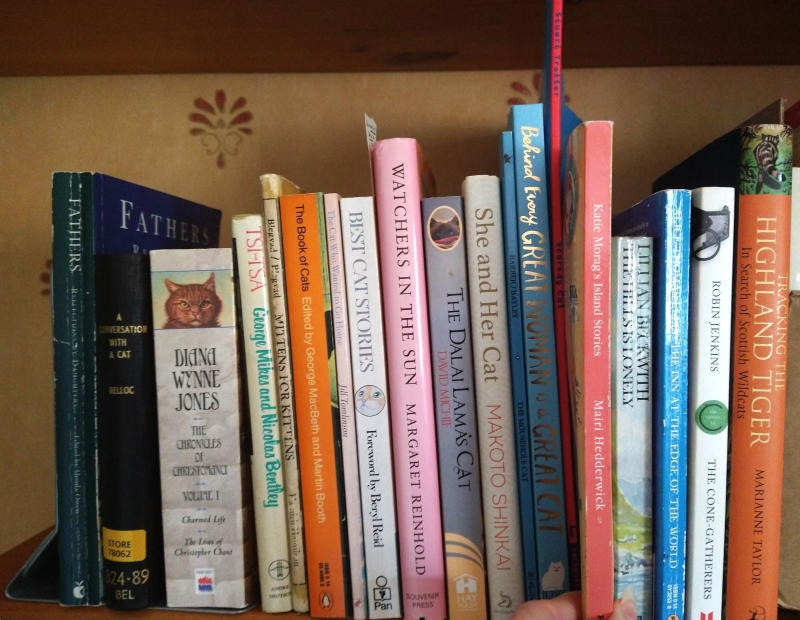
Other themed June reading options.
I like to work towards multiple goals, so I’ve chosen five books each in four categories.
Books I acquired new this year:
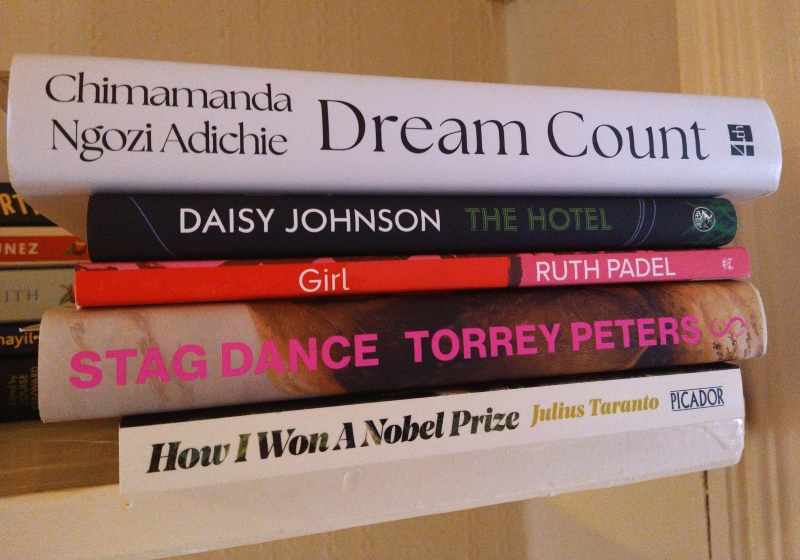
Dream Count by Chimamanda Ngozi Adichie (Hungerford Bookshop) – I pre-ordered this, a super-rarity for me, and read the first 20-some pages before petering out. I think it’s fair to say it won’t be a favourite of hers for me, but I’d still like to read it in its publication year.
The Hotel by Daisy Johnson (Hungerford Bookshop with Christmas gift token) – Creepy short stories by an author whose long-form fiction I’ve really enjoyed. Also counts toward my low-key goal of reducing the list of authors by whom I own two or more unread books.
Girl by Ruth Padel (Hungerford Bookshop with Christmas gift token) – A poetry collection about girlhood through history and in myth. A repeat appearance on my summer reading list; I reviewed her Emerald in 2021. Good to add it in for variety, and a quick win length-wise.
Stag Dance by Torrey Peters (Bookshop.org) – I bought this to show solidarity with trans women after a short-sighted legal ruling here in the UK. Detransition, Baby was awesome but I haven’t managed to get into this yet. It contains three long short stories plus a novella.
How I Won a Nobel Prize by Julius Taranto (Hungerford Bookshop with Christmas gift token) – I believe it was Susan’s review that put this on my radar, though the title and the fact that it’s an academic satire would have been enough to get it onto my TBR.
Catch-up review copies:
A couple of these date back to 2023…
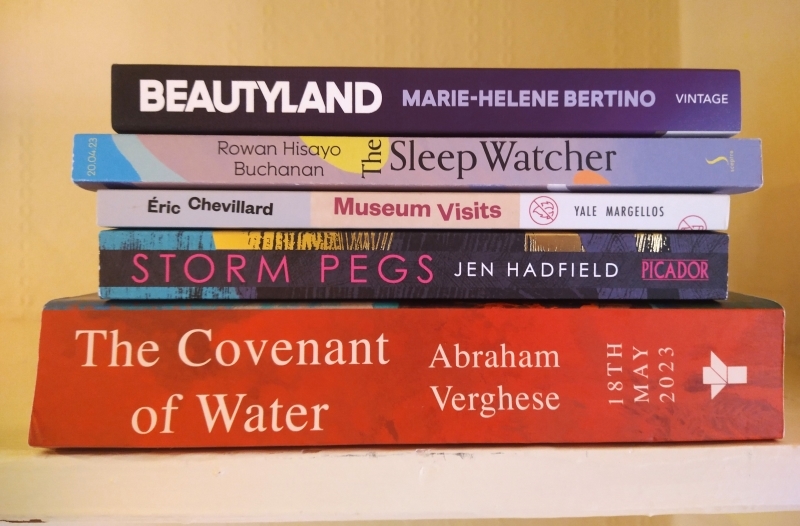
Beautyland by Marie-Helene Bertino – “At the moment when Voyager 1 is launched into space … , a baby of unusual perception is born to a single mother in Philadelphia. Adina Giorno … recognizes that she is different: She possesses knowledge of a faraway planet. The arrival of a fax machine enables her to contact her extraterrestrial relatives.” Quirky; well received by blog and Goodreads friends.
The Sleep Watcher by Rowan Hisayo Buchanan – I’ve read her other two novels but for some reason didn’t pick this up when it was first sent to me. “When she is sixteen, Kit suffers a summer of sleeplessness that isn’t quite what it seems; her body lies in bed while she wanders through her family home, the streets of her run-down seaside town and into the houses of friends and strangers.” Bonus points for being set during summer.
Museum Visits by Éric Chevillard – My one selection in translation. This hybrid collection of short pieces might be deemed essays or stories. “This ensemble of comic miniatures compiles reflections on chairs, stairs, stones, goldfish, objects found, strangers observed, scenarios imagined, reasonable premises taken to absurd conclusions, and vice versa.”
Storm Pegs by Jen Hadfield – New in paperback. I knew I had to read a Shetland-set memoir, and had enjoyed Hadfield’s piece in the Antlers of Water anthology. “In prose as rich and magical as Shetland itself, Hadfield transports us to the islands as a local; introducing us to the remote and beautiful archipelago where she has made her home”.
The Covenant of Water by Abraham Verghese – Cutting for Stone is brilliant but I was daunted by the even greater heft of this follow-up. I hope I’ll find just the right time to sink into it. “Spanning the years 1900 to 1977,” set “on India’s Malabar Coast, and follows three generations of a family that suffers a peculiar affliction: in every generation, at least one person dies by drowning—and in Kerala, water is everywhere.”
Summer-themed books / four in a row on the Bingo card:
I’d be aiming to complete the second row with this quartet:
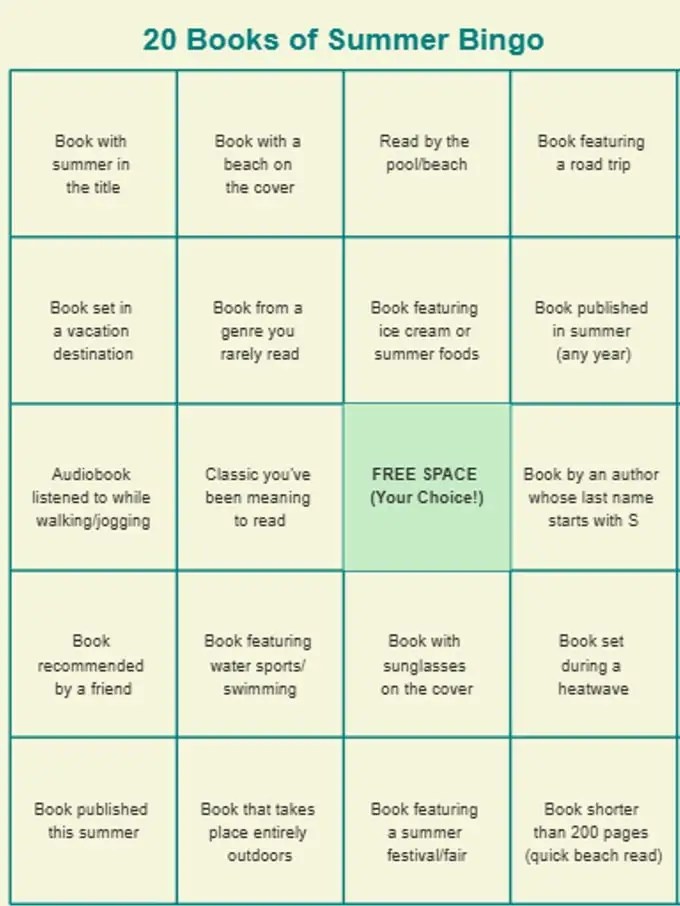
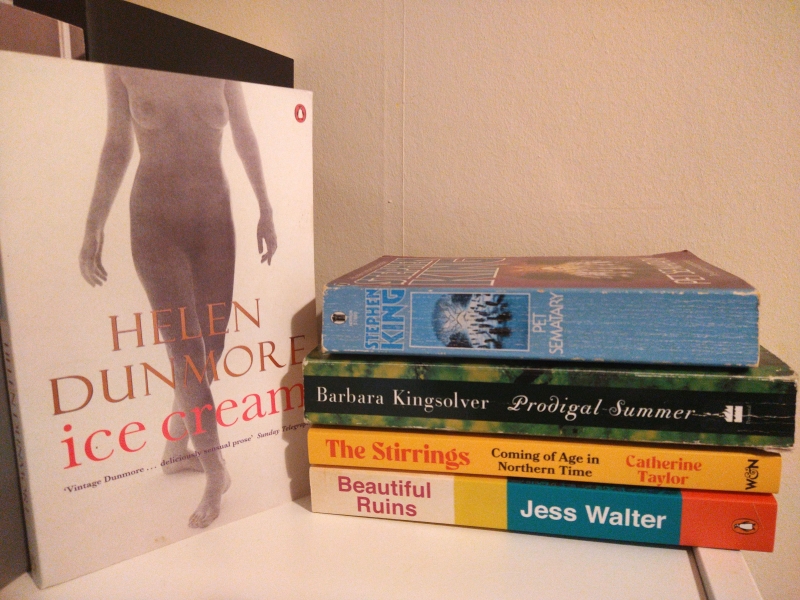
(Book set in a vacation destination)
Beautiful Ruins by Jess Walter (40th birthday gift from my husband, purchased from Hungerford Bookshop) – “the story of an almost-love affair that begins on the Italian coast in 1962 and resurfaces fifty years later in Hollywood. From the lavish set of Cleopatra to the shabby revelry of the Edinburgh Fringe Festival to the backlots of contemporary Hollywood, this is a dazzling, yet deeply human roller coaster of a novel.”
(Book from a genre you rarely read)
Pet Sematary by Stephen King (Little Free Library) – I’ve only ever read King’s book on writing, which of course is not representative of his oeuvre. Sounds like this could be a good introduction to his horror work. Rural Maine + dead animals in the woods + grief theme. A chunky but lightweight paperback; I fancy it for my solo train ride home from Edinburgh.
(Book featuring ice cream or summer foods)
Ice Cream by Helen Dunmore (Community Furniture Project) – A short story collection, facing out because the spine is faded to illegibility rather than to show off the naked lady. I’ve enjoyed Dunmore’s stories before (Love of Fat Men). The plots are described as “ranging from … the death of a lighthouse keeper’s wife to the birth of babies from the Superstock catalogue.”
(Book published in summer)
The Stirrings by Catherine Taylor (Bookshop.org with Christmas gift token) – This was originally published in August 2023, and it’s also set mostly during two pivotal summers: “the scorching summer of 1976 – the last Catherine Taylor would spend with both her parents in their home in Sheffield” and “1989’s ‘Second Summer of Love’, a time of sexual awakening for Catherine, and the unforeseen consequences that followed it.”
Plus my one reread of the challenge:
Prodigal Summer by Barbara Kingsolver (Little Free Library) – “From her outpost in an isolated mountain cabin, Deanna Wolfe, a reclusive wildlife biologist, watches a den of coyotes that have recently migrated into the region. She is caught off-guard by a young hunter who invades her most private spaces and confounds her self-assured, solitary life.”
I have a number of other potential summery reads, too.
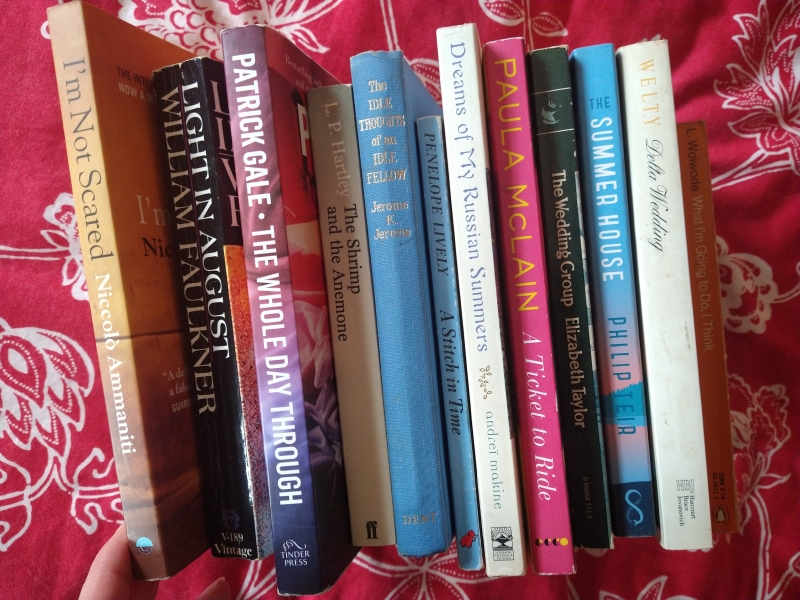
“Just because” books
At the start of the year, I pulled out two huge piles of books I had no particular excuse to read yet was keen to get to. My plan was to pick up one per week or so. Of course, I’ve not so much as opened one yet. Three of these are from that stack, with two more from my BIPOC shelf.
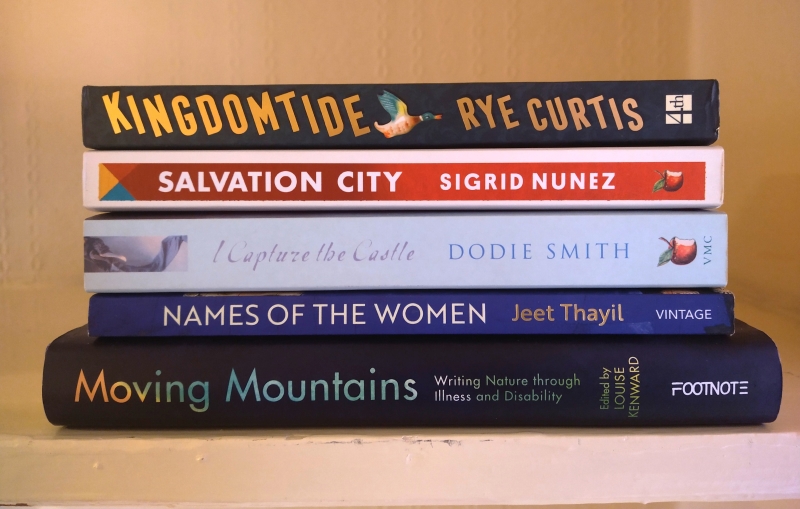
Kingdomtide by Rye Curtis (passed on by Laura T. – thank you!) – I’ve meant to read this for ages, plus it sounds like a good readalike for Heartwood. “The sole survivor of a plane crash, seventy-two-year-old Cloris Waldrip finds herself lost and alone in the unforgiving wilderness of Montana’s rugged Bitterroot Range … Intertwined with her story is Debra Lewis, a park ranger struggling with addiction, a recent divorce, and a new mission: to find and rescue Cloris.”
Salvation City by Sigrid Nunez (new from Amazon some years back) – I love Nunez and aim to read all of her books. This sounds very different from the four I know! “His family’s sole survivor after a flu pandemic …, Cole Vining is lucky to have found refuge with the evangelical Pastor Wyatt and his wife in a small town in southern Indiana. As the world outside has grown increasingly anarchic, Salvation City has been spared much of the devastation, and its residents have renewed their preparations for the Rapture.”
I Capture the Castle by Dodie Smith (charity shop, possibly a decade ago?) – One I’ve always meant to read. My token classic for this challenge, though there are plenty more to choose from on the bookcase in the lounge, e.g. an Austen for Brona’s #ReadAusten25 challenge. “Through six turbulent months of 1934, 17-year-old Cassandra Mortmain keeps a journal, filling three notebooks with sharply funny yet poignant entries about her home, a ruined Suffolk castle, and her eccentric and penniless family.”
Names of the Women by Jeet Thayil (gift from my wish list several years ago) – A novella on the stack will be welcome; this is “about the women whose roles were suppressed, reduced or erased in the Gospels. … Together, the voices of the women dare us to reimagine the story of the New Testament in a way it has never before been told.”
Moving Mountains, ed. Louise Kenward (gift from my wish list last year) – “A first-of-its-kind anthology of nature writing by authors living with chronic illness and physical disability. Through 25 pieces, the writers … offer a vision of nature that encompasses the close up, the microscopic, and the vast.” It will be nice to have a book of short nature pieces on the go.
The above list is more fiction-heavy than usual for me, with a number of chunksters – but also four short fiction collections and a poetry collection to balance out the length. Inspired by Eleanor, I decided to ensure at least 25% were by authors of colour.
If I need to draw on back-ups, I have many more between my “just because” stack, my Women’s Prize nominees shelf, and the rest of my BIPOC authors area.


This happens to be my 1,500th blog post!!
What do you make of my lists? See any options that I should prioritize instead?
The End of the Year Book Tag
I’ve been feeling a little burnt out after Novellas in November, so when I spotted this on Laura’s blog I thought it might be just the thing to help me sort through my December reading plans while I wait to get my reviewing mojo back.
- Is there a book that you started that you still need to finish by the end of the year?
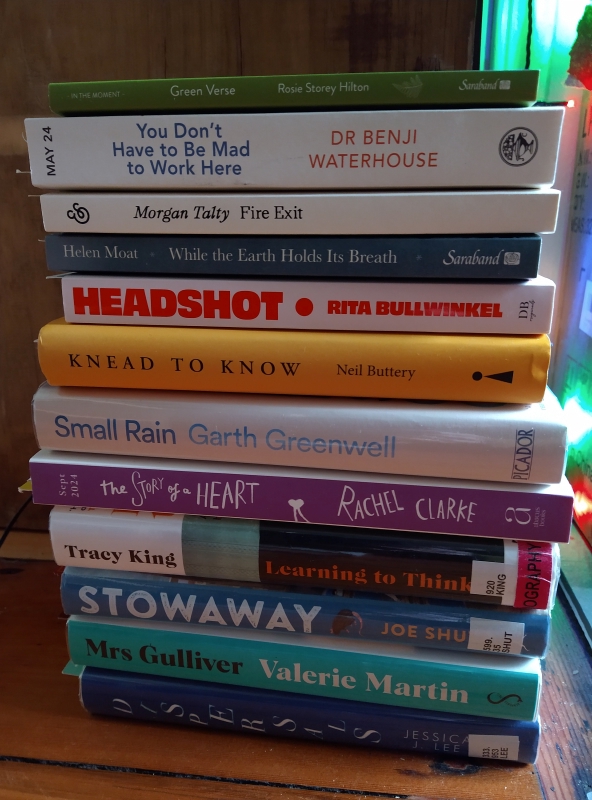
Yes … too many. Pictured are a dozen 2024 releases, a mixture of review copies and library books, that I still hope to get through. Some of them I’m a good way into; others I’ve barely started. (Not shown: All Fours by Miranda July, from NetGalley on my Kindle; and Nine Minds by Daniel Tammet, which I’ll be assessing for Foreword Reviews.)
- Do you have an autumnal book to transition to the end of the year?
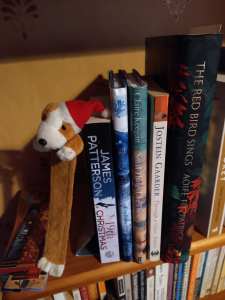
Autumn is the hardest season for me to assign reads to. I’m already in winter mode, so it’s more likely that I’ll pick up one or a few of these wintry or Christmassy books.
-
 Is there a release you are still waiting for?
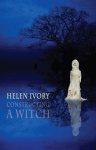
Published last week and on my Kindle from Edelweiss: the poetry collection Constructing a Witch by Helen Ivory. Otherwise, it’s on to January and February releases for my paid reviewing gigs.
- Name three books you want to read by the end of the year.
From the stack above, I haven’t properly started Headshot by Rita Bullwinkel or opened Fire Exit by Morgan Talty, and I’m still hoping to read those two review copies in their entirety. I will also try to squeeze in at least one more McKitterick Prize novel entry.
But I also have up to five 2025 releases to read for paid reviews that would be due early in January.
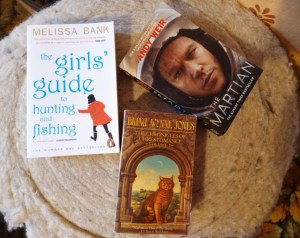
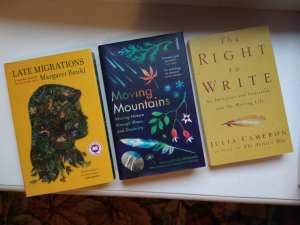
Over the holidays, I fancy dipping into some lighter fiction, cosy and engaging creative nonfiction, and thought-provoking but readable science and theology stuff. Here are some options I pulled off of my bedside table shelves.
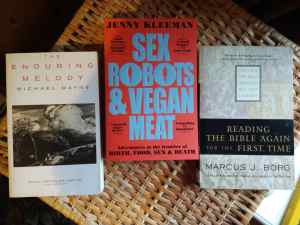
- Is there a book that could still shock you and become your favourite of the year?
Small Rain by Garth Greenwell and Dispersals by Jessica J. Lee are both very promising. I’m nearly 1/3 into the Greenwell (it’s my first time reading him) and I’m so impressed: this is patently autofiction about a medical crisis he had during the pandemic, but there is such clarity and granular detail that it feels absolutely true to the record yet soars above any memoir he might have written about the same events. He’s both back in the moment and understanding everything omnisciently. Greenwell has also written poetry, and I was reminded of the Wordsworth quote “Poetry is the spontaneous overflow of powerful feelings: it takes its origin from emotion recollected in tranquillity.”
I’ve only read the first chapter of the Lee so far, but I’m a real fan of her hybrid nature memoirs and I think the metaphorical links between her life and plants will really work.
- Have you already started making reading plans for 2025?
So far I’ve read something like 11 books with 2025 publication dates, most of them for paid reviews. I will feature some of those soon. I’ve also compiled a list of my 20 Most Anticipated releases of 2025 and will post that early in January.
Apart from that, I expect it will be the usual pairs of contradictory goals: reading ahead (2025 stuff) versus catching up (backlist and my preposterous set-aside shelf); failing to resist review copies and library holds versus trying to read more from my own shelves; reading to challenges and themes versus preserving the freedom to pick up books as the whim takes me.


Speaking of themes, I fancy doing a deep dive into the senses, especially the sense of smell, which particularly intrigues me. (I’ll make it a trio with The Forgotten Sense: The New Science of Smell—and the Extraordinary Power of the Nose by Jonas Olofsson, which will be published on 7 January and is on order for me at the library.)
Checking Up on My 2023 Reading Goals
In January I set some specific reading goals to help me prioritize books from my own shelves. It’s time to assess my progress in the first quarter.
- Catch up on review copies, e.g., by coinciding with the paperback release dates. I’ve managed to review 9 so far, which works out to three per month. Four or more a month (so, at least weekly) would be preferable.
- Authors I own 2+ unread works by – I must read at least one book by each this year. I have crossed 3 off the list thus far: Amy Bloom, Helen Dunmore and Howard Norman. However, I have also started books by Peter Ackroyd, T.C. Boyle, Brian McLaren, Wendy Perriam and Edwin Way Teale. Considering there are 70 authors on my list, though, I need to pick up the pace. I do have plans to read quite a number in connection with future challenges, but this is a project that is probably going to extend into 2024. I will have to be strict with myself and not acquire more books by these authors in the meantime!
- I will participate in at least one reading challenge per month. Success! Nordic FINDS, Reading Indies and Reading Ireland Month down, and 1940 Club coming up soon.
- Reintroduce one set-aside book to my reading pile each week. I’ve reduced this (part physical and part digital) pile by 6 so far, so I’m only at half my quota. Sigh. Once I set a book aside it seems to be the kiss of death. Only some new deadline or thematic inclusion gets me picking these back up.
- ‘Overhauls’ of earlier book hauls to ensure no more than 3 unread remaining from any one haul. We’ve booked a last-minute overnight in Bridport later this month, so I looked up what I bought on our trip there in 2019. I promptly picked up the two unread books (by Lightman and Orwell) for before we go and/or while there. To tie in with the Dorset locale, I’ll also bring along The Chosen by Elizabeth Lowry, a novel about Thomas Hardy and his first wife. It comes out in paperback this month, so it counts toward the review catch-up, and is also on this year’s Walter Scott Prize for Historical Fiction shortlist.
- At least one “just because” book per fortnight. This means anything from my own shelves that isn’t a review copy. I’m smashing this goal with a whole 15 read so far! That’s more than one per week, a good rate to try to keep up.
- (A goal I added in later.) One reread per fortnight. I’m doing surprisingly well, mostly because everything we choose for book club this year seems to be a reread, but with 4 thus far I’m averaging monthly instead. Still, not a bad effort considering I hardly ever reread.
- Request fewer 2023 review books from publishers. I sent out a big batch of requests recently, but almost all have gone ignored (the story of my year), which is probably for the best. My latest coup was securing review copies of Claire Fuller and Curtis Sittenfeld’s new novels – but each did require 3+ request e-mails!
How are you doing on your (formal/informal, explicit/tacit) 2023 reading goals?
Tricking Myself into Reading My Own Books
I suspect many of us have this bibliophile problem: we get tremendously excited about a particular book and just have to have it, whether as a proof from the publisher, pre-ordering it new, or (for an older book) snapping it up secondhand the minute we hear about it. Then months or even years pass and we realize that the novel or memoir we were once so desperate to read has simply joined the ranks of hundreds of other half-forgotten books we still plan to get to on that legendary ‘one day’ but always pass by in favour of newer acquisitions.
I’ve long strived to read more backlist books from my own collection, as well as to catch up on the dozens of books I’ve been foolish enough to pause partway through and group together on two “set-aside” shelves in the lounge. (Many of these I obtained as review copies from publishers, so I do feel a sense of obligation to write at least a mini review for each.) As Marcie (Buried in Print) noted in her recent reading goals post, vague intentions go by the wayside, so it’s time to get specific about how to incorporate these into my reading stacks.


- For my review backlog of 2022 releases, I get a second chance. I’ve noted the paperback release dates for around 20 books and will aim to have catch-up review posts (here or for Shiny New Books) ready for that date, or at least within that month. Having a deadline to work towards is essential for a last-minute worker like me.
- There are some authors I own 3 or more unread works by. Usually this means I enjoyed a book of theirs so much I went on a secondhand binge … then got distracted and didn’t explore their back catalogue as I meant to. Via Margaret, I just found out about What Cathy Read Next’s Backlist Burrow challenge, where she’s picked six authors who piqued her interest and two books by each to read this year. I’m unlikely to manage two each, but I fancy doing this adjacent/modified challenge: where I own 2 or more unread books by an author, I must read at least 1 this year. I have these authors to choose from, but also others in my sights, e.g. Sarah Hall, whose Haweswater I’ll take on holiday to the Lake District in July.
- Challenges like that one are the best way to get me rifling through my own shelves. I started a few low-key, long-term projects of my own back in 2020 (Journey through the Day and 4 in a Row) and am still ostensibly working on them, as well as on thematic pairs and trios (my Three on a Theme series) as they arise, along with regular tie-ins to seasons, holidays, etc. Hosted challenges are somehow better, though, perhaps due to the built-in companionship and accountability. Nordic FINDS this month, Reading Indies in February, Reading Ireland in March, the 1940 Club in April, and so on. Because they’re so useful for getting me reading from my shelves, I will participate in at least 1 reading challenge per month.
- How to tackle the dreaded set-aside shelves? One book at a time. So, in addition to the ones I’ll review to coincide with the paperback release, I’ll also reintroduce 1 set-aside book to my reading pile each week.
- How to ensure that book hauls from shopping excursions and gift-receiving occasions don’t get neglected? By undertaking regular “overhauls” such as this and this, and checking there are no more than 3 unread books remaining from any 1 haul. If there are, start reading the stragglers right away. This will be particularly important because it looks like this year I might complete the triple crown of UK book towns, with trips planned to Wigtown in June and the Sedbergh area in July/August and Hay-on-Wye a perpetual temptation.
- How to make time for all those lovely random books (such as this stack) that I keep meaning to read but somehow never do? I’m going to allow myself to start at least 1 “just because” book per fortnight.
- Connected to all of these will be requesting fewer 2023 review books from publishers. Almost all my recent requests have gone completely ignored, in fact, which is probably for the best. Unless I’m reviewing something for pay, I’ll just plan to read it from the library or, if I can’t find it that way, will add it to my wish list in advance of my birthday and Christmas.


How do you trick yourself into reading your own books?
Final Reading Statistics for 2022
What with Covid ruining the holidays and a cat who’s been to the vet twice in two days, I’m wishing 2022 good riddance. (The only good thing the end of the year brought is a visit from my sister, who hadn’t been to the UK in 15.5 years. After a few cautionary days at a hotel in London, she’s been staying with us and enjoying the slower pace of life of these quiet, rainy days.) It was still a good reading year for me, though; I worried my total might plummet after my mom’s passing, but I found I read as much as ever, just maybe shorter books and more rereads. Late in the year I realized matching the previous three years’ total of 340 books wasn’t going to happen, so reduced my goal accordingly and managed to surpass it yesterday.

How I did with my 2022 goals
My goal for 2022 (which I had completely forgotten about!) was to read mostly backlist books. In fact, I read 44.9% current-year releases, which means 55.1% older material – even if just 2021 or 2020 releases. This is actually higher than my 41.8% new releases last year, so it looks like I failed to live up to the letter of my resolution, but still happened to read well over half “older” books.
Once again, my initial goal for the new year will be to get through all my set-aside books and my review backlog shelf. After that … I’ll just read some books and hope to enjoy them.
The statistics
Fiction: 53.3%
Nonfiction: 33%
Poetry: 13.7%
(Fiction and nonfiction are usually just about equal for me; I’m surprised that fiction pulled well ahead this year. I read a bit less poetry this year than last.)
Female author: 72.3%
Male author: 23%
Nonbinary author: 1.7%
Multiple genders (anthologies): 3%
(I’ve been reading more and more by women each year, but this is the first time that female + nonbinary authors have outnumbered men by more than 3:1.)
BIPOC author: 20.7%
(The second time I have specifically tracked this figure. I’m pleased that it’s higher than last year’s 18.5%, but will continue to work towards 25% or more.)
Work in translation: 8.7%
(Better than last year’s 5%! But I’d still like to get closer to 10%.)
E-books: 26.3%
Print books: 73.7%
(The number of e-books has doubled since last year because of my increase in reviewing for Kirkus and Shelf Awareness, for which I exclusively read e-books.)
Rereads: 12 (3.5%)
(The same number as last year, so one per month seems to be what I naturally gravitate towards. I have a whole shelf of books I’d love to reread, though, so I’d like it to be more like 2–3 a month.)
Where my books came from for the whole year, compared to last year:
- Free print or e-copy from publisher: 42% (↑10.2%)
- Public library: 30% (↑5.3%)
- Downloaded from NetGalley or Edelweiss: 7% (↑1.1%)
- Secondhand purchase: 6.7% (↓10.1%)
- New purchase (sometimes) at a bargain price): 4.7% (↓0.9%)
- Gifts: 4% (↑2%)
- Free (giveaways, The Book Thing of Baltimore, the free mall bookshop, etc.): 2.6% (↓6.7%)
- University library: 2.3% (↓1.5%)
- Borrowed: 0.7% (↑0.7%)
Additional statistics courtesy of Goodreads:
67,899 pages read
Average book length: 225 pages
Average rating for 2022: 3.6
Happy new year!
Some 2022 Reading Goals
First of all, I need to give some proper attention to the books on my set-aside shelf (nearly 40 of them), preferably clearing this in January – while also catching up on review copies from last year and continuing with the January releases.

Thereafter, I’d like to concentrate on backlist books for the year. This may seem ironic given that I review new ones on the blog and for various other outlets, and that I’m going to be featuring my 20 most anticipated titles of 2022 in a post tomorrow, but I have a few reasons for wanting to focus on older material.
One is that backlist reading consistently produces new favourites. Another is that every time I shelve in the library’s back room rolling stacks, I see novels that I’ve always meant to read, or that look fantastic, and think, “I really should borrow more from in here” … then forget all about them and place holds on (sometimes disappointing) new books instead.
A final reason is that, as I pack up my library in preparation for moving and get a good look at the ~500 unread books all over again, I hope and expect that I will be inspired to read them – and also to revisit some long-neglected favourites. (Of course, I may also cull some before the move, which would be fine.) The plan is to eventually replace our fleet of white Billy bookcases with built-in shelving either side of the decorative fireplaces in a few rooms of the new house.


As always, I’d like to get to more classics, doorstoppers and literature in translation (I own hardly any translated titles, so most of this will have to be from the library). I’ll participate in all the usual annual blogger challenges plus any new ones I can fit in, including Annabel’s #NordicFINDS – I’m currently reading Sophie’s World by Jostein Gaarder to review later this month.
I’m sure to follow a similar set of literary prizes as last year, including the Young Writer of the Year Award, the Barbellion Prize, the Rathbones Folio Prize, the Wainwright Prize, and (to a lesser extent) the Dylan Thomas Prize, the Women’s Prize and the Booker Prize. And, of course, I’ll be carefully monitoring the later stages of the McKitterick Prize judging after sending off my own longlist for the unpublished manuscripts. These prize lists plus various review copies will ensure I have a regular influx of recent releases to counterbalance the backlist reads.
Brand new or backlist for you in 2022?
A Look Back at My 2021 Reading: Statistics and Superlatives
I hope everyone passed a lovely holiday week. We had house guests for a few days over New Year’s, so I haven’t had a chance to work up my statistics until now. Marcie sent me a spreadsheet template to keep track of my reading, and my tech whiz husband helped analyze the data. I look forward to catching up on everyone else’s best-of and stats posts, too.
How I did with my 2021 goals
 My simple reading goals for 2021 were to read more biographies, classics, doorstoppers and travel books – genres that tend to sit on my shelves unread. I read one biography in graphic novel form (Orwell by Pierre Christin), but otherwise didn’t manage any. I only read three doorstoppers the whole year, but 29 classics – defining them is always a nebulous matter, but I’m going with books from before 1980 – a number I’m happy with.
 Surprisingly, I did the best with travel books, perhaps because I’ve started thinking about travel writing more broadly and not just as a white man going to the other side of the world and seeing exotic things, since I don’t often enjoy such narratives. Granted, I did read a few like that, and they were exceptional (The Glitter in the Green by Jon Dunn, The Shadow of the Sun by Ryszard Kapuściński and Kings of the Yukon by Adam Weymouth), but if I include essays, memoirs and poetry with significant place-based and migration themes, I was at 26.
The numbers
Exactly the same total as last year (2019 had my maximum-ever of 343). From those three years’ evidence, I’d say I’ve found my natural limit. Next year I will aim for 340 again.
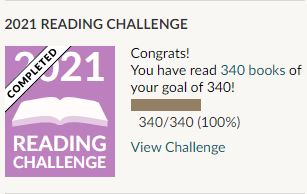
(This is what my lifestyle allows; yours is likely very different. I have bookish friends who read 80 books a year, 120, 150, 180, 200, and so on. My very busy university lecturer/town councillor husband felt bad for ‘only’ reading 65 books this past year, but keep in mind that the average person reads just 12 per year. My message to you, no matter your numbers, is YOU READ LOADS!)
Fiction: 49.7% (6.5% graphic novels; 5.3% short stories)
Nonfiction: 35%
Poetry: 15.3%
(Fiction and nonfiction are usually just about equal for me; I’m surprised that fiction pulled well ahead this year. I also read a bit more poetry this year than last.)
Female author: 66.47%
Male author: 30%
Nonbinary author: 0.88% (Meg-John Barker, Alice Hattrick and Olivia Laing)
Multiple genders (in anthologies): 2.65%
(I’ve been reading more and more by women each year, but this is the first time that female + nonbinary authors have outnumbered men by more than 2:1. I mostly attribute this to my interest in women’s stories. There were also three trans authors on my list.)
BIPOC author: 18.5%
(The first time I have specifically tracked this figure. Not too bad, but I’d prefer 25% or higher.)
Work in translation: 5%
(A decline from last year’s 7.2%. Must try harder!)
E-books: 13.2%
Print books: 86.8%
(Slightly higher than last year because of my new reviewing gig for Shelf Awareness, for which I read almost exclusively e-books.)
2021 releases: 41.8% (add in the 2020 releases and it’s 54.4%)
Pre-release books: 20%
Rereads: 12 (3.5%)
Where my books came from for the whole year:
- Free print or e-copy from publisher: 31.8%
- Public library: 24.7%
- Secondhand purchase: 16.8%
- Free (The Book Thing of Baltimore, the free mall bookshop, a giveaway, Little Free Libraries, etc.): 9.4%
- Downloaded from NetGalley or Edelweiss: 5.9%
- New purchase (sometimes at a bargain price): 5.6%
- University library: 3.8%
- Gifts: 2%
(Decreased from last year: review copies, NetGalley/Edelweiss, gifts; increased from last year: library borrowing, new and secondhand purchases, free books.)
Additional statistics courtesy of Goodreads:
73,520 pages read
Average book length: 216 pages (thank you, novellas and poetry!)
Average rating for 2021: 3.7
Extra Superlatives
First book completed:
Last book completed (also the shortest, at 46 pages)
Longest book, at 628 pages:
Authors I read the most by: Anne Tyler (5), thanks to Liz’s readalong project; Jim Davis and Alice Oseman cartoons (4 volumes each); Jim Crumley nature books and Emily Rapp Black memoirs (3 each)
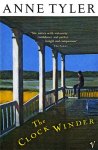
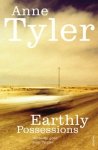
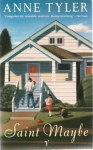

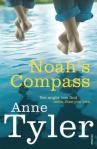
Publishers I read the most from: Carcanet (18), then Picador (17), then Bloomsbury and Faber (14 each); in overall first place was undoubtedly Penguin and its many imprints.
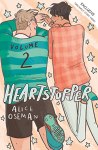
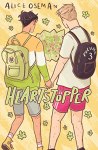
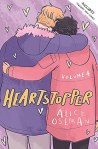
My top discovery of the year: the Heartstopper teen graphic novel series.

My proudest bookish achievement: being asked to be a judge for the McKitterick Prize.
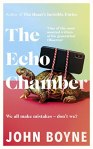
The books that made me laugh the most: The Echo Chamber by John Boyne and Early Morning Riser by Katherine Heiny.
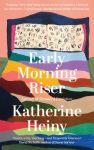
Best book club selections: The Light Years by Elizabeth Jane Howard, Woman on the Edge of Time by Marge Piercy, The Year of Living Danishly by Helen Russell.
Most genuinely helpful book: How to Talk to a Science Denier by Lee McIntyre.
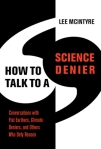
Best last lines encountered: “So where are we gonna go? / I don’t know. Let’s just drive and find out.” (from Heartstopper, Volume 4 by Alice Oseman).
Best 2021 book title: Mrs Death Misses Death.

Shortest book title encountered: In (Will McPhail), followed by Lot (Bryan Washington).
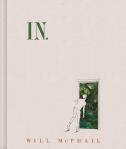
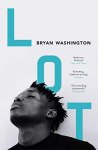
Biggest disappointments: Some of my lowest ratings went to Indelicacy by Amina Cain, Klara and the Sun by Kazuo Ishiguro, and Ness by Robert Macfarlane.
 A 2021 book that everyone loved but me: The Lincoln Highway by Amor Towles.
Themes that kept turning up in my reading: Covid-19, colours (thanks to my summer reading challenge), disability (thanks to shadowing the Barbellion Prize), the mental and physical health benefits of time in nature; perennial topics like friendship, parenting and sisterhood.
October Reading Plans and Books to Catch Up On
My plans for this month’s reading include:
Autumn-appropriate titles & R.I.P. selections, pictured below.


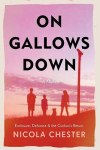 October releases, including some poetry and the debut memoir by local nature writer Nicola Chester – some of us are going on a book club field trip to see her speak about it in Hungerford on Saturday.
A review book backlog dating back to July. Something like 18 books, I think? A number of them also fall into the set-aside category, below.
An alarming number of doorstoppers:
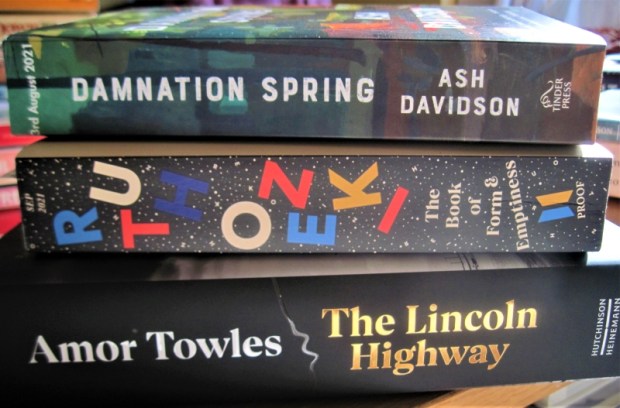
- Damnation Spring by Ash Davidson (a buddy read underway with Marcie of Buried in Print; technically it’s 442 pages, but the print is so danged small that I’m calling it a doorstopper even though my usual minimum is 500 pages)
- The Book of Form and Emptiness by Ruth Ozeki (in progress for blog review)
- Great Circle by Maggie Shipstead (a library hold on its way to me to try again now that it’s on the Booker Prize shortlist)
- The Lincoln Highway by Amor Towles (in progress for BookBrowse review)
Also, I’m aware that we’re now into the last quarter of the year, and my “set aside temporarily” shelf – which is the literal top shelf of my dining room bookcase, as well as a virtual Goodreads shelf – is groaning with books that I started earlier in the year (or, in some cases, even late last year) and for whatever reason haven’t finished yet.
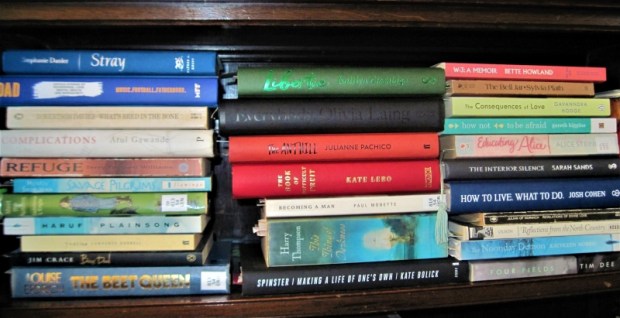
Setting books aside is a dangerous habit of mine, because new arrivals, such as from the library or from publishers, and more timely-seeming books always edge them out. The only way I have a hope of finishing these before the end of the year is to a) include them in challenges wherever possible (so a few long-languishing books have gone up to join my novella stacks in advance of November) and b) reintroduce a certain number to my current stacks at regular intervals. With just 13 weeks or so remaining, two per week seems like the necessary rate.
Do you have realistic reading goals for the final quarter of the year? (Or no goals at all?)
Final 2020 Statistics and Retrospective / 2021 Reading Goals
In 2020…
My mother was supposed to visit us in May – my first visit from family in 13 years – and we were meant to be in the States for Christmas. These planned trips had to be cancelled, of course, and many gigs and regular events we would have attended in London and elsewhere couldn’t go ahead.
We managed two mini-breaks, one to Dorset and Devon and one to Hay-on-Wye, as well as a daytrip to Avebury and Silbury Hill, a night out at an Oxford comedy club, a few meals out, and some outdoor meet-ups with family and friends.
It was also the year we finally started doing video chats with family in America, and we kept up with certain friends better than ever thanks to Zoom meetings.
All told, I have no grounds for complaint about the year that has just passed. I know we are lucky to have had good health, stable employment and a wonderful town and community.
Moreover, I was spoiled for choice with online bookish and musical content last year:
- 45 livestreamed gigs (28+ Bookshop Band, 4 Duke Special, 3 Edgelarks and Megson, 2 Switchfoot, and 1 each by Bellowhead, Krista Detor, Lau, Mark Erelli and Nerina Pallot)
- 8 neighborhood book club meetings
- 8 literary festival events
- 8 quizzes (mostly general trivia; 1 bookish, run by Penguin – I did well among the hundreds of entries!)
- 6 literary prize announcements
- 4 festivals, mostly of folk music
- 4 book launch events
- 3 book club/preview events
- 2 conferences (mostly book-related)
I’m also lucky that, unlike many, my reading was not affected by a stressful year. My reading total was very close to the previous year’s (343), which means that after five years above 300 and climbing, I’ve now figured out what my natural limit is. Next year I will aim for 340 again.
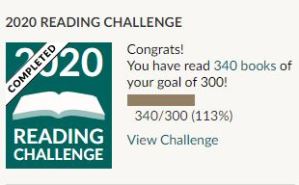
Some interesting additional statistics, courtesy of Goodreads:

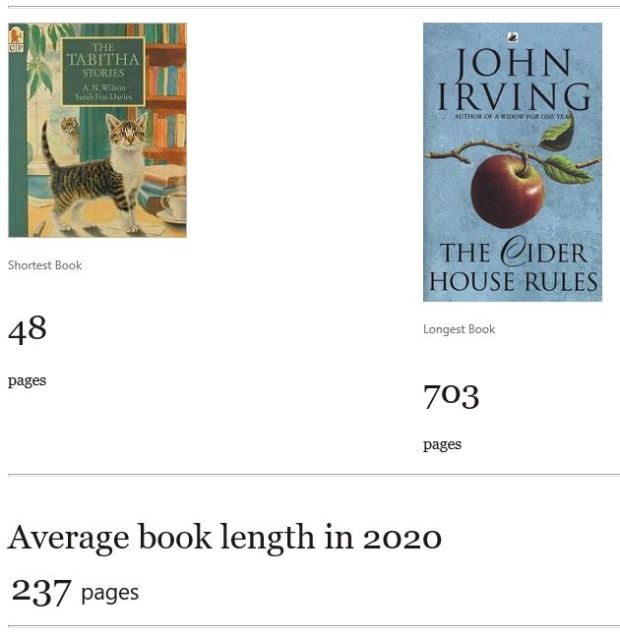
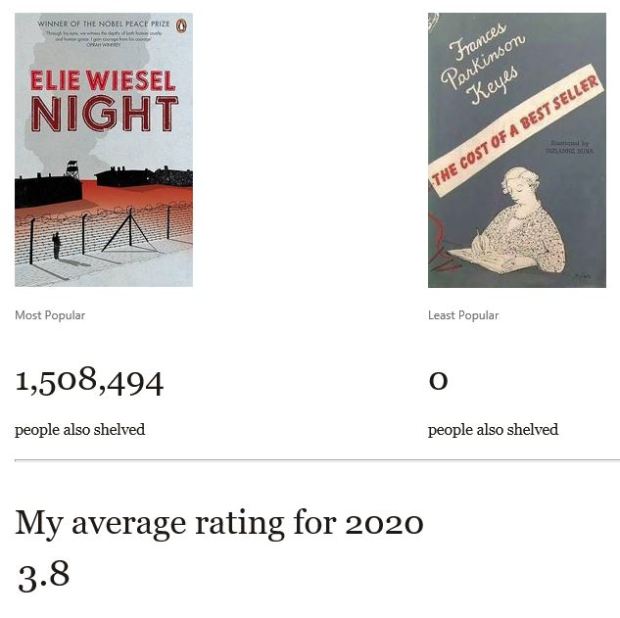
First read of the year: Last read of the year:

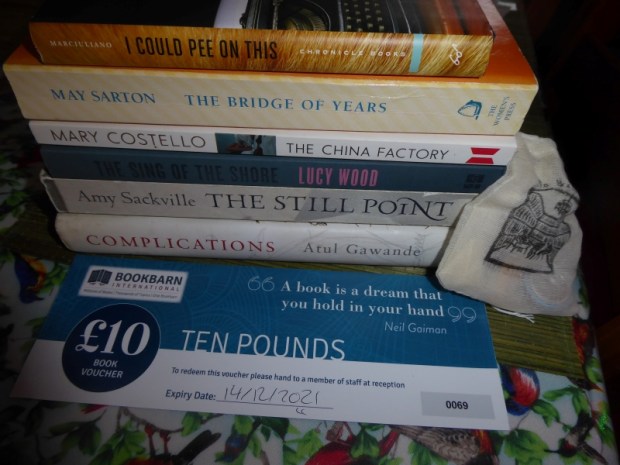
This was my Christmas book haul thus far (I have a feeling more may be marooned at my in-laws’ house), including money to spend the next time I can get to Bookbarn. I started a few of them right away.
My husband reads between one-fifth and one-quarter of what I do in a year, but by anyone’s accounting, 76 books is a lot in a year, especially considering that he has a busy full-time university lecturer job, is a town councillor, and is on lots of other voluntary committees. We overlap in some of our reading tastes (nature and travel writing, and some literary fiction) and I pass a lot of my review copies or library books his way, but he’s less devoted to new books and more likely to pick up books with heavier historical, political, or scientific content. If you’re interested, his rundown of his reading, including his top 3 reads of the year, is here.
2021 Reading Goals
My immediate priorities are to clear my set-aside pile (20 books) and everything I’m currently reading, start some January releases, and get back into some university library books to last me while I have limited access to our public library.
These are the 2021 proofs and finished copies I have received thus far:

Looking further ahead, I plan to continue and/or participate in many of 2020’s reading challenges again, as well as join in Liz’s Anne Tyler readalong for the novels I own and haven’t read yet. (The first one for me will be The Clock Winder in mid- to late February.)
Genres in which my achievement often lags far behind my intentions include literature in translation, biographies, and travel books. To address the first one, I’m going to set up a shelf in my house for unread works in translation, as a visual reminder and area to select from. I’ll start with the one below left as part of my “M” 4-in-a-Row.
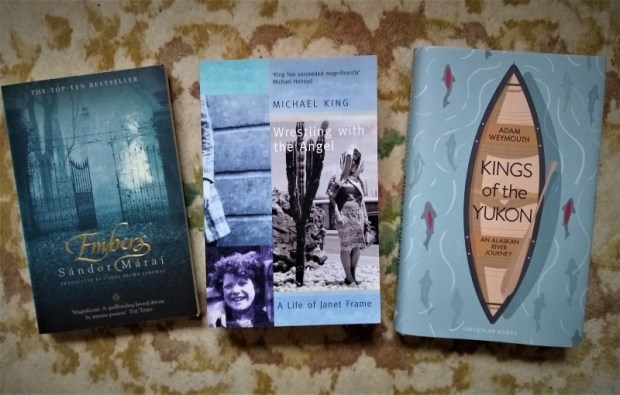
I would be happy to read even one biography this year, since they often take me many months to read. I’m going to make it the one above, of Janet Frame. Standard travel narratives intimidate me for some reason; I get on with them much better if they are in essays or incorporate memoir and/or nature writing. We have a whole shelf of unread travel books, many of which are of the more traditional going somewhere and reporting on what you see type. I want to clear the shelf to give them to my father-in-law, who expressed interest in reading more travel books. I’ll start with the 2018 Young Writer of the Year Award winner, above.
A “Classic of the Month” and “Doorstopper of the Month” are regular features on my blog, yet I don’t always manage to complete one each month. My aim will be to have at least one classic and one doorstopper on the go at all times, and hope that that translates to one a month as much as possible. Here’s my first pair:
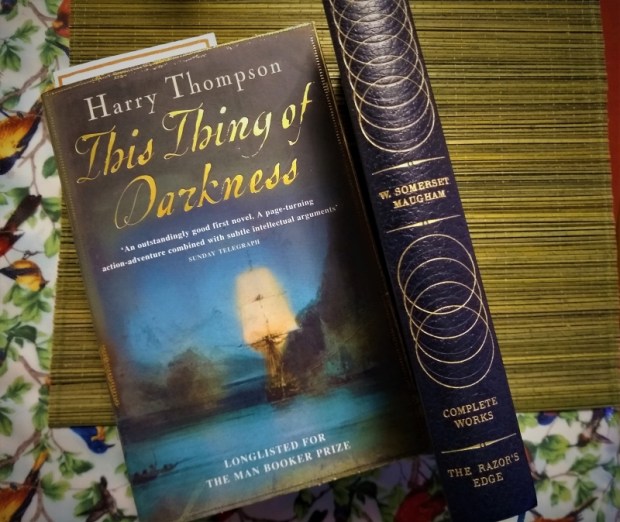
I can see that lots of other book bloggers are prioritizing doorstoppers and backlist reading in 2021. Apart from the modest goals I’ve set here, I expect my reading to be as varied and over-the-top as ever. I know I’ll read lots of 2021 releases, but backlist books are often more memorable, so I’ll try to arrange my stacks and choose my challenges so as to let them shine.
 Bookish Beck = Rebecca Foster. American transplant to England. Freelance proofreader and book reviewer.
 Bookish Beck