Short Fiction for September
I toyed with the wild idea of only reading short stories as my fiction for the month of September, but it was never really going to happen: I just don’t find short stories compelling enough, and in some ways they feel like hard work – every few pages, it seems, you have to adjust to a new scene and set of characters. In the end I made it through one anthology of flash fiction this month, and read parts of three other story collections. Mini reviews below…
Best Small Fictions 2017, edited by Amy Hempel
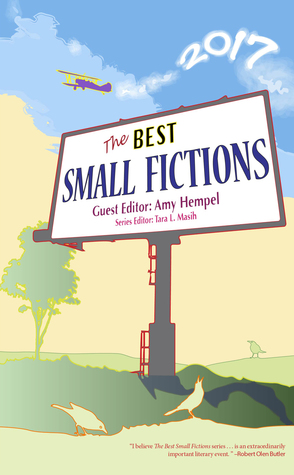 Now in its third year, the Best Small Fictions anthology collects the year’s best short stories under 1000 words. (I reviewed the two previous volumes for BookTrib and the Small Press Book Review.) Starting with a zinger of a first line is one strategy for making a short-short story stand out, and there are certainly some excellent opening sentences here. Symbols and similes are also crucial to conveying shorthand meaning. Two stand-outs are “States of Matter,” Tara Laskowski’s deliciously creepy story of revenge aided by a gravedigger; and Matthew Baker’s “The President’s Doubles,” in which an island nation becomes so protective of its imperiled leader that he ends up a prisoner. They’ve saved the best for last in this collection, though: the late Brian Doyle’s “My Devils,” in which an Irish-American boy learns how to interpret the adult world by deciphering what people say versus what they mean. It’s remarkable how concisely a coming of age and loss of blind faith are conveyed. Although there are fewer overall highlights than in the first volume, this is an excellent snapshot of contemporary super-short story writing, recommended for story lovers and newbies alike. (See my full review for the Pittsburgh Post-Gazette.)
The Bus Driver Who Wanted to Be God and Other Stories by Etgar Keret
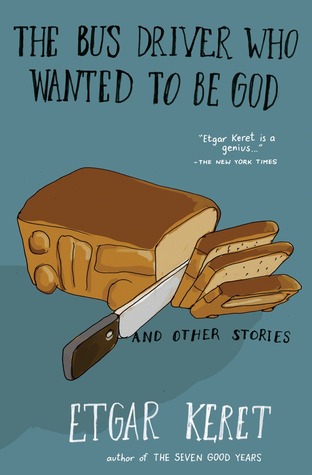 How can you not want to read a book with that title? Unfortunately, “The Story about a Bus Driver Who Wanted to Be God” is the first story and probably the best, so it’s all a slight downhill journey from there. That story stars a bus driver who’s weighing justice versus mercy in his response to one lovelorn passenger, and retribution is a recurring element in the remainder of the book. Most stories are just three to five pages long. Important characters include an angel who can’t fly, visitors from the mouth of Hell in Uzbekistan, and an Israeli ex-military type with the ironic surname of Goodman who’s hired to assassinate a Texas minister for $30,000. You can never predict what decisions people will make, Keret seems to be emphasizing, or how they’ll choose to justify themselves; “Everything in life is just luck.”
Aside from the title story, I particularly liked “Pipes,” in which the narrator makes himself a giant pipe through which to escape to Heaven, a place for misfits who’ve never found a way to be happy on Earth. Twisted biblical allusions like this are rife, including “Plague of the Firstborn.” A few stories have a folktale-like ambiance. It felt like there were too many first-person narrators, though, and too many repeating plots: “Good Intentions” takes up the same contract killing theme as “Goodman,” while both “Katzenstein” and “Jetlag” involve ejection from a plane. I read everything bar the 86-page novella Kneller’s Happy Campers; after so much flash fiction I wasn’t prepared to change pace so dramatically. So I’ve marked this as unfinished even though I read 110 pages in total. (Read in translation from the Hebrew.) 
Honeydew by Edith Pearlman
I don’t know what it is with me lately, but I seem to lack staying power with story collections. I read the first 40% of Pearlman’s most recent book on my Kindle and then just felt no need to continue. You could consider that a virtue of story collections: you can read as much or as little at a time as you want and pick and choose what bits interest you, in a way that you can’t with novels. Or you could say an author must be doing something wrong if a reader doesn’t long to keep turning the pages.
 At any rate, I enjoyed Pearlman’s stories well enough. They all apparently take place in suburban Boston and many consider unlikely romances. My favorite was “Castle 4,” set in an old hospital. Zephyr, an anesthetist, falls in love with a cancer patient, while a Filipino widower who works as a security guard forms a tender relationship with the gift shop lady who sells his disabled daughter’s wood carvings. I also liked “Tenderfoot,” in which a pedicurist helps an art historian see that his heart is just as hard as his feet and that may be why he has an estranged wife. “Blessed Harry” amused me because the setup is a bogus e-mail requesting that a Latin teacher come speak at King’s College London (where I used to work). Two stories in a row (four in total, I’m told) center around Rennie’s antique shop – a little too Mitford quaint for me.
Favorite lines: “Happiness lengthens time. Every day seemed as long as a novel. Every night a double feature. Every week a lifetime, a muted lifetime, a lifetime in which sadness, always wedged under her breast like a doorstop, lost some of its bite.” (from “Stone”)
Even though I didn’t finish either of these books, I’d gladly try something else by the authors. Can you recommend something to me?
Currently reading: After enjoying Bernard MacLaverty’s Midwinter Break so much, I picked up one of his short story collections (along with Keret’s) from Book-Cycle in Exeter earlier this month. So far I’ve read the first two stories in The Great Profundo, one about a struggling artist and a lonely widow who connect over an Emily Dickinson passage, and another about a cardinal whose father confesses he lost his faith years ago.

Upcoming: I have collections by Andrea Barrett, T.C. Boyle, Tessa Hadley and Alice Munro on the shelf. I also have far too many languishing on my Kindle, including For a Little While by Rick Bass, Whatever Happened to Interracial Love? by Kathleen Collins, We Come to Our Senses by Odie Lindsey, Music in Wartime by Rebecca Makkai and 99 Stories of God by Joy Williams. The ones I’m most likely to get to fairly soon, I think, are Difficult Women by Roxane Gay and The Garden Party by Katherine Mansfield.

Are you a short story fan? Read any good ones recently?
More Seasonal Reading
I like this reading with the seasons lark. It’s a shame that my library hold on Ali Smith’s Autumn didn’t come in until well after it turned to winter here in England, but I was intrigued by the sound of her post-Brexit seasonal quartet. Then, as if one winter anthology wasn’t enough, I tried another – this time a broader range of literature, history and travel writing.
Autumn by Ali Smith
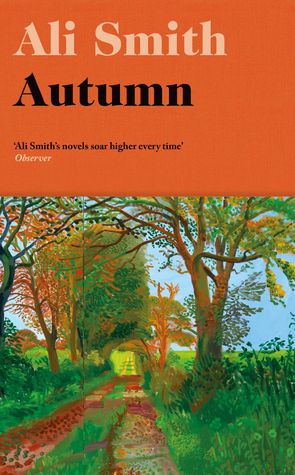 Smith is attempting a sort of state-of-the-nation novel in four parts. Her two main characters are Daniel Gluck, a centenarian dying at a care home, and his former next-door neighbor, Elisabeth Demand, in her early thirties and still figuring out her path in life. The present world Elisabeth and her mother navigate is a true-to-life post-Brexit bureaucratic nightmare where people are building walls and hurling racist epithets – “news right now is like a flock of speeded-up sheep running off the side of a cliff.” Mostly the book is composed of flashbacks to wordplay-filled conversations between Elisabeth and Daniel when he used to babysit for her, as well as dreams/hallucinations Daniel is having on his deathbed. But there’s also a lot of seemingly irrelevant material about pop artist Pauline Boty and Christine Keeler.
This was most likely written very quickly in response to current events, and while some of Smith’s strengths benefit from immediacy – the nearly stream-of-consciousness style (no speech marks) and the jokey dialogue – I think I would have preferred a more circumspect, compressed narrative. In places this was too repetitive, and the seasonal theme felt neither here nor there. I’ll listen out for what the other books are like, but doubt I’ll bother reading them. Aspects of this are very similar to Number 11 by Jonathan Coe (the state-of-Britain remit, even the single mother hoping to appear on a reality show), but I much preferred his take. [Gorgeous cover, though – David Hockney’s Early November Tunnel (2006).]
My rating:
[For more positive reviews, see those by Eric of Lonesome Reader, and Lucy of Hard Book Habit.]
Winter: A Book for the Season, edited by Felicity Trotman
 This seasonal anthology contains a nice mixture of poetry, nature and travel pieces, and excerpts from longer works of fiction. Some favorite pieces were W.H. Hudson on the town birds of Bath in the late nineteenth century, Mark Twain on his determination to keep wearing his trademark white through the winter, a Hans Christian Andersen dialogue between a snowman who longs to be by the stove and the yard-dog that warns him away, and Richard Jefferies on those who go out to work on a winter morning. But I enjoyed the poetry the most. Trotman includes a wide range of celebrated poets, from Shakespeare and Keats to John Clare and Wordsworth. I particularly liked a more recent contribution from Carolyn King, “First Snow,” in which a cat imagines that a giant wallpaper stripper has produced the flakes.
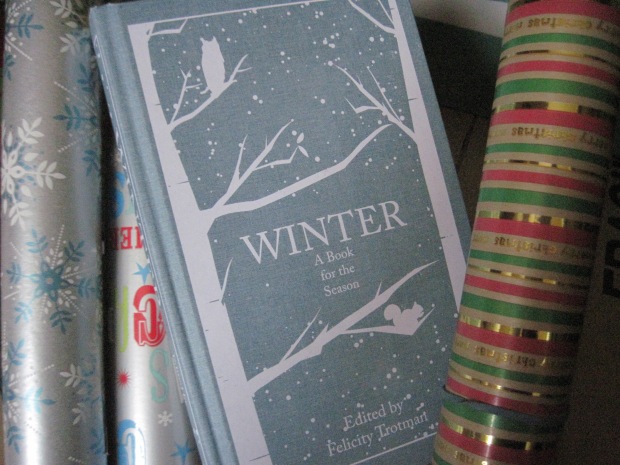
All told, though, there are too many seventeenth-century and older pieces with archaic spellings, and a number of the history and travel extracts, in particular, feel overlong – with nearly 40 pages in total from Ernest Shackleton’s South. Especially given the thin pages and small type, this represents a tediously large chunk of the book. Shorter pieces increase the variety in an anthology and mean the book lends itself to being picked up and read a few stories at a time. This is one to keep on the coffee table each winter and dip into over several years rather than read straight through. (See my full review at The Bookbag.)
My rating: 
As it happens, I’ve now read five books titled Winter: besides the Wildlife Trusts anthology and the novel about Thomas Hardy, both of which I’ve already reviewed here, there’s also Rick Bass’s wonderful memoir of his first year in Montana and Adam Gopnik’s wide-ranging book about the season. But beyond those with the simple one-word title, there are a whole host of titles on my TBR containing the word “Winter”. Here’s the whole list!
Have you read any “Autumn” or “Winter” books this year?
Small Books Are Good, Too
Last week I wrote in praise of doorstoppers – books over 500 pages. But I also love really short books: there’s just as much writing skill involved in making a narrative concise, and it can be supremely satisfying to pick up a book and polish it off within a couple hours, especially if you’re in a situation of captured attention as on a plane. Being honest and slightly selfish for a moment, short books are also a great way to build up a flagging year list.
Below I highlight poetry collections, memoirs, short stories and novellas that should be on your agenda if you’re looking for a quick read (number of pages in brackets after each title):
Poetry
I try to always have a book of contemporary poetry on the go, usually by a British poet since I pluck these at random from my local public library shelves. Poetry collections aren’t always ‘quick’ reads, nor should they be, because you often have to read a poem more than once to understand it or truly appreciate its techniques. Still, with most poetry books numbering somewhere between 45 and 90 pages, even if you parcel them out over days or weeks they’ll take much less time than a novel. Pick up something by Mark Doty, Kathleen Jamie, David Harsent or Christopher Reid and you’ll have plenty of beautiful verse to ponder.
Recently reviewed and recommended:
- Learning to Make an Oud in Nazareth by Ruth Padel [80]
- All One Breath by John Burnside [96]
- Praise in Which I Live and Move and Have My Being by Paul Durcan [176]
Short Memoirs
Depending on how thorough they are, autobiographies can often hover around 300 or 400 pages. Looking through my shelves, though, I’ve spotted a few in the 140–160 page range: My Movie Business by John Irving [158], The Diving-Bell and the Butterfly by Jean-Dominique Bauby [139], and Winter by Rick Bass [162]. Another short one well worth reading is the unusual The Sound of a Wild Snail Eating by Elisabeth Tova Bailey [170], a story about debilitating illness and taking comfort from nature.
Abigail Thomas, one of my favorite memoirists, writes in an episodic style that makes her 200-page books fly by as if they were half that length. Also, Anne Lamott has written two very short faith memoirs that would serve as a good introduction to her style and content for those who haven’t read Traveling Mercies et al.: Help Thanks Wow [102] and Stitches [112].
Recently reviewed and recommended:
- The Two Kinds of Decay by Sarah Manguso [192]
- The Light of the World by Elizabeth Alexander [208]
- What Comes Next and How to Like It by Abigail Thomas [240] – also included on my BookTrib list of mother–daughter memoirs to read for Mother’s Day
Short Stories
I used to shy away from short stories because I didn’t think they were worth the emotional investment, but recently I’ve decided I really like the rhythm of picking up a set of characters, a storyline and a voice and then, after 20 or so pages, following an epiphany or an aporia (or utter confusion), trading them in for a whole new scenario. Short stories are also the perfect length for reading during a quick meal or car ride. Two short story collections made it onto my “Best of 2014” list: White Man’s Problems by Kevin Morris and The Heaven of Animals by David James Poissant.
Recently reviewed and recommended (no page numbers listed here because each story can stand alone):
- Wallflowers by Eliza Robertson
- Funny Once by Antonya Nelson
- Thunderstruck and Other Stories by Elizabeth McCracken
Novellas
With some credits for free Penguin books I got hold of Borges and the Eternal Orang-Utans by Luis Fernando Verissimo (translated from the Portuguese by Margaret Jull Costa) [135], a book I’d been hankering to read ever since I came across that terrific title. It’s an enjoyable academic comedy and locked room mystery, with nods to Borges and Poe (though I probably didn’t get them all).
I also recently discovered Peirene Press, which exclusively publishes novellas in translation. Their motto is “Contemporary European Literature. Thought provoking, well designed, short.” They publish the novellas in thematic trilogies, with headings such as “Male Dilemma: Quests for Intimacy” and “Small Epic: Unravelling Secrets.” The book I own from Peirene (scored from a secondhand bookshop in Henley-on-Thames for £1), from the “Turning Point: Revolutionary Moments” series, is Mr. Darwin’s Gardener by Kristina Carlson [122] (translated from the Finnish by Emily and Fleur Jeremiah).
It’s an odd little book, with a mixture of past and present tense and first-, third- and first-person plural narration. Set in the village of Downe, it’s peripherally about the title character, Charles Darwin’s gardener Thomas Davies, a new widower with two children, one of whom has Duchenne muscular dystrophy (newly identified). It’s thin on plot, it must be said. Daniel Lewis, the verger of Downe for five years, was dismissed for stealing from the church and is beaten up when he comes back to town; some characters think and talk about Darwin’s theory and Davies’s bereavement; there’s an overturned cart.
My favorite section, “At the Anchor,” is composed of conversations at the village pub, and my favorite individual lines reflect on Darwin’s influence on contemporary thought:
“Mr Darwin is a tree that spreads light, Thomas Davies thinks.”
“Great men are remembered, like Mr Darwin, a genuine monolith. We small folk are mere sand, washed by the waves as they go back and forth.”
“People in future decades and centuries will react to our ideas superciliously, as if we were children playing at thinking. We shall look most amusing in the light of new thoughts and inventions.”
If you’re looking to get through a classic in an afternoon, why not try one of these (full text available for free online through Project Gutenberg or other initiatives): Animal Farm by George Orwell [95], Ethan Frome by Edith Wharton [181] or Flush by Virginia Woolf (her spoof ‘biography’ of Elizabeth Barrett Browning’s cocker spaniel) [108]. E. M. Forster’s novels also read very quickly, and several of John Steinbeck’s novels are quite short. Whether or not you’ve seen the Audrey Hepburn movie, you’ll want to read the sparkling, bittersweet Breakfast at Tiffany’s by Truman Capote [100]; my edition also includes several of his best known short stories, including the wonderful “A Christmas Memory.”
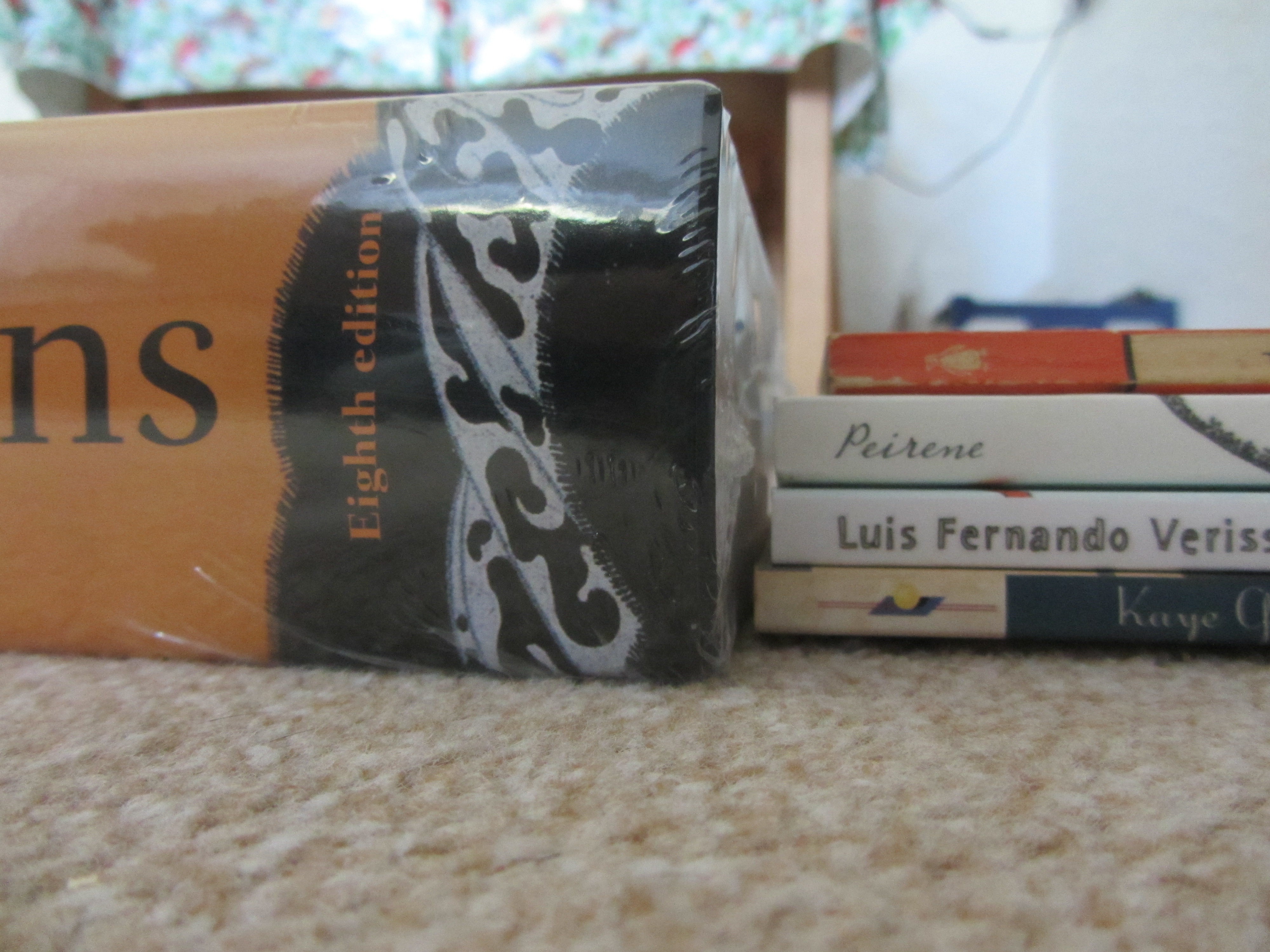
Even four novellas put together don’t stack up very far compared to the Oxford Dictionary of Quotations.
I recently finished The Bookshop by Penelope Fitzgerald [123]; all her books are similarly concise, so you may want to give her a try. The next novella on the pile for me is Ellen Foster by Kaye Gibbons [126]. I had never heard of the author, but the title and description lured me into buying it from a library book sale on a trip back to America (for 25 cents, why not?!). It’s a Southern Gothic story with an eleven-year-old narrator whom Walker Percy likened to Holden Caulfield. The alluring first line: “When I was little I would think of ways to kill my daddy.”
For more ideas, see these two Publishers Weekly’s lists:
“10 Best Books Shorter than 150 Pages” (only repeats one of my suggestions)
“10 Best Short Story Collections You’ve Never Read”
Off topic, but today is a milestone for me: it marks exactly two years that I’ve been a freelance writer!
Are you fond of short books? Do you prefer them to doorstoppers? What are some of your favorite novellas? All comments welcome!
 Bookish Beck = Rebecca Foster. American transplant to England. Freelance proofreader and book reviewer.
 Bookish Beck