20 Books of Summer, 11–13: Campbell, Julavits, Lu
Two solid servings of women’s life writing plus a novel about a Chinese woman stuck in roles she’s not sure she wants anymore.
Thunderstone: A true story of losing one home and discovering another by Nancy Campbell (2022)
 Just before Covid hit, Campbell’s partner Anna had a partially disabling stroke. They had to adjust to lockdown and the rigours of Anna’s at-home care at once. It was complicated in that Campbell was already halfway out the door: after 10 years, their relationship had run its course and she knew it was time to go, but guilt lingered about abandoning Anna at her most vulnerable (“How dare I leave someone who needed me”). That is the backdrop to a quiet book largely formed of a diary spanning June to September 2021. Campbell recounts settling into a caravan by the canal and railway line in Oxford, getting plenty of help from friends and neighbours but also finding her own inner resources and enjoying her natural setting.
The title refers to a fossil that has been considered a talisman in various cultures, and she needed the good luck during a period that involved accidental carbon monoxide poisoning and surgery for an ovarian abnormality (but it didn’t protect her books, which were all destroyed in a leaking shipping container – the horror!). I most enjoyed the longer entries where she muses on “All the potential lives I moved on from” during 20 years in Oxford and elsewhere, which makes me think that I would have preferred a more traditional memoir by her. Covid narratives feel really dated now, unfortunately. (New (bargain) purchase from Hungerford Bookshop with birthday voucher)
Directions to Myself: A Memoir by Heidi Julavits (2023)
 Julavits is a novelist and founding editor of The Believer. I loved her non-standard diary, The Folded Clock, back in 2017, so jumped at the chance to read her new memoir but then took more a year over reading it. The U.S. subtitle, “A Memoir of Four Years,” captures the focus: the change in her son from age five to age nine – from little boy to full-fledged individual. In later sections he sounds so like my American nephew with his Fortnite obsession and lawyerly levels of argumentation and self-justification. A famous author once told Julavits that writers should not have children because each one represents a book they will not write. This book is a rebuttal: something she could not have written without having had her son. Home is a New York City apartment near the Columbia University campus where she teaches – in fact, directly opposite a dorm at which rape allegations broke out – but more often the setting is their Maine vacations, where coastal navigation is a metaphor for traversing life.
Mostly the memoir takes readers through everyday conversations the author has with friends and family about situations of inequality or harassment. Through her words she tries to gently steer her son towards more open-minded ideas about gender roles. She also entrances him and his sleepover friends with a real-life horror story about being chased through the French countryside by a man in a car. The tenor of her musings appealed to me, but already the details are fading. I suspect this will mean much more to a parent.
With thanks to Bloomsbury for the free copy for review.
The Funeral Cryer by Wenyan Lu (2023)
 The title character holds a traditional position in her Chinese village, performing mourning at ceremonies for the dead. It’s a steady source of income for her and her husband, but her career choice has stigma attached: “Now that I brought bad luck and I smelt of the dead, nobody would step into our house to play mah-jong or chat.” Exotic as the setup might seem at first, it underpins a familiar story of a woman caught in frustrating relationships and situations. A very readable but plain style to this McKitterick Prize winner.
With thanks to the Society of Authors for the free copy.
September Releases by Chloe Lane, Ben Lerner, Navied Mahdavian & More
September and October are bounteous months in the publishing world. I’ll have a bunch of books to plug in both, mostly because I’ve upped my reviewing quota for Shelf Awareness. There’s real variety here, from contemporary novellas and heavily autobiographical poetry to nature essays and a graphic memoir.
Arms & Legs by Chloe Lane
 I reviewed Lane’s debut novel, The Swimmers, a black comedy about a family preparing for an assisted suicide, this time last year. It seems there’s an autobiographical setup to the author’s follow-up, which focuses on a couple from New Zealand now living in Florida with their young son. Narrator Georgie teaches writing at a local college and is having an affair with Jason, an Alabama-accented librarian she met through taking Finn to the Music & Movement class. She joins in a volunteer-led controlled burn in the forest, and curiosity quickly turns to horror when she discovers the decaying body of a missing student.
There’s a strong physicality to this short novel: fire, bodies and Florida’s dangerous fauna (“To choose to live in a place surrounded by these creatures, these threats, it made me feel like I was living a bold life”). Georgie has to decide whether setting fire to her marriage with Dan is what she really wants. A Barry Hannah short story she reads describes adultery as just a matter of arms and legs, a phrase that’s repeated several times.
Georgie is cynical and detached from her self-destructive choices, coming out with incisive one-liners (“My life isn’t a Muriel Spark novel, there’s no way to flash forward and find out if I make it out of the housefire alive” and “He rested the spade on his shoulder as if he were a Viking taking a drinks break in the middle of a battle”). Lane burrows into instinct and motivation, also giving a glimpse of the challenges of new motherhood. Apart from a wicked dinner party scene, though, the book as a whole was underwhelming: the body holds no mystery, and adultery is an old, old story.
With thanks to Gallic Books for the proof copy for review.
The Lights by Ben Lerner
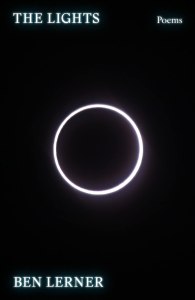 I’d read fiction and nonfiction from Lerner but had no idea of what to expect from his poetry. Almost every other poem is a prose piece, many of these being absurdist monologues that move via word association between topics seemingly chosen at random: psychoanalysis, birdsong, his brother’s colorblindness; proverbs, the Holocaust; art conservation, his partner’s upcoming C-section, an IRS Schedule C tax form, and so on.
The vocabulary and pronouncements can be a little pretentious. The conversational nature and randomness of the subjects contribute to the same autofiction feel you get from his novels. For instance, he probes parenting styles: his parents’ dilemma between understanding his fears and encouraging him in drama and sport; then his daughters’ playful adoption of his childhood nickname of Benner for him.
A few highlights: the enjambment in “Index of Themes”; the commentary on pandemic strictures and contrast between ancient poetry and modern technology in “The Stone.” I wouldn’t seek out more poetry by Lerner, but this was interesting to try. (Read via Edelweiss)
Sample lines:
“When you die in the patent office / there’s a pun on expiration”
“the goal is to be on both sides of the poem, / shuttling between the you and I. … Form / is always the answer to the riddle it poses”
“It’s raining now / it isn’t, or it’s raining in the near / future perfect when the poem is finished / or continuous, will have been completed”
This Country: Searching for Home in (Very) Rural America by Navied Mahdavian
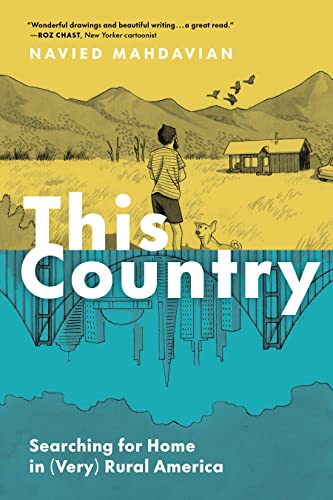 Mahdavian has also published comics in the New Yorker. His debut graphic novel is a memoir of the three years (2016–19) he and his wife lived in remote Idaho. Of Iranian heritage, the author had lived in Miami and then the Bay Area, so was pretty unprepared for living off-grid. His wife, Emelie (who is white), is a documentary filmmaker. They had a box house brought in on a trailer. After Trump’s surprise win, it was a challenging time to be a Brown man in the rural USA. “You’re not a Muslim, are you?” was the kind of question he got on their trips into town. Neighbors were outwardly friendly – bringing them firewood and elk kebabs, helping when their car wouldn’t start or they ran off the road in icy conditions, teaching them the local bald eagles’ habits – yet thought nothing of making racist and homophobic slurs.
I appreciated the self-deprecating depictions of learning DIY from YouTube videos and feeling like a wimp in comparison to his new friends who hunt and have gun collections – one funny spread has him imagining himself as a baby in a onesie sitting across from a manly neighbor. “I am shedding my city madness,” Mahdavian boasts as they plant an abundant garden and start learning about trees and birds. The references to Persian myth and melodrama are intriguing, though sometimes seem à propos of nothing, as do the asides on science and nature. I preferred when the focus was on the couple’s struggles with infertility and reopening the town movie theater – a flop because people only want John Wayne flicks.
This was enjoyable reading, but the simple black-and-white style is unlikely to draw in readers new to graphic storytelling, and I wondered if the overall premise – ‘we expected to find closed-minded racists and we did’ – was enough to hang a memoir on. (Read via Edelweiss)
Reviewed for Shelf Awareness:
(Links to full text)
The Wren, The Wren by Anne Enright
 Enright’s astute eighth novel traces the family legacies of talent and trauma through the generations descended from a famous Irish poet. Cycles of abandonment and abuse characterize the McDaraghs. Enright convincingly pinpoints the narcissism and codependency behind their love-hate relationships. (It was an honor to also interview Anne Enright. You can see our Q&A here.)
When My Ghost Sings by Tara Sidhoo Fraser
 This lyrical debut memoir is an experimental, literary recounting of the experience of undergoing a stroke and relearning daily skills while supporting a gender-transitioning partner. Fraser splits herself into two: the “I” moving through life, and “Ghost,” her memory repository. But “I can’t rely only on Ghost’s mental postcards,” Fraser thinks, and sets out to retrieve evidence of who she was and is.
The Vaster Wilds by Lauren Groff
 (Already featured in my Best of 2023 so far post.) Groff’s fifth novel combines visceral detail and magisterial sweep as it chronicles a runaway Jamestown servant’s struggle to endure the winter of 1610. Flashbacks to traumatic events seep into her mind as she copes with the harsh reality of life in the wilderness. The style is archaic and postmodern all at once. Evocative and affecting – and as brutal as anything Cormac McCarthy wrote. A potent, timely fable as much as a historical novel.
Zoo World: Essays by Mary Quade
 A collection of 15 thoughtful nature/travel essays that explore the interconnectedness of life and conservation strategies, and exemplify compassion for people and, particularly, animals. The book makes a round-trip journey, beginning at Quade’s Ohio farm and venturing further afield in the Americas and to Southeast Asia before returning home.
The Goodbye World Poem by Brian Turner
 The lovely laments in Brian Turner’s fourth collection (a sequel to The Wild Delight of Wild Things) dwell in the aftermath of the loss of his wife and others, and cultivate compensatory appreciation for the natural world. Turner’s poetry is gilded with alliteration and maritime metaphors The long title piece, which closes the collection, repeats many phrases from earlier poems—a pleasing way of drawing the book’s themes together. (My review of the third volume in this loose trilogy is forthcoming.)
And a bonus review book, relevant for its title:
September and the Night by Maica Rafecas
[Translated from the Catalan by Megan Berkobien and María Cristina Hall]
 A new Logistics Centre is to cut through Anaïs’s family vineyards as part of a compulsory land purchase. While her father, Magí, and brother, Jan, are resigned to the loss, this single mother decides to resist, tying herself to a stone shed on the premises that will be right in the path of the bulldozers. This causes others to question her mental health, with social worker Elisa tasked with investigating the case. Key evidence of her irrational behaviour turns out to have perfectly good explanations.
Certain chapters alternate Jan’s and Anaïs’s perspectives, recreate her confusion in a psychiatric hospital, or have every sentence beginning with “There” or “And” – effective anaphora. Although I didn’t think Jan’s several romantic options added to the plot, this debut novella from a Spanish author was a pleasant surprise. It’s based on a true story, though takes place in fictional locations, and bears a gentle message of cultural preservation.
With thanks to Fum d’Estampa Press for the free copy for review.
Recent Writing for BookBrowse, Shiny New Books and the TLS
Here are excerpts from (and links to, where available) some of my recent reviews for other places. A few of these books will undoubtedly be showing up on my end-of-year best lists in a couple weeks’ time.
BookBrowse
I was pleased to have three of the books I reviewed show up on BookBrowse’s list of the top 20 books of the year, as voted for by the site’s readers. What’s more, Educated was voted their top nonfiction book of the year and Where the Crawdads Sing (below) their #1 debut novel. (The third on the list was Unsheltered.)
 Beauty in the Broken Places by Allison Pataki: Ernest Hemingway wrote that we are strong at the broken places, and Allison Pataki found that to be true when her husband, David Levy, a third-year orthopedic surgery resident in Chicago, had a near-fatal stroke at age 30. On June 9, 2015, Dave and five-months-pregnant Allison were on a flight from Chicago to Hawaii for their babymoon, planning to stop in Seattle to visit Dave’s brothers. But they never made it there. On the plane Dave told her he couldn’t see out of his right eye.The plane made an emergency landing in Fargo, North Dakota and Dave was rushed to a hospital for testing. Doctors found he had suffered a bithalamic midbrain ischemic stroke, even though he’d had no risk factors and this stroke type was virtually unknown in patients of his age. Pataki goes back and forth between the details of this health crisis and her past with Dave. Hers is a relatable story of surviving the worst life can throw at you and finding the beauty in it.
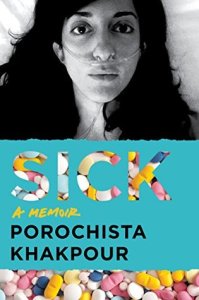 Sick by Porochista Khakpour: Khakpour can’t remember a time when she didn’t feel unwell and like she wanted to escape. “I had no idea what normal was. I never felt good,” she writes in her bracing memoir. Related to this sense of not being at home in her body was the feeling of not having a place where she fit in. Throughout Sick, she gives excellent descriptions of physical and mental symptoms. Her story is a powerful one of being mired in sickness and not getting the necessary help from medical professionals. Lyme disease has cost her $140,000 so far, and a lack of money and health insurance likely delayed her diagnosis by years. There is, unfortunately, some inherent repetition in a book of this nature. At times it feels like an endless cycle of doctors, appointments, and treatment strategies. However, the overall arc of struggling with one’s body and coming to terms with limitations will resonate widely.
 Southernmost by Silas House: In Silas House’s sixth novel, a Tennessee preacher’s family life falls apart when he accepts a gay couple into his church. We go on a long journey in Southernmost: not just a literal road trip from Tennessee to Florida, but also a spiritual passage from judgment to grace. Reconciliation is a major theme, but so is facing up to the consequences of poor decisions. I found the plotting decisions rewarding but also realistic. The pattern of a narrow religious worldview ebbing away to no faith at all and eventually surging back as a broader and more universal spirituality truly resonates. I loved House’s characters and setups, as well as his gentle evocation of the South. His striking metaphors draw on the natural world, like “She had the coloring of a whip-poor-will” and “The sky is the pink of grapefruit meat.” It’s a beautiful, quietly moving novel of redemption and openness to what life might teach us.
 Unsheltered by Barbara Kingsolver: Kingsolver’s bold eighth novel has a dual timeline that compares the America of the 1870s and the recent past, revealing how they are linked by distrust and displacement. The book’s themes and structure emphasize similarities between two time periods that might initially appear very different. Chapters alternate between the story lines, and the last words of one chapter form the title of the next. It’s a clever and elegant connecting strategy, as is the habit of using variations on the title word as frequently as possible – something Jonathan Franzen also does in his novels. (I counted 22 instances of “shelter” and its variants in the text; how many can you spot?) Kingsolver can be heavy-handed with her messages about science, American politics and healthcare, etc. All the same, Unsheltered is a rich, rewarding novel and an important one for our time, with many issues worth pondering and discussing.
 Where the Crawdads Sing by Delia Owens: It’s easy to see why so many have taken this debut novel into their hearts: it’s a gripping mystery but also a tender coming-of-age story about one woman’s desperately lonely upbringing and her rocky route to finding love and a vocation. Not only that, but its North Carolina marsh setting is described in lyrical language that evinces Delia Owens’s background in nature writing, tempered with folksy Southern dialect. The title refers to places where wild creatures do what comes naturally, and throughout the book we are invited to ponder how instinct and altruism interact and what impact human actions can have in the grand scheme of things. In Kya, Owens has created a truly outstanding character. The extremity of her situation makes her a sympathetic figure in spite of her oddities. Crawdads is a real treat.
Shiny New Books
 Under the Rock by Benjamin Myers: When Myers moved to the Calder Valley of West Yorkshire from London over a decade ago, he approached his new patch with admirable curiosity, and supplemented the observations he made from his study window with frequent long walks with his dog (“Walking is writing with your feet”) and research into the history of the area. The result is a divagating, lyrical book that ranges from literature and geology to true crime but has an underlying autobiographical vein. This isn’t old-style nature writing in search of unspoiled places. Instead, it’s part of a growing interest in the ‘edgelands’ where human impact is undeniable but nature is creeping back in. Interludes transcribe his field notes, which are stunning impromptu poems. I came away from this feeling that Myers could write anything – a thank-you note, a shopping list – and make it profound literature. Every sentence is well-crafted and memorable. “Writing is a form of alchemy,” he declares. “It’s a spell, and the writer is the magician.” I certainly fell under his spell here.
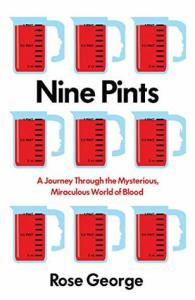 Nine Pints by Rose George: Nine Pints dives deep into the science and cultural history of blood. George’s journalistic tenacity keeps her pushing through the statistics to find the human stories that animate the book. In the first chapter we track the journey of a pint of blood that she donates in her hometown of Leeds. I was particularly interested, if morbidly so, in the chapter on leeches and bloodletting. Other sections journey further afield, chiefly to South Africa and India, to explore AIDS and menstruation taboos. The style can be choppy and repetitive, given to short sentences and identical paragraph openers, and there are a couple of places where the nine-chapter structure shows its weaknesses. While Nine Pints is quite uneven, it does convey a lot of important information about the past, present and future of our relationship to blood.
Times Literary Supplement
 Face to Face: True stories of life, death and transformation from my career as a facial surgeon by Jim McCaul: Eighty percent of a facial surgeon’s work is the removal of face, mouth and neck tumors in surgeries lasting eight hours or more. McCaul also restores patients’ appearance as much as possible after disfiguring accidents. Here he pulls back the curtain on the everyday details of his work life: everything from his footwear (white Crocs that soon become stained with blood and other fluids) to his musical choices (pop for the early phases; classical for the more challenging microsurgery stage). Like neurosurgeon Henry Marsh, he describes the awe of the first incision – “an almost overwhelming sense of entering into a sanctuary.” There’s a vicarious thrill to being let into this insider zone, and the book’s prose is perfectly clear and conversational, with unexpectedly apt metaphors such as “Sometimes the blood vessels can be of such poor quality that it is like trying to sew together two damp cornflakes.” This is a book that inspires wonder at all that modern medicine can achieve.
 On Sheep: Diary of a Swedish Shepherd by Axel Lindén: Lindén left city life behind to take on his parents’ rural collective in southeast Sweden. This documents two years in his life as a shepherd aspiring to self-sufficiency and a small-scale model of food production. Published diaries can devolve into tedium, but the brevity and selectiveness of this one prevent its accounts of everyday tasks from becoming tiresome. Instead, the rural routines are comforting, even humbling, as the shepherd practices being present with these “quiet and unpretentious and stoical” creatures. The attention paid to slaughtering and sustainability issues – especially as the business starts scaling up and streamlining activities – lends the book a wider significance. It is thus more realistic and less twee than its stocking-stuffer dimensions and jolly title font seem to suggest.
 Bookish Beck = Rebecca Foster. American transplant to England. Freelance proofreader and book reviewer.
 Bookish Beck