#17–18: Marrow & The Hundred-Foot Journey
Almost there! Today I have a family memoir about the repercussions of cancer and a novel about an Indian chef who becomes a guardian of traditional French cuisine.
Marrow: A Love Story by Elizabeth Lesser (2016)
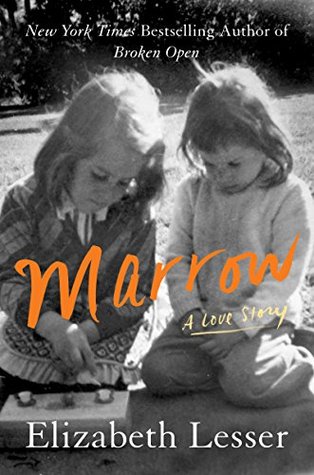 (20 Books of Summer, #17) I put this on the pile for my foodie-themed summer reading challenge because a marrow is an overgrown courgette (zucchini), but of course bone marrow is also eaten and is what is being referred to here. When they were in middle age and Lesser’s younger sister Maggie had a recurrence of her lymphoma, the author was identified as a perfect match to donate bone marrow. She charts the ups and downs of Maggie’s treatment but also goes deep into their family history: parents who rejected the supernatural in reaction to her mother’s Christian Science upbringing; a quartet of sisters who competed for love and attention; and different approaches to life – Maggie was a back-to-the-land Vermont farmer, nurse and botanical artist, while Elizabeth had bucked the trend by moving to New York City and exploring spirituality (she co-founded the Omega Institute, a holistic retreat center).
By including unedited “field notes” Maggie wrote periodically, Lesser recreates the drama and heartache of the cancer journey. She also muses a lot about attempts to repair family relationships through honest conversations and therapy. “Marrow” is not just a literal substance but also a metaphor for getting to the heart of what matters in life. I expect this memoir will be too New Age-y for many readers, but I appreciated its insights and the close sister bonds. I also loved the deckle edge and Maggie’s botanical prints on the endpapers. Recommended to fans of Elizabeth Gilbert and Anne Lamott.
Source: A clearance book from Blackwell’s in Oxford (bought on a trip with Annabel last summer)
My rating: 
The Hundred-Foot Journey by Richard C. Morais (2008)
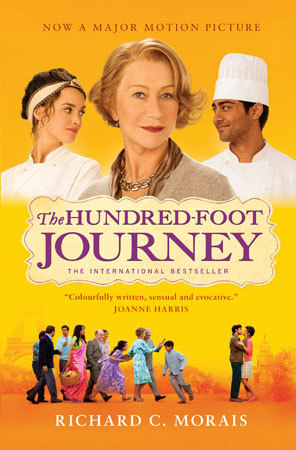 (20 Books of Summer, #18) From the acknowledgments I learned that this was written specifically to be filmed by the author’s friend Ismail Merchant; though Merchant died in 2005, it’s no surprise that it went on to become a well-received 2014 movie. I think the story probably worked better on the big screen, what with the Indian and French settings, the swirls of color and the bustle of restaurant kitchens. Still, I’d forgotten enough about the story line to enjoy the book, too.
Hassan Haji, the narrator, is born in Mumbai, one of six children of a restaurateur, and has his interest in other food cultures awakened early by a memorable French meal (a common experience in several other books I’ve reviewed this summer: Kitchen Confidential, How to Love Wine and Tender at the Bone). After his mother’s death, the extended family relocates to London and then to provincial France. Stranded in Lumière by a car breakdown, the family decides to stay, opening a curry house across from a fine dining establishment run by Gertrude Mallory. Madame Mallory engages in a battle of wills with the uncouth new arrivals. It nearly takes a tragedy for her to get over her snobbishness and xenophobia and realize Hassan has a perfect palate. She takes him on as an apprentice and he makes the title’s 100-foot journey across the street to join her staff.
The film was undoubtedly a Helen Mirren vehicle, and the Lumière material from the middle of the book holds the most interest. The remainder goes more melancholy as Hassan loses many family members and colleagues and deplores the rise of French bureaucracy and fads like molecular gastronomy. Although he eventually earns a third Michelin star for his Paris restaurant, the 40-year time span means that the warm ending somewhat loses its luster. (I can’t remember if the film went so far into the future.) A pleasant summer read nonetheless.
Source: Free from a neighbor
My rating: 
20 Books of Summer, #15–16: Andrew Beahrs and Elizabeth Graver
Today I have a biography-cum-cultural history of America’s wild foods and a novel about beekeeping and mental illness.
Twain’s Feast: Searching for America’s Lost Foods in the Footsteps of Samuel Clemens by Andrew Beahrs (2010)
 (20 Books of Summer, #15) In 1879, Mark Twain, partway through the Grand Tour immortalized in A Tramp Abroad, was sick of bland, poor-quality European food and hankering for down-home American cooking. He drew up a list of 80 foodstuffs he couldn’t wait to get back to: everything from soft-shell crabs to proper ice water. “The menu shouts of a joyous abundance,” Beahrs writes. “It testifies to a deep bond in Twain’s mind between eating and tasting and celebrating … rooted food that would live forever in his memory.”
Beahrs goes in search of some of those trademark dishes and explores their changes in production over the last 150 years. In some cases, the creatures and their habitats are so endangered that we don’t eat them anymore, like Illinois’ prairie chickens and Maryland’s terrapins, but he has experts show him where remnant populations live. In San Francisco Bay, he helps construct an artificial oyster reef. He meets cranberry farmers in Massachusetts and maple tree tappers in Vermont. At the Louisiana Foodservice EXPO he gorges on “fried oysters and fried shrimp and fries. I haven’t had much green, but I’ve had pecan waffles with bacon, and I’ve inserted beignets and café au lait between meals with the regularity of an Old Testament prophet chanting ‘begat.’”
But my favorite chapter was about attending a Coon Supper in Arkansas, a local tradition that has been in existence since the 1930s. Raccoons are hunted, butchered, steamed in enormous kettles, and smoked before the annual fundraising meal attended by 1000 people. Raccoon meat is greasy and its flavor sounds like an acquired taste: “a smell like nothing I’ve smelled before but which I’ll now recognize until I die (not, I hope, as a result of eating raccoon).” Beahrs has an entertaining style and inserts interesting snippets from Twain’s life story, as well as recipes from 19th-century cookbooks. There are lots of books out there about the country’s increasingly rare wild foods, but the Twain connection is novel, if niche.
Source: A remainder book from Wonder Book (Frederick, Maryland)
My rating:
The Honey Thief by Elizabeth Graver (1999)
 (20 Books of Summer, #16) Ever since I read The End of the Point (which featured in one of my Six Degrees posts), I’ve meant to try more by Graver. This was her second novel, a mother-and-daughter story that unearths the effects of mental illness on a family. Eleven-year-old Eva has developed a bad habit of shoplifting, so her mother Miriam moves them out from New York City to an upstate farmhouse for the summer. But in no time Eva, slipping away from her elderly babysitter’s supervision and riding her bike into the countryside, is stealing jars of honey from a roadside stand. She keeps going back and strikes up a friendship with the middle-aged beekeeper, Burl, whom she seems to see as a replacement for her father, Francis, who died of a heart attack when she was six.
Alternating chapters look back at how Miriam met Francis and how she gradually became aware of his bipolar disorder. This strand seems to be used to prop up Miriam’s worries about Eva (since bipolar has a genetic element); while it feels true to the experience of mental illness, it’s fairly depressing. Meanwhile, Burl doesn’t become much of a presence in his own right, so he and the beekeeping feel incidental, maybe only included because Graver kept/keeps bees herself. Although Eva is an appealingly plucky character, I’d recommend any number of bee-themed novels, such as The Secret Life of Bees by Sue Monk Kidd, The History of Bees by Maja Lunde, and even Generation A by Douglas Coupland, over this one.
Source: Secondhand copy from Beltie Books, Wigtown
My rating: 
Summery Classics by J. L. Carr and L. P. Hartley
“Do you remember what that summer was like? – how much more beautiful than any since?”
These two slightly under-the-radar classics made for perfect heatwave reading over the past couple of weeks: very English and very much of the historical periods that they evoke, they are nostalgic works remembering one summer when everything changed – or could have.
A Month in the Country by J. L. Carr (1980)
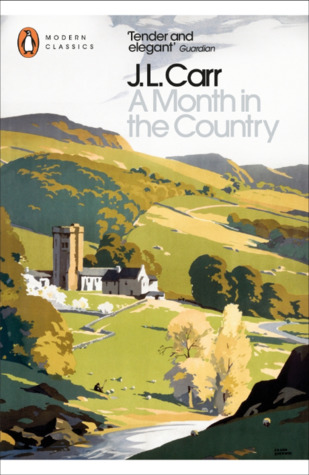 Summer 1920, North Yorkshire. Tom Birkin, a First World War veteran whose wife has left him, arrives in Oxgodby to uncover the local church’s wall painting of the Judgment Day, assumed to be the work of a medieval monk and long since whitewashed over. With nothing waiting for him back in London and no plans beyond this commission, he gives himself over to the daily rhythms of working, eating and sleeping – “There was so much time that marvelous summer.” This simple life is punctuated by occasional incidents like a Sunday school hayride and picnic, and filling in as a lay preacher at a nearby chapel. Also embarked on a quest into the past is Charles Moon, who is searching for the grave of their patroness’ ancestor in the churchyard. Moon, too, has a war history he’d rather forget.
Though it barely exceeds 100 pages, this novella is full of surprises – about Moon, about the presumed identity and fate of the centuries-dead figures he and Birkin come to be obsessed with, and about the emotional connection that builds between Birkin and Reverend Keach’s wife, Alice. “It is now or never; we must snatch at happiness as it flies,” Birkin declares, but did he take his own advice? There is something achingly gorgeous about this not-quite-love story, as evanescent as ideal summer days. Carr writes in a foreword that he intended to write “a rural idyll along the lines of Thomas Hardy’s Under the Greenwood Tree.” He indeed created something Hardyesque with this tragicomic rustic romance; I was also reminded of another very English classic I reviewed earlier in the year: Cider with Rosie by Laurie Lee.
Source: Free bookshop
My rating:
A contemporary readalike: The Offing by Benjamin Myers
The Go-Between by L. P. Hartley (1953)
Summer 1900, Norfolk. Twelve-year-old Leo Colston is invited to spend the several July weeks leading up to his birthday at his school friend Marcus Maudsley’s home, Brandham Hall. Although the fatherless boy is keenly aware of the class difference between their families, in a year of learning to evade bullies he’s developed some confidence in his skills and pluck, fancying himself an amateur magician and gifted singer. Being useful makes him feel less like a charity case, so he eagerly agrees to act as “postman” for Marcus’s older sister, Marian, who exchanges frequent letters with their tenant farmer, Ted Burgess. Marian, engaged to Hugh, a viscount and injured Boer War veteran, insists the correspondence is purely business-related, but Leo suspects he’s abetting trysts the family would disapprove of.
 Leo is right on the cusp of adolescence, a moment of transition that mirrors the crossing into a new century. As he glories in the summer’s mounting heat, “a liberating power with its own laws,” and mentally goads the weather into hitting ever greater extremes, he pushes against the limits of his innocence, begging Ted to tell him about “spooning” (that is, the facts of life). The heat becomes a character in its own right, gloweringly presiding over the emotional tension caused by secrets, spells and betrayals. And yet this is also a very funny novel: I loved Leo’s Franglais conversations with Marcus, and the confusion over mispronouncing “Hugh” as “you.” In places the tone even reminded me of Cold Comfort Farm.
Like A Month in the Country, this autobiographical story is an old man’s reminiscences, going back half a century in memory – but here Leo gets the chance to go back in person as well, seeing what has become of Brandham Hall and meeting one of the major players from that summer drama that branded him for life. I thought this masterfully done in every way: the class divide, the picture of childhood tipping over into the teenage years, the oppressive atmosphere, the comical touches. You know from the famous first line onwards (“The past is a foreign country: they do things differently there”) that this will juxtapose past and present – which, of course, has now become past and further past – in a powerful way, similar to Moon Tiger, my favorite fiction read of last year. I’ll be exploring more of Hartley’s work.
(Note: Although I am a firm advocate of DNFing if a book is not working for you, I would also like to put in a good word for trying a book again another time. Ironically, this had been a DNF for me last summer: I found the prologue, with all its talk of the zodiac, utterly dull. I had the same problem with Cold Comfort Farm, literally trying about three times to get through the prologue and failing. So, for both, I eventually let myself skip the prologue, read the whole novel, and then go back to the prologue. Worked a treat.)
Source: Ex-library copy bought from Lambeth Library when I worked in London
My rating: 
A contemporary readalike: Atonement by Ian McEwan
20 Books of Summer, #13–14: Ruth Reichl and Alice Steinbach
Just three weeks remain in this challenge. I’m reading another four books towards it, and have two more to pick up during our mini-break to Devon and Dorset this coming weekend. A few of my choices are long and/or slow-moving reads, though, so I have a feeling I’ll be reading right down to the wire…
Today I have another two memoirs linked by France and its cuisine.
Tender at the Bone: Growing Up at the Table by Ruth Reichl (1998)
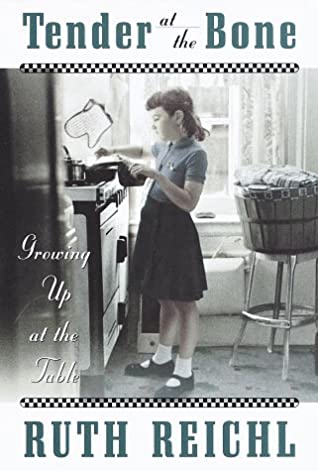 (20 Books of Summer, #13) I’ve read Reichl’s memoirs out of order, starting with Garlic and Sapphires (2005), about her time as a New York Times food critic, and moving on to Comfort Me with Apples (2001), about her involvement in California foodie culture in the 1970s–80s. Whether because I’d been primed by the disclaimer in the author’s note (“I have occasionally embroidered. I learned early that the most important thing in life is a good story”) or not, I sensed that certain characters and scenes were exaggerated here. Although I didn’t enjoy her memoir of her first 30 years as much as either of the other two I’d read, it was still worth reading.
The cover image is a genuine photograph taken by Reichl’s German immigrant father, book designer Ernst Reichl, in 1955. Early on, Reichl had to fend for herself in the kitchen: her bipolar mother hoarded discount food even it was moldy, so the family quickly learned to avoid her dishes made with ingredients that were well past their best. Like Eric Asimov and Anthony Bourdain, whose memoirs I’ve also reviewed this summer, Reichl got turned on to food by a top-notch meal in France. Food was a form of self-expression as well as an emotional crutch in many situations to come: during boarding school in Montreal, her rebellious high school years, and while living off of trendy grains and Dumpster finds at a co-op in Berkeley.
Reichl worked with food in many ways during her twenties. She was a waitress during college in Michigan, and a restaurant collective co-owner in California; she gave cooking lessons; she catered parties; and she finally embarked on a career as a restaurant critic. Her travels took her to France (summer camp counselor; later, wine aficionado), Morocco (with her college roommate), and Crete (a honeymoon visit to her favorite professor). Raised in New York City, she makes her way back there frequently, too. Overall, the book felt a bit scattered to me, with few if any recipes that I would choose to make, and the relationship with a mentally ill mother was so fraught that I will probably avoid Reichl’s two later books focusing on her mother.
Source: Awesomebooks.com
My rating:
Educating Alice: Adventures of a Curious Woman by Alice Steinbach (2004)
 (20 Books of Summer, #14) Steinbach makes a repeat appearance in my summer reading docket: her 2000 travel book Without Reservations was one of my 2018 selections. In that book, she took a sabbatical during her 50s to explore Paris, England, and Italy. Here she continues her efforts at lifelong learning by taking up some sort of lessons everywhere she goes. The long first section sees her back in Paris, enrolling at the Hotel Ritz’s Escoffier École de Gastronomie Française. She’s self-conscious about having joined late, being older than the other students and having to rely on the translator rather than the chef’s instructions, but she’s determined to keep up as the class makes omelettes, roast quail and desserts.
Full disclosure: I’ve only read the first chapter for now as it’s the only one directly relevant to food – in others she takes dance lessons in Japan, studies art in Cuba, trains Border collies in Scotland, etc. – but I was enjoying it and will go back to it before the end of the year.
Source: Free bookshop
Summery Reads of 2020, Part I
Reading with the seasons, I’ve picked up a few books with “summer” or sunshine in their titles. I’ll have more to write up later in August, including novels set during the summer months.
A Summer Bird-Cage by Margaret Drabble (1963)
 Sarah Bennett, who went straight from university in Oxford to Paris for want of a better idea of what to do with her life, is called home to Warwickshire to be a bridesmaid in the wedding of her older sister, Louise, to Stephen Halifax, a wealthy novelist. Afterwards, Sarah decides to move to London and share a flat with a friend whose marriage has recently ended. As the months pass, she figures out life as a single girl in a big city and attends parties hosted by Louise – back from an extended European honeymoon – and others. Sarah eventually works out, from gossip and from confronting Louise herself, that her sister’s marriage isn’t as idyllic as it appeared. Both sisters find themselves at a loss as for what to do next.
Although Drabble’s debut novel is low on action, its characters are sharply drawn and she delights in placing them in situations and conversations where their true values will emerge. I could relate to Sarah for her bookishness, her observant nature, and her feeling that her best days of being a student are behind her. Drabble was only 24 when this was published; though she was already married and a mother, her distinguished university career (a double first from Cambridge) wasn’t long behind her. Given that Drabble’s sister is novelist A.S. Byatt, it’s impossible not to speculate about the autobiographical inspiration for this picture of sisters who are subconscious rivals and don’t even seem to enjoy spending casual time together.
What with the sisters sharing the maiden name Bennett, you also can’t help but think of one of the classic sister novels, Pride and Prejudice. Drabble makes her debt obvious when Sarah goes over to Louise’s for dinner and comments on the “charming convention of the scene – sisters idling away an odd evening in happy companionship. It was like something out of Middlemarch or even Jane Austen.” I was also reminded of the sister pair in Deerbrook: one got all the beauty, but the other seems much more interesting.
The title comes from a John Webster quotation: “’Tis just like a summer bird-cage in a garden: / the birds that are without are desperate to get / in, and the birds that are within despair and / are in a consumption for fear that they will never / get out.” In other words, it’s easy to miss, and idealize, what you don’t have. Sarah still thinks she can have it all; Louise has realized the choices life forces on you. In modern parlance, this is about adulting and FOMO. It still feels relevant, in a way that seems to anticipate the work of Sally Rooney.
My rating:
Rise and Shine by Anna Quindlen (2006)
 Another sisters novel, and the first book in my Journey through the Day with Books challenge. Meghan Fitzmaurice is a household name as the host of America’s most popular morning talk show, Rise and Shine, but her star fades rapidly when, her microphone still on after she thinks they’ve gone to a commercial break, she murmurs “f***ing a**hole” about a guest who is, admittedly, a creep. It turns out her outburst didn’t come out of nowhere: the night before, her husband, Evan, had announced he was leaving her. Meghan goes to Jamaica to regroup, leaving her younger sister, Bridget, a social worker in the Bronx, to figure out what happened and create a semblance of normalcy for her beloved nephew, Meghan’s college-age son Leo, who’s just back from an exchange program at a farm outside Barcelona.
I liked the New York City setting and the central sister relationship – “Sisters tend to get stuck in their roles and they don’t always know how to get out of them. The pretty one. The practical one,” their aunt Maureen, who raised them after their parents’ deaths, says – but the plot hereafter veers between thin and melodramatic. I didn’t warm to Bridget’s boyfriend Irving, a hardboiled older cop, and I get a little nervous about white ladies creating stereotypical African American characters and giving them names like Tequila (Bridget’s receptionist at the women’s shelter) and Princess Margaret (Tequila’s daughter).

In a nice bit of symmetry, though, the book’s end finds a subdued Meghan hosting a late-night show called Day’s End. I didn’t like this nearly as much as her nonfiction (I loved Lots of Candles, Plenty of Cake), but I would read more by Quindlen: I also have a copy of One True Thing, and I have heard that her recent fiction is good.
My rating: 
And a skim from the library that ties in nicely with the cover image above:
The Butterfly Isles: A Summer in Search of Our Emperors and Admirals by Patrick Barkham (2010)
 In 2009, Barkham set out to revive the childhood butterfly-watching hobby he’d shared with his father. The UK is home to 59 species, a manageable number to attempt to see in a season, although it does require a fair bit of travel and insider knowledge. I’ve read too much general history about the human relationship with butterflies (via Rainbow Dust by Peter Marren, which came out a few years later, and An Obsession with Butterflies by Sharman Apt Russell, which Barkham mentions in a Recommended Reading section at the end of the book) to engage with all the context he includes; I focused on the nitty-gritty of the quest running from mid-March to August. I’ll leave it to readers to discover whether he succeeds or not. Nice additions here are the color plates of all the species in question, and the line drawings by Helen Macdonald, yet to come to prominence in her own right – with H Is for Hawk in 2014.
A favorite passage: “Butterflies are symbols of freedom and happiness, sunshine and summer days. They are tokens of romance”
My rating:
Have you been reading anything particularly fitting for summer this year?
Classic of the Month: Cakes and Ale by W. Somerset Maugham (1930)
 (20 Books of Summer, #12) This is the third Maugham novel I’ve reviewed here (after Of Human Bondage and The Moon and Sixpence) and my fourth overall. I’d recommend his work to fans of Charles Dickens and Thomas Hardy, or to anyone looking to expand their knowledge of the classics: his books are short (with the exception of Bondage) and accessible, and the frequent theme of struggling one’s way to love and creative success in defiance of poverty and a cruel fate resonates.
Cakes and Ale is narrated by an older writer named William Ashenden, a Maugham stand-in who previously appeared in the 1928 linked story collection Ashenden, widely recognized as the first English spy narrative. He’s contacted by a popular author of his acquaintance, Alroy Kear (“I could think of no one among my contemporaries who had achieved so considerable a position on so little talent”) with a request: Roy is writing the authorized biography of the late writer Edward Driffield, at his second wife’s behest. Remembering that Ashenden knew Driffield as a boy, Roy hopes to mine his memory for some good anecdotes. The book contains his resulting recollections – though Ashenden is unlikely to share them all with Roy.
Ashenden shares a background with Philip Carey from Of Human Bondage: both were raised in a vicar uncle’s household in Blackstable, Kent. Young Willie would go for bike rides with friendly neighbors Driffield and his wife Rosie, until his aunt and uncle forbade him.
{SPOILERS FOLLOW}
The Driffields, you see, were considered low-class and vulgar, an opinion that was seemingly confirmed first when they ran away from their debts to London, and then when Rosie left Edward for a Kent coal merchant. Rosie comes to represent a familiar type: the whore with the heart of gold. As Ashenden knows from personal experience, she enjoyed sex and slept with men out of kindness or pity. Only decades later did he learn that Edward knew Rosie was stepping out on him, and that the couple had lost a six-year-child to meningitis. This is not, I think, meant to excuse Rosie’s promiscuity, but it does give her an extra dimension, and perhaps explains why Driffield’s first marriage failed. Unfortunately, Rosie’s sexuality is racialized, with Driffield’s second wife saying, “I’ve always thought she looked rather like a white nigger” and an illustration giving her stereotypically wide nostrils and thick lips.)
{END OF SPOILERS}
I felt Driffield must be inspired by Thomas Hardy, and I’m not alone: in a preface, Maugham reports that many assumed he had Hardy in mind, but denies basing his portrait on any author in particular. Yet the similarities are undeniable: the flighty first wife; the late remarriage to his secretary; childlessness; humble origins and the fight to be taken seriously in the literary world. Maugham does, however, mention loving Tess of the d’Urbervilles and its milkmaid heroine, so Rosie is his homage (in the preface Maugham explains that, while the book’s plot occurred to him for a short story, he didn’t want to ‘waste’ Rosie on something so brief).
 Dickens is an influence, too; I enjoyed references to his work, as well as to (on consecutive pages!) the New Woman and Mrs. Humphry Ward, both of whom were part of my MA thesis. The Victorian shadow is long here. But the focus on Rosie means Driffield himself is never more than a cipher. Ashenden admits this: “I am conscious that in what I have written of him I have not presented a living man, standing on his feet, rounded, with comprehensible motives and logical activities; I have not tried to: I am glad to leave that to the abler pen of Alroy Kear.” But The Moon and Sixpence, which employs the same setup of an author reminiscing about a great man he once knew, makes its subject a three-dimensional character, and is better for it.
Note: Maugham’s titles are often unusual and allusive. “Cakes and ale,” as part of a Twelfth Night quotation, represent the luxurious lifestyle in opposition to the moral one. The book’s subtitle is “or The Skeleton in the Cupboard.”
Source: Free bookshop
My rating:
20 Books of Summer: Bourdain, Ozeki and More
Over halfway through the summer and my numbers are looking poor. It’s not that I’m not reading a ton – in general, I am – it’s just that I’m having trouble finishing any foodie books. I’m in the middle of two food-related memoirs plus Cakes and Ale by W. Somerset Maugham, and have recently started buddy-reading Mother’s Milk by Edward St Aubyn with Annabel, so more reviews will be along eventually, but I predict August will be a scramble.
Today I review an in-your-face tell-all about the life of a chef, and a novel set between Japan and the United States that exposes the seamy side of meat production. A lite road trip and an iffy California classic follow as bonuses.
Kitchen Confidential: Adventures in the Culinary Underbelly by Anthony Bourdain (2000)
 (20 Books of Summer, #5) “Get that dried crap away from my bird!” That random line about herbs is one my husband and I remember from a Bourdain TV program and occasionally quote to each other. It’s a mild curse compared to the standard fare in this flashy memoir about what really goes on in restaurant kitchens. His is a macho, vulgar world of sex and drugs. In the “wilderness years” before he opened his Les Halles restaurant, Bourdain worked in kitchens in Baltimore and New York City and was addicted to heroin and cocaine. Although he eventually cleaned up his act, he would always rely on cigarettes and alcohol to get through ridiculously long days on his feet.
From “Appetizer” to “Coffee and a Cigarette,” the book is organized like a luxury meal. Bourdain charts his development as a chef, starting with a childhood summer in France during which he ate vichyssoise and oysters for the first time and learned that food “could be important … an event” and describing his first cooking job in Provincetown and his time at the Culinary Institute of America. He also discusses restaurant practices and hierarchy, and home cook cheats and essentials. (I learned that you should never order fish in a restaurant on a Monday – it’ll be left over from Thursday’s order.) The pen portraits of his crazy sous-chef and baker are particularly amusing; other subjects include a three-star chef he envies and the dedicated Latino immigrants who are the mainstay of his kitchen staff.
My dad is not a reader but he is a foodie, and he has read Bourdain’s nonfiction (and watched all his shows), so I felt like I was continuing a family tradition in reading this. I loved my first taste of Bourdain’s writing: he’s brash, passionate, and hilariously scornful of celebrity chefs and vegetarianism (“the enemy of everything good and decent in the human spirit, an affront to all I stand for, the pure enjoyment of food”). Being in charge of a restaurant sounds manic, yet you can see why some would find it addictive. How ironic, though, to find a whole seven references to suicide in this book. Sometimes he’s joking; sometimes he’s talking about chefs he’s heard about who couldn’t take the pressure. Eighteen years after this came out, he, too, would kill himself.
(See also this article about rereading Bourdain in the 20th anniversary year of Kitchen Confidential.)
Source: Local swap shop (free)
My rating:
(These two are linked by a late chapter in the Bourdain, “Mission to Tokyo,” in which he advises on a new Les Halles offshoot in Japan and gorges himself on seafood delights.)
My Year of Meats by Ruth Ozeki (1998)
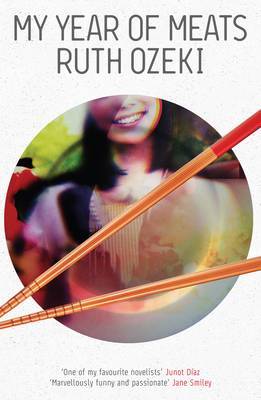 (20 Books of Summer, #6) I don’t know what took me so long to read another novel by Ruth Ozeki after A Tale for the Time Being, one of my favorite books of 2013. This is nearly as fresh, vibrant and strange. Set in 1991, it focuses on the making of a Japanese documentary series, My American Wife, sponsored by a beef marketing firm. Japanese American filmmaker Jane Takagi-Little is tasked with finding all-American families and capturing their daily lives – and best meat recipes. The traditional values and virtues of her two countries are in stark contrast, as are Main Street/Ye Olde America and the burgeoning Walmart culture.
There is a clear message here about cheapness and commodification, but Ozeki filters it through the wrenching stories of two women with fertility problems: Jane, whose reproductive system was damaged by DES, a synthetic estrogen her mother took during pregnancy to prevent a miscarriage; and Akiko, the wife of Jane’s boss, who struggles with an eating disorder and domestic violence.
Jane starts sneaking controversial subjects into her shoots: a lesbian couple, a family formed by interracial adoption, and a five-year-old who has already undergone puberty due to the hormones used on her family’s cattle feedlot. What is “natural,” and what gets branded alien or invasive? From the kudzu that strangles the South to a murdered Japanese exchange student, Ozeki probes the related issues of nativism and racism. Her two protagonists’ stories – one in the first person; the other in the third person – come together in a surprising manner as Jane decides that she has a more pressing obligation than creating a diverting television show.
This is a bold if at times discomforting novel. At first it brought to mind the exaggerated comedy of Julian Barnes’s England, England and Jane Smiley’s Moo, but as it grew darker it reminded me more of Han Kang’s The Vegetarian. It’s tricky, when a work of fiction tackles ethical or environmental matters, to balance storytelling and consciousness-raising, but Ozeki pulls it off with style. The only aspect that didn’t mean much to me, perhaps simply because of my unfamiliarity, was the excerpts from The Pillow Book of Shōnagon. How sad to think that I only have one more Ozeki awaiting me, All Over Creation. She averages a book every 5‒10 years; we can only hope that another is on the way soon.
Source: Charity shop
My rating: 
I picked up another two food-adjacent books that didn’t work for me, though I ended up skimming them to the end.
America Unchained: A Freewheeling Roadtrip in Search of Non-Corporate USA by Dave Gorman (2008)
 (20 Books of Summer, #7) I read the first couple of chapters, in which he plans his adventure, and then started skimming. I expected this to be a breezy read I would race through, but the voice was neither inviting nor funny. I also hoped to find more about non-chain supermarkets and restaurants – that’s why I put this on the pile for my foodie challenge in the first place – but, from a skim, it mostly seemed to be about car trouble, gas stations and fleabag motels. The only food-related moments are when Gorman (a vegetarian) downs three fast food burgers and orders of fries in 10 minutes and, predictably, vomits them all back up; and when he stops at an old-fashioned soda fountain for breakfast.
Source: Free bookshop
Tortilla Flat by John Steinbeck (1935)
 (20 Books of Summer, #8) I read the first 25 pages and then started skimming. This is a story of a group of friends – paisanos, of mixed Mexican, Native American and Caucasian blood – in Monterey, California. During World War I, Danny serves as a mule driver and Pilon is in the infantry. When discharged from the Army, they return to Tortilla Flat, where Danny has inherited two houses. He lives in one and Pilon is his tenant in the other (though Danny will never see a penny in rent). They’re a pair of loveable scamps, like Huck Finn all grown up, stealing wine and chickens left and right.
Steinbeck novels seem to fall into two camps for me. This is one of his inconsequential, largely unlikable novellas (like The Pearl and The Red Pony, which I studied in school – I’m lucky they didn’t put me off Steinbeck forever), whereas The Grapes of Wrath and East of Eden are masterful. It may also have something to do with the slight air of condescension towards characters of a different race: Steinbeck renders their speech with “thee” and “thou,” trying to imitate a Romance language’s informal pronouns, but it feels dated and alienating.
Source: Free bookshop
20 Books of Summer, #3–4: Ella Minnow Pea & Eating for England
June hasn’t seen much progress on this project – though I’m currently on my fifth read, Kitchen Confidential by Anthony Bourdain, and enjoying it a lot – so July and August will need to include eight food- and drink-themed books each.
Today I have a reread of a funny (yet more serious than I remembered) favorite and a light collection of mini-essays on the English love affair with particular foodstuffs.
Ella Minnow Pea by Mark Dunn (2001)
From my original Bookkaholic review from 2013:
Dunn’s debut is a book of letters – in more senses than one. It is a fairly traditional epistolary novel, but also toys with the letters of the alphabet: the wordy citizens of the island nation of Nollop are zealously engaged in creating pangrams (pithy sentences that contain each letter of the alphabet) in tribute to their founder, Nevin Nollop, who authored “The quick brown fox jumps over the lazy dog,” the original pangram displayed in ceramic tiles on his statue in the public square. But things go awry when particular letters start falling off the monument.
A superstitious lot, the Nollop Council decide that the fallen letters can no longer be used, and the characters’ missives become increasingly constrained as they have to avoid certain vowels and consonants. Their writing grows exponentially avant-garde and hilarious as they resort to circumlocutions and phonetic spellings. Before long only L, M, N, O, and P can be used – which, handily, still allows for an approximation of the title character’s name. A madcap journey through the English language and its use in literature: enjoy the ride.
On this rereading…
 I engaged more with the individual characters: Ella and her parents, aunt and cousin; other members of the community; and a few off-island visitors who lead the research into what’s happening with the letters. I was also struck much more by the political satire: freedom of speech is endangered in a repressive society slavishly devoted to a sacred text. Those who continue to use forbidden letters are turned in by their neighbors or enemies and get 1) a warning, 2) a flogging or time in the headstocks, and 3) banishment. The council members see themselves as interpreting the will of Nollop, and believe the pangram to be a miraculous sentence that can never be bettered – but the citizens prove them wrong by creating a superior example (using only 32 letters, versus the fox’s 35) purely by accident.
A remembered favorite line that my husband and I often quote to each other – “No mo Nollop poop!” – doesn’t exist (it’s actually “No mo Nollop pomp! No mo Nollop poo poo!”). My favorite alternative phrase is “terminal-cot” for deathbed once D is disallowed. I also love the new days of the week: Sunshine, Monty, Toes, Wetty, Thurby, Fribs and Satto-Gatto.
Laugh-out-loud silliness plus a sly message about science and reason over superstition: a rare combination that makes this an enduring favorite. I also recommend Dunn’s Ibid: A Life (2004), which is told entirely through the footnotes of a biography, taking “reading between the lines” to a whole new level. I haven’t enjoyed his other novels as much as these two.
Source: Salvation Army store, Cambridge (September 2016)
My original rating (Borrowed from a friend – in 2007?):
My rating now:
Eating for England by Nigel Slater (2007)
 Nigel Slater is a foodie known in the UK for his television programs and newspaper columns. Not as edgy as Gordon Ramsay, as matey as Jamie Oliver, or as ethically clued-in as Hugh Fearnley-Whittingstall, he doesn’t have a particular shtick. A middle-of-the road, middle-class type, he’s all about simple comfort food. We have a few of his cookbooks.
As in his memoir, Toast (2004), food links in to nostalgia for childhood. In 200 or so essays that range from a paragraph to a few pages in length, Slater extols everything from marmalade to Brussels sprouts. He devotes by far the most time to the sweet stuff, though, considering the respective merits of every type of biscuit, candy, chocolate bar and pudding. There’s a clear love here for teatime treats (“Afternoon tea may be the only meal we take that is purely and utterly for pleasure”) and for stodge (“Is there something in our demeanour, our national psyche, which makes heavy, rather bland food sit so comfortably with us?”).
This was all pleasant, if inconsequential. I enjoy ‘observing the English’-type books because I’m familiar enough to recognize everything but still foreign enough to enjoy the quaintness and contradictions. What rubbed me the wrong way, though, were the arch portraits of kinds of cooks. I don’t often write in my books, but I found myself leaving corrective comments in the margins in a few places, especially on “The Slightly Grubby Wholemeal Cook,” an unhelpful stereotype of the “dirty hippie.” His ideas about hygiene and political correctness are a little off in this one. I also objected to his annoyance at people who won’t simply split the bill after a meal out (I’ll pay for what I ordered, thank you), and his defense of the gollywog used in Robertson’s advertising seems particularly ill judged at the current moment.
Source: Charity shop in Newton Stewart (Wigtown trip, April 2018)
My rating:
Classic of the Month: Cider with Rosie by Laurie Lee (1959)
 (20 Books of Summer #2) Lee’s quaint family memoir is set in the years immediately after World War I. He was born in 1914 and his childhood unfolded in Stroud, Gloucestershire and nearby village Slad. I started reading Cider with Rosie in April 2019 when we stopped in Stroud for a night on the way back from a holiday in Devon. I got through the first 100 pages quickly, with the voice reminding me slightly of Gerald Durrell’s in his autobiographical trilogy, but then set the book aside for over a year before picking it back up for this summer’s food- and drink-themed reading. Taking such a long break wasn’t a major problem because the book’s vignettes are thematically arranged, so there was no plot as such to lose track of.
Lee was part of his father’s second brood, born out of the widower’s remarriage to his housekeeper. His father left his new family after just a few years, and for the next three decades Lee’s mother dutifully waited for a return that never came. Lee was a sickly child, doted on by his older half-sisters. He was surrounded by a large wider family of brothers, eccentric war-veteran uncles and duelling elderly neighbors who lived one upstairs and one downstairs in a sort of granny annex attached to their untidy, rambling 17th-century stone house. The book depicts a village on the cusp of modernization: everything was still done with wagons and horses, but that was soon to change.
It’s a nostalgic, evocative look at a country childhood. Lee captures a bygone era, portraying himself as similarly on the precipice of losing innocence. The title comes from a late moment when Rosie Burdock tempts the adolescent Lee with alcoholic cider and kisses underneath a hay wagon. This penultimate chapter on the lust of the flesh takes an alarming turn as he describes the village boys’ planned gang rape of a religious 16-year-old, Lizzy. Lee was among the boys who followed her into the woods one Sunday after church. Luckily, they lost their nerve and nothing happened, but Lee’s blasé recounting felt out of keeping and somehow more dated than the rest of his material. It left a sourness I couldn’t get over.
Quintessentially English but not as purely delightful as I expected, this was still a book I valued for its characterization and its description of golden moments in memory.
Some favorite passages:
“Summer, June summer, with the green back on earth and the whole world unlocked and seething – like winter, it came suddenly and one knew it in bed, almost before waking up; with cuckoos and pigeons hollowing the woods since daylight and the chipping of tits in the pear-blossom.”
“Myself, my family, my generation, were born in a world of silence; a world of hard work and necessary patience, of backs bent to the ground, hands massaging the crops, of waiting on weather and growth; of villages like ships in the empty landscapes and the long walking distances between them; … [The horse’s] eight miles an hour was the limit of our movements, as it had been since the days of the Romans. That eight miles an hour was life and death, the size of our world, our prison.”
Source: Free bookshop
My rating:
Ten more childhood memoirs:
A few I’ve written about here and prefer:
- Boy by Roald Dahl
- To the Is-land by Janet Frame
- Don’t Let’s Go to the Dogs Tonight by Alexandra Fuller
- Bookworm by Lucy Mangan
- Period Piece by Gwen Raverat
A couple of favorites I’ve never written up:
- Oleander, Jacaranda by Penelope Lively
- Hellfire and Herring by Christopher Rush
Plus a few that I haven’t liked quite as much:
- Maggie & Me by Damian Barr
- Childhood by Tove Ditlevsen
- Rosie by Rose Tremain
20 Books of Summer 2020 (Food & Drink Theme): #1 Tiny Moons
It’s my third year participating in Cathy’s 20 Books of Summer challenge. Two years ago I read only books by women; last year I did an animal theme. This year, my 20 books will all tie into a food and drink theme. This includes recognizable foodie lit, memoirs and travel books that have a food element (such as Dave Gorman seeking out non-chain restaurants in America Unchained and Alice Steinbach taking French cooking lessons in Educating Alice), and fiction or nonfiction works that just happen to have a food word in the title. To avoid being grisly, I’ll try not to include any animal books left over from last year!


I have around 30 books to choose from, including these slightly cheaty selections whose authors’ names bring food to mind.

The one constant in my three summers’ selections is that all the books have to be from my own shelves – it’s my way of trying to tackle my hundreds-strong physical TBR. I also have a few classics and two rereads (Dunn and Kingsolver) in the mix here, which would contribute to other ongoing reading goals.
I’m kicking off #20BooksofSummer20 with a quick win, only 85 pages long and read in a single sitting this morning. It was a great start to the project and had my mouth watering for elevenses two hours early…
Tiny Moons: A Year of Eating in Shanghai by Nina Mingya Powles (2020)
This lovely pamphlet of food-themed essays arose from a blog Powles kept while in Shanghai on a one-year scholarship to learn Mandarin. She’d lived in the city as a teen, attending an international high school, so it was somewhat familiar – yet she struggled with homesickness. From one winter to another, she explores the city’s culinary offerings and muses on the ways in which food is bound up with her memories of people and places.
As a child in a mixed-race household in New Zealand, she only knew food words in her Malaysian Chinese mother’s native languages. “My earliest childhood impressions are ones where I am just about to eat something,” she writes. That something might have been Western or Asian food – they coexist in the book (most delightfully on a long-distance train ride she takes: you can buy noodles and dried chicken feet, but also Oreos and Pringles).

As a student in Shanghai, she has dumplings and soup for lunch almost every day. She could live off of spring onion oil noodles and pineapple buns (named for their cross-hatched top rather than their flavour). Messy foods, greasy foods, comfort foods – “It is tiring to be a woman who loves to eat in a society where hunger is something not to be satisfied but controlled.” She and her classmates know that their time here is limited, and they’re going to make the most of these flavours you can’t find every day.
Two sets of cooking lessons add dishes like sticky rice dumplings and stir-fried aubergines to her repertoire. She learns about the traditional foods associated with Chinese festivals, and about the country’s north/south divides: wheat noodles versus rice and thick-skinned dumplings versus thin ones. Street food and snacks abound, including savoury and sweet buns, filled pancakes, tofu bowls and mooncakes.
This is a book about how food can help you be at home, despite loneliness or a language barrier: “In any city anywhere, if there’s a Chinatown I’ll feel at home,” Powles concludes. I love how she uses the senses – not just taste, but also smell and sight – to recreate important places in her life. A fresh banana fritter eaten at her grandparents’ home in Borneo brings it all back, with the senses mingling synaesthetically: “I taste tropical heat. I can taste the slow hours spent in the back garden beneath the mango tree … I taste the fierce sun on my neck”.
My rating:
Readalikes: Shark’s Fin and Sichuan Pepper: A Sweet-Sour Memoir of Eating in China by Fuchsia Dunlop & Two Trees Make a Forest: On Memory, Migration and Taiwan by Jessica J. Lee
Note: Last year Nina Mingya Powles won the inaugural Nan Shepherd Prize for underrepresented voices in nature writing, earning a publishing contract with Canongate for a nature/travel memoir that will be released in August 2021. I’m looking forward to it already.
Tiny Moons was published on February 27th. My thanks to Emma Dai’an Wright of The Emma Press, a small press based in Birmingham, UK, for the free copy for review. (Emma also illustrated the book!)
 Bookish Beck = Rebecca Foster. American transplant to England. Freelance proofreader and book reviewer.
 Bookish Beck