Reading Ireland Month, Part II: Dowd, Enright, Madden & Nugent
I’m catching up with a final set of reviews for #ReadingIrelandMonth26. I read two novels set at least partially during the Troubles, one of them for teenagers; a quiet novel about adultery and bereavement; and a thriller about consent and family legacy. I also read the first half of one more novel, a sombre one about the aftermath of a mental health crisis. Between this post and my first one, I covered 6.5 novels by Irish women, which I’ll call a win.
Bog Child by Siobhan Dowd (2008)
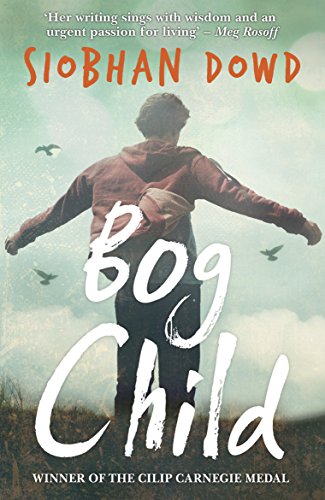 Fergus McCann is 18 and taking A levels; if he can only get three Bs, he’ll have his ticket out of Northern Ireland to study medicine at Aberdeen. This is no ordinary summer, though. He loves running on the hills at the border and here he makes a landmark discovery and embarks on a risky mission. The plot opens with Fergus and his uncle stumbling on the corpse of a girl while cutting peats. It’s a case for archaeologists rather than the police: the body is from the Iron Age and there’s evidence that the girl was sacrificed. An acquaintance then pressures Fergus into running parcels up and down the hill, right under the noses of the British at the checkpoint. He makes friends with Owain, a Welsh soldier, but gets a horrible feeling he’s partially responsible for the bombings he soon hears about on the radio. His family is enmeshed in the IRA anyway: his brother is among the hunger strikers in the local prison. There’s every chance that Joey could die before the summer is out, as much a victim of injustice as “Mel” (as Fergus names the girl from the bog, whose story he dreams).
This was Dowd’s third novel, published posthumously after her death from cancer, and won the Carnegie Medal. I’d say it’s one of the few best young adult novels I’ve ever read. (It’s shelved under Teenage Fiction at my library.) It’s an excellent peripheral glance at history ancient and modern – Fergus’s letter to Margaret Thatcher is brilliant – and effectively recreates a teen’s divided attention: friends, schooling, family drama, the future, and romance (via the daughter of the archaeologist). I searched my library catalogue for further books on bog bodies after reading Anna North’s Bog Queen and it really paid off! (Public library)
The Forgotten Waltz by Anne Enright (2011)
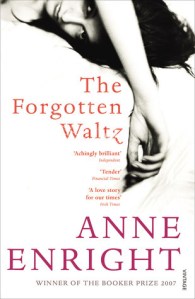 I’ve only read a handful of Enright novels and wanted to experience more, so picked this one because it was shortlisted for the Orange Prize. On the face of it, it’s a fairly straightforward adultery story, but the unshowy potency of Enright’s writing and her realistic insight into relationships set it apart. While married to Conor, Gina has an affair with Seán, who’s older and married to Aileen. Seán is part of their social circle but also someone she knows through work, and business trips are an easy excuse. “The office game was another game for us to play, after the suburban couples game, and before the game of hotel assignations and fabulous, illicit lust, and neither of us thought there might come a moment when all the games would stop. It was a lot of fun.” Gina narrates matter-of-factly, rejecting cause-and-effect language. She doesn’t defend herself, or fool herself that Seán is perfect. This new relationship involves as many challenges as her marriage, what with her mother’s death and Seán’s preteen daughter, Evie, who appears to be autistic and epileptic. The short chapters are all headed with song lyrics, mostly from love songs (“Will You Love Me Tomorrow,” “Stop! In the Name of Love”) whose ironic optimism underlines the novel’s gently melancholy tone. This reminded me most of Maggie O’Farrell’s early work, and more than justified delving into Enright’s back catalogue. (Secondhand – Awesomebooks.com)
{SPOILERS IN THE REST!!}
One by One in the Darkness by Deirdre Madden (1996)
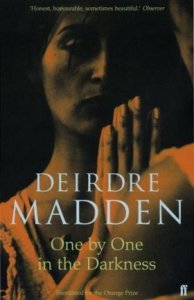 Louise Kennedy’s Trespasses was our book club selection for March; I’d read it just two years ago, so skimmed back through and was impressed by its construction. Some were less convinced by the framing story and not emotionally engaged with Michael and Cushla’s affair, but we all appreciated it as a sideways look at Northern Irish history. One by One in the Darkness, which was also shortlisted for the Women’s (then Orange) Prize, is set close to its publication in the 1990s but returns to the Troubles through memories and flashbacks. Set over one week – Saturday to Friday – it’s the story of the three Quinn sisters. Cate is a journalist in London who flies home to Antrim to break the news that she’s pregnant out of wedlock. Helen is a lawyer and Sally a schoolteacher. They, their mother, and Uncle Brian have all gotten on with life as best they could, but their father’s murder is something they can’t forget and won’t ever get over. By saving that scene for the very last page of this novella, she keeps the horror of it fresh. Through one family’s story, she gives a sense of the scope of the country’s loss. But the book is not without a dark sense of humour, either. Madden was a new author for me. I found her work profound at the sentence level (see below for some favourite lines) rather than engaging at the plot level. (Secondhand – Awesomebooks.com)
“‘What’s wrong with Uncle Peter?’ ‘Two things,’ [Granny] said. ‘He thinks too much, and then he drinks too much.’”
“Once when [Cate] was home she’d remarked to Helen that she thought the forecasts were often inaccurate in Northern Ireland. ‘It’s probably deliberate,’ Helen had replied. ‘If they read out the average day’s news here and then said at the end of it, “Oh, and by the way, it’s going to bucket rain for the next twenty-four hours,” it might be more than people could take.’”
“Cate had remarked once that it was only when you lived away from Northern Ireland that you realised on returning how deeply divided a society it was, and how strange the effect of that could be.”
“There’d been well over three thousand people killed since the start of the Troubles, and every single one of them had parents or husbands and wives and children whose lives had been wrecked. It would be written about in the paper for two days, but as soon as the funeral was over it was as if that was the end, when it was really only the beginning.”
The Truth about Ruby Cooper by Liz Nugent (2026)
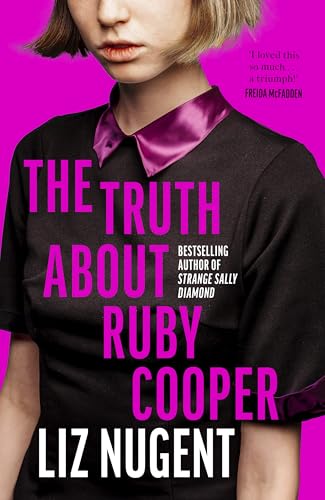 We read Nugent’s Strange Sally Diamond for book club a couple years ago and it was a great Northumberland holiday read for me, with a deliciously off-kilter narrator whose traumatized (and perhaps neurodivergent) perspective carried the novel. Here again Nugent prioritizes unreliable women’s voices and dark happenings, but Ruby is awfully hard to like. At age 16, she falsely accuses her older sister Erin’s boyfriend Milo of raping her. Milo maintains his innocence all along, but goes to jail for the crime; after all, DNA evidence can’t lie, right? Years of his life – and a heartbroken Erin’s – are stolen, his mother dies by suicide, Ruby becomes dependent on alcohol: all of this because of sisterly jealousy and an elaborate lie that their mother upholds rather than expose the family to further shame.
Narration alternates between Erin in Boston and Ruby, who’s moved back to Ireland with their mother. For Ruby’s confession to work, readers are kept in the dark about the truth of the incident, though only for 76 pages. Together the sisters give a tedious blow-by-blow of the intervening years – until Ruby’s daughter, Lucy, is raped by her boss on a drunken night out. Ruby refuses to believe her “because if it was true, that was karma coming to bit me on the ass.” This is where things finally get interesting, as Nugent explores ironies and familial patterns. But I’m sure I won’t be the only one to find the whole thing distasteful. Nugent clearly anticipates a backlash, stating in a prefatory letter, “I need to be very clear about the fact that girls and women like Ruby Cooper are extremely rare.” Was it worth undermining the #BelieveWomen campaign to explore a certain state of mind? Nah.
With thanks to Sandycove (Penguin) for the proof copy for review.
I’d also hoped to finish one more, but ran out of time. Here are my thoughts on the first half:
Show Me Where It Hurts by Claire Gleeson (2025)
 Rachel knew Tom had recurring problems with depression, but had no idea he was on the verge of a breakdown when he deliberately drove their car off the road with the intention of killing his entire family. Their two young children die in the crash but they both survive – Tom held in a psychiatric hospital and Rachel resuming her life as a nurse. The chapters alternate between “After” and “Before,” giving relative date markers in weeks, months or years out from the incident. Gleeson’s understated prose makes it possible for readers to face a tragedy so awful we’d otherwise look away; it never tips over into mawkishness.
Three Days in June vs. Three Weeks in July
Two very good 2025 releases that I read from the library. While they could hardly be more different in tone and particulars, I couldn’t resist linking them via their titles.
Three Days in June by Anne Tyler
(From my Most Anticipated list.) A delightful little book that I loved more than I expected to, for several reasons: the effective use of a wedding weekend as a way of examining what goes wrong in marriages and what we choose to live with versus what we can’t forgive; Gail’s first-person narration, a rarity for Tyler* and a decision that adds depth to what might otherwise have been a two-dimensional depiction of a woman whose people skills leave something to be desired; and the unexpected presence of a cat who brings warmth and caprice back into her home. (I read this soon after losing my old cat, and it was comforting to be reminded that cats and their funny ways are the same the world over.)
From Tyler’s oeuvre, this reminded me most of The Amateur Marriage and has a surprise Larry’s Party-esque ending. The discussion of the outmoded practice of tapping one’s watch is a neat tie-in to her recurring theme of the nature of time. And through the lunch out at a chic crab restaurant, she succeeds at making the Baltimore setting essential rather than incidental, more so than in much of her other work.
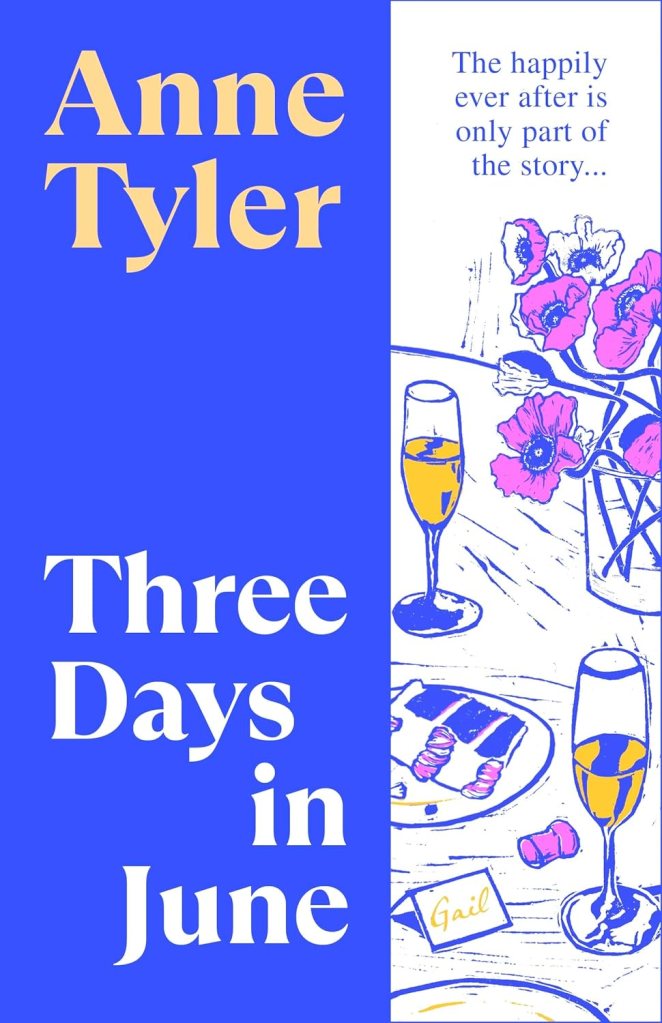
Gail is in the sandwich generation with a daughter just married and an old mother who’s just about independent. I appreciated that she’s 61 and contemplating retirement, but still feels as if she hasn’t a clue: “What was I supposed to do with the rest of my life? I’m too young for this, I thought. Not too old, as you might expect, but too young, too inept, too uninformed. How come there weren’t any grownups around? Why did everyone just assume I knew what I was doing?”
My only misgiving is that Tyler doesn’t quite get it right about the younger generation: women who are in their early thirties in 2023 (so born about 1990) wouldn’t be called Debbie and Bitsy. To some degree, Tyler’s still stuck back in the 1970s, but her observations about married couples and family dynamics are as shrewd as ever. Especially because of the novella length, I can recommend this to readers wanting to try Tyler for the first time. 
*I’ve noted it in Earthly Possessions. Anywhere else?
Three Weeks in July: 7/7, The Aftermath, and the Deadly Manhunt by Adam Wishart and James Nally
July 7th is my wedding anniversary but before that, and ever since, it’s been known as the date of the UK’s worst terrorist attack, a sort of lesser 9/11 – and while reading this I felt the same way that I’ve felt reading books about 9/11: a sort of awed horror. Suicide bombers who were born in the UK but radicalized on trips to Islamic training camps in Pakistan set off explosions on three Underground trains and one London bus. I didn’t think my memories of 7/7 were strong, yet some names were incredibly familiar to me (chiefly Mohammad Sidique Khan, the leader of the attacks; Jean Charles de Menezes, the innocent Brazilian electrician shot dead on a Tube train when confused with a suspect in the 21/7 copycat plot – police were operating under a new shoot-to-kill policy and this was the tragic result).
 Fifty-two people were killed that day, ranging in age from 20 to 60; 20 were not UK citizens, hailing from everywhere from Grenada to Mauritius. But a total of 770 people were injured. I found the authors’ recreation of events very gripping, though do be warned that there is a lot of gruesome medical and forensic detail about fatalities and injuries. They humanize the scale of events and make things personal by focusing on four individuals who were injured, even losing multiple limbs in some cases, but survived and now work in motivational speaking, disability services or survivor advocacy.
What really got to me was thinking about all the hundreds of people who, 20 years on, still live with permanent pain, disability or grief because of the randomness of them or their loved ones getting caught up in a few misguided zealots’ plot. One detail that particularly struck me: with the Tube tunnels closed off at both ends while searchers recovered bodies, the temperature rose to 50 degrees C (122 degrees F), only exacerbating the stench. The book mostly avoids cliches and overwriting, though I did find myself skimming in places. It is based on the research done for a BBC documentary series and synthesizes a lot of material in an engaging way that does justice to the victims. 
Have you read one or both of these?
Could you see yourself picking one of them up?
 Bookish Beck = Rebecca Foster. American transplant to England. Freelance proofreader and book reviewer.
 Bookish Beck