Landmark Books from My Early Life
I initially wanted to title this post “Books that Changed My Life,” but soon realized it would probably be more accurate to speak about them as the books that have shaped my life as a keen reader and meant the most to me as the years have passed.
In making this list I was inspired by a book I recently finished, Kate Gross’s memoir Late Fragments, which finishes with a bibliography of books that influenced her during different periods of her life. Gross, who died of colon cancer at age 36 in 2014, divides her reading life into five distinct, whimsically named eras: “With my back to the radiator” (childhood), “The grub years” (adolescence), “Emerging from the cocoon” (early adulthood), “The woman in the arena” (career life) and “End of life book club.”
I’ll do a follow-up post on the key books from my twenties next month, but for now I want to focus on the books that defined my growing-up and teen years.
What Bewick’s Birds was for Jane Eyre, my parents’ book on flower arranging was for me. I couldn’t tell you the title or author, but I think this green fabric covered tome with its glossy pages and lush full-color photographs was the origin of my love of books as physical objects. I must have spent hours paging through the illustrations and breathing in the new-book aroma. I’ve been a book sniffer ever since.
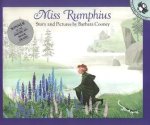 I can’t recall many of the individual picture books my mother read with me when I was little, but one that does stand out in my memory is Miss Rumphius by Barbara Cooney, about an eccentric woman who goes about planting lupines. Again, it’s a gorgeous book filled with flowers – you’d think I might have become a botanist!
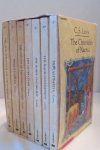 C.S. Lewis’s The Chronicles of Narnia were the first books I ever read by myself, starting at age five. It took me years to get to the allegory-heavy The Last Battle, but I read the other volumes over and over, even after the PBS television movies came out. The Silver Chair was always my favorite, but I’m sure I must have read the first three books 10 or 20 times each.
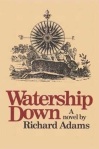 Richard Adams’s Watership Down was the first book I ever borrowed from the adult section of the public library, at age nine. Crossing the big open lobby of the Silver Spring, Maryland library from the children’s room to the imposing stacks of Adult Fiction was like a rite of passage; when I emerged clutching the fat plastic-covered hardback I felt a little bit like a rebel but mostly just pretty darn proud of myself. I inhaled the several hundred pages of this bunny epic and for years afterwards considered it my favorite book.
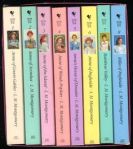 Nowadays I don’t like to commit to series, but as a kid I couldn’t get enough of them: after Narnia, I devoured the Babysitter’s Club and Saddle Club books, the Anastasia Krupnik books, and so on. Whenever I found an author I loved I dutifully read everything they’d written. The Anne of Green Gables series by L.M. Montgomery, in particular, accompanied me through my early teen years. I think I saw the CBC/PBS television miniseries starring Megan Follows first and read the books afterwards. Bereft once the eight-book cycle was over, I read the much darker Emily trilogy, but it just couldn’t live up to the Anne books.
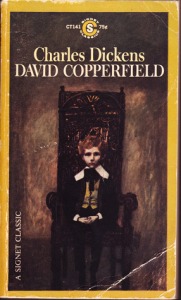 My first foray into the realm of heavy-duty classics was Charles Dickens’s David Copperfield at age 14. I bought a battered secondhand paperback from a library sale and was immediately entranced, from the first line onwards: “Whether I shall turn out to be the hero of my own life, or whether that station will be held by anybody else, these pages must show.” No doubt the idea of discovering my own potential heroism was what drew me in, but I loved everything about this novel: the rich panorama of nineteenth-century life, the vibrant secondary characters, the under-the-surface humor you had to work a little bit to understand, and the sweet second-chance romance. This was the start of my love affair with Victorian literature. I’ve read it three times since then. If ever asked for my favorite book, this is what I name.
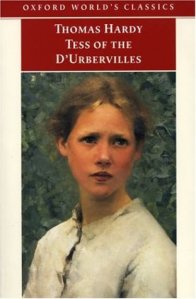 It wasn’t my first Hardy novel (that was Far from the Madding Crowd, another all-time favorite), but Tess of the D’Urbervilles is most memorable for the circumstances in which I read it. At age 19 I accompanied my sister, who’d won a singing contest on local radio, to the Season 2 finale of American Idol in Hollywood. If you were a loyal viewer, you might recall that this was the showdown between Ruben Studdard and Clay Aiken, on whom I had a hopeless crush – it later emerged that he’s gay. I read Tess on the flight to Los Angeles. Stranger pairings have been known, I’m sure, but I’ll never forget that disconnect between bleak England (where I hadn’t yet been at that point) and the sunny entertainment capital.
What are some of the books that meant the most to you in your early years?
Autumn Is Here, in Poetry and Prose
“The trees are undressing, and fling in many places –
On the gray road, the roof, the window-sill –
Their radiant robes and ribbons and yellow laces”
~from “Last Week in October,” Thomas Hardy (1928)
I recently learned that there are two different official start dates for autumn. The meteorological beginning of the season was on September 1st, while the astronomical opening is not until the 22nd. For the purposes of this review I’ll incline towards the former. I’ve been watching leaves fall since early last month, after all, but now – after a weekend spent taking a chilly boat ride down the canal, stocking the freezer with blackberries and elderberries, and setting hops to dry in the shed – it truly feels like autumn is here in southern England. Luckily, I had just the right book in hand to read over the last couple of weeks as I’ve been settling into our new place, Autumn: An anthology for the changing seasons.
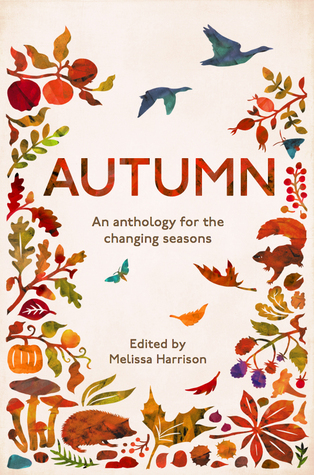 This is the third of four seasonal volumes issued this year by the UK’s Wildlife Trusts, in partnership with London-based publisher Elliott & Thompson and edited by Melissa Harrison (see also my review of Summer). The format of all the books is roughly the same: pieces range from one to a few pages and run the gamut from recurring phenological records (Gilbert White and Thomas Furly Forster) and extracts from classic literature (poems by Shelley, Tennyson and Yeats) to recent nature writers (an excerpt from Helen Macdonald’s H is for Hawk; new work from Amy Liptrot and John Lewis-Stempel). Perhaps half the content has been contributed by talented amateurs, about 10 of them repeats from the first volumes.
This collection was slightly less memorable for me than Summer. A few pieces seem like school assignments, overly reliant on clichés of blackberry picking and crunching leaves underfoot. The best ones don’t attempt too much; they zero in on one species or experience and give a complete, self-contained story rather than general musings. A few stand-outs in this respect are Jo Cartnell chancing upon bank voles, Julian Jones on his obsession with eels, Laurence Arnold telling of his reptile surveying at London Wetland Center, and Lucy McRobert having a magic moment with dolphins off the Scilly Isles. I also enjoyed Kate Blincoe’s account of foraging for giant puffball mushrooms and Janet Willoner on pressing apples into juice – I’m looking forward to watching this at our town’s Apple Day in October.
I think all the contemporary writers would agree that you don’t have to live or go somewhere ‘special’ to commune with nature; there are marvels everywhere, even on your own tiny patch, if you will just go out and find them. For instance, South London seems an unlikely place for wildlife encounters, yet Will Harper-Penrose meets up with one of the country’s most strikingly exotic species (an introduced one), the ring-necked parakeet. Jane Adams comes across a persistent gang of wood mice in her very own attic, while Daphne Pleace spots red deer stags from the safety of her motorhome when on vacation in northwest Scotland.

A Japanese maple near the National Cathedral in Washington, D.C. Photo by Chris Foster.
Remarkably, the book’s disparate pieces together manage to convey a loose chronological progression, from the final days of lingering summer to the gradual onset of winter. Here’s Annie Worsley’s lovely portrayal of autumn’s approach: “In the woodlands the first trees to betray summer are silver birches: splashes of yellow dapple their fine, shimmering greenery. Here and there, long wavering larch tresses begin to change from deep green to orange and ochre.” At the other end of the autumnal continuum, David Gwilym Anthony’s somber climate change poem, “Warming,” provides a perfect close to the anthology: “These days I’ll take what Nature sends / to hoard for dour December: / a glow of warmth as autumn ends.”
A few more favorite lines:
- “Dusk, when the edges of all things blur. A time of mauve and moonlight, of shapeshiftings and stirrings, of magic.” (Alexi Francis)
- “Go down the village street on a late September afternoon and the warm burnt smell of jam-making oozes out of open cottage doors.” (Clare Leighton, 1933)
- “There are miniature Serengetis like this under most logs, if you take the time to look.” (Ryan Clark)
- “Ah, the full autumn Bisto bouquet comes powering to the nose: mouldering leaves, decaying mushrooms, rusting earth.” (John Lewis-Stempel)
My favorite essay of all, though, is by Jon Dunn: playful yet ultimately elegiac, it’s about returning to his croft on a remote Shetland island to find that an otter has been picking off his chickens.
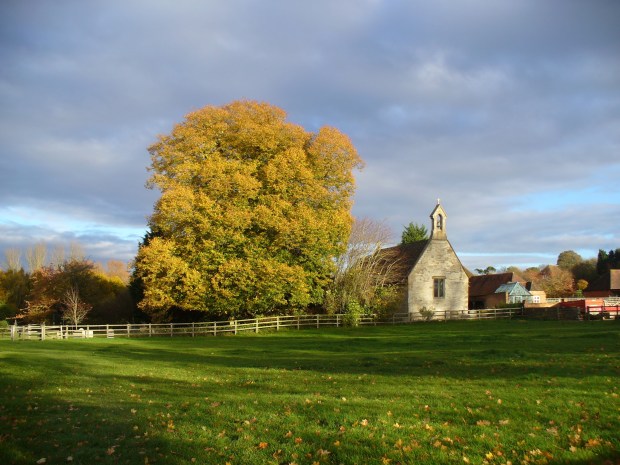
All Saint’s Church in Woolstone, Oxfordshire. Photo by Chris Foster.
Like Summer, this gives a good sense of autumn as a whole, including its metaphorical associations. As Harrison puts it in her introduction, autumn “makes tangible a suite of emotions – wistfulness, nostalgia, a comfortable kind of melancholy – that are, at other times of the year, just out of reach.” It’s been my favorite season since childhood, probably because it combines the start of the school year, my birthday, and American holidays like Halloween and Thanksgiving. Whatever your own experience of autumn – whether it’s a much loved season or not; even if you call it “fall” instead – I can highly recommend this anthology’s chorus of voices old and new. There’s no better way for a book lover to usher in the season.
With thanks to Jennie Condell at Elliott & Thompson for the free copy for review.
My rating: 
Watch the Movie or Read the Book?
It’s a risky business, adapting a well-loved book into a film. I’m always curious to see how a screenwriter and director will pull it off. The BBC generally does an admirable job with the classics, but contemporary book adaptations can be hit or miss. I’ve racked my brain to think of cases where the movie was much better than the book or vice versa, but to my surprise I’ve found that I can only think of a handful of examples. Most of the time I think the film and book are of about equal merit, whether that’s pretty good or excellent.
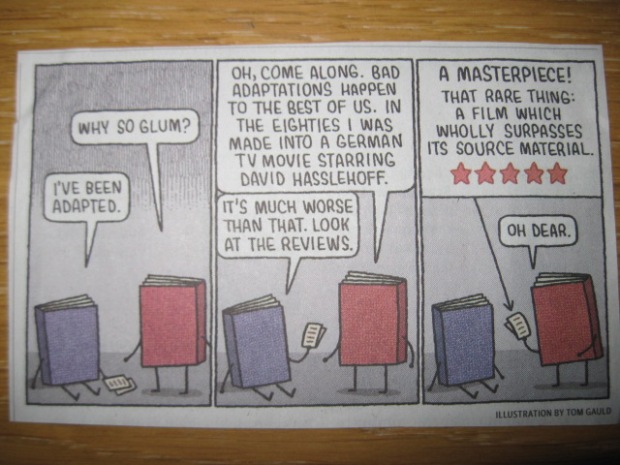
From one of my favorite Guardian cartoonists.
Watch the Movie Instead:
Birdsong [Sebastian Faulks] – Eddie Redmayne, anyone? The book is a slog, but the television miniseries is lovely.
One Day [David Nicholls] – Excellent casting (though Rafe Spall nearly steals the show). Feels less formulaic and mawkish than the novel.
 Father of the Bride and its sequel [Edward Streeter] – The late 1940s/early 1950s books that served as very loose source material are hopelessly dated.
This Is Where I Leave You [Jonathan Tropper] – Again, perfect casting. Less raunchy and more good-natured than the book.
Read the Book Instead:
 Possession [A.S. Byatt] – This is one of my favorite novels of all time. It has a richness of prose and style (letters, poems, etc.) that simply cannot be captured on film. Plus Aaron Eckhart couldn’t act his way out of a paper bag.
Everything Is Illuminated [Jonathan Safran Foer] – The movie’s not bad, but if you want to get a hint of Foer’s virtuosic talent you need to read the novel he wrote at 25.
A Prayer for Owen Meany [John Irving] – The film version, Simon Birch, was so mediocre that Irving wouldn’t let his character’s name be associated with it.
It’s Pretty Much Even:
Decent book and movie: Harry Potter and the Sorcerer’s Stone, The Help, The Hours, Memoirs of a Geisha, Never Let Me Go, The Remains of the Day
 Terrific book and movie: The Fault in Our Stars, The Hundred-Year-Old Man Who Climbed out of the Window and Disappeared (Swedish language), The Orchid Thief / Adaptation (both great but in very different ways!), Tamara Drewe (based on a graphic novel, which itself is based on Far From the Madding Crowd)
If I’m interested in a story, my preference is always to watch the movie before I read the book. If you do it the other way round, you’re likely to be disappointed with the adaptation. Alas, this means that the actors’ and actresses’ faces will be ineradicably linked with the characters in your head when you try to read the book. I consider this a small disadvantage. Reading the book after you’ve already enjoyed the storyline on screen means you get to go deeper with the characters and the plot, since subplots are often eliminated in movie versions.
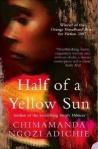 So although I’ve seen the films, I’m still keen to read Half of a Yellow Sun and The Kite Runner. I’m eager to both see and read The English Patient and The Shipping News (which would be my first by Proulx). All four of these I own in paperback. I’m also curious about two war novels being adapted this year, Billy Lynn’s Long Halftime Walk and The Yellow Birds. There’s every chance I’d like these better as movies than I did as books.
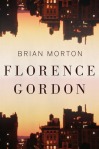 As to books I’m interested in seeing on the big screen, the first one that comes to mind is Kitchens of the Great Midwest by J. Ryan Stradal. It might also be interesting to see how the larger-than-life feminist heroines of Siri Hustvedt’s The Blazing World and Brian Morton’s Florence Gordon would translate for cinema. Can you think of any others?
What film adaptations have impressed or disappointed you recently? Do you watch the movie first, or read the book first?
An Anthology of Summer Reading
In partnership with the UK’s Wildlife Trusts, London-based publisher Elliott & Thompson is celebrating the seasons with a series of anthologies edited by novelist and nature writer Melissa Harrison. My husband had a short piece published in the first volume (Spring), so I was eager to get my hands on a copy of Summer.
 The format in all the books is roughly the same: they’re composed of short pieces that range from one to a few pages and run the gamut from recurring phenological records (Gilbert White and Thomas Furly Forster) and extracts from classic literature (Adam Bede and Far from the Madding Crowd) to recent nature books (Mark Cocker’s Claxton and Paul Evans’s Field Notes from the Edge). In addition, there are new contributions from established writers or talented amateurs, one as young as twelve – heartening proof that young people are still enthused about nature.
With the exception of the poems, none of these entries have titles, and the attribution and date of composition are not given until the very end. The idea behind this pseudo-anonymity, I think, is that if – as I sometimes was – you are patient enough to not skip ahead to discover who wrote it when, you will judge all of the pieces by the same standards. You approach each without expectations, and in many cases may be stumped as to whether the writing is historical or modern. I found W.H. Hudson’s and Mary Webb’s extracts particularly readable, for instance; you wouldn’t guess they’re from the early decades of the twentieth century.
There are 70-some pieces here on a wide variety of subjects, but a few of the ones that struck me were on badger-watching (Caroline Greville, who is writing a memoir on the topic), looking for orchids (environmental journalist Michael McCarthy), moth trapping, and night-time wildlife like glow-worms and bats. I especially appreciated Alexandra Pearce’s essay on the brief life of mayflies and Nicola Chester’s on searching for owls. Of the previously published pieces, Paul Evans’s on ant swarms is a stand-out. My two favorites, though, are from celebrated nature columnist Simon Barnes, who writes about paddling a canoe in Norfolk with his son in search of adventure, and Esther Woolfson, who, as she does in her book Field Notes from a Hidden City, illuminates the unnoticed wildlife of Aberdeen.

Courtesy of Chris Foster
Again and again this message comes through: take the time to look closely and you will find great wonders. “Perhaps as adults our lives are so filled with bills, chores, jobs and other things that we often forget to stop and look at the world around us,” Jan Freedman, curator of natural history at Plymouth City Museum and Art Gallery, astutely notes. Whether it’s lichens or weevils, all you generally have to pay to experience nature’s delights is attention. I loved Alexi Francis’s description of a hare: “Haunches down, nose cross-stitched, it closes its eyes to the sun in a moment of blissful slumber.” Having that moment of communion with nature and then choosing just the right words to capture it is what this book is all about.
Taken together, these pieces truly give the feeling of an English summer. The older writing is remarkably undated, which contributes to a sense of continuity across the centuries. However, the book also evokes more universal notions of summer: those drowsy, leisurely days we gild with nostalgia. As Harrison puts it in her introduction, the longing for summer is really a wish to return to childhood: “Those elysian summers, polished to dazzling brightness by the flow of years, can never be recaptured; but we have this summer, however imperfect we as adults might deem it, and we can go out and seek it at every opportunity we find.”

Courtesy of Chris Foster
As the relatively frequent typos – three in the Barnes piece alone, for example – suggest, the series has been somewhat hastily put together. Nonetheless, these are really rather lovely books. Summer is a perfect bedside companion to dip into as the days warm up. Impossible not to covet the whole four-season set.
With thanks to Marianne Thorndahl at Elliott & Thompson for the free copy for review.
My rating: 
The Essex Serpent by Sarah Perry
This exquisite work of historical fiction explores the gaps – narrower than one might think – between science and superstition and between friendship and romantic love. The Essex Serpent was a real-life legend from the latter half of the seventeenth century, but Perry’s second novel has fear of the sea creature re-infecting Aldwinter, her invented Essex village, in the 1890s. Mysterious deaths and disappearances are automatically attributed to the Serpent who dwells in the depths of the Blackwater. This atmosphere of paranoia triggers some schoolgirls to erupt in frenzied delusions as in The Crucible. It is unclear whether the Church should tolerate a source of mystery or dismiss it all as nonsense – after all, there’s a winged serpent carved onto one of the pews at the parish church.
 In a domestic counterpart to all these supernatural goings-on, we gain entry into two middle-class households. Cora Seaborne’s abusive husband, Michael, has recently died of throat cancer, leaving her to raise their odd (autistic, I wondered?) eleven-year-old son Francis on her own. She has an amateur interest in fossils to rival Mary Anning’s, so when she hears of a cache near Colchester she leaves London for Essex, bringing along Frankie and her companion, Martha. Mutual friends put her in touch with Will Ransome, the vicar of Aldwinter, sure that he and his family – consumptive wife Stella and children Joanna, James and John – will be able to show her around the coast.
Despite an inauspicious first meeting, which sees Cora and Will, still unknown to each other, hauling a drowning sheep out of a lake, theirs soon becomes a close, easy friendship. Cora feels she can speak her mind about the faith she lost and the new marvels she finds in nature:
I had faith, the sort I think you might be born with, but I’ve seen what it does and I traded it in. It’s a sort of blindness, or a choice to be mad – to turn your back on everything new and wonderful – not to see that there’s no fewer miracles in the microscope than in the gospels!
She holds her own in cerebral debates with Will as he deplores his parishioners’ fantasies about the Serpent. Is there really such a big difference between his faith – “all strangeness and mystery – all blood, and brimstone,” Cora teases – and the Serpent legend? In seeming contradiction to his career path, Will is more suspicious than many of the other characters of things he doesn’t understand and can’t explain away, like hypnosis and a Fata Morgana.
The novel’s nuanced treatment of faith and doubt is enhanced by references to Victorian science, including fossil hunting and early medical procedures. Dr. Luke Garrett, Michael’s surgeon, is one of Cora’s best friends back in London; she calls him “The Imp.” In one of the most striking passages of the entire book, he performs rudimentary heart surgery on the young victim of a stab wound. Perry fills in the novel’s background with a plethora of apt Victorian themes, including housing reform and London crime. For a book of 440 pages, it has a large cast and a fairly epic scope. Although there are places where subplots and minor characters might have been expanded upon, Perry wisely refrains from stuffing the novel with evidence of her research. Indeed, it’s a restrained book overall, yet breaks out into effusiveness in just the right places, as in Stella’s mystical adoration of the color blue.
Descriptive passages and the letters passing between the characters give a clear sense of the months passing, yet there is also something timelessly English about the narrative – Dickensian in places (Our Mutual Friend) and Hardyesque in others (Far from the Madding Crowd). I especially loved this picture of the June countryside:
Essex has her bride’s gown on: there’s cow parsley frothing by the road and daisies on the common, and the hawthorn’s dressed in white; wheat and barley fatten in the fields, and bindweed decks the hedges.
Cross this cozy pastoral vision with the Gothic nature of the Serpent craze and you get quite a unique atmosphere. The vague, unexplained sense of menace didn’t work for me at all in Perry’s previous novel, After Me Comes the Flood, but here it’s just right.
It was no doubt true in the late Victorian period that “men and women can’t be friends because the sex part always gets in the way” (as famously declared in When Harry Met Sally). No one is sure what to make of a sexually available, self-assured female like Cora. The different kinds of Greek love, from philia to eros, keep shading into each other here. Like the water that forms the book’s metaphorical substrate, the relationships ebb and flow. Yet there’s no denigrating any connection as just friendship; in fact, friendship is enough to rescue one character from suicide. Like Hanya Yanagihara’s A Little Life, the novel asks whether love is ever enough to save us – and gives a considerably more optimistic answer.

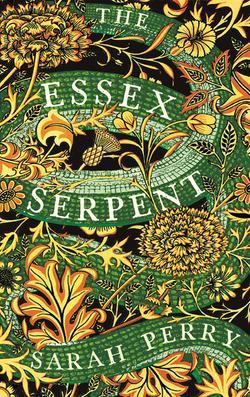
My proof copy didn’t have quite such a gorgeous cover but did come intriguingly wrapped in snakeskin ribbon…
The fact that I have an MA in Victorian literature means I’m drawn to Victorian-set novels but also highly critical about their authenticity. While reading this, though, I thoroughly believed that I was in 1890. Moreover, Perry adroitly illuminates the situation of the independent “New Woman” and the quandary of science versus religion (which were the joint subjects of my dissertation: women’s faith and doubt narratives in Victorian fiction).
I’m delighted, especially having seen Perry speak at Bloxham Festival in February (see my write-up for more on her background and the inspirations behind this novel), to have liked The Essex Serpent three times as much as her debut. It has an elegant, evocative writing style reminiscent of A.S. Byatt and Penelope Fitzgerald. Something holds me back from the full 5 stars – too diffuse? Too much staying on the surface of things? Not quite intimate enough, especially about Cora’s inner life? – but I still declare myself mightily impressed. The Essex Serpent counts as one of my favorite novels of 2016 so far. You can see why Serpent’s Tail (how perfect is her publisher’s name?!) rushed this one into publication a few weeks early. Expect to see it on the Booker Prize shortlist and any other award list you care to mention.
With thanks to Anna-Marie Fitzgerald at Serpent’s Tail for the free review copy.
My rating: 
Reviews Roundup, March–April
One of my goals with this blog was to have one convenient place where I could gather together all my writing that appears in disparate online locations. To that end, once a month I provide links to all book reviews I’ve published elsewhere, with a rating (below each description) and a taster so you can decide whether to read more. A few exceptions: I don’t point out my Kirkus Indie, BlueInk or Publishers Weekly reviews since I don’t get a byline.
The Bookbag
 The Improbability of Love by Hannah Rothschild: From the Baileys Prize longlist, an enchanting debut novel that blends art and cooking, mystery and romance. Annie McDee, a heartbroken PA and amateur chef, pays £75 for a painting from a junk shop, not realizing it’s a lost Watteau that will spark bidding wars and uncover a sordid chapter of history. In a triumph of playful narration, we mostly learn about the artwork’s history from the painting ‘herself’. She recounts her turbulent 300-year-history and lists her many illustrious owners, including Marie Antoinette, Napoleon and Queen Victoria. These are the novel’s only first-person sections; you can just imagine a voiceover from Helen Mirren or Judi Dench.
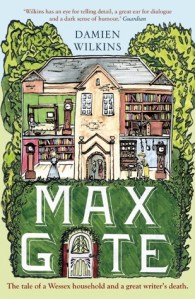 Max Gate by Damien Wilkins: This is a novel of Thomas Hardy’s last days, but we get an unusual glimpse into his household at Max Gate, Dorchester through the point-of-view of his housemaid, twenty-six-year-old Nellie Titterington. Ultimately I suspect a third-person omniscient voice would have worked better. In fact, some passages – recounting scenes Nellie is not witness to – are in the third person, which felt a bit like cheating. Fans familiar with the excellent Claire Tomalin biography might not learn much about Hardy and his household dynamics, but it was fun to spend some imaginary time at a place I once visited. [First published in New Zealand in 2013; releases in the US and UK on June 6th.]

 Dust by Michael Marder: A philosopher carries out an interdisciplinary study of dust: what it’s made of, what it means, and how it informs our metaphors. In itself, he points out, dust is neither positive nor negative, but we give it various cultural meanings. In the Bible, it is the very substance of mortality. Meanwhile “The war on dust, a hallmark of modern hygiene, reverberates with the political hygiene of the war on terror.” The contemporary profusion of allergies may, in fact, be an unintended consequence of our crusade against dust. The discussion is pleasingly wide-ranging, with some unexpected diversions – such as the metaphorical association between ‘stardust’ and celebrity – but also some impenetrable jargon. I’d be interested to try other titles from Bloomsbury’s “Object Lessons” series.
Foreword Reviews
How to Cure Bedwetting by Lane Robson (Oh, the interesting topics my work with self-published books introduces me to!): Explaining the anatomical and behavioral reasons behind bedwetting, the Calgary-based physician gives practical tips for curing the problem within six to twelve months. Throughout, the text generally refers to “pee” and “poop,” which detracts slightly from the professionalism of the work. All the same, this compendium of knowledge, drawing as it does on the author’s forty years of experience, should answer every possible question on the subject. Highly recommended to parents of younger elementary school children, this book will be an invaluable reference in tackling bedwetting.
Nudge
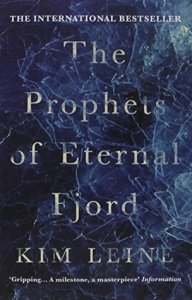 The Prophets of Eternal Fjord by Kim Leine: An epic novel about an unconventional priest, set in late-eighteenth-century Denmark and Greenland. This struck me as a cross between Carsten Jensen’s We, the Drowned, another historical saga from Denmark and one of my favorite novels of all time, and Michel Faber’s The Crimson Petal and the White. Like the former, it features perilous sea voyages and ambivalent father–son relationships; like the latter, it’s edgy and sexualized, full of lechery and bodily fluids. No airbrushing the more unpleasant aspects of history here. The entire story is told in the present tense, with no speech marks. It took me nearly a month and a half to read; by the end I felt I’d been on an odyssey as long and winding as Morten’s.
PANK
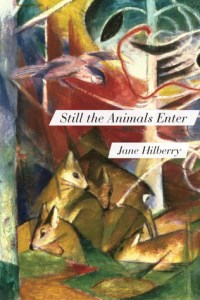 Still the Animals Enter by Jane Hilberry: A rich, strange, and gently erotic collection featuring diverse styles and blurring the lines between child and adult, human and animal, life and death through the language of metamorphosis. Ambivalence about the moments of transition between childhood and adulthood infuses Part One. Early on, “A Hole in the Fence” finishes on a whispered offer: “You could be part of this.” The message in this resonant collection, though, is that we already are a part of it: part of a shared life that moves beyond the individual family or even the human species. We are all connected—to the children we once were, to lovers and family members lost and found, and to the animals we watch in wonder.
Pittsburgh Post-Gazette
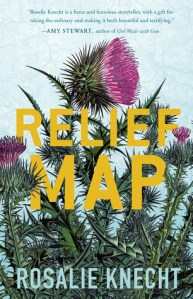 Relief Map by Rosalie Knecht: Lomath, Pennsylvania consists of a half-mile stretch between old textile mills and is home to just 150 people. During one unpredictable summer, blackouts and the arrival of an Eastern European fugitive draw the residents into a welter of paranoia and misguided choices. Our eyewitness to provincial commotion is 16-year-old Livy Marko, who considers herself plain and awkward – her childhood style was supplied by Anne of Green Gables and Goodwill. Knecht’s writing is marked by carefully chosen images and sounds. The novel maintains a languid yet subtly tense ambience. For Livy, coming of age means realizing actions always have consequences. Offbeat and atmospheric, this debut is probably too quiet to make a major splash, but has its gentle rewards.
Shiny New Books
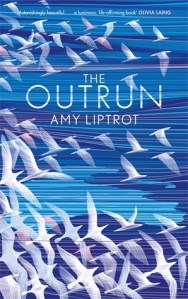 The Outrun by Amy Liptrot: Put simply, this is a memoir about Amy Liptrot’s slide into alcoholism and her subsequent recovery. Liptrot grew up on mainland Orkney, a tight-knit Scottish community she was eager to leave as a teenager but found herself returning to a decade later, washed up after the dissolute living and heartbreak she left behind in London. A simple existence, close to nature and connected to other people, was just what she needed during her first two years of sobriety. Her atmospheric writing about the magical Orkney Islands and their wildlife, rather than the slightly clichéd ruminating on alcoholism, is what sets the book apart. (On the Wellcome Prize shortlist.)

I also post reviews of most of my casual reading and skimming on Goodreads:
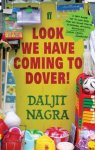 Look We Have Coming to Dover! by Daljit Nagra: The dialect was a bit too heavy for me in some of these poems about the Sikh experience in Britain. By far my favorite was “In a White Town,” which opens: “She never looked like other boys’ mums. / No one ever looked without looking again / at the pink kameez and balloon’d bottoms, // mustard-oiled trail of hair, brocaded pink / sandals and the smell of curry. That’s why / I’d bin the letters about Parents’ Evenings …”
 Work Like Any Other by Virginia Reeves: Between the blurb and the first paragraph, you already know everything that’s going to happen. I admire books that can keep you reading with interest even though you know exactly what’s coming, but this isn’t really one of those. Ultimately I would have preferred for the whole novel, rather than just alternating chapters, to be in Roscoe’s first-person voice, set wholly in prison (where he helps out in the library and with the guard dogs) but with brief flashbacks to his electricity siphoning and the circumstances of his manslaughter conviction. The writing is entirely capable, but the structure made it so I felt the story wasn’t worth my time.
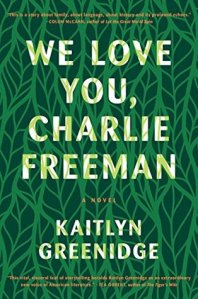 We Love You, Charlie Freeman by Kaitlyn Greenidge: The Freemans are raising Charlie, a chimpanzee, as part of their family for a Toneybee Institute experiment and teaching him to communicate via sign language. Flashbacks to the late 1920s bring an uncomfortable racial subtext to the surface, suggesting that the Toneybee has been involved in dodgy anthropological research over the decades. This is a deep and unsettling story of human–human interactions, even more so than human–animal interactions. I much preferred it to We Are All Completely Beside Ourselves.
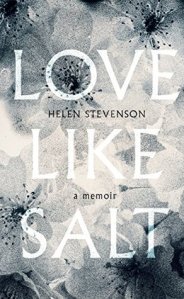 Love Like Salt by Helen Stevenson: Stevenson’s daughter Clara has cystic fibrosis, so I approached and enjoyed this as an illness memoir. However, it’s very scattered, with lots of seemingly irrelevant material included simply because it happened to the author: her mother’s dementia, their life in France, her work as a translator and her hobby of playing the piano, her older husband’s love for Italy and Italian literature, etc. Really the central drama is their seemingly idyllic life in France, Clara being bullied there, and the decision to move back to England (near Bristol), where the girls would attend a Quaker school on scholarships and Clara was enrolled in a widespread clinical trial with modest success. Enjoyable enough if you share some of the author’s interests.
 Springtime: A Ghost Story by Michelle de Kretser: Ghost story? Really? There’s very little in the way of suspense, and not too much plot either, in this Australia-set novella. I would expect tension to linger and questions to remain unanswered. Instead, the author exposes Frances’s ‘ghost’ as harmless. What I think de Kretser is trying to do here is show that ghosts can be people we have known and loved or, alternatively, places we have left behind. There is some nice descriptive writing (e.g. “three staked camellias stood as whitely upright as martyrs”), but not enough story to hold the interest.

 Let the Empire Down by Alexandra Oliver: This debut collection is heavily inspired by history and travel, as well as Serbian poetry and personal anecdote. I enjoyed the earlier poems, especially the ones with ABAB or ABBA rhyme schemes. My favorite was “Plans,” about a twenty-something manicurist who abandoned her talent for science to get ready cash: “A girl’s future should be full and bright, a marble, / but (alas for her) there is a catch: / we take on the immediate. Hope flags: / wishing to be wise and come out shining, / we pop a beaker over our own flame. / We do it cheerfully. We do it coldly.” The last quarter is devoted to poems about films, especially Italian cinema.
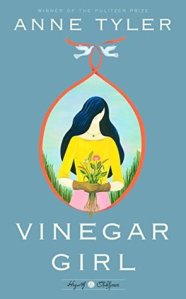 Vinegar Girl by Anne Tyler: This is the most fun I’ve had with the Hogarth Shakespeare series so far, as well as my favorite of the three Anne Tyler novels I’ve read. Yes, it’s set in Baltimore. Kate Battista, the utterly tactless preschool assistant, kept cracking me up. Her father, an autoimmune researcher, schemes for her to marry his lab assistant, Pyotr, so he can stay in the country after his visa expires. The plot twists of the final quarter felt a little predictable, but I was won over by the good-natured storytelling and prickly heroine. (I don’t know The Taming of the Shrew well enough to comment on how this functions as a remake.) Releases in June.
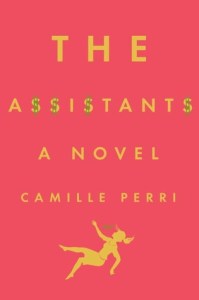 The Assistants by Camille Perri: At age 30, Tina Fontana has been a PA to media mogul Robert Barlow for six years. He’s worth millions; she lives in a tiny Brooklyn apartment. One day a mix-up in refunding expenses lands her with a check for $19,147. If she cashes it she can pay off her debts once and for all and no one at Titan Corporation will be any the wiser, right? This is a fun and undemanding read that will probably primarily appeal to young women. I would particularly recommend it to readers of Friendship by Emily Gould and A Window Opens by Elisabeth Egan. Releases May 3rd.
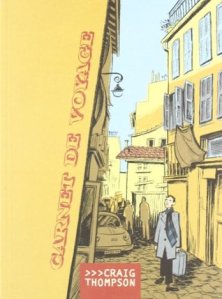 Carnet de Voyage by Craig Thompson: A sketchbook Thompson kept on his combined European book tour for Blankets and research trip for Habibi in March–May 2004. It doesn’t really work as a stand-alone graphic memoir because there isn’t much of a narrative, just a series of book signings, random encounters with friends and strangers, and tourism. My favorite two-page spread is about a camel ride he took into the Moroccan desert. I could also sympathize with his crippling hand pain (from all that drawing) and his “chaos tolerance” overload from the stress of travel.
 Rising Ground: A Search for the Spirit of Place by Philip Marsden: Some very nice writing indeed, but not much of a storyline. The book is something of a jumble of mythology, geology, prehistory, and more recent biographical information about some famous Cornish residents, overlaid on a gentle travel memoir. I enjoyed learning about the meanings of Cornish place names, in particular, and spotting locations I’ve visited.
And my highest recommendation goes to…
Commonwealth by Ann Patchett: It all starts with an early 1960s christening party Los Angeles policeman Fix Keating is throwing for his younger daughter, Franny. DA Bert Cousins turns up, uninvited, with a bottle of gin the grateful guests quickly polish off in their fresh-squeezed orange juice. He also kisses the hostess, sparking a chain of events that will rearrange the Keating and Cousins families in the decades to come. The novel spends time with all six step-siblings, but Franny is definitely the main character – and likely an autobiographical stand-in for Patchett. As a waitress in Chicago, she meets a famous novelist who’s in a slump; the story of her childhood gives him his next bestseller but forces the siblings to revisit a tragic accident they never fully faced up to. Sophisticated and atmospheric; perfect for literary fiction fans in general and Patchett fans in particular. Releases September 13th.
Of Human Bondage: Finally Caught Up from 2015
When it came to it, it isn’t me
was all he seemed to learn
from all his diligent forays outward.
(from “It Isn’t Me” by James Lasdun)
I chose to read this doorstopper from 1915 because it appeared in The Novel Cure on a list entitled “The Ten Best Novels for Thirty-Somethings.” By happy accident, I was also reading it throughout its centenary year. My knowledge of W. Somerset Maugham’s work was limited – I had seen the 2006 film version of The Painted Veil but never read anything by him – so I had no clear idea of what to expect. I was pleased to encounter a narrative rich with psychological insight and traces of the Victorian novel.
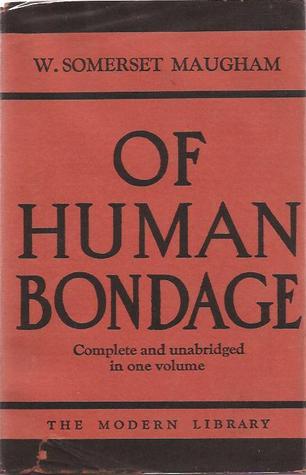 Philip Carey is not unlike a Dickensian hero: born with a club foot and orphaned as a child, he’s raised by his stern vicar uncle in Kent and reluctantly attends boarding school. Much of the book is filled with his post-schooling wanderings and professional shilly-shallying, along with multiple romantic missteps. He studies in Germany, tries to make it as a painter in Paris, and returns to London to train as an accountant and then as a doctor. Each attempted career seems to fail, as does every relationship. Philip reminded me most of David Copperfield, especially after he meets the jolly, Micawber-esque Thorpe Athelny during his hospital internship and becomes friendly with his wife and children.
As is common in Victorian novels, Philip is troubled by his conflicting desires. When it comes to women, he cannot get love to match up with lust. As a youth he loses his virginity to Emily Wilkinson, a woman in her mid-30s, then wants nothing to do with her. A few other dalliances have mixed success, but the novel focuses on Philip’s connection to Mildred Rogers. A café waitress, she’s vain and ill-tempered and acts indifferent to Philip – but is happy for him to spend money on her. He’s disgusted and infatuated all at once: “He did not care if she was heartless, vicious and vulgar, stupid and grasping, he loved her. He would rather have misery with [her] than happiness with [another].” Though Mildred tries to eschew the traditional roles of wife and mother, the Victorian notion of the fallen woman haunts her.
This on-again, off-again romance forms the heart of the book. Both Philip and Mildred are maddening in their own way. Not since Pip (another Philip, interestingly) in Great Expectations have I been so furious at a main character for consistently making the wrong choices, being dazzled by beauty and status and ignoring the more important things in life. Yet the close third-person narration sees so deeply into Philip’s psyche that I could not help but feel sympathy for him, too, cringing over his every failure – especially when stock market losses leave him destitute and he undertakes humiliating (to him) work at a department store. The novel is liberally studded with intimate paragraphs conveying Philip’s thoughts:
He painted with the brain, and he could not help knowing that the only painting worth anything was done with the heart. … [H]e had a terrible fear that he would never be more than second-rate. Was it worth while for that to give up one’s youth, and the gaiety of life, and the manifold chances of being?
Pain and disease and unhappiness weighed down the scale so heavily. What did it all mean? He thought of his own life, the high hopes with which he had entered upon it, the limitations which his body forced upon him, his friendlessness, and the lack of affection which had surrounded his youth. He did not know that he had ever done anything but what seemed best to do, and what a cropper he had come! Other men, with no more advantages than he, succeeded, and others again, with many more, failed. It seemed pure chance. The rain fell alike upon the just and upon the unjust, and for nothing was there a why and a wherefore.
Another humanizing element that especially appealed to me was Philip’s loss of Christian faith. During my study abroad year and especially my master’s year at Leeds, when I wrote a dissertation on women’s loss-of-faith narratives in Victorian fiction, I read a lot of novels about belief and doubt. In Philip’s case, I was interested to see how Maugham portrays what is usually seen as a loss as more of a liberation:
Suddenly he realised that he had lost also that burden of responsibility which made every action of his life a matter of urgent consequence. He could breathe more freely in a lighter air. He was responsible only to himself for the things he did. Freedom! He was his own master at last. From old habit, unconsciously he thanked God that he no longer believed in Him.
Although Philip frequently indulges in self-pity, he also has moments where he wakes up to the wonder of life. These epiphanies of the beauty of London, of the whole world, were among my favorite scenes.
Unusually in a long book, I thought the last 150 pages were the strongest. I struggled to pay attention throughout Philip’s schooling and wearied of the endless negotiations with Mildred, but when Philip is at his lowest point – like the protagonist of Knut Hamsun’s Hunger, not even sure if he’ll find enough to eat – there’s a real intensity to the plot that made this last chunk fly by.
I read a 1930s Modern Library copy from the University of Reading, but consulted Robert Calder’s introduction to the 1992 Penguin Classics edition for background information. It seems the novel was recognizably autobiographical for Maugham, though where a club foot was Philip’s source of shame, for the author it was his stammer (and his sexuality – he married but is known to have been a homosexual).
Like Joyce’s roughly contemporary A Portrait of the Artist as a Young Man, Calder notes, Of Human Bondage fits into the “apprentice novel” genre. Despite being published in 1915, it is set in a recent past so makes no reference to the First World War, though the Boer War plays a background role. I didn’t find the book to be particularly dated; I even discovered that a couple of sayings I might have pegged as later inventions were around in the 1910s: “like it or lump it” and “put that in your pipe and smoke it.”
Of Human Bondage met with a lukewarm critical response in its own time but does seem to be among the more beloved – if obscure – classics nowadays. Calder insists that it “remains Maugham’s most complete statement of the importance of physical and spiritual liberty.”
There have been three film versions – and another is in production this year, apparently. The best known, from 1934, launched the career of Bette Davis, who gave it her all as Mildred Rogers (she was a write-in favorite for the Oscars that year). Overacting, for sure, but her blonde wave and simpering looks were perfect for the role. By contrast, Leslie Howard’s is a fairly subtle Philip. The movie – condensed, amazingly, to just over an hour and a half – focuses on his club foot and his relationship with Mildred; I was disappointed that no attempt was made to reproduce Philip’s introspective monologues through voiceovers.
To my surprise, Calder asserts that Of Human Bondage “has become one of the most widely read of modern novels, particularly by young people, who still find relevance in Philip’s struggle for a free and meaningful life.” It was good enough for Holden Caulfield, after all. It struck me during my reading that two recent novels may have taken inspiration from Maugham: the main character in Esther Freud’s Mr. Mac and Me, set in 1914, has a club foot; and in Hanya Yanagihara’s A Little Life Jude’s shame over his deteriorating physical condition, especially his legs, is reminiscent of Philip’s.
I’m not sure I’ll try anything else by Maugham – how could I when there’s still so much of Dickens and Hardy left to read? – but I’m certainly glad I read this. It’s clear why Berthoud and Elderkin thought Of Human Bondage would be a perfect read for someone in their 30s: it’s infused with the protagonist’s nostalgia for his youth and regret at opportunities not taken and time lost. The novel imagines a world where, even without a god pulling a string, some misfortune seems to be fated. Even so, free will is there, allowing you to recover from failure and try something new that will be truer to yourself in this one and only life.
My rating: 
The Novel Cure—Bibliotherapy in Action
A good book, read at the right moment, should leave you uplifted, inspired, energized and eager for more. With so many books to choose from, what’s the point of reading even one more that leaves you cold?
I’ve mentioned my interest in bibliotherapy before. Well, for anyone new to the concept or interested in finding out more, The Novel Cure by Ella Berthoud and Susan Elderkin, two of the bibliotherapists at London’s School of Life, is an accessible introduction. Subtitled “An A–Z of Literary Remedies,” this is a learned and at times tongue-in-cheek book of advice about what fiction to read if you’re suffering from any sort of malady – physical, psychological, or imagined.
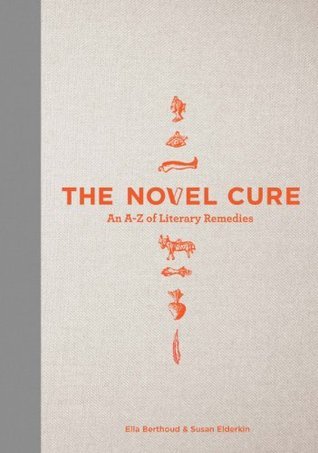 The alphabetical format and “see also” asides make it more like a cross-referenced encyclopedia than a book to read straight through, though I tried it both ways. Initially I flipped through at random, letting one entry take me to another related one and so on, but after a while I went back to the start and caught up on unread entries to finish within a year.
“It helps enormously at times of stress to read about other people who are going through similar things; watching how other people cope or fail to cope will make you feel less alone and give you strength,” the authors write to introduce the “cancer, caring for someone with” entry. I found this to be true when my sister lost her husband to cancer last year. She had never been a reader – apart from celebrity magazines – but in the past year she’s read nearly 90 books, many of them memoirs about illness and bereavement. Books are how I’ve always made sense of the world, so it’s been incredibly gratifying to see her turn to them as well. There are plenty of recommendations I’ll pass on to her from this book, especially “death of a loved one” (After You’d Gone by Maggie O’Farrell and Extremely Loud and Incredibly Close by Jonathan Safran Foer) and “widowed, being” (The Same Sea by Amos Oz and Major Pettigrew’s Last Stand by Helen Simonson).
You’ll be amazed at the range of conditions and circumstances for which the book offers prescriptions. Newly retired? “Bucolic and tranquil, The Enigma of Arrival [by V.S. Naipaul] will encourage you to take stock of your life and enjoy the unfolding of new possibilities.” Workaholic? “Immerse your desiccated soul in something very simple, very rustic, very small. We suggest [Thomas] Hardy’s gentlest, most innocent novel, Under the Greenwood Tree.” Two sections that felt particularly relevant to me as a vertically challenged freelancer were “short, being” and “tax return, fear of doing.” Meanwhile I’ll be pointing my husband to “baldness,” “flying, fear of,” “stress” and “tinnitus” (poor chap). But some of these entries surely resulted from the authors thinking “hey, here’s a great book we have to mention,” and then coming up with a category to fit it into, like “determinedly chasing after a woman even when she’s a nun” for In the Skin of a Lion by Michael Ondaatje.

I think I prefer this U.S. cover.
Indeed, there’s a certain levity to this book that I think some reviewers have missed. These aren’t all entirely serious suggestions, though they are all worthwhile books. I especially liked the sections where the authors incorporate pastiche of the book in question. A piece recommending Pamela by Samuel Richardson is in the form of an old-fashioned letter, for example, while “single, being” apes Bridget Jones’s diary entries. They even imitate certain authors’ prose style, as in “Who poses questions without question marks and observes the subtle changes in the light with exquisite brevity.” Answer: J.P. Donleavy, apparently.
The book is also a great source of top ten lists (I’m working through their novels for thirty-somethings) and advice for how to deal with reading crises (e.g. “busy to read, being too” and “giving up halfway through, tendency to”). My only criticism of the book – and this is one I level against many examples from the ‘books about books’ genre – is that there’s a fair bit of plot summary, sometimes so much so that it puts me off reading a book rather than whets my appetite for it.
It’s a bit belated (or early) for suggesting this as a Christmas gift for a book lover, but perhaps you can hand it over as a birthday gift or an anytime present – even to yourself. I got my copy on Amazon for £4, quite a bargain for a book I’ll be returning to again and again over the years.
My rating: 
Do you agree that novels have the power to cure, or at least help with, problems?
Surveying the Almighty TBR List
Coming to the end of one year and looking ahead to another: it’s a good opportunity to take stock of my virtual and physical to-read piles once more. Thanks to fellow book bloggers Naomi at The Writes of Woman and Eleanor at Elle Thinks for giving me this meme idea and tagging me in it, respectively.
How do you keep track of your TBR pile?
I have a ridiculously large to-read shelf on Goodreads, but that’s more like a vague lifelong wish list – some of them I own, some I’ve only heard of and want to investigate further, some I’m desperate to get hold of, and so on. I recently culled my online TBR and cut it by about 10%, but it’s still overwhelming. In real life, I take occasional inventories of the unread books in our flat (192 at last count). However, this doesn’t account for the fact that at least half of my book collection is still in my parents’ house in the States. While I’m back there for some time over the holidays, I enjoy gazing at my books and choosing a select few to bring back in my suitcase. On this trip I’ll be boxing them all up to go into storage. When shall I ever be reunited with them?!
Is your TBR mostly print or e-book?
If I only consider the books I already have access to, there are more unread print ones on my shelves than there are e-book approvals through NetGalley and Edelweiss. There’s not all that much in it, though; I might estimate the print TBR at 400–500, while I have about 300 books at my disposal through those online sources and new titles come up for request all the time.
How do you determine which books from your TBR to read next?
This generally depends on review deadlines, library due dates, and e-book expirations. In some sense, then, my reading list is completely imposed on me from outside. However, I always make sure I let whimsy guide some of my choices. Next year I hope to be even better about just picking up a book off my shelves and starting it for no reason other than instantaneous interest.
A book that has been on my TBR the longest
On the virtual TBR: probably Fast Food Nation and some of Margaret Atwood’s back catalogue. On the vague list in my head: all the more obscure Dickens and Hardy titles.
 A book I recently added to my TBR
Rochester Knockings: A Novel of the Fox Sisters by Hubert Haddad.
 A book on my TBR strictly because of its beautiful cover
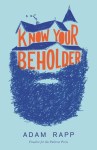
I love the beard-house on the cover of Know Your Beholder by Adam Rapp.
A book on my TBR that I never plan on reading
Will I really pick up Martin Amis’s novels, or Ian McEwan’s early work? How about those obscure Thomas Hardy novels like A Laodicean and A Pair of Blue Eyes?
 An unpublished book on my TBR that I’m excited for
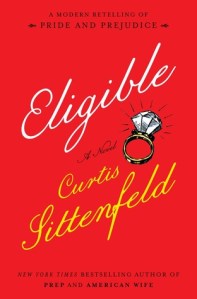
I recently started Eligible by Curtis Sittenfeld (to be published on April 19, 2016). Her novel American Wife is one of my absolute favorites, so I was excited about her Pride and Prejudice retelling and lucky enough to be sent an advanced copy. I’m not that into it yet – the third-person omniscient voice is taking a while to get used to because first-person female narrators are Sittenfeld’s forte – but I hope it will pick up soon.
 A book on my TBR that everyone recommends
I’ve encountered almost universal praise for Elena Ferrante’s four autobiographical novels, the first of which is My Brilliant Friend. They’re on my priority list for 2016.
A book on my TBR that everyone has read but me
1984 by George Orwell.
 A book on my TBR that I’m dying to read
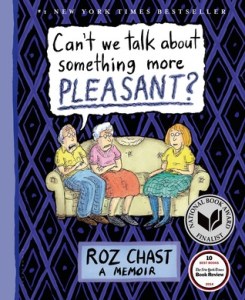
Some of my priority books to get hold of are Nell Zink’s novels, the final two books in Jane Smiley’s The Last Hundred Years trilogy, Can’t We Talk about Something More Pleasant? by Roz Chast, and Reasons to Stay Alive by Matt Haig. I’ve also been meaning to read The Signature of All Things by Elizabeth Gilbert for ages, and I’m intrigued to try The Guest Cat by Takashi Hiraide.
How many books are on your TBR shelf?
5,664 on the Goodreads shelf; maybe 500 in the print queue.
People I’m tagging:
Shannon at River City Reading
Lucy at Literary Relish
 Bookish Beck = Rebecca Foster. American transplant to England. Freelance proofreader and book reviewer.
 Bookish Beck