Four Recommended May Releases
Here are four enjoyable books due out next month that I was lucky enough to read early. The first two are memoirs, the third is an audacious poetry book by an author new to me, and the last is the sophomore novel from an author I’ve loved before. I’ve pulled 250-word extracts from my full reviews and hope you’ll be tempted by one or more of these.
Last Things: A Graphic Memoir of Loss and Love by Marissa Moss
(Coming from Conari Press on May 1st [USA]; June 8th in UK)
 “You’re not aware of last things,” Moss, a children’s book author/illustrator, writes in this wrenching memoir of losing her husband to ALS. We look forward to and celebrate all of life’s firsts, but we never know until afterwards when we’ve experienced a last. The author’s husband, Harvey Stahl, was a medieval art historian working on a book about Louis IX’s prayer book. ALS is always a devastating diagnosis, but Harvey had the particularly severe bulbar variety, and his lungs were quick to succumb. His battery-powered ventilator led to many scares – one time Moss had to plug him into the wall at a gas station and rush home for a spare battery – and he also underwent an emergency tracheotomy surgery.
This is an emotionally draining read. It’s distressing to see how, instead of drawing closer and relying on each other, Marisa and Harvey drifted apart. Harvey pushed everyone away and focused on finishing his book and returning to his academic duties. He refused to accept his limitations and resisted necessary medical interventions. Meanwhile, Moss struggled with the unwanted role of caregiver while trying not to neglect her children and her own career.
I’ve read several nonfiction books about ALS now. Compared to the other two, Moss gets the tone just right. She’s a reliable witness to a medical and bureaucratic nightmare. At the distance of years, though, she writes about the experience without bitterness. I can see this graphic novel being especially helpful to older teens with a terminally ill parent.
My rating: 
My Life with Bob: Flawed Heroine Keeps Book of Books, Plot Ensues by Pamela Paul
(Coming from Henry Holt on May 2nd [USA]; June 13th in UK)
 I hold books about books to high standards and won’t stand for the slightest hint of plot summary, filler or spoilers. It’s all too easy for an author to concentrate on certain, often obscure books that mean a lot to him/her, dissecting the plots without conveying a sense of the wider appeal. The trick is to find the universal in the particular, and vice versa.
Pamela Paul, editor of the New York Times Book Review, does this absolutely perfectly. In 1988, as a high school junior, she started keeping track of her reading in a simple notebook she dubbed “Bob,” her Book of Books. In this memoir she delves into Bob to explain how her reading both reflected and shaped her character. The focus is unfailingly on books’ interplay with her life, such that each one mentioned more than earns its place.
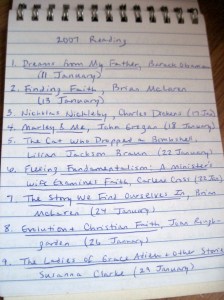
A page from my 2007 reading diary. Lots of mid-faith-crisis religion titles there. Starting in 2009, I think, I’ve kept this information in an annual computer file instead.
So whether she was hoarding castoffs from her bookstore job, obsessing about ticking off everything in the Norton Anthology, despairing that she’d run out of reading material in a remote yurt in China, or fretting that her husband took a fundamentally different approach to the works of Thomas Mann, Paul always looks beyond the books themselves to interrogate what they say about herself.
This is the sort of book I wish I had written. If you have even the slightest fondness for books about books, you won’t want to miss this one. I’ve found a new favorite bibliomemoir, and an early entry on the Best of 2017 list.
My rating: 
Nature Poem by Tommy Pico
(Coming on May 9th from Tin House Books)
 Tommy “Teebs” Pico is a Native American from the Kumeyaay nation and grew up on the Viejas Indian reservation. This funny, sexy, politically aware multi-part poem was written as a collective rebuttal to the kind of line he often gets in gay bars, something along the lines of ‘oh, you’re an Indian poet, so you must write about nature?’ Au contraire: Pico’s comfort zone is the urban, the pop cultural, and the technologically up-to-date – his poems are full of textspeak (“yr,” “bc” for because, “rn” for right now, “NDN” for Indian), an affectation that would ordinarily bother me but that I tolerated here because of Pico’s irrepressible sass: “I wd give a wedgie to a sacred mountain and gladly piss on the grass of / the park of poetic form / while no one’s lookin.”
Some more favorite lines:
“How do statues become more galvanizing than refugees / is not something I wd include in a nature poem.”
“Knowing the moon is inescapable tonight / and the tuft of yr chest against my shoulder blades— / This is a kind of nature I would write a poem about.”
“I can’t write a nature poem bc English is some Stockholm shit, makes me complicit in my tribe’s erasure”
“It’s hard to unhook the heavy marble Nature from the chain around yr neck / when history is stolen like water. // Reclamation suggests social / capital”
My rating: 
The Awkward Age by Francesca Segal
(Coming on May 4th from Chatto & Windus [UK] and May 16th from Riverhead Books [USA])
 I adored Segal’s first novel, The Innocents, a sophisticated remake of Edith Wharton’s The Age of Innocence set in a contemporary Jewish community in London. I wasn’t as fond of this second book, but in her study of an unusual blended family the characterization is nearly as strong as in her debut. Julia Alden lost her husband to cancer five years ago. A second chance at happiness came when James Fuller, a divorced American obstetrician, came to her for piano lessons. He soon moved into Julia and sixteen-year-old Gwen’s northwest London home, and his seventeen-year-old son, Nathan, away at boarding school, came on weekends.
Julia is as ill at ease with Nathan as James is with Gwen, and the kids seem to hate each other. That is until, on a trip to Boston for Thanksgiving with James’s ex, Gwen and Nathan fall for each other. Awkward is one way of putting it. They’re not technically step-siblings as James and Julia aren’t married, but it doesn’t sit right with the adults, and it will have unexpected consequences.
The first third or so of the book was my favorite, comparable to Jonathan Safran Foer or Jonathan Franzen. Before long the romantic comedy atmosphere tips into YA melodrama, but for me the book was saved by a few things: a balance of generations, with Gwen’s grandparents a delightful background presence; the eye to the past, whether it be Gwen’s late father or the occasional Jewish ritual; the Anglo-American element; and a realistic ending.
My rating:
Have you read any May releases that you would recommend? Which of these do you fancy?
The Last Summer by Ricarda Huch (Peirene)
Originally published in 1910, The Last Summer is a suspenseful epistolary novella by Ricarda Huch (1864–1947), one of the first German women to earn a PhD. She wrote widely across many fields – history, poetry, fiction, and religion – and had an asteroid named after her, earning Thomas Mann’s accolade of “the First Lady of Germany.” I’m grateful to Peirene for resurrecting this German classic as I have a special love for epistolary novels – traditionally told through nothing but letters. You have to be on the lookout for little clues dotted through the correspondence that will tell you who these characters are, how they’re connected to one another, what you need to know about their pasts, and what’s happening now.
 Set across one May to August in the early 1900s, the book joins the von Rasimkara family at their summer home. In response to student protests, patriarch Yegor, the governor of St. Petersburg, has shut down the university and left for the country. With him are his wife, Lusinya; their three twenty-something children, Velya, Jessika and Katya; and Yegor’s new secretary-cum-bodyguard, Lyu. What the family don’t know, but readers do from the first letter onward, is that Lyu is in league with the student revolutionaries and is in on a plot to assassinate the governor at his summer home.
This central dramatic irony is what fuels much of the book’s tension. All of the von Rasimkaras persist in believing the best about Lyu, even when the evidence seems to point to his deception. Both daughters fall in love with him, Velya calls him their “guardian angel,” and Lusinya is sure of his loyalty even after odd incidents she can’t explain, like finding him standing in their bedroom doorway in the middle of the night and a mysterious letter appearing under her pillow. “In case of doubt, one ought to hold back with one’s judgement,” Lusinya opines.
I wouldn’t go so far as to call this a “psychological thriller,” as the back cover blurb does, but I do think it’s a compelling picture of how different groups and ideologies can be fundamentally incompatible. In my favorite passage, Lyu describes the von Rasimkara family to his friend Konstantin:
My stay here is fascinating from a psychological viewpoint. The family has all the virtues and defects of its class. Perhaps one cannot even talk of defects; they merely have the one: belonging to an era that must pass and standing in the way of one that is emerging. When a beautiful old tree has to be felled to make way for a railway line, it’s painful to watch; you stand beside it like an old friend, gazing admiringly and in grief until it comes down. It is undeniably a shame about the governor, who is a splendid example of his kind, but I believe that he has already passed his peak.
As I sometimes feel about novellas, the plot is fairly thin and easily could have been spun out to fill a book of twice the length or more. But that is not what Peirene Press books are about. They’re meant to be quick reads that introduce European novellas in translation. This one has a terrific ending – which I certainly won’t spoil, though the title and cover could be read as clues – and is a perfectly enjoyable way to spend a winter evening.
[Peirene issues books in trios. This is the first of the three books in the “East and West: Looking Both Ways” series. The other two, The Orange Grove by Larry Tremblay and Dance by the Canal by Kerstin Hensel, will be released later in 2017.]
The Last Summer was published in the UK on February 1st. Translated from the German by Jamie Bulloch.
With thanks to James Tookey of Peirene Press for the free copy for review.
My rating: 
Other Peirene titles I’ve reviewed:
- Mr. Darwin’s Gardener by Kristina Carlson
- The Looking-Glass Sisters by Gøhril Gabrielsen
- Her Father’s Daughter by Marie Sizun
- The Man I Became by Peter Verhelst
European Traveling and Reading
We’ve been back from our European trip for over a week already, but I haven’t been up to writing until now. Partially this is because I’ve had a mild stomach bug that has left me feeling yucky and like I don’t want to spend any more time at a computer than is absolutely necessary for my work; partially it’s because I’ve just been a bit blue. Granted, it’s nice to be back where all the signs and announcements are in English and I don’t have to worry about making myself understood. Still, gloom over Brexit has combined with the usual letdown of coming back from an amazing vacation and resuming normal life to make this a ho-hum sort of week. Nonetheless, I want to get back into the rhythm of blogging and give a quick rundown of the books I read while I was away.
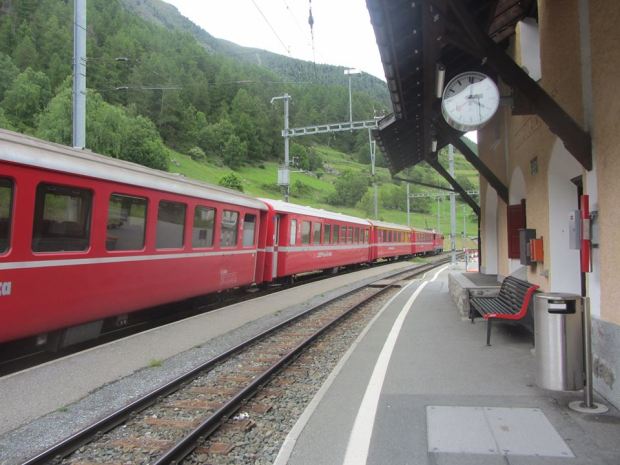
Tiny Lavin station, our base in southeastern Switzerland.
But first, some of the highlights of the trip:
- the grand architecture of the center of Brussels; live jazz emanating from a side street café
- cycling to the zoo in Freiburg with our friends and their kids
- ascending into the mountains by cable car and then on foot to circle Switzerland’s Lake Oeschinensee
- traipsing through meadows of Alpine flowers
- exploring the Engadine Valley of southeast Switzerland, an off-the-beaten track, Romansh-speaking area where the stone buildings are covered in engravings, paintings and sayings
- our one big splurge of the trip (Switzerland is ridiculously expensive; we had to live off of supermarket food): a Swiss dessert buffet followed by a horse carriage ride
- spotting ibex and chamois at Oeschinensee and marmots in the Swiss National Park
- miming “The Hills Are Alive” in fields near our accommodation in Austria (very close to where scenes from The Sound of Music were filmed)
- the sun coming out for our afternoon in Salzburg
- daily coffee and cake in Austrian coffeehouses
- riding the underground and trams of Vienna’s public transport network
- finding famous musicians’ graves in Vienna’s Zentralfriedhof cemetery
- discovering tasty vegan food at a hole-in-the-wall Chinese restaurant in Vienna that makes its own noodles
- going to Slovakia for the afternoon on a whim (its capital, Bratislava, is only 1 hour from Vienna by train – why not?!)
We went to such a variety of places and had so many different experiences. Weather and language were hugely variable, too: it rained nine days in a row; some mornings in Switzerland I wore my winter coat and hat; in Bratislava it was 95 °F. Even in the ostensibly German-speaking countries of the trip, we found that greetings and farewells changed everywhere we went (doubly true in the Romansh-speaking Engadine). Most of the time we had no idea what shopkeepers were saying to us. Just smile and nod. It was more difficult at the farm where we stayed in Austria. Thanks to Google Translate, we had no idea that the owner spoke no English; her e-mails were all in unusual but serviceable English. We speak virtually no German, so fellow farm guests, including a Dutch couple, had to translate between us. (The rest of Europe puts us to shame with their knowledge of languages!)
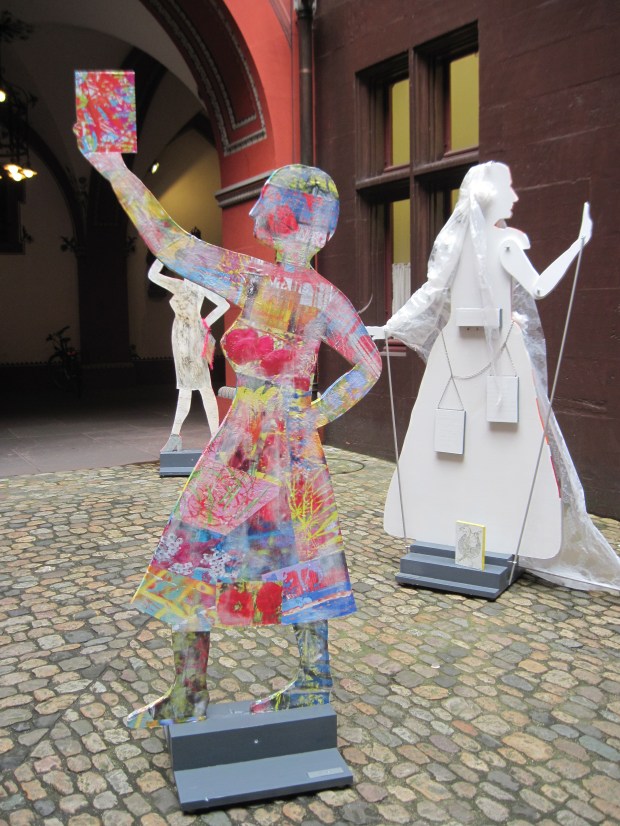
A reading-themed art installation at the Rathaus in Basel, Switzerland.
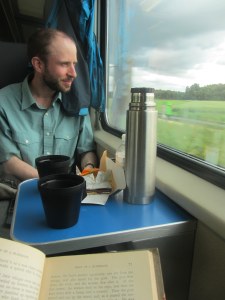
Train travel was, for the most part, easy and stress-free. Especially enjoyable were the small lines through the Engadine, which include the highest regular-service station in Europe (Ospizia Bernina, where we found fresh snowfall). The little town where we stayed in an Airbnb cabin, Lavin, was a request stop on the line, meaning you always had to press a button to get the train to stop and then walk across the tracks (!) to board. Contrary to expectations, we found that nearly all of our European trains were running late. However, they were noticeably more comfortable than British trains, especially the German ones. Thanks to train rides of an hour or more on most days, I ended up getting a ton of reading done.
 On the journey out I finished The Accidental Tourist by Anne Tyler. This is the first “classic” Tyler I’ve read, after her three most recent novels, and although I kept being plagued by odd feelings of ‘reverse déjà vu’, I really enjoyed it. This story of staid, reluctant traveler Macon Leary and how his life is turned upside down by a flighty dog trainer is all about the patterns of behavior we get stuck in. Tyler suggests that occasionally journeying into someone else’s unpredictable life might change ours for the good.
 Diary of a Pilgrimage by Jerome K. Jerome was just what I expected: a very silly book about the travails of international travel. It’s much more about the luckless journey and the endurance of national stereotypes than it is about the Passion Play the travelers see once they get to Germany. It was amusing to see the ways in which some things have hardly changed in 125 years.
 A Whole Life by Robert Seethaler, a novella set in the Austrian Alps, is the story of Andreas Egger – at various times a farmer, a prisoner of war, and a tourist guide. Various things happen to him, most of them bad. I have trouble pinpointing why Stoner is a masterpiece whereas this is just kind of boring. There’s a great avalanche scene, though.
 The Book that Matters Most by Ann Hood releases on August 9th. A new book club helps Ava cope with her divorce, her daughter Maggie’s rebelliousness, and tragic events from her past. Each month one club member picks the book that has mattered most to them in life. I thought the choices were all pretty clichéd and Ava was unrealistically passive. Although what happens to her in Paris is rather melodramatic, I most enjoyed Maggie’s sections.
 Me and Kaminski was my second novel from Daniel Kehlmann. Know-nothing art critic Sebastian Zöllner interviews reclusive artist Manuel Kaminski and then accompanies the older man on a road trip to find his lost sweetheart. Zöllner is an amusingly odious narrator, but I found the plot a bit thin. This is a rare case where I would argue the book needs to be 100 pages longer.
 About midway through the trip I finished another I’d started earlier in the month, This Is Where You Belong by Melody Warnick. The average American moves 11.7 times in their life. I’m long past that already. The book collects an interesting set of ideas about how to feel at home wherever you are: things like learning the place on foot, shopping and eating locally, and getting to know your neighbors. I am bad about integrating into a new community every time we move, so I picked up some good tips. Warnick uses examples from all over (though mostly U.S. locations), but also makes it specific to her home of Blacksburg, Virginia.
 “A cabinet of fantasies, a source of knowledge, a collection of lore from past and present, a place to dream… A bookshop can be so many things.” In A Very Special Year by Thomas Montasser, Valerie takes over Ringelnatz & Co. bookshop when the owner, her Aunt Charlotte, disappears. She has the entrepreneurial skills to run a business and gradually develops a love of books, too. The title book is a magical tome with blank pages that reveal the reader’s destination when the time is right. Twee but enjoyable; a quick read.
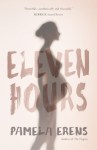 Eleven Hours by Pamela Erens is a taut thriller set during one woman’s experience of childbirth in New York City in 2004. Flashbacks to how the patient and her Caribbean nurse got where they are now add emotional depth. Another very quick read.
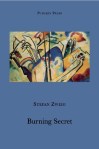 Burning Secret by Stefan Zweig is a psychologically astute novella in which a 12-year-old tries to interpret what’s happening between his mother and a fellow hotel guest, a baron he looks up to. For this naïve boy, many things come as a shock, including the threat of sex and the possibility of deception. This reminded me most of Thomas Mann’s Death in Venice. (On a hill above Salzburg we discovered a strange disembodied bust of Stefan Zweig, along with a plaque and a road sign.)


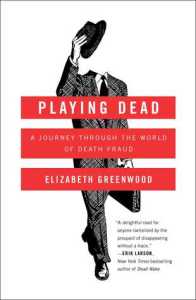 Playing Dead by Elizabeth Greenwood (releases August 9th) was great fun. Thinking of the six-figure education debt weighing on her shoulders, she surveys various cases of people who faked their own death or simply tried to disappear. Death fraud/“pseudocide” is not as easy to get away with as you might think. Fake drownings are especially suspect. I found most ironic the case of a man who lived successfully for 20 years under an assumed name but was caught when police stopped him for having a license plate light out. I particularly liked the chapter in which Greenwood travels to the Philippines, a great place to fake your death, and comes back with a copy of her own death certificate.
 Miss Jane by Brad Watson (releases July 12th) is a historical novel loosely based on the story of the author’s great-aunt. Born in Mississippi in 1915, she had malformed genitals, which led to lifelong incontinence. Jane is a wonderfully plucky protagonist, and her friendship with her doctor, Ed Thompson, is particularly touching. “You would not think someone so afflicted would or could be cheerful, not prone to melancholy or the miseries.” This reminded me most of What Is Visible by Kimberly Elkins, an excellent novel about living a full life and finding romance in spite of disability.
I also left two novels unfinished (that’ll be for another post) and made progress in two other nonfiction titles. All in all, a great set of reading!


I’m supposed to be making my way through just the books we already own for the rest of the summer, but when I got back of course I couldn’t resist volunteering for a few new books available through Nudge and The Bookbag. Apart from a few blog reviews I’m bound to, my summer plan will be to give the occasional quick roundup of what I’ve read of late.
 Bookish Beck = Rebecca Foster. American transplant to England. Freelance proofreader and book reviewer.
 Bookish Beck