Review Catch-Up: Monica, Bibliomaniac, Family Meal, Fudge & More
I’m catching up with reviews of the many October releases I read, including these four sent by publishers…
- a genre-bending, Technicolor graphic novel in the form of short comics
- a book-addict’s memoir of an ambitious Covid-times tour of Britain’s bookshops
- an understated novel about queer men of colour coping with death and mental illness
- and a quirky contemporary poetry collection I read in one sitting.
Followed by a bonus list of October books I reviewed for Shelf Awareness, similarly varied in genre: autofiction, flash fiction, horror-tinged historical fiction, graphic memoirs and more.
Monica by Daniel Clowes
 Daniel Clowes is a respected American graphic novelist best known for Ghost World, which was adapted into a 2001 film starring Scarlett Johansson. I’m not sure what I was expecting of Monica. Perhaps something closer to a quiet life story like Alison by Lizzy Stewart? In any case, not this jumble of 1970s nostalgia and supernatural horror. The book is in nine loosely connected stories that make the head spin with their genre and tonal shifts; one thing that stays constant is Clowes’s drawing style, which combines vibrant, campy colour with exaggerated faces and blunt haircuts.
At first it seems there will be a straightforward linear narrative: the prologue, “Foxhole,” has two soldiers dreaming of what life will be like Vietnam, with the one looking forward to a simple life with his fiancée Penny. “Pretty Penny” shatters those illusions as we see that Penny has fully embraced sexual liberation while he’s been away. She rejects her mother and, in a countercultural decision, keeps the baby when she gets pregnant. Young Monica has a sequence of stepfather figures before Penny dumps her with her parents and goes AWOL.
To an extent, the rest of the book is about Monica’s search for her parents. We see her as a young college student communicating with her dead grandfather via a radio, as a successful entrepreneur selling candles, and as an older woman caretaking for a California Airbnb. But in between there are bizarre sci-fi/folk horror interludes – “The Glow Infernal” and “The Incident” – about unconnected characters, and Monica’s involvement with a cult inevitably turns strange. I couldn’t get past the distasteful story lines or grotesque style. Mostly, I wasn’t convinced that Clowes liked or cared about any of his own characters, so why should I? (This might be Tom Cox’s dream book, but not mine.) I suppose I might try a classic work by Clowes one day, but only if I can be assured that it has more plot and heart.
With thanks to Jonathan Cape (Penguin) for the free copy for review.
Bibliomaniac: An Obsessive’s Tour of the Bookshops of Britain by Robin Ince
Do you know anyone who can buy just one book? Do you know anyone who leaves a bookshop only with what they walked in to buy?
I understand that Robin Ince is a radio personality and comedian who, though holding no formal qualifications, often delivers presentations about science. He was meant to undertake a stadium tour with Professor Brian Cox in the autumn of 2021, but a Covid resurgence put paid to that. Not one for sitting around at home – he comes across as driven, antsy; positively allergic to boredom – he formulated Plan B: 100+ events, most of them in independent bookshops (the oddest venue was a Chinese restaurant; he was speaking to the Plymouth Humanists), over the course of two months, criss-crossing Britain and hitting many favourite places such as Hay-on-Wye, Hungerford (my local indie) and Wigtown. The topic of his previous book was curiosity, which gave him free rein to feature anything that interested him, so no two talks were the same and he incorporated lots of ad hoc book recommendations.
 Ince is not just a speaker at the bookshops but, invariably, a customer – as well as at just about every charity shop in a town. Even when he knows he’ll be carrying his purchases home in his luggage on the train, he can’t resist a browse. And while his shopping basket would look wildly different to mine (his go-to sections are science and philosophy, the occult, 1960s pop and alternative culture; alongside a wide but utterly unpredictable range of classic and contemporary fiction and antiquarian finds), I sensed a kindred spirit in so many lines:
“A bookshop with a proximity to an interesting graveyard is a fine combination.”
“I like charity bookshops, because I can delude myself into believing that I am committing an altruistic act by purchasing too many books. I am not satisfying my consumer lust – I am digging a well in Uganda.”
“This is one of the wonders of books: the delight of being a species that can chronicle and preserve. I pick up a book from a shelf, and someone who is no more than ash or bone can still change me.”
He’s also refreshingly open-minded, determined not to become a white male dinosaur: he once spent a wonderful year reading only women authors, and gratefully accepts the gift of a Black queer feminist work – at which he knows a younger version of himself would have scoffed. I took lots of notes on shops I hadn’t heard of, but also appreciated the witty asides on British ways and on the rigours and coincidences of the tour. If you liked White Spines, this will be right up your street, though to me this was universal where the Royle was too niche. And it didn’t matter a jot that I was previously unfamiliar with Ince as a public figure.
Bibliomaniac came out in paperback on 5 October. My thanks to Atlantic Books for the free copy for review.
Family Meal by Bryan Washington
After the verve of his linked short stories (Lot, which won the Dylan Thomas Prize) and the offbeat tenderness of his debut novel, Memorial, I couldn’t wait for Bryan Washington’s next book. While it’s set in the multicultural Houston of his first book and similarly peopled by young queer men of colour, Family Meal shares the more melancholy edge of Memorial with its focus on bereavement and the habits and relationships that help the characters to cope.
Cam has moved back to Houston from Los Angeles after the untimely death of his boyfriend Kai, who had a budding career as a translator and spent part of each year in Japan. Cam works in a failing gay bar, crashes with his boss and has mostly stopped eating. Although he still loves cooking Asian food for others, he rarely tastes it himself; his overpowering appetite now is for pills and sex, leading him to arrange as many as four hook-ups per day. Kai still appears and communicates to him. “Easier to spend time dwelling on death than it is to live, says Kai.” Is it to escape this spectre, or the memory of what happened to Kai, that Cam descends into his addictions? Meanwhile, his estranged friend TJ, with whom Cam grew up at TJ’s Korean American family’s bakery after the death of Cam’s parents, has his own history of loss and unhealthy relationships. But a connection with the bakery’s new nonbinary employee, Noel, seems like it might be different.
If you’ve read Washington before, you’ll know what to expect: no speech marks, obscenity-strewn dialogue, sexually explicit scenes that seem to be there for the sake of it (because sex is part of life, rather than because they particularly advance the plot). An issue I had here, like with Memorial, is that having multiple first-person narrators doesn’t add anything; Kai and TJ sound so much like Cam, who narrates roughly the first half, that it’s hard to tell their affectless accounts apart. Such interchangeable voices two books running suggests to me that Washington hasn’t yet managed to fully imagine himself outside of his own personality.

The novel has much to convey about found family, food as nurture, and how we try to fill the emptiness in our lives with things that aren’t good for us. However, it often delivers these messages through what wise secondary characters say, which struck me as unsubtle.
“You don’t have to do this alone, says TJ.”
(Kai:) “My mother would say, Cooking is care. The act is the care.”
“Love can be a lot of things though, says Noel. Right? It’s pleasure but it’s also washing the dishes and sorting medication and folding the laundry. It’s picking out what to eat for dinner three nights in a row, even if you don’t want to. And it’s knowing when to speak up, and when to stay quiet, and when, I think, to move on. But also when to fight for it.”
“Sometimes the best we can do is live for each other, she [Kai’s sister] says. It’s enough. Even if it seems like it isn’t.”
There’s no doubting how heartfelt this story is. It brought tears to my eyes at the beginning and end, but in between did not captivate me as much as I hoped. While intermittently poignant on the subject of bereavement, it is so mired in the characters’ unhealthy coping mechanisms that it becomes painful to read.
In my mind Washington and Brandon Taylor are in the same basket, though that may be reductive or unimaginative of me (young, gay Black authors from the American South who have published three books and tend to return to the same themes and settings). Before this year I would have said Taylor had the edge, but The Late Americans was so disappointingly similar to his previous work that Washington has taken the lead. I just hope that with his next work he challenges himself instead of coasting along in the groove he’s created thus far.
I wish I could get a copy of this into the hands of Sufjan Stevens…
With thanks to Atlantic Books for the free copy for review.
Fudge by Andrew Weatherhead
 I read this over a chilled-out coffee at the Globe bar in Hay-on-Wye (how perfect, then, to come across the lines “I know the secret of life / Is to read good books”). Weatherhead mostly charts the rhythms of everyday existence in pandemic-era New York City, especially through a haiku sequence (“The blind cat asleep / On my lap—and coffee / Just out of reach” – a situation familiar to any cat owner). His style is matter-of-fact and casually funny, juxtaposing random observations about hipster-ish experiences. From “Things the Photoshop Instructor Said and Did”: “Someone gasped when he increased the contrast / I feel like everyone here is named Taylor.”
The central piece, “Poem While on Hold with NBA League Pass Customer Support Nov. 17, 2018,” descends into the absurd, but his four hours lost on the phone are reclaimed through his musings on a sport he once played (“I had begun to find meaning in art and music / I was always too cerebral a player anyways … That feeling—of perfect grace and equanimity— / must be what we’re all searching for in this life”) and on life in general. This is poetry that doesn’t feel like poetry, if that makes sense. I have a hunch that it might appeal to readers of David Foster Wallace.
Published by Publishing Genius. With thanks to publicist Lori Hettler for the e-copy for review.
Reviewed for Shelf Awareness:
(Links to full text)
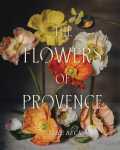
The Flowers of Provence by Jamie Beck (Gift books feature): A gorgeous book of photographs, perfect for gardeners, romantics, and armchair travelers. Her still lifes are as detailed and colorful as medieval paintings.
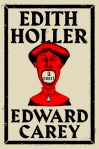
Edith Holler by Edward Carey (forthcoming): A dark fairy tale about a precocious girl confined to her family’s theatre in Norwich, England yet driven to reveal the truth behind her city’s child disappearances. Reminiscent of Dahl, Dickens, and Shakespeare at their goriest.
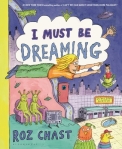
I Must Be Dreaming by Roz Chast: A laugh-out-loud-funny tour through her dream journal as well as a brief introduction to dream theory. Delightfully captures the randomness of dream topics and dialogues.

Tremor by Teju Cole: A kaleidoscopic work of autofiction that journeys between the US and Nigeria as it questions the ownership and meaning of Black art. The sophisticated structure is a highlight of this elegant study of art criticism, suffering, and subjectivity.
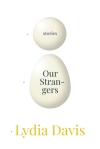
Our Strangers by Lydia Davis (Review and Q&A): In her ninth collection of mostly flash-length stories (a whopping 143 of them), an overarching theme is the mystery of human communication and connection. A real cornucopia of genres, structures, and voices. [Only available via Bookshop.org and independent bookstores.]
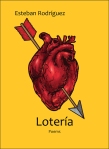
Lotería by Esteban Rodríguez: Lotería is a traditional Mexican game of chance. Each Spanish-language card is allotted a one-page poem in a creative, poignant recounting of his Mexican American family history.
Glass Half Empty by Rachael Smith: The British comics artist third graphic memoir is a refreshingly candid account of her recovery from alcoholism after her father’s death. In some panes, her adult self appears alongside her younger self, offering advice.


The Dead Peasant’s Handbook by Brian Turner: The final installment – after The Wild Delight of Wild Things and The Goodbye World Poem – in an intimate, autobiographical trilogy. Love is presented as the key to surviving bereavement and wartime trauma.
Book Serendipity, Mid-March to Early May 2021
In early April, the publisher Canongate ran a newsletter competition for one reader to win a stack of their recent releases. All you had to do was reply with your favourite word. On Twitter they gave a rundown of the most popular responses. Turning up several times each were petrichor, mellifluous, and oleaginous. Most frequent of all was serendipity: I was one of 15 to submit it! And one of those entries, but not mine, won. Anyway, fun little story there.
I call it Book Serendipity when two or more books that I read at the same time or in quick succession have something pretty bizarre in common. Because I have so many books on the go at once (usually 20‒30), I suppose I’m more prone to such incidents. I’ve realized that, of course, synchronicity is really the more apt word, but this branding has stuck.
The following are in roughly chronological order.
- A white peacock is mentioned in Indelicacy by Amina Cain and The Mermaid of Black Conch by Monique Roffey, both of which were on the 2021 Rathbones Folio Prize shortlist.
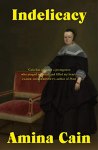

- Speaking of that Rathbones Folio Prize shortlist, four of the eight were paperbacks with French flaps.
- The main character takes ballet lessons in Indelicacy by Amina Cain and A Feather on the Breath of God by Sigrid Nunez.
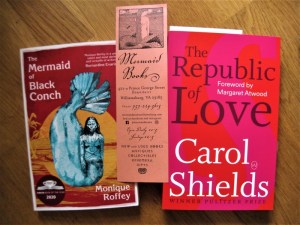
- Mermaids! A big theme in The Mermaid of Black Conch by Monique Roffey (of course) and The Republic of Love by Carol Shields, but they’re also mentioned in the opening story of The Office of Historical Corrections by Danielle Evans and are main characters in “The Pangs of Love” by Jane Gardam in the anthology Close Company.
- The Brothers Grimm story about brothers who have been transformed into swans and their sister who sews shirts out of nettles to turn them back is reworked in The Charmed Wife by Olga Grushin and used as a metaphor in Dusk, Night, Dawn by Anne Lamott.
- An electric carving knife is mentioned as a means of suicide (yipes!) in The Inevitable by Katie Engelhart and Woman on the Edge of Time by Marge Piercy.
- A discussion of the distinction between the fear of dying and the fear of being dead in This Party’s Dead by Erica Buist and The Inevitable by Katie Engelhart.
- Two novels in a row in which an older man is appalled by the squalor of his young girlfriend’s apartment, and she calls him “daddy” during sex (double yipes!), made the Dylan Thomas Prize shortlist: Luster by Raven Leilani and My Dark Vanessa by Kate Elizabeth Russell.


- Architect husbands in The Push by Ashley Audrain and The Art of Falling by Danielle McLaughlin (and, last year, in A Celibate Season by Blanche Howard and Carol Shields), as well as a female architect as a main character in The Living Sea of Waking Dreams by Richard Flanagan earlier this year.
- The next-to-last essay in the Trauma anthology quotes from The Bell Jar by Sylvia Plath, which I was also reading at the time.
- A mention of the eels in London absorbing cocaine from the Thames in the final essay in the Trauma anthology; I then moved right on to the last 40 pages of Nobody Is Talking About This by Patricia Lockwood and the same bizarre fact was mentioned. A week and a half later, there it was again, this time in Asylum Road by Olivia Sudjic.
- A mention of sailors’ habit of getting tattoos of swallows in The Circling Sky by Neil Ansell (who has a swallow tattoo, even though he’s not a sailor) and Birdsong in a Time of Silence by Steven Lovatt.

- A father and teenage child wander an unfamiliar city and enter a sex shop together (yipes yet again!) in Three O’Clock in the Morning by Gianrico Carofiglio and Ten Days by Austin Duffy.
- A mention of the same University of Virginia study in which people self-administered electric shocks to alleviate the boredom of sitting alone with their thoughts in Rooted by Lyanda Lynn Haupt and You’re Not Listening by Kate Murphy.
- Basho’s poetry and George Monbiot’s Feral are both cited in The Circling Sky by Neil Ansell and Rooted by Lyanda Lynn Haupt.
- A dead sister named Mattie in Consent by Annabel Lyon and Drowning Ruth by Christina Schwarz.

- A young Black female protagonist and the same family dynamic (the mother committed suicide and the father is in the Marines/Navy) in The Mothers by Brit Bennett and Luster by Raven Leilani.
- On the same night, I read about two pets encountering snow for the first time: a cat in Close Encounters of the Furred Kind by Tom Cox and a dog in Open Water by Caleb Azumah Nelson.
- A character is described as being as wide as they are tall in Mother for Dinner by Shalom Auslander and The Absolute Book by Elizabeth Knox.


- A character is known as Seventh in Mother for Dinner by Shalom Auslander and the story “The Pangs of Love” by Jane Gardam in the Close Company anthology. Plus, there’s Septimus in Mrs Dalloway by Virginia Woolf, which I’m reading concurrently with those two.
What’s the weirdest reading coincidence you’ve had lately?
Pandemic Reading Strategies & Recommendations, Serious or Tongue-in-Cheek
If you’ve been spending time blog-hopping or on Twitter over the last few weeks, you will have seen countless riffs on this topic. Everyone’s pondering what’s best to read in these times. All we can get our hands on about plagues (Boccaccio, Camus, Defoe)? Allegories of similarly challenging worldwide disasters (WWII, 9/11)? Childhood favorites? Comfort reads? Funny books? Light, undemanding stuff? Rereads?
My general answer would be: as always, read whatever you want or can – anything that captures your attention is worthwhile. We’re under so much stress that our reading should be entirely unpressured. But to be a little more specific, I’ve gathered reading recommendations on a variety of topics, drawing on lists that others have made and linking to my own blog reviews where applicable.
(Some of these ideas are less serious than others.)
If you are brave enough to learn about zoonotic diseases:
 Spillover: Animal Infections and the Next Human Pandemic by David Quammen: This is top-notch scientific journalism: pacey, well-structured, and gripping. The best chapters are on Ebola and SARS; the SARS chapter, in particular, reads like a film screenplay, if this were a far superior version of Contagion. It’s a sobering subject, with some quite alarming anecdotes and statistics, but this is not scare-mongering for the sake of it; Quammen is frank about the fact that we’re still all more likely to get heart disease or be in a fatal car crash.
If you can’t look away from pandemic stories, historical or imagined:


I already had Philip Roth’s Nemesis (set in 1940s New Jersey amid a polio epidemic) out from the library because it was on the Wellcome Book Prize shortlist in 2011. I was also inspired to take Year of Wonders by Geraldine Brooks (set in the 1660s and featuring an English village that quarantined itself during the Plague) off the shelf. I’m nearing the end of these two and should have my reviews up next week.
You will see no one book referenced more than Station Eleven by Emily St. John Mandel. It’s a wholly believable dystopian novel in which 99% of the population has been wiped out by a pandemic. The remnant bands together not just to survive but to create and preserve art. “What was lost in the collapse: almost everything, almost everyone, but there is still such beauty.” (My full BookBrowse review from December 2014.)
See also this Publishers Weekly list of “13 Essential Pandemic Novels.”
If you’re feeling cooped up…
 Infinite Home by Kathleen Alcott: “Edith is a widowed landlady who rents apartments in her Brooklyn brownstone to an unlikely collection of humans, all deeply in need of shelter.” (I haven’t read it, but I do have a copy; now would seem like the time to read it!)
…yet want to appreciate the home you’re stuck in:


Years ago I read and loved At Home: A Short History of Private Life by Bill Bryson and Happier at Home by Gretchen Rubin. I can’t tell you anything more than that because it was before the days when I reviewed everything I read, but these are both reliable authors.
 I love the sound of A Journey Around My Room by Xavier de Maistre: “Finding himself locked in his room for six weeks, a young officer journeys around his room in his imagination, using the various objects it contains as inspiration for a delightful parody of contemporary travel writing and an exercise in Sternean picaresque.”
I’m also drawn to Home: The Story of Everyone Who Ever Lived in Our House by Julie Myerson, who combed archives for traces of all the former residents of her 1870s terraced house in Clapham.
If you’re struggling with being on your own:


The Lonely City by Olivia Laing: This remarkable book on outsider artists interweaves biography, art criticism and memoir. Laing is a tour guide into the peculiar, lonely crowdedness you find in a world city.
How to Be Alone by Sara Maitland: Maitland argues that although being alone is easy to achieve, there is an art to doing it properly, and solitude and loneliness are by no means the same thing. Profiling everyone from the Desert Fathers of early Christianity to the Romantic poets, she enumerates all the benefits that solitude confers.
Journal of a Solitude by May Sarton: A one-year account of her writing life in New Hampshire, this is Sarton’s best. The book dwells on the seasonal patterns of the natural world (shovelling snow, gardening, caring for animals) but also the rhythms of the soul – rising in hope but also falling into occasional, inevitable despair.
See also this Penguin UK list of books to read in self-isolation.
If you’ve been passing the time by baking…
 The City Baker’s Guide to Country Living by Louise Miller: As chief baker at the Sugar Maple Inn in Guthrie, Vermon, Olivia Rawlings settles into a daily routine of baking muffins, bread and cakes. This is a warm, cozy debut novel full of well-drawn secondary characters and romantic possibilities. There’s nothing clichéd about it, though. Livvy is a sassy narrator, and I loved how Miller documents the rhythms of the small-town country year, including tapping the maple trees in the early spring and a pie baking contest at the summer county fair.
 Sourdough by Robin Sloan: Lois Clary, a Bay Area robot programmer, becomes obsessed with baking. “I needed a more interesting life. I could start by learning something. I could start with the starter.” She attempts to link her job and her hobby by teaching a robot arm to knead the bread she makes for a farmer’s market. Madcap adventures ensue. It’s a funny and original novel and it makes you think, too – particularly about the extent to which we should allow technology to take over our food production.
…but can’t find yeast or eggs in the shop:
Yeast: A Problem by Charles Kingsley (1851). Nope, I haven’t read it, but our friend has a copy in his Everyman’s Library collection and the title makes us laugh every time we see it.
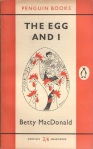 The Egg & I by Betty Macdonald: MacDonald and her husband started a rural Washington State chicken farm in the 1940s. Her account of her failure to become the perfect farm wife is hilarious. The voice reminded me of Doreen Tovey’s: mild exasperation at the drama caused by household animals, neighbors, and inanimate objects. “I really tried to like chickens. But I couldn’t get close to the hen either physically or spiritually, and by the end of the second spring I hated everything about the chicken but the egg.” Perfect pre-Easter reading.
And here are a few lists I put together for Hungerford Bookshop:
If you need a laugh:
Fiction:
Lucky Jim by Kingsley Amis
The Darling Buds of May (and sequels) by H.E. Bates
Ella Minnow Pea by Mark Dunn
Heartburn by Nora Ephron
 Cold Comfort Farm by Stella Gibbons
Anything by Nick Hornby
Three Men in a Boat by Jerome K. Jerome
Anything by David Lodge
Dear Committee Members by Julie Schumacher
The Rosie Project (and sequels) by Graeme Simsion
To Say Nothing of the Dog by Connie Willis
Nonfiction:
 Anything by Bill Bryson
21st-Century Yokel by Tom Cox
Anything by Gerald Durrell
Anything by Nora Ephron (essays)
This Is Going to Hurt by Adam Kay
Priestdaddy by Patricia Lockwood
Dear Lupin by Roger Mortimer
Anything by David Sedaris
Little Failure by Gary Shteyngart
If you want to disappear into a long book:


The Heart’s Invisible Furies by John Boyne
Jonathan Strange & Mr Norrell by Susanna Clarke
David Copperfield by Charles Dickens
Middlesex by Jeffrey Eugenides
The Crimson Petal and the White by Michel Faber
The Signature of All Things by Elizabeth Gilbert
The Nix by Nathan Hill
We, the Drowned by Carsten Jensen
Mary Ann Sate, Imbecile by Alice Jolly
The Poisonwood Bible by Barbara Kingsolver
The Wind-Up Bird Chronicle by Haruki Murakami
The Sparrow by Mary Doria Russell
American Wife by Curtis Sittenfeld
East of Eden by John Steinbeck
The Goldfinch by Donna Tartt
Cutting for Stone by Abraham Verghese
The Paying Guests by Sarah Waters
If you’re looking for some hope:
 Almost Everything: Notes on Hope by Anne Lamott
Hope in the Dark by Rebecca Solnit
Hope Dies Last: Making a Difference in an Indifferent World by Studs Terkel
I’ve been doing a combination of the above strategies, reading about historical plagues in fiction and nonfiction but also doing some rereading and consuming lighter genre stuff like mysteries. I continue to dip into new releases, and I enjoy the ongoing challenge of my reading projects. Right now, I’m working through a few current Women’s Prize longlistees, as well as some past Wellcome Book Prize nominees and Women’s Prize winners, and I’m about to start a third #1920Club title. Plus I’m already thinking about my 20 Books of Summer (I’m considering an all-foodie theme).
Further reading:
- Book Riot pinpoints seven categories of books to read during a pandemic.
- Clare surveys the post-pandemic literary landscape.
- Elle logs her pandemic reading and viewing.
- Laura discusses pandemic reading strategies and distraction reading.
- Literary Hub looks at parallel situations, including post-9/11 reads, to make predictions, and asks what your “go-to quarantine read” says about you. (I’ve read Kindred most recently, but I wouldn’t say that describes me.)
- Simon thinks about what we can and should read.
- Susan highlights some comfort reads.
What are your current reading strategies?
Final Book Serendipity Incidents to Close out 2019
Just a short post this time. I call it serendipitous when two or more books that I’m reading at the same time or in quick succession have something pretty bizarre in common. Because I have so many books on the go at once – usually between 10 and 20 – I guess I’m more prone to such incidents. I post these occasional reading coincidences on Twitter. What’s the weirdest one you’ve had lately? (The following are in rough chronological order.)
[Previous 2019 Book Serendipity posts covered April, July and October.]
- Characters sit for a portrait in The Confession by Jessie Burton and The Hoarder by Jess Kidd.
- An obsession with saints in Fifth Business by Robertson Davies and The Hoarder by Jess Kidd.

- A mention of the urban myth regarding why our fingertips prune in water (something about an outdated evolutionary strategy for gripping underwater) in The Body by Bill Bryson and Humiliation: Stories by Paulina Flores.
- Memories of childhood trips to Martha’s Vineyard in Chances Are by Richard Russo and The Dearly Beloved by Cara Wall.
- The River Thames is the setting for Mudlarking by Lara Maiklem and Once Upon a River by Diane Setterfield.

- Mentions of pelicans being clubbed to death in God Unbound: Theology in the Wild by Brian McLaren and Autumn Across America by Edwin Way Teale.
- A character who speaks and writes backwards words in The Poisonwood Bible and The Robber Bride.
- Epigraphs containing folk names for the hare, and soon enough a dead hare, in Ring the Hill by Tom Cox and Starve Acre by Andrew Michael Hurley.

- An unexpected THIRD set of conjoined twins encountered this year (after Cutting for Stone and The Girls) in Fall on Your Knees by Ann-Marie Macdonald.
- The song “Oh My Darling, Clementine” is quoted in The Robber Bride and Fall on Your Knees.
- Warming an orphaned lamb in a low oven in Moral Disorder by Margaret Atwood and The Dig by Cynan Jones.
- A character is presumed incapable of laughter in Agatha by Anne Cathrine Bomann and Bowlaway by Elizabeth McCracken.
- Marilynne Robinson’s Housekeeping is mentioned in The River Capture by Mary Costello and Surrender by Joanna Pocock.
20 Books of Summer, #11–13: Harrison, Pym, Russell
It’s cats and butterflies in the spotlight this time, adding in a gazelle as a metaphor for Freddie Mercury’s somebody to love.
Travelling Cat: A Journey round Britain with Pugwash by Frederick Harrison (1988)
If Tom Cox had been born 20 years earlier, this is the sort of book he might have written. In 1987, saddened more by his cat Podey being run over than by the end of his marriage, Harrison set out from South London in his Ford Transit van for a seven-month drive around the country. He decided to take Pugwash, one of his local (presumably ownerless) cats, along as a companion.
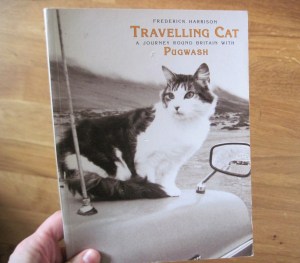 They encountered Morris dancers, gypsies, hippies at Stonehenge for the Summer Solstice, sisters having a double wedding, and magic mushroom collectors. They went to a county fair and beaches in Suffolk and East Yorkshire, and briefly to Hay-on-Wye. And on the way back they collected Podey, whom he’d had stuffed. Harrison muses on the English “vice” of nostalgia for a past that probably never existed; Pugwash does what cats do, and very well.
It’s all a bit silly and dated and lightweight, but enjoyable nonetheless. Plus there are tons of black-and-white photos of “Pugs” and other feline friends. This was a secondhand purchase from The Bookshop, Wigtown. 
Favorite lines:
“Cats hate to make prats of themselves. But then, don’t we all?”
(last lines) “Warm, fed, contented, unemployable, and entirely at peace with the world. Yes indeed. Cats certainly know something we don’t.”
Some Tame Gazelle by Barbara Pym (1950)
(An example of a book that just happens to have an animal in the title.) I’d only read one other Pym novel, Quartet in Autumn, a late and fairly melancholy story of four lonely older people. With her first novel I’m in more typical territory, I take it. The middle-aged Bede sisters are pillars of the church in their English village. Harriet takes each new curate under her wing, making of them a sort of collection, and fends off frequent marriage proposals from the likes of a celebrity librarian and an Italian count.
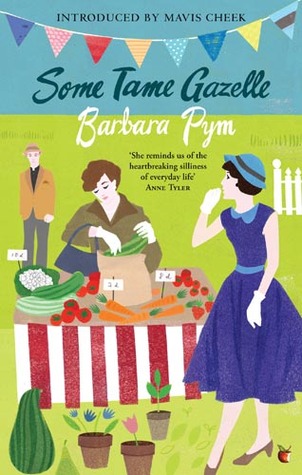 Belinda, on the other hand, only has eyes for one man: Archdeacon Hochleve, whom she’s known and loved for 30 years. They share a fondness for quoting poetry, the more obscure the better (like the title phrase, taken from “Some tame gazelle, or some gentle dove: / Something to love, oh, something to love!” by Thomas Haynes Bayly). The only problem is that the archdeacon is happily married. So single-minded is Belinda that she barely notices her own marriage proposal when it comes: a scene that reminded me of Mr. Collins’s proposal to Lizzie in Pride and Prejudice. Indeed, Pym is widely recognized as an heir to Jane Austen, what with her arch studies of relationships in a closed community.
There were a handful of moments that made me laugh, like when the seamstress finds a caterpillar in her cauliflower cheese and has to wipe with a Church Times newspaper when the Bedes run out of toilet paper (such mild sacrilege!). This is enjoyable, if fluffy; it was probably a mistake to have read one of Pym’s more serious books first: I expected too much of this one. If you’re looking for a quick, gentle and escapist read in which nothing awful will happen, though, it would make a good choice. Knowing most of her books are of a piece, I wouldn’t read more than one of the remainder – it’ll most likely be Excellent Women.
An Obsession with Butterflies: Our Long Love Affair with a Singular Insect by Sharman Apt Russell (2003)
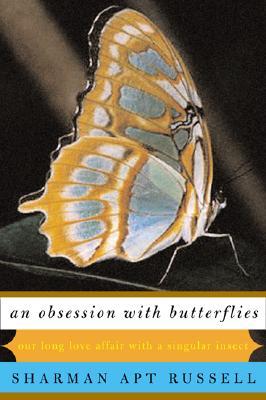 This compact and fairly rollicking book is a natural history of butterflies and of the scientists and collectors who have made them their life’s work. There are some 18,000 species and, unlike, say, beetles, they are generally pretty easy to tell apart because of their bold, colorful markings. Moth and butterfly diversity may well be a synecdoche for overall diversity, making them invaluable indicator species. Although the history of butterfly collecting was fairly familiar to me from Peter Marren’s Rainbow Dust, I still learned or was reminded of a lot, such as the ways you can tell moths and butterflies apart (and it’s not just about whether they fly in the night or the day). And who knew that butterfly rape is a thing?
The final third of the book was strongest for me, including a trip to London’s Natural History Museum; another to Costa Rica’s butterfly ranches, an example of successful ecotourism; and a nicely done case study of the El Segundo Blue butterfly, which was brought back from the brink of extinction by restoration of its southern California dunes habitat. Russell, a New Mexico-based author of novels and nonfiction, also writes about butterflies’ cultural importance: “No matter our religious beliefs, we accept the miracle of metamorphosis. One thing becomes another. … Butterflies wake us up.”
 I also recently read the excellent title story from John Murray’s 2003 collection A Few Short Notes on Tropical Butterflies. Married surgeons reflect on their losses, including the narrator’s sister in a childhood accident and his wife Maya’s father to brain cancer. In the late 1800s, the narrator’s grandfather, an amateur naturalist in the same vein as Darwin, travelled to Papua New Guinea to collect butterflies. The legends from his time, and from family trips to Cape May to count monarchs on migration in the 1930s, still resonate in the present day for these characters. The treatment of themes like science, grief and family inheritance, and the interweaving of past and present, reminded me of work by Andrea Barrett and A.S. Byatt.
(I’ve put the book aside for now but will go back to it in September as I focus on short stories.)
Other butterfly-themed books I have reviewed:
- Four Wings and a Prayer: Caught in the Mystery of the Monarch Butterfly by Sue Halpern (one of last year’s 20 Books of Summer)
- Ruins by Peter Kuper (a graphic novel set in Mexico, this also picks up on monarch migration)
- Magdalena Mountain by Robert Michael Pyle (a novel about butterfly researchers in Colorado)
R.I.P. Reads, Part II: Cox, Gaiman, Paver
Happy Halloween! I enjoyed taking part in R.I.P. for the first time this year. My top two choices out of the six fantastical and/or spooky books I managed to read would be The Loney and The Graveyard Book (see below). For this second installment I’ve been reading eerie short stories that take place in the English countryside, a young adult fantasy novel set mostly in a graveyard, and a ghost story that unfolds in the Himalayas of the 1930s.

Help the Witch by Tom Cox (2018)
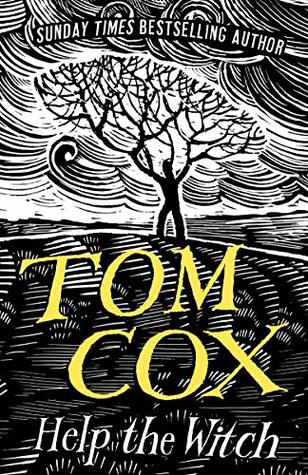 I knew Tom Cox for his witty books about his many cats, including The Good, the Bad and the Furry. His first foray into fiction was published by Unbound earlier this month; I pre-ordered it on a Kindle deal for £1. The settings are dilapidated cottages, moorland and villages, mostly in the North of England. Even in the spookier stories, there’s always a welcome touch of humor. “Seance” raises the ghost of a cyclist who was killed on his bike and now is destined to cycle evermore. He doesn’t, at first, realize that he’s dead. “‘Morning!’ he called to a middle-aged couple with a labradoodle, cheerfully, as he cycled past Whiddon Scrubs. They ignored him. ‘Shitbags,’ he said under his breath.”
The three sets of flash fictions, “Listings,” “Nine Tiny Stories about Houses,” and “Folk Tales of the Twenty-third Century,” particularly made me laugh, though each perhaps overstays its welcome a bit. My two favorites were proper ghost stories: “Speed Awareness,” about a peculiar mix-up with the course teacher, and “Just Good Friends,” in which a woman’s Internet dating experiences turn strange when she meets someone with inside knowledge about her past. I could see the latter being anthologized. These are enjoyable enough stories to flip through around Halloween.
My rating: 
The Graveyard Book by Neil Gaiman (2008)
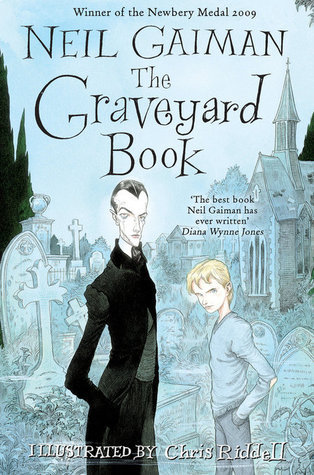 Nobody “Bod” Owens has lived in a graveyard ever since the night he climbed out of his cot and toddled there – the same night that a man named Jack murdered his parents and older sister. He was the only member of his family to survive the slaughter. Although he passes a happy childhood among the graveyard’s witches, ghouls and ghosts from many centuries, he knows he’s different. He’s alive; he has to eat and craves human friendship. As valuable as his lessons in Fading and Dreamwalking prove to be, he longs to attend school and discover more of the world outside – provided he can keep his head down and avoid notice; previous trips beyond the cemetery walls, such as to a pawnshop, have bordered on the disastrous.
Bod’s japes with his returning friend Scarlett turn more serious when he learns that Jack is still after him. This is quite a dark book for its young teen audience, but as I remember from the only other Gaiman book I’ve read, The Ocean at the End of the Lane, he’s a master at balancing sadness with humor and magic. The illustrations by Chris Riddell are terrific, too.
Favorite lines:
Silas, Bod’s guardian: “You’re alive, Bod. That means you have infinite potential. You can do anything, make anything, dream anything. If you change the world, the world will change.”
“Mother Slaughter’s headstone [was] so cracked and worn and weathered that all it said now was:
LAUGH
which had puzzled the local historians for over a hundred years.”
My rating: 
Thin Air: A Ghost Story by Michelle Paver (2016)
 In 1935 Dr. Stephen Pearce and his brother Kits are part of a five-man mission to climb the most dangerous mountain in the Himalayas, Kangchenjunga. Thirty years before, Sir Edmund Lyell led an ill-fated expedition up the same mountain: more than one man did not return, and the rest lost limbs to frostbite. “I don’t want to know what happened to them. It’s in the past. It has nothing to do with us,” Dr. Pearce tells himself, but from the start it feels like a bad omen that they, like Lyell’s party, are attempting the southwest approach; even the native porters are nervous. And as they climb, they fall prey to various medical and mental crises; hallucinations of ghostly figures on the crags are just as much of a danger as snow blindness.
This is pacey, readable historical fiction with a good sense of period and atmosphere. I enjoyed Pearce’s narration, and the one-upmanship type of relationship with his brother adds an interesting dimension to the expedition dynamics. However, I never submitted sufficiently to Paver’s spell to find anything particularly scary. I’ll try again with her other ghost story, Dark Matter, about an Arctic expedition from the same time period.
Favorite passage:
“The Sherpas are wrong. This mountain has no spirit, no sentience and no intent. It’s not trying to kill us. It simply is.” [famous last words…]
My rating:
Have you been reading anything fantastical or spooky this October?
Still More Books about Cats
The past two years I’ve had biannual specials on cat books. You might think I would have run out of options by now, but not so! Granted, my choices this time are rather light fare: several children’s picture books, two slight gift books, and a few breezy memoirs. But it’s nice to have a fluffy post every now and again, and today’s is in honor of getting past a week of the year I always dread: June 15th is the U.S. tax deadline for citizens living abroad, so I’ve been drowning in forms and numbers. To celebrate getting both my IRS and HMRC tax returns sent off by today, here’s some feline-themed reads to enjoy over a G&T or other summery tipple of your choice.
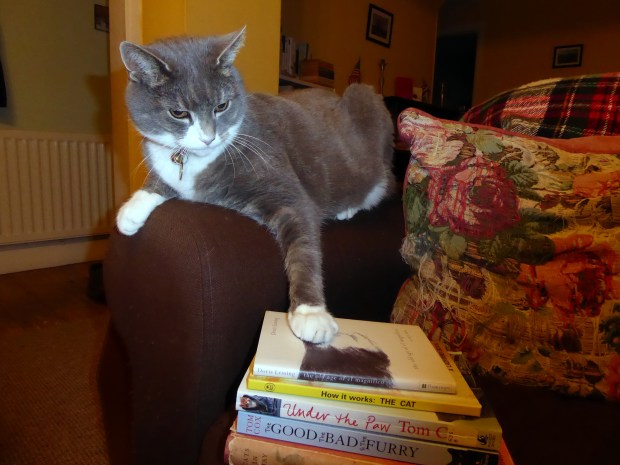
Alfie likes cat books, too. The stacks are good for scratching one’s cheek against.
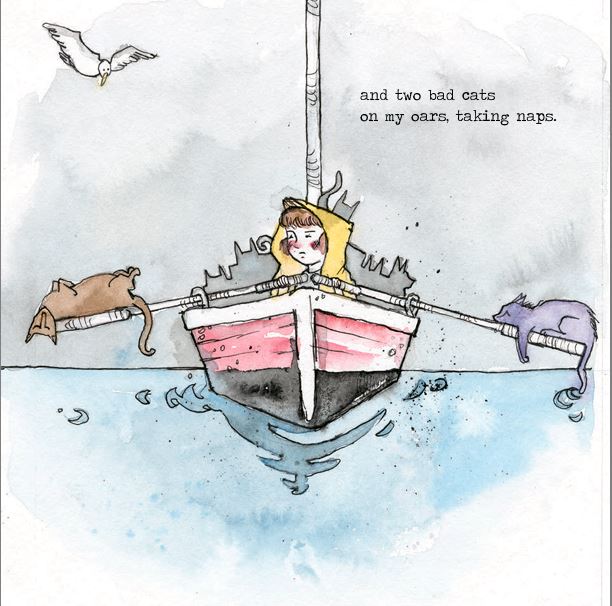
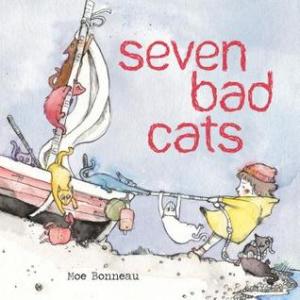 Seven Bad Cats by Monique Bonneau (2018): “Today I put on my boots and my coat, and seven bad cats jumped into my boat.” This is a terrific little rhyming book that counts up to seven and then back down to one with the help of some stowaway cats and their antics. (They come in colors that cats don’t normally come in, but that’s okay with me.) To start with they are incorrigibly lazy and mischievous, but when disaster is at hand they band together to help the little girl get back to shore safely. If only cats were so helpful in real life!
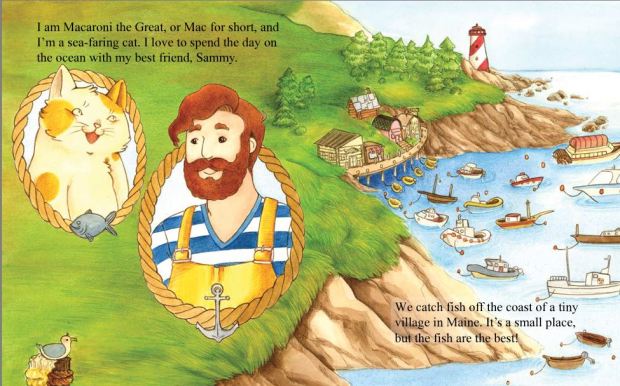
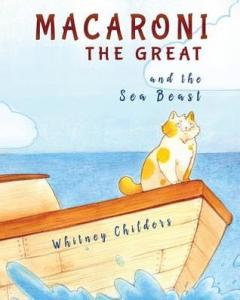 Macaroni the Great and the Sea Beast by Whitney Childers (2018): Macaroni the cat has an idyllic life by the coast of Maine with his hipster fisherman friend, Sammy. Sometimes he helps steer the fishing boat; sometimes he naps on the deck. But when a fearsome sea beast rears its head from the net one day, Mac is ready to fight back and save the day. From the colorfully nautical endpapers through to the peaceful last page, this is a great picture book for cat lovers to share with the little ones in their lives.
You don’t so often hear blokes talking about their cats, do you? That crazy cat lady stereotype dominates. But Tom Cox has written several memoirs about his life with cats.
 In Under the Paw: Confessions of a Cat Man (2008), Cox, who had previously published volumes of his journalism about music and sports, came out as a cat lover. By the end of the book he has SIX CATS, so this was not some passing fad but a deep and possibly worrying obsession. In essays and short list-based asides he traces his history with cats, reveals the wildly different personalities of his current pets, and wittily comments on cat behavior. I especially liked these entries from his “Cat Dictionary”: “ES Pee: The telepathic process that leads a cat to only get properly settled on its owner’s stomach in the moments when that owner is most desperate for the toilet” & “Muzzlewug: The state of bliss created by the perfect friction of an owner’s fingers on a fully extended chin.”
 The Good, the Bad and the Furry (2013) is another fairly entertaining book. Cat owners will recognize the ways in which a pet’s requirements impinge on their lives (but we wouldn’t have it any other way). Cox starts and ends the book with four cats, but – alas – goes down to three for a while in the middle, with visitors upping it to 3.5 sometimes. The Bear, Ralph and Shipley are the stalwarts, with The Bear described as “the only cat I’d ever seen who appeared to be almost permanently on the verge of tears.” He’s melancholy and philosophical, whereas Ralph (who says his own name when he meows) is vain and sullen. “The Ten Catmandments” was my favorite part: “Thou shalt not drink the water put out for thee by thy humans” and “Thou shalt ignore any toy thy human has bought for thee, especially the really expensive ones.” Includes lots of photographs of cats and kittens!
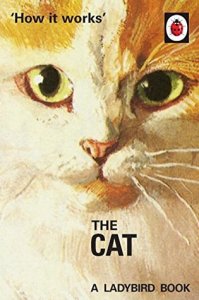 How It Works: The Cat (2016) is a Ladybird pastiche by Jason Hazeley and Joel Morris that we purchased as a bargain book from Aldi; it was published in the USA as The Fireside Book of the Cat. Tongue-in-cheek descriptions sit opposite 1950s-style drawings. Cat owners will certainly get a chuckle from lines like “Dogs have evolved to serve many sorts of human needs. And humans have evolved to serve many sorts of cat food.” (However, “It is a good idea to buy a lot of your cat’s favourite food. That way, you will have something to throw away when she changes her mind.”) Makes a good coffee table book for guests to smile at.
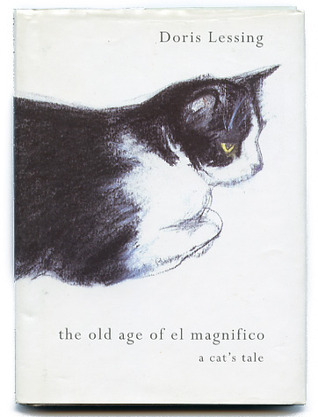 The Old Age of El Magnifico by Doris Lessing (2000): Pure cat lover’s delight. I wasn’t a big fan of Lessing’s Particularly Cats, which is surprisingly unsentimental and even brutal in places. This redresses the balance. It’s the bittersweet story of Butch, her enormous black and white cat, who was known by many additional nicknames including El Magnifico. At the age of 14 he was found to have a cancerous growth in his shoulder, and one entire front leg had to be removed. His habits, and even to an extent his personality, changed after the amputation, and Lessing regretted that she couldn’t let him know it was done for his good. She reflects on her duty towards the cats in her care, and on how pets encourage us to slow our pace and direct our attention fully to the present moment. Work? Chores? Worries? What could really be more important than sitting still and stroking a cat?
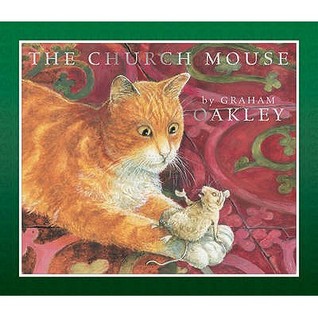 The Church Mouse by Graham Oakley: It is not good for a mouse to be alone. Arthur is lonely as the only mouse resident in the village church, but he has an idea: he proposes to the parson that if he will give all the local mice refuge in the church, they’ll undertake minor chores like flower arranging and picking up confetti. It seems like a good arrangement all around, but Sampson the church cat soon tires of the mice’s antics and creates something of a scene during a Sunday service. Luckily, he and the mice still work together to outwit a burglar who comes for the silver. There are quite a lot of words for a very small child to engage with, but older children should enjoy it very much. I find this whole series so charming. This was the first book of the 14, from 1972.
 Cats in May by Doreen Tovey (1959): The sequel is just as good as the original (Cats in the Belfry). Along with feline antics we get the adventures of Blondin the squirrel, whom Tovey and her husband adopted before they started keeping Siamese cats. (He was just as destructive as the pets that came after him, but I had to love his fondness for tea.) Solomon and Sheba appear on the BBC and object in the strongest possible terms when Doreen and Charles try to introduce a third Siamese, a kitten named Samson, to the household. The flu, visits from the rector’s grandson, and periodic troubles with their old farmhouse, including a chimney fire, round out this highly amusing story of life with pets.
Not all cat books are winners. Here are two that, alas, I cannot recommend:
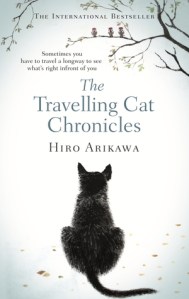 The Travelling Cat Chronicles by Hiro Arikawa (2017): This is the fable-like story of Satoru, a single man in his early thirties, and his cat, Nana (named for the shape of his tail, which resembles a Japanese 7). Satoru adopted Nana about five years ago when the cat, a local stray, was hit by a car. Now he needs to find a new owner for his beloved pet. No spoilers here, but really, there are only so many reasons why a young man would need to do this, and readers will likely work it out well before the “big reveal” over halfway through. We bounce between Nana’s perspective, which is quite cutely rendered, and third-person flashbacks to Satoru’s sad history. The author spells out and overstates everything. It’s pretty emotionally manipulative. Pet owners will appreciate Nana’s humor and loyalty (“I’m your cat till the bitter end!”), but I felt like I was being brow-beaten into crying – though I didn’t in the end.
I Could Pee on This, Too: And More Poems by More Cats by Francesco Marciuliano (2016): Not a single memorable poem or line in the lot. Seriously. Stick with the original.
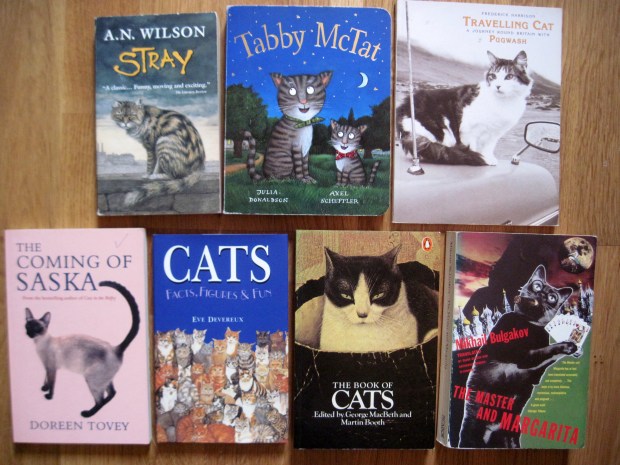
My next batch of cat books. Maybe I’ll try to write them up for a Christmas-tide treat.
Whether you are a cat lover or not, do any of these books appeal?
Cats I’ve Encountered in Books Recently
Even when it’s not a book that’s specifically about cats, cats often seem to turn up in my reading. Maybe it’s simply that I look out for them more since I became a cat owner several years ago. Here are some of the quotes, scenes or whole books featuring cats that I’ve come across this year.
Cats real and imaginary
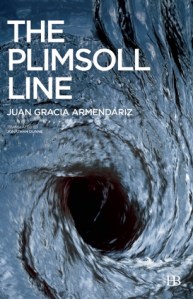 Readers see some of the action from the perspective of Polanski the cat in The Plimsoll Line by Juan Gracia Armendáriz. While the feline might not grasp the emotional importance of the scenes he witnesses, we do. “The cat narrows its eyes when it sees the man lean against the window frame, overcome by a fit of sobbing that has nothing to do with sadness, or sorrow, but with an internal crumbling, like the collapse of a wave breaking on the shore of his skin and sweeping away his memory.”
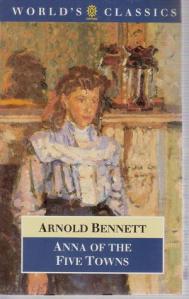 From Anna of the Five Towns by Arnold Bennett: “Anna was disturbed by the arrival at the front door of the milk-girl. Alternately with her father, she stayed at home on Sunday evenings, partly to receive the evening milk and partly to guard the house. The Persian cat with one ear preceded her to the door as soon as he heard the clatter of the can. The stout little milk-girl dispensed one pint of milk into Anna’s jug, and spilt an eleemosynary supply on the step for the cat. ‘He does like it fresh, Miss,’ said the milk-girl, smiling at the greedy cat, and then, with a ‘Lovely evenin’,’ departed down the street, one fat red arm stretched horizontally out to balance the weight of the can in the other.”
From Kilvert’s Diary by Francis Kilvert: “Toby [the cat] sits before the fire on the hearthrug and now and then jumps up on my knee to be stroked. The mice scurry rattling round the wainscot and Toby darts off in great excitement to listen and watch for them.” (18 Oct. 1870)
 The Wind-Up Bird Chronicle by Haruki Murakami starts with a missing cat. “So now I had to go cat hunting. I had always liked cats. And I liked this particular cat. But cats have their own way of living. They’re not stupid. If a cat stopped living where you happened to be, that meant it had decided to go somewhere else. If it got tired and hungry, it would come back. Finally, though, to keep Kumiko happy, I would have to go looking for our cat. I had nothing better to do.”
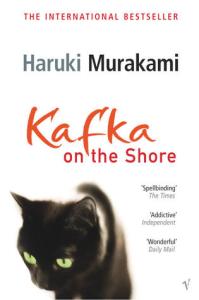
I’m also 64 pages into Murakami’s Kafka on the Shore; in Chapter 6 we meet another seeker of lost cats, Nakata, when he has an absurd conversation with a black cat named Otsuka. (Perhaps he’s the creature pictured on the cover of my paperback?)
Picture books
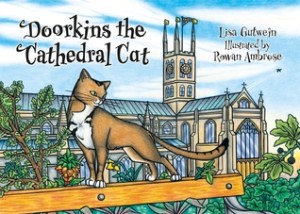 Doorkins the Cathedral Cat by Lisa Gutwein: This sweet children’s book tells the true story of how a stray cat wandered into London’s Southwark Cathedral in 2008 and gradually made it her home. It proceeds day by day through one week to give a helpful idea of the range of activities the cathedral hosts – everything from a wedding to a regular Sunday service – but also showcases important events like visits from the Bishop and the Queen. In every case we get to see how Doorkins insinuates herself into proceedings. I liked how the bright colors of the illustrations echo the cathedral’s stained glass, and appreciated the photo gallery and extra information at the end. The author, a doctor whose husband is a verger at the cathedral, and illustrator Rowan Ambrose, a dentist, met at King’s College London, where I used to work.
The Church Mice in Action by Graham Oakley: My third from the series, I think. The mice suggest to the parson’s sister that she might enter Sampson into cat shows to earn enough to repair the church roof. They then do their best to rig the results, but couldn’t have predicted the consequences. I loved the late summer/onset of autumn atmosphere.
On the extreme reluctance to remove a cat from one’s lap.
 From The Tenant of Wildfell Hall by Anne Brontë: Miss Millward, Eliza’s older sister and the vicar’s daughter, when he passes her a ball of wool that’s rolled under the table – “Thank you, Mr. Markham. I would have picked it up myself, only I did not want to disturb the cat.”
From the essay “On Cat-Worship” in George Mikes’s How to Be Decadent: “Having joked for decades about how the English worship the cat, like the ancient Egyptians only more so, I have fallen for the cat myself. It has become my sacred animal. … I have been late for appointments, failed to go shopping and missed planes because Tsi-Tsa was sitting on my lap.”
Other cat-themed reading on the horizon:
- The Cat Who Stayed for Christmas by Cleveland Amory, borrowed from the public library, should make a good pre-holiday read.
- I’m keen to get hold of The Travelling Cat Chronicles by Hiro Arikawa, which comes out in November.
- My husband gave me a copy of Tom Cox’s The Good, the Bad and the Furry for my birthday.
- I have Jason Hazeley’s The Fireside Grown-Up Guide to the Cat and Thomas McNamee’s The Inner Life of Cats on my Kindle.
- It’s not particularly geared towards cat lovers (see Eleanor’s review), but it is called My Cat Yugoslavia by Pajtim Statovci and is also on my Kindle.
- I have copies of Cats in May by Doreen Tovey plus a couple of anthologies of cat-related writing picked up in Hay-on-Wye.
 Bookish Beck = Rebecca Foster. American transplant to England. Freelance proofreader and book reviewer.
 Bookish Beck