Three on a Theme (Valentine’s Day): “Love” Books by Amy Bloom, George Mackay Brown & Hilary Mantel
Every year I say it: I’m really not a Valentine’s Day person and yet it’s become a tradition to put together a themed post featuring one or more books with “Love” or “Heart” in the title. This is the tenth year in a row, in fact – after 2017, 2018, 2019, 2020, 2021, 2022, 2023, 2024 and 2025. As you might expect, none of the three below contains a straightforward love story. The relationships portrayed tend to be unequal, creepy or doomed, but the solid character work and use of setting and voice was enough to keep me engaged with all of the books.
Love Invents Us by Amy Bloom (1997)
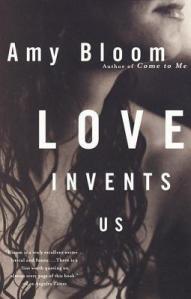 I’ve found Bloom’s short stories more successful than her novels. This is something of a halfway house: linked short stories (one of which was previously published in Come to Me; another that gives the title line to her 2000 collection A Blind Man Can See How Much I Love You) about Elizabeth Taube. When we first meet her on Long Island in the 1960s, she’s a rebellious and sexually precocious Jewish girl; by the time we’ve journeyed through several decades of vignettes, she’s a flighty and psychologically scarred single mother. Stories of her Lolita-esque attractiveness to grown salesmen and teachers, her shoplifting, her casual work for elderly African American Mrs. Hill, and her great love for Horace, nicknamed Huddie, a Black basketball player, are in the first person. The longer second part – about the aftermath of her physical affair with Huddie and her ongoing emotional entanglement with her English teacher, Max Stone – is in the third person yet feels more honest. Liz seems like bad news for everyone she meets. Bloom shows us some of the reasons for what she does, but I still couldn’t absolve her protagonist. I’d also reverse the title: We Invent Love. Liz is responsible for irrevocably altering two lives besides her own based on what she needs to feel secure. This is very much Lorrie Moore territory, but Moore leaves less of a bitter taste. (Secondhand – Community Furniture Project)
A Calendar of Love and Other Stories by George Mackay Brown (1967)
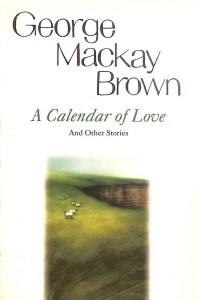 The title story opens a collection steeped in the landscape and history of Orkney. Each month we check in with three characters: Jean, who lives with her ailing father at the pub they run; and her two very different suitors, pious Peter and drunken Thorfinn. When she gives birth in December, you have to page back to see that she had encounters with both men in March. Some are playful in this vein or resemble folk tales: a boy playing hooky from school, a distant cousin so hapless as to father three bairns in the same household, and a rundown of the grades of whisky available on the islands. Others with medieval time markers are overwhelmingly bleak, especially “Witch,” about a woman’s trial and execution – and one of two stories set out like a play for voices. I quite liked the flash fiction “The Seller of Silk Shirts,” about a young Sikh man who arrives on the islands, and “The Story of Jorfel Hayforks,” in which a Norwegian man sails to find the man who impregnated his sister and keeps losing a crewman at each stop through improbable accidents. This is an atmospheric book I would have liked to read on location, but few of the individual stories stand out. (Secondhand – Community Furniture Project, Newbury)
An Experiment in Love by Hilary Mantel (1995)
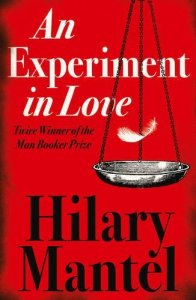 Mantel is best remembered for the Wolf Hall trilogy, but her early work includes a number of concise, sharp novels about growing up in the north of England. Carmel McBain attends a Catholic school in Manchester in the 1960s before leaving to study law at the University of London in 1970. In lockstep with her are a couple of friends, including Karina, who is of indeterminate Eastern European extraction and whose tragic Holocaust family history, added to her enduring poverty, always made her an object of pity for Carmel’s mother. But Karina as depicted by Carmel is haughty, even manipulative, and over the years their relationship swings between care and competition. As university students they live on the same corridor and have diverging experiences of schoolwork, romance, and food. “Now, I would not want you to think that this is a story about anorexia,” Carmel says early on, and indeed, she presents her condition as more like forgetting to eat. But then you recall tiny moments from her past when teachers and her mother shamed her for eating, and it’s clear a seed was sown. Carmel and her friends also deal with the results of the new-ish free love era. This is dark but funny, too, with Carmel likening roast parsnips to “ogres’ penises.” Further proof, along with Every Day Is Mother’s Day, that it’s well worth exploring authors’ back catalogue. (Public library)
Plus a DNF:
 Unexpected Lessons in Love by Bernardine Bishop (2013): I loved Bishop’s The Street, and this posthumous novel initially drew me in with its medical detail (two friends who both had stoma operations) and the exploration of different forms of love – romantic, parental, grandparental – before starting to feel obvious (two adoptions, one historical and one recent), maudlin and overlong. With some skimming, I made it to page 120. (Secondhand – Awesomebooks.com)
Other relevant reading on the go:
I would have tried spinning this one into another thematic trio, but ran out of time…
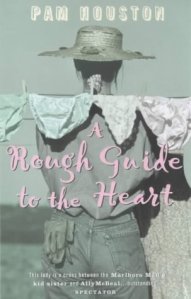 A Rough Guide to the Heart by Pam Houston (1999): A mix of personal essays and short travel pieces. The material about her dysfunctional early family life, her chaotic dating, and her thrill-seeking adventures in the wilderness is reminiscent of the highly autobiographical Waltzing the Cat. Amusingly, this has a previous price label from Richard Booth’s Bookshop in Hay-on-Wye, where it was incorrectly classed as Romance Fiction – one could be excused the mistake based on the title and cover! (Secondhand – Community Furniture Project)
And three books about marriage…
 The Honesty Box by Lucy Brazier – A pleasant year’s diary of rural living and adjusting to her husband’s new diagnosis of neurodivergence.
- Strangers by Belle Burden – A high-profile memoir about her husband’s strange and marriage-ending behaviour (his affair was only part of it) during the 2020 lockdown.
- Mrs. Bridge by Evan S. Connell – For Literary Wives Club in March. I’m in the early pages but it seems comparable to Richard Yates.
Adventures in Rereading: The History of Love by Nicole Krauss for Valentine’s Day
Special Valentine’s edition. Every year I say I’m really not a Valentine’s Day person and yet manage a themed post featuring one or more books with “Love” or “Heart” in the title. This is the ninth year in a row, in fact – after 2017, 2018, 2019, 2020, 2021, 2022, 2023, and 2024!
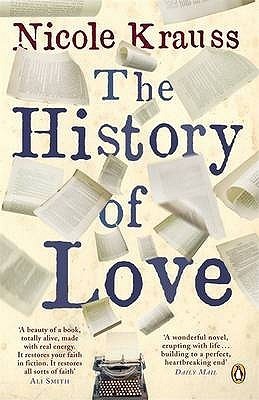 Leopold Gursky is an octogenarian Holocaust survivor, locksmith and writer manqué; Alma Singer is a misfit teenager grieving her father. What connects them? A philosophical novel called The History of Love, lost for years before being published in Spanish. Alma’s late father saw it in a bookshop window in Buenos Aires and bought it for his love. They adored it so much they named their daughter after the heroine. Now his widow is translating it into English on commission for a covert client. Leo and Alma’s distinctive voices, wry but earnest, really make this sparkle. Alma’s sections are numbered fragments from a diary and there are also excerpts from the book within the book. My only critique would be that she sounds young for her age; her precocity makes her seem closer to 10 than 15. But her little brother Bird, who thinks he may be the messiah, is a delight. The array of New York City locales includes a life drawing class, a record office, and a Central Park bench. A gentle air of mystery circulates as we work out who Leo’s son is and how Alma tracks down the author. It’s a bittersweet story that insists on love as an equivalent to loss. Complex but accessible, bookish and heartfelt, it’s one to recommend to my book club in the future. (Little Free Library)
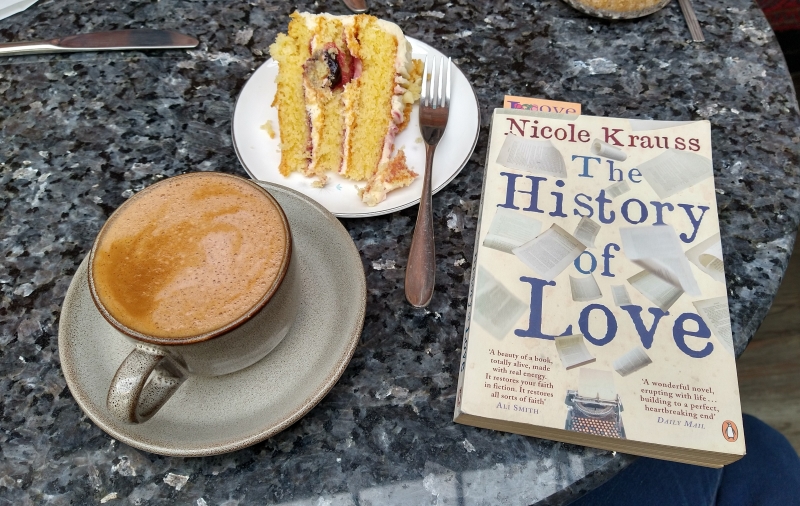
Finishing my reread during a coffee date in Hungerford this morning.
My original rating (2011):
When I first read this, I mostly considered it in comparison to Krauss’s former husband Jonathan Safran Foer’s work. (I’ve long since read everything by both of them.) I noted then that it
has a lot of elements in common with Everything is Illuminated, such as a preoccupation with Eastern European and Jewish ancestry, quirky methods of narration including multiple voices, and a sweet humour that lies alongside such heart-rending stories of family and loss that tears are never far from your eyes. Leo Gursky and Alma Singer are delightful and distinct characters. I wasn’t sure about the missing/plagiarized/mistaken The History of Love itself; the ruined copies, the different translations, the way the manuscript was constantly changing hands – all this was intriguing, but the book itself was a postmodern jumble of magic realism and pointless meanderings of thought.
Dang, I was harsh! But admirably pithy about the plot. It’s intriguing that I’ve successfully reread Krauss but failed with Foer when I attempted Everything is Illuminated again in 2020. Reading the first, 9/11-set section of Confessions by Catherine Airey, I’ve also been recalling his Extremely Loud and Incredibly Close and thinking it probably wouldn’t stand up to a reread either. I suspect I’d find it mawkish, especially with its child narrator. Alma evades that trap, perhaps by being that little bit older, though she sounds young because of how geeky and sheltered she is.
Three “Love” or “Heart” Books for Valentine’s Day: Ephron, Lischer and Nin
Every year I say I’m really not a Valentine’s Day person and yet put together a themed post featuring books that have “Love” or a similar word in the title. This is the eighth year in a row, in fact (after 2017, 2018, 2019, 2020, 2021, 2022, and 2023)! Today I’m looking at two classic novellas, one of them a reread and the other my first taste of a writer I’d expected more from; and a wrenching, theologically oriented bereavement memoir.
Heartburn by Nora Ephron (1983)
I’d already pulled this out for my planned reread of books published in my birth year, so it’s pleasing that it can do double duty here. I can’t say it better than my original 2013 review:
The funniest book you’ll ever read about heartbreak and betrayal, this is full of wry observations about the compromises we make to marry – and then stay married to – people who are very different from us. Ephron readily admitted that her novel is more than a little autobiographical: it’s based on the breakdown of her second marriage to investigative journalist Carl Bernstein (All the President’s Men), who had an affair with a ludicrously tall woman – one element she transferred directly into Heartburn.
Ephron’s fictional counterpart is Rachel Samstad, a New Yorker who writes cookbooks or, rather, memoirs with recipes – before that genre really took off. Seven months pregnant with her second child, she has just learned that her second husband is having an affair. What follows is her uproarious memories of life, love and failed marriages. Indeed, as Ephron reflected in a 2004 introduction, “One of the things I’m proudest of is that I managed to convert an event that seemed to me hideously tragic at the time to a comedy – and if that’s not fiction, I don’t know what is.”
As one might expect from a screenwriter, there is a cinematic – that is, vivid but not-quite-believable – quality to some of the moments: the armed robbery of Rachel’s therapy group, her accidentally flinging an onion into the audience during a cooking demonstration, her triumphant throw of a key lime pie into her husband’s face in the final scene. And yet Ephron was again drawing on experience: a friend’s therapy group was robbed at gunpoint, and she’d always filed the experience away in a mental drawer marked “Use This Someday” – “My mother taught me many things when I was growing up, but the main thing I learned from her is that everything is copy.” This is one of celebrity chef Nigella Lawson’s favorite books ever, for its mixture of recipes and rue, comfort food and folly. It’s a quick read, but a substantial feast for the emotions.
 Sometimes I wonder why I bother when I can’t improve on reviews I wrote over a decade ago (see also another upcoming reread). What I would add now, without disputing any of the above, is that there’s more bitterness to the tone than I’d recalled, even though Ephron does, yes, play it for laughs. But also, some of the humour hasn’t aged well, especially where based on race/culture or sexuality. I’d forgotten that Rachel’s husband isn’t the only cheater here; pretty much every couple mentioned is currently working through the aftermath of an affair or has survived one in the past. In one of these, the wife who left for a woman is described not as a lesbian but by another word, each time, which felt unkind rather than funny.
Still, the dialogue, the scenes, the snarky self-portrayal: it all pops. This was autofiction before that was a thing, but anyone working in any genre could learn how to write readable content by studying Ephron. “‘I don’t have to make everything into a joke,’ I said. ‘I have to make everything into a story.’ … I think you often have that sense when you write – that if you can spot something in yourself and set it down on paper, you’re free of it. And you’re not, of course; you’ve just managed to set it down on paper, that’s all.” (Little Free Library)
My original rating (2013): 
My rating now:
Stations of the Heart: Parting with a Son by Richard Lischer (2013)
“What we had taken to be a temporary unpleasantness had now burrowed deep into the family pulp and was gnawing us from the inside out.” Like all life writing, the bereavement memoir has two tasks: to bear witness and to make meaning. From a distance that just happens to be Mary Karr’s prescribed seven years, Lischer opens by looking back on the day when his 33-year-old son Adam called to tell him that his melanoma, successfully treated the year before, was back. Tests revealed that the cancer’s metastases were everywhere, including in his brain, and were “innumerable,” a word that haunted Lischer and his wife, their daughter, and Adam’s wife, who was pregnant with their first child.
 The next few months were a Calvary of sorts, and Lischer, an emeritus professor at Duke Divinity School, draws deliberate parallels with the biblical and liturgical preparations for Good Friday that feel appropriate for this Ash Wednesday. Lischer had no problem with Adam’s late-life conversion from Protestantism to Catholicism, whose rites he followed with great piety in his final summer. He traces Adam and Jenny’s daily routines as well as his own helpless attendance at hospital appointments. Doped up on painkillers, Adam attended one last Father’s Day baseball game with him; one last Fourth of July picnic. Everyone so desperately wanted him to keep going long enough to meet his baby girl. To think that she is now a young woman and has opened all the presents Adam bought to leave behind for her first 18 birthdays.
The facts of the story are heartbreaking enough, but Lischer’s prose is a perfect match: stately, resolute and weighted with spiritual allusion, yet never morose. He approaches the documenting of his son’s too-short life with a sense of sacred duty: “I have acquired a new responsibility: I have become the interpreter of his death. God, I must do a better job. … I kissed his head and thanked him for being my son. I promised him then that his death would not ruin my life.” This memoir brought back so much about my brother-in-law’s death from brain cancer in 2015, from the “TEAM [ADAM/GARNET]” T-shirts to Adam’s sister’s remark, “I never dreamed this would be our family’s story.” We’re not alone. (Remainder book from the Bowie, Maryland Dollar Tree) 
A Spy in the House of Love by Anaïs Nin (1954)
 I’d heard Nin spoken of in the same breath as D.H. Lawrence, so thought I might similarly appreciate her because of, or despite, comically overblown symbolism around sex. I think I was also expecting something more titillating? (I guess I had this confused for Delta of Venus, her only work that would be shelved in an Erotica section.) Many have tried to make a feminist case for this novella about Sabina, an early liberated woman in New York City who has extramarital sex with four other men who appeal to her for various not particularly good reasons (the traumatized soldier whom she comforts like a mother; the exotic African drummer – “Sabina did not feel guilty for drinking of the tropics through Mambo’s body”). She herself states, “I want to trespass boundaries, erase all identifications, anything which fixes one permanently into one mould, one place without hope of change.” The most interesting aspect of the book was Sabina’s questioning of whether she inherited her promiscuity from her father (it’s tempting to read this autobiographically as Nin’s own father left the family for another woman, a foundational wound in her life).
Come on, though, “fecundated,” “fecundation” … who could take such vocabulary seriously? Or this sex writing (snort!): “only one ritual, a joyous, joyous, joyous impaling of woman on a man’s sensual mast.” I charge you to use the term “sensual mast” wherever possible in the future. (Secondhand – Oxfam, Newbury) 
But hey, check out my score for the Faber Valentine’s quiz!
Three on a Theme for Valentine’s Day: “Love” Short Story Collections
Even though I’m really not a Valentine’s Day sort of person*, this is the seventh year in a row that I’ve put together a themed post featuring books that have “Love” or a similar word in the title in the run-up to mid-February (2017, 2018, 2019, 2020, 2021 and 2022).
I also don’t generally read short story collections if it’s not September – I seem to need that alliterative crutch to get to a dozen or so of them – but my “Birds” trio and these three were so great that I had to wonder why I don’t read them all year round.
Are these love stories? Some, to an extent. But also loss stories. Loneliness stories. Hatred stories. Abandonment stories. A few even verge on horror. In other words, realistic slivers of life. And as different as Carver’s lean, masculine tales of addiction and failure might seem from Bloom’s wry scenes of family life and Dunmore’s intimate pictures of isolation and mental illness, I found that all three resonated with each other. As for character detail, Dunmore’s “fat men” echo the overweight male protagonist in Bloom’s first story cycle.
Where the God of Love Hangs Out by Amy Bloom (2010)
One of these stories, “Sleepwalking,” was familiar to me because it is reprinted from her 1993 collection, Come to Me, and another two were originally published in 2000’s A Blind Man Can See How Much I Love You – isn’t she great at titles?! She excels at first lines, too: some from this volume are “At two o’clock in the morning, no one is to blame,” “William has gout,” “Clare can’t walk,” “No power” and “I had always planned to kill my father.”
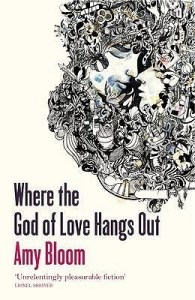 The book contains two quartets of linked stories and four stand-alone stories. The first set is about Clare and William, whose dynamic shifts from acquaintances to couple-friends to lovers to spouses. Bloom, a former psychotherapist, is interested in tracking how they navigate these changes over the years, and does so by switching between first- and third-person narration and adopting a different perspective for each story. She does the same with the four stories about Lionel and Julia, a Black man and his white stepmother. Over the course of maybe three decades, we see the constellations of relationships each one forms, while the family core remains. She also includes sexual encounters between characters who are middle-aged and older – when, according to stereotypes, lust should have been snuffed out.
Of the unlinked stories, the most memorable was “By-and-By,” a distressingly unemotional account of the ripple effects of a serial killer’s actions as seen by a victim’s roommate. I also loved the title story, which appears last. An older man and his daughter-in-law meet twice, by accident, in small-town eateries, the one wanting to come clean about a troubled past and the other wanting to embark on a new and surprising romance. This one reminded me of Richard Russo and early John Irving, while the collection as a whole would suit fans of Julia Glass, Tessa Hadley, Sue Miller, Lorrie Moore and Elizabeth Strout. (Secondhand – Bookbarn International)
What We Talk about When We Talk about Love by Raymond Carver (1981)
Such a famous title that it has spawned countless imitators, two of which I’ve even read (What We Talk about When We Talk about God by Rob Bell and What We Talk about When We Talk about Anne Frank by Nathan Englander). It turns out I had Carver confused with John Cheever, so I was expecting gritty stories of alcoholism in the 1950s Midwest. Yes to the alcohol abuse, but Carver was from the Pacific Northwest and was writing in the 1980s. A number of his protagonists are drunk, deadbeat dads who have been kicked out and make a scene to get back at their wives. Others are more passive, stuck in suburban ennui. Grown men fear turning into their fathers (“Sacks”). Ultimatums are defused (“Everything Stuck to Him”) and custody arrangements fought over (the Solomonic fable “Popular Mechanics”).
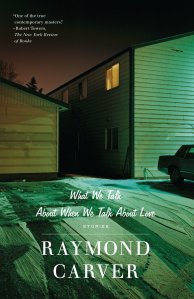 The declarative simplicity of the prose, and the interest in male activities like gambling, hunting and fishing, can’t fail to recall Ernest Hemingway, yet I warmed to Carver much more than Hem. Two of these stories struck me as feminist for how they expose nonchalant male violence towards women; elsewhere I spotted tiny gender-transgressing details (a man who knits, for instance). In “Tell the Women We’re Going,” two men escape their families to play pool and drink, then make a fateful decision on the way home. I don’t think I’ve been as shocked by the matter-of-fact brutality of a short story since “The Lottery.” My favourite was also chilling, “So Much Water So Close to Home.” Both reveal how homosocial peer pressure leads to bad behaviour; this was toxic masculinity before we had that term.
Many of the stories are only 3–8 pages long, such that 17 fit into a slender volume. They’re about half and half first- and third-person, sometimes with speech marks and sometimes not. At 15 pages, the title story is the longest and a great one. Two couples are having pre-dinner drinks and discussing types of love – physical, spiritual and so on. The POV character mostly conveys monologues by his friend Mel, a cardiologist (of course he would be a heart doctor!), comparing the obsessive love of his first wife’s ex, who turned out to be a stalker, and the mature devotion he saw in an elderly couple at his hospital after a horrific car accident. There were a few flippant or less memorable stories in here, but I’m impressed enough to seek out more of Carver’s work, poetry or prose. (Secondhand – Books for Amnesty, York)
Love of Fat Men by Helen Dunmore (1997)
This was an early work by Dunmore, who was so prolific in her two-decade career that I still come across titles of hers that I’ve never heard of before. I don’t think a book by this title would get published nowadays, but I won’t hold it against her. It is literal in that Ulli, a recurring character in 10 of these 19 stories, finds comfort in sleeping with larger men. I wondered what so captured Dunmore’s imagination about Scandinavia: you can work out that Ulli is from Finland and most of the stories are set there or in nearby countries.
 Every other story returns to Ulli, but the fragments of her life miss out the connective tissue: we suspect she’s pregnant as a teen, but don’t learn what she chose to do about it; we witness some dysfunctional scenes and realize she’s estranged from her family later on, but don’t find out if there was some big bust-up that prompted it. She comes across as a loner and a nomad, apt to be effaced by stronger personalities. In “The Ice Bear,” she’s on a ferry from Sweden back to Finland and can’t escape the prattle of a male missionary. In “A Question of Latitude” she’s out for a restaurant meal with friends, one of whom diagnoses her thus: “Nothing really affects you, does it? You just smile and put it out of your mind. And you cut people out of your life the same way, when you’ve finished with them.”
Whereas in the Bloom the interconnected stories are the strongest, here my preference was for the others. “The Bridge Painter” is about a man who leaves a peculiar calling card at each bridge he visits. “Annina” paints a woman with a questionable grasp on reality after the loss of a child. Best of all is probably “North Sea Crossing,” which contrasts two father-and-son pairs. If you only know Dunmore from novels, I can recommend her poetry and short stories, too. (Secondhand – Bas Books, Newbury)
All three:
Try all of these authors right away if you haven’t already!
*A daytrip into London on Thursday was our Valentine’s gift to selves. We toured the Tower of London and the Science Museum (the Wellcome medical collections for me) and had an exceptional late lunch at Dishoom (starters and drinks pictured below). Tonight we’ll be having chocolate prune pots in front of The Bookshop Band’s love-themed livestream concert.

Three on a Theme for Valentine’s Day: “Love” Books by Natalie Diaz, Maile Meloy and Jane Smiley
This post is an annual tradition for me, somehow.* Love, whether erotic, romantic or familial, turns up in the titles of these three works by women writers: poems, short stories and a novella.
Postcolonial Love Poem by Natalie Diaz (2020)
Diaz, raised on a Mojave reservation in California, won a Pulitzer Prize for this honey-thick exploration of queer Native American identity. There are lustful moments aplenty here—
My lover comes to me like darkfall—long,
and through my open window. Mullion, transom. […]
I keep time on the hematite clocks of her shoulders.
(from “Like Church”)
 —but the mineral-heavy imagery (“the agate cups of your palms …the bronzed lamp of my breast”) is so weirdly archaic and the vocabulary so technical that I kept thinking of the Song of Solomon. Not that there’s anything wrong with that; it’s just not the model I expected to find.
So I ended up preferring the forthright political poems about contemporary Native American life. Police shootings, pipeline protests: it’s a fact that her people are disproportionately persecuted (see “American Arithmetic”). Her brother’s drug abuse and mental illness also form a repeating subject (e.g., “It Was the Animals”).
The collection is as much of a love poem to land as it is to a woman, with water bodies described as affectionately as female bodies. “The Colorado River is the most endangered river in the United States—also, it is a part of my body” is the opening line of “The First Water Is the Body”; see also “exhibits from the American Water Museum.”
My favourite single poem, “If I Should Come Upon Your House Lonely in the West Texas Desert,” is sexy but also, charmingly, features echoes of “Goldilocks and the Three Bears”:
I will swing my lasso of headlights
across your front porch,
let it drop like a rope of knotted light
at your feet.
While I put the car in park,
you will tie and tighten the loop
of light around your waist—
and I will be there with the other end
wrapped three times
around my hips horned with loneliness.
[…]
I will lie down in you.
Eat my meals at the red table of your heart.
Each steaming bowl will be, Just right.
I will eat it all up,
break all your chairs to pieces.
(New purchase, Awesomebooks.com) 
Half in Love by Maile Meloy (2002)
Meloy’s was a new name for me when I picked this up as part of a bargain secondhand book haul last year, but she’s actually published 10 books and is esteemed in literary circles; Ann Patchett even dedicated her latest release, These Precious Days, to her.
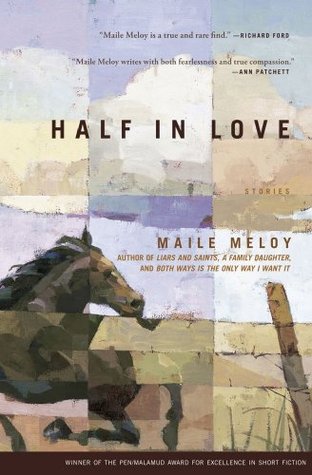 Meloy is from Montana and most of the 14 stories in this, her debut collection, are set in the contemporary American West among those who make their living from the outdoors, diving to work on hydroelectric dams or keeping cattle and horses. However, one of the more memorable stories, “Aqua Boulevard,” is set in Paris, where a geriatric father can’t tamp down his worries for his offspring.
The few historical stories have a melancholy air, with protagonists whose star has faded. There’s the brief, touching portrait of an outmoded career in “The Ice Harvester” and the secondhand reminiscences of being in late-colonial diplomatic service in the Middle East in “Last of the White Slaves”; “Red” is about an American soldier stationed in London during the Second World War.
Crime and its consequences recur. I loved the opening story, “Tome,” about a lawyer whose client wants her to keep in touch after he goes to jail. Teenage girls are the title characters in a couple of stories; “Ranch Girl” is in the second person. “Kite Whistler Aquamarine” is a heartbreaker about a filly born premature one winter. “Paint” was the standout for me: it’s pretty terrifying what a wife’s temporary attitude of neglect leads to when her luckless husband undertakes some DIY.
As is usual with a collection, a few of the stories left little impression on me. But there’s sufficient range and depth here to induce me to seek out more of Meloy’s work. I can recommend this to readers of Claire Boyles, David Guterson, Lily King, Jane Smiley (see below!) and David Vann. (Secondhand purchase, 2nd & Charles) 
Favourite passages:
“Be interesting in your twenties,” Suzy says. “Otherwise you’ll want to do it in your thirties or forties, when it wreaks all kinds of havoc, and you’ve got a husband and kids.”
Eugénie invited my husband to Greece every summer because she wanted him to publish her memoir. She had lived a remarkable life but didn’t have a remarkable book, and it dragged through slow ghostwritten revisions. Every year, at work in the hot city, I thought of blue water and white bougainvillea and forgot how exhausting it was to be her guest, to stay in favor and say the right things. So each summer we would arrive, look at the new draft, give careful suggestions that would not be taken, and find ourselves on the terrace waiting for her to trip mercifully off to bed.
Ordinary Love by Jane Smiley (1990)
 This is one of Smiley’s earlier works and feels a little generic, like she hadn’t yet developed a signature voice or themes. One summer, a 52-year-old mother of five prepares for her adult son Michael’s return from India after two years of teaching. His twin brother, Joe, will pick him up from the airport later on. Through conversations over dinner and a picnic in the park, the rest of the family try to work out how Michael has changed during his time away. “I try to accept the mystery of my children, of the inexplicable ways they diverge from parental expectations, of how, however much you know or remember of them, they don’t quite add up.” The narrator recalls her marriage-ending affair and how she coped afterwards. Michael drops a bombshell towards the end of the 91-page novella. Readable yet instantly forgettable, alas. I bought it as part of a dual volume with Good Will, which I don’t expect I’ll read. (Secondhand purchase, Bookbarn International)
If you read just one … It’s got to be Postcolonial Love Poem, the most Eros-appropriate of the three by far.
*I’m really not a Valentine’s Day person, yet this is the sixth year in a row that I’ve put together a themed post featuring books that have “Love” or a similar word in the title in the run-up to mid-February (2017, 2018, 2019, 2020, and 2021).
Read any books about love lately?
Three on a Theme: “Heart”
From a vibrant novel about trauma and second chances to a cultural history of our knowledge of the organ and its symbols, via a true story of the effects of being struck by lightning, what might these three disparate books have to tell us about the human heart on Valentine’s Day?
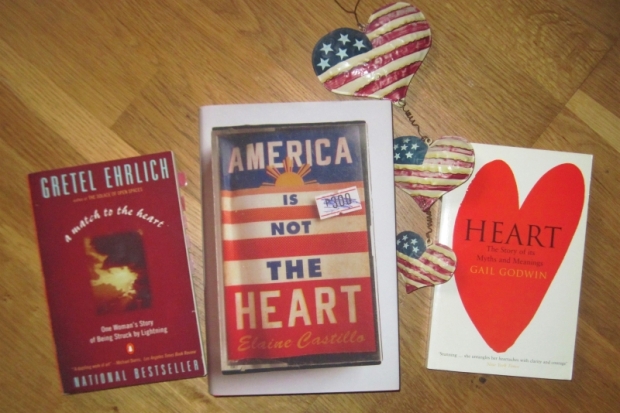
America Is Not the Heart by Elaine Castillo (2018)
This was criminally overlooked a few years ago, though I do remember Naomi F. featuring it on The Writes of Womxn. Set in the early 1990s in the Filipino immigrant neighborhoods of the Bay Area in California, it throws you into an unfamiliar culture at the deep end. There are lots of different ethnicities mentioned, and snippets of various languages (not just Tagalog, the one I knew of previously) run through the text, sometimes translated but often not. It’s a complex, confident debut novel that references episodes from the history of the Philippines of which I was mostly ignorant – genocide and reforms, dictatorship and a Marxist resistance.
 Geronima is a family name for the De Veras; not many realize that Hero, in her mid-thirties and newly arrived in the USA as an undocumented immigrant, and her cousin Roni, her uncle Pol’s seven-year-old daughter, share the same first name. Hero is estranged from her wealthy parents: they were friendly with the Marcos clan, while she ran away to serve as a doctor in the New People’s Army for 10 years. We gradually learn that she was held in a prison camp for two years and subjected to painful interrogations. Still psychologically as well as physically marked by the torture, she is reluctant to trust anyone. She stays under the radar, just taking Roni to and from school and looking after her while her parents are at work.
When Roni’s mother Paz, a medical professional, turns to traditional practices for help with Roni’s extreme eczema, Hero takes Roni to the Boy’s BBQ & Grill / Mai’s Hair and Beauty complex to see Adela Cabugao, a Filipina faith healer. The restaurant becomes a refuge for Hero and Roni – a place where they hang out with Adela’s granddaughter, Rosalyn, and her friends in the long hours Paz is away at her hospital jobs, eating and watching videos or reading Asian comics. Over the next few years Rosalyn introduces Hero to American holidays and customs. Castillo is matter-of-fact about Hero’s hook-ups with guys and girls but never strident about a bisexuality label. Hero pursues sex but remains wary of romance.
The everydayness of life here – car rides, cassette tapes, job applications, foil trays of food – contrasts with too-climactic memories. Though the plot can meander, there’s forward motion in that Hero shifts from a survival mindset into an assurance of safety that allows her to start rebuilding her life. I loved the 1990s as a setting. The characters shine and the dialogue (not in speech marks) feels utterly authentic in this fresh immigration story. My only minor disappointment was that second-person narration does not recur beyond a chapter about Paz and one about Rosalyn. The title riffs on a classic of Filipino American literature, America Is in the Heart (1946) by Carlos Bulosan, though I didn’t explore that comparison; it’s a novel that opens up real Google wormholes, should you take up the challenge. Castillo’s vibrant, distinctive voice reminded me of authors from Chimamanda Ngozi Adichie to Viet Thanh Nguyen. Please tell me she has another book in the works.
Favorite line: “Baggage means no matter how far you go, no matter how many times you immigrate, there are countries in you you’ll never leave.”
Words about the heart:
“Hero had no truck with people for whom the heart was a dreamt-up thing, held together by divine saliva, a place where gods of love still made their beds. A heart was something you could buy on the street, six to a skewer … served with garlicky rice and atsuete oil.”
“Hero had never even felt ambivalence toward Pol … She’d only ever known what it felt like to love him, to keep the minor altar of admiration for him in her heart well cleaned, its flowers rotless and blooming. What she hadn’t known was that her love was a room, cavernous, and hate could enter there, too; curl up in the same bed, blanketed and sleep-warm.”
“May tinik sa puso. You know what that means? Like she has a fishbone in the heart. She’s angry about something.”
Source: Free from a neighbor
My rating: 
A Match to the Heart by Gretel Ehrlich (1994)
 In August 1991, as a summer thunderstorm approached her Wyoming ranch, Ehrlich was struck by lightning. Although she woke up in a pool of blood, her dogs stayed by her side and she was able to haul herself the quarter-mile home and call 911 before she collapsed completely. Being hit by so much electricity (10–30 million volts) had lasting effects on her health. Her heart rhythms were off and she struggled with fatigue for years to come. In a sense, she had died and come back to a subtly different life.
After relocating to the California coast, she shadows her cardiologist and observes open-heart surgery, attends the annual Lightning Strike and Electric Shock Conference, and explores a new liminal land of beaches and islands. Again and again, she uses metaphors of the bardo and the phoenix to make sense of the in-between state she perhaps still inhabits. Full-on medical but also intriguingly mystical, this is another solid memoir from a phenomenal author. I know of her more as a nature/travel writer (This Cold Heaven is fantastic) and have another of her books on the shelf, The Solace of Open Spaces.
Words about the heart:
“Above and beyond the drama of cardiac arrest, or the threat of it, is the metaphorical territory of the heart: if love desists, if passion arrests, if compassion stops circulating through the arteries of society, then civilization, such as it is, will stop.”
“The thoracic cavity must have been the place where human music began, the first rhythm was the beat of the heart, and after that initial thump, waltzes and nocturnes, preludes and tangos rang out, straight up through flesh and capillary, nerve ganglion and epidermal layer, resonating in sternum bone: it wasn’t light that created the world but sound.”
Source: Birthday gift (secondhand) a couple years ago
My rating:
Heart: The Story of Its Myths and Meanings by Gail Godwin (2001)
 I’d read one novel and one memoir by Godwin and was excited to learn that she had once written a wide-ranging study of the religious and literary meanings overlaid on the heart. While there are some interesting pinpricks here, the delivery is shaky: she starts off with a dull, quotation-stuffed, chronological timeline, all too thorough in its plod from the Epic of Gilgamesh to the Industrial Revolution. I quickly resorted to skimming and my eye alighted on Chinese philosophy (“True knowledge, Confucius taught, lies in the heart. He created and taught an ethical system that emphasized ‘human-heartedness,’ stressing balance in the heart”) and Dickens’s juxtaposition of facts and emotion in Hard Times.
Part Two, “Heart Themes in Life and Art,” initially seemed more promising in that it opens with the personal stories of her half-brother’s death in a murder–suicide and her mother’s fatal heart attack while driving a car, but I didn’t glean much from her close readings of, e.g. Joseph Conrad and Elizabeth Bowen. Still, I’ll keep this on the shelf as a reference book for any specific research I might do in the future.
Source: Bookbarn International on February 2020 visit (my last time there)
My rating: 
If you read just one … It’s got to be America Is Not the Heart. (Though, if you’re also interested in first-person medical accounts, add on A Match to the Heart.)
Three on a Theme: “Love”
I’m really not a Valentine’s Day person, yet this is the fifth year in a row that I’ve put together a themed post featuring books that have “Love” or a similar word in the title in the run-up to mid-February. (Here are the 2017, 2018, 2019 and 2020 posts. I’m also at work on a set of three “Heart” titles to post about on the 14th.) All three of the below books reflect, in their own ways, on how love perplexes and sustains us at different points in our lives.
The Emma Press Anthology of Love, ed. Rachel Piercey and Emma Wright (2018)
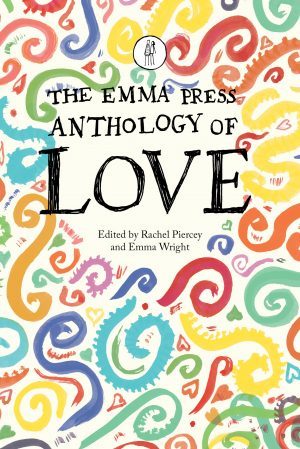 I read my first book from the publisher (Tiny Moons by Nina Mingya Powles) last summer and loved it, so when this one popped up in the Waterstones sale in January I snapped it up. Your average love poetry volume would trot out all the standards from Shakespeare’s sonnets to Carol Ann Duffy, whereas this features recent work from lesser-known contemporary poets. Of the 56 poets, I’d heard of just two before: Stephen Sexton, because I reviewed his collection, If All the World and Love Were Young, last year; and Rachel Long, because I was simultaneously reading her Costa Award-shortlisted debut, My Darling from the Lions.
What I most appreciated about the book is that it’s free of cliché. You can be assured there will be no ‘Roses are red, violets are blue’ simplicity of theme or style. It must be nigh on impossible to write about romantic and erotic love without resorting to the same old symbols, but here there is a fresh, head-turning metaphor every few pages. Rachel Plummer describes her first crush, on a video game character, in “Luigi.” Love is conveyed through endless cups of tea or practical skills that favor postapocalyptic survival; desire is sparked by the downy hair on a woman’s back or the deliberate way a lover pulls on a pair of tights. Anything might be a prelude to seduction: baking, preparing lab specimens, or taking a taster at the off-license.
There are no real duds here, but a couple of my overall favorites were “Note from Edinburgh” by Stav Poleg and “Not the Wallpaper Game” by Jody Porter (“her throat was a landmine grown over with roses / and her arms were the antidote to the sufferings of war”). I’m running low on poetry, so I’ve gone ahead and ordered three more original anthologies direct from The Emma Press (poems on the sea, illness, and aunts!). After all, it’s #ReadIndies month and I’m delighted to support this small publisher based in Birmingham.
Favorite lines:
I have a friend who always believed
love was like being touched
by a livewire or swimming
on her back in a lightning storm.
I want to tell her it’s homesickness,
how longing pulls us in funny ways.
(from “Falooda” by Cynthia Miller)
It’s today already
and we have only the rest of our lives.
Long may we dabble our feet in the clear Italian lakes.
Long may we mosey through the graveyards of the world.
(from “Romantic” by Stephen Sexton)
Love After Love by Ingrid Persaud (2020)
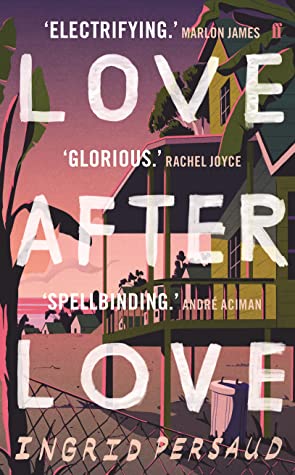 I saw the author read from this in November as part of a virtual Faber Live Fiction Showcase. My interest was then redoubled by the book winning the Costa First Novel Award. All three narrators – Betty, her son Solo, and their lodger Mr Chetan – are absolutely delightful, and I loved the Trini slang and the mix of cultures (for example, there is a Hindu temple where locals of Indian extraction go to practice devotion to the Goddess). Early on, I was reminded most, in voice and content, of Mr Loverman by Bernardine Evaristo.
But the lightness of Part One, which ends with a comically ill-fated tryst, soon fades. When Solo moves to New York City to make his own way in the world, he discovers that life is cruel and not everyone is good at heart. Indeed, my only hesitation in recommending this book is that it gets so very, very dark; the blurb and everything I had heard did not prepare me. If easily triggered, you need to know that there are many upsetting elements here, including alcoholism, domestic violence, self-harm, attempted suicide, sadomasochism, and gruesome murder. Usually, I would not list such plot elements for fear of spoilers, but it seems important to note that what seems for its first 100 pages to be such a fun, rollicking story becomes more of a somber commentary on injustices experienced by both those who leave Trinidad and those who stay behind.
A beautiful moment of reconciliation closes the story, but man, getting to that point is tough. The title speaks of love, yet this novel is a real heartbreaker. What that means, though, is that it makes you feel something. Not every author can manage that. So Persaud is a powerful talent and I would certainly recommend her debut, just with the above caveats.
Readalikes:
- Golden Child by Claire Adam
- A Little Life by Hanya Yanagihara
Love’s Work: A Reckoning with Life by Gillian Rose (1995)
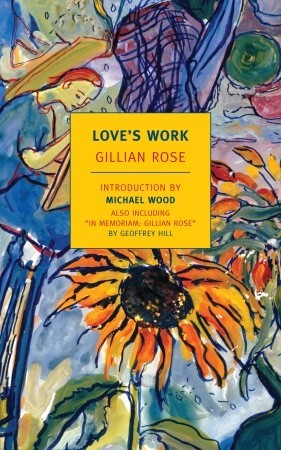 The English philosopher’s memoir-in-essays got on my radar when it was mentioned in two other nonfiction works I read in quick succession (one of my Book Serendipity incidents of late 2019): Notes Made while Falling by Jenn Ashworth and My Year Off by Robert McCrum. I had in mind that it was a cancer memoir, and while receiving a terminal diagnosis of ovarian cancer in her early forties is indeed an element, it is a wide-ranging short book that includes pen portraits of remarkable friends – an elderly woman, a man with AIDS – she met in New York City, musings on her Jewish family history and the place that religious heritage holds in her life, and memories of the contrast between the excitement of starting at Oxford and the dismay at her mother’s marriage to her stepfather (from whom she got her surname, having changed it by deed poll at age 16 from her father’s “Stone”) falling apart.
The mishmash of topics and occasional academic jargon (e.g., “These monitory anecdotes indicate, however, the anxiety of modernity” and “Relativism of authority does not establish the authority of relativism: it opens reason to new claimants”) meant I didn’t enjoy this as much as I’d expected to. 
Words about love:
“However satisfying writing is—that mix of discipline and miracle, which leaves you in control, even when what appears on the page has emerged from regions beyond your control—it is a very poor substitute indeed for the joy and the agony of loving.”
“There is no democracy in any love relation: only mercy. … each party … is absolute power as well as absolute vulnerability. … I am highly qualified in unhappy love affairs. My earliest unhappy love affair was with Roy Rogers.”
“To grow in love-ability is to accept the boundaries of oneself and others, while remaining vulnerable, woundable, around the bounds. Acknowledgement of conditionality is the only unconditionality of human love.”
If you read just one … Make it The Emma Press Anthology of Love. (But, if you’re feeling strong, add on Love After Love, too.)
Have you read any books about love lately?
Some Books about Marriage
My pre-Valentine’s Day reading involved a lot of books with “love”, “heart”, “romance”, etc. in the title (here’s the post that resulted). I ended up with a number of leftovers, plus some incidental reads from late in 2019, that focused on marriage – whether it’s happy or troubled, or not technically a marriage at all.
Marriage: A Duet by Anne Taylor Fleming (2003)
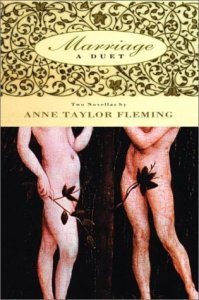 Two novellas in one volume. In “A Married Woman,” Caroline Betts’s husband, William, is in a coma after a stroke or heart attack. As she and her adult children visit him in the hospital and ponder the decision they will have to make, she remains haunted by the affair William had with one of their daughter’s friends 15 years ago. Although at the time it seemed to destroy their marriage, she stayed and they built a new relationship.
I fully expected the second novella, “A Married Man,” to give William’s perspective (like in Carol Shields’s Happenstance), but instead it’s a separate story with different characters, though still set in California c. 2000. Here the dynamic is flipped: it’s the wife who had an affair and the husband who has to try to come to terms with it. David and Marcia Sanderson start marriage therapy at New Beginnings and, with the help of Prozac and Viagra, David hopes to get past his bitterness and give in to his wife’s romantic overtures.
Fleming is a careful observer of how marriages change over time and in response to shocks, but overall I found the tone of these tales abrasive and the language slightly raunchy.
Not quite about a marriage, but a relationship so lovely that I can’t resist including it…
Our Souls at Night by Kent Haruf (2015)
 Understated, bittersweet, realistic. Perfect. I’d long meant to try Kent Haruf’s work and even had the first two Plainsong trilogy books on the shelf, but this novella, picked up secondhand at a bargain price from a charity warehouse, demanded to be read first. Fans of Elizabeth Strout’s work will find in Haruf’s Holt, Colorado an echo of her Crosby, Maine – fictional towns where ordinary folk live out their quiet triumphs and sorrows. From the first line, which opens in medias res, Haruf draws you in, making you feel as if you’ve known these characters forever: “And then there was the day when Addie Moore made a call on Louis Waters.” She has a proposal for her neighbor. She’s a widow; he’s a widower. They’re both lonely and prone to melancholy thoughts about how they could have done better by their families (“life hasn’t turned out right for either of us, not the way we expected,” Louis says). Would he like to come over to her house at nights to talk and sleep? Just two ageing creatures huddling together for comfort; no hanky-panky expected or desired.
So that’s just what they do. Before long, though, they come up against the disapproval of locals and family, especially when Addie’s grandson comes to stay and they join Louis to make a makeshift trio. The matter-of-fact prose, delivered without speech marks, belies a deep undercurrent of emotion in this story about the everyday miracle of human connection. There’s even a neat little reference to Haruf’s Benediction at the start of Chapter 34 (again like Strout, who peppered Olive, Again with cameo appearances from characters introduced in her earlier books). I also loved that the characters live on Cedar Street – I grew up on a Cedar Street. This gets my highest recommendation.
State of the Union: A Marriage in Ten Parts by Nick Hornby (2019)
 Hornby has been making quite a name for himself in film and television. State of the Union is also a TV series, and reads a lot like a script because it’s composed mostly of the dialogue between Tom and Louise, an estranged couple who each week meet up for a drink in the pub before their marriage counseling appointment. There’s very little descriptive writing, and much of the time Hornby doesn’t even need to add speech attributions because it’s clear who’s saying what in the back and forth.
The crisis in this marriage was precipitated by Louise, a gerontologist, sleeping with someone else after her sex life with Tom, an underemployed music writer, dried up. They rehash their life together, what went wrong, and what might happen next in 10 snappy chapters that are funny but also cut close to the bone. What married person hasn’t wondered where the magic went as midlife approaches? (Tom: “I hate to be unromantic, but convenient placement is pretty much the definition of marital sex.”)
Two-Part Invention: The Story of a Marriage by Madeleine L’Engle (1988)
 The fourth and final volume of the autobiographical Crosswicks Journal. This one focuses on L’Engle’s 40-year marriage to Hugh Franklin, an actor best known for his role as Dr. Charles Tyler in All My Children between 1970 and 1983. In the book’s present day, the summer of 1986, she’s worried about Hugh when his bladder cancer, which starts off seeming treatable, leads to every possible complication and deterioration. Her days are divided between home, work (speaking engagements; teaching workshops at a writers’ conference) and the hospital.
Drifting between past and present, she remembers how she and Hugh met in the 1940s NYC theatre world, their early years of marriage, becoming parents to Josephine and Bion and then, when close friends died suddenly, adopting their goddaughter, and taking on the adventure of renovating Crosswicks farmhouse in Connecticut and temporarily running the local general store. As usual, L’Engle writes beautifully about having faith in a time of uncertainty. (The title refers not just to marriage, but also to Bach pieces that she, a devoted amateur piano player, used for practice.)
A wonderful passage about marriage:
“Our love has been anything but perfect and anything but static. Inevitably there have been times when one of us has outrun the other and has had to wait patiently for the other to catch up. There have been times when we have misunderstood each other, demanded too much of each other, been insensitive to the other’s needs. I do not believe there is any marriage where this does not happen. The growth of love is not a straight line, but a series of hills and valleys. I suspect that in every good marriage there are times when love seems to be over. Sometimes these desert lines are simply the only way to the next oasis, which is far more lush and beautiful after the desert crossing than it could possibly have been without it.”
The Wife by Meg Wolitzer (2003)
 My latest book club read. On a flight to Finland, where her supposed genius writer of a husband, Joe Castleman, will accept the prestigious Helsinki Prize, Joan finally decides to leave him. When she first met Joe in 1956, she was a student at Smith College and he was her (married) creative writing professor, even though he’d only had a couple of stories published in middling literary magazines. Joan was a promising author in her own right, but when Joe left his first wife for her and she dropped out of college, she willingly took up a supporting role instead, and has remained in it for decades.
Ever since his first novel, The Walnut, a thinly veiled account of leaving Carol for Joan, Joe has produced books “populated by unhappy, unfaithful American husbands and their complicated wives.” Add on the fact that he’s Jewish and you have a Saul Bellow or Philip Roth type, a serial womanizer who’s publicly uxorious.
Alternating between the trip to Helsinki and telling scenes from earlier in their marriage, this short novel is deceptively profound. The setup may feel familiar, but Joan’s narration is bitingly funny and the points about the greater value attributed to men’s work are still valid. There’s also a juicy twist I never saw coming, as Joan decides what role she wants to play in perpetuating Joe’s literary legacy. My second by Wolitzer; I’ll certainly read more.
Plus a DNF:
The Story of a Marriage by Andrew Sean Greer (2008)
 In 1953 in San Francisco, Pearlie Cook learns two major secrets about her husband Holland after his old friend shows up at their door. Greer tries to present another fact about the married couple as a big surprise, but had planted so many clues, starting on page 9, that I’d already guessed it and wasn’t shocked at the end of Part I as I was supposed to be. Greer writes perfectly capably, but I wasn’t able to connect with this one and didn’t love Less as much as most people did. I don’t think I’ll be trying another of his books. (I read 93 pages out of 195.)
Have you read any books about marriage recently?
Love, Etc. – Some Thematic Reading for Valentine’s Day
Even though we aren’t big on Valentine’s Day (we went out to a “Flavours of Africa” supper club last weekend and are calling it our celebration meal), for the past three years I’ve ended up doing themed posts featuring books that have “Love” or a similar word in the title or that consider romantic or familial love in some way. (Here are my 2017, 2018 and 2019 posts.) These seven selections, all of them fiction, sometimes end up being more bittersweet or ironic than straightforwardly romantic, but see what catches your eye anyway.
Shotgun Lovesongs by Nickolas Butler (2014)
 Four childhood friends from Little Wing, Wisconsin; four weddings (no funeral – though there are a couple of close calls along the way). Which bonds will last, and which will be strained to the breaking point? Henry is the family man, a dairy farmer who married his college sweetheart, Beth. Lee* is a musician, the closest thing to a rock star Little Wing will ever produce. He became famous for Shotgun Lovesongs, a bestselling album he recorded by himself in a refurbished chicken coop for $600, and now lives in New York City and hobnobs with celebrities. Kip gave up being a Chicago commodities trader to return to Little Wing and spruce up the old mill into an events venue. Ronny lived for alcohol and rodeos until a drunken accident ended his career and damaged his brain.
The friends have their fair share of petty quarrels and everyday crises, but the big one hits when one guy confesses to another that he’s in love with his wife. Male friendship still feels like a rarer subject for fiction, but you don’t have to fear any macho stylings here. The narration rotates between the four men, but Beth also has a couple of sections, including the longest one in the book. This is full of nostalgia and small-town (especially winter) atmosphere, but also brimming with the sort of emotion that gets a knot started in the top of your throat. All the characters are wondering whether they’ve made the right decisions. There are a lot of bittersweet moments, but also some comic ones. The entire pickled egg sequence, for instance, is a riot even as it skirts the edge of tragedy.
*Apparently based on Bon Iver (Justin Vernon), whose first album was a similarly low-budget phenomenon recorded in Wisconsin. I’d never heard any Bon Iver before and expected something like the more lo-fi guy-with-guitar tracks on the Garden State soundtrack. My husband has a copy of the band’s 2011 self-titled album, so I listened to that and found that it has a very different sound: expansive, trance-like, lots of horns and strings. (But NB, the final track is called “Beth/Rest.”) For something more akin to what Lee might play, try this video.
Mr Loverman by Bernardine Evaristo (2013)
 Barry came to London from Antigua and has been married for 50 years to Carmel, the mother of his two adult daughters. For years Carmel has been fed up with his drinking and gallivanting, assuming he has lots of women on the side. Little does she know that Barry’s best friend, Morris, has also been his lover for 60 years. Morris divorced his own wife long ago, and he’s keen for Barry to leave Carmel and set up home with him, maybe even get a civil partnership. When Carmel goes back to Antigua for her father’s funeral, it’s Barry’s last chance to live it up as a bachelor and pluck up his courage to tell his wife the truth.
Barry’s voice is a delight: a funny mixture of patois and formality; slang and Shakespeare quotes. Cleverly, Evaristo avoids turning Carmel into a mute victim by giving her occasional chapters of her own (“Song of…” versus Barry’s “The Art of…” chapters), written in the second person and in the hybrid poetry style readers of Girl, Woman, Other will recognize. From these sections we learn that Carmel has her own secrets and an equal determination to live a more authentic life. Although it’s sad that these two characters have spent so long deceiving each other and themselves, this is an essentially comic novel that pokes fun at traditional mores and includes several glittering portraits.
Mariette in Ecstasy by Ron Hansen (1991)
 Set in an upstate New York convent mostly in 1906–7, this is a story of religious fervor, doubt and jealousy. Mariette Baptiste is a 17-year-old postulant; her (literal) sister, 20 years older, is the prioress here. Mariette is given to mystical swoons and, just after the Christmas mass, also develops the stigmata. Her fellow nuns are divided: some think Mariette is a saint who is bringing honor to their organization; others believe she has fabricated her calling and is vain enough to have inflicted the stigmata on herself. A priest and a doctor both examine her, but ultimately it’s for the sisters to decide whether they are housing a miracle or a fraud.
The short sections are headed by the names of feasts or saints’ days, and often open with choppy descriptive phrases that didn’t strike me as quite right for the time period (versus Hansen has also written a Western, in which such language would seem appropriate). Although the novella is slow to take off – the stigmata don’t arrive until after the halfway point – it’s a compelling study of the psychology of a religious body, including fragments from others’ testimonies for or against Mariette. I could imagine it working well as a play.
Bizarre Romance by Audrey Niffenegger and Eddie Campbell (2018)
 Most of these pieces originated as text-only stories by Niffenegger and were later adapted into comics by Campbell. By the time they got married, they had been collaborating long-distance for a while. Some of the stories incorporate fairies, monsters, ghosts and other worlds. A young woman on her way to a holiday party travels via a mirror to another land where she is queen; a hapless bar fly trades one fairy mistress for another; Arthur Conan Doyle’s father sketches fairies in an asylum; a middle-aged woman on a cruise decides to donate her remaining years to her aged father.
My favorite of the fantastical ones was “Jakob Wywialowski and the Angels,” a story of a man dealing with an angel infestation in the attic; it first appeared as a holiday story on the Amazon homepage in 2003 and is the oldest piece here, with the newest dating from 2015. I also liked “Thursdays, Six to Eight p.m.,” in which a man goes to great lengths to assure two hours of completely uninterrupted reading per week. Strangely, my two favorite pieces were the nonfiction ones: “Digging up the Cat,” about burying her frozen pet with its deceased sibling; and “The Church of the Funnies,” a secular sermon about her history with Catholicism and art that Niffenegger delivered at Manchester Cathedral as part of the 2014 Manchester Literary Festival.
The Nine-Chambered Heart by Janice Pariat (2017)
 I find second-person narration intriguing, and I like the idea of various people’s memories of a character being combined to create a composite portrait (previous books that do this that I have enjoyed are The Life and Death of Sophie Stark and Kitchens of the Great Midwest). The protagonist here, never named, is a young Indian writer who travels widely, everywhere from the Himalayas to Tuscany. She also studies and then works in London, where she meets and marries a fellow foreigner. We get the sense that she is restless, eager for adventure and novelty: “You seem to be a woman to whom something is always about to happen.”
An issue with the book is that most of the nine viewpoints belong to her lovers, which would account for the title but makes their sections seem repetitive. By contrast, I most enjoyed the first chapter, by her art teacher, because it gives us the earliest account of her (at age 12) and so contributes to a more rounded picture of her as opposed to just the impulsive, flirtatious twentysomething hooking up on holidays and at a writers’ residency. I also wish Pariat had further explored the main character’s relationship with her parents. Still, I found this thoroughly absorbing and read it in a few days, steaming through over 100 pages on one.
Kinds of Love by May Sarton (1970)
 Christina and Cornelius Chapman have been “summer people,” visiting Willard, New Hampshire each summer for decades, but in the town’s bicentennial year they decide to commit to it full-time. They are seen as incomers by the tough mountain people, but Cornelius’s stroke and their adjustments to his disability and older age have given them the resilience to make it through a hard winter. Sarton lovingly builds up pictures of the townsfolk: Ellen Comstock, Christina’s gruff friend; Nick, Ellen’s mentally troubled son, who’s committed to protecting the local flora and fauna; Jane Tuttle, an ancient botanist; and so on. Willard is clearly a version of Sarton’s beloved Nelson, NH. She’s exploring love for the land as well as love between romantic partners and within families.
It’s a meandering novel pleasant for its atmosphere and its working out of philosophies of life through conversation and rumination, but Part Three, “A Stranger Comes to Willard,” feels like a misstep. A college dropout turns up at Ellen’s door after his car turns over in a blizzard. Before he’s drafted into the Vietnam War, he has time to fall in love with Christina’s 15-year-old granddaughter, Cathy. There may only be a few years between the teens, but this still didn’t sit well with me.
I liked how each third-person omniscient chapter ends with a passage from Christina’s journal, making things personal and echoing the sort of self-reflective writing for which Sarton became most famous. The book could have been closer to 300 pages instead of over 460, though.
The Dearly Beloved by Cara Wall (2019)
 An elegant debut novel about two couples thrown together in 1960s New York City when the men are hired as co-pastors of a floundering Presbyterian church. Nearly the first half is devoted to the four main characters’ backstories and how each couple met. It’s a slow, subtle, quiet story (so much so that I only read the first half and skimmed the second), and I kept getting Charles and James, and Lily and Nan confused.
So here’s the shorthand: Charles is the son of an atheist Harvard professor and plans to study history until a lecture gets him thinking seriously about faith. Lily has closed herself off to life since she lost her parents in a car accident; though she eventually accedes to Charles’s romantic advances, she warns him she won’t bend where it comes to religion. James grew up in a poor Chicago household with an alcoholic father, while Nan is a Southern preacher’s daughter who goes up to Illinois to study music at Wheaton.
James doesn’t have a calling per se, but is passionate about social justice. As co-pastor, his focus will be on outreach and community service, while Charles’s will be on traditional teaching and ministry duties. Nan is desperate for a baby but keeps having miscarriages; Lily has twins, one of whom is autistic (early days for that diagnosis; doctors thought the baby should be institutionalized). Although Lily remains prickly, Nan and James’s friendship is a lifeline for them. The “dearly beloved” term thus applies outside of marriage as well, encompassing all the ties that sustain us – in the last line, Lily thinks, “these friends would forever be her stitches, her scaffold, her ballast, her home.”
Have you read any “love” books, or books about love of any kind, lately?
Kinds of Love: Three Books for Valentine’s Day
At about this time of year I try to read a handful of books with “love” in the title. I’m currently reading Iris Murdoch’s The Sacred and Profane Love Machine for the #IMReadalong, and I have one more “love” title towards the end of this post, but it turns out that my focus this year has been more on the kinds of love that tend to get ignored around Valentine’s Day – familial love for one’s ageing parents and grandparents.

Be With: Letters to a Carer by Mike Barnes (2018)
 Mike Barnes, a Toronto poet and novelist, has been a primary caregiver for his mother, Mary, in the nine years since her Alzheimer’s diagnosis disease. She grew up on a Saskatchewan farm and is now in her nineties; he’s in his sixties. A bipolar sufferer, Barnes has spent his own fair share of time in hospitals and on disability. He’s moved Mary between care homes four times as her condition has deteriorated. Though he laments her gradual loss of words and awareness of her family, he can still discern instances of her bravery and the beauty of life.
This book of fragments – memories and advice delivered via short letters – was written in between demanding caregiving tasks and is meant to be read in those same gaps. Dementia is one situation in which you should definitely throw money at a problem, Barnes counsels, to secure the best care you can, even round-the-clock nursing help. However, as the title suggests, nothing outweighs simply being there. Your presence, not chiefly to make decisions, but just to sit, listen and place a soothing hand on a forehead, is the greatest gift.
There are many excellent, pithy quotations in this book. Here are a few of my favorites:
Dementia is…
“a retreat under fire”
“a passage of exquisite vulnerability”
By your loved one’s side is “Not where things are easy, or satisfactorily achieved, or achievable, or even necessarily pleasant. But where you ought to be, have to be, and are. It brings a peace.”
The goal is “Erring humanely”.
I can imagine this being an invaluable companion for caregivers, to be tucked into a pocket or purse and pulled out for a few moments of relief. On the theme of a parent’s dementia, I’d also recommend Paulette Bates Alden’s book of linked short stories, Unforgettable.
My rating:
Out now from Myriad Editions. My thanks for the free copy for review.
The Smallest Things: On the enduring power of family: A memoir of tiny dramas by Nick Duerden (2019)
 Journalist Nick Duerden always appreciated how his maternal grandparents, Nonna and Nonno, seemed so ordinary and unchanging. Every trip to see them in the Milan suburbs was, comfortingly, the same. He’d muddle along with his meager Italian, and they’d look after him in their usual clucking way. It was only as he reached middle age and realized that his grandparents were undeniably very old – his grandmother is 99 and in a care home at the time of writing – that he realized how lucky he was to still have them in his life and how unlikely it was that they’d be around for much longer.
Duerden compares his small immediate family with his Spanish wife’s large extended one, and his uptight paternal grandparents with the more effusive set. There are also some family secrets still to uncover. I made the mistake of reading a previous nonfiction book of Duerden’s just the week before this one: Get Well Soon (2018), which has a long chapter about his grandparents that told me all I needed to know about them. That’s probably the main reason why this short book struck me as lightweight, though I did ultimately find it a touching tribute, especially to his grandmother. It could make a good Mother’s Day present.
My rating:
Out today from Elliott & Thompson. My thanks for a proof copy for review.
Love Story by Erich Segal (1970)
 This offbeat novella was a bestseller and a successful film. You surely know its most famous line: “Love means not ever having to say you’re sorry.” Oliver Barrett IV is a golden boy: his banker father and previous generations of the eminent Barrett family funded various buildings at Harvard, where Oliver is a hockey player in the late 1960s. Jenny Cavilleri, on the other hand, comes from a single-parent Italian-American family in New Jersey. She’s made it to Radcliffe as a harpsichordist, but her father is just a baker; she’d never be considered good enough for the likes of Oliver. But they meet at the Radcliffe library and, sure enough, fall for each other. She calls him “Preppie”; he calls her a bitch. They’re only partially joking. It may be true love against the odds, but it has an expiration date, as we know from the first line: “What can you say about a twenty-five-year old girl who died?”
I wanted to like this more. There’s a pleasing lightness to the style, but because the whole book is from Oliver’s perspective, I felt like Jenny got short shrift: she’s the wise-cracking gal from the block, and then she’s the innocent victim in the hospital bed. Because this is only about 120 pages, there’s not much space in between for her character to be developed. I was somewhat appalled to learn about a 1977 sequel in which Oliver finds a new love.
(Segal’s daughter Francesca is also a novelist (The Innocents).)
My rating:
 Bookish Beck = Rebecca Foster. American transplant to England. Freelance proofreader and book reviewer.
 Bookish Beck