#WITMonth, Part II: Wioletta Greg, Dorthe Nors, Almudena Sánchez and More
My next four reads for Women in Translation month (after Part I here) were, again, a varied selection: a mixed volume of family history in verse and fragmentary diary entries, a set of nature/travel essays set mostly in Denmark, a memoir of mental illness, and a preview of a forthcoming novel about Mary Shelley’s inspirations for Frankenstein. One final selection will be coming up as part of my Love Your Library roundup on Monday.
(20 Books of Summer, #13)
Finite Formulae & Theories of Chance by Wioletta Greg (2014)
[Translated from the Polish by Marek Kazmierski]
 I loved Greg’s Swallowing Mercury so much that I jumped at the chance to read something else of hers in English translation – plus this was less than half price AND a signed copy. I had no sense of the contents and might have reconsidered had I known a few things: the first two-thirds is family wartime history in verse, the rest is a fragmentary diary from eight years in which Greg lived on the Isle of Wight, and the book is a bilingual edition, with Polish and English on facing pages (for the poems) or one after the other (for the diary entries). I’m not sure what this format adds for English-language readers; I can’t know whether Kazmierski has rendered anything successfully. I’ve always thought it must be next to impossible to translate poetry, and it’s certainly hard to assess these as poems. They are fairly interesting snapshots from her family’s history, e.g., her grandfather’s escape from a stalag, and have quite precise vocabulary for the natural world. There’s also been an attempt to create or reproduce alliteration. I liked the poem the title phrase comes from, “A Fairytale about Death,” and “Readers.” The short diary entries, though, felt entirely superfluous. (New purchase – Waterstones bargain, 2023)
(20 Books of Summer, #14)
A Line in the World: A Year on the North Sea Coast by Dorthe Nors (2021; 2022)
[Translated from the Danish by Caroline Waight]
 Nors’s first nonfiction work is a surprise entry on this year’s Wainwright Prize nature writing shortlist. I’d be delighted to see this work in translation win, first because it would send a signal that it is not a provincial award, and secondly because her writing is stunning. Like Patrick Leigh Fermor, Aldo Leopold or Peter Matthiessen, she doesn’t just report what she sees but thinks deeply about what it means and how it connects to memory or identity. I have a soft spot for such philosophizing in nature and travel writing.
You carry the place you come from inside you, but you can never go back to it.
I longed … to live my brief and arbitrary life while I still have it.
This eternal, fertile and dread-laden stream inside us. This fundamental question: do you want to remember or forget?
Nors lives in rural Jutland – where she grew up, before her family home was razed – along the west coast of Denmark, the same coast that reaches down to Germany and the Netherlands. In comparison to Copenhagen and Amsterdam, two other places she’s lived, it’s little visited and largely unknown to foreigners. This can be both good and bad. Tourists feel they’re discovering somewhere new, but the residents are insular – Nors is persona non grata for at least a year and a half simply for joking about locals’ exaggerated fear of wolves.
Local legends and traditions, bird migration, reliance on the sea, wanderlust, maritime history, a visit to church frescoes with Signe Parkins (the book’s illustrator), the year’s longest and shortest days … I started reading this months ago and set it aside for a time, so now find it difficult to remember what some of the essays are actually about. They’re more about the atmosphere, really: the remote seaside, sometimes so bleak as to seem like the ends of the earth. (It’s why I like reading about Scottish islands.) A bit more familiarity with the places Nors writes about would have pushed my rating higher, but her prose is excellent throughout. I also marked the metaphors “A local woman is standing there with a hairstyle like a wolverine” and “The sky looks like dirty mop-water.” 
With thanks to Pushkin Press for the proof copy for review.
Pharmakon by Almudena Sánchez (2021; 2023)
[Translated from the Spanish by Katie Whittemore]
 This is a memoir in micro-essays about the author’s experience of mental illness, as she tries to write herself away from suicidal thoughts. She grew up on Mallorca, always feeling like an outsider on an island where she wasn’t a native. Did her depression stem from her childhood, she wonders? She is also a survivor of ovarian cancer, diagnosed when she was 16. As her mind bounces from subject to subject, “trying to analyze a sick brain,” she documents her doctor visits, her medications, her dreams, her retweets, and much more. She takes inspiration from famous fellow depressives such as William Styron and Virginia Woolf. Her household is obsessed with books, she says, and it’s mostly through literature that she understands her life. The writing can be poetic, but few pieces stand out on the whole. My favourite opens: “Living in between anxiety and apathy has driven me to flowerpot decorating.”
With thanks to Fum d’Estampa Press for the free copy for review.
And a bonus preview:
Mary and the Birth of Frankenstein by Anne Eekhout (2021; 2023)
[Translated from the Dutch by Laura Watkinson]
 Anne Eekhout’s fourth novel and English-language debut is an evocative recreation of two momentous periods in Mary Shelley’s life that led – directly or indirectly – to the composition of her 1818 masterpiece. Drawing parallels between the creative process and motherhood and presenting a credibly queer slant on history, the book is full of eerie encounters and mysterious phenomena that replicate the Gothic science fiction tone of Frankenstein itself. The story lines are set in the famous “Year without a Summer” of 1816 (the storytelling challenge with Lord Byron) and during a period in 1812 that she spent living in Scotland with the Baxter family; Mary falls in love with the 17-year-old daughter, Isabella.
Coming out on 3 October from HarperVia. My full review for Shelf Awareness is pending.
Six Degrees of Separation: Romantic Comedy to Wild Fell
This is a fun meme I take part in every few months.
For August we begin with Romantic Comedy by Curtis Sittenfeld, one of my top 2023 releases so far. (See Kate’s opening post.)
 #1 Sittenfeld’s protagonist, Sally Milz, writes TV comedy, as does Kristin Newman (That ’70s Show, How I Met Your Mother, etc.), author of What I Was Doing While You Were Breeding, a lighthearted record of her travels and romantic conquests. (She even has a passage that reminds me of Sally’s Danny Horst Rule: “I looked like a thirty-year-old writer. Not like a twenty-year-old model or actress or epically legged songstress, which is a category into which an alarmingly high percentage of Angelenas fall. And, because the city is so lousy with these leggy aliens, regular- to below-average-looking guys with reasonable employment levels can actually get one, another maddening aspect of being a woman in this city.”)
 #2 I didn’t realize when I picked it up in a charity shop that my copy smelled strongly of cigarette smoke. I aired it in kitty litter, then by scented candles, and it still reeks. I reckon I can tolerate the smell long enough to finish it and put it in the Little Free Library, which gets good ventilation. A novel I acquired from the free bookshop we used to have in the mall in town was the only book I can remember having to get rid of before reading because it just smelled too bad (also of cigarettes in that case): My Sister’s Keeper by Jodi Picoult.
 #3 So I didn’t read that, but I have read another Picoult novel, Sing You Home. The author is known for picking a central issue to address in each work, and in that one it was sexuality. Zoe, a music therapist, is married to Max but leaves him for Vanessa – and then decides to sue him for the use of the embryos they created together via IVF. It was the first book I’d read with that dynamic (a previously straight woman enters into a lesbian partnership), but by no means the last. Later came Untamed by Glennon Doyle, Hidden Nature by Alys Fowler, The Fixed Stars by Molly Wizenberg … and one you maybe weren’t expecting: the fantastic memoir First Time Ever by Peggy Seeger. The authors vary in how they account for it. They were gay all along but didn’t realize it? Their orientation changed? Or they just happened to fall in love with someone of the same gender? Seeger doesn’t explain at all, simply records how head-over-heels she was for Ewan MacColl … and then for Irene Pyper Scott.
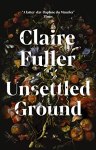 #4 Peggy Seeger is one of my heroes these days. I first got into her music through the lockdown livestreams put together by Folk on Foot and have since seen her live and acquired several of her albums, including a Smithsonian Folkways collection of her best-loved folk standards. One of these is, of course, “I’m Gonna Be an Engineer,” which was one of the inspirations for Claire Fuller’s Unsettled Ground.
 #5 Unsettled Ground, an unusual story of rural poverty and illiteracy, is set in a fictional village modelled on Inkpen, where Nicola Chester lives. Her memoir On Gallows Down, which held particular local interest for me, was shortlisted for the Wainwright Prize last year.
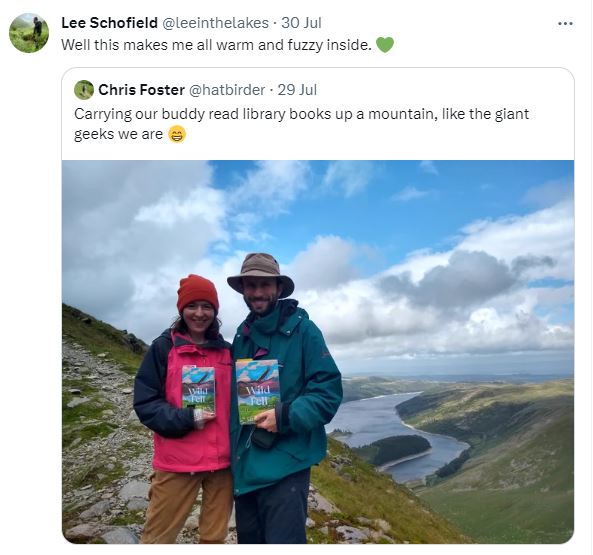
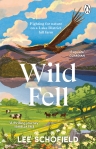 #6 Also shortlisted that year was Wild Fell by Lee Schofield, about his work at RSPB Haweswater. Like Chester, he’s been mired in the struggle to balance sustainable farming with conservation at a beloved place. And like a fellow Lakeland farmer (and previous Wainwright Prize winner for English Pastoral), James Rebanks, he’s trying to be respectful of tradition while also restoring valuable habitats. My husband and I each took a library copy of Wild Fell along to Cumbria last week (about which more anon) and packed it in a backpack for an on-location photo during our wild walk at the very atmospheric Haweswater.
Where will your chain take you? Join us for #6Degrees of Separation! (Hosted on the first Saturday of each month by Kate W. of Books Are My Favourite and Best.) Next month’s starting book is Wifedom by Anna Funder.
Have you read any of my selections? Tempted by any you didn’t know before?
Prize Updates: McKitterick Prize Winner and Wainwright Prize Longlists
It was my second year as a first-round manuscript judge for the McKitterick Prize; have a look at my rundown of the shortlist here.
 The winner, Louise Kennedy, and runner-up, Liz Hyder, were announced on 29 June. (Nominee Aamina Ahmad won a different SoA Award that night, the Gordon Bowker Volcano Prize for a novel focusing on the experience of travel away from home.) Other recipients included Travis Alabanza, Caroline Bird, Bonnie Garmus and Nicola Griffith. For more on all of this year’s SoA Award winners, see their website.


I’m a big fan of the Wainwright Prize for nature and conservation writing, and have been following it particularly closely since 2020, when I happened to read most of the nominees. In 2021 I also managed to read quite a lot from the longlists; 2022, the first year of an additional prize for children’s literature, saw me reading about a third of the total nominees.
This is the third year that I’ve been part of an “academy” of bloggers, booksellers, former judges and previously shortlisted authors asked to comment on a very long list of publisher submissions. I’m delighted that a few of my preferences made it through to the longlists.
My taste generally runs more to the narrative nature writing than the popular science or travel-based books. I find I’ve read just two from the Nature list (Bersweden and Huband) and one each from Conservation (Pavelle) and Children’s (Hargrave) so far.

The 2023 James Cropper Wainwright Prize for Nature Writing longlist:
- The Swimmer: The Wild Life of Roger Deakin, Patrick Barkham (Hamish Hamilton)
- The Flow: Rivers, Water and Wildness, Amy-Jane Beer (Bloomsbury)
- Where the Wildflowers Grow, Leif Bersweden (Hodder)
- Twelve Words for Moss, Elizabeth-Jane Burnett (Allen Lane)
- Cacophony of Bone, Kerri ní Dochartaigh (Canongate)
- Sea Bean, Sally Huband (Hutchinson)
- Ten Birds that Changed the World, Stephen Moss (Faber)
- A Line in the World: A Year on the North Sea Coast, Dorthe Nors, translated by Caroline Waight (Pushkin)
- The Golden Mole: And Other Living Treasure, Katherine Rundell, illustrated by Talya Baldwin (Faber)
- Belonging: Natural Histories of Place, Identity and Home, Amanda Thomson (Canongate)
- Why Women Grow: Stories of Soil, Sisterhood and Survival, Alice Vincent (Canongate)
- Landlines, Raynor Winn (Penguin)

The 2023 James Cropper Wainwright Prize for Writing on Conservation longlist:
- Sarn Helen: A Journey Through Wales, Past, Present and Future, Tom Bullough, illustrated by Jackie Morris (Granta)
- Beastly: A New History of Animals and Us, Keggie Carew (Canongate)
- Rewilding the Sea: How to Save Our Oceans, Charles Clover (Ebury)
- Birdgirl, Mya-Rose Craig (Jonathan Cape)
- The Orchid Outlaw, Ben Jacob (John Murray)
- Elixir: In the Valley at the End of Time, Kapka Kassabova (Jonathan Cape)
- Rooted: How Regenerative Farming Can Change the World, Sarah Langford (Viking)
- Black Ops and Beaver Bombing: Adventures with Britain’s Wild Mammals, Fiona Mathews and Tim Kendall (Oneworld)
- Forget Me Not, Sophie Pavelle (Bloomsbury)
- Fen, Bog, and Swamp: A Short History of Peatland Destruction and its Role in the Climate Crisis, Annie Proulx (Fourth Estate)
- The Lost Rainforests of Britain, Guy Shrubsole (HarperCollins)
- Nomad Century: How to Survive the Climate Upheaval, Gaia Vince (Allen Lane)

The 2023 James Cropper Wainwright Prize for Children’s Writing on Nature and Conservation longlist:
- The Earth Book, Hannah Alice (Nosy Crow)
- The Light in Everything, Katya Balen, illustrated by Sydney Smith (Bloomsbury)
- Billy Conker’s Nature-Spotting Adventure, Conor Busuttil (O’Brien)
- Protecting the Planet: The Season of Giraffes, Nicola Davies, illustrated by Emily Sutton (Walker)
- Blobfish, Olaf Falafel (Walker)
- A Friend to Nature, Laura Knowles, illustrated by Rebecca Gibbon (Welbeck)
- Spark, M G Leonard (Walker)
- A Wild Child’s Book of Birds, Dara McAnulty (Macmillan)
- Leila and the Blue Fox, Kiran Millwood Hargrave, illustrated by Tom de Freston (Hachette Children’s Group)
- The Zebra’s Great Escape, Katherine Rundell, illustrated by Sara Ogilvie (Bloomsbury)
- Archie’s Apple, Hannah Shuckburgh, illustrated by Octavia Mackenzie (Little Toller)
- Grandpa and the Kingfisher, Anna Wilson, illustrated by Sarah Massini (Nosy Crow)
It’s impressive that women writers are represented so well this year: 9/12 for Nature, 8/12 for Conservation, and 8/12 for Children’s. Amusingly, Katherine Rundell is on TWO of the lists. There are also, refreshingly, several BIPOC authors, and – I think for the first time ever – a work in translation (A Line in the World by Dorthe Nors, which I have as a set-aside proof copy and will get back into at once).
Here is where I have to admit that quite a number of the nominees, overall, are books I DNFed, authors whose work I’ve tried before and not enjoyed, or books I’ve been turned off of by the reviews. I’ll not mention these by name just now, and will leave any predictions for a future date when I’ve read a few more of the nominees. It seems that I’m most likely to catch up with the majority of the children’s longlist, if anything.
The shortlists will be announced on 10 August, and winners will be announced on 14 September at a 10th Anniversary live event held as part of the Kendal Mountain Festival in Cumbria (tickets available here).
See any nominees you’ve read? Who would you like to see shortlisted?
All My Wild Mothers by Victoria Bennett & I Have Some Questions for You by Rebecca Makkai
I’m catching up with reviews of two February releases that I spent the whole of last month submerged in. These are early entries on my Best of 2023 list: A lovely memoir about grief and gardening, caring for an ill child and a dying parent; and a riveting true crime-inspired novel, set on a boarding school campus, that rages at injustice and violence against women.
All My Wild Mothers: Motherhood, loss and an apothecary garden by Victoria Bennett
Early in February, I attended the online book launch via Sam Read Bookseller in Grasmere. With conversation, readings and song, it was the ideal introduction to the themes of this debut memoir by a poet. The book is composed of dozens of brief autobiographical, present-tense essays, each titled after a wildflower with traditional healing properties. The chapters are headed by a black-and-white woodcut of each plant (by Bennett’s husband, Adam Clarke) and a précis of its medicinal uses, as well as where it is found. Again and again, these descriptions site the flora on edgelands or “disturbed ground” – the perfect metaphorical tie-in to Bennett’s tumultuous life and the comfort that creating an apothecary garden brought.
Bennett is the youngest of six children. When she was expecting her son – much longed for after multiple pregnancy losses – news came that her eldest sister had died in a canoeing accident. At age two, her son was diagnosed with type 1 diabetes; managing his condition has imposed a heavy emotional burden. And years later, she was the primary caregiver for her elderly mother as she was dying of mesothelioma. The memoir’s format – which arose in part because it was written over the course of 10 years, during stolen moments – realistically presents bereavement and caring as ongoing, cyclical challenges rather than one-time events.

There are no simple solutions offered here, nothing so pat as that ‘gardening heals all hurts’, but Bennett writes into the broken places and finds joy in what comes to life spontaneously in nature or in her ramshackle yard on a social housing estate in Cumbria. She recalls a horse chestnut tree that looked over her outside the window of her childhood home; she and her son take impish delight in guerrilla gardening and sometimes disastrous cooking projects with foraged fruit. Some of my favourite individual vignettes were “Elder,” about the magic and medicine of making elderberry syrup from the few village trees that escape the chainsaw; “Dandelion,” about her trio of older sisters, who were Greenham Common protestors and always tried to protect her as well as nature; “Herb Robert,” about her sister-in-law’s funeral; and especially “Honeysuckle,” about a local agricultural show where the officious organizers make them feel like interlopers yet her son wins first place for their feral, fecund garden.
Many side topics twine into the narrative as well: a difficult relationship with a controlling mother; a family history that takes in boarding schools, cults, road trips, risk taking and mental health issues; the economic disparity that leads to one set of rules for the rich and another for those on benefits. But the core of the book is a tender mother–son relationship. “I can give him this: a seed, with all its defiant hope against the dark; and the memory that once, we grew a garden out of rock, and waste, and all things broken, and it thrived.” Sitting somewhere between creative nonfiction and nature essays, it’s a beautiful read for any fan of women’s life writing, especially if you share the interests in grief or gardening. I hope we’ll see it recognized on the Barbellion and Wainwright Prize shortlists alike.
Readalikes I have reviewed: A Still Life by Josie George, The Book of Difficult Fruit by Kate Lebo, The Cure for Sleep by Tanya Shadrick
With thanks to Victoria Bennett and Two Roads for the free copy for review.
I Have Some Questions for You by Rebecca Makkai
I’m a big fan of Makkai’s first two novels, The Borrower and The Hundred-Year House, and have her other two books lined up to read, so I was excited to hear about this new work and put it on my Most Anticipated list for the year. My interest was redoubled by Laura’s review, which likens it to a cross between Prep and My Dark Vanessa – irresistible.
Bodie Kane grew up in a deprived and dysfunctional family in Indiana, and has beneficent Mormon neighbours to thank for the tuition money that allowed her to attend Granby, an exclusive New Hampshire boarding school, in the early to mid-1990s. She was an angry and awkward high school student, yet her memories of Granby and the friendships she made there are still an emotional mainstay more than two decades later. In 2018, she is a successful film professor with a podcast about Hollywood starlets. Although she is separated from Jerome, her artist husband, he lives next door and they co-parent their two children.
After an invitation comes from Granby to teach a two-week course on podcasting, Bodie trades Los Angeles for a bitter New England winter. It’s the perfect excuse to indulge her obsession with the 1995 murder of her former Granby roommate, Thalia Keith, who was found dead in the swimming pool one March morning after a play performance. Bodie has never been comfortable with the flawed case against the Black athletics coach, Omar Evans, who has been imprisoned ever since. When one of her students chooses to make Thalia’s murder the subject of a podcast, it’s all the justification Bodie needs to dive deep into her pet hypothesis: Thalia was sleeping with the music director, Denny Bloch, and he was involved in her death in some way. Her blinkered view threatens to exclude a key explanation. Still, the informal sleuthing she and her students do is enough to warrant a follow-up hearing in 2022, but they – and Omar – are up against a broken system.

Makkai has taken her cues from the true crime genre and constructed a convincing mesh of evidence and theories. There’s a large cast of secondary characters, from Dorian, the bully who once humiliated Bodie with sexual slurs, to Fran, the faculty kid/gay best friend who now lives and works on campus herself and continues to be Bodie’s trusty backup. The combinations of background + teenage behaviour + 40-something lives all feel authentic in their randomness (when I saw that Makkai sourced 24 names from indie bookstore supporters, I realized afresh just how real, as opposed to ‘made-up’, these characters feel).
At times I wondered if there was too much detail on the case and the former classmates; I might even have streamlined the novel by doing away with the 2022 section altogether, though it ends up being crucial to the plot. But Makkai has so carefully crafted these pen portraits, and so intimately involved us in Bodie’s psyche, that it’s easy to become invested in the story. What’s more, the novel introduces a seam of rage about violence towards women – so predictably excused and allowed to recur by a justice system weighted against victims –
What’s as perfect as a girl stopped dead, midformation? Girl as blank slate. Girl as reflection of your desires, unmarred by her own. Girl as sacrifice to the idea of girl.
let’s say it was the one where the rugby team covered up the girl’s death and the school covered for the rugby team. Actually it was the one where the therapist spent years grooming her. It was the one where the senator, then a promising teenager, shoved his d*ck in the girl’s face. … It was the one where her body was never found. It was the one where her body was found in the snow. It was the one where he left her body for dead under the tarp.
– yet also finds nuance in the situation when Bodie’s ex-husband is subjected to exaggerated #MeToo accusations. It’s timely, daring, intelligent, enthralling storytelling. Susan (review here) and I are both hoping to see this make the Women’s Prize longlist next week.
Readalikes I have reviewed: Ghost Wall by Sarah Moss, My Dark Vanessa by Kate Elizabeth Russell, The Bass Rock by Evie Wyld
With thanks to Fleet for the proof copy for review.
What are the best 2023 books you’ve read so far?
20 Books of Summer #11, Review Catch-up, and Wainwright Children’s Picks
Comparing my January–April reading totals with my May–July average, I see that my reading is down 57% over the last few months (at least in terms of number of books finished), and I can only blame the stress and time-consuming processes of moving house and DIY. I feel like I’ve slowed to a crawl through my various challenges, including my 20 Books.
With increasingly apocalyptic news filling my feeds, I find that I simultaneously a) want to retreat into books all the more and b) wonder what the point of all this compulsive reading is. For now, I’m taking as back-up Gretchen Rubin’s motto shared on National Book Lovers Day (“Reading is my tree house and my cubicle, my treadmill and my snow day” – what a perfect summary! It’s playtime, escape, mental exercise, indulgence but also, in some cases, work) and the premise of San Diego philosopher Nick Riggle’s upcoming This Beauty, which I’m reading for an early review: the purpose of life is to participate in and replicate beauty.
20 Books of Summer, #11
From the hedgerows: A collection of short stories on the wildlife, places and people of Newbury District by Lew Lewis (2008)
 The love and appreciation of natural beauty starts at home, and we are lucky here in West Berkshire to have a very good newspaper that still hosts a nature column (currently by beloved local author Nicola Chester). This collection of Newbury Weekly News articles spans 1979 to 1996, with the majority of the pieces from 1990–5. They were contributed by 17 authors, but most are by Lew Lewis (including under a pseudonym).
If you regularly read the Guardian Country Diary feature, you’ll find the format familiar. The general idea is to pick a natural phenomenon that’s seasonal or timely in some way, and write a short essay on it that incorporates context, personal observation, a political conscience and sometimes whimsical or nostalgic musing. Many pieces are about bird sightings; a few are about plants and insects; others celebrate the unique landscapes we have here, like heath and chalk downland. Some are quaint, like an introduction to “ticking” (birders’ list-keeping).
It was faintly depressing to see that we’ve been noting these habitat and species losses and their causes (generally, intensified agriculture) for over 30 years, and haven’t done enough to reverse them. But there are some good news stories, too, like “Return of the Red Kite,” one of our flagship species. This is basically self-published and could have done with some extra proofreading, but the black-and-white illustrations, most by Richard Allen, are charming. I was so pleased to find this on my library reshelving trolley one day. It’s an important artefact of a nature-lover’s heritage. There should be a follow-up volume or two! (Public library)
Review Book Catch-up
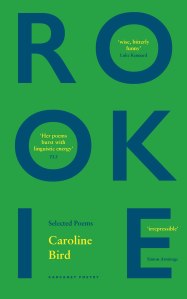 Rookie: Selected Poems by Caroline Bird (2022)
I discovered Caroline Bird early last year through In These Days of Prohibition and her latest collection, The Air Year, was one of my favourite reads of 2021. Part of the joy of working my way through this chronological volume was finding the traces of Bird’s later surrealism. Her first collection, Looking through Letterboxes, was written when she was just 14 and published when she was 16, but you’d never guess that from reading these poems of family, fairy tales and unspecified longing. I particularly liked the first stanza of “Passing the Time”:
Thirty paperclip statues on every table in the house
and things are slightly boring without you.
I’ve knitted a multi-coloured jacket for every woodlouse
in the park. But what can you do?
Trouble Came to the Turnip has some cheeky and randy fare, with the title poem offering a beleaguered couple various dubious means of escape. Watering Can pits monogamy and marriage against divorce and the death of love, via some twisted myths and fairy tales (e.g., Narcissus and Red Riding Hood). “Last Tuesday” is a stand-out. The Hat-Stand Union has more of what I most associate with Bird’s verse: dreams and the surreal. “How the Wild Horse Stopped Me” was a favourite. Mostly, I’m glad I own this so I can have access to the material from her two latest collections, but it was also fun to encounter her earlier style. In an afterword, she writes: “I chose poetry because it let me hide and, once hidden, I could be brave, roll my heart in sequins and chuck it out, glittering, into the street.”
With thanks to Carcanet Press for the free copy for review.
Getting through It: My Year of Cancer during Covid by Helen Epstein (2022)
 Given my love of medical memoirs and my recent obsession with Covid chronicles, this was always going to appeal to me. Epstein, an arts journalist and nonfiction author born in Prague and based in Massachusetts, was diagnosed with endometrial cancer in June 2020. She documents the next year or so in a matter-of-fact diary format, never shying away from the details of symptoms, medical procedures and side effects. Her husband Patrick’s e-mail updates sent out to friends and family, and occasional medical reports, fill in the parts she was less clear on due to fatigue and brain fog – including two small strokes she suffered. Surgery was followed by chemo and then the fraught decision of whether to decline brachytherapy (internal radiation). And, of course, all this was happening at a time when people were less able to see loved ones and rely on their regular diversions. The apt cover conjures up the outdoor chaise longue where Epstein would hold court and receive visitors.
In my mind, cancer patients fall into two camps: those who want to read everything they can about their illness so they know what to expect, and those who avoid thinking about it at all costs. For those in the former group, a no-nonsense book like this will be invaluable. I particularly appreciated Epstein’s attention to her husband’s experience, which she had to dig a little deeper to understand, and her realization that having female cancer brought back memories of childhood sexual molestation. She is also candid about how other people’s emotional demands (e.g., recounting a family member’s illness, or expecting effusive gratitude for small thoughtful acts) weighed on her. A forthright Everywoman’s narrative.
With thanks to the author for the free e-copy for review. Full disclosure: We are acquaintances through a Facebook group for book reviewers.
Wainwright Children’s Prize shortlist
I’ve now read 4 of 7 books on the Wainwright Prize’s Children’s Nature and Conservation Writing shortlist. I’m unlikely to have a chance to read the other three before the winner is announced unless my library system acquires them quickly. Any of the ones I’ve read would make a deserving winner, but the two I review below really grabbed me by the heartstrings and I would be particularly delighted to see one or the other take this inaugural award.
One World: 24 Hours on Planet Earth by Nicola Davies, illus. Jenni Desmond (2022)
 It’s one minute to midnight in London. Two Brown sisters are awake and looking at the moon. A journey of the imagination takes them through the time zones to see the natural spectacles the world has to offer: polar bears hunting at the Arctic Circle, baby turtles scrambling for the sea on an Indian beach, humpback whales breaching in Hawaii, and much more. Each spread has no more than two short paragraphs of text to introduce the landscape and fauna and explain the threats each ecosystem faces due to human influence. As the girls return to London and the clock chimes to welcome in 22 April, Earth Day, the author invites us to feel kinship with the creatures pictured: “They’re part of us, and every breath we take. Our world is fragile and threatened – but still lovely. And now it’s the start of a new day: a day when I’ll speak about these wonders, shout them out”.

A lot of research went into ensuring accuracy, and the environmentalist message is clear but not overstated. Fantastic! (Public library) 
Julia and the Shark by Kiran Millwood Hargrave, illus. Tom de Freston (2021)
 I could never have predicted when I read The Way Past Winter that Hargrave would become one of my favourite contemporary writers. Julia and her parents (and not forgetting the cat, Noodle) are off on an island adventure to Unst, in the north of Shetland, where her father will keep the lighthouse for a summer and her mother, a marine biologist, will search for the Greenland shark, a notably long-lived species she’s researching in hopes of discovering clues to human longevity – a cause close to her heart after her own mother’s death with dementia. Julia makes friends with Kin, a South Asian boy whose family run the island laundromat-cum-library. They watch stars and try to evade local bullies together. But one thing Julia can’t escape is her mother’s mental health struggle (late on named as bipolar: “Mum sometimes bounced around like Tigger, and other times she was mopey like Eeyore”). Julia thinks that if she can find the shark, it might fix her mother.
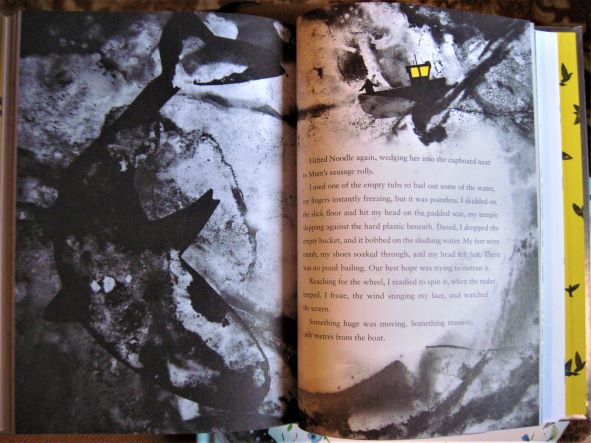
Hargrave treats the shark as both a real creature and a metaphor for all that lurks – all that we fear and don’t understand. It and murmurations of starlings are visual motifs throughout the book, which has a yellow and black colour scheme. Like One World, it’s as beautifully illustrated as it is profound in its messages. Julia is no annoyingly precocious child narrator, just a believable one who shows us her struggling family and the love and magic that get them through. I could see this becoming a modern children’s classic. (Public library)
Bookish Bits and Bobs
It’s felt like a BIG week for prize news. First we had the Booker Prize longlist, about which I’ve already shared some thoughts. My next selection from it is Trust by Hernan Diaz, which I started reading last night. The shortlist comes out on 6 September. We have our book club shadowing application nearly ready to send off – have your fingers crossed for us!
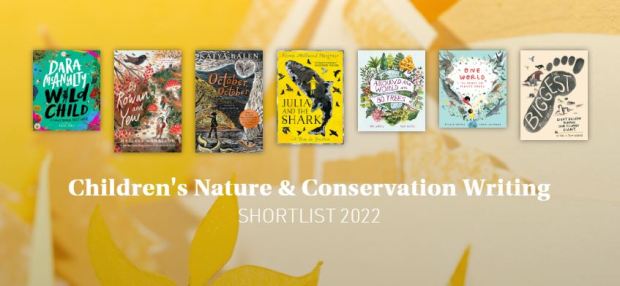
Then on Friday the three Wainwright Prize shortlists (I gave my reaction to the longlists last month) were announced: one for nature writing, one for conservation writing, and – new this year – one for children’s books on either.
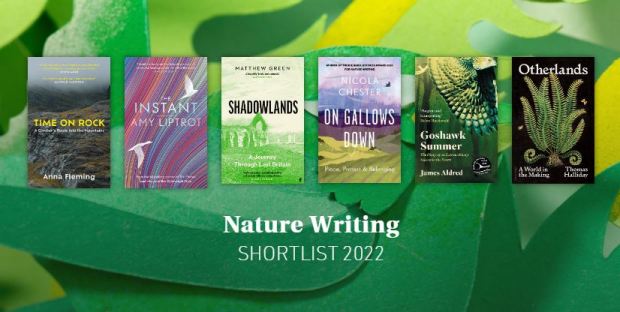
 I’m delighted that my top two overall picks, On Gallows Down by Nicola Chester and Silent Earth by Dave Goulson, are still in the running. I’ve read half of the nature list and still intend to read Shadowlands, which is awaiting me at the library. I’d happily read any of the remaining books on the conservation list and have requested the few that my library system owns. Of the children’s nominees, I’m currently a third of the way through Julia and the Shark and also have the Davies out from the library to read.
As if to make up for the recent demise of the Costa Awards, the Folio Prize has decided to split into three categories: fiction, nonfiction and poetry; the three finalists will then go head-to-head to compete for the overall prize. I’ve always wondered how the Folio judges pit such different books against each other. This makes theirs an easier job, I guess?
Speaking of prize judging, I’ve been asked to return as a manuscript judge for the 2023 McKitterick Prize administered by the Society of Authors, the UK trade union for writers. (Since 1990, the McKitterick Prize has been awarded to a debut novelist aged 40+. It’s unique in that it considers unpublished manuscripts as well as published novels – Political Quarterly editor Tom McKitterick, who endowed the Prize, had an unpublished novel at the time of his death.) Although I’d prefer to be assessing ‘real’ books, the fee is welcome. Submissions close in October, and I’ll spend much of November–December on the reading.
Somehow, it’s August. Which means:
- Less than a month left for the remaining 10 of my 20 Books of Summer. I’m actually partway through another 12 books that would be relevant to my flora theme, so I just have to make myself finish and review 10 of them.
- It’s Women in Translation month! I’m currently reading The Last Wild Horses by Maja Lunde and have The Summer Book by Tove Jansson out from the library. I also have review copies of two short novels from Héloïse Press, and have placed a library hold on The Disaster Tourist by Yun Ko-eun. We’ll see how many of these I get to.

 Marcie (Buried in Print) and I have embarked on a buddy read of Cloudstreet by Tim Winton. I’ve never read any of his major works and I’m enjoying this so far.
Goodreads, ever so helpfully, tells me I’m currently 37 books behind schedule on my year’s reading challenge. What the website doesn’t know is that, across my shelves and e-readers, I am partway through – literally – about 90 books. So if I could just get my act together to sit down and finish things instead of constantly grabbing for something new, my numbers would look a lot better. Nonetheless, I’ve read loads by anyone’s standard, and will read lots more before the end of the year, so I’m not going to sweat it about the statistics.
A new home has meant fun tasks like unpacking my library (as well as not-so-fun ones like DIY). As a reward for successfully hosting a housewarming party and our first weekend guests, I let myself unbox and organize most of the rest of the books in my new study. My in-laws are bringing us a spare bookcase soon; it’s destined to hold biographies, poetry and short story collections. I thought I’d be able to house all the rest of my life writing and literary reference books on two Billy bookcases, but it’s required some clever horizontal stacks, special ‘displays’ on the top of each case, and, alas, some double-stacking – which I swore I wouldn’t do.


Scotland and Victoriana displays, unread memoirs and literary reference books at left; medical reads display and read memoirs at right.
I need to acquire one more bookcase, a bit narrower than a Billy, to hold the rest of my read fiction plus some overflow travel and humour on the landing.
I get a bit neurotic about how my library is organized, so questions that others wouldn’t give much thought to plague me:
- Should I divide read from unread books?
- Do I hide the less sightly proof copies in a stack behind the rest?
- Is it better to have hardbacks and paperbacks all in one sequence, or separate them to maximize space?
(I’ve employed all of these options for various categories.)
I also have some feature shelves to match particular challenges, like novellas, future seasonal reads, upcoming releases and review books to catch up on, as well as signed copies and recent acquisitions to prioritize. Inevitably, once I’ve arranged everything, I find one or two strays that then don’t fit on the shelves I’ve allotted. Argh! #BibliophileProblems, eh?
I’ve been skimming through The Bookman’s Tale by Ronald Blythe, and this passage from the diary entry “The Bookshelf Cull” stood out to me:
“Should you carry a dozen volumes from one shelf to another, you will most likely be carrying hundreds before you finish. Sequences will be thrown out; titles will have to be regrouped; subjects will demand respect.”
What are your August reading plans? Following any literary prizes?
How are your shelves looking? Are they as regimented as mine, or more random?
The Wainwright Prize 2022 Longlists
The Wainwright Prize is my favourite nonfiction prize and one I follow closely because I tend to read many of the nature books released in the UK in any given year, as well as some popular science. I was honoured to be part of an “academy” of bloggers, booksellers, previous year judges and previously shortlisted authors asked to comment on a very long list of publisher submissions. These votes were used to help arrive at the longlists. This year, the categories have been subtly adjusted to avoid the problem there has been the past two years of certain books falling between the cracks because they are set between the UK and overseas. Now there is a clearer thematic division between narrative nature writing and conservation, without the UK/global dichotomy. For the first year, there is also a prize for children’s books on nature (fiction and non-). Several of my picks made it through to each longlist.
I’m snatching a few moments between a bistro dinner and seal watching out our B&B window on the tiny island of Berneray to put this together. Below I give brief comments based on what I’ve read so far and would like to read.
The 2022 James Cropper Wainwright Prize for Nature Writing longlist:
- Otherlands: A World in the Making, Dr Thomas Halliday (Allen Lane)
- 12 Birds to Save Your Life: Nature’s Lessons in Happiness, Charlie Corbett (Penguin)
- Goshawk Summer: A New Forest Season Unlike Any Other, James Aldred (Elliott & Thompson)
- Much Ado About Mothing: A year intoxicated by Britain’s rare and remarkable moths, James Lowen (Bloomsbury Wildlife)
- On Gallows Down: Place, Protest and Belonging, Nicola Chester (Chelsea Green Publishing)
- Shadowlands: A Journey through Lost Britain, Matthew Green (Faber & Faber)
- The Heeding, Rob Cowen, illustrated by Nick Hayes (Elliott & Thompson)
- The Instant, Amy Liptrot (Canongate)
- The Sea Is Not Made of Water: Life Between the Tides, Adam Nicolson (William Collins)
- The Trespasser’s Companion, Nick Hayes (Bloomsbury)
- Time on Rock: A Climber’s Route into the Mountains, Anna Fleming (Canongate)
- Wild Green Wonders: A Life in Nature, Patrick Barkham (Guardian Faber Publishing)
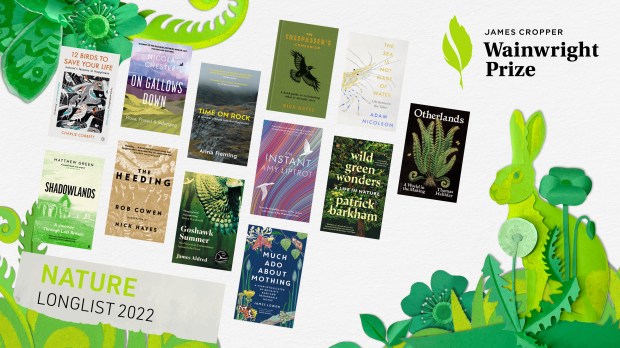
My thoughts: I have read and loved Goshawk Summer and On Gallows Down—the latter would be my overall top recommendation for the prize for how it fuses place-based memoir and passion for protecting wildlife and landscapes. I’ve also read The Heeding and The Instant but had mixed feelings about both. I’ve had the Barkham, Halliday and Nicolson out from the library but realized I only wanted to skim them – they were too dense (or, in the case of Barkham’s collected columns, too disparate) to read right through. I have a review copy of Much Ado about Mothing and have been finding it a delightful nature quest. I don’t know much about the four other titles, but would gladly read them if I found copies.
The 2022 James Cropper Wainwright Prize for Writing on Conservation:
- Abundance: Nature in Recovery, Karen Lloyd (Bloomsbury Wildlife)
- Aurochs and Auks, John Burnside (Little Toller Books)
- Climate Change Is Racist, Jeremy Williams and Dr Shola Mos-Shogbamimu (Icon Books)
- Divide: The relationship crisis between town and country, Anna Jones (Kyle Books)
- Eating to Extinction: The World’s Rarest Foods and Why We Need to Save Them, Dan Saladino (Jonathan Cape)
- Our Biggest Experiment: A History of the Climate Crisis, Alice Bell (Bloomsbury Sigma)
- Regenesis: Feeding the World Without Devouring the Planet, George Monbiot (Allen Lane)
- Silent Earth: Averting the Insect Apocalypse, Dave Goulson (Vintage)
- Soundings: Journeys in the Company of Whales, Doreen Cunningham (Virago)
- The Insect Crisis: The Fall of the Tiny Empires that Run the World, Oliver Milman (Atlantic Books)
- The Treeline: The Last Forest and the Future of Life on Earth, Ben Rawlence (Jonathan Cape)
- The Women Who Saved the English Countryside, Matthew Kelly (Yale University Press)
- Wild Fell: Fighting for nature on a Lake District hill farm, Lee Schofield (Doubleday)
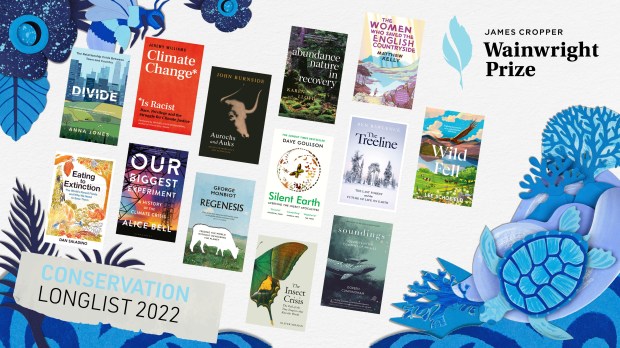
My thoughts: I’ve only read Aurochs and Auks and Silent Earth (which I reviewed for Shelf Awareness and would gladly see win the prize for shedding light on an aspect of the biodiversity crisis that’s not talked about enough; curious to longlist a second book, the Milman, on the same topic, though). I’d happily read any of the others. I’m particularly interested in Soundings, which I already have on my e-reader from a review opportunity I passed up.
The 2022 James Cropper Wainwright Prize for Children’s Writing on Nature and Conservation longlist:
- A Bug’s World, Dr Erica McAlister, illustrated by Stephanie Fizer Coleman (Wren & Rook)
- Around the World in 80 Trees, Ben Lerwill, illustrated by Kaja Kajfež (Welbeck)
- By Rowan and Yew, Melissa Harrison (Chicken House)
- Julia and the Shark, Kiran Millwood Hargrave, illustrated by Tom de Freston (Orion Children’s Books)
- Nests, Susan Ogilvy (Particular Books)
- October, October, Katya Balen, illustrated by Angela Harding (Bloomsbury Children’s Books)
- One World: 24 Hours on Planet Earth, Nicola Davies, illustrated by Jenni Desmond (Walker Books)
- Spark, Mitch Johnson (Orion Children’s Books)
- The Biggest Footprint: Eight billion humans. One clumsy giant, Rob Sears, illustrated by Tom Sears (Canongate)
- The Summer We Turned Green, William Sutcliffe (Bloomsbury YA)
- Twitch, M.G. Leonard (Walker Books)
- Wild Child: A Journey Through Nature, Dara McAnulty, illustrated by Barry Falls (Macmillan Children’s Books)

My thoughts: To my surprise, I’d read two of these: October, October and Wild Child. I’ve also read the Harrison novel that preceded this one. I’ve read other novels by Hargrave so would read this one, too. I’m unlikely to seek out any of the rest, but I’m pleased this new prize exists. If children are our only hope for surviving the climate crisis as a species, then we have to get them on-side as early as possible.
Overall thoughts: Pretty good representation of women on the lists! Just one person of colour this year, I think. A good mix of subjects; not too much repetition. (My husband (an entomologist) was pleased to see four books about insects.) And a decent balance of veteran versus new writers. I look forward to following the process and seeing who makes it through to the shortlist (on 28 July, with the winners to be announced on 7 September).
Have you read anything from the Wainwright Prize longlists?
Which of these books take your fancy?
20 Books of Summer, 6–7: Melissa Harrison & Oliver Rackham
After two days in Inverness, our Western Isles adventure is ready to begin. I’m writing on the ferry from Ullapool to Stornoway (the main population centre on the island of Lewis in the Outer Hebrides of Scotland), where we’ll pick up a rental car and head to our Airbnb before exploring standing stones and bird reserves well into the long evening.
On the bus this morning I started Black Narcissus by Rumer Godden, the next in my flora-themed reading. For today, I have brief responses to two books I finished before we left: a genial children’s fantasy novel and an in-depth guide to a tree. Ash is today’s linking word.
By Ash, Oak and Thorn by Melissa Harrison (2021)
 Burnet, Cumulus and Moss are “Hidden Folk” (like Iceland’s elves), ancient, tiny beings who hibernate for winter in an ash tree. When they lose their home and Cumulus, the oldest, starts fading away, they set off on a journey to look for more of their kind and figure out what is happening. This eventually takes them to “the Hive” (London, presumably); they are helped along the way by creatures they might have been wary of: they hitch rides on deer and pigeons, and a starling, fox and rat are their allies in the city.
This reminded me of Watership Down with the classic quest feel, the many perils faced, and the way the species communicate with each other and are rendered as having different accents. The feasts and creative use of miniature objects recalled what I most love about the Brambly Hedge books. There is an important message about overcoming fear and prejudice, and a warning that Mortals have lost their connection to the Wild World. The hint is that the trio might play a role in helping humans reclaim it – perhaps in the sequel, recently longlisted for the Wainwright Prize (more on which anon).
Although there is a didactic element, with Harrison also commenting on emotions and pointing out natural phenomena for children to notice through the seasons, this didn’t bother me, and – in the Tove Jansson tradition – there are plenty of asides for grown-ups to appreciate, too. I’m unfamiliar with the series that inspired this, the 1930s The Little Grey Men books by “B.B.” (Denys Watkins-Pitchford), so can’t comment on it in comparison to the source material. I’ve read four other Harrison books, nonfiction and adult fiction, but this outstripped them all. (Public library)
A favourite passage:
“Going on an adventure might be exciting, but if you’re a home-loving person, it’s not long until you start wanting to feel safe and indoorsy again.”
The Ash Tree by Oliver Rackham (2014)
 A single-species monograph, this was more academic than I expected from Little Toller – it has statistics, tables and figures. So, it contains everything you ever wanted to know about ash trees, and then some. I actually bought it for my husband, who has found the late Rackham’s research on British landscapes useful, but thought I’d take a look as well. (The rental house we recently left had a self-seeded ash in the front garden that sprang up to almost the height of the house within the five years we lived there. Every time our landlords came round, we held our breath waiting for them to notice that the roots had started to push up the pavement and tell us it had to be cut down, but until now it has survived.)
Topics include the birds and insects the trees shelter, the lichen that grows on them, coppicing and pollarding techniques (“plashing” into hedges, the creation of horizontal seats), and the designation of ancient and veteran trees. Ash dieback disease, a major global issue, is another point for discussion. I found myself skimming through a lot of the detail, especially in later chapters. My favourite bits of trivia were that Yeats mentions the ash the most out of a handful of notable UK/Ireland poets, and that baseball bats are generally made out of ash wood. There are loads of colour photographs to help visualize tree features and locations. (New purchase)
Spring Reading, Part II: May, Moving and Swifts
Eight days after our move, there are still piles of boxes, but the furniture is in place and there are clear walkways, so we’ll call that progress. We got a lot of help on moving day from neighbours, one of whom built a tower of book boxes in the corner of the dining room! I had fun dismantling it last week and assigning each box to a particular bookcase. Arranging the contents on shelves will be for once we’re back from Spain.
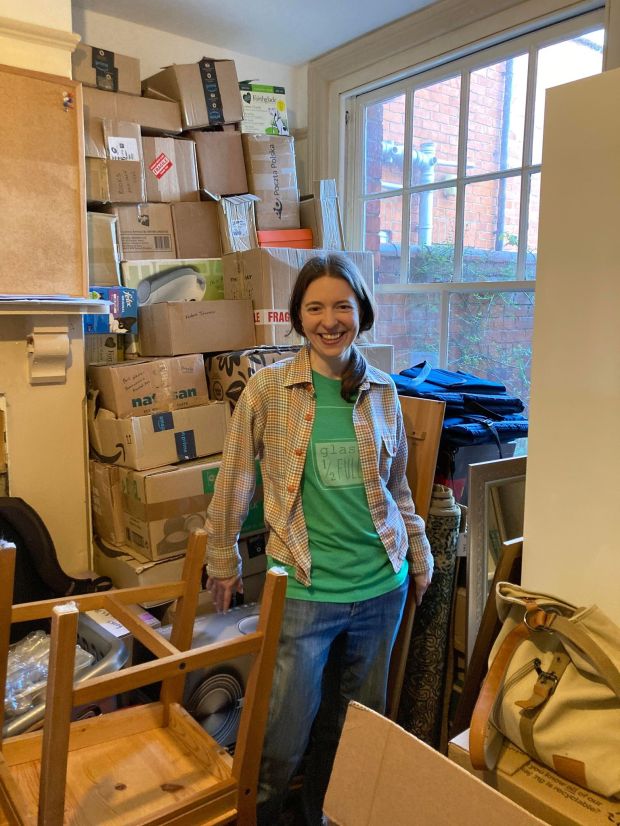
What with moving and DIY, I haven’t had a lot of time for reading lately, so didn’t finish any more of the spring books I’d intended to include – except for one children’s book from the library. I’ll give a little rundown of some of what has been on my coffee table stack.
Busy Spring: Nature Wakes Up by Sean Taylor and Alex Morss; illus. Cinyee Chiu (2021)
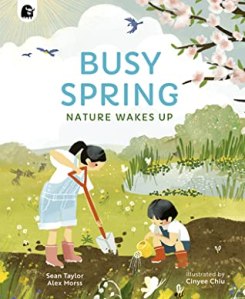 This was a cute read about two little girls helping their father in the garden and discovering the natural wonders of the season, like tadpoles in a pond, birds building nests, and insects and worms in the compost heap. A section at the end gives more information about the science of spring – unfortunately, it mislabels one bird and includes North American species without labelling them as such, whereas the rest of the book was clearly set in the UK. The strategy reminded me of that in Wild Child by Dara McAnulty. This year is the first time a children’s book Wainwright Prize will be awarded, so we’ll see this kind of book being recognized more.
May reads:
 Encore is my last unread journal of May Sarton’s. It begins in May 1991, when she’s 79 and in recovery from major illness. She’s still plagued by pain and fatigue, but her garden and visits from friends are a solace. Although she has to lie down to garden, “to put my hands in the earth to dig is life giving … it is almost as if the earth were nourishing me at the moment.” As usual, there are lovely reflections on the freedoms as well as the losses of ageing. This book, like the previous, was dictated, so there is a bit of repetition. I’ve been amused to see how pretentious she found A.S. Byatt’s Possession! An entry or two at a sitting helped calm my mind during the stress of moving week.
“In a funny way what drives me is the spring, the fleeting spring. Because of the enormous wind and rain we have had, a lot of the daffodils have blown down, though not as many as I feared. But the truth is that their peak is past. We shall have them for another week and then they will be gone. It seems quite unbearable but that is what spring is—the letting go. The waiting and waiting and waiting, and then the letting go.”
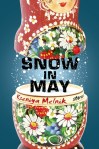
I started a reread of Snow in May by Kseniya Melnik and am partway through the second story. It’s a linked short story collection set in Magadan in northeast Russia – known for Stalin’s forced-labour camps. In “Love, Italian Style, or in Line for Bananas,” it’s 1975 and Tanya is on a shopping spree in Moscow. At a time of deprivation, she buys even things she doesn’t need or that aren’t quite right. Propositioned by an Italian football player on the plane ride over, she fantasizes about the exotic and romantic, juxtaposed against her everyday life.
“The pollen swirled around her like snow. There was a time when the distinctions between right and wrong seemed indisputable, and doing right felt good. When all the decisions had been premade and in her best interest. Back when she didn’t need so much to be happy.”
Belonging
 I saw it on shelf at the library and knew now was the perfect time to read My Life in Houses by Margaret Forster, a memoir via the places she’s lived, starting with the house where she was born in 1938, on a council estate in Carlisle. There’s something appealing to me about tracing a life story through homes – Paul Auster did the same in part of Winter Journal. I’d be tempted to undertake a similar exercise myself someday.
 The swifts come screeching down our new street and we saw one investigating a crevice in our back roof for a nest! In Fledgling by Hannah Bourne-Taylor, she is lonely in rural Ghana, where she and her husband had moved for his work, and takes in a young swift displaced from its nest. I’m only in the early pages, but can tell that her care for the bird will be a way of exploring her own feeling of displacement and the desire to belong. “Although I was unaware of it at the time, the English countryside and the birds had turned into my anchor of home.”
Wainwright and Women’s Prizes: Predictions & Wishes
It’s that time of year when all the literary prize news comes at once. Tonight: the announcement of the Wainwright Prize winners. (I was honoured to be invited to the ceremony, but traveling into London was more than I felt up to handling under the circumstances.) Tomorrow, the 8th, the Women’s Prize for Fiction is awarded. It’s been so long since the shortlist announcement that my enthusiasm has waned, but nonetheless, I make predictions and wishes for it as well as the Wainwright below.
Wainwright Prize
I’d read (or skimmed, or decided against) all 13 of the UK nature writing nominees, as well as a few from the global conservation longlist, before the shortlists were announced (see my mini-reviews and predictions).
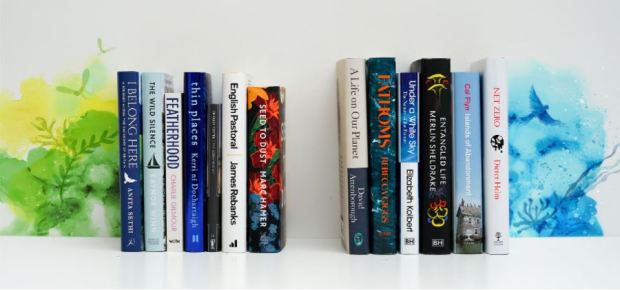
Unfortunately, my favourite from the lists, Vesper Flights by Helen Macdonald, did not make it through to the final round. To some extent it was a victim of the new division into two prizes: the idea seems to be to separate the narrative-driven, personal writing from the scientific, environmentally minded nonfiction. Books that draw on both genres, like Macdonald’s essays this year, and Tim Dee’s and Kathleen Jamie’s excellent travelogues (Greenery and Surfacing) last year, fall into the gap.
Since the shortlist announcement, I’ve read more of Islands of Abandonment by Cal Flyn and started Fathoms by Rebecca Giggs. Both are exceptionally written and impressive in scope, but as her portraits of the world’s derelict places have truly captivated my imagination, I stand by my initial prediction that Cal Flyn will win the global conservation prize.

As for the nature writing prize, I’m torn: The book that I think is of most lasting UK importance, with vital lessons to teach, is English Pastoral by James Rebanks. By contrast, the book that I wholeheartedly loved and admired was Featherhood by Charlie Gilmour. I’d be happy to see either one win.


Women’s Prize
Like last year, the winner announcement was delayed by several months, giving me time to forget all about it. Back in April I was very invested in the race (see my thoughts on the longlist; my wish list correctly predicted four of the six on the shortlist), and since then I’ve read and enjoyed a couple more from the longlist.
I predicted it would be Women’s Prize fodder when I read it back in June 2020, and I still think it the safest, strongest contender: The Vanishing Half by Brit Bennett. It’s easy to see this following in the footsteps of An American Marriage: a book club book concerned with race and relationships.
So that’s what I think will win, whereas I marginally preferred the superficially similar but subtler Transcendent Kingdom by Yaa Gyasi and would like to see its author get some recognition, so that’s what should win.


Next prize to think about: The Booker, whose shortlist will be announced on the 14th. On the 13th I’ll give my thoughts on the longlisted novels that I’ve read so far.
 Bookish Beck = Rebecca Foster. American transplant to England. Freelance proofreader and book reviewer.
