Hay-on-Wye Trip & Sixpence House Reread
We found Hay-on-Wye fairly bustling on an early September weekend. Not all of the bookshops are operational or have reliable opening hours, so we missed our chance to go in a few of them this time. Still, nine was plenty to be getting on with. The castle currently has scaffolding up for necessary renovations, and many eateries were offering little or no indoor table service. Masks are not actually compulsory in Wales, but we wore ours inside shops anyway, and half or more of the other customers and booksellers were doing the same.


Day 1: Drive there; Clock Tower Books, Oxfam, a great haul from the honesty shelves by the Castle (everything’s £1); ice cream cones from Shepherds; dinner at The Globe.

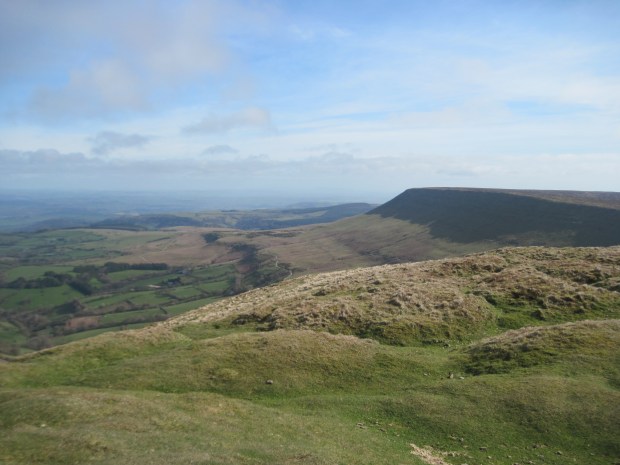
Day 2: A walk up Hay Bluff; roast lunch at the Three Tuns pub; Broad Street Book Centre, Hay Cinema Bookshop.
Day 3: Cinema outdoor area, Booth’s, British Red Cross shop, back to Oxfam, back to Clock Tower Books, Green Ink Booksellers; ice cream cones from Shepherds (again); drive home.
“To look for a specific book in Hay is a hopeless task; you can only find the books that are looking for you, the ones you didn’t even know to ask for in the first place. … What you mean to find matters less than what you do find.”
~Sixpence House: Lost in a Town of Books, Paul Collins (see below)


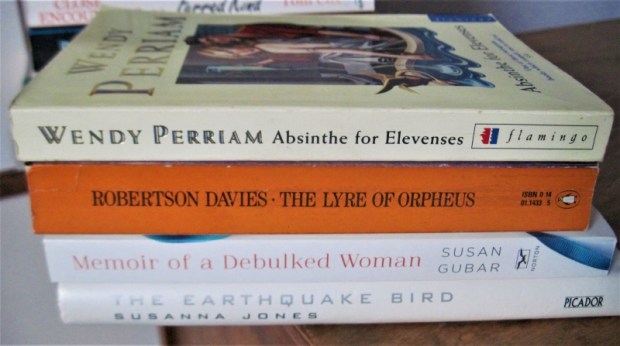
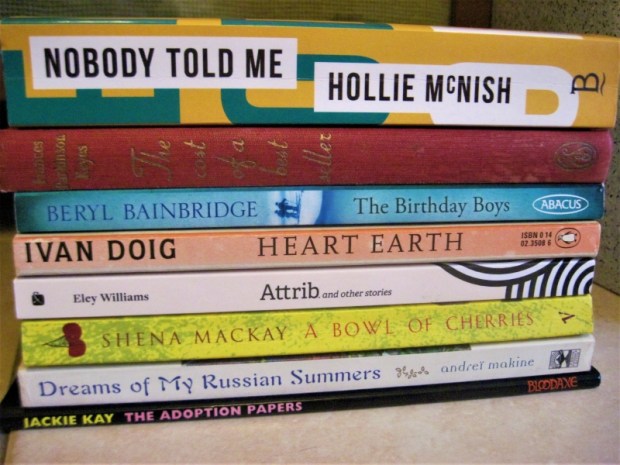
I bought 26 books in total (though one is an omnibus, so you could call it 28), at an average spend of £1.81 per volume. (My husband bought 10 nature books. We also found a gift for my father-in-law’s birthday next week – whew!) I’m particularly pleased with the Robertson Davies novels and the memoirs, some of which have been on my wish list for a long time. My interests in animals plus foodie and medical themes come through clearly. Some authors here I’ve never tried but have been meaning to; others are familiar names I was interested to read more by. I only noticed later on that Ghosts, the John Fuller poetry book, is a signed copy.
What I read
From last year’s book haul: The first 30 or so pages in Ingenious Pain by Andrew Miller and Jesus Land by Julia Scheeres. I’ll probably only skim the Spowers travel book (another one I only just noticed is signed). I have to read a different Dunmore first, towards my Women’s Prize reading project, as it’s requested after me at the library, but I’ll try to get to Talking to the Dead before too much longer.
I got through another 90 pages in Mike Parker’s On the Red Hill, about life in the house he and his partner inherited in the Welsh countryside from another gay couple. I also read about half of Tilly and the Lost Fairy Tales, Anna James’s second middle-grade novel about a girl who disappears into books and interacts with the characters, and the remainder of A.N. Wilson’s The Tabitha Stories, a cute chapter book with illustrations about a kitten learning how to be a cat.
Mostly, I focused on rereading the whole of Paul Collins’s memoir Sixpence House. I’ve listed this as one of the landmark books in my life because, as I was getting ready for my year abroad in England in the late summer of 2003, it was one of the books that whetted my appetite for traveling, and particularly for visiting Hay-on-Wye. (We first went in 2004; this was our seventh trip.)

In 2000 Collins moved from San Francisco to Hay with his wife and toddler son, hoping to make a life there. His parents were British and he’d enjoyed trips to the Book Town before, so it wasn’t a completely random choice. The place suited his interest in the oddities and obscure figures of literature and history. In fact, he’d just finished writing Banvard’s Folly, a fun book containing 13 profiles of thinkers and inventors whose great ideas flopped. (I should reread it, too.)
As he edits his manuscript and hunts for the perfect cover and title, he is also unexpectedly drawn into working for Richard Booth, the eccentric bookseller who was responsible for creating the world’s first book town and crowned himself King of Hay. Booth hired him to sort out the American Studies section – but if you ever went in the pre-2007 Booth’s you’ll know how impossible it would have been to make order out of its chaos. He comes across lots of interesting books time has forgotten, though (I first learned about W.N.P. Barbellion’s The Journal of a Disappointed Man from this book; why have I still not read it?!), and muses on counterfeiting, cover designs, bookbinding, and the sadness of the remainders bin.
Renting an apartment above Pembertons, which no longer exists but was at that time the town’s only new bookshop, Collins and his wife look at various properties and fall in love with a former pub. But when the survey comes back, they realize fixing all the damp and rot would nearly double its £125,000 price tag. (That sure looks good these days! The B&B next to the Airbnb flat where we stayed was for sale for over £700,000. Cusop Dingle is full of large, posh houses – Collins’s landlady referred to it as the “Beverly Hills of Hay.”) Buying one of the new-build houses on the edge of town just isn’t their dream.
In the end, after six months or so in Hay, they admit defeat and move back to the States. So in a sense this is – just like Banvard’s Folly, the book being shepherded into publication within it – a book about an experiment that turned out to be a noble failure. It’s warm, funny in a Bryson-esque way, and nostalgic for a place that still exists but a time that never will again. I loved spotting familiar landmarks, even if the shops have changed hands or are no longer there. This was probably my fourth read, but it all still felt fresh. An enduring favorite of mine. 
I’d be intrigued to know what Collins would make of Hay 20 years later. In 2000 it had 40 bookshops; now it’s only 12, with online sellers, book-related businesses, and shops further afield pushing the listings in the annual leaflet to 26. Whereas then Collins felt they were the only young family in town, it’s very much a hipster place now and we saw many groups of teens and twentysomethings. A tapas bar, boutique stores, turmeric chai lattes … it’s not just a musty antiquarian book lover’s paradise anymore, and that might sadden some like Collins. Yet gentrification and the Festival may be the only things that have kept the town alive. Richard Booth died last year, but the book town vision should live on.


I miss Hay already. I hate to think of all the time that might pass before I can get there again, and what will (or won’t) have changed by then. A few years can seem to go by in an instant these days. My vow is to go again before I turn 40.
Making Plans for a Return to Hay-on-Wye & A Book “Overhaul”
Somehow it’s been nearly 3.5 years since our last trip to Hay-on-Wye, the Book Town of Wales (I wrote about that April 2017 visit here). This coming weekend will be our seventh trip to Hay, one of our favorite places. We’ve booked an Airbnb in nearby English hamlet Cusop Dingle for two nights, so it’s a pretty short break, but longer than the weekend away we managed last month – reduced to only 36 hours by the cat’s poorly timed but ultimately minor one-day illness.
I’ve acquired many, many books from the free mall bookshop over the past year. (It’s now closed permanently, alas.) And I had no shortage of additional incomers during lockdown, via the unofficial Little Free Library I started and orders I placed with independent bookstores and publishers. So you could say I don’t need a book-buying trip to Hay. But 1) it’s never a question of need, is it? and 2) We want to continue to support the town, which will have been hit hard by temporary closures and by its annual literary festival being purely online this year.
I have no particular plans for what to buy this time, so will just see what takes my fancy. There are noticeably fewer bookshops than when we first started visiting Hay in 2004, but among the dozen or so remaining are some truly excellent shops like Addyman Books, the Hay Cinema Bookshop, and Booth’s Bookshop. Our best bargains last time were from the Oxfam charity shop and the honesty shelves around the castle, so those will likely be our first ports of call, and from there we’ll let whimsy be our guide. Saturday and Monday will be for wandering the town and book shopping, while Sunday will include countryside walks around Hay Bluff. We also hope to explore some eatery options we’ve not tried before.
An Overhaul of Last Trip’s Book Purchases
Simon of Stuck in a Book runs a regular blog feature he calls “The Overhaul,” where he revisits a book haul from some time ago and takes stock of what he’s read, what he still owns, etc. (here’s the most recent one). With his permission, I’m borrowing the title and format to look back at what I bought in Hay last time.
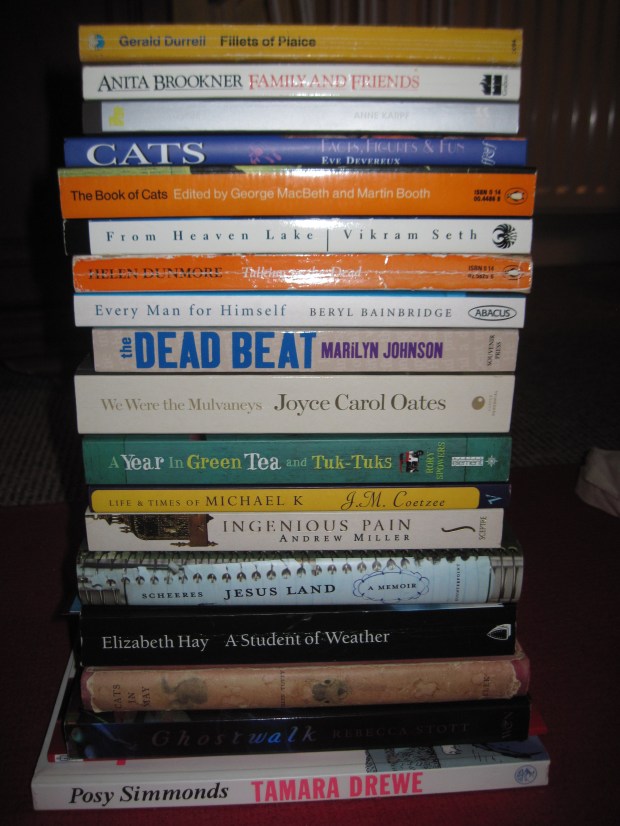
Date of haul: April 2017
Location: Hay-on-Wye
Number of books bought: 18
Had already read: (3/18)
- How to Age by Anne Karpf
- From Heaven Lake by Vikram Seth
- Tamara Drewe by Posy Simmonds – It’s on my shelf for rereading.
Have read since then: (5/18)
- Every Man for Himself by Beryl Bainbridge [resold]
- Fillets of Plaice by Gerald Durrell
- A Student of Weather by Elizabeth Hay (!)
- The Dead Beat by Marilyn Johnson
- Cats in May by Doreen Tovey
BUT also read from my hubby’s pile (not pictured):
- Sold for a Farthing by Clare Kipps
- All the Presidents’ Pastries by Roland Mesnier
- Second Nature by Michael Pollan
- A Shepherd’s Life by James Rebanks
DNFed: (3/18)
- Life & Times of Michael K by J.M. Coetzee [resold]
- We Were the Mulvaneys by Joyce Carol Oates – Might try this one again another time.
- Ghostwalk by Rebecca Stott [given away]
Resold unread: (1/18)
- Family and Friends by Anita Brookner – I’d added it to the Oxfam pile to make up a 5 for £1 stack, but then didn’t enjoy Booker winner Hotel du Lac enough to try another by Brookner.
Total still unread: 6
Total no longer owned: 4
This is not too bad a showing overall, though it does reveal my habit of buying books and letting them sit around for years unread. (Surely I’m not alone in this?!)
The six purchases still to read are two cat-themed anthologies for reading piecemeal, plus these four – two fiction and two non-:
- Talking to the Dead by Helen Dunmore
- Ingenious Pain by Andrew Miller
- Jesus Land by Julia Scheeres
- A Year in Green Tea and Tuk-Tuks by Rory Spowers
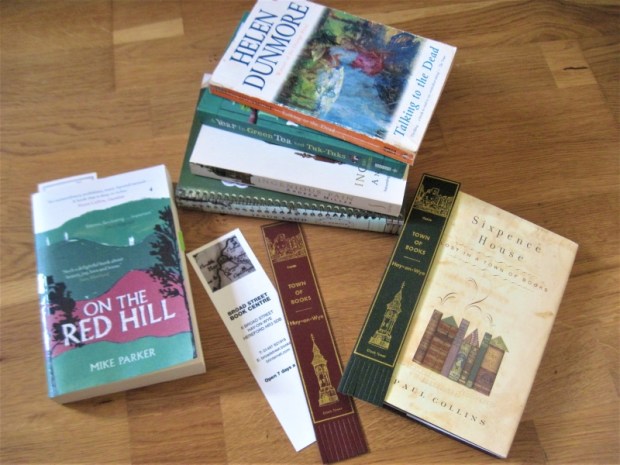
To force myself to get to them, these are the four I’ve packed for reading in the car and while in Hay. I’m also bringing, to read on location: 1) On the Red Hill by Mike Parker, a Wainwright Prize-shortlisted memoir about life in the Welsh countryside (I’m about 40 pages into it already); and 2) Sixpence House, which I’ve read several times before and consider among my absolute favorite books; it’s Paul Collins’s memoir about finding a temporary home and work among the bookshops of Hay.
I’ll be back on Tuesday with this year’s book haul plus photos and notes on how we found the town this time around. (But first, Six Degrees of Separation will post on Saturday while I’m away.)
The Not the Wellcome Prize Blog Tour: Francesca Segal and Ian Williams
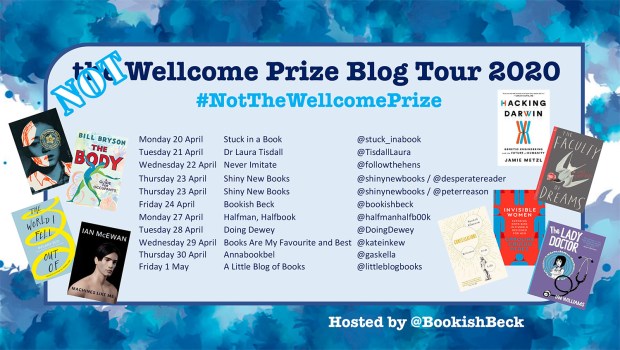
It’s my stop on the “Not the Wellcome Prize” blog tour. With two dozen reviews of health-themed 2019 books to choose from, I decided to nominate these two for the longlist because they’re under the radar compared to some other medical releases, plus they showcase the breadth of the books that the Prize recognizes: from a heartfelt memoir of a mother welcoming premature babies to a laugh-out-loud graphic novel about a doctor practicing in a small town in Wales. (The Prize website says “picture-led books are not eligible,” so in fact it is likely that graphic novels have never been considered, but we’ve been flexible with the rules for this unofficial blog tour.)
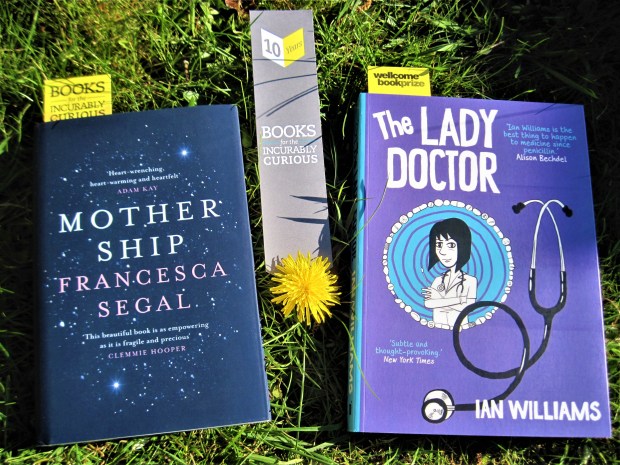
Mother Ship by Francesca Segal
 This first work of nonfiction from the author of the exquisite The Innocents is a visceral diary of the first eight weeks in the lives of her twin daughters, who were born by Caesarean section at 29 weeks in October 2015 and spent the next two months in the NICU, “an extremely well-funded prison or perhaps more accurately a high-tech zoo.” In Mother Ship, she strives to come to terms with this unnatural start to motherhood. “Taking my unready daughters from within me felt not like a birth but an evisceration,” she writes. “My children do not appear to require mothering. Instead they need sophisticated medical intervention.”
Segal describes with tender precision the feeling of being torn: between the second novel she’d been in the middle of writing and the all-consuming nature of early parenthood; and between her two girls (known for much of the book as “A-lette” and “B-lette”), who are at one point separated in different hospitals. Her attitude towards the NHS is pure gratitude.
As well as portraying her own state of mind, she crafts twinkly pen portraits of the others she encountered in the NICU, including the staff but especially her fellow preemie mums, who met in a “milking shed” where they pumped breast milk for the babies they were so afraid of losing that they resisted naming. (Though it was touch and go for a while, A-lette and B-lette finally earned the names Raffaella and Celeste and came home safely.) Female friendship is thus a subsidiary theme in this exploration of desperate love and helplessness.
The Lady Doctor by Ian Williams
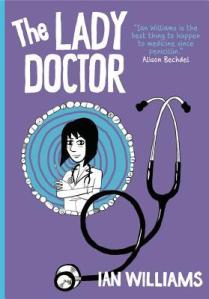 This sequel to 2014’s The Bad Doctor returns to a medical practice in small-town Wales. This time, though, the focus is on Iwan James’s colleague, Dr. Lois Pritchard, who also puts in two days a week treating embarrassing ailments at the local hospital’s genitourinary medicine clinic. At nearly 40, Lois is a divorcee with no children; just a dog. She enjoys her nights out drinking with her best friend, Geeta, but her carefree life is soon beset by various complications: she has to decide whether she wants to join the health centre as a full partner, a tryst with her new fella goes horribly wrong, and her estranged mother suddenly reappears in her life, hoping that Lois will give her a liver transplant. And that’s not to mention all the drug addicts and VD-ridden lotharios hanging about.
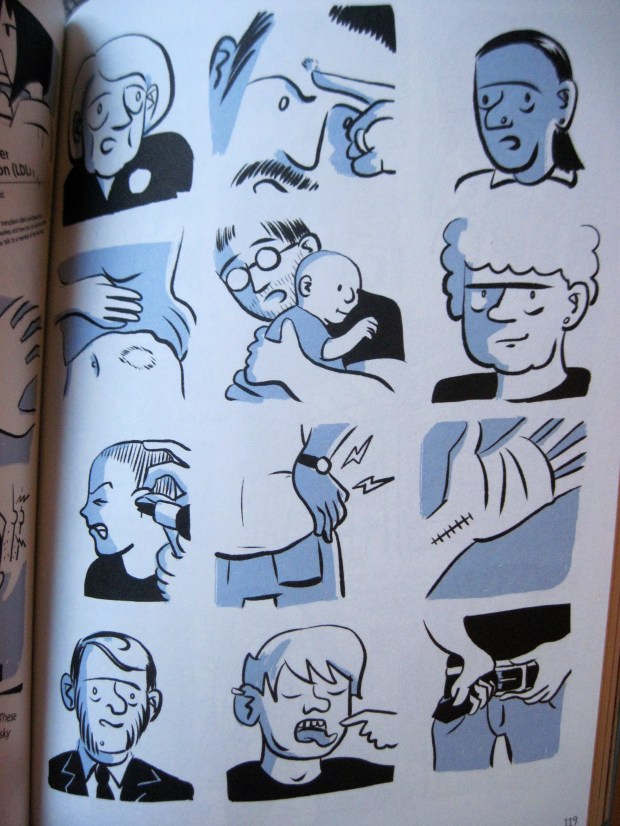
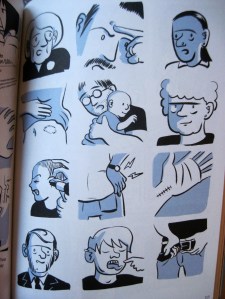 Williams was a GP in North Wales for 20 years, and no doubt his experiences have inspired his comics. His tone is wonderfully balanced: there are plenty of hilarious, somewhat raunchy scenes, but also touching moments where Lois learns that a doctor is never completely off duty and has no idea what medical or personal challenge will crop up next. The drawing style reminded me most of Alison Bechdel’s or Posy Simmonds’, with single shades from rose to olive alternating as the background. I especially loved the pages where each panel depicts a different patient to show the range of people and complaints a doctor might see in a day. Myriad Editions have a whole “Graphic Medicine” series that I’m keen to explore.
See below for details of the blogs where other reviews have appeared or will be appearing soon.
The shadow panel will choose a shortlist of six titles to be announced on 4 May. We will then vote to choose a winner, with the results of a Twitter poll serving as one additional vote. The Not the Wellcome Prize winner will be announced on 11 May.
“Graphic Medicine”: The Lady Doctor by Ian Williams
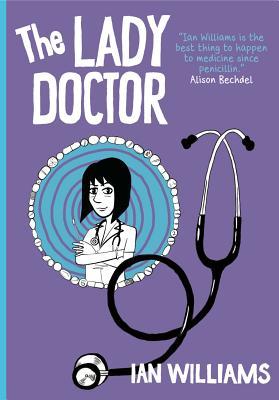 This sequel to Ian Williams’s 2014 graphic novel The Bad Doctor returns to a medical practice in small-town Wales. This time, though, the focus is on Iwan James’s colleague, Dr. Lois Pritchard, who also puts in two days a week treating embarrassing ailments at the local hospital’s genitourinary medicine clinic. At nearly 40, Lois is a divorcee with no children, just a dog. She enjoys nights out drinking with her best friend, Geeta, but her carefree life is soon beset by complications: she has to decide whether she wants to join the health center as a full partner, a tryst with her new fella goes horribly wrong, and her estranged mother suddenly reappears in her life, hoping Lois will give her a liver transplant. And that’s not to mention all the drug addicts and VD-ridden lotharios hanging about.
Williams was a GP in North Wales for 20 years; no doubt his experiences have inspired his comics. His tone is wonderfully balanced: there are plenty of hilarious, somewhat raunchy scenes, but also a lot of heartfelt moments as Lois learns that a doctor is never completely off duty and you have no idea what medical or personal challenge will crop up next. The drawing style reminds me of Alison Bechdel’s (and in the cover blurb she says, “Ian Williams is the best thing to happen to medicine since penicillin”), with single colors from pink to olive alternating as the background. I especially loved the pages where each panel depicts a different patient to show the breadth of people and complaints a doctor might see in a day.
This review is on the short side for me, but I don’t want to resort to spoilers, so will just say that if you’re a fan of Bechdel and Posy Simmonds, or if you are unfamiliar with graphic novels and fancy trying one, do seek this out. The medical theme made it a must for me. In fact, Myriad Editions have a whole “Graphic Medicine” series that I’ll be keen to explore.
My rating: 
The Lady Doctor will be published in the UK by Myriad Editions on January 31st and in the USA by Penn State University Press on February 18th. My thanks to the publisher and publicist Emma Dowson for the free copy for review.
Heart and Mind: New Nonfiction by Sandeep Jauhar and Jan Morris
Heart: A History, by Sandeep Jauhar
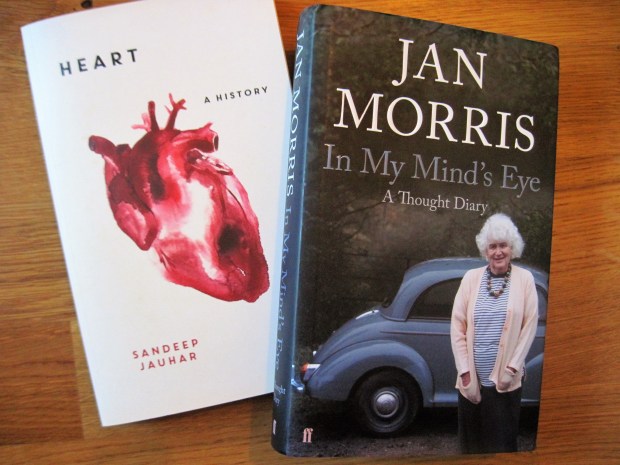
There could hardly be an author better qualified to deliver this thorough history of the heart and the treatment of its problems. Sandeep Jauhar is the director of the Heart Failure Program at Long Island Medical Center. His family history – both grandfathers died of sudden cardiac events in India, one after being bitten by a snake – prompted an obsession with the heart, and he and his brother both became cardiologists. As the book opens, Jauhar was shocked to learn he had up to a 50% blockage of his own coronary vessels. Things had really gotten personal.
Cardiovascular disease has been the #1 killer in the West since 1910 and, thanks to steady smoking rates and a continuing rise in obesity and sedentary lifestyles, will still affect 60% of Americans. However, the key is that fewer people will now die of heart disease thanks to the developments of the last six decades in particular. These include the heart–lung machine, cardiac catheterization, heart transplantation, and artificial hearts.
 Along the timeline, Jauhar peppers in bits of his own professional and academic experience, like experimenting on frogs during high school in California and meeting his first cadaver at medical school. My favorite chapter was the twelfth, “Vulnerable Heart,” which is about how trauma can cause heart arrhythmias; it opens with an account of the author’s days cataloguing body parts in a makeshift morgue as a 9/11 first responder. I also particularly liked his account of being called out of bed to perform an echocardiogram, which required catching a taxi at 3 a.m. and avoiding New York City’s rats.
Maybe I’ve read too much surgical history this year (The Butchering Art by Lindsey Fitzharris and Face to Face by Jim McCaul), though, because I found myself growing fairly impatient with the medical details in the long Part II, which centers on the heart as a machine, and was drawn more to the autobiographical material in the first and final sections. Perhaps I would prefer Jauhar’s first book, Intern: A Doctor’s Initiation.
In terms of readalikes, I’d mention Siddhartha Mukherjee’s The Gene, in which the personal story also takes something of a backseat to the science, and Gavin Francis’s Shapeshifters, which exhibits a similar interest in the metaphors applied to the body. While I didn’t enjoy this quite as much as two other heart-themed memoirs I’ve read, The Sanctuary of Illness by Thomas Larson and Echoes of Heartsounds by Martha Weinman Lear, I still think it’s a strong contender for next year’s Wellcome Book Prize (the judging panel is announced tomorrow!).
Some favorite lines:
“it is increasingly clear that the biological heart is extraordinarily sensitive to our emotional system—to the metaphorical heart, if you will.”
“Who but the owner can say what lies inside a human heart?”“As a heart-failure specialist, I’d experienced enough death to fill up a lifetime. At one time, it was difficult to witness the grief of loved ones. But my heart had been hardened, and this was no longer that time.”
My rating: 
Heart is published in the UK today, September 27th, by Oneworld. My thanks to the publisher for the proof copy for review.
In My Mind’s Eye: A Thought Diary, by Jan Morris
I’ve been an admirer of Jan Morris’s autobiographical and travel writing for 15 years or more. In this diary covering 2017 into early 2018, parts of which were originally published in the Financial Times and the Welsh-language literary newspaper O’r Pedwar Gwynt, we get a glimpse into her life in her early nineties. It was a momentous time in the world at large but a fairly quiet and reflective span for her personally. Though each day’s headlines seem to herald chaos and despair, she’s a blithe spirit – good-natured about the ravages of old age and taking delight in the routines of daily one-mile walks down the lane and errands in local Welsh towns with her beloved partner Elizabeth, who’s in the early stages of dementia.
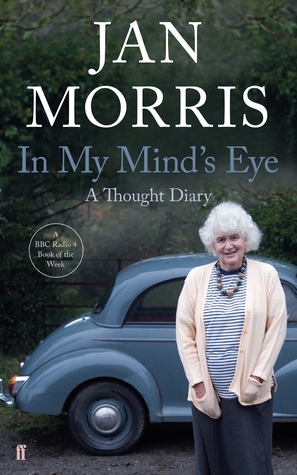 There are thrilling little moments, though, when a placid domestic life (a different kind of marmalade with breakfast each day of the week!) collides with exotic past experiences, and suddenly we’re plunged into memories of travels in Swaziland and India. Back when she was still James, Morris served in World War II, was the Times journalist reporting from the first ascent of Everest, and wrote a monolithic three-volume history of the British Empire. She took her first airplane flight 70 years ago, and is nostalgic for the small-town America she first encountered in the 1950s. Hold all that up against her current languid existence among the books and treasures of Trefan Morys and it seems she’s lived enough for many lifetimes.
There’s a good variety of topics here, ranging from current events to Morris’s love of cats; I particularly liked the fragments of doggerel. However, as is often the case with diaries, read too many entries in one go and you may start to find the sequence of (non-)events tedious. Each piece is only a page or two, so I tried never to read many more than 10 pages at a time. Even so, I noticed that the plight of zoo animals, clearly a hobby-horse, gets mentioned several times. It seemed to me a strange issue to get worked up about, especially as enthusiastic meat-eating and killing mice with traps suggest that she’s not applying a compassionate outlook consistently.
In the end, though, kindness is Morris’s cardinal virtue, and despite minor illness, telephone scams and a country that looks to be headed to the dogs, she’s encouraged by the small acts of kindness she meets with from friends and strangers alike. Like Diana Athill (whose Alive, Alive Oh! this resembles), I think of Morris as a national treasure, and I was pleased to spend some time seeing things from her perspective.
Some favorite lines:
“If I set out in the morning for my statutory thousand daily paces up the lane, … I enjoy the fun of me, the harmless conceit, the guileless complexity and the merriment. When I go walking in the evening, on the other hand, … I shall recognize what I don’t like about myself – selfishness, self-satisfaction, foolish self-deceit and irritability. Morning pride, then, and evening shame.” (from Day 99)
“Good or bad, virile or senile, there’s no life like the writer’s life.” (from Day 153)
My rating: 
In My Mind’s Eye was published by Faber & Faber on September 6th. My thanks to the publisher for the free copy for review.
The Best Books from the First Half of 2018
Here’s a quick look back at a baker’s dozen of 2018 releases that have stood out most for me so far. I’ve linked to books that I’ve already reviewed in full on the blog or elsewhere.
Fiction:
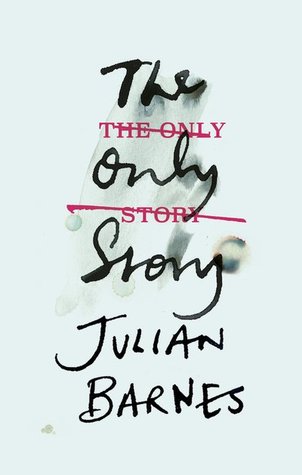 The Only Story by Julian Barnes: A familiar story: a May–December romance fizzles out. A sad story: an idealistic young man who swears he’ll never be old and boring has to face that this romance isn’t all he wanted it to be. A love story nonetheless. Paul met 48-year-old Susan, a married mother of two, at the local tennis club when he was 19. The narrative is partly the older Paul’s way of salvaging what happy memories he can, but also partly an extended self-defense. Barnes takes what could have been a dreary and repetitive story line and makes it an exquisitely plangent progression: first-person into second-person into third-person. The picture of romantic youth shading into cynical but still hopeful middle age really resonates, as do the themes of unconventionality, memory, addiction and pity.
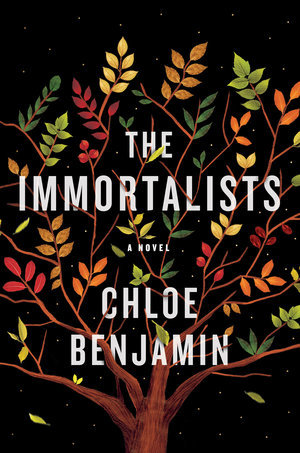 The Immortalists by Chloe Benjamin: Summer 1969: four young siblings escape a sweltering New York City morning by visiting a fortune teller who can tell you the day you’ll die. In the decades that follow, they have to decide what to do with this advance knowledge: will it spur them to live courageous lives, or drive them to desperation? This compelling family story lives up to the hype. Imagine the fun Benjamin had researching four distinct worlds: Daniel, a military doctor, examines Iraq War recruits; Klara becomes a magician in Las Vegas; Varya researches aging via primate studies; and Simon is a dancer in San Francisco. The settings, time periods, and career paths are so diverse that you get four novels’ worth of interesting background.
 Florida by Lauren Groff: Two major, connected threads in this superb story collection are ambivalence about Florida, and ambivalence about motherhood. There’s an oppressive atmosphere throughout, with environmental catastrophe an underlying threat. Set-ups vary in scope from almost the whole span of a life to one scene. A dearth of named characters emphasizes just how universal the scenarios and emotions are. Groff’s style is like a cross between Karen Russell’s Swamplandia! and Cormac McCarthy’s The Road, and her unexpected turns of phrase jump off the page. A favorite was “Above and Below,” in which a woman slips into homelessness. Florida feels innovative and terrifyingly relevant. Any one of its stories is a bracing read; together they form a masterpiece.
 Motherhood by Sheila Heti: Should one have children? Should I have children? No matter who’s asking the questions or in what context, you’re going to get the whole gamut of replies. Heti’s unnamed heroine consults a fortune teller and psychics, tosses coins and interprets her dreams as The Decision looms. Chance, inheritance, and choice vie for pride of place in this relentless, audacious inquiry into the purpose of a woman’s life. I marked out dozens of quotes that could have been downloaded directly from my head or copied from my e-mails and journal pages. The book encapsulates nearly every thought that has gone through my mind over the last decade as I’ve faced the intractable question of whether to have children. Heti has captured brilliantly what it’s like to be in this situation in this moment in time.
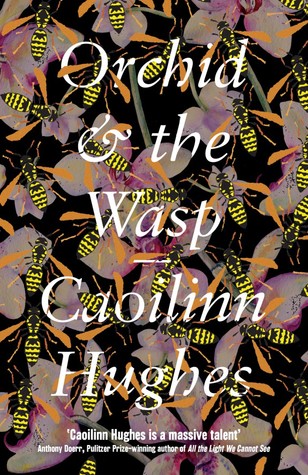 Orchid & the Wasp by Caoilinn Hughes: The action spans about nine years: a politically turbulent decade that opens with the Iraq War protests and closes with the Occupy movement in New York City. Gael Foess, our lovable antiheroine, is a trickster. She’s learned well her banker father’s lesson that money and skills don’t get distributed fairly in this life, so she’s going to do what she can to ensure that her loved ones succeed. Art, music, religion and health are major interlocking themes. The author is wonderfully adept at voices, and the book’s frenetic pace is well matched by the virtuosic use of language – wordplay, neologisms, and metaphors drawn from the arts and nature. Hughes is an exciting writer who has rightfully attracted a lot of buzz for her debut.
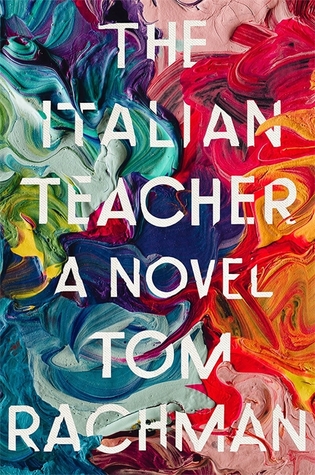 The Italian Teacher by Tom Rachman: Charles “Pinch” Bavinsky is just an Italian teacher, though as a boy in Rome in the 1950s–60s he believed he would follow in the footsteps of his sculptor mother and his moderately famous father, Bear Bavinsky, who paints close-ups of body parts. We follow Pinch through the rest of his life, a sad one of estrangement, loss and misunderstandings – but ultimately there’s a sly triumph in store for the boy who was told that he’d never make it as an artist. Rachman jets between lots of different places – Rome, New York City, Toronto, rural France, London – and ropes in quirky characters in the search for an identity and a place to belong. This is a rewarding story about the desperation to please, or perhaps exceed, one’s parents, and the legacy of artists in a fickle market.

The ‘bests’ that I happen to own in print.
Nonfiction:
 The Line Becomes a River by Francisco Cantú: Francisco Cantú was a U.S. Border Patrol agent for four years in Arizona and Texas. Impressionistic rather than journalistic, his book is a loosely thematic scrapbook. He inserts snippets of U.S.–Mexico history, including the establishment of the border, and quotes from other primary and secondary texts. He also adds in fragments of his family’s history: His ancestors left Mexico during the Mexican Revolution of the 1910s, but there’s no doubt his Latino name and features made him a friendly face for illegal immigrants. The final third of the book makes things personal when his friend is detained in Mexico. Giving faces to an abstract struggle, this work passionately argues that people should not be divided by walls but united in common humanity.
 The Unmapped Mind by Christian Donlan: Some of the best medical writing from a layman’s perspective I’ve ever read. Donlan, a Brighton-area video games journalist, was diagnosed with (relapsing, remitting) multiple sclerosis in 2014. “I think sometimes that early MS is a sort of tasting menu of neurological disease,” Donlan wryly offers. He approaches his disease with good humor and curiosity, using metaphors of maps to depict himself as an explorer into uncharted territory. The accounts of going in for an MRI and a round of chemotherapy are excellent. Short interludes also give snippets from the history of MS and the science of neurology in general. What’s especially nice is how he sets up parallels with his daughter’s early years. My frontrunner for next year’s Wellcome Book Prize so far.
 Free Woman by Lara Feigel: Doris Lessing lived by ideals of free love and Communism, but it came at the price of abandoning her children. Lara Feigel could identify with Lessing in some ways, and as she entered a rocky time in her mid-thirties – a miscarriage followed by IVF, which was a strain on her marriage; the death of a close friend; ongoing worry over how motherhood might affect her academic career – she set out to find what Lessing could teach her about how to be free. A familiarity with the works of Doris Lessing is not a prerequisite to enjoying this richly satisfying hybrid of biography, literary criticism and memoir. The Golden Notebook is about the ways in which women compartmentalize their lives and the struggle to bring various strands into harmony; that’s what Free Woman is all about as well.
 Implosion by Elizabeth W. Garber: The author grew up in a glass house designed by her father, Modernist architect Woodie Garber, outside Cincinnati in the 1960s to 70s. This and Woodie’s other most notable design, Sander Hall, a controversial tower-style dorm at the University of Cincinnati that was later destroyed in a controlled explosion, serve as powerful metaphors for her dysfunctional family life. Woodie is such a fascinating, flawed figure. Garber endured sexual and psychological abuse yet likens him to Odysseus, the tragic hero of his own life. She connected with him over Le Corbusier’s designs, but it was impossible for a man born in the 1910s to understand his daughter’s generation. This definitely is not a boring tome just for architecture buffs. It’s a masterful memoir for everyone.
 Skybound by Rebecca Loncraine: Each year seems to bring one exquisite posthumous memoir about facing death with dignity. For Rebecca Loncraine, after treatment for breast cancer in her early thirties, taking flying lessons in an unpowered glider was her way of rediscovering joy and experiencing freedom by facing her fears in the sky. She discovered a particular love for flying alongside birds: red kites in Wales, and vultures in Nepal. The most remarkable passages of the book are the exhilarating descriptions of being thousands of feet up in the air and the reflections on why humans are drawn to flight and what it does for our bodies and spirits. Loncraine had virtually finished this manuscript when her cancer returned; she underwent another 14 grueling months of treatment before her death in September 2016.
 Bookworm by Lucy Mangan: Mangan takes us along on a nostalgic chronological tour through the books she loved most as a child and adolescent. No matter how much or how little of your early reading overlaps with hers, you’ll appreciate her picture of the intensity of children’s relationship with books – they can completely shut out the world and devour their favorite stories over and over, almost living inside them, they love and believe in them so much – and her tongue-in-cheek responses to them upon rereading them decades later. There are so many witty lines that it doesn’t really matter whether you give a fig about the particular titles she discusses or not. A delightful paean to the joys of being a lifelong reader; recommended to bibliophiles and parents trying to make bookworms out of their children.
 Educated by Tara Westover: This is one of the most powerful and well-written memoirs I’ve ever read. It tells of a young woman’s off-grid upbringing in Idaho and the hard work that took her from almost complete ignorance to a Cambridge PhD. Westover’s is an incredible story about testing the limits of perseverance and sanity. Her father may have been a survivalist, but her psychic survival is the most impressive outcome here. What takes this astonishing life story to the next level, making it a classic to sit alongside memoirs by Alexandra Fuller, Mary Karr and Jeannette Walls, is the writing. Westover writes with calm authority, channeling the style of the scriptures and history books that were formative in her upbringing and education.
What are some of the best books you’ve read so far this year?
What 2018 releases do I need to catch up on right away?
Two Memoirs of Women’s Freedom: Lara Feigel and Rebecca Loncraine
I have read some truly phenomenal memoirs this year, most of them by women. These two have rather different starting points – frustration with the constraints of marriage and motherhood, and breast cancer treatment – but I’ve paired them because both are journeys of self-discovery in which the author commits to determining how to live a free and true life.
Free Woman: Life, Liberation and Doris Lessing by Lara Feigel
It started with a spate of weddings one summer. Lara Feigel, a literature lecturer at King’s College London, found herself strangely irked at all this capitulation to marital convention, even though she herself had married in her twenties and had a young son. What did her mild outrage signify? At the same time, she was rereading the works of Doris Lessing, whom she found simultaneously admirable and vexing: Lessing lived by her ideals of free love and Communism, but it came at the price of abandoning her children. Feigel could identify with Lessing in some ways but not in others, and as she entered a rocky time in her mid-thirties – a miscarriage followed by IVF, which was a strain on her marriage; the death of a close friend; and ongoing worry over how motherhood might affect her academic career – she set out to find what Lessing could teach her about how to be free.
Throughout, Feigel holds up her own experiences of marriage and motherhood in parallel to Lessing’s. She maintains a delicate balance between biographical and autobiographical information and brings in references to other writers – everyone from Rachel Cusk to D.H. Lawrence – to explore various opinions on maternal ambivalence and sexual fulfillment. I could relate to the bookworm’s impulse to turn to literature for comfort and direction – “the most enduring novelists … illuminate our lives,” and “we live differently as a result of reading them,” Feigel insists. Lessing seemed to her the perfect “writer to discover in your thirties; a writer who wrote about the lives of grown-up women with an honesty and fullness I had not found in any novelist before or since.”
And yet a familiarity with or fondness of the works of Doris Lessing is not a prerequisite to enjoying this book. I’ve only ever read The Golden Notebook (1962) and Alfred and Emily (2008), a fictionalized biography of Lessing’s parents, both during my mid-twenties. The former I almost certainly read before I could fully appreciate it. It’s about the ways in which women compartmentalize their lives and the struggle to bring various strands into harmony; that’s what Free Woman is all about as well. Feigel often looks for clues in Lessing’s heavily autobiographical Martha Quest novels, which I’d like to read, and also travels to California to meet one of Lessing’s lovers and to Zimbabwe to see the farm where Lessing grew up.
Like Samantha Ellis’s How to Be a Heroine and Rebecca Mead’s My Life in Middlemarch, this is a richly satisfying hybrid of biography, literary criticism and memoir. I would also recommend it to readers of Alexandra Fuller’s Don’t Let’s Go to the Dogs Tonight, Nancy Horan’s Loving Frank, and Adrienne Rich’s Of Woman Born. Feigel’s is a particularly brave and forthright book. I feel proud of her in an oddly personal way: during my years as a library assistant at King’s, I saw her chair countless literature and life writing events. She seemed impossibly young for a professor type, and wore her navy blue shift dress and string of pearls like it was her grown-up’s uniform. I can tell that the years since, including the difficult experiences she recounts here, have both softened and toughened her, sandpapering away what she calls her “diffident angularity” and replacing it with womanly wisdom.
My rating:
Free Woman was published by Bloomsbury UK on March 8th. My thanks to the publisher for the free copy for review.
Skybound: A Journey in Flight by Rebecca Loncraine
In 2016 it was When Breath Becomes Air by Paul Kalanithi; in 2017 it was The Bright Hour by Nina Riggs. And now Skybound. Each year seems to bring one exquisite posthumous memoir about facing a death from cancer with dignity. For Rebecca Loncraine, after treatment for breast cancer in her early thirties, taking flying lessons in an unpowered glider was her way of rediscovering joy and experiencing freedom by facing her fears in the sky.
She was a freelance writer based on her parents’ farm in the Black Mountains of Wales, an area that’s familiar to me from trips to Hay-on-Wye and from my reading of Bruce Chatwin’s On the Black Hill. The history and geography of the region, as revealed from the air, weave through the book, as do childhood memories and recollections of chemotherapy. Loncraine discovered a particular love for flying alongside birds: the red kites in Wales, and later vultures in Nepal. The most remarkable passages of the book are the exhilarating descriptions of being thousands of feet up in the air and the reflections on why humans are drawn to flight and what it does for our bodies and spirits. She learned from a British Airways pilot that 500,000 people are airborne at any one moment! We take for granted what should still be acknowledged as a miraculous feat.
“There’s no road in the sky. Each individual glider pilot finds a new pathless way through the air, a unique scribble. We locate a bit of ridge lift, here; fly out to a thermal, there; we wind and manoeuvre over the curving land. We never take the same route twice, so flight offers me a new perspective each time I fly.”
“Influenced by the ancient seam of human thought that associates the sky with the imagination, weaving and circling in the sky begins to feel like sailing through the realm of the subconscious itself.”
This hobby-turned-obsession was not without its inconveniences and dangers. Even when it’s warm at ground level it’s frigid at 13,000 feet, so you have to bundle up. Meanwhile, the strength of the sun means you keep guzzling water and have to wear either a urine-collecting device or adult diapers. The earliest attempts at unpowered flight were generally fatal, and when Loncraine went to New Zealand for a bonus season of flying to replace the Welsh winter, one of her fellow flyers died in a crash. Her instructor told her she’d become fearless, even reckless. But when she met one of the pioneers of gliding, then in his nineties, in New Zealand he spoke an aphorism that perfectly captures the role flying played for Loncraine: “The antidote to fear is fascination.”
There’s a brief afterword by Loncraine’s mother, Trisha. Her daughter had virtually finished this manuscript when the cancer returned, and underwent another 14 grueling months of treatment before her death in September 2016. This is a simply wonderful book; what a shame that we won’t get another.
My rating: 
Skybound was published by Picador on April 19th. My thanks to the publisher for a proof copy for review.
Review: The Last Wilderness by Neil Ansell
Many travel books are about the quest for new, exotic places and the widest possible range of experiences; many nature books focus on the surprising quality and variety of life to be found by staying close to home. In that loose framework, Neil Ansell’s The Last Wilderness belongs on the nature shelf rather than the travel section: here he’s all about developing his knowledge of a particular place, the Northwest Highlands of Scotland, where he stays five times over the course of one year to give a panoramic view of the area in different non-touristy seasons.
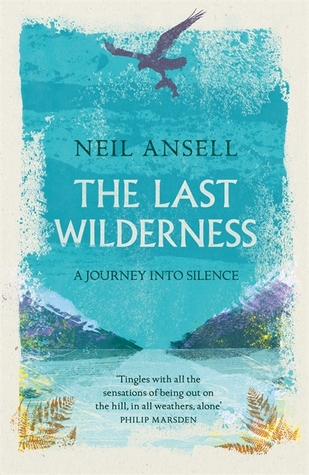 Ansell’s visits have the flavor of a pilgrimage: his wonder at the region’s sights and sounds, and particularly at the creatures he encounters, is akin to what one would experience in the presence of the holy; he also writes about wildlife as if it is a relic of a fast-vanishing world. “It is that exploratory desire to possess the wilds for ourselves that has resulted in their disappearance,” he notes. A true wilderness is unvisited, and true solitude is hard to experience “if the world is only a click away.”
Depicted against this backdrop of environmental damage are the author’s personal losses: a heart problem and progressive hearing loss mean that the world is narrowing in for him. He mourns each sign of diminishment, such as the meadow pipits whose call he can no longer hear. Depth of experience is replacing breadth for him, though flashbacks to his intrepid world travels – an African safari, hitchhiking in Australia, time in Sweden and Costa Rica – show that he has tried both approaches. There’s a good balance here between adventuring and the comfort of an increasingly familiar place.
Like “a tale told round a campfire,” Ansell’s is a meandering and slightly melancholy story that draws you in. If The Last Wilderness suffers, it’s mostly in comparison with his Deep Country (2011), one of the most memorable nature/travel books I’ve ever read, a modern-day Walden about his five years living in a cottage in the Welsh hills. Solitude and survival are more powerful themes there, though they echo here too. Once again, he writes of magical encounters with wildlife and gives philosophical reflections on the nature of the self. I can highly recommend Neil Ansell’s books to anyone who enjoys nature and travel writing.
My rating:
The Last Wilderness: A Journey into Silence will be published by Tinder Press on February 8th. My thanks to Becky Hunter for the review copy.
Adventures in the Town of Books
We had a wonderful time in Hay-on-Wye. The weather was gorgeous – which we never would have counted on in Wales in early April – and it was a treat to get out into the countryside. Even though there were road works on the main route through Hay and a house under construction across from our Airbnb property, it was so quiet most of the time. Most often we only heard sheep and pheasants in the fields or songbirds flitting around the garden. We’ve been back to normal life for a few days, but the contrast between Hay and our terraced street’s noisy neighbors and frequent car movement has remained stark. Also, I greatly enjoyed the time off work, and struggled to clear 200+ e-mails the day after we got back.

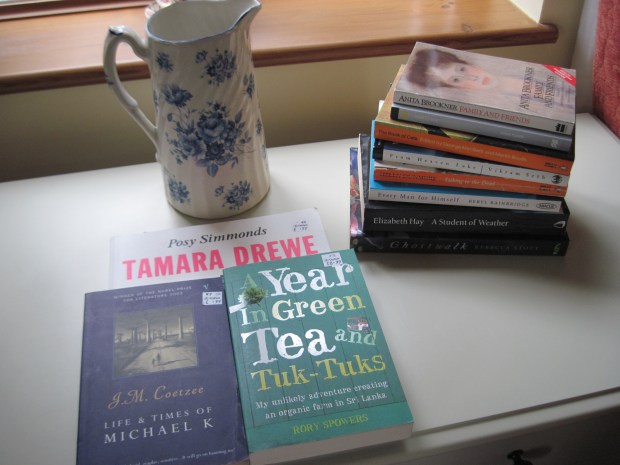
Early bargains came from the Oxfam charity shop (a box outside with paperbacks at 5 for £1, plus various nearly new copies at 99p each) and the ‘honesty’ shopping areas around the castle (50p paperbacks and £1 hardbacks). Each day my husband’s and my rival stacks kept growing.
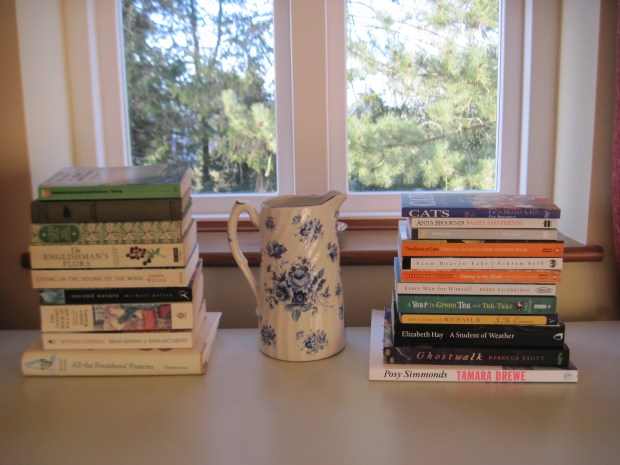
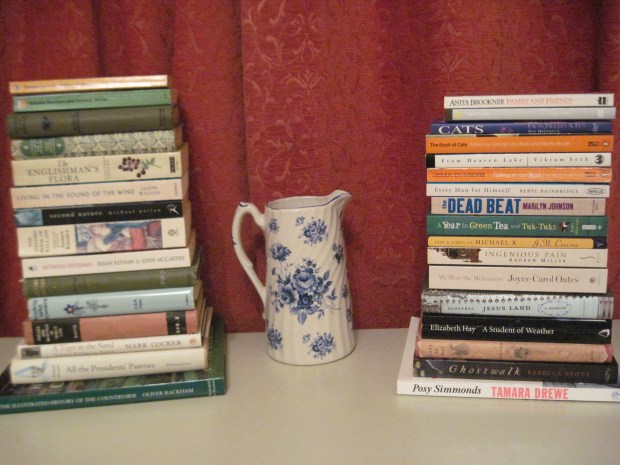
In the end we purchased 40 books, averaging ~£1.48 each: 3 gifts (alas that we couldn’t do better in this respect) plus another 18 or 19 books each. All very equitable! My husband focused on nature and travel, including some rare and novelty insect books.
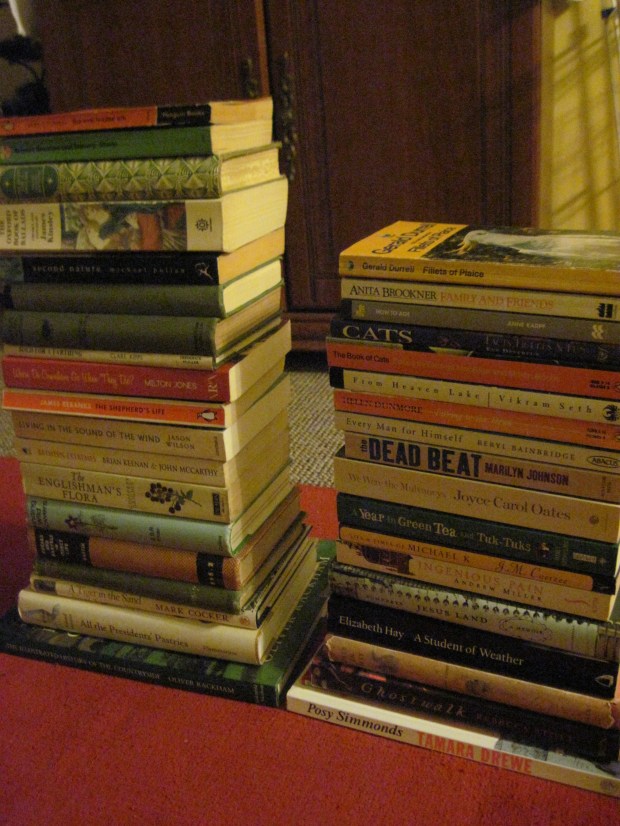
Some of my prize finds were a vintage copy of the next book in Doreen Tovey’s cat series, a copy of the Joyce Carol Oates novel I intend to make my introduction to her work, and Marilyn Johnson’s book on obituaries. As a bonus, three of the books I bought are ones I’ve already read: Vikram Seth’s travel book on China, How to Age from the School of Life series – a total bargain at 50p!, and Posy Simmonds’ Tamara Drewe, an update of Thomas Hardy’s Far from the Madding Crowd and one of the first graphic novels I ever read and loved.
Of course, I didn’t end up reading very much (or any) of many of the books I took with me. I glanced at The Rebecca Rioter, but didn’t find it at all interesting; I forgot to look at The Airbnb Story; and I seem to be stuck fast just two chapters into Our Mutual Friend. On the other hand, I’ve been enjoying Bruce Chatwin’s On the Black Hill, of which I read over half, and I made good progress in George Saunders’s Lincoln in the Bardo.
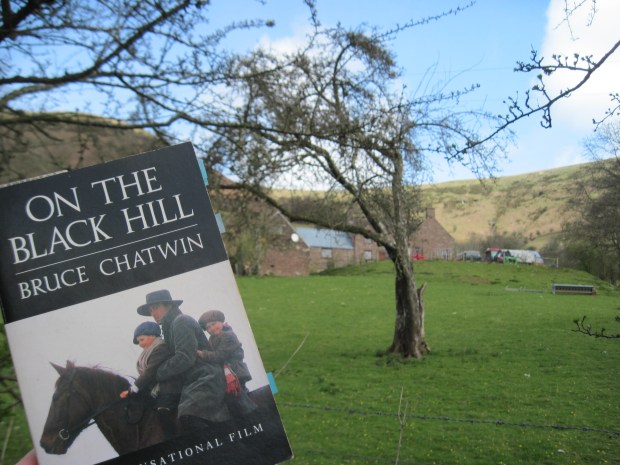
We sought out “The Vision” farm we found on the map, which presumably inspired Chatwin.
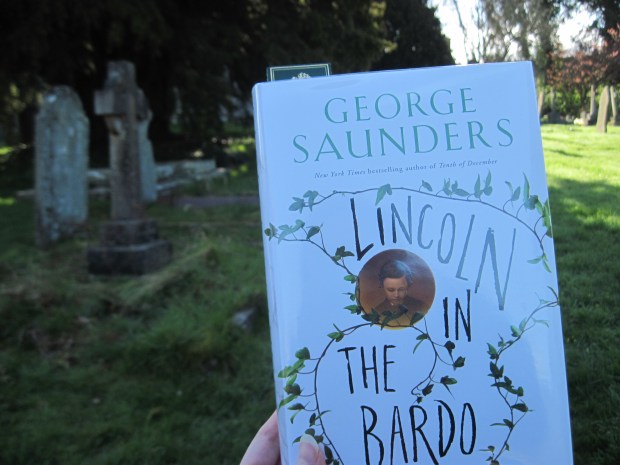
I took Lincoln in the Bardo for a jaunt up the road to the Cusop churchyard; it seemed an appropriate spot.
It’s also been fun to browse Francis Kilvert’s diary entries from his years as the curate in nearby Clyro. In one of my favorite passages, he expresses horror at finding British tourists overrunning Llanthony Abbey ruins. For a minister, he certainly sounds like a misanthrope:
I had the satisfaction of managing to walk from Hay to Clyro by the fields without meeting a single person, always a great triumph to me and a subject for warm self congratulation for I have a peculiar dislike to meeting people, and a peculiar liking for a deserted road.
We went out to Llanthony for the first time on this trip, and paid Clyro’s church a visit, too.
-
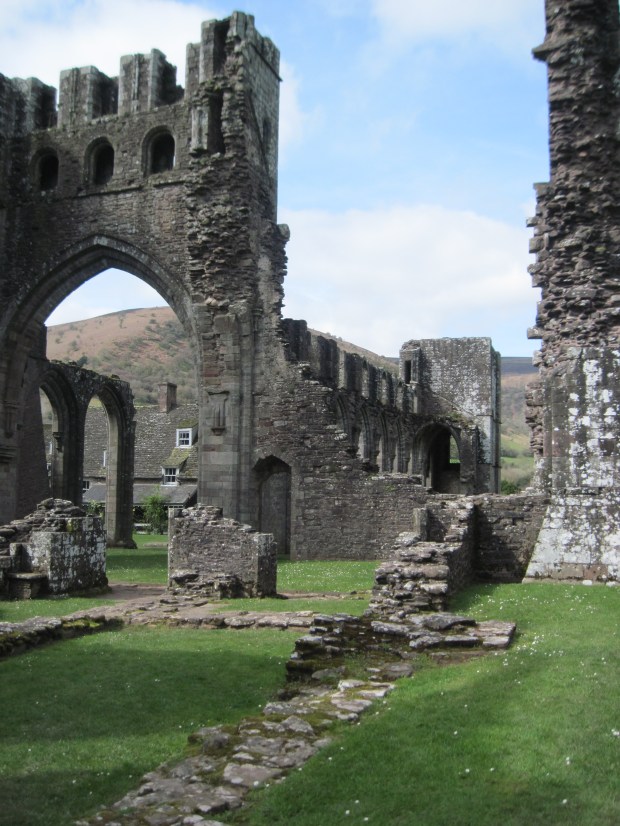
- Llanthony Priory ruins
-
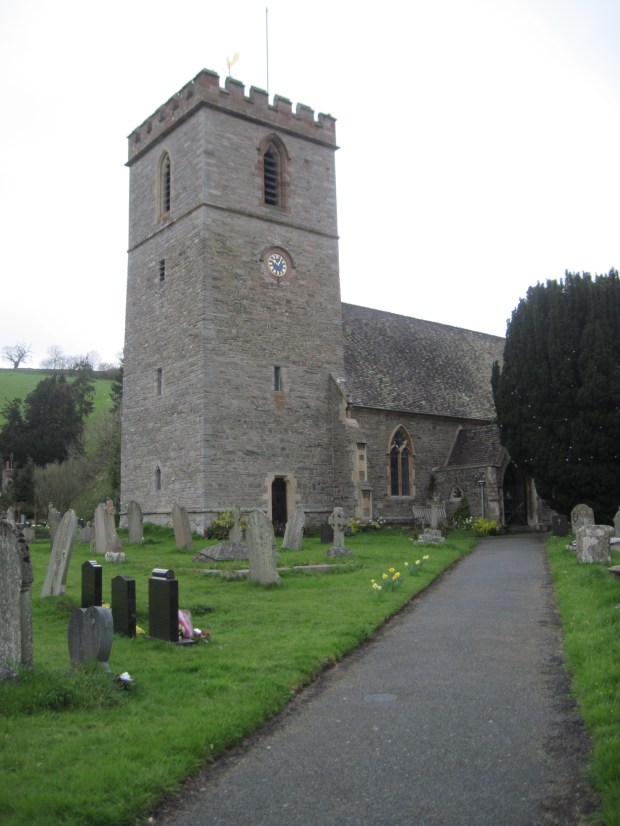
- Clyro’s church
-
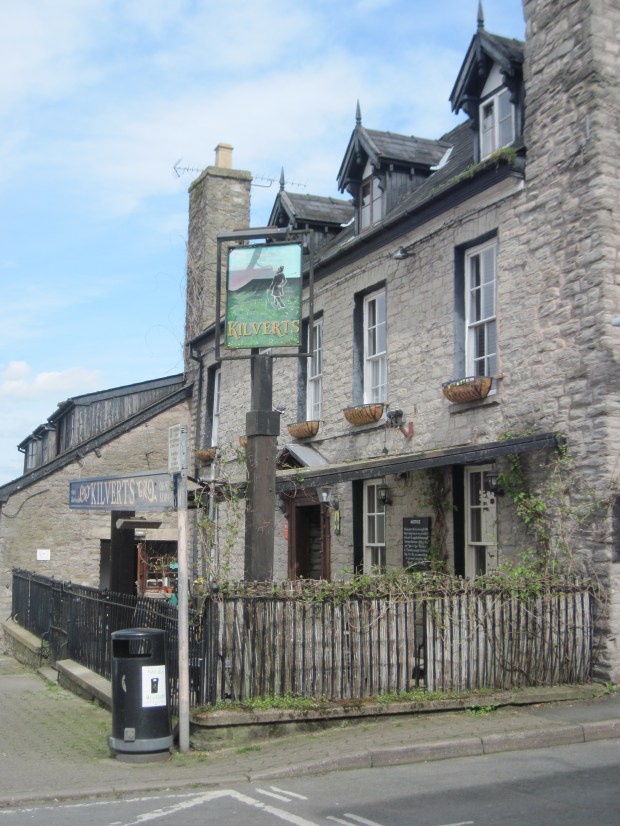
- Kilverts restaurant in Hay.
-
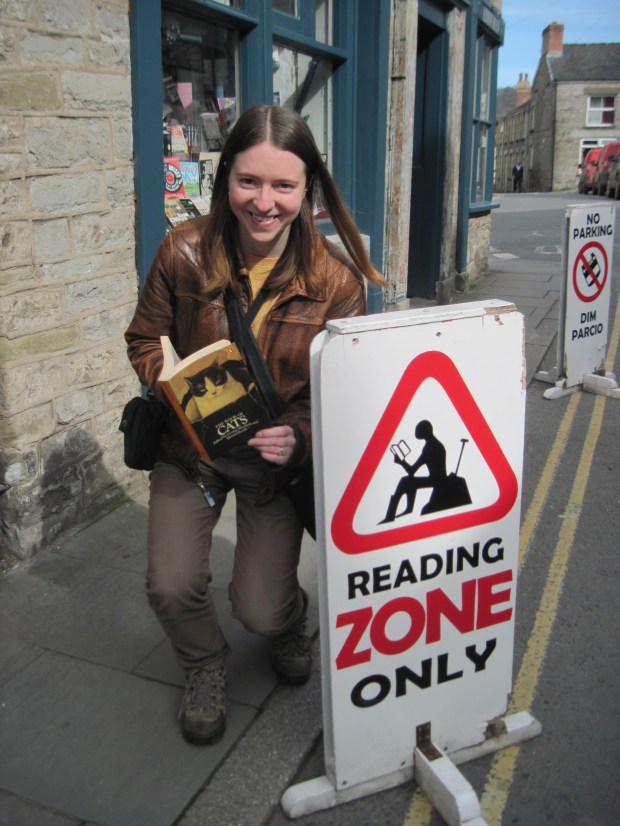
- In the reading zone.
-
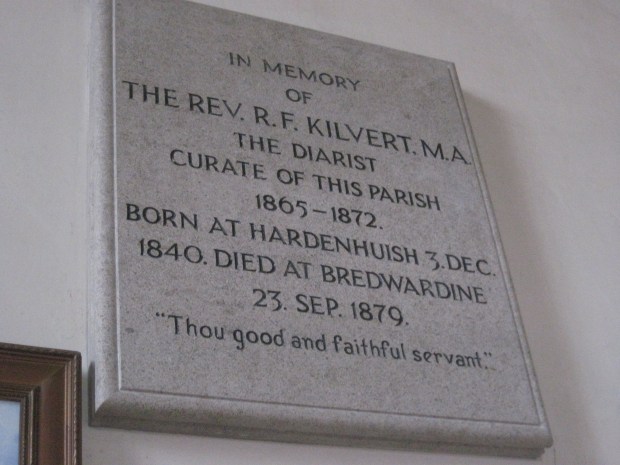
- Inside Clyro church.
-
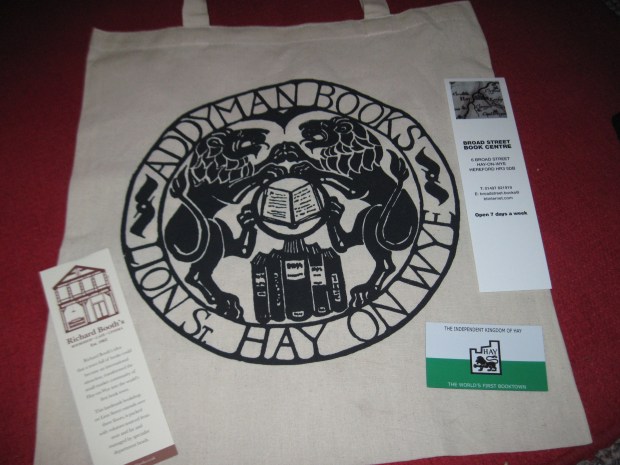
- New Hay swag! (tote, bookmarks and magnet)
Hay is much less shabby compared to our first visit. Many of the shops have been spruced up, and the pubs can’t get away with serving bog-standard fare anymore. A number of the newest eateries and entertainment venues are only open on weekends, so we’ll be sure to time our next trip to cover a Friday–Saturday. The town has even gained some hipster establishments, like a fair-trade shop and a coffee shop/vintage clothing emporium.
-
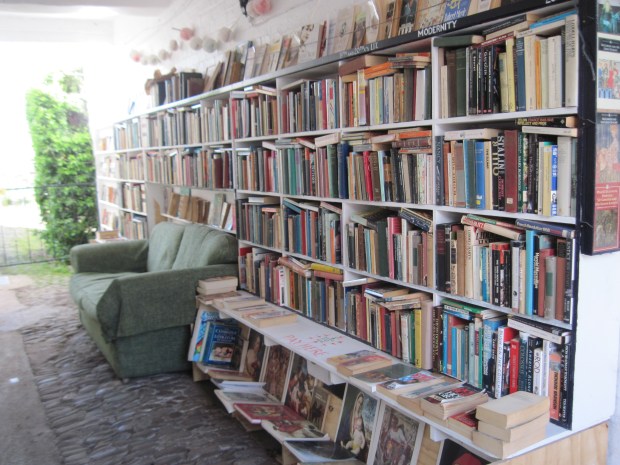
- You find books down every alley in Hay.
-

- A phoenix on the Hay Book Arts Trail.
-

- Best random spotting: a book A.S. Byatt once owned!
The Book Arts Trail was celebrating the 40 years of ‘independence’ of Richard Booth’s kingdom of Hay this year, and I expect we’ll still find the place going strong at 50.
 Bookish Beck = Rebecca Foster. American transplant to England. Freelance proofreader and book reviewer.
 Bookish Beck