Happy Birthday & Bookshop Day
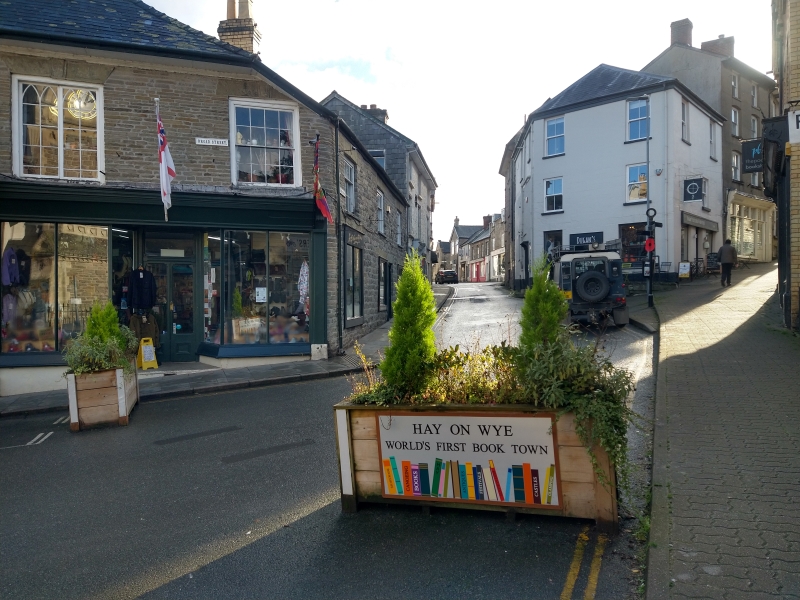
Happy Bookshop Day from Hay-on-Wye (and its newest bookshop, Gay on Wye)!


Today is my 40th birthday and I have been spending the weekend book shopping, reading, eating and drinking. What more could I ask for?


Before we left for Wales, I had my book club over for birthday cakes and bubbles. My husband made me a chocolate Guinness cake (vegan so everyone could share it) and pumpkin chai cupcakes; both recipes were from Hummingbird Bakery cookbooks.


I’ll report back on Monday with my book haul and trip highlights.
For now, here are some sweet lines from a children’s book I read this morning, about cats named Tom and Mot who discover that friendship and imagination are the greatest gifts, and that present has a double meaning: the now that must be appreciated.
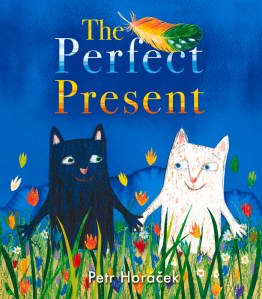
“And then it was time for a hot drink and the cake. The cake tasted like the BEST birthday cake in the world. … ‘Today was the best present in the world,’ said Tom. ‘The perfect present!’”
The Rituals by Rebecca Roberts (Blog Tour)
Rebecca Roberts adapted her 2022 Welsh-language novel Y Defodau, her ninth, into The Rituals, which draws on her time working as a non-religious celebrant. Her protagonist, Gwawr Efa Taylor, is a freelance celebrant, too. The novel is presented as her notebook, containing diary entries as well as the text of some of the secular ceremonies she performs to mark rites of passage. We open on a funeral for a 39-year-old woman, then swiftly move on to a Bridezilla celebrity’s wedding that sours in a way that threatens to derail Gwawr’s entire career. A victim of sabotage, she’s doubly punished by gossip.
As she tries to piece her life back together, Gwawr finds support from many quarters, such as her beloved grandfather (Taid), a friend who invites her along on a writing retreat, her Welsh-language book club, a high school acquaintance, other customers and a sweet dog. She and the widower from the first funeral make a pact to start counselling at the same time to work through their grief – we know early on that she has experienced the devastating loss of Huw, but the details aren’t revealed until later. A couple of romantic prospects emerge for the 37-year-old, but also some uncomfortable reminders of past scandal.
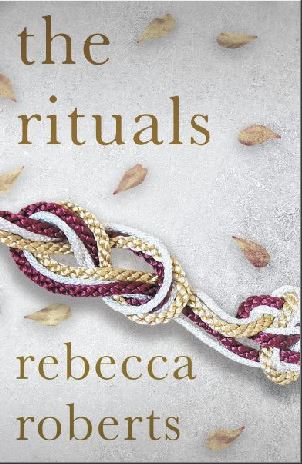
There are heavy issues here, like alcoholism, infant loss and suicide, but they reflect the range of human experience and allow compassionate connections to form. Gwawr’s empathy is motivated by her bereavement: “That’s what keeps me going – knowing that I’ve turned the worst time of my life into something that helps other people. Taking the good from the bad.” You can see that attitude infusing her naming ceremonies and funerals. I’ll say no more about the plot, just that it prioritizes moments of high emotion and is both absorbing and touching.
I think this is only the second Welsh-language book I have read in translation (the first was The Life of Rebecca Jones by Angharad Price). It’s whetted my appetite for heading back to Wales for the first time since 2020 – we’re off to Hay-on-Wye on Friday. The Rituals is a tear-jerker for sure, but also sweet, romantic and realistic. I enjoyed it in much the same way I did The Collected Regrets of Clover by Mikki Brammer, and was pleased to try something from a small press that champions women’s writing.
With thanks to Random Things Tours and Honno Welsh Women’s Press for the proof copy for review.
Buy The Rituals from Bookshop.org [affiliate link]
I was delighted to be part of the blog tour for The Rituals. See below for details of where other reviews have appeared or will be appearing soon.

October Reading Plans
My plans for the rest of the month’s reading, in pictures.
A handful of October releases (not counting the ones I’ve reviewed in advance for Shelf Awareness et al., one for a blog tour, or what I’ll be reading for November deadlines).


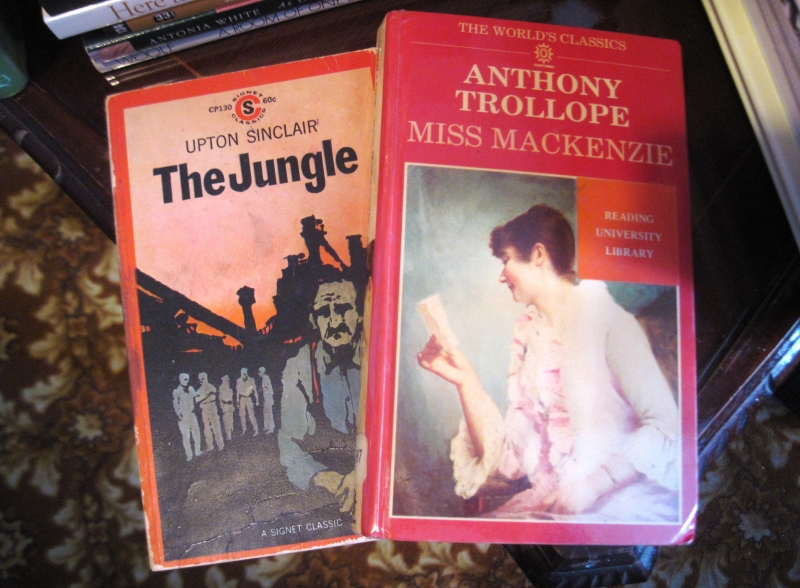
I turn 40 on the 14th, so have made a halfhearted attempt to gather my last four unread from The Novel Cure’s books to read in your thirties before that milestone passes. Whether I’ll actually read them, I’m less sure about. I’ve owned this copy of The Jungle for decades; I’ve not enjoyed Trollope since my student days. Time runs short, anyway, but I’ll see how I get on with the Sinclair at least, and perhaps skim the Trollope to get a sense of why Berthoud and Elderkin chose it for that list.
[The others are London Fields by Martin Amis, which is on loan just as I need it, and The Best of It All by Rona Jaffe, which I borrowed once and didn’t get far in; now it appears to have been withdrawn from the system. (My DNF review from 2018: “I read the first chapter and had a weird reverse case of déjà vu: this is awfully similar to Mad Men, Suzanne Rindell’s Three-Martini Lunch, and A.J. Pearce’s Dear Mrs Bird, though of course they would have been based on Jaffe’s novel rather than the other way round. Caroline Bender, fresh out of a broken engagement, arrives for her first day as a typist at a New York City publishing house and has to adjust to the catty office politics. I think I’ll truly enjoy this, but I need to find another time when I can give it my full attention. It’s nearly 450 pages of small print, so I need a chunk of time when I can really sink into it, like a flight or a long train ride.)]
Also in conjunction with that big birthday, I’ve collected some notable 1983 releases, including 5 out of the 10 most popular on Goodreads’ list. (The Ephron and Hill would be rereads for me.) I’ll work on them in these last few months of the year.
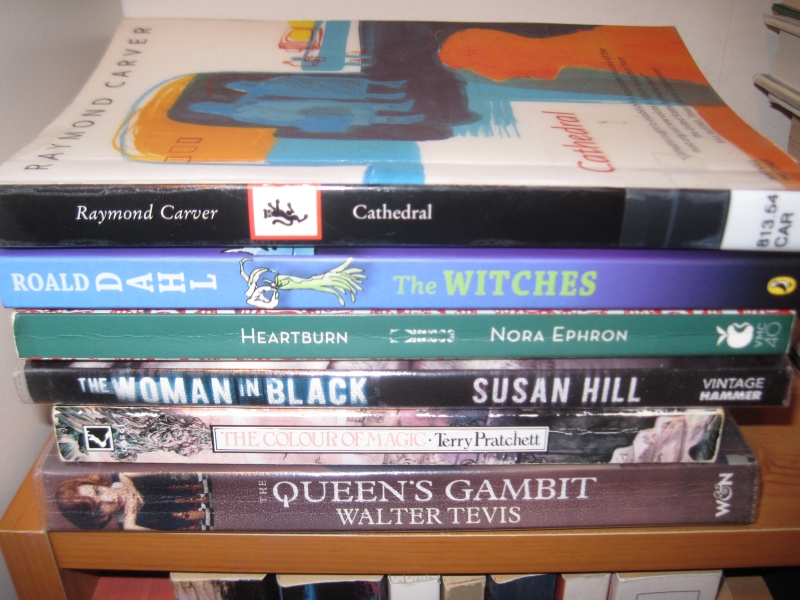
A lesser-known Margaret Drabble novel for our women’s classics book club subgroup; Pale Fire for 1962 Club; two potential books for AusReading Month.

Some spooky or death-themed R.I.P. options (I know the challenge technically starts in September, but I only ever think to read such books as Halloween approaches).
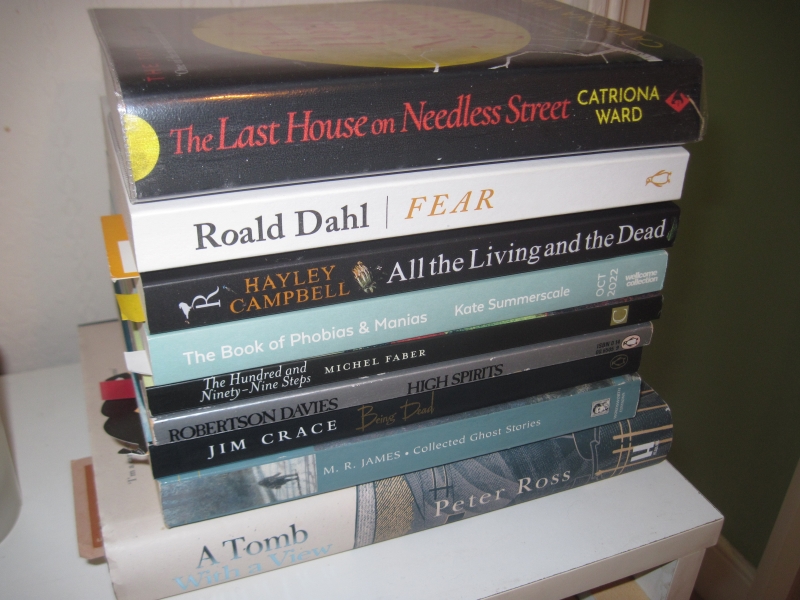
I’ll be spending my birthday weekend in Hay-on-Wye, one of my special places. Here’s my Wales-themed and/or Hay-related pile. I’ll take all of these and probably many of the above as well; I like to have lots to choose from!

20 Books of Summer, 11–12: Gillian Clarke Poetry and Ross Gay Essays
It might not look like I’ll finish the 20 Books of Summer challenge in time, but I’ve got it all planned out and should be reviewing the last few on the final day! My initial foodie idea has turned into a micro-theme that joins only about six of the titles in total. I’ve swapped in various other things along the way, such as a couple of poetry collections and novellas (note to self: always include at least a few very short books!), but the focus has been on getting through stuff from my own shelves, especially recent acquisitions and work by women.
Today I have an excellent poetry collection infused with the language of gardening and geology and reflecting on two crises of the early 2000s, and a book of mini-essays about noticing the small pleasures that make life worth living.
Making the Beds for the Dead by Gillian Clarke (2004)
 I look out for black-and-white Carcanet spines whenever I’m scanning the poetry section in a secondhand bookshop. Clarke’s was a new name for me (the National Poet of Wales from 2008 to 2016, she’s now 86) but the blurb attracted me and this ended up being exactly the sort of poetry I love: full of colours and nature imagery, profuse with alliteration and slant rhymes, relishing its specialist terminology, and taking on the serious subject matter of manmade disasters. Several medium-length sequences are devoted to gardening (“The Middleton Poems” and “Nine Green Gardens”) and geology (“The Stone Poems”); some earlier pieces are ekphrastic, or dedicated to particular poets.
Clarke remembers the delight she took as a child in the unfamiliar vocabulary of the Bible, “a narrative of spells / in difficult columns on those moth-thin pages, / words to thrill the heart with a strange music.” The book teems with animals – though, alas, many of them are dead (as in “Adders” and “Taxidermy”). The title sequence, indeed is about the foot and mouth disease outbreak that decimated the UK livestock population in 2001. Farmers were forced to cull their flocks and news footage showed mountains of carcasses burning. She hovers over the catastrophe, imagining herself into the minds of family farmers, gossiping onlookers, and a traumatized vet. Just as one crisis was coming to an end, September 11 came – another unforgettable tragedy, commemorated with “The Fall.” A very affecting collection, all told. I’ll be sure to read more by Clarke. (Secondhand – Bridport Old Books, 2023) 
A favourite passage, from “The Yew Tunnel in Winter”:
Listen to sap rise, unstoppable flood,
for all the centuries as the tap-roots grew,
pumping through branches to the stirring bud
from deepest earth. In graveyards they say a yew
sends a root into the mouths of all the dead.
Here, sense all that power snowed in and still,
shut in the dream of winter and history
at the end of a muffled lane
The Book of Delights by Ross Gay (2019)
“Perhaps delight is like after the great cosmic finger has pointed at something, and that something … appears.”
Gay is better known as a poet, with several collections to his name, and teaches at Indiana University. This book project started as a challenge to self to write a daily essay about something that was good in his life, quickly and longhand. He started on his 42nd birthday (August 1) and continued for a full year; there are 102 micro-essays here, so he managed one every few days. They are about everything or nothing much, depending on how you look at it: an adored foodstuff or piece of music, a dream, a surprise encounter with a stranger, what was growing in his garden at the time, etc.
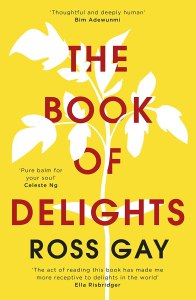 One essay is titled “The Jenky,” about the crooked and makeshift. Gay watches the birds enjoying a dead tree in his (deliberately neglected) yard, and notes a sign reading “Caution: Bees on Bridge” and thereby making space for nature. A few of the more memorable incidents involve plane travel. One time he flies with a tomato seedling in his lap and finds that people treat him more kindly. He gets an unexpectedly enthusiastic response from a security guard when he mentions that he’s on his way to read poems and realizes later that, by some quirk of regional American accents, the man thought he’d said “reading palms.”
Although I enjoyed the book more as I went along, something held me back from loving it. There weren’t enough sentiments that I recognized, and the loose, informal style wasn’t always for me. While you get glimpses into his upbringing and travels, I tend to prefer a memoir. It may also be that Gay and I are just different personalities. The delight he takes in other people’s oddities suggests he might be an extrovert; he truly enjoys being spoken to, or even touched (on the shoulder, for instance), by strangers, whereas I don’t particularly. Part of this is about minority group bonding for him: he writes of the “Negreeting” exchanged between Black people passing each other on a street. There were also a few too many mentions of him peeing into bottles or in his car.
So I liked this, but maybe not enough to try more by Gay, though I should probably see what his verse is like. I was glad to have read it, especially when I realized I can only think of about 20 books I’ve read by Black men. Ever. Yikes. (New – Christmas gift, 2022) 
Nature Book Catch-Up: Sally Huband, Richard Smyth & Anna Vaught
I’m catching up with a few nature- and travel-based 2023 releases that were sent to me for review. I’ve grouped them together because these British authors share some of the same interests and concerns. They celebrate beloved places that become ours through the time we spend in them and the attention we grant; they mourn the loss of biodiversity from rockpools and gardens and seabird cliffs. What kind of diminished world they’re raising their children into is a major worry for all three, and for Huband and Vaught the unease is exacerbated by chronic illness. Wild creatures, and the fellow authors who have hymned them, ease the hurt.
Sea Bean: A beachcomber’s search for a magical charm by Sally Huband
After more than a decade in her adopted home of Shetland, Sally Huband is still a newcomer. A tricky path to motherhood and ensuing chronic illness (the autoimmune disease palindromic rheumatism) limited her mobility and career. Beachcombing is at once her way of belonging to a specific place and feeling part of the wider world – what washes up on a Shetland beach might come from as far away as Atlantic Canada or the Caribbean. Sea glass, lobster pot tags, messages in bottles, driftwood … and a whole lot of plastic, of course. Early on, Huband sets her sights on a sea bean – also known as a drift-seed, from the tropics – which in centuries past was a talisman for ensuring safe childbirth. Possession of one was enough to condemn a 17th-century local woman to death for witchcraft, she learned.
 Stories of motherhood, the quest to find effective treatment in a patriarchal medical system, volunteer citizen science projects (monitoring numbers of dead seabirds, returning beached cetaceans to the water, dissecting fulmar stomachs to assess their plastic content), and studying Shetland’s history and customs mingle in a fascinating way. Huband travels around the archipelago and further afield, finding a vibrant beachcombing culture on the Dutch island of Texel. As in Moby-Duck by Donovan Hohn, one of my all-time favourite nonfiction books, there is delight at the randomness of what the ocean delivers.
I requested this book because Huband’s was my favourite essay in the Antlers of Water anthology. In it, she deplored the fact that women were still not allowed to participate in the Up Helly Aa fire festival in Lerwick. Good news: that is no longer the case, thanks to campaigning by Huband and others. In a late chapter, she also reports that blackface was recently banned from the festivals, and a Black Lives Matter demonstration drew 2000 people. Change does come, but slowly to a traditional island community. And sometimes it is not the right sort of change, as with an enormous wind farm, resisted vigorously by residents, that will primarily enrich a multinational company instead of serving the local people.
In many ways, this is a book about coming to terms with loss, and Huband presents the facts with sombre determination. Passages about the threats to birds and marine life had me near tears. But she writes with such poetic tenderness that the evocative specifics of island life point towards what’s true for all of us making the best of our constraints. I was lucky enough to visit several islands of Shetland in 2006; whether you have or not, this is a radiant memoir I would recommend to readers of Kathleen Jamie, Jean Sprackland and Malachy Tallack.
Some favourite lines:
No island can ever live up to the heightened expectations that we always seem to place on them; life catches up with us, sooner or later.
With each loss, emotional pain accretes for those who have paid attention.
If hope is a hierarchy of wishes then I am happy enough, each time that I beachcomb, to find fragments of the bark of paper birch
I’ve come to think of the ocean as an archive of sorts.
With thanks to Hutchinson Heinemann for the proof copy for review.
The Jay, the Beech and the Limpetshell: Finding Wild Things with My Kids by Richard Smyth
all around us
the stuff of spells. Our parents
let us go to scamper deeper,
leap from stumps lush with moss.
Everything aloof about me
fell into the soil once charged
with younger siblings
and freedoms of a wood.
…
I give you a damp valley floor,
this feather for your pocket.
~an extract from “Arger Fen,” from Latch by Rebecca Goss
I know Richard Smyth for his writing on birds (I’ve reviewed both A Sweet, Wild Note and An Indifference of Birds) and his somewhat controversial commentary on modern nature writing. This represents a change in direction for him toward more personal reflection, and with its focus on the phenomena of childhood and parenthood it recalls Wild Child by Patrick Barkham and The Nature Seed by Lucy Jones and Kenneth Greenway. But, as I knew to expect from previous works, he has such talent for reeling in the tangential and extrapolating from the concrete to the abstract that this lively read ends up being about everything: what it is to be human on this fading planet.
 And this despite the fact that four of five chapter headings suggest pandemic-specific encounters with nature. Lockdown walks with his two children, and the totems they found in different habitats – also including a chaffinch nest and an owl pellet – are indeed jumping-off points, punctuating a wide-ranging account of life with nature. Smyth surveys the gateway experiences, whether books or television shows or a school tree-planting programme or collecting, that get young people interested; and talks about the people who beckon us into greater communion – sometimes authors and celebrities; other times friends and family. He also engages with questions of how to live in awareness of climate crisis. He acknowledges that he should be vegetarian, but isn’t; who does not harbour such everyday hypocrisies?
It’s still, unfortunately, rare for men to write about parenthood (and especially pregnancy loss – I only think of Native by Patrick Laurie and William Henry Searle’s books), so it’s great to see that represented, and it’s a charming idea that we create “downfamily” because the “upfamily” doesn’t last forever. Although there’s nostalgia for his childhood here, and anxiety about his kids’ chances of seeing wildlife in abundance, Smyth doesn’t get mired in the past or in existential dread. He has a humanist belief that people are essentially good and can do positive things like build offshore wind farms, and in the meantime he will take Genevieve and Daniel into the woods to play so they will develop a sense of wonder at all that lives on. Even for someone like me who doesn’t have children, this was a captivating, thought-provoking read: We’re all invested in the future of life on this planet.
With thanks to Icon Press for the free copy for review.
These Envoys of Beauty: A Memoir by Anna Vaught
Anna Vaught is a versatile author: I have a copy of her mental health-themed novel Saving Lucia, longlisted for the inaugural Barbellion Prize, on the shelf; she’s written a spooky set of stories, Famished (see Susan’s review); and I gave some early reader feedback on the opening pages of her forthcoming work of quirky historical fiction, The Zebra and Lord Jones. She’s also publishing a book on writing, and editing a collection of pieces submitted for the first Curae Prize for writers who are also carers. I was drawn to her first nonfiction release by reviews by fellow bloggers – it’s always good when a blog tour achieves its aim!
These dozen short essays are about how nature doesn’t necessarily heal, but is a most valued companion in a life marked by chronic illness and depression. The evocative title and epigraphs are from Ralph Waldo Emerson’s essay “Nature” (1836). The pieces loop through Vaught’s past and present, focussing on favourite places in Wiltshire, where she lives, and at the Pembrokeshire coast. It’s the second memoir about complex PTSD that I’ve read this year (see also What My Bones Know). Both at the time and now, when flashbacks of her parents’ verbal and physical abuse haunt her, lying down in a grassy field, exploring a sea cave or sucking on a gorse flower could be a salve. “Nature offered stability and satisfying detail; pattern, form and things that made sense.”
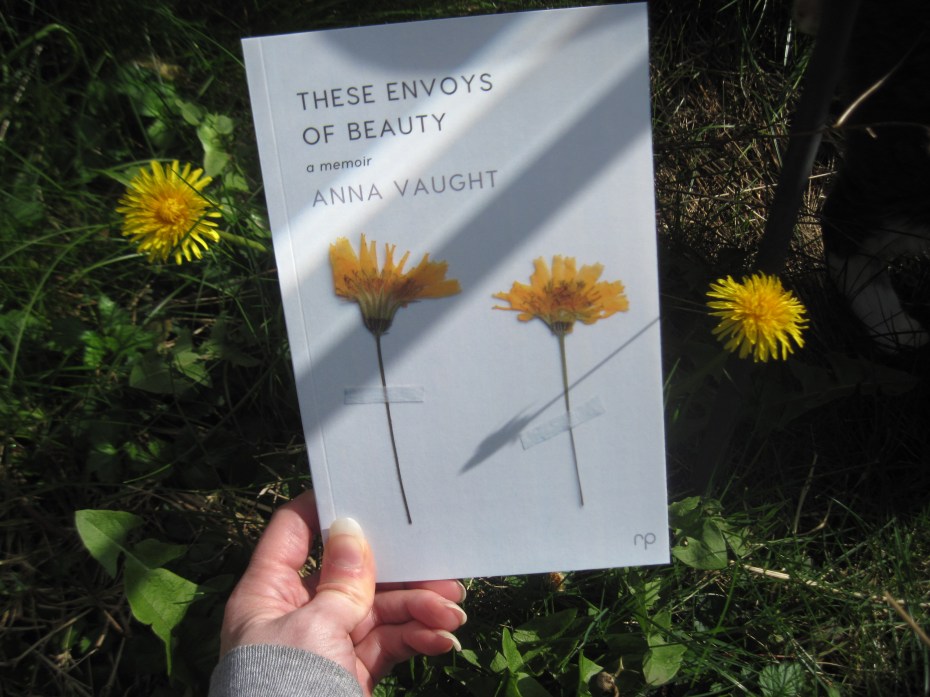
Vaught has a particular love for trees, flowers and moss – even just reciting their Latin names gives her a thrill, and she adds additional information about some species in footnotes. Although her childhood was painful, she retains gratitude for its wide-eyed wonder, and in the exuberance of her prose you can sense a willed childlike perspective (“But back to the list of clouds and writing about clouds!”). I found the frequent self-referential nature of the essays and direct reader address a little precious, but appreciated the thoughts about how nature holds us: “I have always felt a generosity around me, and that I was less lonely outside; at the very least, I could find something to comfort me”. She’s a bookish kindred spirit as well. I’ll be sure to try her work in other genres.
With thanks to Reflex Press for the free copy for review.
Sapphira and the Slave Girl & Portrait of the Artist as a Young Dog (#1940Club)
(I was disgusted by the ad-ridden appearance of my blog, and defeated by the task of culling my media library, so I’ve upgraded to a paid plan for a trial year. I had until now vowed not to spend any money on the site since I don’t make any money from it, but WordPress hooked me in with a 30% off deal, and I’ll appreciate the no ads and extra storage space. I hope it looks better now!)
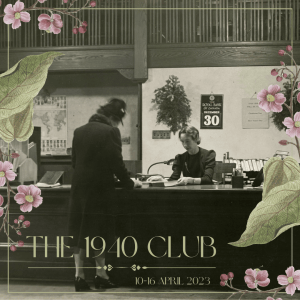
A year club hosted by Karen and Simon is always a great excuse to read more classics. One of these was a winner, if peculiar; the other was so-so, but helped clarify for me what a particular literary prize is looking for.
Sapphira and the Slave Girl by Willa Cather
{SPOILERS IN THIS ONE}
I was surprised to find that this was my seventh book by Cather, so I’ve actually read over half of her novels now. I think all her other works I know were set on the prairies of the Midwest (or in Santa Fe in the case of Death Comes for the Archbishop), so Sapphira and the Slave Girl feels like an odd one out not just for its antebellum historical subject matter but also for its setting in Cather’s hometown of Winchester, Virginia.
In 1856, the Colberts’ is a house divided: Henry, a miller from Quaker stock, disapproves of slavery; his wife, Sapphira, grew up with slaves and treats them severely. While the other Colbert brothers’ meddling with Black women is an open secret – one of them is assumed to have fathered Henry and Sapphira’s mixed-race teenage slave, Nancy – Henry looks fondly on Nancy and thinks of her almost like a second daughter. Sapphira resents that attention. When her Colbert nephew, Martin, a known cad, comes to visit, she arranges, or at least allows, convenient opportunities for Martin to be alone with Nancy.
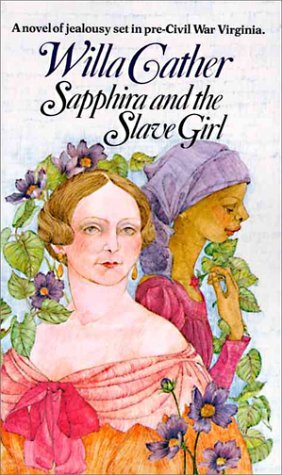 Nancy appeals to the Colberts’ adult daughter, Rachel Blake, to accompany her on her walks so that Martin will not “overtake” her in the woods. Although none of the white characters take the repeated threat of attempted rape seriously enough, Henry and Rachel do eventually help Nancy escape to Canada via the Underground Railroad. When Sapphira realizes her ‘property’ has been taken from her, she informs Rachel she is now persona non grata, but changes her mind when illness brings tragedy into Rachel’s household.
Had this been written 40–80 years later, it would have been completely different: first of all, I would expect it to much more graphically recount Black suffering, rather than depicting generally happy “darkies” with folksy accents and quirky character traits; secondly, there would be either a redemptive or a punitive plot arc for Sapphira. Instead, Cather paints her as a flawed human being who accepts the status quo but is also graceful in disability (she has dropsy and is in a wheelchair) and accepting of the approach of death.
I wish I remembered from the Hermione Lee biography more about the immediate inspiration for this novel, and its reception. Simply taking an interest in Black characters must have set it apart. For instance, there is a whole chapter on Nancy’s grandmother, Aunt Jezebel, the first generation kidnapped from Africa; and the final section has Nancy, now a sophisticated Montreal housekeeper dressed in silk and fur, visiting her mother 20 years after the Civil War. That Cather’s characterization otherwise doesn’t rise above cheerful mammy stereotypes can hardly be counted against her given the time period, right? It was good to experience a lesser-known American classic that I can imagine appealing to fans of Thomas Hardy and Edith Wharton as well. (From a Little Free Library in Queen Camel, Somerset; April 2021)
Portrait of the Artist as a Young Dog by Dylan Thomas
 Published when Thomas was in his mid-twenties, this is a series of 10 sketches, some of which are more explicitly autobiographical (as in first person, with a narrator named Dylan Thomas) than others. There is a rough chronological trajectory to the stories, with the main character a mischievous boy, then a grandstanding teenager, then a young journalist in his first job. The countryside and seaside towns of South Wales recur as settings, and – as will be no surprise to readers of Under Milk Wood – banter-filled dialogue is the priority. I most enjoyed the childhood japes in the first two pieces, “The Peaches” and “A Visit to Grandpa’s.” The rest failed to hold my attention, but I marked out two long passages that to me represent the voice and scene-setting that the Dylan Thomas Prize is looking for. The latter is the ending of the book and reminds me of the close of James Joyce’s “The Dead.” (University library)
I was a lonely night-walker and a steady stander-at-corners. I liked to walk through the wet town after midnight, when the streets were deserted and the window lights out, alone and alive on the glistening tram-lines in dead and empty High Street under the moon, gigantically sad in the damp streets by ghostly Ebenezer Chapel. And I never felt more a part of the remote and overpressing world, or more full of love and arrogance and pity and humility, not for myself alone, but for the living earth I suffered on… [etc.]
For a long time he waited on the stairs, though there was no love now to wait for and no bed but his own too many miles away to lie in, and only the approaching day to remember his discovery. All around him the disturbed inhabitants of the house were falling back into sleep. Then he walked out of the house on to the waste space and under the leaning cranes and ladders. The light of the one weak lamp in a rusty circle fell across the brick-heaps and the broken wood and the dust that had been houses once, where the small and hardly known and never-to-be-forgotten people of the dirty town had lived and loved and died and, always, lost.
(I’ve previously participated in the 1920 Club, 1956 Club, 1936 Club, 1976 Club, 1954 Club and 1929 Club.)
Chase of the Wild Goose by Mary Louisa Gordon: A Lurid Editions Reprint
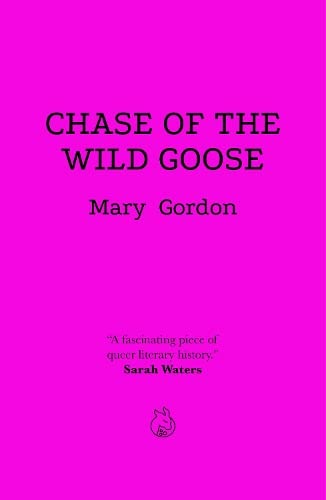 Chase of the Wild Goose, a playful, offbeat biographical novel about the Ladies of Llangollen, was first published by Leonard and Virginia Woolf’s Hogarth Press in 1936. I was delighted to be invited to take part in an informal blog tour celebrating the book’s return to print (today, 1 February) as the inaugural publication of Lurid Editions, which will focus on reprinting lesser-known and trailblazing 20th-century classics.
Mary Louisa Gordon was a medical doctor and early graduate of the London School of Medicine for Women. She also served as a prison inspector and had a special concern for the plight of female prisoners; another of her works was Penal Discipline (1922). Chase of the Wild Goose was published when she was 75. She underwrote the book to keep it in print until her death in 1941. A word-of-mouth success, it sold reasonably well in those first years.
I’d encountered the Ladies of Llangollen a couple of times before, in nonfiction: in The Art of the Wasted Day by Patricia Hampl, where they are among her exemplars of solitary, introspective living; and in Sign Here If You Exist and Other Essays by Jill Sisson Quinn, where, in the way that they blur the lines between romance and friendship, they presage her experience with an intimate female friend. This was a different way to explore their story.
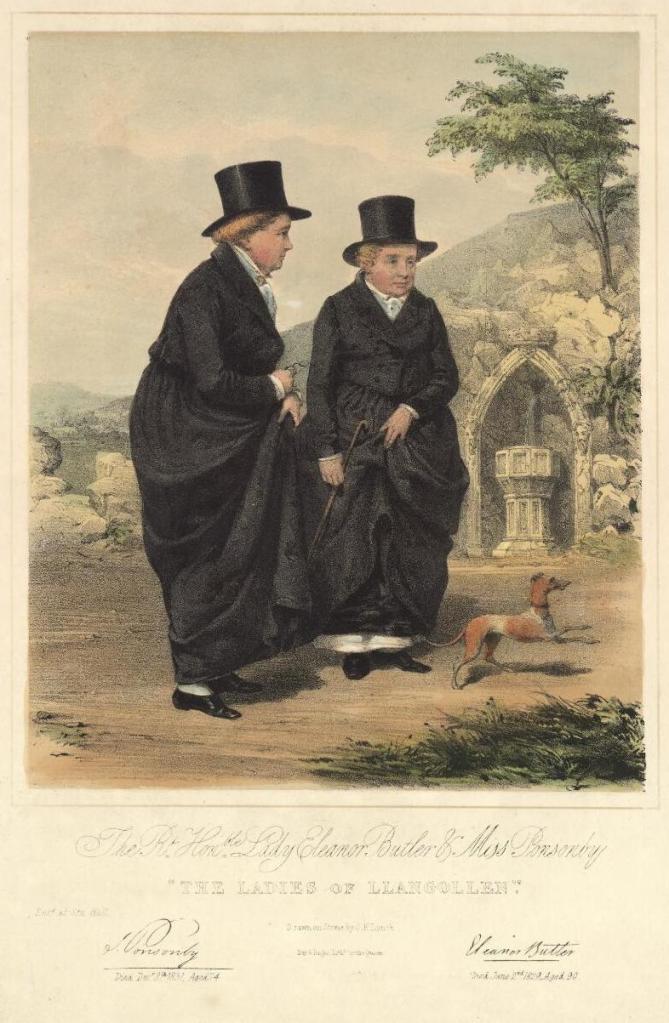
Portrait of The Rt. Honble. Lady Eleanor Butler & Miss Ponsonby ‘The Ladies of Llangollen’. By James Henry Lynch, Public domain, via Wikimedia Commons. (Wearing their customary plain riding habits and top hats.)
“The two heroines of this story, the Lady Eleanor Butler and Miss Sarah Ponsonby, have a remarkable history. They achieved fame at a stroke. They made a noise in the world which has never since died out, and which we, their spiritual descendants, continue to echo.”
These are the opening lines of what, in its first half, is a fairly straightforward chronological account of the protagonists’ lives, from their first meeting to when they flee to Wales to set up house together at Plas Newydd. They grow up in Ireland and, although their prospects differ – EB has a wealthy upbringing at Kilkenny Castle, whereas teenage SP has recently lost her mother and is being passed around relatives and acquaintances – both are often told that marriage is the only viable option. The eccentric spinster stereotype is an unkind one, but one EB is willing to risk. In one terrific scene, she shames her archbishop great-uncle for being just like everyone else and threatening to sell her to the highest bidder in matrimony. Still, the notion persists that if only the right man comes courting, they’ll change their tune.
At their first meeting EB and SP engage in an intense discussion of the possibilities for women, and within two weeks they’re already pledging to be together forever: “I think that nothing cheap, or second-rate, or faute de mieux, will ever do for you or me … We think—you and I—that we want something strange and exceptional, but something different may be ordained for us,” Eleanor says to Sarah. “From now onwards I… won’t you keep me… in your heart?” Sarah asks in parting. Eleanor replies, “I think you have been in it since before we were born.”
The strength of that romantic conviction that they are fated for each other keeps them going despite difficulties – EB’s father disowns her and cuts her off, which has inevitable financial implications, though she had already bought Plas Newydd outright; and for both of them, leaving Ireland is a wrench because they feel certain that they can never go back.

Plas Newydd. Photo by Wolfgang Sauber, CC BY-SA 3.0 , via Wikimedia Commons.
By Part II, the erstwhile fugitives, settled into local life in North Wales, enter into a sedate middle age of visitors and correspondence. Much of the material for this section is drawn from the journal EB kept. Part III is where things get really interesting: in a metafictional twist, Gordon herself enters the narrative as she meets and converses with the long-dead Ladies at their house, reflecting on the social changes that have occurred since their time.
As the Afterword by Dr Nicola Wilson notes, Chase of the Wild Goose is creative nonfiction in the same vein as Orlando, building on real-life figures and relationships in a way that must have seemed ahead of its age, not least for how it looks back to venerate queer foremothers. Although there are long stretches of the book that are tedious with biographical detail and melodramatic speeches, there is enough in the way of convincing dialogue and scenes to make up for that. While I feel the novel probably has more to offer to academics and those with a particular interest in its subjects than to general readers, I was pleased to be able to experience a rediscovered classic. I marvelled every time I reminded myself that this largely takes place in the late eighteenth to early nineteenth century. Gordon ably reproduces the diction and mores of the Ladies’ time, but her modernist intrusion takes it beyond pastiche.
As for the title, I’m most accustomed to the wild goose as a metaphor for the Holy Spirit in Celtic Christian iconography, but of course it is also a pun on the proverbial wild-goose chase. Gordon nods to both connotations; the phrase appears several times in the text and is the protagonists’ private term for their search for a life together – for liberty and for love. You have to cheer for them, achieving what so few could in their time. Here’s to you, Ladies!
With thanks to D-M Withers and Lurid Editions for the free copy for review.
A first read for Karen and Lizzys #ReadIndies challenge. I will hope to add many more before the end of the month!

Liz has also reviewed the novel.
For more information, do also read this fascinating Guardian article.
October Poetry Releases: Bergin, Draycott, Lopez, Rizwan, Skoulding
It was a prolific month for poetry. There is so much variety here in form and topic, from the tongue-in-cheek aphorisms of Tara Bergin’s Savage Tales to the maritime and ornithological portrait of Anglesey in Zoë Skoulding’s A Marginal Sea. Something for everyone, I’d like to think, and I hope these capsule reviews and sample poems give you a taste.
Savage Tales by Tara Bergin
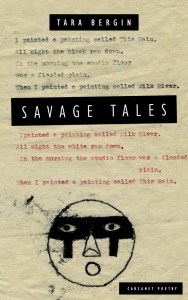 This is the third collection by the Irish poet; I’d previously read her The Tragic Death of Eleanor Marx. Grouped into nine thematic sections, these very short poems take the form of few-sentence aphorisms or riddles, with the titles, printed in the bottom corner, often acting as something of a punchline – especially because I had them on my e-reader and they only appeared after I’d turned the digital ‘page’. Some appear to be autobiographical, about life for a female academic. Others are political (I loved “Tenants and Landlords”), or about wolves or blackbirds. The verse in “Constructions” takes different shapes on the page. Here are “The Subject Field” and “The Actor”:


With thanks to Carcanet Press for the free e-copy for review.
The Kingdom by Jane Draycott
 I love the Matisse cut-outs on the cover of Draycott’s fifth collection. The title poem’s archaic spelling (“hyther,” “releyf”) contrast with its picture of a modern woman seeking respite from “the men coming on to you / the taxi drivers saying here jump in no / no you don’t need no money.” Country vs. city, public vs. private, pastoral past and technological future are some of the dichotomies the verse plays with. I enjoyed the alliteration and references to an old English herbarium, Derek Jarman and polar regions. However, it was hard to find overall linking themes to latch onto.
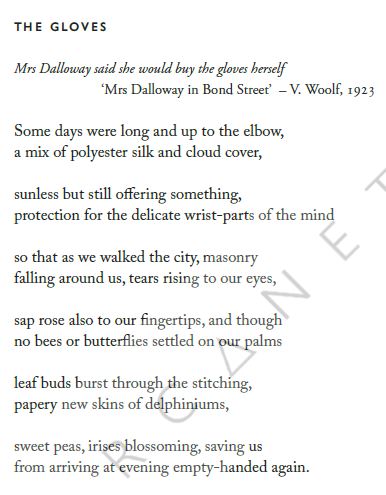
With thanks to Carcanet Press for the free e-copy for review.
We Borrowed Gentleness by J. Estanislao Lopez
 Brimming with striking metaphors and theological echoes, the first poetry collection by the Houston-based writer is an elegant record of family life on both sides of the Mexican border. “Laredo Duplex” (below) explains how violence prompted the family’s migration. “The Contract” recalls acting as a go-between for a father who didn’t speak English; in “Diáspora” the speaker is dubious about assimilation: “I am losing my brother to whiteness.” The tone is elevated and philosophical (“You take the knife of epistemology and the elegiac fork”), with ample alliteration. Flora and fauna and the Bible are common sources of unexpected metaphors. Lopez tackles big issues of identity, loss and memory in delicate verse suited to readers of Kaveh Akbar. (My full review is on Shelf Awareness.)
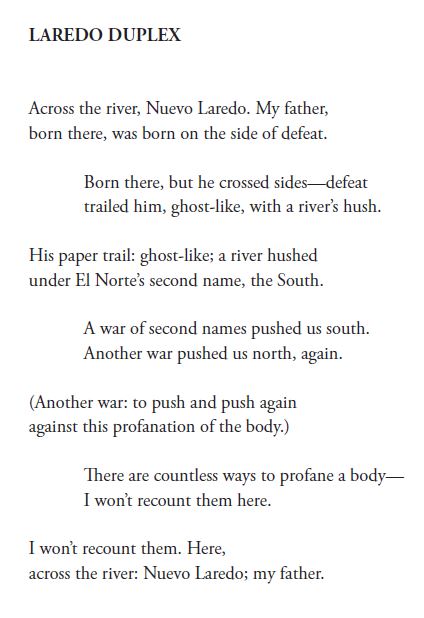
With thanks to Alyson Sinclair PR for the free e-copy for review.
Europe, Love Me Back by Rakhshan Rizwan
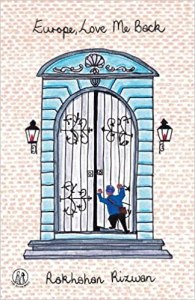 This debut collection has Rizwan juxtaposing East and West, calling out European countries for the prejudice she has experienced as a Muslim Pakistani in academia. She has also lived in the UK and USA, but mostly reflects on time spent in Germany and the Netherlands, where her imperfect grasp of the language was an additional way of standing out. “Adjunct” is the source of the cover image: she knocks and knocks for admittance, but finds herself shut out still. Rizwan takes extended metaphors from marriage, motherhood and women’s health: in “My house is becoming like my country,” she imagines her husband instituting draconian laws; in “I have found in my breast,” a visit to a doctor about a lump only exposes her own exoticism (“Basically, the Muslims are metastasizing”). In “Paris Proper,” she experiences the city differently from a friend because of the colonial history of the art. (See also Liz’s review.)
Some favourite lines:
“my breasts harden / with milk, that peculiar ache of women’s bodies / which do only half the sin / but carry all the history” (from “Half the Sin”)

With thanks to The Emma Press for the proof copy for review.
A Marginal Sea by Zoë Skoulding
 Skoulding’s collection is said to be all about Anglesey in Wales, but from that jumping-off point the poems disperse to consider maps, maritime vocabulary, seabirds, islands, tides and much more. There are also translations from the French, various commissions and collaborations, and pieces about the natural vs. the manmade. Some are in paragraph form and there’s a real variety to how lines and stanzas are laid out on the page. I especially liked “Red Squirrels in Coed Cyrnol.” I’ll read more by Skoulding.
 With thanks to Carcanet Press for the free e-copy for review.
Read any good poetry recently?
The #1954Club: Moominsummer Madness and Under Milk Wood
A year club hosted by Karen and Simon is always a great excuse to read more classics. The play’s the thing for this installment of the 1954 Club: Tove Jansson’s delightfully odd creatures end up in a floating theatre and rise to the occasion, and I’ve finally read Dylan Thomas’s famous play for voices. I’ll try to manage another couple of write-ups this weekend, too. (Both: University library;  )
)
Moominsummer Madness by Tove Jansson
[Translated from the Swedish by Thomas Warburton]
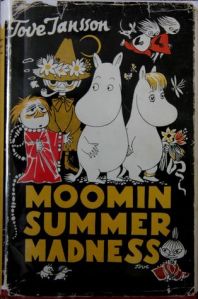 One never knows what magic or mischief will bubble up at Midsummer. For Moomintroll’s family, it all starts with the eruption of a volcano, which leads to a flood. Moominmamma does her best to uphold comforting routines in their inundated home, but eventually they leave it for a better-appointed house that floats by. One with thick velvet curtains, doors to nowhere, and cupboards full of dresses. I wearied ever so slightly of the dramatic irony that this is clearly a theatre but the characters don’t know what one is and have to be enlightened by Emma the stage rat. Meanwhile, Snufkin becomes accidental father to two dozen “woodies” and Moomintroll and the Snork Maiden are arrested for burning officious signs.
The teasing commentary on the pretensions of the theatre is sweet: Moominpappa decides to write a tragic play with a lion in; Emma tells him it simply must be in blank verse, so he obliges, but no one in the audience can understand a word until the actors speak normally. As usual with Jansson, there is separation and longing, disaster mitigated, disorientation navigated with pluck or resignation. While I didn’t enjoy this as much as some of her others, I appreciated the focus this time on bending the rules of how things must be done. My favourite quotes were about the overwhelming nature of choice and the value of a good cry:
(The Snork Maiden on the dresses in the costume closet) “They were far too many, don’t you see. I couldn’t ever have had them all or even choose the prettiest. They nearly made me afraid! If there’d been only two instead!”
(Misabel) “I’m taking the chance to have a cry over a lot of things now when there’s a good reason.”
Under Milk Wood by Dylan Thomas
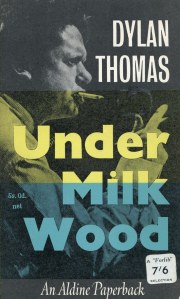 I discovered A Child’s Christmas in Wales just last year and delighted in the language and the flights of fancy. Under Milk Wood is a short play completed just a month before Thomas’s death at the age of 39. It features a chorus of voices as the inhabitants of Llaregyb, a made-up coastal Welsh town, journey from one night through to the next. Gossipy neighbours, bickering spouses, flirtatious lovers; a preacher, a retired sea captain, fishermen; and much more. Some of the character names are jokes in and of themselves, like “Nogood Boyo” and “Willy Nilly,” and others sound so silly they might as well be rhyming slang.
The dead feel as vibrant as the living. The musicality of the prose sometimes made me feel I was reading poetry instead (indeed, a number of songs and rhymes are performed), and there is a bawdy charm to the whole thing. What might be stage directions in another play are read aloud here by “First Voice” and “Second Voice,” who trade off narration.
Maybe it was too much to hope that there could have been a plot somewhere in there as well? No matter. I could see how Thomas influenced the likes of Max Porter and George Saunders (Lincoln in the Bardo, anyway). I’m sorry I missed the chance to see this performed locally last month.
A favourite passage:
“It is spring, moonless night in the small town, starless and bible-black, the cobblestreets silent and the hunched, courters’-and-rabbits’ wood limping invisible down to the sloeblack, slow, black, crowblack, fishingboat-bobbing sea.”
(I’ve also participated in the 1920 Club, 1956 Club, 1936 Club, and 1976 Club.)
Seasons’ Greetings: Winter (Part I) & Christmas Reading
My first few wintry reads for the season included a modern children’s classic, a wonderful poetry collection, and a so-so Advent-set novella. For my pre-Christmas reads, I have a couple of story-length classics and two recent novellas.
Winter Story by Jill Barklem (1980)
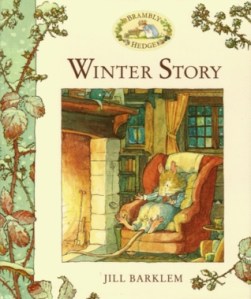 My favourite of the series so far (just Spring still to go) for how nostalgic it is for winter traditions.
“Tobogganing tomorrow,” said Wilfred.
“Snow pancakes for tea,” said Clover.
“We’ll make a snow mouse,” said Catkin.
The mice host a Snow Ball at the Ice Hall, with outfits and dances out of Austen and victuals out of Dickens. As always, the tree-trunk interiors are lit up like doll’s house tableaux with cosy rooms and well-stocked larders. Nothing much happens in this one, but that was fine with me: no need for a conflict and its resolution when you’ve got such a lovely, lucky life. (Public library) 
The Winter Orchards by Nina Bogin (2001)
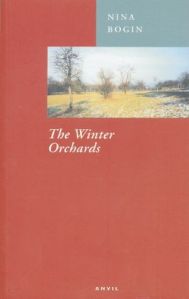 After enjoying Thousandfold in 2019, I was keen to catch up on Bogin’s previous poetry. Themes I’d noted in her latest work, nature and family, are key here, too. There is an overall wistful tone to the book, as in the passages below:
I didn’t like lungwort at first,
its spotted leaves, its furred
flowers, and I didn’t like its name.
But now I want to gather lungwort again,
now that I can’t return
to the brook meadow I picked it in (from “Lungwort”)
I’ll love the fallow and forgotten fields
because I have no choice, and woods
whose paths have been erased. (from “Landscape”)
The losses responded to are sometimes personal – saying Kaddish for her father – and sometimes more broadly representative, as when she writes about a dead bird found on the road or conflicts like the Gulf War and former Yugoslavia. Alongside beautiful nature poetry featuring birds and plants are vignettes from travels in France, Sweden, and upstate New York. (New purchase) 
An Advent Calendar by Shena Mackay (1978)
 I smugly started this on the first day of Advent, and initially enjoyed Mackay’s macabre habit of taking elements of the Nativity scene or a traditional Christmas and giving them a seedy North London twist. So we open on a butcher’s shop and a young man wearing “bloody swabbing cloths” rather than swaddling clothes, having lost a finger to the meat mincer (and later we see “a misty Christmas postman with his billowy sack come out of the abattoir’s gates”). In this way, John Wood becomes an unwitting cannibal after taking a parcel home from the butcher’s that day, and can’t forget about it as he moves his temporarily homeless family into his old uncle’s house and continues halfheartedly in his job as a cleaner. His wife has an affair; so does a teenage girl at the school where his sister works. No one is happy and everything is sordid. “Scouring powder snowed” and the animal at this perverse manger scene is the uncle’s neglected goat. This novella is soon read, but soon forgotten. (Secondhand purchase)
And so to Christmas…
“The Christmas Dinner” by Washington Irving (1820)
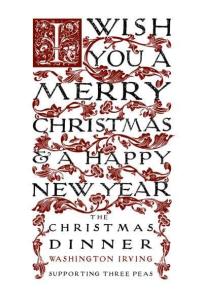 An evocative portrait of an English Christmas meal, hosted by a squire in the great hall of his manor, originally published in Irving’s The Sketch Book of Geoffrey Crayon, Gent. A boar’s head, a mummers’ play, the Lord of Misrule: you couldn’t get much more traditional. “Master Simon covered himself with glory by the stateliness with which, as Ancient Christmas, he walked a minuet with the peerless, though giggling, Dame Mince Pie.” Irving’s narrator knows this little tale isn’t profound or intellectually satisfying, but hopes it will raise a smile. He also has a sense that he is recording something that might soon pass away:
I felt also an interest in the scene, from the consideration that these fleeting customs were posting fast into oblivion. … There was a quaintness, too, mingled with all this revelry, that gave it a peculiar zest; it was suited to the time and place; and as the old Manor House almost reeled with mirth and wassail, it seemed echoing back the joviality of long-departed years.
A pleasant one-sitting read; so much better than a Christmas card! 
This Renard Press pamphlet is in support of Three Peas, a charity providing food and medical care to refugees in Europe. Thanks to Annabel for my gifted copy!
Small Things Like These by Claire Keegan (2021)
Always, Christmas brought out the best and the worst in people.
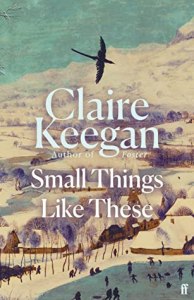 This was our second most popular read during last month’s Novellas in November challenge. I’d read a lot about it in fellow bloggers’ posts and newspaper reviews so knew to expect a meticulously chiselled and heartwarming story about a coal merchant in 1980s Ireland who comes to value his quiet family life all the more when he sees how difficult existence is for the teen mothers sent to work in the local convent’s laundry service. Born out of wedlock himself nearly 40 years ago, he is grateful that his mother received kindness and wishes he could do more to help the desperate girls he meets when he makes deliveries to the convent.
I found this a fairly predictable narrative, and the nuns are cartoonishly villainous. So I wasn’t as enthusiastic as many others have been, but still enjoyed having this as one of my reads on my travel day to the USA. I was familiar with the Magdalene Laundries from the movie The Magdalene Sisters and found this a touching reminder to be grateful for what you have while helping those less fortunate. A perfect message for Christmas. (NetGalley)
Miss Marley by Vanessa Lafaye (2018)
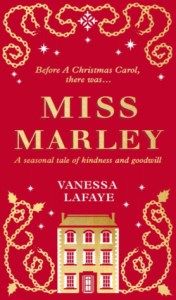 Lafaye was a local-ish author to me, an American expat living in Marlborough. When she died of breast cancer in 2018, she left this A Christmas Carol prequel unfinished, and fellow historical novelist Rebecca Mascull completed it for her. Clara and Jacob Marley come from money but end up on the streets, stealing from the rich to get by. Jacob sets himself up as a moneylender to the poor and then, after serving an apprenticeship alongside Ebenezer Scrooge, goes into business with him. They are a bad influence on each other, reinforcing each other’s greed and hard hearts. Jacob is determined never to be poor again. Because he’s forgotten what it’s like, he has no compassion when Clara falls in love with a luckless Scottish tea merchant. Like Scrooge, Jacob is offered one final chance to mend his ways. This was easy and pleasant reading, but I did wonder if there was a point to reading this when one could just reread Dickens’s original. (Secondhand purchase)
A Child’s Christmas in Wales by Dylan Thomas (1952)
(Illus. Edward Ardizzone, 1978)
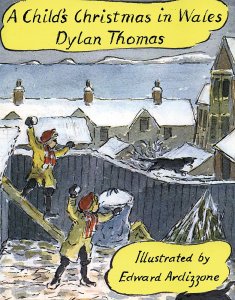 It’s a wonder I’d never managed to read this short story before. I was prepared for something slightly twee; instead, it is sprightly and imaginative, full of unexpected images and wordplay. In the Wales of his childhood, there were wolves and bears and hippos. Young boys could get up to all sorts of mischief, but knew that a warm house packed with relatives and a cosy bed awaited at the end of a momentous day. Reflective and magical in equal measure; a lovely wee volume that I am sure to reread year after year. (Little Free Library)
A favourite passage:
Our snow was not only shaken from whitewash buckets down the sky, it came shawling out of the ground and swam and drifted out of the arms and hands and bodies of the trees; snow grew overnight on the roofs of the houses like a pure and grandfather moss, minutely white-ivied the walls and settled on the postman, opening the gate, like a dumb, numb thunderstorm of white, torn Christmas cards.
If there’s been one adjective linking most of these books, it’s been “nostalgic.” There’s something about winter in general, and the holiday season in particular, that lends itself to thinking back to the past and trying to preserve traditions, isn’t there?
 Bookish Beck = Rebecca Foster. American transplant to England. Freelance proofreader and book reviewer.
