20 Books of Summer, 14–16: Polly Atkin, Nan Shepherd and Susan Allen Toth
I’m still plugging away at the challenge. It’ll be down to the wire, but I should finish and review all 20 books by the 31st! Today I have a chronic illness memoir, a collection of poetry and prose pieces, and a reread of a cosy travel guide.
Some of Us Just Fall: On Nature and Not Getting Better by Polly Atkin (2023)
I was heartened to see this longlisted for the Wainwright Prize. It was a perfect opportunity to recognize the disabled/chronically ill experience of nature and the book achieves just what the award has recognised in recent years: the braiding together of life writing and place-based observation. (Wainwright has also done a great job on diversity this year: there are three books by BIPOC and five by women on the nature writing shortlist alone.)
 Polly Atkin knew something was different about her body from a young age. She broke bones all the time, her first at 18 months when her older brother ran into her on his bicycle. But it wasn’t until her thirties that she knew what was wrong – Ehlers-Danlos syndrome and haemochromatosis – and developed strategies to mitigate the daily pain and the drains on her energy and mobility. “Correct diagnosis makes lives bearable,” she writes. “It gives you access to the right treatment. It gives you agency.”
The book assembles long-ish fragments, snippets from different points of her past alternating with what she sees on rambles near her home in Grasmere. She writes in some depth about Lake District literature: Thomas De Quincey as well as the Wordsworths – Atkin’s previous book is a biography of Dorothy Wordsworth that spotlights her experience with illness. In describing the desperately polluted state of Windermere, Atkin draws parallels with her condition (“Now I recognise my body as a precarious ecosystem”). Although she spurns the notion of the “Nature Cure,” swimming is a valuable therapy for her.
Theme justifies form here: “This is the chronic life, lived as repetition and variance, as sedimentation of broken moments, not as a linear progression.” For me, there was a bit too much particularity; if you don’t connect to the points of reference, there’s no way in and the danger arises of it all feeling indulgent. Besides, by the time I opened this I’d already read two Ehlers-Danlos memoirs (All My Wild Mothers by Victoria Bennett and Floppy by Alyssa Graybeal) and another reference soon came my way in The Invisible Kingdom by Meghan O’Rourke. So overfamiliarity was a problem. And by the time I forced myself to pick this off of my set-aside shelf and finish it, I’d read Nina Lohman’s stellar The Body Alone. For those newer to reading about chronic illness, though, especially if you also have an interest in the Lakes, it could be an eye-opener.
With thanks to Sceptre (Hodder) for the free copy for review.
Selected Prose & Poetry by Nan Shepherd (2023)
 I’d read and enjoyed Shepherd’s The Living Mountain, which has surged in popularity as an early modern nature writing classic thanks to Robert Macfarlane et al. I’m not sure I’d go as far as the executor of the Nan Shepherd Estate, though, who describes her in the Preface as “Taylor Swift in hiking boots.” The pieces reprinted here are from her one published book of poems, In the Cairngorms, and the mixed-genre collection Wild Geese. There is also a 28-page “novella,” Descent from the Cross. After World War I, Elizabeth, a workers’ rights organiser for a paper mill, marries a shell-shocked veteran who wants to write a book but isn’t sure he has either the genius or the dedication. It’s interesting that Shepherd would write about a situation where the wife has the economic upper hand, but the tragedy of the sickly failed author put me in mind of George Gissing or D.H. Lawrence, so didn’t feel fresh. Going by length alone, I would have called this a short story, but I understand why it would be designated a novella, for the scope.
None of the miniature essays – field observations and character studies – stood out to me. About half of the book is given over to poetry. As with the nature writing, there is a feeling of mountain desolation. There are a lot of religious references and hints of the mystical, as in “The Bush,” which opens “In that pure ecstasy of light / The bush is burning bright. / Its substance is consumed away / And only form doth stay”. It’s a mixed bag: some feels very old-fashioned and sentimental, with every other line or, worse, every line rhyming, and some archaic wording and rather impenetrable Scots dialect. It could have been written 100 years before, by Robert Burns if not William Blake. But every so often there is a flash of brilliance. “Blackbird in Snow” is quite a nice one, and reminiscent of Thomas Hardy’s “The Darkling Thrush.” I even found the cryptic lines from “Real Presence” that inspired a song on David Gray’s Skellig. My favourite poem by far was:
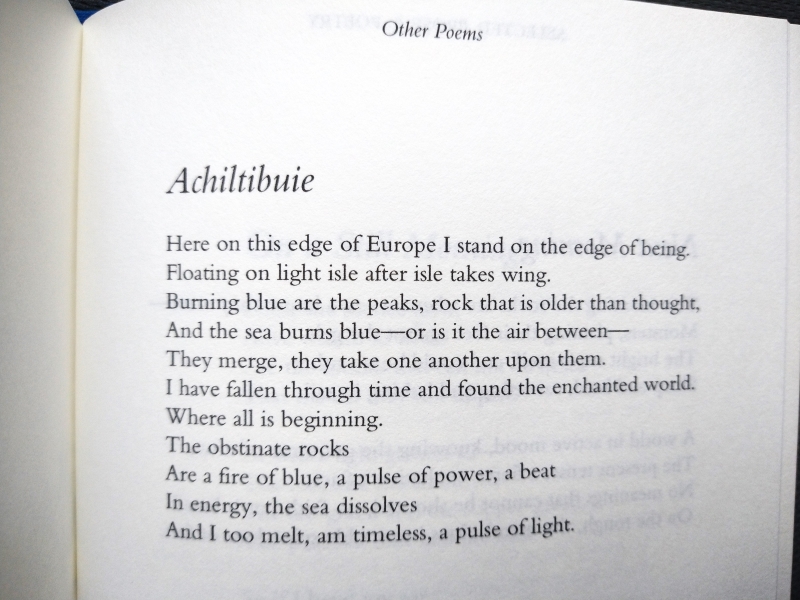
Overall, this didn’t engage me; it’s only for Shepherd fanatics and completists. (Won from Galileo Publishers in a Twitter giveaway)
England As You Like It: An Independent Traveler’s Companion by Susan Allen Toth (1995)
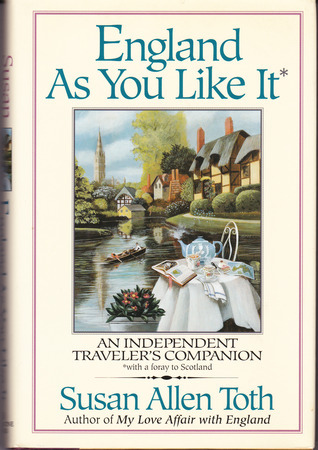 A reread. As I was getting ready to go overseas for the first time in the summer of 2003, Toth’s trilogy of memoirs whetted my appetite for travel in Britain. (They’re on my Landmark Books in My Life, Part II list.) This is the middle book and probably the least interesting in that it mostly recounts stays in particular favourite locations, such as Dorset, the Highlands, and various sites in Cornwall. However, I’ve never forgotten her “thumbprint theory,” which means staying a week or more in an area no larger than her thumb covers on a large-scale map, driving an hour or less for day trips. Not for her those cram-it-all-in trips where you race through multiple countries in a week (I have American friends who did Paris, London and Rome within six days, or five countries in eight days; blame it on stingy vacation policies, I guess). Instead, she wants to really bed into one place and have the time to make serendipitous discoveries such as an obscure museum or a rare opening of a private garden.
I most liked the early general chapters about how to make air travel bearable, her obsession with maps, her preference for self-catering, and her tendency to take home edible souvenirs. Of course, all the “Floating Facts” are hopelessly out-of-date. This being the early to mid-1990s, she had to order paper catalogues to browse cottage options (I still did this for honeymoon prep in 2006–7) and make international phone calls to book accommodation. She recommends renting somewhere from the National Trust or Landmark Trust. Ordnance Survey maps could be special ordered from the British Travel Bookshop in New York City. Entry fees averaged a few pounds. It’s all so quaint! An Anglo-American time capsule of sorts. I’ve always sensed a kindred spirit in Toth, and those whose taste runs toward the old-fashioned will probably also find her a charming tour guide. I’ve also reviewed the third book, England for All Seasons. (Free from The Book Thing of Baltimore)
Miscellaneous #ReadIndies Reviews: Mostly Poetry + Brown, Sands
Catching up on a few final #ReadIndies contributions in early March! Short responses to some indie reading I did from my shelves over the course of last month.

Bloodaxe Books:
Parables & Faxes by Gwyneth Lewis (1995)
 I was surprised to discover this was actually my fourth book by Lewis, a bilingual Welsh author: two memoirs, one of depression and one about marriage; and now two poetry collections. The table of contents suggest there are only 16 poems in the book, but most of the titles are actually headings for sections of anywhere between 6 and 16 separate poems. She ranges widely at home and abroad, as in “Welsh Espionage” and the “Illinois Idylls.” “I shall taste the tang / of travel on the atlas of my tongue,” Lewis writes, an example of her alliteration and sibilance. She’s also big on slant and internal rhymes – less so on end rhymes, though there are some. Medieval history and theology loom large, with the Annunciation featuring more than once. I couldn’t tell you now what that many of the poems are about, but Lewis’s telling is always memorable.
Sample lines:
For the one
who said yes,
how many
said no?
…
But those who said no
for ever knew
they were damned
to the daily
as they’d disallowed
reality’s madness,
its astonishment.
(from “The ‘No’ Madonnas,” part of “Parables & Faxes”)
(Secondhand purchase – Westwood Books, Sedbergh) 
&
Fields Away by Sarah Wardle (2003)
 Wardle’s was a new name for me. I saw two of her collections at once and bought this one as it was signed and the themes sounded more interesting to me. It was her first book, written after inpatient treatment for schizophrenia. Many of the poems turn on the contrast between city (London Underground) and countryside (fields and hedgerows). Religion, philosophy, and Greek mythology are common points of reference. End rhymes can be overdone here, and I found a few of the poems unsubtle (“Hubris” re: colonizers and “How to Be Bad” about daily acts of selfishness vs. charity). However, there are enough lovely ones to compensate: “Flight,” “Word Tasting” (mimicking a wine tasting), “After Blake” (reworking “Jerusalem” with “And will chainsaws in modern times / roar among England’s forests green?”), “Translations” and “Word Hill.”
Favourite lines:
(oh, but the last word is cringe!)
Catkin days and hedgerow hours
fleet like shafts of chapel sun.
Childhood in a cobwebbed bower
guards a treasure chest of fun.
(from “Age of Awareness”)
(Secondhand purchase – Carlisle charity shop) 
Carcanet Press:
Tripping Over Clouds by Lucy Burnett (2019)
 The title is a setup for the often surrealist approach, but where another Carcanet poet, Caroline Bird, is warm and funny with her absurdism, Burnett is just … weird. Like, I’d get two stanzas into a poem and have no idea what was going on or what she was trying to say because of the incomplete phrases and non-standard punctuation. Still, this is a long enough collection that there are a good number of standouts about nature and relationships, and alliteration and paradoxes are used to good effect. I liked the wordplay in “The flight of the guillemet” and the off-beat love poem “Beer for two in Brockler Park, Berlin.” The noteworthy Part III is composed of 34 ekphrastic poems, each responding to a different work of (usually modern) art.
Favourite lines:
This is a place of uncalled-for space
and by the grace of the big sky,
and the serrated under-silhouette of Skye,
an invitation to the sea unfolds
to come and dine with mountain.
(from “Big Sands”)
(New (bargain) purchase – Waterstones website) 
&
The Met Office Advises Caution by Rebecca Watts (2016)
 The problem with buying a book mostly for the title is that often the contents don’t live up to it. (Some of my favourite ever titles – An Arsonist’s Guide to Writers’ Homes in New England, The Voluptuous Delights of Peanut Butter and Jam – were of books I couldn’t get through). There are a lot of nature poems here, which typically would be enough to get me on board, but few of them stood out to me. Trees, bats, a dead hare on the road; maps, Oxford scenes, Christmas approaching. All nice enough; maybe it’s just that the poems don’t seem to form a cohesive whole. Easy to say why I love or hate a poet’s style; harder to explain indifference.
Sample lines:
Branches lash out; old trees lie down and don’t get up.
A wheelie bin crosses the road without looking,
lands flat on its face on the other side, spilling its knowledge.
(from the title poem)
(New (bargain) purchase – Amazon with Christmas voucher)
Faber:
Places I’ve Taken My Body by Molly McCully Brown (2020)
 The title signals right away how these linked autobiographical essays split the ‘I’ from the body – Brown resents the fact that disability limits her experience. Oxygen deprivation at their premature birth led to her twin sister’s death and left her with cerebral palsy severe enough that she generally uses a wheelchair. In Bologna for a travel fellowship, she writes, “There are so many places that I want to be, but I can’t take my body anywhere. But I must take my body everywhere.” A medieval city is particularly unfriendly to those with mobility challenges, but chronic pain and others’ misconceptions (e.g. she overheard a guy on her college campus lamenting that she’d die a virgin) follow her everywhere.
A poet, Brown earned minor fame for her first collection, which was about historical policies of enforced sterilization for the disabled and mentally ill in her home state of Virginia. She is also a Catholic convert. I appreciated her exploration of poetry and faith as ways of knowing: “both … a matter of attending to the world: of slowing my pace, and focusing my gaze, and quieting my impatient, indignant, protesting heart long enough for the hard shell of the ordinary to break open and reveal the stranger, subtler singing underneath.” This is part of a terrific run of three pieces, the others about sex as a disabled person and the odious conservatism of the founders of Liberty University. Also notable: “Fragments, Never Sent,” letters to her twin; and “Frankenstein Abroad,” about rereading this novel of ostracism at its 200th anniversary. (Secondhand purchase – Amazon)
New River Books:
The Hedgehog Diaries: A Story of Faith, Hope and Bristle by Sarah Sands (2023)
 Reasons for reading: 1) I’d enjoyed Sands’s The Interior Silence and 2) Who can resist a book about hedgehogs? She covers a brief slice of 2021–22 when her aged father was dying in a care home. Having found an ill hedgehog in her garden and taken it to a local sanctuary, she developed an interest in the plight of hedgehogs. In surveys they’re the UK’s favourite mammal, but it’s been years since I saw one alive. Sands brings an amateur’s enthusiasm to her research into hedgehogs’ place in literature, philosophy and science. She visits rescue centres, meets activists in Oxfordshire and Shropshire who have made hedgehog welfare a local passion, and travels to Uist to see where hedgehogs were culled in 2004 to protect ground-nesting birds’ eggs. The idea is to link personal brushes with death with wider threats of extinction. Unfortunately, Sands’s lack of expertise is evident. This was well-meaning, but inconsequential and verging on twee. (Christmas gift from my wishlist)
The Three Best Books I’ve Read So Far This Year
I’m very stingy with my 5-star ratings, so when I give one out you can be assured that a book is truly special. These three are all backlist reads – look out for my Classic of the Month post next week for a fourth that merits 5 stars – that are well worth seeking out. Out of the 50 books I’ve read so far this year, these are far and away the best.
This Sunrise of Wonder: Letters for the Journey by Michael Mayne (1995)

The cover image is Mark Rothko’s Orange, Red, Yellow (1956).
I plucked this Wigtown purchase at random from my shelves and it ended up being just what I needed to lift me out of January’s funk. Mayne’s thesis is that experiencing wonder, “rare, life-changing moments of seeing or hearing things with heightened perception,” is what makes us human. Call it an epiphany (as Joyce did), call it a moment of vision (as Woolf did), call it a feeling of communion with the universe; whatever you call it, you know what he is talking about. It’s that fleeting sense that you are right where you should be, that you have tapped into some universal secret of how to be in the world.
Mayne believes poets, musicians and painters, in particular, reawaken us to wonder by encouraging us to pay close attention. His frame of reference is wide, with lots of quotations and poetry extracts; he has a special love for Turner, Monet and Van Gogh and for Rilke, Blake and Hopkins. Mayne was an Anglican priest and Dean of Westminster, so he comes at things from a Christian perspective, but most of his advice is generically spiritual and not limited to a particular religion. There are about 50 pages towards the end that are specifically about Jesus; one could skip those if desired.
The book is a series of letters written to his grandchildren from a chalet in the Swiss Alps one May to June. Especially with the frequent quotations and epigraphs, the effect is of a rich compendium of wisdom from the ages. I don’t often feel awake to life’s wonder – I get lost in its tedium and unfairness instead – but this book gave me something to aspire to.
A few of the many wonderful quotes:
“The mystery is that the created world exists. It is: I am. The mystery is life itself, together with the fact that however much we seek to explore and to penetrate them, the impenetrable shadows remain.”
“Once wonder goes; once mystery is dismissed; once the holy and the numinous count for nothing; then human life becomes cheap and it is possible with a single bullet to shatter that most miraculous thing, a human skull, with scarcely a second thought. Wonder and compassion go hand-in-hand.”
“this recognition of my true worth is something entirely different from selfishness, that turned-in-upon-myselfness of the egocentric. … It is a kind of blasphemy to view ourselves with so little compassion when God views us with so much.”
Body of Work: Meditations on Mortality from the Human Anatomy Lab by Christine Montross (2007)
 When she was training to become a doctor in Rhode Island, Montross and her anatomy lab classmates were assigned an older female cadaver they named Eve. Eve taught her everything she knows about the human body. Montross is also a published poet, as evident in her lyrical exploration of the attraction and strangeness of working with the remnants of someone who was once alive. She sees the contrasts, the danger, the theatre, the wonder of it all:
“Stacked beside me on my sage green couch: this spinal column that wraps into a coil without muscle to hold it upright, hands and feet tied together with floss, this skull hinged and empty. A man’s teeth.”
“When I look at the tissues and organs responsible for keeping me alive, I am not reassured. The wall of the atrium is the thickness of an old T-shirt, and yet a tear in it means instant death. The aorta is something I have never thought about before, but if mine were punctured, I would exsanguinate, a deceptively beautiful word”
All through her training, Montross has to remind herself to preserve her empathy despite a junior doctor’s fatigue and the brutality of the work (“The force necessary in the dissections feels barbarous”), especially as the personal intrudes on her career through her grandparents’ decline and her plans to start a family with her wife – which I gather is more of a theme in her next book, Falling into the Fire, about her work as a psychiatrist. I get through a whole lot of medical reads, as any of my regular readers will know, but this one is an absolute stand-out for its lyrical language, clarity of vision, honesty and compassion.
There There by Tommy Orange (2018)
Had I finished this late last year instead of in the second week of January, it would have been vying with Lauren Groff’s Florida for the #1 spot on my Best Fiction of 2018 list.
 The title – presumably inspired by both Gertrude Stein’s remark about Oakland, California (“There is no there there”) and the Radiohead song – is no soft pat of reassurance. It’s falsely lulling; if anything, it’s a warning that there is no consolation to be found here. Orange’s dozen main characters are urban Native Americans converging on the annual Oakland Powwow. Their lives have been difficult, to say the least, with alcoholism, teen pregnancy, and gang violence as recurring sources of trauma. They have ongoing struggles with grief, mental illness and the far-reaching effects of fetal alcohol syndrome.
The novel cycles through most of the characters multiple times, alternating between the first and third person (plus one second person chapter). As we see them preparing for the powwow, whether to dance and drum, meet estranged relatives, or get up to no good, we start to work out the links between everyone. I especially liked how Orange unobtrusively weaves in examples of modern technology like 3D printing and drones.
The writing in the action sequences is noticeably weaker, and I wasn’t fully convinced by the sentimentality-within-tragedy of the ending, but I was awfully impressed with this novel overall. I’d recommend it to readers of David Chariandy’s Brother and especially Sunil Yapa’s Your Heart Is a Muscle the Size of a Fist. It was my vote for the National Book Critics Circle’s John Leonard Prize (for the best first book, of any genre, published in 2018), and I was pleased that it went on to win.
Three Recent Review Books: Holmes, Tokarczuk & Whitaker
Where the Road Runs Out by Gaia Holmes (2018)
A gem of a poetry collection. Gaia Holmes is a creative writing tutor in Halifax, Yorkshire. This is her third volume of poetry. A major thread of the book is caring for her father at home and in the hospital as he was dying on the Orkney Islands – a time of both wonder and horror. It felt like she could never get anything right and kept angering him, as she recounts in “Feckless.” Even after his death, she continued to see him. I especially loved the food metaphors in “Kummerspeck” (a German term for emotional overeating; literally, “grief bacon”), where sweets, meat and salt cannot sate the cravings of ravenous grief.
 Other themes include pre-smartphone life (“Before All This” – not everything needed to be documented, you could live where you were and not rely on others’ constant approval), the lengths women will go to impress men (“The Audition”), being the only childless person in a room (“Ballast”) and a marriage falling apart (“Your Orange Raincoat”). Also notable are a multi-part tribute to the Chilean miners trapped in 2010 and an imagined outbreak of violence between runners and ramblers. Holmes channels Anne Sexton in “Angel of the Checkout,” with its wonderful repeated line “do you know the price of love?”, and Mary Oliver in the first stanza of “Wild Pigeons.”
There are no rhymes, just alliteration and plays on words, with a lot of seaside imagery. I would highly recommend this to poetry lovers and newbies alike.
A favorite passage:
I have no manual
for dying
so I do what I think
you’re supposed to do
in this situation.
I light the stub
of last night’s candle,
utter something holy
and stand
at your bedside
with the unfamiliar taste
of the Lord’s Prayer
clinging to my lips.
(from “The Lord’s Prayer”)
My rating: 
My thanks to Comma Press for the free copy for review.
Drive Your Plow over the Bones of the Dead by Olga Tokarczuk (2009; English translation, 2018)
[Translated from the Polish by Antonia Lloyd-Jones]
 What a bizarre novel! Janina Dusezjko is a delightfully twisted Miss Marple type who lives in a remote forest cabin in Poland, near the Czech border. She’s determined to learn the truth of what happened to her two beloved dogs, whom she calls her Little Girls. When four different men who were involved in local hunting – her unpleasant neighbor, a deer poacher whom she nicknamed Big Foot; a police commandant; a fox farm owner; and the president of the mushroom pickers’ association – are all found murdered, her theorizing runs wild. She believes the animals are taking revenge, and intends to use her astrology skills to glean more information about these untimely deaths. The police, meanwhile, dismiss her as a hysterical old crone.
The title comes from William Blake, whose writing is an undercurrent to the book: Dizzy, Janina’s former English pupil, is reading and translating Blake, and I reckon Janina’s nutty philosophy and capitalization of random words, especially abstractions, may be an homage to Blake. I probably missed some of the more intricate allusions, and my attention wandered for a while during the middle of the book, but this was an offbeat and mostly enjoyable read. I struggled with Flights, but I’m glad I tried Tokarczuk again.
A representative passage:
“We have this body of ours, a troublesome piece of luggage, we don’t really know anything about it and we need all sorts of Tools to find out about its most natural processes.”
My rating:
My thanks to Fitzcarraldo Editions for the free copy for review.
Chicken Unga Fever: Stories from the Medical Frontline by Dr. Phil Whitaker (2018)
This is a selection of Whitaker’s “Health Matters” columns from the New Statesman magazine. In his time as a GP he’s seen his fair share of common and unusual illnesses, and has so honed his diagnosing skills that he can start to figure out what’s wrong based on how someone stands up and walks towards his office from the waiting room. That’s why he’s a “meeter” (calling names in person and escorting patients down the hallway) rather than a “buzzer” (waiting for them to come to him, having being called via a digital screen).
 In digestible essays of 2.5 pages each, Whitaker discusses mental health sectioning, home visiting, the rise of technology and antibiotic resistance, the culture of complaint, zealous overscreening and overtreatment (he’d have an ally there in Barbara Ehrenreich: see her Natural Causes) and the tricky issue of getting consent from teenagers. He also recreates individual cases that have left an impression on him. When it comes to diagnoses, he recognizes that sometimes it’s a matter of luck – like when he landed on Cushing’s disease based on a rare combination of common symptoms – and that sometimes you have to admit you don’t know and turn to the Internet. That’s where the title comes from – an out-of-hours caller’s approximation of suspected chikungunya fever.
This is an enjoyable book for medically minded laymen to read a few pieces at a time, though I suspect its take on various issues could soon be outdated.
My rating:
My thanks to Salt Publishing for the free copy for review.
Review & Giveaway: Hame by Annalena McAfee
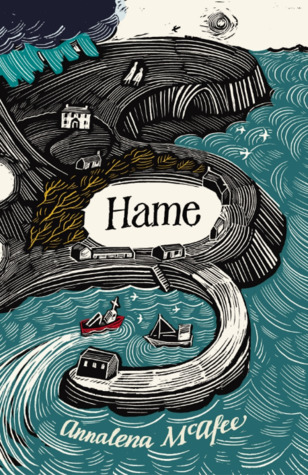 As I mentioned on Tuesday, I previously knew of Annalena McAfee only as Mrs. Ian McEwan, though she has a distinguished literary background: she founded the Guardian Review and edited it for six years, was Arts and Literary Editor of the Financial Times, and is the author of multiple children’s books and one previous novel for adults, The Spoiler (2011).
Well, anyone who reads Hame will be saying “Ian who?” as this is on such a grand scale compared to anything McEwan has ever attempted. The subtitle, “The Fascaray Archives,” gives an idea of how thorough McAfee means to be: the life of fictional poet Grigor McWatt is her way into everything that forms the Scottish identity. Her invented island of Fascaray is a carefully constructed microcosm of Scotland from ancient times to today. I loved the little glimpses of recent history, like the referendum on independence and a Donald Trump figure, billionaire “Archie Tupper,” bulldozing an environmentally sensitive area to build his new golf course (this really happened, in Aberdeenshire in 2012).
Narrator Mhairi McPhail arrives on Fascaray in August 2014, her nine-year-old daughter Agnes in tow. She’s here to oversee the opening of a new museum, edit a seven-volume edition of McWatt’s magnum opus, The Fascaray Compendium (a 70-year journal detailing the island’s history, language, flora, fauna and customs), and complete a critical biography of the poet. Over the next four months she often questions the feasibility of her multi-strand project. She also frets about her split from Marco, whom she left back in New York City after their separate infidelities. And her rootlessness – she’s Canadian via Scotland but has spent a lot of time in the States, giving her a mixed-up heritage and accent – is a constant niggle.
Mhairi’s narrative sections share space with excerpts from her biography of McWatt and extracts from McWatt’s own writing: The Fascaray Compendium, newspaper columns, letters to on-again, off-again lover Lilias Hogg, and Scots translations of famous poets from Blake to Yeats. We learn of key events from the island’s history through Mhairi’s biography and McWatt’s prose, including ongoing tension between lairds and crofters, Finnverinnity House being used as a Special Ops training school during World War II, a lifeboat lost in a gale in the 1970s, and the way the fishing industry is now ceding to hydroelectric power.
The balance between the alternating elements isn’t quite right – sections from Mhairi’s contemporary diary seem to get shorter as the novel goes along, such that it feels like there’s not enough narrative to anchor the book. Faced with yet more Scots poetry and vocabulary lists, or passages from Mhairi’s dry biography, it’s mighty tempting to skim.
That’s a shame, as the novel contains some truly lovely writing, particularly in McWatt’s nature observations:
In July and August, on rare days of startling and sustained heat, dragonflies as blue as the cloudless skies shimmer over cushions of moss by the burn while the midges, who abhor direct sunlight, are nowhere to be seen. Out to sea, somnolent groups of whales pass like cortèges of cruise ships and around them dolphins and porpoises joyously arc and dip as if stitching the ocean’s silken canopy of turquoise, gentian and cobalt.
For centuries male Fascaradians have sailed in the autumn, at the time of the ripe barley and the fruiting buckthorn, to hunt the plump young solan geese or gannets – the guga – near their nesting sites on the uninhabited rock pinnacles of Plodda and Grodda. No true Fascaradian can suffer vertigo since the scaling of these granite towers is done without the aid of mountaineers’ crampons or picks.
“Hame” means home in Scots – like in McWatt’s claim to fame, the folk-pop song “Hame tae Fascaray” – and themes of home and identity are strong here. The novel asks to what extent identity is bound up with a particular country and language, and whether we can craft our own selves. Must the place you come from always be the same as the home you choose? I could relate to Mhairi’s feeling that there’s nowhere she belongs, whether she’s in the bustle of New York or “marooned on a patch of damp peat floating in the North Sea.”
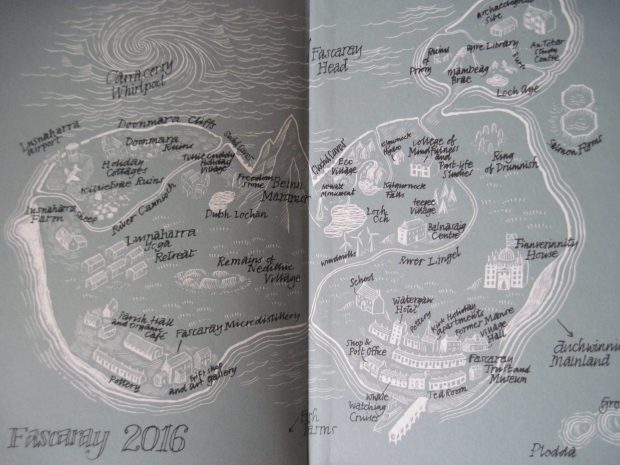
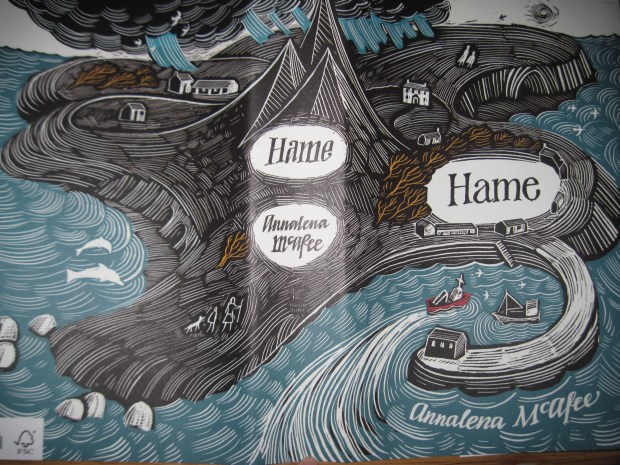
A map of the island from the inside of the back cover.
Although the blend of elements initially made me think that this would resemble A.S. Byatt’s Possession, it’s actually more like Rachel Cantor’s Good on Paper, which similarly stars a scholar who’s a single parent to a precocious daughter. In places I was also reminded of the work of Scarlett Thomas, Sara Maitland and Sarah Moss, and there’s even an echo of Robert Macfarlane’s Landmarks in the inventories of dialect words.
If you’ve done much traveling in Scotland, an added pleasure of the novel is trying to spot places you’ve been. (I thought I could see traces of Stromness, Orkney; indeed, McWatt reminded me most of Orcadian poet George Mackay Brown.) The comprehensive, archival approach didn’t completely win me over, but I was impressed by the book’s scope and its affectionate portrait of a beloved country. McAfee is of Scots-Irish parentage herself, and you can tell this is a true labor of love, and a cogent tribute.
Hame was published by Harvill Secker on February 9th. With thanks to Anna Redman for sending a free copy for review.
My rating: 
Giveaway Announcement!
I was accidentally sent two copies of Hame, so I am giving one away to a reader. Alas, this giveaway will have to be UK-only – the book is a hardback of nearly 600 pages, so would be prohibitively expensive to send abroad.
If you’re interested in winning a copy, simply leave a comment to that effect below. The competition will be open through the end of Friday the 17th and I will choose a winner at random on Saturday the 18th, to be announced via the comments and a personal e-mail.
Good luck!
 Bookish Beck = Rebecca Foster. American transplant to England. Freelance proofreader and book reviewer.
 Bookish Beck