What Makes a Review Popular?
I’ve only been reviewing on Goodreads for a couple years, but in that time I’ve noticed some contradictory trends. The most-liked reviews can be thousands of words long or two sentences; disjointed ramblings or concise analysis; gif after gif (screen captures of moving or still images from TV or film) or pure text; strewn with typos or perfectly honed; personal or detached; gimmicky or straightforward; gushing praise or forthright dismissal. In other words, I’m somewhat puzzled as to what makes a review popular.
To some extent it’s down to the popularity of a reviewer: the more friends and followers they have, the more likely people are to ‘like’ their review (if you’re not familiar with Goodreads, it has a ‘like’ button just like on Facebook, and reviews of a certain book then arrange themselves in order with the ones with the highest likes on the top). But this isn’t a sure thing. Although top reviewers probably account for a good percentage of the most popular reviews, there are always those sneaky book reviews that come out of nowhere and go viral.
Here are my thoughts on what is likely to make a review popular, thinking not just of Goodreads but of other sites I’ve worked with:
The book has buzz already, and/or has won a major prize.
By far, my most popular review ever is of Eleanor Catton’s The Luminaries [458 likes]. It won the Man Booker Prize in 2013.
 My second most popular review ever is of Gabrielle Zevin’s The Storied Life of A.J. Fikry [264 likes]. It was a New York Times bestseller and especially successful with the bookish types on Goodreads.
To my knowledge, our most popular article ever published on Bookkaholic was a book debate we did about Adam Johnson’s The Orphan Master’s Son, which won the Pulitzer Prize in 2013. I rated it 3 stars, while my opponent, an Australian blogger, gave it 5.
There’s thousands of 5-star ratings for Anthony Doerr’s All the Light We Cannot See, the 2015 Pulitzer winner, so while mine is not one of the top reviews by any means, it’s still my fifth most popular one at 62 likes.
You get in there early.
 Mine was one of the first reviews of The Luminaries to hit Goodreads, thanks to an advanced reader’s copy sent to me by We Love This Book. I also managed to review A.J. Fikry a few weeks before the publication date thanks to an Edelweiss download. With an early review, you can sometimes set the trend.
Helen Macdonald’s superb memoir, H is for Hawk, was released in the UK about a year before it finally arrived in the States, so that allowed my review time to gain some momentum (though not as much as a review that contained lots of photographs, something I still haven’t figured out how to do in html). It’s my sixth most popular review at 48 likes.
You epitomize the positive (or dissenting) response.
 My third most popular review is of Ruth Ozeki’s A Tale for the Time Being [138 likes], one of my favorite books from 2013 or any year. That was an unreserved 5-star rating. My 5-star review of Jo Baker’s Longbourn, my fourth most popular at 64 likes, went up the week of publication and started off strong before being overtaken by some other positive reviews.
By contrast, my reviews of The Luminaries and A.J. Fikry are lukewarm and critical, respectively. For the latter, I seem to represent the negative response: people who were disappointed by how clichéd and sappy a promising bibliophile’s novel turned out to be.
[Note: The above numbers were correct as of October 12, 2015; I will now stop updating them as it was taking up too much of my time and memory! My Goodreads teaser for A Little Life has now overtaken H is for Hawk as my sixth most popular review.]
Do you have any theories as to what makes a review popular? If you’re a blogger and/or reviewer, what have been some of your most popular pieces?
All comments welcome!
Reviews Roundup, July–August
One of my goals with this blog is to have one convenient place where I can gather together all my writing that has appeared in disparate online locations. To that end, once a month I’ll provide links to all the book reviews I’ve published elsewhere, with a rating (below each description) and a short taster so you can decide whether to click to read more. A couple of exceptions: I won’t point out my Kirkus Indie or BlueInk reviews since I don’t get a byline.
The Bookbag
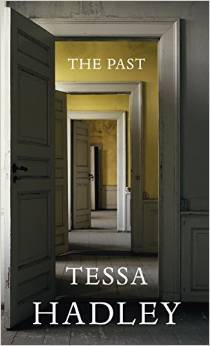 The Past by Tessa Hadley: Four adult siblings gather at their grandfather’s Devon vicarage for one last summer holiday before the house is sold. Their interactions, past and present, skirt the edges of tragedy and show the secrets and psychological intricacies any family harbors. Hadley writes beautifully subtle stories of English family life. Here she channels Elizabeth Bowen with a setup borrowed from The House in Paris: the novel is divided into three parts, titled “The Present,” “The Past,” and “The Present.” That structure allows for a deeper look at what the house and a neighboring cottage have meant to the central family. Hadley writes great descriptive prose and has such insight into family dynamics. Releases September 3rd.

 Between Gods by Alison Pick: At a time of transition – preparing for her wedding and finishing her first novel, set during the Holocaust – the author decided to convert to Judaism, the faith of her father’s Czech family. There are so many things going on in this sensitive and engrossing memoir: depression, her family’s Holocaust history, her conversion, career struggles, moving to Toronto, adjusting to marriage, and then pregnancy and motherhood following soon after – leading full circle to a time of postpartum depression. That said, this book is exactly what you want from a memoir: it vividly depicts a time of tremendous change, after which the subject is still somehow the same person, or perhaps more herself than ever.
BookBrowse
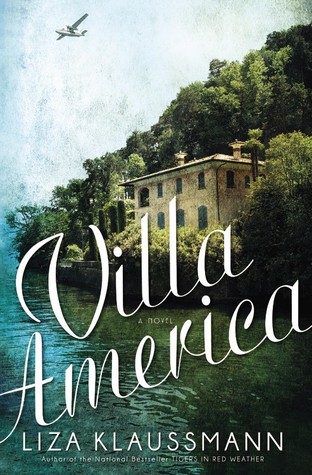 Villa America by Liza Klaussmann [the full text of my review is available for free this week as part of Editor’s Choice]: In her second novel, Klaussmann explores the glittering, tragic lives of Gerald and Sara Murphy, real-life models for F. Scott Fitzgerald’s Tender Is the Night. The book is slow to start with, with the first third unnecessarily devoted to Gerald’s and Sara’s childhoods and courtship. It is not until the Murphys are established in France and receive visits from fellow artists that the book really comes to life. It is easy to see why the Murphys attracted hangers-on. Yet beneath the façade of glamour, there is real sadness and struggle. Gerald’s uncertain sexuality is a tacit issue between him and Sara, and sickness strikes the family with cruel precision. The novel set up a beautiful contrast between happiness and tragedy.
Foreword Reviews
Stop the Diet, I Want to Get Off! by Lisa Tillinger Johansen: Yo-yo dieters and newbies alike should pick up Johansen’s witty book before wasting any time, money, or heartache on ineffective fad diets. Surveying diets old and new in a conversational style, Johansen gives the merits and dangers of each and suggests realistic principles for healthy eating and exercise. She bases her advice on solid facts, but cannily avoids the dry, scientific tone some experts might use. Instead, she uses chatty, informal language and personal stories to enliven her writing.
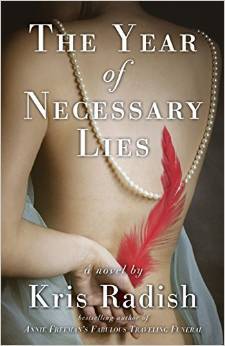 The Year of Necessary Lies by Kris Radish: Radish’s tenth novel highlights women’s role in the Audubon Society campaign to eradicate feathers from ladies’ hats. Her fictional heroine, Julia Briton, is a composite portrait of the many courageous women who stood up to plume hunters and the fashion industry alike in the early years of the twentieth century. “I did not simply want to survive, but to live with great passion and to do something that made a difference in the world,” Julia declares. Recommended for fans of Sue Monk Kidd’s The Invention of Wings.

Nudge
Now and at the Hour of Our Death by Susana Moreira Marques: In 2011 Marques, a freelance journalist, spent five months visiting the dying through a Portuguese home palliative care project. The resulting book falls into two parts: “Travel Notes about Death,” one-line aphorisms and several-paragraph anecdotes; and “Portraits,” case studies and interview transcripts from three families facing the death of a loved one. The lack of a straightforward narrative and the minimal presence of the author mean that the book overall feels disjointed. Nonetheless, it is a thought-provoking look at hospice services and emotions surrounding death. Releases September 3rd.
 Caught by Lisa Moore: A classic cat-and-mouse story in which a Canadian drug smuggler escapes from prison to score another load of marijuana from Colombia. Moore paints Slaney and Hearn as “modern-day folk heroes,” and her writing elevates what could have been a plain crime story into real literature. From the title onwards, the book is heavy with foreshadowing as Moore exploits the dramatic irony that readers know the police have a sting operation trailing Slaney the whole way. Indeed, the most remarkable thing about the novel is how it maintains tension even though the outcome seems inevitable. “The best stories … we’ve known the end from the beginning.” To my surprise, Caught is not just a good old-fashioned adventure story, but also has the epic, tragic weight of Homer’s Odyssey.
Field Notes from the Edge by Paul Evans: A book full of unexpected nuggets of information and inspiration: in addition to the travel notes and field observations, Evans (who writes a Guardian country diary from Wenlock Edge, Shropshire) incorporates personal anecdote, folk songs, myths and scientific advances. His central idea is that we have lost our connection with nature due to fear – “ecophobia,” the opposite of which is E.O. Wilson’s “biophilia.” How do we overcome that fear? Mostly by doing just what Evans does: spending time in nature, finding beauty and developing an affinity for particular places and species.
Shiny New Books
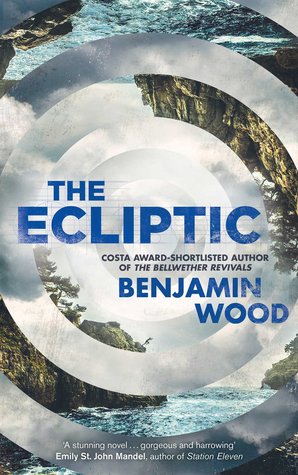 The Ecliptic by Benjamin Wood: Portmantle is a mysterious artists’ retreat center on a Turkish island. Our narrator, Elspeth Conroy (aka Knell), is a Scottish painter who came to Portmantle in 1962 after some struggles with mental illness. The first third of the novel is tremendously gripping and Gothic. The core of the book, nearly 200 pages, is a flashback to Elspeth’s life before. At last, after what feels like too long a digression, we come full circle back to Portmantle. I didn’t warm to The Ecliptic quite as much as I did to Wood’s debut, The Bellwether Revivals. Still, it’s really interesting to see how he alternates between realism and surrealism here. The parts that feel most real and immediate and the parts that are illusory are difficult to distinguish between. An odd, melancholy, shape-shifting novel.
We Love This Book
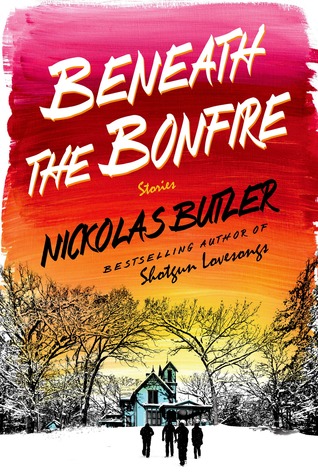 Beneath the Bonfire by Nickolas Butler: Ten tales of moral complexity in America’s gritty heartland. Fire and recreational drugs are powerful forces linking these Wisconsin-set stories. Opener “The Chainsaw Soirée” sets the tone by describing a failed utopia reminiscent of Lauren Groff’s Arcadia. The stand-out is “Morels,” in which three stoned friends go foraging for mushrooms in their dying rural community. The title’s similarity to “morals” is no coincidence: when the trio are involved in a hit-and-run they have to decide what to stand for. Unsentimental but lyrically composed, these stories will appeal to fans of Ron Rash.
 Among the Ten Thousand Things by Julia Pierpoint: Pierpont’s ambitiously structured debut novel explores how infidelity affects a whole New York City family. In short sections of matter-of-fact statements Pierpont gives a what-happened-next for each of the characters over the next decade or so. But “it’s the between-time that lasted,” Pierpoint argues as she returns to that summer of revelations for a closer look. The climactic events of the holiday contrast childhood innocence and adulthood; when you’re on the cusp, certain experiences can push you over the brink from one to the other. This offbeat take on the dysfunctional family novel should interest fans of Nicole Krauss or Rebecca Dinerstein (The Sunlit Night). [Few extra thoughts at Goodreads.]

I also post reviews of most of my casual reading and skimming on Goodreads.
 F: A Novel by Daniel Kehlmann: What does F stand for? Faith, finances, fraud, forgery, family and Fate all play a role in Kehlmann’s fourth novel available in English translation. F is also for the Friedlands: Arthur the unreliable patriarch; Martin, a portly Catholic priest who doesn’t believe in God; and his twin half-brothers, Eric and Ivan, a mentally ill businessman and a homosexual painter who forges his mentor’s masterworks. Reading this brilliant, funny spoof on the traditional family saga is like puzzling out a Rubik’s Cube: it is a multi-faceted narrative with many meanings that only become clear the deeper you go. (Full review in September/October 2015 issue of Third Way magazine.)

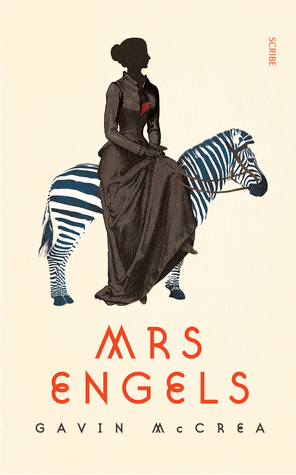 Mrs. Engels by Gavin McCrea: I generally love Victorian-set historical fiction and books about famous wives, so I was surprised by how little I liked this novel about Lizzie Burns, the illiterate, working-class Irish woman who was Frederick Engels’ longtime partner. The novel flits between 1870–1, when Lizzie and Frederick were newly arrived in London and involved in helping the poor and Franco-Prussian War refugees, and their earlier years in Manchester. Lizzie is a no-nonsense first-person narrator, and her coarse, questionably grammatical speech fits with her background. Unfortunately, I never warmed to Lizzie or felt that she was giving a truly intimate look at her own life. This novel had such potential to bring an exciting, revolutionary time to life, but it never fulfilled its promise for me. Releases in the States on October 13th.

Rank by Aaron McCollough: Some nice alliteration and pleasant imagery of flora, fauna and musical instruments. However, I struggled to find any overarching meaning in these run-on poems. In fact, I could not tell you what a single one of them is actually about. Story is just as important as sound in poetry, I feel, and in that respect this collection was lacking. Releases September 1st.
Trout’s Lie by Percival Everett: “The line of time / Is past. / The line folds back, / Splits. / Two lines now, future, present. The past / Is a circle of / Abstraction, regret.” There is a lot of repetition and wordplay in these poems. The title piece uses a line in Italian from Dante – translating to “in the middle of our life’s path” – that forms another recurring theme: being stuck between times or between options and having to decide which way to go. These read quickly, with the run-on phrases flowing naturally from topic to topic. I’m not sure this was the best introduction to a prolific author I’d never heard of; I’ll have to look into his other work. Releases October 15th.
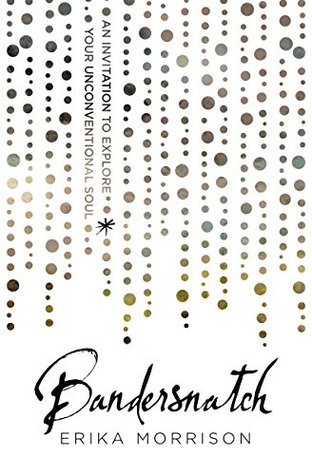 Bandersnatch by Erika Morrison: This is Christian self-help, an ideal read for fans of Glennon Doyle Melton and Rob Bell. The title, a creature from Lewis Carroll’s imagination, is Morrison’s shorthand for a troublemaker. She argues that as Christians we should be following Jesus down the road of “positive nonconformity”: taking an avant-garde approach to life, turning ordinary moments into divine opportunities through spiritual alchemy, taking an interest in the least of these with kingdom anthropology, and making the everyday trials of marriage and parenthood our works of art. I liked the book best when Morrison illustrated her points with stories from her own life. Overall I found the book repetitive, and the language can definitely be hippy-dippy in places. Releases October 6th.

Family Values by Wendy Cope: Cope mostly uses recognizable forms (villanelles, sonnets, etc.): this is interesting to see in contemporary poetry, but requires a whole lot of rhyming, most of it rather twee (e.g. “tuppence/comeuppance”), which gives the whole collection the feeling of being written for children. My two favorites were “Lissadell,” about a vacation to Ireland, and “Haiku,” perfect in its simplicity:
A perfect white wine
is sharp, sweet and cold as this:
birdsong in winter.
Paulette Bates Alden: An Underrated Author
I first came across Paulette Alden’s work last June, when she contacted me to ask if I’d like to review her new short story collection, Unforgettable. It’s a self-published book available through Kindle, and in all honesty, given my experience reviewing self-published material for Kirkus and Foreword, I wasn’t expecting much. What a pleasant surprise, then, to find that these were excellent, literary short stories with a strong voice and sense of place. Since then I have read two more Alden books: Crossing the Moon, her memoir of infertility, and Feeding the Eagles, her first short story collection, which shares a protagonist with Unforgettable. Here, in the order in which I have read them, are Alden’s published works:
Unforgettable
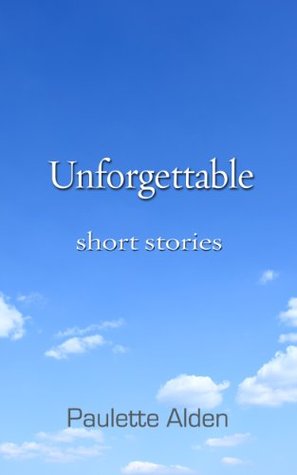 Nine linked stories focus on the life of Miriam Batson, a writer and adjunct professor at a Minnesota college. Now in her late forties, Miriam faces the challenge of caring for her aging mother. Indeed, the final five stories are inspired by Alden’s experience as a caregiver for her late mother, who suffered from dementia. Although it is intriguing to ponder just how autobiographical these stories might be, ultimately it makes little difference to a reader’s enjoyment. The close third-person perspective creates such intimate knowledge of the main character that one cannot help but feel sympathy for her professional and personal struggles.
The opening story, “The Student,” is among the strongest. Miriam learns that Brian, one of the students in her advanced short story class, has attempted suicide – in three different ways. Horror cedes to compassion as she realizes how he must have been suffering, even while keeping up a cheerful exterior in class. As she visits Brian in the hospital during his recovery, Miriam is taken aback by her feelings for him. Hesitant to borrow spiritual language, she still senses that she and Brian have a soul connection. At the same time, she realizes that no relationship is entirely one thing or another; their teacher-student dynamic may resemble a parent-child link, but sex keeps creeping in unexpectedly.
In “Sorrow,” told in the present tense, Miriam learns of the death of one of her black nannies and returns to South Carolina to pay her respects. Filled with memories of segregation, this story shares the social conscience of Kathryn Stockett’s The Help. “Enormously Valuable” returns to the first story’s academic setting, with Miriam receiving notification that someone else – a less experienced man – has gotten the teaching job she applied for. She decides to take legal advice to determine whether this is a case of sex discrimination. This story tips over into melodrama slightly, but is still an affecting look at career disappointment. The themes of bureaucracy and petty infighting in a university English department recall John Williams’s Stoner.
“Swimming, Snow” was commissioned as the Minnesota Center for Book Arts’ 1993 Winter Book. Miriam slowly starts to heal after her father’s death, thanks to the therapeutic effects of activities like massage, classical music, and sex. This one is a perfect segue into the collection’s last five stories, which together reflect on Alden’s experiences as a caregiver during her mother’s final years with dementia.
The title story, the last in the collection, does indeed have a stand-alone feel, combining all the emotions of the previous four into the most shrewdly crafted of the tales, rich with symbolism. It opens with Miriam driving to a monastery for a writing retreat. Although it is April, it is snowing, and Nat King Cole’s song “Unforgettable” is on the radio. Ironically, that title is also the name given to her mother’s nursing home’s remodeling campaign. Miriam has been taking beginner’s Italian lessons; her bewilderment is an echo of her mother’s confusion about language. In addition, Easter is coming up the following week, and the symbology of death and restoration plays a significant role. Miriam can no longer deny that her mother will be dead soon, yet she feels that she will live on – perhaps even through Miriam’s work: “Writing is her religion, her resurrection. Long after her mother is gone, she will have this moment. Her mother will rise from the dead and live again in those words.”
Alden tenderly conveys the overwhelming difficulties and small joys of being the primary caregiver for a loved one with serious health problems. You do not have to share any of Miriam’s experiences to value her insight and admire her courage. I daresay every reader will find at least one aspect of these stories to be, as the title suggests, simply unforgettable.
My rating:
Crossing the Moon
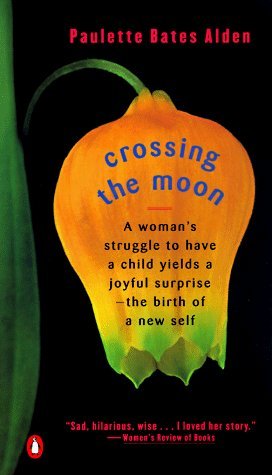 Frank and tender, this is a wonderful memoir about women’s reproductive choices – or the way life sometimes takes those choices out of your hands. Alden was happily married, with a beloved cat named Cecil and her first short story collection coming out soon. At age 39, she still hadn’t thought all that much about motherhood, but suddenly decision time was on her. Despite her ambivalence (“I might never have a child, and the irony is not lost on me, that I’m not even sure I want one”), she went ahead with multiple rounds of infertility treatment, only conceding defeat and grieving her loss when she was 42.
All along she was resisting multiple voices: that of her Southern upbringing, which said all women were supposed to have children; that of feminism, which told her she wasn’t supposed to want what all women are supposed to have. There was also her own inner suspicion that the life she already had was the one she wanted. “From the very start, I had seen writing and motherhood as mutually exclusive.”
I found this a very touching story of learning to love the life you have. “It came to me that it really was a choice between two good things – having a child and not having a child. Our life without a child seemed good to me. I caught a glimpse that it was what was right for us, for the best.”
My rating:
 Feeding the Eagles
Miriam Batson first appeared in this 1983 collection published by Graywolf Press. Of the 11 stories here, seven are in the third person and four in the first person. They dart back and forth in time: sometimes Miriam is married and back in South Carolina visiting her parents and sister; other times she’s a young graduate student on the way back to California. It was particularly interesting for me, having read Alden’s memoir, to trace the autobiographical roots of many of the stories. I even spotted a couple of lines taken word for word from life: “‘I’ll tell you what I think,’ [Miriam’s] mother says slowly. ‘I think people who don’t have children are the most selfish people in the world.’”
These stories are strong on symbolism and often have memorable endings. For instance, the title phrase seems odd but in context is a beautiful image of turning failure into a positive. Miriam and her husband Ted have gone out fishing from their Minnesota cabin. Ted throws a big fish back, hoping the hook injury wasn’t too deep, but a while later they see it floating on its side. They’re feeling a little guilty – until an eagle drops in and snatches the dead fish. “‘Now you don’t have to feel so bad,’ Ted says. ‘We’re feeding the eagles.’” Elsewhere, Miriam’s grandmother’s wig is a peculiar token of family inheritance, while a snake encountered at a campground is a reminder of excessive sensuality.
As in Unforgettable and Crossing the Moon, the overarching theme of the book is a woman’s identity and how this shifts through life. Miriam is a daughter, a wife, a grown sister, a writer. She is not a mother, a decision that defines her as much as any other. But even within these roles, time creeps in and changes things. With her elderly parents facing bankruptcy, Miriam realizes, “It occurred to me for the first time that maybe my father didn’t know what was going on.” That sense of a turning of the generations, of the child taking on the responsible parent guise, is undoubtedly true to life.
Another central theme is how places of safety and familiarity lose their capacity to reassure us. For Miriam/Alden, the South becomes increasingly foreign but still has a metaphorical hold on her. “Stretching out around us in every direction are the flat Midwestern plains, and it comes to me that I will not live my life as I have always imagined I would—without even thinking of it—in South Carolina.” All the same, as she drives to the old family cabin in South Carolina before it passes out of their hands for good, she thinks how “all of the roads of her life lead back to this one.”
On this reading the story that meant most to me was “At the Beach,” in which Miriam and her sister Linda take a rare vacation together and marvel at how their parents are aging. “Just so you take them in in their old age,” Miriam jokes, but beneath the quip lies deep concern. I could recognize my sister and myself – now separated by an ocean but not so much anymore by the eight years between us – in this sentence: “It seems we talk more now that we are older, now that we live so far apart and have so little time together.”
One thing I love about Alden’s books is how she seems to see life in discrete parts but also, looking back nostalgically, as a coherent narrative that leads logically and inevitably to the present. This makes for a gently bittersweet tone, but I come away sensing gratitude. As my favorite lines from Crossing the Moon have it, “who can say what is ‘best’? Maybe it’s possible to get to a place where what is best is simply what is.”
My rating:
 The Answer to Your Question
I haven’t read this one yet, but I have a copy on my e-reader and am saving it for a rainy day treat. On the surface it sounds completely different from anything else Alden has written. The blurb describes a page-turning thriller about a man who has been accused of murdering four women and his librarian mother’s quest to figure out whether he really did it and why. It won the Kindle Book Review Best Indie Book of 2013 in the suspense category. I feel sure that it will have the same psychological acuity as Alden’s other books.
Who are some of your favorite lesser-known authors? Share them in the comments below!
In Praise of Literary Prizes
I like a spot of competition. Whether watching Olympic figure skating, playing board games like Scrabble and Boggle, entering a low-key Oscars pool, or rooting for my favorites in American Idol seasons and Miss America pageants, I’ve always loved trying to pick the best. This means that literary prizes are hugely exciting for me, and I follow the races closely.
I’m particularly devoted to the Man Booker Prize. I was delighted to see Hanya Yanagihara’s A Little Life on the recent longlist (catch up on it here), a truly interesting set of books, diverse in terms of their genres and authors’ nationalities and nicely balanced between male and female writers (6:7). I’ve read four of the longlisted titles so far:
 The Fishermen, Chigozie Obioma (full review in May 2015 issue of Third Way): From a young Nigerian debut novelist comes a haunting tale of sibling rivalry and revenge. With sectarian riots afoot, the four oldest Agwu boys decide to make money by skipping school and fishing in the Omi-Ala River. Things get more complicated when Abulu, the local madman, issues a prophecy that seems bound to divide the brothers. The first quarter of the novel, especially, is drenched in foreshadowing (not always subtle, nor do the plot turns often rise above the predictable). Rich with prophecy and allusions, this owes much to biblical narratives and tragedies from Shakespeare to Chinua Achebe.
- Lila, Marilynne Robinson – reviewed at For Books’ Sake
- A Spool of Blue Thread, Anne Tyler – also reviewed at For Books’ Sake
- A Little Life, Hanya Yanagihara – reviewed at Shiny New Books

 Next up: I’m reviewing The Green Road by Anne Enright for the November 2015 issue of Third Way. The Booker Prize shortlist will be announced on September 15th and the winner on October 13th.
Beyond the Booker, here are some of the other prizes I follow throughout the year, listed in vague chronological order:
 The Not the Booker Prize run by the Guardian. On this year’s shortlist is Shame by Melanie Finn, a book I loved when I reviewed it for Third Way’s April 2015 issue. It’s a powerful story of regret and the search for redemption. Though it has elements of a straightforward psychological thriller, the daring structure and moral complexities are more akin to Graham Greene. In alternating chapters, Pilgrim Jones contrasts flashbacks to her car accident and the subsequent investigation back in Switzerland with her present-tense African odyssey. This is Conrad’s Africa, a continent characterized by darkness and suffering. The question of culpability remains murky, yet the possibility of salvation shines through. [Voting will take place in October.]

- The Guardian First Book Award (open to both fiction and nonfiction): the shortlist will be announced this Friday, August 14th. One entry, Spill Simmer Falter Wither by Sara Baume, has already been chosen by readers, and the other nine are selected from publishers’ submissions. [Winner announced in late November.]
 The Dylan Thomas Prize for young writers (under 39) went to Joshua Ferris for To Rise Again at a Decent Hour last year. [Longlist in September, shortlist in October and winner announced in November.]
- The Costa Book Awards give separate prizes for fiction, debut fiction, biography, poetry, and children’s books, and also choose one overall winner. [Category shortlists in late November, category winners in early January and overall winner on January 26, 2016.]
- The Folio Prize, only two years old, considers any work of fiction published in English; before the Booker expanded to include American entries last year, it was the most Catholic of the fiction prizes. Now it risks being considered redundant; especially since it lost its Folio Society sponsorship, it’s unclear whether it will continue. [Shortlist in February and winner announced in March.]
 The Wellcome Book Prize is for medical-themed literature, fiction or nonfiction. Last year’s winner, The Iceberg by Marion Coutts, meant a lot to me for personal reasons but was also one of the most unusual and impressive memoirs I’ve ever read. I reviewed it for The Bookbag here. [Shortlist in March and winner announced in April.]

- The Pulitzer Prize is America’s premier literary award. I confess I often feel a little out of touch with the winners and don’t necessarily make a conscious effort to seek out the nominated books. I’d like to be more familiar with Pulitzer winners. Next year marks the prize’s centennial, so there’s no better time! [Winners announced in April.]
- The Independent Foreign Fiction Prize is for any book that has been translated into English and published in the UK in the previous year. I’ve found some great offbeat reads by browsing through previous longlists. As of next year, the prize is merging with the Man Booker International award, which previously recognized the life work of a foreign author every other year. [Longlist in March, shortlist in April and winner announced in May.]
 The Bollinger Everyman Wodehouse Prize, the UK’s prize for comic literature, has run since 2000. Among the past winners are Paul Torday, Howard Jacobson, Terry Pratchett, Geoff Dyer, Gary Shteyngart, and (surprise!) Ian McEwan. I’ve read five of the winners, including Lost for Words by Edward St. Aubyn. [Shortlist in March and winner announced in May.]
- The Baileys Women’s Prize for Fiction (formerly known as the Orange Prize). Ali Smith won the 2015 award for How to Be Both. [Longlist in March; shortlist and winner announced in June.]
Do you follow literary prize races? Do you make a point of reading the winner and/or the shortlisted books? All comments welcome!
Audiobook Giveaway: Safekeeping, Jessamyn Hope
This giveaway is now closed. Congratulations to Lisa Lieberman and Maureen Cean, winners of the two audiobook copies!
I’m excited to announce my first-ever blog giveaway! Jessamyn Hope is kindly offering copies of the audiobook of her debut novel, Safekeeping, to two of my blog readers. This was one of my favorite books of the summer; check out my full review here. The audiobook is narrated by Kristen Potter, who also recently voiced Emily St. John Mandel’s Station Eleven.
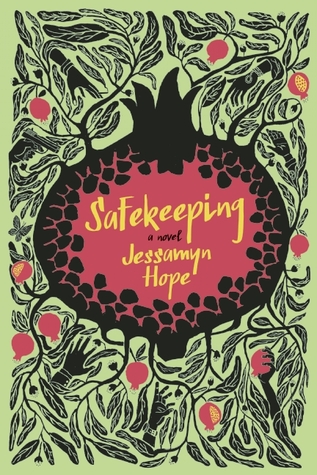
For your chance to win one of the two available copies, simply leave a comment below. The giveaway will stay open for just over one week, until 10 pm GMT / 5 pm ET on Monday, August 17th. After that point I will number the comments and choose the winners through a random number generator.
This giveaway is open to readers in any country. Good luck!
Graphic Novels for Newbies
Following on from last week’s article on quick reads…
I sometimes wonder if counting graphic novels on my year lists is a bit like cheating, since some are little more than comic books. However, the majority of graphic novels I read have a definite storyline and more words on a page than your average comic. When I worked in London I took advantage of the extensive public library holdings there and tried out a lot of graphic novelists’ work that was new to me. Some of my favorites are Alison Bechdel, Posy Simmonds, Audrey Niffenegger and Joe Sacco. As it happens, I’ve never officially reviewed graphic novels (nor do I own any), but here’s a handful I’ve enjoyed, along with my reading notes:
 Fun Home: A Family Tragicomic by Alison Bechdel
This memoir in graphic novel form is super. Bechdel puts the ‘fun’ in both dysfunctional family and funeral home – the family business her father inherited in small-town Pennsylvania. All through her 1970s upbringing, as Alison grew up coveting men’s shirts and feeling strange quivers of suspicion when she encountered the word “lesbian” in the dictionary, her father was leading a double life, sleeping with the younger men who babysat his kids or helped out with his twin passions of gardening and home renovation.
In an ironic sequence of events, the coming-out letter Alison sent home from college was followed just weeks later by her mother’s revelation of her father’s homosexual indiscretions and their upcoming divorce, and then no more than a few months later by her father’s sudden death. Bruce Bechdel was run down by a Sunbeam Bread truck as he was crossing the road with an armload of cleared brush from a property he was renovating. Was it suicide, or just a horribly arbitrary accident? (The Sunbeam Bread detail sure makes one cringe.) In any case, it was a “mort imbécile,” just as Camus characterized any death by automobile.
Bechdel traces the hints of queerness in her family, the moments when she and her father saw into each other and recognized something familiar. She also muses on the family as a group of frustrated and isolated artists each striving, unfulfilled, towards perfection. This is a thoughtful, powerful memoir, and no less so for being told through a comic strip.
(Bechdel’s Are You My Mother? was also on my BookTrib list of mother–daughter memoirs to read for Mother’s Day.)
 Blankets by Craig Thompson
This sweet, autobiographical coming-of-age story in graphic novel form is not quite as likable and quick-witted as Fun Home, but it has similar themes such as sexual awakening and the difficulty of understanding one’s parents. Blankets are a linking metaphor: the quilt Craig’s first love, Raina, makes for him; huddling in the same bed with his little brother Phil for warmth during freezing Wisconsin winters; and playing ‘storm at sea’ with the covers.
There’s also an interesting loss-of-faith element to the narrative. Craig is brought up in your average Midwestern fundamentalist Evangelical church and attends youth group, camp, etc. (where he meets Raina); the pastor even wants him to consider going into the ministry, but he doesn’t fit in here – even in the Christian subculture he’s forced into a fringe group of outsiders. Writing and drawing are acts of self-creation and self-preservation. He wants to find a way to use his drawing for good but no one seems to see a value in it. Thus everything, or nothing in particular, leads him to reject his faith when he gets to college.
How satisfying it is to leave a mark on a blank surface. To make a map of my movement – no matter how temporary.
The drawings are lush and bold (though even more so in Thompson’s Habibi). [SPOILERS ahead!] I appreciated how Thompson denies the satisfaction of a happy ending to Craig and Raina’s love story; it’s more realistic this way, recognizing that high school sweethearts rarely stay together. As Raina says, “everything ENDS…everything DEGENERATES, CRUMBLES – so why bother getting started in the first place?” And yet the beauty and power in memory of young love remains, thus Thompson’s rhapsodizing here.
 Mrs Weber’s Omnibus by Posy Simmonds
[a collection of her comics for the Guardian]
As with the Garfield cartoons, you get to see the development of Simmonds’s style and the characters, as well as the march of fashion over the period 1977–1993. Very clever skewering of middle class liberal values and political correctness gone mad: the characters (especially polytechnic sociology lecturer George, in the Department of Liberal Studies, and children’s book author Wendy Weber) espouse these values, but their actions don’t always live up to the tolerance they preach. Here are some of the themes:
- 1980s politics: reactionary against Thatcherism; youth unemployment and purposelessness; income inequality; economic and social injustice
- Hypocrisy, avoiding unpleasant truths, compromising youthful ideals
- Middle vs. upper-middle / upper class: second homes, private education
- Place of women: the irony that stay-at-home motherhood is idealized and the difficulties of working motherhood denied (women – liberated to do what?)
 Raven Girl by Audrey Niffenegger
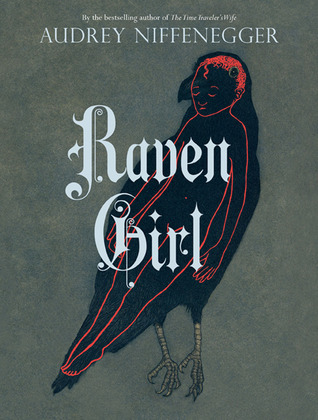
A lovely and simple fairy tale, with classical plot elements like transformation and true love transcending all boundaries. In a quaint English setting, a country postman is tasked with delivering a letter to an address he’s never seen before:
Dripping Rock
Raven’s Nest
2 Flat Drab Manor
East Underwhelm, Otherworld
EE1 LH9 [postcode = East of East, Lower Heights]
Here the postman meets a young raven fallen out of her nest, takes her home to mend her and they fall in love. Even when her wing heals and she can fly, she chooses to stay with him. Their daughter is a mixed creature; she can only croak, but she has no wings and so is raised as a human child. At university she meets a plastic surgeon who can create human-animal chimeras; she begs him to make her wings – a mixture of science and magic. It involves bloody surgery and painful recovery, but in the end she has the wings she’s always felt were hers. Her identity is described in terms very much like Jan Morris’s in Conundrum, when describing her sex change and her knowledge that she was really a girl: “My mother is a raven and my father is a postman, but I feel that truly I should have been a raven.”
Like Niffenegger’s other work, there’s an ever so slightly uncomfortable blend of sinister/grotesque elements with charming, innocuous magic.
 Jimmy Corrigan, the Smartest Kid on Earth by Chris Ware
This is probably the most peculiar graphic novel I’ve ever read. It’s the story of Jimmy Corrigan, a sad-sack workaholic who, at 36, has no friends apart from his mother, who constantly telephones him. One day he gets a letter from the father he’s never met, asking him to come meet him. And so Jimmy gets on a plane from Chicago out to suburban Michigan. Corrigan is one of those unfortunate-looking fellows who has a potato for a head and a wispy comb-over, and could be anywhere between 30 and 60; he looked little different as a child in the flashback scenes – somewhat like Charlie Brown, also in his depression, diffidence and inability to speak to women.
I much preferred the historical interludes looking at his grandfather (another Jimmy) and his years growing up in Chicago with the World’s Fair under construction. I also liked the more random additions such as patterns for cutting and folding your own model village or business cards with ‘scenic views’ of today’s Waukosha, MI on them.
Parental (verbal) abuse and neglect is a recurring theme, as are bullying from peers, car accidents, and Superman. There’s also an uncomfortable amount of imagined violence – either homicide or suicide.
Also recommended:
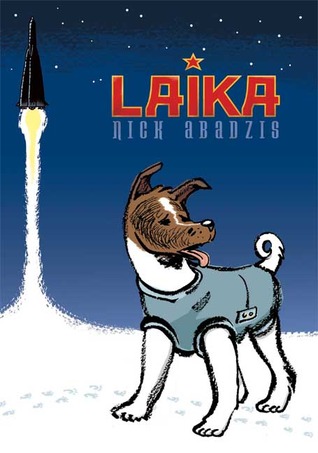 Laika by Nick Abadzis
Palestine by Joe Sacco
Couch Fiction by Philippa Perry
Days of the Bagnold Summer by Joff Winterhart
Do you read graphic novels? What are some of your favorites?
Review: The Girl Who Slept with God, Val Brelinski
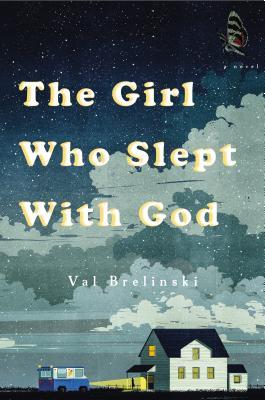 That striking title sets the scene for an out-of-the-ordinary coming-of-age novel set in a fundamentalist Christian family in Arco, Idaho in 1970. The Quanbecks renounce dancing, movies, alcohol and everything else that represents regular teenage life for thirteen-year-old Jory. She and her sisters are sheltered from the world within their church and Christian school. That sense of being set apart only grows stronger when seventeen-year-old Grace comes back pregnant from a short mission trip to Mexico. Grace swears it was an immaculate conception and she, like Mary, has been entrusted with carrying God’s child. Is she telling the truth, is she repressing a traumatic event, or is she mentally ill? Val Brelinski keeps that question largely open throughout her strong debut novel.
Grace’s actions will have a lasting effect on Jory. The girls’ parents – their father a Harvard-educated astronomer and their mother a virtual shut-in who relies on prescription anxiety pills – decide that Grace will live away from them and the community, and Jory will keep her company. Dr. Quanbeck buys a small house next-door to Hilda Kleinfelter and withdraws both girls from school so word can’t get around. Jory will attend secular Schism High, where she gets an education in teenage socialization that includes the Homecoming dance, liquor and an accidental LSD trip. Hilda becomes a sort of surrogate grandmother to the girls, and Grip, a deadbeat ice cream van driver in his twenties, is their new best friend.
Brelinski is sensitive to the ways in which religion and romantic infatuation influence her characters’ choices, and even when things get a little bit uncomfortable – like when Grip and Jory steal a kiss – the plot feels true to life. The choice of close third-person narration from Jory’s perspective, rather than first-person, thankfully keeps the book from resembling a teen diary. This is the best of both worlds: we get Jory’s thoughts, but in more sophisticated literary language. The novel also blends biblical metaphors and Dr. Quanbeck’s astronomical vocabulary to good effect, as in this lovely passage near the end:
The universe had opened up and revealed its own perfectly blank face to [Jory’s] own, returning her gaze with a flattened emptiness that stretched on and on and on—a world so wide and featureless and open, so dark and formless, that light never pierced it: no sun, no moon, no stars. And it now seemed entirely possible that two girls … could stumble mutely on across the face of it forever, seeking a home, and a resting place, and finding none.
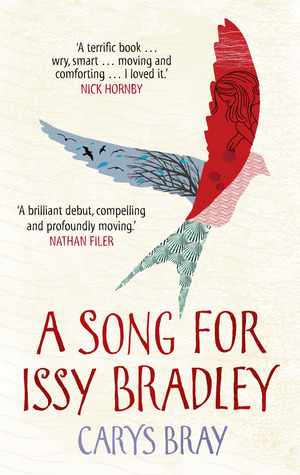 In a book full of memorable characters, I found Grace and Dr. Quanbeck to be the most compelling ones, mostly for how logic and superstition collide in their thinking. Like the father in A Song for Issy Bradley by Carys Bray, one of my favorite novels from last year, Dr. Quanbeck could almost seem like the villain here for the choices he imposes on his family, but the picture of him is nuanced so that you can see how desperately he loves his family and wants to protect them from worldly pain.
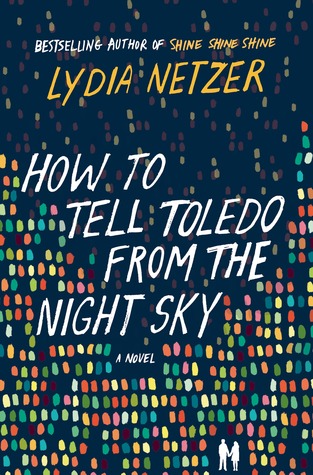 Along with Issy Bradley (set in Britain’s Mormon community), the novel reminded me most of We Sinners by Hanna Pylväinen, another picture of family life under strict religious guidelines, and How to Tell Toledo from the Night Sky by Lydia Netzer, a love story with astronomical overtones. Much as I liked it, I did think Brelinski’s novel was about a quarter too long; both the middle section – where Jory is negotiating her newfound freedom – and the dénouement felt drawn out. It would be interesting to see Brelinski’s talent for characterization and scene-setting applied to short stories or a much shorter novel. I also thought the initial decision to set the two girls up in their own home felt slightly far-fetched.
All the same, I appreciated this balanced picture of family life. The Quanbecks are never just oddities or your stereotypical dysfunctional family, but as idealistic and messed up as all the rest of us. As Mrs. Kleinfelter puts it, “Most [families] are pretty much the same, I think. Good and bad mixed together in a small bag. Or a small house.”
My rating:
I received early access to this book through the Penguin First to Read program.
Small Books Are Good, Too
Last week I wrote in praise of doorstoppers – books over 500 pages. But I also love really short books: there’s just as much writing skill involved in making a narrative concise, and it can be supremely satisfying to pick up a book and polish it off within a couple hours, especially if you’re in a situation of captured attention as on a plane. Being honest and slightly selfish for a moment, short books are also a great way to build up a flagging year list.
Below I highlight poetry collections, memoirs, short stories and novellas that should be on your agenda if you’re looking for a quick read (number of pages in brackets after each title):
Poetry
I try to always have a book of contemporary poetry on the go, usually by a British poet since I pluck these at random from my local public library shelves. Poetry collections aren’t always ‘quick’ reads, nor should they be, because you often have to read a poem more than once to understand it or truly appreciate its techniques. Still, with most poetry books numbering somewhere between 45 and 90 pages, even if you parcel them out over days or weeks they’ll take much less time than a novel. Pick up something by Mark Doty, Kathleen Jamie, David Harsent or Christopher Reid and you’ll have plenty of beautiful verse to ponder.
Recently reviewed and recommended:
- Learning to Make an Oud in Nazareth by Ruth Padel [80]
- All One Breath by John Burnside [96]
- Praise in Which I Live and Move and Have My Being by Paul Durcan [176]
Short Memoirs
Depending on how thorough they are, autobiographies can often hover around 300 or 400 pages. Looking through my shelves, though, I’ve spotted a few in the 140–160 page range: My Movie Business by John Irving [158], The Diving-Bell and the Butterfly by Jean-Dominique Bauby [139], and Winter by Rick Bass [162]. Another short one well worth reading is the unusual The Sound of a Wild Snail Eating by Elisabeth Tova Bailey [170], a story about debilitating illness and taking comfort from nature.
Abigail Thomas, one of my favorite memoirists, writes in an episodic style that makes her 200-page books fly by as if they were half that length. Also, Anne Lamott has written two very short faith memoirs that would serve as a good introduction to her style and content for those who haven’t read Traveling Mercies et al.: Help Thanks Wow [102] and Stitches [112].
Recently reviewed and recommended:
- The Two Kinds of Decay by Sarah Manguso [192]
- The Light of the World by Elizabeth Alexander [208]
- What Comes Next and How to Like It by Abigail Thomas [240] – also included on my BookTrib list of mother–daughter memoirs to read for Mother’s Day
Short Stories
I used to shy away from short stories because I didn’t think they were worth the emotional investment, but recently I’ve decided I really like the rhythm of picking up a set of characters, a storyline and a voice and then, after 20 or so pages, following an epiphany or an aporia (or utter confusion), trading them in for a whole new scenario. Short stories are also the perfect length for reading during a quick meal or car ride. Two short story collections made it onto my “Best of 2014” list: White Man’s Problems by Kevin Morris and The Heaven of Animals by David James Poissant.
Recently reviewed and recommended (no page numbers listed here because each story can stand alone):
- Wallflowers by Eliza Robertson
- Funny Once by Antonya Nelson
- Thunderstruck and Other Stories by Elizabeth McCracken
Novellas
With some credits for free Penguin books I got hold of Borges and the Eternal Orang-Utans by Luis Fernando Verissimo (translated from the Portuguese by Margaret Jull Costa) [135], a book I’d been hankering to read ever since I came across that terrific title. It’s an enjoyable academic comedy and locked room mystery, with nods to Borges and Poe (though I probably didn’t get them all).
I also recently discovered Peirene Press, which exclusively publishes novellas in translation. Their motto is “Contemporary European Literature. Thought provoking, well designed, short.” They publish the novellas in thematic trilogies, with headings such as “Male Dilemma: Quests for Intimacy” and “Small Epic: Unravelling Secrets.” The book I own from Peirene (scored from a secondhand bookshop in Henley-on-Thames for £1), from the “Turning Point: Revolutionary Moments” series, is Mr. Darwin’s Gardener by Kristina Carlson [122] (translated from the Finnish by Emily and Fleur Jeremiah).
It’s an odd little book, with a mixture of past and present tense and first-, third- and first-person plural narration. Set in the village of Downe, it’s peripherally about the title character, Charles Darwin’s gardener Thomas Davies, a new widower with two children, one of whom has Duchenne muscular dystrophy (newly identified). It’s thin on plot, it must be said. Daniel Lewis, the verger of Downe for five years, was dismissed for stealing from the church and is beaten up when he comes back to town; some characters think and talk about Darwin’s theory and Davies’s bereavement; there’s an overturned cart.
My favorite section, “At the Anchor,” is composed of conversations at the village pub, and my favorite individual lines reflect on Darwin’s influence on contemporary thought:
“Mr Darwin is a tree that spreads light, Thomas Davies thinks.”
“Great men are remembered, like Mr Darwin, a genuine monolith. We small folk are mere sand, washed by the waves as they go back and forth.”
“People in future decades and centuries will react to our ideas superciliously, as if we were children playing at thinking. We shall look most amusing in the light of new thoughts and inventions.”
If you’re looking to get through a classic in an afternoon, why not try one of these (full text available for free online through Project Gutenberg or other initiatives): Animal Farm by George Orwell [95], Ethan Frome by Edith Wharton [181] or Flush by Virginia Woolf (her spoof ‘biography’ of Elizabeth Barrett Browning’s cocker spaniel) [108]. E. M. Forster’s novels also read very quickly, and several of John Steinbeck’s novels are quite short. Whether or not you’ve seen the Audrey Hepburn movie, you’ll want to read the sparkling, bittersweet Breakfast at Tiffany’s by Truman Capote [100]; my edition also includes several of his best known short stories, including the wonderful “A Christmas Memory.”
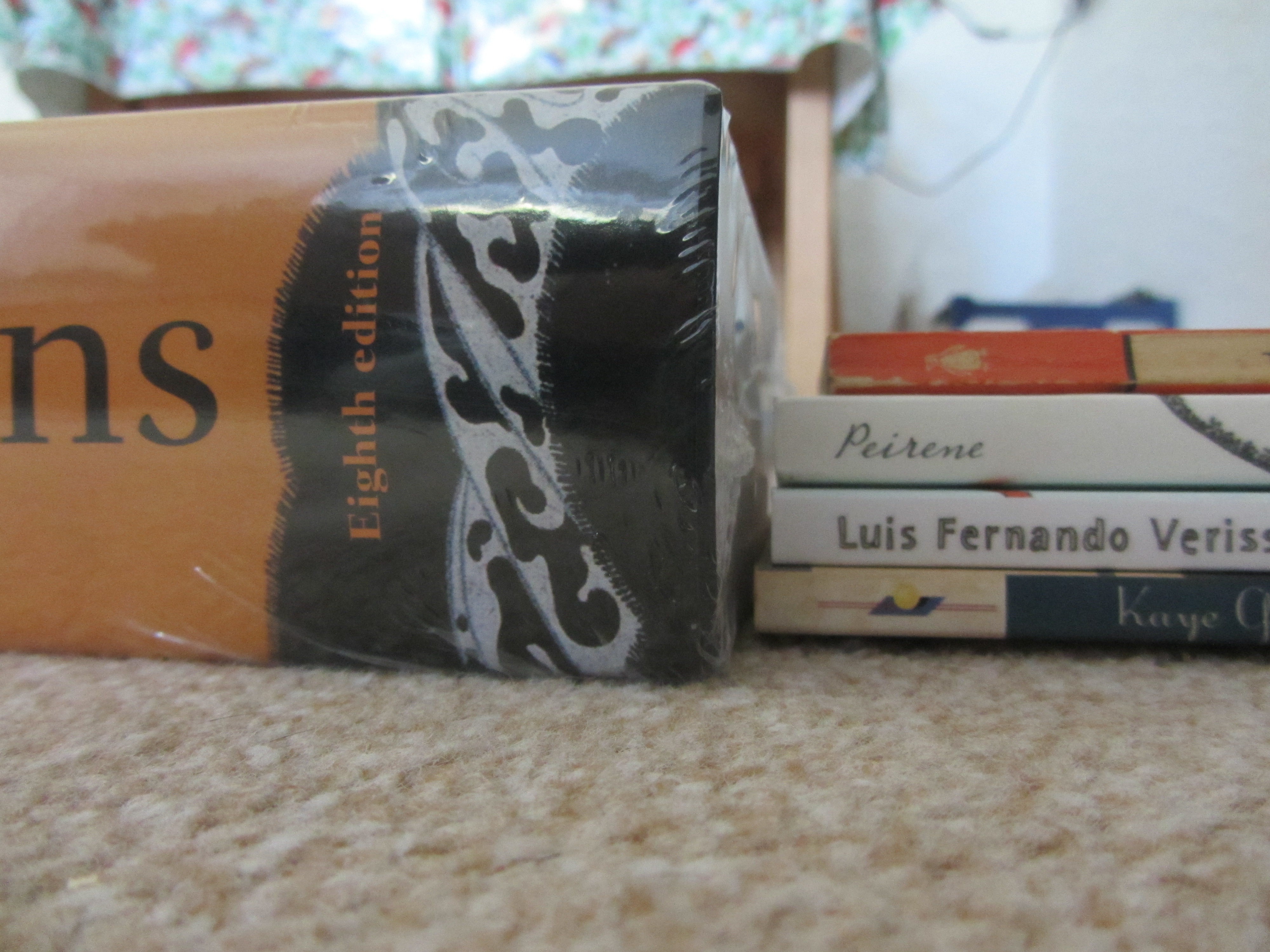
Even four novellas put together don’t stack up very far compared to the Oxford Dictionary of Quotations.
I recently finished The Bookshop by Penelope Fitzgerald [123]; all her books are similarly concise, so you may want to give her a try. The next novella on the pile for me is Ellen Foster by Kaye Gibbons [126]. I had never heard of the author, but the title and description lured me into buying it from a library book sale on a trip back to America (for 25 cents, why not?!). It’s a Southern Gothic story with an eleven-year-old narrator whom Walker Percy likened to Holden Caulfield. The alluring first line: “When I was little I would think of ways to kill my daddy.”
For more ideas, see these two Publishers Weekly’s lists:
“10 Best Books Shorter than 150 Pages” (only repeats one of my suggestions)
“10 Best Short Story Collections You’ve Never Read”
Off topic, but today is a milestone for me: it marks exactly two years that I’ve been a freelance writer!
Are you fond of short books? Do you prefer them to doorstoppers? What are some of your favorite novellas? All comments welcome!
A Tale of Two Bookshops: Bookbarn International and Wonder Book
A friend’s wedding in Bristol last Saturday provided the perfect opportunity for a return visit to Bookbarn International, a terrific secondhand bookshop near Bath in northeast Somerset. Between the stock on their shelves and in the warehouse from which they sell online, they have millions of books, and all the ones in the shop are either £1 or 50 pence (children’s books and, when I went, all paperback fiction as a summer reading promotion). It’s like heaven for this bibliophile. I first went a couple years ago on the way back from Cornwall – although, on both occasions, my longsuffering husband protests, Bookbarn wasn’t really ‘on the way’ in any sense.
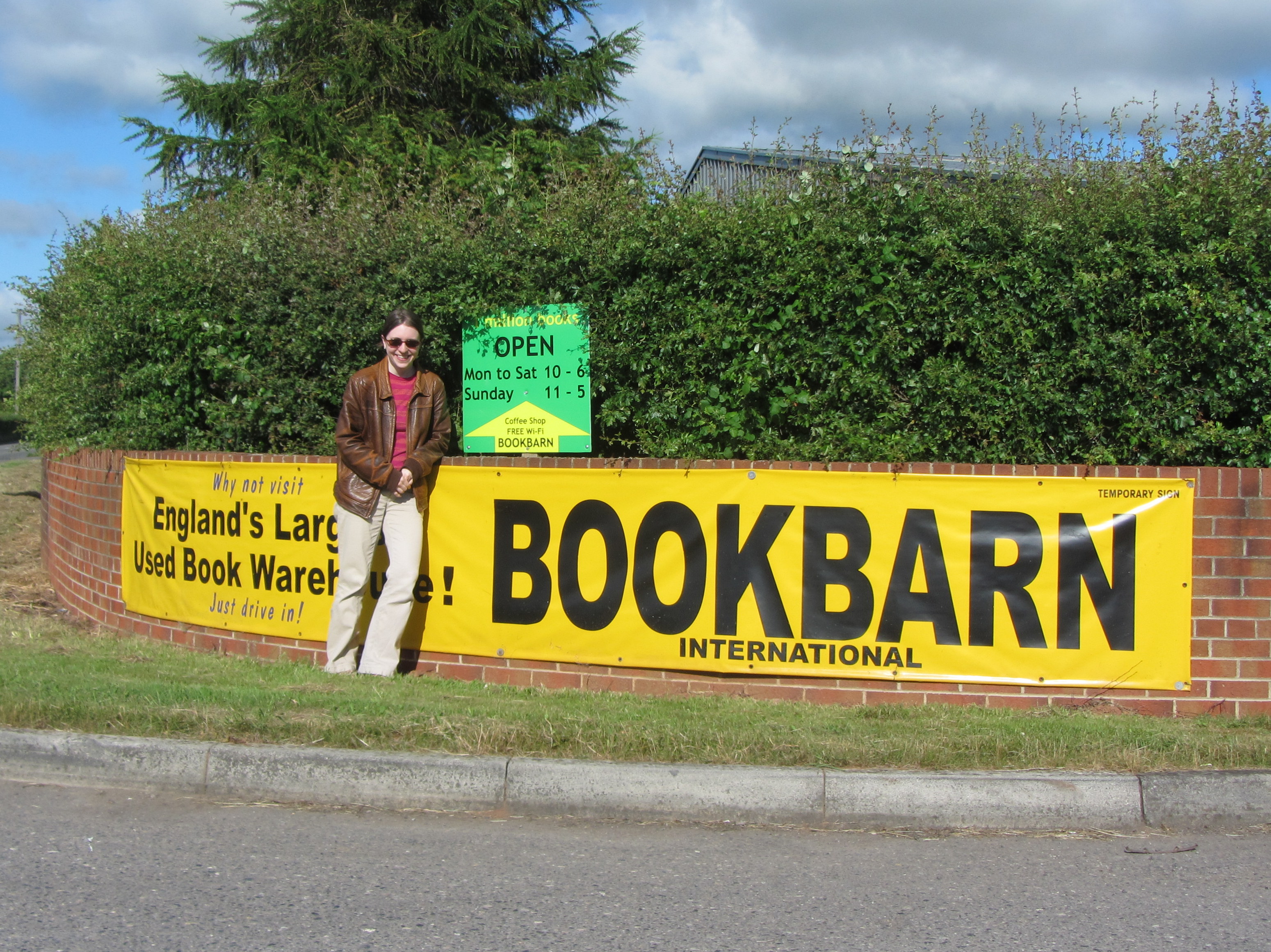
First visit in June 2013

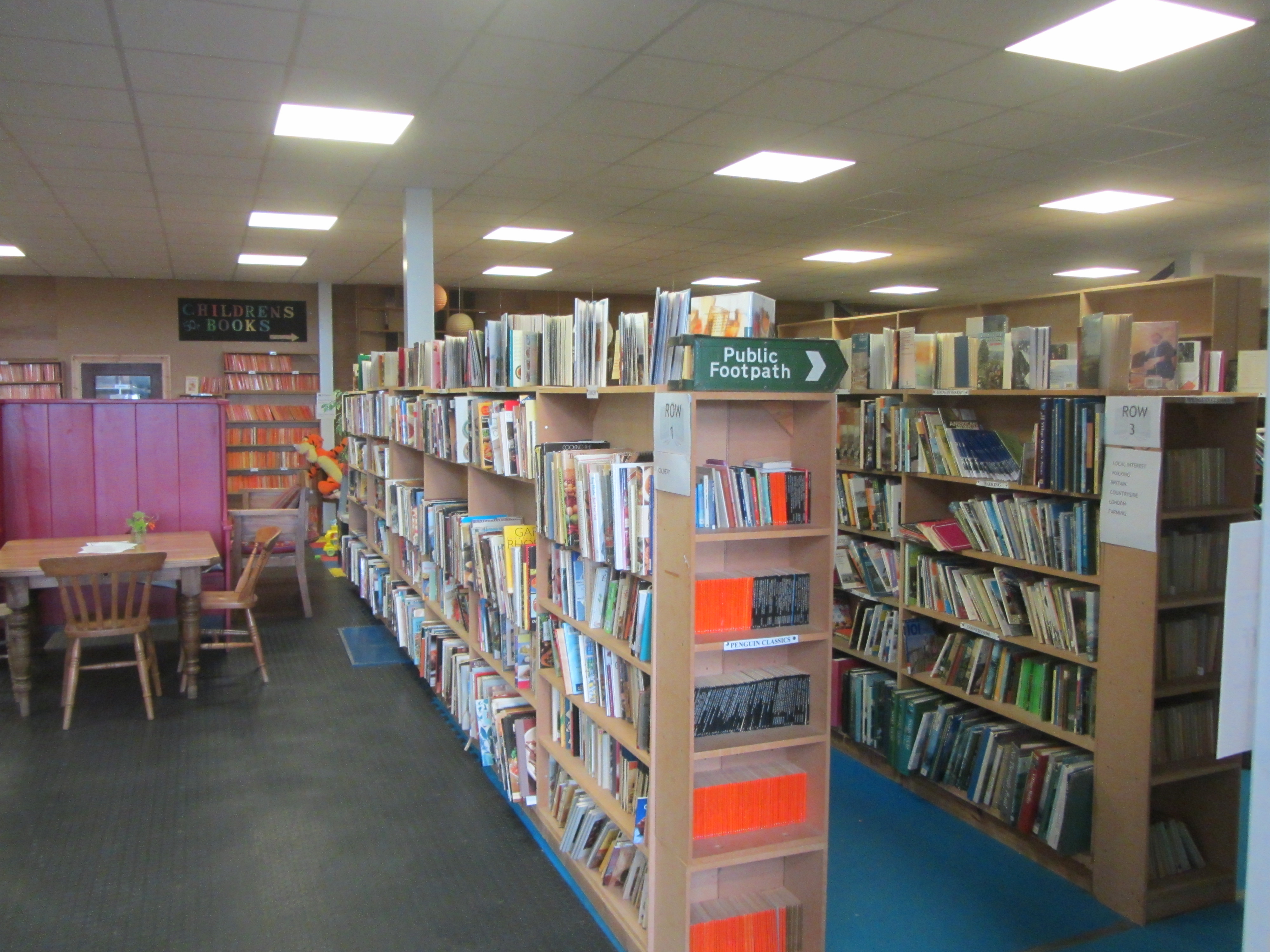
Well worth the detour, though, as Bookbarn is basically the British equivalent of my beloved Wonder Book, a chain with several branches in Maryland. I first encountered the store when my sister worked for WHAG television station in Hagerstown, and when I chose to go to college in Frederick, I wouldn’t say that the town’s two Wonder Book branches (one has since closed, alas) were a deciding factor, but they were certainly a bonus. I even worked there as a part-time book assistant during my senior year at Hood College, and it didn’t quite spoil my love for the place – though I’ll admit it’s much better to be a customer than an employee.

The Frederick location (photo from their website).

Say it ain’t so! You never know what you’ll find in terms of categorization at Wonder Book.
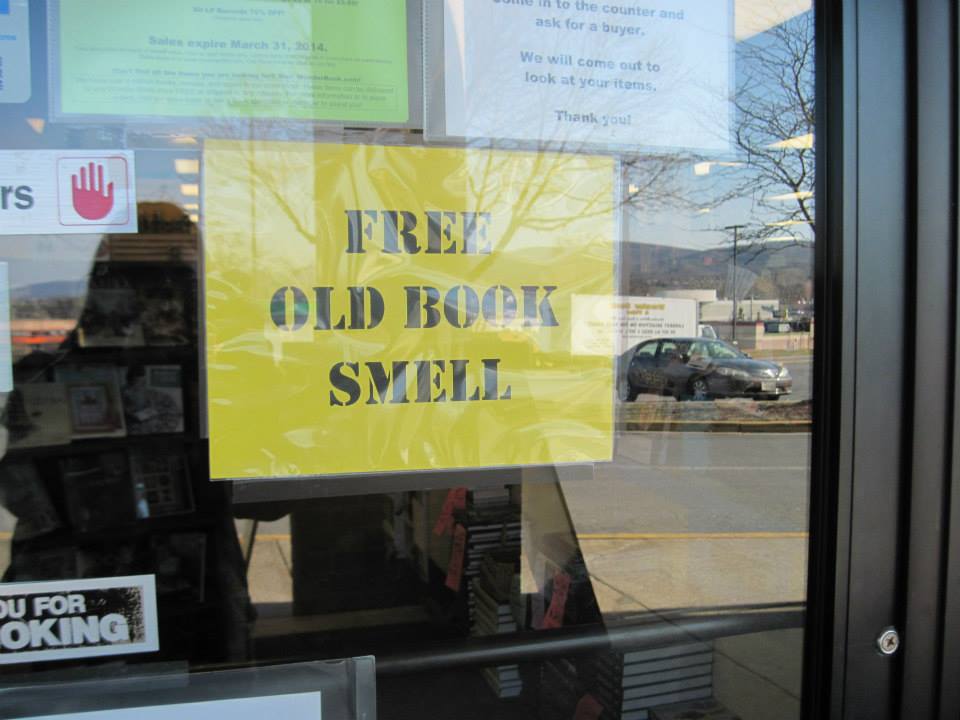
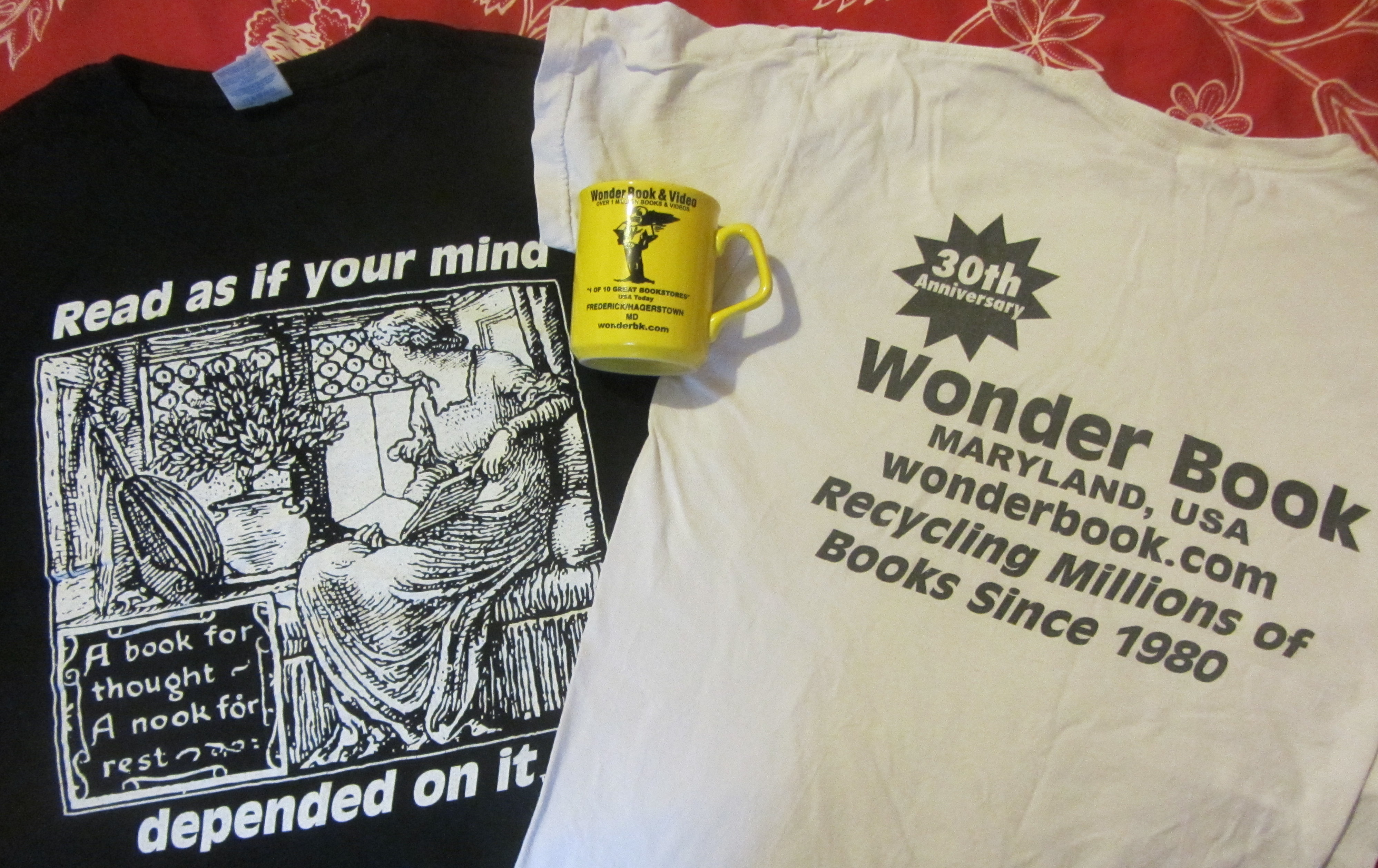
I’ve lived abroad for over eight years now, but I still manage to get back to Wonder Book once or twice a year during visits to family. Like Bookbarn, it’s an enormous warehouse-like place with dozens of different categories and subcategories of books, most at very reasonable prices. Again like Bookbarn, it’s the kind of place where you’ll need to allow time to root around, since within sections the books might not be in perfect alphabetical order. The stock rolls over so quickly or, especially in the case of theology, is so overwhelmingly large that there’s just no way to sensibly organize it all. Come with a list, but be willing to browse at a leisurely pace and let serendipity guide you as much as the subject headings. You’ll also find snacks and book-themed gifts such as (at Wonder Book anyway) mugs and T-shirts.
On this last visit to Bookbarn I got 18 books for all of £12 – bargain! Pictured below are my purchases, minus the ones certain readers or their children might be getting for birthday or Christmas presents later in the year…
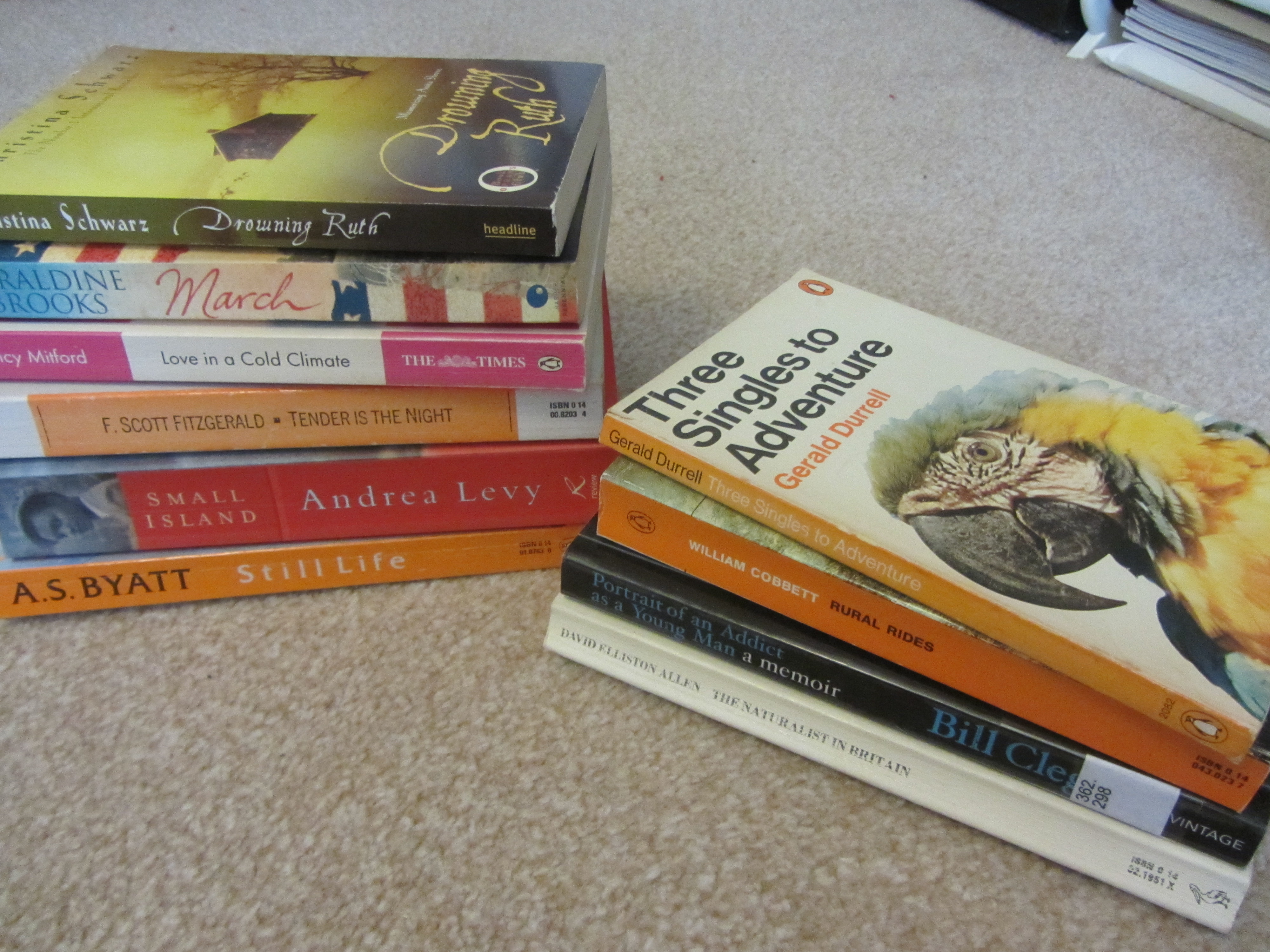
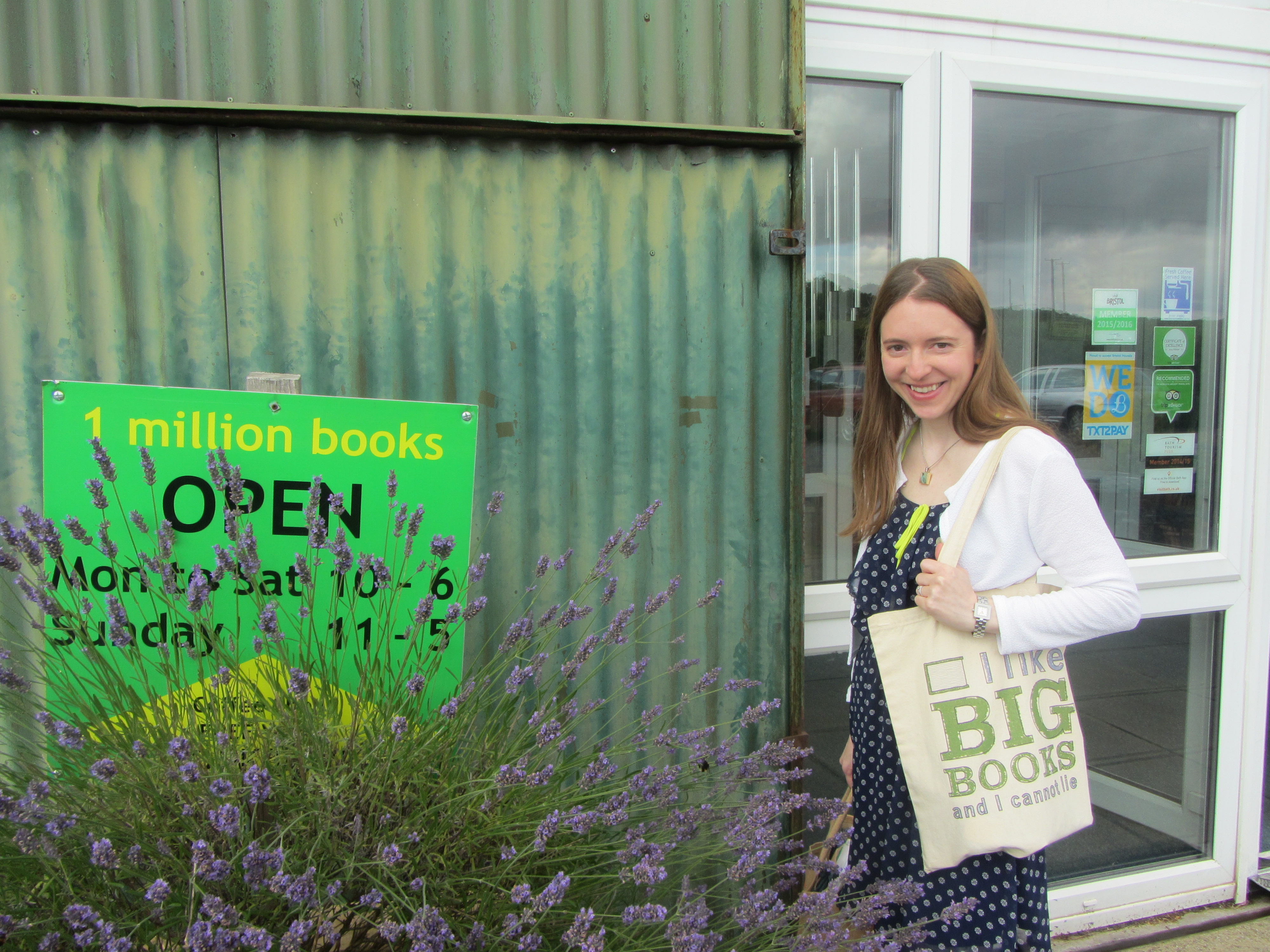
For the greatest concentration of wonderful bookshops in one place, I can’t recommend Hay-on-Wye, Wales highly enough (see my article on Book Towns for more). See also Jen Campbell’s The Bookshop Book for more ideas of bookshops to seek out wherever your travels take you.
Are you a devoted secondhand book shopper? What are some of your favorite bookshops in the United States, United Kingdom, or further afield?
Review: Early One Morning by Virginia Baily
Like the Roberto Benigni film Life Is Beautiful, Virginia Baily’s second novel* shows how the Holocaust affected Italy’s Jews. It’s not a Holocaust novel, though; it’s a before-and-after story that’s more about adoption, coming of age when you don’t know who you are, and adapting to motherhood. It’s about choices, inevitabilities, regrets and a love that endures.
 October 1943: Chiara Ravello is walking near Rome’s Jewish ghetto when she spots a large group of people being herded into trucks. A Jewish woman catches her eye and directs her seven-year-old son to go with Chiara. Pretending the boy is her nephew, Chiara saves him from certain death. The war years have been a hard time for the Ravello family: Chiara’s father and her fiancé both died about five years ago, and her mother perished in a bombing a few months ago. Now she and her epileptic sister Cecilia are preparing to flee the occupation by taking refuge in their grandmother’s home in the hills above Rome. Chiara never expected to be a mother after Carlo’s death, but now she has the chance to raise Daniele Levi as her own.
That’s where many novels would have ended it: with a hopeful conclusion after a time of hardship; with a new beginning spooling out in the future. Instead, this is where Baily starts her bittersweet tale. It’s no happily ever after for Chiara and Daniele; indeed, over the years that Daniele is a silent, sullen boy, then a rebellious teenager, and finally a drug addict, Chiara will frequently question the impulsive choice she made that morning in 1943. She seems doomed, in Daniele’s eyes at least, to be “the wicked stepmother, half-provider, half-tyrant.” This gives the novel something of the flavor of Lionel Shriver’s We Need to Talk about Kevin, another rare instance of fictional ambivalence about motherhood.
There’s an extra layer to the novel, however. In 1973, Chiara learns that Daniele has a daughter he never knew: Maria, now 16, lives with her mother in Wales. Angry and unsure of her new identity, Maria has boycotted her school leaving exams and asks to live with Chiara for the summer instead. Baily describes these two very different characters equally well, and does a great job of capturing the feel of Rome and its surroundings, especially through Maria’s viewpoint. She also moves deftly between the events of 1943–44 and those of 1973 in alternating chapters, giving subtle clues as to the time period through her interesting choice of tense: right up to the last chapter, she uses the present tense to describe past action, and the past tense for current action.
Through the flashbacks, we learn surprising truths about how Chiara abandoned a family member and gained a best friend. She made dubious choices during the war, but also showed great bravery and generosity. Baily gives just enough away, and so gradually that the novel’s nearly 400 pages pass quickly. In touching on World War II and the Holocaust only peripherally, the novel avoids well-worn, clichéd narratives and does something new.
The writing does not draw attention to itself; there are no long-winded descriptions or ornate sentences. Baily relies more on food (as in “[Maria’s] insides were lubricated with olive oil”) and period fashion to add detail and local color. Still, where there is metaphorical language it usually refers to animals and seems both appropriate and evocative. I also love the warm, earthy tones of the book’s cover, which reminds me of my time spent in Tuscany last year. However, I’m not sure the novel’s title works; it doesn’t say enough about the book.
Still, I admire how Baily takes what seems like a familiar Holocaust rescue story and turns it on its head. A late passage in which Chiara watches over Daniele as he sleeps off a hangover hints at the emotional ambiguities she conveys here:
Funny how sometimes she used to think that because he had this horseshoe birthmark, a talisman of good fortune imprinted in his skin, he carried his luck with him. How she persisted in thinking it was luck that had saved him when the rest of his family had perished, and not, as he seems to want to demonstrate to her, its opposite.
‘I don’t blame you, Ma,’ he has told her more than once.
‘So why are you so intent on throwing your life away?’ she has asked him, but he doesn’t seem to have an answer.
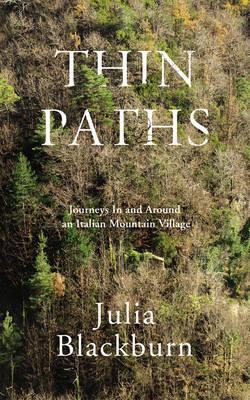 I would particularly recommend this novel to fans of Maggie O’Farrell and Anthony Doerr. Read this alongside Julia Blackburn’s Thin Paths or another choice from my Italian summer reading list – it’s the next best thing to being there.
My rating:
*At first I presumed this was a debut, but it turns out she wrote one novel previously, under the name Ginny Baily, Africa Junction (2011).
Many thanks to Virago for my free copy, received through a newsletter giveaway.
 Bookish Beck = Rebecca Foster. American transplant to England. Freelance proofreader and book reviewer.
