The Barbellion Prize 2020 Winner
It has been a pleasure following the Barbellion Prize race this year. In case you haven’t already seen the news, the winner of the inaugural award is Golem Girl by Riva Lehrer (my review).

It’s not often that my favourite from a literary prize list is also the judges’ pick, so I’m particularly pleased that my prediction came true. The full announcement is here. Here’s what two of the judges had to say:
Assistant Professor of Literature Dr Shahd Alshammari: “Golem Girl is a memoir that is infused with art, life, discrimination, love, self-love, and what it means to be vulnerable. Disability is on every page—and that is the type of literature we need.”
Cat Mitchell, Lecturer and Programme Leader of the Writing and Publishing degree at the University of Derby: “Golem Girl is a powerful and wide-reaching account of a life lived with disability. By interweaving her writing and art, Riva explores queerness, community, society’s fear of difference, and the often problematic representation of disabled bodies in art and medicine.”
Professor Tom Shakespeare FBA, Professor of Disability Research at London School of Hygiene and Tropical Medicine, and an advisor to the Prize, added: “From Pope to Stevenson, Woolf to Plath, writers have lived with illness and disability for centuries. Now here comes exactly the right prize at the right time: disabled writers have been locked down far longer, and deserve far more recognition than they get. The Barbellion Prize deserves to succeed, and Riva Lehrer’s Golem Girl will put it on the map.”
To recap, the other three on the shortlist were:
- The Fragments of My Father by Sam Mills
- Sanatorium by Abi Palmer
- Kika & Me by Dr Amit Patel
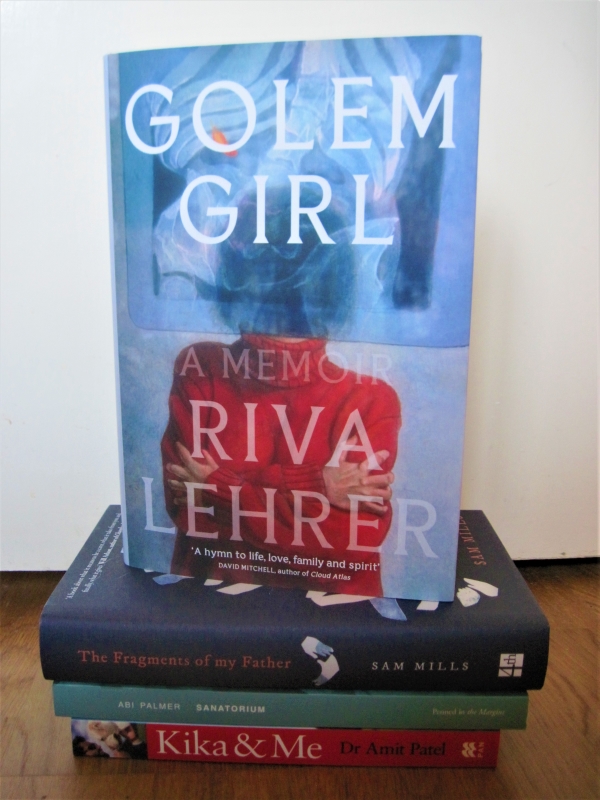
It’s been quite the whirlwind reading and reviewing all four books as the first two review copies only arrived on the 28th of January. Most of my reviews got bunched up right in the 36 or so hours before the announcement, but I was relieved that I managed to get them all up in advance. The Prize basically has no budget, so when I approached Cat (who used to work in publicity at Penguin) and asked if I and a handful of other bloggers could get involved, I wasn’t sure if it would be a possibility. I was really grateful to the four publishers for being willing to supply review copies. I hope we have helped to get the word out there.
The Barbellion Prize is already accepting entries for the 2021 award (submissions close on 31 October; see the website for more information). On my wish list thus far are two excellent memoirs, Sanctuary by Emily Rapp Black, who has a prosthetic leg and lost her son to Tay-Sachs disease, and A Still Life by Josie George, who lives joyfully with chronic illness.
Other relevant 2021 releases I’m interested in getting hold of are: The Invention of Miracles: language, power, and Alexander Graham Bell’s quest to end deafness by Katie Booth, Places I’ve Taken My Body by Molly McCully Brown, What Doesn’t Kill You: A Life with Chronic Illness – Lessons from a Body in Revolt by Tessa Miller, and Waiting for Superman: One Family’s Struggle to Survive – and Cure – Chronic Fatigue Syndrome by Tracie White.
Have you been inspired to read any of the shortlisted books?
Finishing Off the Barbellion Prize Shortlist: Sam Mills and Dr Amit Patel
The Barbellion Prize 2020 will be awarded tomorrow “to an author whose work has best represented the experience of chronic illness and/or disability.” (See also my reviews of Golem Girl by Riva Lehrer and Sanatorium by Abi Palmer.)
These two memoirs, though very different outwardly, both draw attention to the practical and emotional challenges of life with disability or a mental illness, and call for compassion from individuals and a commitment to help from governing bodies.
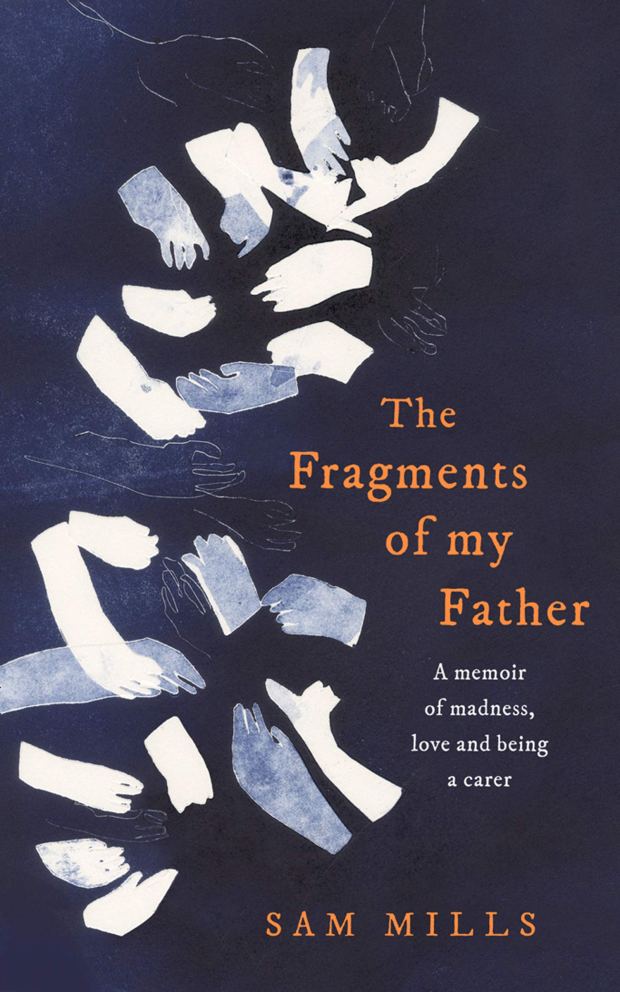
The Fragments of My Father: A memoir of madness, love and being a carer by Sam Mills
One in eight people in the UK cares for an ill or disabled relative. Sam Mills has been a carer for a parent – not once, but twice. The first time was for her mother, who had kidney cancer that spread to her lungs and died one Christmas. A few years later, Mills’s father, Edward, who has paranoid schizophrenia, started having catatonic episodes, as with the incident she opens her memoir on. In 2016, on what would have been her mother’s 70th birthday, Edward locked himself in the toilet of the family home in Surrey. Her brother had to break in with a screwdriver and ambulance staff took him away to a hospital. It wasn’t the first time he’d been institutionalized for a mental health crisis, nor would it be the last. It was always excruciating to decide whether he was better off at home or sectioned on a ward.
Mills darts between past and present as she contrasts her father’s recent condition with earlier points in their family life. She only learned about his diagnosis from her mother when, at age 14, she saw him walk down the stairs naked and then cry when he burned the chips. While schizophrenia can have a genetic element, relatives of a schizophrenic are also more likely to be high achievers. So, although Mills went through a time of suicidal depression as a teenager, meditation got her through and she exhibits more of the positive traits: An author of six books and founder of the small press Dodo Ink, she is creative and driven. Still, being her father’s full-time carer with few breaks often leaves her exhausted and overwhelmed.
The book’s two main points of reference are Leonard Woolf and F. Scott Fitzgerald, who cared for mentally ill wives and had to make difficult choices about their treatment and housing. In a nutshell, Mills concludes that Woolf was a good carer while Fitzgerald was a terrible one. Leonard was excused World War I service due to his nervous exhaustion from being a carer, and he gave up on the idea of children when doctors said that motherhood would be disastrous for Virginia. Virginia herself absolved Leonard in her suicide note, reassuring him that no couple could have been happier and that no one could have looked after her better. Scott, on the other hand, couldn’t cope with Zelda’s unpredictable behaviour – not least because of his own alcoholism – so had her locked up in expensive yet neglectful institutions and censored her work when it came too close to overlapping with his own plots.
The Fragments of My Father brings together a lot of my favourite topics to read about: grief, physical and mental illness, and literary biography. It had already been on my wish list since I first heard about it last year, but I’m glad the Barbellion Prize shortlisting gave me a chance to read it. It helps to have an interest in the Fitzgeralds and Woolfs – though in my case I had read a bit too extensively about them for this strand to feel fully fresh. (I also had a ‘TMI’ response to some revelations about the author’s relationships and sex life.)
Ultimately, I most appreciated the information on being a carer, including the mental burden and the financial and social resources available. (Although there is a government allowance for carers, Mills wasn’t eligible because of her freelance earnings, so she had to apply for Society of Authors grants instead.) With caring so common, especially for women, we need a safety net in place for all whose earnings and relationships will be affected by family duties. I read this with an eye to the future, knowing there’s every possibility that one day I’ll be a carer for a parent(-in-law) or spouse.
Readalikes I have also reviewed:
- Labours of Love: The Crisis of Care by Madeleine Bunting
- All the Lives We Ever Lived: Seeking Solace in Virginia Woolf by Katharine Smyth
Favorite lines:
“had I ever made a conscious choice? Caring felt like something that was happening to me, as though my father’s illness had been an eruption that had flowed like lava over my life. … I can’t think of any other job where someone defines your role by conferring its title on you, as though they are holding out a mould that you must fill.”
“caring is rarely simple because its nature is not static. It creates routines, crafts the days into set shapes, lulls you into states of false security, and then mutates, slaps you with fresh challenges, leaves you lost just when you feel you have gained wisdom.”
With thanks to Fourth Estate for the free copy for review.
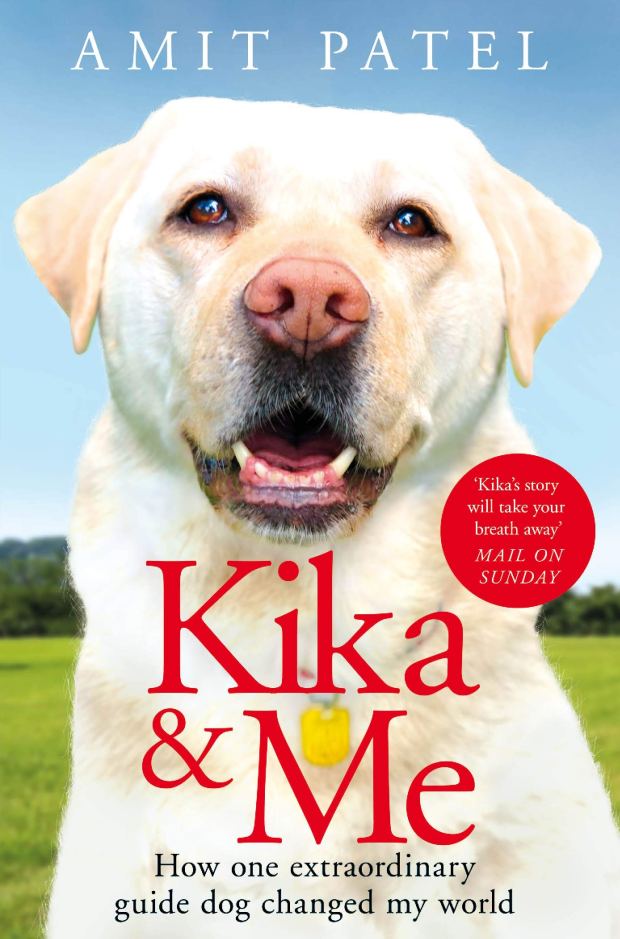
Kika & Me: How one extraordinary guide dog changed my world by Dr Amit Patel with Chris Manby
Dr Patel grew up in Guildford, studied medicine at Cambridge, and specialised in trauma medicine as a junior doctor in London. Diagnosed with keratocornus, which changes the shape of the cornea (it affects 1 in 450), he required first special contact lenses and then a series of cornea transplants. By the time of his eighth transplant, he’d remortgaged his house to pay an American specialist. Meeting and marrying Seema was a time of brightness before, in November 2013, he completely lost his vision within 36 hours. Blindness meant that he could no longer do his job, and constant eye pain and inactivity exacerbated his depression. While white cane and Braille training, plus the Royal National Institute of Blind People’s “Living with Sight Loss” course, started to boost his independence, it was being paired with his guide dog, Kika the Labrador, in 2015 that truly gave Patel his life back.
Trying out guide dogs sounds a little bit like speed dating. The Guide Dogs for the Blind Association (founded in the UK in 1931) warned that Kika was a “Marmite dog,” moody and likely to push boundaries; there was no guarantee she and Patel would get along. But from the start Kika was just right for him. More than once, what seemed like her pure stubbornness – lying on his feet and refusing to move – kept him from dangerous situations, like getting trapped between a busy road and a building site on an unfamiliar route. After a 10-day core skills training course, during which man and dog stayed at a hotel together, Kika was ready to join them at home. In the days to come, she would learn all Patel’s usual routes around their neighbourhood and into the City – with the help of smears of mackerel pâté.
If you’re like me, you’ll be most curious to learn about the nitty-gritty of life for a visually impaired person. I loved hearing about how Patel practiced his Braille letters with an egg container and ping pong balls. Since he went blind, he and his wife have had two children, and with Kika’s help manoeuvring a baby buggy is no problem. Guide dogs are trained to be predictable, e.g., doing their business in the same spot at the same times so it’s much easier to find and clean up. Some dog training tricks also worked for children, like putting a bell on a Labrador or a toddler to know when they wandered off!
Patel has had some unfortunate experiences since he went blind, particularly on the London Underground: teenagers picking him up and spinning him around on a train platform, busy commuters barging past him and Kika on an escalator, and an impatient woman hitting Kika with her handbag. While Patel doesn’t like being negative on social media, he finds that posting video clips of these incidents raises awareness of the challenges VIPs face. Every time he hits a setback, he uses it as an opportunity. For instance, one Diwali he was excited to visit Neasden Temple, only to be dismayed that they wouldn’t allow Kika inside. Since then, he has worked with temples around the world to improve disability services. He is also involved in London’s “Transport for All” work, and advises companies on access issues.
More so than the rest of the shortlist, Kika & Me is illuminating about daily life with a disability and has a campaigning focus. It’s an easy read, and not just for animal lovers. Judging the book by the cover, I might not have picked it up otherwise, so I’m grateful that the Barbellion put it on my radar. I’m deeply impressed by what Patel has achieved and the positive attitude he maintains. (Kika has her own Twitter account! @Kika_GuideDog)
With thanks to Pan Macmillan for the free copy for review.
(Fellow bloggers John Fish and Jackie Law have also been reading along with the Barbellion Prize shortlist. See their reviews thus far: John—Mills and Palmer; Jackie—Mills and Palmer.)
Next year the Barbellion Prize hopes to award more money, including to all nominated authors. They are accepting submissions for 2021, and are grateful for any Paypal donations via their website (see the page footer). I’ve donated to the cause. Can you help, too?
Barbellion Prize Shortlist: Golem Girl by Riva Lehrer
Three memoirs remain on the shortlist; three windows onto living with disability or caring for a relative with an incapacitating mental illness.
First up is a visual artist’s account of growing up with spina bifida, entering Disabled culture, and forming a collaborative style all her own.
Golem Girl: A Memoir by Riva Lehrer (2020)
“My first monster story was Frankenstein,” Lehrer writes. Like Dr. Frankenstein’s creation or the Golem of medieval Jewish legend, she felt like a physical monstrosity in search of an animating purpose. Born with spina bifida, she spent much of her first two years in Cincinnati Children’s Hospital and would endure dozens of surgeries in years to come to repair her spine and urinary tract and attempt to make her legs the same length. In 1958, when she was born, 90% of children with her condition died before age two. Lehrer’s mother, Carole, who grew up in a family pharmacy business and had worked as a medical researcher, was her daughter’s dogged health advocate. Carole fought for Riva even though she was caught up in her own chronic pain after a botched back surgery that left her addicted to painkillers.
Lehrer went to a special school for the disabled in Ohio. It was racially integrated (rare at that time) and offered children physical therapy and normal experiences like Girl Scouts and day camp. But it was clear the teachers didn’t expect these children to achieve anything or have a family life; home ec classes just taught how to wash up from a wheelchair and make meals for one. One horrible day, a substitute teacher locked a classroom door and hectored the children, saying their parents must have drunk and fornicated and they were the wages of sin.
Between the routine or emergency surgeries and family heartaches, Lehrer grew up to attend art school at the University of Cincinnati and Art Institute of Chicago. Professors (most of them male) found her work grotesque and self-indulgent, and she struggled with how to depict her body. There were boyfriends and girlfriends, even a wife (though in the late 1980s, before same-sex marriage was legally recognized). In 1996 she joined the Chicago Disabled Artists Collective and it was a revelation. She learned that Disabled (like Deaf) is a cultural identity as much as a physical reality, adopted vocabulary like crip (a reclaimed term, like queer) and ableism, and began painting fellow artists with dwarfism, prostheses, or wheelchairs.
Becoming a member of the Medical Humanities faculty as well as a visiting artist at two Chicago universities, the School of the Art Institute and Northwestern, gave Lehrer access to Gross Anatomy Labs, where she found in the historical collections – just as she had at the Mütter Museum of medical curiosities in Philadelphia – a fetus in a jar with her very condition. Knowing that she might be the first Disabled person her budding doctors met, she was determined to give them an “inclusive vision” of “the reality of human divergence.” She would have the medical students draw one of the jarred specimens, not as an oddity but as an individual, and give a 15-minute presentation about someone who lives with that disability.
Golem Girl is a touching family memoir delivered in short, essay-like chapters, most of them named after books or films. It is also a primer in Disability theory and – what truly lifts it above the pack – a miniature art gallery, with reproductions of paintings from various of Lehrer’s series as well as self-portraits, family portraits, and photographs. “I fiercely wanted to see a gallery filled with portraits of luminous crips,” she writes; “I suspected I was going to have to make them myself.” And that is just what she has done. The “Circle Stories” featured the Chicago Disabled Artists Collective and “Mirror Shards” included animal daimons, while “The Risk Pictures” of some of her personal heroes were daringly collaborative: she would give the subject an hour alone in her studio with their portrait in progress and allow them to amend it as they wished. Much of her work has bright colors and involves anatomical realism and symbols personal to herself and/or the subject – with Frida Kahlo an acknowledged influence.
I’ve now (just about) read the whole Barbellion Prize shortlist. For how it illuminates a life of being different – through queerness in addition to disability, engages with the academic fields of anatomy and Disability studies, and showcases the achievements of Disabled artists, this would be my clear winner of the inaugural award, with Sanatorium my backup choice. It is also a finalist for the National Book Critics Circle Award for Autobiography.
Readalikes I have also reviewed:
- Constellations by Sinéad Gleeson
- I Am, I Am, I Am by Maggie O’Farrell
Favorite lines:
“The hospital demands surrender. You accept the piercing, the cutting, the swallowing of noxious chemicals. You roll over and stand up even when it’s as impossible as flying around the ceiling. Whoever has authority can remove your clothes and display your stitched-up monster body to crowds of young white-coated men. You’re an assemblage of parts that lack gender and those elusive things called feelings.”
“‘Normal’ beauty is unmarked, smooth, shiny, upright; but my gaze began to slip past normal beauty as if it was coated in baby oil. I wanted crip beauty—variant, iconoclastic, unpredictable. Bodies that were lived in with intentionality and self-knowledge. Crip bodies were fresh.”
With thanks to Virago for the free copy for review.
See my introductory post for more about the Barbellion Prize, which is in its first year and will be awarded on Friday “to an author whose work has best represented the experience of chronic illness and/or disability.”
I will review the final two on the shortlist, The Fragments of My Father by Sam Mills and Kika & Me by Amit Patel, tomorrow.
Introducing the Barbellion Prize & A Review of Sanatorium by Abi Palmer
New this year, the Barbellion Prize will be awarded annually “to an author whose work has best represented the experience of chronic illness and/or disability.” It’s named after W.N.P. Barbellion (the pen name of Bruce Frederick Cummings), the English author of The Journal of a Disappointed Man, which he started writing at 13. A self-taught naturalist, he specialized in lice when he worked for the British Museum’s department of natural history in London. He was rejected for war service in 1915 after a doctor found him to have multiple sclerosis. At that time, the diagnosis was like a death sentence; indeed, Cummings died at age 30 in 1919, though by then he had managed to produce two volumes of memoirs as well as a daughter.
Here’s some more information on the prize criteria from the website: “Eligibility for the prize is predicated on the author’s presentation of life with a long-term chronic illness or disability, whether that be in the form of blindness, MS, cystic fibrosis, dwarfism, or another comparable condition that may substantially define one’s life. Authors – such as those in a carer’s capacity – who themselves are not ill may be considered for the prize if their work is truly exceptional as an articulation of life with illness, but authors who themselves deal personally with illness or disability will take priority in any selection for the prize.”


Especially in the absence of the Wellcome Book Prize, which has been on hiatus since the announcement of the 2019 winner, I’m delighted that there is a new prize with a health slant, particularly one that will lead to greater visibility for disabled writers and their stories. From a longlist of eight, in January the Barbellion Prize judges chose a shortlist of four titles: three memoirs and a work of autofiction. The publishers kindly agreed to send me the shortlist for review. Two have arrived so far (there have been postal delays in the UK, as in many places).

I have already read one of the nominees and will do my best to review the rest before the £1000 prize is awarded on the 12th. The others are:
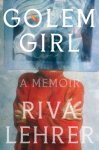
- Golem Girl by Riva Lehrer – An illustrated memoir by a visual artist born with spina bifida.
- The Fragments of My Father by Sam Mills – A memoir of being a carer for her father, who has paranoid schizophrenia; also includes musings on Leonard Woolf and F. Scott Fitzgerald, who cared for mentally ill wives. I’m currently reading this one.
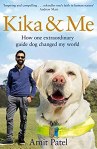 Kika & Me by Amit Patel – Patel was a trauma doctor and lost his sight within 36 hours due to a rare condition. He was paired with his guide dog, Kika, in 2015.
Sanatorium by Abi Palmer (2020)
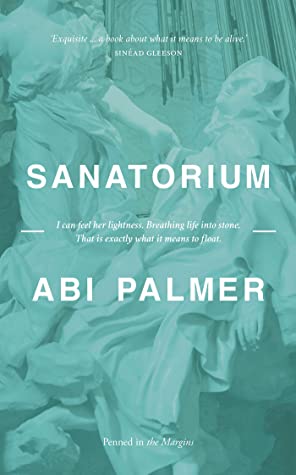 Water is a source of comfort and delight for Abi, the narrator of Sanatorium (whose experiences may or may not be those of the author; always tricky to tell with autofiction). Floating is like dreaming for her – an intermediate state between the solid world where she’s in pain and the prospect of vanishing into the air. In 2017 she spends a few weeks at a sanatorium in Budapest for water therapy; when she returns to London she buys a big inflatable plastic bathtub to keep up the exercises as she tries to wean herself off of opiates.
Abi feels fragile due to a whole host of body issues, some in her past but most continuing into the present: an autoimmune connective tissue disorder, psoriatic arthritis, Crohn’s disease, and sexual assaults. Her knee is most immediately problematic, leading her to use a mobility scooter. As her health waxes and wanes, other people – unable to appreciate any internal or incremental changes – judge her by whether or not she is able to walk well.
 The book is in snippets, often of just a paragraph or even one sentence, and cycles through its several strands: Abi’s time in Budapest and how she captures it in an audio diary; ongoing therapy at her London flat, custom-designed for disabled tenants (except “I was the only cripple who could afford it”); the haunted house she grew up in in Surrey; and notes on plus prayers to St. Teresa of Ávila, accompanied by diagrams of a female figure in yoga poses.
Locations are given in small letters in the top corner of the page, apart from for the more dreamlike segments that can’t be pinned down to any one place. For instance, I was reminded of a George Saunders story by the surreal interlude in which Abi imagines Van Gogh’s Starry Night reproduced in the hair on a detached pair of legs mounted on a wall as a work of art.
The different formats and short chunks of prose generally keep the voice from becoming monotonous, though I did wonder if occasional use of the third person (and some more second person) could have been effective, too. Far from a straightforward memoir, the book incorporates passages that are closer to fantasy and poetry, and the visual elements and fertile imagery attest to Palmer’s background as a mixed-media artist.
Sanatorium is a fascinating work – matter-of-fact, playful and sensual – that vividly conveys the reality of life with a chronic illness. It was already on my wish list, but I’m so glad that this shortlisting gave me a chance to read it. Though I haven’t read the other nominees yet, the passages below are proof that this would be a deserving Barbellion Prize winner.
You go through life as a chronically ill person with so many different people who have so many different opinions about how your treatment should be. They’re not always useful or right. You have to build your own narrative and your own sense of what feels appropriate. You have to learn to trust your body to tell you what’s working. But that’s hard too, when your body keeps changing the rules.
I am one of the more privileged ones and still I’m screaming. God, it would be so nice just to dissolve into nothing and wash up onto a lonely beach.
I wonder if what I’ve learned about chronic illness, more than anything, is that it’s a constant cycle. You fall apart, then you try your best to rebuild again. I wonder what would happen if I stopped trying.
Readalikes I have also reviewed:
- Heal Me by Julia Buckley
- Bodies of Water by V. H. Leslie
- My Year of Rest and Relaxation by Ottessa Moshfegh
With thanks to Penned in the Margins for the free copy for review.
Booker and Young Writer Ceremonies & Tracy Chevalier Book Club
This year I correctly predicted Shuggie Bain by Douglas Stuart and Surge by Jay Bernard as the winners of the Booker Prize and the Sunday Times Young Writer of the Year Award, respectively. Patting myself on the back!


(Earlier in the year, I had a feeling Maggie O’Farrell would win the Women’s Prize, but wasn’t confident enough to single her out; and I got the Wainwright Prizes all wrong.)
I watched both the Booker Prize (live) and Young Writer of the Year Award (pre-recorded) ceremonies online; not having to secure an invitation or pay £30 for the train into London has been an ongoing bonus of pandemic arrangements.
 The Booker ceremony was nicely tailored to viewers at home, incorporating brief, informal pre-recorded interviews with each nominated author and a video chat between last year’s winners, Margaret Atwood and Bernardine Evaristo. When Evaristo asked Atwood about the difference between winning the Booker in 2019 versus in 2000, she replied, deadpan, “I was older.” I especially liked the short monologues that well-known UK actors performed from each shortlisted book. Only a few people – the presenter, Evaristo, chair of judges and publisher Margaret Busby, and a string quartet – appeared in the studio, while all the other participants beamed in from other times and places. Stuart is only the second Scottish winner of the Booker, and seemed genuinely touched for this recognition of his tribute to his mother.
I’ve attended the Young Writer ceremony at the London Library twice: in 2017, when I was on the shadow panel, and again last year. It was a shame not to be able to meet up with fellow bloggers and the shortlisted authors, but I appreciated hearing the judges’ thoughts on each nominee. Tessa Hadley said the whole shortlist was “so full of young energy.” Kit de Waal called Catherine Cho’s Inferno “an absolute page-turner.” All the judges remarked at how funny, cutting and original Naoise Dolan’s Exciting Times is. Critic Houman Barekat referred to Seán Hewitt’s Tongues of Fire as “unabashedly earnest.” Hadley said Marina Kemp’s Nightingale is just the kind of novel she loves, a “delicate, full notation,” and Barekat observed that it is a timely reminder of the value of care work.


It was clear that, for the judges, all five books were terrifically accomplished and would be worthy winners. Still, the unanimous decision was in favor of Surge, which Sunday Times literary editor Andrew Holgate said is “remarkable for its passionate engagement and diversity of voices.” Bernard read “Hiss” (also up on the Granta website) and said that “poems can take on another life” through performance and short films, so the poet can’t predict whether they will stay in poetry or branch out into other genres.
 Back on 18 November, I attended another online event to which I’d gotten a last-minute invitation: a “book club” featuring Tracy Chevalier in conversation with her literary agent, Jonny Geller, on Girl with a Pearl Earring at 20 and her new novel, A Single Thread. In 1996 she sent Geller a letter asking if he’d read Virgin Blue, which she’d written for the MA at the University of East Anglia – the only UK Creative Writing course out there at the time. After VB, she started a contemporary novel set at Highgate Cemetery, where she was a tour guide. It was to be called Live a Little (since a Howard Jacobson title). But shortly thereafter, she was lying in bed one day, looking at a Vermeer print on the wall, and asked herself what the look on the girl’s face meant and who she was. She sent Geller one page of thoughts and he immediately told her to stick Live a Little in a drawer and focus on the Vermeer idea.
Intriguingly, Chevalier stated that the deadline of her pregnancy determined the form of Girl with a Pearl Earring: she knew she had to keep things simple, with a linear narrative, one point of view, and spare prose. While the novel had a quiet publication in August 1999, a good review from Deborah Moggach helped, and it became a “word of mouth success,” never hitting #1 but selling continuously. Chevalier believes this was due to a rare coming together of story and writing; sometimes good stories are hampered by mediocre writing, or vice versa. She and Geller discussed the strange coincidence of two other Vermeer novels coming out at the same time (e.g. Girl in Hyacinth Blue by Susan Vreeland); she had the good luck of being the victor. The film version is “lovely,” she said. Geller has never forgotten Scarlett Johansson, who turned 18 on set, leaving her gum in during a cast supper of spaghetti.


Chevalier’s actual Highgate novel, Falling Angels, didn’t borrow at all from her contemporary-set draft as it was set in 1900. Incorporating suffragette history, it felt like an untold story ripe for the plucking. Falling Angels has long been the one I consider my favorite Chevalier – as of last month, when we did The Last Runaway in book club, I’ve read all her work – but after this event I’m eager to reread it and GwaPE to see what I think.
 Lastly, Chevalier and Geller talked about her new novel, A Single Thread, which was conceived before Trump and Brexit but had its central themes reinforced by the constant references back to 1930s fascism during the Trump presidency. She showed off the needlepoint spectacles case she’d embroidered for the novel. This wasn’t the first time she’d taken up a craft featured in her fiction: for The Last Runaway she learned to quilt, and indeed still quilts today. Geller likened her to a “method actor,” and jokingly fretted that they’ll lose her to one of these hobbies one day. Chevalier’s work in progress features Venetian glass. I’m already looking forward to it.
Like me, she moved to England from the Washington, D.C. area and has never lost the ‘accent’, so I feel like she’s a kindred spirit.
Bookish online events coming up soon: Penguin book quiz, followed by book club holiday social (a Zoom meeting with glasses of wine in hand!), on the 15th
Have you taken advantage of any online literary events recently?
Young Writer of the Year Award 2020: Shortlist Reviews and Predictions
Being on the shadow panel for the Sunday Times Young Writer of the Year Award was a bookish highlight of 2017 for me. I’m pleased for this year’s panelists, especially blogging friend Marina Sofia, to have had the same opportunity, and I look forward to hearing who they choose as their shadow panel winner on December 3rd and then attending the virtual prize ceremony on December 10th.

At the time of the shortlisting, I happened to have already read Exciting Times by Naoise Dolan and was halfway through Catherine Cho’s memoir Inferno. I got the poetry collection Surge by Jay Bernard out from the library to have another go (after DNFing it last year), and the kind folk of FMcM Associates sent me the other two shortlisted books, a poetry collection and a novel, so that I could follow along with the shadow panel’s deliberations. Here are my brief thoughts on all five nominees.
Surge by Jay Bernard (2019)
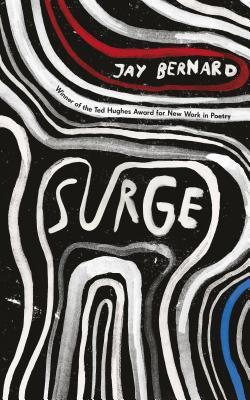 As a writer-in-residence at the George Padmore Institute, a research centre for radical Black history, in 2016, Bernard investigated the New Cross Massacre, a fire that killed 13 young people in 1981. In 2017, the tragedy found a horrific echo in the Grenfell Tower fire, which left 72 dead. This debut poetry collection bridges that quarter-century through protest poems from various perspectives, giving voice to victims and their family members and exploring the interplay between race, sexuality and violence. Patois comes in at several points, most notably in “Songbook.” I especially liked “Peg” and “Pride,” and the indictment of government indifference in “Blank”: “It-has-nothing-to-do-with-us today issued this statement: / those involved have defended their actions and been … acquitted / retired with full pay”. On the whole, I found it difficult to fully engage with this collection, but I am reliably informed that Bernard’s protest poems have more impact when performed aloud.
Readalikes: In Nearby Bushes by Kei Miller, A Portable Paradise by Roger Robinson and Don’t Call Us Dead by Danez Smith
My rating: 
Inferno by Catherine Cho (2020)
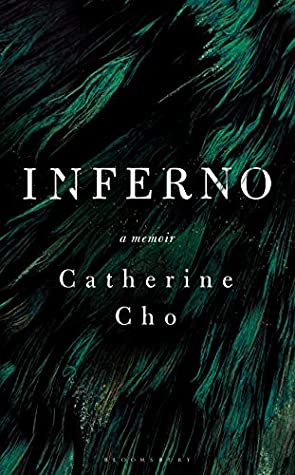 Cho, a Korean American literary agent based in London, experienced stress-induced postpartum psychosis after the birth of her son. She and her husband had returned to the USA when Cato was two months old to introduce him to friends and family, ending with a big Korean 100-day celebration at her in-laws’ home. Almost as soon as they got to her in-laws’, though, she started acting strangely: she was convinced cameras were watching their every move, and Cato’s eyes were replaced with “devil’s eyes.” She insisted they leave for a hotel, but soon she would be in a hospital emergency room, followed by a mental health ward. Cho alternates between her time in the mental hospital and a rundown of the rest of her life before the breakdown, weaving in her family history and Korean sayings and legends. Twelve days: That was the length of her hospitalization in early 2018, but Cho so painstakingly depicts her mindset that readers are fully immersed in an open-ended purgatory. She captures extremes of suffering and joy in this vivid account. (Reviewed in full here.)
Readalikes: An Angel at My Table by Janet Frame and Dear Scarlet by Teresa Wong
My rating: 
Exciting Times by Naoise Dolan (2020)
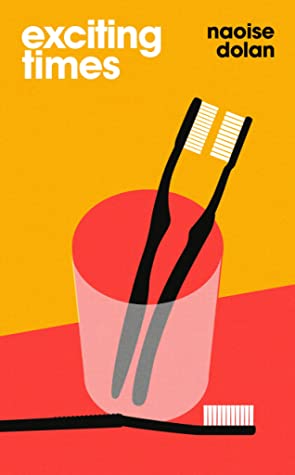 At 22, Ava leaves Dublin to teach English as a foreign language to wealthy preteens in Hong Kong and soon comes to a convenient arrangement with her aloof banker friend, Julian, who lets her live with him without paying rent and buys her whatever she wants. They have sex, yes, but he’s not her boyfriend per se, so when he’s transferred to London for six months, there’s no worry about hard feelings when her new friendship with Edith Zhang turns romantic. It gets a little more complicated, though, when Julian returns and she has to explain these relationships to her two partners and to herself. On the face of it, this doesn’t sound like it would be an interesting plot, and the hook-up culture couldn’t be more foreign to me. But with Ava Dolan has created a funny, deadpan voice that carries the entire novel. I loved the psychological insight, the playfulness with language, and the zingy one-liners (“I wondered if Victoria was a real person or three Mitford sisters in a long coat”). (Reviewed in full here.)
Readalikes: Besotted by Melissa Duclos and Conversations with Friends by Sally Rooney
My rating:
Tongues of Fire by Seán Hewitt (2020)
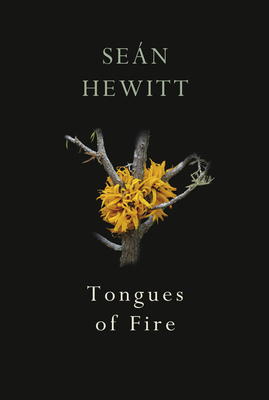 In the title poem, the arboreal fungus from the cover serves as “a bright, ancestral messenger // bursting through from one realm to another” like “the cones of God, the Pentecostal flame”. This debut collection is alive with striking imagery that draws links between the natural and the supernatural. Sex and grief, two major themes, are silhouetted against the backdrop of nature. Fields and forests are loci of meditation and epiphany, but also of clandestine encounters between men: “I came back often, // year on year, kneeling and being knelt for / in acts of secret worship, and now / each woodland smells quietly of sex”. Hewitt recalls travels to Berlin and Sweden, and charts his father’s rapid decline and death from an advanced cancer. A central section of translations of the middle-Irish legend “Buile Suibhne” is less memorable than the gorgeous portraits of flora and fauna and the moving words dedicated to the poet’s father: “You are not leaving, I know, // but shifting into image – my head / already is haunted with you” and “In this world, I believe, / there is nothing lost, only translated”.
Readalikes: Physical by Andrew McMillan and If All the World and Love Were Young by Stephen Sexton
My rating:
Nightingale by Marina Kemp (2020)
 Marguerite Demers, a 24-year-old nurse, has escaped Paris to be a live-in carer for elderly Jérôme Lanvier in southern France. From the start, she senses she’s out of place here – “She felt, as always in this village, that she was being observed”. She strikes up a friendship with a fellow outsider, an Iranian émigrée named Suki, who, in this story set in 2002, stands out for wearing a hijab. Everyone knows everyone here, and everyone has history with everyone else – flirtations, feuds, affairs, and more. Brigitte Brochon, unhappily married to a local farmer, predicts Marguerite will be just like the previous nurses who failed to hack it in service to the curmudgeonly Monsieur Lanvier. But Marguerite sticks up for herself and, though plagued by traumatic memories, makes her own bid for happiness. The novel deals sensitively with topics like bisexuality, euthanasia, and family estrangement, but the French provincial setting and fairly melodramatic plot struck me as old-fashioned. Still, the writing is strong enough to keep an eye out for what Kemp writes next. (U.S. title: Marguerite.)
Readalikes: French-set novels by Joanne Harris and Rose Tremain; The Hoarder by Jess Kidd
My rating:
General thoughts:
After last year’s unexpected winner – Raymond Antrobus for his poetry collection The Perseverance – I would have said that it’s time for a novel by a woman to win. However, I feel like a Dolan win would be too much of a repeat of 2017’s win (for Sally Rooney), and Kemp’s debut novel isn’t quite up to scratch. Much as I enjoyed Inferno, I can’t see it winning over these judges (three of whom are novelists: Kit de Waal, Sebastian Faulks and Tessa Hadley), though it would be suited to the Wellcome Book Prize if that comes back in 2021. So, to my surprise, I think it’s going to be another year for poetry.
I’ve been following the shadow panel’s thoughts via Marina’s blog and the others’ Instagram accounts and it looks like they are united in their admiration for the poetry collections, particularly the Hewitt. That would be my preference, too: I respond better to theme and style in poetry (Hewitt) than to voice and message (Bernard). However, I think that in 2020 the Times may try to trade its rather fusty image for something more woke, bearing in mind the Black Lives Matter significance and the unprecedented presence of a nonbinary author.
My predictions:
Shadow panel winner: Tongues of Fire by Seán Hewitt
Official winner: Surge by Jay Bernard
Have you read anything from this year’s shortlist?
Booker Prize 2020: Two More Shortlist Reviews and a Prediction
The 2020 Booker Prize will be announced on Thursday the 19th. (Delayed from the 17th, the date on my commemorative bookmark, so as not to be overshadowed by the release of the first volume of Barack Obama’s presidential memoirs.) After I reviewed Burnt Sugar and correctly predicted half of the shortlist in this post, I’ve managed to finish another two of the novels on the shortlist, along with two more from the longlist. As sometimes happens with prize lists – thinking also of the Women’s Prize race in 2019 – this year’s shortlist fell into rough pairs: two stark mother–daughter narratives, two novels set in Africa, and two gay coming-of-age stories.

The New Wilderness by Diane Cook
In a striking opening to a patchy novel, Bea goes off to the woods to give birth alone to a stillborn daughter. It’s such a different experience to when she birthed Agnes in a hospital eight years ago. Now, with coyotes and buzzards already circling, there’s no time for sentimentality; she turns her back on the baby and returns to the group. Bea is part of a wilderness living experiment that started out with 20 volunteers, but illness and accidents have since reduced their number.
 Back in the toxic, overcrowded City, Bea was an interior decorator and her partner a professor of anthropology. Bea left to give Agnes a better chance at life; like so many other children, she had become ill from her polluted surroundings. Now she is a bright, precocious leader in the making, fully participating in the community’s daily chores. Settlement tempts them, but the Rangers enforce nomadism. Newcomers soon swell their numbers, and there are rumors of other groups, too. Is it even a wilderness anymore if so many people live in it?
The cycles of seasons and treks between outposts make it difficult to get a handle on time’s passing. It’s a jolt to realize Agnes is now of childbearing age. Only when motherhood is a possibility can she fully understand her own mother’s decisions, even if she determines to not repeat the history of abandonment. The blurb promised a complex mother–daughter relationship, but this element of the story felt buried under the rigor of day-to-day survival.
It is as if Cook’s primary interest was in how humans would react to being returned to primitive hunter–gatherer conditions – she did a lot of research into Native American practices, for instance, and she explores the dynamics of sex and power and how legends arise. As a child I was fascinated by Native cultures and back-to-the-land stories, so I enjoyed the details of packing lists, habits, and early rituals that form around a porcelain teacup.
But for me some nuts and bolts of storytelling were lacking here: a propulsive plot, a solid backstory, secondary characters that are worthwhile in their own right and not just stereotypes and generic roles. The appealing description induced me to overcome my usual wariness about dystopian novels, but a plodding pace meant it took me months to read. A lovely short epilogue narrated by Agnes made me wonder how much less tedious this chronicle might have been if told in the first person by Bea and Agnes in turn. I’ll try Cook’s story collection, Man V. Nature, to see if her gifts are more evident in short form.
My rating: 
My thanks to Oneworld for the free copy for review.
Real Life by Brandon Taylor
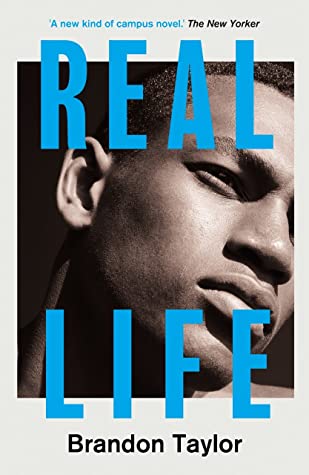 Over the course of one late summer weekend, Wallace questions everything about the life he has built. As a gay African American, he has always been an outsider at the Midwestern university where he’s a graduate student in biochemistry. Though they vary in background and include several homosexuals, some partnered and some unattached, most of his friends are white, and he’s been so busy that he’s largely missed out on evening socializing by the lake – and skipped his father’s funeral (though there are other reasons for that as well).
Tacit prejudice comes out into the open in ugly ways in these few days. When he finds his nematode experiments sabotaged, a female colleague at his lab accuses him of misogyny, brandishing his identity as a weapon against him: “you think that you get to walk around because you’re gay and black and act like you can do no wrong.” Then, in a deliciously awkward dinner party scene, an acquaintance brings up Wallace’s underprivileged Alabama upbringing as if it explains why he’s struggling to cope in his academic career.
Meanwhile, Wallace has hooked up with a male – and erstwhile straight – friend, and though there is unwonted tenderness in this relationship, there is also a hint of menace. The linking of sexuality and violence echoes the memories of abuse from Wallace’s childhood, which tumble out in the first-person stream of consciousness of Chapter 5. Other male friends, too, are getting together or breaking apart over mismatched expectations. Kindness is possible, but built-in injustice and cruelty, whether vengeful or motiveless, too often take hold.
There are moments when Wallace seems too passive or self-pitying, but the omniscient narration emphasizes that all of the characters have hidden depths and that emotions ebb and flow. What looks like despair on Saturday night might feel like no big deal come Monday morning. I so admired how this novel was constructed: the condensed timeframe, the first and last chapters in the past tense (versus the rest in the present tense), the contrast between the cerebral and the bodily, and the thematic and linguistic nods to Virginia Woolf. A very fine debut indeed.
My rating: 
I also read two more of the longlisted novels from the library:
Such a Fun Age by Kiley Reid
 Such a fun book! I’d read the first chapter earlier in the year and set it aside, thinking it was too hip for me. I’m glad I decided to try again – it was a great read, so assured and contemporary. Once I got past a slightly contrived first chapter, I found it completely addictive. The laser-precision plotting and characterization reminded me of Jennifer Egan, Jonathan Franzen and Zadie Smith at their peak, but the sassy voice is all Reid’s own. There are no clear villains here; Alix Chamberlain could easily have filled that role, but I felt for her and for Kelley as much as I did for Emira. The fact that I didn’t think anyone was completely wrong shows how much nuance Reid worked in. The question of privilege is as much about money as it is about race, and these are inextricably intertwined.
Love and Other Thought Experiments by Sophie Ward
 An intriguing set of linked short stories that combine philosophy and science fiction. Rachel and Eliza are preparing to have a baby together when an ant crawls into Rachel’s eye and she falls ill. Eliza wants to believe her partner but, as a scientist, can’t affirm something that doesn’t make sense (“We don’t need to resort to the mystical to describe physical processes,” she says). Other chapters travel to Turkey, Brazil and Texas – and even into space. It takes 60+ pages to figure out, but you can trust all the threads will converge around Rachel and her son, Arthur, who becomes an astronaut. I was particularly taken by a chapter narrated by the ant (yes, really) as it explores Rachel’s brain. Each section is headed by a potted explanation of a thought experiment from philosophy. I wasn’t entirely sure what to make of the alternative future of the two final chapters. Still, I was impressed with the book’s risk-taking and verve. It’s well worth making a rare dip into sci-fi for this one.
Back in September I still thought Hilary Mantel would win the whole thing, but since her surprise omission from the shortlist I’ve assumed the prize will go to Shuggie Bain by Douglas Stuart. This was a DNF for me, but I’ll try it again next year in case it was just a matter of bad timing (like the Reid and The Go-Between – two books I attempted a second time this year and ended up loving). Given that it was my favorite of the ones I read, I would be delighted to see Real Life win, but I think it unlikely. My back-up prediction is The Shadow King by Maaza Mengiste, which I would consider reserving from the library if it wins.

Have you read anything from the Booker shortlist?
Which book do you expect to win?
Completing the Women’s Prize Winners Reading Project and Voting
In this 25th anniversary year of the Women’s (previously Orange/Baileys) Prize, people have been encouraged to read all of the previous winners. I duly attempted to catch up on the 11 winners I hadn’t yet read, starting with Fugitive Pieces by Anne Michaels; Half of a Yellow Sun by Chimamanda Ngozi Adichie and A Crime in the Neighborhood by Suzanne Berne as part of a summer reading post; and When I Lived in Modern Times by Linda Grant, Property by Valerie Martin and Larry’s Party by Carol Shields (a reread) in this post.
This left just four for me to read before voting for my all-time favorite in the web poll. I managed two as recent buddy reads but had to admit defeat on the others, giving them just the barest skim before sending them back to the library.
The Idea of Perfection by Kate Grenville (1999; 2001 prize)
(Buddy read with Laura T.; see her review here)
 This is essentially an odd-couple romance, but so awkward I don’t think any of its scenes could accurately be described as a meet-cute. Harley Savage, a thrice-married middle-aged widow, works for the Applied Arts Museum in Sydney. The tall, blunt woman is in Karakarook, New South Wales to help the little town launch a heritage museum. Douglas Cheeseman is a divorced engineer tasked with tearing down a local wooden bridge and building a more suitable structure in its place. Their career trajectories are set to clash, but the novel focuses more on their personal lives. From the moment they literally bump into each other outside Douglas’ hotel, their every meeting is so embarrassing you have to blush – she saves him from some angry cows, while he tends to her after a bout of food poisoning.
Grenville does well to make the two initially unappealing characters sympathetic, primarily by giving flashes of backstory. Douglas is the posthumous child of a war hero, but has never felt he’s a proper (macho) Australian man. In fact, he has a crippling fear of heights, which is pretty inconvenient for someone who works on tall bridges. Harley, meanwhile, is haunted by the scene of her last husband’s suicide and is also recovering from a recent heart attack.
The title is, I think, meant to refer to how the protagonists fail to live up to ideals or gender stereotypes. However, it more obviously applies to the subplot about Felicity Porcelline, a stay-at-home mother who has always sought to be flawless – a perfect pregnancy, an ageless body (“Sometimes she thought she would rather be dead than old”), the perfect marriage – but gets enmired in a dalliance with the town butcher. I was never convinced Felicity’s storyline was necessary. Without it, the book might have been cut from 400 pages to 300.
Still, this was a pleasant narrative of second chances and life’s surprises. The small-town setting reminded Laura of Olive Kitteridge in particular, and I also thought frequently of Anne Tyler and her cheerfully useless males (“There was a lot to be said for being boring, and it was something [Douglas] was good at”). But I suspect the book won’t remain vivid in my memory, especially with its vague title that doesn’t suggest the contents. I enjoyed Grenville’s writing, though, so will try her again. In my mind she’s more known for historical fiction. I have a copy of The Secret River, so will see if she lives up to that reputation.
My rating: 
How to Be Both by Ali Smith (2014)
(Buddy read with Marcie of Buried in Print.)
 A book of two halves, one of which I thoroughly enjoyed; the other I struggled to engage with. I remembered vaguely as I was reading it that this was published in two different versions. As it happened, my library paperback opened with the contemporary storyline.
New Year’s Day marks the start of George’s first full year without her mother, a journalist who died at age 50. Her mother’s major project was “Subvert,” which used Internet pop-ups to have art to comment on politics and vice versa. George remembers conversations with her mother about the nature of history and art, and a trip to Italy. She’s now in therapy, and has a flirty relationship with Helena (“H”), a mixed-race school friend.
Smith’s typical wordplay comes through in the book’s banter, especially in George and H’s texts. George is a whip-smart grammar pedant. Her story was, all in all, a joy to read. There is even a hint of mystery here – is it possible that her mother was being monitored by MI5? When George skips school to gaze at her mother’s favorite Francesco del Cossa painting in the National Gallery, she thinks she sees Lisa Goliard, her mother’s intense acquaintance, who said she was a bookbinder but acted more like a spy…
The second half imagines a history for Francesco del Cossa, who rises from a brick-making family to become a respected portrait and fresco painter. The artist shares outward similarities with George, such as a dead mother and homoerotic leanings. There are numerous tiny connections, too, some of which I will have missed as my attention waned. The voice felt all wrong for the time period; I sensed that Smith wasn’t fully invested in the past, so I wasn’t either. (In dual-timeline novels, I pretty much always prefer the contemporary one and am impatient to get back to it; at least in books like Unsheltered and The Liar’s Dictionary there are alternate chapters to look forward to if the historical material gets tedious.)
An intriguing idea, a very promising first half, then a drift into pretension. Or was that my failure to observe and appreciate? Smith impishly mocks: “If you notice, it changes everything about the picture.” With her format and themes, she questions accepted binaries. There are interesting points about art, grief and gender, even without the clever links across time. But had the story opened with the other Part 1, I may never have gotten anywhere.
My rating:
Skims
I made the mistake of leaving the three winners that daunted me the most stylistically – McBride, McInerney and Smith – for last. I eventually made it through the Smith, though the second half was quite the slog, but quickly realized these two were a lost cause for me.
 A Girl Is a Half-formed Thing by Eimear McBride: I’d glanced at the first few pages in a shop before and found the style immediately off-putting. When I committed to this #ReadingWomen project, I diligently requested a copy from the university library even though I seriously doubted I’d have the motivation to read it. It turns out my first impression was correct: I would have to be paid much more than I’ve ever been paid for writing about a book just to get through this one. From the first paragraph on, it’s deliberately impenetrable in a sub-Joycean way. Ron Charles, the Washington Post book critic and one of my literary heroes/gurus, found the subject matter relentlessly depressing and the obfuscating style elitist. (Might it work as an audiobook? I can’t say; I’ve never listened to one.)
 The Glorious Heresies by Lisa McInerney: Not as stylistically difficult as expected, though there is mild dialect and long passages in italics (one of my reading pet peeves). But I’m not drawn to gangster stories, and after a couple of chapters didn’t feel like pushing myself through the book. I did enjoy the setup of Maureen killing an intruder with a holy stone, eliciting this confession: “I crept up behind him and hit him in the head with a religious ornament. So first I suppose God would have to forgive me for killing one of his creatures and then he’d have to forgive me for defiling one of his keepsakes.” For Anna Burns and Donal Ryan fans, perhaps?
It’s been many years since I’ve read some of these novels, such that all I have to go on is my vague memories and Goodreads ratings, and there are a handful there towards the bottom that I couldn’t get through at all, but I still couldn’t resist having a go at ranking the 25 winners, from best to least. My completely* objective list:
(*not at all)
Larry’s Party by Carol Shields
Half of a Yellow Sun by Chimamanda Ngozi Adichie
We Need to Talk about Kevin by Lionel Shriver
An American Marriage by Tayari Jones
The Tiger’s Wife by Téa Obreht
On Beauty by Zadie Smith
Home Fire by Kamila Shamsie
A Crime in the Neighborhood by Suzanne Berne
The Road Home by Rose Tremain
When I Lived in Modern Times by Linda Grant
The Idea of Perfection by Kate Grenville
Fugitive Pieces by Anne Michaels
The Lacuna by Barbara Kingsolver
Bel Canto by Ann Patchett
May We Be Forgiven by A.M. Homes
Property by Valerie Martin
Small World by Andrea Levy
Home by Marilynne Robinson
How to Be Both by Ali Smith
The Power by Naomi Alderman
Hamnet by Maggie O’Farrell
A Spell of Winter by Helen Dunmore
The Glorious Heresies by Lisa McInerney
The Song of Achilles by Madeline Miller
A Girl Is a Half-formed Thing by Eimear McBride
You can see the arbitrary nature of prizes at work here: some authors I love have won for books I don’t consider their best (Adichie, Kingsolver, O’Farrell, Patchett), while some exceptional female authors have been nominated but never won (Toni Morrison, Elizabeth Strout, Anne Tyler). Each year the judges are different, and there are no detailed criteria for choosing the winner, so it will only ever be the book that five people happen to like the best.
As she came out top of the heap with what is, coincidentally, the only one of the winning novels that I have managed to reread, my vote goes to Carol Shields for Larry’s Party. (People’s memory for prize winners is notoriously short, so I predict that one of the last two years’ winners, Tayari Jones or Maggie O’Farrell, will win the public’s best of the best vote.)

You have until midnight GMT on Sunday November 1st to vote for your favorite winner at this link. That’s less than a week away now, so get voting!
Note: If you’re interested in tracking your Women’s Prize reading over the years, check out Rachel’s extremely helpful list of all the nominees. It comes in spreadsheet form for you to download and fill out. I have read 138 nominees (out of 477) and DNFed another 19 so far.
Who gets your vote?
Two Bellwether Prize Winners by Heidi Durrow and Hillary Jordan
I conceived of the idea to read all of the Bellwether Prize winners because I loved Lisa Ko’s The Leavers so much. The PEN/Bellwether Prize for Socially Engaged Fiction is a biennial award given since 2000 by PEN America and Barbara Kingsolver, who created and funds the prize, “to a U.S. citizen for a previously unpublished work of fiction that addresses issues of social justice.” (More information can be found here.) Earlier this year, I found secondhand or cheap new copies of two of the winners and tried another one from the library.
The Girl Who Fell from the Sky by Heidi W. Durrow (2010)
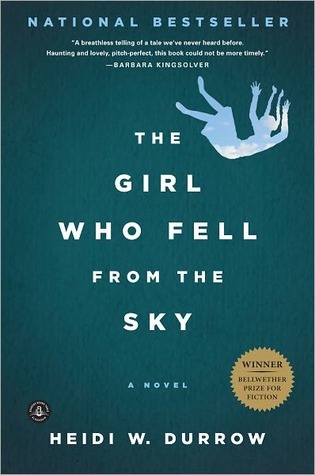 This review is ALL SPOILER because there isn’t really a way to discuss the book otherwise, so skip onwards if you think you might want to read this someday. Durrow was inspired by her own family history – she is biracial, her father a Black serviceman and her mother from Denmark – and by a newspaper story about a woman who jumped off the top of a multi-story building with her small children. Only one daughter survived the fall. Durrow was captivated by that girl’s story and wanted to imagine what her life would be like in the wake of tragedy.
In 1982, Rachel has come to live with her father’s mother in Portland, Oregon. She’s starting a new life there after a long time in the hospital. She survived her mother Nella’s leap from their Chicago apartment building because she landed on the top of the heap of three siblings. As her teen years unfold, she struggles to incorporate her European heritage with her African American identity and turns to promiscuity. Details of what happened that day in Chicago unfold gradually.
The secondary characters are more interesting than Rachel herself, even though she narrates, and I felt more sympathy for her when she was a child. I would have liked more of the mother’s journal entries, showing how her depression and alcoholism developed. The coincidence of the one eyewitness to the jump ending up in Portland was too much for me. Overall, this was fairly dismal and didn’t make enough of its compelling premise. It was an easy read, but had it been much longer than 260 pages I would likely have DNFed.
My rating:
Mudbound by Hillary Jordan (2008)
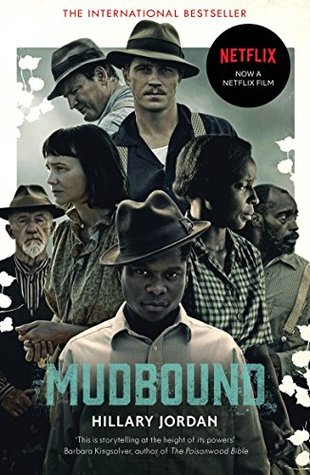 1946: Two servicemen return from fighting in Europe, headed to the same Mississippi farm. Jamie McAllan was a fighter pilot and Ronsel Jackson was part of a tank division. Both are dependent on alcohol to help them cope with the memories of what they have seen and done. But Jamie can get away with drunk driving and carousing with local women, knowing that his big brother, Henry, will take him back in no matter what. Ronsel, though, has to keep his head down and be on his guard at every moment: war hero or not, no one in Mississippi is going to let a Black man walk in through the front door of a store or get a lift home in a white man’s truck. His sharecropping family’s position at the McAllan farm, Mudbound, is precarious, with the weather and the social hierarchy always working against them.
This story of love, betrayal, and the obsession with land is told through rotating first-person narration from six key players, three McAllans and three Jacksons. Each voice is distinct and perfectly captures the character’s personality and level of education. Jordan uses this kaleidoscope view to explore how fateful decisions bind the two families together. I particularly loved the two female voices: Laura, Henry’s wife; and Florence, Ronsel’s mother. Though they’re often stuck inside cooking and delivering babies, they still play their roles in the farm’s drama. The novel opens with a burial scene, but readers get faked out not once but twice about how the character died. I raced through the last three-quarters, and the final 50–100 pages are a real doozy. This feels like a modern classic of the segregated South and I’d recommend it for those looking for a follow-up to The Vanishing Half.
My rating:
And a DNF:
Running the Rift by Naomi Benaron (2010)
I read 25 pages and didn’t feel drawn into the characters’ story. When the main characters are from a persecuted ethnic minority and one boy is a star runner, you sort of know where things are heading. (I’m also perhaps too familiar with Rwandan history from We Wish to Inform You that Tomorrow We Will Be Killed with Our Families by Philip Gourevitch.)
Remaining Bellwether Prize winners:
 2019 Katherine Seligman, If You Knew [retitled At the Edge of the Haight – publication forthcoming in January 2021]
2014 Ron Childress, And West Is West
2012 Susan Nussbaum, Good Kings Bad Kings
2004 Marjorie Kowalski Cole, Correcting the Landscape
2002 Gayle Brandeis, The Book of Dead Birds
2000 Donna Gershten, Kissing the Virgin’s Mouth
Have you read one of these winners? Do any tempt you?
Women’s Prize Winners Reading Project: Grant, Martin, Shields et al.
In this 25th anniversary year of the Women’s Prize, readers are being encouraged to catch up on all the previous winners. I’d read 14 of them (including Hamnet) as of mid-April and have managed five more since then – plus a reread, a DNF and a skim. I recently reviewed Fugitive Pieces by Anne Michaels, and Half of a Yellow Sun by Chimamanda Ngozi Adichie and A Crime in the Neighborhood by Suzanne Berne as part of this summer reading post. This leaves just four more for me to read before voting for my all-time favorite in November.
When I Lived in Modern Times by Linda Grant (2000)
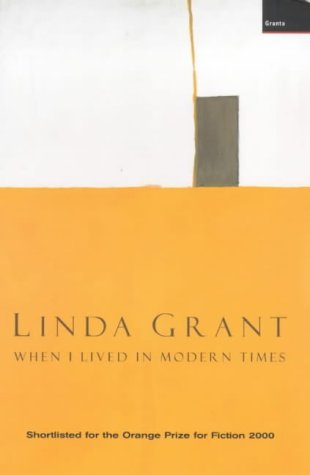 Some settings have been done to death, but here’s one I don’t think I’d ever encountered before: Israel in the final year before statehood. Grant dramatizes the contrast between Palestine, a doomed British colony, and the Jewish hope of a homeland. In 1946 twenty-year-old Evelyn Sert leaves her home in London, masquerading as a Gentile tourist (though she has Latvian Jewish ancestry) so as to jump ahead of thousands of displaced persons awaiting entry visas. With her mother recently dead of a stroke, she takes advice and money from her mother’s married boyfriend, “Uncle Joe,” a Polish Jew and Zionist, and heads to Palestine.
After six weeks on a kibbutz, Evelyn sets out to make her own life in Tel Aviv as a hairdresser and falls in with Johnny, a Jew who fought for the British. It’s safer to be part of the colonial structure here, so she once again passes as Gentile, dyeing her hair blonde and going by Priscilla Jones. In a land where all kinds of people have been thrown together by the accident of their ethnicity and the suffering it often entailed, one man’s terrorist is another’s freedom fighter. For Evelyn, who’s never known anywhere apart from suburban London and arrived in Palestine a virgin, the entire year is a journey of discovery. Will a place of ancient religious significance embrace modern architecture, technology and government? Grant really captures this period of transition for an individual and for a nascent nation of exiles. I loved the supporting characters and the nostalgic look back from half a century on.
Favorite passages:
In a country with its face turned towards the future, our stories sat on our shoulders like a second head, facing the way we had come from. We were the tribe of Janus, if there is such a thing.
With hindsight it always seems easy to do the right thing, but we were trying to decide something in those days that people don’t often get a chance to have a say in and it was this: would we be a free nation after two thousand years of wandering or would we always be a subject race? Would we be ghetto Jews or new Jews?
Property by Valerie Martin (2003)
 A compact study of slavery that unfolds through the relationship between a New Orleans plantation owner’s wife and her husband’s mistress. Manon Gaudet has never been happy in her marriage, but when their slave girl, Sarah, bears her husband a second child, she decides she has had enough of silently condoning his behavior. A slave uprising and cholera and yellow fever outbreaks provide some welcome drama, but the bulk of this short novel is an examination of the psyche of a woman tormented by hatred and jealousy. Ownership of another human being is, if not technically impossible, certainly not emotionally tenable. Manon’s situation is also intolerable because she has no rights as a woman in the early nineteenth century: any property she inherits will pass directly to her husband. Though thoroughly readable, for me this didn’t really add anything to the corpus of slavery fiction.
A reread (as well as a buddy read with Buried in Print):
Larry’s Party by Carol Shields (1997)
“The whole thing about mazes is that they make perfect sense only when you look down on them from above.”
 Larry Weller is an Everyman: sometimes hapless and sometimes purposeful; often bewildered with where life has led him, but happy enough nonetheless. From the start, Shields dwells on the role that “mistakes” have played in making Larry who he is, like a floral arts catalogue coming in the mail from the college instead of one on furnace repair and meeting Dorrie at a Halloween party he attended with a different girl. Before he knows it he and a pregnant Dorrie are getting married and he’s been at his flower shop job for 12 years. A honeymoon tour through England takes in the Hampton Court Palace maze and sparks an obsession that will change the course of Larry’s life, as he creates his first maze at their Winnipeg home and gradually becomes one of a handful of expert maze-makers.
The sweep of Larry’s life, from youth to middle age, is presented roughly chronologically through chapters that are more like linked short stories: they focus on themes (family, friends, career, sex, clothing, health) and loop back to events to add more detail and new insight. I found the repetition of basic information about Larry somewhat off-putting in that it’s as if we start over with this character with each chapter – the same might be said of Olive Kitteridge, but that book’s composition was drawn out and it involves a multiplicity of perspectives, which explains the slight detachment from Olive. Here the third-person narration sticks close to Larry but gives glimpses into other points of view, tiny hints of other stories – a man with AIDS, a woman trying to atone for lifelong selfishness, and so on.
From my first reading I remembered a climactic event involving the Winnipeg maze; a ribald chapter entitled “Larry’s Penis,” about his second marriage to a younger woman and more; and the closing dinner party, a masterful sequence composed almost entirely of overlapping dialogue (like the final wedding reception scene in her earlier novel, The Box Garden) as Larry hosts his two ex-wives, his current girlfriend, his sister and his partner, and a colleague and boss. What is it like to be a man today? someone asks, and through the responses Shields suggests a state of uneasiness, of walking on eggshells and trying not to be a chauvinist in a world whose boundaries are being redrawn by feminism. That process has continued in the decades since, though with predictable backlash from those who consider women a threat.
It seems slightly ironic that Shields won the Women’s Prize for this episodic fictional biography of a man, but I found so much to relate to in Larry’s story – the “how did I get here?” self-questioning, the search for life’s meaning, “the clutter of good luck and bad” – that I’d say Larry is really all of us.
One of Shields’s best, and quite possibly my winner of winners.
My original rating (2008?):
My rating now:
Currently rereading: Gilead by Marilynne Robinson
A skim:
A Spell of Winter by Helen Dunmore (1995)
 An annoying thing happened with this one: the back cover blurb gave away a central theme. It’s one I’m keen to avoid yet feel I have encountered disproportionately often in fiction, especially recently (I won’t name any titles as that would give it away instantly). Dunmore writes nicely – from my quick skim of this one it seemed very atmospheric – but I am not particularly drawn to her plots. I’ve read Exposure for book club and own two more of her novels, Talking to the Dead and Zennor in Darkness, so by the time I’ve read those I will have given her a solid try. So far I’ve preferred her poetry – I’ve read three of her collections.
A favorite passage:
“It is winter in the house. This morning the ice on my basin of water is so thick I can not break it. The windows stare back at me, blind with frost. … I can see nothing through the frost flowers on the glass. I wonder if it is snowing yet, but I think it is too cold. … I look at the house, still and breathless in the frost. I have got what I wanted. A spell of winter hangs over it, and everyone has gone.”
And a DNF:
The Song of Achilles by Madeline Miller (2011)
 Patroclus is a disappointment of a prince. He has no chance of winning Helen of Troy’s hand in marriage, and exile awaits him when he is responsible for an accidental death. As a foster child in the household of another king, he becomes obsessed with Achilles. The two young men take part in music lessons and military training, and Patroclus follows Achilles away from the palace to be taught by a centaur. That’s as far as I got before I couldn’t bear any more. The homoerotic hints are laughably unsubtle: (of a lyre) “‘You can hold it, if you like.’ The wood would be smooth and known as my own skin” & (fighting) “he rolled me beneath him, pinning me, his knees in my belly. I panted, angry but strangely satisfied.”
I got a free download from Emerald Street, the Stylist magazine e-newsletter. The ancient world, and Greek mythology in particular, do not draw me in the least, and I have had bad experiences with updates of Greek myths before (e.g. Bright Air Black by David Vann). I never thought this would be a book for me, but still wanted to attempt it so I could complete the set of Women’s Prize winners. I read 77 pages out of 278 in the e-book, but when I have to force myself to pick up a book, I know it’s a lost cause. As with the Dunmore, I think it’s safe to say this one never would have gotten my vote anyway.
The final four to complete my project:
(On the stack to read soon)
The Idea of Perfection by Kate Grenville – free from mall bookshop
The Glorious Heresies by Lisa McInerney – public library copy
How to Be Both by Ali Smith – public library copy; a planned buddy read with B.I.P.
(To get from the university library)
A Girl Is a Half-formed Thing by Eimear McBride
 Bookish Beck = Rebecca Foster. American transplant to England. Freelance proofreader and book reviewer.
 Bookish Beck