Love Your Library, September 2022
How embarrassing to find out from a fellow blogger’s post that two North American readers host a weekly meme for library borrowing. It’s called Library Loot (title envy!), and you should feel free to participate in that in addition to or instead of my monthly event.
 Pretty soon it will be time to stock up on horror and short books for R.I.P. and Novellas in November. For now, I’m still working on some short story collections, and plan to skim a bunch of nonfiction I’m interested-ish in (but not enough to read every word) to make space on my card. I did have reserves on three Booker-shortlisted titles, but admitted to myself that I don’t actually want to read them and cancelled my holds. The one that I do still plan to read is Treacle Walker by Alan Garner, a perfect read for #NovNov22, if not before.
Since last month:
READ
- Brief Lives by Anita Brookner (for book club)

- Case Study by Graeme Macrae Burnet
- The Dinner Party by Joshua Ferris

- The Boat by Nam Le
- Nightcrawling by Leila Mottley

- This Time Tomorrow by Emma Straub
- Oh William! by Elizabeth Strout
- Summer by Edith Wharton
- The Young Accomplice by Benjamin Wood

CURRENTLY READING
- The Dark Is Rising by Susan Cooper
- State of Wonder by Ann Patchett (a reread)
- Leap Year by Helen Russell
- Tomorrow, and Tomorrow, and Tomorrow by Gabrielle Zevin
Plus various new releases on loan or on hold.
What have you been reading or reviewing from the library recently?

Share a link to your own post in the comments. Feel free to use the above image. The hashtag is #LoveYourLibrary.
Get Ready for Novellas in November!
Novellas: “all killer, no filler” (said Joe Hill). For the third year in a row, Cathy of 746 Books and I are co-hosting Novellas in November as a month-long challenge, with four weekly prompts we’ll take it in turns to focus on. We’re announcing early to give you plenty of time to get your stacks ready.

Here’s the schedule:
1–7 November: Short classics (Rebecca)
8–14 November: Novellas in translation (Cathy)
15–21 November: Short nonfiction (Rebecca)
22–28 November: Contemporary novellas (Cathy)
29–30 November: You might like to post a “New to my TBR” or “My NovNov Month” roundup.
(As a reminder, we suggest 150–200 pages as the upper limit for a novella, and post-1980 as a definition of “contemporary.”)
This year we have one overall buddy read. Claire Keegan has experienced a resurgence of attention thanks to the Booker Prize shortlisting of Small Things Like These – one of our most-reviewed novellas from last year. Foster is a modern Irish classic that comes in at under 90 pages, and, in an abridged version, is free to read on the New Yorker website. You can find that here. (Or whet your appetite with Cathy’s review.)
Keegan describes Foster as a “long short story” rather than a novella, but it was published as a standalone volume by Faber in 2010. A new edition will be released by Grove Press in the USA on November 1st, and the book is widely available for Kindle. It is also the source material for the recent record-breaking Irish-language film The Quiet Girl, so there are several ways for you to encounter this story.
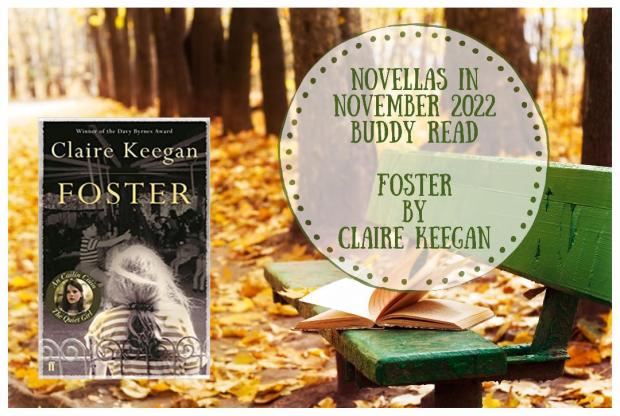
We’re looking forward to having you join us! We will each put up a pinned post where you can leave links starting on 1 November. Keep in touch via Twitter (@bookishbeck / @cathy746books) and Instagram (@bookishbeck / @cathy_746books), and feel free to use the terrific feature images Cathy has made and our new hashtag, #NovNov22.
September’s Focus: Short Stories
This is the seventh year in a row in which I’m making a special effort to read short stories in September; otherwise, story collections tend to languish on my shelves (and Kindle) unread. In September 2020 I read 8 collections, and in September 2021 it was 12. How many can I get through this time?! Here are my options, including, at far right, some I’m partway through, a thematic trio (“Birds” titles) I fancy reviewing together, and a few from the library.


To my surprise, if I count linked short stories, I’ve already read 13 collections this year. Highlights: Dance Move by Wendy Erskine, The Summer Book by Tove Jansson, Antipodes by Holly Goddard Jones, and How High We Go in the Dark by Sequoia Nagamatsu.
 The best of the lot, though, has been Stories from the Tenants Downstairs by Sidik Fofana, which I’ll be reviewing for BookBrowse over the weekend. It’s a character- and voice-driven set of eight stories about the residents of a Harlem apartment complex, many of them lovable rogues who have to hustle to try to make rent in this gentrifying area.
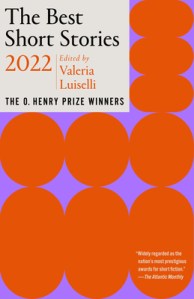 A September release I’ll quickly plug: The Best Short Stories 2022: The O. Henry Prize Winners, selected by Valeria Luiselli. I read this for Shelf Awareness and my review will be appearing in a couple of weeks. Half of the 20 stories are in translation – Luiselli insists this was coincidental – so it’s a nice taster of international short fiction. Contributing authors you will have heard of: Chimamanda Ngozi Adichie, Lorrie Moore, Samanta Schweblin and Olga Tokarczuk. The style runs the gamut from metafiction to sci-fi/horror. Covid-19, loss and parenting are frequent elements. My two favourites: Joseph O’Neill’s “Rainbows,” about sexual misconduct allegations, then and now; and the absolutely bonkers novella-length “Horse Soup” by Vladimir Sorokin, about a woman and a released prisoner who meet on a train and bond over food. (13 September, Anchor Books)
 Here’s a short story collection I received for review but, alas, couldn’t finish: Milk Blood Heat by Dantiel W. Moniz. This was longlisted for the Dylan Thomas Prize and won the NB Magazine Blogger’s Book Prize. The link, I have gathered, is adolescent girls in Florida. I enjoyed the title story, which opens the collection and takes peer pressure and imitation to an extreme, but couldn’t get through more than another 1.5 after that; they left zero impression.
Currently reading: The Boat by Nam Le (it won the Dylan Thomas Prize; I’ve read the first story so far and it was knockout!), Birds of a Lesser Paradise by Megan Mayhew Bergman.
 Resuming soon: The Predatory Animal Ball by Jennifer Fliss (e-book), Hearts & Bones by Niamh Mulvey, The Secret Lives of Church Ladies by Deesha Philyaw – all were review copies.
Are you a short story fan? Read any good ones recently?
Join me in this low-key challenge if you wish!
Love Your Library, August 2022
Edited: Belatedly adding in links to this month’s posts by Eleanor and Marcie, with a huge thank you for participating!
And here’s my haul from today. A few short story collections there because in September I always try to focus a bit more on stories.
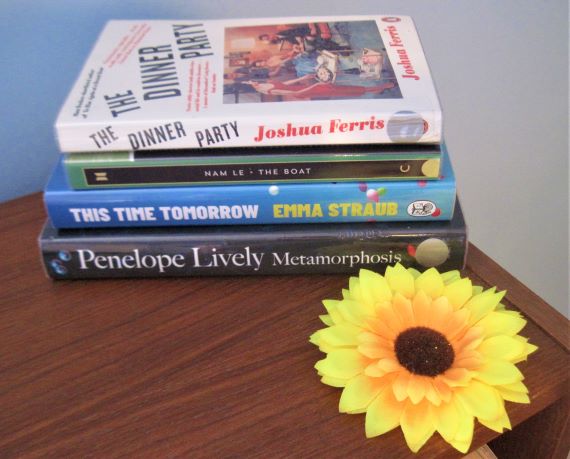
Naomi has also been reading a lot from her local libraries, and Laura stocked up before heading out on holiday:

Normally my library system would be busily buying up the Booker Prize longlist, the Wainwright Prize shortlists, and big-name upcoming releases by the likes of John Irving and Ian McEwan. I have a file on my desktop with a list of 29 author names I periodically check for, as any on-order titles from them will show up at the top of the results. But there’s been a huge slowdown on acquisitions, and I know exactly why: the librarian who orders and processes new books experienced a family tragedy this summer and has been on compassionate leave for a while already. Were I not a library volunteer who also vaguely knows her socially, I’d have no idea and might be simmering with impatience right now. Instead, I’ll be patient, read what I already have out, and address my review book backlog.
Since last month…
READ
- Where the Wildflowers Grow by Leif Bersweden
- Bridget Jones: Mad About the Boy by Helen Fielding (for book club)

- My Life in Houses by Margaret Forster
- Black Narcissus by Rumer Godden
- Julia and the Shark by Kiran Millwood Hargrave
- The Summer Book by Tove Jansson
- From the Hedgerows by Lew Lewis
- The Last Wild Horses by Maja Lunde
- Golden Boys by Phil Stamper
- The False Rose by Jakob Wegelius
Also a children’s book I spotted while shelving – who knew it existed?!
- River Rose and the Magical Lullaby by Kelly Clarkson; illus. Laura Hughes
CURRENTLY READING
- Brief Lives by Anita Brookner (for book club)
- Case Study by Graeme Macrae Burnet
- Nightcrawling by Leila Mottley
- State of Wonder by Ann Patchett (a reread)
- Oh William! by Elizabeth Strout
- The Young Accomplice by Benjamin Wood
A few of these are from the Booker Prize longlist, in advance of the shortlist announcement on 6 September.
And from the university library:
- Summer by Edith Wharton
Still lots around that I’ve borrowed and not gotten into yet:


And various new releases on hold or awaiting me on the reservation shelf.
What have you been reading or reviewing from the library recently?
Share a link to your own post in the comments. Feel free to use the above image. The hashtag is #LoveYourLibrary.
Book Serendipity, May to Mid-August 2022
This is a regular feature of mine every few months. I call it “Book Serendipity” when two or more books that I read at the same time or in quick succession have something in common – the more bizarre, the better. Because I usually have 20–30 books on the go at once, I suppose I’m more prone to such incidents. The following are in roughly chronological order.
- Not only did the opening scene of All Down Darkness Wide by Seán Hewitt share with Falling Angels by Tracy Chevalier a graveyard setting, but more specifically an angel statue whose head falls off.

- SPOILER: {The protagonist has a backstory of a mother who drowned, presumably by suicide, in Secrets of the Sea House by Elisabeth Gifford and The Dance Tree by Kiran Millwood Hargrave.}
- I started reading two e-books on the same day that had Taylor Swift lyrics as an epigraph: Bad Vibes Only by Nora McInerny and Tracy Flick Can’t Win by Tom Perrotta. I have never knowingly heard a Taylor Swift song.
- Rescuing insects from a swimming pool in Fledgling by Hannah Bourne-Taylor and In the Quaker Hotel by Helen Tookey.
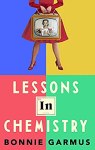
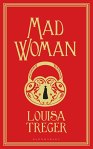
- Reading two feminist works of historical fiction in which the protagonist refuses to marry (even though it’s true love) at the same time: Lessons in Chemistry by Bonnie Garmus and Madwoman by Louisa Treger (about Nellie Bly).
- Two London-set books featuring a daughter named Mabel, one right after the other: This Is Not a Pity Memoir by Abi Morgan and Bridget Jones: Mad about the Boy by Helen Fielding.
- In Jenn Shapland’s My Autobiography of Carson McCullers I came across the fact that McCullers married the same man twice. Just a few days before, I’d seen that same odd fact about Hilary Mantel in her Wikipedia bio.
- A character named Clodagh in Black Narcissus by Rumer Godden and “Rainbows” by Joseph O’Neill, one of the entries in The Best Short Stories 2022: The O. Henry Prize Winners.
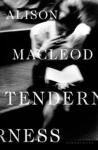
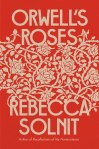
- Reading two books about an English author who died young of TB at the same time: Tenderness by Alison MacLeod (about D.H. Lawrence) and Orwell’s Roses by Rebecca Solnit.
- Reading two novels that mention the shipwreck of the Batavia at the same time: The Night Ship by Jess Kidd (where it’s a major element) and Cloudstreet by Tim Winton (just a tiny reference that nonetheless took me aback). According to Wikipedia, “Batavia was a ship of the Dutch East India Company. Built in Amsterdam in 1628 as the company’s new flagship, she sailed that year on her maiden voyage for Batavia, capital of the Dutch East Indies. On 4 June 1629, Batavia was wrecked on the Houtman Abrolhos, a chain of small islands off the western coast of Australia.”
- David Lack’s Swifts in a Tower is mentioned in Swifts and Us by Sarah Gibson (no surprise there) but also in From the Hedgerows by Lew Lewis.
- There’s a child nicknamed Chub in Damnation Spring by Ash Davidson and Cloudstreet by Tim Winton (which both also at least started off being buddy reads with Marcie of Buried in Print!).
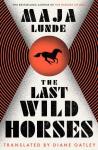
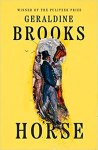
- Two novels in quick succession in which the discovery of a horse skeleton sparks the action in one story line: The Last Wild Horses by Maja Lunde and (coming up soon – I have a library reservation placed) Horse by Geraldine Brooks.
- Unst, Shetland as a setting in Orchid Summer by Jon Dunn, Sightlines by Kathleen Jamie, Julia and the Shark by Kiran Millwood Hargrave, and Where the Wildflowers Grow by Leif Bersweden.
- “Quiet as it’s kept” (a quote from the opening line of Toni Morrison’s The Bluest Eye) is borrowed in a poem in No Country for Eight-Spot Butterflies by Julian Aguon and one in the anthology American Wildflowers: A Literary Field Guide, ed. Susan Barba (“A Siren Patch of Indigo” by Cyrus Cassells).
- I didn’t recognize the word “swingeing” in The Reindeer Hunters by Lars Mytting and encountered it again the same day in Brief Lives by Anita Brookner before I had a chance to look it up (it means extreme or severe).
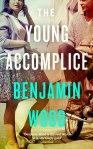
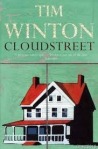
- A 1950s setting and a main character who is a man with missing fingers/arm in Cloudstreet by Tim Winton and The Young Accomplice by Benjamin Wood.
What’s the weirdest reading coincidence you’ve had lately?
Bookish Bits and Bobs
It’s felt like a BIG week for prize news. First we had the Booker Prize longlist, about which I’ve already shared some thoughts. My next selection from it is Trust by Hernan Diaz, which I started reading last night. The shortlist comes out on 6 September. We have our book club shadowing application nearly ready to send off – have your fingers crossed for us!
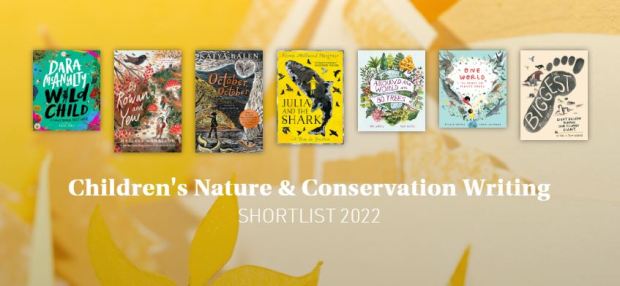
Then on Friday the three Wainwright Prize shortlists (I gave my reaction to the longlists last month) were announced: one for nature writing, one for conservation writing, and – new this year – one for children’s books on either.
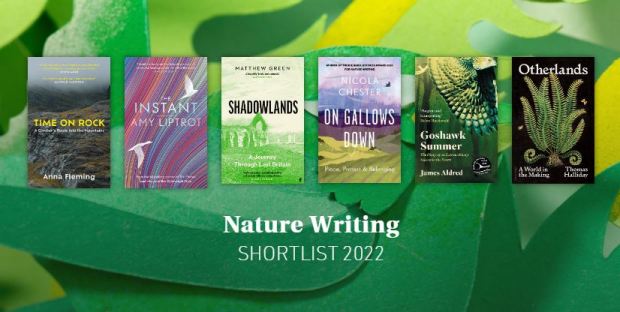
 I’m delighted that my top two overall picks, On Gallows Down by Nicola Chester and Silent Earth by Dave Goulson, are still in the running. I’ve read half of the nature list and still intend to read Shadowlands, which is awaiting me at the library. I’d happily read any of the remaining books on the conservation list and have requested the few that my library system owns. Of the children’s nominees, I’m currently a third of the way through Julia and the Shark and also have the Davies out from the library to read.
As if to make up for the recent demise of the Costa Awards, the Folio Prize has decided to split into three categories: fiction, nonfiction and poetry; the three finalists will then go head-to-head to compete for the overall prize. I’ve always wondered how the Folio judges pit such different books against each other. This makes theirs an easier job, I guess?
Speaking of prize judging, I’ve been asked to return as a manuscript judge for the 2023 McKitterick Prize administered by the Society of Authors, the UK trade union for writers. (Since 1990, the McKitterick Prize has been awarded to a debut novelist aged 40+. It’s unique in that it considers unpublished manuscripts as well as published novels – Political Quarterly editor Tom McKitterick, who endowed the Prize, had an unpublished novel at the time of his death.) Although I’d prefer to be assessing ‘real’ books, the fee is welcome. Submissions close in October, and I’ll spend much of November–December on the reading.
Somehow, it’s August. Which means:
- Less than a month left for the remaining 10 of my 20 Books of Summer. I’m actually partway through another 12 books that would be relevant to my flora theme, so I just have to make myself finish and review 10 of them.
- It’s Women in Translation month! I’m currently reading The Last Wild Horses by Maja Lunde and have The Summer Book by Tove Jansson out from the library. I also have review copies of two short novels from Héloïse Press, and have placed a library hold on The Disaster Tourist by Yun Ko-eun. We’ll see how many of these I get to.

 Marcie (Buried in Print) and I have embarked on a buddy read of Cloudstreet by Tim Winton. I’ve never read any of his major works and I’m enjoying this so far.
Goodreads, ever so helpfully, tells me I’m currently 37 books behind schedule on my year’s reading challenge. What the website doesn’t know is that, across my shelves and e-readers, I am partway through – literally – about 90 books. So if I could just get my act together to sit down and finish things instead of constantly grabbing for something new, my numbers would look a lot better. Nonetheless, I’ve read loads by anyone’s standard, and will read lots more before the end of the year, so I’m not going to sweat it about the statistics.
A new home has meant fun tasks like unpacking my library (as well as not-so-fun ones like DIY). As a reward for successfully hosting a housewarming party and our first weekend guests, I let myself unbox and organize most of the rest of the books in my new study. My in-laws are bringing us a spare bookcase soon; it’s destined to hold biographies, poetry and short story collections. I thought I’d be able to house all the rest of my life writing and literary reference books on two Billy bookcases, but it’s required some clever horizontal stacks, special ‘displays’ on the top of each case, and, alas, some double-stacking – which I swore I wouldn’t do.


Scotland and Victoriana displays, unread memoirs and literary reference books at left; medical reads display and read memoirs at right.
I need to acquire one more bookcase, a bit narrower than a Billy, to hold the rest of my read fiction plus some overflow travel and humour on the landing.
I get a bit neurotic about how my library is organized, so questions that others wouldn’t give much thought to plague me:
- Should I divide read from unread books?
- Do I hide the less sightly proof copies in a stack behind the rest?
- Is it better to have hardbacks and paperbacks all in one sequence, or separate them to maximize space?
(I’ve employed all of these options for various categories.)
I also have some feature shelves to match particular challenges, like novellas, future seasonal reads, upcoming releases and review books to catch up on, as well as signed copies and recent acquisitions to prioritize. Inevitably, once I’ve arranged everything, I find one or two strays that then don’t fit on the shelves I’ve allotted. Argh! #BibliophileProblems, eh?
I’ve been skimming through The Bookman’s Tale by Ronald Blythe, and this passage from the diary entry “The Bookshelf Cull” stood out to me:
“Should you carry a dozen volumes from one shelf to another, you will most likely be carrying hundreds before you finish. Sequences will be thrown out; titles will have to be regrouped; subjects will demand respect.”
What are your August reading plans? Following any literary prizes?
How are your shelves looking? Are they as regimented as mine, or more random?
Love Your Library, July 2022
Margaret posted about books picked at random while volunteering at the library, and the way a certain type of cover can draw you in or fit your mood. I’ve certainly experienced this, too!
I’ve noticed that, lately, my library system has been making an effort to cover gaps in its holdings, purchasing books to boost its collections of LGBTQ and postcolonial literature: reissues of novels by Caribbean and Indigenous (e.g. Maori) authors, more by trans people, Black British authors from the Virago Modern Classics series, etc. They also tend to buy up writers’ back catalogues, especially if reprinted as a uniform series – I keep hoping they’ll do this for Sarah Hall. Though I volunteer at the library twice a week, I don’t have insider knowledge; it’s still a mystery to me how and why some books get ordered and some don’t.
Since last month…
READ
- Orchid Summer by Jon Dunn
- Lessons in Chemistry by Bonnie Garmus
- Secrets of the Sea House by Elisabeth Gifford
- This Is Not a Pity Memoir by Abi Morgan (for book club)
- The Summer of the Bear by Bella Pollen
- Transitions: Our Stories of Being Trans, ed. Juno Roche et al.
- Stormy Petrel by Mary Stewart
- Madwoman by Louisa Treger – reviewing for Shelf Awareness
And from the university library:
- The Daughter of Time by Josephine Tey
From whence this amusing quote about library books:
“No T. More in any of the bookshops, so tried Public Library. Can’t think why one never thinks of Public Libraries. Probably because books expected to be soupy. Think this looks quite clean and unsoupy. You get fourteen days. Sounds like a sentence rather than a loan.”
(I sometimes get perfume-y books, but not soupy ones. How about you?)
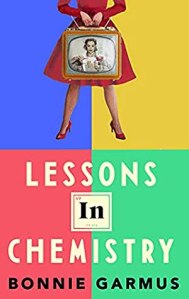 I’ll zero in on one of these, Lessons in Chemistry, because there are 50 reservations after me in the queue – that must be a record for my small library system! Bonnie Garmus made her authorial debut at age 64; you can be sure she’ll be in the running for the next Paul Torday Memorial Prize (awarded by the Society of Authors to a first novel by a writer over 60). Elizabeth Zott is a scientist through and through, applying a chemist’s mindset to her every venture, including cooking, rowing and single motherhood in the 1950s. When she is fired from her job in a chemistry lab and gets a gig as a TV cooking show host instead, she sees it as her mission to treat housewives as men’s intellectual equals, but there are plenty of people who don’t care for her unusual methods and free thinking. I was reminded strongly of The Atomic Weight of Love and The Rosie Project, as well as novels by Katherine Heiny and especially John Irving what with the deep dive into backstory and particular pet subjects, and the orphan history for Zott’s love interest. This was an enjoyable tragicomedy. You have to cheer for the triumphs she and other female characters win against the system of the time. However, her utter humourlessness/guilelessness felt improbable, the very precocious child (and dog) stretch belief, and the ending was too pat for me.
CURRENTLY READING
Continuing with my flora and summer themes; continuing to linger in Scotland; reading about the amazing birds filling our skies (and nesting in our eaves):
- Where the Wildflowers Grow by Leif Bersweden
- Bridget Jones: Mad About the Boy by Helen Fielding (for book club)
- Swifts and Us by Sarah Gibson
- Black Narcissus by Rumer Godden
- Tenderness by Alison MacLeod
- Where the World Ends by Geraldine McCaughrean
- Golden Boys by Phil Stamper
- The False Rose by Jakob Wegelius
- Summer by Edith Wharton
What have you been reading or reviewing from the library recently?
Share a link to your own post in the comments. Feel free to use the above image. The hashtag is #LoveYourLibrary.
Love Your Library, June 2022
In the past month we’ve had visits to libraries in Canada and Catalonia – thanks to Marcie and Margaret for sharing about these.
It’s been good to see more activities resuming at my local library, where I volunteer twice a week. In recent months I’ve noticed the upstairs meeting room being used for Lego building and flower arranging, as well as for reading group discussions.
When it comes to library material, I’ve been borrowing much more than I’ve been reading. I stocked up in advance of our Scotland holiday – even though we’re travelling by train, bus and ferry, so I haven’t been able to take very many books with me.


This is what I’ve gotten to since last month:
READ
- The Dance Tree by Kiran Millwood Hargrave
- The Feast by Margaret Kennedy
- A Parrot in the Pepper Tree by Chris Stewart
- The Murderer’s Ape by Jakob Wegelius
(I reviewed the above four across my Spain trip and 20 Books of Summer posts.)
- By Ash, Oak and Thorn by Melissa Harrison
- Stormy Petrel by Mary Stewart (review to come)
- The Schoolhouse by Sophie Ward
CURRENTLY READING
- Orchid Summer by Jon Dunn
- Secrets of the Sea House by Elisabeth Gifford
- Black Narcissus by Rumer Godden
- This Is Not a Pity Memoir by Abi Morgan
- The Summer of the Bear by Bella Pollen
What have you been reading or reviewing from the library recently?
Share a link to your own post in the comments. Feel free to use the above image. The hashtag is #LoveYourLibrary.
20 Books of Summer 2022: Flora Theme
It’s my fifth year participating in Cathy’s 20 Books of Summer challenge, which starts tomorrow. Each year I choose a theme. Thus far I’ve done books by women; animals; food and drink; and colours. This year will be all about flora; mostly trees, I reckon. As always, I’ll interpret the theme loosely and include titles, authors and covers that seem apt for whatever reason.
I have lots to choose from. Here’s the stacks from my shelves, divided into fiction and non-:


And a relevant recent haul from the library:
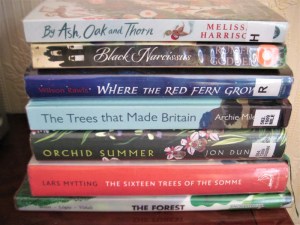
There will be other options on my Kindle too, such as Orwell’s Roses by Rebecca Solnit.
I’m eyeing these up as my first four:


(Nina Mingya Powles also kicked off my 2020 foodie reading!)

Are you joining in the summer reading challenge? What’s the first book on the docket?
Love Your Library, May 2022
I have a big ol’ stack of library books with me in Spain and I hope they have been good companions on the holiday, especially on the 20-hour ferry rides there and back (I’m scheduling this before we set off).
Margaret shared a lovely post about a grandchild’s early appreciation of the local library. And Naomi reviewed three novels she has recently read from the library, two I loved and one I’m partway through.
Since last month, here are my stats…
READ
- Elizabeth Finch by Julian Barnes
- Yinka, Where is Your Huzband? by Lizzie Damilola Blackburn
- Falling Angels by Tracy Chevalier (reread for May’s book club meeting)

- Bitch: The Female of the Species by Lucy Cooke (review pending for Shelf Awareness)
- The Sentence by Louise Erdrich
- The Exhibitionist by Charlotte Mendelson
- French Braid by Anne Tyler
With loads still on the go, and a preposterous number of reservations pending and hopefully not all arriving while I’m away.
What have you been reading or reviewing from the library recently?
Share a link to your own post in the comments. Feel free to use the above image. The hashtag is #LoveYourLibrary.
 Bookish Beck = Rebecca Foster. American transplant to England. Freelance proofreader and book reviewer.
