Summer Reads, Part I: Buti, Ellis, C. Foster (Reread), Itami, Thomson
The less said about the summer of 2026, the better. It feels like the heat wave will never end. We’ve had 4 mm of rain the whole month. Drought imperils so much. But it’s not right to complain when wildfires rage not so far away. One glance at the news headlines and there’s no avoiding the signs of climate breakdown everywhere. I can’t bear it. I just keep reading.
Year of the Drought by Roland Buti (2015; 2017)
[Translated from French by Charlotte Mandell]
How exhausting was that summer of 1976, always beating down on our heads!
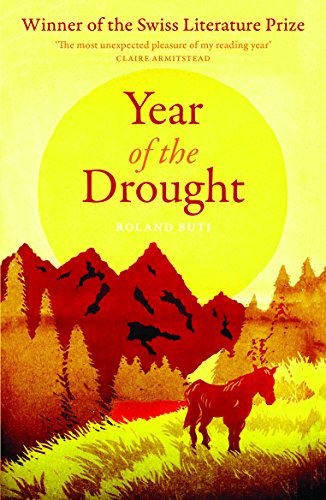 This Swiss novella takes place during the infamous European heat wave that people still talk about half a century later. It’s a perfect febrile setting for 13-year-old Gus’s coming-of-age, which includes a sexual awakening and the dawning realisation that his parents aren’t perfect; that in fact his family is falling apart. The Sutters’ operations embody the move from family smallholding to an industrial model. They keep a small number of cattle but are also experimenting with large-scale henhouses holding thousands of birds. In contrast with that vast flock, about whose welfare the characters seem indifferent, is an injured white dove that Gus finds and keeps as a pet. (A wise choice by Buti: it’s easier to feel compassion for an individual, such as the dove or the old farm horse, Bagatelle, than for a faceless mass.) Helping Gus and his father on the farm is distant cousin Rudy, who has Down’s syndrome; disrupting their routines is Cécile, Gus’s mother’s friend, who has come to stay with them.
Because of the drought, our minds were full of dreams of coolness and moisture
Dreams of rain, dreams of love, dreams of preserving some mythical family happiness that maybe never existed. Like the weather, everything goes wrong – in tragic ways. It’s all so awful I recoiled. Buti jumps ahead several decades to offer a longer view of the land, but I couldn’t ignore how casually the teenage Gus adopted his father’s violent, misogynistic ways. None of what happens bodes well for the future. The one laugh I got out of the experience was the charity shop accidentally labelling the book “Romance fiction.” (Secondhand – BHF, Newbury) 
Book 1 of The Summerhouse Trilogy
The Clothes in the Wardrobe by Alice Thomas Ellis (1987)
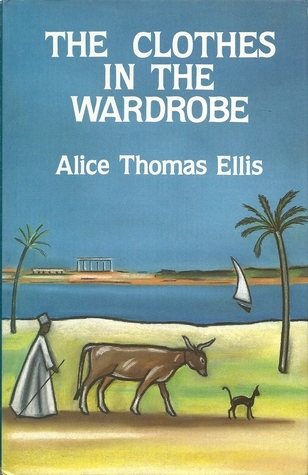 I hadn’t had great luck with Ellis, fiction and nonfiction, before, but I’m so glad I was tempted by this omnibus edition and tried her again. This melancholy, introspective novella was right up my street. Margaret’s yearning for her Egyptian upbringing isn’t the only reason I reached for Moon Tiger as a readalike; Ellis’s tone reminded me of Barbara Comyns and Penelope Lively for its mix of cynicism and nostalgia. Margaret is soon to marry Sylvester, though she doesn’t love him at all and he’s closer to her mother’s age as well as a known womanizer. Perhaps the engagement was her mother’s idea more than her own? The title is an apt symbol for living to someone else’s expectations: “my life fitted me as ill as a garment designed for somebody else,” Margaret thinks. It’s no coincidence that she’s to be married in her mother’s old wedding dress. There are also sartorial metaphors around memory (“Did the elderly have minds like old wardrobes stuffed to overflowing…”) and resistance to ageing. I marked out so many shrewd observations and witty conversations. I empathized with Margaret’s feeling of being trapped in a life she hasn’t chosen.
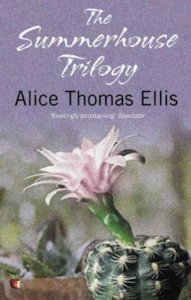 It seems like one of those books where nothing will happen, but there’s actually a surprise ending that looks set to move Margaret onto a different track. As I understand it, the other two volumes repeat the weeks leading up to the wedding from other perspectives: Margaret’s staid mother-in-law-to-be; and her mother’s bohemian friend Lili, who was her bridesmaid back in Egypt and arrives in time to shake things up. I love that premise. The omnibus cover seems random, but the question of whether the cactus in the summerhouse will flower as good luck for the wedding becomes an important plot point. I’ll jump right into Book 2. (Secondhand – Regent Books, Wantage)
The Screaming Sky by Charles Foster (2021)
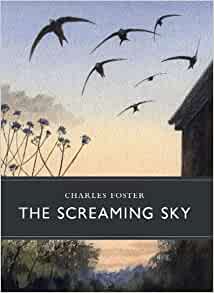 The only thing that has redeemed these dry, scorching days is the swifts screeching across the sky. How can it be that I was once unaware of them? How is it possible for people not to look up for these noisy acrobats whenever they’re outdoors? Somehow, I was oblivious until maybe 10–15 years ago. Now, I always have at least one eye on the sky during these crucial few months. And although this year swifts have been with me since early April (first in Portugal and then in our neighbourhood), I’m already dreading their departure for Africa in a few weeks. They’re still here! I trill to myself each morning. But soon that won’t be true. And with populations in freefall, there may come a day when they don’t return to the UK at all.
Charles Foster is a kindred spirit who sets similar emotional store by the presence or absence of the common swift (Apus apus). I appreciated this when I first read it five years ago (my review), but all the more so now. The monograph takes us through one year with swifts. In the summer, he needs travel no further than his own street in Oxford, but the rest of the time he has to chase them down in continental Europe and central and southern Africa. It’s an old-fashioned quest, a romantic pursuit, a hopeless attempt to keep hold of creatures as fast and elusive as the wind. Foster salts his narrative with all the salient facts but acknowledges that, for all we claim to know about them, these birds retain an essential magic and mystery. “Their power, freedom and joy are the way that everything really is – though we don’t usually see it. It is just that when the swifts scream through the sky, you can’t miss it. That’s how everything, all the time, is meant to be.” (Review copy from Little Toller Books)
My original rating:
My rating now: 
Bonus content:
From Robert Macfarlane’s The Book of Birds (illus. Jackie Morris):
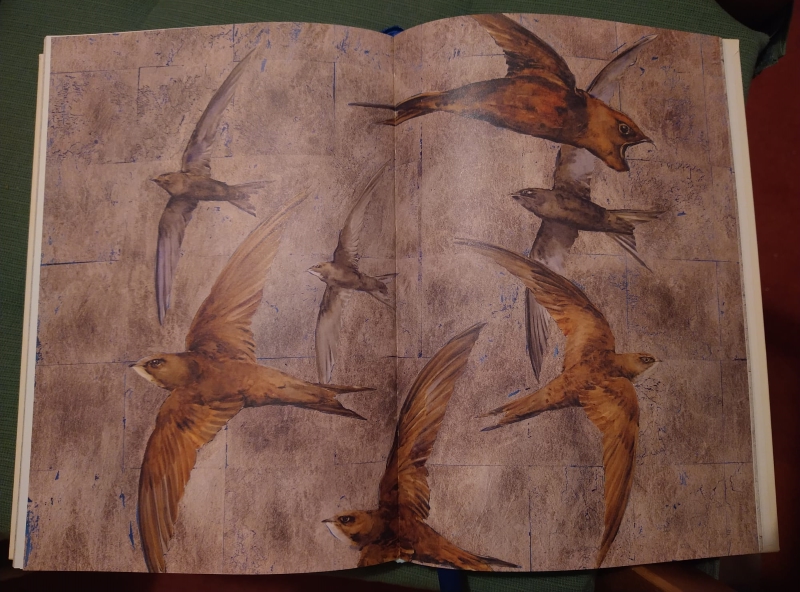
From the Spell Songs album Let the Light In: “Swifts”
& My current earworm, also featuring Kris Drever: a more general reassurance – or at least philosophical acceptance – that change is the one constant in life, in perfect pop song form (“Change”)
And from Ugandan poet Nick Makoha’s The New Carthaginians: “in the first part of the night, I saw the coastal villages, men arguing / about the price of oil and swifts darting into shadows.” (from “Codex© of Birds”)
Kakigori Summer by Emily Itami (2025)
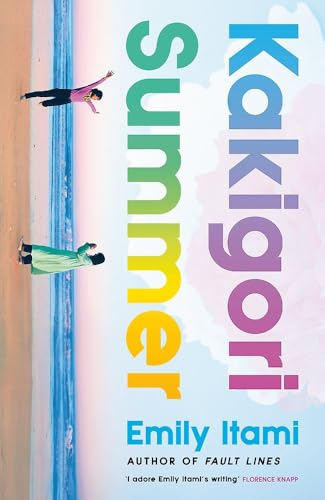 Itami was shortlisted for a Costa Award for her enjoyable 2021 debut, Fault Lines. Kakigori is a flavoured shaved-ice dessert and it’s a great choice of title for this bittersweet – but mostly sweet – story of three sisters raised between Tokyo and London who reunite in Japan to spend a summer together with their prickly great-grandmother, Obaachan, who’s nearing 100. Narration alternates between Rei, the oldest, who has a high-flying finance job and keeps everyone in line; Kiki, who’s a single mother and works in a care home for the elderly; and Ai, a flighty pop star now in disgrace for her affair with a married man. Although there is much joy in their banter, little Hikaru’s antics, and the pursuit of the finest culinary treats, a shadow over it all is their mother’s unexplained death. She went for a swim one day when they were girls and never came back, nor was a body ever found; they have to suspect suicide. (“Well, that’s that, then. Nothing will be all right ever again.”) This easy-reading novel affirms the goodness of life despite the reality of death. Its typically Japanese feasts and funerary rites brought to mind Bryan Washington’s similarly well-balanced Memorial. My only note would be that I’m not sure the voices were distinctive enough to warrant three first-person narrators; third person rotating would probably have done the job. (Public library)
Saltwater: A Midsummer Ghost Story by Elaine Thomson (2026)
“The dead are closer than we think.”
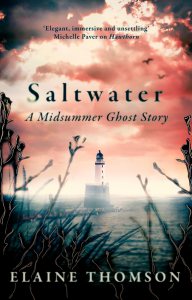 I hadn’t heard of the Scottish island of Stroma, so assumed it was made up. In fact, it’s real, lying between Orkney and the north coast of Caithness on mainland Scotland, but uninhabited as of 1962. Tom Torrance travels by train and boat from Edinburgh a few days before midsummer to oversee the last steps in the construction of the island’s lighthouse and meet with Mr Stevenson (of the famous lighthouse-building clan, which included novelist Robert Louis Stevenson). With him is his brother Jamie; he’s not of much practical help, but they cling to each other because they lost their mother to tuberculosis a week ago. The travelling minister Tom meets on the train gives him a rowan-wood amulet and cautions him that midsummer is a liminal time when the spirit world is close at hand. Tom doesn’t heed the warning. He arrives to find a disaster-prone construction project that has entailed serious injuries and broken machinery. Flora Christie and her grandmother, Thrawn Jean, are local women with healing powers who are treated with suspicion: women, especially those with red hair, are considered bad luck around boats. The men want to seal a “witch bottle” into the wall for good luck. He dismisses their superstitions but at the same time keeps seeing hallucinations of the dead in the waves and on the in-construction edifice. Is it grief, Flora’s special whisky, or a real taste of the supernatural?
This was highly reminiscent of Michelle Paver’s work. The typical Victorian-pastiche ghost story bores me because it’s always just the same: the narrator is a dignified gentleman who can’t possibly be seeing such things, yet documents them and his own horror with great precision. Thomson set herself an interesting challenge, writing a quartet of Scottish ghost stories set at turning points of the year. (This is the second, after Hawthorn.) I probably won’t try the others unless my library acquires them. (Public library) 
Adventuring (and Reading) in the Outer Hebrides
Islands are irresistible for the unique identities they develop through isolation, and the extra effort that it often takes to reach them. Over the years, my husband and I have developed a special fondness for Britain’s islands – the smaller and more remote the better. After exploring the Inner Hebrides in 2005 and Orkney and Shetland in 2006, we always intended to see more of Scotland’s islands; why ever did we leave it this long?

From Wikimedia Commons. By Kelisi.
Rail strikes and cancelled trains threatened our itinerary more than once, so it was a relief that we were able to go, even at extra cost. Our back-up plan left us with a spare day in Inverness, which we filled with coffee and pastries outside the cathedral, browsing at Leakey’s bookshop, walking along the River Ness and in the botanical gardens, and a meal overlooking the 19th-century castle.


Then it was on to the Outer Hebrides at last, via a bus ride and then a ferry to Stornoway in Lewis, the largest settlement in the Western Isles. Here we rented a car for a week to allow us to explore the islands at will. We were surprised at how major a town Stornoway is, with a big supermarket and slight suburban sprawl – yet it was dead on the Saturday morning we went in to walk around; not until 11:30 was there anything like the bustle we expected.
We’d booked three nights in a tiny Airbnb house 15 minutes from the capital. First up on our tourist agenda was Callanish stone circle, which we had to ourselves (once the German coach party left). Unlike at Stonehenge, you can walk in among the standing stones. The rest of our time on Lewis went to futile whale watching, the castle grounds, and beach walks.


This post threatens to become a boring rundown, so I’ll organize the rest thematically, introduced by songs by Scottish artists.
“I’ll Always Leave the Light On” by Kris Drever
Long days: The daylight lasts longer so far north, so each day we could plan activities not just for the morning and afternoon but late into the evening. At our second stop – three nights in another Airbnb on North Uist – we took walks after dinner, often not coming back until 10 p.m., at which point there was still another half-hour until sunset.
“Why Does It Always Rain on Me?” by Travis
Weather: We got a mixture of sun and clouds. It rained at least a bit on most days, and we got drenched twice, walking out to an eagle observatory on Harris (where we saw no eagles, as they are too sensible to fly in the rain) and dashing back to the car from a coastal excursion. I was doomed to wearing plastic bags around my feet inside my disintegrating hiking boots for the rest of the trip. There was also a strong wind much of the time, which made it feel colder than the temperature suggested – I often wore my fleece and winter hat.

A witty approach to weather forecasting. (Outside the shop/bistro on Berneray.)
“St Kilda Wren” by Julie Fowlis
 Music and language: Julie Fowlis is a singer from North Uist who records in English and Gaelic. (This particular song is in Gaelic, but the whole Spell Songs album was perfect listening on our drives because of the several Scottish artists involved and the British plants and animals sung about.) There is a strong Gaelic-speaking tradition in the Western Isles. We heard a handful of people speaking it, all road signs give place names in Gaelic before the English translation, and there were several Gaelic pages in the free newspaper we picked up.
Wildlife: The Outer Hebrides is a bastion for some rare birds: the corncrake, the red-necked phalarope, and both golden and white-tailed eagles. Thanks to intel gleaned from Twitter, my husband easily found a phalarope swimming in a small roadside loch. Corncrakes hide so well they are virtually impossible to see, but you will surely hear their rasping calls from the long grass. Balranald is the westernmost RSPB reserve and a wonderful place to hear corncrakes and see seabirds flying above the machair (wildflower-rich coastal grassland). No golden eagles, but we did see a white-tailed eagle flying over our accommodation on our last day, and short-eared owls were seemingly a dime a dozen. We were worried we might see lots of dead birds on our trip due to the avian flu raging, but there were only five – four gannets and an eider – and a couple looked long dead. Still, it’s a distressing situation.


We also attended an RSPB guided walk to look for otters and did indeed spot one on a sea loch. It happened to be the Outer Hebrides Wildlife Festival week. Our guide was knowledgeable about the geography and history of the islands as well.

Badges make great, cheap souvenirs!
St. Kilda: This uninhabited island really takes hold of the imagination. It can still be visited, but only via a small boat through famously rough seas. We didn’t chance it this time. I might never get there, but I enjoy reading about it. There’s a viewing point on North Uist where one can see out to St. Kilda, but it was only the vaguest of outlines on the hazy day we stopped.
“Traiveller’s Joy” by Emily Smith
Additional highlights:
- An extended late afternoon tea at Mollans rainbow takeaway shed on Lewis. Many of the other eateries we’d eyed up in the guidebook were closed, either temporarily or for good – perhaps an effect of Covid, which hit just after the latest edition was published.


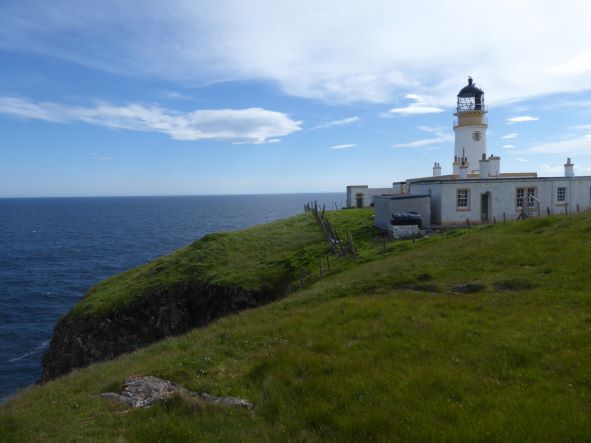
- A long reading session with a view by the Butt of Lewis, which has a Stevenson lighthouse.
- Watching mum and baby seals playing by the spit outside our B&B window on Berneray.
- Peat smoked salmon. As much of it as I could get.
- A G&T with Harris gin (made with kelp).
“Dear Prudence” (Beatles cover) by Lau
Surprises:
- Gorgeous, deserted beaches. This is Luskentyre on Harris.

- No midges to speak of. The Highlands are notorious for these biting insects, but the wind kept them away most of the time we were on the islands. We only noticed them in the air on one still evening, but they weren’t even bad enough to deploy the Avon Skin So Soft we borrowed from a neighbour.
- People still cut and burn peats for fuel. Indeed, when we stepped into the Harris gin distillery for a look around, I was so cold and wet that I warmed my hands by a peat fire! Even into the 1960s, people lived in primitive blackhouses, some of which have now been restored as holiday rentals. The one below is run as a museum.

- Not far outside Stornoway is the tiny town of Tong. We passed through it each day. Here Mary Anne MacLeod was born in 1912. If only she’d stayed on Lewis instead of emigrating to New York City, where she met Fred Trump and had, among other children, a son named Donald…
- Lord Leverhulme, founder of Unilever, bought Lewis in 1918 and part of Harris the next year. He tried to get crofters to work in his businesses, but all his plans met with resistance and his time there was a failure, as symbolized by this “bridge to nowhere” (Garry Bridge). His legacy is portrayed very differently here compared to in Port Sunlight, the factory workers’ town he set up in Merseyside.

- The most far-flung Little Free Library I’ve ever visited (on Lewis).

- Visits from Lulu the cat at our North Uist Airbnb.

“Wrapped Up in Books” by Belle and Sebastian
What I read: I aimed for lots of relevant on-location reads. I can’t claim Book Serendipity: reading multiple novels set on Scottish islands, it’s no surprise if isolation, the history of the Clearances, boat rides, selkies and seabirds recur. However, the coincidences were notable for one pair, Secrets of the Sea House by Elisabeth Gifford and Night Waking by Sarah Moss, a reread for me. I’ll review these two together, as well as The Summer of the Bear by Bella Pollen (inspired by a real incident that occurred on North Uist in 1980), in full later this week.

I also read about half of Sightlines by Kathleen Jamie, a reread for me; its essays on gannets and St. Kilda chimed with the rest of my reading. Marram, Leonie Charlton’s memoir of pony trekking through the Outer Hebrides, will form part of a later 20 Books of Summer post thanks to the flora connection, as will Jon Dunn’s Orchid Summer, one chapter of which involves a jaunt to North Uist to find a rare species.


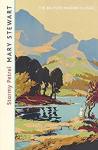 Stormy Petrel by Mary Stewart: My selection for the train journey up. I got Daphne du Maurier vibes from this short novel about a holiday Dr Rose Fenemore, an English tutor at Cambridge, takes to Moila, a (fictional) small island off of Mull in the Inner Hebrides. It’s a writing retreat for her: she’s working on a book of poetry, but also on the science fiction she publishes under a pseudonym. Waiting for her brother to join her, she gets caught up in mild intrigue when two mysterious men enter her holiday cottage late one stormy night. Each has a good excuse cooked up, but who can she trust? I enjoyed the details of the setting but found the plot thin, predictable and slightly silly (“I may be a dish, but I am also a don”). This feels like it’s from the 1950s, but was actually published in 1991. I might try another of Stewart’s.
I also acquired four books on the trip: one from the Little Free Library and three from Inverness charity shops.

I started reading all three in the bottom pile, and read a few more books on my Kindle, two of them for upcoming paid reviews. The third was:
 Tracy Flick Can’t Win by Tom Perrotta: A sequel to Election, which you might remember as a late-1990s Reese Witherspoon film even if you don’t know Perrotta’s fiction. Tracy Flick was the goody two-shoes student who ran for school president and had her campaign tampered with. Now in her forties, she’s an assistant principal at a high school and a single mother. Missing her late mother and wishing she’d completed law school, she fears she’ll be passed over for the top job when the principal retires. This is something of an attempt to update the author’s laddish style for the #MeToo era. Interspersed with the third-person narration are snappy first-person testimonials from Tracy, the principal, a couple of students, and the washed-up football star the school chooses to launch its new Hall of Fame. I can’t think of any specific objections, but nor can I think of any reason why you should read this.
On my recommendation, my husband read Love of Country by Madeleine Bunting and The Frayed Atlantic Edge by David Gange, two excellent nonfiction books about Britain’s islands and coastline.
“Other Side of the World” by KT Tunstall
General impressions: We weren’t so taken with Lewis on the whole, but absolutely loved what we saw of Harris on our drive to the ferry to Berneray and wished we’d allotted it more time. While we only had one night on Berneray and mostly saw it in the rain, we thought it a lovely little place. It only has the one shop, which doubles as the bistro in the evenings – warned by the guidebook that this is the only place to eat on the island, we made our dinner reservation many weeks in advance. The following morning, as we ate our full Scottish cooked breakfast, I asked the B&B owner what led him to move from England to “the ends of the earth.” He took mild objection to my tossed-off remark and replied that the islands are more like “the heart of it all.” Thanks to fast Internet service, remote working is no issue.


We are more than half serious when we talk about moving to Scotland one day. We love Edinburgh, though the tourists might drive us mad, and enjoyed our time in Wigtown four years ago. I’d like to think we could even cope with island life in Orkney or the Hebrides. We imagine them having warm, tight-knit communities, but would newcomers feel welcome? With only one major supermarket in the whole Western Isles, would we find enough fresh fruit and veg? And however would one survive the bleakness of the winters?
North Uist captivated us right away, though. Within 15 minutes of driving onto the island via a causeway, we’d seen three short-eared owls and three red deer stags, and we got great views of hen harriers and other raptors. One evening we found ourselves under what seemed to be a raven highway. It felt unlike anywhere else we’d been: pleasingly empty of humans, and thus a wildlife haven.
The long journey home: The public transport nightmares of our return trip put something of a damper on the end of the holiday. We left the islands via a ferry to Skye, where we caught a bus. So far, so good. Our second bus, however, broke down in the middle of nowhere in the Highlands and the driver plus we five passengers were stuck for 3.5 hours awaiting a taxi we thought would never come. When it did, it drove the winding road at terrifying speed through the pitch black.
Grateful to be alive, we spent the following half-day in Edinburgh, bravely finding brunch, the botanic gardens and ice cream with our heavy luggage in tow. The final leg home, alas, was also disrupted when our overcrowded train to Reading was delayed and we missed the final connection to Newbury, necessitating another taxi – luckily, both were covered by the transport operators, and we’ll also reclaim for our tickets. Much as we believe in public transport and want to support it, this experience gave us pause. Getting to and around Spain by car was so much easier, and that trip ended up a lot cheaper, too. Ironic!

Guarding the bags in Edinburgh
“Take Me Back to the Islands” by Idlewild
Next time: On this occasion we only got as far south as Benbecula (which, pleasingly, is pronounced Ben-BECK-you-luh). In the future we’d think about starting at the southern tip and seeing Barra, Eriskay and South Uist before travelling up to Harris. We’ve heard that these all have their own personalities. Now, will we get back before many more years pass?
Swedish Death Cleaning (#NordicFINDS and #ReadIndies) & Three Rereads
An unexpected opportunity to contribute another post for Nordic FINDS this week (after my skim of Sophie’s World): yesterday we went into London – for just the second time since the pandemic started – and I took along a couple of novella-length books, one of them this Swedish nonfiction work that I picked up from a charity shop the other week. As it was released by Canongate in 2017, it also fits into Karen and Lizzy’s Read Indies challenge.
Our previous London trip was to see Bell X1 play at Union Chapel back in December. Yesterday was also for a gig, this time The Lost Words: Spell Songs playing Cadogan Hall. I’d been dubious about this ensemble project based on Robert Macfarlane and Jackie Morris’s The Lost Words and The Lost Spells but ended up loving both books as well as the two albums of folk/world music based on them, and it was a brilliant evening of music.
Anyway, on to the books. I also reread a novella in advance of book club, so afterwards I’ll take a quick look at the rereading I’ve done so far this year.
Döstädning: The Gentle Art of Swedish Death Cleaning by Margareta Magnusson
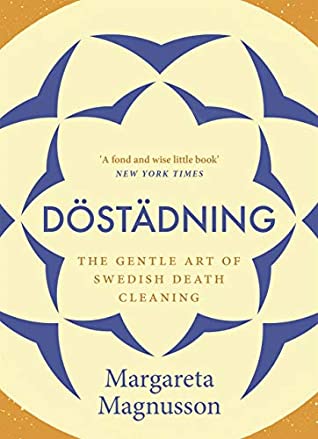 This is not about trauma cleaning, but downsizing and culling possessions so that the burden doesn’t fall to your children or other relatives after your death. Magnusson, who is in her 80s, has experience with death cleaning: first after her mother’s death, then after her mother-in-law’s, and finally after her husband’s, when she decided to move from the family home to a small flat. I enjoyed the little glimpses into her life as a mother of five and an artist. The family moved around a lot for her husband’s work, living in the USA and Singapore. She makes more of an allowance for possessions that hold sentimental value (especially photos and letters), being more concerned about the accumulation of STUFF.
As for general strategies, she suggests starting the process c. age 65 and beginning with the big things, from furniture on down, so that you make visible progress right away. “I’ve discovered that it is rewarding to spend time with these objects one last time and then dispose of them.” She goes category by category through her possessions. Clothing and cookbooks are pretty easy to shed: get rid of whatever doesn’t fit or suit you anymore, and only keep a couple of much-used cookbooks; you can find most any recipe on the Internet these days, after all. Leave the emotional material for last or you’ll get bogged down, she advises – you can take your time and enjoy reminiscing as you look through mementoes later on. She even considers what to do about old pets.
To let things, people and pets go when there is no better alternative is a lesson that has been very difficult for me to learn, and it is a lesson that life, as it goes further along, is teaching me more and more often.
Magnusson writes that she does not intend this to be a sad book, and it’s mostly very practical and unsentimental, even funny at times: on disposing of secret stuff, “save your favourite dildo but throw away the other fifteen!”; a little section on the perils of “man caves” and her memories of her clumsy cat Klumpeduns. I also laughed at the concept of a fulskåp (“a cabinet for the ugly”) for unwanted gifts that must eventually be rehomed or disposed of.
One problem that I have with decluttering books in general is that there isn’t enough of an anti-consumerist and green message. One, don’t accumulate the stuff in the first place (and reuse and buy secondhand wherever possible); two, possessions should almost never be thrown away, and only as an absolute last resort after doing everything possible to repair, refurbish, rehome or recycle them.
This was an enjoyable little book that I’ll pass on to someone else who might find it useful (so long as it’s not considered too on the nose as a book recommendation!), but it didn’t necessarily add anything for me beyond what I’d encountered in Outer Order, Inner Calm by Gretchen Rubin and Year of No Clutter by Eve O. Schaub. (Secondhand purchase) 
[I’m a little confused as to whether this is in translation or not. It first appeared in Swedish, but as no translator is listed anywhere in the copyright info, I assume that Magnusson translated it herself. Apart from some wrong number/amount and during/over choices, it reads like a native speaker’s work.]
2022’s Rereading
I’ve reread three books so far this year, which for me is pretty good going. It helped that all three were novella length, and I had book club as an excuse to return to the two novels.
 The Sense of an Ending by Julian Barnes was the other book I popped in the back of my purse for yesterday’s London outing. Barnes is one of my favourite authors – I’ve read 21 books by him now! – but I remember not being very taken with this Booker winner when I read it just over 10 years ago. (I prefer to think of his win as being for his whole body of work as he’s written vastly more original and interesting books, like Flaubert’s Parrot.) It’s the story of an older man looking back on his youth, and his friend’s suicide, in the light of what he learns after a somewhat mysterious bequest. The themes of history, memory and regret certainly mean more to me now in my late 30s than they did in my late 20s, but I still find this work a little lightweight; sordid, too. (Free from mall bookshop)
Readalikes: Any Human Heart by William Boyd, Moon Tiger by Penelope Lively, The Child in Time by Ian McEwan
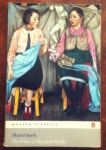 The Prime of Miss Jean Brodie by Muriel Spark was January’s book club selection. I had remembered no details apart from the title character being a teacher. It’s a between-the-wars story set in Edinburgh. Miss Brodie’s pet students are girls with attributes that remind her of aspects of herself. Our group was appalled at what we today would consider inappropriate grooming, and at Miss Brodie’s admiration for Hitler and Mussolini. Educational theory was interesting to think about, however. Spark’s work is a little astringent for me, and I also found this one annoyingly repetitive on the sentence level. (Public library)
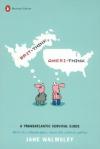 Brit-Think, Ameri-Think: A Transatlantic Survival Guide by Jane Walmsley: This is the revised edition from 2003, so I must have bought it as preparatory reading for my study abroad year in England. This may even be the third time I’ve read it. Walmsley, an American in the UK, compares Yanks and Brits on topics like business, love and sex, parenting, food, television, etc. I found my favourite lines again (in a panel entitled “Eating in Britain: Things that Confuse American Tourists”): “Why do Brits like snacks that combine two starches? (a) If you’ve got spaghetti, do you really need the toast? (b) What’s a ‘chip-butty’? Is it fatal?” The explanation of the divergent sense of humour is still spot on, and I like the Gray Jolliffe cartoons. Unfortunately, a lot of the rest feels dated – she’d updated it to 2003’s pop culture references, but these haven’t aged well. (New purchase?)
 Bookish Beck = Rebecca Foster. American transplant to England. Freelance proofreader and book reviewer.
