Book Serendipity, 2019 Second Half
I call it serendipitous when two or more books that I’m reading at the same time or in quick succession have something pretty bizarre in common. Because I have so many books on the go at once – usually between 10 and 20 – I guess I’m more prone to such incidents. I post these occasional reading coincidences on Twitter. What’s the weirdest one you’ve had lately? (The following are in rough chronological order.)
[Previous 2019 Book Serendipity posts from April and July.]
- Two novels in which a character attempts to glimpse famous mountains out of a train window but it’s so rainy they can barely be seen: The Unchangeable Spots of Leopards by Kristopher Jansma and The Pine Islands by Marion Poschmann.


- Ex-husbands move from England to California and remarry younger women in The Stillness The Dancing by Wendy Perriam and Heat Wave by Penelope Lively.
 References to Edgar Allan Poe in both Timbuktu by Paul Auster and The Unchangeable Spots of Leopards by Kristopher Jansma.
- An account of Percy Shelley’s funeral pyre in both The Unchangeable Spots of Leopards by Kristopher Jansma and Frankissstein by Jeanette Winterson.
- Mentions of barn owls being killed by eating poisoned rats in Owl Sense by Miriam Darlington and Homesick by Catrina Davies.


- Miriam Rothschild is mentioned in Irreplaceable by Julian Hoffman and An Obsession with Butterflies by Sharman Apt Russell.
- Gorse is thrown on bonfires in Homesick by Catrina Davies and The Stillness The Dancing by Wendy Perriam.
 A character has a nice cup of Ovaltine in Some Tame Gazelle by Barbara Pym and The Stillness The Dancing by Wendy Perriam.
- I started two books with “Bloom” in the title on the same day.

 Two books I finished about the same time conclude by quoting or referring to the T. S. Eliot lines about coming back to the place where you started and knowing it for the first time (Owl Sense by Miriam Darlington and This Is Not a Drill, the Extinction Rebellion handbook).
- Three books in which the narrator wonders whether to tell the truth slant (quoting Emily Dickinson, consciously or not): The Unchangeable Spots of Leopards by Kristopher Jansma, The Poisonwood Bible by Barbara Kingsolver and The Hiding Game by Naomi Wood.
- On the same day, I saw mentions of crullers in both On Chapel Sands by Laura Cumming and The Dutch House by Ann Patchett.


- There are descriptions of starling murmurations over Brighton Pier in both Irreplaceable by Julian Hoffman and Expectation by Anna Hope. (Always brings this wonderful Bell X1 song to mind!)
- I was reading The Outermost House by Henry Beston and soon after found an excerpt from it in Irreplaceable by Julian Hoffman; later I started The Easternmost House by Juliet Blaxland, whose title is a deliberate tip of the hat to Beston.
 At a fertility clinic, the author describes a pair of transferred embryos as “two sequins of light” (in On Chapel Sands by Laura Cumming) and “two points of light” (in Expectation by Anna Hope).
- Mentions of azolla ferns in Time Song by Julia Blackburn and Bloom (aka Slime) by Ruth Kassinger.
 Incorporation of a mother’s brief memoir in the author’s own memoir in On Chapel Sands by Laura Cumming and All Things Consoled by Elizabeth Hay.
- Artist mothers in On Chapel Sands by Laura Cumming, All Things Consoled by Elizabeth Hay, and Expectation by Anna Hope.
- Missionary fathers in The Poisonwood Bible by Barbara Kingsolver and The Wind that Lays Waste by Selva Almada.


- Twins, one who’s disabled from a birth defect and doesn’t speak much, in Golden Child by Claire Adam and The Poisonwood Bible by Barbara Kingsolver.
 An Irish-American family in a major East Coast city where the teenage boy does construction work during the summers in Ask Again, Yes by Mary Beth Keane and The Dutch House by Ann Patchett.
- SPOILERS: A woman with terminal cancer refuses treatment so she can die on her own terms and is carried out into her garden in Expectation by Anna Hope and A Reckoning by May Sarton.
- A 27-year-old professor has a student tearfully confide in her in Crow Lake by Mary Lawson and The Small Room by May Sarton.


- Reading The Yellow House by Sarah M. Broom at the same time as The Dutch House by Ann Patchett.
 “I was nineteen years old and an idiot” (City of Girls, Elizabeth Gilbert); “I was fifteen and generally an idiot” (The Dutch House, Ann Patchett).
- Mentions of a conjuring tricks book in Time Song by Julia Blackburn and Fifth Business by Robertson Davies.
- A teen fleeces their place of employment in Sweet Sorrow by David Nicholls and Who Will Run the Frog Hospital? by Lorrie Moore.


- A talking parrot with a religious owner in The Poisonwood Bible by Barbara Kingsolver and Olive Kitteridge by Elizabeth Strout.
- Pictorial book serendipity: three books I was reading, and another waiting in the wings, had a red, black and white color scheme.

 Kripalu (a Massachusetts retreat center) is mentioned in Fleishman Is in Trouble by Taffy Brodesser-Akner and Once More We Saw Stars by Jayson Greene.
- The character of Netty Quelch in Robertson Davies’s The Manticore reminds me of Fluffy in Ann Patchett’s The Dutch House.
- The artist Chardin is mentioned in How Proust Can Change Your Life by Alain de Botton and Varying Degrees of Hopelessness by Lucy Ellmann.
- A Czech grand/father who works in a plant nursery in the opening story of Andrea Barrett’s Ship Fever and Patricia Hampl’s The Florist’s Daughter.


- The author was in Eva Le Gallienne’s NYC theatre company (Madeleine L’Engle’s Two-Part Invention and various works by May Sarton, also including a biography of her).
 Gillian Rose’s book Love’s Work is mentioned in both Notes Made while Falling by Jenn Ashworth and My Year Off by Robert McCrum. (I will clearly have to read the Rose!)
- Sarah Baartman (displayed in Europe as the “Hottentot Venus”) is mentioned in Shame on Me by Tessa McWatt and Hull by Xandria Phillips.
Library Checkout: September 2019
A quieter month of trying to finish up some books that I’ve had on the go for quite a while. I give links to reviews of any books I haven’t already featured, and ratings for ones I’ve read or skimmed. What have you been reading from your local libraries? Library Checkout runs on the last Monday of every month. I don’t have an official link-up system, but feel free to use this image in your post and to leave a link to your blog in the comments if you’ve taken part.

READ
- Once More We Saw Stars: A Memoir by Jayson Greene

- The Assassination of Margaret Thatcher: Stories by Hilary Mantel

- Because: A Lyric Memoir by Joshua Mensch [poetry]

- Old Toffer’s Book of Dogs by Christopher Reid [poetry; university library]

SKIMMED
- The Lost Art of Scripture by Karen Armstrong
- The Cabaret of Plants by Richard Mabey [university library]
- The Hidden Ways: Scotland’s Forgotten Roads by Alistair Moffat

CURRENTLY READING
- Time Song: Searching for Doggerland by Julia Blackburn
- A Single Thread by Tracy Chevalier
- The Envoy from Mirror City by Janet Frame [university library]
- The Electricity of Every Living Thing: One Woman’s Walk with Asperger’s by Katherine May
- The Nickel Boys by Colson Whitehead
CURRENTLY SKIMMING
- Life Lessons from a Brain Surgeon: The New Science and Stories of the Brain by Rahul Jandial
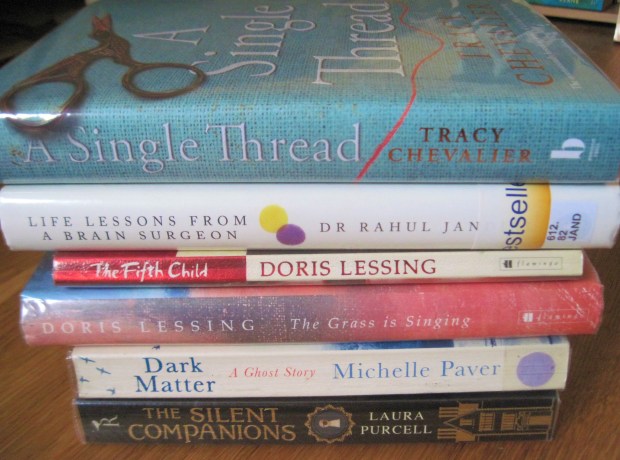
CHECKED OUT, TO BE READ (all for R.I.P.!)
- The Hoarder by Jess Kidd
- The Fifth Child by Doris Lessing
- Dark Matter by Michelle Paver
- The Silent Companions by Laura Purcell
+ Owls Do Cry by Janet Frame [university library], The Grass Is Singing by Doris Lessing
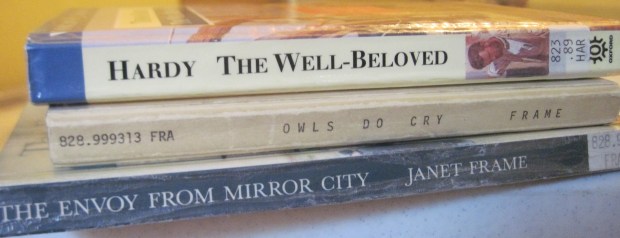
IN THE RESERVATION QUEUE
- The Easternmost House: A Year of Life on the Edge of England by Juliet Blaxland
- The Body: A Guide for Occupants by Bill Bryson
- The Confession by Jessie Burton
- The School of Life: An Emotional Education by Alain de Botton
- Girl, Woman, Other by Bernardine Evaristo
- Starve Acre by Andrew Michael Hurley
- A Half-Baked Idea: How Grief, Love and Cake Took Me from the Courtroom to Le Cordon Bleu by Olivia Potts
- Chances Are by Richard Russo
- The Poetry Pharmacy Returns: More Prescriptions for Courage, Healing and Hope by William Sieghart
- My Name Is Why: A Memoir by Lemn Sissay
- Grand Union: Stories by Zadie Smith
- Feel Free: Essays by Zadie Smith
- On Earth We’re Briefly Gorgeous by Ocean Vuong
RETURNED UNFINISHED
- The Porpoise by Mark Haddon – I read “The Flight,” the excellent 10-page prologue, which is almost like a stand-alone short story and features a terrifying plane crash and its aftermath. But after that I found I had zero interest in continuing with a Pericles update.
- The Well-Beloved by Thomas Hardy [university library]
- Dark Glasses by Blake Morrison [university library] – I read all but the final and longest poem, “The Inquisitor,” so about 50 out of 79 pages. I have trouble remembering now what the book is about, beyond, well, everything: life, family, seasons, choices, regrets.
- I Never Said I Loved You by Rhik Samadder – I read the introduction and part of the first chapter (about 12 pages). I’m not sure how I heard about it or why I thought I wanted to read it. I guess it sounded like it would be an amusing family memoir that employed humor as well as pathos when dealing with serious subjects like depression. I’d never heard of the author, though (a broadcaster and Guardian columnist), so I had no specific interest in his life story and the writing had nothing to recommend it.
- Some Hope by Edward St. Aubyn – I read the first chapter, skipped forward to read the first few pages of Chapter 10 (when Patrick tries to be more mature and nuanced in his thinking as he searches for peace of mind; it’s too simple to just loathe his father), and skimmed to the end. This is more like Never Mind than Bad News in that it returns to that shallow, glittering world of the rich partying set. I found I had trouble keeping all the secondary characters straight, and didn’t care about them; I only wanted to hear about Patrick.
RETURNED UNREAD
- If Only I Could Tell You by Hannah Beckerman – I tried the first few pages and didn’t enjoy the style. It felt awfully portentous for what is essentially women’s fiction.
Does anything appeal from my stacks?
Books of Summer #18–20: Alan Garner, Peter Matthiessen, Lorrie Moore
I’m sneaking in just in time here, on the very last day of the #20BooksofSummer challenge, with my final three reviews: two novellas, one of them a work of children’s fantasy; and a nature/travel classic that turns into something more like a spiritual memoir.
The Owl Service by Alan Garner (1967)
 I’d heard of Garner, a British writer of classic children’s fantasy novels, but never read any of his work until I picked this up from the free bookshop where I volunteer on a Friday. My husband remembers reading Elidor (also a 1990s TV series) as a boy, but I’m not sure Garner was ever well known in America. Perhaps if I’d discovered this right after the Narnia series when I was a young child, I would have been captivated. I did enjoy the rural Welsh setting, and to start with I was intrigued by the setup: curious about knocking and scratching overhead, Alison and her stepbrother Roger find a complete dinner service up in the attic of this house Alison inherited from her late father. Alison becomes obsessed with tracing out the plates’ owl pattern – which disappears when anyone else, like Nancy the cook, looks at them.
I gather that Garner frequently draws on ancient legend for his plots. Here he takes inspiration from Welsh myths, but the background was so complex and unfamiliar that I could barely follow along. This meant that the climactic ‘spooky’ scenes failed to move me. Instead, I mostly noted the period slang and the class difference between the English children and Gwyn, Nancy’s son, who’s forbidden from speaking Welsh (Nancy says, “I’ve not struggled all these years in Aber to have you talk like a labourer”) and secretly takes elocution lessons to sound less ‘common’.
Can someone recommend a Garner book I might get on with better?
My rating: 
The Snow Leopard by Peter Matthiessen (1978)
 For two months of 1973, from late September to late November, Matthiessen joined zoologist George Schaller on a journey from the Nepalese Himalayas to the Tibetan Plateau to study Himalayan blue sheep. Both also harbored a hope of spotting the elusive snow leopard.
Matthiessen had recently lost his partner, Deborah Love, to cancer, and left their children behind – at residential schools or with family friends – to go on this spirit-healing quest. Though he occasionally feels guilty, especially about the eight-year-old, his thoughts are usually on the practicalities of the mountain trek. They have sherpas to carry their gear, and they stop in at monasteries but also meet ordinary people. More memorable than the human encounters, though, are those with the natural world. Matthiessen watches foxes hunting and griffons soaring overhead; he marvels at alpine birds and flora.
The writing is stunning. No wonder this won a 1979 National Book Award (in the short-lived “Contemporary Thought” category, which has since been replaced by a general nonfiction award). It’s a nature and travel writing classic. However, it took me nearly EIGHTEEN MONTHS to read, in all kinds of fits and starts (see below), because I could rarely read more than part of one daily entry at a time. I struggle with travel narratives in general – perhaps I think it’s unfair to read them faster than the author lived through them? – but there’s also an aphoristic density to the book that requires unhurried, meditative engagement.

The mountains in their monolithic permanence remind the author that he will die. The question of whether he will ever see a snow leopard comes to matter less and less as he uses his Buddhist training to remind himself of tenets of acceptance (“not fatalism but a deep trust in life”) and transience: “In worrying about the future, I despoil the present”; what is this “forever getting-ready-for-life instead of living it each day”? I’m fascinated by Buddhism, but anyone who ponders life’s deep questions should get something out of this.
My rating: 
Who Will Run the Frog Hospital? by Lorrie Moore (1994)
Thanks to Cathy for reminding me about this one – I had intended to make it one of my novellas for November, but as I was scrambling around to find a last couple of short books to make up my 20 I thought, “Frog! hey, that fits”* and picked it up.
 Oddly, given that Moore is so well known for short stories, I’ve only ever read two of her novels (the other was A Gate at the Stairs). Berie Carr lives just over the border from Quebec in Horsehearts, a fictional town in upstate New York. She and her best friend Sils are teenagers at the tail end of the Vietnam War, and work at Storyland amusement park on the weekends and during the summer. When Sils gets into trouble, Berie starts pocketing money from the cash register to help her out, but it will only be so long until she gets caught and the course of her life changes.
Berie is recounting these pivotal events from adulthood, when she’s traveling in Paris with her husband, Daniel. There are some troubling aspects to their relationship that don’t get fully explored, but that seems to be part of the point: we are always works in progress, and never as psychologically well as we try to appear. I most enjoyed the book’s tone of gentle nostalgia: “Despite all my curatorial impulses and training, my priestly harborings and professional, courtly suit of the past, I never knew what to do with all those years of one’s life: trot around in them forever like old boots – or sever them, let them fly free?”
Moore’s voice here reminds me of Amy Bloom’s and Elizabeth McCracken’s, though I’ve generally enjoyed those writers more.
*There are a few literal references to frogs (as well as the understood slang for French people). The title phrase comes from a drawing Sils makes about their mission to find and mend all the swamp frogs that boys shoot with BB guns. Berie also remarks on the sound of a frog chorus, and notes that two decades later frogs seem to be disappearing from the earth. In both these cases frogs are metaphors for a lost innocence. “She has eaten the frog” is also, in French, a slang term for taking from the cash box.
(I can’t resist mentioning Berie and Sils’ usual snack: raw, peeled potatoes cut into quarters and spread with margarine and salt!)
My rating: 
A recap of my 20 Books of Summer:
- I enjoyed my animal theme, which was broad enough to encompass straightforward nature books but also a wide variety of memoirs and fiction. In most cases there was a literal connection between the animal in the title and the book’s subject.
- I read just nine of my original choices, plus two of the back-ups. The rest were a mixture of: books I brought back from America, review copies, books I’d started last year and set aside for ages, and ones I had lying around and had forgotten were relevant.
- I accidentally split the total evenly between fiction and nonfiction: 10 of each.
- I happened to read three novels by Canadian authors. The remainder were your usual British and American suspects.
- The clear stand-out of the 20 was Crow Planet by Lyanda Lynn Haupt, followed closely by The Snow Leopard (see above) and The Seafarers by Stephen Rutt – all nonfiction!
- In my second tier of favorites were three novels: Fifteen Dogs, The Unchangeable Spots of Leopards, and Crow Lake.

I also had three DNFs that I managed to replace in time.
Hollow Kingdom by Kira Jane Buxton [a review copy – and one of my Most Anticipated titles]
(I managed the first 36 pages.) Do you have a friend who’s intimidatingly sharp, whose every spoken or written line leaps from wordplay to a joke to an allusion to a pun? That’s how I felt about Hollow Kingdom. It’s so clever it’s exhausting.
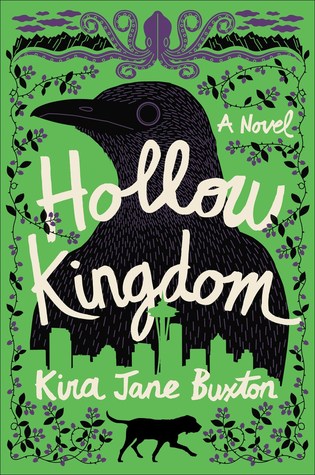 I wanted to read this because I’d heard it’s narrated by a crow. S.T. (Shit Turd) is an American Crow who lives with an electrician, Big Jim, in Seattle, along with Dennis the dumb bloodhound. One day Jim’s eyeball pops out and he starts acting crazy and spending all his time in the basement. On reconnaissance flights through the neighborhood, S.T. realizes that all the humans (aka “MoFos” or “Hollows”) are similarly deranged. He runs into a gang of zombies when he goes to the Walgreens pharmacy to loot medications. Some are even starting to eat their pets. (Uh oh.)
We get brief introductions to other animal narrators, including Winnie the Poodle and Genghis Cat. An Internet-like “Aura” allows animals of various species to communicate with each other about the crisis. I struggle with dystopian and zombie stuff, but I think I could make an exception for this. Although I do think it’s overwritten (one adverb and four adjectives in one sentence: “We left slowly to the gentle song of lugubrious paw pads and the viscous beat of crestfallen wings”), I’ll try it again someday.
 Gould’s Book of Fish: A Novel in Twelve Fish by Richard Flanagan: I read the first 164 pages last year before stalling; alas, I could make no more headway this summer. It’s an amusing historical pastiche in the voice of a notorious forger and counterfeiter who’s sentenced to 14 years in Van Diemen’s Land. I could bear only so much of this wordy brilliance, and no more.
 Tisala by Richard Seward Newton: I guess I read the blurb and thought this was unmissable, but I should have tried to read a sample or some more reviews of it. I got to page 6 and found it so undistinguished and overblown that I couldn’t imagine reading another 560+ pages about a whale.
For next year, I’m toying with the idea of a food and drink theme. Once again, this would include fiction and nonfiction that is specifically about food but also slightly more cheaty selections that happen to have the word “eats” or “ate” or a potential foodstuff in the title, or have an author whose name brings food to mind. I perused my shelf and found exactly 20 suitable books, so that seems like a sign! (The eagle-eyed among you may note that two of these were on my piles of potential reads for this summer, and two others on last summer’s. When will they ever actually get read?!)
Alternatively, I could just let myself have completely free choice from my shelves. My only non-negotiable criterion is that all 20 books must be ones that I own, to force me to get through more from my shelves (even if that includes review copies).


How did you fare with your summer reading?
Library Checkout: August 2019
Lots of buzzy books this month, some of which lived up to the hype and some of which did not entirely. Many of these were requested after me, so I’ve had to be snappy and read them within three weeks. Most I’ve already written about here, but I give links to reviews of any that I haven’t already featured, and ratings for the ones I’ve read or skimmed. What have you been reading from your local library? Library Checkout runs on the last Monday of every month. I don’t have an official link-up system, but feel free to use this image in your post and to leave a link to your blog in the comments if you’ve taken part.
READ
- Golden Child by Claire Adam
- On Chapel Sands: My Mother and Other Missing Persons by Laura Cumming
- An Angel at My Table by Janet Frame [university library]
- Expectation by Anna Hope

- The Poisonwood Bible by Barbara Kingsolver [university library; a reread]
- Sweet Sorrow by David Nicholls
- The Pine Islands by Marion Poschmann
- A Reckoning by May Sarton [university library]
- The Hiding Game by Naomi Wood
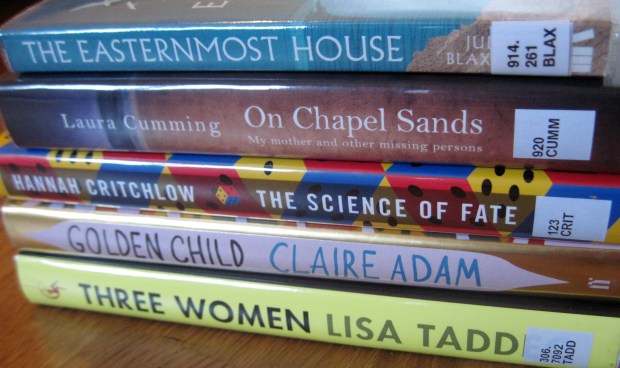
SKIMMED
- The Science of Fate: Why Your Future Is More Predictable than You Think by Hannah Critchlow

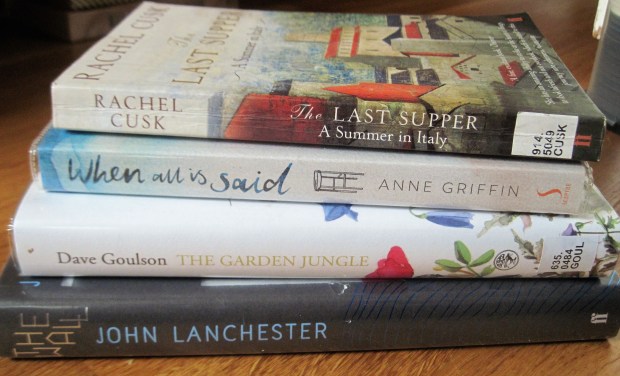
- The Last Supper: A Summer in Italy by Rachel Cusk
- The Garden Jungle: Or Gardening to Save the Planet by Dave Goulson
- The Sun Does Shine by Anthony Ray Hinton
CURRENTLY READING
- Time Song: Searching for Doggerland by Julia Blackburn
- Our Place: Can We Save Britain’s Wildlife before It Is Too Late? by Mark Cocker [set aside temporarily]
- Once More We Saw Stars by Jayson Greene
- Bodies in Motion and at Rest by Thomas Lynch [university library]
- The Electricity of Every Living Thing: One Woman’s Walk with Asperger’s by Katherine May
- Because: A Lyric Memoir by Joshua Mensch
- Dark Glasses by Blake Morrison [poetry; university library]
- Old Toffer’s Book of Dogs by Christopher Reid [poetry; university library]
CHECKED OUT, TO BE READ
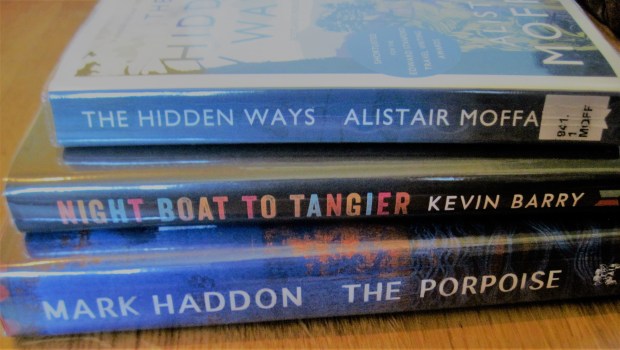
- The Night Boat to Tangier by Kevin Barry
- The Porpoise by Mark Haddon
- The Hidden Ways: Scotland’s Forgotten Roads by Alistair Moffat
I’ve also had a recent stock-up on university library books via my husband – not that I needed any more books!
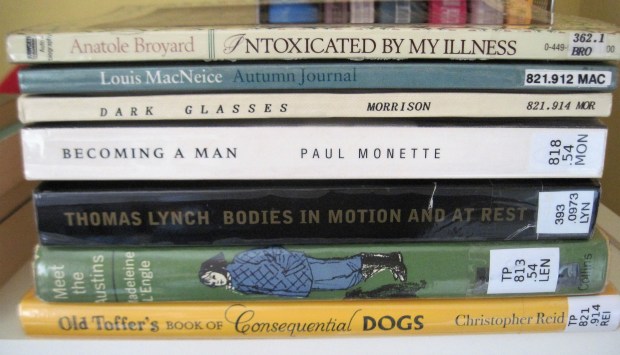
- Intoxicated by My Illness by Anatole Broyard
- Meet the Austins by Madeleine L’Engle
- Autumn Journal by Louis MacNeice
- Becoming a Man: Half a Life Story by Paul Monette
IN THE RESERVATION QUEUE
- The Lost Art of Scripture by Karen Armstrong
- If Only I Could Tell You by Hannah Beckerman
- The Easternmost House: A Year of Life on the Edge of England by Juliet Blaxland
- The Body: A Guide for Occupants by Bill Bryson
- The Confession by Jessie Burton
- A Single Thread by Tracy Chevalier
- The School of Life: An Emotional Education by Alain de Botton
- Akin by Emma Donoghue
- A Short History of Falling: Everything I Observed about Love whilst Dying by Joe Hammond
- Starve Acre by Andrew Michael Hurley
- The Man Who Saw Everything by Deborah Levy
- I Never Said I Loved You by Rhik Samadder
- The Poetry Pharmacy Returns: More Prescriptions for Courage, Healing and Hope by William Sieghart
- Feel Free: Essays by Zadie Smith
- The Nickel Boys by Colson Whitehead
RETURNED UNFINISHED
- Multitudes: Eleven Stories by Lucy Caldwell – I enjoyed the short opener, “The Ally Ally O,” which describes a desultory ride in the car with mother and sisters with second-person narration and no speech marks. I should have given up on “Thirteen,” though, a tired story of a young teen missing her best friend; she tries drinking, boys and parties, but her heart’s not really in it. I couldn’t face any more stories of troubled adolescence.
- How to Treat People: A Nurse’s Notes by Molly Case – I read the first 77 pages. Her writing about her nursing training and the patients she encountered is pleasant enough, but I found the structure (Airway – Breathing – Circulation – Disability – Exposure) clichéd and too similar to the Aoife Abbey book I DNFed earlier in the year. If you’re going to read a book about nursing it might as well be Christie Watson’s The Language of Kindness.
- I Want to Show You More by Jamie Quatro – I read the first two stories, a total of 18 pages. “Decomposition,” about a woman’s lover magically becoming a physical as well as emotional weight on her and her marriage, has an interesting structure as well as second-person narration, but I fear the collection as a whole will just be a one-note treatment of a woman’s obsession with her affair. The same goes for Fire Sermon, which I’m taking off my TBR.
- Three Women by Lisa Taddeo – I read the Author’s note and Prologue; I skimmed the Epilogue. That was enough. I feel about this book the way I did about My Absolute Darling: so many have acclaimed it as brilliant, but I don’t feel any need to expose myself to the disturbing content. Many trusted reviewers have concluded that, despite her stated aims, Taddeo doesn’t say anything original about female desire.
RETURNED UNREAD
- How Do You Like Me Now? by Holly Bourne – lost interest; wasn’t drawn in by the first few pages.
- The Brief Wondrous Life of Oscar Wao by Junot Díaz – This was a university library book that sat on my bedside shelf for … months? Maybe even years? I finally decided it was time to let it go. Perhaps another time.
- When All Is Said by Anne Griffin – Well, this is a first: The book is so heavily perfumed from its last borrower’s wrists that I can’t bear to read this paperback; I’ll have to place a reserve on the hardback instead to ensure I don’t encounter this copy again.
- The Wall by John Lanchester – lost interest; wasn’t drawn in by the first few pages.
- Mason & Dixon by Thomas Pynchon – Just glancing at the first few pages was daunting enough. I thought this historical fiction epic about the eighteenth-century surveyors’ travels sounded like the Pynchon I’d enjoy most and would make a good doorstopper. But it hung around for so many months unread that, like Oscar Wao, I finally gave up on it.
- The Farm by Joanne Ramos – lost interest; wasn’t drawn in by the first few pages.
Does anything appeal from my stacks?
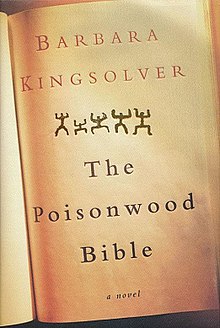
Doorstopper of the Month: A Reread of The Poisonwood Bible (1998)
“The fallen Congo came to haunt even our little family, we messengers of goodwill adrift on a sea of mistaken intentions.”
You may have gathered by now that I struggle with rereading. Often I find that on a second reading a book doesn’t live up to my memory of it – last year I reread just four books, and I rated each one a star lower than I had the first time. But that wasn’t the case with my September book club book, Barbara Kingsolver’s The Poisonwood Bible, which I’ve just flown through in 11 days. I first read it in the spring of 2002 or 2003, so maybe it’s that I’d allowed enough time to pass for it to be almost completely fresh – or that I was in a better frame of mind to appreciate its picture of harmful ideologies in a postcolonial setting. In any case, this time it struck me as a masterpiece, and has instantly leapt onto my favorites list.
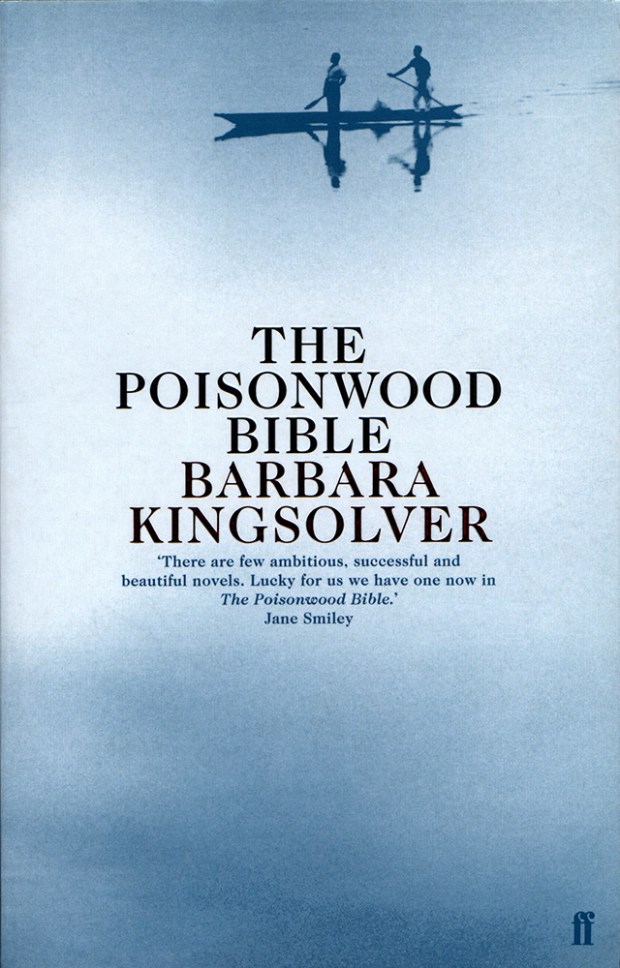
Here’s what I’d remembered about The Poisonwood Bible after the passage of 16–17 years:
- It’s about a missionary family in Africa, and narrated by the daughters.
- One of the sisters marries an African.
- The line “Nathan was made frantic by sex” (except I had it fixed incorrectly in my mind; it’s actually “Nathan was made feverish by sex”).
Everything else I’d forgotten. Here’s what stood out on my second reading:
- Surely one of the best opening lines ever? (Though technically there’s a prologue that comes before it.) “We came from Bethlehem, Georgia, bearing Betty Crocker cake mixes into the jungle.”
- The book is actually narrated in turns by the wife and four daughters of Southern Baptist missionary Nathan Price, who arrives in the Congo with his family in 1959. These five voices are a triumph of first-person narration, so distinct and arising organically from the characters’ personalities and experiences. The mother, Orleanna, writes from the future in despondent isolation – a hint right from the beginning that this venture is not going to end well. Fifteen-year-old Rachel is a selfish, ditzy blonde who speaks in malapropisms and period slang and misses everything about American culture. Leah, one of the 13-year-olds, is whip-smart and earnest; she idolizes their father and echoes his religious language. Her twin, Adah, who was born with partial paralysis, rarely speaks but has an intricate inner life she expresses through palindromes, cynical poetry and plays on words. And Ruth May, just five years old, sees more than she understands and sets it all across plainly but wittily.
- Nathan’s arrogant response to the ‘native customs’ is excruciating. His first prayer, spoken to bless the meal the people of Kilanga give in welcome, quickly becomes a diatribe against nakedness, and he later rails against polygamy and witch doctors and tries to enforce child baptism. When he refuses to take their housekeeper Mama Tataba’s advice on planting, all of the seeds he brought from home wash away in the first rainstorm. On a second attempt he meekly makes the raised beds she recommended, and keeps away from the poisonwood that made him break out in a nasty rash. This garden he plants is a metaphor for control versus adaptation.
- Brother Fowles, Nathan’s predecessor at the mission, is proof that Christianity doesn’t have to be a haughty rampage. He respects Africans enough to have married one, and his religion is a playful, elastic one built around love and working alongside creation.
- The King James Bible (plus Apocrypha, for which Nathan harbors a strange fondness) provides much of the book’s language and imagery, as well as the section headings. Many of these references come to have (sometimes mocking) relevance. Kingsolver also makes reference to classics of Africa-set fiction, like Chinua Achebe’s Things Fall Apart and Joseph Conrad’s Heart of Darkness.
- Africa is a place of many threats – malaria and dysentery, snakes in the chicken house, swarms of ants that eat everything in their path, corruption, political coups and assassinations – not least the risk of inadvertently causing grave cultural offense.
- The backdrop of the Congo’s history, especially the declaration of independence in 1960 and the U.S.-led “replacement” (by assassination) of its first prime minister, Patrice Lumumba, with the dictator Mobutu, is thorough but subtle, such that minimal to no Googling is required to understand the context. (Only in one place, when Leah and Rachel are arguing as adults, does Kingsolver resort to lecturing on politics through dialogue, as she does so noticeably in Unsheltered.)
- Names are significant, as are their changes. With the end of colonialism Congo becomes Zaire and all its cities and landmarks are renamed, but the change seems purely symbolic. The characters take on different names in the course of the book, too, through nicknames, marriage or education. Many African words are so similar to each other that a minor mispronunciation by a Westerner changes the meaning entirely, making for jokes or irony. And the family’s surname is surely no coincidence: we are invited to question the price they have paid by coming to Africa.
- We follow the sisters decades into the future. “Africa has a thousand ways to get under your skin,” Leah writes; “we’ve all ended up giving up body and soul to Africa, one way or another.” Three of the four end up staying there permanently, but disperse into different destinies that seem to fit their characters. Even those Prices who return to the USA will never outrun the shadow the Congo has left on their lives.
 What an amazing novel about the ways that right and wrong, truth and pain get muddied together. Some characters are able to acknowledge their mistakes and move on, while others never can. As Adah concludes, “We are the balance of our damage and our transgressions.”
I worried it would be a challenge to reread this in time to hand it over for my husband to take on his week-long field course in Devon, but it turned out to be a cinch. That’s the mark of success of a doorstopper for me: it’s so engrossing you hardly notice how long the book is. I think this will make for our best book club discussion yet. I can already think of a few questions to ask – Is it fair that Nathan never gets to tell his side of the story? Which of the five voices is your favorite? Who changes and who stays the same over the course of the book? – and I’m sure I’ll find many more resources online since this was an Oprah’s Book Club pick too.
English singer-songwriter Anne-Marie Sanderson’s excellent Book Songs, Volume 1 EP includes the song “Poisonwood.” The excerpted lyrics are below, with direct quotes from the text in bold.

Our Father speaks for all of us
Our Father knows what’s best for us as well
He planted a garden where poisonwood grew
He cut down the orchids cos none of us knew
that the seeds that filled his pockets
would grow and grow without stopping
his beans, his Kentucky Wonders
played their part in tearing us asunder.
Our mother suffered through all of this
Our mother carried the guilt
Carry us, marry us, ferry us, bury us
Carry us, bury us with the poisonwood.
Page count: 615
My rating: 
August’s Reading Plans: Too Many Projects!
My August is looking chock-full of reading projects – many of them self-imposed, to be fair.
20 Books of Summer: I’ve finished a few more books and just need to write them up; I’m in the middle of another nine, including Tisala as my doorstopper for the month.
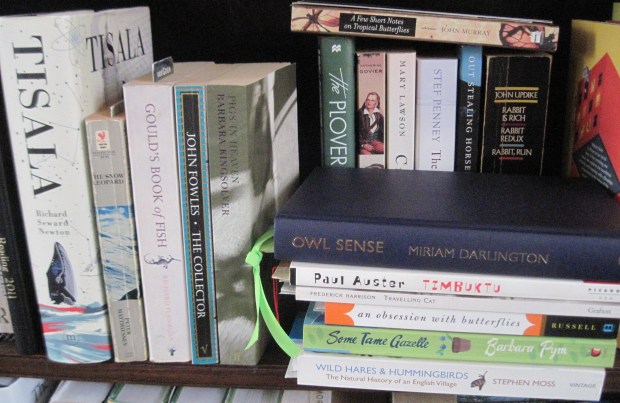
Summer theme: Books with summer/sun/shine in the title, and others set in summer, like The Go-Between by L.P. Hartley, my classic for the month.

Women in Translation month: I’ve started the Ferrante and also want to get to the Fenollera and start the Flores stories (all those Fs!), which are coming out from Oneworld in November. Also, in yesterday’s post I received a surprise copy of a forthcoming Fitzcarraldo Editions essay by Annie Ernaux about her mother’s dementia, so I will squeeze that in too.

Robertson Davies week: In the final week of August I’ll be joining in with Lory’s (The Emerald City Book Review) Robertson Davies readalong by starting Fifth Business, the first volume in The Deptford Trilogy.

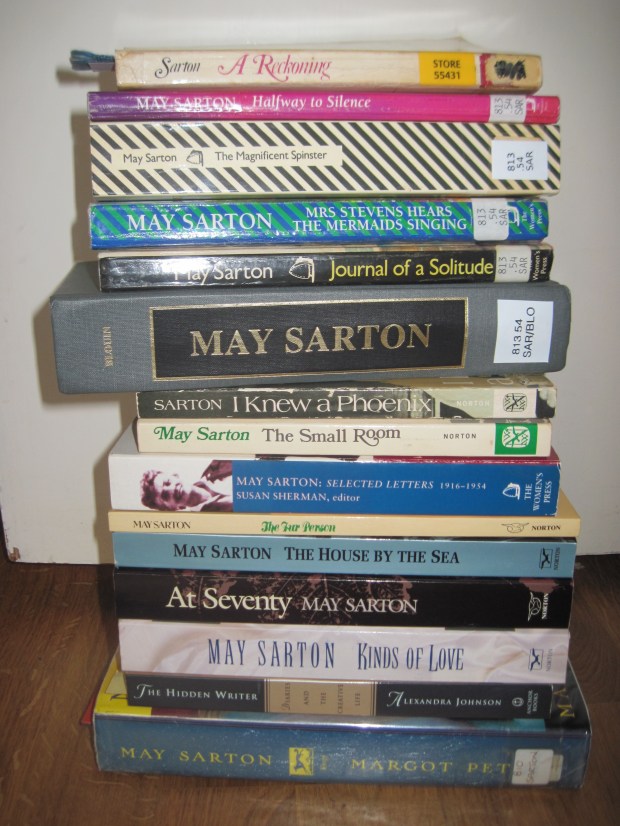
May Sarton article: I’m writing a profile for Bookmarks magazine this month, and am currently in the throes of research: finishing the Margot Peters biography I started last year and set aside for ages; reading another novel or two by Sarton; skimming back through various of the journals, novels and poems I’ve read before; and exploring other external sources. Luckily, my husband was able to forage for loads from his university library for me.
What’s keeping you busy this month?
Library Checkout: July 2019
Lots of library books in progress or waiting in the wings; not so many that I’ve actually managed to read this month. I give links to reviews of any books that I haven’t already featured on the blog in some way, and ratings for all the ones I’ve read or skimmed. What have you been reading from your local library? Library Checkout runs on the last Monday of every month. I don’t have an official link-up system, but feel free to use this image in your post and to leave a link to your blog in the comments if you’ve taken part.
READ
- Exposure by Helen Dunmore
- City of Girls by Elizabeth Gilbert
- The Crossway by Guy Stagg
- Frankissstein: A Love Story by Jeanette Winterson
SKIMMED
- Flight Risk: The Highs and Lows of Life as a Doctor at Heathrow Airport by Dr. Stephanie Green

CURRENTLY READING
- How to Treat People: A Nurse’s Notes by Molly Case
- Our Place: Can We Save Britain’s Wildlife before It Is Too Late? by Mark Cocker
- An Angel at My Table by Janet Frame
- Sweet Sorrow by David Nicholls
- The Pine Islands by Marion Poschmann
CHECKED OUT, TO BE READ
- Time Song: Searching for Doggerland by Julia Blackburn
- How Do You Like Me Now? by Holly Bourne
- Once More We Saw Stars by Jayson Greene
- The Sun Does Shine by Anthony Ray Hinton
- Expectation by Anna Hope
- The Electricity of Every Living Thing: One Woman’s Walk with Asperger’s by Katherine May
- Because: A Lyric Memoir by Joshua Mensch
- I Want to Show You More by Jamie Quatro
- The Farm by Joanne Ramos
- The Hiding Game by Naomi Wood

ON HOLD, TO BE CHECKED OUT
- On Chapel Sands: My Mother and Other Missing Persons by Laura Cumming
- Three Women by Lisa Taddeo
IN THE RESERVATION QUEUE
- Golden Child by Claire Adam
- If Only I Could Tell You by Hannah Beckerman
- The Easternmost House: A Year of Life on the Edge of England by Juliet Blaxland
- The Science of Fate: Why Your Future Is More Predictable than You Think by Hannah Critchlow
- The Last Supper: A Summer in Italy by Rachel Cusk
- The Garden Jungle: Or Gardening to Save the Planet by Dave Goulson
- When All Is Said by Anne Griffin
- The Porpoise by Mark Haddon
- The Wall by John Lanchester
- The Man Who Saw Everything by Deborah Levy
- I Never Said I Loved You by Rhik Samadder
- Feel Free: Essays by Zadie Smith
RETURNED UNFINISHED
- Stroke: A 5% Chance of Survival by Ricky Monahan Brown
- How to Catch a Mole: And Find Yourself in Nature by Marc Hamer
RETURNED UNREAD
- Queenie by Candice Carty-Williams
- How to Fail: Everything I’ve Ever Learned from Things Going Wrong by Elizabeth Day
- The Years by Annie Ernaux
- The Summer Book by Tove Jansson
- Under the Camelthorn Tree: Raising a Family among Lions by Kate Nicholls
I lost interest in all of these, plus there were holds after me on the first three.
Does anything appeal from my stacks?
Upcoming Reading Plans: Milan Trip and Summer Books
“Centre of fashion, business and finance,” “muggy and mosquito-ridden in summer” – from the guidebook descriptions it could hardly sound less like our kind of place, and yet Milan is where we’re off to tomorrow. While it wouldn’t be our first-choice destination, my husband is attending a landscape ecology conference there and presenting a paper; I’m going along for the week to have a holiday. It’s Italy. Why not?! I doubt the northern plain will be as much to our taste as Tuscany, which we explored on a wonderfully memorable trip in April 2014 (on which I first drank coffee), but there will still be history and culture around every corner, and we plan on eating very well and getting out of the city to see some of the Lakes region, too.
We’re traveling the slow way: a train to London; the Eurostar to Paris, where we’ll stay for one night; and a seven-hour train ride to Milan the following day. If the weather remains as hot as it has been in Continental Europe (e.g. 40°C / 105°F in Paris this week – ugh!), I’m not sure I’ll be up for a lot of solo sightseeing. I’ll put in a much-reduced work load for the week, but for much of the rest of the time when my husband is at the conference I may just lounge around our Airbnb, with a stack of print books, in front of the USB-powered fan I’ve ordered.
So of course I’ve been having great fun thinking about what reading material I might pack. I’ve assembled a main stack, and a subsidiary stack, of books that seem appropriate for one or more reasons.
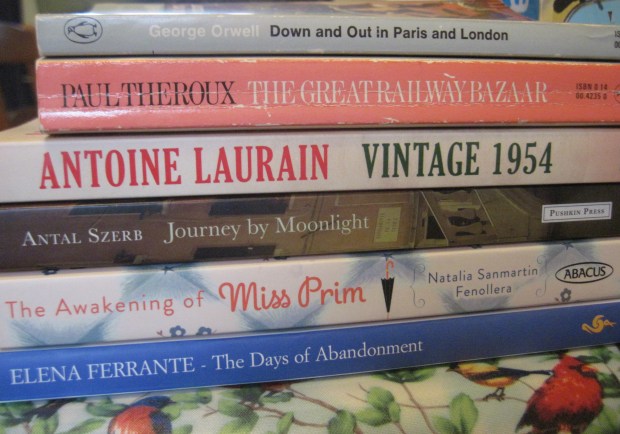
Down and Out in Paris and London, George Orwell – To read on the Eurostar between London and Paris. Orwell’s first book and my first try with his nonfiction: an account of the living conditions of the poor in two world cities.
Bonus goal it fulfills: Classic of the month
Vintage 1954, Antoine Laurain – For a Nudge review; to read en route to and in Paris. Drinking a 1954 Beaujolais transports a Parisian and his neighbors – including an Airbnb guest – back to the 1950s. Sounds like good fun.
Bonus goal it fulfills: Lit in translation
The Great Railway Bazaar, Paul Theroux – To read on the long train ride to Milan. Theroux travels from London to Tokyo on trains, then returns via the Trans-Siberian Express. I’ve always meant to try his work.
Bonus goal it fulfills: Travel classics
Journey by Moonlight, Antal Szerb – A Hungarian novel set on an Italian honeymoon. Try to resist these first lines: “On the train everything seemed fine. The trouble began in Venice, with the back-alleys.”
Bonus goals it fulfills: Lit in translation; 20 Books of Summer substitute (horse on the cover)
The Awakening of Miss Prim, Natalia Sanmarin Fenollera – Promises to be a cozy, fluffy novel about what happens when librarian Prudencia Prim arrives in a small village. I had the feeling it was set in Italy, but maybe it’s actually Spain? I’ll find out.
Bonus goal it fulfills: Lit in translation
The Days of Abandonment, Elena Ferrante – I’ve tried two Ferrante novels and not been too impressed, yet still I keep trying. This one’s set during a heat wave. Maybe I’ll get on with it better than I did with My Brilliant Friend or The Lost Daughter?
Bonus goal it fulfills: Lit in translation
The extra stack:
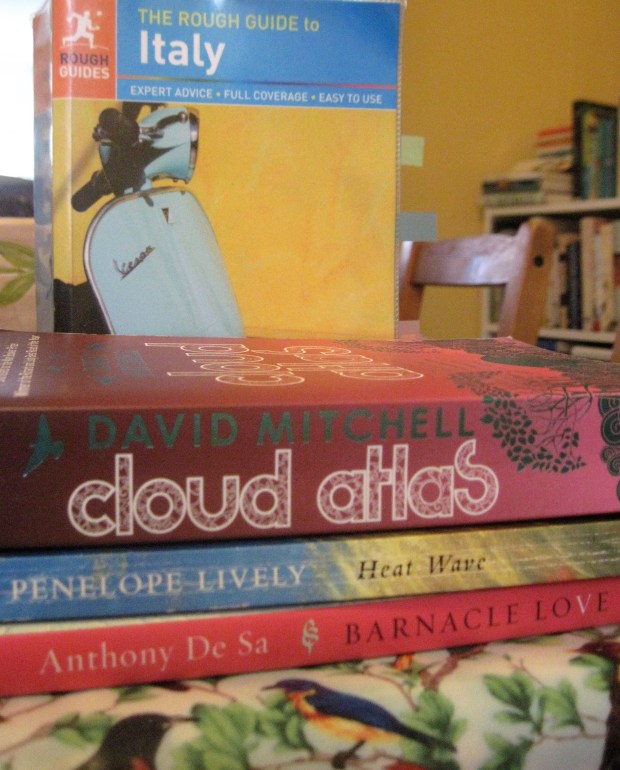
Heat Wave, Penelope Lively – The title says it all.
Bonus goal it fulfills: Reading with the seasons
Barnacle Love, Anthony De Sa – An extra animal book for 20 Books of Summer.
Cloud Atlas, David Mitchell – A novel I’ve meant to read for years. I’ve earmarked it for our super-long day of travel back to the UK.
Bonus goal it fulfills: Doorstopper of the Month
Considering getting from the library:
The Last Supper, Rachel Cusk – I’ve only made it through one of the three Cusk books I’ve attempted, but perhaps a travel memoir is a more surefire selection?
On my Kindle:
 The Fourth Shore, Virginia Baily – There’s an Italian flavor to this WWII novel, as there was to Baily’s previous one, Early One Morning. However, I’ve heard that this is mostly set in Tripoli, so I won’t make it a priority.
From Scratch, Tembi Locke – An actress’s memoir of falling in love with an Italian chef and her trips to his family home in Sicily with their adopted daughter. (Foodie and bereavement themes!)
I’ll read the first few pages of lots of these to make sure they ‘take’ and will try to pack a sensible number. (Which probably means all but one or two!) We’ll be packing light in general, since there’s only so many clothes one can wear in such heat, so I don’t mind carrying a backpack full of books – I’m used to it from weekly treks to the library and flights to America, and I know that I don’t find reading on Kindle as satisfying, though it certainly is convenient for when you’re on the go.
If you’d like to put in a good word for any of the above options, or want to dissuade me from a book I might not find worthwhile, let me know.
Meanwhile, I’ve been slow out of the gate with my 20 Books of Summer, but I finally have a first set of mini-reviews coming up tomorrow.
Other summer-themed books that I have on hand or will get from the library soon include One Summer: America, 1927 by Bill Bryson, The Go-Between by L.P. Hartley, The Sun Does Shine by Anthony Ray Hinton, The Summer Book by Tove Jansson, and Sunburn by Laura Lippman.
How’s your summer reading going?
Will you do any reading ‘on location’ this year?
Library Checkout: June 2019
(A rare second post in a day from me, but Library Checkout runs on the last Monday of the month, no matter what!)
I’ve been slowly chipping away at several nonfiction library books (memoir, nature, travel) – with the exception of bestsellers that are requested after me; these I always have to read within two or three weeks.
On Friday I picked up Elizabeth Gilbert’s City of Girls from the library, expecting that there would be huge demand for it, but at the moment it hasn’t got any holds after me. I doubt I’ll want to take such a large hardback on the train to Milan next week, though, so I’ll hope to get straight into it on our return.
I give links to reviews of any books that I haven’t already featured on the blog in some way, and ratings for all. What have you been reading from your local library? I don’t have an official link-up system, so please just pop a link to your blog in the comments if you’ve taken part in Library Checkout this month. Feel free to use the above image in your post.
READ
- Lowborn: Growing Up, Getting Away and Returning to Britain’s Poorest Towns by Kerry Hudson
- The Music Shop by Rachel Joyce
- The Doll Factory by Elizabeth Macneal
SKIMMED
- The Amazing Adventures of Kavalier and Clay by Michael Chabon
- The Wild Remedy: How Nature Mends Us: A Diary by Emma Mitchell
- The Seasons, a Faber & Faber / BBC Radio 4 poetry anthology
CURRENTLY READING
- Stroke: A 5% Chance of Survival by Ricky Monahan Brown
- An Angel at My Table by Janet Frame
- How to Catch a Mole and Find Yourself in Nature by Marc Hamer
- The Crossway by Guy Stagg
CHECKED OUT, TO BE READ
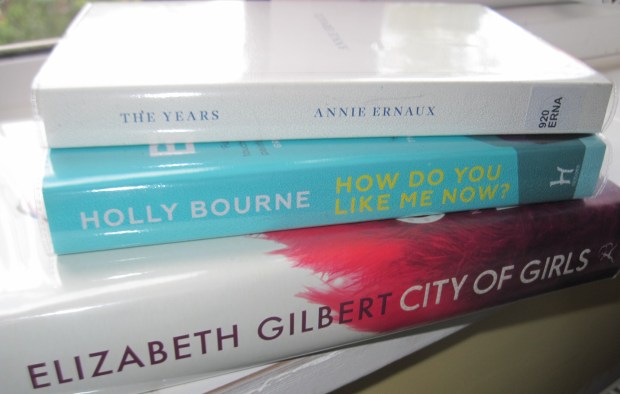
- How Do You Like Me Now? by Holly Bourne
- How to Treat People: A Nurse’s Notes by Molly Case
- Our Place: Can We Save Britain’s Wildlife before It Is Too Late? by Mark Cocker
- The Years by Annie Ernaux
- City of Girls by Elizabeth Gilbert
- Once More We Saw Stars by Jayson Greene
- The Electricity of Every Living Thing: One Woman’s Walk with Asperger’s by Katherine May
- Because: A Lyric Memoir by Joshua Mensch
- Under the Camelthorn Tree: Raising a Family among Lions by Kate Nicholls
- The Pine Islands by Marion Poschmann
ON HOLD, TO BE CHECKED OUT
- Queenie by Candice Carty-Williams
- Frankisstein: A Love Story by Jeanette Winterson
IN THE RESERVATION QUEUE
- On the Marsh: A Year Surrounded by Wildness and Wet by Simon Barnes
- On Chapel Sands: My Mother and Other Missing Persons by Laura Cumming
- How to Fail: Everything I’ve Ever Learned from Things Going Wrong by Elizabeth Day
- The School of Life by Alain de Botton
- The Garden Jungle: Or Gardening to Save the Planet by Dave Goulson
- Flight Risk: The Highs and Lows of Life as a Doctor at Heathrow Airport by Dr. Stephanie Green
- The Porpoise by Mark Haddon
- Expectation by Anna Hope
- The Summer Book by Tove Jansson
- Sweet Sorrow by David Nicholls
- Feel Free: Essays by Zadie Smith
- Three Women by Lisa Taddeo
- The Hiding Game by Naomi Wood
RETURNED UNFINISHED
- A Pocket Mirror by Janet Frame
- Convenience Store Woman by Sayaka Murata
Does anything appeal from my stacks?
Reading Statistics for the First Half of 2019, Including Where My Books Came From
Almost halfway through the year: how am I doing on the reading goals I set for myself? So-so. I’m mostly managing one doorstopper and one classic per month, though sometimes I’ve had to fudge it a little with modern classics or a skim read. I’ve read precisely 0 travel classics, biographies, or re-reads, so those aims are a fail thus far. As to literature in translation, I’m doing better: it’s made up 8.1% of my reading, nearly double my 2018 percentage. And it looks like I’m on track to meet or exceed my Goodreads target.

The breakdown:
Fiction: 42.3%
Nonfiction: 42.3%
Poetry: 15.4%
(Exactly equal numbers of fiction and nonfiction books! What are the odds?!)
Male author: 41.3%
Female author: 56.7%
Non-binary author: 2%
(This is the first year when I’ve consciously read work by non-binary authors – three of them.)
E-books: 9.3%
Print books: 90.7%
(I seem to be moving further and further away from e-books now that they no longer make up the bulk of my paid reviewing.)
I always find it interesting to look back at where my books come from. Here are the statistics for the year so far, in both real numbers and percentages (not including books I’m currently reading, DNFs or books I only skimmed):
- Free print or e-copy from the publisher or author: 65 (43%)
- Public library: 31 (21%)
- Secondhand purchase: 21 (14%)
- Downloaded from NetGalley or Edelweiss: 12 (8%)
- Gifts: 9 (6%)
- Free, e.g. from Book Thing of Baltimore, local swap shop or free mall bookshop: 5 (3.5%)
- University library: 4 (2.5%)
- New book purchase: 2 (1.5%)
- Borrowed: 1 (0.5%)
 Bookish Beck = Rebecca Foster. American transplant to England. Freelance proofreader and book reviewer.
 Bookish Beck