Library Checkout: June 2019

(A rare second post in a day from me, but Library Checkout runs on the last Monday of the month, no matter what!)
I’ve been slowly chipping away at several nonfiction library books (memoir, nature, travel) – with the exception of bestsellers that are requested after me; these I always have to read within two or three weeks.
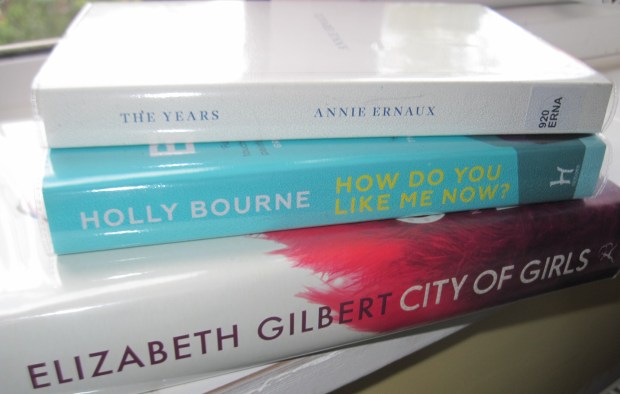
On Friday I picked up Elizabeth Gilbert’s City of Girls from the library, expecting that there would be huge demand for it, but at the moment it hasn’t got any holds after me. I doubt I’ll want to take such a large hardback on the train to Milan next week, though, so I’ll hope to get straight into it on our return.
I give links to reviews of any books that I haven’t already featured on the blog in some way, and ratings for all. What have you been reading from your local library? I don’t have an official link-up system, so please just pop a link to your blog in the comments if you’ve taken part in Library Checkout this month. Feel free to use the above image in your post.
READ
- Lowborn: Growing Up, Getting Away and Returning to Britain’s Poorest Towns by Kerry Hudson

- The Music Shop by Rachel Joyce

- The Doll Factory by Elizabeth Macneal

SKIMMED
- The Amazing Adventures of Kavalier and Clay by Michael Chabon

- The Wild Remedy: How Nature Mends Us: A Diary by Emma Mitchell
- The Seasons, a Faber & Faber / BBC Radio 4 poetry anthology
CURRENTLY READING
- Stroke: A 5% Chance of Survival by Ricky Monahan Brown
- An Angel at My Table by Janet Frame
- How to Catch a Mole and Find Yourself in Nature by Marc Hamer
- The Crossway by Guy Stagg
CHECKED OUT, TO BE READ
- How Do You Like Me Now? by Holly Bourne
- How to Treat People: A Nurse’s Notes by Molly Case
- Our Place: Can We Save Britain’s Wildlife before It Is Too Late? by Mark Cocker
- The Years by Annie Ernaux
- City of Girls by Elizabeth Gilbert
- Once More We Saw Stars by Jayson Greene
- The Electricity of Every Living Thing: One Woman’s Walk with Asperger’s by Katherine May
- Because: A Lyric Memoir by Joshua Mensch
- Under the Camelthorn Tree: Raising a Family among Lions by Kate Nicholls
- The Pine Islands by Marion Poschmann
ON HOLD, TO BE CHECKED OUT
- Queenie by Candice Carty-Williams
- Frankisstein: A Love Story by Jeanette Winterson
IN THE RESERVATION QUEUE
- On the Marsh: A Year Surrounded by Wildness and Wet by Simon Barnes
- On Chapel Sands: My Mother and Other Missing Persons by Laura Cumming
- How to Fail: Everything I’ve Ever Learned from Things Going Wrong by Elizabeth Day
- The School of Life by Alain de Botton
- The Garden Jungle: Or Gardening to Save the Planet by Dave Goulson
- Flight Risk: The Highs and Lows of Life as a Doctor at Heathrow Airport by Dr. Stephanie Green
- The Porpoise by Mark Haddon
- Expectation by Anna Hope
- The Summer Book by Tove Jansson
- Sweet Sorrow by David Nicholls
- Feel Free: Essays by Zadie Smith
- Three Women by Lisa Taddeo
- The Hiding Game by Naomi Wood
RETURNED UNFINISHED
- A Pocket Mirror by Janet Frame
- Convenience Store Woman by Sayaka Murata
Does anything appeal from my stacks?
Reading Statistics for the First Half of 2019, Including Where My Books Came From
Almost halfway through the year: how am I doing on the reading goals I set for myself? So-so. I’m mostly managing one doorstopper and one classic per month, though sometimes I’ve had to fudge it a little with modern classics or a skim read. I’ve read precisely 0 travel classics, biographies, or re-reads, so those aims are a fail thus far. As to literature in translation, I’m doing better: it’s made up 8.1% of my reading, nearly double my 2018 percentage. And it looks like I’m on track to meet or exceed my Goodreads target.

The breakdown:
Fiction: 42.3%
Nonfiction: 42.3%
Poetry: 15.4%
(Exactly equal numbers of fiction and nonfiction books! What are the odds?!)
Male author: 41.3%
Female author: 56.7%
Non-binary author: 2%
(This is the first year when I’ve consciously read work by non-binary authors – three of them.)
E-books: 9.3%
Print books: 90.7%
(I seem to be moving further and further away from e-books now that they no longer make up the bulk of my paid reviewing.)
I always find it interesting to look back at where my books come from. Here are the statistics for the year so far, in both real numbers and percentages (not including books I’m currently reading, DNFs or books I only skimmed):
- Free print or e-copy from the publisher or author: 65 (43%)
- Public library: 31 (21%)
- Secondhand purchase: 21 (14%)
- Downloaded from NetGalley or Edelweiss: 12 (8%)
- Gifts: 9 (6%)
- Free, e.g. from Book Thing of Baltimore, local swap shop or free mall bookshop: 5 (3.5%)
- University library: 4 (2.5%)
- New book purchase: 2 (1.5%)
- Borrowed: 1 (0.5%)
How are you doing on any reading goals you set for yourself?
Where do you get most of your books from?
All the Books I’ve Abandoned So Far This Year
Hard to believe, but it’s time to start on the mid-year roundups already. I’ll be doing a few posts with statistics on my reading from the first half of 2019: where my books came from, how I fared with my most anticipated reads and how I’m doing towards any projects, the best 2019 releases so far, etc. But first, let’s get this out of the way:
I’ve DNFed 37 books so far this year, equating to roughly 20% of what I started. Although that’s higher than my usual 15% average, suggesting that I’m particularly lacking in stick-to-itiveness lately, I don’t think it’s unreasonable that a fifth of the books I pick up don’t work for me for whatever reason (e.g. tone, voice, writing style, subject matter or similarity to other things I’ve read).
My biannual posts on abandoned books are always perversely popular. If you’re reading this post to feel better about the books you’ve abandoned recently: 1) Welcome! 2) I absolve you of any perceived guilt! 3) I encourage readers to give up on books they are not enjoying – at any time, but as early on as possible. You owe it to yourself to devote your limited, precious time to the books you’ll love and find worthwhile. I apologize in advance for not getting on with a book that you loved.
I won’t mention books I’ve already written about, perhaps in one of my monthly Library Checkout posts. No cover images, tags, links or full reviews here – though I might write that little bit more if I got the book from the publisher. So this is just a text dump, I’m afraid. The titles are mostly in chronological order (with some grouped together); the number of pages I read is generally given in brackets at the end.
The Gunners by Rebecca Kauffman: A group of six kids grew up playing together in the abandoned Gunner house in Lackawanna, New York. They’re now all around 30 and have dispersed to their different lives, but, reeling from the suicide of one of their own, they’ll be brought back together for a funeral. Too much time is spent with Mikey early on, and the sentences don’t flow all that well – the language is a bit simplistic and repetitive. Other reviews have suggested this is a nice read but not all that special. I’ll watch The Big Chill sometime instead. (23 pp.)
Wonder Valley by Ivy Pochoda: There’s a striking opening, as a naked runner bypasses a morning traffic jam in 2010 Los Angeles. We meet a couple of the other main characters, including Ren, who’s come west via a Greyhound bus after eight years in juvenile detention, while they’re stuck in traffic, then cut to Britt, who in 2006 got attracted to a hippie commune near Joshua Tree. The writing is fine, but I didn’t feel invested in any of the characters. (34 pp.)
The Last Samurai by Helen De Witt: Alas, once I got past the prologue I found this impenetrable. It was one of my bibliotherapy prescriptions for uncertainty about whether to have children. I liked the opening legend about an atheist father being talked into attending seminary. The language is repetitive but I thought I could forgive it because it was narrated by an eleven-year-old. But once the book proper starts we’re in Oxford in the 1980s, splitting hairs over translations. I skimmed to page 90 and was ultimately none the wiser about who’s narrating and what’s going on. (20 pp.)
Mr Wrong by Elizabeth Jane Howard: I read the two shortest stories, “Summer Picnic” and “The Proposition.” The former was pleasantly like Elizabeth Taylor or Tessa Hadley lite; I got zero out of the latter. I tried to settle into the opening, title story, but couldn’t.
Underbug: An Obsessive Tale of Termites and Technology by Lisa Margonelli: On the one hand, Margonelli writes enjoyable science for laymen, in a style that reminds me of Ed Yong’s. Termite research has surprising relevance in various fields, such as biofuel production, architecture, and swarm intelligence. On the other hand, I’m simply not interested enough in this set of species. I can imagine having better luck with a book that considered a different group of insects per chapter. My favorite bit was Chapter 13 because it was autobiographical – she tells the ironic story of how termites ate through the wall of her place, and remembers her back-to-nature existence in Maine with a father who trapped and skinned muskrats. I’ll seek out her previous book on petroleum. (131 pp.)
The Hope Fault by Tracy Farr: The style is reminiscent of Virginia Woolf’s, or Tessa Hadley’s, especially as in The Past. The whole family has returned to the ancestral home, which has just been sold and needs to be cleared, in the midst of a deluge. We meet Iris, her grown son Kurt, her niece Lulu, and her ex-husband Paul – with his new wife Kristin and their still-unnamed one-month-old daughter. The shifting POV mostly sticks with Iris. Chapter titles are nicely random phrases plucked from that chapter. The short sections, some of them pure dialogue, are so short you don’t feel you get anywhere or have anything to latch onto. I loved Farr’s previous novel, The Life and Loves of Lena Gaunt, and hoped to love this one too, but the narrative drive just wasn’t there. (44 pp.)
The Heat of the Day by Elizabeth Bowen: I read about the first 35 pages, and in that time hadn’t warmed to any characters or gotten any sense of what this would be about. However, I can see what contemporary authors like A.J. Pearce and Sarah Waters were aiming for. Odd phrasing, too: “By casting about—but then hitherto this had always been done calmly—he had never yet not come on a policy which both satisfied him and in the end worked. There never had yet not been a way through.” (Passive voice, double negatives, and unnecessary verbiage? No thanks.)
The Dinner List by Rebecca Serle: I should have done my homework on Serle; if I had, I would have realized that she writes young adult romances, and though this has been marketed as adult commercial fiction, it still has that YA vibe. The book’s conceit is that the vision board Sabrina’s college roommate Jessica made her do about the five people, alive or dead, whom she’d invite to her ideal dinner party, has become a reality. Short snippets from this dinner – which includes Sabrina’s ex, Tobias; her dead father, Robert, who left her and her mother when she was a little girl; Professor Conrad, her philosophy instructor; Jessica; and Audrey Hepburn – are interspersed with glimpses of Sabrina’s relationship with Tobias, which started by chance one day in Santa Monica and unexpectedly picked up again four years later in New York City. Apart from the lite romance feel, there is lots of weird phrasing: “it came out to be cheaper,” “ripping open a teabag” to make tea (who would do that and why?!), “any way else,” and so on. (65 pp.)
The Altruists by Andrew Ridker: In 2015 Maggie and Ethan Alter, both living in New York City – she a do-gooder who tutors immigrant children and lives so frugally she’s always a little bit hungry; he a compulsive shopper and hermit, since he broke up with his last boyfriend – unexpectedly get letters from their father, Arthur, a widowed engineering professor, inviting them home for spring break. Ridker writes well, as you’d expect from any Iowa Writers’ Workshop graduate. This reminded me most of The Futures by Anna Pitoniak, with traces of Jonathan Franzen or Jonathan Safran Foer in the mix of quirky and cynical characters. But in the chunk I read, I didn’t warm to any of the central characters and never even really got a clear sense of them. I’ll keep an eye out for what Ridker does and maybe try something else by him. (50 pp.)
Sea Monsters by Chloe Aridjis: I had no idea what’s happening (apart from nothing much), except that a 17-year-old girl is exploring derelict mansions in a Mexican town with one guy or another. The atmosphere is well done, but there’s no way the nonexistent plot can keep me reading for another 145 pages. Shame I never even got to those Ukrainian dwarves. (30 pp.)
Children of God by Mary Doria Russell: The Sparrow was one of my favorite backlist reads last year, and when I heard there was a sequel I rushed to put it on my wish list and got a copy for my birthday. While I was, of course, intrigued to learn that a character we thought was dead is still alive, and it was nice to see Emilio Sandoz, the broken priest, having a chance at happiness back on Earth, I couldn’t get myself interested in the political machinations of the alien races. Without the quest setup and terrific ensemble cast of the first book, this didn’t grab me. I’ll pass it on to my minion (aka husband) and he can tell me if anything of interest happens. (60 pp.)
Memories of the Future by Siri Hustvedt: “I am writing not only to tell. I am writing to discover. … I have always believed that memory and the imagination are a single faculty.” As clever a meditation as this is on identity and memory, at a certain point I found it a chore to pick up. I have no objection to autofiction, but I wanted more current wisdom than twentysomething folly, and what I’ve read about the later #MeToo theme suggests that it is unfortunately heavy-handed. I still plan to read the three Hustvedt novels I haven’t read yet, as well as her memoir; I’ll also dip into her essays and poetry. I think she’s an immense talent; this one just wasn’t for me. (112 pp.)
The Secret Barrister: Stories of the Law and How It’s Broken: Although I’ve lived in the UK off and on for 14 years now, I still know very little about its politics and particularly the criminal justice system. I was interested to learn more, and found the opening chapter usefully basic (judges, solicitors, barristers, etc.). The following chapter on magistrates’ court lost me; all I gleaned was that it’s a Bad Thing because the accused don’t get a fair shake. I can’t decide if you’d need to know more or less about the law to find this engaging; I have a law clerk friend who read it and enjoyed it well enough while also finding it depressing. (73 pp.)
A View of the Empire at Sunset by Caryl Phillips: I read the first chapter and skimmed another two. I’m afraid this is utterly lifeless writing; informative but not at all inviting.
Our Lady of Everything by Susan Finlay: The blurb sounded irresistible, but the writing was an instant turn-off. (Starting with a 10-step “Banishing Ritual” was an awful idea; the introduction to two main characters then wasn’t inviting; the following chapters all introduce a different point-of-view character.) (5 pp.)
Liar by Ayelet Gundar-Goshen: I liked the Atonement-style setup: a 17-year-old ice cream scooper has a run-in with a disgruntled, washed-up reality show star and allows rumors of an attempted sexual assault to bloom. Nice biblical echoes and metaphors, though some are a bit belabored (e.g. “Nofar’s guilt, like a Persian cat, rubbed her legs fleetingly, sat for a brief moment on her lap, then moved onward”). Mostly I just felt no pull to keep going and find out what happened. (63 pp.)
Prayer: Letters to Malcolm by C.S. Lewis: Lewis’s last book is a fictional one-sided correspondence that debates the nature of prayer. I thought I might be able to interest myself in prayer as an academic matter, but it turns out that not believing in it means I don’t care enough. (26 pp.)
A Handful of Dust by Evelyn Waugh: Mitford-esque flippant depiction of some upper-class types. (16 pp.)
The Bibliophile’s Dictionary: 2,054 masterful words and phrases by Miles Westley: A secondhand purchase from The Book Shop, Wigtown. The idea is a treasury of obscure vocabulary words, divided into thematic categories and grouped by synonyms. Each word/phrase is illustrated with an example of its use in context in a work of literature, or in a few cases a newspaper article. I kept it as a bedside book for a number of weeks and moderately enjoyed reading a few entries per night. My main annoyances were that Westley often confuses forms, giving a definition for the adjective when he’s using the noun or vice versa, and that his field of reference is pretty narrow: he’s always quoting from authors like Saul Bellow, Pat Conroy, Jack London and Tom Wolfe – dead white guys. I’ll keep this around as a reference book but can’t see myself reading it all the way through. (50 pp.)
The Pocket Mirror by Janet Frame: Having read from Frame’s fiction and memoirs, I wanted to dip into her poetry as well. This collection of free verse from 1967 is mostly written in the first person and concerns everyday local sights and sounds: beaches, town scenes, the view out the window of a morning, and so on; some are short while others are rambling. However, there are also several poems of death and war, and a particular obsession with napalm. While there’s nothing especially off-putting about these poems, nor are they very compelling in style or theme. (22 pp.)
In West Mills by De’Shawn Charles Winslow: There are echoes of Toni Morrison (especially Song of Solomon) in this debut novel set in the small fictional town of West Mills, North Carolina. Wilson has crafted a memorable antiheroine in Azalea “Knot” Centre, who likes to pretend she doesn’t care what people think about her but actually cares deeply. Alcohol and sex are her two vices, and in the 1940s her two out-of-wedlock daughters are secretly adopted by other families in the town, such that she can watch them grow up. The plot is initially slow-moving – it takes nearly half the length to introduce all the characters and deal with Knot’s first baby – but then leaps ahead to 1960 and further community entanglements. The rendering of the local dialect struck me as hokey, and none of the secondary characters seem worthy of sharing a stage with Knot. (162 pp.)
Convenience Store Woman by Sayaka Murata: I feared an Eleanor Oliphant trajectory in this story of a thirtysomething woman who’s worked in the same convenience store for half her life and only barely succeeds in convincing herself and others that she’s a normal person. Even in the little I read, the language was quite repetitive, with Keiko several times describing herself as just a cog in society’s workings, and frequently repeating the rote conversations she has with customers. (30 pp.)
The Rapture by Claire McGlasson: I would normally thrill to any book about a cult, but the writing in this one – maybe it was Dilys’s narration, I don’t know – never grabbed me. What a gorgeous book, though: corduroy-type ridging on the yellow cover, and a colorful deckle-cut dust jacket (with a jackdaw perched in an aggressively ordinary bedroom) that doesn’t quite cover the whole thing. Kudos to Faber for the design. (22 pp.)
I’m so weary of books of anonymized case studies:
- Growing Pains: Making Sense of Childhood, A Psychiatrist’s Story by Mike Shooter
- Seven Signs of Life: Stories from an Intensive Care Doctor by Aoife Abbey
- The Heartland: Finding and Losing Schizophrenia by Nathan Filer: Filer was completely unprepared when he arrived to work in a psychiatric hospital outside Bristol. This book is a record of what he learned: about the history of schizophrenia as a diagnosis, its social stigma, and the experience of living it via speaking to patients and hearing their stories. I read the first of those stories, about Erica, a fashion journalist who became so paranoid that she was being hunted down for committing unwitting crimes that she tried to commit suicide. Compared to Nancy Tucker’s That Was When People Started to Worry, this is dull and not very enlightening. I also found myself irritated by Filer’s habit of hedging around all his terms with “so-called,” and the title is all wrong – people seeing just the two words “The Heartland” on the spine will have no idea that this is a book about mental illness. (They might be thinking it’s about the American Midwest, or whatever.) (58 pp.)
The Narrow Land by Christine Dwyer Hickey: I was attracted by the cover and the prospect of learning about the Hoppers’ marriage, but the first section sticks with a small boy, a German refugee, heading up to Cape Cod. Mrs. Hopper is a more appealing character, yet somehow I never gained traction with the story. (46 pp.)
A Stranger City by Linda Grant: An unidentified woman who jumped off a bridge in London is buried in a paupers’ grave. Flashback to seven months earlier and various conversations and train rides, promising that we’ll learn how these characters are interconnected. The prospect sounds similar to John Lanchester’s Capital, but none of the characters, nor the writing, were interesting enough to bait me. (32 pp.)
Book Serendipity Strikes Again
Only two months since my last Book Serendipity entry, and already another 17 occurrences! I post these occasional reading coincidences on Twitter and/or Instagram. I call it serendipitous when two or more books that I’m reading at the same time or in quick succession have something pretty bizarre in common. Because I have so many books on the go at once – usually between 10 and 20 – I guess I’m more prone to such incidents. What’s the weirdest one you’ve had lately? (The following are in rough chronological order.)
- Characters with lupus in The Monsters of Templeton by Lauren Groff and Daisy Jones & The Six by Taylor Jenkins Reid [I also read about one who features in Lost and Wanted by Nell Freudenberger] PLUS I then read Wise Blood by Flannery O’Connor, who died of lupus
- Daisy’s declaration of “I am not a muse. I am the somebody. End of fucking story” in Daisy Jones & The Six by Taylor Jenkins Reid reminded me of Lee Miller’s attitude in The Age of Light by Whitney Scharer
- Mentions of old ladies’ habit of keeping tissues balled up in their sleeves in The Girls by Lori Lansens and Growing Pains by Mike Shooter
 (A sad one, this) The stillbirth of a child is an element in three memoirs I’ve read within a few months, Notes to Self by Emilie Pine, Threads by William Henry Searle, and The Chronology of Water by Lidia Yuknavitch
- A character’s parents both died in a car accident in The Monsters of Templeton by Lauren Groff and Saint Maybe by Anne Tyler
- Two books open on New Year’s Eve 2008 and comment on President Obama’s election: Ordinary People by Diana Evans and Rabbits for Food by Binnie Kirshenbaum

- Three novels in which both romantic partners are artists and find themselves (at least subconsciously) in competition: The Narrow Land by Christine Dwyer Hickey, The Age of Light by Whitney Scharer and Stanley and Elsie by Nicola Upson
- There’s a Czech father (or father figure) in The Florist’s Daughter by Patricia Hampl and The Girls by Lori Lansens
 I’d never heard of 4chan before, but then encountered it twice in quick succession, first in So You’ve Been Publicly Shamed by Jon Ronson and then in The Unauthorised Biography of Ezra Maas by Daniel James
- (Another sad one) Descriptions of the awful sound someone makes when they learn a partner or child has died in Hard Pushed by Leah Hazard and Jesus’ Son by Denis Johnson
- Alan Turing is a character in Murmur by Will Eaves and Machines Like You by Ian McEwan

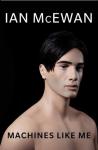
- Antonie van Leeuwenhoek (a pioneer of microscopy) is mentioned in Machines Like You by Ian McEwan and The Making of You by Katharina Vestre
- A woman is described as smelling like hay in Memoirs of a Book Thief by Alessandro Tota and Pierre Van Hove and The Chronology of Water by Lidia Yuknavitch
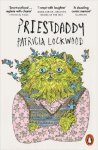 An inside look at the anti-abortion movement in Priestdaddy by Patricia Lockwood and Crazy for God by Frank Schaeffer
- The attempted adoption of a four-year-old boy who’s been in foster care is an element in The Ginger Child by Patrick Flanery and Machines Like You by Ian McEwan
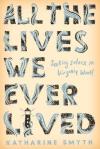
- The loss of a difficult father who was an architect is an element in All the Lives We Ever Lived by Katharine Smyth and The Chronology of Water by Lidia Yuknavitch (and in last year’s Implosion by Elizabeth Garber)


- The improv mantra “Yes, and…” is mentioned in No Happy Endings: A Memoir by Nora McInerny by Sorry I’m Late, I Didn’t Want to Come: An Introvert’s Year of Living Dangerously by Jessica Pan
Plans for 20 Books of Summer

This is my second time taking part in Cathy’s 20 Books of Summer project. Once again I plan to focus solely on books that I own to try to get through a respectable number of them. For 2019 I’ve decided to read books that are about animals or have an animal in the title. I’ve set aside a few back-ups (the ones standing upright in the photos), and if I’m struggling I can cheat a bit by including books that happen to have an animal on the cover.


In the interest of statistics … last year I read eight nonfiction titles and 12 fiction – so that’s exactly what I’ve pulled out for this year. (For the record, I only intend to read the first of Updike’s Rabbit novels at this stage.) I have two re-reads set aside this time (Julian Barnes and Abigail Thomas) versus one last year. Last year I read one doorstopper; this year I don’t have any on the docket. In 2018 I was particularly proud of getting through two short story collections, so this year I’ve chosen one animal-themed one to read. Randomly, three of last year’s books were review copies from publishers or the author, and three were signed copies. This time I have none of either, unless I do some substituting.
Also interesting to note is that this year three of the books I’ve picked are by Canadian authors (André Alexis, Michael Crummey and Mary Lawson), and another has a Canadian setting (The Tenderness of Wolves). Canadian readers, rejoice!
Another project I might join in with this summer is the Robertson Davies reading week – I own his Deptford trilogy, and would at least read one of the books, if not attempt all three.
What are your summer reading plans?
Re-Reading Modern Classics: Fiction Advocate’s “Afterwords” Series
I didn’t manage a traditional classic this month: I stalled on Cider with Rosie and gave up on Evelyn Waugh’s A Handful of Dust after just 16 pages. Instead, I’m highlighting three books from Fiction Advocate’s new series about re-reading modern classics, “…Afterwords.” Their tagline is “Essential Readings of the New Canon,” and the concept is to have “acclaimed writers investigate the contemporary classics.”
As Italo Calvino notes in his invaluable essay “Why Read the Classics?”, “The classics are those books about which you usually hear people saying: ‘I’m rereading…’, never ‘I’m reading…’.” Harold Bloom agrees in The Western Canon: “One ancient test for the canonical remains fiercely valid: unless it demands rereading, the work does not qualify.” But readers will also encounter books that strike such a chord with them that they become personal classics. Calvino exhorts readers that “during unenforced reading … you will come across the book which will become ‘your’ book…‘Your’ classic is a book to which you cannot remain indifferent, and which helps you define yourself in relation or even in opposition to it.”
For the Afterwords series, the three writers below have each chosen a modern classic that they can’t stop reading for all it has to say to their own situation and on humanity in general.
I Meant to Kill Ye: Cormac McCarthy’s Blood Meridian by Stephanie Reents (2018)
Blood Meridian must be one of the two or three bleakest books I’ve ever read. I was led to it by Bloom, who speaks about it as a, if not the, Great American Novel. It’s over 10 years since I’ve read it now, but I still remember some of the specific incidences of violence, like skewering babies and sodomizing corpses on a battlefield, as well as the overall feeling of nihilism: there’s no reason for the evil promulgated by characters like the Judge; it is simply a reality – perhaps the human condition.
 Reents, who teaches English at the College of the Holy Cross, returns to Blood Meridian, a novel she has re-read compulsively over the years, to ask why it continues to have such a hold over her. Its third-person perspective is so distant that we never understand characters’ motivations or glimpse their inner lives, she notes; everyone seems like a pawn in a fated course. She usually shies away from violence and long descriptive passages; she has an uneasy relationship with the West, having moved away from Idaho to live on the East coast. So why should this detached, brutal Western based on the Glanton Gang’s Mexico/Texas killing spree have so captivated her? “Often, we most admire the books that we could never produce, the writing styles or intellects so different from our own that we aren’t even tempted to try imitating them,” she offers as explanation. “It’s a pure kind of admiration, unsullied by envy.” (I feel that way about Faulkner and Steinbeck.)
As part of her quest, Reents recreated some of the Gang’s desert route and traveled to the Texas State University library near Austin to look at McCarthy’s early drafts, notes and correspondence. She was intrigued to learn that the Kid was a more conventional POV character to start with, and McCarthy initially included more foreshadowing. By cutting all of it, he made it so that the book’s extreme violence comes out of nowhere. Reents also explores the historical basis for the story via General Samuel Chamberlain’s dubious memoir. Pondering the volatility of the human heart as she drives along the Mexican border, she ends on the nicely timely note of a threatened Trump-built wall. I doubt I could stomach reading Blood Meridian again (though I’ve read another two McCarthy novels since), but I enjoyed revisiting it with Reents as she finds herself “re-bewildered by its beauty and horror.”
A Little in Love with Everyone: Alison Bechdel’s Fun Home by Genevieve Hudson (2018)
Alison Bechdel is one of Hudson’s queer heroes (along with James Baldwin, Tracy Chapman, and seven others), portrayed opposite the first page of each chapter in black and white drawings by Pace Taylor – the sort of people who gave her the courage to accept her lesbian identity after a conventional Alabama upbringing.
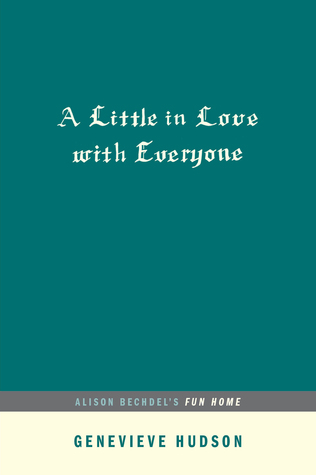 As portrayed in her landmark graphic memoir Fun Home, Bechdel was in college and finally coming to terms with her sexuality at the same time that she learned that her father was gay and her parents were about to divorce. Her father died in an accident just a few months later and, though he had many affairs, had never managed to live out his homosexuality openly. As Bechdel’s mother scoffed, “Your father tell the truth? Please!” By contrast, Hudson appreciates Bechdel so much because of her hard-won honesty: “In her work, Bechdel does the opposite of lying. She excavates the real. She dredges up the stuff of her life, embarrassing parts and all.”
Hudson looks at how people craft their own coming-out narratives, the importance of which cannot be overemphasized, in her experience. “Coming out was a tangible thing with tangible effects. For every friend who left my life, a new person arrived—usually someone with broader horizons, exciting stories, and a deviance that seemed sweet and sexy and sincere. After I came out, roaming the streets of Charleston in fat sunglasses and thin dresses, a group of beautiful lesbians appeared out of nowhere. … Everyone was a little in love with everyone.”
A Cool Customer: Joan Didion’s The Year of Magical Thinking by Jacob Bacharach (2018)
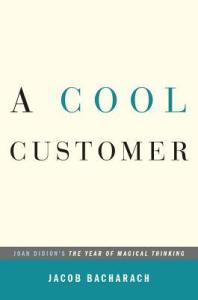 I made the mistake of not taking any notes on, or even marking out any favorite passages in, this, so all I can tell you is that for me it was the most powerful of the three I’ve tried from the series. The author re-examines Didion’s work in the light of his own encounter with loss – his brother’s death from a drug overdose – and ponders why it has become such a watershed in bereavement literature. Didion really is the patron saint of grief thanks to her two memoirs, Magical Thinking and Blue Nights – after she was widowed she also lost her only daughter – even though she writes with a sort of intellectual detachment; you have to intuit the emotion between the lines. Bacharach smartly weaves his family story with a literate discussion of Didion’s narratives and cultural position to make a snappy and inviting book you could easily read in one sitting.
Indeed, all of the Afterwords books are 120–160-page, small-format paperbacks that would handily slip into a pocket or purse.
My thanks to the publisher for the free copies for review.
The other titles in the series are An Oasis of Horror in a Desert of Boredom by Jonathan Russell Clark (on 2666 by Roberto Bolaño), New Uses for Failure by Adam Colman (on 10:04 by Ben Lerner, and Bizarro Worlds by Stacie Williams (on The Fortress of Solitude by Jonathan Lethem).
Next month’s plan: The Leopard by Giuseppe di Lampedusa will be my classic to get me in the mood for traveling to Italy for the first week of July.
Library Checkout: May 2019
A more modest library reading month for me as we were off to America midway through – I’ve taken the Chabon with me to finish off by the 31st for my Doorstopper of the Month post, but my 15 holds are suspended until we come back. I give links to reviews of any books that I haven’t already featured on the blog in some way, and ratings for all.
What have you been reading from your local library? I don’t have an official link-up system, so please just pop a link to your blog in the comments if you’ve taken part in Library Checkout this month. Feel free to use this image in your post.
LIBRARY BOOKS READ
- Jesus’ Son by Denis Johnson
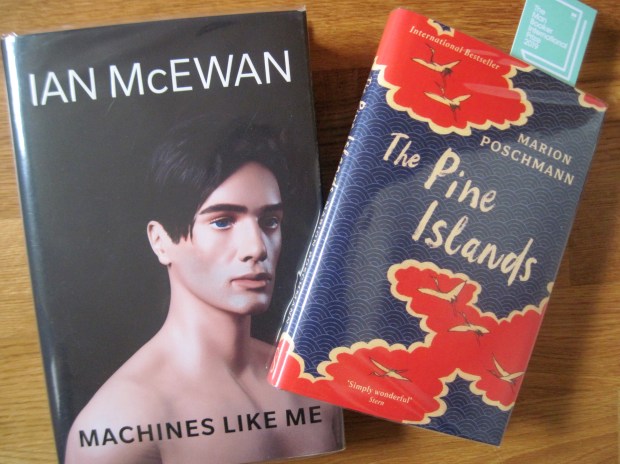
- Machines Like Me by Ian McEwan
- I’ll Be Gone in the Dark: One Woman’s Obsessive Search for the Golden State Killer by Michelle McNamara
- The Butcher’s Hands [poetry] by Catherine Smith
- A Farmer’s Diary: A Year at High House Farm by Sally Urwin
SKIMMED
- Horizon by Barry Lopez
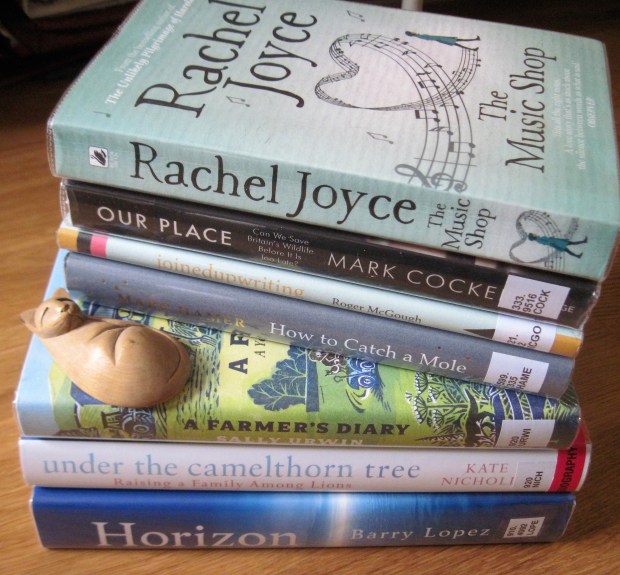
CURRENTLY READING
- The Amazing Adventures of Kavalier and Clay by Michael Chabon
(Set aside temporarily)
- An Angel at My Table by Janet Frame
- A Pocket Mirror by Janet Frame
- The Crossway by Guy Stagg

CURRENTLY SKIMMING
- The Seasons, a Faber & Faber / BBC Radio 4 poetry anthology
CHECKED OUT, TO BE READ
- Stroke: A 5% Chance of Survival by Ricky Monahan Brown
- Our Place: Can We Save Britain’s Wildlife before It Is Too Late? by Mark Cocker
- How to Catch a Mole and Find Yourself in Nature by Marc Hamer
- The Music Shop by Rachel Joyce
- Because: A Lyric Memoir by Joshua Mensch
- Under the Camelthorn Tree: Raising a Family among Lions by Kate Nicholls
- The Pine Islands by Marion Poschmann
- The Lost Properties of Love: An Exhibition of Myself by Sophie Ratcliffe
IN THE RESERVATION QUEUE
- On the Marsh: A Year Surrounded by Wildness and Wet by Simon Barnes
- How Do You Like Me Now? by Holly Bourne
- Queenie by Candice Carty-Williams
- How to Treat People: A Nurse’s Notes by Molly Case
- How to Fail: Everything I’ve Ever Learned from Things Going Wrong by Elizabeth Day
- The Years by Annie Ernaux
- City of Girls by Elizabeth Gilbert
- Once More We Saw Stars by Jayson Greene
- Lowborn: Growing Up, Getting Away and Returning to Britain’s Poorest Towns by Kerry Hudson
- The Doll Factory by Elizabeth Macneal
- The Electricity of Every Living Thing: One Woman’s Walk with Asperger’s by Katherine May
- The Wild Remedy: How Nature Mends Us: A Diary by Emma Mitchell
- Convenience Store Woman by Sayaka Murata
- Feel Free: Essays by Zadie Smith
- Frankisstein: A Love Story by Jeanette Winterson
RETURNED UNREAD
- Joinedupwriting by Roger McGough (lost interest)
- First Time Ever by Peggy Seeger (requested after me; I’ll try again sometime)
Does anything appeal from my stacks?
One Book Leads to Another (Including Shepherds’ Memoirs)
Reading about a particular topic, time period or type of character often leads me to want to read more about the same thing. This isn’t the same as what I call “book serendipity,” when such connections happen purely coincidentally; instead, it’s a deliberate way of following a thread of interest further. I keep meaning to read more about lighthouses, butterflies and Virginia Woolf, for instance. Some attempts are more successful than others, though.
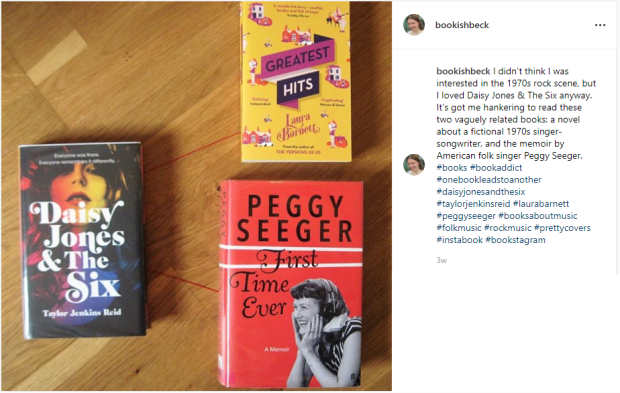
Alas, I had to return the Peggy Seeger memoir to the library unread because it was requested after me, and I haven’t found the immediate spur to pick up Greatest Hits yet.
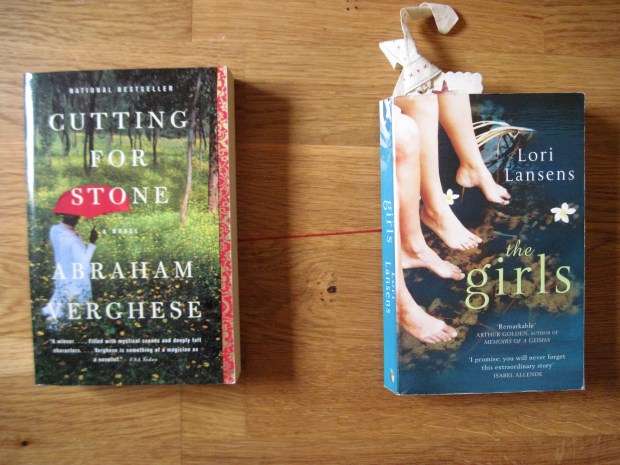
However, soon after I finished one novel about conjoined twins, Abraham Verghese’s Cutting for Stone, I launched straight into another one, Lori Lansens’ The Girls. I’m halfway through and it’s great so far. (Another I’d recommend is Chang and Eng by Darin Strauss, about the original “Siamese twins.”)
This spring I realized that I’d read four and a bit shepherds’ memoirs in 17 months, which is quite the concentration considering I’m not a countryside gal. Here’s how I’d rank the five:
#1: A Farmer’s Diary: A Year at High House Farm by Sally Urwin
 Urwin is a charming guide to a year in the life of her working farm in Northumberland. Just don’t make the mistake of dismissing her as “the farmer’s wife.” She may only be 4 foot 10 (her Twitter handle is @pintsizedfarmer and her biography describes her as “(probably) the shortest farmer in England”), but her struggles to find attractive waterproofs don’t stop her from putting in hard labor to tend to the daily needs of a 200-strong flock of sheep.
From mating the ewes to preparing the next year’s lambs for market, we see the whole cycle once through and about to start again. Lambing is a fraught couple of months that form the heart of the book, but there are plenty of other challenges, including stolen sheep, fallen trees, and constant financial concerns that lead to a petition to the Royal Agricultural Benevolent Institution for help paying the gas bill and keeping food on the table for their two kids.
Despite the year’s setbacks, Urwin has an indomitable spirit and writes in a chatty, chin-up style that reflects the book’s origin in blog posts from 2017 to 2018. She gets a lot of comic mileage out of her yo-yo dieting, the many escapades of Candy the fat pony, and quirky English traditions like the village fete. I enjoy reading about people’s daily habits through a diary, and all the better when it’s a lifestyle that’s totally foreign to me.
#2: The Sheep Stell by Janet White
 First published in 1991, The Sheep Stell taps into a widespread feeling that we have become cut off from the natural world and that existing in communion with animals is a healthier lifestyle. White’s pleasantly nostalgic memoir tells of finding contentment in the countryside, first on her own and later with a dearly loved family. It is both an evocative picture of a life adapted to seasonal rhythms and an arresting account of the casual sexism – and even violence – White experienced in a traditionally male vocation when she emigrated to New Zealand in 1953. From solitary youthful adventures that recall Gerald Durrell’s and Patrick Leigh Fermor’s to a more settled domestic life with animals reminiscent of the writings of James Herriot and Doreen Tovey, White’s story is unfailingly enjoyable. (I reviewed it for the Times Literary Supplement last year.)
#3: On Sheep: Diary of a Swedish Shepherd by Axel Lindén
(translated from the Swedish by Frank Perry)
 Axel Lindén left his hipster Stockholm existence behind to take on his parents’ rural collective. On Sheep documents two years in his life as a shepherd aspiring to self-sufficiency and a small-scale model of food production. The diary entries range from a couple of words (“Silage; wet”) to several pages, and tend to cluster around busy times on the farm. The author expresses genuine concern for the sheep’s wellbeing. However, he cannily avoids anthropomorphism, insisting that his loyalty must be to the whole flock rather than to individual animals. The brevity and selectiveness of the diary keep the everyday tasks from becoming tiresome. Instead, the rural routines are comforting, even humbling.
 #4: The Shepherd’s Life by James Rebanks
My husband valued this more as a memoir than as a cultural document; the opposite was true for me. As a memoir it’s fairly unexceptional, but it’s valuable as a picture of a rare and dwindling way of life in the British countryside.
#5: Heida: A Shepherd at the Edge of the World by Steinunn Sigurðardóttir
(translated from the Icelandic by Philip Roughton)
 DNF after 53 pages. I was offered a proof copy by the publisher on Twitter. I thought it would be interesting to hear about a female Icelandic shepherd who was a model before taking over her family farm and then reluctantly went into politics to try to block a hydroelectric power station on her land. Unfortunately, though, the book is scattered and barely competently written. It doesn’t help that the proof is error-strewn. [This mini-review has been corrected to reflect the fact that, unlike what is printed on the proof copy, the sole author is Steinunn Sigurðardóttir, who has written the book as if from Heiða Ásgeirsdóttir’s perspective.]
What’s the last major reading theme you’ve had?
Can I tempt you with a sheep-herding memoir?
We’re off to America tomorrow for two weeks for a holiday plus family time and a college friend’s wedding. While I won’t be particularly communicative on others’ blogs or social media, I’m scheduling a few blogs per week that we’re away. Back on June 3rd – just in time for the start of 20 Books of Summer!

Here’s the stack of books I’ve packed – with plenty more waiting for me over there and my Kindle providing some 400 backups.
A Bouquet of Spring Reading
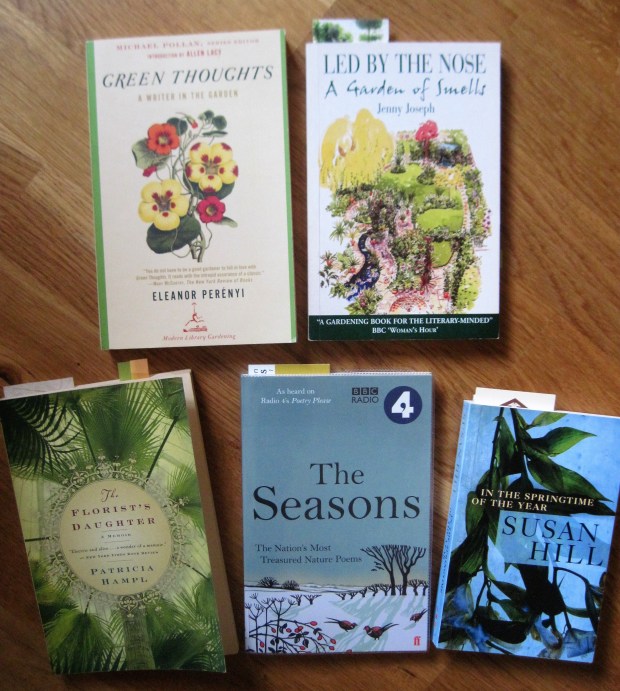
In March through May I often try to read a few gardening-themed books and/or ones with “spring” in the title. Here are some of the ones that I have on the go as occasional reading:
Flowers and gardens
The Florist’s Daughter by Patricia Hampl: Her mother’s final illness led Hampl to reflect on her upbringing in St. Paul, Minnesota as the daughter of an Irish Catholic library clerk and a Czech florist. I love how she writes about small-town life and helping out in her father’s flower shop:
“These apparently ordinary people in our ordinary town, living faultlessly ordinary lives … why do I persist in thinking—knowing—they weren’t ordinary at all? … Nostalgia is really a kind of loyalty”
“it was my father’s domain, but it was also marvelously other, this place heavy with the drowsy scent of velvet-petaled roses and Provençal freesias in the middle of winter, the damp-earth spring fragrance of just-watered azaleas and cyclamen”
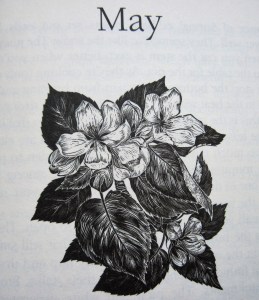 Led by the Nose: A Garden of Smells by Jenny Joseph: Joseph’s name might not sound familiar, but she was the author of the famous poem “Warning: When I Am an Old Woman I Shall Wear Purple” and died early last year. This is a pleasant set of short pieces about what you might see and sense in your garden month by month. “Gardeners do indeed look before and after, at the same time living, as no one else, in the now of the nose,” she maintains. I’m particularly fascinated by the sense of smell and how a writer can describe odors, so I was delighted to find this in a charity shop in Edinburgh last year and have been reading it a few pages at a time as a bedside book. I especially like the wood engravings by Yvonne Skargon that head each chapter.
Green Thoughts: A Writer in the Garden by Eleanor Perényi: A somewhat dense collection of few-page essays, arranged in alphabetical order, on particular plants, tools and techniques. I tried reading it straight through last year and only made it as far as “Beans.” My new strategy is to keep it on my bedside shelves and dip into whichever pieces catch my attention. I don’t have particularly green fingers, so it’s not a surprise that my eye recently alighted on the essay “Failure,” which opens, “Sooner or later every gardener must face the fact that certain things are going to die on him. It is a temptation to be anthropomorphic about plants, to suspect that they do it to annoy.”
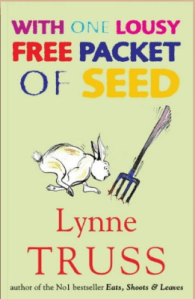 With One Lousy Free Packet of Seed by Lynne Truss (DNF at page 131 out of 210): A faltering gardening magazine is about to be closed down, but Osborne only finds out when he’s already down in Devon doing the research for his regular “Me and My Shed” column with a TV actress. Hijinks were promised as the rest of the put-out staff descend on Honiton, but by nearly the two-thirds point it all still felt like preamble, laying out the characters and their backstories, connections and motivations. My favorite minor character was Makepeace, a pugnacious book reviewer: “he used his great capacities as a professional know-all as a perfectly acceptable substitute for either insight or style.”
Spring
The Seasons, a Faber & Faber / BBC Radio 4 poetry anthology: From Chaucer and other Old English poets to Seamus Heaney (“Death of a Naturalist”) and Philip Larkin (“The Trees”), the spring section offers a good mixture of recent and traditional, familiar and new. A favorite passage was “May come up with fiddle-bows, / May come up with blossom, / May come up the same again, / The same again but different” (from “Nuts in May” by Louis MacNeice). Once we’re back from America I’ll pick up with the summer selections.
In the Springtime of the Year by Susan Hill: Early one spring, Ruth Bryce’s husband, Ben, dies in a forestry accident. They had only been married a year and here she is, aged twenty-one and a widow. Ben’s little brother, 14-year-old Jo, is a faithful visitor, but after the funeral many simply leave Ruth alone. I’m 100 pages in and still waiting for there to be a plot as such; so far it’s a lovely, quiet meditation on grief and solitude amid the rhythms of country life. Ben’s death is described as a “stone cast into still water,” and here at nearly the halfway point we’re seeing how some of the ripples spread out beyond his immediate family. I’m enjoying the writing more than in the three other Hill books I’ve read.
 Absent in the Spring by Mary Westmacott: (The title doesn’t actually have anything to do with the season; it’s a quotation from Shakespeare’s Sonnet 98: “From you have I been absent in the spring.”) From 1944, this is the third of six novels Agatha Christie published under the alias Mary Westmacott. Joan Scudamore, traveling back to London from Baghdad after a visit to her adult daughter, encounters bad weather and misses her train, which leaves her stranded in the desert for days that feel more like weeks. We’re led back through scenes from Joan’s earlier life and realize that she’s utterly clueless about what those closest to her want and think. Rather like Olive Kitteridge, Joan is difficult in ways she doesn’t fully acknowledge. Like a desert mirage, the truth of who she’s been and what she’s done is hazy, and her realization feels a little drawn out and obvious. Once she gets back to London, will she act on what she’s discovered about herself and reform her life, or just slip back into her old habits? This is a short and immersive book, and a cautionary tale to boot. It examines the interplay between duty and happiness, and the temptation of living vicariously through one’s children.
Have you been reading anything particularly appropriate for spring this year?
Library Checkout: April 2019
This was a huge library reading month for me! I finished off a lot of books that I’d started last month, several of which were requested after me, and picked up a novel from the Women’s Prize longlist plus a few that have attracted a lot of buzz. Looking ahead, I’ve placed holds on a bunch of recent nonfiction: nature, medicine, current events and essays. [I give links to reviews of any books that I haven’t already featured on the blog in some way, and ratings for all.]
What have you been reading from your local library? I don’t have an official link-up system, so please just pop a link to your blog in the comments if you’ve taken part in Library Checkout this month. Feel free to use this image in your post.
LIBRARY BOOKS READ
- A Breath of French Air, H.E. Bates
- 21st-Century Yokel by Tom Cox
- Murmur by Will Eaves
- Also Human: The Inner Lives of Doctors by Caroline Elton
- Ordinary People by Diana Evans
- Faces in the Water by Janet Frame

- The Garden of Eden by Ernest Hemingway

- Injury Time by Clive James [poetry]
- Lanny by Max Porter
- The World I Fell Out Of by Melanie Reid
- Daisy Jones & the Six, Taylor Jenkins Reid
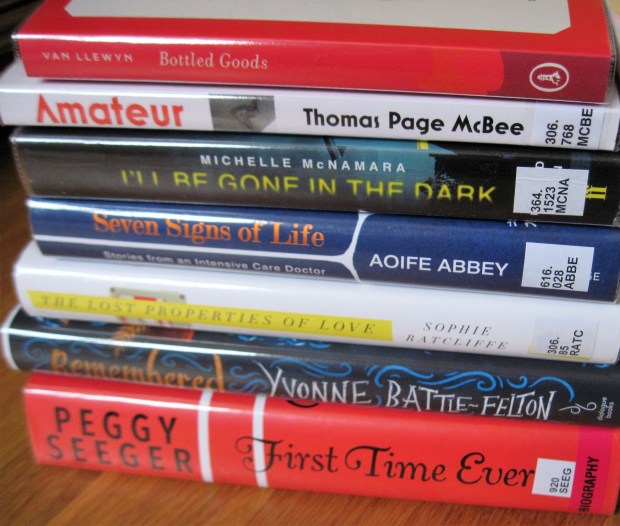
- Bottled Goods by Sophie van Llewyn
- The Dreamers, Karen Thompson Walker
SKIMMED
- Hired: Six Months Undercover in Low-wage Britain by James Bloodworth
- It’s All a Game: A Short History of Board Games by Tristan Donovan
- The Village News: The Truth behind England’s Rural Idyll by Tom Fort
- Outsiders: Five Women Writers Who Changed the World by Lyndall Gordon
- The Recovering: Intoxication and Its Aftermath by Leslie Jamison
- To Obama: With Love, Joy, Hate and Despair by Jeanne Marie Laskas
- Amateur: A Reckoning with Gender, Identity and Masculinity by Thomas Page McBee [a look back through before finalizing our Wellcome Book Prize shadow panel vote]
- Lost and Found: Memory, Identity, and Who We Become when We’re No Longer Ourselves by Jules Montague
- Still Water: The Deep Life of the Pond by John Lewis-Stempel
- The Uninhabitable Earth: A Story of the Future by David Wallace-Wells
CURRENTLY READING
- Jesus’ Son by Denis Johnson
- I’ll Be Gone in the Dark: One Woman’s Obsessive Search for the Golden State Killer by Michelle McNamara
- The Crossway by Guy Stagg
CURRENTLY SKIMMING
- The Seasons, a Faber & Faber / BBC Radio 4 poetry anthology (the “Spring” section, naturally)
CHECKED OUT, TO BE READ
- Stroke: A 5% Chance of Survival by Ricky Monahan Brown
- Because: A Lyric Memoir by Joshua Mensch
- The Lost Properties of Love: An Exhibition of Myself by Sophie Ratcliffe
- First Time Ever by Peggy Seeger
- The Butcher’s Hands [poetry] by Catherine Smith
ON HOLD, TO BE PICKED UP
- Our Place: Can We Save Britain’s Wildlife before It Is Too Late? by Mark Cocker
- How to Catch a Mole and Find Yourself in Nature by Marc Hamer
- Under the Camelthorn Tree: Raising a Family among Lions by Kate Nicholls
IN THE RESERVATION QUEUE
- How to Treat People: A Nurse’s Notes by Molly Case
- Once More We Saw Stars by Jayson Greene
- Lowborn: Growing Up, Getting Away and Returning to Britain’s Poorest Towns by Kerry Hudson
- Horizon by Barry Lopez
- The Doll Factory by Elizabeth Macneal
- The Electricity of Every Living Thing: One Woman’s Walk with Asperger’s by Katherine May
- Machines Like Me by Ian McEwan
- The Wild Remedy: How Nature Mends Us: A Diary by Emma Mitchell
- Convenience Store Woman by Sayaka Murata
- Feel Free: Essays by Zadie Smith
- A Farmer’s Diary: A Year at High House Farm by Sally Urwin
- Frankisstein: A Love Story by Jeanette Winterson
RETURNED UNFINISHED
- Seven Signs of Life: Stories from an Intensive Care Doctor by Aoife Abbey
- Remembered by Yvonne Battle-Felton
RETURNED UNREAD
- The Pebbles on the Beach: A Spotter’s Guide by Clarence Ellis
- Lost Children Archive by Valeria Luiselli
- Taking the Arrow out of the Heart by Alice Walker [poetry]
- The Face Pressed against a Window: A Memoir by Tim Waterstone
(I lost interest in all of these.)
 Bookish Beck = Rebecca Foster. American transplant to England. Freelance proofreader and book reviewer.
 Bookish Beck