Book Serendipity: 2020, Part I
I call it serendipitous when two or more books that I’m reading at the same time or in quick succession have something pretty bizarre in common. Because I have so many books on the go at once – usually between 10 and 20 – I guess I’m more prone to such incidents. I also post these occasional reading coincidences on Twitter. (The following are in rough chronological order.)
- A Wisconsin setting in three books within a month (Shotgun Lovesongs by Nickolas Butler, This Is How It Always Is by Laurie Frankel and Crossing to Safety by Wallace Stegner)
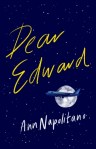
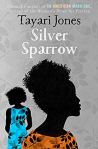
- I came across a sculpture of “a flock of 191 silver sparrows” in Dear Edward by Ann Napolitano while also reading Silver Sparrow by Tayari Jones.
- Characters nearly falling asleep at the wheel of a car in Crossing to Safety by Wallace Stegner and In the Dream House by Carmen Maria Machado
- There’s no escaping Henry David Thoreau! Within the span of a week I saw him mentioned in The Library of Ice by Nancy Campbell, The Snow Tourist by Charlie English, Losing Eden by Lucy Jones and Crossing to Safety by Wallace Stegner. Plus I’d just read the whole graphic novel Thoreau and Me by Cédric Taling.


- Discussions of the work of D.H. Lawrence in Unfinished Business by Vivian Gornick and The Offing by Benjamin Myers
- That scientific study on patient recovery in hospital rooms with a window view vs. a view of a brick wall turns up in both Dear Life by Rachel Clarke and Losing Eden by Lucy Jones.
- The inverted teardrop shapes mirror each other on these book covers:
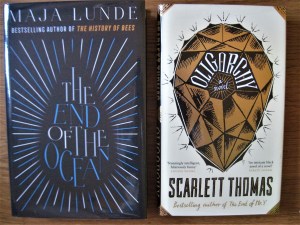
- Punchy, one-word titles on all these books I was reading simultaneously:

- Polio cases in The Golden Age by Joan London, Nemesis by Philip Roth and Crossing to Safety by Wallace Stegner
- An Italian setting and the motto “Pazienza!” in Dottoressa by Susan Levenstein and Crossing to Safety by Wallace Stegner
- Characters named Lachlan in The Ninth Child by Sally Magnusson and The Inland Sea by Madeleine Watts


- Mentions of the insecticide Flit in Nemesis by Philip Roth and Sacred Country by Rose Tremain
- A quoted Leonard Cohen lyric in Traveling Mercies by Anne Lamott; Cohen as a character in A Theatre for Dreamers by Polly Samson
- Plague is brought to an English village through bolts of cloth from London in Year of Wonders by Geraldine Brooks and Hamnet by Maggie O’Farrell; both also feature a woman who is a herbal healer sometimes mistaken for a witch (and with similar names: Anys versus Agnes)

- Gory scenes of rats being beaten to death in Hamnet by Maggie O’Farrell and Nemesis by Philip Roth
- Homemade mobiles in a baby’s room in A Theatre for Dreamers by Polly Samson and Sacred Country by Rose Tremain
- Speech indicated by italics rather than the traditional quotation marks in Pew by Catherine Lacey and Red at the Bone by Jacqueline Woodson
What’s the weirdest reading coincidence you’ve had lately?
Library Checkout: March 2020
(Unusually, here is a second post in one day from me. Library Checkout runs on the last Monday of every month; exceptions are rare!)
The only stockpiling I’ve been doing this month is of books. My public library system finally announced its full closure on the 21st, to last through at least the end of May, so I have no real excuse not to get through most of what I’ve borrowed.
I’ve been working my way through a selection of new releases (notably, skimming Hilary Mantel’s trilogy-ending doorstopper – it’s exquisitely written, of course, but far too long and detailed), plus a few backlist books that coincide with my interests in bibliotherapy, health and life writing. Some very short books – a graphic novel, a poetry collection, and a few essay- or novella-length works – make the “Read” list look longer than it really is.
Once again, I had a lot of DNFs this month because I’d placed holds on buzzy books but found that within a few pages, or after the first chapter, the voice or style didn’t click with me. This is no problem, though; I’ll just think of it as my way of sampling new releases while supporting the library service.
What have you been reading from your local libraries? Feel free to use the image above and leave a link to your blog in the comments if you’ve taken part, and/or tag me on Twitter (@bookishbeck / #TheLibraryCheckout). As usual, I give ratings where applicable, plus links to reviews of books I haven’t already featured.
READ
- The Mysterious Affair at Styles by Agatha Christie

- Dear Life: A Doctor’s Story of Love and Loss by Rachel Clarke

- A Story about Cancer (with a Happy Ending) [graphic novel], India Desjardins, illus. Marianne Ferrer [trans. from the French by Solange Ouellet]

- Childhood by Tove Ditlevsen

- This Is How It Always Is by Laurie Frankel
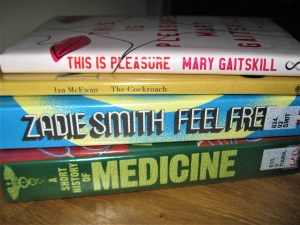
- This Is Pleasure by Mary Gaitskill
- Miss Austen by Gill Hornby
- The Golden Age by Joan London
- The End of the Ocean by Maja Lunde
- The Cockroach by Ian McEwan

- A Portable Paradise by Roger Robinson [poetry]
- Why You Should Read Children’s Books, Even Though You Are So Old and Wise by Katherine Rundell
- Oligarchy by Scarlett Thomas
SKIMMED
- Literary Values by John Burroughs
- Actress by Anne Enright
- Staying Alive in Toxic Times: A Seasonal Guide to Lifelong Health by Dr Jenny Goodman
- A Short History of Medicine by Steve Parker
CURRENTLY READING
- Youth by Tove Ditlevsen
- Reading with Patrick: A teacher, a student and the life-changing power of books by Michelle Kuo
- Meet the Austins by Madeleine L’Engle
- Other People’s Countries by Patrick McGuinness
- Nemesis by Philip Roth
- Pine by Francine Toon
CURRENTLY SKIMMING
- The Changing Mind: A Neuroscientist’s Guide to Aging Well by Daniel Levitin
- The Mirror & the Light by Hilary Mantel
- What Are We Doing Here?: Essays by Marilynne Robinson
- Neurotribes: The Legacy of Autism and How to Think Smarter about People Who Think Differently by Steve Silberman
- Feel Free: Essays by Zadie Smith

CHECKED OUT, TO BE READ
- Fugitive Pieces by Anne Michaels
- The Cruellest Month by Louise Penny
- Golden Boy by Abigail Tarttelin
- Red at the Bone by Jacqueline Woodson
PLUS an exciting new batch of university library books
- The Parable of the Sower by Octavia E. Butler
- The Song of the Lark by Willa Cather
- Love Medicine by Louise Erdrich
- Man’s Search for Meaning by Viktor Frankl
- When I Lived in Modern Times by Linda Grant
- Property by Valerie Martin

ON HOLD, TO BE PICKED UP
- The Girl with the Louding Voice by Abi Daré
IN THE RESERVATION QUEUE
- A Thousand Moons by Sebastian Barry
- Queenie by Candice Carty-Williams
- Can You Hear Me? A Paramedic’s Encounters with Life and Death by Jake Jones
- The Most Fun We Ever Had by Claire Lombardo
- Guest House for Young Widows: Among the Women of ISIS by Azadeh Moaveni
- The Accidental Countryside by Stephen Moss
- Redhead by the Side of the Road by Anne Tyler
RETURNED UNFINISHED
- The Warlow Experiment by Alix Nathan – The premise was awfully tempting, but even in just the first 20 pages I found the writing ponderous and repetitive.
- Such a Fun Age by Kiley Reid – I’m not hip enough for this one. Zadie Smith on turbo charge.

RETURNED UNREAD
- Djinn Patrol on the Purple Line by Deepa Anappara – The voice didn’t grab me.
- The Night Brother by Rosie Garland – The story didn’t lure me in.
- The Giver of Stars by Jojo Moyes – The historical setting didn’t convince me.
- My Wild, Sleepless Nights: A Mother’s Story by Clover Stroud – I DNFed Stroud’s last book, too; I should have known better that I don’t get on with her style.
- Our Fathers by Rebecca Wait – This was requested after me, so I didn’t get a chance to try it.
What appeals from my stacks?
Adventures in Rereading: Julian Barnes and Jennifer Egan
My last two rereads ended up being as good as or better than they had been the first time around; these two, however, failed to live up to my memory of them, one of them dramatically so. My increased literary experience and/or the advance of years meant these works felt less fresh than they did the first time around.
Flaubert’s Parrot by Julian Barnes (1984)
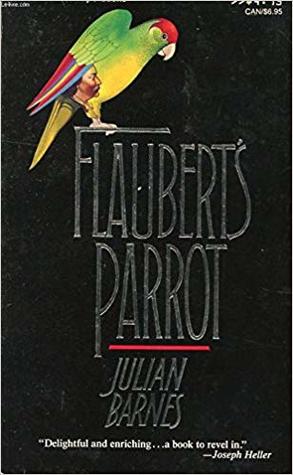 Barnes is in my trio of favorite authors, along with A. S. Byatt and David Lodge. He’s an unapologetic intellectual and a notable Francophile who often toggles between England and France, especially in his essays and short stories. This was his third novel and riffs on the life and works of Gustave Flaubert, best known for Madame Bovary.
Odd-numbered chapters build a straightforward narrative as Geoffrey Braithwaite, a widower, retired doctor and self-described “senile amateur scholar,” travels to Rouen for five days to see the sites associated with Flaubert and becomes obsessed with determining which of two museum-held stuffed parrots Flaubert used as his inspiration while writing the story “A Simple Heart.” Even-numbered chapters, however, throw in a variety of different formats: a Flaubert chronology, a bestiary, an investigation of the contradictory references to Emma Bovary’s eye color, a dictionary of accepted ideas, an examination paper, and an imagined prosecutor’s case against the writer.
There are themes and elements here that recur in much of Barnes’s later work:
- History – what remains of a life? (“He died little more than a hundred years ago, and all that remains of him is paper.”)
- Love versus criticism of one’s country (“The greatest patriotism is to tell your country when it is behaving dishonourably, foolishly, viciously.”)
- Time and its effects on relationships and memory
- How life is transmuted into art
- Languages and wordplay
- Bereavement
Indeed, I was most struck by Chapter 13, “Pure Story,” in which Dr. Braithwaite finally comes clean about his wife’s death and the complications of their relationship. Barnes writes about grief so knowingly and with such nuance, yet his own wife, Pat Kavanagh, didn’t die until 2008. Much of what he’s published since then has dwelt on loss, but more than two decades earlier he was already able to inhabit that experience in his imagination.
As a 22-year-old graduate student, I gobbled this up even though I knew very little about French literature and history and hadn’t yet read any Flaubert. I wasn’t quite as dazzled by the literary and biographical experimentation this time. While I still admired the audacity of the novel, I wouldn’t call it a personal favorite any longer. I think others of Barnes’s works will resonate for me more on a reread.
My original rating (c. 2006):
My rating now:
A Visit from the Goon Squad by Jennifer Egan (2010)
This makes up a pleasing pair as it shares Barnes’s experimentation with form and meditation on time. Before my reread I only remembered that it was about washed-up musicians and that there was one second-person chapter and another told as a PowerPoint presentation. Looking back at my original review, I see I was impressed by how Egan interrogated “society’s obsession with youth and celebrity, the moments of decision that can lead to success or to downfall … and the way time (the ‘goon’ of the title) and failure can wear away at one’s identity.” Back then I called the Pulitzer Prize-winning novel “achingly fresh, contemporary and postmodern. It is, in fact, so up-to-the-minute that one wonders how long that minute can last.” I was right to question its enduring appeal: this time I found the book detached, show-offy and even silly in places, and the characterization consistently left me cold.
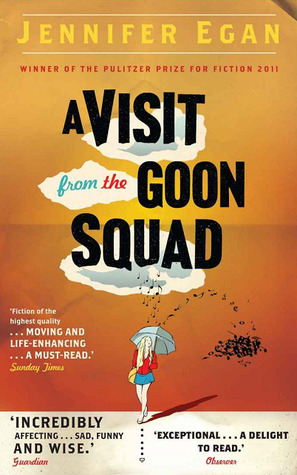 This was probably the first linked short story collection I ever read (now a favorite subgenre), and the first time I’d encountered second-person narration in fiction, so it’s no wonder I was intrigued. “Each chapter involves a very clever shift in time period and point of view,” I noted in 2011. This time, though, I found the 1970s–2020s timeline unnecessarily diffuse, and I was so disinterested in most of the characters – kleptomaniac PA Sasha, post-punk music producer Bennie, musician turned janitor turned children’s performer Scotty, a disgraced journalist, a starlet, and so on – that I didn’t care to revisit them.
The chapter in which Scotty catches a fish and takes it into Bennie’s office was a favorite, along with the PowerPoint presentation Sasha’s daughter puts together on the great pauses of rock music (while also revealing a lot about her family dynamic), but I found the segment on PR attempts to burnish an African general’s reputation far-fetched and ended up mostly skimming five of the last six chapters.
This was a buddy read with Laura T. (see her review); we came to similar conclusions: this may have felt fresh and even prescient about technology in 2010–11, but it didn’t stand up to a reread; still, we’ll keep our copies if just for the 75-page PowerPoint presentation.
Note: Egan has said that her next project is a companion piece to Goon Squad that uses a similar structure and follows some of its peripheral characters into new territory. Based on this rereading experience, I don’t think I’ll seek out the sequel.
My original rating (June 2011):
My rating now: 
To reread next: Everything Is Illuminated by Jonathan Safran Foer and On Beauty by Zadie Smith
Done any rereading lately?
Library Checkout: February 2020
The public and university library systems I use came to my aid and supplied lots of books for Paul Auster Reading Week and my Valentine’s-themed reading project. I’m now reading a mixture of brand-new releases and backlist novels and memoirs that caught my eye for one reason or another. I’m eagerly awaiting some high-profile fiction that’s still on order – new work from Sebastian Barry, Hilary Mantel and Maggie O’Farrell! Still a fair few DNFs this month, but never mind.
What have you been reading from your local libraries? Library Checkout runs on the last Monday of every month. Feel free to use this image and leave a link to your blog in the comments if you’ve taken part. As usual, I give links to reviews of books I haven’t already featured. I had a couple of very high ratings this month!

READ
- War Bears by Margaret Atwood

- The New York Trilogy by Paul Auster
- Oracle Night by Paul Auster
- Winter Journal by Paul Auster
- Shotgun Lovesongs by Nickolas Butler

- Mr Loverman by Bernardine Evaristo
- Bizarre Romance by Audrey Niffenegger
- Stay Hungry, Stay Foolish: Advice for the Rest of Your Life — Classic Graduation Speeches
SKIMMED
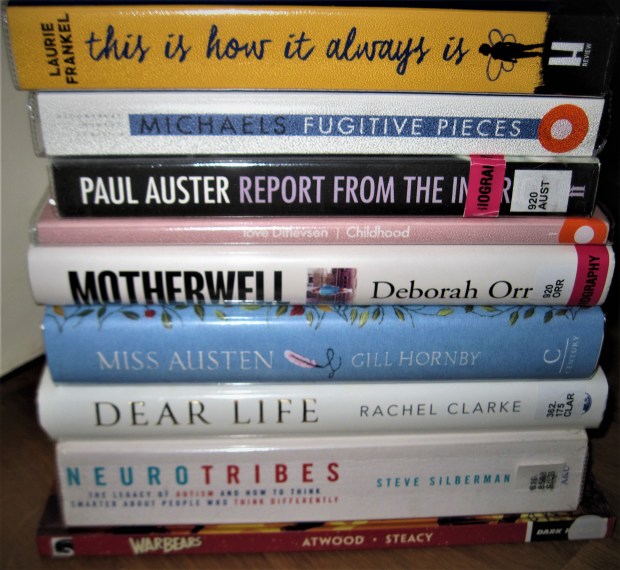
- Report from the Interior by Paul Auster
- Motherwell: A Girlhood by Deborah Orr
CURRENTLY READING
- Dear Life: A Doctor’s Story of Love and Loss by Rachel Clarke
- Childhood by Tove Ditlevsen
- This Is How It Always Is by Laurie Frankel
- Miss Austen by Gill Hornby
- Reading with Patrick: A teacher, a student and the life-changing power of books by Michelle Kuo
- Meet the Austins by Madeleine L’Engle
- The Golden Age by Joan London
- The End of the Ocean by Maja Lunde
- Other People’s Countries by Patrick McGuinness
CURRENTLY SKIMMING
- Literary Values by John Burroughs
- Staying Alive in Toxic Times: A Seasonal Guide to Lifelong Health by Dr Jenny Goodman
- Neurotribes: The Legacy of Autism and How to Think Smarter about People Who Think Differently by Steve Silberman
CHECKED OUT, TO BE READ
- Whatever Happened to Margo? by Margaret Durrell
- The Night Brother by Rosie Garland
- Fugitive Pieces by Anne Michaels
- The Warlow Experiment by Alix Nathan
- Before Everything by Victoria Redel
- Conrad & Eleanor by Jane Rogers
- Nemesis by Philip Roth
- Oligarchy by Scarlett Thomas
- Our Fathers by Rebecca Wait
IN THE RESERVATION QUEUE
- A Thousand Moons by Sebastian Barry
- The Girl with the Louding Voice by Abi Daré
- Actress by Anne Enright
- The Mirror and the Light by Hilary Mantel
- The Giver of Stars by Jojo Moyes
- Hamnet by Maggie O’Farrell
- Such a Fun Age by Kiley Reid
- What Are We Doing Here?: Essays by Marilynne Robinson
- Portable Paradise by Roger Robinson [poetry]
- Why You Should Read Children’s Books, Even Though You Are So Old and Wise by Katherine Rundell
- My Wild, Sleepless Nights: A Mother’s Story by Clover Stroud
- Pine by Francine Toon

ON HOLD, TO BE PICKED UP
- This Is Pleasure by Mary Gaitskill
- A Short History of Medicine by Steve Parker
- Feel Free: Essays by Zadie Smith
RETURNED UNFINISHED
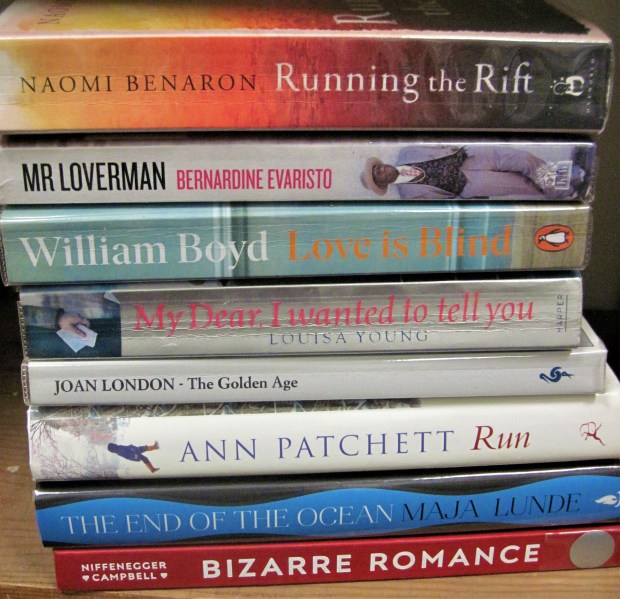
- Running the Rift by Naomi Benaron – I read 25 pages and didn’t feel drawn in to the characters’ story. (It could also be that I’m too familiar with Rwandan history from reading We Wish to Inform You that Tomorrow We Will Be Killed with Our Families by Philip Gourevitch.)
- When All Is Said by Anne Griffin – I read 60 pages and found it wordy and sentimental.
- Jazz by Toni Morrison – I dragged my way through nearly 100 pages. In 1920s Harlem, Joe and Violet Trace’s marriage falls apart when he takes up with Dorcas Manfred, who’s just 18. We know pretty much from the first page that Joe ends up shooting Dorcas dead, and that at the girl’s funeral Violet takes her haircutting scissors to her rival’s face. After that it’s just a matter of why. There are some wonderful descriptions of the cityscape, but I wearied of the endless layering of flashbacks.
- Run by Ann Patchett – I read the first 80 pages. There are a lot of interesting elements here: Catholicism, interracial adoption, grief, politics and fish. But they don’t feel like they fit together in the same book. The circumstances of the accident that sparks the main action feel very contrived. I was also annoyed at the constant use of “fishes” as a plural.
RETURNED UNREAD
- Love Is Blind by William Boyd – Requested after me; lost interest.
- You Are Now Entering the Human Heart by Janet Frame [short stories] – Couldn’t get into any of the stories.
- Speak No Evil by Uzodinma Iweala – Lost interest.
What appeals from my stacks?
Adventures in Rereading: A. S. Byatt and Abigail Thomas
At the end of last year, I picked out a whole shelf’s worth of books I’ve been meaning to reread. I know that others of you are devoted re-readers, returning to childhood favorites for comfort or poring over admired novels two or three times to figure out how they work. Alas, I’m usually resistant to rereading because I feel like it takes away time that I could be spending reading new or at least new-to-me books. Yet along with the nostalgia there is also a certain relief to returning to a favorite: here’s a book that is guaranteed not to disappoint.
So far this year I’ve finished two rereads, and I’m partway through a third. I’m not managing the one-every-other-week pace I would need to keep up to get through the whole shelf this year, but for me this is still good progress. I’ll report regularly on my experience of rereading.
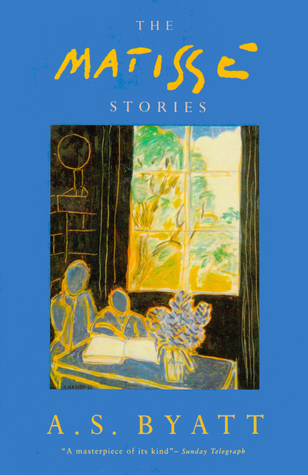
The Matisse Stories by A. S. Byatt (1993)
Byatt is my favorite author. My memory for individual short stories is pitiful, yet I have never forgotten the first of three stories in this volume, so I focus on it here with a close rereading. In “Medusa’s Ankles,” a middle-aged woman goes berserk in a hair salon but it all turns out fine. I remember imagining what that would be like: to let go, to behave badly with no thought for others’ opinions, to act purely on instinct – and for there to be no consequences.
I’d forgotten all the particulars of the event. Susannah, a linguist, is drawn to the salon by the Rosy Nude reproduction she sees through the window. She becomes a reluctant receptacle for her stylist Lucian’s stories, including tales of his wife’s fat ankles and his mistress’ greater appeal. He confides in her his plan to run away. “I don’t want to put the best years of my life into making suburban old dears presentable. I want something more.”
 Susannah holds in all her contempt for Lucian and his hip shop redesign until the day he fobs her off on another stylist – even though she’s said she needs an especially careful job this time because she is to appear on TV to accept the Translator’s Medal. When Deirdre is done, Susannah forgets about English politeness and says just what she thinks: “It’s horrible. I look like a middle-aged woman with a hair-do.” (Never mind that that’s exactly what she is.)
In a whirlwind of fury, she trashes the salon. Byatt describes the aftermath, indulging her trademark love of colors: “It was a strange empty battlefield, full of glittering fragments and sweet-smelling rivulets and puddles of venous-blue and fuchsia-red unguents, patches of crimson-streaked foam and odd intense spills of orange henna or cobalt and copper.”
You can just imagine the atmosphere in the salon: everyone exchanging horrified looks and cautiously approaching Susannah as if she’s a dangerous dog. Lucian steps in to reassure her: “We all feel like that, sometimes. Most of us don’t dare. … The insurance’ll pay. Don’t worry. … You’ve done me a good turn in a way.” Maybe he’ll go off with his girlfriend and start a new business, after all. Predictably, the man has made it all about him.
The ironic kicker to this perfect story about middle age and female rage comes after Susannah goes home to a husband we hadn’t heard about yet. “He saw her. (Usually he did not.) ‘You look different. You’ve had your hair done. I like it. You look lovely. It takes twenty years off you. You should have it done more often.’”
“Art Work” briefly, unnecessarily, uses a Matisse painting as a jumping-off point. A bourgeois couple, a painter and magazine design editor, hire Mrs. Brown, a black woman, to clean their house and are flabbergasted when she turns out to be an artist in her own right. “The Chinese Lobster,” the final story, is the only one explicitly about Matisse. An academic dean invites her colleague out to lunch at a Chinese restaurant to discuss a troubled student he’s supervising. This young woman has eating disorders and is doing a portfolio of artwork plus a dissertation on Matisse’s treatment of female bodies. Her work isn’t up to scratch, and now she’s accused her elderly supervisor of sexual harassment. The racial and sexual politics of these two stories don’t quite hold up, though both are well constructed.
I reread the book in one morning sitting last week.
My original rating (c. 2005):
My rating now: 
A Three Dog Life by Abigail Thomas (2006)
In April 2000 Thomas’s husband Rich was hit by a car and incurred a traumatic brain injury when their dog Harry got off the leash and Rich ran out into the road near their New York City home to save him. It was a miracle that Rich lived, but his disability was severe enough that he had to be moved to an upstate nursing home. This is one of the first memoirs I ever remember reading, and it made a big impression. I don’t think I realized at the time that it was written in discrete essays, many of which were first published in magazines and anthologies. It represents an advance on the highly fragmentary nature of her first memoir, Safekeeping.
 Thomas maintains a delicate balance of emotions: between guilt every time she bids Rich goodbye in the nursing home and relief that she doesn’t have to care for him 24/7; between missing the life they had and loving the cozy one she’s built on her own with her three dogs. (The title is how Aborigines refer to the coldest nights.) As in One Hundred Names for Love and All Things Consoled, Rich’s aphasia produces moments of unexpectedly poetic insight.
Before rereading I remembered one phrase and one incident (though I’d thought the latter was from Safekeeping): doctors described Rich’s skull as “shattered like an eggshell,” and Thomas remembers a time she was driving and saw the car ahead hit a raccoon; she automatically swerved to avoid the animal, but saw in her rearview mirror that it was still alive and realized the compassionate thing would have been to run it over again. I’ve never forgotten these disturbing images.
Unassuming and heart on sleeve, Thomas wrote one of the most beautiful books out there about loss and memory. I’d recommend this to fans of Anne Lamott and readers of bereavement memoirs in general. This is what I wanted from the rereading experience: to find a book that was even better the second time around.
My original rating (c. 2006):
My rating now:
Currently rereading: Flaubert’s Parrot by Julian Barnes
Considering rereading next: On Beauty by Zadie Smith
Done any rereading lately?
Library Checkout: January 2020
December into January has been a big library reading month for me. I made it through most of the Costa Awards poetry shortlist plus two from the fiction shortlists and enjoyed some YA and middle-grade fiction (not my usual reading comfort zone) and graphic novels. As we head into February, I’m reading lots of ‘Love’-themed titles for a Valentine’s Day post, and starting the reading for some other projects: Bellwether Prize winners, past Wellcome Book Prize long- and shortlistees, and Annabel’s Paul Auster reading week.
You’ll notice that I also had a lot of unfinished library books this month. Some I’d read 20‒30 pages of; others I dropped after just a few pages (or barely made it past the first page). I need to get better at doing this few-page sampling before I even borrow a book so I don’t bother hauling things I’m not going to read to and fro. Often, though, I show up to the library on a Friday afternoon with a long list of books to borrow and just 10 minutes to get to my bookshop volunteering, so I grab and go without opening them up. Next month I’ll try to do better.
As usual, I give links to reviews of books I haven’t already featured. I had three very high ratings this month!
What have you been reading from your local libraries? Library Checkout runs on the last Monday of every month. Feel free to use this image and leave a link to your blog in the comments if you’ve taken part.
READ
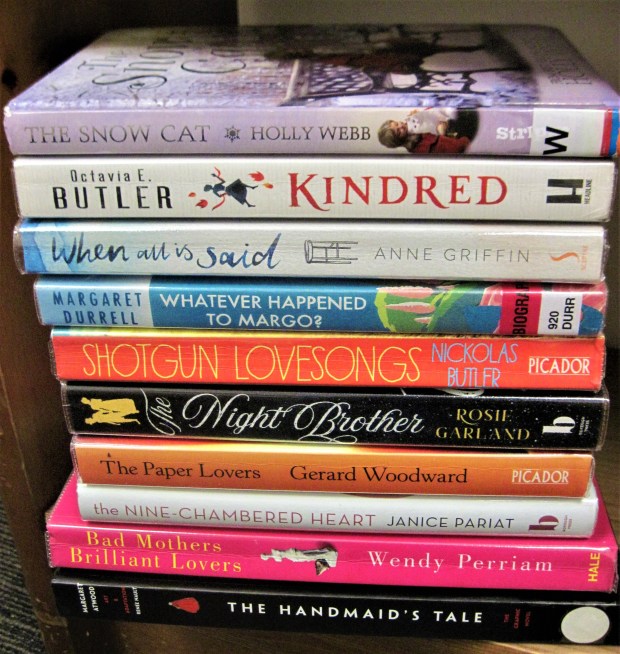
- The Handmaid’s Tale by Margaret Atwood [graphic novel adaptation by Renée Nault]
- City of Glass [from The New York Trilogy] by Paul Auster
- On Love and Barley: Haiku of Bashō [poetry]

- Kindred by Octavia E. Butler

- Flèche by Mary Jean Chan [poetry]
- The Confessions of Frannie Langton by Sara Collins
- The Envoy from Mirror City by Janet Frame
- Confession with Blue Horses by Sophie Hardach
- The Boy, the Mole, the Fox and the Horse by Charlie Mackesy
- Reckless Paper Birds by John McCullough [poetry]
- The Imitation Game: Alan Turing Decoded by Jim Ottaviani [graphic novel]
- The Nine-Chambered Heart by Janice Pariat
- Mr Dickens and His Carol by Samantha Silva
- A Good Enough Mother by Bev Thomas
- Frost by Holly Webb
- The Snow Cat by Holly Webb
- Everything, Everything by Nicola Yoon [for February book club]
SKIMMED
- The Body Lies by Jo Baker
- The Making of Poetry: Coleridge, the Wordsworths and Their Year of Marvels by Adam Nicolson
- Invisible Women: Exposing Data Bias in a World Designed for Men by Caroline Criado Perez
- The Five: The Untold Lives of the Women Killed by Jack the Ripper by Hallie Rubenhold
CURRENTLY READING
- Winter Journal by Paul Auster
- Running the Rift by Naomi Benaron
- Literary Values by John Burroughs
- Shotgun Lovesongs by Nickolas Butler
- Mr Loverman by Bernardine Evaristo
- When All Is Said by Anne Griffin
- Meet the Austins by Madeleine L’Engle
- Jazz by Toni Morrison
- Bizarre Romance by Audrey Niffenegger
CHECKED OUT, TO BE READ
- The rest of The New York Trilogy by Paul Auster
- Love Is Blind by William Boyd
- Whatever Happened to Margo? by Margaret Durrell
- The Night Brother by Rosie Garland
- Speak No Evil by Uzodinma Iweala
- The Golden Age by Joan London
- The End of the Ocean by Maja Lunde
- Run by Ann Patchett
IN THE RESERVATION QUEUE
- Disobedience by Naomi Alderman
- Dear Life: A Doctor’s Story of Love and Loss by Rachel Clarke
- Childhood by Tove Ditlevsen
- This Is How It Always Is by Laurie Frankel
- Miss Austen by Gill Hornby
- The Giver of Stars by Jojo Moyes
- The Warlow Experiment by Alix Nathan
- Motherwell: A Girlhood by Deborah Orr
- A Short History of Medicine by Steve Parker
- Nemesis by Philip Roth
- Oligarchy by Scarlett Thomas
- Pine by Francine Toon
RETURNED UNFINISHED
- Surge by Jay Bernard [poetry] – I read the first 20 pages. Protest poems in various voices. I enjoyed one in pidgin – reminiscent of Kei Miller.
- Short Short Stories by Dave Eggers – I read 22 out of 55 pages. These flash fiction stories appeared in the Guardian in 2004. Of the first 10 stories, a few were amusing (a man’s current earworm spells the demise of his relationship; guessing how water feels to fish; a flight attendant has fun with his routines) but the rest were slight or gratuitously sexual, and the style is repetitive throughout.
- Under the Camelthorn Tree: Raising a Family among Lions by Kate Nicholls
- The Botanist’s Daughter by Kayte Nunn
- Shadowplay by Joseph O’Connor
- The Ice by Laline Paull
- Bad Mothers, Brilliant Lovers by Wendy Perriam
- The Paper Lovers by Gerard Woodward
- My dear, I wanted to tell you by Louisa Young
RETURNED UNREAD
- Winter Garden by Kristin Hannah – Not a fan of the prose style.
- Consolations by David Whyte – Not what I thought it would be.
Anything that appeals in my stacks?
2020 Reading Goals and Anticipated Releases
Review copies have started to feel like an obligation I don’t want. Almost as soon as one comes through the door, I regret having asked for or accepted it. (Now I have to read the danged thing, and follow through with a review!) So I’m going to cut back severely this year. The idea is to wait until late in 2020 to figure out which are the really worthwhile releases, and then only read those instead of wading through a lot of mediocre stuff.
“Until one has some kind of professional relationship with books one does not discover how bad the majority of them are. In much more than nine cases out of ten the only objectively truthful criticism would be ‘This book is worthless,’ while the truth about the reviewer’s own reaction would probably be ‘This book does not interest me in any way, and I would not write about it unless I were paid to’. … The best practice, it has always seemed to me, would be simply to ignore the great majority of books and to give very long reviews … to the few that seem to matter.” (from “Confessions of a Book Reviewer” in Books v. Cigarettes by George Orwell)
These are the January to May 2020 releases I own so far, with perhaps a few more on the way. I acquired a lot of these in September through November, before I made the decision to cut down on review copies.

I’m also looking forward to new books by Sebastian Barry, Susanna Clarke, Stephanie Danler, Anne Enright, Yaa Gyasi, John Irving, Daisy Johnson, Daniel Kehlmann, Sue Monk Kidd, Rebecca Dinerstein Knight, Maya Shanbhag Lang, Helen Macdonald, Hilary Mantel, David Mitchell, Sarah Moss, Mark O’Connell, Maggie O’Farrell, Anne Tyler, Abraham Verghese, Raynor Winn and Molly Wizenberg.
I can still access new/pre-release books via my public library and NetGalley/Edelweiss, especially fiction to review for BookBrowse and nonfiction for Kirkus and the TLS.
This resolution is not about denying or punishing myself, as bloggers’ book-buying bans sometimes seem to be, so if an unmissable book (e.g. HAMNET) is offered on Twitter or via my blog, I won’t consider it cheating to say yes. FOMO will likely be a chronic condition for me this year, but ultimately I hope to do myself a favor.
With the reading time I’m saving, I plan to make major inroads into those 440 print books I own and haven’t read yet, and to do a lot of re-reading (I only managed one and a bit rereads in 2019). I might well blog less often and only feature those books that have been exceptional for me. I’ve set aside this shelf of mostly fiction that I think deserves re-reading soon:

“I do not think we go back to the exciting books,—they do not usually leave a good taste in the mouth; neither to the dull books, which leave no taste at all in the mouth; but to the quiet, mildly tonic and stimulating books,—books that have the virtues of sanity and good nature, and that keep faith with us.” (from “On the Re-Reading of Books” in Literary Values by John Burroughs)
I hope (as always) to read more classics, literature in translation and doorstoppers. Travel and biography are consistently neglected categories for me. Though I won’t set specific goals for these genres, I will aim to see measurable progress. I will also take advantage of the Wellcome Book Prize being on hiatus this year to catch up on some of the previous winners and shortlisted books that I’ve never managed to read.
Mostly, I want to avoid any situations that make me feel guilty or mean (so no more books received direct from the author, and any review books that disappoint will be quietly dropped), follow my whims, and enjoy my reading.
What are some of your goals (reading-related or otherwise) for 2020?
Holiday Book Haul and Final 2019 Statistics
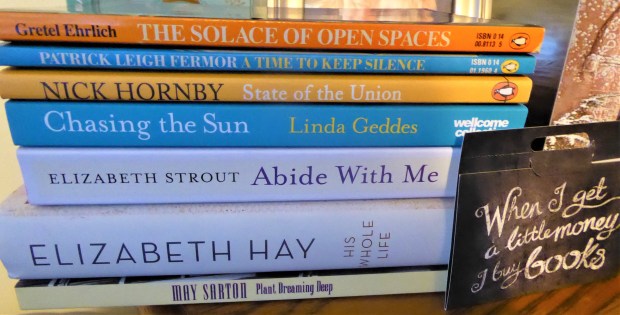
This is the stack I got for Christmas – along with a £30 Waterstones voucher to buy more books! I haven’t spent it yet, but I’m contemplating some combination of Be My Guest by Priya Basil, Disappearing Earth by Julia Phillips, The Glovemaker by Ann Weisgarber, a pre-order of the paperback of Benjamin Myers’s The Offing, and a cheap 2020 calendar.
2019 was my most prolific reading year yet! (I’m sure I said the same thing the last two years.) People sometimes joke, “why not aim for a book a day?” but that’s not how I do things. Instead of reading one book from start to finish and then beginning another, I almost always have 10 to 20 books on the go at a time. I tend to start and finish books in batches – I’m addicted to starting new books, but also to finishing them.
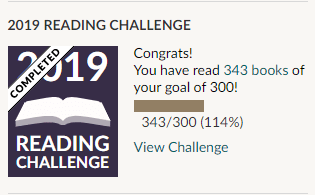
Some interesting additional statistics courtesy of Goodreads:
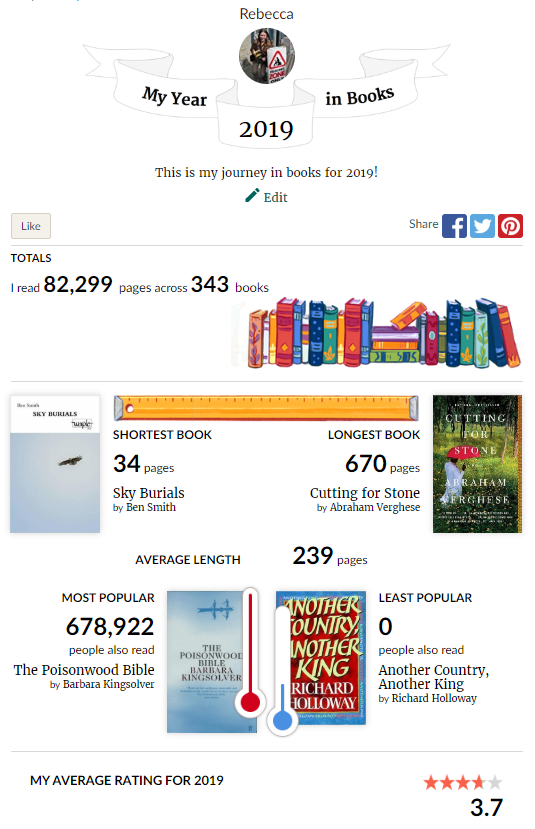
How did 2019 turn out for you reading-wise?
Other 2019 Superlatives and Some Statistics
My best discoveries of the year: The poetry of Tishani Doshi; Penelope Lively and Elizabeth Strout (whom I’d read before but not fully appreciated until this year); also, the classic nature writing of Edwin Way Teale.


The authors I read the most by this year: Margaret Atwood and Janet Frame (each: 2 whole books plus parts of 2 more), followed by Doris Lessing (2 whole books plus part of 1 more), followed by Miriam Darlington, Paul Gallico, Penelope Lively, Rachel Mann and Ben Smith (each: 2 books).
Debut authors whose next work I’m most looking forward to: John Englehardt, Elizabeth Macneal, Stephen Rutt, Gail Simmons and Lara Williams.
My proudest reading achievement: A 613-page novel in verse (Mary Ann Sate, Imbecile by Alice Jolly) + 2 more books of over 600 pages (East of Eden by John Steinbeck and Cutting for Stone by Abraham Verghese).


Best book club selection: Red Dust Road by Jackie Kay was our first nonfiction book and received our highest score ever.
Some best first lines encountered this year:
 “What can you say about a twenty-five-year old girl who died?” (Love Story by Erich Segal)
- “The women of this family leaned towards extremes” (Away by Jane Urquhart)
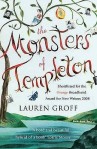
- “The day I returned to Templeton steeped in disgrace, the fifty-foot corpse of a monster surfaced in Lake Glimmerglass.” (from The Monsters of Templeton by Lauren Groff)
The downright strangest book I read this year: Lanny by Max Porter
The 2019 books everybody else loved (or so it seems), but I didn’t: Fleishman Is in Trouble by Taffy Brodesser-Akner, The Topeka School by Ben Lerner, Underland by Robert Macfarlane, The Boy, The Mole, The Fox and The Horse by Charlie Mackesy, Three Women by Lisa Taddeo and The Nickel Boys by Colson Whitehead
 The year’s major disappointments: Cape May by Chip Cheek, We Are the Weather: Saving the Planet Begins at Breakfast by Jonathan Safran Foer, Letters to the Earth: Writing to a Planet in Crisis, ed. Anna Hope et al., Bowlaway by Elizabeth McCracken, Rough Magic: Riding the World’s Loneliest Horse Race by Lara Prior-Palmer, The Lager Queen of Minnesota by J. Ryan Stradal, The Knife’s Edge by Stephen Westaby and Frankissstein by Jeanette Winterson
The worst book I read this year: Jonathan Livingston Seagull by Richard Bach
Some statistics on my 2019 reading:
Fiction: 45.4%
Nonfiction: 43.4%
Poetry: 11.2%
(As usual, fiction and nonfiction are neck and neck. I read a bit more poetry this year than last.)
Male author: 39.4%
Female author: 58.9%
Nonbinary author (the first time this category has been applicable for me): 0.85%
Multiple genders (anthologies): 0.85%
(I’ve said this the past three years: I find it interesting that female authors significantly outweigh male authors in my reading; I have never consciously set out to read more books by women.)
E-books: 10.3%
Print books: 89.7%
(My e-book reading has been declining year on year, partially because I’ve cut back on the reviewing gigs that involve only reading e-books and partially because I’ve done less traveling; also, increasingly, I find that I just prefer to sit down with a big stack of print books.)
Work in translation: 7.2%
(Lower than I’d like, but better than last year’s 4.8%.)
Where my books came from for the whole year:
- Free print or e-copy from publisher: 36.8%
- Public library: 21.3%
- Secondhand purchase: 13.8%
- Free (giveaways, The Book Thing of Baltimore, the free mall bookshop, etc.): 9.2%
- Downloaded from NetGalley, Edelweiss or Project Gutenberg: 7.8%
- Gifts: 4.3%
- University library: 2.9%
- New purchase (usually at a bargain price): 2.9%
- Church theological library: 0.8%
- Borrowed: 0.2%
(Review copies accounted for over a third of my reading; I’m going to scale way back on this next year. My library reading was similar to last year’s; my e-book reading decreased in general; I read more books that I either bought new or got for free.)
Number of unread print books in the house: 440
(Last thing I knew the figure was more like 300, so this is rather alarming. I blame the free mall bookshop, where I volunteer every Friday. Most weeks I end up bringing home at least a few books, but it’s often a whole stack. Surely you understand. Free books! No strings attached!)
A Report on My Most Anticipated Reads & The Ones that Got Away
Between my lists in January and June, I highlighted 45 of the 2019 releases I was most looking forward to reading. Here’s how I did:
Read: 28 [Disappointments (rated
Currently reading: 1
Abandoned partway through: 5
Lost interest in reading: 1
Haven’t managed to find yet: 9
Languishing on my Kindle; I still have vague intentions to read: 1
To my dismay, it appears I’m not very good at predicting which books I’ll love; I would have gladly given 43% of the ones I read a miss, and couldn’t finish another 11%. Too often, the blurb is tempting or I loved the author’s previous book(s), yet the book doesn’t live up to my expectations. And I still have 376 books published in 2019 on my TBR, which is well over a year’s reading. For the list to keep growing at that annual rate is simply unsustainable.
Thus, I’m gradually working out a 2020 strategy that involves many fewer review copies. For strings-free access to new releases I’m keen to read, I’ll go via my local library. I can still choose to review new and pre-release fiction for BookBrowse, and nonfiction for Kirkus and the TLS. If I’m desperate to read an intriguing-sounding new book and can’t find it elsewhere, there’s always NetGalley or Edelweiss, too. I predict my FOMO will rage, but I’m trying to do myself a favor by waiting most of the year to find out which are truly the most worthwhile books rather than prematurely grabbing at everything that might be interesting.
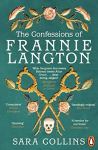
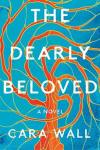
I regret not having time to finish two 2019 novels I’m currently reading that are so promising they likely would have made at least my runners-up list had I finished them in time. I’m only a couple of chapters into The Confessions of Frannie Langton by Sara Collins (on the Costa Awards debut shortlist), a Gothic pastiche about a Jamaican maidservant on trial for killing her master and mistress (doubly intended) in Georgian London, but enjoying it very much. I’m halfway through The Dearly Beloved by Cara Wall, a quiet character study of co-pastors and their wives and how they came to faith (or not); it is lovely and simply cannot be rushed.
The additional 2019 releases I most wished I’d found time for before the end of this year are:
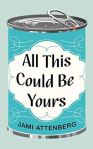
All This Could Be Yours by Jami Attenberg
Your House Will Pay by Steph Cha
Dominicana by Angie Cruz
&
In the Dream House by Carmen Maria Machado: I’ve heard that this is an amazing memoir of a same-sex abusive relationship, written in an experimental style. It was personally recommended to me by Yara Rodrigues Fowler at the Young Writer of the Year Award ceremony, and also made Carolyn Oliver’s list of nonfiction recommendations.
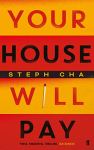
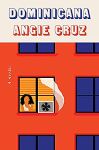

Luckily, I have another chance at these four since they’re all coming out in the UK in January; I have one as a print proof (Cruz) and the others as NetGalley downloads. I also plan to skim Invisible Women: Exposing Data Bias in a World Designed for Men by Caroline Criado Perez, a very important new release, before it’s due back at the library.
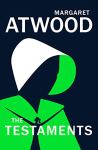 The biggest release of 2019 is another that will have to wait until 2020: I know I made a lot of noise about boycotting The Testaments, but I’ve gradually come round to the idea of reading it, and was offered a free hardback to read as a part of an online book club starting on the 13th, so I’m currently rereading Handmaid’s to be ready to start the sequel in the new year.
Here’s the books I’m packing for the roughly 48 hours we’ll spend at my in-laws’ over Christmas. (Excessive, I know, but I’m a dabbler, and like to keep my options open!) A mixture of current reads, including a fair bit of suspense and cozy holiday stuff, with two lengthy autobiographies, an enormous Victorian pastiche, and an atmospheric nature/travel book waiting in the wings. I find that the holidays can be a good time to start some big ol’ books I’ve meant to read for ages.

Left stack: to start and read gradually over the next couple of months; right stack: from the currently reading pile.
I’ll be back on the 26th to start the countdown of my favorite books of the year, starting with fiction.
 Bookish Beck = Rebecca Foster. American transplant to England. Freelance proofreader and book reviewer.
