You Think It, I’ll Say It: Stories by Curtis Sittenfeld
“Oh, our private habits, our private selves—how strange we all are, how full of feelings and essentially alone.”
You could say that Curtis Sittenfeld is the reason I’m a book reviewer. Back when I worked as a library assistant in London, I filled the hours of tedium by writing one- or two-paragraph responses to every book I read, but these just sat in a Word file and never saw the light of day. I had so little confidence in my writing that I didn’t show these proto-reviews to anyone, not even on Goodreads. One day in 2011, though, I saw that Stylist magazine was looking for a temporary books columnist; to be considered you had to submit a 100-word review of your favorite book by a woman. I chose Sittenfeld’s American Wife, her masterfully introspective 2008 novel from the perspective of a fictionalized Laura Bush. It was great practice in being concise, that’s for sure, and Stylist chose me as a finalist. (You can see my 100-word review here.) From there it went to public voting on the website. Alas, I didn’t win, but it was the first time I got recognition for a book review, and I was hooked. When I left my job in 2013 to go freelance, I was determined that reviewing would be part of my work.
Sittenfeld is still one of my favorite authors, and I’ve read everything she’s written. Like Maggie O’Farrell and Carolyn Parkhurst, her work is perfectly balanced between women’s fiction and literary fiction and she describes families and romantic relationships expertly, in prose so deliciously smooth it slides right down. If you’re a fan of her novels, I would certainly recommend these 11 short stories to you. They’re about marriage, parenting, authenticity, celebrity and social media in Trump’s America, with the two key recurring elements of role reversal and retrospect.
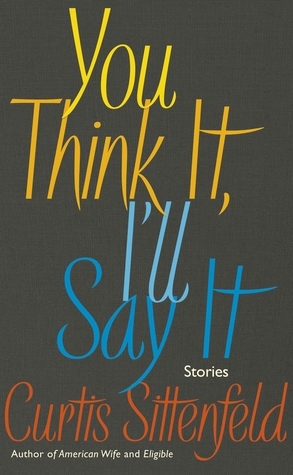 The opening story, “The Nominee,” which only appears in the U.K. edition, feels like a natural follow-up to American Wife. Though never named, the narrator is clearly Hillary Clinton, and in a voice that’s consistent with her memoirs she ponders her struggle to earn popular appeal: “The typical American voter doesn’t wish to share a beer with me.” It’s 2016 and she’s about to be interviewed by a younger female journalist who has written about her dozens of times. Back in 2002 she was compassionate when this journalist fell apart during an interview, but she knows not to expect the same courtesy in return. No, she fully expects to be burned. But still the nominee truly believes she’ll win, as the opposite outcome would be catastrophic.
Yet that’s the reality in the final story, “Do-Over,” which was shortlisted for this year’s Sunday Times EFG Short Story Award. In the wake of Trump’s election, Clay hears from Sylvia, a high school classmate, out of the blue and meets up with her for dinner in Chicago. She’s still sore about the sexist nature of the election at Bishop Academy in which, despite having tied, she was given the patronizing, made-up role of “assistant prefect” while Clay was named senior prefect. Sylvia has engineered this fake date as a gift to herself, to see what could happen, and she’s going to behave as badly as she wants.
The role reversal is clearest in “Gender Studies” and “A Regular Couple.” In the former, Nell, a gender studies professor, accidentally uses a taxi driver for sex. In the latter, Maggie is on her honeymoon with Jason; though they’re both lawyers, she recently handled a sportsman’s rape trial and earns 20 times what Jason does in nonprofit immigration law. There’s another flipping of positions in this one: among the other honeymooners at their ski resort is Ashley Frye, who was one of the popular girls at Maggie’s high school and made her feel awkward and inferior. But Maggie’s TV appearances have given her an aura of celebrity: now she’s the popular one, and she has an idea for how to get revenge on Ashley.
The most similar to Sittenfeld’s early fare is “Vox Clamantis in Deserto,” in which a college student loses her virginity under bizarre circumstances in 1994. Several stories involve a dual time setting: a decade or more later, characters reflect on the strange turns their lives have taken to get them where they are now and have a chance to rethink the decisions they made.
My favorite single story is “Plausible Deniability,” the only time I can think of that Sittenfeld has used a male point-of-view. The narrator is William, a 41-year-old lawyer in St. Louis who has distinctly different relationships with his brother and his sister-in-law. There’s a clever surprise in this one, as there is later on in “The Prairie Wife,” and it makes you ask about the various ways there are of being close with another person.
Other stories concern new mothers’ guilt and compromises, the temptation of adultery, and the danger of jealousy and making up your mind about someone too soon. I was less sure about “Volunteers Are Shining Stars,” voiced by a character with OCD and set among African-Americans at a family shelter in Washington, D.C., and I thought “Off the Record” was a bit too similar to “The Nominee.” Overall, though, this is a whip-smart, current and relatable book, ideal for readers who don’t think they like short stories.
My rating: 
You Think It, I’ll Say It is published in the UK today, May 3rd, by Doubleday. My thanks to the publisher for the free review copy.
Recommended May Releases
May and June are HUGE months for new releases. I’ve been doing enough early reading via NetGalley and Edelweiss that I’ve found plenty to recommend to you for next month. From a novel voiced by one of Hemingway’s wives to a physicist’s encouragement to waste more time, I hope there will be something here for everyone.
The Pisces by Melissa Broder
[Coming from Hogarth Press (USA) on the 1st and Bloomsbury (UK) on the 3rd]
 At first I thought this was one of those funny, quirky but somewhat insubstantial novels about a thirtysomething stuck with a life she isn’t sure she wants – something along the lines of Goodbye, Vitamin, The Portable Veblen, or All Grown Up. Then I thought it was just a crass sex comedy. But the further I read the deeper it all seemed to become: tropes from Greek myth and the fluidity of gender roles made me think of You Too Can Have a Body Like Mine, another debut novel that surprised me for its profundity. Lucy, a thirty-eight-year-old PhD student, agrees to spend a summer dog-sitting for her yoga entrepreneur sister in Venice Beach, California while she undertakes therapy for the twin problems of low self-esteem and love addiction. If you know one thing about this book, it’s that there’s sex with a merman. Ultimately, though, I’d say it’s about “the prison of the body” and choosing which of the different siren voices calling us to listen to. I found it outrageous but rewarding.
My rating:
How to Be a Perfect Christian by Adam Ford and Kyle Mann
[Coming from Multnomah (USA) on the 1st]
 The Babylon Bee is a Christian version of The Onion, so you know what you’re getting here: a very clever, pitch-perfect satire of evangelical Christianity today. If, like me, you grew up in a nondenominational church and bought into the subculture hook, line and sinker (Awana club, youth group, courtship, dc Talk albums, the whole shebang), you will find that so much of this rings true. The book is set up as a course for achieving superficial perfection through absolute “conformity to the status quo of the modern church.” Sample advice: find an enormous church that meets your needs, has a great coffee bar and puts on a laser-lit worship performance to rival “an amusement park for cats or a Def Leppard concert”; master the language of Christianese (“Keeping it in prayer” pretty much covers your bases); and bring as little as you can to the church potluck (a 25-pack of napkins) but consume as much as is anatomically possible. So, a lot of fun, just a little overlong because you get the joke early on.
My rating:
The Ensemble by Aja Gabel
[Coming from Riverhead (USA) on the 15th]
 In May 1994, the members of the Van Ness String Quartet are completing their final graduate recital at a San Francisco conservatory and preparing for the Esterhazy quartet competition in the Canadian Rockies. These four talented musicians – Jana, first violin; Brit, second violin; Henry, viola; and Daniel, cello – have no idea what the next 15 years will hold for them: a cross-country move, romances begun and lost, and career successes and failures. Drawing on her own history as a violinist and cellist, Aja Gabel infuses her debut novel with the simultaneous uncertainty and euphoria of both the artistic life and early adulthood in general. An alternating close third-person perspective gives glimpses into the main characters’ inner lives, and there are evocative descriptions of classical music. I think The Ensemble will mean even more to those readers who are involved in music, but anyone can relate to the slow fade from youth into middle age and the struggle to integrate art with the rest of life.
My rating:
Tropic of Squalor by Mary Karr
[Coming from Harper (USA) on the 8th]
 Mary Karr is mostly known as a memoirist, but this is actually her fifth poetry collection. Death is a major theme, with David Foster Wallace’s suicide and 9/11 getting multiple mentions. Karr also writes self-deprecatingly about her Texas childhood. Best of all is the multi-part “The Less Holy Bible”: a sort of Devil’s Dictionary based loosely around the books of the Bible, it bounces between Texas and New York City and twists biblical concepts into commonsense advice. Not one for those who are quick to cry heresy, perhaps, but I enjoyed it very much, especially “VI. Wisdom: The Voice of God”: “Ninety percent of what’s wrong with you could be cured with a hot bath, / says God through the manhole covers, but you want magic, to win / the lottery you never bought a ticket for. … Don’t look for initials in the geese honking / overhead or to see through the glass even darkly. It says the most obvious shit, / i.e. Put down that gun, you need a sandwich.”
My rating:
In Praise of Wasting Time by Alan Lightman
[Coming from Simon & Schuster / TED (USA and UK) on the 15th]
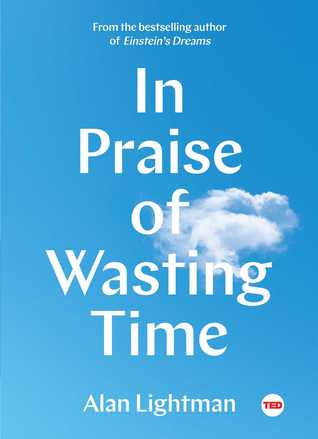 Lightman, a physicist and MIT professor, argues that only in unstructured time can we rediscover our true identity and recover our carefree childhood creativity. This work-as-play model goes against the modern idea that time is money and every minute must be devoted to a project. “For any unexpected opening of time that appears during the day, I rush to patch it, as if a tear in my trousers. … I feel compelled to find a project, to fill up the hole.” Yet there is another way of approaching time, as he discovered when doing research in a village in Cambodia. He realized that the women he talked to didn’t own watches and thus had no real sense of how long any task took them. This sharp, concise treatise ruminates on the cultural forces that have enslaved us in the West to productivity. (In short, he blames the Internet, but specifically smartphones.) Lightman insists on the spiritual benefits of free time and solitude. “With a little determination, each of us can find a half hour a day to waste time,” he asserts.
My rating:
Love and Ruin by Paula McLain
[Coming from Ballantine Books (USA) and Fleet (UK) on the 1st]
 This is the weakest of the three McLain novels I’ve read, but when we’re talking about a writer of this caliber that isn’t much of a criticism. It’s strange to me that, having written a novel from the perspective of Hadley Richardson, Ernest Hemingway’s first wife, McLain would choose to tell the story of another Hemingway wife – this time Martha Gellhorn, a war reporter and author in her own right. If I set aside this misgiving, though, and just assess the quality of the writing, there are definitely things to praise, such as the vivid scenes set during the Spanish Civil War, the dialogues between Martha and Hem, the way he perhaps fills in for her dead father, her fondness for his sons, and her jealousy over his growing success while her books sink like stones. I especially liked their first meeting in a bar in Key West, and the languid pace of their life in Cuba. I read such books because I’m intrigued about the appeal of a great man, but here I got a little bogged down with the many settings and events.
My rating:
What May books do you have on the docket? Have you already read any that you can recommend?
Blog Tour Review: The Leavers by Lisa Ko
Lisa Ko’s exceptional debut novel, The Leavers, was hand-picked by Barbara Kingsolver for the 2016 PEN/Bellwether Prize for Socially Engaged Fiction, was a finalist for the 2017 National Book Award for Fiction in the States, and is now the launch title for Little, Brown UK’s new imprint, Dialogue Books, which will feature “stories from illuminating voices often excluded from the mainstream,” specifically those “for, about and by readers from the LGBTQI+, disability, working class and BAME communities.” I highly recommend it to fans of Nathan Hill’s The Nix, Atticus Lish’s Preparation for the Next Life and Celeste Ng’s Little Fires Everywhere. It’s an ambitious and satisfying novel set in New York and China, with major themes of illegal immigration, searching for a mother and a sense of belonging, and deciding what to take with you from your past.
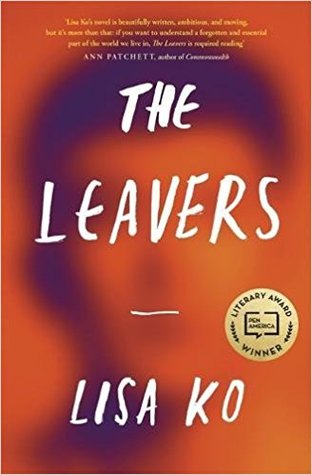 Eleven-year-old Deming Guo and his mother Peilan (nicknamed “Polly”), an undocumented immigrant, live in New York City with another Fuzhounese family: Leon, Polly’s boyfriend, works in a slaughterhouse, and they share an apartment with his sister Vivian and her son Michael. Deming gets back from school one day to find that his mother never came home from her job at a nail salon. She’d been talking about moving to Florida to work in a restaurant, but how could she just leave him behind with no warning?
Ten years later, Deming is Daniel Wilkinson, adopted and raised in upstate New York by a pair of white professors, Peter and Kay. He’s made a mess of his life with drinking and an addiction to online poker, and has been expelled from college. Now the guitar is his life, but even his best friend and bandmate Roland Fuentes isn’t willing to cut him any slack when he doesn’t show up for rehearsals and performances. Peter and Kay are pulling strings to get Daniel accepted into their college, but he keeps screwing up every chance he’s given. He can only hope his efforts to reconnect with his birth mother will be more successful.
The novel shifts fluidly between a third-person account of our protagonist then (Deming) and now (Daniel) and a first-person confession as Polly explains all: her upbringing in poverty in China, her pregnancy out of wedlock, her illegal entry to the United States, and why she had to leave Deming so suddenly. Polly and Deming/Daniel are vibrant characters, and I ached for their struggles. Both have the sense of being split between lives, of “juggling selves.” Their collective story is about figuring out who you are, what can be made right, and what to leave behind as you move forward in life. It’s such a beautiful novel, and an impressive debut from Lisa Ko.
My rating:
The Leavers will be published in paperback by Dialogue Books on April 26th. My thanks to Little, Brown for the free copy for review.
A Trip to Wigtown, Scotland’s Book Town
Wigtown is tucked away in the southwest corner of Scotland in Galloway, a region that doesn’t draw too many tourists. It did remind us a lot of Hay-on-Wye, the Book Town in Wales, what with the dry-stone walls, rolling green hills with more imposing mountains behind, sheep in the fields, and goodly number of bookshops. Wigtown is a sleepier place – it’s really just one main street and square – and has fewer bookshops and eateries overall, but the shops it does have are mainly large and inviting, and several are lovely bookshops-cum-cafés where you can pause for tea/coffee and cake before continuing with your book browsing. It rained for much of our trip and even snowed on a couple of brief occasions, but we got one day of very good weather and made the best of all the rest.


Day 1, Monday the 2nd: Six-plus hours of driving, partially in the sleet and snow, saw us arriving to our spacious and comfortable B&B by 6 p.m., giving us an hour to freshen up before dinner in the dining room. Cullen skink (leek and potato soup with chunks of smoked haddock); pork chops in a mustard cream sauce with roast parsnips, boiled potatoes and carrots, and mashed swede (aka rutabaga); and chocolate cake with gingerbread sauce. All delicious!
Day 2, Tuesday the 3rd: Smoked salmon and scrambled eggs for breakfast, accompanied by plenteous tea and toast. Off in the drizzle to see some local sites: Torhouse stone circle and Crook of Baldoon RSPB bird reserve. Nice sightings of whooper swans, pink-footed geese and lapwings, and a panoramic view of Wigtown across the way. Back to the car in the steady rain to find that we had a flat tire. Thanks to our foot pump, we got back to the W. Barclay garage in town, where they ordered a new tire and fitted the spare wheel. In the afternoon we drove to the Isle of Whithorn to see the 13th-century St. Ninian’s Chapel ruins and St. Ninian’s Cave. In the evening we went to Craft for beer/cider and the weekly acoustic music night, which, alas, just ended up being two old guys playing Americana songs on guitars.


Today’s book shopping: Glaisnock Café, where we also stopped for coffee and a tasty slice of courgette and avocado cake; The Open Book (run by Airbnb customers – this week it was Maureen from Pennsylvania and her niece Rebecca from Switzerland; they’d booked the experience two years ago, and the wait is now up to three years); the Wigtown Community shop (a charity shop); and browsing at Old Bank Books and Byre Books.


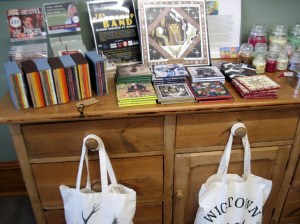
I loved seeing lots of Bookshop Band merchandise around. This was in the Festival Shop.
Day 3, Wednesday the 4th: Vegetarian ‘full Scottish’ cooked breakfast to fuel us for a rainy day of bookshops and explorations further afield. 12 p.m.: return trip to the garage to have our tire fitted. All the staff were so friendly and pleasant. They seemed delighted to see tourists around, and were interested in where we came from and what we were finding to do in the area. Mr. Barclay himself had one of the thickest Scottish accents I’ve ever heard, but I managed to decipher that he thinks of Galloway as “the next best place to heaven,” despite the weather. We spotted a local ‘celebrity’, Ben of the Bookshop Band, in the Co-op, but didn’t say hello as he was trying to pay for his shopping and had the baby in tow.
In the afternoon we ventured to Newton Stewart, the nearest big town, to buy petrol, picnic supper food, and another secondhand book at the community shop there. We retreated from the sudden snow for a scrumptious dinner of smoked salmon, black pudding and haggis (all of them battered and fried, with chips!) at a diner-like smokehouse. Back in Wigtown, we got a mainly dry evening to do the Martyrs’ Walk. In 1685 two Covenanters (Scottish reformers who broke from Charles I’s Anglican Church), Margaret McLachlan, 63, and Margaret Wilson, 18, were tied to stakes on the mud flats and allowed to drown in the rising tide.


Today’s book shopping: THE BOOKSHOP. I’ve meant to visit ever since I read Jessica Fox’s memoir, Three Things You Need to Know about Rockets, in February 2013. Previously based in California, Fox decided on a whim to visit a bookshop in Scotland and ended up here at the country’s largest. She promptly fell in love with the bookshop owner and with Wigtown itself; though she and Shaun Bythell are no longer an item, she has been a major mover and shaker in the town, playing a role in the annual festival and establishing The Open Book.


The Bookshop is a wonderfully rambling place with lots of nooks and crannies housing all sorts of categories. Look out for the shot and mounted Kindle, the Festival bed, the stuffed badger, a scroll of bookseller’s rules, Captain the cat, and a display of Bythell’s The Diary of a Bookseller. Together we found £35 worth of books we wanted to buy – whew! – thanks to my husband’s niche nature books, and had a nice chat with the man himself at the till. He signed my book, commiserated with us about the weather and our trip to see “Willie” (Barclay), and gave us tips for what to see locally. You’d hardly believe he’s the same curmudgeon who wrote the book. Now that I’ve been to the town and the shop, it’s time for me to start rereading it.


We also perused the smallish but very nice selection at Beltie Books, where we made a welcome stop for a cappuccino and some cookies, and I bought a cut-price new book at the Festival Shop. (They stock books by festival speakers plus a curated selection of new releases.)
Day 4, Thursday the 5th: SUNSHINE, at last! After hearty omelettes, we headed to the hill that overlooks the town to get the best views of the week. On to Monreith for a charming coastal walk up to the Gavin Maxwell monument of a bronze otter. (He wrote Ring of Bright Water, which my husband brought along to read on our trip.) After a lunch stop back in town, it was out to the red kite feeding station about 40 minutes away – I came for the books; my husband came for the red kites. Though they’re common enough in our part of Berkshire, he was keen to see the site of another recent reintroduction. Wales also has a feeding station we visited some years ago, and on both occasions seeing dozens of birds swoop down for meat was quite the spectacle – though here you sit on an open porch, even closer to the action. We did a few other short walks in the area, finishing off with a sunset sit in Wigtown’s bird hide.


Today’s book shopping: ReadingLasses calls itself Britain’s only women’s bookshop. They stock Persephone Books direct from Bloomsbury, and they also have a large selection of secondhand books. This is the best place to go in town for a light meal and a snack. We had delicious homemade soup with soda bread for an early lunch, followed by coffee and tiffin. I bought a novel by Candia McWilliam, a Scottish author I’ve only read nonfiction by before.


At Curly Tale Books, the children’s bookshop next-door to The Bookshop, we bought a picture book about the local ‘belted’ Galloway cows for our niece. We didn’t realize the shop owner is also the author! She offered to sign the book for us, but we decided that a five-year-old wouldn’t appreciate it enough.
Day 5, Friday the 6th: Full Scottish breakfast to see us on our way, and a farewell to the two B&B cats, including the fluffiest cat on earth. To break up the rather arduous journey, we stopped early on at the Cairn Holy stone circle/tomb and the Cream o’ Galloway farm shop for cheese and ice cream. Home at 7:30 p.m. to find something from the freezer for dinner, unpack and shelve all these new books.

Cairn Holy
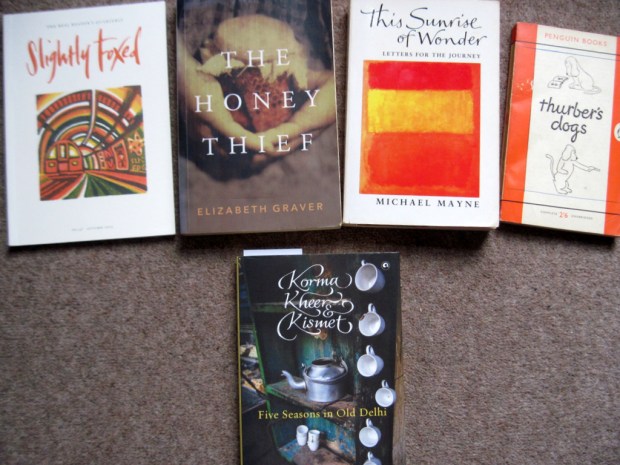
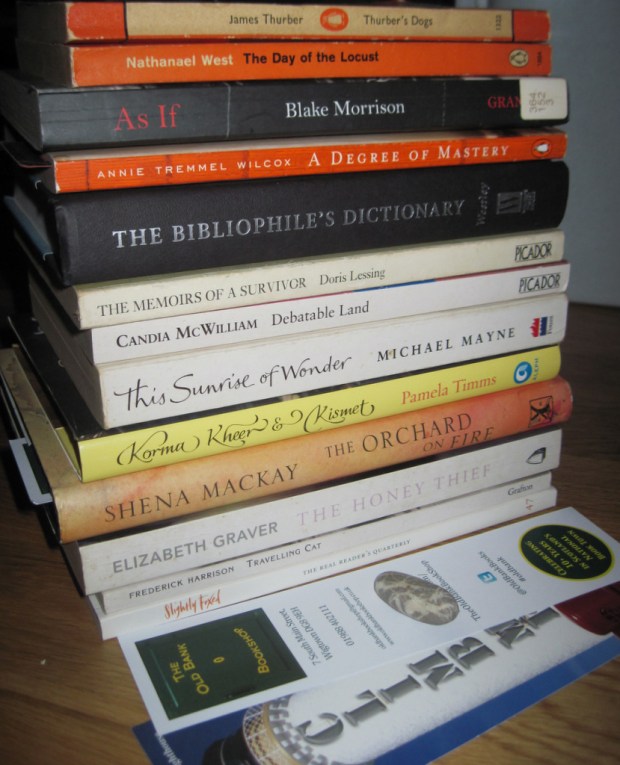
Total acquisitions: 13 books for me, 7 books for my husband, 3 books for gifts
Wigtown is more than twice as far away as Hay is for us, so we’re less likely to go back. (It’s also a tough place to find a decent evening meal.) However, I’d like to think that life will take me back to Wigtown someday, perhaps for the Festival, or for a stay at The Open Book – though I’d have to start planning ahead to 2021!
What I read:
Bits of lots of books I had on the go, but mostly a few vaguely appropriate titles:
Under the Skin by Michel Faber was the perfect book for reading on rainy Scottish highways. I’m so glad I decided at the last minute to bring it. Isserley drives along Highland roads picking up hitchhikers – but only the hunky males – to take back to her farm near the Moray Firth. It’s likely that you already know the setup of this even if you haven’t read it, perhaps from the buzz around the 2013 film version starring Scarlett Johansson. It must have been so difficult for the first reviewers and interviewers to discuss the book without spoilers back in 2000. David Mitchell, in his introduction to my Canons series reprint, does an admirable job of suggesting the eeriness of the contents without giving anything significant away.
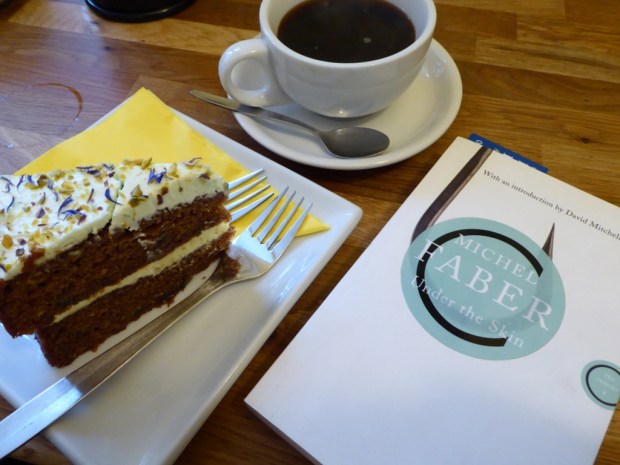
Shelve this under science fiction, though it veers towards horror and then becomes a telling allegory. I knew the basic plot beforehand, but there were still some surprises awaiting me, and I was impressed with how Faber pulled it all off. Keep an eye open for how he uses the word “human.” This has a lot to say about compassion and dignity, and how despite our differences we are fundamentally the same “under the skin.”
An atmospheric line: “The fields all around her house were shrouded in snow, with patches of dark earth poking through here and there as if the world were a rich fruit cake under cream.”
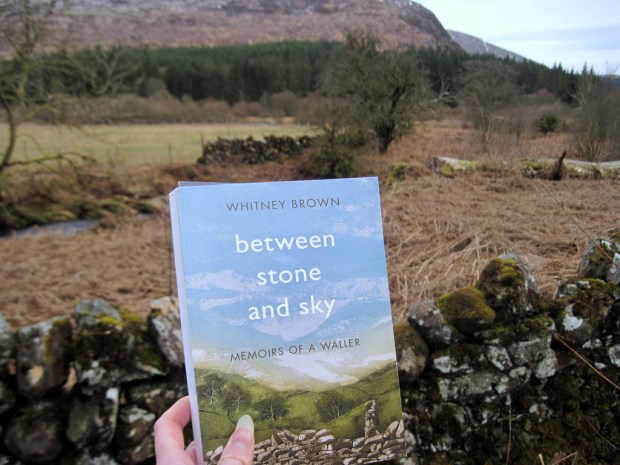
Between Stone and Sky: Memoirs of a Waller by Whitney Brown: For a TLS review. Brown, from South Carolina, trained as a dry-stone waller in Wales (where she fell in love with a man who wouldn’t marry her), but we saw plenty such walls in Scotland too. As an expat I could relate to her feeling of being split between two countries.  (Releases May 17th.)
I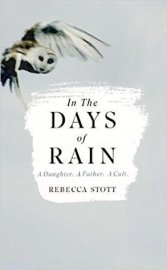 n the Days of Rain: A daughter. A father. A cult. by Rebecca Stott: I read the first two-fifths or so, mostly in the car and over our leisurely B&B breakfasts. One branch of Stott’s Exclusive Brethren family came from Eyemouth, a Scottish fishing village. A family memoir, a bereavement memoir, a theological theme: this brings together a lot of my favorite things. And it won last year’s Costa Biography Award, so you know it’s got to be good.
I also started two books by Scottish novelists, The Orchard on Fire by Shena Mackay and The Accidental by Ali Smith – though I don’t know if I’ll make it through the latter.
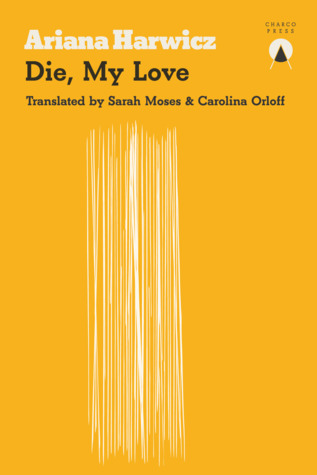
Die, My Love by Ariana Harwicz
This intense Argentinian novella, originally published in 2012 and nominated for this year’s Republic of Consciousness and Man Booker International Prizes, is an inside look at postpartum depression as it shades into what looks like full-blown psychosis. We never learn the name of our narrator, just that she’s a foreigner living in France (like Harwicz herself) and has a husband and young son. The stream-of-consciousness chapters are each composed of a single paragraph that stretches over two or more pages. From the first page onwards, we get the sense that this character is on the edge: as she’s hanging laundry outside, she imagines a sun shaft as a knife in her hand. But for now she’s still in control. “I wasn’t going to kill them. I dropped the knife and went to hang out the washing like nothing had happened.”
 Not a lot happens over the course of the book; what’s more important is to be immersed in this character’s bitter and perhaps suicidal or sadistic outlook. But there are a handful of concrete events. Her father-in-law has recently died, so she tells of his funeral and what she perceives as his sad little life. Her husband brings home a stray dog that comes to a bad end. Their son attends a children’s party and they take along a box of pastries that melt in the heat.
The only escape from this woman’s mind is a chapter from the point of view of a neighbor, a married radiologist with a disabled daughter who passes her each day on his motorcycle and desires her. With such an unreliable narrator, though, it’s hard to know whether the relationship they strike up is real. This woman is racked by sexual fantasies, but doesn’t seem to be having much sex; when she does, it’s described in disturbing terms: “He opened my legs. He poked around with his calloused hands. Desire is the last thing there is in my cries.”
The language is jolting and in-your-face, but often very imaginative as well. Harwicz has achieved the remarkable feat of showing a mind in the process of cracking up. It’s all very strange and unnerving, and I found that the reading experience required steady concentration. But if you find the passages below intriguing, you’ll want to seek out this top-class translation from new Edinburgh-based publisher Charco Press. It’s the first book in what Harwicz calls “an involuntary trilogy” and has earned her comparisons to Virginia Woolf.
“My mind is somewhere else, like I’ve been startled awake by a nightmare. I want to drive down the road and not stop when I reach the irrigation ditch.”
“I take off my sleep costume, my poisonous skin. I recover my sense of smell and my eyelashes, go back to pronouncing words and swallowing. I look at myself in the mirror and see a different person to yesterday. I’m not a mother.”
“The look I’m going for is Zelda Fitzgerald en route to Switzerland, and not for the chocolate or watches, either.”
My rating:
Translated from the Spanish by Sarah Moses and Carolina Orloff. My thanks to the publisher for the free copy for review.
Just Okay for Me, Dawg
This was one of the catchphrases of long-time judge Randy Jackson on the reality TV show American Idol, which was my guilty pleasure viewing for a decade or more. The three recent books for which I provide short-ish reviews below have nothing much in common apart from the fact that I requested or accepted them from publishers and ended up feeling disappointed but like I still owed a review. You can consider them all  .
.
The Friendship Cure by Kate Leaver
(Duckworth, March 22nd)
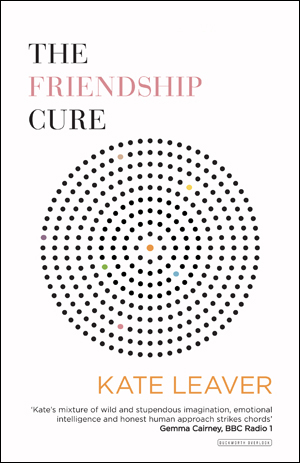 We’re in the middle of a loneliness epidemic, so friends are more important than ever. That’s the impetus for Kate Leaver’s jaunty, somewhat insubstantial book about modern friendship. She observes teen girls on the Tube and reflects on how we as primates still engage in social grooming – though language has replaced much of this more primitive bond-forming behavior. We experience a spike in our number of friends through adolescence and early adulthood, but friendships can fall by the wayside during our thirties as we enter long-term relationships and turn our attention to children and other responsibilities. Leaver argues that female friendships can amplify women’s voices and encourage us to embrace imperfection. She also surveys the bromance, mostly in its TV and film manifestations. There are plenty of pop culture references in the book; while I enjoy a Scrubs or Parks and Recreation scene or quotation as much as the next fan, the reliance on pop culture made the book feel lightweight.
Perhaps the most useful chapter was the one on online friendships (hi, book blogger friends!). We so often hear that these can’t replace IRL friendships, but Leaver sticks up for social media: it allows us to meet like-minded people, and is good for introverted and private people. Anything is better than isolation. The biggest problem I had with the book was the tone: Leaver is going for a Caitlin Moran vibe, and peppers in hip references to Taylor Swift, Lindsay Lohan and the like. But then she sometimes tries for more of a Mary Beard approach, yet doesn’t trust herself to competently talk about science, so renders it in matey, anti-intellectual language like “Robin [Dunbar, of Oxford University] did some fancy maths” (um, I think you mean “Dr. Dunbar”!) or “Let me hit you with a bit of research.”
Favorite lines:
“on some days, somewhere in our souls, we still count the number of social media connections as a measure of who we are”
“When you successfully recruit a new person into your friendship circle, you’re essentially confirming that you are a likable human being, worthy of someone’s time and emotional investment.”
You might choose to read instead: Kory Floyd’s The Loneliness Cure; Ann Patchett’s Truth and Beauty; Anna Quindlen’s essay “Girlfriends” from Lots of Candles, Plenty of Cake.
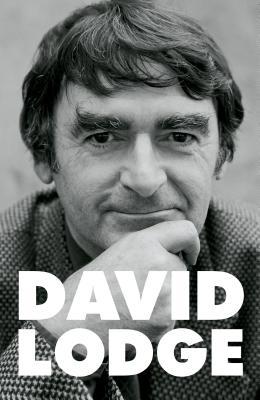
Writer’s Luck: A Memoir: 1976–1991 by David Lodge
(Harvill Secker, January 11th)
David Lodge has been one of my favorite authors for over a decade. His first memoir, Quite a Good Time to Be Born: A Memoir, 1935–1975 (see my Nudge review), is a good standalone read, even for non-fans, for its insight into the social changes of post-war Britain. However, this volume makes the mistake of covering much less ground, in much more detail – thanks to better record-keeping at the peak of his career – and the result is really rather tedious. The book opens with the publication of How Far Can You Go? and carries through to the reception of Paradise News, with a warning that he cannot promise a third volume; he is now 83. Conferences, lecture tours, and travels are described in exhaustive detail. There’s also a slightly bitter edge to Lodge’s attempts to figure out why ventures flopped or novels got negative reviews (Small World, though Booker-shortlisted, was better received in America), though he concludes that his career was characterized by more good luck than bad.
 I liked the account of meeting Muriel Spark in Italy, and valued the behind-the-scenes look at the contentious task of judging the 1989 Booker Prize, which went to Kazuo Ishiguro for The Remains of the Days. Especially enjoyable is a passage about getting hooked on saunas via trips to Finland and to Center Parcs, a chain of all-inclusive holiday activity camps in England. Oh how I laughed at his description of nude sauna-going in midlife (whether I was supposed to or not, I’m not sure): “The difference in pleasure between swimming wearing a costume of any kind and the sensation of swimming without one, the water coursing unimpeded round your loins as you move through it, cannot be exaggerated, and I first discovered it in Center Parcs.” I also cringed at the Lodges placing “our Down’s son” Christopher in a residential care home – I do hope thinking about disability has moved on since the mid-1980s.
Ultimately, I’m not sure Lodge has had an interesting enough life to warrant a several-volume project. He’s an almost reassuringly dull chap; “The fact is that I am constitutionally monogamous,” he admits at one point. Although it was fun for me to see the genesis of novels like Paradise News, I don’t think I’d have the stomach for reading any more about why Lodge thinks his star faded starting in the 1990s. However, I’ll keep this on the shelf to go back to for some context when I finally get around to rereading Small World and Nice Work.
Favorite lines:
“there has been a downside to the Prize Culture which the Booker engendered. It has warped the evaluation of new fiction by measuring success as if it were a competitive sport.”
You might choose to read instead: Lodge’s Quite a Good Time to Be Born or John Carey’s The Unexpected Professor: An Oxford Life in Books – overall the better autobiography of a working-class, bookish lad.
The Parentations by Kate Mayfield
(Point Blank [Oneworld], March 29th)
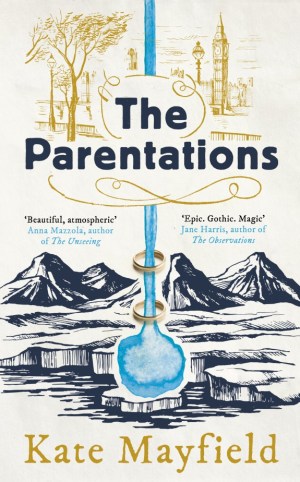 Sisters Constance and Verity Fitzgerald have been alive for over 200 years. A green pool in Iceland, first discovered in 1783, gives them “extended mortality” so long as they take the occasional two-week nap and only swallow two drops of the liquid at a time. In London in 2015, they eat a hearty stew by candlelight and wait for their boy to come. Then they try the churchyard: dead or alive, they are desperate to have him back. Meanwhile, Clovis Fowler is concealing extra phials of the elixir from her husband, their son and the maid. What’s going on here? We go back to Iceland in 1783 to see how the magic pool was first found, and then hop across to 1783 London to meet the sisters as children.
I read the first 67 pages, continued skimming to page 260, and then gave up. At well past the one-third point, the novel still hasn’t established basic connections. A book of nearly 500 pages has to hook the reader in sooner and more securely, not lull them with wordiness (case in point: on the first page of the first chapter, the adjective “macilent” – I looked it up and it means thin or lean, either of which would have been a far preferable word to use).
I could see faint echoes here of so many great books – Jonathan Strange and Mr. Norrell, A Discovery of Witches, Slade House, The Essex Serpent; works by Hannah Kent and Diane Setterfield, maybe even Matt Haig? I liked Mayfield’s memoir The Undertaker’s Daughter and had hoped for improvement with this debut novel. As it is, The Parentations has an interesting premise and lineage, but doesn’t deliver.
Favorite lines:
“His rage foments a decision. He will either take his place in the mounds of the dead, or he will find a good reason to stay alive.”
“Francis and Averil Lawless have impressed upon their daughters the concept of the consequences of a single moment, and there is no better teacher than the river’s majesty and its demand for respect for its waters, which can easily bring violence and ruin as well as wealth and peace.”
You might choose to read instead: Any of the literary fantasy novels listed above.
What books have disappointed or defeated you lately?
Wellcome Book Prize Shortlist: Stay with Me by Ayobami Adebayo
“Women manufacture children and if you can’t you are just a man. Nobody should call you a woman.”
On balance, I’m glad that the Wellcome Book Prize shortlist reading forced me to go back and give Stay with Me another try. Last year I read the first 15% of this debut novel for a potential BookBrowse review but got bored with the voice and the story, rather unfairly dismissing it as a rip-off of Chimamanda Ngozi Adichie. I also doubted that the health theme was strong enough for it to make the Wellcome shortlist, but that’s because I hadn’t read far enough to realize just how many medical conditions come up for consideration: it’s not just infertility, but also false pregnancy, cot death (or SIDS), sickle cell disease, and impotence.
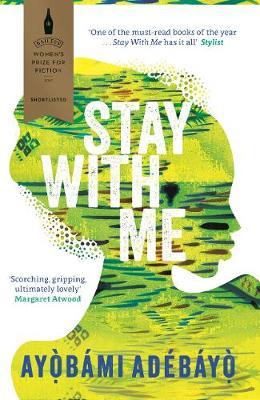 This time around I found Yejide a more sympathetic character. The words that open this review are cruel ones spoken by her mother-in-law. Her desperation to become and stay a mother drives her to extreme measures that also give a window onto indigenous religion in Nigeria: ‘breastfeeding’ a goat on the Mountain of Jaw-Dropping Miracles, and allowing an act of ritual scarification to prevent the return of an abiku, or spirit child (I’ve heard that one narrates Ben Okri’s Booker Prize-winning 1991 novel, The Famished Road).
Polygamy is another Nigerian custom addressed in the novel. Yejide’s husband, Akinyele Ajayi, allows himself to be talked into taking another wife, Funmilayo, when Yejide hasn’t produced a child after four years. There’s irony in the fact that polygyny is considered a valid route to pregnancy while polyandry is not, and traditional versus Western values are contrasted in the different generations’ reactions to polygamy: does it equate to adultery?
There are some welcome flashes of humor in the novel, such as when Yejide deliberately serves a soup made with three-day-old beans and Funmi gets explosive diarrhea. I also enjoyed the ladies’ gossip at Yejide’s hair salon. However, the story line tends towards the soap operatic, and well before halfway it starts to feel like just one thing after another: A lot happens, but to no apparent purpose. I was unconvinced by the choices the author made in terms of narration (split between Yejide and Akin, both in first person but with some second person address to each other) and structure (divided between 2008 and the main action starting in the 1980s). We see certain scenes from both spouses’ perspective, but that doubling doesn’t add anything to the overall picture. The writing is by turns maudlin (“each minute pregnant with hope, each second tremulous with tragedy”) and uncolloquial (“afraid that my touch might … careen him into the unknown”).
Things that at first seemed insignificant to me – the 1993 election results, what happens to Funmi, the one major scene set in 2008 – do eventually take on more meaning, and there is a nice twist partway through as well as a lovely surprise at the end. I did feel the ache of the title phrase as it applies to this couple’s children and marriage, so threatened by “all the mess of love and life that only shows up as you go along.” It all makes for truly effortless reading that I gobbled up in chunks of 50 or 100 pages – which indicates authorial skill, of course – yet this seems to me a novel more interesting for the issues it addresses than for its story and writing.
My rating:
See also:
My gut feeling: I would be very surprised if a novel won two years in a row. While the medical situations examined here are fairly wrenching, Stay with Me isn’t strong enough to win. Its appearance on the shortlist (for the Women’s Prize, too) is honor enough, I think.
Shortlist strategy:
- I’m one-third through The Vaccine Race by Meredith Wadman but have started skimming because it’s dense and not quite as laymen-friendly as The Immortal Life of Henrietta Lacks and The Emperor of All Maladies, the two books its subject matter is most reminiscent of for me.
- On Friday I started To Be a Machine by Mark O’Connell, which I’m also one-third through and have taken away on our mini-holiday. This is the shortlisted book whose topic appealed to me the least, so I’m pleasantly surprised to be enjoying it so much. It helps that O’Connell comes at the science as an outsider – he’s a freelance writer with a literature background, and he’s interested in the deeper philosophical questions that transhumanism raises.
- I’m awaiting a review copy of Mayhem by Sigrid Rausing, which I’ll be featuring as part of the official Wellcome Book Prize shortlist blog tour.
Dubiously Thematic Easter Reading
In 2015 and 2017 I came up with some appropriately theological reading recommendations for Easter. This year I’m going for a more tongue-in-cheek approach, as befits the unfortunate conjunction of Easter with April Fools’ Day.
Currently reading or reviewing:
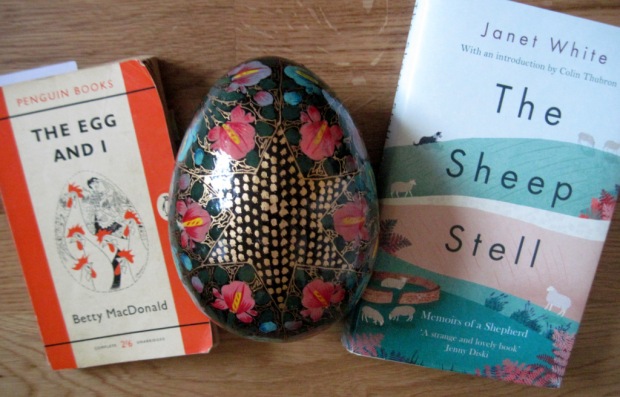
The Egg and I by Betty MacDonald
I bought this on a whim from a local charity shop, based on the title, cover and blurb. I’m about one-third of the way through so far. MacDonald and her husband started a chicken farm in a mountainous area of the Pacific Northwest in the 1940s. Her account of her failure to become the perfect farm wife is rather hilarious. My only hesitation is about her terrible snobbishness towards rednecks and “Indians.”


A representative passage: “Gathering eggs would be like one continual Easter morning if the hens would just be obliging and get off the nests. Co-operation, however, is not a chickenly characteristic and so at egg-gathering time every nest was overflowing with hen, feet planted, and a shoot-if-you-must-this-old-grey-head look in her eye.”
The Sheep Stell by Janet White
 I’m reviewing this reissued memoir for the TLS. It’s a delightful story of finding contentment in the countryside, whether on her own or with family. White, now in her eighties, has been a shepherd for six decades in the British Isles and in New Zealand. While there’s some darker material here about being stalked by a spurned suitor, the tone is mostly lighthearted. I’d recommend it to anyone who’s enjoyed books by Gerald Durrell, James Herriot and Doreen Tovey.
Representative passages: “Shepherding is a strange mixture of tremendous physical work alternating with periods of calm, quiet indolence.” & “A dare, a dream and a challenge. I could have hunted the whole world over and never in a lifetime found anywhere so right: warm, high, pastoral and severed by the sea.”
Read recently:
The Trouble with Goats and Sheep by Joanna Cannon
 Mrs. Creasy disappears one Monday in June 1976, and ten-year-old Grace Bennett and her friend Tilly are determined to figure out what happened. I have a weakness for precocious child detectives (from Harriet the Spy to Flavia de Luce), so I enjoyed Grace’s first-person sections, but it always feels like cheating to me when an author realizes they can’t reveal everything from a child’s perspective so add in third-person narration and flashbacks. These fill in the various neighbors’ sad stories and tell of a rather shocking act of vigilante justice they together undertook nine years ago.
Sheep are a metaphor here for herd behavior and a sense of belonging, but also for good versus evil. Grace and Tilly become obsessed with a Bible passage the vicar reads about Jesus separating the sheep from the goats. But how can he, or they, know who’s truly righteous? As Grace says, “I think that’s the trouble, it’s not always that easy to tell the difference.” It’s a simplistic message about acknowledging the complexity of other lives and situations rather than being judgmental, and matches the undemanding prose.
Reminiscent of Rachel Joyce, but not as good.
My rating:
Vita Nova by Louise Glück
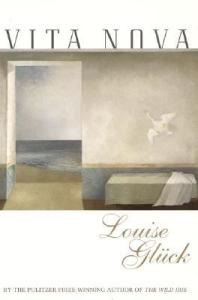 My first collection from the prolific Pulitzer winner. Some of the poems are built around self-interrogation, with a question and answer format; several reflect on the myth of Orpheus and Eurydice. The first and last poems are both entitled “Vita Nova,” while another in the middle is called “The New Life.” I enjoyed the language of spring in the first “Vita Nova” and in “The Nest,” but I was unconvinced by much of what Glück writes about love and self-knowledge, some of it very clichéd indeed, e.g. “I found the years of the climb upward / difficult, filled with anxiety” (from “Descent to the Valley”) and “My life took me many places, / many of them very dark” (from “The Mystery”).
Best lines about spring:
“The spring of the year; young men buying tickets for the ferryboats. / Laughter, because the air is full of apple blossoms.” (from “Vita Nova”)
“Spring / descended. Or should one say / rose? … yellow-green of forsythia, the Commons / planted with new grass— // the new / protected always” (from “Ellsworth Avenue”)
My rating:
Plucked off the shelf for their dubious thematic significance!

To Rise Again at a Decent Hour by Joshua Ferris
Animal, Vegetable, Miracle by Barbara Kingsolver
Wise Blood by Flannery O’Connor
So You’ve Been Publicly Shamed by Jon Ronson
The Resurrection of Joan Ashby by Cherise Wolas
Happy Easter to all those who mark it, and have a good week. I have a few review-based posts scheduled for while we’re in Wigtown, a trip I hope to report on next Monday, when I will also attempt to catch up on blogs and comments.
What to Look Out for in April
April will be a busy month on the blog what with four Wellcome Book Prize shortlist reviews plus posts on our shadow panel decision and the awards ceremony, three blog tours within a week, and various other review books jostling for my attention.

To be reviewed at any time.
April 5th seems to be a huge day for new releases. I own four print books that are all coming out on that day; alas, the only one I’ve been able to start is Elizabeth J. Church’s All the Beautiful Girls, for an upcoming Shiny New Books review. I’m approaching the one-quarter point. The others may well have to wait for a quieter time.
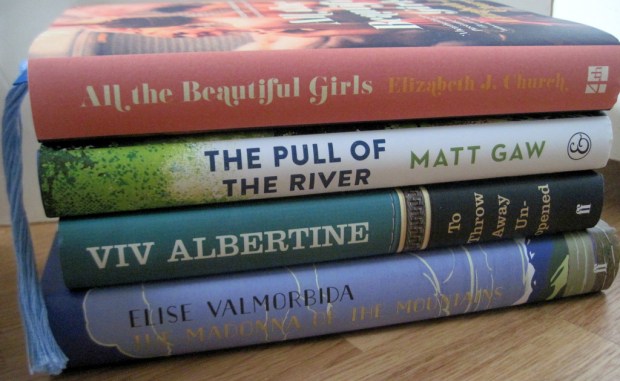
April 5th releases.
 I started another April 5th release on my Kindle a couple of weeks ago, Things Bright and Beautiful by Anbara Salam. It’s about a missionary couple whose lives are disrupted by the return of an older missionary. I was thinking of abandoning it until I got to the last line of the prologue, which threw in a pretty great twist. So maybe I’ll go back to it.
For now, I can recommend the one April 5th release I actually managed to finish:
Dear Mrs. Bird by A.J. Pearce
 If you loved The Guernsey Literary and Potato Peel Pie Society, I have just the book for you: another feel-good World War II-set novel with characters you’ll cheer for. December 1940, London: Twenty-two-year-old Emmeline Lake dreams of being a Lady War Correspondent, but for now she’ll start by typing up the letters submitted to Henrietta Bird’s advice column in Woman’s Friend. All too quickly, though, the job feels too small for Emmy. Mrs. Bird refuses to print letters on Unpleasant subjects, which could include anything from an inappropriate crush to anxiety. She thinks cowardly readers bring their troubles on themselves and need to buck up instead of looking to others for help. But Emmy can’t bear to throw hurting people’s missives away. Perhaps she could send some advice of her own?
Emmy shares a flat with her best friend Bunty, and they each have a fiancé who is part of the war effort. As a volunteer for the Fire Brigade, Emmy sees the effects of Luftwaffe bombings up close. But it’s only after heartache hits home for both of these young women that they really understand how much is at stake in the war. The novel got a little melodramatic for me in its last quarter, but it’s overall a charming “Keep Calm and Carry On” and Stick It to Hitler-style story that never strays far from jollity for too long.
Other readalikes: My Salinger Year by Joanna Rakoff and The Night Watch by Sarah Waters
Some favorite lines:
“I told myself we could all get blown up by tomorrow so we might just as well enjoy ourselves.”
“Granny didn’t spend half her life chaining herself to railings for today’s woman to moon around waiting for some chap to look after her.”
My rating:
 On Monday we’re off to Wigtown, Scotland’s Book Town, for five days. Though we’ve been to Hay-on-Wye, Wales six times, we’ve never been to Wigtown despite meaning to for years. When I read Shaun Bythell’s Wigtown bookselling memoir last autumn, it felt like a sign that it was time. Did you see his The Diary of a Bookseller has been described in French as le quotidien d’un libraire misanthrope écossais (literally, “the daily life of a misanthropic Scottish bookseller”)?
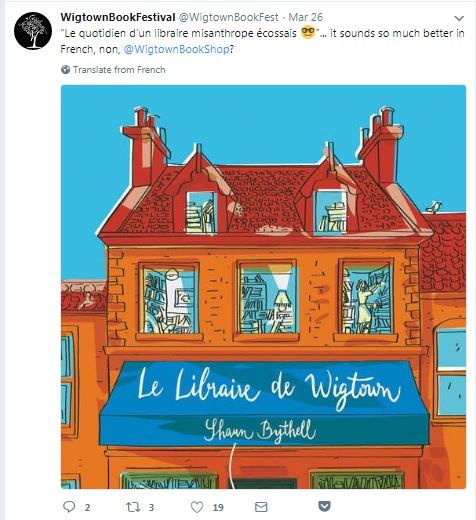
That’s too good! If only it were the official French title. I will of course be visiting his shop, and asking for a signature on my proof copy if I can pluck up the nerve. We’ll strive to be model customers lest we become the subject of a grumpy Tweet or Facebook post.
Coals to Newcastle and all that, but here’s the pile I’ve packed for Wigtown.
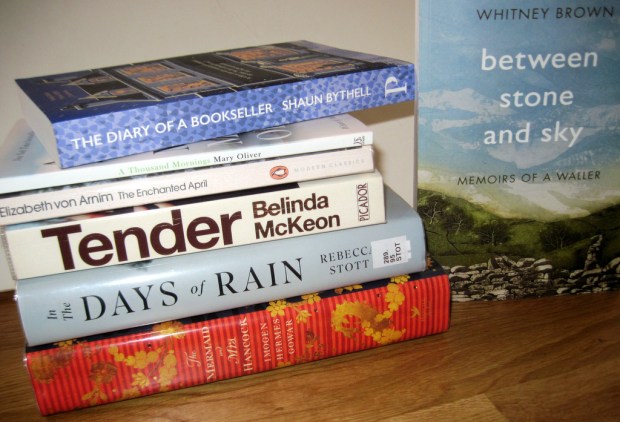
This is mostly for the six-hour car rides there and back. During the days we’ll be busy with outings to the surrounding countryside plus book shopping and café visits, but I daresay there will be some time for reading at the B&B in the afternoons and evenings.
For once I haven’t scoured my shelves for place-appropriate books; I don’t think I own any particularly Scottish reads, unless Michel Faber’s Under the Skin counts (ah wait, I also have an Ali Smith novel on the shelf).
Anyway, this time I’ve really just put together a pile of books I’ve been wanting to read for ages. The only ‘work’-related one is Between Stone and Sky, for a TLS review; otherwise I’m giving myself from Easter through the 6th off. I’m not even sure I’ll take my Kindle, except as a backup – that kind of thing could get you (or, rather, your Kindle) shot in this town. If I do, I’ll be sure to leave it behind in the B&B room or the glove box when we go into town for the day!
What are you up to in April?
Iris Murdoch Readalong: A Severed Head
A strange but very readable satire on who you’re supposed to love versus who you actually do. My sixth Murdoch novel, and a very good one for book clubs or for newcomers to start with, I think, given how much it tackles in its just over 200 pages.
Love Triangle
As in Under the Net, we have a male narrator; here it’s Martin Lynch-Gibbon, 41, a wine merchant’s son who’s writing a work of military history. He’s been married to Antonia, five years his senior, for 11 years now. Martin also has a mistress, 26-year-old Georgie Hands. The thrill of the illicit, of possessing both these appealing women, is too much to resist, but he has a sense of being on the cusp – his delicately balanced life is about to go up in flames.
Love Quadrilateral
Antonia gets home from her psychoanalysis appointment and appears to be acting strangely. She soon confesses to Martin that she’s madly in love with her therapist, Palmer Anderson, who is half-American and has been Martin’s friend for years. They amicably agree to part. Martin goes to talk with Palmer, who lays on the Freudian patter and convinces Martin that Antonia is more of a mother figure for him because of their age gap. It’s all very civilized.
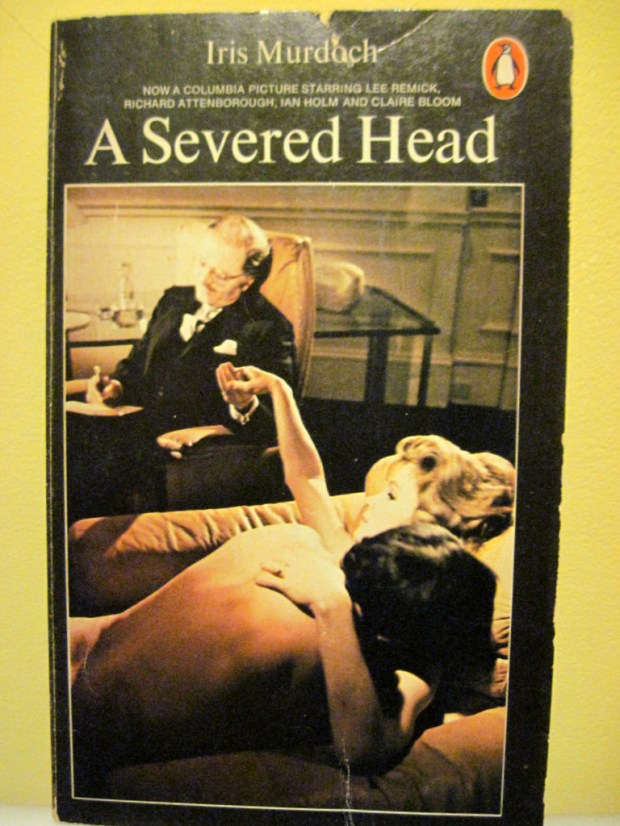
This awful cover image is a still from the 1970 film, presumably portraying Martin and Antonia in flagrante on Palmer’s therapy couch? Starring Lee Remick, Richard Attenborough and Ian Holm.
Love Hexagon?
We meet Martin’s brother Alexander and sister Rosemary when he goes to Rembers, the family estate in the Cotswolds, for the Christmas holidays. It seems Alexander’s always been somewhat in love with Antonia – he even sculpted her head. After lovely scenes of the snow seen from the train via Reading and a Christmas spent en famille, another player comes onto the scene: Palmer’s sister, Honor Klein, whom Martin picks up from Liverpool Street station. She’s cool and a bit domineering, and a dab hand with a samurai sword. Martin is smitten. But just wait until he goes to visit her in Cambridge…
As the members of this small group fall in and then out of love with each other, Murdoch explores any number of weighty ideas and themes. With a samurai sword around (as pictured on a couple of more recent Penguin covers), you have to wonder if, like Chekhov’s gun, it’s bound to be used in a violent way. At the very least it’s a phallic symbol, turning up in dreams along with blood, which itself is symbolized by the red wine so frequently consumed and sometimes spilled in the novel. I thought of the title as asking what happens when the mind and body become detached from each other and want different things. There are also plentiful references to ancient superstitions and taboos: the cuckold’s horns, the Oedipal impulse, and the rituals surrounding the oracular voice.
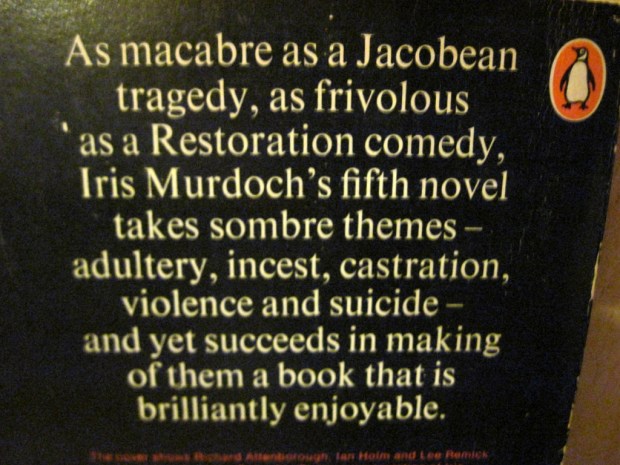
My back cover blurb. Sorry if you consider anything here a spoiler…
What with all the scenes of people bursting into a room and declaring their love for someone else now, and Martin moving his belongings back and forth, this is something like a comic play. It’s one of the few Murdoch novels to have been adapted for the theatre or cinema (it has also been a radio play), and you can see why: it has a theatrical, quick-moving story line, and Murdoch even deliberately references “actors in a play” and “the drama.” Martin’s sense of helplessness is also likened to feeling destined to play one role in life, whether he likes it or not. It’s a very visual novel, too, with objects (like the Audubon prints and the Meissen cockatoos decorating the Lynch-Gibbons’ place, or “we sat enlaced like a beautiful netsuke”) and colors taking on significance in a way that I’m sure must have influenced A.S. Byatt.
A couple of small things bothered me: the overkill in describing Honor’s features as Jewish, and the overall short shrift given to Georgie. But on the whole I really enjoyed this one, especially Martin’s three (increasingly informal and defensive) versions of the same apology letter, and the fact that Palmer almost always appears in his dressing gown. In one 2017 year-end recommendation for Sally Rooney’s Conversations with Friends, I saw it compared with A Severed Head, and I guess I can see why: the love quadrilateral, the blend of tragic and comic themes, and the perhaps recklessly optimistic ending. Both are well worth reading.
My favorite snippet of dialogue:
(Martin) “‘We’ve been happy. I want to go on being happy.’
‘Happy, yes,’ said Antonia. ‘But happiness is not the point. We aren’t getting anywhere. You know that as well as I do.’
‘One doesn’t have to get anywhere in a marriage. It’s not a public conveyance.’”
My rating:
I’m participating on and off in Liz Dexter’s two-year Iris Murdoch readalong project to get through some of the paperbacks I already own. See also her very interesting introductory post on A Severed Head. I have several more of the readalong books lined up for later in the year: The Italian Girl in June, The Nice and the Good in September, and An Accidental Man in December. Join us for one or more!
Have you read this or anything else by Iris Murdoch?
 Bookish Beck = Rebecca Foster. American transplant to England. Freelance proofreader and book reviewer.
 Bookish Beck