First Encounter: Karl Ove Knausgaard
 For years I felt behind the curve because I had not yet read the two prime examples of European autofiction: Elena Ferrante and Karl Ove Knausgaard. It seemed like everyone was raving about them, calling their work revelatory and even compulsive (Zadie Smith has famously likened Knausgaard’s autobiographical novels to literary “crack”). Well, my first experience of Ferrante (see my review of My Brilliant Friend), about this time last year, was underwhelming, so that tempered my enthusiasm for trying Knausgaard. However, I had a copy of A Death in the Family on the shelf that I’d bought with a voucher, so I was determined to give him a go.
I read this first part of the six-volume “My Struggle” series over the course of about two months. That’s much longer than I generally spend with a book, and unfortunately reflects the fact that it was the opposite of compelling for me; at times I had to force myself to pick it up from a stack of far more inviting books and read just five or 10 pages so I’d see some progress. Now, a couple of weeks after finally reading the last page, I can say that I’m glad I tried Knausgaard to see what the fuss is all about, but I think it unlikely that I’ll read any of his other books.
Written in 2008, when he was 39, this is Knausgaard’s record of his childhood and adolescence – specifically his relationship with his father, a distant and sometimes harsh man who drank himself to an early death. And yet at least half the book is about other things, with the father – whether alive or dead – as just a shadow in the background. I found it so curious what Knausgaard chooses to focus on in painstaking detail versus what he skates over.
For instance, he spends ages on the preparations for a New Year’s Eve party he attended in high school: acquiring the booze, the lengths he had to go to in hiding it and lugging it through a snowy night, and so on. He gives a broader idea of his school years through some classroom scenes and word pictures of friends he was in an amateur rock band with and girls he had crushes on, but these are very brief compared to the 50 pages allotted to the party.
Part Two feels like a significant improvement. It opens at the time of composition, with Karl Ove the writer and family man in his office in Sweden – a scene we briefly saw around 30 pages into Part One. I like these interludes perhaps best of all because they make a space for his philosophical musings about writing and parenthood:
Even if the feeling of happiness [fatherhood] gives me is not exactly a whirlwind but closer to satisfaction or serenity, it is happiness all the same. Perhaps, even, at certain moments, joy. And isn’t that enough? Isn’t it enough? Yes, if joy had been the goal it would have been enough. But joy is not my goal, never has been, what good is joy to me? The family is not my goal, either. … The question of happiness is banal, but the question that follows is not, the question of meaning.
Writing is drawing the essence of what we know out of the shadows. That is what writing is about. Not what happens there, not what actions are played out there, but the there itself.
At about the book’s halfway point we finally delve into the title event. About a decade previously Karl Ove got a call from his older brother, Yngve, telling him that their father was dead. Almost instantly he found himself trying to construct a narrative around this fact, assessing his thoughts to see if they had the appropriate gravity:
this is a big, big event, it should fill me to the hilt, but it isn’t doing that, for here I am, staring at the kettle, annoyed that it hasn’t boiled yet. Here I am, looking out and thinking how lucky we were to get this flat … and not that dad’s dead, even though that is the only thing that actually has any meaning.

Karl Ove Knausgaard at Turku Book Fair, 2011. By Soppakanuuna (Own work) [CC BY-SA 3.0 (http://creativecommons.org/licenses/by-sa/3.0) or GFDL (http://www.gnu.org/copyleft/fdl.html)%5D, via Wikimedia Commons.
What puzzles me, once again, is Knausgaard’s fixation on detail. He describes every meal he and Yngve shared with their grandmother, their every conversation, what he ate, how he slept, what he wore, what he cleaned and how and when. How could he possibly remember all of this, unless the journal that he mentions keeping at the time was truly exhaustive? And why does it all matter anyway? Does this slavish recreation fulfill the same role that obsessive action did back then: displacing his feelings about his father?
This is all the more unusual to me given the numerous asides where the author/narrator denigrates his memory:
I remembered hardly anything from my childhood. That is, I remembered hardly any of the events in it. But I did remember the rooms where they took place.
nostalgia is not only shameless, it is also treacherous. What does anyone in their twenties really get out of a longing for their childhood years? For their own youth? It was like an illness.
Now I had burned all the diaries and notes I had written, there was barely a trace of the person I was until I turned twenty-five, and rightly so; no good ever came out of that place.
Why did I remember this so well? I usually forgot almost everything people, however close they were, said to me.
The best explanation I can come up with is that this is not a work of memory. It’s more novel than it is autobiography. It’s very much a constructed object. Early in Part Two he reveals that when he first tried writing about his father’s death he realized he was too close to it; he had to step back and “force [it] into another form, which of course is a prerequisite for literature.” Style and theme, he believes, should take a backseat to form.
Ultimately, then, I think of this book as an experiment in giving a literary form to his father’s life and death, which affected him more than he’d ever, at least consciously, acknowledged. Even if I found the narrative focus strange at times, I recognize that it makes for precise vision: I could clearly picture each scene in my head, most taking place in an airy house with wood paneling and shag pile carpeting matching its 1970s décor. Maybe what I’m saying is: this would make a brilliant film, but I don’t think I have the patience for the rest of the books.
My rating: 
Whether or not you’ve read Knausgaard, do you grasp his appeal? Should I persist with his books?
Narcissism for Beginners by Martine McDonagh
Don’t talk like we were stuck in a lift.
Why would I be missing you so violently?
We’re all the hero when directing the scene,
But therapy for liars is a giant ice cream.
(from “Montparnasse” by Elbow)
I broke one of my cardinal reviewing rules—write about the book while it’s still fresh in your mind—and waited two weeks after finishing Martine McDonagh’s Narcissism for Beginners before writing it up. Luckily the Elbow stanza above (Guy Garvey’s lyrics are like poetry, after all) brought back to me some of the themes I want to explore: how you can miss someone you barely know, the way that ties ebb and shift such that your blood kin are strangers and the unrelated become like family, and how a narcissistic personality can use coercion and deception to get his or her way. Plus there’s the ice cream metaphor of the last line, a link to the terrific cover on finished copies of the novel—not on my proof, alas.
 The novel is presented as Sonny Anderson’s extended letter to the mother he doesn’t remember. He’s lived with his guardian, a Brit named Thomas Hardiker, in Redondo Beach, California for 11 years; before that they were in Brazil with Sonny’s father. A month ago, on his twenty-first birthday, Sonny received the astounding news that he’s a millionaire thanks to a trust fund from his late father, Robin Agelaste-Bim, better known as Guru Bim. His mother is Sarah Anderson: once a Scottish housewife, now untraceable. Despite his youth, Sonny has been a meth addict and kicked the habit through NA. This kid’s done a lot of living already, but sets out on a new adventure to learn about his parents from those who knew them. And while he’s in Britain, he’ll squeeze in some tourism related to his favorite movie, Shaun of the Dead.
Starting with Sonny’s plane ride to Heathrow, the book is in the present tense, which makes you feel you’re taking the journey right along with him. Although this isn’t being marketed as young adult fiction, it has the same vibe as some YA quest narratives I’ve read: John Green’s The Fault in Our Stars, both of David Arnold’s books, and Nicola Yoon’s The Sun is Also a Star. Sonny is more bitter and world-weary than those teen protagonists, but you still get the slang and the pop culture references along with the heartfelt emotions.
Sonny’s first visit is to Torquay octogenarian Doris Henry, who was the Agelaste-Bims’ servant and Robin’s wet nurse circa 1970. Next up: London and Ruth Williams, whom Sonny’s mother, then going by Suki, recruited into a LifeForce meditation group. Ruth remembers taking against Guru Bim immediately: “He was faking it to get in with Suki. I understood the attraction, though; those narcissistic types are always charming.” Bim and Suki formed a splinter group, Trembling Leaves and soon announced Suki’s pregnancy, but things went awry and Suki fled to Scotland with her ex-boyfriend, Andrew.
This slightly madcap biographical trip around Britain also takes in Brighton, Scotland and Keswick in the Lake District. At each stop Sonny’s able to fill in more about his past, but it’s the letters Thomas sent along for him that contain the real shockers. It’s an epistolary within an epistolary, really, with Thomas’s series of long, explanatory letters daubing in the details and anchoring Sonny’s sometimes-earnest, sometimes-angry missive to his mother.
I loved tagging along on this kooky hero’s quest. My one small criticism about an otherwise zippy novel is that there is a lot of backstory to absorb, from Sonny’s former drug use onwards. For an American expat, though, it was especially fun to watch Sonny trying to get used to some peculiarities of Britain: “apparently it’s compulsory to eat potato chips and on Brit trains” and “We argue about which floor she lives on. I say second and Ruth says first, until we realise we mean the same thing.”
In a year that opened with a narcissist being installed in the White House and will soon see the publication of a new book about cult leader Jim Jones (The Road to Jonestown by Jeff Guinn, April 11th), McDonagh’s picture of Guru Bim is sure to strike a chord. As Ruth tells Sonny, in Ancient Greek an agelast was someone with no sense of humor; and she accused Bim of being “a manipulative charlatan.”
For Sonny, whose very name places him in relationship to others, coming to grips with who he came from means deciding to live differently and be content with his own piecemeal family, including Thomas, the Great Dudini (their dog), and maybe even a cool old lady like Ruth. You’ll love spending time with them all, and I imagine you’ll get a particular kick out of this if you like Shaun of the Dead. (Whisper it: I’ve never seen it.)
Narcissism for Beginners was published in the UK on March 9th. With thanks to Unbound for the review copy.
My rating: 
Martine McDonagh was an artist manager in the music industry for 30 years and now leads the Creative Writing & Publishing MA at West Dean College, Sussex. This is her third novel, following I Have Waited, and You Have Come and After Phoenix.
Four Books for World Kidney Day
Today, March 9th, is World Kidney Day. “The kidneys are like the Rodney Dangerfield of vital organs—they get no popular respect,” Vanessa Grubbs (whose memoir I discuss below) wryly comments. Chances are you rarely have occasion to think about your kidneys. But I’m honoring them with a reading list because several years ago I was diagnosed with polycystic kidney disease, a degenerative condition that runs in my family. My maternal grandmother had it – we’ve never definitively traced it further back than her – and four of her six children have it, too. (If you took a high school genetics class, you might remember that with an autosomal dominant condition offspring have a 50% chance of inheriting the gene for the disease.) A few cousins of my generation also have PKD, and starting with my mom we’ve had a few successful kidney transplants in the family so far.
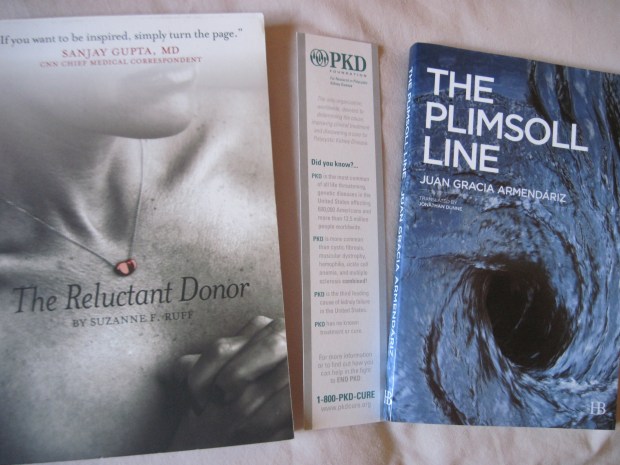
I must mention the excellent work done by the PKD Foundation in the States and the PKD Charity here in the UK. Both are a great support and source of information for me and my wider family.
The Plimsoll Line by Juan Gracia Armendáriz
As soon as I read Melissa’s review at The Book Binder’s Daughter, I knew I had to get this one. “The Plimsoll line” is a maritime term indicating how low a cargo-laden ship can sit in the water without sinking; here it’s used metaphorically to ask just how much one man can take. Gabriel Ariz is a 52-year-old art professor who lives not far from the city yet surrounded by oak woods. He’s divorced from Ana, who’s pressuring him to sell the house, and their young adult daughter Laura died a few years ago in a car accident. Now this pack-a-day smoker who gets drunk with his brother, traveling photographer Óscar, learns that he has end-stage renal disease and his life will have to change. On indefinite leave from work, he attends a dialysis clinic several times a week and joins the organ transplant list.
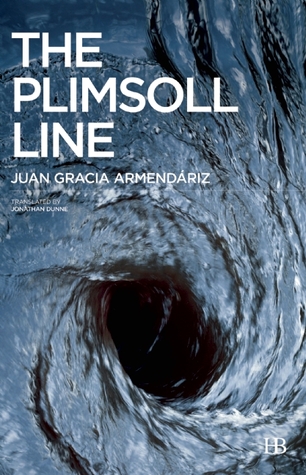 At times this was a bit overwritten for my tastes – some paragraphs stretch to several pages, and I’ve had to look up words, including “lentitude” and “logomachy” – but I did love the author’s trick of jumping into different perspectives. On multiple occasions he employs an “anonymous observer,” and in various chapters the point-of-view shifts to a member of the animal kingdom: Polanski the cat, a black kite flying overhead, a mole popping up in the garden, or a beetle winging across the detritus of Gabriel’s untidy household. We also get an extended section from Laura’s journals that reveals a disturbing family secret.
This is not one for the squeamish as it gives an unflinching account of dialysis: “His forearm throbbed, lacerated by needle marks. Sara had taken a while to find the fistula, and now the pain spread under the surgical tape like a jellyfish sting.” But for every passage that makes you cringe there’s a beautiful one that captures things perfectly: “he is living in constant deferment, between parentheses” and “If the succubus of his bad dreams were to say to him, ‘Make a wish,’ he would ask to be able to mold himself to the geological quietude of stones.”
The Plimsoll Line won Spain’s Premio Tiflos de Novela in 2008 and first appeared in English translation in 2015. It is part of a “Trilogy of Illness”; I presume the other volumes are not yet available in English, though I’ve enquired of the translator, Jonathan Dunne, via a Facebook message just in case. Forget Ferrante and Knausgaard; this is the semi-autobiographical series I’ll be awaiting the next installment of with bated breath.
My rating:
Hundreds of Interlaced Fingers by Vanessa Grubbs
 Grubbs is a nephrologist and assistant professor of medicine at San Francisco General Hospital. Well before she made the kidneys her clinical area of expertise, a personal encounter made them special to her. In 2003 she met Robert Phillips when she was an attending trying to get support for her Office of Diversity Affairs; he was a hospital trustee. She only later learned, after they started dating, that due to FSGS his kidneys had failed in his twenties and he’d been on dialysis for years. In 2005 she donated him one of her kidneys. Robert’s health was touch-and-go for a little while there, but he proposed to her soon afterwards. I read about a third of this and then skimmed the rest because I wasn’t all that interested in their separate histories. However, I did like the context Grubbs gives, such as a brief history of dialysis, nephrology case studies, and a great set of FAQs. She also notes that minorities are less likely to get organ transplants, a disparity she is working to rectify.
This memoir grew out of an essay for Health Affairs, “Good for Harvest, Bad for Planting.” Releases June 13th.
My rating: 
The A to Z of You and Me by James Hannah
 (First reviewed in November 2015; here’s a shortened version.) Lying in a hospice bed, 40-year-old Ivo looks back on his life. Even after just four short decades and a modest career at a garden center, he has plenty to regret. Hard partying and drug use exacerbated his diabetes and prompted kidney failure. His lifestyle also led indirectly to his girlfriend, nursing student Mia (the “you” he often addresses directly), leaving him. He’s estranged from his sister and his friends from school days, especially Mal. How did he mess up so badly and cut himself off so completely that he’s now dying alone? And how much can he put right before he goes?
There’s plenty of affecting writing in Hannah’s debut novel. I liked how he captures the routines of institutional life. Nurse Sheila’s A to Z game, encouraging Ivo to think of a memory attached to body parts starting with each letter of the alphabet, provides a hokey but effective structure. Keeping in mind that in British English Z is pronounced ‘zed’, the title doesn’t rhyme, but this is still somewhat sappy. I’d recommend it to fans of Mark Haddon and David Nicholls. I’ll follow Hannah’s career and hope he avoids melodrama and a contrived setup – the two near-pitfalls of this one – in the future.
My rating: 
The Reluctant Donor by Suzanne F. Ruff
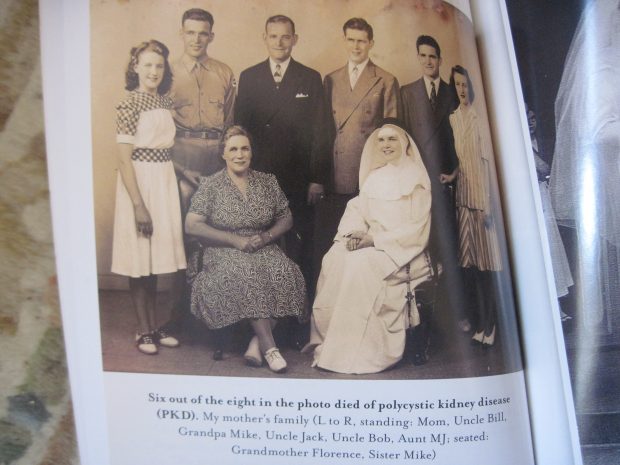
A sepia-toned photograph at the centerfold tells a solemn tale: six of these eight members of Ruff’s Irish-Catholic Chicago family died, directly or indirectly, as a result of PKD. I’ve always known there’s a long waiting list for transplant kidneys, but I was surprised to learn that dialysis machines used to be rare; demand far exceeded supply, and the procedure was not covered by Medicare until 1973. Ruff’s aunt, Sister Mike, decided the lives of people with children were more important than her own, so didn’t press for dialysis; when her kidneys failed in her forties, death followed just a few months later.
 Things had greatly improved by the time Ruff’s mother needed a transplant. Joan sounds like a feisty, lovable character, with plenty of good advice on being a patient: fight for your rights (the meek ones often end up being carried out feet first), get up and walk as soon after surgery as you possibly can, and appreciate the joy of an entirely ordinary day. Ruff’s parents had her and her sisters tested for PKD when they were teenagers. Having gone to the trouble, they then lied about the results! They said no one had PKD, but in the end two out of three did; only Ruff was spared. This is how she ended up donating a kidney to her younger sister, JoAnn. The more interesting sections of the book are about Ruff’s family history; her internal struggle to convince herself to commit to organ donation makes for pretty repetitive moaning.
 In general, the writing isn’t great. Skimming through, I found a page with 16 of my proofreading marks; on most pages it’s more like 2–3. There’s also a tendency to over-write when portraying emotion: “Genetic disease. Those two words made my spine shiver, my ears ring, my throat close, and my heart pound; I became lightheaded and faint. Terror crept into my core and gripped me in its vice [sic].” While I’m not sure I could recommend this to someone who doesn’t have a personal stake in organ donation, for those who are interested in an autobiographical account of genetic disease/transplant surgery, it’s a quick, pleasant read.
My rating:
Plus two more kidney-themed novels I’m on the look-out for:
- Useful, Debra Oswald, about a man who decides to donate a kidney to a stranger
- The Kidney Hypothetical: Or How to Ruin Your Life in Seven Days, Lisa Yee, a YA comedy in which a girl asks her boyfriend if he’d give her a kidney. Hypothetically, right?
 I’m on the fence about:
- Larry’s Kidney: Being the True Story of How I Found Myself in China with My Black Sheep Cousin and His Mail-Order Bride, Skirting the Law to Get Him a Transplant—and Save His Life, Daniel Asa Rose (I think the subtitle says it all!)
- I, Kidney, Chris Six: a self-published, semi-autobiographical novel
Midwinter Cedes to Spring
I’ve marked the turn of the seasons by following a ‘Midwinter’ book with a ‘Spring’ one.
Moominland Midwinter by Tove Jansson
 My third and favorite Moomins book (so far).
Moomins are supposed to sleep through the winter, but this year young Moomintroll awakens and finds himself in a “strange and dangerous” world transformed by snowdrifts. He can’t get his parents to wake up so is effectively a temporary orphan, surrounded by peculiar creatures from Jansson’s menagerie, this time including a dim-witted squirrel, invisible shrews, a glum little dog who wishes he could run with wolves, and the Dweller Under the Sink (with its exceptionally bushy eyebrows).
While Moomintroll searches for totems of familiarity—
He looked at the cupboard in the corner and thought of how nice it was to know that his own old bath-gown was hanging inside it. That something certain and cosy still remained in the middle of all the new and worrying things.
—Too-ticky has the opposite mindset: “All things are so very uncertain, and that’s exactly what makes me feel reassured.” She goes fishing under the ice, builds a life-size horse out of snow, and assembles tree trunks and old furniture for the midwinter ritual of a huge bonfire.
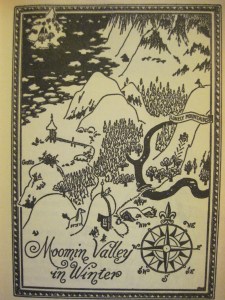 When they receive a visit from the Hemulen, who’s keen on skiing and declares the indoors too stuffy in winter, the creatures quickly tire of his energetic optimism. The truth is that they like sitting around being miserable. “I’m cold! I’m lonely! I want the sun back again!” Moomintroll pouts, but even he is too affable to make the Hemulen leave.
Of course the spring finally arrives, as it does every year, but it’s depressingly long in coming and for Moomintroll becomes a matter of faith. I love the strangeness of Jansson’s imagination, the balance of melancholy and comedy, and the little philosophical nuggets buried along the way – children and adult readers alike will get a lot out of this. It doesn’t talk down to children with a rosy message about everything being alright.
My rating:
Spring: An anthology for the changing seasons, edited by Melissa Harrison
Although this was the first of the Wildlife Trusts anthologies published in 2016, I got a late start last year so am reading this as the final of four. In common with the other volumes, it’s a terrific mix of contemporary and historical writing, big names and newcomers, observation and reflection. Compared with the other books, it seems to have more about WT sites in particular, with a few pieces from current volunteers or former employees. I also noticed that there’s a bit more of a focus on birds – with essays on the chiffchaff, the birds encountered on the Cley Marshes, cuckoo festivals, young dippers, and a tawny owl chick.
 That said, there’s still plenty of variety here, with everything from spring flora* to adders fueling the generally two- to three-page essays. I especially liked Kate Long’s piece on filming hedgehogs at night and Vijay Medtia’s on how people of color living in cities have little access to nature; he recalls spotting a magpie with a twig in its beak at a train station and having to ask someone what it was called. Of the previously published authors, I enjoyed hearing more from Rob Cowen and Miriam Darlington and laughed at Will Cohu’s ice cream and underwear metaphors applied to varieties of cherry trees.
You can’t beat George Orwell on toad sex, and it’s fun to encounter excerpts from classic novels in the context of a nature book: The Wind in the Willows, Lorna Doone, and Jane Eyre (which, shamefully, I didn’t recognize until Lowood was mentioned in the last paragraph). I think my favorite piece of all, though, was Jo Sinclair’s about watching spring’s arrival after a major operation and noting nature’s inscrutable jumble of beauty and brutality.
And my favorite passage:
Year after year all this loveliness for eye and ear recurs: in early days, in youth, it was anticipated with confidence; in later years, as the season approaches, experience and age qualify the confidence with apprehension lest clouds of war or civil strife, or some emergency of work, or declining health, or some other form of human ill may destroy the pleasure or even the sight of it: and when once again it has been enjoyed we have a sense of gratitude greater than in the days of confident and thoughtless youth. Perhaps the memory of those days, having become part of our being, helps us in later life to enjoy each passing season.
(from Sir Edward Grey’s The Charm of Birds, 1927)
This passage from Reverend Francis Kilvert’s diary (April 14, 1871) makes me look forward to our trip to nearby Hay-on-Wye next month: “The village is in a blaze of fruit blossom. Clyro is at its loveliest. What more can be said?” Simply that these anthologies are an essential companion to the seasons.
*Like my husband’s piece, positioned right before the R.D. Blackmore extract.
(See also my reviews of Summer, Autumn and Winter.)
My rating:
Three Recommended March Releases
Here are three enjoyable novels due out next month that I was lucky enough to read early. The first two are debuts, while the third is by an author I’ve had good luck with before. I’ve pulled 250-word extracts from my full reviews and hope you’ll be tempted by one or more of these.
Spaceman of Bohemia by Jaroslav Kalfař
(Coming on March 7th from Little, Brown and Company [USA] and March 9th from Sceptre [UK])
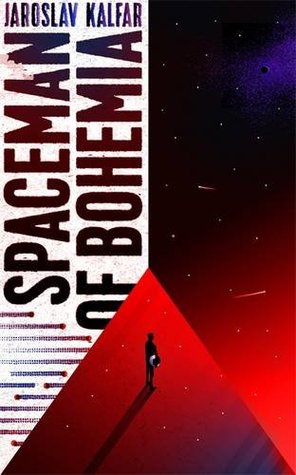 Call this a cross between Everything Is Illuminated (Jonathan Safran Foer) and The Book of Strange New Things (Michel Faber). In April 2018 Czech astronaut Jakub Procházka is launched to investigate cosmic dust storm “Chopra,” but realizes he can never escape his family history or the hazards of his own mind. Amid the drudgery of daily life onboard the JanHus1 space shuttle, he makes a friend: a giant, alien spider he names Hanuš. Jakub has the sense that Hanuš is sifting through his memories, drawing out the central tragedies that form his motivation for going to space, including the shame and persecution that resulted from his father being a Party loyalist and member of the Secret Police prior to the Velvet Revolution.
This debut novel is a terrific blend of the past and the futuristic, Earth and space. There is much to enjoy: Jakub’s sometimes baroque narrative voice (“What good am I, a thin purse of brittle bones and spoiling meat?”) – all the more impressive because Jaroslav Kalfař is in his late twenties and has only spoken English for about 13 years; the mixture of countryside rituals and the bustle of Prague; and the uncertainty about whether Jakub has a viable future, with or without his wife Lenka. The book goes downhill in Part Two and doesn’t quite pull everything together before its end. However, it’s still one of the best debuts I’ve encountered in recent years, and I’ll be eager to see what Kalfař will come up with next.
My rating:
The Idiot by Elif Batuman
(Coming on March 14th from Penguin [USA] and June 1st from Jonathan Cape [UK])
 An odd but very funny anti-Bildungsroman. This is Selin Hanim’s account of her freshman year at Harvard (circa 1995) and the summer of European travel that follows. A daughter of Turkish immigrants, she wants to become a writer, but even as she minutely records every happening and thought she doubts the point of it. In Russian and linguistics classes, in interactions with her roommates and her Serbian friend Svetlana, and in her growing obsession with Ivan, a senior math major from Hungary, she includes a Knausgaardian amount of mundane detail yet always remains at an emotional distance from events. The tone is so very deadpan that you may never warm to Selin. However, it feels appropriate for what the novel is attempting: a commentary on the difficulty of having real, meaningful conversations when language breakdown is rife.
Once again Batuman has borrowed a Dostoevsky title (her 2010 memoir was called The Possessed). I suspect her debut novel is generally indebted to Eastern European literature in the randomness of the incidents and the way they are bluntly recounted rather than explained. This can be problematic for the story line: it feels like things keep happening that serve no purpose in the grander scheme. It’s as if Batuman is subverting the whole idea of a simple coming-of-age trajectory. At the same time, she convincingly captures what it’s like to be young and confused. This reminded me of my college and study abroad experience; that familiarity plus the off-the-wall humor kept me reading.
Sample lines:
(On a plane) “I opened the foil lid and looked at the American meal. I couldn’t tell what it was. The man in the seat ahead of me started tossing and turning. His pillow fell into my dessert. The pink whipped foam formed meaningful-looking patterns on the white fabric. I saw a bird—that meant travel.”
“Spiderwebs attached themselves, like long trails of agglutinative suffixes, onto our arms and faces.”
My rating:
My Darling Detective by Howard Norman
(Coming on March 28th from Houghton Mifflin)
 When Jacob Rigolet’s mother Nora, former head of Halifax Free Library, throws ink on a photograph during an art auction in 1977, it sparks an unusual quest into his past. Jacob’s fiancee Martha Crauchet, the detective of the title, learns two startling facts from Nora’s police file: Jacob was born in the Halifax library; and Bernard Rigolet had been serving overseas for more than a year before his birth in 1945, so can’t be his father. Three years ago Nora’s obsession with World War II led to a breakdown she calls her “fall from grace”; she’s been confined to a rest home ever since. As Jacob gives up being an art buyer to attend library school, Martha gets involved in a cold case that involves his real father. The film noir atmosphere is enhanced by a hardboiled detective radio program he and Martha are hooked on: set in the year of Jacob’s birth, Detective Levy Detects keeps overlapping with real life.
This offbeat mystery reminded me of The World According to Garp. I could see it working as a low-budget indie movie or TV special. I loved how climactic things kept happening at the library, and enjoyed glimpses of bad borrower behavior: selling the library’s art books to a secondhand bookstore and a 105-year overdue loan found in someone’s attic. I have a suspicion this novel won’t linger long in my mind, but it was a fun weekend read. (Historical note: one character’s mother was killed in the Halifax Explosion.)
My rating:
Have you read any March releases you would recommend?
The Last Summer by Ricarda Huch (Peirene)
Originally published in 1910, The Last Summer is a suspenseful epistolary novella by Ricarda Huch (1864–1947), one of the first German women to earn a PhD. She wrote widely across many fields – history, poetry, fiction, and religion – and had an asteroid named after her, earning Thomas Mann’s accolade of “the First Lady of Germany.” I’m grateful to Peirene for resurrecting this German classic as I have a special love for epistolary novels – traditionally told through nothing but letters. You have to be on the lookout for little clues dotted through the correspondence that will tell you who these characters are, how they’re connected to one another, what you need to know about their pasts, and what’s happening now.
 Set across one May to August in the early 1900s, the book joins the von Rasimkara family at their summer home. In response to student protests, patriarch Yegor, the governor of St. Petersburg, has shut down the university and left for the country. With him are his wife, Lusinya; their three twenty-something children, Velya, Jessika and Katya; and Yegor’s new secretary-cum-bodyguard, Lyu. What the family don’t know, but readers do from the first letter onward, is that Lyu is in league with the student revolutionaries and is in on a plot to assassinate the governor at his summer home.
This central dramatic irony is what fuels much of the book’s tension. All of the von Rasimkaras persist in believing the best about Lyu, even when the evidence seems to point to his deception. Both daughters fall in love with him, Velya calls him their “guardian angel,” and Lusinya is sure of his loyalty even after odd incidents she can’t explain, like finding him standing in their bedroom doorway in the middle of the night and a mysterious letter appearing under her pillow. “In case of doubt, one ought to hold back with one’s judgement,” Lusinya opines.
I wouldn’t go so far as to call this a “psychological thriller,” as the back cover blurb does, but I do think it’s a compelling picture of how different groups and ideologies can be fundamentally incompatible. In my favorite passage, Lyu describes the von Rasimkara family to his friend Konstantin:
My stay here is fascinating from a psychological viewpoint. The family has all the virtues and defects of its class. Perhaps one cannot even talk of defects; they merely have the one: belonging to an era that must pass and standing in the way of one that is emerging. When a beautiful old tree has to be felled to make way for a railway line, it’s painful to watch; you stand beside it like an old friend, gazing admiringly and in grief until it comes down. It is undeniably a shame about the governor, who is a splendid example of his kind, but I believe that he has already passed his peak.
As I sometimes feel about novellas, the plot is fairly thin and easily could have been spun out to fill a book of twice the length or more. But that is not what Peirene Press books are about. They’re meant to be quick reads that introduce European novellas in translation. This one has a terrific ending – which I certainly won’t spoil, though the title and cover could be read as clues – and is a perfectly enjoyable way to spend a winter evening.
[Peirene issues books in trios. This is the first of the three books in the “East and West: Looking Both Ways” series. The other two, The Orange Grove by Larry Tremblay and Dance by the Canal by Kerstin Hensel, will be released later in 2017.]
The Last Summer was published in the UK on February 1st. Translated from the German by Jamie Bulloch.
With thanks to James Tookey of Peirene Press for the free copy for review.
My rating:
Other Peirene titles I’ve reviewed:
- Mr. Darwin’s Gardener by Kristina Carlson
- The Looking-Glass Sisters by Gøhril Gabrielsen
- Her Father’s Daughter by Marie Sizun
- The Man I Became by Peter Verhelst
Yet More Books about Cats
I reviewed two sets of cat books last year, one in April and another in October. When you start looking, you realize there are endless pet books out there, with cat books seemingly second only to dog books in popularity. In the past few months I’ve encountered five more books about cats: a Christmas classic, a scientist’s introduction to cat behavior, an anthology of church-themed fiction, an installment of a charming children’s series, and a very funny memoir.
The Cat Who Came for Christmas by Cleveland Amory
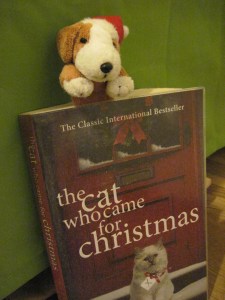 In the late 1970s Amory was a bona fide animal lover (he’d founded the NYC-based Fund for Animals, after all) but didn’t have a pet of his own until he was involved in the rescue of an unprepossessing stray one Christmas: Polar Bear, the cat who would introduce his fussy habits to a bachelor’s household and complicate his life in all kinds of ways. Cat owners will recognize so many things – the 3 a.m. bowl-emptying snack, testy relations with various other species – but I found the book strangely belabored and irrelevant as it goes into the history of the domestic cat, the business of naming cats, and Amory’s travels on behalf of the Fund. [Public library]
Favorite lines:
- “For an animal person, an animal-less home is no home at all.”
- “The fact is that most cats, most of the time, have already met everybody they care to meet.”
Cat Sense: The Feline Enigma Revealed by John Bradshaw
 Bradshaw is the founder and director of the Anthrozoology Institute at the University of Bristol. He writes as both an expert in animal behavior and a cat lover. I only skimmed this one rather than reading it in full because I expected it would repeat a lot of the information in Abigail Tucker’s The Lion in the Living Room. There is indeed a fair amount of overlap in the discussion of domestic cat evolution and the environmental effects of cats’ hunting instinct, but Bradshaw’s book is unique for the amount of time it gives to cat genetics and behavior, especially things like breeding and how cats interact with other cats and with people. This would be a good halfway house if you want a readable but quite scientific book about cats. The Lion in the Living Room is the better all-round introduction, though. [Public library]
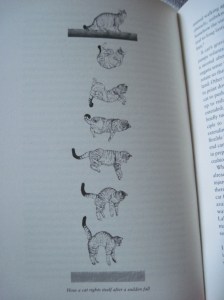
Bradshaw’s diagram of a cat landing on its feet.
Favorite lines:
- “Part of the pleasure of owning a pet comes from projecting our thoughts and feelings on to the animal, treating it as if it were almost human. We talk to our cats as if they could understand our every word, while knowing full well that they certainly can’t.”
- “Purring therefore seems to convey a general request: ‘Please settle down next to me.’ In the gentlest way, the purring cat is asking someone else, whether cat or human, to do something for it.”
The Church Cat: Clerical Cats in Stories and Verse, edited by Mark Bryant
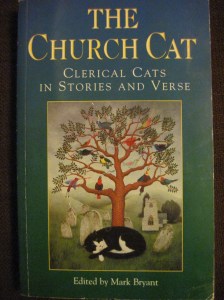 This seems like an impossibly narrow category: stories and poems that combine cats with a church setting. But Bryant has found some real gems that fulfill just that criterion. A few of the short stories, by Ellis Peters, M.R. James and Ernest Dudley, are compact murder mysteries. I most enjoyed Arnold Bennett’s “The Cat and Cupid,” about spinster sisters and “notorious cat-idolaters” who squabble over the handsome new organist; W.L. Alden’s “The Yellow Terror,” about a ship’s cat who insists that his owner hold church services onboard; and Christopher Park’s “The Case of the Cross-eyed Sphinx and the Holy Ghost” (my overall favorite) in which a newly married man meets his wife’s family, including a defrocked chaplain in a wheelchair and his barking mad wife, all of whom have “had an overdose of cat worship.” Of the 21 pieces, only five or six stood out for me (and none of the poetry, really). [Charity shop]
The Church Mice Adrift by Graham Oakley
This 1976 picture book was my introduction to the 14-strong “Church Mice” series. The town of Wortlethorpe is looking to modernize: tearing down all its heritage buildings in favor of glass-fronted monstrosities. This leaves a troop of rats without a home, but they spy an opportunity when they sneak through Sampson’s catflap in the church door. The wily creatures displace the church mice and even Sampson the ginger wonder cat can’t take back his territory. So the cat and his mice are forced to get creative, and come up with a plan that involves a doll’s house turned into a floating café for rats…
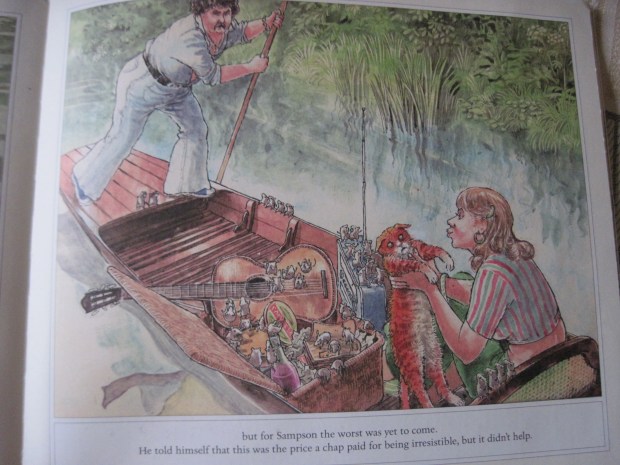
I loved the illustrations (the 1970s clothing on the few human characters cracked me up!) and the plot, a good mixture of humor and mild peril. There’s a fair number of words on each page, yet not too many. I can see this being ideal to read aloud with young children before having them take over the reading at age 5 or 6. I look forward to experiencing more of the church mice’s adventures. My thanks to Margaret of From Pyrenees to Pennines for recommending this charming series. [Public library]
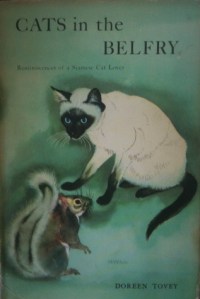
Cats in the Belfry by Doreen Tovey
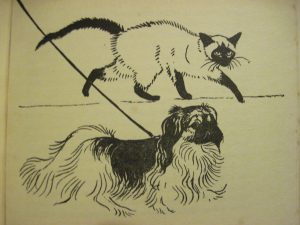
Solomon stalking a neighbor dog.
Do you think your cat is noisy and troublesome? Be thankful you don’t have Doreen Tovey’s Siamese cats! This 1957 book was the first of her many cat-themed memoirs and is perfectly delightful for any animal lover. Their first Siamese was Sugieh, who loved nothing more than to jump into a full bath and frighten the life out of the bather. They bred her and kept two of the littermates, Solomon and Sheba, a mischievous pair whose first three years of antics fill much of the book: terrorizing dogs, pulling down the curtains, following horses, and developing, er, ‘refined’ tastes – “What with spiders, string, and the occasional butterfly caught napping on a cabbage which he ate wings and all, Solomon was, of course, frequently sick. But never, ever, was he so gloriously sick as the day he ate the cream cakes.” [Charity shop]
Up next:
 I have Thomas McNamee’s The Inner Life of Cats (coming out on March 28th) and Jason Hazeley’s The Fireside Grown-Up Guide to the Cat (coming out on April 4th) on my e-readers.
- I’m sure to borrow more books from the public library by Tovey and Bradshaw, who has a book about training your cat (ha!).
- I covet I Could Pee on This, Too: And More Poems by More Cats by Francesco Marciuliano.
Whether you consider yourself a cat lover or not, do any of these books appeal?
The Doll’s Alphabet: Stories by Camilla Grudova
Camilla Grudova lives in Toronto and has a degree in Art History and Germany from McGill University of Montreal. The Doll’s Alphabet, her debut collection, sets surreal tales of women’s inner lives against ruined cityscapes. These 13 stories are like perverted fairytales or fragmentary nightmares, full of strange recurring imagery and hazily dystopian setups. Flash fiction-length stories alternate with longer ones that move at a dizzying pace, and the book is roughly half third-person and half first-person – a balance I always appreciate.
 “Unstitching,” the two-page opener, introduces the metaphors and gender politics that form the backdrop for Grudova’s odd imagination. One day Greta realizes she can unstitch herself, removing an outer covering to reveal her true identity; “It brought great relief … like undoing one’s brassiere before bedtime or relieving one’s bladder after a long trip.” Her neighbor Maria does the same, but men – including Greta’s husband – find this intimidating, and are jealous because they don’t seem to have a deeper self to uncover. I was tickled by the idea of women having a secret life unshared by men, but had trouble grasping the actual mechanics of the unstitching: “She did not so much resemble a sewing machine as she was the ideal form on which a sewing machine was based. The closest thing she resembled in nature was an ant.” Huh? This is a case where keeping things vague might have been a better strategy.
Sewing machines keep popping up, along with mermaids, dolls, babies, zoos, factories, and old-fashioned or derelict shops. For example, the narrator of “The Mouse Queen” is a clerk in a doll’s house shop, while her husband Peter works in a graveyard. One night he brings home the corpse of an old dwarf woman, which the narrator decides to stow in the abandoned grocery store under their apartment. Um, naturally.
In “Waxy” (full text available on the Granta website) the narrator works at a sewing machine factory and unlawfully acquires a baby by her sub-par Man, Paul. The sexual violence in this one and in “Moth Emporium” is deeply unsettling: even in these off-kilter fictional worlds women’s bodies are considered a threat and pregnancy is never innocuous.
My two favorites were “Agata’s Machine” (full text available at The White Review) and “Notes from a Spider.” The former is perhaps indebted to D.H. Lawrence’s “The Rocking-Horse Winner” in its picture of obsessive and ultimately self-destructive activity. It features two Eastern European eleven-year-olds: the narrator is bullied, while her friend Agata is an aloof genius. In her attic room Agata keeps what looks like a sewing machine, but pushing its treadle creates flickering images of Pierrot (a clown) or an angel. This one has a chilling ending. The last story, “Notes from a Spider,” is told by a half-man, half-spider with eight legs. He keeps a zoo for vermin and opens – what else? – a sewing machine museum.
I’ve discovered that I have limited tolerance for outlandish tales like these. I’d be intrigued to find one of Grudova’s stories in an anthology, and I might be happy to read the best four or five of these. But because the same images and concepts keep repeating, the book feels twice as long as it needs to be. Ultimately this book was not for me, but I would not hesitate to recommend it to you if you have enjoyed the more fantastical of the feminist short stories by Karen Russell, Alexandra Kleeman and Helen Simpson.
The Doll’s Alphabet was published on February 14th by Fitzcarraldo Editions. With thanks to publicist Nicolette Praça for the review copy.
My rating:
London-based publisher Fitzcarraldo Editions produces elegantly simple volumes of long-form essays and niche contemporary fiction, with much of the latter appearing in English translation for the first time. I’ve enjoyed a number of Fitzcarraldo books – particularly On Immunity by Eula Biss, The Hatred of Poetry by Ben Lerner, and Second-Hand Time by Svetlana Alexievich – and even when the topics don’t hold any particular interest for me (as was the case with Football by Jean-Philippe Toussaint and Pretentiousness by Dan Fox), they are still thought-provoking, out-of-the-ordinary discourses on the topic at hand.

Coming up next from Fitzcarraldo (March 22nd) is French author Mathias Enard’s novel Compass, which won the 2015 Prix Goncourt. On one sleepless night in Vienna Franz Ritter, an ailing musicologist, entertains memories of travels in the Middle East and his unrequited love for Sarah. Here’s part of the first run-on paragraph as a preview of the hypnotic style:
We are two opium smokers each in his own cloud, seeing nothing outside, alone, never understanding each other we smoke, faces agonizing in a mirror, we are a frozen image to which time gives the illusion of movement, a snow crystal gliding over a ball of frost, the complexity of whose intertwinings no one can see, I am that drop of water condensed on the window of my living room, a rolling liquid pearl that knows nothing of the vapour that engendered it, nor of the atoms that still compose it but that, soon, will serve other molecules, other bodies, the clouds weighing heavy over Vienna tonight: over whose nape will this water stream, against what skin, on what pavement, towards what river, and this indistinct face on the glass is mine only for an instant, one of the millions of possible configurations of illusion …
Review: Darke by Rick Gekoski
Dr. James Darke, the narrator of rare-book dealer Rick Gekoski’s debut novel, is of the same lineage as titular antiheroes like Hendrik Groen and Fredrik Backman’s Ove, or J. Mendelssohn, protagonist of the title novella in Colum McCann’s Thirteen Ways of Looking: an aging widower and curmudgeon with an unforgettable voice.
As Darke begins, this retired English teacher is literally sealing himself off from the world. He hires a handyman to take out the door’s built-in letterbox, change the locks and install a high-tech peephole; he has all his mail redirected to an old colleague, George; he changes his e-mail address; and he compiles a thorough list of service providers who will come to him – everything from grocery deliveries to a doctor. Now, with any luck, he won’t need to set foot outside his London home while he writes this “coming-of-old-age book.”
 For eight months Darke stays in self-imposed exile, his solitude broken only by visits from Bronya, a Bulgarian cleaner who engages him in discussions of his beloved Dickens. Although he’s only sixty-something, Darke sounds like a much older man, complaining of constipation and vision problems and launching a vendetta against the annoying neighbor dog. Ignoring the pile of adamant letters George guiltily delivers on behalf of Darke’s daughter, Lucy, he keeps up his very particular habits and rituals (I loved the steps of making coffee with an espresso-maker) and gives himself over to memories of life with Suzy.
The novel is tripartite: In Part I we meet Darke and get accustomed to his angry, hypercritical voice. In Part II we descend into a no-holds-barred account of his wife Suzy’s death from lung cancer. She’s another wonderful character: pessimistic, ungraceful and utterly foul-mouthed. Here Darke unleashes the full extent of his bitterness. He mocks the approach, advocated by Joan Didion (“that poor Joan D’Idiot,” he calls her!), of turning to sages of the past for comfort, instead insisting that literature – including W.B. Yeats, T.S. Eliot and all the rest – was of no use to him in the face of his wife’s impending death:
We don’t have God, so we have literature, with its associated proverbs and allegories, its received wisdom. We quote and genuflect and defer and pay homage, as if in a holy sanctuary. But just as God failed us, so too will reading. We will turn against it as certainly, and rightly, as we did against Him. Nobody, and nothing, can explain life for us.
Luckily, Part III is something of a reprieve, as Darke starts to come out of his temporary retreat and resume life. He has a rental car delivered and sets out for Oxford, where he revisits his and Suzy’s old university haunts and hesitantly reopens a connection with Lucy and her young son, Rudy.
Sebastian Barry astutely notes the novel’s debt to Dante, but the component parts of the Divine Comedy are reordered, with the purgatory of the house-bound months broken by the hellish narrative of Suzy’s dying, which is then lifted by Darke’s return to life.
Each section has a different tone and is enjoyable in its own way, but for me there was no getting around the fact that Part I is the most entertaining. I was surprised to read in the Acknowledgments that Gekoski toned down this first dose of Darke considerably, on the advice of his wife and his literary agent; I think he could have hammed him up a fair bit more. Also, Lucy didn’t ring true for me as a character, which detracted from what’s meant to be an alternately volatile and poignant relationship; I preferred Darke’s scenes with Bronya.
In any case, the novel makes great metaphorical use of light and darkness. Not so subtle, maybe, but it works:
witnessing a protracted and horrible death infects the soul, the images implant themselves, root and flourish, you can never look at yourself or others in the innocent light – you are tarnished, uncleanably darkened.
And of course, look to literature and you find nothing but “shitslingers – Kahlil Gibran, Mr Tolstoy, the dreaded Eliot – all of them. Just wandering in the dark with flashlights.”
With lots of memorable scenes and turns of phrase, Darke is a rewarding glance at loss, literature and the sometimes futile search for salvation. It’s inspiring to see Gekoski, an American-born academic and literary critic (he’s been dubbed the Bill Bryson of the book world), turn his hand to fiction at age 71. I knew of him through his nonfiction, including Outside of a Dog: A Bibliomemoir, which I read in 2010, and have also enjoyed a couple of his articles that nicely presage this novel, on the subjects of reading through grief and turning against print books. I hope you’ll give his work a try.
Darke was published in the UK on February 2nd. With thanks to Becca Nice and Jamie Norman of Canongate for the free copy for review.
My rating:
Six “Love” Books for Valentine’s Day
Starting in mid-January I began surveying my shelves, library stack and Kindle for books with “love” in the title. Here are the six I had time to try; I didn’t get to Alain de Botton’s The Course of Love on my Kindle, nor my paperback copies of Iris Murdoch’s The Sacred and Profane Love Machine and Nancy Horan’s Loving Frank.
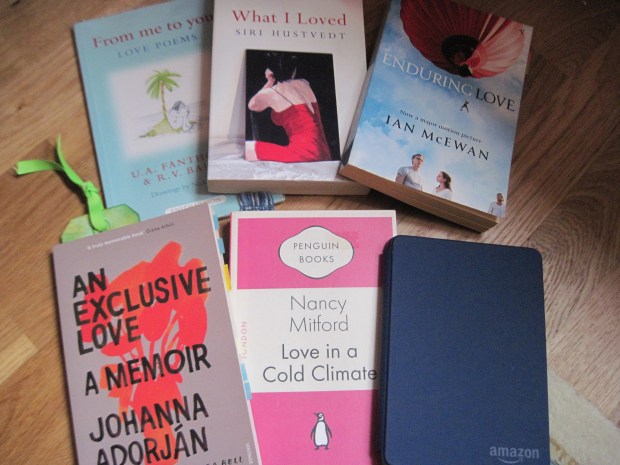
You’ll notice that a number of the books I’ve read aren’t that optimistic about love; in several cases the use of the word in the title even seems to be ironic. As Lady Montdore exclaims in Love in a Cold Climate, “Love indeed – whoever invented love ought to be shot.” So I can’t offer them as particularly romantic choices. But let’s start positively, with some pleasantly out-of-the-ordinary love poems.
From Me to You: Love Poems, U.A. Fanthorpe and R.V. Bailey
 Ursula Fanthorpe and Rosie Bailey met as English teachers at the same Cheltenham school in their late twenties and were partners for nearly 40 years. None of the poems in this short volume are attributed, though I recognized a few from Fanthorpe’s Collected Poems. They’re not particularly distinguished as poetry, but I appreciated the simple, unsentimental examples of what makes up everyday life with a partner: “There is a kind of love called maintenance, / Which stores the WD40 and knows when to use it; // Which checks the insurance, and doesn’t forget / The milkman” (“Atlas”) and “I’m working on a meal you haven’t had to imagine, / A house cleaned to the rafters” (“Dear Valentine”). [Public library]
What I Loved, Siri Hustvedt
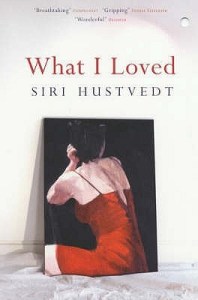 This 2003 novel could just as well have been titled “What I Lost,” which might be truer to its elegiac tone. Narrated by Professor Leo Hertzberg and set between the 1970s and 1990s, it’s about two New York City couples – academics and artists – and the losses they suffer over the years. With themes of modern art, perspective, memory, separation and varieties of mental illness, it asks to what extent we can ever know other people or use replacements to fill the gaps left by who and what is missing. Read it if you’ve enjoyed The Suicide of Claire Bishop by Carmiel Banasky, other books by Siri Hustvedt, or anything by Howard Norman. My favorite lines about love were “I often thought of our marriage as one long conversation” and “love thrives on a certain kind of distance … it requires an awed separateness to continue.” [Charity shop]
Love in a Cold Climate, Nancy Mitford
 I didn’t realize this 1949 novel is a sequel to The Pursuit of Love, so it took a while to figure out who all the characters were. Fanny Logan is a cousin orbiting around Lord and Lady Montdore and their daughter Polly Hampton, all recently returned from some years in India. Fanny marries an Oxford don, while Polly shocks everyone by eloping with her uncle by marriage, “Boy” Dougdale, a recent widower once known as the “Lecherous Lecturer” for interfering with little girls. (This hint of pedophilia is carelessly tossed off in a way no writer would get away with today.) Meanwhile, the heir to the Hampton estate, an effeminate chap named Cedric, comes over from Canada for a visit and wins Lady Montdore over. This amusing picture of aristocratic life in the 1930s marvels at who we love and why. [Bookbarn International]
Enduring Love, Ian McEwan
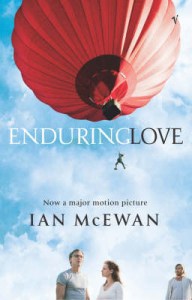 Interesting to consider this as a precursor to Saturday: both have a scientist as the protagonist and get progressively darker through a slightly contrived stalker plot. Enduring Love opens, famously, with a ballooning accident that leaves its witnesses questioning whether they couldn’t have done more to prevent it. Freelance science journalist Joe Rose – on a picnic with his partner, Keats scholar Clarissa, at the time – was one of those who rushed to help, as was Jed Parry, a young Christian zealot who fixates on Joe. He seems to think that by loving Joe, a committed atheist, he can bring him to God. In turn, Joe’s obsession with Jed’s harassment campaign drives Clarissa away. It’s a deliciously creepy read that contrasts rationality with religion and inquires into what types of love are built to last. [Charity shop]
An Exclusive Love: A Memoir, Johanna Adorján
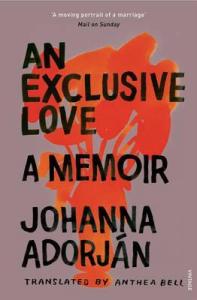 The author’s grandparents, Hungarian Holocaust survivors who moved to Denmark as refugees, committed suicide together on October 13, 1991. Her grandfather, an orthopedic surgeon who had been in an Austrian concentration camp, was terminally ill and his wife was determined not to live a day without him. This short, elegant memoir alternates Adorján’s imagined reconstruction of her grandparents’ last day with an account of their life together, drawn from family memories and interviews with those who knew them. She wonders whether, like Primo Levi and Arthur Koestler, theirs was a typically Jewish failure to fit in wherever they went, and/or a particularly Hungarian melancholy. “The answer is their great love,” the newspaper report of their death insisted. [Waterstones clearance]
Note: That striking cover is by Leanne Shapton.
And another nonfiction selection that I didn’t make it all the way through:
A Book about Love, Jonah Lehrer
 (Abandoned at 31%.) Although I can see why he starts where he does, Lehrer’s early focus on attachment and attunement – two psychological theories of how babies learn to relate affectionately to others – means the book gets bogged down in studies performed on mice and/or children and feels more like a parenting book than anything else. (If that’s what you’re after, read All Joy and No Fun.) A glance at the table of contents suggests the rest of the book will go into marriage, divorce and how love changes over time, but I couldn’t be bothered to stick around. That said, Lehrer’s popular science writing is clear and engaging, and with the heartfelt mea culpa at the start of this book I couldn’t hold a grudge about his earlier plagiarism scandal. [Kindle book from NetGalley.]
No overtly heartwarming love stories in that selection, then, but are there any you fancy reading anyway? Have you read any “love” titles recently?
See also: The Guardian’s list of Top 10 Authentic Romances.
 Bookish Beck = Rebecca Foster. American transplant to England. Freelance proofreader and book reviewer.
 Bookish Beck