Hope for a Cool Pillow by Margaret Overton
“There must be better and worse ways to die. It seems both rational and possible to minimize the likelihood of an unpleasant end.”
~William T. Vollmann, “A Good Death”
 If pressed to say which books Margaret Overton’s wry, out-of-the-ordinary new memoir most reminded me of, I’d describe it as a cross between Atul Gawande’s Being Mortal and Roz Chast’s Can’t We Talk about Something More Pleasant? The Chicago-area anesthesiologist is the author of a previous memoir, Good in a Crisis (2012), about the aftermath of a divorce and a brain aneurysm. Her latest book, which released on March 1st, started off as a manifesto on the need for an overhaul of American end-of-life care, with a strong drive towards creating an advanced directive and otherwise being meticulously prepared for one’s own death.
From there, I gather, the book took on a life of its own. It’s delightfully digressive, incorporating cases Overton observed in the hospital where she worked and lessons gleaned from a Harvard Business School course on healthcare delivery but also her personal experience of guiding her parents through their last days – her father died of lung cancer in 1998 and her mother, who suffered from dementia, finally followed in 2010.
Years surrounded by infirmity and the possibility of death have convinced her of the benefits of hospice and physician-assisted suicide, still only legal in a few states. We need to know (as we already do for our pets) when suffering is too much and stop extending life at any cost, Overton insists – rather than allowing hospitals to profit from death, as currently happens, with many elderly patients undergoing expensive and ultimately ineffectual procedures in their final weeks. “The last six months of life accounted for roughly twenty-five percent of our Medicare spending.”
For as universal as suffering and death are, we sure are wont to refuse them space in our lives. Again and again Overton uses the striking metaphor of “lemon juice,” drawn from a news story about a hapless would-be bank robber who thought spraying himself with lemon juice would make him invisible to onlookers and police. In our daily lives, she opines, we keep wearing that lemon juice, denying that there is a problem with our healthcare system and our thinking about death.
My thoughts kept coming back to care at the end of life. How do we change the end game? How do we make it better for the elderly, for those of us who will some day become elderly, and how do we save our country some money in the process so that when it is our turn, there will be money left in the system to provide us with the care we want? It seemed to me that if we could just tinker with this one aspect of healthcare, a number of other issues would fall into place.
What’s so special about this book is seeing the problem from several angles and perspectives: that of a physician, that of a healthcare researcher, and that of a dutiful daughter. Overton keeps her narrative interesting by avoiding chronological rundowns; instead she intercuts, sometimes paragraph by paragraph, multiple anecdotes – alternating a hospital case with her mother’s last days, say, or jumping between her experience at the Harvard course and her father’s treatment. I can see how some might find the non-consecutive structure off-putting, but I loved every bit of this short, powerful book, from the evocative title through to the excellent final chapter. Anyone who has enjoyed the aforementioned Gawande and Chast books should not hesitate to make this their next read.
See also this Chicago Tribune article on Margaret Overton.
With thanks to publicist Beth Parker for the e-copy for review.
My rating: 
At the Existentialist Café by Sarah Bakewell
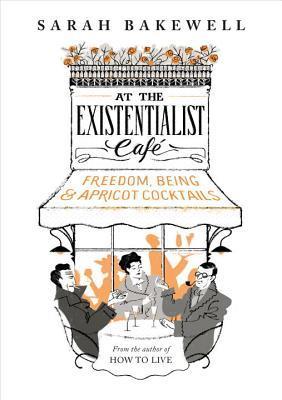 I’ve long meant to read Sarah Bakewell’s How to Live, a biography of Montaigne that also promises to be a deep examination of philosophical and ethical issues. When I heard she had a new book out, I jumped at the chance to learn more about existentialism. I’ve come away from At the Existentialist Café with only a nebulous sense of what existentialism actually means (though Bakewell’s bullet-pointed list of points towards a definition on page 34 is helpful), but certainly with more knowledge about and appreciation for Jean-Paul Sartre and Simone de Beauvoir, two of her main subjects. This is appropriate given the shift in Bakewell’s thinking: “When I first read Sartre and Heidegger, I didn’t think the details of a philosopher’s personality or biography were important. … Thirty years later, I have come to the opposite conclusion. Ideas are interesting, but people are vastly more so.”
Some of the interesting characters herein, apart from Sartre and de Beauvoir (always referred to in these pages as “Beauvoir,” which irked me unduly), are Edmund Husserl, Martin Heidegger, Karl Jaspers, Hannah Arendt, Maurice Merleau-Ponty and Albert Camus. It’s a large cast; you may well find yourself flipping back and forth to the helpful who’s who list in the back of the book. I was amused to see that Freiburg, Germany is the seat of phenomenology (which gave rise to existentialism) – I’m heading there in June to stay with friends at the start of a mini European tour. Husserl was the chair of philosophy at Freiburg, and Heidegger his colleague.
The best I can make out, Heidegger’s philosophy was about describing experience to get to the heart of things. Disregard peripherals and focus on the self’s knowledge of the world, he advised. His best known work, Being and Time, contrasted individual beings with Being itself (i.e. ontology). Think of him as an experimental, modernist novelist, Bakewell advises; understanding what he’s doing with his philosophy is difficult otherwise. Existentialism built on this framework but emphasized freedom and how it is exercised in particular situations.
World War II, especially the year 1945, was a turning point for many of the philosophers discussed. Sartre was held in a POW camp but his eye troubles gave him a way out. Many left Europe for America due to anti-Semitism, including Hannah Arendt and Bruno Bettelheim. Although Heidegger contrasted “the they” (das Man – more similar, perhaps, to the English phrase “the Man”) with the voice of conscience in such a way that suggested one should resist totalitarianism, he would later be exposed as a Nazi. In the following years, the United States became very popular culturally: jazz music, film noir, Hemingway. At the same time, the French were shocked at America’s racial inequality. Sartre believed that one should always take the opinion of the “least favored” or most oppressed party in any situation, which would lead him to speak out for minorities and the colonized, as in the Algerian liberation movement of the 1950s–60s. In the meantime, the rise of the Soviet Union and the development of the atom bomb would emerge as imminent societal threats.
Sartre and de Beauvoir had an open relationship but clearly relied on and felt deeply about each other, especially when it came to their writing. Bakewell convinced me of Sartre’s surprising sex appeal, despite his unprepossessing appearance: “down-turned grouper lips, a dented complexion, prominent ears, and eyes that pointed in different directions.” Apparently he had a silly side and would even do Donald Duck impressions. At the same time, he had rock-solid convictions, as evidenced by his refusal of the Légion d’Honneur and the Nobel Prize. I also learned that he was a biographer of Jean Genet and Gustave Flaubert; his biography of the latter, in three volumes, stretched to 2800 pages! Bakewell waxes anti-lyrical in her account of the disheartening experience of reading it: “Occasional lightning flashes strike the primordial soup, although they never quite spark it into life, and there is no way to find them except by dredging through the bog for as long as you can stand it.”
From the title and subtitle (“Freedom, Being and Apricot Cocktails”), I expected this book to be a bit more of a jolly narrative than it was. The frequent Left Bank Paris setting is atmospheric, but the tone is never as blithe as promised. I would also have liked some additional autobiographical material from Bakewell, who grew up in Reading, England (where I currently live) and met the existentialists through Sartre’s Nausea at age 16.
In the end the fault may not be her book’s but mine: I wasn’t up for fully engaging with a multi-subject biography packed with history and hard-to-grasp philosophical ideas. I’d recommend this to readers who long for bohemian Paris and have enjoyed either an existentialist work or a philosophical novel like Sophie’s World (Jostein Gaarder) or 36 Arguments for the Existence of God (Rebecca Goldstein).
My rating: 
With thanks to Chatto & Windus for the review copy.
Further reading: If anything, I think I’m likely to try de Beauvoir’s autobiographical works – the descriptive language Bakewell quotes from them sounds appealing, and of course she was fundamental in paving the way for modern feminism.
You can read an excerpt from At the Existentialist Café, about de Beauvoir’s composition of The Second Sex, at Flavorwire. See also Bakewell’s Guardian list of 10 reasons why we should still be reading the existentialists.
Have you read anything by the existentialists? What would you recommend?
Books in Brief: Five I Loved Recently
 The Zookeeper’s Wife
By Diane Ackerman
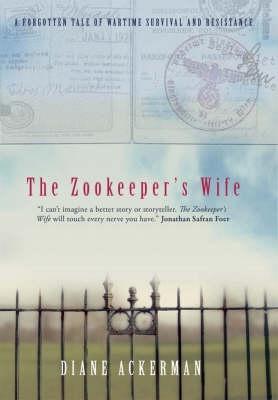
A different sort of Holocaust story, set at Warsaw Zoo in the years surrounding World War II. Even after Nazis dismantled their zoo and killed many of the larger animals, Jan and Antonina Żabiński stayed at their home and used the zoo’s premises for storing explosives and ammunition for Jan’s work in the Polish resistance as well as sheltering “Guests,” Jews passing through. This is a gripping narrative of survival against the odds, with the added pleasure of the kind of animal antics you’d find in a Gerald Durrell book. Their son Ryszard kept as pets a badger who bathed sitting back in the tub like a person and an arctic hare who stole cured meats like “a fat, furry thug.” Much of the book is based on Antonina’s journals, but I wish there had been more direct quotes from it and less in the way of reconstruction.
 Walking Away: Further Travels with a Troubadour on the South West Coast Path
By Simon Armitage
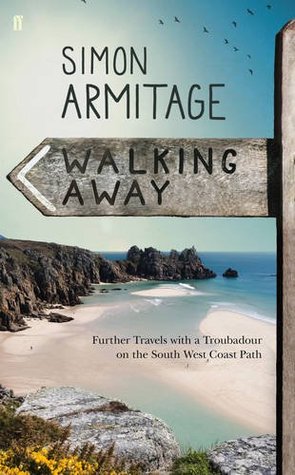
As a sequel to Walking Home, the account of his 2010 trek along the Pennine Way, Armitage walked much of England’s South West Coast Path in August–September 2013. As before, he relied on the hospitality of acquaintances and strangers to put him up along the way and transport his enormous suitcase for him so he could walk about 10 miles a day to his next poetry reading. Emulating a modern-day troubadour, Armitage passed around a sock at the end of readings for donations (though the list of other stuff people left in the sock, with which he closes the book, is quite amusing). Along the way he meets all kinds of odd folk and muses on the landscape and the distressing amounts of seaside rubbish. His self-deprecating style reminded me of Bill Bryson. A pleasant ramble of a travel book.
 Winter World: The Ingenuity of Animal Survival
By Bernd Heinrich
This great seasonal read carefully pitches science to the level of the layman. Heinrich, an emeritus professor of biology at the University of Vermont, surveys various strategies animals use for surviving the winter: caching food, huddling together, hibernating or entering torpor, and lowering their body temperature – even to the point where 50% of their body water is ice, as with hibernating frogs. He carries out ever so slightly gruesome experiments that make him sound like a lovably nutty professor:
To find out how quickly a fully feathered kinglet loses body heat, I experimentally heated a dead kinglet and then measured its cooling rate. … I do not know how many seeds a chipmunk usually packs into each of its two pouches—I easily inserted sixty black sunflower seeds through the mouth into just one pouch of a roadkill.
His passion for knowledge carries through in his writing. I came away with a fresh sense of wonder for how species are adapted to their environments: “Much that animals have evolved to do would have seemed impossible to us, if experience has not taught us otherwise.”
 Poor Your Soul
By Mira Ptacin
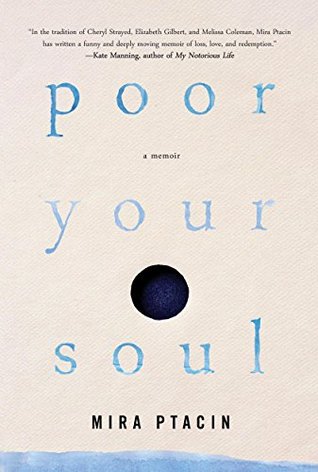
Ptacin’s memoir is based around two losses: that of her brother, in a collision with a drunk driver; and that of a pregnancy in 2008. She skips back and forth in time to examine the numb aftermath of trauma as well as the fresh pain of actually going through it. In places I felt Ptacin sacrificed the literary quality hindsight might have allowed, prioritizing instead the somewhat clichéd thoughts and responses she had in the moment. Still, I loved so much about this book, especially her memories of growing up in the cereal capital of America and the account of her mother coming to America from Poland. Her mother is a terrific character, and it’s her half-warning, half-commiserative phrase that gives the novel its title (not a typo, as you might be forgiven for thinking): a kind of Slavic “I pity the fool.”
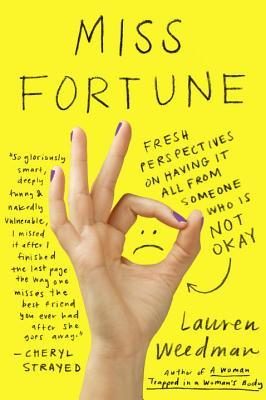 Miss Fortune: Fresh Perspectives on Having It All from Someone Who Is Not Okay
By Lauren Weedman
Weedman is a playwright and minor celebrity who’s worked on The Daily Show, Hung and Looking. This is a truly funny set of essays about marriage (from beginning to end), motherhood, working life and everything in between. Self-deprecatingly, she focuses on ridiculous situations she’s gotten herself into, like the world’s unsexiest threesome and an accidental gang symbol tattoo. Amid the laughs are some serious reflections on being adopted and figuring out how to be a responsible stepmother. With a warning that parts can be pretty raunchy, I’d recommend this to fans of David Sedaris and Bossypants.
My rating for all:
The Lonely City by Olivia Laing
For several years in her mid-thirties, British author Olivia Laing lived in New York City. A relationship had recently fallen through and she was subletting an apartment from a friend. Whole days went by when she hardly left the flat, whiling away her time on social media and watching music videos on YouTube. Whenever she did go out, she felt cut off because of her accent and her unfamiliarity with American vernacular; she wished she could wear a Halloween mask all the time to achieve anonymity. How ironic, she thought, that in a city of millions she could be so utterly lonely.
Loneliness feels like such a shameful experience, so counter to the lives we are supposed to lead, that it becomes increasingly inadmissible, a taboo state whose confession seems destined to cause others to turn and flee. … [L]oneliness inhibits empathy because it induces in its wake a kind of self-protective amnesia, so that when a person is no longer lonely they struggle to remember what the condition is like.
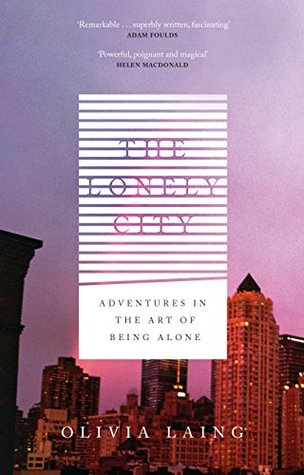 Whereas alcoholic writers were the points of reference for her previous book, the superb The Trip to Echo Spring (2013), here outsider artists take center stage: Edward Hopper, Andy Warhol, David Wojnarowicz, Henry Darger, and the many lost to AIDS in the 1980s to 1990s. It’s a testament to Laing’s skill at interweaving biography, art criticism and memoir when I say that I knew next to nothing about any of these artists to start with and have little fondness for modern art but still found her book completely absorbing.
Several of the artists shared underlying reasons for loneliness: an abusive childhood, mental illness and/or sexuality perceived as aberrant. Edward Hopper might seem the most ‘normal’ of the artists profiled, but even he was bullied when he shot up to 6 feet at age 12; his wife Jo, doing some amateur psychoanalyzing, named it the root of his notorious taciturnity. His Nighthawks, with its “noxious pallid green” shades, perfectly illustrates the inescapability of “urban alienation,” Laing writes: when she saw it in person at the Whitney, she realized the diner has no door. (It’s a shame the book couldn’t accommodate a centerfold of color plates, but each chapter opens with a black-and-white photograph of its main subject.)
Andy Warhol was born Andrej Warhola to Slovakian immigrants in Pittsburgh in 1928. He was often tongue-tied and anxious, and used fashion and technology as ways of displacing attention. In 1968 he was shot in the torso by Valerie Solanas, the paranoid, sometimes-homeless author of SCUM Manifesto, and ever after had to wear surgical corsets. For Warhol and Wojnarowicz, art and sex were possible routes out of loneliness. As homosexuals, though, they could be restricted to sordid cruising grounds such as cinemas and piers. Like Klaus Nomi, a gay German electro-pop singer whose music Laing listened to obsessively, Wojnarowicz died of AIDS. Nomi was one of the first celebrities to succumb, in 1983. The epidemic only increased the general stigma against gay people. Even Warhol, as a lifelong hypochondriac, was leery about contact with AIDS patients. Through protest marches and artworks, Wojnarowicz exposed the scale of the tragedy and the lack of government concern.
In some ways Henry Darger is the oddest of the outsiders Laing features. He is also the only one not based in New York: he worked as a Chicago hospital janitor for nearly six decades; it was only when he was moved into a nursing home and the landlord cleared out his room that an astonishing cache of art and writing was discovered. Darger’s oeuvre included a 15,000-page work of fiction set in “the Realms of the Unreal” and paintings that veer towards sadism and pedophilia. Laing spent a week reading his unpublished memoir. With his distinctive, not-quite-coherent style and his affection for the asylum where he lived as an orphaned child, he reminded me of Royal Robertson, the schizophrenic artist whose work inspired Sufjan Stevens’s The Age of Adz album, and the artist character in the movie Junebug (2005).
A few of the chapters are less focused because they split the time between several subjects. I also felt that a section on Josh Harris, Internet entrepreneur and early reality show streaming pioneer, pulled the spotlight away from outsider art. Although I can see, in theory, how his work is performance art reflecting on our lack of true connection in an age of social media and voyeurism, I still found this the least relevant part.

The American cover
The book is best when Laing is able to pull all her threads together: her own seclusion – flitting between housing situations, finding dates through Craigslist and feeling trapped behind her laptop screen; her subjects’ troubled isolation; and the science behind loneliness. Like Korey Floyd does in The Loneliness Cure, Laing summarizes the physical symptoms and psychological effects associated with solitude. She dips into pediatrician D.W. Winnicott’s work on attachment and separation in children, and mentions Harry Harlow’s abhorrent rhesus monkey experiments in which babies were raised without physical contact.
The tone throughout is academic but not inaccessible. Ultimately I didn’t like this quite as much as The Trip to Echo Spring, but it’s still a remarkable piece of work, fusing social history, commentary on modern art, biographical observation and self-knowledge. The first chapter and the last five paragraphs, especially, are simply excellent. Your interest may wax and wane through the rest of the book, but I expect that, like me, you’ll willingly follow Laing as a tour guide into the peculiar, lonely crowdedness you find in a world city.
(See also Laing’s list of 10 Books about Loneliness, chosen for Publishers Weekly.)
With thanks to Canongate for sending a free copy.
My rating:
Books in Brief: Five I Loved Recently
Why We Write about Ourselves: Twenty Memoirists on Why They Expose Themselves (and Others) in the Name of Literature
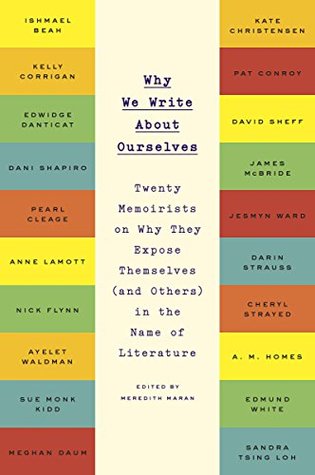 (Edited by Meredith Maran)
A great collection of first-person pieces from memoir authors, charting their individual journeys into autobiographical writing and giving their top tips. Opinions vary as to whether you have to get the approval of the people who appear in your work – some think that’s essential; others simply change the names and get on with it. Sometimes this has led to fallout within families. One thing everyone agrees on, though, is that a memoir has to be as carefully crafted as any novel, with a clear narrative arc and distinctive dialogue and scenes. My favorite pieces were from Kate Christensen, Edwidge Danticat and Darin Strauss.
Can’t We Talk about Something More Pleasant?
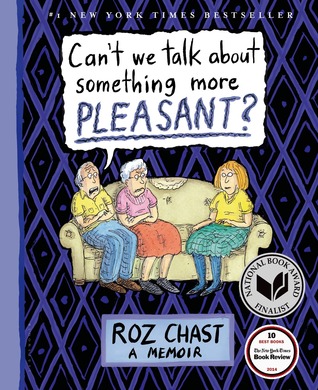 (By Roz Chast)
Memoir + graphic novel = graphic memoir. This one’s about her parents’ aging, senility and death yet still manages to be laugh-out-loud funny. It also includes photos of her parents’ apartment filled with ancient stuff they’d hoarded and a touching series of sketches she made of her mother while she was dying. This and Fun Home are the two best graphic memoirs I’ve read. A favorite line, uttered when her mother bounced back temporarily from hospice care: “Where, in the five Stages of Death, is EAT TUNA SANDWICH?!?!?”
Best Food Writing 2015
(Edited by Holly Hughes)
 “Food is intimate. We take it into our bodies. When we gather at the table with friends and family, we’re gathering to affirm something.” The title doesn’t lie – these essays are terrific. There wasn’t a single one I didn’t find interesting, whether the topic was lab meat; seeking out the perfect burger, Bolognese sauce or gumbo; particular chefs or restaurants; food fads; starting a simple meatball supper club; or feeding picky kids. A couple favorites were “Finding Home at Taco Bell” by John DeVore and “The One Ingredient that Has Sustained Me during Bouts of Leukemia” by Jim Shahin. This series has been running since 2000, but this is the first time I’ve picked up one of the books. I’ll be looking out for it again next year.
 The Longest Night
(By Andria Williams)
Utterly absorbing historical fiction. What with the remote setting and the threat of Cold War or nuclear fallout, this is reminiscent of The Last Pilot and The Wives of Los Alamos, but more engaging than either of those. You may also see hints of Richard Yates or even Tom Perrotta’s Little Children in the story of a marriage strained to the breaking point. Each character is fully explored and the early 1960s atmosphere is completely convincing. A great debut and an author I’d like to hear more from.
Your Heart Is a Muscle the Size of a Fist
(By Sunil Yapa)
 A hard-hitting novel with an unforgettably resonant title, this is set at the 1999 Seattle WTO protest. Yapa explores the motivations and backstories of activists, police officers, and delegates as the day deteriorates into violence. The novel flows pretty much effortlessly. Yapa’s writing style is closest to Smith Henderson’s (Fourth of July Creek): short, verbless sentences alternate with long, lyrical ones; there’s plenty of repetition and rhetorical questions, but it remains accessible rather than overblown. This fine debut novel is about cultivating the natural compassion in your heart even while under the threat of the fist.
My rating for all: 
Love, Sex, Death & Words: Catch-up Book #3
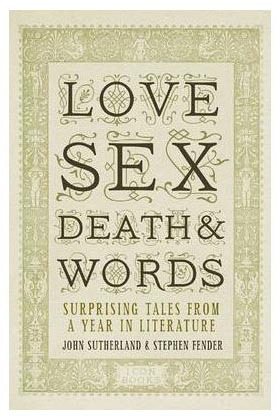 Love, Sex, Death & Words: Surprising Tales from a Year in Literature was my bedside book for 2015. It’s composed of 366 daily entries compiled by John Sutherland, one of my favorite commentators on books, and Stephen Fender. Each entry zeroes in on an event from literary history corresponding to that calendar date. The events range enormously in terms of time period, setting and theme. Births, deaths, anniversaries, Nobel prizes awarded to authors you’ve never heard of, publication dates – this has it all.
A few of my favorite random pieces were: “12 July – The end of blasphemy” (the last successful blasphemy charge was made against a work of literature in 1977: a poem in Gay News that implied Jesus was homosexual and imagines a Roman soldier sodomizing his corpse); “20 August – England’s finest naturalist–novelist is buried” (introducing me to Richard Jefferies, about whom I knew next to nothing); “19 November – After a sound night’s sleep at the Willard Hotel, Washington, D.C., Julia Ward Howe wakes early in the dawn with the words of ‘The Battle Hymn of the Republic’ in her head”; and “9 December – Peanuts gets its first of many outings on television.”
Bits of what I read here kept tying in with my reading and writing assignments over the course of the year. Several mini-essays about the Nobel Prize inspired me to write a BookBrowse backstory article about literary prizes named after people (such as Alfred Nobel). A piece about Alexander Pope’s relationship with his doctor, John Arbuthnot, struck me for its similarity to Jude’s friendship with Andy in Hanya Yanagihara’s A Little Life – “Pope was of necessity closer to his physician than any other human being.”
There are also humorous little comments about the writing life dotted through, like “None but a blockhead, [Samuel] Johnson said, writes for anything but money.” I can feel better about my work ethic after reading about Edgar Wallace, creator of King Kong, who “hated the labor of actually writing” so much that between dictation sessions he brewed a pot of tea every half hour and smoked 80 cigarettes a day. I chuckled at this analogy: “Harold Bloom … is to literary criticism what Einstein was to physics” (for learned yet readable literary criticism, I’d take John Sutherland any day). And I even learned a new word: “pathographesis” is writing inspired by illness – one of my favorite autobiographical subgenres.
Like The Novel Cure, this would make an ideal gift for any bibliophile. Entries are only a page or a page and a half, so even the busiest literature lover will have time to fit them in. Over the course of a year, you’ll take away your own personalized cache of literary nuggets, and still get to keep the book on the shelf for future reference when birthdays and holidays get you thinking “now, what else happened on this day?”
My rating:
Have you read any “daily devotional” type books for literature lovers? Let me know if there’s any you’d recommend.
Airmail: Books that Lasted All of 2015 #2
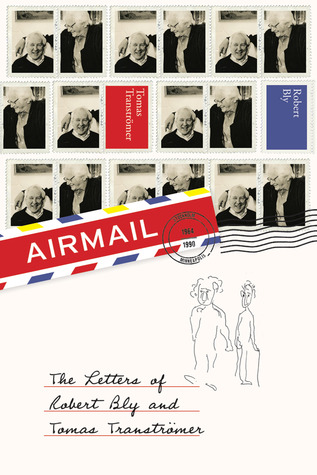 Airmail: The Letters of Robert Bly and Tomas Tranströmer was my first-ever Goodreads giveaway win. Way back in the summer of 2013, the good people of Graywolf Press spent a small fortune to send this tremendous book all the way from Minnesota to my tiny then-house on the outskirts of Reading, England. It took me an unconscionably long time first to pick it up, then to read it, and finally to review it. But here we are.
This is the first time I’d read a literary correspondence, and I absolutely loved it. I knew very little about either poet before picking this up, though I recognized Bly as the translator of the copy of Knut Hamsun’s Hunger I had read a few years back. The two first corresponded in 1964 when Tranströmer requested a copy of the poetry journal The Sixties from Bly’s small press. At this point Tranströmer was already an established poet in his native Sweden, but in decades to come Bly was responsible for making his reputation in English translation.
“Friendships have their rhythms and seasons, fat times and lean times,” editor Thomas R. Smith writes in his introduction. One of the pleasures of this book is watching a friendship develop, as salutations go from “Dear Mr. Tranströmer” and “Best wishes” to “Your friend” and “With deep fondness always.”
Their relationship was both professional and personal: they translated each other’s poems into their respective languages so discussed intricacies of meaning as well as publication details and reading tours, but they also visited each other and became ever deeper confidants through deaths in the family and Bly’s painful divorce. They also commiserate over the debacle of the Vietnam War (as a protestor Bly was once arrested alongside Dr. Spock and Allen Ginsberg) and the Nixon–Reagan affronts to liberalism.
These letters sparkle with humor, especially from Tranströmer, who paints a Micawber-ish picture of his impecunious family, initially supported through his day job as a psychologist at a boys’ prison. My impression of him was of an impish joker.
Our shortage of money is comical—toward the end of the month we go around and shake all our old clothes in the hope that a stray coin might fall out.
We drank some champagne, which makes you think very clearly—my head turned into an aquarium with goldfish who were mumbling sentences of Marcus Aurelius.
Bly’s a witty sort, too:
I’ll send you the most insulting review I’ve ever gotten—it’s wonderful, he objects to everything about me except the size of my shoes!
I carefully set aside these free days which are known as Introvert Days, and are to be spent in solitary anxious, obstinate, confused ectomorph brooding.
Forgive my new typewriter—its mother was frightened by a Latin manuscript, and it doesn’t believe in pauses…
You don’t have to have any interest in poetry to read this with enjoyment. In fact, I didn’t care for most of the poem extracts. In the 1960s and 70s, at least – the heyday for the letters – they both wrote free verse poems that alternate matter-of-fact observations with abstractions. Lacking in sound techniques, they struck me as flat and artless. They weren’t to my taste apart from this one stanza of Tranströmer’s that instantly jumped out to me:
Two truths approach each other. One comes from inside, the other from outside, and where they meet we have a chance to catch sight of ourselves. (from “Preludes”)
However, Bly, at least, became “positively form-mad” in his later years; “[I] now have to eat all my words praising free verse as the only food conceivable for true Christian folk,” he wrote in 1981. He even created his own form, the “ramage” of 85 syllables. Perhaps I’ll like their later work better – I’m game for trying a full collection from each of them.
For anyone interested in the nitty-gritty of translation, there are many fascinating passages here where the poets wrestle with vocabulary and nuances. “Poems are best when there are incredible mysteries in them,” Bly declares, and all the more difficult to retain that mystery as they passed back and forth between Swedish and English. “I think it was something unexplainable, something water-like or flowing in our approach to poetry that made our translations of each other full of feeling even with occasional mistakes,” Bly wrote to their Swedish editor.
These selected letters continue through 1990, when Tranströmer had a stroke and their correspondence inevitably declined. Tomas Tranströmer would go on to win the Nobel Prize in 2011 and died in March 2015. Robert Bly is still going at age 89 and has recently been the subject of a biopic. Stealing Sugar from the Castle, a volume of his new and selected poems, was published in 2013.
After this I’d be keen to try out more authors’ correspondence volumes. I love letters whether they appear in epistolary fiction or in nonfiction, and here they form a touching picture of a friendship that sustained their writers for decades. In 1978 Bly wrote: “Thank you for receiving my grief and my uncertainties and my shadowy complications without running out the door.” That’s the mark of a true friend.
With thanks to Graywolf Press for the free copy, won in a Goodreads giveaway.
My rating: 
The Novel Cure—Bibliotherapy in Action
A good book, read at the right moment, should leave you uplifted, inspired, energized and eager for more. With so many books to choose from, what’s the point of reading even one more that leaves you cold?
I’ve mentioned my interest in bibliotherapy before. Well, for anyone new to the concept or interested in finding out more, The Novel Cure by Ella Berthoud and Susan Elderkin, two of the bibliotherapists at London’s School of Life, is an accessible introduction. Subtitled “An A–Z of Literary Remedies,” this is a learned and at times tongue-in-cheek book of advice about what fiction to read if you’re suffering from any sort of malady – physical, psychological, or imagined.
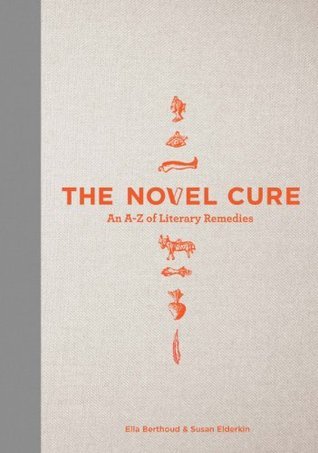 The alphabetical format and “see also” asides make it more like a cross-referenced encyclopedia than a book to read straight through, though I tried it both ways. Initially I flipped through at random, letting one entry take me to another related one and so on, but after a while I went back to the start and caught up on unread entries to finish within a year.
“It helps enormously at times of stress to read about other people who are going through similar things; watching how other people cope or fail to cope will make you feel less alone and give you strength,” the authors write to introduce the “cancer, caring for someone with” entry. I found this to be true when my sister lost her husband to cancer last year. She had never been a reader – apart from celebrity magazines – but in the past year she’s read nearly 90 books, many of them memoirs about illness and bereavement. Books are how I’ve always made sense of the world, so it’s been incredibly gratifying to see her turn to them as well. There are plenty of recommendations I’ll pass on to her from this book, especially “death of a loved one” (After You’d Gone by Maggie O’Farrell and Extremely Loud and Incredibly Close by Jonathan Safran Foer) and “widowed, being” (The Same Sea by Amos Oz and Major Pettigrew’s Last Stand by Helen Simonson).
You’ll be amazed at the range of conditions and circumstances for which the book offers prescriptions. Newly retired? “Bucolic and tranquil, The Enigma of Arrival [by V.S. Naipaul] will encourage you to take stock of your life and enjoy the unfolding of new possibilities.” Workaholic? “Immerse your desiccated soul in something very simple, very rustic, very small. We suggest [Thomas] Hardy’s gentlest, most innocent novel, Under the Greenwood Tree.” Two sections that felt particularly relevant to me as a vertically challenged freelancer were “short, being” and “tax return, fear of doing.” Meanwhile I’ll be pointing my husband to “baldness,” “flying, fear of,” “stress” and “tinnitus” (poor chap). But some of these entries surely resulted from the authors thinking “hey, here’s a great book we have to mention,” and then coming up with a category to fit it into, like “determinedly chasing after a woman even when she’s a nun” for In the Skin of a Lion by Michael Ondaatje.

I think I prefer this U.S. cover.
Indeed, there’s a certain levity to this book that I think some reviewers have missed. These aren’t all entirely serious suggestions, though they are all worthwhile books. I especially liked the sections where the authors incorporate pastiche of the book in question. A piece recommending Pamela by Samuel Richardson is in the form of an old-fashioned letter, for example, while “single, being” apes Bridget Jones’s diary entries. They even imitate certain authors’ prose style, as in “Who poses questions without question marks and observes the subtle changes in the light with exquisite brevity.” Answer: J.P. Donleavy, apparently.
The book is also a great source of top ten lists (I’m working through their novels for thirty-somethings) and advice for how to deal with reading crises (e.g. “busy to read, being too” and “giving up halfway through, tendency to”). My only criticism of the book – and this is one I level against many examples from the ‘books about books’ genre – is that there’s a fair bit of plot summary, sometimes so much so that it puts me off reading a book rather than whets my appetite for it.
It’s a bit belated (or early) for suggesting this as a Christmas gift for a book lover, but perhaps you can hand it over as a birthday gift or an anytime present – even to yourself. I got my copy on Amazon for £4, quite a bargain for a book I’ll be returning to again and again over the years.
My rating:
Do you agree that novels have the power to cure, or at least help with, problems?
My Favorite Nonfiction Reads of 2015
Without further ado, I present to you my 15 favorite non-fiction books read in 2015. I’m a memoir junkie so many of these fit under that broad heading, but I’ve dipped into other areas too. I give two favorites for each category, then count down my top 7 memoirs read this year.
Note: Only four of these were actually published in 2015; for the rest I’ve given the publication year. Many of them I’ve already previewed through the year, so – like I did yesterday for fiction – I’m limiting myself to two sentences per title: the first is a potted summary; the second tells you why you should read this book. (Links given to full reviews.)
Foodie Lit
 A Homemade Life: Stories and Recipes from My Kitchen Table by Molly Wizenberg (2009): Wizenberg reflects on the death of her father Burg from cancer, time spent living in Paris, building a new life in Seattle, starting her food blog, and meeting her husband through it. Each brief autobiographical essay is perfectly formed and followed by a relevant recipe, capturing precisely how food is tied up with memories.
 Comfort Me with Apples: More Adventures at the Table by Ruth Reichl (2001): Reichl traces the rise of American foodie culture in the 1970s–80s (Alice Waters and Wolfgang Puck) through her time as a food critic for the Los Angeles Times, also weaving in personal history – from a Berkeley co-op with her first husband to a home in the California hills with her second after affairs and a sticky divorce. Throughout she describes meals in mouth-watering detail, like this Thai dish: “The hot-pink soup was dotted with lacy green leaves of cilantro, like little bursts of breeze behind the heat. … I took another spoonful of soup and tasted citrus, as if lemons had once gone gliding through and left their ghosts behind.”
Nature Books
 Meadowland: The Private Life of an English Field by John Lewis-Stempel (2014): Lewis-Stempel is a proper third-generation Herefordshire farmer, but also a naturalist with a poet’s eye. Magical moments and lovely prose, as in “The dew, trapped in the webs of countless money spiders, has skeined the entire field in tiny silken pocket squares, gnomes’ handkerchiefs dropped in the sward.”
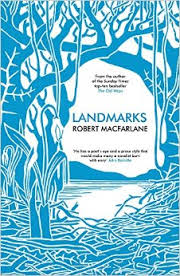 Landmarks by Robert Macfarlane: This new classic of nature writing zeroes in on the language we use to talk about our environment, both individual words – which Macfarlane celebrates in nine mini-glossaries alternating with the prose chapters – and the narratives we build around places, via discussions of the work of nature writers he admires. Whether poetic (“heavengravel,” Gerard Manley Hopkins’s term for hailstones), local and folksy (“wonty-tump,” a Herefordshire word for a molehill), or onomatopoeic (on Exmoor, “zwer” is the sound of partridges taking off), his vocabulary words are a treasure trove.
Theology Books
 Amazing Grace: A Vocabulary of Faith by Kathleen Norris (1998): In few-page essays, Norris gives theological words and phrases a rich, jargon-free backstory through anecdote, scripture and lived philosophy. This makes the shortlist of books I would hand to skeptics to show them there might be something to this Christianity nonsense after all.
 My Bright Abyss: Meditation of a Modern Believer by Christian Wiman (2013): Seven years into a cancer journey, Wiman, a poet, gives an intimate picture of faith and doubt as he has lived with them in the shadow of death. Nearly every page has a passage that cuts right to the quick of what it means to be human and in interaction with other people and the divine.
General Nonfiction
 Penelope Fitzgerald: A Life by Hermione Lee (2013): Although Penelope Fitzgerald always guarded literary ambitions, she was not able to pursue her writing wholeheartedly until she had reared three children and nursed her hapless husband through his last illness. This is a thorough and sympathetic appreciation of an underrated author, and another marvellously detailed biography from Lee.
 Being Mortal: Medicine and What Matters in the End by Atul Gawande (2014): A surgeon’s essential guide to decision-making about end-of-life care, but also a more philosophical treatment of the question of what makes life worth living: When should we extend life, and when should we concentrate more on the quality of our remaining days than their quantity? The title condition applies to all, so this is a book everyone should read.
Memoirs
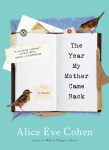 The Year My Mother Came Back by Alice Eve Cohen: Wry and heartfelt, this is a wonderful memoir about motherhood in all its variations and complexities; the magic realism (Cohen’s dead mother keeps showing up) is an added delight. I recommend this no matter what sort of relationship, past or present, you have with your mother, especially if you’re also a fan of Anne Lamott and Abigail Thomas.
- The Art of Memoir
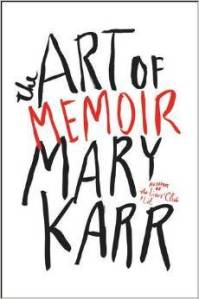 by Mary Karr: There is a wealth of practical advice here, on topics such as choosing the right carnal details (not sexual – or not only sexual – but physicality generally), correcting facts and misconceptions, figuring out a structure, and settling on your voice. Karr has been teaching (and writing) memoirs at Syracuse University for years now, so she’s thought deeply about what makes them work, and sets her theories out clearly for readers at any level of familiarity.
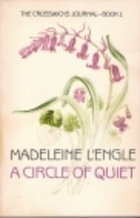 A Circle of Quiet by Madeleine L’Engle (1971): In this account of a summer spent at her family’s Connecticut farmhouse, L’Engle muses on theology, purpose, children’s education, the writing life, the difference between creating stories for children and adults, neighbors and fitting into a community, and much besides. If, like me, you only knew L’Engle through her Wrinkle in Time children’s series, this journal should come as a revelation.
-
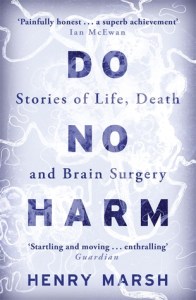 Do No Harm: Stories of Life, Death and Brain Surgery by Henry Marsh (2014): “Terrible job, neurosurgery. Don’t do it.” – luckily for us, Henry Marsh reports back from the frontlines of brain surgery so we don’t have to. In my favorite passages, Marsh reflects on the mind-blowing fact that the few pounds of tissue stored in our heads could be the site of our consciousness, our creativity, our personhood – everything we traditionally count as the soul.
 I Hate to Leave This Beautiful Place by Howard Norman (2013): Norman has quickly become one of my favorite writers. You wouldn’t think these disparate autobiographical essays would fit together as a whole, given that they range in subject from Inuit folktales and birdwatching to a murder–suicide committed in Norman’s Washington, D.C. home and a girlfriend’s death in a plane crash, but somehow they do; after all, “A whole world of impudent detours, unbridled perplexities, degrading sorrow, and exacting joys can befall a person in a single season, not to mention a lifetime.”
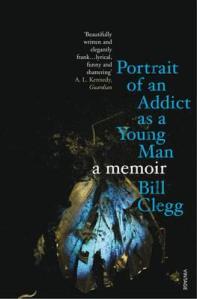 Portrait of an Addict as a Young Man by Bill Clegg (2010): Through this book I followed literary agent Bill Clegg on dozens of taxi rides between generic hotel rooms and bar toilets and New York City offices and apartments; together we smoked innumerable crack pipes and guzzled dozens of bottles of vodka while letting partners and family members down and spiraling further down into paranoia and squalor. He achieves a perfect balance between his feelings at the time – being out of control and utterly enslaved to his next hit – and the hindsight that allows him to see what a pathetic figure he was becoming.
And my overall favorite nonfiction book of the year:
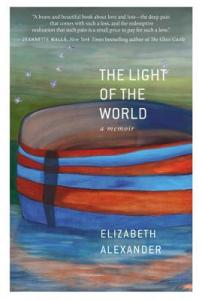 1. The Light of the World by Elizabeth Alexander: In short vignettes, beginning afresh with every chapter, Alexander conjures up the life she lived with – and after the sudden death of – her husband Ficre Ghebreyesus, an Eritrean chef and painter. This book is the most wonderful love letter you could imagine, and no less beautiful for its bittersweet nature.
What were some of your best nonfiction reads of the year?
Review: Seal Morning by Rowena Farre
Here’s an obscure nature classic for animal lovers who can’t get enough of Gerald Durrell and James Herriot. It was a bestseller and a critical success when first published in 1957, and the fact that it has been reprinted several times in the new millennium is testament to its enduring appeal. It’s the account of seven years Farre spent living in a primitive Scottish croft (no electricity or running water) with her Aunt Miriam, starting at age 10. Despite an abrupt beginning, a dearth of dialogue and slightly rushed storytelling, I found this very enjoyable.
 Like the young Durrell, Farre kept a menagerie of wild and half-domesticated animals, including Cuthbert and Sara the gray squirrels, Rodney the rat, Hansel and Gretel the otters, and – the star of this memoir – Lora, a common seal pup. Other pets came and went, like an ill-tempered roe deer fawn, a family of song thrushes, and a pair of fierce wild cat kittens. Early chapters about the struggle to keep all these ravenous creatures fed and wrangled are full of humorous mishaps, like Cuthbert falling down a chimney into the porridge.
Farre acquired Lora on a trip to Lewis. Like dogs, seal pups are very loyal and attached. Farre fed Lora a bottle on her lap and let her sleep at the foot of the bed. Lora was also strikingly intelligent: she recognized 35 words, collected the mail from the postman, unpacked groceries and had an aptitude for music, including playing the mouth organ and xylophone and ‘singing’ along to piano accompaniment. She and the otters, along with Ben the dog, loved to frolic in the water and slide down snowy hills in the winter.
Besides capturing animal antics, what Farre does best in this book is to evoke the extreme isolation of their living situation. Aunt Miriam had saved up £75 a year for them to live off, but also painted designs on wooden bowls for extra cash. The regular summer routine of storing up food was not about passing the time but survival. Near-catastrophes, like getting lost in a mountain mist or the goats raiding Lora’s food supply, showed how precarious life could be. There was little to do on winter days, and only five or six hours of daylight anyway;
“Another hour in the croft and I would have had a nervous breakdown,” said Aunt Miriam. Life up here got you like that sometimes.
Really there are very few adults these days who possess the mental and emotional self-sufficiency necessary for leading satisfactory existences in these remote parts.
A life with animals is bound to involve some sadness. One pet gets picked off by a peregrine; another is injured in a trap and has to be put down. Ben’s fate is particularly sad. Lora’s, by contrast, is just mysterious: after seven years at the croft, she simply disappeared. Farre never learned what became of her.
At age 17, Farre had to decide how to make her own way in life. She took solo camping trips to contemplate her future, doing some informal seal research on Shetland and Iceland. Especially after Aunt Miriam met a Canadian man on an extended trip to visit friends in Berkshire and got engaged, it was clear that their crofting life together was soon to end. Farre hints at what happened next for her: she would go on to travel with British gypsies and journey to the Himalayas, subjects for two further autobiographies. The book ends on a melancholy note as Farre returns to the croft five years later and finds it no better than a ruin.
Farre died relatively young, aged 57 in 1979. Alas, an afterword by Maurice Fleming introduces an element of doubt about the writer and the strict veracity of her memoir. For one thing, Rowena Farre wasn’t her real name. “Piecing Daphne Lois Macready’s life together is like laying out a jigsaw from which some bits are missing and others faded,” Fleming writes. We know she was born in India to an Army officer and the family moved around the Far East for a number of years. However, Farre does not account for her formal schooling, and no evidence of the croft has ever been found. In other words, we don’t know how much is true.
Does this matter? It doesn’t detract from my enjoyment of this lively animal-themed memoir (after all, Herriot also did plenty of fictionalizing), but it does make me wonder whether some of Lora’s feats might be made up. Are seals really as intelligent and personable as she makes them out to be? I was left feeling slightly uneasy, and wanting to do more research about both Farre and seals to figure out what’s what. Still, this is a wonderfully cozy read to pick up by a fire this autumn or winter.
With thanks to the publisher, Birlinn, for the free copy.
My rating: 
 Bookish Beck = Rebecca Foster. American transplant to England. Freelance proofreader and book reviewer.
 Bookish Beck