Phantom Gang by Ciarán O’Rourke: Dylan Thomas Prize Blog Tour
As part of the 2023 Dylan Thomas Prize blog celebration, I’m featuring the second collection by Irish poet Ciarán O’Rourke, Phantom Gang (2022).

There is an elegiac cast to much of this, with scenes that evoke historical warfare from the American West through the Second World War Resistance to Afghanistan. The title line references the discovery of the victims of an ancient raid. Even the love poems and descriptions of the natural world are more redolent of desperation and decline than they are celebratory. “Book of Salt,” in the tradition of Catullus, is the longest poem in the book and voices unrequited longing. Its short lines and end rhymes are in service of a passion mixed with hatred. There are lovely descriptions of curlew and starlings, but also mourning for the loss of the corncrake.

A favourite passage of mine was from “Portrait in Red and Black”:
Only the goldfinch
feels alive –
a skeet of colour,
stout as a cloud,
his knuckle and plunge
of plumage stark
against the slipping boughs.
I watch him thrum
and pluck terrifically,
marshalling the morning
with my heart in his mouth.
That excerpt is representative in that most of the poems are composed of two- or three-line stanzas, with assonance, alliteration and internal rhymes more common techniques than end rhymes. Although there are some mentions of recent figures – James Dyson, Elon Musk, Donald Trump – the collection as a whole feels inclined towards the past, with Bertolt Brecht and John Clare as stars. It’s austere, refined work, rooted yet ranging in both time and place.
More favourite lines:
“History”
Our one sick world spins on –
returningly, and slow
and with birds
the rising days begin,
the rage and ache
we call the spring,
a word for what
the carnage reckoned –
and still the birds returning.
~from “The Tree”
(My thanks to The Irish Pages Press and Midas PR for the free copy for review.)
I’ve reviewed Dylan Thomas Prize-longlisted poetry in several previous years as well:
- Eye Level by Jenny Xie
- If All the World and Love Were Young by Stephen Sexton
- Auguries of a Minor God by Nidhi Zak/Aria Eipe
For a reminder of the full longlist, see my post from last month. I’ve read 3.5 books from it now and would be delighted to see Nell Stevens’ debut novel (my review) make the shortlist. This will be announced on 23 March, with the winner on 11 May.
Happy St Patrick’s Day – this is also my token contribution to Reading Ireland Month!

Young Writer of the Year Award Shortlist: Larger than an Orange by Lucy Burns
Looking back, being on the 2017 shadow panel for the Sunday Times Young Writer of the Year Award was still one of the best things I’ve achieved in my time as a book blogger. Each year I eagerly look out for this award’s shortlist to see how many titles I’ve read and who I think the judges will choose as the winner. For a couple years the prize has had a higher cash fund thanks to sponsorship from the Charlotte Aitken Trust, and is now, like the McKitterick Prize that I’ve judged the past two years, administered by the Society of Authors.

This year’s four nominees include two novels and two nonfiction works: Oxblood by Tom Benn is said to be a “poignantly rendered exploration of domesticity and violence” and Maddie Mortimer’s Maps of our Spectacular Bodies, which won the Desmond Elliott Prize and was longlisted for the Booker Prize, is a “lyrical and captivating look at mortality, desire and forgiveness”; Lucy Burns’s debut memoir is an examination of abortion through the prism of her personal experience; and Katherine Rundell’s Super-Infinite (winner of the Baillie Gifford Prize for Non-Fiction) is a biography of John Donne.
I was intrigued by the premise (narration by a young woman – and her cancer) of the Mortimer when it was longlisted for the Booker so bought a sale copy with a Christmas voucher, but the style and over-400-page length has been defeating me. I might try again, but for a debut author’s experimental work I think 200 pages would have been sufficient. I’m not keen to try the Benn, but would gladly read the Rundell from the library another time. The final book is one I requested as a review copy.
Larger Than an Orange by Lucy Burns (2021)
I’ve only read one other memoir of an abortion (as opposed to a memoir in which an abortion is simply one event of many), Happening by Annie Ernaux, so it was perhaps inevitable for me to get similar vibes from the two works. Both are fragmentary, spare; matter of fact in tone to avoid melodramatic extremes of emotion. The difference, of course, is that in the 1960s abortion was illegal in France and so ending a pregnancy required clandestine action. However, even in 2017, when the then 26-year-old Burns had a medical abortion in England, where it had been legal for 50 years, she found that the process was invasive and officious. She presents the experience as infantilizing – not trusting the patient, and lacking in compassion. And although it was the only practical choice for her at the time and she remains firmly committed to women’s right to an abortion, it sparked feelings of guilt, shame and depression that lingered and affected her work and personal life. At counselling appointments she expressed disgust at herself, and she became obsessed with looking up American pro-life propaganda and testimonials from former abortion clinic workers online.
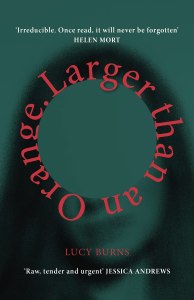 The book is, collage-like, assembled from pieces – sometimes as little as one paragraph or one line to a page – of dated autobiographical material, going back and forth between the summer of the abortion and the few-year aftermath as she suffers with irregular bleeding, chooses a new contraceptive method and has a short-term relationship; transcripts of radio debates; alphabetical lists of predicted search terms and so on. She even requests her medical records, including sections from it plus ultrasound images, and marks her baby’s would-be birthday.
I could imagine this working very well as a play for voices, especially because Burns is in the habit of counting each person she tells about the abortion and referring to them by their number until, at fifty-something, she gives up. Friends, receptionists, the people at work who adjudicate her petition to be granted two weeks’ leave: there are those she tells willingly and those she feels duty-bound to inform to explain her health or behaviour. Some remain a part of her life and others, awkward or judgemental, fade out of it.
This is a powerful read I can’t say I necessarily enjoyed, but did admire for its uncompromising clarity and honesty, and its willingness to probe both sides of ethical issues in a way that ‘good feminists’ might think they cannot.
With thanks to FMcM Associates and Chatto & Windus for the free copy for review.
Tomorrow we’ll hear the Young Writer of the Year results. My feeling is that Katherine Rundell, though already a prize winner for this book and an established author due to her children’s oeuvre, will win for Super-Infinite.
Have you read anything from this year’s shortlist?
Bill Bryson’s Notes from a Small Island: Reread and Stage Production
Bill Bryson, an American author of humorous travel and popular history or science books, is considered a national treasure in his adopted Great Britain. He is a particular favourite of my husband and in-laws, who got me into his work back in the early to mid-2000s. As I, too, was falling in love with the country, I found much to relate to in his travel-based memoirs of expatriate life and temporary returns to the USA. Sometimes it takes an outsider’s perspective to see things clearly.

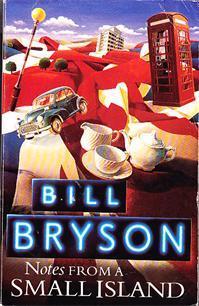 When we heard that Notes from a Small Island (1995), his account of a valedictory tour around Britain before returning to live in the States for the first time in 20 years, had been adapted into a play by Tim Whitnall and would be performed at our local theatre, the Watermill, we thought, huh, it never would have occurred to us to put this particular book on stage. Would it work? we wondered. The answer is yes and no, but it was entertaining and we were glad that we went. We presented tickets as my in-laws’ Christmas present and accompanied them to a mid-February matinee before supper at ours.
A few members of my book club decided to see the show later in the run and suggested we read – or reread, as was the case for several of us – the book in March. I started my reread before attending the play and had gotten through the first 50 pages, which is mostly about his first visit to England in 1973 (including a stay in a Dover boarding-house presided over by the infamously officious “Mrs Smegma”). This was ideal as the first bit contains the funniest stuff and, with the addition of some autobiographical material from later in the book plus his 2006 memoir The Life and Times of the Thunderbolt Kid, made up the entirety of the first act.

Photos are screenshots from the Watermill website.
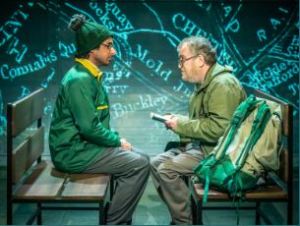
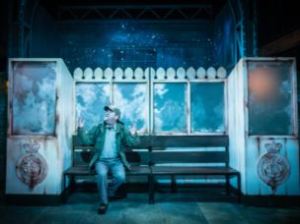
Bryson traveled almost exclusively by public transport, so the set had the brick and steel walls of a generic terminal, and a bus shelter and benches were brought into service as the furnishing for most scenes. The problem with frontloading the play with hilarious scenes is that the second act, like the book itself on this reread, became rather a slog of random stops, acerbic observations, finding somewhere to stay and something to eat (often curry), and then doing it all over again.
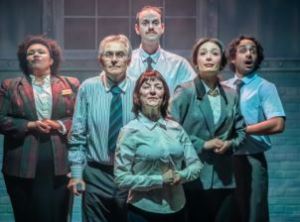
Mark Hadfield, in the starring role, had the unenviable role of carrying the action and remembering great swathes of text lifted directly from the book. That’s all well and good as a strategy for giving a flavour of the writing style, but the language needed to be simplified; the poor man couldn’t cope and kept fluffing his lines. There were attempts to ease the burden: sections were read out by other characters in the form of announcements, letters or postcards; some reflections were played as if from Bryson’s Dictaphone. It was best, though, when there were scenes rather than monologues against a projected map, because there was an excellent ensemble cast of six who took on the various bit parts and these were often key occasions for humour: hotel-keepers, train-spotters, unintelligible accents in a Glasgow pub.

The trajectory was vaguely southeast to northwest – as far as John O’Groats, then back home to the Yorkshire Dales – but the actual route was erratic, based on whimsy as much as the availability of trains and buses. Bryson sings the praises of places like Salisbury and Durham and the pinnacles of coastal walks, and slates others, including some cities, seaside resorts and tourist traps. Places of personal significance make it onto his itinerary, such as the former mental asylum at Virginia Water, Surrey where he worked and met his wife in the 1970s. (My husband and I lived across the street from it for a year and a half.) He’s grumpy about having to pay admission fees that in today’s money sound minimal – £2.80 for Stonehenge!
 The main interest for me in both book and play was the layers of recent history: the nostalgia for the old-fashioned country he discovered at a pivotal time in his own young life in the 1970s; the disappointments but still overall optimism of the 1990s; and the hindsight the reader or viewer brings to the material today. At a time when workers of every type seem to be on strike, it was poignant to read about the protests against Margaret Thatcher and the protracted printers’ strike of the 1980s.
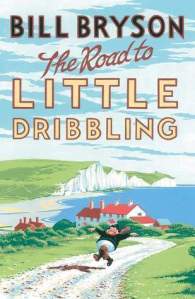 The central message of the book, that Britain has an amazing heritage that it doesn’t adequately appreciate and is rapidly losing to homogenization, still holds. Yet I’m not sure the points about the at-heart goodness and politeness of the happy-with-their-lot British remain true. Is it just me or have general entitlement, frustration, rage and nastiness taken over? Not as notable as in the USA, but social divisions and the polarization of opinions are getting worse here, too. One can’t help but wonder what the picture would have been post-Brexit as well. Bryson wrote a sort-of sequel in 2015, The Road to Little Dribbling, in which the sarcasm and curmudgeonly persona override the warmth and affection of the earlier book.
Indeed, my book club noted that a lot of the jokes were things he couldn’t get away with saying today, and the theatre issued a content warning: “This production includes the use of very strong language, language reflective of historical attitudes around Mental Health, reference to drug use, sexual references, mention of suicide, flashing lights, pyrotechnics, loud sound effect explosions, and haze. This production is most suitable for those aged 12+.”
So, yes, an amusing journey, but a bittersweet one to revisit, and an odd choice for the stage.
A favourite line I’ll leave you with: “To this day, I remain impressed by the ability of Britons of all ages and social backgrounds to get genuinely excited by the prospect of a hot beverage.”
Book:
Original rating (c. 2004): 
My rating now: 
Play:
Have you read anything by Bill Bryson? Are you a fan?
Literary Wives Club: His Only Wife by Peace Adzo Medie
(My fourth read with the Literary Wives online book club; see also Kay’s review and Naomi’s review.)
{SPOILERS IN THIS ONE}
Peace Adzo Medie’s 2020 debut novel was the first disappointment I’ve had from Reese Witherspoon’s book club. The Kirkus review excerpt inside the paperback’s front cover should have given me an idea of what to expect: “A Cinderella story set in Ghana … A Crazy Rich Asians for West Africa.” While both slightly reductive, those comparisons do give some sense of the book’s tone and superficiality.
Afi Tekple is a seamstress whose family arranges for her to marry Elikem Ganyo, a rich international businessman who has properties all over Ghana. In a neat bit of symmetry, I read a novel earlier this year that opened with a traditional Ghanaian divorce ceremony where the husband was in absentia (What Napoleon Could Not Do); this opens with a traditional wedding ceremony where, again, the groom isn’t there. The giving of schnapps as part of a dowry is a customary element of both.
The first half of the novel was agonizingly slow. Afi and her mother do little but sit in an opulent Accra flat, waiting for Eli to grace them with his presence. When he does appear, what luck! (eye roll) he and Afi have a magical sexual connection, described in romance novel language. But he’s only there part time, dividing his attentions between households. Afi enrols in fashion school, cooks and keeps house for Eli, and falls pregnant with his son, Selorm. (In another instance of poor pacing, we then jump to a year after the birth.) It should be a perfect life, yet she’s not happy because there is a rival for her husband’s affections.

You see, Eli’s family chose Afi in the hope that she’d get him to give up the Liberian woman who gave birth to his sickly daughter. They despise Muna for her independent spirit and transgressive behaviour. Although Afi knew about Muna, she doesn’t realize the extent to which she was the Ganyos’ pawn until late on. Meanwhile, Afi has gone from a timid country girl to a confident, high-class boutique owner accustomed to modern conveniences. She won’t ignore her longing to move into Eli’s house and get their marriage legally recognized. She issues an ultimatum: either she’s the only, official wife or she’s out of there.
I kept expecting a showdown between Afi and Muna; then, the further I got, the more I feared Muna wouldn’t appear at all. She does have a scene, 20 pages from the end, and instantly takes on more contours than the evil stereotype the Ganyos have spread, yet it doesn’t change Afi’s jealousy and determination to live independently. I hoped for more of a message of understanding and sisterhood. Initially, the arranged marriage plot reminded me of a particular Chimamanda Ngozi Adichie short story, but Afi’s narration was only so-so and there were more grammar and vocabulary errors than I’m used to encountering in conventionally published work. This might appeal to readers of Ayobami Adebayo’s Stay with Me. (Public library) 
The main question we ask about the books we read for Literary Wives is:
What does this book say about wives or about the experience of being a wife?
My main takeaway from His Only Wife is that a marriage doesn’t work if there’s someone interfering – and that refers to Afi’s mother-in-law probably more so than it does to Muna.
Eli just wants to have his cake and eat it. He thinks he should be free to accumulate as many cars and houses and women as he wants. He never intended to leave that woman and you all knew it … I want him to be mine only. Is that too much to ask? I’m sorry that I’m not like other wives who are able to happily share their husbands with co-wives and mistresses and girlfriends. That’s just not me. I’m not built like that.
I was a little uncomfortable that Medie presents legal marriage and monogamy as the only viable option, with Afi coming to disparage the village ceremony she had and wanting the fairy tale proposal in Paris and church wedding instead. Polygamy has a long tradition in countries including Ghana and Nigeria; it might have been interesting for Medie to explore contrasting attitudes toward it. Instead, this feels like pandering to Western tastes.
Next book: The Harpy by Megan Hunter in June
All My Wild Mothers by Victoria Bennett & I Have Some Questions for You by Rebecca Makkai
I’m catching up with reviews of two February releases that I spent the whole of last month submerged in. These are early entries on my Best of 2023 list: A lovely memoir about grief and gardening, caring for an ill child and a dying parent; and a riveting true crime-inspired novel, set on a boarding school campus, that rages at injustice and violence against women.
All My Wild Mothers: Motherhood, loss and an apothecary garden by Victoria Bennett
Early in February, I attended the online book launch via Sam Read Bookseller in Grasmere. With conversation, readings and song, it was the ideal introduction to the themes of this debut memoir by a poet. The book is composed of dozens of brief autobiographical, present-tense essays, each titled after a wildflower with traditional healing properties. The chapters are headed by a black-and-white woodcut of each plant (by Bennett’s husband, Adam Clarke) and a précis of its medicinal uses, as well as where it is found. Again and again, these descriptions site the flora on edgelands or “disturbed ground” – the perfect metaphorical tie-in to Bennett’s tumultuous life and the comfort that creating an apothecary garden brought.
Bennett is the youngest of six children. When she was expecting her son – much longed for after multiple pregnancy losses – news came that her eldest sister had died in a canoeing accident. At age two, her son was diagnosed with type 1 diabetes; managing his condition has imposed a heavy emotional burden. And years later, she was the primary caregiver for her elderly mother as she was dying of mesothelioma. The memoir’s format – which arose in part because it was written over the course of 10 years, during stolen moments – realistically presents bereavement and caring as ongoing, cyclical challenges rather than one-time events.

There are no simple solutions offered here, nothing so pat as that ‘gardening heals all hurts’, but Bennett writes into the broken places and finds joy in what comes to life spontaneously in nature or in her ramshackle yard on a social housing estate in Cumbria. She recalls a horse chestnut tree that looked over her outside the window of her childhood home; she and her son take impish delight in guerrilla gardening and sometimes disastrous cooking projects with foraged fruit. Some of my favourite individual vignettes were “Elder,” about the magic and medicine of making elderberry syrup from the few village trees that escape the chainsaw; “Dandelion,” about her trio of older sisters, who were Greenham Common protestors and always tried to protect her as well as nature; “Herb Robert,” about her sister-in-law’s funeral; and especially “Honeysuckle,” about a local agricultural show where the officious organizers make them feel like interlopers yet her son wins first place for their feral, fecund garden.
Many side topics twine into the narrative as well: a difficult relationship with a controlling mother; a family history that takes in boarding schools, cults, road trips, risk taking and mental health issues; the economic disparity that leads to one set of rules for the rich and another for those on benefits. But the core of the book is a tender mother–son relationship. “I can give him this: a seed, with all its defiant hope against the dark; and the memory that once, we grew a garden out of rock, and waste, and all things broken, and it thrived.” Sitting somewhere between creative nonfiction and nature essays, it’s a beautiful read for any fan of women’s life writing, especially if you share the interests in grief or gardening. I hope we’ll see it recognized on the Barbellion and Wainwright Prize shortlists alike.
Readalikes I have reviewed: A Still Life by Josie George, The Book of Difficult Fruit by Kate Lebo, The Cure for Sleep by Tanya Shadrick
With thanks to Victoria Bennett and Two Roads for the free copy for review.
I Have Some Questions for You by Rebecca Makkai
I’m a big fan of Makkai’s first two novels, The Borrower and The Hundred-Year House, and have her other two books lined up to read, so I was excited to hear about this new work and put it on my Most Anticipated list for the year. My interest was redoubled by Laura’s review, which likens it to a cross between Prep and My Dark Vanessa – irresistible.
Bodie Kane grew up in a deprived and dysfunctional family in Indiana, and has beneficent Mormon neighbours to thank for the tuition money that allowed her to attend Granby, an exclusive New Hampshire boarding school, in the early to mid-1990s. She was an angry and awkward high school student, yet her memories of Granby and the friendships she made there are still an emotional mainstay more than two decades later. In 2018, she is a successful film professor with a podcast about Hollywood starlets. Although she is separated from Jerome, her artist husband, he lives next door and they co-parent their two children.
After an invitation comes from Granby to teach a two-week course on podcasting, Bodie trades Los Angeles for a bitter New England winter. It’s the perfect excuse to indulge her obsession with the 1995 murder of her former Granby roommate, Thalia Keith, who was found dead in the swimming pool one March morning after a play performance. Bodie has never been comfortable with the flawed case against the Black athletics coach, Omar Evans, who has been imprisoned ever since. When one of her students chooses to make Thalia’s murder the subject of a podcast, it’s all the justification Bodie needs to dive deep into her pet hypothesis: Thalia was sleeping with the music director, Denny Bloch, and he was involved in her death in some way. Her blinkered view threatens to exclude a key explanation. Still, the informal sleuthing she and her students do is enough to warrant a follow-up hearing in 2022, but they – and Omar – are up against a broken system.

Makkai has taken her cues from the true crime genre and constructed a convincing mesh of evidence and theories. There’s a large cast of secondary characters, from Dorian, the bully who once humiliated Bodie with sexual slurs, to Fran, the faculty kid/gay best friend who now lives and works on campus herself and continues to be Bodie’s trusty backup. The combinations of background + teenage behaviour + 40-something lives all feel authentic in their randomness (when I saw that Makkai sourced 24 names from indie bookstore supporters, I realized afresh just how real, as opposed to ‘made-up’, these characters feel).
At times I wondered if there was too much detail on the case and the former classmates; I might even have streamlined the novel by doing away with the 2022 section altogether, though it ends up being crucial to the plot. But Makkai has so carefully crafted these pen portraits, and so intimately involved us in Bodie’s psyche, that it’s easy to become invested in the story. What’s more, the novel introduces a seam of rage about violence towards women – so predictably excused and allowed to recur by a justice system weighted against victims –
What’s as perfect as a girl stopped dead, midformation? Girl as blank slate. Girl as reflection of your desires, unmarred by her own. Girl as sacrifice to the idea of girl.
let’s say it was the one where the rugby team covered up the girl’s death and the school covered for the rugby team. Actually it was the one where the therapist spent years grooming her. It was the one where the senator, then a promising teenager, shoved his d*ck in the girl’s face. … It was the one where her body was never found. It was the one where her body was found in the snow. It was the one where he left her body for dead under the tarp.
– yet also finds nuance in the situation when Bodie’s ex-husband is subjected to exaggerated #MeToo accusations. It’s timely, daring, intelligent, enthralling storytelling. Susan (review here) and I are both hoping to see this make the Women’s Prize longlist next week.
Readalikes I have reviewed: Ghost Wall by Sarah Moss, My Dark Vanessa by Kate Elizabeth Russell, The Bass Rock by Evie Wyld
With thanks to Fleet for the proof copy for review.
What are the best 2023 books you’ve read so far?
February Releases by Nick Acheson, Charlotte Eichler and Nona Fernández (#ReadIndies)
Three final selections for Read Indies. I’m pleased to have featured 16 books from independent publishers this month. And how’s this for neat symmetry? I started the month with Chase of the Wild Goose and finish with a literal wild goose chase as Nick Acheson tracks down Norfolk’s flocks in the lockdown winter of 2020–21. Also appearing today are nature- and travel-filled poems and a hybrid memoir about Chilean and family history.

The Meaning of Geese: A thousand miles in search of home by Nick Acheson
I saw Nick Acheson speak at New Networks for Nature 2021 as the ‘anti-’ voice in a debate on ecotourism. He was a wildlife guide in South America and Africa for more than a decade before, waking up to the enormity of the climate crisis, he vowed never to fly again. Now he mostly stays close to home in North Norfolk, where he grew up and where generations of his family have lived and farmed, working for Norfolk Wildlife Trust and appreciating the flora and fauna on his doorstep.
 This was indeed to be a low-carbon initiative, undertaken on his mother’s 40-year-old red bicycle and spanning September 2021 to the start of the following spring. Whether on his own or with friends and experts, and in fair weather or foul, he became obsessed with spending as much time observing geese as he could – even six hours at a stretch. Pink-footed geese descend on the Holkham Estate in their thousands, but there were smaller flocks and rarer types as well: from Canada and greylag to white-fronted and snow geese. He also found perspective (historical, ethical and geographical) by way of Peter Scott’s conservation efforts, chats with hunters, and insight from the Icelandic researchers who watch the geese later in the year, after they leave the UK. The germane context is woven into a month-by-month diary.
The Covid-19 lockdowns spawned a number of nature books in the UK – for instance, I’ve also read Goshawk Summer by James Aldred, Birdsong in a Time of Silence by Steven Lovatt, The Consolation of Nature by Michael McCarthy, Jeremy Mynott and Peter Marren, and Skylarks with Rosie by Stephen Moss – and although the pandemic is not a major element here, one does get a sense of how Acheson struggled with isolation as well as the normal winter blues and found comfort and purpose in birdwatching.
Tundra bean, taiga bean, brent … I don’t think I’ve seen any of these species – not even pinkfeet, to my recollection – so wished for black-and-white drawings or colour photographs in the book. That’s not to say that Acheson is not successful at painting word pictures of geese; his rich descriptions, full of food-related and sartorial metaphors, are proof of how much he revels in the company of birds. But I suspect this is a book more for birders than for casual nature-watchers like myself. I would have welcomed more autobiographical material, and Wintering by Stephen Rutt seems the more suitable geese book for laymen. Still, I admire Acheson’s fervour: “I watch birds not to add them to a list of species seen; nor to sneer at birds which are not truly wild. I watch them because they are magnificent”.
With thanks to Chelsea Green Publishing for the free copy for review.
Swimming Between Islands by Charlotte Eichler
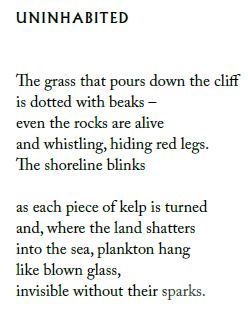
 Eichler’s debut collection was inspired by various trips to cold and remote places, such as to Lofoten 10 years ago, as she explains in a blog post on the Carcanet website. (The cover image is her painting Nusfjord.) British and Scandinavian islands and their wildlife provide much of the imagery and atmosphere. You can sink into the moss and fog, lulled by alliteration. A glance at some of the poem titles reveals the breadth of her gaze: “Brimstones” – “A Pheasant” (a perfect description in just two lines) – “A Meditation of Small Frogs” – “Trapping Moths with My Father.” There are also historical vignettes and pen portraits. The scenes of childhood, as in the four-part “What Little Girls Are Made Of,” evoke the freedom of curiosity about the natural world and feel autobiographical yet universal.
With thanks to Carcanet Press for the free copy for review.
Voyager: Constellations of Memory—A Memoir by Nona Fernández (2019; 2023)
[Translated from the Spanish by Natasha Wimmer]
Our archive of memories is the closest thing we have to a record of identity. … Disjointed fragments, a pile of mirror shards, a heap of the past. The accumulation is what we’re made of.
 When Fernández’s elderly mother started fainting and struggling with recall, it prompted the Chilean actress and writer to embark on an inquiry into memory. Astronomy provides the symbolic language here, with memory a constellation and gaps as black holes. But the stars also play a literal role. Fernández was part of an Amnesty International campaign to rename a constellation in honour of the 26 people “disappeared” in Chile’s Atacama Desert in 1973. She meets the widow of one of the victims, wondering what he might have been like as an older man as she helps to plan the star ceremony. This oblique and imaginative narrative ties together brain evolution, a medieval astronomer executed for heresy, Pinochet administration collaborators, her son’s birth, and her mother’s surprise 80th birthday party. NASA’s Voyager probes, launched in 1977, were intended as time capsules capturing something of human life at the time. The author imagines her brief memoir doing the same: “A book is a space-time capsule. It freezes the present and launches it into tomorrow as a message.”
With thanks to Daunt Books for the free copy for review.
#ReadIndies and Review Catch-up: Hazrat, Nettel, Peacock, Seldon
Another four selections for Read Indies month. I’m particularly pleased that two from this latest batch are “just because” books that I picked up off my shelves; another two are catch-up review copies. A few more indie titles will appear in my February roundup on Tuesday. For today, I have a fun variety: a history of the exclamation point, a Mexican novel about choosing motherhood versus being childfree, a memoir of a decades-long friendship between two poets, and a posthumous poetry collection with themes of history, illness and nature.
An Admirable Point: A brief history of the exclamation mark by Florence Hazrat (2022)
I’m definitely a punctuation geek. (My favourite punctuation mark is the semicolon, and there’s a book about it, too: Semicolon: The Past, Present, and Future of a Misunderstood Mark by Cecelia Watson, which I have on my Kindle.) One might think that strings of exclamation points are a pretty new thing – rounding off phrases in (ex-)presidential tweets, for instance – but, in fact, Hazrat opens with a Boston Gazette headline from 1788 that decried “CORRUPTION AND BRIBERY!!!” in relation to the adoption of the new Constitution.
 The exclamation mark as we know it has been around since 1399, and by the 16th century its use for expression and emphasis had been codified. I was reminded of Gretchen McCulloch’s discussion of emoji in Because Internet, which also considers how written speech signifies tone, especially in the digital age. There have been various proposals for other “intonation points” over the centuries, but the question mark and exclamation mark are the two that have stuck. (Though I’m currently listening to an album called interrobang – ‽, that is. Invented by Martin Speckter in 1962; recorded by Switchfoot in 2021.)
I most enjoyed Chapter 3, on punctuation in literature. Jane Austen’s original manuscripts, replete with dashes, ampersands and exclamation points, were tidied up considerably before they made it into book form. She’s literature’s third most liberal user of exclamation marks, in terms of the number per 100,000 words, according to a chart Ben Blatt drew up in 2017, topped only by Tom Wolfe and James Joyce.
There are also sections on the use of exclamation points in propaganda and political campaigns – in conjunction with fonts, which brought to mind Simon Garfield’s Just My Type and the graphic novel ABC of Typography. It might seem to have a niche subject, but at just over 150 pages this is a cheery and diverting read for word nerds.
With thanks to Profile Books for the proof copy for review.
Still Born by Guadalupe Nettel (2020; 2022)
[Translated from the Spanish by Rosalind Harvey]
This was the Mexican author’s fourth novel; she’s also a magazine director and has published several short story collections. I’d liken it to a cross between Motherhood by Sheila Heti and (the second half of) No One Is Talking About This by Patricia Lockwood. Thirtysomething friends Laura and Alina veer off in different directions, yet end up finding themselves in similar ethical dilemmas. Laura, who narrates, is adamant that she doesn’t want children, and follows through with sterilization. However, when she becomes enmeshed in a situation with her neighbours – Doris, who’s been left by her abusive husband, and her troubled son Nicolás – she understands some of the emotional burden of motherhood. Even the pigeon nest she watches on her balcony presents a sort of morality play about parenthood.
 Meanwhile, Alina and her partner Aurelio embark on infertility treatment. Laura fears losing her friend: “Alina was about to disappear and join the sect of mothers, those creatures with no life of their own who, zombie-like, with huge bags under their eyes, lugged prams around the streets of the city.” They eventually have a daughter, Inés, but learn before her birth that brain defects may cause her to die in infancy or be severely disabled. Right from the start, Alina is conflicted. Will she cling to Inés no matter her condition, or let her go? And with various unhealthy coping mechanisms to hand, will her relationship with Aurelio stay the course?
Laura alternates between her life and her friends’ circumstances, taking on an omniscient voice on Nettel’s behalf – she recounts details she couldn’t possibly be privy to, at least not at the time (there’s a similar strategy in The Group by Lara Feigel). The question of what is fated versus what is chosen, also represented by Laura’s interest in tarot and palm-reading, always appeals to me. This was a wry and sharp commentary on women’s options. (Giveaway win from Bookish Chat on Twitter)
Still Born was published by Fitzcarraldo Editions in the UK and is forthcoming from Bloomsbury in the USA on August 8th.
A Friend Sails in on a Poem by Molly Peacock (2022)
I’ve read one of Peacock’s poetry collections, The Analyst, as well as her biography of Mary Delany, The Paper Garden. I was delighted when she got in touch to offer a review copy of her latest memoir, which reflects on her nearly half a century of friendship with fellow poet Phillis Levin. They met in a Johns Hopkins University writing seminar in 1976, and ever since have shared their work in progress over meals. They are seven years apart in age and their careers took different routes – Peacock headed up the Poetry Society of America’s subway poetry project and then moved to Toronto, while Levin taught at the University of Maryland – but over the years they developed “a sense of trust that really does feel familial … There is a weird way, in our conversations about poetry, that we share a single soul.” For a time they were both based in New York City and had the same therapist; more recently, they arranged annual summer poetry retreats in Cazenovia (recalled via diary entries), with just the two attendees. Jobs and lovers came and went, but their bond has endured.
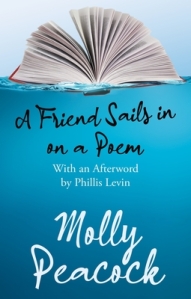 The book traces their lives but also their development as poets, through examples of their verse. Her friend is “Phillis” in real life, but “Levin” when it’s her work is being discussed – and her own poems are as written by “Peacock.” Both women became devoted to the sonnet, an unusual choice because at the time that they were graduate students free verse reigned and form was something one had to learn on one’s own time. Stanza means “room,” Peacock reminds readers, and she believes there is something about form that opens up space, almost literally but certainly metaphorically, to re-examine experience. She repeatedly tracks how traumatic childhood events, as much as everyday observations, were transmuted into her poetry. Levin did so, too, but with an opposite approach: intellectual and universal where Peacock was carnal and personal. That paradox of difference yet likeness is the essence of the friendships we sail on. What a lovely read, especially if you’re curious about ‘where poems come from’; I’d particularly recommend it to fans of Ann Patchett’s Truth and Beauty.
With thanks to Molly Peacock and Palimpsest Press for the free e-copy for review.
The Bright White Tree by Joanna Seldon (Worple Press, 2017)
This appeared the year after Seldon died of cancer; were it not for her untimely end and her famous husband Anthony (a historian and political biographer), I’m not sure it would have been published, as the poetry is fairly mediocre, with some obvious rhymes and twee sentiments. I wouldn’t want to speak ill of the dead, though, so think of this more like a self-published work collected in tribute, and then no problem. Some of the poems were written from the Royal Marsden Hospital, with “Advice” a useful rundown of how to be there for a friend undergoing cancer treatment (text to let them know you’re thinking of them; check before calling, or visiting briefly; bring sanctioned snacks; don’t be afraid to ask after their health).
 Seldon takes inspiration from history (the story of Kitty Pakenham, the bombing of the Bamiyan Buddhas), travels in England and abroad (“Robin in York” vs. “Tuscan Garden”), and family history. Her Jewish heritage is clear from poems about Israel, National Holocaust Memorial Day and Rosh Hashanah. Her own suffering is put into perspective in “A Cancer Patient Visits Auschwitz.” There are also ekphrastic responses to art and literature (a Gaugin, A Winter’s Tale, Jane Eyre, and so on). I particularly liked “Conker,” a reminder of a departed loved one “So is a good life packed full of doing / That may grow warm with others, even when / The many years have turned, and darkness filled / Places where memory shone bright and strong. / I feel the conker and feel he is here.” (New bargain book from Waterstones online sale with Christmas book token)
There are haikus dotted through the collection; here’s one perfect for the season:
“Snowdrops Haiku”
Maids demure, white tips to
Mob caps… Look now! They’ve
Splattered the lawn with snow
Have you discovered any new-to-you independent publishers recently?
Winter Reads, Part II: Elisa Shua Dusapin, Howard Norman & Picture Books
As hoped for in my first instalment of winter reads, the weather is warmer now and signs of spring are appearing in the form of cherry blossom, crocuses, daffodils, primroses and snowdrops. So I’m bidding a (perhaps premature) farewell to winter with these two novels featuring very chilly settings. I also borrowed from the library a big ol’ pile of wintry children’s books full of bears, rabbits, snowmen, snowballs and days off school.
Winter in Sokcho by Elisa Shua Dusapin (2016; 2020)
[Daunt Books Originals; translated from the French by Aneesa Abbas Higgins]
Another title doing double duty for #FrenchFebruary and #ReadIndies month. This was Dusapin’s debut and won the Prix Robert Walser and the Prix Régine-Deforges.
Our beaches are still waiting for the end of a war that’s been going on for so long people have stopped believing it’s real. They build hotels, put up neon signs, but it’s all fake, we’re on a knife-edge, it could all give way any moment. We’re living in limbo. In a winter that never ends.
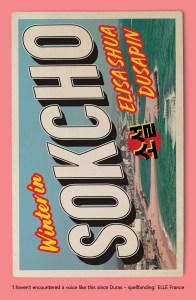 The protagonist is a young mixed-race woman working behind the reception desk at a hotel in Sokcho, a South Korean resort at the northern border. A tourist mecca in high season, during the frigid months this beach town feels down-at-heel, even sinister. The arrival of a new guest is a major event at the guesthouse. And not just any guest but Yan Kerrand, a French graphic novelist. Although she has a boyfriend and the middle-aged Kerrand is probably old enough to be her father – and thus an uncomfortable stand-in for her absent French father – the narrator is drawn to him. She accompanies him on sightseeing excursions but wants to go deeper in his life, rifling through his rubbish for scraps of work in progress.
The underemployed, self-sabotaging young woman is so familiar these days as to be a cliché (and I’d already met a very similar one, also Korean, in Ro from Sea Change by Gina Chung), but there is still something enticing about the atmosphere of this novella. I also enjoyed the narrator’s relationship with her mother, a fishmonger, which sets up for the entirely inconclusive and potentially very disturbing ending. Impossible to say more without spoilers, but I’d be interested to hear what others who have read it think will happen after the last page. (Birthday gift from my wish list) 
The Northern Lights by Howard Norman (1987)
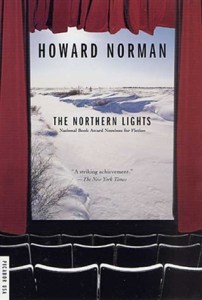 Norman is a really underrated writer and I’m a big fan of The Bird Artist and especially I Hate to Leave This Beautiful Place. This is a weird one; it’s his debut and you can see the autobiographical inspiration (per his Introduction) and the sorts of interests that would recur across his oeuvre, such as subarctic Canada and its Indigenous peoples, absent fathers and hotels (not the only reason this reminded me most of early John Irving).
The Canadian settings represent the two poles of isolation and the urban: Quill, Manitoba versus Toronto in 1959–60. The novel opens with the death of teenage Noah’s best friend, Pelly, who fell through a frozen lake while riding his unicycle. Noah’s family dynamic changes quickly, as his cousin Charlotte, orphaned by a factory disaster, comes to live with them and then his cartographer father leaves them to become a hermit in a remote cabin furnished with musical instruments. Noah stays with Pelly’s parents, Sam and Hettie (a Cree woman), to brave a harsh Quill winter –
January and February mornings you would get a crack of icy static in the nostrils when first stepping outside and have to shade your eyes against the harsh glint of snow, if the sun had worked its way through. Certain days neighbors were seen only on their way to their woodsheds. Chimney smoke was our windsocks. Enormous drifts had built up against the houses, sculpted in various shapes. Even brief walks were taken on snowshoes. Winter might be seven months long.
– while his mother, Mina, takes Charlotte to Toronto to run The Northern Lights, the movie theatre where she met her husband as a young woman. The previous alcoholic owner has run it into the ground; “the curtain smelled like a ten-thousand-year-old moose hide.”
At the time that Noah joins them, he’s never seen a movie before, but as “manager” of the theatre he soon sees The Magnificent Seven 15 times in quick succession. Norman does a peculiar thing here, which is to introduce a key character quite late on in the action. Noah hires Levon, a Cree man, to be the projectionist and he promptly moves his entire family into the building. Had Noah relocated to Toronto earlier, we might have seen more of these characters. Norman’s habit of mimicking broken speech from non-native speakers through overly frequent commas (indicating pauses, I suppose) irked me. There are lots of quirky elements here and I enjoyed the overall atmosphere, but felt the plot left something to be desired. I’d start elsewhere with Norman, but could still recommend this to readers of Robertson Davies and Elizabeth Hay. (Secondhand – 2nd & Charles)
And a DNF:
Snowflake, AZ by Marcus Sedgwick (2019): I wanted to try something else by the late Sedgwick (I’ve only read his nonfiction monograph, Snow) and this seemed ideal. I could have gotten onboard with the desert dystopia, but Ash’s narration was so unconvincing. Sedgwick was attempting a folksy American accent but all the “ain’t”s and “darned”s really don’t work from a teenage character. I only managed about 20 pages. (Public library)
Plus a whole bunch of children’s picture books:
 The Snow Queen by Hans Christian Andersen [adapted by Geraldine McCaughrean; illus. Laura Barrett] (2019): The whole is in the shadow painting style shown on the cover, with a black, white and ice blue palette. It’s visually stunning, but I didn’t like the language as much as in the original (or at least older) version I remember from a book I read every Christmas as a child.
 A Polar Bear in the Snow by Mac Barnett [art by Shawn Harris] (2020): From a grey-white background, a bear’s face emerges. The remaining pages are made of torn and cut paper that looks more three-dimensional than it really is. The bear passes other Arctic creatures and plays in the sea. Such simple yet intricate spreads.
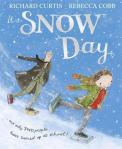 Snow Day by Richard Curtis [illus. Rebecca Cobb] (2014): When snow covers London one December, only two people fail to get the message that the school is closed: Danny Higgins and Mr Trapper, his nemesis. So lessons proceed. At first it feels like a prison sentence, but at break time Mr Trapper gives in to the holiday atmosphere. These two lonely souls play as if they were both children, making an army of snowmen and an igloo. And next year, they’ll secretly do it all again. Watch out for the recurring robin in a woolly hat.
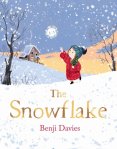 The Snowflake by Benji Davies (2020): I didn’t realize this was a Christmas story, but no matter. A snowflake starts her lonely journey down from a cloud; on Earth, Noelle hopes for snow to fall on her little Christmas tree. From motorway to town to little isolated house, Davies has an eye for colour and detail.
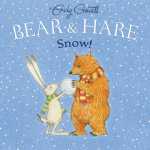 Bear and Hare: SNOW! by Emily Gravett (2014): Bear and Hare, wearing natty scarves, indulge in all the fun activities a blizzard brings: snow angels, building snow creatures, having a snowball fight and sledging. Bear seems a little wary, but Hare wins him over. The illustration style reminded me of Axel Scheffler’s work for Julia Donaldson.
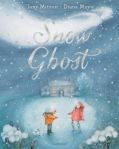 Snow Ghost by Tony Mitton [illus. Diana Mayo] (2020): Snow Ghost looks for somewhere she might rest, drifting over cities and through woods until she finds the rural home of a boy and girl who look ready to welcome her. Nice pastel art but twee couplets.
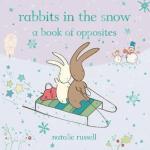 Rabbits in the Snow: A Book of Opposites by Natalie Russell (2012): A suite of different coloured rabbits explore large and small, full and empty, top and bottom, and so on. After building a snowman and sledging, they come inside for some carrot soup.
 The Snowbear by Sean Taylor [illus. Claire Alexander] (2017): Iggy and Martina build a snowman that looks more like a bear. Even though their mum has told them not to, they sledge into the woods and encounter danger, but the snow bear briefly comes alive and walks down the hill to save them. Delightful.
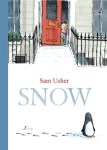
 Snow (2014) & Lost (2021) by Sam Usher: A cute pair from a set of series about a little ginger boy and his grandfather. The boy is frustrated with how slow and stick-in-the-mud his grandpa seems to be, yet he comes through with magic. In the former, it’s a snow day and the boy feels like he’s missing all the fun until zoo animals come out to frolic. There’s lots of white space to simulate the snow. In the latter, they build a sledge and help search for a lost dog. Once again, ‘wild’ animals come to the rescue. /
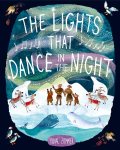 The Lights that Dance in the Night by Yuval Zommer (2021): I’ve seen Zommer speak as part of a conference panel on children’s nature writing. The Aurora Borealis unfolds across the sky above the creatures and people of the far north: “We sashayed for an Arctic fox. We swayed above an old musk ox.” I expected more anatomical accuracy (i.e., faces not flattened so that eyes appear to be next to each other on the same side of a face) but I loved how vivid and imaginative it all is.
Any snowy or icy reads (or weather) for you lately?
Poetry Review Catch-up: Burch, Carrick-Varty, Davidson, Marya, Parsons (#ReadIndies)
As Read Indies month continues, I’m catching up on poetry collections I’ve been sent by three independent publishers: the UK’s Carcanet Press, and Alice James Books and Terrapin Press, both based in the USA. Various as these five are in style and technique, nature and family ties are linking themes. From each I’ve chosen one short poem as a representative.
Leave Me a Little Want by Beverly Burch (2022)
 Burch’s fourth collection juxtaposes the cosmic and the mundane, marvelling at the behind-the-scenes magic that goes into one human being born but also making poetry of an impatient wait in a long post office queue. We find weather and travel; smell as well as sight and sound; alliteration and internal rhyme. Beset by environmental anxiety and the scale of bad news during the pandemic, she pauses in appreciation of the small and gradual. Often nature teaches these lessons. “Practice slow. Days for a seed to unfurl a shoot, / yawn out true leaves. Stems creep upward like prayers. / Weeks to make a flower, more to shape fruit.” Burch expresses gratitude for what is and what has been: a man carrying an infant outside her kitchen window gives her a pang for the baby days, but when she puts her hunting cat on house arrest she realizes how glad she is that impulsivity is past: “Intensity. More subtle than passion. / Odd to be grateful so much of my life is over.” Each section contains multiple unrhymed sonnets, as well as an “incantation” and/or an exploration of “Ars Poetica”.
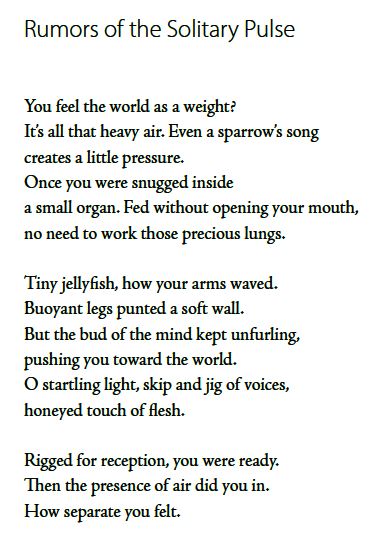
With thanks to Terrapin Books for the free e-copy for review.
More Sky by Joe Carrick-Varty (2023)
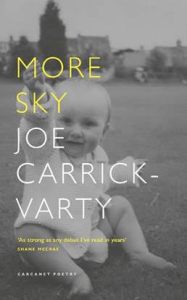 In this debut collection by an Eric Gregory Award-winning poet, his father’s suicide is ever-present – and not just in poems like “54 Questions for the Man Who Sold a Shotgun to My Father” but in seemingly unrelated pieces that start off being about something else. Everything comes around to the reality of a neglectful, alcoholic father and the sordid flat he inhabited before his death. Carrick-Varty alternates between an intimate “you” address and third-person scenarios, auditioning coping mechanisms. His frame of reference is wide: football, rappers, Buddhist cosmology. Some poems are printed sideways up the page; there are stanzas, paragraphs and columns. The word “suicide” itself is repeated to the point where it loses meaning, becoming just a sibilant collection of syllables (as in “From the Perspective of Coral,” where “suicide” is substituted for sea creatures, or the long culminating poem, “sky doc,” in which every stanza opens with “Once upon a time when suicide was…”) The tone is often bitter, as is to be expected, but there is joy in the deft use of language.

With thanks to Carcanet Press for the free e-copy for review.
Arctic Elegies by Peter Davidson (2022)
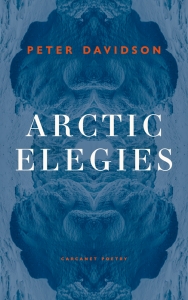 Much of the verse in Davidson’s second collection draws on British religious history and liturgy. Some is also in conversation with art, music or other poetry. In all of these cases, I found the Notes at the end of the volume invaluable for understanding the context and inspiration. While most are in stanzas, some employing traditional forms (e.g., “Sonnet for Trinity Sunday”), a few of the poems are in paragraphs and feel more like essays, such as “Secret Theatres of Scotland.” As the title heralds, an elegiac tone runs throughout, with “Arctic Elegy” (taking material from an oratorio he wrote for performance in St Andrew’s Cathedral in 2015) dedicated to the ill-fated Franklin Expedition of 1845–8:
Wonderful is the patience of the snow
And glorious the violence of the cold.
How lovely is the power of the dark pole
To draw the iron and move the compass rose.
As cold as loss as cold as freezing steel
In this same vein, I also appreciated the wry “The Museum of Loss” and the ornate “The Mourning Virtuoso.” There’s a bit of an Auden flavour here, but the niche topics didn’t always hold my attention. 

With thanks to Carcanet Press for the free copy for review.
Sugar Work by Katie Marya (2022)
 Marya’s debut collection contains frank autobiographical poems about growing up in Atlanta and Las Vegas with a single mother who was a sex worker and an absentee father. As the pages turn, she gets her first period, loses her virginity, marries and divorces. Her childhood persists in photographs, and the details of places, foods and pop culture form the recognizable texture of American suburbia. Social media haunts or taunts: that photo her addict father posts every year on Facebook of him holding her, aged three, on a beach; the Instagram perfection she wishes she could attain. Marya’s phrasing is carnal, unsentimental and in-your-face (viz. “Valentine’s Day: “Do you think love only exists / because death exists? / I do not want to marry you. // But I do want explosions / of white taffeta and a cake / propped up in my mouth // with your hand for a photo. / Skin is a casing and I hook / mine to yours with a needle.”) There is also a feminist determination to see justice for women who are abused and accused.
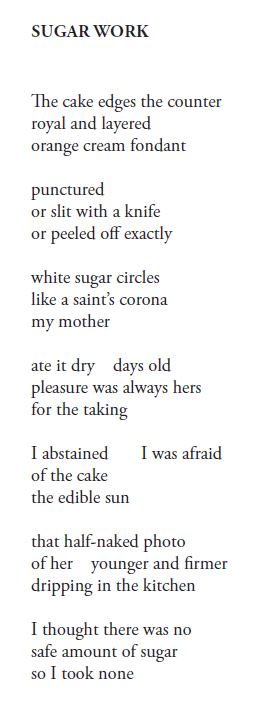
With thanks to Alyson Sinclair PR for the free e-copy for review.
The Mayapple Forest by Kim Ports Parsons (2022)
 Parts of this alliteration-rich debut collection respond to the pandemic’s gifts of time and attention. Gardening and baking, two of the activities that sustained so many people during lockdowns, appear as acts of faith – planting seeds and waiting to see what becomes of them – and acts of remembrance (in “The Poetry of Pie,” she’s a child making peach pie with her mother). There is a fresh awareness of nature, especially birds: starlings, a bluebird nest, the lovely portrait in “Barn Owl.” From the forest floor to the stars, this world is full of wonders. Human stories thread through, too: dancing to soul music, fixing an elderly woman’s hair, the layers of history uncovered during a renovation of her childhood home. Contrasting with her temporary residence in the Midwest is her nostalgia for Baltimore. Parsons reflects on the sudden loss of her father (“A quick death’s a blessing / for the one who dies”) and the still-tender absence of her mother, the book’s dedicatee.

With thanks to Terrapin Books for the free e-copy for review.
Read any good poetry recently?
A Trip to Kyoto with Muriel Barbery and Florentyna Leow (#FrenchFebruary and #ReadIndies)
One of my most recent Book Serendipity incidents was reading these two 139-page books about a foreigner’s wanderings in Kyoto (often touring temples) at the same time. They’re also both from independent publishers, so I’m taking the opportunity to review them together for Read Indies month. The Barbery is also towards Marina Sofia’s casual French February challenge.
A Single Rose by Muriel Barbery (2020; 2021)
[Translated from the French by Alison Anderson]
 That Barbery is a Japanophile was clear from her whimsical The Writer’s Cats, which I reviewed for Novellas in November in 2021. Here she takes inspiration from a Japanese aesthetic of minimalist prose, melancholy walks in rainy gardens, and a mixture of legends and stoic Buddhist philosophy. Rose, the half-French, half-Japanese protagonist, is in Kyoto to hear the reading of the will made by her late father, Haru, a contemporary art dealer.
A 40-year-old botanist, Rose is adrift, her father’s death just the latest in a string of losses that have caused her to close off her heart. Her time in Kyoto, while she waits to meet with the lawyer, is a low-key cycle of visits to gardens and Buddhist temples, sake-soused meals, going to bed sad and tipsy, and waking up to rain and preparing to do it all over again. Her minder is Paul, a Belgian who was her father’s assistant. They initially find each other irritating, but are gradually drawn together as two damaged souls.
There are lovely descriptive passages, and the theme of the inescapability of suffering cannot be refuted. The universality of loss comes across in key quotes from Issa and Rainer Maria Rilke, respectively: “in this world / we walk on the roof of hell / gazing at flowers” and “A single rose is every rose.” Still, I somehow found this work both too subtle (the only vaguely relevant chapter-opening snippets of history or legend) and too obvious (“Everybody hurts” is hardly a groundbreaking message). This was my third novella by Barbery. Shall I carry on and read The Elegance of the Hedgehog as well?
With thanks to Gallic Books for the free copy for review.
How Kyoto Breaks Your Heart by Florentyna Leow (2023)
On the face of it, this collection has quite a lot in common with Nina Mingya Powles’s Tiny Moons, from the same publisher: travel- and food-inspired essays that loop through some of the same experiences of loneliness and disorientation. The writers also have a similar background, with Leow a Malaysian Chinese woman living in Japan. She is able to pass for Japanese and so is experienced at code-switching as she moves from temple to jazz bar to teahouse and learns new dialects and accents.
 For some years she made a living by leading tours she could never have afforded herself. Much as she loves Kyoto and its sights, she tired of the crowds and of seeing the same temples all the time. It took a stranger observing that she seemed unhappy in her work for her too realize it was time for a change.
This disillusionment and the end of her friendship with her female housemate are the main themes of this short book, especially in the six-part title essay. Interestingly, she describes the end of their relationship in the sort of terms that would generally be used for a romantic break-up, despondently querying what went wrong between them when they had been so happy picking and cooking the fruit from the persimmon tree outside their apartment window. Indeed, later on she cites the concept of a “romantic friendship.”
But I think what she was really mourning was the temporary nature of life. We’re nostalgic for golden times we can never get back. I think of parts of my early twenties like that. I wouldn’t necessarily trade my life now to go back in time (or maybe I would), but those periods will always glow in my memory.
My favourite essays were “Persimmons,” “A Bowl of Tea,” “A Rainy Day in Kyoto” and “Egg Love” – prove you care for someone by learning how they like their eggs. This wasn’t a particularly stand-out read for me, especially in comparison to the Powles, but I’d happily read more by Leow in the future.
A favourite passage:
REASONS FOR TEA
To celebrate. To thank someone. To enjoy the scent of different incense. To listen to the rain. To view an autumn moon reflected on a pond outside. To watch snow blanket the garden. To hear the texture of that silence. To walk through freshly fallen snow before dawn on the way to the teahouse. To drink tea by candlelight. To remember someone. To bask in the light, the cool of early summer mornings. Because it is spring. Because the leaves are changing colour. Because it is autumn. Because the plum blossoms are out. Because the world is beautiful. Because why not?
How Kyoto Breaks Your Heart will be published on 23 February. With thanks to The Emma Press for the proof copy for review.
 Bookish Beck = Rebecca Foster. American transplant to England. Freelance proofreader and book reviewer.
