Nonfiction Week of #NovNov: Short Memoirs by Lucille Clifton, Alice Thomas Ellis and Deborah Levy
It’s nonfiction week of Novellas in November, which for me usually means short memoirs (today) and nature books (coming up on Wednesday). However, as my list of 10 nonfiction favorites from last year indicates, there’s no shortage of subjects covered in nonfiction works of under 200 pages; whether you’re interested in bereavement, food, hospitality, illness, mountaineering, nature, politics, poverty or social justice, you’ll find something that suits. This week is a great excuse to combine challenges with Nonfiction November, too.

We hope some of you will join in with our buddy read for the week, The Story of My Life by Helen Keller (free to download here from Project Gutenberg if you don’t already have access). At a mere 85 pages, it’s a quick read. I’ve been enjoying learning about her family history and how meeting her teacher was the solution to her desperate need to communicate.
My first three short nonfiction reads of the month are all in my wheelhouse of women’s life writing, with each one taking on a slightly different fragmentary form.
Generations: A Memoir by Lucille Clifton (1976)
[87 pages]
 After her father’s death, Clifton, an award-winning poet, felt compelled to delve into her African American family’s history. Echoing biblical genealogies, she recites her lineage in a rhythmic way and delivers family anecdotes that had passed into legend. First came Caroline, “Mammy Ca’line”: born in Africa in 1822 and brought to America as a child slave, she walked north from New Orleans to Virginia at age eight, became a midwife, and died free. Mammy Ca’line’s sayings lived on through Clifton’s father, her grandson: she “would tell us that we was Sayle people and we didn’t have to obey nobody. You a Sayle, she would say. You from Dahomey women.” Then came Caroline’s daughter, Lucy Sale, famously the first Black woman hanged in Virginia – for shooting her white lover. And so on until we get to Clifton herself, who grew up near Buffalo, New York and attended Howard University.
The chapter epigraphs from Walt Whitman’s “Song of Myself” call into question how much of an individual’s identity is determined by their family circumstances. While I enjoyed the sideways look at slavery and appreciated the poetic take on oral history, I thought more detail and less repetition would have produced greater intimacy. 
Reissued by NYRB Classics tomorrow, November 9th, with a new introduction by Tracy K. Smith. My thanks to the publisher for the proof copy for review.
Home Life, Book Four by Alice Thomas Ellis (1989)
[169 pages]
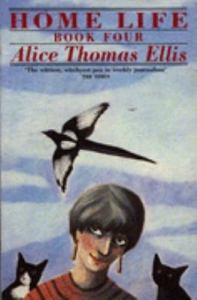 For four years, Ellis wrote a weekly “Home Life” column for the Spectator. Her informal pieces remind me of Caitlin Moran’s 2000s writing for the Times – what today might form the kernel of a mums’ blog. In short, we have a harried mother of five trying to get writing done while maintaining a household – but given she has homes in London and Wales AND a housekeeper, and that her biggest problems include buying new carpet and being stuck in traffic, it’s hard to work up much sympathy. These days we’d say, Check your privilege.
The sardonic complaining rubbed me the wrong way, especially when the subject was not finding anything she wanted to read even though she’d just shipped four boxes of extraneous books off to her country house, or using noxious sprays to get rid of one harmless fly, or a buildup of rubbish bags because they’d been “tidying.” These essays feel of their time for the glib attitude and complacent consumerism. It’s rather a shame they served as my introduction to Ellis, but I think I’d still give her fiction a try. (Secondhand purchase, Barter Books) 
The Cost of Living by Deborah Levy (2018)
[187 pages]
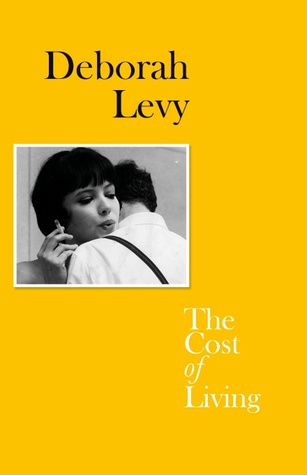 In the space of a year, Levy separated from her husband and her mother fell ill with the cancer that would kill her. Living with her daughters in a less-than-desirable London flat, she longed for a room of her own. Her octogenarian neighbor, Celia, proffered her garden shed as a writing studio, and that plus an electric bike conferred the intellectual and physical freedom she needed to reinvent her life. That is the bare bones of this sparse volume, the middle one in an autobiographical trilogy, onto which Levy grafts the tissue of experience: conversations and memories; travels and quotations that have stuck with her.
It’s hard to convey just what makes this brilliant. The scenes are everyday – set at her apartment complex, during her teaching work or on a train; the dialogue might be overheard. Yet each moment feels perfectly chosen to reveal her self, or the emotional truth of a situation, or the latent sexism of modern life. “All writing is about looking and listening and paying attention to the world,” she writes, and it’s that quality of attention that sets this apart. I’ve had mixed success with Levy’s fiction (though I loved Hot Milk), but this was flawless from first line to last. I can only hope the rest of the memoir lives up to it. (New purchase) 
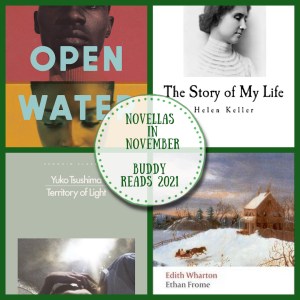
Keep in touch via Twitter (@bookishbeck / @cathy746books) and Instagram (@bookishbeck / @cathy_746books). We’ll add any of your review links in to our master posts. Feel free to use the terrific feature image Cathy made and don’t forget the hashtag #NovNov.
Any short nonfiction on your reading pile?
Open Water & Other Contemporary Novellas Read This Year (#NovNov)
Open Water is our first buddy read, for Contemporary week of Novellas in November (#NovNov). Look out for the giveaway running on Cathy’s blog today!
I read this one back in April–May and didn’t get a chance to revisit it, but I’ll chime in with my brief thoughts recorded at the time. I then take a look back at 14 other novellas I’ve read this year; many of them I originally reviewed here. I also have several more contemporary novellas on the go to round up before the end of the month.
Open Water by Caleb Azumah Nelson (2021)
[145 pages]
 I always enjoy the use of second person narration, and it works pretty well in this love story between two young Black British people in South London. The title is a metaphor for the possibilities and fear of intimacy. The protagonist, a photographer, doesn’t know what to do with his anger about how young Black men are treated. I felt Nelson was a little heavy-handed in his treatment of this theme, though I did love that the pivotal scene is set in a barbershop, a place where men reveal more of themselves than usual – I was reminded of a terrific play I saw a few years ago, Barber Shop Chronicles.
Ultimately, I wasn’t convinced that fiction was the right vehicle for this story, especially with all the references to other authors, from Hanif Abdurraqib to Zadie Smith (NW, in particular); I think a memoir with cultural criticism was what the author really intended. I’ll keep an eye out for Nelson, though – I wouldn’t be surprised if this makes it onto the Sunday Times Young Writer of the Year Award shortlist in January. I feel like with his next book he might truly find his voice.
Readalikes:
- Assembly by Natasha Brown (also appears below)
- Poor by Caleb Femi (poetry with photographs)
- Normal People by Sally Rooney
Other reviews:
Other Contemporary Novellas Read This Year:
(Post-1980; under 200 pages)


Somebody Loves You by Mona Arshi
Assembly by Natasha Brown
Indelicacy by Amina Cain 
A Lie Someone Told You About Yourself by Peter Ho Davies

Blue Dog by Louis de Bernières 
The Office of Historical Corrections by Danielle Evans 
Anarchipelago by Jay Griffiths
Tinkers by Paul Harding


An Island by Karen Jennings
Ness by Robert Macfarlane
Black Dogs by Ian McEwan


Broke City by Wendy McGrath 
A Feather on the Breath of God by Sigrid Nunez
In the Winter Dark by Tim Winton
Currently reading:
- Inside the Bone Box by Anthony Ferner
- My Monticello by Jocelyn Nicole Johnson
- The Cemetery in Barnes by Gabriel Josipovici
What novellas do you have underway this month? Have you read any of my selections?
R.I.P. Reads for Halloween: Ashworth, Bazterrica, Hill, Machado & More
I don’t often read anything that could be classed as suspense or horror, so the R.I.P. challenge is a fun excuse to dip a toe into these genres each year. This year I have an eerie relationship study, a dystopian scenario where cannibalism has become the norm, some traditional ghost stories old and new, and a bonus story encountered in an unrelated anthology.

Ghosted: A Love Story by Jenn Ashworth (2021)
Laurie’s life is thrown off kilter when, after they’ve been together 15 years, her husband Mark disappears one day, taking nothing with him. She continues in her job as a cleaner on a university campus in northwest England. After work she visits her father, who is suffering from dementia, and his Ukrainian carer Olena. In general, she pretends that nothing has happened, caring little how odd it will appear that she didn’t call the police until Mark had been gone for five weeks. Despite her obsession with true crime podcasts, she can’t seem to imagine that anything untoward has happened to him. What happened to Mark, and what’s with that spooky spare room in their flat that Laurie won’t let anyone enter?
 If you find unreliable narrators delicious, you’re in the right place. The mood is confessional, yet Laurie is anything but confiding. Occasionally she apologizes for her behaviour: “I realise this does not sound very sane” is one of her concessions to readers’ rationality. So her drinking problem doesn’t become evident until nearly halfway through, and a bombshell is still to come. It’s the key to understanding our protagonist and why she’s acted this way.
Ghosted wasn’t what I expected. Its air of supernatural menace mellows; what is to be feared is much more ordinary. The subtitle should have been more of a clue for me. I appreciated the working class, northern setting (not often represented; Ashworth is up for this year’s Portico Prize) and the unusual relationships Laurie has with Olena, as well as with co-worker Eddie and neighbour Katrina. Reminiscent of Jo Baker’s The Body Lies and Sue Miller’s Monogamy, this story of a storm-tossed marriage was a solid introduction to Ashworth’s fiction – this is her fifth novel – but I’m not sure the payoff lived up to that amazing cover.
With thanks to Sceptre for the free copy for review.
Tender Is the Flesh by Agustina Bazterrica (2017; 2020)
[Translated from the Spanish by Sarah Moses]
 This sledgehammer of a short Argentinian novel has a simple premise: not long ago, animals were found to be infected with a virus that made them toxic to humans. During the euphemistic “Transition,” all domesticated and herd animals were killed and the roles they once held began to be filled by humans – hunted, sacrificed, butchered, scavenged, cooked and eaten. A whole gastronomic culture quickly developed around cannibalism.
Marcos is our guide to this horrific near-future world. Although he works in a slaughterhouse, he’s still uneasy with some aspects of the arrangement. The standard terminology is an attempt at dispassion: the “heads” are “processed” for their “meat.” Smarting from the loss of his baby son and with his father in a nursing home, Marcos still has enough compassion that when he’s gifted a high-quality female he views her as a person rather than potential cuts of flesh. His decisions from here on will call into question his loyalty to the new system.
I wondered if there would come a point where I was no longer physically able to keep reading. But it’s fiendishly clever how the book beckons you into analogical situations and then forces you to face up to cold truths. It’s impossible to avoid the animal-rights message (in a book full of gruesome scenes, the one that involves animals somehow hits hardest), but I also thought a lot about how human castes might work – dooming some to muteness, breeding and commodification, while others are the privileged overseers granted peaceful ends. Bazterrica also conflates sex and death in uncomfortable ways. In one sense, this was not easy to read. But in another, I was morbidly compelled to turn the pages. Brutal but brilliant stuff. (Public library/Edelweiss)
Fear: Tales of Terror and Suspense, selected by Roald Dahl (2017)
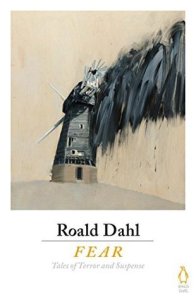 I reviewed the five female-penned ghost stories for R.I.P. back in 2019. This year I picked out another five, leaving a final four for another year. (Review copy)
“W.S.” by L.P. Hartley: The only thing I’ve read of Hartley’s besides The Go-Between. Novelist Walter Streeter is confronted by one of his characters, to whom he gave the same initials. What’s real and what’s only going on in his head? Perfectly plotted and delicious.
“In the Tube” by E.F. Benson: The concept of time is called into question when someone witnesses a suicide on the London Underground some days before it could actually have happened. All recounted as a retrospective tale. Believably uncanny.
“Elias and the Draug” by Jonas Lie: A sea monster and ghost ship plague Norwegian fishermen.
“The Ghost of a Hand” by J. Sheridan Le Fanu: A disembodied hand wreaks havoc in an eighteenth-century household.
“On the Brighton Road” by Richard Middleton: A tramp meets an ill boy on a road in the Sussex Downs. A classic ghost story that pivots on its final line.
The Small Hand: A Ghost Story by Susan Hill (2010)
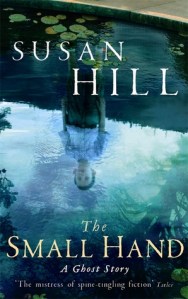 This was my fourth of Hill’s classic ghost stories, after The Woman in Black, The Man in the Picture and Dolly. They’re always concise and so fluently written that the storytelling voice feels effortless. I wondered if this one might have been inspired by “The Ghost of a Hand” (above). It doesn’t feature a disembodied hand, per se, but the presence of a young boy who slips his hand into antiquarian book dealer Adam Snow’s when he stops at an abandoned house in the English countryside, and again when he goes to a French monastery to purchase a Shakespeare First Folio. Each time, Adam feels the ghost is pulling him to throw himself into a pond. When Adam confides in the monks and in his brother, he gets different advice. A pleasant and very quick read, if a little predictable. (Free from a neighbour)
And a bonus story:
 Carmen Maria Machado’s “The Lost Performance of the High Priestess of the Temple of Horror” appears in Kink (2021), a short story anthology edited by Garth Greenwell and R.O. Kwon. (I requested it from NetGalley just so I could read the stories by Machado and Brandon Taylor.) It opens “I would never forget the night I saw Maxa decompose before me.” A seamstress, obsessed with an actress, becomes her dresser. Set in the 19th-century Parisian theatre world, this pairs queer desire and early special effects and is over-the-top sensual in the vein of Angela Carter, with hints of the sadomasochism that got it a place here.
Sample lines: “Women seep because they occupy the filmy gauze between the world of the living and the dead.” & “Her body blotted out the moon. She was an ambulatory garden, a beacon in a dead season, life where life should not grow.”
Also counting the short stories by Octavia E. Butler and Bradley Sides, I did some great R.I.P. reading this year! I think the book that will stick with me the most is Tender Is the Flesh.
Talking to the Dead x 2: Helen Dunmore and Elaine Feinstein
My fourth title-based dual review post this year (after Ex Libris, The Still Point and How Not to Be Afraid), with Betty vs. Bettyville to come in December if I can manage them both. Today I have an early Helen Dunmore novel about the secrets binding a pair of sisters and an Elaine Feinstein poetry collection written after the loss of her husband. Their shared title seemed appropriate as Halloween approaches. Both: 
Talking to the Dead by Helen Dunmore (1996)
 Nina, a photographer, has travelled to stay with her sister in Sussex after the birth of Isabel’s first child, Antony. A house full of visitors, surrounded by an unruly garden, is perfect for concealment. A current secret trades off with one from deep in the sisters’ childhood: their baby brother Colin’s death, which they remember differently. Antony and Colin function like doubles, with the sisters in subtle competition for ownership of the past and present. This was a delicious read: as close as literary fiction gets to a psychological thriller, dripping with sultry summer atmosphere and the symbols of aphrodisiac foods and blowsy flowers. From the novel’s title and opening pages, you have an inkling of what’s to come, but it still hits hard when it does. Impossible to say more about the plot without spoiling it, so just know that it’s a suspenseful story of sisters with Tessa Hadley, Maggie O’Farrell and Polly Samson vibes. I hadn’t much enjoyed my first taste of Dunmore’s fiction (Exposure), but I’m very glad that Susan’s enthusiasm spurred me to pick this up. (Secondhand purchase, Honesty bookshop outside the Castle, Hay-on-Wye)
Talking to the Dead by Elaine Feinstein (2007)
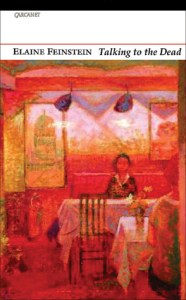 Much like Margaret Atwood’s Dearly, my top poetry release of last year, this is a tender and playful response to a beloved spouse’s death. The short verses are in stanzas and incorporate the occasional end rhyme and spot of alliteration as Feinstein marshals images and memories to recreate her husband’s funeral and moments from their marriage and travels beforehand and her widowhood afterwards – including moving out of their shared home. The poems flow so easily and beautifully from one to another; I’d happily read much more from Feinstein. This was her 13th poetry collection; before her death in 2019, she also wrote many novels, stories, biographies and translations. I’ll leave you with a poem suitable for the run-up to the Day of the Dead. (Secondhand purchase, Minster Gate Bookshop, York)
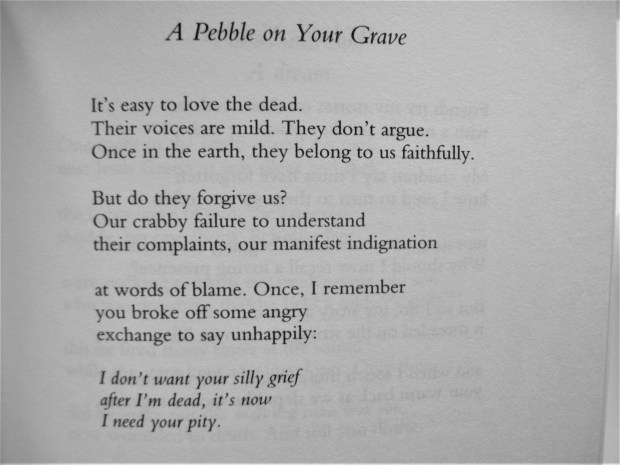
Does one or both of these appeal to you?
How Not to Be Afraid (of Everything): Gareth Higgins and Jane Wong
I’ve done a couple of other dual review posts this year (and I have another planned for Friday) where the books’ titles are so similar that I couldn’t resist discussing them together, even if the books themselves were extremely different. First I featured two books called Ex Libris; later I reviewed The Still Point with The Still Point of the Turning World. This time I have two 2021 releases: How Not to Be Afraid, Gareth Higgins’s self-help/theology book about resisting despair and living in faith; and Chinese American poet Jane Wong’s collection How to Not Be Afraid of Everything, which draws on her family history. Together the titles seemed like a perfect antidote to R.I.P. (more coming up for that on Halloween!).
How Not to Be Afraid: Seven Ways to Live When Everything Seems Terrifying by Gareth Higgins
 I saw Higgins at the online Church Times Festival of Faith and Literature in April, after which I promptly ordered all the speakers’ books; I’m still reading the other three. He grew up in Northern Ireland in the waning days of the Troubles and has been involved in peacemaking projects as well as in artistic expressions of progressive Christianity such as Wild Goose Festival, which he co-founded, and The Porch, an online magazine he edits. Fear was ingrained in him from his upbringing and reinforced by the bullying he experienced over his sexuality. He writes that it took him decades to learn that fear is a story, one often based on false assumptions about our powerlessness, and that we can change the story.
There’s a psychological/self-help bent to the book as Higgins invites readers, through the exercises at the end of each chapter, to ponder what myths about the true self and its possibilities are limiting their lives. The “seven” of the subtitle actually refers to seven main types of fear, each addressed in turn, such as “fear of having done something that can’t be fixed,” “fear of not having enough,” and “fear of a meaningless life.” There’s a good mix of memoir, theory, anecdotes and therapy speak (though it’s never jargon-y), and while the perspective is Christian, the content is not so religious as to turn off anyone – unless they’re dead set against faith. Many passages hit me right in the solar plexus and made me long to work out how my life can be bigger and part of telling a better story. Particularly recommended to fans of Barbara Brown Taylor, Brian McLaren and Richard Rohr. (New purchase)
How to Not Be Afraid of Everything by Jane Wong
 Wong is an assistant professor of creative writing at Western Washington University. The centerpiece of her second collection is “When You Died,” a 20-page epic about her grandparents’ experience during China’s “Great Leap Forward,” a 1950s–60s Maoist campaign of agricultural reform that led to severe famine. Her grandfather survived it and her mother was born at the tail end of it. Wong was born to immigrant parents in New Jersey and the atmosphere and imagery she uses to describe her living situation there reminded me of Qian Julie Wang’s in her memoir Beautiful Country.
Foodstuffs provide the figurative palette, with decay never far behind. I most enjoyed the multi-part poem “The Frontier” (“The frontier arranges itself / around me like a moat. / The frontier drops fruit / upon my head. I break open, / hot cantaloupe in winter. / I wobble around, spilling fruit / everywhere. All day, fruit flies / pay their respects.”) and “The Cactus,” about her spiky self-preservation instincts. This is the theme of the title poem as well:
How to not punch everyone in the face.
How to not protect everyone’s eyes from
my own punch. I have been practicing
my punch for years, loosening my limbs.
My jaw unhinged creates a felony I refuse
to go to court for.
There are many unusual metaphors and word choices, and a lot of the alliteration I love. Opening poem “Mad” is playfully set up like a Mad Libs game with all the key words as blanks. But at the same time, there are loads of prose poems – never my favourite thing to come across in a collection – and some long ones that I kept getting lost in.
Released by Alice James Books on the 12th. With thanks to Nectar Literary for the free e-copy for review.
Autumnal Children’s and YA Books
Browsing through old magazines, I found a fun BookPage reading list from October 2019 entitled “Pumpkin spice latte literature.” It asks, “what if autumn were distilled into a book? The mixture of crispness and warmth, the thrill of possibility, the bittersweetness of change—these books are pure pumpkin spice.” I love the lateral thinking that came up with
 The Art of Fielding by Chad Harbach (back to school in the Midwest)
- I Remember Nothing by Nora Ephron (wry reflections from the autumn of a life)
- Possession by A.S. Byatt (bookish geeking out)
- Calling a Wolf a Wolf by Kaveh Akbar (taking comfort from a vision of recovery from alcoholism)
- An Enchantment of Ravens by Margaret Rogerson (wit and magic)
I’ve read the first three, and am keen to catch up on Akbar’s debut poetry collection after loving Pilgrim Bell this summer. I’m only unlikely to pick up Rogerson’s fantasy. In any case, I enjoyed seeing how the editors came up with their selections.
I tend to be rather more literal with my seasonal reading recommendations. Does it have autumn in the title or as a setting?! Is it about pumpkins or Halloween?
This year I happen to have amassed all children’s and YA selections.
October, October by Katya Balen (2020)
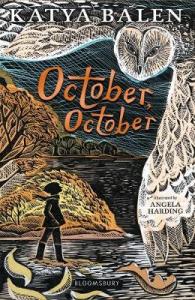 I’ll admit it: it was Angela Harding’s gorgeous cover illustration that drew me to this one. But I found a story that lived up to it, too. October, who has just turned 11 and is named after her birth month, lives in the woods with her father. Their shelter and their ways are fairly primitive, but it’s what October knows and loves. When her father has an accident and she’s forced into joining her mother’s London life, her only consolations are her rescued barn owl chick, Stig, and the mudlarking hobby she takes up with her new friend, Yusuf.
The child’s perspective is well rendered through artful run-on sentences. Balen is careful to show the consequences of October’s decisions and to present advantages as well as disadvantages so it’s not just countryside = good, city = bad. I thought the father’s recovery a bit too quick, but overall, this middle grade novel was a great read for any age, as well as one to get kids thinking about illness and loss. And how about these heart-tugging last lines? “There are stories everywhere and I want to tell them all. And all the world is wild and waiting for me.” (Public library)
Autumn Story by Jill Barklem (1980)
 The second in the quartet of seasonal “Brambly Hedge” stories. Autumn is a time for stocking the pantry shelves with preserves, so the mice are out gathering berries, fruit and mushrooms. Young Primrose wanders off, inadvertently causing alarm – though all she does is meet a pair of elderly harvest mice and stay for tea and cake in their round nest amid the cornstalks. I love all the little touches in the illustrations: the patchwork tea cosy matches the quilt on the bed one floor up, and nearly every page is adorned with flowers and other foliage. After we get past the mild peril that seems to be de rigueur for any children’s book, all is returned to a comforting normal. Time to get the Winter volume out from the library. (Public library)
Une Chanson d’ours by Benjamin Chaud (2011)
 The first whole book I’ve read in French in many a year. I just about coped, given that it’s a picture book with not all that many words on a page; any vocabulary I didn’t know offhand, I could understand in context. It’s late into the autumn and Papa Bear is ready to start hibernating for the year, but Little Bear spies a late-flying bee and follows it out of the woods and all the way to the big city. Papa Bear, realizing his lad isn’t beside him in the cave, sets out in pursuit and bee, cub and bear all end up at the opera hall, to the great surprise of the audience. What will Papa do with his moment in the spotlight? This is a lovely book that, despite the whimsy, still teaches about the seasons and parent–child bonds as it offers a vision of how humans and animals could coexist. I’ve since found out that this was made into a series of four books, all available in English translation. (Little Free Library)
Pumpkinheads by Rainbow Rowell; illus. Faith Erin Hicks (2019)
 This YA graphic novel is set on a Nebraska pumpkin patch that’s more like Disney World than a simple field down the road. Josiah and Deja have worked together at the Succotash Hut for the last three autumns. Today they’re aware that it’s their final Halloween before leaving for college. Deja’s goal is to try every culinary delicacy the patch has to offer – a smorgasbord of foodstuffs that are likely to be utterly baffling to non-American readers: candy apples, Frito pie (even I hadn’t heard of this one), kettle corn, s’mores, and plenty of other saccharine confections.
Josiah’s goal, by contrast, is to catch the eye of Marcy, the beauty who works at the fudge stand. Deja convinces him to desert the Succotash Hut and go in pursuit of Marcy via as many food stands as possible. She’s willing to indulge his unrealistic fantasy even though, as a bisexual who’s dated just about everyone at the patch, she knows romance is sometimes not all it’s cracked up to be. Meanwhile, there’s an angry billy goat on the loose.
This is a fun and quick romp, and the ending genuinely surprised me. I liked the story better than the art, though – my main problem was that these teen characters look more like they’re 30 (Josiah, especially, looks almost haggard what with the sharp lines down the sides of his face – I guess they’re to give him a ‘chiselled’ jaw?), similar to that weird phenomenon of much older actors playing high schoolers. So, I laughed to see in an afterword conversation between Rowell and Hicks that one of the major things they changed from early mock-ups was making the protagonists look older. (Public library)
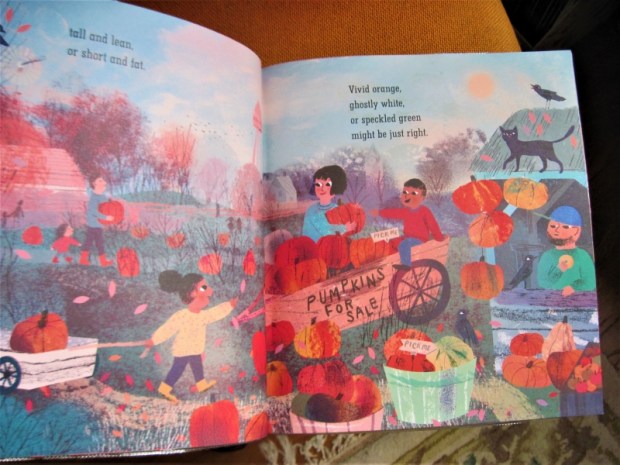
Pick a Pumpkin by Patricia Toht; illus. Jarvis (2019)
 From picking the best pumpkin at the patch to going out trick-or-treating, this is a great introduction to Halloween traditions. It even gives step-by-step instructions for carving a jack-o’-lantern. The drawing style – generally 2D, and looking like it could be part cut paper collages, with some sponge painting – reminds me of Ezra Jack Keats and most of the characters are not white, which is refreshing. There are lots of little autumnal details to pick out in the two-page spreads, with a black cat and crows on most pages and a set of twins and a mouse on some others. The rhymes are either in couplets or ABCB patterns. Perfect October reading. (Public library)
 Any super-autumnal reading for you this year?
Do you read children’s picture books and YA novels even if you (and any children) are well past that age – or is it just me?
The 1976 Club: Woman on the Edge of Time & The Takeover
It’s my fourth time participating in one of Simon and Karen’s reading weeks (after last year’s 1920 Club and 1956 Club and April’s 1936 Club). I start with a novel I actually read for my book club’s short-lived feminist classics subgroup way back in March but didn’t manage to review before now, and then have another I picked up especially for this challenge. Both were from the university library.

Woman on the Edge of Time by Marge Piercy
An unusual and fascinating novel with hints of science fiction, but still grounded in the real world (in a way that would attract fans of Octavia E. Butler’s Kindred and Parable duology), this contrasts utopian and dystopian scenes experienced by a Latina woman who’s been confined to a mental hospital. At 37, Connie Ramos has had a tough life marked by deprivation and domestic violence; “it was a crime to be born poor as it was a crime to be born brown.” She finds herself in conversation with Luciente, a plant geneticist who claims to be visiting from the future – coastal Massachusetts in 2137 – and has heard rumors of this prior Age of Greed and Waste. Luciente senses that Connie is a “catcher,” receptive to the wavelength of other times and places.
 When drawn into Luciente’s future, Connie thinks of it more as a peasant past because of the animal husbandry and agriculture, but comes to appreciate how technology and gender equality contribute to a peaceful society and environmentally restored landscape. I was intrigued by the dynamic Piercy imagines: everyone is of indeterminate gender (the universal pronouns are “person” and “per” – how about it? Both less confusing and more aesthetically pleasing than they/them!); embryos are cultured in machines and the resulting children raised communally with three honorary named “mother” figures. People choose their own names and change them in response to rites of passage. There’s no government or police. Free love reigns. “Our notions of evil center around power and greed” rather than sex, Connie is told.
With Connie and her fellow inmates facing mind-altering surgery in the ‘real’ world, Luciente’s community becomes a blessed escape. But on one of her time travels, she ends up in a dystopian future New York City instead. From 126 floors up, all that’s visible through the smoggy air is other towers. Everyone is genetically modified and everything is owned by corporations. Which scenario represents the authentic evolution of human society?
The way Piercy intersperses these visions with life at the mental hospital, and closes with excerpts from Connie’s patient notes, forces you to question whether they might all be hallucinations. We didn’t come to any firm conclusion during our Zoom discussion. The others found Connie’s life unremittingly bleak, but I love me a good mental hospital narrative. While I wearied a bit of the anthropological detail as the novel went on, I thought it an intense cultural commentary from a writer ahead of her time on gender roles and the environment (small-scale food production, foraging, renewable energy and reusing/recycling are givens in her utopia, and she questions the nonsensical reliance on cars. Why didn’t we listen to the prophets of the 1970s when we maybe had a chance to turn things around?!).
My rating:
The Takeover by Muriel Spark
 Had I read this in manuscript with no author name attached, I might have declared it to have been written by Iris Murdoch for the clutch of amoral characters, the love triangles, the peculiar religious society, the slight meanness of the attitude, and the detachment of the prose. Maggie Radcliffe is a rich American who owns three houses in the vicinity of Rome, one of which she rents out to Hubert Mallindaine, an effete homosexual who alleges that he is descended from the goddess Diana and founds a cult in her honour. He holds to this belief as fiercely as he defends his right to remain at Nemi even when Maggie decides she wants him out and employs lawyers to start eviction proceedings. There are odd priests, adulterous family members, scheming secretaries, and art and jewellery thieves, too. I wouldn’t say I’m a fan, but I liked this, my fourth novel by Spark, better than the rest. Italian bureaucracy makes for an amusing backdrop to what is almost a financial farce with an ensemble cast.
My rating:
Another 1976 release I’ve reviewed this year: The Easter Parade by Richard Yates.
Local Resistance: On Gallows Down by Nicola Chester
It’s mostly by accident that we came to live in Newbury: five years ago, when a previous landlord served us notice, we viewed a couple of rental houses in the area to compare with what was available in Reading and discovered that our money got us more that little bit further out from London. We’ve come to love this part of West Berkshire and the community we’ve found. It may not be flashy or particularly famous, but it has natural wonders worth celebrating and a rich history of rebellion that Nicola Chester plumbs in On Gallows Down. A hymn-like memoir of place as much as of one person’s life, her book posits that the quiet moments of connection with nature and the rights of ordinary people are worth fighting for.
So many layers of history mingle here: from the English Civil War onward, Newbury has been a locus of resistance for centuries. Nicola* has personal memories of the long-running women’s peace camps at Greenham Common, once a U.S. military base and cruise missile storage site – to go with the Atomic Weapons Establishment down the road at Aldermaston. As a teenager and young woman, she took part in symbolic protests against the Twyford Down and Newbury Bypass road-building projects, which went ahead and destroyed much sensitive habitat and many thousands of trees. Today, through local and national newspaper and magazine columns on wildlife, and through her winsome nagging of the managers of the Estate she lives on, she bears witness to damaging countryside management and points to a better way.

While there is a loose chronological through line, the book is principally arranged by theme, with experiences linked back to historical or literary precedents. An account of John Clare and the history of enclosure undergirds her feeling of the precarity of rural working-class life: as an Estate tenant, she knows she doesn’t own anything, has no real say in how things are done, and couldn’t afford to move elsewhere. Nicola is a school librarian and has always turned to books and writing to understand the world. I particularly loved Chapter 6, about how she grounds herself via the literature of this area: Kenneth Grahame’s The Wind in the Willows, Adam Thorpe’s Ulverton, and especially Richard Adams’s Watership Down.
Whatever life throws at her – her husband being called up to fight in Iraq, struggling to make ends meet with small children, a miscarriage, her father’s unexpected death – nature is her solace. She describes places and creatures with a rare intimacy borne out of deep knowledge. To research a book on otters for the RSPB, she seeks out every bridge over every stream. She goes out “lamping” with the local gamekeeper after dark and garners priceless nighttime sightings. Passing on her passion to her children, she gets them excited about badger watching, fossil collecting, and curating shelves of natural history treasures like skulls and feathers. She also serves as a voluntary wildlife advocate on her Estate. For every victory, like the re-establishment of the red kite population in Berkshire and regained public access to Greenham Common, there are multiple setbacks, but she continues to be a hopeful activist, her lyrical writing a means of defiance.
We are writing for our very lives and for those wild lives we share this one, lonely planet with. Writing was also a way to channel the wildness; to investigate and interpret it, to give it a voice and defend it. But it was also a connection between home and action; a plank bridge between a domestic and wild sense. A way both to home and resist.
You know that moment when you’re reading a book and spot a place you’ve been or a landmark you know well, and give a little cheer? Well, every site in this book was familiar to me from our daily lives and countryside wanderings – what a treat! As I was reading, I kept thinking how lucky we are to have such an accomplished nature writer to commemorate the uniqueness of this area. Even though I was born thousands of miles away and have moved more than a dozen times since I settled in England in 2007, I feel the same sense of belonging that Nicola attests to. She explicitly addresses this question of where we ‘come from’ versus where we fit in, and concludes that nature is always the key. There is no exclusion here. “Anyone could make a place their home by engaging with its nature.”
*I normally refer to the author by surname in a book review, but I’m friendly with Nicola from Twitter and have met her several times (and she’s one of the loveliest people you’ll ever meet), so somehow can’t bring myself to be that detached!
On Gallows Down was released by Chelsea Green Publishing on October 7th. My thanks to the author and publisher for arranging a proof copy for review.
My husband and I attended the book launch event for On Gallows Down in Hungerford on Saturday evening. Nicola was introduced by Hungerford Bookshop owner Emma Milne-White and interviewed by Claire Fuller, whose Women’s Prize-shortlisted novel Unsettled Ground is set in a fictional version of the village where Nicola lives.
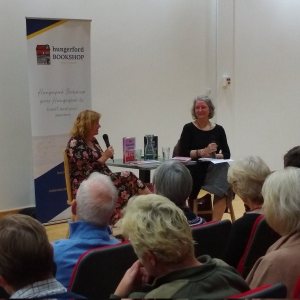
Nicola Chester and Claire Fuller. Photo by Chris Foster.
Nicola dated the book’s genesis to the moment when, 25 years ago, she queued up to talk to a TV news reporter about Newbury Bypass and froze. She went home and cried, and realized she’d have to write her feelings down instead. Words generally come to her at the time of a sighting, as she thinks about how she would tell someone how amazing it was.
Her memories are tied up with seasons and language, especially poetry, she said, and she has recently tried her hand at poetry herself. Asked about her favourite season, she chose two, the in-between seasons – spring for its abundance and autumn for its nostalgia and distinctive smells like tar spot fungus on sycamore leaves and ivy flowers.


A bonus related read:
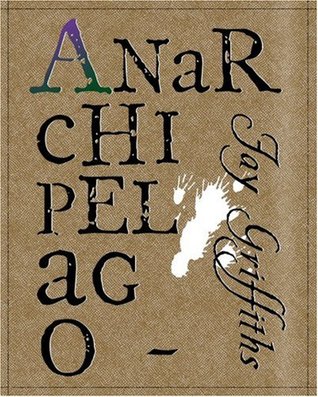
Anarchipelago by Jay Griffiths (2007)
This limited edition 57-page pamphlet from Glastonbury-based Wooden Books caught my eye from the library’s backroom rolling stacks. Griffiths wrote her impish story of Newbury Bypass resistance in response to her time among the protesters’ encampments and treehouses. Young Roddy finds a purpose for his rebellious attitude wider than his “McTypical McSuburb” by joining other oddballs in solidarity against aggressive policemen and detectives.
There are echoes of Ali Smith in the wordplay and rendering of accents.
“When I think of the road, I think of more and more monoculture of more and more suburbia. What I do, I do in defiance of the Louis Queasy Chintzy, the sickly stale air of suburban car culture. I want the fresh air of nature, the lifefull wind of the French revolution.”
In a nice spot of Book Serendipity, both this and On Gallows Down recount the moment when nature ‘fought back’ as a tree fell on a police cherry-picker. Plus Roddy is kin to the tree-sitting protesters in The Overstory by Richard Powers as well as another big novel I’m reading now, Damnation Spring by Ash Davidson.
Three on a Theme: Queer Family-Making
Several 2021 memoirs have given me a deeper understanding of the special challenges involved when queer couples decide they want to have children.
“It’s a fundamentally queer principle to build a family out of the pieces you have”
~Jennifer Berney
“That’s the thing[:] there are no accidental children born to homosexuals – these babies are always planned for, and always wanted.”
~Michael Johnson-Ellis
The Other Mothers by Jennifer Berney
Berney remembers hearing the term “test-tube baby” for the first time in a fifth-grade sex ed class taught by a lesbian teacher at her Quaker school. By that time she already had an inkling of her sexuality, so suspected that she might one day require fertility help herself.
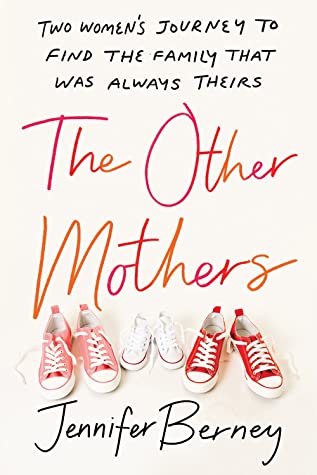 By the time she met her partner, Kellie, she knew she wanted to be a mother; Kellie was unsure. Once they were finally on the same page, it wasn’t an easy road to motherhood. They purchased donated sperm through a fertility clinic and tried IUI, but multiple expensive attempts failed. Signs of endometriosis had doctors ready to perform invasive surgery, but in the meantime the couple had met a friend of a friend (Daniel, whose partner was Rebecca) who was prepared to be their donor. Their at-home inseminations resulted in a pregnancy – after two years of trying to conceive – and, ultimately, in their son. Three years later, they did the whole thing all over again. Rebecca had sons at roughly the same time, too, giving their boys the equivalent of same-age cousins – a lovely, unconventional extended family.
It surprised me that the infertility business seemed entirely set up for heterosexual couples – so much so that a doctor diagnosed the problem, completely seriously, in Berney’s chart as “Male Factor Infertility.” This was in Washington state in c. 2008, before the countrywide legalization of gay marriage, so it’s possible the situation would be different now, or that the couple would have had a different experience had they been based somewhere like San Francisco where there is a wide support network and many gay-friendly resources.
Berney finds the joy and absurdity in their journey as well as the many setbacks. I warmed to the book as it went along: early on, it dragged a bit as she surveyed her younger years and traced the history of IVF and alternatives like international adoption. As the storyline drew closer to the present day, there was more detail and tenderness and I was more engaged. I’d read more from this author. (Published by Sourcebooks. Read via NetGalley)
small: on motherhoods by Claire Lynch
A line from Berney’s memoir makes a good transition into this one: “I felt a sense of dread: if I turned out to be gay I believed my life would become unbearably small.” The word “small” is a sort of totem here, a reminder of the microscopic processes and everyday miracles that go into making babies, as well as of the vulnerability of newborns – and of hope.
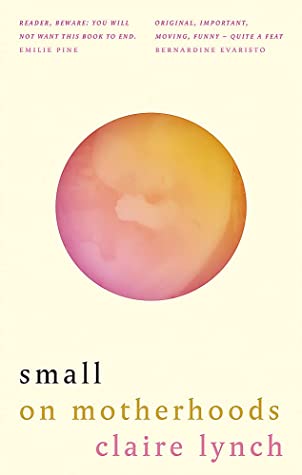
Lynch and her partner Beth’s experience in England was reminiscent of Berney’s in many ways, but with a key difference: through IVF, Lynch’s eggs were added to donor sperm to make the embryos implanted in Beth’s uterus. Mummy would have the genetic link, Mama the physical tie of carrying and birthing. It took more than three years of infertility treatment before they conceived their twin girls, born premature; they were followed by another daughter, creating a crazy but delightful female quintet. The account of the time when their daughters were in incubators reminded me of Francesca Segal’s Mother Ship.
There are two intriguing structural choices that make small stand out. The first you’d notice from opening the book at random, or to page 1. It is written in a hybrid form, the phrases and sentences laid out more like poetry. Although there are some traditional expository paragraphs, more often the words are in stanzas or indented. Here’s an example of what this looks like on the page. It also happens to be from one of the most ironically funny parts of the book, when Lynch is grouped in with the dads at an antenatal class:
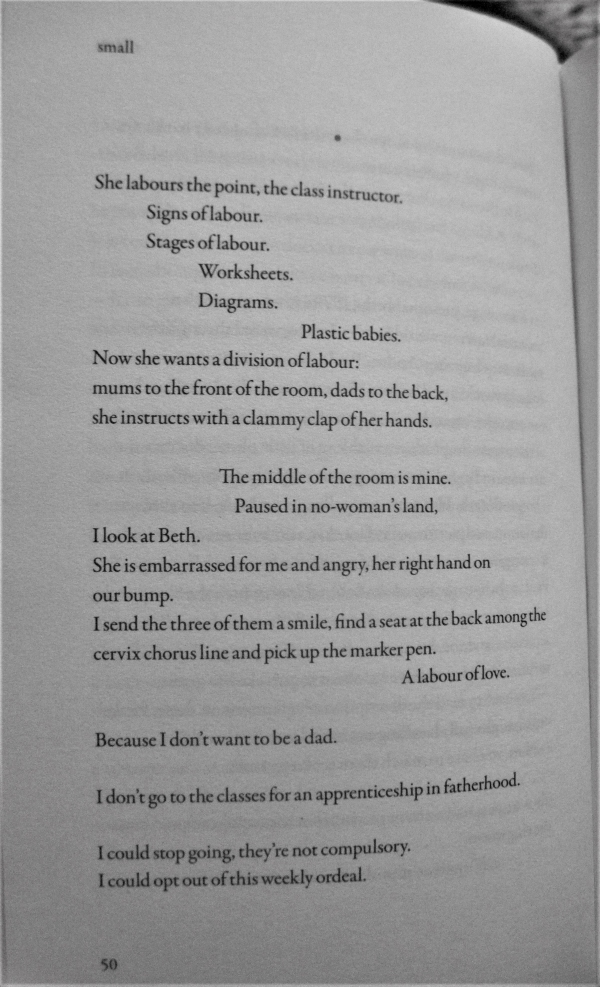
It’s a fast-flowing, artful style that may remind readers of Bernardine Evaristo’s work (and indeed, Evaristo gives one of the puffs). The second interesting decision was to make the book turn on a revelation: at the exact halfway mark we learn that, initially, the couple intended to have opposite roles: Lynch tried to get pregnant with Beth’s baby, but miscarried. Making this the pivot point of the memoir emphasizes the struggle and grief of this experience, even though we know that it had a happy ending.
With thanks to Brazen Books for the free copy for review.
How We Do Family by Trystan Reese
We mostly have Trystan Reese to thank for the existence of a pregnant man emoji. A community organizer who works on anti-racist and LGBTQ justice campaigns, Reese is a trans man married to a man named Biff. They expanded their family in two unexpected ways: first by adopting Biff’s niece and nephew when his sister’s situation of poverty and drug abuse meant she couldn’t take care of them, and then by getting pregnant in the natural (is that even the appropriate word?) way.
 All along, Reese sought to be transparent about the journey, with a crowdfunding project and podcast ahead of the adoption, and media coverage of the pregnancy. This opened the family up to a lot of online hatred. I found myself most interested in the account of the pregnancy itself, and how it might have healed or exacerbated a sense of bodily trauma. Reese was careful to have only in-the-know and affirming people in the delivery room so there would be no surprises for anyone. His doctor was such an ally that he offered to create a more gender-affirming C-section scar (vertical rather than horizontal) if it came to it. How to maintain a sense of male identity while giving birth? Well, Reese told Biff not to look at his crotch during the delivery, and decided not to breastfeed.
I realized when reading this and Detransition, Baby that my view of trans people is mostly post-op because of the only trans person I know personally, but a lot of people choose never to get surgical confirmation of gender (or maybe surgery is more common among trans women?). We’ve got to get past the obsession with genitals. As Reese writes, “we are just loving humans, like every human throughout all of time, who have brought a new life into this world. Nothing more than that, and nothing less. Just humans.”
This is a very fluid, quick read that recreates scenes and conversations with aplomb, and there are self-help sections after most chapters about how to be flexible and have productive dialogue within a family and with strangers. If literary prose and academic-level engagement with the issues are what you’re after, you’d want to head to Maggie Nelson’s The Argonauts instead, but I also appreciated Reese’s unpretentious firsthand view.
And here’s further evidence of my own bias: the whole time I was reading, I felt sure that Reese must be the figure on the right with reddish hair, since that looked like a person who could once have been a woman. But when I finished reading I looked up photos; there are many online of Reese during pregnancy. And NOPE, he is the bearded, black-haired one! That’ll teach me to make assumptions. (Published by The Experiment. Read via NetGalley)
Plus a bonus essay from the Music.Football.Fatherhood anthology, DAD:
“A Journey to Gay Fatherhood: Surrogacy – The Unimaginable, Manageable” by Michael Johnson-Ellis
 The author and his husband Wes had both previously been married to women before they came out. Wes already had a daughter, so they decided Johnson-Ellis would be the genetic father the first time. They then had different egg donors for their two children, but used the same surrogate for both pregnancies. I was astounded at the costs involved: £32,000 just to bring their daughter into being. And it’s striking both how underground the surrogacy process is (in the UK it’s illegal to advertise for a surrogate) and how exclusionary systems are – the couple had to fight to be in the room when their surrogate gave birth, and had to go to court to be named the legal guardians when their daughter was six weeks old. Since then, they’ve given testimony at the Houses of Parliament and become advocates for UK surrogacy.
(I have a high school acquaintance who has gone down this route with his husband – they’re about to meet their daughter and already have a two-year-old son – so I was curious to know more about it, even though their process in the USA might be subtly different.)
On the subject of queer family-making, I have also read: The Argonauts by Maggie Nelson ( ) and The Fixed Stars by Molly Wizenberg ().
If you read just one … Claire Lynch’s small was the one I enjoyed most as a literary product, but if you want to learn more about the options and process you might opt for Jennifer Berney’s The Other Mothers; if you’re particularly keen to explore trans issues and LGTBQ activism, head to Trystan Reese’s How We Do Family.
Have you read anything on this topic?
Review and Q&A: Those Fantastic Lives by Bradley Sides
Bradley Sides and I worked together on Bookkaholic web magazine in 2014–15 and I’ve been following his career ever since. I was delighted to get early access to his debut short story collection, Those Fantastic Lives (out today from Blacklight Press), which was an ideal transition for me from September’s short story focus to October’s R.I.P. challenge for how it blends the genres of dystopia, horror, and magic realism with literary writing.
Many of the protagonists in these 17 stories are orphans or children who have lost one parent. Grief uproots them, leaves them questing; combine their loneliness with dashes of the supernatural and you have perfect situations for strange and wonderful things to happen. So in the title story we have Sam, who at eight longs to follow in his psychic grandmother’s footsteps. In the achingly beautiful “Dolls for the End of the World,” young Patrick’s empathy somehow makes the apocalypse more bearable. In “The Hunt,” 10-year-old Zoey is obsessed with finding a sasquatch, while “In the Hollow” Walt trusts wolf-like creatures to lead him to his dead mother.
“Commencement,” in a first-person plural voice, is the creepiest of the lot, documenting preparations for graduation at a special academy. To be named the class valedictorian is an enduring yet dubious honor… But there are flashes of humor in the book as well. For instance, the lighthearted werewolf story “A Complicated Correspondence” is told via a series of increasingly convoluted e-mails. These two and “Back in Crowville,” in which scarecrows are used to scare off ghosts, too, struck me as perfect Halloween reading. I’d particularly recommend the book to readers of Kelly Link and Lydia Millet.
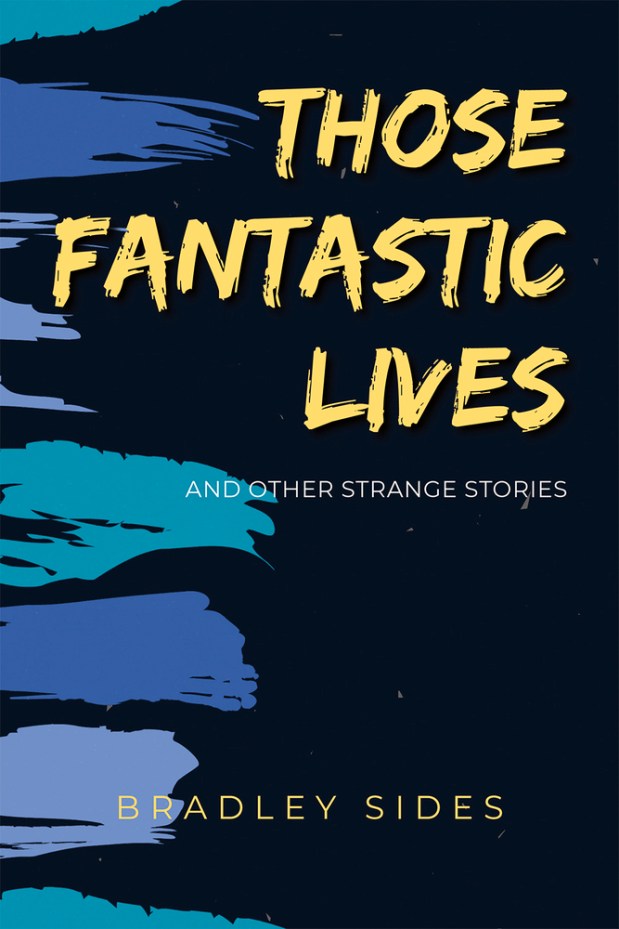
Brad and I had a chat over e-mail about his inspiration, themes and publication process.
Can you remember what the seed was for some of these stories? A particular line, scene, image, or character? Do you start writing a story with a title in mind, or does the title usually suggest itself later on?
Almost all of the stories I write come to me initially as a vision. I don’t mean in a dream or anything that dramatic, but I might be walking and see a stream, and suddenly that stream is placed in another world, and the stakes are much, much higher. Once I see my characters or my setting or my situation, I have to write a story that leads up to the moment I’m seeing. Writing and creating is, for me, a very internalized process.
Titles are so hard for me. I wish this weren’t the case, but I never write with titles in mind. Sometimes I’ll have the story ready, and I might have to wait weeks before I come to the right title. In regards to writing, I think I’m the worst at titling.
I think my favorite line in the book might be “Just because something can’t be seen doesn’t mean that it’s gone.” That’s from “The Comet Seekers,” about a pair of brothers in search of their father. A number of the stories feature children who have lost a guardian. How does bereavement alter the course of these coming-of-age narratives?
I’m so interested in loss in general. In life, we lose things. As kids. As adults. It doesn’t stop. I grew up on a farm, and animals died constantly. Chickens were slaughtered by foxes. Ducks were killed on their nests by turtles. Cows were sold and slaughtered. Pets died. Loss was everywhere. I’ve always thought about it. I guess, in many ways, loss haunts me.
I feel like bereavement and orphanhood create tension in many of my stories, but they also serve to add stakes to my characters’ lives. It’s tough to keep losing. Sometimes, you’ll do anything to keep from experiencing that—or to try to keep from experiencing that, at least. There’s power there.
I imagine that, like sequencing an album, choosing the order of the stories was a pleasurable challenge. How did you decide on the structure of the book – the opening story, the closing story; the themes running into or contrasting with each other; transitions; and so on?
It was a fun process to start putting all of my work together. I mean, it was also a little stressful once I got near the end and was getting ready to send Those Fantastic Lives out, but it was still fun. I have written a lot of stories, but for my collection, I wanted to only include the stories I love the most. I cut and cut based on just pure writerly love first—and gut instinct, I suppose. Once I had it narrowed, I started looking closely at themes. I removed a handful that felt like they didn’t belong. I really like slim collections (and slim books in general), so I wanted something relatively short—something less than 200 pages. The strangest thing I did was that I read the collection aloud. SEVERAL times, too. If a story didn’t fit the sound, I cut it. I really wanted to put out a cohesive collection, and I think (hope?) I’ve done that with these seventeen stories.
I loved how elements recurred in later tales – for instance, in both “Losing Light” and “The Mooneaters” characters consume sources of light and glow from the inside, and “What They Left Behind” connects back to “The Mooneaters” in that a character starts to sprout feathers. How do you account for these pervasive images?
This is probably a terrible response to such a great question, but it’s the truth: I look at the sky a lot. As in, probably way beyond what is normal. When I walk my dog, I look up at the morning sky and think about the clouds and the rising sun. When my wife and I are out on the porch in the evenings, I look up and think about the approaching stars. The coming moon. Whether early or late, the birds are always around, flying to wherever it is they go. I am so amazed by and curious of the sky. It’s such a beautiful, mysterious place that hovers above us, and it’s kind of the perfect space for me to root a lot of the fantastical elements of my stories.
In my favorite story, “The Galactic Healers,” Lian makes contact with aliens who offer a therapeutic balm. His suspicious father takes the medicine by force – a plan that quickly backfires. To what extent might this one be read as a parable of colonial exploitation and toxic masculinity?
I’m so glad you liked “The Galactic Healers,” Rebecca. It is one of my favorites, too. I’m naturally drawn, just as a human and not even necessarily speaking as a writer, to the topics you mention. I think about otherness. What it means to be outside or different. In that same way, I think about tender versus toxic behavior. I think the reading you have of the story is definitely a good one. And it probably captures where I was, in my head, at that time.
I sensed shades of Karen Russell and George Saunders. Who are some of your favorite writers, and who would you cite as inspirations for the collection?
I love Karen Russell and George Saunders both. I’m honored that my work reminds you of their writing. I think they are both influences on my fiction. I’m also inspired by Ray Bradbury a lot. I’m a very visual creator, so television writers also serve as huge inspirations for me. Mike Flanagan’s work (The Haunting of Hill House and The Haunting of Bly Manor) haunts me, and I love it.

Bradley Sides. Photo by Abraham Rowe.
Versions of 12 of the stories previously appeared in various publications. What has your experience been of getting your work into literary magazines?
Getting published in literary magazines is an exhausting process. Don’t get me wrong, it’s a necessary one and one that gives me a lot of joy in the long run, but it’s also tough. I write weird stuff. Not every magazine wants a story about glowing monsters or a tiny kid whose home planet was invaded by giants and now lives on an ice cube. Finding the right magazine takes time, and even when I think I’ve found the right place, I’m sometimes wrong. I submit, hope for the best, and keep submitting. Usually, most of my stories wind up finding homes in the first five or so magazines I submit them to, but that’s not always the case. With “What They Left Behind,” for example, I bet I sent that story to twenty or thirty magazines before I found the perfect match at Crow & Cross Keys. Although it took some time to land at its home, it found its PERFECT home.
These stories were seven years in the making. What was your road to publication like, and how did you land at Blacklight Press?
Like many yet-to-publish-a-book writers, I was constantly searching for publication information as I was reaching the end of my writing cycle for Those Fantastic Lives, and I kept encountering these articles about how long and tough the publication process can be. I was prepared for it to take years before I found a press willing to take on my collection.
Once it was ready, I sent Those Fantastic Lives out to a handful of publishers—all of which I’d found out about with basic web searches. A couple were interested, but the offer wasn’t what I was looking for. A couple showed interest, but ultimately passed. Blacklight landed, and I knew it was what I was looking for very early on.
The process of when I began to when I found my publisher was probably less than six months.
The whole team at Blacklight has been fantastic, too. It’s really been a dream experience. I feel very grateful.
In your day job, you teach English and creative writing to high schoolers. What are some of the most important lessons you hope your students will take away from your classes, and what have you learned from them?
I hope, more than anything, that my students learn that their words—and their stories—matter. If they truly put themselves into their work, it is art, and it is important. I also hope they leave my classroom knowing how important respect is. To other writers. To themselves. To their eventual readers. To people in general. Respect is key.
I’ve learned so much from my creative writing students. They inspire me. They motivate me. Seeing their excitement when they write something they are proud of reminds me why I write in the first place. They are also wonderfully eager readers. I love discussing stories with them and learning how they perceive texts. Creative writing classes are treasured places.
What are you working on next?
Earlier this year, I began working on my next set of stories. I’m a slow writer. Maybe a very slow writer. With it being so early in the process, it’s hard to say exactly what the next collection will look like, but I do think I’ll largely stay focused on the same kinds of themes. Loss, loneliness, and transformation are naturally interesting to me. There’ll be more experimentation with form. A story in the shape of a manual. A gameplay story. A transcript. A flash in questions. There’ll be plenty of magical weirdness, too, with, probably, pond monsters, apocalypses, a shark boy, kidnapping ghosts, and who knows what else. I just hope it won’t take me so long to write this second book!
 Bookish Beck = Rebecca Foster. American transplant to England. Freelance proofreader and book reviewer.
 Bookish Beck