Stanley and Elsie by Nicola Upson & A Visit to Sandham Memorial Chapel
“I don’t want them to look like war paintings, Elsie. I want them to look like heaven.”
When I was offered a copy of this novel to review as part of the blog tour, I was unfamiliar with the name of its subject, the artist Sir Stanley Spencer (1891–1959) – until I realized that he painted the WWI-commemorative Sandham Memorial Chapel in Hampshire, which I had never visited* but knew was just 5.5 miles from our home in Berkshire.

Take another look at the title, though: two characters are given double billing, the second of whom is Elsie Munday, who in the opening chapter presents herself for an interview with Stanley and his wife, Hilda (also a painter), who promptly hire her to be their housemaid at Chapel View in 1928. This creates a setup similar to that in Girl with a Pearl Earring, with a lower-class character observing the inner workings of an artist’s household and giving plain-speaking commentary on what she sees. Upson’s close third-person narration sticks with Elsie for the whole of Part I, but in Part II the picture widens out, with the point of view rotating between Hilda, Elsie and Dorothy Hepworth, the reluctant third side in a love triangle that develops between Stanley and her partner, Patricia Preece.
Hilda and Stanley argue about everything, from childrearing to art: they even paint dueling portraits of Elsie – with Hilda’s Country Girl winning out. Elsie knows she’s lucky to have such a comfortable position with the Spencers and their daughters at Burghclere, and later at Cookham, but she’s uneasy at how Stanley turns her into a confidante in his increasingly tempestuous marriage. Hilda, frustrated at Stanley’s selfish, demanding ways, often returns to her family home in Hampstead, leaving Elsie alone with her employer. Stanley doesn’t give a fig for local opinion, but Elsie knows she has a reputation to protect – especially considering that her moments alone with Stanley aren’t entirely free of sexual tension.
 I love reading about artists’ habits – how creative work actually gets done – so I particularly loved the scenes where Elsie, sent on errands, finds Stanley up a ladder in the chapel, pondering how to get a face or object just right. On more than one occasion he borrows her kitchen items, such as a sponge and cooked and uncooked rashers of bacon, so he can render them perfectly in his paintings. I also loved that this is a local interest book for me, with Newbury, where I live, mentioned four or five times in passing as the nearest big town. Part II, with its account of Stanley’s extramarital doings becoming ever more sordid, didn’t grip me as much as Part I, but I found the whole to be an elegantly written study of a very difficult man and the ties that he made and broke over the course of several decades.
For the tone as well as the subject matter, I would particularly recommend it to readers of Jonathan Smith’s Summer in February and Graham Swift’s Mothering Sunday, and especially Esther Freud’s Mr. Mac and Me.
My rating: 
Stanley and Elsie will be published by Duckworth on May 2nd. My thanks to the publisher for the proof copy for review. They also sent a stylish tote bag!


Nicola Upson
Nicola Upson is best known for her seven Josephine Tey crime novels. She has also published nonfiction, including a book on the sculpture of Helaine Blumenfeld. This is her first stand-alone novel.
*Until now. On a gorgeous Easter Saturday that felt more like summer than spring, I had my husband drop me off on his way to a country walk so I could tour the chapel. I appreciated Spencer’s “holy box” so much more having read the novel than I ever could have otherwise – even though the paintings were nothing like I’d imagined from Upson’s descriptions.

You enter the chapel through the wooden double doors at the center.
What struck me immediately is that, for war art, the focus is so much more on domesticity. Spencer briefly served in Salonika, Macedonia (like his patrons’ brother, Harry Sandham, to whose memory the chapel is dedicated), but had initially been rejected by the army and started off as a medical orderly in an English hospital. Both Salonika and Beaufort hospital appear in the paintings, but there are no battle scenes or bloody injuries. Instead we see tableaux of cooking, doing laundry, making beds, inventorying kitbags, filling canteens, reading maps, dressing under mosquito nets and making stone mosaics. It’s as if Spencer wanted to spotlight what happens in between the fighting. These everyday activities would have typified the soldiers’ lives more than active combat, after all.
I was reminded of how Stanley explains his approach in the novel:
“There’s something heroic in the everyday, don’t you think?”
“Isn’t that what peace is sometimes? A succession of bland moments? We have to cherish them, though, otherwise what was the point of fighting for them?”
The paintings show inventive composition but are in an unusual style that sometimes verges on the grotesque. Many of the figures are lumpen and childlike, especially in Tea in the Hospital Ward, where the soldiers scoffing bread and jam look like cheeky schoolboys. There are lots of animals on display, especially horses and donkeys, but they often look enormous and not entirely realistic. The longer you look, the more details you spot, like a dog raiding a stash of Fray Bentos tins and a young man looking at his reflection in a picture frame to part his hair with a comb. These aren’t desolate, burnt-out landscapes but rich with foliage and blossom, even in Macedonia, which recalls the Holy Land and seems timeless.


The central painting behind the altar, The Resurrection of the Soldiers, imagines the dead rising out of their graves, taking up their white crosses and delivering them to Jesus, a white-clad figure in the middle distance. There’s an Italian Renaissance feeling to this one, with one face in particular looking like it could have come straight out of Giotto (an acknowledged influence on Spencer’s chapel work). It’s as busy as Bosch, but not as dark thematically or in terms of the color scheme – while some of the first paintings in the sequence, like the one of scrubbing hospital floors, recall Edward Hopper with their somber realism. We see all these soldiers intact: at their resurrection they are whole, with no horrific wounds or humiliating nudity. Like Stanley says to Elsie, it’s more heaven than war.


If you are ever in the area, I highly recommend even a quick stop at this National Trust property. I showed a few workers my advanced copy of the novel; while the reception staff were unaware of its existence, a manager I caught up with after my tour knew about it and had plans to read it soon. She also said they will stock it in the NT shop on site.
Rathbones Folio Prize Shortlist: The Perseverance by Raymond Antrobus
The Rathbones Folio Prize is unique in that nominations come from The Folio Academy, an international group of writers and critics, and any book written in English is eligible, so there’s nonfiction and poetry as well as fiction on this year’s varied shortlist of eight titles:
 Can You Tolerate This? by Ashleigh Young [essays]
- The Crossway by Guy Stagg [travel memoir]
- Mary Ann Sate, Imbecile by Alice Jolly [historical fiction]
- Milkman by Anna Burns [literary fiction]
- Ordinary People by Diana Evans [literary fiction]
- The Perseverance by Raymond Antrobus [poetry]
- There There by Tommy Orange [literary fiction]
- West by Carys Davies [historical fiction]

I’m helping to kick off the Prize’s social media tour by championing the debut poetry collection The Perseverance by Raymond Antrobus (winner of the 2018 Geoffrey Dearmer Award from the Poetry Society), issued by the London publisher Penned in the Margins last year. Antrobus is a British-Jamaican poet with an MA in Spoken Word Education who has held multiple residencies in London schools and works as a freelance teacher and poet. His poems dwell on the uneasiness of bearing a hybrid identity – he’s biracial and deaf but functional in the hearing world – and reflect on the loss of his father and the intricacies of Deaf history.
I was previously unaware of the difference between “deaf” and “Deaf,” but it’s explained in the book’s endnotes: Deaf refers to those who are born deaf and learn sign before any spoken language, so they tend to consider deafness part of their cultural identity; deaf means that the deafness was acquired later in life and is a medical consequence rather than a defining trait.
The opening poem, “Echo,” recalls how Antrobus’s childhood diagnosis came as a surprise because hearing problems didn’t run in the family.
I sat in saintly silence
during my grandfather’s sermons when he preached
The Good News I only heard
as Babylon’s babbling echoes.

Raymond Antrobus. Photo credit: Caleb Femi.
Nowadays he uses hearing aids and lip reading, but still frets about how much he might be missing, as expressed in the prose poem “I Move through London like a Hotep” (his mishearing when a friend said, “I’m used to London life with no sales tax”). But if he had the choice, would Antrobus reverse his deafness? As he asks himself in one stanza of “Echo,” “Is paradise / a world where / I hear everything?”
Learning how to live between two worlds is a major theme of the collection, applying not just to the Deaf and hearing communities but also to the balancing act of a Black British identity. I first encountered Antrobus through the recent Black British poetry anthology Filigree (I assess it as part of a review essay in an upcoming issue of Wasafiri literary magazine), which reprints his poem “My Mother Remembers.” A major thread in that volume is art as a means of coming to terms with racism and constructing an individual as well as a group identity. The ghazal “Jamaican British” is the clearest articulation of that fight for selfhood, reinforced by later poems on being called a foreigner and harassment by security staff at Miami airport.
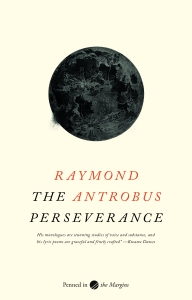 The title comes from the name of the pub where Antrobus’s father drank while his son waited outside. The title poem is an elegant sestina in which “perseverance” is the end word of one line per stanza. The relationship with his father is a connecting thread in the book, culminating in the several tender poems that close the book. Here he remembers caring for his father, who had dementia, in the final two years of his life, and devotes a final pantoum to the childhood joy of reading aloud with him.
A number of poems broaden the perspective beyond the personal to give a picture of early Deaf history. Several mention Alexander Graham Bell, whose wife and mother were both deaf, while in one the ghost of Laura Bridgeman (the subject of Kimberly Elkins’s excellent novel What Is Visible) warns Helen Keller about the unwanted fame that comes with being a poster child for disability. The poet advocates a complete erasure of Ted Hughes’s offensive “Deaf School” (sample lines: “Their faces were alert and simple / Like faces of little animals”; somewhat ironically, Antrobus went on to win the Ted Hughes Award last month!) and bases the multi-part “Samantha” on interviews with a Deaf Jamaican woman who moved to England in the 1980s. The text also includes a few sign language illustrations, including numbers that mark off section divisions.

The Perseverance is an issues book that doesn’t resort to polemic; a bereavement memoir that never turns overly sentimental; and a bold statement of identity that doesn’t ignore complexities. Its mixture of classical forms and free verse, the historical and the personal, makes it ideal for those relatively new to poetry, while those who enjoy the sorts of poets he quotes and tips the hat to (like Kei Miller, Danez Smith and Derek Walcott) will find a resonant postcolonial perspective.
A favorite passage from “Echo” (I’m a sucker for alliteration):
the ravelled knot of tongues,
of blaring birds, consonant crumbs
of dull doorbells, sounds swamped
in my misty hearing aid tubes.
The winner of the Rathbones Folio Prize will be announced on May 20th.
My thanks to the publisher for the free copy for review.
Wellcome Book Prize Blog Tour: Will Eaves’s Murmur
“This is the death of one viewpoint, and its rebirth, like land rising above the waves, or sea foam running off a crowded deck: the odd totality of persons each of whom says ‘me’.”
When I first tried reading Murmur, I enjoyed the first-person “Part One: Journal,” which was originally a stand-alone story (shortlisted for the BBC National Short Story Award 2017) but got stuck on “Part Two: Letters and Dreams” and ended up just giving the rest of the book a brief skim. I’m glad that the book’s shortlisting prompted me to return to it and give it proper consideration because, although it was a challenge to read, it was well worth it.

Eaves’s protagonist, Alec Pryor, sometimes just “the scientist,” is clearly a stand-in for Alan Turing, quotes from whom appear as epigraphs heading most chapters. Turing was a code-breaker and early researcher in artificial intelligence at around the time of the Second World War, but was arrested for homosexuality and subjected to chemical castration. Perhaps due to his distress at his fall from grace and the bodily changes that his ‘treatment’ entailed, he committed suicide at age 41 – although there are theories that it was an accident or an assassination. If you’ve read about the manner of his death, you’ll find eerie hints in Murmur.
Every other week, Alec meets with Dr Anthony Stallbrook, a psychoanalyst who encourages him to record his dreams and feelings. This gives rise to the book’s long central section. As is common in dreams, people and settings whirl in and out in unpredictable ways, so we get these kinds of flashes: sneaking out from the boathouse at night with his schoolboy friend, Chris Molyneux, who died young; anti-war protests at Cambridge; having sex with men; going to a fun fair; confrontations with his mother and brother; and so on. Alec and his interlocutors discuss the nature of time, logic, morality, and the threat of war.
There are repeated metaphors of mirrors, gold and machines, and the novel’s language is full of riddles and advanced vocabulary (volutes, manumitted, pseudopodium) that sometimes require as much deciphering as Turing’s codes. The point of view keeps switching, too, as in the quote I opened with: most of the time the “I” is Alec, but sometimes it’s another voice/self observing from the outside, as in Akwaeke Emezi’s Freshwater. There are also fragments of second- and third-person narration, as well as imagined letters to and from June Wilson, Alec’s former Bletchley Park colleague and fiancée. All of these modes of expression are ways of coming to terms with the past and present.
 I am usually allergic to any book that could be described as “experimental,” but I found Murmur’s mosaic of narrative forms an effective and affecting way of reflecting its protagonist’s identity crisis. There were certainly moments where I wished this book came with footnotes, or at least an Author’s Note that would explain the basics of Turing’s situation. (Is Eaves assuming too much about readers’ prior knowledge?) For more background I recommend The Imitation Game, starring Benedict Cumberbatch as Turing.
To my surprise, given my initial failure to engage with Murmur, it is now my favorite to win the Wellcome Book Prize. For one thing, it’s a perfect follow-on from last year’s winner, To Be a Machine. (“It is my fate to make machines that think,” Alec writes.) For another, it connects the main themes of this year’s long- and shortlists: mental health and sexuality. In particular, Alec’s fear that in developing breasts he’s becoming a sexual hybrid echoes the three books from the longlist that feature trans issues. Almost all of the longlisted books could be said to explore the mutability of identity to some extent, but Murmur is the very best articulation of that. A playful, intricate account of being in a compromised mind and body, it’s written in arresting prose. Going purely on literary merit, this is my winner by a mile.
My rating:
With thanks to Midas PR for the free copy for review.

From Gallop: Selected Poems by Alison Brackenbury. Originally published in the volume After Beethoven.
Will Eaves is an associate professor in the Writing Programme at the University of Warwick and a former arts editor of the Times Literary Supplement. Murmur, his fourth novel, was also shortlisted for the 2018 Goldsmiths Prize and was the joint winner of the 2019 Republic of Consciousness Prize. He has also published poetry and a hybrid memoir.
Opinions on this book vary within our shadow panel; our final votes aren’t in yet, so it remains to be seen who we will announce as our winner on the 29th.
If you are within striking distance of London, please consider coming to the “5×15” shortlist event being held next Tuesday evening the 30th.
I was delighted to be asked to participate in the Wellcome Book Prize blog tour. See below for details of where other reviews have appeared or will be appearing soon.

Under the Rock by Benjamin Myers: Paperback Giveaway
Benjamin Myers’s Under the Rock was my nonfiction book of 2018, so I’m delighted to be kicking off the blog tour for its paperback release on the 25th (with a new subtitle, “Stories Carved from the Land”). I’m reprinting my Shiny New Books review below, with permission, and on behalf of Elliott & Thompson I am also hosting a giveaway of a copy of the paperback. Leave a comment saying that you’d like to win and I will choose one entry at random at the end of the day on Tuesday the 30th. (Sorry, UK only.)
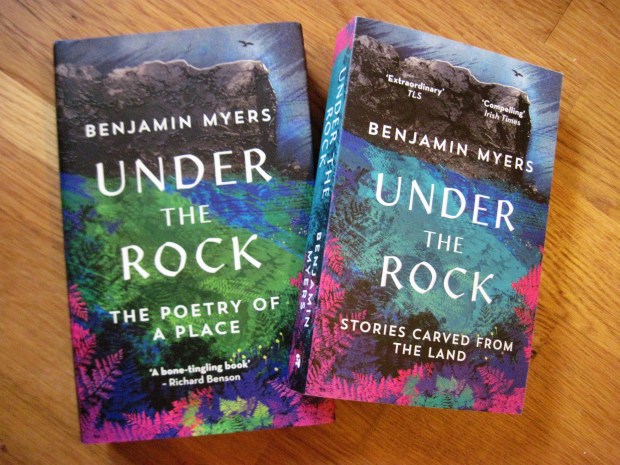
My review:
Benjamin Myers has been having a bit of a moment. In 2017 Bluemoose Books published his fifth novel, The Gallows Pole, which went on to win the Roger Deakin Award and the Walter Scott Prize for Historical Fiction and is now on its fourth printing. This taste of fame has brought renewed attention to his earlier work, including Beastings (2014), recipient of the Northern Writers’ Award. I’ve been interested in Myers’s work ever since I read an extract from the then-unpublished The Gallows Pole in Autumn, the Wildlife Trusts anthology edited by Melissa Harrison, but this is the first of his books that I’ve managed to read.
“Unremarkable places are made remarkable by the minds that map them,” Myers writes, and that is certainly true of Scout Rock, a landmark overlooking Mytholmroyd, near where the author lives in the Calder Valley of West Yorkshire. When he moved up there from London over a decade ago, he and his wife lived in a rental cottage built in 1640. He approached his new patch with admirable curiosity, and supplemented the observations he made from his study window with frequent long walks with his dog, Heathcliff (“Walking is writing with your feet”), and research into the history of the area. The result is a divagating, lyrical book that ranges from geology to true crime but has an underlying autobiographical vein.
Ted Hughes was born nearby, the Brontës not that much further away, and Hebden Bridge, in particular, has become a bastion of avant-garde artists and musicians. Myers also gets plenty of mileage out of his eccentric neighbours and postman. It’s a town that seems to attract oddballs and renegades, from the vigilantes who poisoned the fishing hole to an overdose victim who turns up beneath a stand of Himalayan balsam. A strange preponderance of criminals has come from the region, too, including sexual offenders like Jimmy Savile and serial killers such as the Yorkshire Ripper and Harold Shipman (‘Doctor Death’).
On his walks Myers discovers the old town tip, still full of junk that won’t biodegrade for hundreds more years, and finds traces of the asbestos that was dumped by Acre Mill, creating a national scandal. This isn’t old-style nature writing in search of a few remaining unspoiled places. Instead, it’s part of a growing literary interest in the ‘edgelands’ between settlement and the wild – places where the human impact is undeniable but nature is creeping back in. (Other recent examples would be Common Ground by Rob Cowen, Landfill by Tim Dee, Edgelands by Paul Farley and Michael Symmons Roberts, and Outskirts by John Grindrod.)
Under the Rock gives a keen sense of the seasons’ change and the seemingly inevitable melancholy that accompanies bad weather. A winter of non-stop rain left Myers nigh on delirious with flu; Storm Eva caused the Calder River to flood. He was a part of the effort to rescue trapped pensioners. Heartening as it is to see how the disaster brought people together – Sikh and Muslim charities and Syrian refugees were among the first to help – looting also resulted. One of the most remarkable things about this book is how Myers takes in such extremes of behaviour, along with mundanities, and makes them all part of a tapestry of life.
The book’s recurring themes tangle through all of the sections, even though it has been given a somewhat arbitrary four-part structure (Wood – Earth – Water – Rock). Interludes between these major parts transcribe Myers’s field notes, which are more like impromptu poems that he wrote in a notebook kept in his coat pocket. The artistry of these snippets of poetry is incredible given that they were written in situ, and their alliteration bleeds into his prose as well. My favourite of the poems was “On Lighting the First Fire”:
Autumn burns
the sky
the woods
the valley
death is everywhere
but beneath
the golden cloak
the seeds of
a summer’s
dreaming still sing.
The Field Notes sections are illustrated with Myers’s own photographs, which, again, are of enviable quality. I came away from this feeling like Myers could write anything – a thank-you note, a shopping list – and make it read as profound literature. Every sentence is well-crafted and memorable. There is also a wonderful sense of rhythm to his pages, with a pithy sentence appearing every couple of paragraphs to jolt you to attention.
“Writing is a form of alchemy,” Myers declares. “It’s a spell, and the writer is the magician.” I certainly fell under the author’s spell here. While his eyes are open to the many distressing political and environmental changes of the last few years, the ancient perspective of the Rock reminds him that, though humans are ultimately insignificant and individual lives are short, we can still rejoice in our experiences of the world’s beauty while we’re here.
From the publisher:
“Benjamin Myers was born in Durham in 1976. He is a prize-winning author, journalist and poet. His recent novels are each set in a different county of northern England, and are heavily inspired by rural landscapes, mythology, marginalised characters, morality, class, nature, dialect and post-industrialisation. They include The Gallows Pole, winner of the Walter Scott Prize for Historical Fiction, and recipient of the Roger Deakin Award; Turning Blue, 2016; Beastings, 2014 (Portico Prize for Literature & Northern Writers’ Award winner), Pig Iron, 2012 (Gordon Burn Prize winner & Guardian Not the Booker Prize runner-up); and Richard, a Sunday Times Book of the Year 2010. Bloomsbury will publish his new novel, The Offing, in August 2019.
As a journalist, he has written widely about music, arts and nature. He lives in the Upper Calder Valley, West Yorkshire, the inspiration for Under the Rock.”
Following Up on the Prescriptions from My Bibliotherapy Appointment
In January 2018 I had the wonderful opportunity to have a free bibliotherapy session at the School of Life in London with Ella Berthoud, one of the authors of The Novel Cure. I wrote about the experience in this post. I quickly got hold of all but a couple of my prescribed reads, but have been slower about actually reading them. Though I’ve read five now, I’ve only written up four, two of which I only managed to finish this week. (These 250-word reviews are in order of my reading.)
Heligoland by Shena Mackay (2002)
(CURE: moving house)
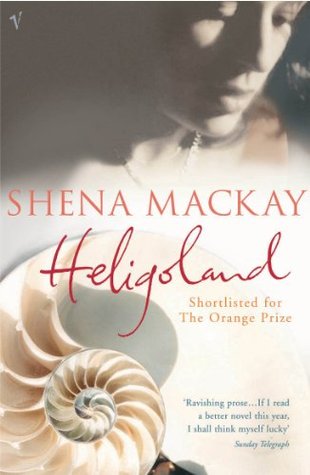 Heligoland is a Scottish island best known from the shipping forecast, but here it’s an almost mythical home. Rowena Snow was orphaned by her Indian/Scottish parents, and a second time by her aunt. Since then she’s drifted between caring and cleaning jobs. The Nautilus represents a fresh chance at life. This shell-shaped artists’ commune in South London houses just three survivors: Celeste Zylberstein, who designed the place; poet Francis Campion; and antiques dealer Gus Crabb. Rowena will be the housekeeper/cook, but she struggles with self-esteem: does she deserve to live in a haven for upper-class creative types?
The omniscient perspective moves between the Nautilus residents but also on to lots of other minor hangers-on, whose stories are hard to keep track of. Mackay’s writing reminded me somewhat of Tessa Hadley’s and is lovely in places – especially when describing a buffet or a moment of light-filled epiphany in a garden. There’s not much to be said beyond what’s in the blurb: Mackay is attempting to give a picture of a drifter who finds an unconventional home; in the barest sense she does succeed, but I never felt a connection with any of the characters. In this ensemble cast there is no one to love and thus no one to root for. While I didn’t love this book, it did inspire me to pick up others by Mackay: since then I’ve read The Orchard on Fire, which I liked a lot more, and the first half of Dunedin.
My rating: 
Family Matters by Rohinton Mistry (2002)
(CURE: worry over ageing parents)
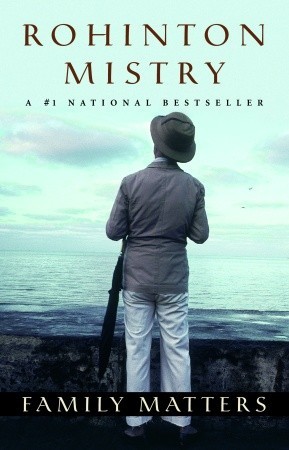 Retired professor Nariman Vakeel, 79, has Parkinson’s disease and within the first few chapters has also fallen and broken his ankle. His grown stepchildren, Coomy and Jal, reluctant to care for him anyway, decide they can’t cope with the daily reality of bedpans, sponge baths and spoon feeding in their large Chateau Felicity apartment. He’ll simply have to recuperate at Pleasant Villa with his daughter Roxana and her husband and sons, even though their two-bedroom apartment is barely large enough for the family of four. You have to wince at the irony of the names for these two Bombay housing blocks, and at the bitter contrast between selfishness and duty.
Perhaps inevitably, Nariman starts to fade into the background. An increasingly speechless invalid, he only comes alive through his past: italicized sections, presented as his night-time ravings, tell of his love for Lucy, whom his parents refused to let him marry, and the untimely end of his arranged marriage. I enjoyed time spent in a vibrantly realized Indian city and appreciated a chance to learn about a lesser-known community: Nariman and family are Parsis (or Zoroastrians). There’s also a faint echo here of King Lear, with one faithful daughter set against two wicked children.
As to ageing parents, this is a pretty relentlessly bleak picture, but there are sparks of light: joy in life’s little celebrations, and unexpected kindnesses. Mistry’s epic has plenty of tender moments that bring it down to an intimate scale. I’m keen to read his other novels.
My rating:
Maggie & Me by Damian Barr (2013)
(A supplementary prescription because I love memoirs and didn’t experience Thatcher’s Britain.)
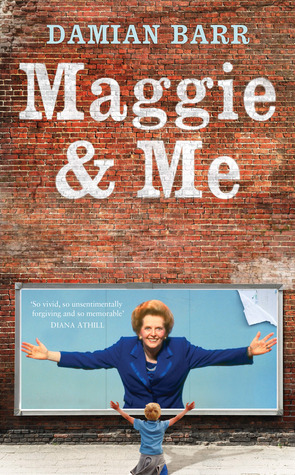 Like a cross between Angela’s Ashes and Toast, this recreates a fairly horrific upbringing from the child’s perspective. Barr was an intelligent, creative young man who early on knew that he was gay and, not just for that reason, often felt that there was no place for him: neither in working-class Scotland, where his father was a steelworker and his brain-damaged mother flitted from one violent boyfriend to another; nor in Maggie Thatcher’s 1980s Britain at large, in which money was the reward for achievement and the individual was responsible for his own moral standing and worldly advancement. “I don’t need to stand out any more,” he recalls, being “six foot tall, scarecrow skinny and speccy with join-the-dots spots, bottle-opener buck teeth and a thing for waistcoats. Plus I get free school dinners and I’m gay.”
There are a lot of vivid scenes in this memoir, some of them distressing ones of abuse, and the present tense, dialect, and childish grammar and slang give it authenticity. However, I never quite bought in to the Thatcher connection as an overarching structure. Three pages at the start, five at the end, and a Thatcher quote as an epigraph for each chapter somehow weren’t enough to convince me that the framing device was necessary or apt. Still, I enjoyed this well enough as memoirs go, and I would certainly recommend it if you loved Nigel Slater’s memoir mentioned above. I also have Barr’s recent debut novel, You Will Be Safe Here, on my Kindle.
My rating: 
The Monsters of Templeton by Lauren Groff (2008)
(A supplementary prescription for uncertainty about having children.)
 I enjoyed this immensely, from the first line on: “The day I returned to Templeton steeped in disgrace, the fifty-foot corpse of a monster surfaced in Lake Glimmerglass.” Twenty-eight-year-old Willie Upton is back in her hometown, pregnant by her older, married archaeology professor after a summer of PhD fieldwork in Alaska. “I had come home to be a child again. I was sick, heartbroken, worn down.” She gives herself a few weeks back home to dig through her family history to find her father – whom Vi has never identified – and decide whether she’s ready to be a mother herself.
We hear from various leading lights in the town’s history and/or Willie’s family tree through a convincing series of first-person narratives, letters and other documents. Groff gives voice to everyone from a Mohican chief to a slave girl who catches her master’s eye. Willie and Vi are backed up by a wonderful set of secondary characters, past and present. Groff wrote this in homage to Cooperstown, New York, where she grew up. (If you’ve heard of it, it’s probably for the baseball museum; it’s not far from where my mother is from in upstate New York.) Templeton is “a slantwise version” of Cooperstown, Groff admits in an opening Author’s Note, and she owes something of a debt to its most famous citizen, James Fenimore Cooper. What a charming way to celebrate where you come from, with all its magic and mundanity. This terrific debut novel cemented my love of Groff’s work.
My rating:
I also have Ella to thank for the inspiration to reread a childhood favorite, Little Women by Louisa May Alcott, last year; the experiment formed the subject of my first piece for Literary Hub. I also worked my way through The Artist’s Way by Julia Cameron, another of my prescriptions, over a number of months in 2018, but failed to keep up with the regular writing exercises so didn’t get the maximum benefit.
My husband and I made a start on reading a few books aloud to each other, including Sum: Forty Tales from the Afterlives by David Eagleman, but that fell by the wayside after a handful of weeks.
(Incidentally, I had forgotten that Cutting for Stone turns up in The Novel Cure on a list of the 10 best books to combat xenophobia.)
 Still to read: Jitterbug Perfume by Tom Robbins (CURE: horror of ageing)
And one I still have to get hold of but haven’t been able to find cheap secondhand because it’s a Persephone classic: The Victorian Chaise-Longue by Marghanita Laski (a supplementary prescription because I love Victorian pastiches).
Four Recent Review Books: Aidt, Brackenbury, Duclos & Zidrou
Four February–March releases: A shape-shifting bereavement memoir; a poet’s selected works, infused with nature and history; a novel set among expatriates in Shanghai; and a graphic novel about a romance at the watershed of age 60 – you can’t say I don’t read a variety of books! I’m particularly pleased that two of these four are in translation. All:

When Death Takes Something from You Give It Back: Carl’s Book by Naja Marie Aidt
[Translated from the Danish by Denise Newman]
 In March 2015 Aidt got a call telling her that her second of four sons, Carl Emil, was dead. The 25-year-old experienced drug-induced psychosis after taking some mushrooms that he and his friend had grown in their flat and, naked, jumped out of his fifth-floor Copenhagen window. In italicized sections she cycles back to the moment she was notified, each time adding on a few more harrowing details about Carl’s accident and the condition she found him in. The rest of the text is a collage of fragments: memories, dreams, dictionary definitions, journal entries, and quotations from the patron saints of bereavement (C.S. Lewis and Joan Didion) and poets who lost children, such as Stéphane Mallarmé.
The playful disregard for chronology and the variety of fonts, typefaces and sizes are a way of circumventing the feeling that grief has made words lose their meaning forever. David Grossman, whose son died during his service in the Israeli army, does a similar thing in Falling Out of Time, which, although it is fiction, blends poetry and dialogue in an attempt to voice the unspeakable. Han Kang’s The White Book and Yiyun Li’s Where Reasons End are two other comparable precursors.

A representative passage:
“no language possible language died with my child could not be artistic could not be art did not want to be fucking art I vomit over art over syntax write like a child main clauses searching everything I write is a declaration I hate writing don’t want to write any more”
With thanks to Quercus Books for the free copy for review.
Gallop: Selected Poems by Alison Brackenbury
 I first encountered Alison Brackenbury’s poetry through her reading as part of the 2016 “Nature Matters” conference in Cambridge. From four generations of Lincolnshire shepherds, Brackenbury writes about history, nature, country life (especially horses, as you might guess from the title and cover) and everyday joys and regrets. A Collected/Selected Poems volume is often difficult to assess as a whole because there can be such a variety of style and content; while that is certainly true here in terms of the poems’ length and rhyme schemes, the tone and themes are broadly similar throughout. I connected most to her middle period. Her first and last lines are especially honed.
Highlights include “The Wood at Semmering” (“This is a dismal wood. We missed our train.”), “Half-day” (“Will she lift / Her face from cloth’s slow steam: will she find out / Ironing is duty; summer is a gift?”), “Hill Mist” (“I am too fond of mist, which is blind / without tenderness”), “On the Road” (the bravery of a roadkill squirrel), “Epigrams” (being in the sandwich generation), “The Card” (“Divorce comes close to death”), “Cycles” (“Would I go back?”), “The Jane Austen Reader” (“Welcome to the truth. Miss Bingley married Darcy”), “On the Aerial” (a starling’s many songs), and “Dickens: a daydream.”

A wee poem that’s perfect for this time of year. (I can see sparrows in a forsythia bush from my office window.)
Some favorite lines:
“we are love’s strange seabirds. We dive there, still.” (from “The Divers’ Death”)
“Ancestors are not in our blood, but our heads: / we make history.” (from “Robert Brackenbury”)
With thanks to Carcanet Press for the free copy for review.
Besotted by Melissa Duclos
 Sasha is soon to leave Shanghai, her departure hastened by the collapse of her relationship with Liz, whom she hired to work at her international school because she had no teaching experience or Chinese – and maybe because she signed her cover letter “Besottedly,” thinking it meant drunkenly. Even before Liz arrived, Sasha built romantic fantasies around her, thinking she’d show her the ropes and give her a spare room to live in. All went according to plan – the erstwhile straight Liz even ended up in Sasha’s bed – until it all fell apart.
The novel is set over one school year and shows the main characters exploring the expat community, which primarily involves going to happy hours. Liz starts language exchange sessions at Starbucks with a Chinese guy, Sam, and both women try to ignore the unwanted advances of their acquaintance Dorian, an architect. Little misunderstandings and betrayals go a long way towards rearranging these relationships, while delicate flashbacks fill in the women’s lives before China.
There were a couple of narrative decisions here that didn’t entirely work for me: Sasha narrates the whole book, even scenes she isn’t present for; and there is persistent personification of abstractions like Loneliness and Love. But the descriptions of the city and of expat life are terrific, and the wistful picture of a romance that starts off sweet but soon sours is convincing.
A favorite passage:
“Shanghai had found its own identity since then: a glittering capitalist heart, hardened into a diamond and barely hidden beneath its drab, brown communist cloak. … Constantly under construction, Shanghai was a place to reinvent yourself.”
Full disclosure: Melissa and I worked together on Bookkaholic web magazine, and are Facebook friends. She sent me a free proof copy for review.
Blossoms in Autumn by Zidrou and Aimée de Jongh
[Translated from the French by Matt Madden]
 The French-language title, translated literally, is The Programmed Obsolescence of Our Feelings. (Talk about highfalutin!) Both that and the English title defy the notion that we become less capable of true love and growth the older we are – as will be dramatized through the story of a later-life romance between the two main characters. Ulysses Varennes, a 59-year-old widower who retired early from his career as a mover, hates books (gasp!) because moving boxes of them ruined his back (he even refuses to read them!). Mediterranea Solenza, coming up on 62, was a nude model in her prime and is now a cheesemaker. At the book’s opening she has just laid her mother to rest, and her affair with Ulysses serves as a chance at a new life that somehow counterbalances the loss.


We come to understand these characters through the sadness of their past but also through their hopeful future, both encompassed by the metaphor of a Homeric journey (Ulysses, get it?). Indeed, the book takes an unusual turn I never would have expected; if it beggars belief, it is at least touching. Zidrou is a Belgian comics writer and Aimée de Jongh is a Dutch-born illustrator. She portrays these ageing bodies sensitively but realistically, retreating into an appropriately impressionistic style for the spreads that show their actual lovemaking. In a nice touch, the first two words and last two words of the book are exactly the same.
With thanks to SelfMadeHero for the free copy for review.
Would you be interested in reading one or more of these?
March’s Doorstopper: Cutting for Stone by Abraham Verghese (2009)
I’m squeaking in here on the 31st with the doorstopper I’ve been reading all month. I started Cutting for Stone in an odd situation on the 1st: We’d attempted to go to France that morning but were foiled by a fatal engine failure en route to the ferry terminal, so were riding in the cab of a recovery vehicle that was taking us and our car home. My poor husband sat beside the driver, trying to make laddish small talk about cars, while I wedged myself by the window and got lost in the early pages of Indian-American doctor Abraham Verghese’s saga of twins Marion and Shiva, born of an unlikely union between an Indian nun, Sister Mary Joseph Praise, and an English surgeon, Thomas Stone, at Missing Hospital in Addis Ababa in 1954.
 What with the flashbacks and the traumatic labor, it takes narrator Marion over 100 pages to get born. That might seem like a Tristram Shandy degree of circumlocution, but there was nary a moment when my interest flagged during this book’s 50-year journey with a medical family starting in a country I knew nothing about. I was reminded of Midnight’s Children, in that the twin brothers are born loosely conjoined at the head and ever after have a somewhat mystical connection, understanding each other’s thoughts even when they’re continents apart.
When Sister Mary Joseph Praise dies in childbirth and Stone absconds, the twins are raised by the hospital’s blunt obstetrician, Hema, and her husband, a surgeon named Ghosh. Both brothers follow their adoptive parents into medicine and gain knowledge of genitourinary matters. We observe a vasectomy, a breech birth, a C-section, and the aftermath of female genital mutilation. While Marion relocates to an inner-city New York hospital, Shiva stays in Ethiopia and becomes a world expert on vaginal fistulas. The novel I kept thinking about was The Cider House Rules, which is primarily about orphans and obstetrics, and I was smugly confirmed by finding Verghese’s thanks to his friend John Irving in the acknowledgments.
Ethiopia’s postcolonial history is a colorful background, with Verghese giving a bystander’s view of the military coup against the Emperor and the rise of the Eritrean liberation movement. Like Marion, the author is an Indian doctor who came of age in Ethiopia, a country he describes as a “juxtaposition of culture and brutality, this molding of the new out of the crucible of primeval mud.” Marion’s experiences in New York City and Boston then add on the immigrant’s perspective on life in the West in the 1980s onwards.
Naomi of Consumed by Ink predicted long ago that I’d love this, and she was right. Of course I thrilled to the accounts of medical procedures, such as an early live-donor liver transplant (this was shortlisted for the Wellcome Book Prize in 2009), but that wasn’t all that made Cutting for Stone such a winner for me. I can’t get enough of sprawling Dickensian stories in which coincidences abound (“The world turns on our every action, and our every omission, whether we know it or not”), minor characters have heroic roles to play, and humor and tragedy balance each other out, if ever so narrowly. (Besides Irving, think of books like The Heart’s Invisible Furies by John Boyne.) What I’m saying, as I strive to finish this inadequate review in the last hour of the last day of the month, is that this was just my sort of thing, and I hope I’ve convinced you that it might be yours, too.
Favorite lines:
Hema: “The Hippocratic oath is if you are sitting in London and drinking tea. No such oaths here in the jungle. I know my obligations.”
“Doubt is a first cousin to faith”
“A childhood at Missing imparted lessons about resilience, about fortitude, and about the fragility of life. I knew better than most children how little separate the world of health from that of disease, living flesh from the icy touch of the dead, the solid ground from treacherous bog.”
Page count: 667
My rating: 
Next month: Since Easter falls in April and I’ve been wanting to read it for ages anyway, I’ve picked out The Resurrection of Joan Ashby by Cherise Wolas to start tomorrow.
Classics of the Month: Colette and Hemingway
I had the hardest time settling to a classic this month. I tried Elizabeth Bowen’s The Heat of the Day for Reading Ireland Month, but couldn’t get past page 35; I barely made it to the second page of (in quick succession) Backwater by Dorothy Richardson, The Years and The Waves by Virginia Woolf. Meanwhile, I started Full Tilt by Dervla Murphy and Woolf’s The Voyage Out, and have been enjoying both, but they may well take me a few months to read.
In the end I read two short classics about obsessive love, both set in the France of the 1920s.
Chéri by Colette (1920)
 [Translated from the French by Roger Senhouse]
My first time trying Colette. The novella, set in the Paris suburbs, circles the relationship of Léa de Lonval, an ageing courtesan, and Frédérick Peloux, her handsome, supercilious lover boy (“the set of his head! quite a statue! But what a little beast he is! When he laughs, you’d swear it’s a greyhound snarling!”). Although they’ve been together for six years, the young man, whom she simply calls Chéri (“dear one”) is just 25 – about half her age. When Chéri’s mother arranges a financially beneficial marriage for him, he and Léa convince themselves it means nothing, but later question whether they’ve lost their chance at true love.
These are both aloof characters who sometimes have trouble accessing their emotions (“My temperature’s normal, so it’s nothing physical. I see. I’m just unhappy,” Léa realizes; “Well, why shouldn’t I have a heart like everybody else?” Chéri asks). To what extent is Léa a replacement mother figure for Chéri? Does love always entail possession and a loss of freedom? These psychological questions and the complex characters held my interest, though in the end the story is fairly thin. I’d read more by Colette: her memoirs come recommended, for instance.
My rating:
The Garden of Eden by Ernest Hemingway (1986)
I find Hemingway offputtingly macho at the best of times, so was surprised to learn he’s the favorite author of a go-getting feminist type from my neighborhood book club. When she put this forward as our April selection I hadn’t even heard of it. It was Hemingway’s second posthumous publication. My main problems are that: 1) it reads like an early draft of an early novel – unpolished and with no proper ending, and 2) it reads like a male having-it-all fantasy, in which two women simultaneously lavish him with sexual attention and switching from one to the other presents no serious consequences.
It’s thought that Hemingway began writing the book in 1946, but was casting his mind back to the late 1920s, when he was preparing to leave his first wife, Hadley Richardson, for his second, Pauline Pfeiffer. In 1927 he and Pauline honeymooned in France’s Le Grau-du-Roi, which is where The Garden of Eden opens. Hemingway’s stand-in is writer David Bourne, who’s had success with a novel about flying in the war and is now dividing his time between Africa-set short stories that reflect on his childhood and his relationship with his father, and an autobiographical narrative drawing on his life with his new wife, Catherine.
 They’re on an extended honeymoon in France and Spain, and the title invites you to think of this as an idyllic time-outside-of-time spent swimming, feasting, taking long drives and making love. Catherine doesn’t want to do what others expect. She loves feeling that she and David have created a whole world unto themselves; they’re free to go anywhere and do anything. Obsessed with equality, she gets a close-cut gamine haircut that matches David’s exactly. But before long their heads are turned by a young woman they meet in a café, and this Marita becomes the third in an increasingly uncomfortable ménage à trois.
To the extent that this is a dramatization of the Genesis story and its accompanying Jewish myths, it is a reasonably successful plot. David calls Catherine “Devil,” but really she’s the Lilith figure, with David (Adam) later moving on to Marita (Eve). Alternatively, Marita could be thought of as the snake, a temptress destroying the couple’s perfect union. Catherine is much the most interesting character, mercurial and driven by odd compulsions: to sleep with a woman, to burn David’s stories and clippings. It was edgy for Hemingway to be thinking about gender fluidity and bisexuality, but the way these two women slavishly attend to David’s needs so that he can go on with his heroic writing work didn’t sit well with me.
What I most enjoyed about the novel were the descriptions of food and drink and the scenes in which David is sitting down to work (“You’d better write another story. Write the hardest one there is to write that you know.”) and reliving the elephant hunt. As usual, though, there’s the annoyances of the Hemingway style: underpunctuated; too many adjectives (sometimes as many as four in a row); simplistic language, including about good and evil; flat and unrealistic dialogue. Apparently Hemingway worked on the manuscript off and on for 15 years until it ballooned to 800 pages, yet he never finished it. Editors cut it down to a manageable size, but the ending? It’s as if nothing ever happened. Utterly frustrating.
Some favorite lines:
David: “Everyone’s full of charm. Charm and sturgeon eggs.”
David to Catherine: “Why can’t you want something that makes sense?” / Catherine: “I do. But I want us to be the same and you almost are and it wouldn’t be any trouble to do it.”
Catherine, towards the end: “I wish it hadn’t ended in complete disillusion too”
My rating: 
Next month’s plan: To tie in with our travels (we’re having another go at our attempted French getaway next weekend): A Breath of French Air by H.E. Bates and Thérèse Raquin by Emile Zola; Cider with Rosie by Laurie Lee to read in Stroud the final Sunday of the month.
Reading Ireland Month 2019: Jess Kidd and Jane Urquhart
Last month I picked out this exchange from East of Eden by John Steinbeck:
“But the Irish are said to be a happy people, full of jokes.”
“They’re not. They’re a dark people with a gift for suffering way past their deserving. It’s said that without whisky to soak and soften the world, they’d kill themselves. But they tell jokes because it’s expected of them.”
There’s something about that mixture of darkness and humor, isn’t there? I also find that Irish art (music as well as literature) has a lot of heart. I only read two Ireland-related historical novels this month, but they both have that soulful blend of light and somber. Both:
Things in Jars by Jess Kidd (2019)
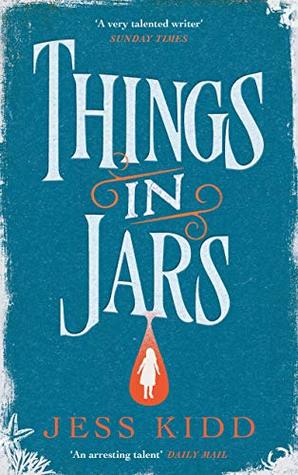
In the autumn of 1863 Bridie Devine, female detective extraordinaire, is tasked with finding the six-year-old daughter of a baronet. Problem is, this missing girl is no ordinary child, and collectors of medical curiosities and circus masters alike are interested in acquiring her.
In its early chapters this delightful Victorian pastiche reminded me of a cross between Sarah Waters’s Fingersmith and Neil Gaiman’s The Graveyard Book, and that comparison played out pretty well in the remainder. Kidd paints a convincingly gritty picture of Dickensian London, focusing on an underworld of criminals and circus freaks: when Bridie first arrived in London from Dublin, she worked as an assistant to a resurrectionist; her maid is a 7-foot-tall bearded lady; and her would-be love interest, if only death didn’t separate them, is the ghost of a heavily tattooed boxer.
Medicine (surgery – before and after anesthesia) and mythology (mermaids and selkies) are intriguing subplots woven through, such that this is likely to appeal to fans of The Way of All Flesh and The Mermaid and Mrs Hancock. Kidd’s prose is spry and amusing, particularly in her compact descriptions of people (but also in her more expansive musings on the dirty, bustling city): “a joyless string of a woman, thin and pristine with a halibut pout,” “In Dr Prudhoe’s countenance, refinement meets rogue,” and “People are no more than punctuation from above.”
I’ll definitely go back and read Kidd’s two previous novels, Himself and The Hoarder. I didn’t even realize she was Irish, so I’m grateful to Cathy for making me aware of that in her preview of upcoming Irish fiction. [Trigger warnings: violence against women and animals.] (Out from Canongate on April 4th.)
Away by Jane Urquhart (1993)
I was enraptured from the first line: “The women of this family leaned towards extremes” – starting with Mary, who falls in love with a sailor who washes up on the Irish coast in the 1840s amid the cabbages, silver teapots and whiskey barrels of a shipwreck and dies in her arms. Due to her continued communion with the dead man, people speak of her being “away with the fairies,” even after she marries the local schoolteacher, Brian O’Malley.
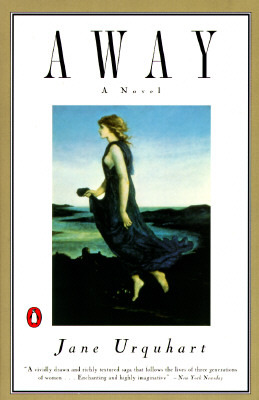 With their young son, Liam, they join the first wave of emigration to Canada during the Potato Famine, funded by their landlords, the Sedgewick brothers of Puffin Court (amateur naturalist Osbert and poet Granville). No sooner have the O’Malleys settled and had their second child, Eileen, than Mary disappears. As she grows, Eileen takes after her mother, mystically attuned to portents and prone to flightiness, while Liam is a happily rooted Great Lakes farmer. Like Mary, Eileen has her own forbidden romance, with a political revolutionary who dances like a dream.
I’ve been underwhelmed by other Urquhart novels, Sanctuary Line and The Whirlpool, but here she gets it just right, wrapping her unfailingly gorgeous language around an absorbing plot – which is what I felt was lacking in the others. The Ireland and Canada settings are equally strong, and the spirit of Ireland – the people, the stories, the folk music – is kept alive abroad. I recommend this to readers of historical fiction by Margaret Atwood, A.S. Byatt and Hannah Kent.
Some favorite lines:
Osbert says of Mary: “There’s this light in her, you see, and it must not be put out.”
“When summer was finished the family was visited by a series of overstated seasons. In September, they awakened after night frosts to a woods awash with floating gold leaves and a sky frantic with migrating birds – sometimes so great in number that they covered completely with their shadows the acre of light and air that Brian had managed to create.”
“There are five hundred and forty different kinds of weather out there, and I respect every one of them. White squalls, green fogs, black ice, and the dreaded yellow cyclone, just to mention a few.”
It’s my second time participating in Reading Ireland Month, run each March by Cathy of 746 Books and Niall of Raging Fluff.
Did you manage to read any Irish literature this month?
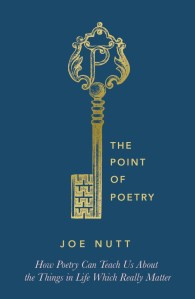
Blog Tour Review: The Point of Poetry by Joe Nutt
Lots of adults are afraid of poetry, Joe Nutt believes. As a Midlands lad he loved going to the public library and had a magical first encounter with poetry at secondary school – the last time many people will ever read it. A former English teacher and Times Educational Supplement columnist who has written books about Shakespeare, Donne and Milton, he also spent many years in the business world, where he sensed apprehension and even hostility towards poetry. This book is meant as a gentle introduction, or reintroduction, to the joys of reading a poem for yourself.
The 22 chapters each focus on a particular poem, ranging in period and style from the stately metaphysical verse of Andrew Marvell to the rapid-fire performance rhythms of Hollie McNish. The pattern in these essays is to provide background on the poet and his or her milieu or style before moving into more explicit interpretation of the poem’s themes and techniques; the poem is then generally printed at the end of the chapter.*

I most appreciated the essays on poems I already knew and loved but gained extra insight into (“Blackberry-Picking” by Seamus Heaney and “The Darkling Thrush” by Thomas Hardy) or had never read before, even if I knew other things by the same poets (“The Bistro Styx” by Rita Dove and “The Sea and the Skylark” by Gerard Manley Hopkins). The Dove poem echoes the Demeter and Persephone myth as it describes a meeting between a mother and daughter in a Paris café. The mother worries she’s lost her daughter to Paris – and, what’s worse, to a kitschy gift shop and an artist for whom she works as a model. Meanwhile, Heaney, Hardy and Hopkins all reflect – in their various, subtle ways – on environmental and societal collapse and ask what hope we might find in the midst of despair.

Joe Nutt
Other themes that come through in the chosen poems include Englishness and countryside knowledge (E. Nesbit and Edward Thomas), love, war and death. Nutt points out the things to look out for, such as doubling of words or sounds, punctuation, and line length. His commentary is especially useful in the chapters on Donne, Wordsworth and Hopkins. In other chapters, though, he can get sidetracked by personal anecdotes or hang-ups like people not knowing the difference between rifles and shotguns (his main reason for objecting to Vicki Feaver’s “The Gun,” to which he devotes a whole chapter) or Bob Dylan winning the Nobel Prize. These felt like unnecessary asides and detracted from the central goal of celebrating poetry. One can praise the good without denigrating what one thinks bad, yes?
 *Except for a few confusing cases where it’s not. Where’s Ted Hughes’s “Tractor”? If reproduction rights couldn’t be obtained, a different poem should have been chosen. Why does a chapter on Keats’s “The Eve of St. Agnes” quote just a few fragments from it in the text but then end with a passage from Shakespeare’s Venus and Adonis (ditto with the excerpt from Donne that ends the chapter on Milton)? The particular Carol Ann Duffy and Robert Browning poems Nutt has chosen are TL; DR, while he errs to the other extreme by not quoting enough from The Rime of the Ancient Mariner and Paradise Lost, perhaps assuming too much audience familiarity. (I’ve never read either!)
So, overall, a bit of a mixed bag: probably better suited to those less familiar with poetry; and, oddly, often more successful for me in its generalizations than in its particulars:
if you once perceive that poetry operates on the edges of man’s knowledge and experience, that it represents in art a profoundly sincere attempt by individuals to grapple with the inexorable conditions of human life, then you are well on the way to becoming not just a reader of it but a fan.
The poet’s skill is in making us look at the world anew, through different, less tainted lenses.
A poem, however unique and strange, however pure and white the page it sits on, doesn’t enter your life unaccompanied. It comes surrounded by literary echoes and memories, loaded with the past. That’s why you get better at understanding [poems], why you enjoy them more, the more you read.
Poetry is so often parsimonious. It makes us work for our supper.
Rossetti deliberately avoids certainty throughout. I enjoy that in any poem. It makes you think.
There is really only one response to great poetry: an unqualified, appreciative ‘yes’.
Related reading:
- The Hatred of Poetry by Ben Lerner
- 52 Ways of Looking at a Poem by Ruth Padel
- The Poem and the Journey and 60 Poems to Read Along the Way by Ruth Padel
- The Poetry Pharmacy by William Sieghart
- Why Poetry by Matthew Zapruder
(I have read and can recommend all of these. Padel’s explication of poetry is top-notch.)
The Point of Poetry was published by Unbound on March 21st (World Poetry Day). My thanks to the publisher for a free copy for review.
 Bookish Beck = Rebecca Foster. American transplant to England. Freelance proofreader and book reviewer.
 Bookish Beck