Irmina by Barbara Yelin (Graphic Novel)
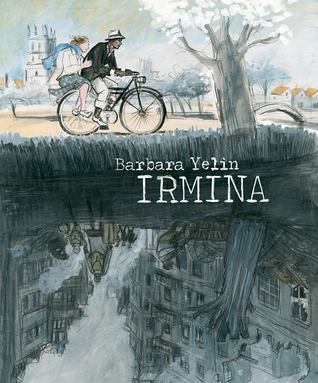 Barbara Yelin’s Irmina is one of the most visually stunning graphic novels I’ve ever come across. Not only that, but it’s based on a fascinating family story: after her grandmother’s death Yelin, a Munich-based artist, found a box of diaries and letters that told the story of a budding love affair that was not to be and charted a young woman’s gradual capitulation to Nazi ideology. How could her grandmother go from being a brave rule-breaker to a cowed regime supporter in just a few short years, she wondered? This fictionalized biography is her attempt to reconcile the ironies and hard facts of her ancestor’s life.
In 1934 Irmina von Behdinger arrives in London for a cultural exchange, attending a commercial school to train as a typist. One night she accompanies a friend to a fancy party and meets Howard, a young Barbados native she initially assumes to be a bartender. It turns out he actually has a scholarship to study law at Oxford. He’s learned, dignified and charming, and soon he and Irmina begin spending a lot of time together. Although she wishes she, too, could study at a proper university, women’s education is not valued in Germany.
Irmina and Howard’s carefree explorations of Oxford and London contrast with the increasingly bleak news coming from Germany about Hitler and his treatment of Jews. As her host family decries Nazism, Irmina tries to protest: “they are not MY Germans … this is politics! It doesn’t affect the average person.” She dreams of being an independent working woman and pursuing a relationship with Howard, but a change in her financial circumstances means she has to go back to Stuttgart instead. Promising to return to England as soon as she can raise some money, Irmina bids farewell to Howard at Portsmouth harbor in April 1935.
Back in Germany, she finds a translation job with the Ministry of War, hoping desperately to be transferred to the German consulate in London once she proves herself. But as the years pass and German relations with the rest of Europe grow strained, her dream seems increasingly unlikely. Having recently lost touch with Howard, she meets Gregor Meinrich, an architect for the SS, and gives up work when they marry and have a son. With the rare exception of a shocking event like Kristallnacht, it’s all too easy to ignore what’s happening to the nation’s Jews and absorb the propaganda that says they have earned their misfortune.
The novel is in three parts: London, Berlin and Barbados – Irmina gets a brief, late chance to see what her life might have been like with Howard. Yelin’s usual palette is muted and melancholy: grays, charcoal, slate blue, browns and flesh tones. However, in each section she chooses one signature color that adds symbolic flashes of life. For London it’s the bright blue of Irmina’s scarf, mirrored in Oxford’s sky and river, as well as in the occasional shopfront and lady’s dress.
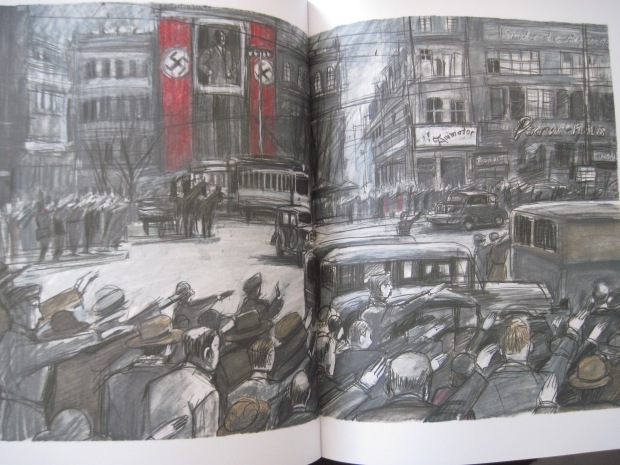
In Berlin the red of the Nazi flag crops up in lipstick, dress patterns, flowers, wine and the décor of a ballroom. In the most poignant scene of all, though, red is equated with the spilling of Jewish blood. As a friend discusses what she doesn’t want to hear – “they’re taking them all to the East now, where they kill them” – Irmina is getting a jar of berry preserves down from a high shelf and drops it, spattering scarlet everywhere. On the other hand, to evoke the calm and natural beauty of 1980s Barbados, the featured hue is a seafoam green.
I was particularly impressed with the two-page spreads showing city scenes. They range from Impressionist fog to Modernist detail, reminding me of everything from Monet to Modigliani. Although the artwork stands out a bit more than the story, this still strikes me as a fresh look at the lives of ordinary Germans who were kept in the dark (by themselves and others) about Hitler’s activities. In an afterword, Dr. Alexander Korb, Director of the University of Leicester’s Stanley Burton Centre for Holocaust and Genocide Studies, reflects on Irmina’s motivation:
Irmina had a full range of possibilities. Yet the fact that she chose the Nazi path from the wide variety in front of her, encompassing feminism, internationality and individuality, makes her story typical of this time. It was just as typical that she failed to find happiness in fascism, like millions of others.
For the out-of-the-ordinary window onto Third Reich history and the excellent illustrations, I highly recommend Irmina to graphic novel lovers and newbies alike.
With thanks to the publisher, SelfMadeHero, for the free copy. Translated from the German by Michael Waaler.
My rating: 
Mixed Feelings about Elena Ferrante
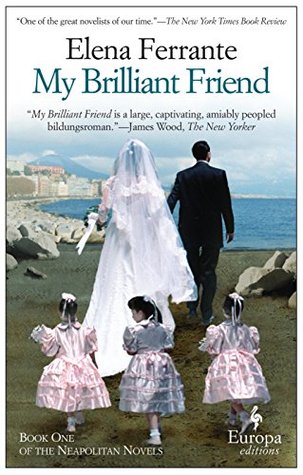
I paid my 40 pence and waited in what felt like an endless holds queue to get my hands on a public library copy of My Brilliant Friend, the first of Elena Ferrante’s four Neapolitan novels. For months I’d been eager to try out this literary phenomenon in translation. I read about the first 100 pages and then my interest started to tail off. Aware of the impending due date, I skimmed the rest – so this doesn’t count towards my year’s reading list.
What went wrong? I didn’t dislike the book; in fact, I found it to be an accomplished psychological study of a female friendship and how it changes over time. Yet there were some factors that kept me at a distance. I’ll give a quick synopsis before listing pros and cons.
 The Story:
Elena, in her sixties, gets a call from the son of her childhood best friend, Lila. His mother and all her possessions have vanished from her home. Elena recalls Lila’s longtime desire to disappear without a trace, and decides she won’t let her: she sits down to her computer to write the story of their friendship, a bulwark against failing memory and deliberate sabotage.
From here Elena, a novelist in her own right (often assumed to be an autobiographical stand-in for Ferrante), returns to the girls’ childhood in 1940s and 1950s Naples, a place of organized crime, domestic violence, and what seems like surprising social backwardness. Neapolitan dialect contrasts with educated Italian. Lila and Elena have a low-key academic rivalry until Lila has to quit school to help her father, a shoemaker. Even then Lila finds ways to show her friend up, maxing out her whole family’s library cards and learning Latin and Greek on her own time. Lila is always one step ahead of Elena, whether in her studies or in attracting boys’ attention. This volume concludes with Lila’s wedding at the age of 16.
What I Loved:
- The psychological acuity Ferrante brings to the relationship between Elena and Lila. Their friendship has a shifting dynamic, vacillating between jealousy and support as they move from childhood through puberty. The novel powerfully captures Elena’s hesitation and Lila’s brazenness, often in piercing one-liners:
she did her best to make me understand that I was superfluous in her life.
In general I was the pretty one, while she was skinny, like a salted anchovy, she gave off an odor of wildness
Lila acted … on me like a demanding ghost
only what Lila touched became important.
- The choice between education and a trade. Money and class have a lot to do with it, but both girls long for a Woolfian “room of one’s own” and even talk of writing novels together one day. Although Lila finds fulfillment designing shoes, it’s plain she envies Elena’s chance to complete high school. “My brilliant friend” is what Lila calls Elena late on in the novel, but it’s what Elena has always thought of Lila too.
- The Naples setting: Don Achille’s murder; setting off fireworks on New Year’s; the sense that the community is on the up and up when someone they know publishes a book. A few of my favorite lines describe the girls’ neighborhood:
We didn’t know the origin of that fear-rancor-hatred-meekness that our parents displayed toward the Carraccis and transmitted to us, but it was there, it was a fact, like the neighborhood, its dirty-white houses, the fetid odor of the landings, the dust of the streets.
What I Struggled with:
- A lack of context. Footnotes would have been intrusive, but perhaps a short introduction from the translator or an English-language critic could have helped set the scene and given some sociological details that would aid in my understanding of mid-twentieth-century Italy. Even just within the first chapter of Only in Naples by Katherine Wilson, a memoir I’m currently reading, there’s more basic information about Italy to help orient foreigners.
- The confusing names. The central characters are known by multiple names – for example, Lila’s full name is Raffaella Cerullo – and nicknames aren’t always intuitive; it reminded me of the variations in War & Peace. Thank goodness for the three-page index of characters.
- Short shrift given to Elena’s odd relationship with her mother. I felt there was a lot more that could have been explored. Perhaps that is a matter for another volume.
- Repetition in the day to day, especially regarding Elena’s schooling. I wondered whether all four, or at least two, of the books might have been condensed into one 400-page novel.
- Minor punctuation and translation issues. I only marked out one passage that sounded false to my ear (“I’ve kept a place for you.” / “Go away, my mother has understood everything.”), but the punctuation drove me a little nutty. I dislike lots of phrases being strung together with commas – as in the anchovy sentence above; I always look for a semicolon!
In general, I avoid series fiction. I hate being saddled with a sense of obligation, and I don’t like feeling that a story is unfinished. That doesn’t mean a book’s last pages can’t be open-ended, but I’d prefer to imagine my own future for the characters rather than have to read about it in another book or three or 14. While I seriously doubt I will pick up another of the Neapolitan novels, I could possibly be persuaded to pick up one of her stand-alone novellas. Naomi at Consumed by Ink wrote a very appealing review of The Lost Daughter, for instance. Although this long-awaited literary experiment was a touch disappointing, I’m still eager to try another model of “autofiction” in translation, Karl Ove Knausgaard.
My rating: 
Further reading: Meghan O’Rourke’s 2014 Guardian article about Elena Ferrante’s growing popularity and mysterious persona.
Have I given Elena Ferrante a fair shake? If not, what should I try next?
Five Books about Cats
I always used to be more of a dog person than a cat person, even though we had both while I was growing up, but now I’m a dedicated cat owner and have tried out some related reading. You’ll notice I don’t rate any of these five books about cats particularly highly, whereas there have been a number of dog books I’ve given 4 stars (Dog Years by Mark Doty, Ordinary Dogs by Eileen Battersby, A Dog’s Life by Peter Mayle; even books that aren’t necessarily about dogs but reference life with them, like A Three Dog Life by Abigail Thomas and Travels with Charley by John Steinbeck). What’s with that? Maybe dog lovers don’t have to worry so much about striking a balance between a pet’s standoffishness and affection. Maybe dogs play a larger role in everyday human life and leave a more gaping hole when they shuffle off the canine coil. Still, I enjoyed aspects of or specific passages from each of the following.
 The Guest Cat by Takashi Hiraide
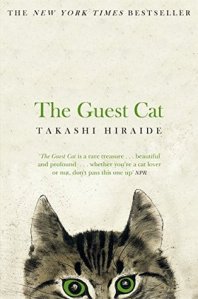
As a cat-loving freelance writer who aspires to read more literature in translation, I thought from the blurb that this book could not be more perfect for me. I bought it in a charity shop one afternoon and started reading right away. It’s only 140 pages, so I finished within 24 hours, but felt at a distance from the story the whole time. Part of it might be the translation – the translator’s notes at the end explain some useful context about the late 1980s setting, but also conflate the narrator and the author in such a way that the book seems like an artless memoir rather than a novella. But the more basic problem for me is that there’s simply not enough about the cat. There’s plenty of architectural detail about the guesthouse the narrator and his wife rent on the grounds of a mansion, plenty of economic detail about the housing market…but the cat just doesn’t make enough of an impression. I’m at a bit of a loss to explain why this has been such a bestseller. Quite the disappointment.
My rating: 
 The Fur Person by May Sarton
I’m a huge fan of May Sarton’s journals – in which various cats play supporting roles – so for a while I’d been hoping to come across a copy of this little novelty book from 1957, a childish fable about a tomcat who transforms from a malnourished Cat-About-Town to a spoiled Gentleman Cat. Luckily I managed to find a copy of this one plus the Lessing (see below) in the Nature section at Book Thing of Baltimore. In a preface to the 1978 edition Sarton reveals that Tom Jones was, indeed, a real cat, a stray she and her partner Judy Matlack adopted when they lived in Cambridge, Massachusetts. Wonderful coincidence: when they were on sabbatical in the early 1950s, they sublet the place to the Nabokovs, who looked after Tom while they were away!
 I found this a bit lightweight overall, and the whole idea of a ‘fur person’ is a little strange – don’t we love cats precisely because they’re not people? Still, I enjoyed the proud cat’s Ten Commandments (e.g. “II. A Gentleman Cat allows no constraint of his person … III. A Gentleman Cat does not mew except in extremity”) and spotted my own domestic situation in this description: “while she [‘Gentle Voice’ = Judy] was away the other housekeeper [= Sarton] was sometimes quite absent-minded and even forgot his lunch once or twice because she sat for hours and hours in front of a typewriter, tapping out messages with her fingers.” The black-and-white illustrations by David Canright are a highlight.
My rating:
 Particularly Cats…And Rufus by Doris Lessing
A book about cats that I would almost hesitate to recommend to cat lovers: it contains many a scene of kitty carnage, as well as some unenlightened resistance to spaying and neutering. Lessing grew up on a farm in Zimbabwe that was at one point overrun with about 40 cats. Her mother went away, expecting her father to have ‘taken care of them’ by the time she got back. He tried chloroform to start with, but it was too slow and ineffective; in the end he rounded them all up in a room and got out his WWI revolver. And that’s not the end of it; even into her adulthood in England Lessing balked at taking female cats in for surgery so would find occasionally herself saddled with unwanted litters of kittens that they decided had to be drowned. It’s really a remarkably unsentimental record of her dealings with cats.
That’s not to say there weren’t some cats she willingly and lovingly kept as pets, particularly a pair of rival females known simply as “black cat” and “grey cat,” and later a stray named Rufus who adopted her. But even with cherished felines she comes across as tough: “Anyway, she had to be killed and I decided that to keep cats in London was a mistake” or “I smacked grey cat” for bullying the black one. The very fact of not giving the pair names certainly quashes any notion of her as some cuddly cat lady. All the same, she was a dutiful nurse when black cat and Rufus fell ill. The book ends on a repentant note: “Knowing cats, a lifetime of cats, what is left is a sediment of sorrow quite different from that due to humans: compounded of pain for their helplessness, of guilt on behalf of us all.”
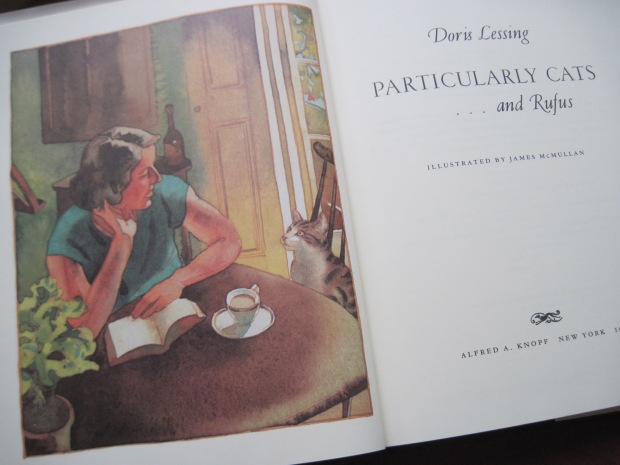
My favorite thing about the book is the watercolor illustrations by James McMullan.
My rating:
 The Unadulterated Cat: A Campaign for Real Cats by Terry Pratchett
Like Douglas Adams or Monty Python, Terry Pratchett is, alas, a representative of the kind of British humor I just don’t get. But I rather enjoyed this small novelty book (bought for my husband for Christmas) all the same. For Pratchett, a “Real” cat is a non-pampered, tough-as-nails outdoor creature that hunts and generally does its own thing but also knows how to wrap its human servants around its paws. I like his idea of “cat chess” as a neighborhood-wide feline game of strategy, moving between carefully selected vantage points to keep an eye on the whole road yet avoid confrontation with other cats. It’s certainly true on our street. And this is quite a good summary of what cats do and why we put up with them:
What other animal gets fed, not because it’s useful, or guards the house, or sings, but because when it does get fed it looks pleased? And purrs. The purr is very important. It’s the purr that makes up for the Things Under the Bed, the occasional pungency, the 4 a.m. yowl.
My rating:
 On Cats by Charles Bukowski
“In my next life I want to be a cat. To sleep 20 hours a day and wait to be fed. To sit around licking my ass.” I’d never read anything else by Bukowski, so I wasn’t sure quite what to expect from this book, which is mostly composed of previously unpublished poems and short prose pieces about the author’s multiple cats. The tone is an odd mixture of gruff and sentimental. Make no mistake: his cats were all Real cats, in line with the Pratchett model. A white Manx cat, for instance, had been shot, run over, and had his tail cut off. Another was named Butch Van Gogh Artaud Bukowski. You wouldn’t mess with a cat with a macho name like that, would you? My favorite passage is from “War Surplus,” about an exchange he and his wife had with a store clerk:
“what will the cats do if there is an explosion?”
“lady, cats are different than we are, they are of a lower order.”
“I think cats are better than we are,” I said.
the clerk looked at me. “we don’t have gas masks for cats.”
My rating:
Is there a terrific cat book out there that I haven’t read yet? I do hope so! Please add your suggestions in the comments.
When the Sky Fell Apart by Caroline Lea
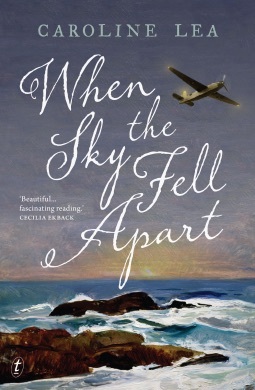 “Perhaps, Claudine thought, warmth and kindness didn’t have a country or a language.”
Caroline Lea’s strong debut novel is set on Jersey, one of the Channel Islands between England and France, in the years of German occupation surrounding the Second World War. Although it’s told in a shifting, close third person, the book opens with and keeps returning to the perspective of ten-year-old Claudine Duret. It’s through her eyes that we view the striking first scene, which takes place in June 1940:
When he was on fire, the man smelt bitter. … Even after they had tipped buckets of sea water over him, he still smelt. But sweeter. It reminded her of Maman’s Sunday lunch: roast pork with blackened skin and the cooked fat seeping out through the cracks. Claudine’s mouth watered.
It’s appropriate that Claudine thinks of meat, for the man on fire is Clement Hacquoil, the local butcher. He is the island’s first war injury, the victim of a bombing raid on the St. Helier harbor. As people come together to help him, we meet some of the terrific supporting characters, including Dr. Tim Carter, an Englishman who fears he’ll never fit into this insular community; and Edith Bisson, Claudine’s former babysitter, who concocts herbal remedies.
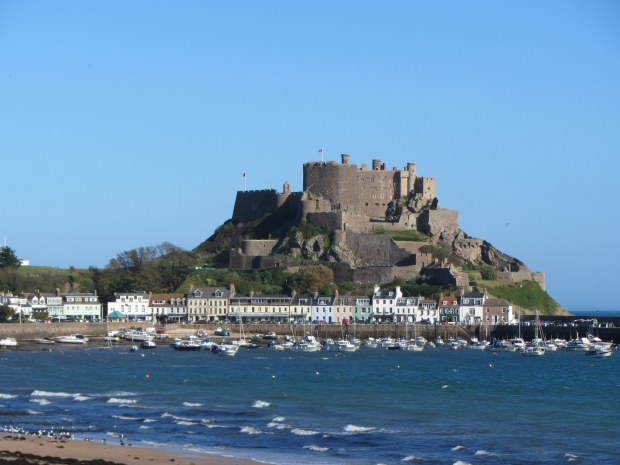
My husband and I explored Jersey in October 2013. This is Mont Orgueil Castle. Photo by Chris Foster.
Two weeks previously there was a call to evacuate and roughly half the island’s population fled – “Like rats … buggering off at the first sign of trouble,” as one old clinger-on taunted. Those who remain are stubborn or without the resources to leave, like Maurice, a former fisherman and now full-time caregiver for his wife Marthe, who has Huntington’s disease. Dr. Carter is determined to stay even after a German commandant and his troops take over the hospital. Claudine, left to her own devices during her mother’s black moods, makes friends with a German soldier, Gregor, but has unpleasant encounters with other soldiers.
A couple things precipitate the book’s crisis: Marthe’s condition is deteriorating but Dr. Carter thinks treatments available in London could help her; and Gregor is in hiding because the Commandant wants to send him to a work camp. Maurice has the idea of escaping to London with Marthe on his fishing boat, and Gregor, Claudine and Edith plan to go along.

Grosnez Castle, a 14th-century ruin. Photo by Chris Foster.
I found the trip preparations a bit belabored, such that the whole novel might be improved by a cut of 60–80 pages. I also wondered whether the contrast between Gregor and Hans, the two main German soldiers we meet, was too stark and stereotyping. However, I loved the book’s distinctive characters, the inconclusive ending I didn’t expect, the snippets of foreign languages (not just German and French, but also Jèrriais) and Lea’s atmospheric descriptions of Jersey. She was born and raised on the island, and in passages like this you can sense her fondness for its landscape:
The island was like a beautiful jewel: formed by years of pressure and compression, shaped by the elements and then constrained and combed and ordered by the metallic tools of man. … To the east, picture-perfect houses, like clutches of crafted eggs, nestling by the golden beaches. To the west, the vast mudflats where children could pour salt into a hole in the mud and razorfish might pop out like a conjuror’s trick. The steady breaking and wombing of the sea, metronomic measure of seeping time.
I would not hesitate to recommend this to book clubs (see the reader questions here, but beware spoilers!) and to fans of The Guernsey Literary and Potato Peel Pie Society and Esther Freud’s Mr. Mac and Me. I look forward to reading what Caroline Lea writes next.
My rating: 
Note: When the Sky Fell Apart was published by Text Publishing in the U.K. and Australia on February 25th. It is currently available in the U.S. as a Kindle book; a paperback release is scheduled for November.
My thanks go to Caroline Lea for the free signed copy, won through a Twitter giveaway.
Hope for a Cool Pillow by Margaret Overton
“There must be better and worse ways to die. It seems both rational and possible to minimize the likelihood of an unpleasant end.”
~William T. Vollmann, “A Good Death”
 If pressed to say which books Margaret Overton’s wry, out-of-the-ordinary new memoir most reminded me of, I’d describe it as a cross between Atul Gawande’s Being Mortal and Roz Chast’s Can’t We Talk about Something More Pleasant? The Chicago-area anesthesiologist is the author of a previous memoir, Good in a Crisis (2012), about the aftermath of a divorce and a brain aneurysm. Her latest book, which released on March 1st, started off as a manifesto on the need for an overhaul of American end-of-life care, with a strong drive towards creating an advanced directive and otherwise being meticulously prepared for one’s own death.
From there, I gather, the book took on a life of its own. It’s delightfully digressive, incorporating cases Overton observed in the hospital where she worked and lessons gleaned from a Harvard Business School course on healthcare delivery but also her personal experience of guiding her parents through their last days – her father died of lung cancer in 1998 and her mother, who suffered from dementia, finally followed in 2010.
Years surrounded by infirmity and the possibility of death have convinced her of the benefits of hospice and physician-assisted suicide, still only legal in a few states. We need to know (as we already do for our pets) when suffering is too much and stop extending life at any cost, Overton insists – rather than allowing hospitals to profit from death, as currently happens, with many elderly patients undergoing expensive and ultimately ineffectual procedures in their final weeks. “The last six months of life accounted for roughly twenty-five percent of our Medicare spending.”
For as universal as suffering and death are, we sure are wont to refuse them space in our lives. Again and again Overton uses the striking metaphor of “lemon juice,” drawn from a news story about a hapless would-be bank robber who thought spraying himself with lemon juice would make him invisible to onlookers and police. In our daily lives, she opines, we keep wearing that lemon juice, denying that there is a problem with our healthcare system and our thinking about death.
My thoughts kept coming back to care at the end of life. How do we change the end game? How do we make it better for the elderly, for those of us who will some day become elderly, and how do we save our country some money in the process so that when it is our turn, there will be money left in the system to provide us with the care we want? It seemed to me that if we could just tinker with this one aspect of healthcare, a number of other issues would fall into place.
What’s so special about this book is seeing the problem from several angles and perspectives: that of a physician, that of a healthcare researcher, and that of a dutiful daughter. Overton keeps her narrative interesting by avoiding chronological rundowns; instead she intercuts, sometimes paragraph by paragraph, multiple anecdotes – alternating a hospital case with her mother’s last days, say, or jumping between her experience at the Harvard course and her father’s treatment. I can see how some might find the non-consecutive structure off-putting, but I loved every bit of this short, powerful book, from the evocative title through to the excellent final chapter. Anyone who has enjoyed the aforementioned Gawande and Chast books should not hesitate to make this their next read.
See also this Chicago Tribune article on Margaret Overton.
With thanks to publicist Beth Parker for the e-copy for review.
My rating:
Six Books I Abandoned Recently
Are they not criminals, books that have wasted our time and sympathy, are they not the most insidious enemies of society, corrupters, defilers, the writers of false books, faked books, books that fill the air with decay and disease?
Strong words there, from Virginia Woolf in “How Should One Read a Book?” I’m not quite so fervently opposed to these six books I abandoned recently, but I do share Woolf’s feeling of having had my time wasted. Particularly since I started as a freelance book reviewer, I’ve noticed that I am not very patient with my leisure reading: if a book doesn’t totally grab me and keep me turning the pages with rapt interest, I’m more likely to leave it unfinished. Better if I can do that before spending too much time with a book, but sometimes I approach the halfway point before finally giving up.
Below I give brief write-ups of the abandonees. I’d be interested to hear if you’ve read any of them and thought they were worth persisting with.
 Of Love and Desire by Louis de Bernières
Like so many, I enjoyed Captain Corelli’s Mandolin but haven’t tried much else from de Bernières. These are love poems: many of them Greek-influenced; most of them sentimental and not very interesting. I marked out one passage I liked, but even it then turns into a clichéd relationship poem: “I looked behind and saw the long straight line of my mistakes, / Faithful as hounds, their eyes alert, trailing in my wake. But / They weren’t dogs, they were women, some fair, some dark …” (from “Mistakes”). [Read the first 25 pages.]
My rating: 
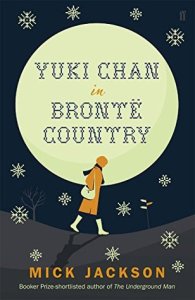 Yuki Chan in Brontë Country by Mick Jackson
The premise for this one – young Japanese woman visits the Brontë sites in Yorkshire as a way of reconnecting with her departed mother – sounded so interesting, but the third-person narration is very flat and detached. It makes Yuki and all the other characters seem like stereotypes: the fashion-obsessed Asian girl, the horde of Japanese tourists. I also noticed that far too many sentences and paragraphs start with “She.” I couldn’t be bothered to see how it would turn out. [Read the first 26%.]
My rating:
 Shylock Is My Name by Howard Jacobson
I’d read Jacobson’s three most recent novels and liked them all well enough. He’s certainly your go-to author if you want a witty discussion of the modern Jewish “persecution complex.” I think the problem with this one was that I wasn’t sure what it wanted to be: a contemporary Jewish novel, or a Hebrew fable, or some mixture thereof. Shylock is pretty much dropped in as is from The Merchant of Venice, so it’s unclear whether he’s Strulovitch’s hallucination or a time traveler or what. The exasperated father characters are well drawn, but their flighty daughters less so. I just got to a point where I didn’t care at all what happened next, which to me was the sign to give up and move on to something else. [Read the first 43%.]
My rating:
 As Close to Us as Breathing by Elizabeth Poliner
The writing is measured and lovely, and I appreciated the picture of late-1940s life for a Jewish family, but the pace was killing me: this is set in one summer, but with constant flashbacks and flash-forwards to other family stories, such that although we learn on page 1 that a character has died, even by the 60% mark I still had not learned how. Also, the narrator is telling everything in retrospect from 1999, but there is too little about her life at that present moment. I would direct readers to Elizabeth Graver’s The End of the Point instead. [Read the first 60%.]
My rating:
 The Book of Aron by Jim Shepard
I’d read such rave reviews of this novel set in the Warsaw ghetto during the Second World War, and I’ve always meant to try something by Jim Shepard, so this seemed an ideal place to start. I decided to stop because although this is a fairly believable child’s voice, it is only being used to convey information. To me the spark of personality and the pull of storytelling are lacking. I felt like I was reading a history book about the Holocaust, subtly tweaked (i.e. dumbed down and flattened) to sound like it could be a child’s observations. [Read the first 53 pages.]
My rating:
 Georgia by Dawn Tripp
Who doesn’t love Georgia O’Keeffe’s dreamy paintings of flowers and southwestern scenes? Initially I loved her tough-as-nails voice in this fictionalized autobiography, too, but as the story wore on it felt like she was withholding herself to some degree, only giving the bare facts of (dry, repetitive) everyday life and (wet, repetitive) sex scenes with 24-years-her-elder photographer Alfred Stieglitz. Call me impatient, but I couldn’t be bothered to stick around to see if something actually happened in this novel. I think I’d be interested in glancing through O’Keeffe and Stieglitz’s correspondence, though, just to see how the voices compare to what Tripp has created here. [Read the first 48%.]
My rating:
Reviews Roundup, February–March
One of my goals with this blog was to have one convenient place where I could gather together all my writing that appears in disparate online locations. To that end, once a month I provide links to all book reviews I’ve published elsewhere, with a rating (below each description) and a taster so you can decide whether to read more. A few exceptions: I don’t point out my Kirkus Indie, BlueInk or Publishers Weekly reviews since I don’t get a byline. Meanwhile, I’ve done my first article for the Los Angeles Review of Books – exciting!
The Bookbag
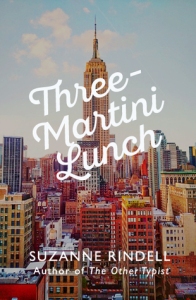
Three-Martini Lunch by Suzanne Rindell: Brings the late 1950s, specifically the bustling, cutthroat New York City publishing world, to life through the connections between three young people who collide over a debated manuscript. The three first-person voices fit together like a dream. It’s an expert evocation of Beat culture and post-war paranoia over Communism and homosexuality. Walking into Eden’s office, especially, you’ll think you’ve landed on the set of Mad Men. This classy, well-plotted follow-up will win Rindell even more fans and tide us all over until the film version of The Other Typist – produced by and starring Keira Knightley – appears. Releases May 19th in the UK.

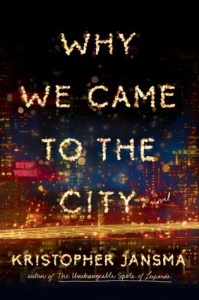 Why We Came to the City by Kristopher Jansma: Five university friends strive to make their lives count against the indifferent backdrop of recession-era New York City. When one of them falls ill, they pull together like a family. The tone of the novel lies somewhere between A Little Life and the sitcom Friends (a Mexican version of which the characters watch obsessively). Even as his characters realize that they are not special and not in control of their lives, Jansma never lets his book descend too far into gloom. Narrowly misses out on 5 stars from me because the storyline loses momentum in Part Two. Rich with emotion and literary allusions (from Walden to The Iliad), this is my favorite novel of the year so far.
Waltzing in Vienna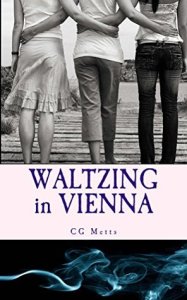 by C.G. Metts (& interview): Three girlfriends – a singer staging a comeback, a psychology professor reawakening to sexuality after being widowed, and a socialite Southern Belle – are reunited in Charleston, South Carolina in their early forties. Remembering their wild college days, they wonder how to make midlife count. There’s a fun Sex and the City or Ya-Ya Sisterhood vibe to this recommended debut novel. I liked the mixture of nostalgia and gentle feminism, and I think this may also inspire readers to see South Carolina’s coastal landscape for themselves. The title phrase is the friends’ shorthand for smoking marijuana together.
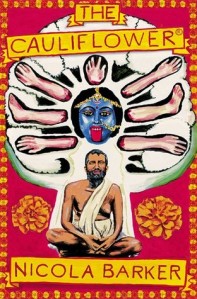 The Cauliflower® by Nicola Barker: Put simply, this is a fictionalized biography of the largely illiterate Hindu guru Sri Ramakrishna (1836–1886). That may sound dry as dust, but Barker makes it a playful delight by skipping around in time and interspersing aphorisms, imagined film scenes, questions and answers, and even a recipe with the narrative chapters. The kernel of the story – set in 1857 at the Dakshineswar Kali Temple, six miles north of Calcutta – is narrated in the first person by the guru’s nephew, Hriday. Scripture of all types (the Bible is also cited) is a relevant, joyful echo here rather than a dull set of rules. Bizarre but very readable. Releases April 21st.
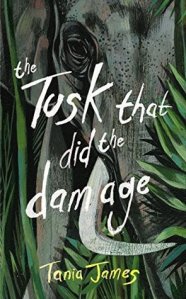 The Tusk That Did the Damage by Tania James: This composite picture of the state of wildlife conservation in India is told from three perspectives: an elephant named the Gravedigger, a poacher, and a documentary filmmaker. James ably intersperses three voices as she explores how people fail to live up to their ideals and make harmful assumptions. Despite these attributes, it was one of those books I had to force myself through. Perhaps it was the environmental agenda: if a book is going to wear its message so openly, it has to live up to it in terms of the writing. I might have preferred it if the whole novel had been from Emma’s point of view, with one climactic encounter with the Gravedigger to make the poaching question immediate and not simply academic.
BookBrowse
Dog Run Moon: Stories by Callan Wink [subscription service]: Wink’s debut story collection, set mostly under Montana’s open skies, stars a motley cast of aimless young men, ranchers, Native Americans, and animals live and dead. He plays around with Western stereotypes in intriguing ways. A few of the tales are a bit less compelling, and I would have preferred more variety in narration (8 of 9 are third person), but the stand-outs more than make up for it. My two favorites were “Runoff” (there’s a double meaning to the title) and “Exotics,” in which all the characters are lured by the life they don’t currently have.
 For Books’ Sake
Interview with Rachel B. Glaser, author of Paulina & Fran [my review of which was in last month’s roundup]
Foreword Reviews
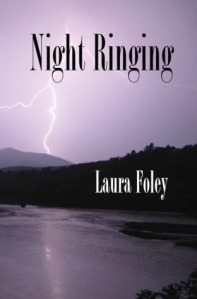 Night Ringing by Laura Foley: Foley’s strong fifth collection ruminates on romance and family via autobiographical free verse. One of the collection highlights is “In the Honda Service Area,” which unexpectedly unites modern technology with ancient literature. While a woman describes her impending hip replacement surgery to a friend, Foley tries to concentrate on Homer’s Iliad. The collection is dedicated to Foley’s partner, Clara Giménez, and lesbian romance is a subtle undercurrent. Especially recommended for fans of Jane Hilberry and Adrienne Rich.
The Temple of Paris by Laura DeBruce: This second volume in Laura DeBruce’s Quicksilver Legacy trilogy is a fast-paced fantasy adventure novel. In the previous book, the author introduced the “Immortals,” centuries-old creatures who are impervious to disease and aging due to a magic elixir. If Hana, the teenage protagonist, can learn how to use the elixir in her possession correctly, she can save her mother from a potentially fatal blood disorder. Although the complicated plot might be challenging for those new to the series, older teens will appreciate the rollicking story and the chance for vicarious European sightseeing.
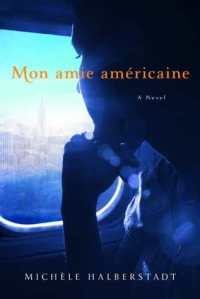 Mon amie américaine by Michèle Halberstadt: After years of heavy smoking and migraines, a brain aneurysm plunges forty-year-old Molly into a coma. The novel is presented as Michèle’s confessional letter to her American friend Molly, addressed in the second person. During Molly’s coma and after she wakes up, Michèle ponders their unlikely friendship and also frets over her threatened marriage. The novella is like a cross between Jenny Offill’s Dept. of Speculation and Jean-Dominique Bauby’s The Diving-Bell and the Butterfly, and bears tantalizing traces of deliberate homage to Pedro Almodóvar’s coma-themed Talk to Her: an understated dual account of betrayal and disability.
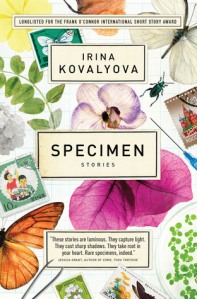 Specimen: Stories by Irina Kovalyova: “People like to pretend that our genes define the truth for us. But I assure you that’s not the case,” a character insists in the title story. Diverse in setting and form, these nine stories, long-listed for the Frank O’Connor International Short Story Award, contrast the scientific understanding of genetics with deeper wisdom about the bonds of love and family. Nestling science into rich psychological narratives, Kovalyova’s work is reminiscent of that of Andrea Barrett and A. S. Byatt; in fact, the latter is directly referenced in one story. She also channels Anthony Marra and Adam Johnson by affirming love’s survival in spite of repressive situations.
Of Crime and Passion by Jonathan Harnisch: In this novella, a proud young man seeks to transcend his underprivileged upbringing by worming his way into the homes of the rich and seducing powerful women. At its heart, the book is about the ongoing conflict between economic and social classes. With the melodramatic action and old-fashioned dialogue, though, it is easy to imagine this coming-of-age tale working better in the form of a play.
Hakai Magazine
(a Canadian publication highlighting coastal ecosystems)
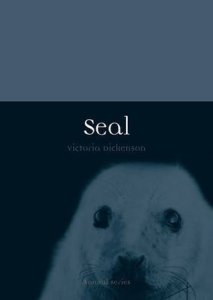 Seal by Victoria Dickenson: “It is hard to imagine a creature more distant from the human species in bodily form, habits, and habitat than the seal,” Dickenson writes in her introduction, “yet our mutual regard tells of a long, shared history of interaction.” Seal is the latest in the 80-strong Animal series from Reaktion Books. Like other volumes, this gives a brief discussion of the featured animal’s evolutionary biology, followed by an interdisciplinary survey of how it has entered human culture throughout history. In the final two chapters—the highlight of an occasionally dry book—Dickenson gives a balanced account of the history of hunting seals.
Los Angeles Review of Books
“Rediscovering an Overlooked Woman Novelist”: A dual review of Constance Fenimore Woolson: Portrait of a Lady Novelist by Anne Boyd Rioux () and Miss Grief and Other Stories (), a new selection of Woolson’s short fiction.
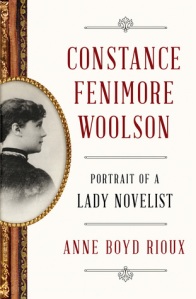
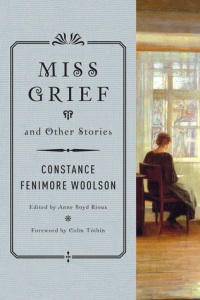 Constance Fenimore Woolson (1840–1894) is most often remembered for her connection to male writers; her great-uncle was pioneering American novelist James Fenimore Cooper, and in her later years as an expatriate in Europe she associated with Henry James, fueling rumors of a romance between them. Deserving to be known in her own right, Woolson represents key junctures between realism and regionalism, and between American and European styles. Gives a remarkable picture of a bold, bright woman who paved the way for writers such as Edith Wharton, E. M. Forster, and Willa Cather, and who arguably might be hailed in the same breath as Henry James and George Eliot.
Nudge
My quick response to Instructions for a Heatwave, for a Maggie O’Farrell retrospective: Another spot-on tale of family and romantic relationships – O’Farrell always gets the emotional tenor just right. You may spot hints of Rachel Joyce’s The Unlikely Pilgrimage of Harold Fry or Bernhard Schlink’s The Reader, but the psychological and linguistic precision is all O’Farrell’s own. Her descriptive language is unfailingly elegant. I love how she opens with the heat as the most notable character: “It inhabits the house like a guest who has outstayed his welcome: it lies along corridors, it circles around curtains, it lolls heavily on sofas and chairs.”
Pretentiousness: Why It Matters by Dan Fox: This wide-ranging essay discusses pretentiousness as it relates to class, taste, and modern art. Fox grew up outside of Oxford but now lives in New York City, where he is the co-editor of frieze. From its Latin etymology we learn that pretentious means “to stretch before,” so to hold something in front of you like a mask. He thus starts off by talking about acting techniques and rhetoric, then broadens this out to themes of authenticity and self-discovery. The most interesting part of the book concerns class connotations. This is a somewhat meandering work, and though it has good individual lines it is not always riveting.
 Third Way magazine
I’ve reviewed books, mostly fiction, for them for the last 2.5 years; sadly, the April 2016 issue will be the final one. It’s a shame; the progressive Christian perspective on popular culture is a niche it will be hard to fill.
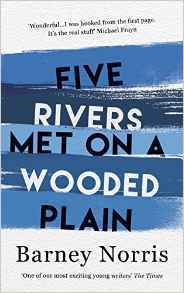
Five Rivers Met on a Wooded Plain by Barney Norris: Barney Norris is a playwright in his twenties, so it’s no surprise that there’s something a little staged to his debut novel. The lives of the book’s five narrators collide one night when a car hits a moped in Salisbury town center. We hear from each protagonist in turn as they reflect on their losses and wonder whether religion – represented by Salisbury Cathedral and the scripture and rituals of Christianity – might help. Rita is the liveliest and most engaging character, difficult as her expletive-strewn narrative might be to traverse. Like David Nicholls, Norris prizes emotional connection and delivers a theatrical plot. If he can avoid the more clichéd aspects of a novel like One Day, he could have a long career in fiction ahead of him. Releases April 21st.
I also post reviews of most of my casual reading and skimming on Goodreads:
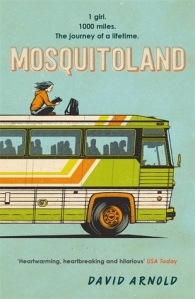 Mosquitoland by David Arnold: I don’t read a whole lot of YA, but the voice of this one captured me right away. Like Hazel in The Fault in Our Stars, Mim (Mary Iris Malone) is a lovably sarcastic oddball – she describes herself as “a young Ellen Page” à la Juno – with some hidden issues that come out over the course of the book. Here Mim’s journey takes the form of a road trip from Mississippi, where she lives with her father and new stepmother, back to Ohio to be with her sick mother. She meets a kooky cast of secondary characters along the way, narrowly escapes danger, and even gets a chance at romance.
A Change of World: Poems by Adrienne Rich: This is a forthcoming Norton reissue of Rich’s first collection from 1951. I’d always thought of her as a later, feminist poet, so it was jolting to see an introduction from W.H. Auden – that made it feel like a real generational crossover. It’s a very impressive debut, full of mannered, rhyme-rich verse. Two favorites were “Walden 1950” (“Thoreau, lank ghost, comes back to visit Concord, / Finds the town like all towns, much the same— / A little less remote, less independent”) and “The Innocents.” I’ll be interested to read some of her later work and see if she loosened up with form. Releases June 21st.
 The Shadow Hour by Kate Riordan: A clever dual-timeline novel with a pleasing Gothic flavor. In 1922 Grace Fairford takes up a governess position at Fenix House near Cheltenham, the very place where her grandmother, Harriet Jenner, worked in 1878. Every few chapters the perspective shifts from Grace (first person) to Harriet (third person). The novel is full of coincidences and the sense of history repeating itself. Riordan’s writing is capable, sometimes clichéd, but the echoes of Jane Eyre and The Turn of the Screw make this a delicious guilty-pleasure read.
Life’s Too Short to Pretend You’re Not Religious by David Dark: Etymologically, the word “religion” means to bind together again. Simply put, Dark’s thesis is that we’re all connected: we are in relationship with the people around us and can’t pretend otherwise. What we need is a shared vision for our shared life, and that involves engaging with other people. No pie-in-the-sky theology here; Dark affirms Daniel Berrigan’s assertion that “the actual world is our only world,” so things like climate change, gun control, immigration, and foreign policy are religious issues because they affect us all in this life. Together we have to imagine another story that isn’t capitalism and American imperialism as usual.
Adios, Cowboy by Olja Savičević Ivančević: In summer 2009, Dada (aka Rusty) returns to her Croatian hometown to care for her mother. Going home facing up to the fact of her brother’s death – when he was 18 he threw himself under a train. “One has to sit down beside one’s demon and mollify it until it’s calm – that’s all, perhaps, that can be done,” she muses. Now for the title: Dada’s late father, brother, and friends (“the Iroquois Brothers”) were all big on cowboys and Indians. When news comes that a spaghetti western actor/director named Ned Montgomery will be passing through town, it causes Dada to think about her father and her brother and, what’s more, about the workings of her own memory.
Now Go Out There: (and Get Curious) by Mary Karr: There’s not much to this Syracuse University commencement speech. Leftovers of sob-story autobiography and clichéd advice cobbled together. Disappointing given how much I loved Karr’s recent The Art of Memoir. For a truly inspirational graduation address, I recommend David Foster Wallace’s This Is Water.
 How to Be Here: A Guide to Creating a Life Worth Living by Rob Bell: Bell left his pastoral role to become a motivational speaker so, unsurprisingly, this book is closer to self-help than theology. He’s good pals with Elizabeth Gilbert, and this book would make a great companion piece to her Big Magic. It’s about how to find what gets you out of bed in the morning and live mindfully. As always, his formatting – bite-size paragraphs, stretching out phrases with line breaks – is slightly annoying. I didn’t learn a whole lot; it was more a case of being reminded of things I knew deep down. He prefaces most chapters with an anecdote about his creative ventures, some of which were utter failures.
And my highest recommendation goes to…
The Summer Guest by Alison Anderson: The kernel of the novel is a true story: for two summers in the late 1880s, Chekhov stayed at the Lintvaryovs’ guest house in Luka, Ukraine. One strand of the narration is a journal kept during those years by Zinaida, the family’s eldest daughter, a doctor dying of a brain tumor. Zina’s story is offset by those of two contemporary women. Katya, a Russian émigré in London who’s trying to keep her failing publishing house afloat, sends the never-before-published diary to Ana, a translator based near the French border with Switzerland. There’s a touch of mystery here: where was the diary found? And what became of the novel Chekhov mentions he had in progress? Ana’s search for answers takes her to the Lintvaryov estate, even though Ukraine in 2014 is a hotbed of unrest. Having recently watched the BBC War & Peace miniseries with rapt interest and seen a Tchaikovsky symphony performance, it was the perfect time to get lost in an intricate, playful novel about how Russian literature still resonates. I’ll certainly be looking up Anderson’s other novels.
Girl at War Paperback Release
Next Thursday, the 24th, marks the UK paperback publication of Girl at War by Sara Nović, which I reviewed last year for BookBrowse (a subscription-only site, but you can see an excerpt of my review here). It was #3 on my list of last year’s best fiction, so I’m delighted that Little, Brown Book Group got in touch asking me to help publicize the paperback release. They created a shareable image with a snippet of my NetGalley feedback.
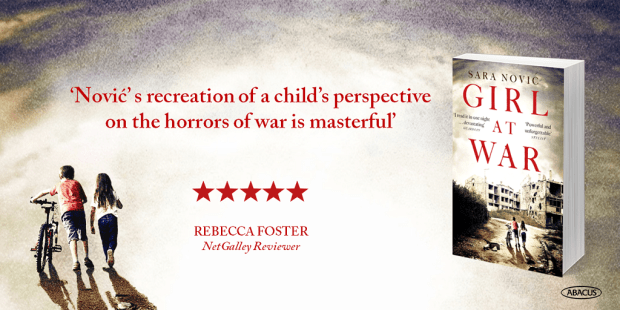
This pitch-perfect debut novel is an inside look at the Yugoslavian Civil War and its aftermath, from the perspective of a young girl caught up in the fighting. If you haven’t already read it, I encourage you to seek it out soon.
At the Existentialist Café by Sarah Bakewell
 I’ve long meant to read Sarah Bakewell’s How to Live, a biography of Montaigne that also promises to be a deep examination of philosophical and ethical issues. When I heard she had a new book out, I jumped at the chance to learn more about existentialism. I’ve come away from At the Existentialist Café with only a nebulous sense of what existentialism actually means (though Bakewell’s bullet-pointed list of points towards a definition on page 34 is helpful), but certainly with more knowledge about and appreciation for Jean-Paul Sartre and Simone de Beauvoir, two of her main subjects. This is appropriate given the shift in Bakewell’s thinking: “When I first read Sartre and Heidegger, I didn’t think the details of a philosopher’s personality or biography were important. … Thirty years later, I have come to the opposite conclusion. Ideas are interesting, but people are vastly more so.”
Some of the interesting characters herein, apart from Sartre and de Beauvoir (always referred to in these pages as “Beauvoir,” which irked me unduly), are Edmund Husserl, Martin Heidegger, Karl Jaspers, Hannah Arendt, Maurice Merleau-Ponty and Albert Camus. It’s a large cast; you may well find yourself flipping back and forth to the helpful who’s who list in the back of the book. I was amused to see that Freiburg, Germany is the seat of phenomenology (which gave rise to existentialism) – I’m heading there in June to stay with friends at the start of a mini European tour. Husserl was the chair of philosophy at Freiburg, and Heidegger his colleague.
The best I can make out, Heidegger’s philosophy was about describing experience to get to the heart of things. Disregard peripherals and focus on the self’s knowledge of the world, he advised. His best known work, Being and Time, contrasted individual beings with Being itself (i.e. ontology). Think of him as an experimental, modernist novelist, Bakewell advises; understanding what he’s doing with his philosophy is difficult otherwise. Existentialism built on this framework but emphasized freedom and how it is exercised in particular situations.
World War II, especially the year 1945, was a turning point for many of the philosophers discussed. Sartre was held in a POW camp but his eye troubles gave him a way out. Many left Europe for America due to anti-Semitism, including Hannah Arendt and Bruno Bettelheim. Although Heidegger contrasted “the they” (das Man – more similar, perhaps, to the English phrase “the Man”) with the voice of conscience in such a way that suggested one should resist totalitarianism, he would later be exposed as a Nazi. In the following years, the United States became very popular culturally: jazz music, film noir, Hemingway. At the same time, the French were shocked at America’s racial inequality. Sartre believed that one should always take the opinion of the “least favored” or most oppressed party in any situation, which would lead him to speak out for minorities and the colonized, as in the Algerian liberation movement of the 1950s–60s. In the meantime, the rise of the Soviet Union and the development of the atom bomb would emerge as imminent societal threats.
Sartre and de Beauvoir had an open relationship but clearly relied on and felt deeply about each other, especially when it came to their writing. Bakewell convinced me of Sartre’s surprising sex appeal, despite his unprepossessing appearance: “down-turned grouper lips, a dented complexion, prominent ears, and eyes that pointed in different directions.” Apparently he had a silly side and would even do Donald Duck impressions. At the same time, he had rock-solid convictions, as evidenced by his refusal of the Légion d’Honneur and the Nobel Prize. I also learned that he was a biographer of Jean Genet and Gustave Flaubert; his biography of the latter, in three volumes, stretched to 2800 pages! Bakewell waxes anti-lyrical in her account of the disheartening experience of reading it: “Occasional lightning flashes strike the primordial soup, although they never quite spark it into life, and there is no way to find them except by dredging through the bog for as long as you can stand it.”
From the title and subtitle (“Freedom, Being and Apricot Cocktails”), I expected this book to be a bit more of a jolly narrative than it was. The frequent Left Bank Paris setting is atmospheric, but the tone is never as blithe as promised. I would also have liked some additional autobiographical material from Bakewell, who grew up in Reading, England (where I currently live) and met the existentialists through Sartre’s Nausea at age 16.
In the end the fault may not be her book’s but mine: I wasn’t up for fully engaging with a multi-subject biography packed with history and hard-to-grasp philosophical ideas. I’d recommend this to readers who long for bohemian Paris and have enjoyed either an existentialist work or a philosophical novel like Sophie’s World (Jostein Gaarder) or 36 Arguments for the Existence of God (Rebecca Goldstein).
My rating:
With thanks to Chatto & Windus for the review copy.
Further reading: If anything, I think I’m likely to try de Beauvoir’s autobiographical works – the descriptive language Bakewell quotes from them sounds appealing, and of course she was fundamental in paving the way for modern feminism.
You can read an excerpt from At the Existentialist Café, about de Beauvoir’s composition of The Second Sex, at Flavorwire. See also Bakewell’s Guardian list of 10 reasons why we should still be reading the existentialists.
Have you read anything by the existentialists? What would you recommend?
Books in Brief: Five I Loved Recently
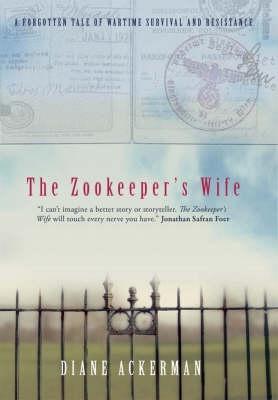 The Zookeeper’s Wife
By Diane Ackerman
A different sort of Holocaust story, set at Warsaw Zoo in the years surrounding World War II. Even after Nazis dismantled their zoo and killed many of the larger animals, Jan and Antonina Żabiński stayed at their home and used the zoo’s premises for storing explosives and ammunition for Jan’s work in the Polish resistance as well as sheltering “Guests,” Jews passing through. This is a gripping narrative of survival against the odds, with the added pleasure of the kind of animal antics you’d find in a Gerald Durrell book. Their son Ryszard kept as pets a badger who bathed sitting back in the tub like a person and an arctic hare who stole cured meats like “a fat, furry thug.” Much of the book is based on Antonina’s journals, but I wish there had been more direct quotes from it and less in the way of reconstruction.
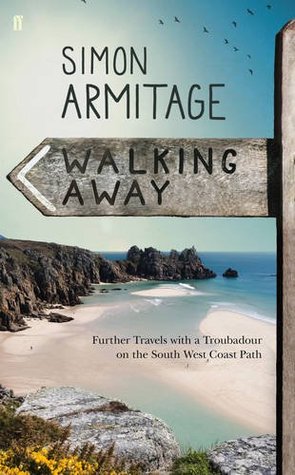 Walking Away: Further Travels with a Troubadour on the South West Coast Path
By Simon Armitage
As a sequel to Walking Home, the account of his 2010 trek along the Pennine Way, Armitage walked much of England’s South West Coast Path in August–September 2013. As before, he relied on the hospitality of acquaintances and strangers to put him up along the way and transport his enormous suitcase for him so he could walk about 10 miles a day to his next poetry reading. Emulating a modern-day troubadour, Armitage passed around a sock at the end of readings for donations (though the list of other stuff people left in the sock, with which he closes the book, is quite amusing). Along the way he meets all kinds of odd folk and muses on the landscape and the distressing amounts of seaside rubbish. His self-deprecating style reminded me of Bill Bryson. A pleasant ramble of a travel book.
 Winter World: The Ingenuity of Animal Survival
By Bernd Heinrich
This great seasonal read carefully pitches science to the level of the layman. Heinrich, an emeritus professor of biology at the University of Vermont, surveys various strategies animals use for surviving the winter: caching food, huddling together, hibernating or entering torpor, and lowering their body temperature – even to the point where 50% of their body water is ice, as with hibernating frogs. He carries out ever so slightly gruesome experiments that make him sound like a lovably nutty professor:
To find out how quickly a fully feathered kinglet loses body heat, I experimentally heated a dead kinglet and then measured its cooling rate. … I do not know how many seeds a chipmunk usually packs into each of its two pouches—I easily inserted sixty black sunflower seeds through the mouth into just one pouch of a roadkill.
His passion for knowledge carries through in his writing. I came away with a fresh sense of wonder for how species are adapted to their environments: “Much that animals have evolved to do would have seemed impossible to us, if experience has not taught us otherwise.”
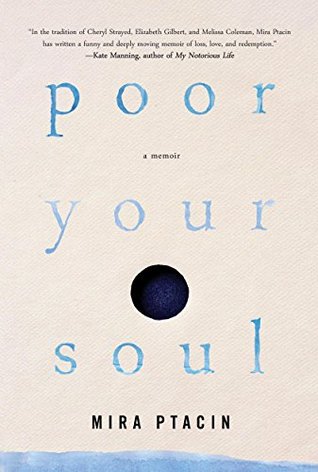 Poor Your Soul
By Mira Ptacin
Ptacin’s memoir is based around two losses: that of her brother, in a collision with a drunk driver; and that of a pregnancy in 2008. She skips back and forth in time to examine the numb aftermath of trauma as well as the fresh pain of actually going through it. In places I felt Ptacin sacrificed the literary quality hindsight might have allowed, prioritizing instead the somewhat clichéd thoughts and responses she had in the moment. Still, I loved so much about this book, especially her memories of growing up in the cereal capital of America and the account of her mother coming to America from Poland. Her mother is a terrific character, and it’s her half-warning, half-commiserative phrase that gives the novel its title (not a typo, as you might be forgiven for thinking): a kind of Slavic “I pity the fool.”
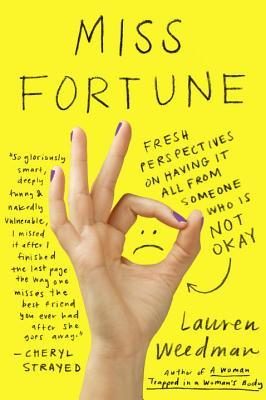 Miss Fortune: Fresh Perspectives on Having It All from Someone Who Is Not Okay
By Lauren Weedman
Weedman is a playwright and minor celebrity who’s worked on The Daily Show, Hung and Looking. This is a truly funny set of essays about marriage (from beginning to end), motherhood, working life and everything in between. Self-deprecatingly, she focuses on ridiculous situations she’s gotten herself into, like the world’s unsexiest threesome and an accidental gang symbol tattoo. Amid the laughs are some serious reflections on being adopted and figuring out how to be a responsible stepmother. With a warning that parts can be pretty raunchy, I’d recommend this to fans of David Sedaris and Bossypants.
 Bookish Beck = Rebecca Foster. American transplant to England. Freelance proofreader and book reviewer.
 Bookish Beck