Six Degrees of Separation: From What I Loved to The Story of an African Farm
I’m a Six Degrees regular now: this is my sixth month taking part. This time (see Kate’s introductory post) we have all started with Siri Hustvedt’s What I Loved (2003). Narrated by a professor and set between the 1970s and 1990s, it’s about two New York City couples – academics and artists – and the losses they suffer over the years.
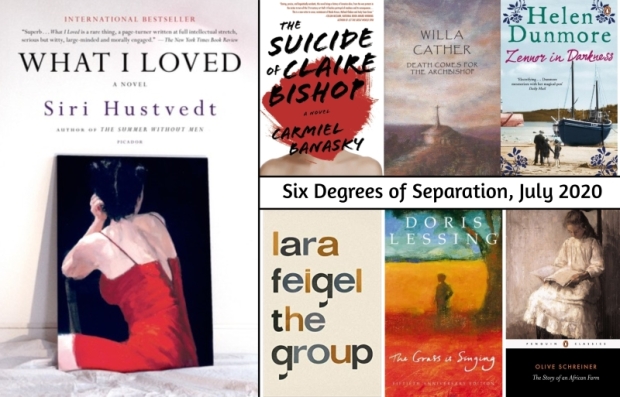
 #1 The readalike I chose when I read What I Loved for a Valentine’s Day post in 2017 was The Suicide of Claire Bishop by Carmiel Banasky, which I’d covered for Foreword Reviews in 2015 (see here); it shares the themes of modern art and mental illness.
#2 Death + a “bishop” leads me to Death Comes for the Archbishop (1927), which vies with My Ántonia for the top spot from the six novels I’ve read so far by Willa Cather. It’s set in Santa Fe, New Mexico in the nineteenth century. I read it shortly after my trip to Santa Fe for the D.H. Lawrence Society of North America conference in the summer of 2005.
#3 Although I don’t think I’ve read a Lawrence novel in the past 15 years, I still enjoy reading about him, e.g. in Frieda by Annabel Abbs. My next biographical novel that includes DHL and his wife as characters will be Zennor in Darkness by Helen Dunmore (1994).
#4 Although it’s mostly set in London among university friends now in their late thirties or early forties, a few late scenes of The Group by Lara Feigel (brand new; I’ll be reviewing it in full later this month) are set in Zennor, Cornwall.

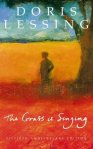
#5 The other book I’ve read by Lara Feigel is Free Woman, her bibliomemoir about marriage, motherhood and the works of Doris Lessing. My favorite of the six books I’ve read so far by Lessing is The Grass Is Singing (1950), set on a farm in Zimbabwe.
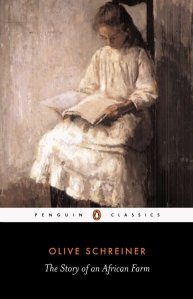 #6 The Story of an African Farm by Olive Schreiner (1883) is one of the novels I wrote about for my MA dissertation on female characters with unconventional religious views in the Victorian novel. In particular, I looked at the intersection of dissenting religious fiction and the “New Woman” novels that paved the way for Modernism. This is an obscure classic well worth picking up for its early feminist perspective; Schreiner was also a socialist and anti-war campaigner.
My chain has featured only books by women again this month: a few classics, a historical novel with real people in it, an updated modern classic (the Feigel – I’ll discuss its debt to Mary McCarthy’s The Group in my review), and more. The themes have included art, death, feminism, friendship, and religion.
Join us for #6Degrees of Separation if you haven’t already! Next month’s starting book is How to Do Nothing by Jenny Odell.
Have you read any of my selections?
Are you tempted by any you didn’t know before?
Six Degrees of Separation: From Normal People to The Bass Rock
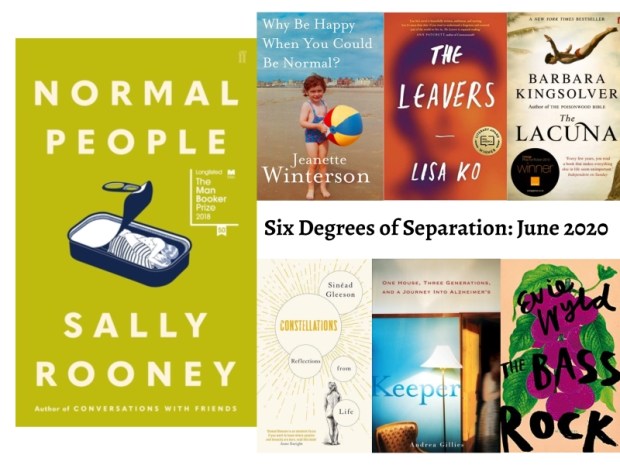
I’m a #6Degrees regular now: this is my fifth time participating. This month (see Kate’s introductory post) we start with Sally Rooney’s Normal People (2018). I loved Conversations with Friends but wasn’t so enamored with Rooney’s second novel (see my review), so I haven’t been tempted to watch the television adaptation; I don’t have a TV anyway.
#1 Picking out one of the words from the book title, and echoing the question that Rooney’s characters seem to be asking themselves, I’ll hop over to a memoir I enjoyed a lot in late 2011, Why Be Happy When You Could Be Normal? by Jeanette Winterson. Adopted into a strict religious household, Winterson had to hide her sexuality. Here you get the full story behind her autobiographical debut novel, Oranges Are Not the Only Fruit.

#2 Adoption is my link to The Leavers by Lisa Ko. When he’s abandoned by his mother, an undocumented Chinese immigrant in the USA, Daniel is adopted by a pair of white professors. This is an achingly beautiful story of searching for a mother and a sense of belonging. It won the 2016 PEN/Bellwether Prize for Socially Engaged Fiction.
#3 Barbara Kingsolver created and funds the biennial Bellwether Prize for unpublished fiction that addresses issues of social justice. I have vague ambitions to read as many Bellwether and Women’s Prize winners as I can. While it’s not one of my favorites by Kingsolver, The Lacuna (2009) won her the (then) Orange Prize. A historical novel, it’s largely set in the household of Diego Rivera and Frida Kahlo.
#4 Frida Kahlo is my link to Constellations by Sinéad Gleeson, autobiographical essays about the female body in pain. Kahlo is one of Gleeson’s gurus in that she turned her chronic pain and pregnancy loss into art – “making wounds the source of inspiration.” Constellations was our Not the Wellcome Prize winner during this hiatus year for the official prize.
#5 The first winner of the Wellcome Book Prize, in 2009, was Keeper by Andrea Gillies, a memoir of her mother-in-law Nancy’s struggle with Alzheimer’s disease. I also intend to read as many WBP winners and nominees as possible, so I recently ordered a secondhand copy of this and read the introduction before setting it aside for another time. Already I can tell it will be an engaging if harrowing book; Gillies pulls no punches in her depiction of the misery of the years when Nancy lived with her family and then in an institution.


[#5.5 Another book called Keeper, this one by Jessica Moor, provides my cheaty half-step. I found this debut novel to be a gripping and grimly fascinating story of why women stay with their abusers and what finally drives them to leave.]
 #6 Violence against women is also the theme of The Bass Rock by Evie Wyld, my novel of 2020 so far. While it ranges across the centuries, it always sticks close to the title location, an uninhabited island off the east coast of Scotland. It cycles through its three strands in an ebb and flow pattern that is appropriate to the coastal setting and creates a sense of time’s fluidity. This is not a puzzle book where everything fits together. Instead, it is a haunting echo chamber where elements keep coming back, stinging a little more each time. A must-read, especially for fans of Claire Fuller, Sarah Moss and Lucy Wood. (See my full Shiny New Books review.)
I’ve featured only books by women this month, and there have been quite a number of prize winners in here, too.
Join us for Six Degrees of Separation if you haven’t already!
Have you read any of my selections? Are you tempted by any you didn’t know before?
New Reading Projects! (Join Me?)
It’s only one week since we announced the Not the Wellcome Prize winner, the culmination of a month-long project that was months more in the planning. I don’t think I’ll be coordinating another blog tour anytime soon, as it was a lot of work finding participants, working out a schedule and keeping on top of the publicizing via social media. Still, it was a lot of fun, and already I’m missing the buzz and ready to get stuck into more projects.
I’d love it if you joined me for one or more of these. Some could be combined with your 20 Books of Summer or other challenges, too.
Ongoing buddy reads
 It would have been Richard Adams’s 100th birthday on the 9th. That night I started rereading his classic tale of rabbits in peril, Watership Down, which was my favorite book from childhood even though I only read it the once at age nine. I’m 80 pages in and enjoying all the local place names. Who would ever have predicted that that mousy tomboy from Silver Spring, Maryland would one day live just 6.5 miles from the real Watership Down?!
 My husband is joining me for the Watership Down read (he’s not sure he ever read it before), and we’re also doing a buddy read of Arctic Dreams by Barry Lopez. In that case, we ended up with two free copies, one from the bookshop where I volunteer and the other from The Book Thing of Baltimore, so we each have a copy on the go. Lopez’s style, like Peter Matthiessen’s, lends itself to slower, reflective reading, so I’m only two chapters in. It’s novel to journey to the Arctic, especially as we approach the summer.
I plan to take my time over these two, so tell me if you have a copy of either and feel like picking it up at any point over the next few months.
Bibliotherapy self-prescriptions
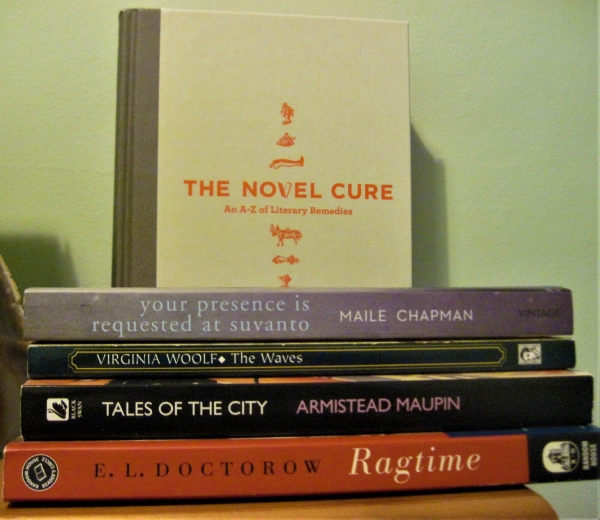
The other day I got out my copy of The Novel Cure by School of Life bibliotherapists Ella Berthoud and Susan Elderkin and browsed through the categories for some prescriptions that might feel relevant to the current situation. I found four books I own that fit the bill:
From the list of “The Ten Best Novels to Lower Your Blood Pressure”: Your Presence Is Requested at Suvanto by Maile Chapman & The Waves by Virginia Woolf (and I’ve read another three of them, including, recently, Crossing to Safety).
One of several prescriptions for Loneliness: Tales of the City by Armistead Maupin.
The cure for Zestlessness: Ragtime by E. L. Doctorow.
If you have access to one of these, or have a copy of The Novel Cure and are keen on following up on another of the prescriptions, let me know.
And now for two memes that I (think I) have created. Although I’m sure something similar has been done in the past, I couldn’t find any specific blogs about them. I don’t know about you, but I always need encouragement to pick up books from my own shelves – even though libraries are currently closed, I’m still working my way through a library stack, and I’m tempted to make another order of new books from Hungerford Bookshop. It’s great to support libraries and independent bookstores, of course, but there could be no better time to mine your own bookshelves for treasures you bought ages ago but still have never read.
Journey through the Day with Books
I enjoyed picking out 18 books from my shelves that refer to particular times of day or meals or activities associated therewith. Four of these are books I’ve already read and four are ones I’m currently reading. You can piggyback on my selections if you wish, or find your own set.
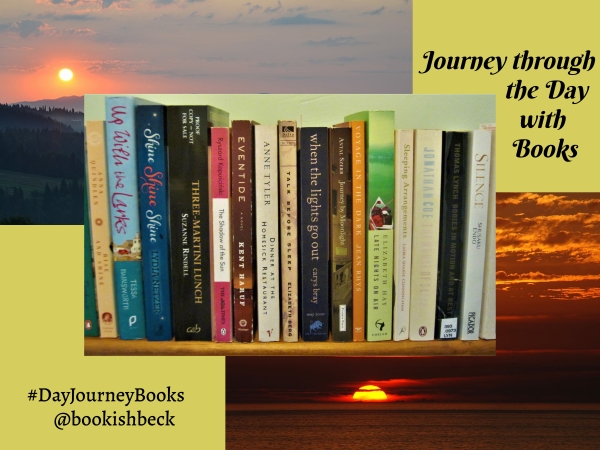
Here’s my full list:
Zennor in Darkness by Helen Dunmore
Rise and Shine by Anna Quindlen
Up with the Larks by Tessa Hainsworth
Shine Shine Shine by Lydia Netzer
Three-Martini Lunch by Suzanne Rindell
The Shadow of the Sun by Ryszard Kapuściński
Eventide by Kent Haruf
Dinner at the Homesick Restaurant by Anne Tyler
Talk before Sleep by Elizabeth Berg
When the Lights Go Out by Carys Bray
Journey by Moonlight by Antal Szerb
Voyage in the Dark by Jean Rhys
Late Nights on Air by Elizabeth Hay
Sleeping Arrangements by Laura Shaine Cunningham
The House of Sleep by Jonathan Coe
Bodies in Motion and at Rest by Thomas Lynch
Silence by Shūsaku Endō
Arctic Dreams by Barry Lopez
The Four in a Row Challenge
I’ve been contemplating this one for quite a while. It’s inspired by Phyllis Rose’s The Shelf –from LEQ to LES: Adventures in Extreme Reading (one of Simon’s favourite books – see his review), for which she picked a shelf of the New York Society Library, eliminated duplicates and repeat entries from the same author, and read the remainder – whether she’d heard of them or not; whether they were awful or not. (“Hands down the worst book on the shelf is Le Queux’s Three Knots, a mystery that reads as if it were written by an eight-year-old on Percocet.”)

This is a variation in that you’re looking at your own TBR shelves and picking a set of four books in a row. For many, that will be four novels whose authors’ surnames all start with the same letter. But if you organize your books differently (especially within nonfiction), you may find that the set of four is more arbitrary. You never know what they might have in common, though (book serendipity!).
I’m no strict challenge host, so if you want to engineer your shelf order, or if you decide to swap a book in later on, that is no problem at all. My one firm rule is only one book per author.
I’ve picked out a few appealing sets, all from my fiction shelves. F, G, L and M had particularly rich pickings. I’ll report back as I finish each set, while the “Journey through a Day” may well take me the whole rest of the year.
Still ongoing (more here): Projects to read as many Bellwether Prize, Wellcome Book Prize and Women’s Prize winners as possible, as well as Wellcome long- and shortlistees.
Can I tempt you to take part in any of these reading projects?
[Journey through the Day: Sunrise in Pieniny, Poland (Pudelek / CC BY-SA (https://creativecommons.org/licenses/by-sa/4.0)) / Sunset (Alvesgaspar / CC BY-SA (https://creativecommons.org/licenses/by-sa/3.0))
Four in a Row: Four pelicans in a row (Sheba_Also 43,000 photos / CC BY-SA (https://creativecommons.org/licenses/by-sa/2.0)) / Phone boxes, Market Place, Ripon (Tim Green from Bradford / CC BY (https://creativecommons.org/licenses/by/2.0))]
Six Degrees of Separation: From The Road to On Being Different
This month’s Six Degrees of Separation (see Kate’s introductory post) starts with Cormac McCarthy’s bleak dystopian novel The Road (2006).
I’ve read several of McCarthy’s novels, including this one. Believe it or not, this is not the darkest – that would be Blood Meridian.

#1 Sticking with the road trip theme, I’ll start by highlighting one of my favorite novels from 2018, Southernmost by Silas House. Tennessee preacher Asher Sharp’s family life falls apart when he welcomes a homosexual couple into his church. After being voted out of his post, he kidnaps his son and drives to Key West, Florida, where his estranged gay brother lives.


#2 A minister is also the main character in Abide with Me by Elizabeth Strout (2006). I finished this one, my fourth novel from Strout, a couple of weeks ago. She tenderly probes the dark places of a mid-twentieth century Maine community and its pastor’s doubts, but finds the light shining through. From first line to last word, this was gorgeous.
#3 “Abide with Me,” Reverend Tyler Caskey’s favorite hymn, gives the novel its title. Also named after a song is Norwegian Wood by Haruki Murakami (1987/2000). I have a copy on the shelf and tried the first 20 pages a couple of months ago, but it was so normal – compared to The Wind-Up Bird Chronicle, anyway – that I felt disoriented and set it aside.


#4 Returning to bleakness … the Norwegian reference takes me one of the first books from Norway I remember reading: Hunger by Knut Hamsun (1890). It’s a spare story of a starving writer who wanders the streets of Oslo looking for opportunities for food and publication, tramping about simply to keep warm at the onset of a bitter Scandinavian winter.
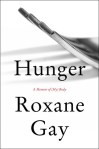
#5 Same title; rather different contents: Hunger by Roxane Gay (2017) is a collection of short autobiographical essays that riff on weight, diet, exercise and body image. The writing style is matter-of-fact and never self-pitying. This is still the only thing I’ve read by her, but I mean to read more, starting with her novel An Untamed State.
[#5.5 Her surname takes me to the title of my cheaty half-step, A Gay and Melancholy Sound by Merle Miller (1962), a semi-autobiographical novel about a man from Iowa who helps free the concentration camps and then has a career as a theatrical producer. It was Nancy Pearl’s first Book Lust Rediscoveries reprint book and is on my TBR.]
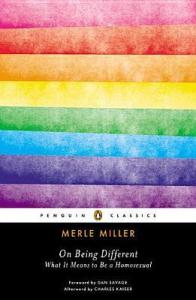 #6 While it’s not implied by that title, Miller was, er, gay, which leads to another of his books, On Being Different. I have Pearl to thank for leading me to this 1971 essay, which was republished in book form in 2013. It’s an insider’s view of what it is like to be a homosexual. A period piece now, it feels like a precursor to the revolution in gay rights. It’s one of the books (along with Straight by Hanne Blank and Conundrum by Jan Morris) that have most boosted my tolerance and compassionate understanding.
(This loops nicely back to #1 and the story of a preacher accepting homosexuality in his family as well as in his church congregation.)
Join us for #6Degrees of Separation if you haven’t already!
Have you read any of my selections? Are you tempted by any you didn’t know before?
Six Degrees of Separation: From Stasiland to The End of the Point
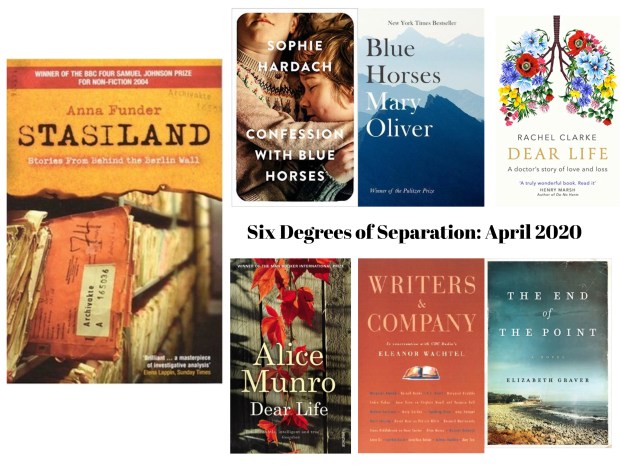
It’s my third time participating in Kate’s Six Degrees of Separation meme (see her introductory post). The challenge starts with Stasiland (2003) by Anna Funder, which I also happened to read recently. While working part-time for an overseas television service in what was once West Berlin, Funder started gathering stories of how ordinary people were put under surveillance and psychologically terrorized by the Stasi, the East German secret police. She molds her travels and her interviewees’ testimonies into riveting stories – though this won the Samuel Johnson Prize for nonfiction in 2004, it’s as character-driven as any novel.
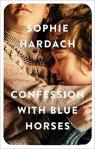
#1 My interest in Stasiland was piqued by reading Sophie Hardach’s Costa Prize-shortlisted novel Confession with Blue Horses (2019). When Ella’s parents, East German art historians under Stasi surveillance, were caught trying to defect during a ‘vacation’ to Hungary in 1987, their three children were taken from them and only two were returned. Ella is determined to find her brother, whom they’ve had no word of since, via a correspondence with the Stasi archive. It’s an emotionally involving story of one ordinary family’s losses and reconstruction.

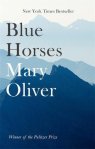 #2 Blue Horses (2014) is one of Mary Oliver’s lesser poetry collections. I found it to be a desperately earnest and somewhat overbaked set of nature observations and pat spiritual realizations. There are a few poems worth reading (e.g., “After Reading Lucretius, I Go to the Pond” and Part 3 of “The Fourth Sign of the Zodiac”), and lines here and there fit for saving, but overall this is so weak that I’d direct readers to Oliver’s landmark 1980s work instead.
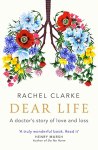
#3 Oliver’s poetry, especially “Wild Geese” and “The Summer Day,” gets quoted everywhere. The latter’s most famous lines, “Tell me, what is it you plan to do / with your one wild and precious life?” appears in Dear Life by Rachel Clarke, my book of 2020 so far. Clarke specializes in palliative medicine and alternates her patients’ stories with her own in a completely natural way. A major theme is her relationship with her late father, also a doctor, and his lessons of empathy and dedication. A passionate yet practical book, this aims to get people talking about end-of-life issues.
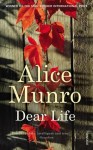
#4 I have meant to read Dear Life by Alice Munro (2012) since before she won the Nobel Prize. I was sent a free paperback copy for a Nudge review, but as the site already had a review of the book up, I let it slip and never followed through. More than once I’ve put this short story collection onto a reading stack, but I have never quite gotten past the first page or two. At some point this must be rectified.
#5 Alice Munro is one of the authors featured in Writers & Co. by Eleanor Wachtel (1993), a terrific collection of interviews from Wachtel’s weekly Canadian Broadcasting Corporation radio program. Whether I’d read anything by these authors (or even heard of them) or not, I found each Q&A chock-full of priceless nuggets of wisdom about creativity, mothers and daughters, drawing on autobiographical material, the writing process, and much more.

#6 My first-ever author Q&A, for Bookkaholic in 2013, was related to The End of the Point by Elizabeth Graver. (Alas that the site is now defunct, so the interview only exists as a file on my computer.) In an astonishing historical sweep, from Massachusetts’s first colonial settlers through the cultural upheavals of the twentieth century, Graver’s family saga with a difference questions parent‒child ties, environmental responsibility, and the dictates of wealth and class. Her complex, elegiac tale, reminiscent of Virginia Woolf’s To the Lighthouse and Liza Klaussmann’s Tigers in Red Weather, offers multiple points of view in a sympathetic gaze at a vanishing way of life – but an enduring sense of place.
Join us for #6Degrees of Separation if you haven’t already!
Have you read any of my selections? Are you tempted by any you didn’t know before?
Book Spine Poetry Returns
The literary world continues to revolve, rapidly replacing all in-person events with online ones. On Thursday night I was meant to be in London seeing Anne Tyler. Instead, I spent the evening on Twitter, watching a literary prize announcement, attending two virtual book launches, and (pre)ordering three March releases from my nearest independent bookstore, Hungerford Bookshop. Today I sent the shop owner a long list of book recommendations for the website. I offered remote bibliotherapy for customers and she asked me to add to her curated lists of Long books, Books that are part of a big series, Books to make you laugh, and Books about hope (that last one was really hard). I’m also going to be taking part in two blog tours in early April for novels whose book tours were cancelled. A hint is below.
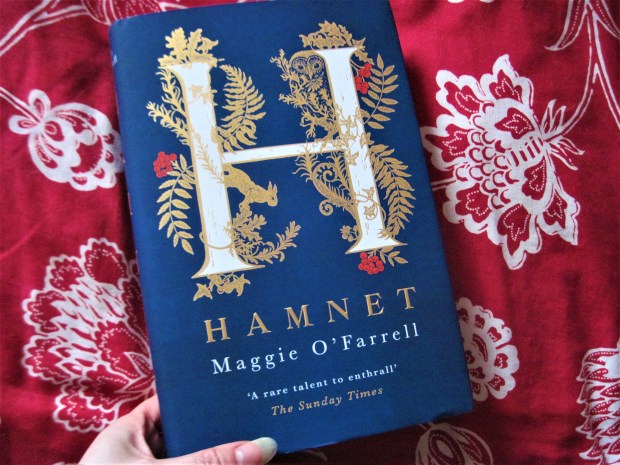
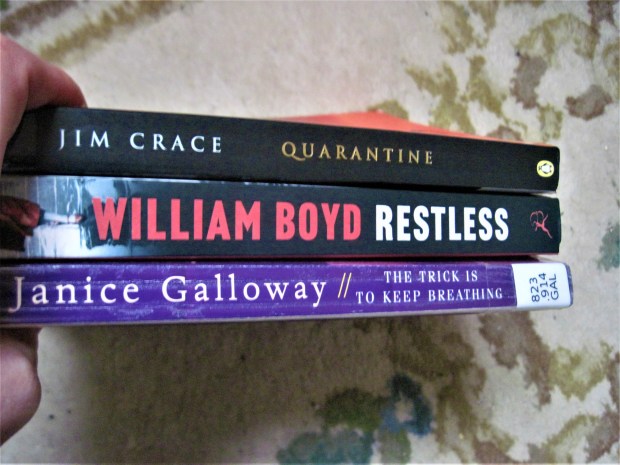
I’m continuing to read and write to the blog plan I had set up for March into April. What else is there to do? In the meantime, I assembled some titles, mostly from books on my bedside table, into a few impromptu poems. Remember what fun book spine poetry was back in 2016? (My efforts from that short-lived craze are here and here.)
A partial haiku for our times:
Plus two more wee poems of hope and lament.
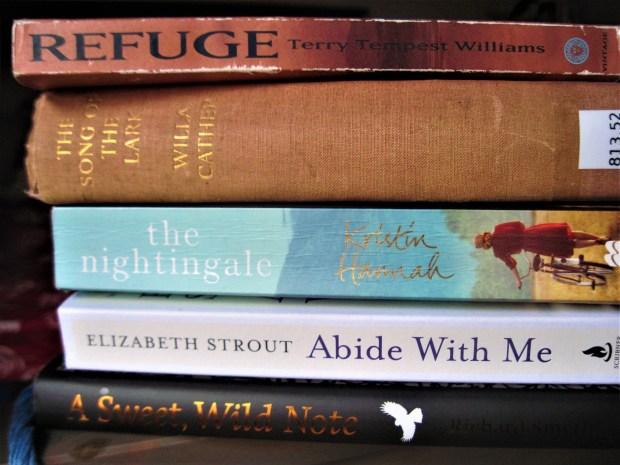
Refuge
The song of the lark,
The nightingale
Abide with me
A sweet, wild note.
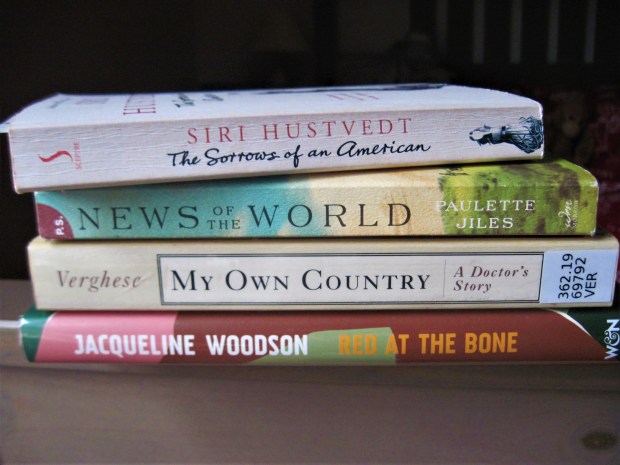
The Sorrows of an American
News of the world:
My own country,
Red at the bone.
I hope you are all staying safe and keeping your spirits up.
What have you been reading that has felt particularly appropriate or comforting?
Six Degrees of Separation: From Wolfe Island to Riverine
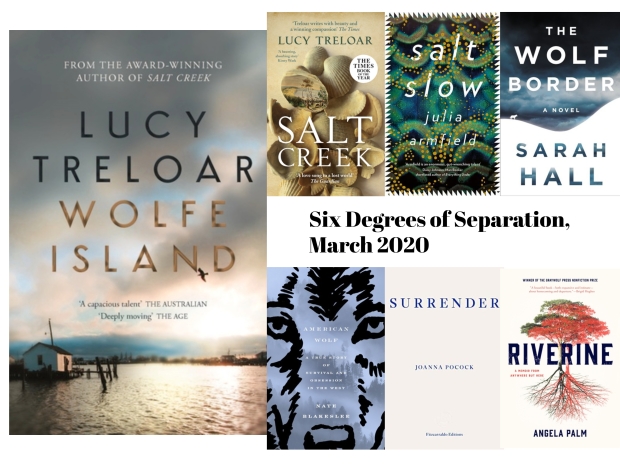
It’s my second month participating in Kate’s Six Degrees of Separation meme (see her introductory post). This time the challenge starts with Wolfe Island by Lucy Treloar. Alas, as far as I can tell this hasn’t yet been published outside of Australia. Which is such a shame, because I absolutely adored…
#1 Salt Creek, Treloar’s debut novel. I read it in 2018 and deemed it “one of the very best works of historical fiction I’ve read.” A widowed teacher settled in England looks back on the eight ill-fated years her family spent at an outpost in South Australia in the 1850s–60s. It’s a piercing story of the clash of cultures and the secret prejudices that underpin our beliefs.
#2 I recently saw someone on Twitter remarking on the apparent trend for book titles to have the word “Salt” in them. Of the few examples he mentioned, I’ve read and enjoyed Salt Slow by Julia Armfield, which was on the Young Writer of the Year Award shortlist last year. The book’s nine short stories are steeped in myth and magic, but often have a realistic shell.
#3 One story in Salt Slow, “Formerly Feral,” is about a teenager who has a wolf for a stepsister. So, to get back to the literal wording of our starting point (a homonym, anyway; I didn’t know whether to take this in the Salt direction or the Wolf direction; now I’ve done both!), another work of fiction I read that incorporated wolves was The Wolf Border by Sarah Hall, a fantastic novel to which Scottish independence and rewilding form a backdrop.
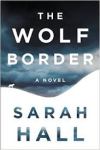
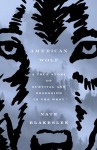
#4 The controversy over the reintroduction of wolves to Yellowstone National Park – and the decision to remove their endangered status, thus declaring open season for hunters – is at the heart of the nonfiction study American Wolf by Nate Blakeslee. “The West was caught up in a culture war, and for some people it was more than just a metaphor,” he writes.
#5 Wolves and rewilding in the American West also come into the memoir-in-essays Surrender by Joanna Pocock, about the two years of loss and change she spent in Missoula, Montana and her sense of being a foreigner both there and on her return to London.
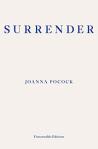
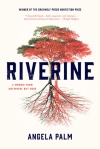
#6 A wonderful memoir-in-essays that was criminally overlooked in 2016 was Riverine by Angela Palm (my BookBrowse review). It has such a strong sense of place, revealing how traces of the past are still visible in the landscape and how our environment shapes who we are. Palm reflects on the winding course of her life in the Midwest and the people who meant most to her along the way, including a friend who was later sentenced to life in prison for murdering their elderly neighbors. In keeping with the watery imagery, there is a stream-of-consciousness element to the writing.
Join us for #6Degrees of Separation if you haven’t already!
Have you read any of my selections? Are you tempted by any you didn’t know before?
Six Degrees of Separation: From Fleishman Is in Trouble to Shotgun Lovesongs
I’ve not participated in Kate’s Six Degrees of Separation meme before, although I’d seen it around on other people’s blogs. I think all this time I’d misunderstood, assuming that you had to go from the start point to one particular end point. Instead, bloggers are given one book to start with and then have free rein to link it to six other books in whatever ways. Most of the fun is in seeing the different directions and destinations people choose. I am always drawing connections between books I read and noting coincidences (e.g., my occasional Book Serendipity posts), so this is a perfect meme for me! I’m very late in posting this month – for a while I was stuck on link #4 – but next month I’ll be right on it.
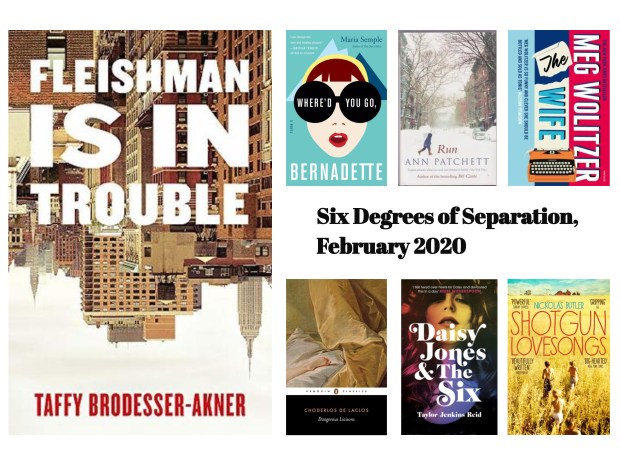
#1 Fleishman Is in Trouble by Taffy Brodesser-Akner: I didn’t care for this debut novel about a crumbling marriage and upper-middle-class angst in contemporary New York City. A major plot point is the mother going missing, just like in Where’d You Go, Bernadette by Maria Semple, a very pleasing epistolary novel I read in 2013.

 #2 There’s also an absent Bernadette in Run by Ann Patchett (2007), which opens with a killer line: “Bernadette had been dead two weeks when her sisters showed up in Doyle’s living room asking for the statue back.” (Alas, I abandoned the novel after 80 pages; it has a lot of interesting elements, but they don’t seem to fit together in the same book.)
#3 Ann Patchett wrote for Seventeen magazine for nine years. Before she ever published a novel, Meg Wolitzer was a winner of Seventeen’s fiction contest. Wolitzer’s The Wife (2003), my current book club read in advance of our March meeting, is a bitingly funny novel narrated by a woman trapped in a support role to her supposedly genius writer husband.

#4 I’ve heard great things about the recent film version of The Wife, which has Glenn Close as Joan Castleman. Close also stars as the Marquise de Merteuil in Dangerous Liaisons (1988). The 1782 Choderlos de Laclos novel was one of the texts we focused on in one of my freshman college courses, Screening Literature. For our final projects, we compared a few film adaptations. My group got Cruel Intentions (1999), a teen flick that provided one of Reese Witherspoon’s breakout roles.
#5 Witherspoon is giving Oprah a run for her money with her Hello Sunshine book club, which has chosen some terrific stuff. I happen to have read nine of her picks so far, and of those I particularly enjoyed Daisy Jones and the Six by Taylor Jenkins Reid.
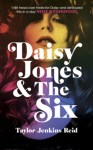

#6 Daisy is said to have been inspired by the personal and professional complications of the band Fleetwood Mac. The musical roman à clef element isn’t necessary to understanding the novel, but is fun to ponder. In the same way, Shotgun Lovesongs by Nickolas Butler features a musician modeled after singer/songwriter Bon Iver. I adored Shotgun Lovesongs and have a review of it coming out as part of Friday’s post, so consider this your teaser…
And there we have it! My first ever #6Degrees of Separation.
Have you read any of my selections? Are you tempted by any you didn’t know before?
Choose the Year Book Tag: 2010
Thanks to a couple of Lauras (Reading in Bed and Dr Laura Tisdall) for making me aware of this tag that has also been going around on BookTube. If you haven’t already taken part and think this looks like fun, why not give it a try?
Goodreads lists the 200 most popular books of any given year. Skim through and see how many you’ve read from the list and discuss whichever ones you like. (I chose not to answer the last two questions of this prompt but have included them at the bottom of the post.)
- Choose a year and say why.
I browsed a few of the years and found that 2010 contained 12 books that I’ve read, including some that stood out to me for various reasons. For instance, two of them marked the start of my interest in medical-themed reading. I also think of 2010 as when my reading went into ‘mega’ mode, i.e. approaching 200 books per year. (Now it’s more like 320 a year.)
- Which books published in that year have you read [or if none, heard of]?
Because the list is based on the number of times a book has been added to users’ shelves (though not necessarily read and rated) on Goodreads, there is a LOT of YA and series fiction, e.g. Mockingjay at #1. Other notable inclusions: Heaven Is for Real by Todd Burpo and Orange Is the New Black before that really took off.
Read at the time:
 Gimmicky child narrator, but thoroughly readable: Room by Emma Donoghue (#4)
Medical masterpieces: The Immortal Life of Henrietta Lacks by Rebecca Skloot (#6) and The Emperor of All Maladies: A Biography of Cancer by Siddhartha Mukherjee (#45)
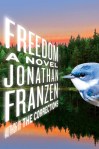 Postmodern, angsty pop culture-filled delights: A Visit from the Goon Squad by Jennifer Egan (#31) and Freedom by Jonathan Franzen (#37). I wonder if they’ve stood the test of time?
Vintage Bryson in curiosity-indulging mode: At Home: A Short History of Private Life by Bill Bryson (#69)
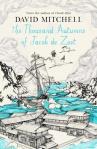 Not his usual sort of thing, but my introduction to him and a damn fine work of historical fiction: The Thousand Autumns of Jacob de Zoet by David Mitchell (#112)
Not my usual sort of thing (sappiness + magic realism), but I read it at a festival and it passed the time: The Particular Sadness of Lemon Cake by Aimee Bender (#116)
Part of my progressive Christian education, but not a great example; not memorable in the least: Radical: Taking Back Your Faith from the American Dream by David Platt (#138)
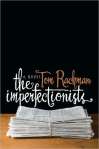 A joy of a linked short story collection set among expat journalists in Rome; this author hasn’t disappointed me since: The Imperfectionists by Tom Rachman (#156)
Who knew typesetting could be so fascinating?! Just My Type: A Book About Fonts by Simon Garfield (#178)
 Read later on:
A brilliant WWII novel, truly among the best of the best: The Invisible Bridge by Julie Orringer (#93)
A DNF: Washington: A Life by Ron Chernow (#73) was way too involved for my level of interest.
- Are there any books published in that year that sound interesting, and would you read them now?
On the TBR:
 #50 Major Pettigrew’s Last Stand by Helen Simonson
#75 The Warmth of Other Suns: The Epic Story of America’s Great Migration by Isabel Wilkerson
#124 Girl in Translation by Jean Kwok
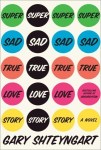
#152 Super Sad True Love Story by Gary Shteyngart
None of these are priorities, but I’d still read them if a copy came my way.
[4. Most obscure-sounding book
5. Strangest book cover]
Do you remember any of these 2010 releases with fondness? Which other ones from the list should I read?
Literary Fiction Book Tag
Thanks to the Lauras (Reading in Bed and Dr Laura Tisdall) for making me aware of this tag that is also going around on BookTube. Laura F. specifically tagged me. If you haven’t already taken part and think this looks like fun, why not give it a try? For my examples I’ve chosen books I read this year or last year.
- How do you define literary fiction?
 My inclination is to adapt one of Italo Calvino’s definitions of a classic (recapped here): a book that will never finish saying all it has to say. In other words, a perennially relevant work that speaks to the human condition. Obviously, not all literary fiction can live up to that standard; some will inevitably feel dated due to its setting, slang, technology, and so on. But at its best, literary fiction voices, and makes an attempt at answering, one or more of life’s biggest questions. As Laura F. says, this generally means that it lends itself to discussion and (re)interpretation. I know I can be an awful snob about genre fiction, but I avoid crime, science fiction, etc. because I find these genres less ‘serious’ and thus less worthwhile than literary fiction.
- Name a literary fiction novel with a superb character study.
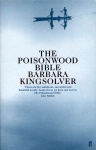
The first novel that comes to mind here is The Poisonwood Bible, which would be a suitable answer for several of these categories but on rereading struck me most for how well developed its five main characters are. Barbara Kingsolver does an impressive job of distinguishing these multiple narrators from each other based on how they speak/write.
- Name a literary fiction novel that has experimental or unique writing.
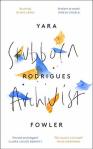 One of the fiction highlights of 2019 so far for me is Stubborn Archivist by Yara Rodrigues Fowler. It stands out from the autofiction field due to its placement of words. Some pages contain just a few lines, or a single short paragraph that reads like a prose poem. Even in the more conventional sections, a lack of punctuation creates a breathless, run-on pace.
- Name a literary fiction novel with an interesting structure.
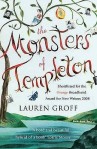 In The Monsters of Templeton, Lauren Groff’s debut novel, Willie Upton is back in her hometown in upstate New York, partway through a PhD and pregnant by her married professor. We hear from various leading lights in the town’s history and/or Willie’s family tree through a series of first-person narratives, letters and other documents.
- Name a literary fiction novel that explores social themes.
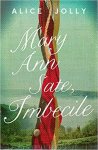 Mary Ann Sate, Imbecile by Alice Jolly, which I reviewed for Nudge, is written entirely in verse and narrated in dialect by an unlearned servant from a cloth mill town in Gloucestershire. With unemployment rising amid the clamor for universal male suffrage, the scene is set for a climactic clash between the common people and the landowning class.
- Name a literary fiction novel that explores the human condition.
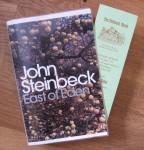 John Steinbeck’s East of Eden has an overarching theme of good and evil as it plays out in families and in individual souls. This weighty material – openly addressed in theological and philosophical terms in the course of the novel – is couched in something of a family saga that follows several generations of the Trasks and the Hamiltons.
- Name a brilliant literary-hybrid genre novel.
 The Sparrow by Mary Doria Russell is a rare sci-fi novel that I loved wholeheartedly. Set on a near-future Jesuit mission to the two alien species on a distant planet, it is about the possibility of believing in God, and doing good works in His name, when suffering seems to be the only result. (See also: The Book of Strange New Things by Michel Faber.)
- What genre do you wish was mixed with literary fiction more?
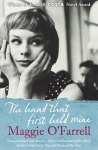 I’ve always felt that Maggie O’Farrell expertly straddles the line between literary and women’s fiction; her books are addictively readable but also hold up to critical scrutiny. Her best is The Hand that First Held Mine, but everything I’ve read by her is wonderful. I’d happily read more books like hers. (Expectation by Anna Hope was slightly less successful.)
 Bookish Beck = Rebecca Foster. American transplant to England. Freelance proofreader and book reviewer.
 Bookish Beck


.jpg)
.jpg)