My Patchy Experience with Book Clubs
I know that a number of you have long-term, faithful book clubs. Boy, am I envious! You might find it surprising that I’ve only ever been in one traditional book club, and it wasn’t a resounding success. Partway through my time working for King’s College, London, an acquaintance from another library branch started the club. A group of five to eight of us from Library Services aimed to meet after work one evening a month at a Southbank venue or a staff room to discuss our latest pick. By poring over old e-mails and my Goodreads library, I’ve managed to remember 10 of the books we read between November 2011 and June 2013:
- Do Androids Dream of Electric Sheep?, Philip K. Dick [classic science fiction]
- The Little Shadows, Marina Endicott [Canadian historical fiction]
- A Spot of Bother, Mark Haddon [contemporary fiction]
- The Talented Mr. Ripley, Patricia Highsmith [classic suspense]
- The Vintner’s Luck, Elizabeth Knox [bizarre historical fiction/magic realism]
- What Was Lost, Catherine O’Flynn [contemporary fiction]
- Franny and Zooey, J.D. Salinger [classic short fiction]
- The Rabbi’s Cat, Joann Sfar [graphic novel in translation]
- Girl Meets Boy, Ali Smith [an update of Greek myth]
- Angel, Elizabeth Taylor [an obscure English classic]
That may well be the complete list. Although I was a member for 20 months until I quit to go freelance, we often only managed to meet every other month because we couldn’t find a mutually convenient free evening or no one had read the book in time. I was consistently frustrated that – even when our selections were only about 200 pages long – I was often one of the only people to have read the whole book.
Overall, the quality of books we chose struck me as mediocre: I rated half of these books 2 stars, and the rest 3 stars. (I think I was a harsher rater then, but it’s not a good sign, is it?) Perhaps this is part of the inevitable compromising that goes with book clubs, though: You humor other people in their choices and hope they’ll be kind about yours? My suggestion, for the record, was the pretty dismal Little Shadows, for which I got a free set of book club copies to review for Booktime magazine. But I also voted in favor of most of the above list.
Looking back, I am at least impressed by how varied our selections were. People were interested in trying out different genres, so we ranged from historical fiction to sci-fi, and even managed a graphic novel. But when we did get together for discussion there was far too much gossipy chat about work, and when we finally got around to the book itself the examination rarely went deeper than “I liked it” or “I hated all the characters.”
If it was profound analysis I was after, I got that during the years I volunteered at Greenbelt, an annual summer arts festival with a progressive Christian slant. I eagerly read the eclectic set of three books the literature coordinator chose for book club meetings in 2010 – Star of the Morning: The Extraordinary Life of Lady Hester Stanhope by Kirsten Ellis, The First Person and Other Stories by Ali Smith, and The Bridge of San Luis Rey by Thornton Wilder – and then as a literature volunteer for the next three years I read and prepared copious notes and questions about our festival “Big Read.” We did Exile by Richard North Patterson in 2011, Dark Eden by Chris Beckett in 2012 and So Many Ways to Begin by Chris Beckett in 2013, and each time I offered to chair the book club meetings.
Unfortunately, due at least in part to logistical considerations, these were run in the way many festival events are: a panel of two to five talking heads with microphones was at the front of the tent, sometimes on a raised dais, while the audience of whatever size sat towards the back. This created a disconnect between the “experts” and the participants, and with the exception of the McGregor meeting I don’t recall much audience input. I’ve mostly blanked out the events – as I tend to for anything that entails public speaking and nervous preparation for something you can’t control – but I was pleased to be involved and I should probably make more of this on my CV. It wasn’t your average book club setting, that’s for sure.
In recent years the closest thing I’ve had to a book club has been online buddy reading. The shadow panels for the Wellcome Book Prize and Sunday Times Young Writer of the Year Award fall into this category, as do online readalongs I’ve done for several Iris Murdoch novels and for C.S. Lewis’s Mere Christianity with various female family members. A few of us book bloggers chatted about Andrea Levy’s Small Island in an online document earlier this year, and my mom and I e-mailed back and forth while reading W. Somerset Maugham’s The Painted Veil in May. I’m also doing my last three of the #20BooksofSummer as online buddy reads, checking in occasionally on Twitter.
Of course, there are some inherent limitations to this kind of discussion – people read at different paces and don’t want to spoil the plot for others, and at some point the back-and-forth fizzles out – but it’s always been easier for me to organize my thoughts in writing, so I likely feel more comfortable contributing than I might in an in-person meeting.
This is all context for my decision to join my neighborhood book club next month. The club arose some months back out of our community’s Facebook group, a helpful resource run by a go-getting lady a few doors down from us. So far it’s turning out to be a small group of thirty- and fortysomething women who alternate meetings at each other’s houses, and the name they’ve chosen gives an idea of the tone: “Books, Booze and Banter.”
I made the mistake of not getting involved right at the start; I wanted to hang back and see what kind of books they’d choose. This means I wasn’t part of the early process of putting titles in a hat, so I’ve looked on snobbishly for several months as they lurched between crime and women’s fiction, genres I generally avoid. (Still, there were actually a couple books I might have joined them for had I not been in America and had they been readily available at the public library.) For many people a book club selection will be the only book they get through that month, so I can understand how they’d want it to be something ‘readable’ that they’d be happy to pick up anyway. Even though statistically I read 27 books a month, I’m still jealously protective of my reading time; I want everything I read to be worthwhile.
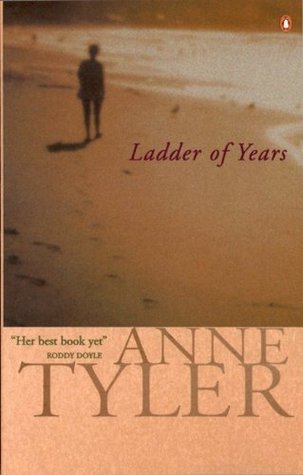 So for September I managed to steer the group away from a poorly received historical novel of over 400 pages and the new Joël Dicker and onto Ladder of Years by Anne Tyler, which the bookstore chain Waterstones has been promoting heavily as one of their books of the month. I already had a charity shop copy in hand and the others liked the sound of it, so we’re all set for September 12th! Future months’ literary fiction choices look promising, too, so provided I enjoy the discussion and the camaraderie I plan to stick with it: a backlist Pat Barker novel I’ve not read, and Kirsty Logan and Jonathan Coe novels I’ve read before and won’t reread but will remind myself about briefly before the meetings.
I’m out of practice with this book club thing. My mother tells me that I have a lot to contribute but that I must also be open to what I’ll learn from other people – even if I don’t expect to. So I don’t want to set myself up as some kind of expert. In fact, I probably won’t even mention that I’m a freelance book reviewer and book blogger. Mostly I’m hoping to find some friendly faces around the neighborhood, because even though we’ve lived here just over two years I still only know a handful of names and keep myself to myself as I work from home. Even if I have to read books I wouldn’t normally, it’ll be worth it to meet more people.
What has your experience with book clubs (in person and online) been?
Painful but Necessary: Culling Books, Etc.
I’ve been somewhat cagey about the purpose for my trip back to the States. Yes, it was about helping my parents move, but the backstory to that is that they’re divorcing after 44 years of marriage and so their home of 13 years, one of three family homes I’ve known, is being sold. It was pretty overwhelming to see all the stacks of stuff in the garage. I was reminded of these jolting lines from Nausheen Eusuf’s lush poem about her late parents’ house, “Musée des Beaux Morts”: “Well, there you have it, folks, the crap / one collects over a lifetime.”


On the 7th I moved my mom into her new retirement community, and in my two brief spells back at the house I was busy dealing with the many, many boxes I’ve stored there for years. In the weeks leading up to my trip I’d looked into shipping everything back across the ocean, but the cost would have been in the thousands of dollars and just wasn’t worth it. Although my dad is renting a storage unit, so I’m able to leave a fair bit behind with him, I knew that a lot still had to go. Even (or maybe especially) books.
Had I had more time at my disposal, I might have looked into eBay and other ways to maximize profits, but with just a few weeks and limited time in the house itself, I had to go for the quickest and easiest options. I’m a pretty sentimental person, but I tried to approach the process rationally to minimize my emotional overload. I spent about 24 hours going through all of my boxes of books, plus the hundreds of books and DVDs my parents had set aside for sale, and figuring out the best way to dispose of everything. Maybe these steps will help you prepare for a future move.

The Great Book Sort-Out in progress.
When culling books, I asked myself:
- Do I have duplicate copies? This was often the case for works by Dickens, Eliot and Hardy. I kept the most readable copy and put the others aside for sale.
- Have I read it and rated it 3 stars or below? I don’t need to keep the Ayn Rand paperback just to prove to myself that I got through all 1000+ pages. If I’m not going to reread Jane Smiley’s A Thousand Acres, better to put it in the local Little Free Library so someone else can enjoy it for the first time.
- Can I see myself referring to this again? My college philosophy textbook had good explanations and examples, but I can access pithy statements of philosophers’ beliefs on the Internet instead. I’d like to keep up conversational French, sure, but I doubt I’ll ever open up a handbook of unusual verb conjugations.
- Am I really going to read this? I used to amass classics with the best intention of inhaling them and becoming some mythically well-read person, but many have hung around for up to two decades without making it onto my reading stack. So it was farewell to everything by Joseph Fielding and Sinclair Lewis; to obscure titles by D.H. Lawrence and Anthony Trollope; and to impossible dreams like Don Quixote. If I have a change of heart in the future, these are the kinds of books I can find in a university library or download from Project Gutenberg.
My first port of call for reselling books was Bookscouter.com (the closest equivalents in the UK are WeBuyBooks and Ziffit). This is an American site that compares buyback offers from 30 secondhand booksellers. There’s a minimum number of books / minimum value you have to meet before you can complete a trade-in. You print off a free shipping label and then drop off the box at your nearest UPS depot or arrange for a free USPS pickup. I ended up sending boxes to Powell’s Books, TextbookRush and Sellbackyourbook and making nearly a dollar per book. Powell’s bought about 18 of my paperback fiction titles, while the other two sites took a bizarre selection of around 30 books each.
Some books that were in rather poor condition or laughably outdated got shunted directly into piles for the Little Free Library or a Salvation Army donation. Many of my mom’s older Christian living books and my dad’s diet and fitness books I sorted into categories to be sold by the box in an online auction after the house sells.
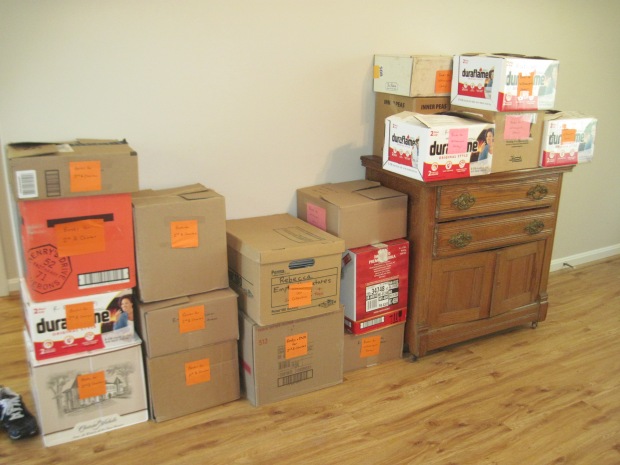
The final set of books awaiting sale.
All this still left about 18 boxes worth of rejects. For the non-antiquarian material I first tried 2nd & Charles, a new and secondhand bookstore chain that offers cash or store credit on select books. I planned to take the rest, including the antiquarian stuff, to an Abebooks seller in my mom’s new town, but I never managed to connect with him. So, the remaining boxes went to Wonder Book and Video, a multi-branch store I worked for during my final year of college. The great thing about them (though maybe not so great when you work there and have to sort through boxes full of dross) is that they accept absolutely everything when they make a cash offer. Although I felt silly selling back lots of literary titles I bought there over the years, at a massive loss, it was certainly an efficient way of offloading unwanted books.
As to everything else…
- I sent off 42.5 pounds (19.3 kilograms) of electronic waste to GreenDisk for recycling. That’s 75 VHS tapes, 63 CDs, 38 cassette tapes, 11 DVDs, five floppy disks, two dead cables, and one dead cell phone I saved from landfill, even if I did have to pay for the privilege.
- I donated all but a few of my jigsaw puzzles to my mom’s retirement community.
- I gave my mom my remaining framed artworks to display at her new place.
- I gave some children’s books, stuffed animals, games and craft supplies away to my nieces and nephews or friends’ kids.
- I let my step-nephew (if that’s a word) take whatever he wanted from my coin collection, and then sold that and most of my stamp collection back to a coin store.
- Most of my other collections – miniature tea sets, unicorn figurines, classic film memorabilia – all went onto the auction pile.
- My remaining furniture, a gorgeous rolltop desk plus a few bookcases, will also be part of the auction.
- You can tell I was in a mood to scale back: I finally agreed to throw out two pairs of worn-out shoes with holes in them, long after my mother had started nagging me about them.


Mementos and schoolwork have been the most difficult items for me to decide what to do with. Ultimately, I ran out of time and had to store most of the boxes as they were. But with the few that I did start to go through I tried to get in a habit of appreciating, photographing and then disposing. So I kept a handful of favorite essays and drawings, but threw out my retainers, recycled the science fair projects, and put the hand-knit baby clothes on the auction pile. (My mom kept the craziest things, like 12 inches of my hair from a major haircut I had in seventh grade – this I threw out at the edge of the woods for something to nest with.)


 All this work and somehow I was still left with 29 smallish boxes to store with my dad’s stuff. Fourteen of these are full of books, with another four boxes of books stored in my mom’s spare room closet to select reading material from on future visits. So to an extent I’ve just put off the really hard work of culling until some years down the road – unless we ever move to the States, of course, in which case the intense downsizing would start over here.
At any rate, in the end it’s all just stuff. What I’m really mourning, I know, is not what I had to get rid of, or even the house, but the end of our happy family life there. I didn’t know how to say goodbye to that, or to my hometown. I’ve got the photos and the memories, and those will have to suffice.
Have you had to face a mountain of stuff recently? What are your strategies for getting rid of books and everything else?
I Spy TBR Challenge
I spotted this recently on Ex Urbanis and it was too fun to pass up. (I believe the meme started on YouTube, but I’ve been unable to trace the chain back to the very beginning.) There are 20 categories; for each one choose at least one title or cover that fits in some way.
I decided to limit myself to books on my to-read shelves, but had to cheat for two categories and pick books I’ve already read. Some were so easy I could have picked out at least 5–10 books that fit the bill, while others were quite a challenge.
The idea is to gather up all the books within five minutes, but because I had to go up and down the stairs and survey shelves in multiple rooms it took me just over 15! See how fast you can find something for each prompt.
Food

Transport
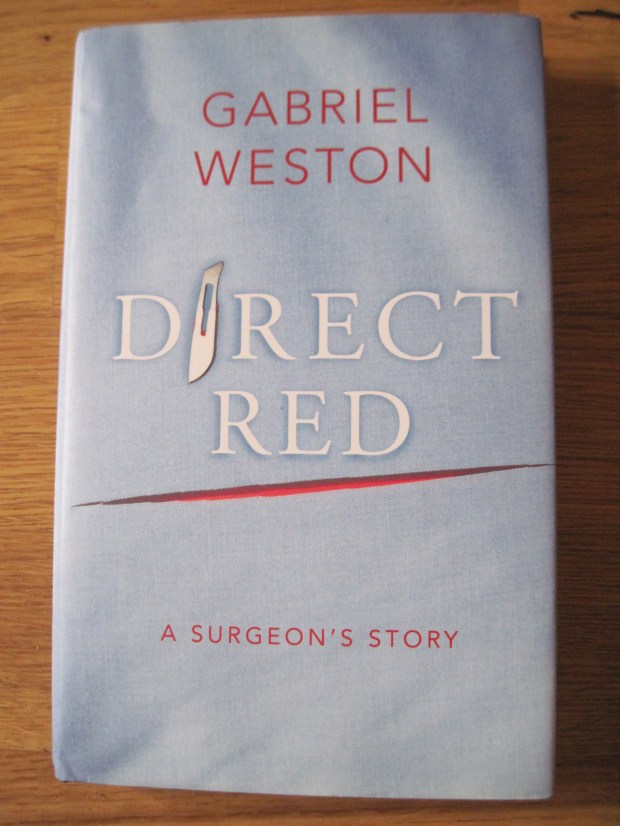
Weapon – This one was really tough, since I don’t read crime fiction. But I finally managed to find a surgeon’s memoir with a scalpel on the cover.
Animal – I could easily have found 15+ for this one, thanks to my husband’s nature books, but I stuck with fiction.
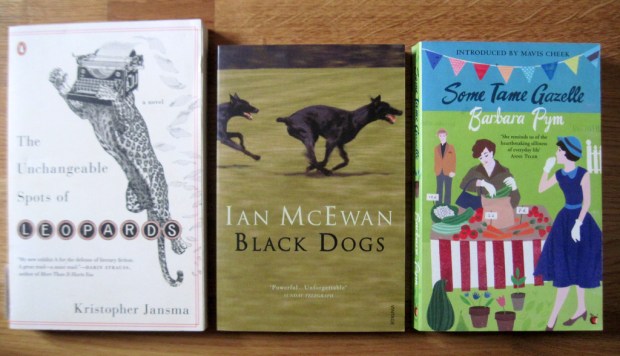
Number

Something You Read
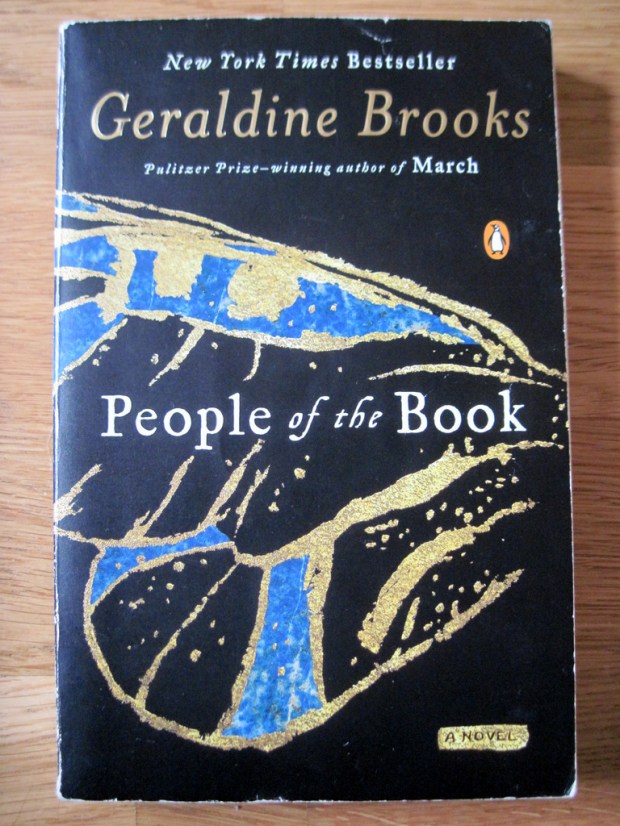
Body of Water
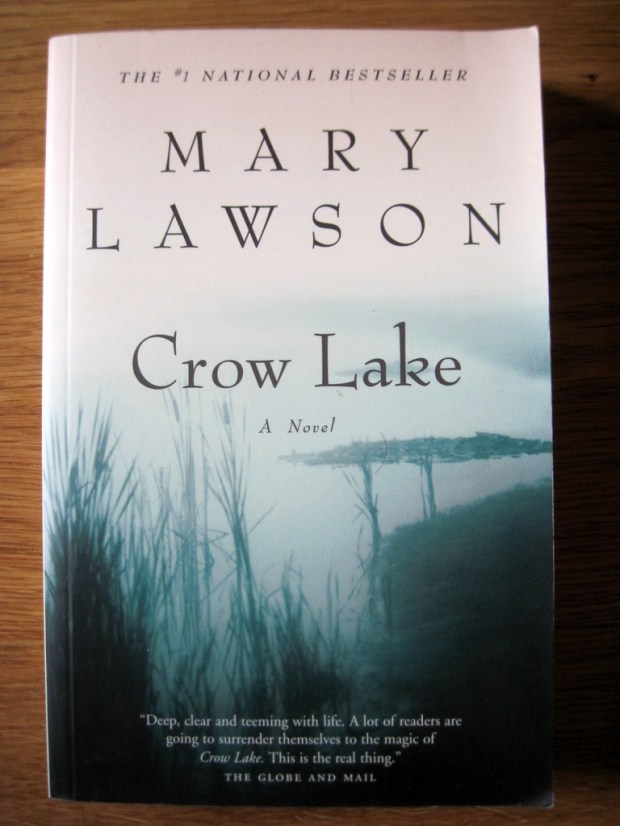
Product of Fire – Another really difficult one, so I cheated with this May Sarton memoir I’ve already read.
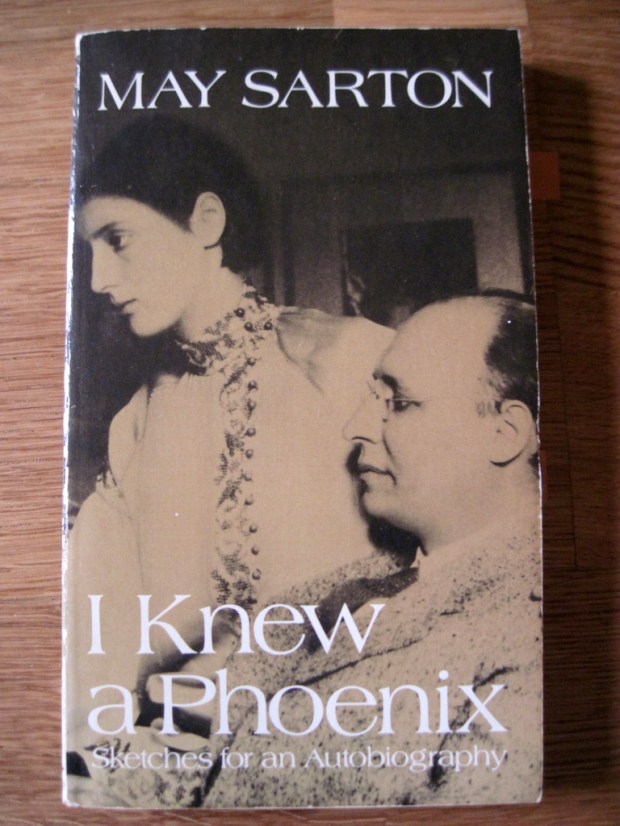
Royalty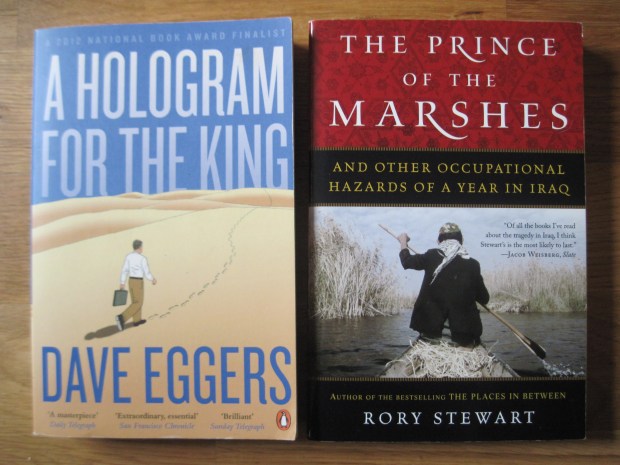
Architecture
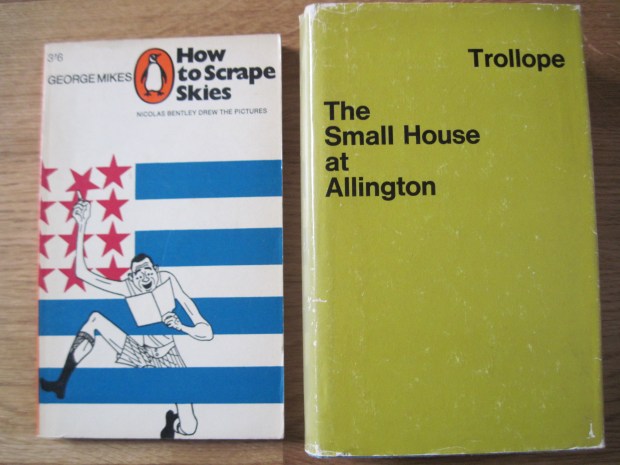
Clothing – Another cheat of sorts: all I could find was the cover of Bill Bryson’s memoir, which I’ve already read.

Family Member
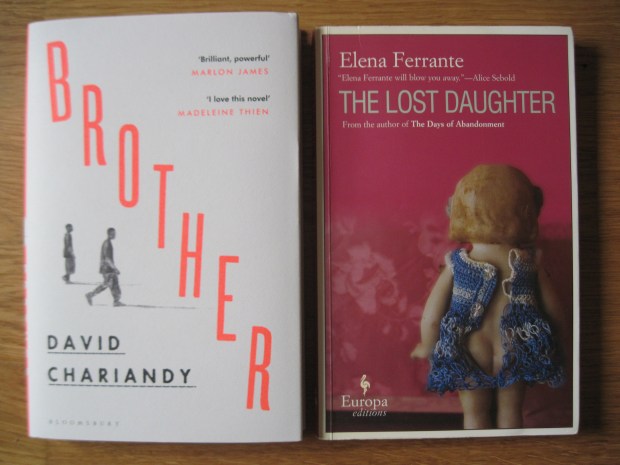
Time of Day

Music
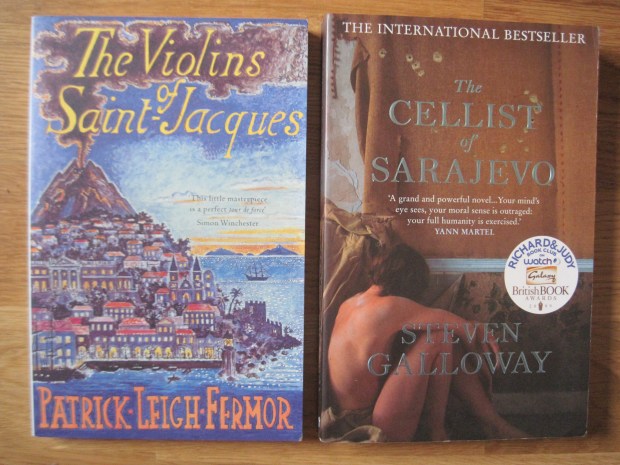
Paranormal Being
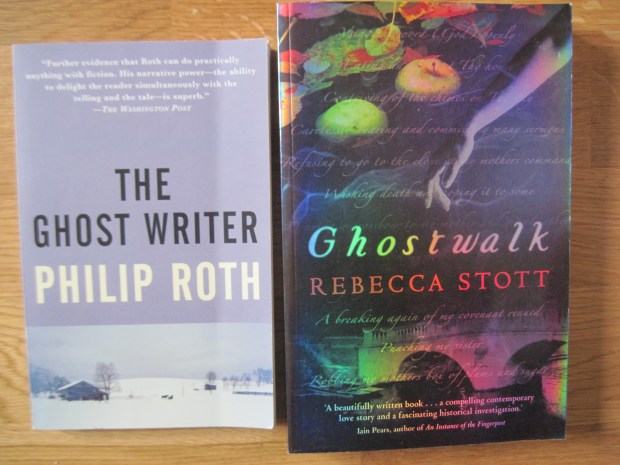
Occupation
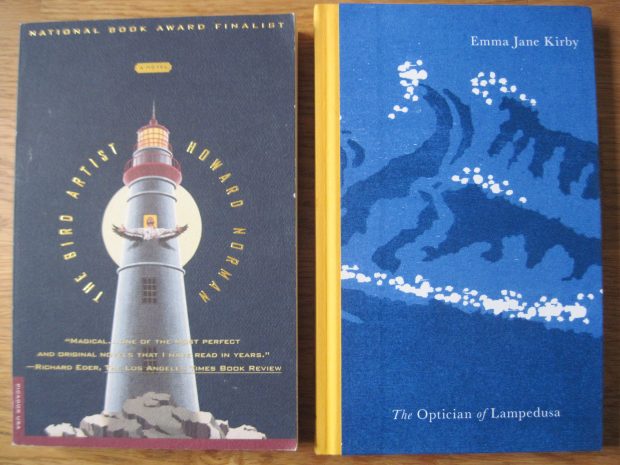
Season
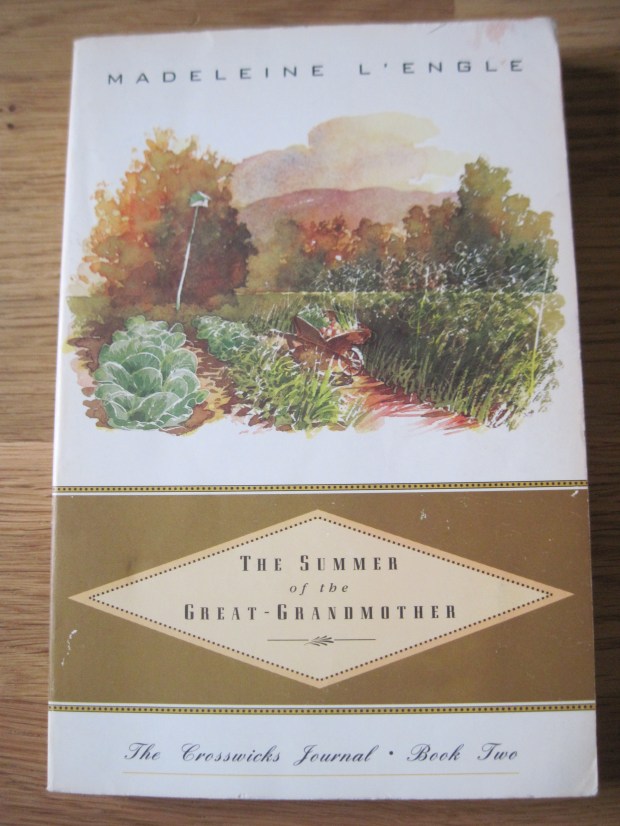
Color – Another one I could have amassed tons for. (Partially cut off is Ernest Hemingway’s Green Hills of Africa.)
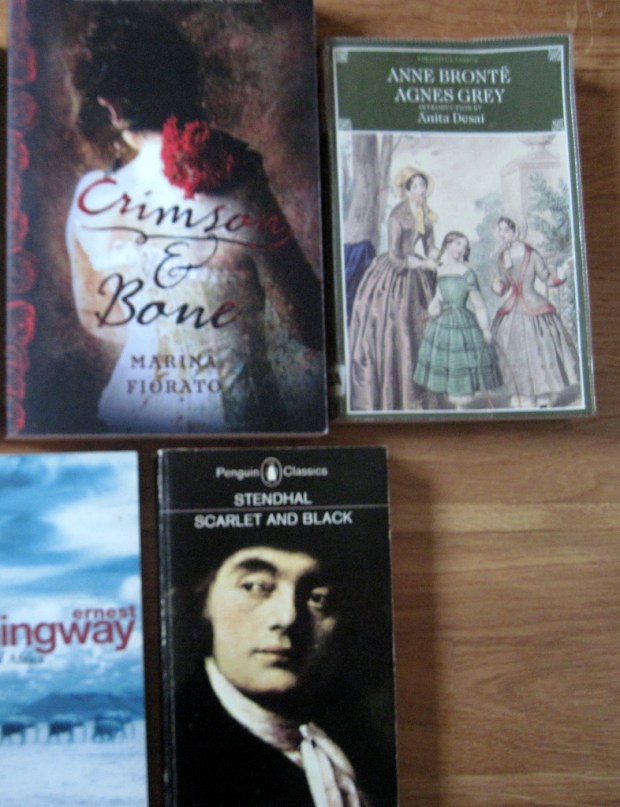
Celestial Body

Something that Grows
Third Blog Anniversary
Hard to believe, but I’ve only been blogging for three years as of today. It feels like something I’ve been doing forever, but at the same time I still consider myself a newbie. This is my 382nd post, so I’ve been keeping up an average of 2.5 posts a week.

By Joey Gannon from Pittsburgh, PA (Candles) [CC BY-SA 2.0 (http://creativecommons.org/licenses/by-sa/2.0)%5D, via Wikimedia Commons.
I’ve particularly enjoyed doing author Q&As and highlighting seasonal reads, novellas, books about cats, and physical book traits. I especially like writing up bookshop visits and other literary travels, and discussing literary prizes. My supply of graphic novels seems to have dried up; for new releases I focus on literary fiction, historical fiction and memoirs.
Straightforward book reviews have always been less popular than book lists and other more tangentially book-related posts. Library Checkout posts are consistently well-liked, as were the “Books in Brief” sets of five mini-reviews I used to do. As I’ve noted before, my posts on abandoned books are always perversely popular.
Some of my favorite posts from the past year were on World Kidney Day, Mother–Daughter Author Pairs, and Book Hoarding, and my review in verse of Jonathan Eig’s Ali: A Life.
The numbers of likes seem to be less than informative as they simply reflect a growing number of followers – many of my recent posts have averaged 20–25 likes – so I prefer to look at comments, as it means people are truly reading and engaging. In terms of numbers of comments, my top posts of all time appeared in the last year and were:
- Bibliotherapy appointment
- Books in Brief, May 2017 (featuring books by Sebastian Barry, Tracy Chevalier, Thomas H. Cook, Nicole Gulotta and Elizabeth Hay)
- (Tied for 3rd) Booker Longlist 2017 & Jacob’s Room Is Full of Books review
Thanks to everyone who has supported me this past year, and/or all three years, by visiting the site, commenting, re-tweeting, and so on. You’re the best!
“Why We Sleep” … And Why Can’t I Wake Up?
Why We Sleep: The New Science of Sleep and Dreams by Matthew Walker
I’d heard about this book but didn’t feel compelled to get hold of it until David Lodge, one of my favorite authors, named it his book of 2017 in the TLS year-end roundup. I got an e-copy from NetGalley but then found the physical book on the bestsellers display in my local library and found that a more conducive format for skimming. It’s a fairly long and dense book, with smallish type and scientific figures, so I knew I was unlikely to read the whole thing, but enjoyed mining it for fascinating information about evolution, neuroscience and child development.
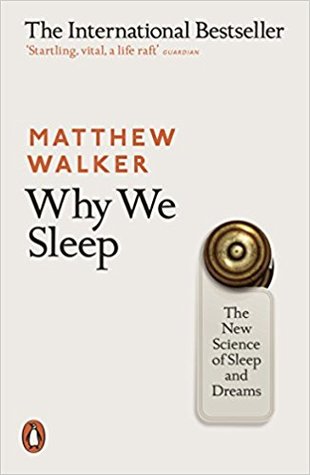 We often hear that sleep, diet and exercise are the three pillars of health, but Walker, a professor of neuroscience at the University of California, Berkeley, goes further: he believes sleep is the platform on which diet and exercise rest. Getting 7–9 hours of sleep a night is not some luxury to aim for but an absolute essential for the brain to process new information and prepare for receiving more the next day. Dreaming is like overnight therapy, and fuels creativity. Sleep deprivation has been associated with dementia and cancer: it’s no accident that Margaret Thatcher and Ronald Reagan, who prided themselves on getting by on just five hours of sleep a night, both developed Alzheimer’s. Just a few nights of insufficient sleep can weaken the immune system and increase the risks of developing a serious illness. It’s no wonder Walker calls sleep loss an epidemic.
Here are some other facts I gleaned:
- During primate evolution, the transition to sleeping on the ground instead of in trees meant we could sleep more deeply – not having to worry about falling out – and the resulting increase in REM sleep and dreams contributed to the development of complex culture and creativity.
- Fetuses are asleep most of the time; they kick in their sleep. Alcohol use during pregnancy or breastfeeding can lead to a decline in the offspring’s sleep quality or quantity.
- People with autism get 30–50% less REM sleep than neurotypical people.
- The postprandial slump in energy many of us experience is evolutionarily inbuilt, and suggests that a short nap (30–40 minutes) would be natural and beneficial. For instance, some African tribespeople still regularly nap at the hottest point of the day.
Walker’s sleep tips are mostly common-sense stuff you will have heard before. His #1 piece of advice is to have a sleep schedule, always going to sleep and waking up at the same time. (“Catching up” on weekends doesn’t work, though napping before 3 p.m. can.) Set an alarm for bedtime so you’ll stick to it, he suggests.
My rating: 
Making It Personal
I like my sleep, and I like my lie-ins. It’s one of many reasons why I don’t have kids. But I hoped that the older I got the better I’d be about waking up in the mornings. That hasn’t seemed to be the case. The past couple of weeks have been abnormal in that my husband has been working from home, too – he’s been on strike from the university and/or keeping clear of the snow – but on an average weekday, when the alarm goes off at a time starting with a 6, I feel like I could sleep for hours more. I usually cover my head with a pillow and stay in bed with the cat curled against my legs for an extra half-hour while my husband showers and starts getting things ready; only when I hear the tea being poured do I finally extricate myself from the covers and lurch downstairs to eat breakfast and make our sandwiches for the day.
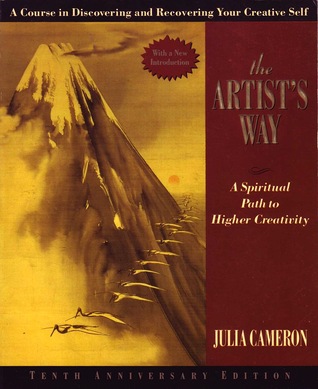 One of my bibliotherapy prescriptions was The Artist’s Way by Julia Cameron, a 12-week set of readings and exercises – chiefly 20 minutes of automatic writing each morning and creative “dates” you take yourself on. For the former, you set your alarm half an hour early each day and fill three longhand pages with whatever comes to mind. It’s not a journal; it’s more a way of processing what’s going on in your life, gradually moving from mundane thoughts about daily pressures to more creative stuff. But if I can’t wake up for our regular alarm, how in the world would I get up even earlier to commit to this creative exercise? I’ve wondered if I could cheat a bit and do the pages after a short nap in the early afternoons, but I think the idea really is to put down whatever comes into your head first thing every morning.
I can see that this would be a good discipline, especially as I come up to my fifth anniversary of freelancing and take stock of my career. I just don’t know if I can make myself do it.
Have you read anything about sleep, creativity or mindfulness recently?
Also on my TBR to be skimmed:
 24/7: Late Capitalism and the Ends of Sleep by Jonathan Crary
- The Business of Sleep: How Sleeping Better Can Transform Your Career by Vicki Culpin, a TEDx speaker and professor of organizational behavior [forthcoming on May 8th from Bloomsbury Business]
- The Secret World of Sleep: The Surprising Science of the Mind at Rest by Penelope A. Lewis
- Dreamland: Adventures in the Strange Science of Sleep by David K. Randall
A Patroness of the Arts
I recently sponsored my first book via Unbound, the UK’s crowdfunding publisher. You’re probably familiar with some Unbound titles even if that name doesn’t ring a bell. For instance, you might remember that The Wake by Paul Kingsnorth, an Unbound title from 2014, became the first crowdfunded novel longlisted for the Man Booker Prize. I’ve reviewed another previous Unbound title, Martine McDonagh’s Narcissism for Beginners, and will be participating in the blog tour for Lev Parikian’s Why Do Birds Suddenly Disappear? in May.

 The forthcoming title I’ve chosen to support is Women on Nature by Katharine Norbury, which promises to be a wide-ranging and learned anthology celebrating the tradition of women’s writing about nature (both fiction and non-). I enjoyed Norbury’s first book, The Fish Ladder, which is a memoir in the vein of H Is for Hawk, and also saw her speak at the New Networks for Nature conference in 2016.

Albums that exist because I helped crowdfund them.
I’d only ever crowdfunded music before – albums by The Bookshop Band, Krista Detor, Duke Special and Marc Martel. Beaming internally at feeling like a patroness of the arts after funding my Women on Nature hardback, I kept the smug glow going by signing up to support The Bookshop Band via Patreon (where you can commit to a certain amount per creation, e.g. per music video, and have the option of setting a monthly cap) and to fund an album by their singer/cellist Beth Porter and her band The Availables via Indiegogo.
Have you ever gotten involved in a crowdfunding project? How about for the arts?
Filling One Last Bookcase
Earlier this week I inherited a beautiful antique bookcase from an online friend* who, we learned only recently, lived just 20 minutes away. She has to shed some furniture to move to London, and very kindly thought of me. This is the last major item we could possibly fit in our house, but I was happy to accept because it’s so much nicer than any of our Ikea shelving units. It has the kind of mahogany detail that looks like it could belong on a ship’s wheel.


My goals for the extra shelving space were to be able to keep genres together, to eliminate double stacking where possible, to put all books out on display instead of having some away in an overflow crate, and perhaps to free up the tops of a couple units for knick knacks, etc.


It was a multi-step process undertaken with military precision. Can you tell I used to work in a library?
- Reincorporate Short Stories into General Fiction
- Double-stack the already-read Fiction in the bedroom, leaving the more presentable books at the front; create a Signed Copies area
- Move Poetry in with Classics, double-stacking and putting some books on their sides to make more space; create a Classics priority area, with one book per month chosen for the rest of 2018
- Move oversize Science and Nature, Graphic Novels, Children’s Books, and Coffee Table Books (which, because they’re buried under magazines and newspapers on the coffee table shelf, we never look at) onto the bottom shelf of the new bookcase
- Move all Life Writing (biographies/memoirs), which had been split across a few rooms, onto one bookcase in my study
- Add a selection of Travel and Literary Reference to fill the built-in shelves of my desk, joining Reference and Humor
- Integrate Science and Nature, previously kept separate, into one bookcase


Unread fiction is mostly on the hall bookcase, with an area on the bottom shelf for upcoming projects so I can see what’s awaiting me. I’m keeping these in rough date order from left to right: bibliotherapy prescriptions, possibilities for Reading Ireland month, novellas for November, etc.
However, there are a handful of annoying hardback and trade paperback novels that are just that little bit too tall to fit here, so these have formed a partial shelf on the antique case. I’ve also set aside there the book(s) that I think might be included in my Best of 2018 list and a growing stash of Wellcome Book Prize 2019 hopefuls.
You would never believe it, but I think I need more books! Good thing we have a trip planned to Wigtown, Scotland’s Book Town, for the first week of April. In any case, it’s better to have room to grow into than to already be at capacity or overfull. I can always reshuffle as time goes on if I decide I don’t want any double stacking upstairs or if we ever manage to bring back more of my library from America.


From Book Riot I got the idea of making a personal “hold shelf” of books you own and have been meaning to read. So far I only have four books set aside, arranged as a sort of buffet atop the hall bookcase. Perhaps later I’ll replace this with a full shelf on the antique bookcase. Other ideas for the empty space there would be showcasing my most presentable fiction, or creating a favorites shelf. This was suggested by Paul and corroborated by The Novel Cure, which suggests pulling out the 10 books you love most and are likely to turn to for inspiration.
*If you’re on Instagram, you must check her out. She is a #bookstagram pro: @beth.bonini.
How do you organize your bookshelves?
A Publisher Party and a One-Man Play
I was a veritable social butterfly this past week: I went out two evenings in a row! (Believe me, that’s rare.) On Tuesday I met up with bloggers Annabel, Eric and Kim at the Faber Spring Party held at Crypt on the Green in London, and on Wednesday my husband and I attended a performance at the University of Reading of Michael Mears’s one-man play on the plight of Britain’s conscientious objectors during World War I, This Evil Thing.
Faber Spring Party
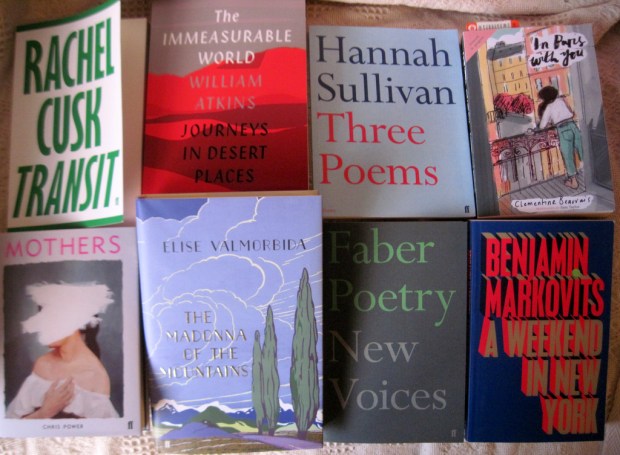
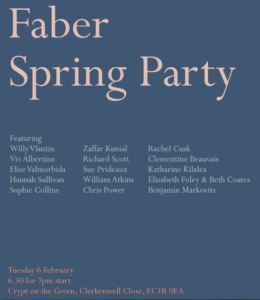 I’ve never been to an event quite like this. Publisher Faber & Faber, which will be celebrating its 90th birthday in 2019, previewed its major releases through to September. Most of the attendees seemed to be booksellers and publishing insiders. Drinks were on a buffet table at the back; books were on a buffet table along the side. Glass of champagne in hand, it was time to plunder the free books on offer. I ended up taking one of everything, with the exception of Rachel Cusk’s trilogy: I couldn’t make it through Outline and am not keen enough on her writing to get an advanced copy of Kudos, but figured I might give her another try with the middle book, Transit.

For the evening’s presentation, each featured author had a few minutes to introduce their new book and/or give a short reading.
Rachel Cusk opened the evening with a reading from Kudos. If you’re familiar with her recent work, you won’t be surprised at this synopsis: a man on a plane recounts having his dog put to sleep. (Out on May 3rd.)
William Atkins’s book on deserts, The Immeasurable World, is based on three years of travel and is, he is not ashamed to say, in the old-fashioned travel writing tradition. (Out on June 7th.)
Hannah Sullivan’s Three Poems is a hybrid work of poem-essays. #2 is more philosophical, she said; #3 is about her father’s death and her son’s birth. She read sonnet 3.21. (Out now.)
Clémentine Beauvais’s In Paris with You is a YA romance in free verse, loosely based on Eugene Onegin. I don’t know the source text but started this on the train ride home and it’s enjoyable thus far. I’m in awe at how translator Sam Taylor has taken the French of her Songe à la douceur and turned it into English poetry. (Out on June 7th.)
Chris Power’s Mothers is a book of linked short stories, three of which are about a character named Eva. He read a portion of a story about her having an encounter with an unpleasant man in Innsbruck. (Out on March 1st.)
Elise Valmorbida’s The Madonna of the Mountains, set in 1923–50, is a saga that resembles “an Italian Mother Courage,” she says. She read a scene in which a character comes across a madwoman. (Out on April 5th.)
Zaffar Kunial read the poem “Spark Hill” from his forthcoming collection Us. It’s about a childhood fight in the area of Birmingham where he grew up. He had a folder open in front of him but, impressively, recited the long poem completely from memory. (Out on July 5th.)
American novelist Benjamin Markovits was a professional basketball player in Germany for six months. Like the tennis-playing protagonist of his upcoming book, A Weekend in New York, he got tired of being measured. After 15 years, his hero is eager to escape a life of being constantly ranked. This is the first in a quartet of novels that inevitably invites comparison with John Updike’s “Rabbit” books. (Out on June 7th.)
I confess I didn’t previously know the name Viv Albertine; she was the guitarist for the female punk band The Slits, and To Throw Away Unopened is her second memoir. Albertine realized that it was her mother who had made her an angry rebel; the title is the label on a bag she found in her mother’s room after her death. (Out on April 5th.)
Sophie Collins incorporates hybrid forms in her poetry – what she calls “lyric essays.” The theme of her book Who Is Mary Sue? is perceptions of women’s writing (with “Mary Sue” as a metonym for the stereotypical good girl). She read from “Engine.” (Out now.)
Katharine Kilalea’s debut novel Ok, Mr Field is about an injured concert pianist who becomes obsessed with a house he buys in South Africa. (Out on June 7th.)
Elizabeth Foley and Beth Coates are the authors of two Homework for Grown-Ups books. Their new book, What Would Boudicca Do?, is about lessons we can draw from the women of history. For instance, the sampler booklet has pieces called “Dorothy Parker and Handling Jerks” and “Frida Kahlo and Finding Your Style.” There’s a heck of a lot of books like this out this year, though, and I’m not so sure this one will stand out. (Out on September 6th.)
Richard Scott read two amazingly intimate poems from his upcoming collection, Soho. One, “cover-boys,” was about top-shelf gay porn; the other was about mutilated sculptures of male bodies in the Athens archaeological museum. If you appreciated Andrew McMillan’s Physical, you need to get hold of this the second it comes out. I went back and read “cover-boys” in the sampler booklet and it wasn’t nearly as powerful as it was aloud; Scott’s reading really brought it to life, in contrast to some other authors’ dull delivery. (Out on April 5th.)
Sue Prideaux’s forthcoming biography of Friedrich Nietzsche is entitled I Am Dynamite! She encountered her subject when she wrote her first biography, of Edvard Munch. Although Nietzsche has been embraced by far-right groups in America, he was in fact against racism, nationalism, and anti-semitism, so he has important messages for us today. I’ll be keen to get hold of this one. (Out on September 6th.)
Guitar in hand, Willy Vlautin closed the evening with a performance of the title track from the soundtrack album to his fifth novel, Don’t Skip Out on Me – he was the singer in Portland, Oregon alt-country band Richmond Fontaine, which has recently stopped touring. He said the novel asks, “can you make the scars of broken people bearable?” (Out now.)

Now that I’ve got this terrific stack of books, wherever do I start?! I’m currently reading the Beauvais; from there I’ll focus on ones that have already been released, starting with Vlautin and the two poetry collections. The titles that aren’t out until June can probably wait – though it’s tempting to be one of the privileged few who get to read them nearly four months early. One Faber book per week should see me getting through all these by the final release date.
This Evil Thing
Michael Mears plays about 50 different characters in this one-man production. He’s an actor and pacifist who has written a number of solo pieces over 20 years. In this commemorative year of the end of the First World War, he knew we would hear a lot about battles, soldiers, and their families back home. But conscientious objectors weren’t likely to be remembered: theirs is a “story that’s rarely told,” he realized. This Evil Thing sets out to correct that omission. The title phrase refers not to war in general but specifically to conscription.
 The two main characters Mears keeps coming back to in the course of the play are Bert Brocklesby, a Yorkshire preacher, and philosopher Bertrand Russell. Brocklesby refused to fight and, when he and other COs were shipped off to France anyway, resisted doing any work that supported the war effort, even peeling the potatoes that would be fed to soldiers. He and his fellow COs were beaten, placed in solitary confinement, and threatened with execution. Meanwhile, Russell and others in the No-Conscription Fellowship fought for their rights back in London. There’s a wonderful scene in the play where Russell, clad in nothing but a towel after a skinny dip, pleads with Prime Minister Asquith.
As in solo shows I’ve seen before (e.g. A Christmas Carol with Patrick Stewart), Mears had to find subtle ways to distinguish between characters: he used a myriad different voices, including regional accents; he quickly donned a jacket, hat, or pair of glasses. Russell was identified by his ever-present pipe. The most challenging scene, Mears said in the Q&A at the end, was one with four characters in a French street café.
Mears reveals during the play that his grandfather fought in WWI and his father in WWII, but he has never had to put his own pacifist views to the test. What about Hitler? people always ask. Mears is honest and humble enough to admit that he doesn’t know what he would have done had he been called on to fight Hitler, or had he faced persecution as a CO in WWI. Ultimately, what Mears hopes audiences take from his play, which won acclaim at the Edinburgh Festival Fringe, is that “this is not an irrelevant piece of history.” Standing up for what you believe in, especially if it goes against the spirit of the times, is always valuable.
Welcome to the Fold, Little Book: How I Tend to My Secondhand Purchases
I’ll always remember a moment in fifth grade when I returned a book I’d borrowed to a classmate at the lunch table. It was one of those Griffin and Sabine-type books with lots of paper flaps and pull-out envelopes, and as she looked it over she marveled, “Rebecca always returns my books in better condition than when I lent them to her.” I still pride myself on how I care for physical books. I don’t write in them (except to correct errors), dog-ear pages, or break the spines if I can possibly help it, and I’ve been known to unfold pages and/or reshelve books correctly while browsing in a library or secondhand bookshop.
During the 5+ years I was a library assistant in London, my all-time favorite task was repairing books. Eventually I ended up as the repairs coordinator for our site, doing most of the day-to-day repairs and running training sessions for new hires. Repairing books felt a lot like arts and crafts and thus was fundamentally different from any of our other work, which generally involved computers, customers, or heavy lifting. And it was hardly costly: apart from special book-friendly glue and tape, the only supplies were paintbrushes, rubber bands and scrap paper. The most high-tech we got was photocopying missing pages from another copy of a book and cutting them to size so they could be inserted to fill the gap.
I later did a summer placement in the Special Collections division, where we never repaired the rare books ourselves. Those were all seen to by off-site specialists – for a pretty penny, so we only sent a few at a time as the budget allowed. I wouldn’t attempt to fix an ailing antiquarian hardback myself (though a friend once got me a copy of The Care and Feeding of Books Old and New: A Simple Repair Manual for Book Lovers to thank me for being a bridesmaid in her wedding – it’s currently in a box in America), but I often do minor cleaning and sprucing up on the secondhand books I purchase.
Here’s my makeshift toolkit:

(Step one, though – which just requires fingers – is unfolding any dog-eared or otherwise crinkled pages.)
An eraser: I erase stray marks and (sometimes) previous prices from inside the front cover.
Goo Gone: Do you know about this amazing American cleaning product?! It completely removes the remnants of price labels and anything else persistently sticky, and smells pleasantly of orange oil.
Paper towels: A damp paper towel is all that’s necessary for removing coffee rings and other dubious substances from a book’s cover.
Clear tape: I don’t own the library-approved brand (Scotch Book Tape), but for patching small tears on paperback covers or holding the spines of hardback cookbooks together, this Poundland purchase does the job.
Translucent mending tape (acid-free filmoplast) for using inside books: I found out about this through my library repair work. It’s sticky on one side and either glossy or matte on the other; you can see the printed words through it. I use this for repairing torn pages and reaffixing detached paperback covers. It’s made by Neschen and Gresswell, and can be purchased on Amazon.
Heavy books: I get out a weighty stack for flattening a book that has curly, water-damaged pages or a creased cover.
Things that can’t be fixed – or at least I have no idea how to fix them: A persistent cigarette or mold smell; booklice; foxing (the brown specks that form along a text block); greasy fingerprint stains on a text block or matte cover.
Are you happy to take your secondhand books as they come, or do you also try to rehabilitate them in some way? I don’t mind minor signs that a book has been pre-owned and loved, such as a previous owner’s name written inside the cover, a very few underlines or marginalia in pencil, or a left-behind bookmark or other memento, but I do prefer not to see the remnants of what they were snacking on as they read…
 Bookish Beck = Rebecca Foster. American transplant to England. Freelance proofreader and book reviewer.
 Bookish Beck