Book Serendipity, 2019 Second Half
I call it serendipitous when two or more books that I’m reading at the same time or in quick succession have something pretty bizarre in common. Because I have so many books on the go at once – usually between 10 and 20 – I guess I’m more prone to such incidents. I post these occasional reading coincidences on Twitter. What’s the weirdest one you’ve had lately? (The following are in rough chronological order.)
[Previous 2019 Book Serendipity posts from April and July.]
- Two novels in which a character attempts to glimpse famous mountains out of a train window but it’s so rainy they can barely be seen: The Unchangeable Spots of Leopards by Kristopher Jansma and The Pine Islands by Marion Poschmann.


- Ex-husbands move from England to California and remarry younger women in The Stillness The Dancing by Wendy Perriam and Heat Wave by Penelope Lively.
 References to Edgar Allan Poe in both Timbuktu by Paul Auster and The Unchangeable Spots of Leopards by Kristopher Jansma.
- An account of Percy Shelley’s funeral pyre in both The Unchangeable Spots of Leopards by Kristopher Jansma and Frankissstein by Jeanette Winterson.
- Mentions of barn owls being killed by eating poisoned rats in Owl Sense by Miriam Darlington and Homesick by Catrina Davies.


- Miriam Rothschild is mentioned in Irreplaceable by Julian Hoffman and An Obsession with Butterflies by Sharman Apt Russell.
- Gorse is thrown on bonfires in Homesick by Catrina Davies and The Stillness The Dancing by Wendy Perriam.
 A character has a nice cup of Ovaltine in Some Tame Gazelle by Barbara Pym and The Stillness The Dancing by Wendy Perriam.
- I started two books with “Bloom” in the title on the same day.

 Two books I finished about the same time conclude by quoting or referring to the T. S. Eliot lines about coming back to the place where you started and knowing it for the first time (Owl Sense by Miriam Darlington and This Is Not a Drill, the Extinction Rebellion handbook).
- Three books in which the narrator wonders whether to tell the truth slant (quoting Emily Dickinson, consciously or not): The Unchangeable Spots of Leopards by Kristopher Jansma, The Poisonwood Bible by Barbara Kingsolver and The Hiding Game by Naomi Wood.
- On the same day, I saw mentions of crullers in both On Chapel Sands by Laura Cumming and The Dutch House by Ann Patchett.


- There are descriptions of starling murmurations over Brighton Pier in both Irreplaceable by Julian Hoffman and Expectation by Anna Hope. (Always brings this wonderful Bell X1 song to mind!)
- I was reading The Outermost House by Henry Beston and soon after found an excerpt from it in Irreplaceable by Julian Hoffman; later I started The Easternmost House by Juliet Blaxland, whose title is a deliberate tip of the hat to Beston.
 At a fertility clinic, the author describes a pair of transferred embryos as “two sequins of light” (in On Chapel Sands by Laura Cumming) and “two points of light” (in Expectation by Anna Hope).
- Mentions of azolla ferns in Time Song by Julia Blackburn and Bloom (aka Slime) by Ruth Kassinger.
 Incorporation of a mother’s brief memoir in the author’s own memoir in On Chapel Sands by Laura Cumming and All Things Consoled by Elizabeth Hay.
- Artist mothers in On Chapel Sands by Laura Cumming, All Things Consoled by Elizabeth Hay, and Expectation by Anna Hope.
- Missionary fathers in The Poisonwood Bible by Barbara Kingsolver and The Wind that Lays Waste by Selva Almada.


- Twins, one who’s disabled from a birth defect and doesn’t speak much, in Golden Child by Claire Adam and The Poisonwood Bible by Barbara Kingsolver.
 An Irish-American family in a major East Coast city where the teenage boy does construction work during the summers in Ask Again, Yes by Mary Beth Keane and The Dutch House by Ann Patchett.
- SPOILERS: A woman with terminal cancer refuses treatment so she can die on her own terms and is carried out into her garden in Expectation by Anna Hope and A Reckoning by May Sarton.
- A 27-year-old professor has a student tearfully confide in her in Crow Lake by Mary Lawson and The Small Room by May Sarton.


- Reading The Yellow House by Sarah M. Broom at the same time as The Dutch House by Ann Patchett.
 “I was nineteen years old and an idiot” (City of Girls, Elizabeth Gilbert); “I was fifteen and generally an idiot” (The Dutch House, Ann Patchett).
- Mentions of a conjuring tricks book in Time Song by Julia Blackburn and Fifth Business by Robertson Davies.
- A teen fleeces their place of employment in Sweet Sorrow by David Nicholls and Who Will Run the Frog Hospital? by Lorrie Moore.


- A talking parrot with a religious owner in The Poisonwood Bible by Barbara Kingsolver and Olive Kitteridge by Elizabeth Strout.
- Pictorial book serendipity: three books I was reading, and another waiting in the wings, had a red, black and white color scheme.

 Kripalu (a Massachusetts retreat center) is mentioned in Fleishman Is in Trouble by Taffy Brodesser-Akner and Once More We Saw Stars by Jayson Greene.
- The character of Netty Quelch in Robertson Davies’s The Manticore reminds me of Fluffy in Ann Patchett’s The Dutch House.
- The artist Chardin is mentioned in How Proust Can Change Your Life by Alain de Botton and Varying Degrees of Hopelessness by Lucy Ellmann.
- A Czech grand/father who works in a plant nursery in the opening story of Andrea Barrett’s Ship Fever and Patricia Hampl’s The Florist’s Daughter.


- The author was in Eva Le Gallienne’s NYC theatre company (Madeleine L’Engle’s Two-Part Invention and various works by May Sarton, also including a biography of her).
 Gillian Rose’s book Love’s Work is mentioned in both Notes Made while Falling by Jenn Ashworth and My Year Off by Robert McCrum. (I will clearly have to read the Rose!)
- Sarah Baartman (displayed in Europe as the “Hottentot Venus”) is mentioned in Shame on Me by Tessa McWatt and Hull by Xandria Phillips.
October Recommendations: Ashworth, Donoghue, Kay & McWatt
Intricate essays about writing in the wake of trauma, a feel-good novel about an odd couple on a trip to France, hilarious festive outtakes from a career in medicine, and a race-themed family memoir: I have four very different books to recommend to you this month. All: 
Notes Made while Falling by Jenn Ashworth
(Coming from Goldsmiths Press [UK] on the 15th; already out from MIT Press [USA])
Like Anne Boyer’s The Undying and Sinéad Gleeson’s Constellations, this is an incisive memoir-in-essays about the effects of trauma on a woman’s body. Specifically, Ashworth’s story starts with her son’s birth in 2010, a disaster she keeps returning to over the course of seven sinuous personal essays. A routine C-section was followed by haemorrhaging, blood transfusions and anaphylaxis. The effects lasted for years afterwards: haunted by the sound of her blood dripping and the feeling that her organs could fall out of her abdomen at any time, she suffered from vomiting, insomnia and alcoholism, drinking late into the night as she watched gruesome true crime films.
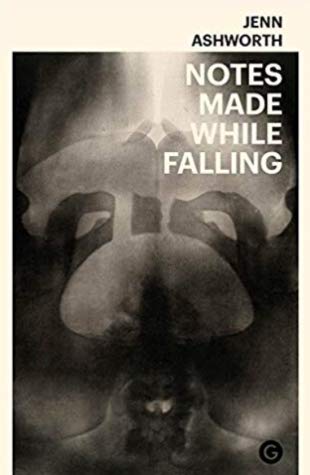 Ashworth toggles between experience, memory, and the transformation of experience into a written record. She admits she has lost faith in fiction, either reading or writing it (she is a lecturer at Lancaster University and the author of four novels). Her Mormon upbringing in Preston is a major part of her backstory, and along with her childhood indoctrination she remembers brief stays in a children’s home and in the hospital with chicken pox.
The essays experiment with structure and content. For instance, “Ground Zero” counts down from #8, with incomplete final lines in each section, then back up to #8, with each piece from the second set picking up where the first left off. Slashes and cross-outs represent rethinking or alternate interpretations. “Off Topic: On Derailment” encompasses so many topics, from excommunication to Agatha Christie to rollercoasters to Charles Dickens, that you have to read it to believe she can make it all fit together (elsewhere she muses on Chernobyl, magic tricks and hating King Lear).
“How to Begin: The Cut” started as a talk given at Greenbelt 2013, when I was in the audience. I especially loved “A Lecture on Influence,” a coy self-examination through creative writing lessons, and “How to Fall without Landing: Celestial City,” a meditation on the precariousness of the human condition. Her frame of literary reference is wide and surprising. This also reminded me of Sight by Jessie Greengrass, The Empathy Exams by Leslie Jamison, I Am, I Am, I Am by Maggie O’Farrell, and In the Days of Rain by Rebecca Stott; I would recommend it to readers of any of the above.
Some favorite lines:
“My God-hurt head has a hole in it or needs one; to let the world in, or out – I can’t ever decide.”
“how to write about everything? How to take in the things that don’t belong to you without being poisoned by them? How to make use of the things that live inside, those seedlings you never asked for? How to breathe in? How to breathe out? How to keep on doing that?”
“Some days it feels like writing truthfully about her own life is the most subversive thing a woman can do.”
My thanks to the publisher for the free copy for review.
Akin by Emma Donoghue
(Coming from Picador [UK] on the 3rd; already out from Little, Brown and Co. [USA])
I’ve read Donoghue’s six most recent works of fiction. Her books are all so different from each other in setting – a one-room prison in contemporary America, bawdy 1870s San Francisco, rural Ireland in the 1850s – that it’s hard to pin her down to one time period or roster of topics. She never writes the same book twice, and that’s got to be a good thing.
 Akin gets off to a slightly slow start but soon had me hooked. Noah Selvaggio, a childless widower and retired chemist in New York City, is looking forward to an imminent trip to Nice, where he was born, to celebrate his 80th birthday. He never guessed that he’d have company on his trip, much less a surly 11-year-old. This is Michael Young, his nephew Victor’s son. Victor died of a drug overdose a year and a half ago; the boy’s mother is in prison; his maternal grandmother has just died. There’s no one else to look after Michael, so with a rush passport he’s added to the itinerary.
In some ways Michael reminded me of my nephews, ages 11 and 14: the monosyllabic replies, the addiction to devices and online gaming, the finicky eating, and the occasional flashes of childlike exuberance. Having never raised a child, Noah has no idea how strict to be with his great-nephew about screen time, unhealthy food and bad language. He has to learn to pick his battles, or every moment of this long-awaited homecoming trip would be a misery. And he soon realizes that Michael’s broken home and troubled area of NYC make him simultaneously tougher and more vulnerable than your average kid.
The odd-couple dynamic works perfectly here and makes for many amusing culture clashes, not so much France vs. the USA as between these Americans of different generations. The dialogue, especially, made me laugh. Donoghue nails it:
[Noah:] “The genre, the style. Is rap the right word for it? Or hip-hop?”
[Michael:] “Don’t even try.” Michael turned his music back on.
(At the cathedral)
[Michael:] “This is some seriously frilly shit.”
[Noah:] “It’s called Baroque style.”
[Michael:] “I call it fugly.”
But there’s another dimension to the novel that keeps it from being pleasant but forgettable. Noah’s grandfather was a famous (fictional) photographer, Père Sonne, and he has recently found a peculiar set of photographs left behind by his late mother, Margot. One is of the hotel where they’re staying in Nice, known to be a holding tank for Jews before they were sent off to concentration camps. The more Noah looks into it, the more he is convinced that his mother was involved in some way – but which side was she on?
This is feel-good fiction in the best possible sense: sharp, true-to-life and never sappy. With its spot-on dialogue and vivid scenes, I can easily see it being made into a movie, too. It’s one of my favorite novels of the year so far.
My thanks to the publisher for the proof copy for review.
Twas the Nightshift before Christmas by Adam Kay
(Coming from Picador on the 17th)
 If you’ve read This Is Going to Hurt, the UK’s bestselling nonfiction title of 2018, you’ll know just what to expect from the comedian’s holiday-themed follow-up. It’s raunchy, morbid and laugh-out-loud funny. In the seven years that Kay was a medical doctor, he had to work on Christmas Day six times. He takes us through the holiday seasons of 2004 to 2009, from the sickeningly festive run-up to the letdown of Christmas day and its aftermath. With his Rudolph tie on and his Scrooge spirit intact, he attends to genital oddities, childbirth crises and infertility clients, and feebly tries to keep up his relationships with his family and his partner despite them having about given up on him after so many holiday absences.
This will be a stocking-stuffer for many this year, and I can see myself returning to it year after year and flicking through for a laugh. However, there’s one story here that Kay regrets omitting from This Is Going to Hurt as being too upsetting, and he also ends on a serious note, urging readers to spare a thought for those who give up their holidays to keep our hospitals staffed.
A favorite passage:
“A lot of the reward for this job comes in the form of a warm glow. It doesn’t make you look any less tired, you can’t pay the rent with it, and it’s worth a lot less than the social life you’ve traded it for, but this comforting aura of goodness and purpose definitely throws light into some dark corners and helps you withstand a lot of the shit.”
My thanks to the publisher for the proof copy for review.
Shame on Me: An Anatomy of Race and Belonging by Tessa McWatt
(Coming from Scribe UK on the 10th)
 “What are you?” This question has followed McWatt since she was eight years old. When her third-grade teacher asked the class if they knew what “Negro” meant, one boy pointed to her. “Oh, no, not Tessa,” the teacher replied, following up with a question: “What are you, Tessa?” But it has always been hard to put her mixed-race background into one word. Her family moved from Guyana to Canada and she has since settled in England, where she is a professor of creative writing; her ancestry is somewhat uncertain but may include Chinese, Indian, indigenous South American, Portuguese, French/Jewish, African, and Scottish.
The book opens with the startling scene of her grandmother, a young Chinese woman brought over to work the sugarcane fields of British Guiana, being raped by her own uncle. “To strangers, even friends—on some days also to myself—I am images of violence and oppression. I am the language of shame and destitution, of slavery and indenture, of rape and murder. I am images of power and privilege, of denial and shades of skin, shapes of faces,” McWatt writes.
Her investigation of the meaning of race takes the form of an academic paper, Hypothesis–Experiment–Analysis–Findings, and within the long third section she goes part by part through the bodily features that have most often been used as markers of racial identity, including the nose, eyes, hair and buttocks. She dives into family history but also into wider historical movements, literature and science to understand her hybrid self. It’s an inventive and sensitive work reminiscent of The Color of Water by James McBride. I would recommend it to anyone who enjoys reading (or feels they should try) interrogations of race.
A favorite line:
“as I try to square my politics with my privilege, it seems that my only true inheritance is that I am always running somewhere else.”
I won a signed proof copy in a Twitter giveaway.
Have you read any October releases that you would recommend? Do any of these tempt you?
Library Checkout: September 2019
A quieter month of trying to finish up some books that I’ve had on the go for quite a while. I give links to reviews of any books I haven’t already featured, and ratings for ones I’ve read or skimmed. What have you been reading from your local libraries? Library Checkout runs on the last Monday of every month. I don’t have an official link-up system, but feel free to use this image in your post and to leave a link to your blog in the comments if you’ve taken part.

READ
- Once More We Saw Stars: A Memoir by Jayson Greene

- The Assassination of Margaret Thatcher: Stories by Hilary Mantel
- Because: A Lyric Memoir by Joshua Mensch [poetry]

- Old Toffer’s Book of Dogs by Christopher Reid [poetry; university library]

SKIMMED
- The Lost Art of Scripture by Karen Armstrong
- The Cabaret of Plants by Richard Mabey [university library]
- The Hidden Ways: Scotland’s Forgotten Roads by Alistair Moffat

CURRENTLY READING
- Time Song: Searching for Doggerland by Julia Blackburn
- A Single Thread by Tracy Chevalier
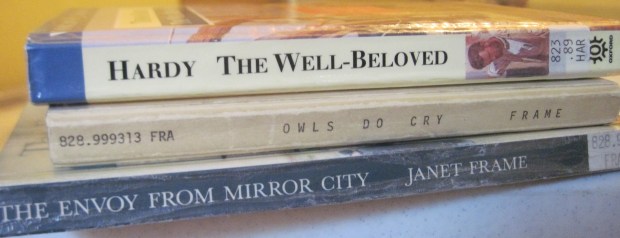
- The Envoy from Mirror City by Janet Frame [university library]
- The Electricity of Every Living Thing: One Woman’s Walk with Asperger’s by Katherine May
- The Nickel Boys by Colson Whitehead
CURRENTLY SKIMMING
- Life Lessons from a Brain Surgeon: The New Science and Stories of the Brain by Rahul Jandial
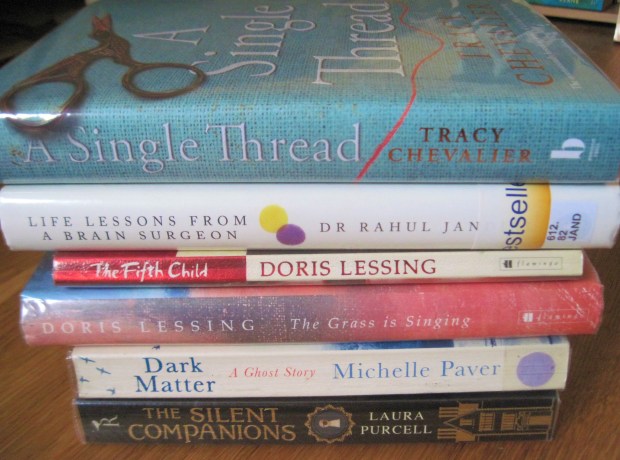
CHECKED OUT, TO BE READ (all for R.I.P.!)
- The Hoarder by Jess Kidd
- The Fifth Child by Doris Lessing
- Dark Matter by Michelle Paver
- The Silent Companions by Laura Purcell
+ Owls Do Cry by Janet Frame [university library], The Grass Is Singing by Doris Lessing
IN THE RESERVATION QUEUE
- The Easternmost House: A Year of Life on the Edge of England by Juliet Blaxland
- The Body: A Guide for Occupants by Bill Bryson
- The Confession by Jessie Burton
- The School of Life: An Emotional Education by Alain de Botton
- Girl, Woman, Other by Bernardine Evaristo
- Starve Acre by Andrew Michael Hurley
- A Half-Baked Idea: How Grief, Love and Cake Took Me from the Courtroom to Le Cordon Bleu by Olivia Potts
- Chances Are by Richard Russo
- The Poetry Pharmacy Returns: More Prescriptions for Courage, Healing and Hope by William Sieghart
- My Name Is Why: A Memoir by Lemn Sissay
- Grand Union: Stories by Zadie Smith
- Feel Free: Essays by Zadie Smith
- On Earth We’re Briefly Gorgeous by Ocean Vuong
RETURNED UNFINISHED
- The Porpoise by Mark Haddon – I read “The Flight,” the excellent 10-page prologue, which is almost like a stand-alone short story and features a terrifying plane crash and its aftermath. But after that I found I had zero interest in continuing with a Pericles update.
- The Well-Beloved by Thomas Hardy [university library]
- Dark Glasses by Blake Morrison [university library] – I read all but the final and longest poem, “The Inquisitor,” so about 50 out of 79 pages. I have trouble remembering now what the book is about, beyond, well, everything: life, family, seasons, choices, regrets.
- I Never Said I Loved You by Rhik Samadder – I read the introduction and part of the first chapter (about 12 pages). I’m not sure how I heard about it or why I thought I wanted to read it. I guess it sounded like it would be an amusing family memoir that employed humor as well as pathos when dealing with serious subjects like depression. I’d never heard of the author, though (a broadcaster and Guardian columnist), so I had no specific interest in his life story and the writing had nothing to recommend it.
- Some Hope by Edward St. Aubyn – I read the first chapter, skipped forward to read the first few pages of Chapter 10 (when Patrick tries to be more mature and nuanced in his thinking as he searches for peace of mind; it’s too simple to just loathe his father), and skimmed to the end. This is more like Never Mind than Bad News in that it returns to that shallow, glittering world of the rich partying set. I found I had trouble keeping all the secondary characters straight, and didn’t care about them; I only wanted to hear about Patrick.
RETURNED UNREAD
- If Only I Could Tell You by Hannah Beckerman – I tried the first few pages and didn’t enjoy the style. It felt awfully portentous for what is essentially women’s fiction.
Does anything appeal from my stacks?
Short Story Collections Read Recently
This is the fourth year in a row that I’ve made a concerted effort to read more short stories in the alliterative month of September. (See also my 2016, 2017 and 2018 performances.) Short story collections are often hit and miss for me, and based on a few recent experiences I seem to be prone to DNFing them after two stories – when I’ve had my fill of the style and content. I generally have better luck with linked stories like Olive Kitteridge and its sequel, because they rely on a more limited set of characters and settings, and you often get intriguingly different perspectives on the same situations.
So far this year, I’ve read just five story collections – though that rises to 13 if I count books of linked short stories that are often classed as novels (Barnacle Love, Bottled Goods, Jesus’ Son, The Lager Queen of Minnesota, Olive Kitteridge, Olive, Again, That Time I Loved You and The Unchangeable Spots of Leopards). Twelve is my minimum goal for short story collections in a year – the equivalent of one per month – so I’m pleased to have surpassed that, and will continue to pick up the occasional short story collection as the year goes on.
The first two books I review here were hits with me, while the third disappointed me a bit.
The Assassination of Margaret Thatcher by Hilary Mantel (2014)
 Four of these 10 stories first appeared in the London Review of Books, and another four in the Guardian. Most interestingly, the opening story, “Sorry to Disturb,” about a bored housewife trying to write a novel while in Saudi Arabia with her husband in 1983–4, was published in the LRB with the subtitle “A Memoir.” That it’s one of the best few ‘stories’ here doesn’t negate Mantel’s fictional abilities so much as prove her talent for working in the short form.
My other few favorites were the very short ones, about a fatal discovery of adultery, an appalling accident on a holiday in Greece, and a sighting of a dead father on a train. I also enjoyed “How Shall I Know You?” in which an author is invited to give a talk to a literary society. I especially liked the jokey pep talks to self involving references to other authors: “come now, what would Anita Brookner do?” and “for sure A.S. Byatt would have managed it better.” Other topics include children’s horror at disability, colleague secrets at a Harley Street clinic, and a sister’s struggle with anorexia. The title story offers an alternative history in which Thatcher is assassinated by the IRA upon leaving an eye hospital after surgery.
In her stories Mantel reminds me most of Tessa Hadley. It’s high time I read another Mantel novel; most likely that will be the third Thomas Cromwell book, due out next year.
My rating:
In the Driver’s Seat by Helen Simpson (2005)
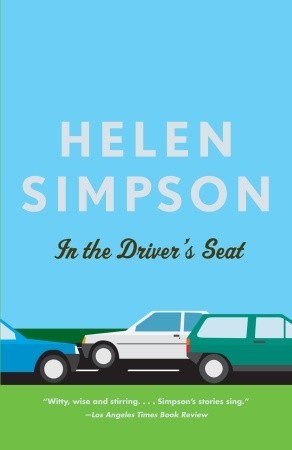 I liked this even more than Simpson’s first book, Four Bare Legs in a Bed, which I reviewed last year. The themes include motherhood (starting, in a couple of cases, in one’s early 40s), death versus new beginnings, and how to be optimistic in a world in turmoil. There’s gentle humor and magic to these stories that tempers some of the sadness. I especially liked “The Door,” about a grieving woman looking to restore her sense of security after a home break-in, “The Green Room,” a Christmas Carol riff (one of two Christmas-themed stories here) in which a woman is shown how her negative thoughts and obsession with the past are damaging her, and “Constitutional,” set on a woman’s one-hour circular walk during her lunch break and documenting her thoughts about everything from pregnancy to a nonagenarian friend’s funeral. [The UK title of the collection is Constitutional.]
In two stories, “Every Third Thought” and “If I’m Spared,” a brush with death causes a complete change of outlook – but will it last? “The Year’s Midnight” creates a brief connection between frazzled mums at the swimming pool in the run-up to the holidays. “Up at a Villa” and the title story capture risky moments that blend fear and elation. In “The Tree,” which is funny and cringeworthy all at the same time, a man decides to take revenge on the company that ripped off his forgetful old mother. Prize for the best title goes to “The Phlebotomist’s Love Life,” though it’s the least interesting story of the 11.
(Found in a Little Free Library at the supermarket near my parents’ old house.)
Some favorite lines:
“the inevitable difficulty involved in discovering ourselves to others; the clichés and blindness and inadvertent misrepresentations”
“Always a recipe for depression, Christmas, when complex adults demanded simple joy without effort, a miraculous feast of stingless memory.”
“You shouldn’t be too interested in the past. You yourself now are the embodiment of what you have lived. What’s done is done.”
My rating: 
The Lager Queen of Minnesota by J. Ryan Stradal (2019)
I had sky-high hopes for Stradal’s follow-up after Kitchens of the Great Midwest (it was on my Most Anticipated list for the second half of the year). Theoretically, a novel about three pie-baking, beer-making female members of a Minnesota family should have been terrific. Like Kitchens, this is female-centered, on a foodie theme, set in the Midwest and structured as linked short stories. Here the chapters are all titled after amounts of money; they skip around in time between the 1950s and the present day and between the perspectives of Edith Magnusson, her estranged younger sister Helen Blotz, and Edith’s granddaughter, Diana Winter.
 Edith and Helen have a rivalry as old as the Bible, based around an inheritance that Helen stole to reopen her husband’s family brewery, instead of sharing it with Edith. Ever since, Edith has had to work minimum-wage jobs at nursing homes and fast food restaurants to make ends meet. When Diana comes to live with her as a teenager, she, too, works hard to contribute to the family, but then gets caught up in a dodgy money-making scheme. It’s in penance for this error that she starts working at a local brewery, but beer soon becomes as much of an obsession for Diana as it once was for her great-aunt Helen.
I had a few problems with the book’s setup: Helen is portrayed as a villain, and never fully sheds that stereotypical designation; meanwhile, Edith is passive and boring, just a bit “wet” (in British slang). Edith and Diana suffer more losses than seems likely or fair, and there are too many coincidences involved in Diana’s transformation into a master brewer. I also found it far-fetched that a brewery would hire her as a 19-year-old and let her practice making many, many batches of lager, all while she’s still underage. None of the characters fully came alive for me, though Diana was the closest. The ending wasn’t as saccharine as I expected, but still left me indifferent. I did like reading about the process of beer-making and flavor development, though, even though I’m not a beer drinker.
My rating: 
Short story DNFs this year (in chronological order):
Mr Wrong by Elizabeth Jane Howard – I read the two shortest stories, “Summer Picnic” and “The Proposition.” The former was pleasantly like Elizabeth Taylor or Tessa Hadley lite; I got zero out of the latter.
 I Want to Show You More by Jamie Quatro – I read the first two stories. “Decomposition,” about a woman’s lover magically becoming a physical as well as emotional weight on her and her marriage, has an interesting structure as well as second-person narration, but I fear the collection as a whole will just be a one-note treatment of a woman’s obsession with her affair.
Multitudes: Eleven Stories by Lucy Caldwell – I read the first two stories. I enjoyed the short opener, “The Ally Ally O,” which describes a desultory ride in the car with mother and sisters with second-person narration and no speech marks. I should have given up on “Thirteen,” though, a tired story of a young teen missing her best friend.
The Country Ahead of Us, the Country Behind by David Guterson – I read “Angels in the Snow” (last Christmas) and “Wood Grouse on a High Promontory Overlooking Canada” (the other week). Both were fine but not particularly memorable; a glance at the rest suggests that they’ll all be about baseball and hunting. If I wanted to read about dudes hunting I’d turn to Ernest Hemingway or David Vann. Nevertheless, I’ll keep this around in case I want to try it again after reading Snow Falling on Cedars this winter.
Currently reading:
 Ship Fever by Andrea Barrett – Elegant stories about history, science and human error. Barrett is similar to A.S. Byatt in her style and themes, which are familiar to me from my reading of Archangel. This won a National Book Award in 1996.
- Descent of Man by T. Coraghessan Boyle – Even in this slim volume, there are SO MANY stories, and all so different from each other. Some I love; some are meh. I’m tempted to leave a few unread, though then I can’t count this towards my year total…
- Sum: Tales from the Afterlives by David Eagleman – A bibliotherapy prescription for reading aloud. My husband and I read a few stories to each other, but I’m going it alone for the rest. This is fairly inventive in the vein of Alan Lightman’s Einstein’s Dreams, yet I find it repetitive.
Future prospects:
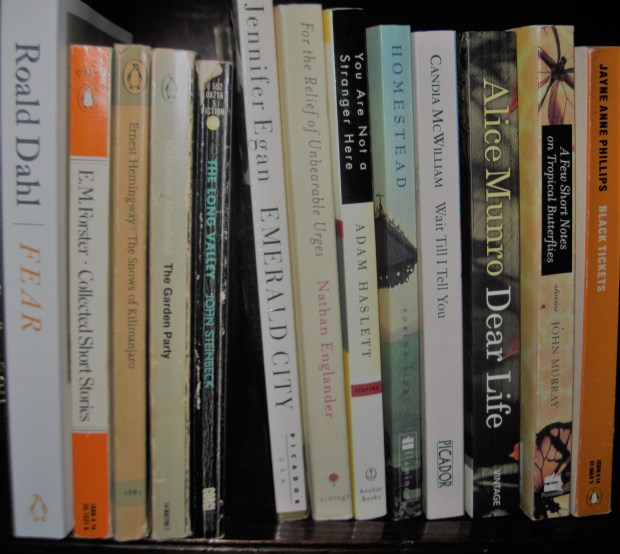
See also Laura’s excellent post about her favorite individual short stories.
Are you a short story fan? Read any good ones recently?
Penguin Influencers Event & 2020 Releases to Look Out For
Just a quick one to report on an event I attended in London last night – thanks to Annabel for asking if she could invite me along. This Penguin Influencers evening was held at sofa.com, a furniture showroom nestled beneath a railway arch near Southwark station. It was a slightly odd venue, but at least there were lots of comfy places to sit. Displays of proof copies were arranged on coffee tables so we could go around and fill our free Tana French tote bags with what caught our eye. There were a few dozen of us there: just one bloke; and mostly women younger than me.

It was good to meet some bloggers I recognized from Twitter and Facebook groups, including Rachel Gilbey (one of whose blog tours I’ve participated in) and Linda Hill (one of whose blog competitions I’ve won); I also spotted a couple more familiar faces, even though I didn’t get to say hello: Ova from Excuse My Reading and Umut from Umut Reviews. It was especially nice to see Beth Bonini, the Bookstagram queen, again. She used to live near me, though we didn’t realize that until just as she was moving from Newbury to London; she gave me her gorgeous bookcase.
As to the book acquisitions…
 The Wych Elm by Tana French is now out in paperback. I’ve not read anything by French, but have meant to for a long time because many trusted bloggers think she’s terrific, even if (like me) they don’t ordinarily read crime. This just exceeds 500 pages, so I think I’ll make it my doorstopper for next month, and it will also tie in with the R.I.P. challenge.
 I’d already read Olive, Again by Elizabeth Strout on my Kindle via a NetGalley download, but it’s great to now own one of my favorite releases of the year in print. (I found it difficult to go back through the e-book when writing my review because it didn’t have a proper table of contents and I’d forgotten all the chapter/story titles as I went along.)
 Three Hours by Rosamund Lupton is coming out on January 9th. It’s a tense school shooting novel set in Somerset, and the publicist told us that if we don’t agree with her in all those clichés – ‘I couldn’t put it down; I stayed up all night reading it’ – we can sue her!
 Dear Edward by Ann Napolitano is coming out on February 27th. Edward is the only survivor after a plane bound from New York City to Los Angeles crashes in Colorado. The novel is about how he rebuilds his life afterwards; the publicist warned us to bring tissues.
 Keeper by Jessica Moor is Penguin’s lead debut title of 2020, coming out on March 19th. When a young woman is found dead at a popular suicide site, the police dismiss it as an open-and-shut case of suicide. But the others at the women’s shelter where Katie Straw worked aren’t convinced. We meet five very different women from the refuge and hear their stories, in the process learning about some of the major threats that face women today. There are already words of praise in from Val McDermid and Jeanette Winterson.
It probably won’t be until later in December that I start reading 2020 titles and reporting back on what I’ve read, plus listing the other releases I’m most looking forward to.
Though I might have hoped for a few more free books to make the cost of my train ticket into London feel worthwhile, I enjoyed connecting with fellow bloggers, hearing about some 2020 releases, and briefly fooling myself that I’m an influencer in the book world. At the very least, I’m now on a Penguin mailing list so might be invited to some future events or sent some proofs.
Olive Kitteridge and Olive, Again
Although I’ve confessed to being generally wary of sequels, and I am scrupulously avoiding this autumn’s other high-profile sequel (you know the one!), I loved Olive Kitteridge enough to continue straight on to Elizabeth Strout’s sequel, Olive, Again, which I thought even better.
Olive Kitteridge (2008)
I have a soft spot for literature’s curmudgeons – the real-life ones like J. R. Ackerley, Shaun Bythell and Geoff Dyer as well as the fictional protagonists like Dr. James Darke in Rick Gekoski’s debut novel, Cassandra Darke in Posy Simmonds’s graphic novel, Hagar Shipley in The Stone Angel, Hendrik Groen in his two titular Dutch diaries, and Frederick Lothian in Josephine Wilson’s Extinctions. So it’s no surprise that I warmed immediately to Olive Kitteridge, a grumpy retired math teacher in Crosby, Maine. She’s seen and heard it all, and will bluntly say just what she thinks. She has no time for anyone else’s nonsense.
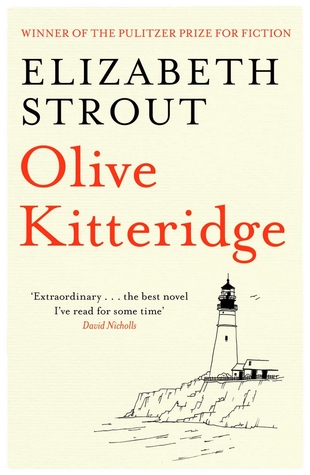 I love our first introduction to her, three pages into the opening piece of this linked short story collection: she dismisses her pharmacist husband Henry’s new employee as “mousy,” and when Henry suggests inviting the girl and her husband over for dinner, snaps, Bartleby-like, “Not keen on it.” The great sadness of Olive’s life is the death of a fellow teacher she never quite had an affair with, but loved in her early forties. The great failure of Olive’s life is not connecting with her only son, Christopher, a podiatrist who marries a woman Olive dislikes and moves to California, then remarries a single mother of two and settles in New York City.
I started this in February and didn’t finish it until this month. I lost momentum after “A Different Road,” in which Olive and Henry are in a hostage situation in the local hospital. This was a darker turn than I was prepared for from Strout – I thought unrequited love and seasonal melancholy was as bleak as she’d go. But I hadn’t read “Tulips” yet, in which we learn that a local boy is in prison for stabbing a woman 29 times.
My least favorite stories were the ones that are about other locals and only mention Olive in passing, perhaps via advice she once gave a student. It almost feels like Strout wrote these as stand-alone stories and then, at her publisher’s behest, inserted a sentence or two so they could fit into a book about Olive. I much prefer the stories that are all about Olive, whether she’s engaging in a small act of rebellion on her son’s wedding day, visiting his new family in New York, or entertaining the prospect of romance some time after Henry’s death.
Olive is a sort of Everywoman; in her loneliness, frustrated desire and occasional depression she’s like us all. I wrote an article on linked short story collections some months ago and pretty much everyone I consulted mentioned Olive as the epitome. I didn’t love the book quite as much as I expected to, but I was very glad to have read it. It won the Pulitzer Prize in 2009.
[Apropos of nothing: this book contains the worst possible nickname for my name that I’ve ever encountered: Bicka-Beck.]
My rating:
Olive, Again (2019)
(Coming from Random House [USA] on October 15th and Viking [UK] on October 31st)
 I liked this that little bit more than Olive Kitteridge for a number of reasons:
1) I read it over a matter of days rather than months, so the characters and happenings stayed fresher in my mind and I experienced it more as a novel-in-stories than as a set of discrete stories.
2) Olive, our Everywoman protagonist, approaches widowhood, decrepitude and death with her usual mixture of stoicism and bad temper. You may hear more about her bowels than you’d like to, but at least Strout is being realistic about the indignities of ageing.
3) Crucially, Olive has started, very late in life, to take a genuine interest in other people, such as her son’s second wife; a local girl who becomes Poet Laureate; and the carers who look after her following a heart attack. “Tell me what it’s like to be you,” she says one day to the Somali nurse who comes over from Shirley Falls. Comparing others’ lives with her own, she realizes she’s been lucky in many ways. Yet that doesn’t make understanding herself, or preparing for death, any easier.
4) There are connections to other Strout novels that made me intrigued to read further in her work. In “Exiles,” Bob and Jim Burgess of The Burgess Boys are reunited in Maine, while in the final story, “Friend,” Olive befriends a new fellow nursing home resident, Isabelle Daignault of Amy and Isabelle.
5) Olive delivers a baby!
As with the previous volume, I most liked the stories that stuck close to Olive, and least liked those that are primarily about others in Crosby or Shirley Falls and only mention Olive in passing, such as via a piece of advice she gave to one of her math students several decades ago. Twice Strout goes sexually explicit – a voyeurism situation, and a minor character who is a dominatrix; I felt these touches were unnecessary. Overall, though, these stories are of very high quality. The two best ones, worth seeking out whether you think you want to read the whole book or not, are “The Poet” and “Heart.”
My rating:
I read an advanced e-copy via NetGalley.
Are you a fan of Elizabeth Strout’s work? Do you plan to read Olive, Again?
Thomas Hardy Tourism in Dorset
We fancied a short break before term starts (my husband is a teaching associate in university-level biology), so booked a cheap Airbnb room in Bridport for a couple of nights and headed to Dorset on Wednesday, stopping at the Thomas Hardy birthplace cottage on the way down and returning on Friday via Max Gate, the home he designed on the outskirts of Dorchester.
I’d been to both before, but over 15 years ago. In the summer of 2004, at the end of my study abroad year, I used a travel grant from my college to spend a week in Dorset and Nottinghamshire, researching the sense of place in the works of Hardy and D.H. Lawrence. I marvel at my bravery now: barely out of my teens, there I was traveling alone by train and bus to places I’d never been before, finding my own B&B accommodation, and taking long countryside walks to arrive at many sites on foot.

Max Gate
I found that much had changed in 15 years. The main difference is that both properties have now been given the full National Trust treatment, with an offsite visitor centre and café down the lane from Hardy’s Cottage, and the upper floors of Max Gate now open to the public after the end of private tenancies in 2011.* This could be perceived as a good thing or a bad thing: Everything is more commercial and geared towards tourists, yes, but also better looked after and more inviting thanks to visitor income and knowledgeable volunteers. Fifteen years ago I remember the two sites being virtually deserted, with the cottage’s garden under black plastic and awaiting a complete replanting. Now it’s flourishing with flowers and vegetables.
*In 2004 only a few ground-floor rooms were open to the public. I happened to spot in the visitor’s book that novelist Vikram Seth had signed in just before me. When I made the caretakers aware of this, they expressed admiration for his work and offered him an exclusive look at the study where Hardy wrote Tess of the d’Urbervilles. I got to tag along! The story is less impressive since it’s been a standard part of the house tour for eight years now, but I still consider it a minor claim to fame.
The thatched cottage doesn’t possess anything that belonged to the Hardy family, but is decorated in a period style that’s true to its mid-1800s origin. Hardy was born here and remained until his early thirties, completing an architecture apprenticeship and writing his first few books, including Under the Greenwood Tree. Even if you’re not particularly familiar with or fond of Hardy’s work, I’d recommend an afternoon at the cottage for a glimpse of how simple folk lived in that time. With wood smoke spooling out of the chimney and live music emanating from the door – there are two old fiddles in the sitting room that guests are invited to play – it was a perfectly atmospheric visit.

 Afterwards, we headed to Portland, an isthmus extending from the south coast near Weymouth and known for its stone. It’s the setting of The Well-Beloved, which Hardy issued in serial form in 1892 and revised in 1897 for its book publication. Jocelyn Pierston, a sculptor whose fame is growing in London, returns to “the Isle of Slingers” (Hardy gave all his English locales made-up names) for a visit and runs into Avice Caro, a childhood friend. On a whim, he asks her to marry him. Before long, though, following a steamy (for Victorian literature, anyway) scene under an upturned boat during a storm, he transfers his affections to Miss Bencomb, the daughter of his father’s rival stone merchant. The fickle young man soon issues a second marriage proposal. I read the first 30 pages, but that was enough for me.

St. George’s Church, Portland, in a Christopher Wren style.
 [I failed on classics or doorstoppers this month, alas, so look out for these monthly features to return in October. I did start The Warden by Anthony Trollope, my first of his works since Phineas Finn in 2005, with the best of intentions, and initially enjoyed the style – partway between Dickens and Hardy, and much less verbose than Trollope usually is. However, I got bogged down in the financial details of Septimus Harding’s supposed ripping-off of the 12 old peasants who live in the local hospital (as in a rest center for the aged and infirm, like the Hospital of St Cross at Winchester). He never should have had his comfortable £800 a year, it seems. His son-in-law, the archdeacon Dr. Grantly, and his would-be son-in-law, gadfly John Bold, take opposing sides as Harding looks to the legal and religious authorities for advice. I read the first 125 pages but only briefly skimmed the rest. Given how much longer the other five volumes are, I doubt I’ll ever read the rest of the Barchester Chronicles.]
My other appropriate reading of the trip was Moon Tiger by Penelope Lively, in which Claudia Hampton, a popular historian now on her deathbed, excavates the layers of her personal past and dwells on the subjectivity of history and memory. She grew up in Dorset and mentions ammonites and rock strata, which we encountered on our beach walks.

Bridport isn’t so well known, but we thought it a lovely place, full of pleasant cafés, pubs and charity shops. It also has an independent bookshop and two secondhand ones, and we had an excellent meal of dumplings and noodle bowls at the English/Asian fusion restaurant Dorshi. It’s tucked away down an alley, but well worth a special trip. Our other special experience of the trip was a tour of Dorset Nectar, a small, family-run organic cider farm just outside of Bridport, which included a tasting of their 10+ delicious ciders. We had splendid late-summer weather for our three days away, too – we really couldn’t have asked for better.


Three secondhand books purchased, for a total of £4.10.
Choose the Year Book Tag: 2010
Thanks to a couple of Lauras (Reading in Bed and Dr Laura Tisdall) for making me aware of this tag that has also been going around on BookTube. If you haven’t already taken part and think this looks like fun, why not give it a try?
Goodreads lists the 200 most popular books of any given year. Skim through and see how many you’ve read from the list and discuss whichever ones you like. (I chose not to answer the last two questions of this prompt but have included them at the bottom of the post.)
- Choose a year and say why.
I browsed a few of the years and found that 2010 contained 12 books that I’ve read, including some that stood out to me for various reasons. For instance, two of them marked the start of my interest in medical-themed reading. I also think of 2010 as when my reading went into ‘mega’ mode, i.e. approaching 200 books per year. (Now it’s more like 320 a year.)
- Which books published in that year have you read [or if none, heard of]?
Because the list is based on the number of times a book has been added to users’ shelves (though not necessarily read and rated) on Goodreads, there is a LOT of YA and series fiction, e.g. Mockingjay at #1. Other notable inclusions: Heaven Is for Real by Todd Burpo and Orange Is the New Black before that really took off.
Read at the time:
 Gimmicky child narrator, but thoroughly readable: Room by Emma Donoghue (#4)
Medical masterpieces: The Immortal Life of Henrietta Lacks by Rebecca Skloot (#6) and The Emperor of All Maladies: A Biography of Cancer by Siddhartha Mukherjee (#45)
 Postmodern, angsty pop culture-filled delights: A Visit from the Goon Squad by Jennifer Egan (#31) and Freedom by Jonathan Franzen (#37). I wonder if they’ve stood the test of time?
Vintage Bryson in curiosity-indulging mode: At Home: A Short History of Private Life by Bill Bryson (#69)
 Not his usual sort of thing, but my introduction to him and a damn fine work of historical fiction: The Thousand Autumns of Jacob de Zoet by David Mitchell (#112)
Not my usual sort of thing (sappiness + magic realism), but I read it at a festival and it passed the time: The Particular Sadness of Lemon Cake by Aimee Bender (#116)
Part of my progressive Christian education, but not a great example; not memorable in the least: Radical: Taking Back Your Faith from the American Dream by David Platt (#138)
 A joy of a linked short story collection set among expat journalists in Rome; this author hasn’t disappointed me since: The Imperfectionists by Tom Rachman (#156)
Who knew typesetting could be so fascinating?! Just My Type: A Book About Fonts by Simon Garfield (#178)
 Read later on:
A brilliant WWII novel, truly among the best of the best: The Invisible Bridge by Julie Orringer (#93)
A DNF: Washington: A Life by Ron Chernow (#73) was way too involved for my level of interest.
- Are there any books published in that year that sound interesting, and would you read them now?
On the TBR:
 #50 Major Pettigrew’s Last Stand by Helen Simonson
#75 The Warmth of Other Suns: The Epic Story of America’s Great Migration by Isabel Wilkerson
#124 Girl in Translation by Jean Kwok
#152 Super Sad True Love Story by Gary Shteyngart
None of these are priorities, but I’d still read them if a copy came my way.
[4. Most obscure-sounding book
5. Strangest book cover]
Do you remember any of these 2010 releases with fondness? Which other ones from the list should I read?
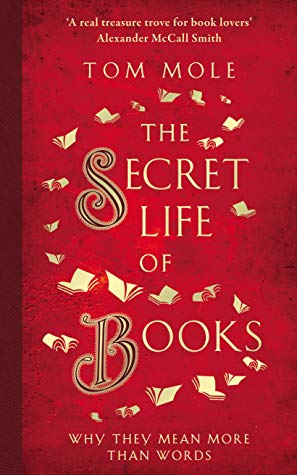
The Secret Life of Books by Tom Mole
 If you’re like me and author Tom Mole, the first thing you do in any new acquaintance’s house is to scrutinize their bookshelves, whether openly or surreptitiously. You can learn all kinds of surprising things about what someone is interested in, and holds dear, from the books on display. (And if they don’t have any books around, should you really be friends?)
Mole runs the Centre for the History of the Book at the University of Edinburgh, where he is a professor of English Literature and Book History. His specialist discipline and this book’s subtitle – “Why They Mean More than Words” – are clues that here he’s concerned with books more as physical and cultural objects than as containers of knowledge and stories:
“reading them is only one of the things we do with books, and not always the most significant. For a book to signal something about you, you don’t necessarily need to have read it.”
From the papyrus scroll to the early codex, from a leather-bound first edition to a mass-market paperback, and from the Kindle to the smartphone reading app, Mole asks how what we think of as a “book” has changed and what our different ways of accessing and possessing books say about us. He examines the book as a basis of personal identity and relationships with other people. His learned and digressive history of the book contains many pleasing pieces of trivia about authors, libraries and bookshops, making it a perfect gift for bibliophiles. I also enjoyed the three “interludes,” in which he explores three paintings that feature books.
There are a lot of talking points here for book lovers. Here are a few:
- Are you a true collector, or merely an “accumulator” of books? (Mole is the latter, as am I. “I have a few modest antiquarian volumes, but most of my books are paperbacks … I was the first in my immediate family to go to university, and I suspect the books on my shelves reassure me that I really have learned something along the way.”)
- In Anne Fadiman’s scheme, are you a “courtly” or a “carnal” reader? The former keeps a book pristine, while the latter has no qualms about cracking spines or dog-earing pages. (I’m a courtly reader, with the exception that I correct all errors in pencil.)
- Is a book a commercial product or a creative artifact? (“This is why authors quite often cross out the printed version of their name when they sign. Their action negates the book’s existence as a product of industry or commerce and reclaims it as the product of their own artistic effort.”)
- How is the experience of reading an e-book, or listening to an audiobook, different from reading a print book? (There is evidence that we remember less when we read on a screen, because we don’t have the physical cues of a book in our hand, plus “most people could in theory fit a lifetime’s reading on a single e-reader.”)
I would particularly recommend this to readers who have enjoyed Anne Fadiman’s Ex Libris, Alberto Manguel’s various books on libraries, and Tim Parks’s Where I’m Reading From.
A personal note: I was delighted to come across a mention of one of the visiting professors on my Master’s course in Victorian Literature at the University of Leeds, Matthew Rubery. In the autumn term of 2005, he taught one of my seminars, “The Reading Revolution in the Victorian Period,” which had a Book History slant and included topics like serial publication, anonymity and the rise of the media. A few years ago Rubery published an academic study of audiobooks, The Untold Story of the Talking Book, which Mole draws on for his discussion.
Two more favorite passages:
“when I’m reading, I’m not just spending time with a book, but investing time in cultivating a more learned version of myself.”
“A library is an argument. An argument about who’s in and who’s out, about what kinds of things belong together, about what’s more important and what’s less so. The books that we choose to keep, the ones that we display most prominently, and the ones that we shelve together make an implicit claim about what we value and how we perceive the world.”
My rating:
The Secret Life of Books will be published by Elliott & Thompson on Thursday 19th September. My thanks to Alison Menzies for arranging my free copy for review.
Literary Fiction Book Tag
Thanks to the Lauras (Reading in Bed and Dr Laura Tisdall) for making me aware of this tag that is also going around on BookTube. Laura F. specifically tagged me. If you haven’t already taken part and think this looks like fun, why not give it a try? For my examples I’ve chosen books I read this year or last year.
- How do you define literary fiction?
 My inclination is to adapt one of Italo Calvino’s definitions of a classic (recapped here): a book that will never finish saying all it has to say. In other words, a perennially relevant work that speaks to the human condition. Obviously, not all literary fiction can live up to that standard; some will inevitably feel dated due to its setting, slang, technology, and so on. But at its best, literary fiction voices, and makes an attempt at answering, one or more of life’s biggest questions. As Laura F. says, this generally means that it lends itself to discussion and (re)interpretation. I know I can be an awful snob about genre fiction, but I avoid crime, science fiction, etc. because I find these genres less ‘serious’ and thus less worthwhile than literary fiction.
- Name a literary fiction novel with a superb character study.
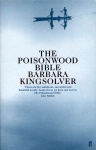
The first novel that comes to mind here is The Poisonwood Bible, which would be a suitable answer for several of these categories but on rereading struck me most for how well developed its five main characters are. Barbara Kingsolver does an impressive job of distinguishing these multiple narrators from each other based on how they speak/write.
- Name a literary fiction novel that has experimental or unique writing.
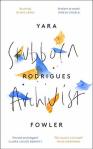 One of the fiction highlights of 2019 so far for me is Stubborn Archivist by Yara Rodrigues Fowler. It stands out from the autofiction field due to its placement of words. Some pages contain just a few lines, or a single short paragraph that reads like a prose poem. Even in the more conventional sections, a lack of punctuation creates a breathless, run-on pace.
- Name a literary fiction novel with an interesting structure.
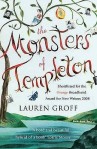 In The Monsters of Templeton, Lauren Groff’s debut novel, Willie Upton is back in her hometown in upstate New York, partway through a PhD and pregnant by her married professor. We hear from various leading lights in the town’s history and/or Willie’s family tree through a series of first-person narratives, letters and other documents.
- Name a literary fiction novel that explores social themes.
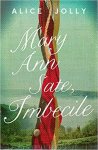 Mary Ann Sate, Imbecile by Alice Jolly, which I reviewed for Nudge, is written entirely in verse and narrated in dialect by an unlearned servant from a cloth mill town in Gloucestershire. With unemployment rising amid the clamor for universal male suffrage, the scene is set for a climactic clash between the common people and the landowning class.
- Name a literary fiction novel that explores the human condition.
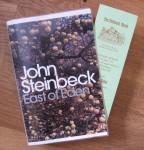 John Steinbeck’s East of Eden has an overarching theme of good and evil as it plays out in families and in individual souls. This weighty material – openly addressed in theological and philosophical terms in the course of the novel – is couched in something of a family saga that follows several generations of the Trasks and the Hamiltons.
- Name a brilliant literary-hybrid genre novel.
 The Sparrow by Mary Doria Russell is a rare sci-fi novel that I loved wholeheartedly. Set on a near-future Jesuit mission to the two alien species on a distant planet, it is about the possibility of believing in God, and doing good works in His name, when suffering seems to be the only result. (See also: The Book of Strange New Things by Michel Faber.)
- What genre do you wish was mixed with literary fiction more?
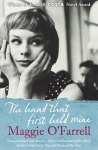 I’ve always felt that Maggie O’Farrell expertly straddles the line between literary and women’s fiction; her books are addictively readable but also hold up to critical scrutiny. Her best is The Hand that First Held Mine, but everything I’ve read by her is wonderful. I’d happily read more books like hers. (Expectation by Anna Hope was slightly less successful.)
 Bookish Beck = Rebecca Foster. American transplant to England. Freelance proofreader and book reviewer.
