My Life in Book Quotes
I keep an ongoing Word file with details on my year’s reading: books finished with the date, number of pages, and source – similar information to what’s recorded on Goodreads – plus any quotations that particularly stood out to me. It occurred to me that by looking back through these annual book lists for the quotes that meant the most to me I could probably narrate my recent years. So here are the 2015–2016 quotes that tell my story.

Career
“I’m learning that what’s important is not so much what I do to make a living as who I become in the process. … the heroine, when at a juncture, makes her own choice—the nonheroine lets others make it for her.”
(A Year by the Sea: Thoughts of an Unfinished Woman, Joan Anderson)
“The dishes. The dishes! The goddamn dishes! No wonder women don’t succeed.”
(The author’s mother’s explosion in The Year My Mother Came Back, Alice Eve Cohen)
“Success says, What more can I get?
Craft says, Can you believe I get to do this?”
(How to Be Here: A Guide to Creating a Life Worth Living, Rob Bell)
“Amateurs look for inspiration; the rest of us just get up and go to work.”
(Everyman, Philip Roth)
Finding a Home
“In Orcadian, ‘flitting’ means ‘moving house’. I can hear it spoken with a tinge of disapproval or pity: the air-headed English couple who couldn’t settle.”
(The Outrun, Amy Liptrot)
“Where, after we have made the great decision to leave the security of childhood and move on into the vastness of maturity, does anybody ever feel completely at home?”
(A Circle of Quiet, Madeleine L’Engle)
“there is no such thing / as the right route or a clear passage / no matter where you start, / or how you plan it.”
(from “Aneurysm,” Selected Poems, Kate Clanchy)
Life vs. Books
“He had accepted that if you were a bookish person the events in your life took place in your head.”
(Golden Age, Jane Smiley)
“my way of seeing has always been different, shyer. To see the world I’ve always opened a book.”
(The Violet Hour: Great Writers at the End, Katie Roiphe)
“Other people’s lives, and the lives I read about in books, seem richer, mine seems so threadbare.”
(The Past, Tessa Hadley)
Overthinking
“She remembered finding her first white hair somewhere near her thirtieth birthday and it had sent her on a tailspin for half a day. It’s starting, she’d thought then. The follicle that produced that hair is dying. I’ve reached the tipping point and from now on it’s nothing but slow decline.”
(Dog Run Moon: Stories, Callan Wink)
“All the most terrifying Ifs involve people. All the good ones do as well.”
(A Little Life, Hanya Yanagihara)
“I wished then, and still do, that there was something in me also that would march steadily in one road, instead of down here or there or somewhere else, the mind running a net of rabbit-paths that twisted and turned and doubled on themselves, pursued always by the hawk-shadow of doubt.”
(Now in November, Josephine Johnson – to be reviewed here within next couple weeks)
Library Checkout: April 2016
You’ll notice a lot of familiar titles: some I’ve reviewed here recently; others have been hanging around since last month. It’s high time I actually read some of these – especially the Elizabeth Gilbert, for which I have high hopes. It’s a long Bank Holiday weekend coming up here in the UK, so maybe I’ll use that as the excuse to sink into a nice long library book…
LIBRARY BOOKS READ
- The Human Age: The World Shaped by Us by Diane Ackerman
- The Zimzum of Love: A New Way of Understanding Marriage by Rob and Kristen Bell
- To the River by Olivia Laing
- The Observances by Kate Miller (poetry)
- Dream Work by Mary Oliver (poetry)
- One of Us: The Story of a Massacre and Its Aftermath by Åsne Seierstad
- Golden Age by Jane Smiley
Skimmed only:
- My Brilliant Friend by Elena Ferrante
- The Towers of Trebizond by Rose Macaulay
LIBRARY BOOKS CURRENTLY READING
- Words in Air: The Complete Correspondence between Elizabeth Bishop and Robert Lowell, edited by Thomas Travisano [It’s over 800 pages, so I’ll probably be reading it all year!]
 CHECKED OUT, TO BE READ
- In the Unlikely Event by Judy Blume
- The Revised Fundamentals of Caregiving by Jonathan Evison
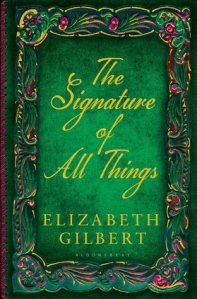
- The Signature of All Things by Elizabeth Gilbert
- The Great Soul of Siberia by Sooyong Park (about tigers)
RETURNED UNREAD
- The Land Ballot by Fleur Adcock
- Song of the Sea Maid by Rebecca Mascull
(Thanks, as always, to Shannon of River City Reading for the great blog idea and template!)
Books in Brief: Five I Loved Recently
The Human Age: The World Shaped by Us
By Diane Ackerman
 A perfect tonic to books like The Sixth Extinction, this is an intriguing and inspiring look at how some of the world’s brightest minds are working to mitigate the negative impacts we have had on the environment and improve human life through technology. As in David R. Boyd’s The Optimistic Environmentalist, Ackerman highlights some innovative programs that are working to improve the environment. Part 1 is the weakest – most of us are already all too aware of how we’ve trashed nature – but the book gets stronger as it goes on. My favorite chapters were the last five, about 3D printing, bionic body parts and human–animal hybrids created for medical use, and how epigenetics and the microbial life we all harbor might influence our personality and behavior more than we think.
My rating: 
I Will Find You
By Joanna Connors
 Connors was a young reporter running late for an assignment for the Cleveland Plain-Dealer when she was raped in an empty theatre on the Case Western campus. Using present-tense narration, she makes the events of 1984 feel as if they happened yesterday. It wasn’t until 2005 that Connors, about to send her daughter off to college, felt the urge to go public about her experience. “I will find you,” her rapist had warned her as he released her from the theatre, but she turned the words back on him, locating his family and learning everything she could about what made him a repeat criminal. She never uses this to explain away what he did, but it gives her the necessary compassion to visit the man’s grave. This is an excellent work of reconstruction and investigative reporting.
My rating:
One of Us: The Story of a Massacre and Its Aftermath
By Åsne Seierstad
 An utterly engrossing account of Anders Behring Breivik’s July 22, 2011 attacks on an Oslo government building (8 dead) and the political youth camp on the island of Utøya (69 killed). Over half of this hefty tome is prologue: Breivik’s life story, plus occasional chapters giving engaging portraits of his teenage victims. The massacre itself, along with initial interrogations and identification of the dead, takes up two long chapters totaling about 100 pages – best devoured in one big gulp when you’re feeling strong. It’s hard to read, but brilliantly rendered. Anyone with an interest in psychology or criminology will find the insights into Breivik’s personality fascinating. This is a book about love and empathy: what they can achieve; what happens when they are absent. It shows how wide the ripples of one person’s actions can be, but also how deep individual motivation goes. All wrapped up in a gripping true crime narrative. Doubtless one of the best books I will read this year.
My rating: 
Cold: Adventures in the World’s Frozen Places
By Bill Streever
 “Cold is a part of day-to-day life, but we often isolate ourselves from it, hiding in overheated houses and retreating to overheated climates, all without understanding what we so eagerly avoid.” In 12 chapters spanning one year, Streever covers every topic related to the cold that you could imagine: polar exploration, temperature scales, extreme weather events (especially the School Children’s Blizzard of 1888 and the “Year without Summer,” 1815), ice ages, cryogenics technology, and on and on. There’s also a travel element, with Streever regularly recording where he is and what the temperature is, starting in his home turf of Anchorage, Alaska. My favorite chapters were February and March, about the development of refrigeration and air conditioning and cold-weather apparel, respectively.
My rating:
A Series of Catastrophes and Miracles
By Mary Elizabeth Williams
 “SPOILER: I lived,” the Salon journalist begins her bittersweet memoir of having Stage 4 metastatic melanoma. In August 2010 she had a several-millimeter scab on her head surgically removed. When the cancer came back a year and a half later, this time in her lungs as well as on her back, she had the extreme good luck of qualifying for an immunotherapy trial that straight up cured her. It’s an encouraging story you don’t often hear in a cancer memoir. On the other hand, her father-in-law’s esophageal cancer and her best friend Debbie’s ovarian cancer simply went from bad to worse. As the title suggests, Williams’s tone vacillates between despair and hope, but her writing is always wry and conversational.
My rating:
(For each one, read my full Goodreads review by clicking on the title link.)
Have you read any of these? Which one takes your fancy?
Jane Smiley’s Last Hundred Years trilogy
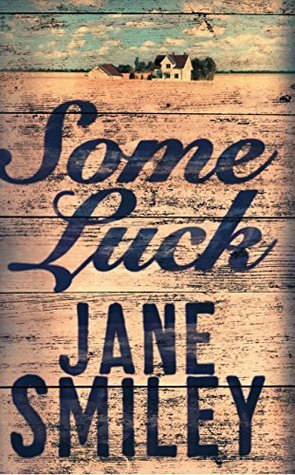
Jane Smiley’s “The Last Hundred Years” trilogy is a saga prioritizing the experiences of the Langdons, an Iowa farming family, over the century beginning in 1920. In chronological chapters, one per year from 1920 to the near future of 2019, Smiley follows an ordinary couple, their six children and several generations of their descendants as they navigate America’s social changes and re-evaluate their principles during decades of upheaval.
 Some Luck
Here’s an excerpt from my Shiny New Books review in early 2015: “Farming, unpredictable and frequently heartbreaking, is an appropriate framework for an all-American story. Aspects of the Great American Novel are certainly on display: immigrant roots, coming-of-age trajectories for individuals and the nation, and American dream scenarios of reinvention. Within the confines of its third-person omniscient point-of-view, the novel shifts between the perspectives of each main character, especially the children. Smiley avoids a gimmicky One Day effect by varying the time of year so most chapters highlight different events, birthdays or holidays. Droughts, the Great Depression, the Second World War, and McCarthyism all feature, while the start of the Cold War – including paranoia over the Russians getting the bomb – sets up the second volume.”
My rating:
Some months ago it occurred to me that I never followed up with the Langdons. Although I don’t generally read sequels or series, I nonetheless made it a priority to find the other two volumes of the trilogy from the library.
Early Warning
The second book covers 1953 to 1986. The family loses one member to Vietnam, one to cancer, and one to the easiest, simplest death you could imagine. There’s a shotgun wedding, a divorce, and several affairs. In short, it feels like a real family, like your family. Events seem arbitrary at the time but later take on the cast of inevitability. Historical landmarks are there as background information, not as clichéd points of action (a good example is the JFK assassination). The Vietnam War threads through the middle section, but isn’t overpowering. The connections with history are pretty subtle here. One of my favorites is when Janet, at a Vietnam protest march, suddenly realizes she’s behind Martin Luther King, Jr. and Dr. Spock. Her later involvement with the Peoples Temple grew tiresome for me, but I appreciated the ironic eye on the future: in 1980, “Well, I guess, they invaded Afghanistan…wherever that is!”
 Iowa was still my preferred setting, an ideal site for pondering time’s workings and how money comes and goes: Joe “knew enough at his age to know that dollars were like drops of mist – they fluttered around you and then dissipated.” I also like Andy’s therapy sessions, frequently featured in the first half. There’s even a gentle mystery in this book: a boy who doesn’t seem to be related to the family keeps showing up, but by the end we figure out who he is.
People may rise and fall in importance, just as they do in real life, but everyone has a perspective. That’s part of Smiley’s message here, I think. Early on she observes that Rosanna “hadn’t thought of Roland Frederick as having a point of view.” Recognizing other people as valid subjects, overcoming solipsism, is really what literature is all about.
Although I’m interested in what happens next, I don’t like the grandchildren generation all that much; Richie and Michael are especially unpleasant, and I have a feeling they will be major players in Golden Age. Still, I feel invested in and close to this family, so I’m going to see it through to the end.
Favorite passage:
Joe’s dystopian vision: “But he could see it, looking south – he could see all the layers lift off – the roof of the house, the second floor, the first floor. He could see the children and Jesse and Jenny and Lois and Minnie being lifted out on a fountain of debt and scattered to the winds; then he could see the corn and beans scoured away, and the topsoil, once twelve inches thick, now six inches thick, and below that, the silty clay loam, more gray than black, then the subsoil, brownish clay all the way down, down, down to the yellow layer, mostly, again, clay, all of it exposed, all of it flying into the atmosphere like money, burning up in the hot sunshine, disappearing.”
My rating:
Golden Age
Alas, the final installment was my least favorite. There are a few reasons for this. One is simply that I didn’t like the third- and fourth-generation characters as much. Another is that, with such a large family tree, you get more lists of names and catch-up sessions. The intrusion of history is also more overt. I noted this in the 2011 chapter, especially, which mentions the Japanese earthquake, Utøya and the Occupy movement. One character dies on 9/11; another gets a flesh-eating bacteria. One is struck by lightning; another dies in a hit and run. Not only are several of the deaths unrealistic, but, true to the winding-down spirit, there are simply a lot of them.
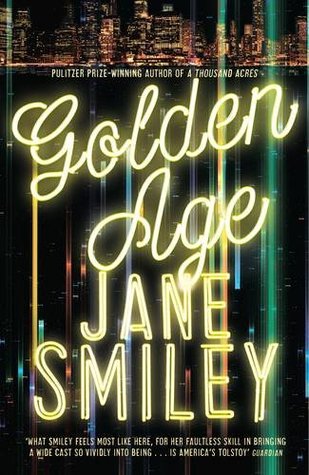 As people disperse and the second generation starts to die off, the bonds between the family members weaken. The Iowa farm diminishes in real-life and symbolic importance compared to the action on the coasts: California, New York and Washington, where Richie is a congressman. I might actually have preferred if Smiley had imagined an alternative history for the 2000s and 2010s. (Of course, that would have broken the mold she made for herself.) For me, it all felt too close. I had a sense of her picking easy targets: “I would like to thank the members of the U.S. Congress for being so easy to satirize,” she writes in her acknowledgments. There’s also too much horse material – a frequent indulgence for Smiley.
The last five or so chapters were speculative at the time Smiley was writing, and some of her predictions already seem a little silly, like violent protests against a Harper government in Vancouver in 2016. However, her environmental worries are right on, and her words about the 2012 presidential election seem prescient in relation to this year’s race: a character advises his family to vote Democrat “as a protest against the Republican Party for offering a roster of candidates that went from bad to worse to worst ever.”
My rating: 
Ultimately, my favorite overall character was Andy, who reinvented herself as a young woman and does so again as a widow, turning into a computer and investment whiz. Frank was an early favorite in Some Luck, where he reminded me a lot of Mad Men’s Don Draper, but I grew less enamored with him over the years. Henry was perhaps my second favorite in the previous two books, but he rather fades into the background in the final book.
My advice to anyone wondering whether they should read this trilogy would be to start with Some Luck and, if you really like it, proceed to Early Warning. Golden Age is largely unnecessary and can be reserved for die-hard Smiley fans or series completists.
Further reading: Literary Hub article, “Why Wasn’t Great American Novelist Jane Smiley on the Cover of a Magazine?”
Book Spine Poetry
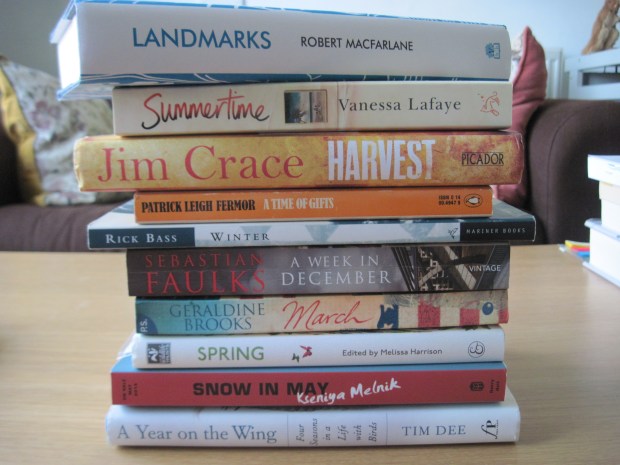
April is National Poetry Month, so I thought I’d try my hand at some book spine poetry. Thanks to Naomi at Consumed by Ink and Cathy at 746 Books for the fun idea! I have taken the liberty of adding punctuation between some lines, but the book titles themselves appear exactly as on the spines. This has been a fun project to do a bit at a time over the last couple of weeks – it’s always a nice break from my editing and more analytical writing.
Peruse your own shelves or the local library’s and have a go. It’s an easy way to get creative!
The years go by so fast…
Landmarks
Summertime
Harvest
A time of gifts
Winter
A week in December
March
Spring
Snow in May
A year on the wing
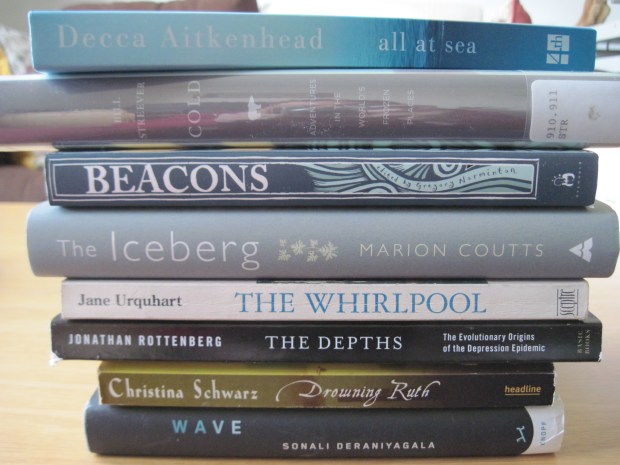
A morbid little number, with a riff on Stevie Smith:
All at sea
Cold beacons:
The iceberg,
The whirlpool,
The depths.
Drowning Ruth,
Wave.
Memento mori:
In fond remembrance of me
How to read a graveyard:
A tour of bones,
Mostly harmless.
Last night on earth?
Nothing to be frightened of.

Thanks to my husband, we have a ton of bird-themed books. The concluding line from Emily Dickinson makes this one a bit of a cheat.
Adventures among birds
To see every bird on earth:
The secret lives of puffins,
Last of the curlews,
The life of the skies.
Rare encounters with ordinary birds:
Songbird journeys,
An eye on the sparrow,
The goldfinch.
Falcon fever:
The armchair birder
Feeding the eagles,
Chasing the wild goose.
Hope is the thing with feathers.

An attempt to lay the groundwork for some progressive theology:
How (not) to speak of God
Jesus among other gods:
Atonement?
Blessed assurance?
Everything is illuminated?
The nice and the good
Crossing to safety?
A new kind of Christianity
The story we find ourselves in.
An unquiet mind
Until I find you.
Love wins;
No man is an island;
We make the road by walking.

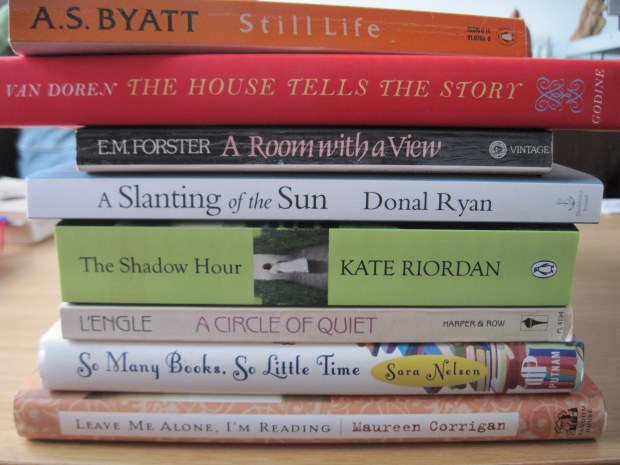
This one’s my favorite – a tribute to my peaceful days spent working from home.
Still life
The house tells the story:
A room with a view
A slanting of the sun
The shadow hour
A circle of quiet.
So many books, so little time;
Leave me alone, I’m reading.
Happy 200th Birthday, Charlotte Brontë!
Today marks a big anniversary: the bicentennial of Charlotte Brontë’s birth. I’ve noticed a whole cluster of books being published or reissued in time for her 200th birthday, many of which I’ve reviewed with enjoyment; some of which I’ve sampled and left unfinished. I hope you’ll find at least one book on this list that will take your fancy. There could be no better time for going back to Charlotte Brontë’s timeless stories and her quiet but full life story.
Short Stories Inspired by Jane Eyre
MINOR SPOILERS AHEAD.
 Reader, I Married Him: Stories Inspired by Jane Eyre, edited by Tracy Chevalier
A mixed bag. Although there are some very good stand-alone stories (from Tessa Hadley, Sarah Hall, Emma Donoghue and Elizabeth McCracken, as you might expect), ultimately the theme is not strong enough to tie them all together and some seem like pieces the authors had lying around and couldn’t figure out what else to do with. Think about it this way: what story isn’t about romance and the decision to marry?
A few of the tales do put an interesting slant on this age-old storyline by positing a lesbian relationship for the protagonist or offering the possibility of same-sex marriage. Then there are the stories that engage directly with the plot and characters of Jane Eyre, giving Grace Poole’s (Helen Dunmore) or Mr. Rochester’s (Salley Vickers) side of things, putting Jane and Rochester in couples therapy (Francine Prose), or making Jane and Helen Burns part of a post-WWII Orphan Exchange (Audrey Niffenegger). My feeling with these spinoff stories was, I’m afraid, what’s the point? Plus there were a number of others that just felt tedious.
My least favorites were probably by Lionel Shriver (incredibly boring!), Kirsty Gunn (unrealistic, and she gives the name Mr. Rochester to a dog!) and Susan Hill (the title story, but she’s made it about Wallis Simpson – and has the audacity to admit, as if proudly, that she’s never read Jane Eyre!). On the other hand, one particular standout is by Elif Shafak. A Turkish Muslim falls in love with a visiting Dutch student but is so unfamiliar with romantic cues that she doesn’t realize he isn’t equally taken with her.
In Patricia Park’s story, my favorite of all, a Korean girl from Buenos Aires moves to New York City to study English. Park turns Jane Eyre on its head by having Teresa give up on the chance of romance to gain stability by marrying Juan, the St. John Rivers character. I loved getting a glimpse into a world I was entirely ignorant of – who knew there was major Korean settlement in Argentina? This also redoubled my wish to read Park’s novel, Re Jane. She’s working on a second novel set in Buenos Aires, so perhaps it will expand on this story.
The Bookbag reviews
Charlotte Brontë’s Secret Love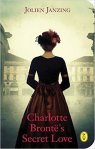 by Jolien Janzing
Charlotte and Emily Brontë’s time in Belgium – specifically, Charlotte’s passion for her teacher, Constantin Heger – is the basis for this historical novel. The authoritative yet inviting narration is a highlight, but some readers may be uncomfortable with the erotic portrayal; it doesn’t seem to fit the historical record, which suggests an unrequited love affair.

Sanctuary by Robert Edric
Branwell Brontë narrates his final year of life, when alcoholism, mental illness and a sense of disgrace hounded him to despair. I felt I never came to understand Branwell’s inner life, beneath the decadence and all the feeling sorry for himself. This gives a sideways look at Charlotte, Emily and Anne, though the sisters are little more than critical voices here; none of them has a distinctive personality.
Mutable Passions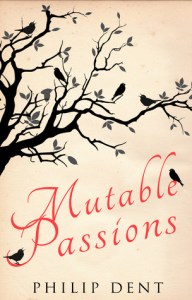 : Charlotte Brontë: A Disquieting Affair by Philip Dent
Dent focuses on a short period in Charlotte Brontë’s life: with all her siblings dead and Villette near completion, a surprise romance with her father’s curate lends a brief taste of happiness. Given her repeated, vociferous denial of feelings for Mr. Nicholls, I had trouble believing that, just 20 pages later, his marriage proposal would provoke rapturous happiness. To put this into perspective, I felt Dent should have referenced the three other marriage proposals Brontë is known to have received. Overwritten and suited to readers of romance novels than to Brontë enthusiasts, this might work well as a play. Dent is better at writing individual scenes and dialogue than at providing context.
Two Abandonees
I had bad luck with these two novels, which both sounded incredibly promising but I eventually abandoned (along with Yuki Chan in Brontë Country, featured in last month’s Six Books I Abandoned Recently post):
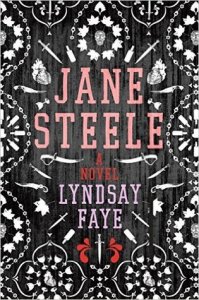 Jane Steele by Lyndsay Faye
Jane Steele is not quite Jane Eyre, though her life seems to mirror that of Brontë’s heroine in most particulars. How she differs is in her violent response to would-be sexual abusers. She’s a feminist vigilante wreaking vengeance on her enemies, whether her repulsive cousin or the vindictive master of “Lowan Bridge” (= Cowan Bridge, Brontë’s real-life school + Lowood, Jane Eyre’s). I stopped reading because I didn’t honestly think Faye was doing enough to set her book apart. “Reader, I murdered him” – nice spin-off line, but there wasn’t enough original material here to hold my attention. (Read the first 22%.)
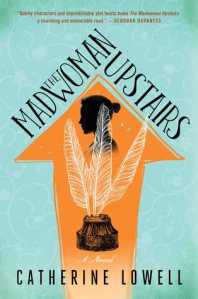 The Madwoman Upstairs by Catherine Lowell
There was every reason for me to love this novel – awkward American narrator, Oxford setting, Brontë connections aplenty, snarky literary criticism – but I got bored with it. Perhaps it was the first-person narration: being stuck in sarcastic Samantha Whipple’s head means none of the other characters feel real; they’re just paper dolls, with Orville a poor excuse for a Mr. Rochester substitute. I did laugh out loud a few times at Samantha’s unorthodox responses to classic literature (“Agnes Grey is, without question, the most boring book ever written”), but I gave up when I finally accepted that I had no interest in how the central mystery/treasure hunt played out. (Read the first 56%.)
An Excellent Biography
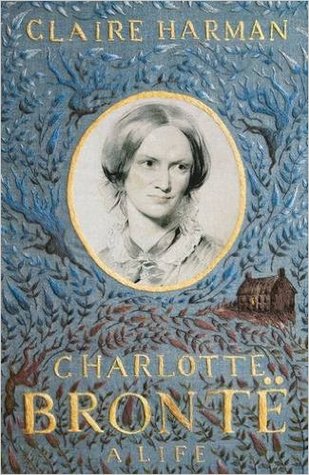 If I could recommend just one book from the recent flurry of Brontëana, it would be Charlotte Brontë: A Life by Claire Harman, which I reviewed for For Books’ Sake back in November.
One of the things Harman’s wonderful biography does best is to trace how the Brontës’ childhood experiences found later expression in their fiction. A chapter on the publication of Jane Eyre (1847) is a highlight. Diehard fans might not encounter lots of new material, but Harman does make a revelation concerning Charlotte’s cause of death – not TB, as previously believed, but hyperemesis gravidarum, or extreme morning sickness. This will help you appreciate afresh the work of a “poet of suffering” whose novels were “all the more subversive because of [their] surface conventionality.” Interesting piece of trivia for you: this and the Janzing novel (above) open with the same scene from Charlotte’s time in Belgium.
Have you read any of these, or other recent Brontë-themed books? What were your thoughts?
Reviews Roundup, March–April
One of my goals with this blog was to have one convenient place where I could gather together all my writing that appears in disparate online locations. To that end, once a month I provide links to all book reviews I’ve published elsewhere, with a rating (below each description) and a taster so you can decide whether to read more. A few exceptions: I don’t point out my Kirkus Indie, BlueInk or Publishers Weekly reviews since I don’t get a byline.
The Bookbag
 The Improbability of Love by Hannah Rothschild: From the Baileys Prize longlist, an enchanting debut novel that blends art and cooking, mystery and romance. Annie McDee, a heartbroken PA and amateur chef, pays £75 for a painting from a junk shop, not realizing it’s a lost Watteau that will spark bidding wars and uncover a sordid chapter of history. In a triumph of playful narration, we mostly learn about the artwork’s history from the painting ‘herself’. She recounts her turbulent 300-year-history and lists her many illustrious owners, including Marie Antoinette, Napoleon and Queen Victoria. These are the novel’s only first-person sections; you can just imagine a voiceover from Helen Mirren or Judi Dench.
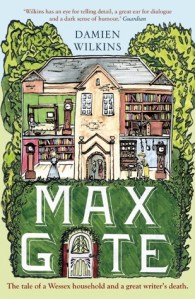 Max Gate by Damien Wilkins: This is a novel of Thomas Hardy’s last days, but we get an unusual glimpse into his household at Max Gate, Dorchester through the point-of-view of his housemaid, twenty-six-year-old Nellie Titterington. Ultimately I suspect a third-person omniscient voice would have worked better. In fact, some passages – recounting scenes Nellie is not witness to – are in the third person, which felt a bit like cheating. Fans familiar with the excellent Claire Tomalin biography might not learn much about Hardy and his household dynamics, but it was fun to spend some imaginary time at a place I once visited. [First published in New Zealand in 2013; releases in the US and UK on June 6th.]
 Dust by Michael Marder: A philosopher carries out an interdisciplinary study of dust: what it’s made of, what it means, and how it informs our metaphors. In itself, he points out, dust is neither positive nor negative, but we give it various cultural meanings. In the Bible, it is the very substance of mortality. Meanwhile “The war on dust, a hallmark of modern hygiene, reverberates with the political hygiene of the war on terror.” The contemporary profusion of allergies may, in fact, be an unintended consequence of our crusade against dust. The discussion is pleasingly wide-ranging, with some unexpected diversions – such as the metaphorical association between ‘stardust’ and celebrity – but also some impenetrable jargon. I’d be interested to try other titles from Bloomsbury’s “Object Lessons” series.
Foreword Reviews
How to Cure Bedwetting by Lane Robson (Oh, the interesting topics my work with self-published books introduces me to!): Explaining the anatomical and behavioral reasons behind bedwetting, the Calgary-based physician gives practical tips for curing the problem within six to twelve months. Throughout, the text generally refers to “pee” and “poop,” which detracts slightly from the professionalism of the work. All the same, this compendium of knowledge, drawing as it does on the author’s forty years of experience, should answer every possible question on the subject. Highly recommended to parents of younger elementary school children, this book will be an invaluable reference in tackling bedwetting.
Nudge
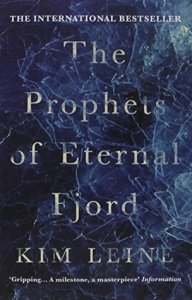 The Prophets of Eternal Fjord by Kim Leine: An epic novel about an unconventional priest, set in late-eighteenth-century Denmark and Greenland. This struck me as a cross between Carsten Jensen’s We, the Drowned, another historical saga from Denmark and one of my favorite novels of all time, and Michel Faber’s The Crimson Petal and the White. Like the former, it features perilous sea voyages and ambivalent father–son relationships; like the latter, it’s edgy and sexualized, full of lechery and bodily fluids. No airbrushing the more unpleasant aspects of history here. The entire story is told in the present tense, with no speech marks. It took me nearly a month and a half to read; by the end I felt I’d been on an odyssey as long and winding as Morten’s.
PANK
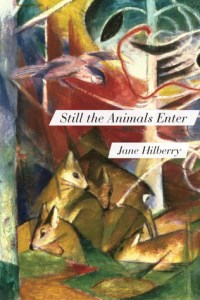 Still the Animals Enter by Jane Hilberry: A rich, strange, and gently erotic collection featuring diverse styles and blurring the lines between child and adult, human and animal, life and death through the language of metamorphosis. Ambivalence about the moments of transition between childhood and adulthood infuses Part One. Early on, “A Hole in the Fence” finishes on a whispered offer: “You could be part of this.” The message in this resonant collection, though, is that we already are a part of it: part of a shared life that moves beyond the individual family or even the human species. We are all connected—to the children we once were, to lovers and family members lost and found, and to the animals we watch in wonder.
Pittsburgh Post-Gazette
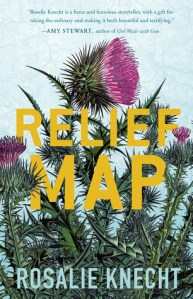 Relief Map by Rosalie Knecht: Lomath, Pennsylvania consists of a half-mile stretch between old textile mills and is home to just 150 people. During one unpredictable summer, blackouts and the arrival of an Eastern European fugitive draw the residents into a welter of paranoia and misguided choices. Our eyewitness to provincial commotion is 16-year-old Livy Marko, who considers herself plain and awkward – her childhood style was supplied by Anne of Green Gables and Goodwill. Knecht’s writing is marked by carefully chosen images and sounds. The novel maintains a languid yet subtly tense ambience. For Livy, coming of age means realizing actions always have consequences. Offbeat and atmospheric, this debut is probably too quiet to make a major splash, but has its gentle rewards.
Shiny New Books
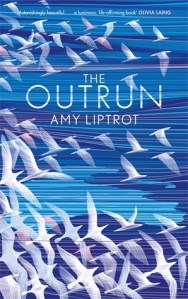 The Outrun by Amy Liptrot: Put simply, this is a memoir about Amy Liptrot’s slide into alcoholism and her subsequent recovery. Liptrot grew up on mainland Orkney, a tight-knit Scottish community she was eager to leave as a teenager but found herself returning to a decade later, washed up after the dissolute living and heartbreak she left behind in London. A simple existence, close to nature and connected to other people, was just what she needed during her first two years of sobriety. Her atmospheric writing about the magical Orkney Islands and their wildlife, rather than the slightly clichéd ruminating on alcoholism, is what sets the book apart. (On the Wellcome Prize shortlist.)
I also post reviews of most of my casual reading and skimming on Goodreads:
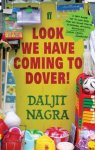 Look We Have Coming to Dover! by Daljit Nagra: The dialect was a bit too heavy for me in some of these poems about the Sikh experience in Britain. By far my favorite was “In a White Town,” which opens: “She never looked like other boys’ mums. / No one ever looked without looking again / at the pink kameez and balloon’d bottoms, // mustard-oiled trail of hair, brocaded pink / sandals and the smell of curry. That’s why / I’d bin the letters about Parents’ Evenings …”
 Work Like Any Other by Virginia Reeves: Between the blurb and the first paragraph, you already know everything that’s going to happen. I admire books that can keep you reading with interest even though you know exactly what’s coming, but this isn’t really one of those. Ultimately I would have preferred for the whole novel, rather than just alternating chapters, to be in Roscoe’s first-person voice, set wholly in prison (where he helps out in the library and with the guard dogs) but with brief flashbacks to his electricity siphoning and the circumstances of his manslaughter conviction. The writing is entirely capable, but the structure made it so I felt the story wasn’t worth my time.
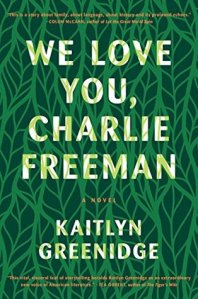 We Love You, Charlie Freeman by Kaitlyn Greenidge: The Freemans are raising Charlie, a chimpanzee, as part of their family for a Toneybee Institute experiment and teaching him to communicate via sign language. Flashbacks to the late 1920s bring an uncomfortable racial subtext to the surface, suggesting that the Toneybee has been involved in dodgy anthropological research over the decades. This is a deep and unsettling story of human–human interactions, even more so than human–animal interactions. I much preferred it to We Are All Completely Beside Ourselves.
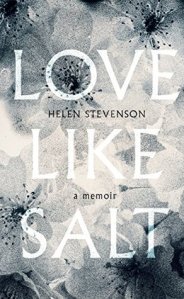 Love Like Salt by Helen Stevenson: Stevenson’s daughter Clara has cystic fibrosis, so I approached and enjoyed this as an illness memoir. However, it’s very scattered, with lots of seemingly irrelevant material included simply because it happened to the author: her mother’s dementia, their life in France, her work as a translator and her hobby of playing the piano, her older husband’s love for Italy and Italian literature, etc. Really the central drama is their seemingly idyllic life in France, Clara being bullied there, and the decision to move back to England (near Bristol), where the girls would attend a Quaker school on scholarships and Clara was enrolled in a widespread clinical trial with modest success. Enjoyable enough if you share some of the author’s interests.
 Springtime: A Ghost Story by Michelle de Kretser: Ghost story? Really? There’s very little in the way of suspense, and not too much plot either, in this Australia-set novella. I would expect tension to linger and questions to remain unanswered. Instead, the author exposes Frances’s ‘ghost’ as harmless. What I think de Kretser is trying to do here is show that ghosts can be people we have known and loved or, alternatively, places we have left behind. There is some nice descriptive writing (e.g. “three staked camellias stood as whitely upright as martyrs”), but not enough story to hold the interest.

 Let the Empire Down by Alexandra Oliver: This debut collection is heavily inspired by history and travel, as well as Serbian poetry and personal anecdote. I enjoyed the earlier poems, especially the ones with ABAB or ABBA rhyme schemes. My favorite was “Plans,” about a twenty-something manicurist who abandoned her talent for science to get ready cash: “A girl’s future should be full and bright, a marble, / but (alas for her) there is a catch: / we take on the immediate. Hope flags: / wishing to be wise and come out shining, / we pop a beaker over our own flame. / We do it cheerfully. We do it coldly.” The last quarter is devoted to poems about films, especially Italian cinema.
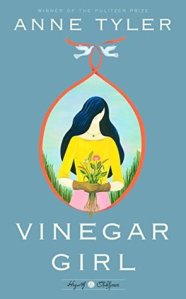 Vinegar Girl by Anne Tyler: This is the most fun I’ve had with the Hogarth Shakespeare series so far, as well as my favorite of the three Anne Tyler novels I’ve read. Yes, it’s set in Baltimore. Kate Battista, the utterly tactless preschool assistant, kept cracking me up. Her father, an autoimmune researcher, schemes for her to marry his lab assistant, Pyotr, so he can stay in the country after his visa expires. The plot twists of the final quarter felt a little predictable, but I was won over by the good-natured storytelling and prickly heroine. (I don’t know The Taming of the Shrew well enough to comment on how this functions as a remake.) Releases in June.
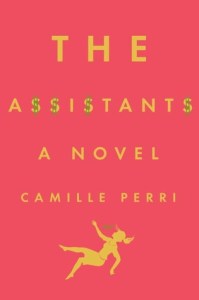 The Assistants by Camille Perri: At age 30, Tina Fontana has been a PA to media mogul Robert Barlow for six years. He’s worth millions; she lives in a tiny Brooklyn apartment. One day a mix-up in refunding expenses lands her with a check for $19,147. If she cashes it she can pay off her debts once and for all and no one at Titan Corporation will be any the wiser, right? This is a fun and undemanding read that will probably primarily appeal to young women. I would particularly recommend it to readers of Friendship by Emily Gould and A Window Opens by Elisabeth Egan. Releases May 3rd.
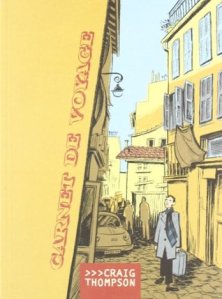 Carnet de Voyage by Craig Thompson: A sketchbook Thompson kept on his combined European book tour for Blankets and research trip for Habibi in March–May 2004. It doesn’t really work as a stand-alone graphic memoir because there isn’t much of a narrative, just a series of book signings, random encounters with friends and strangers, and tourism. My favorite two-page spread is about a camel ride he took into the Moroccan desert. I could also sympathize with his crippling hand pain (from all that drawing) and his “chaos tolerance” overload from the stress of travel.
 Rising Ground: A Search for the Spirit of Place by Philip Marsden: Some very nice writing indeed, but not much of a storyline. The book is something of a jumble of mythology, geology, prehistory, and more recent biographical information about some famous Cornish residents, overlaid on a gentle travel memoir. I enjoyed learning about the meanings of Cornish place names, in particular, and spotting locations I’ve visited.
And my highest recommendation goes to…
Commonwealth by Ann Patchett: It all starts with an early 1960s christening party Los Angeles policeman Fix Keating is throwing for his younger daughter, Franny. DA Bert Cousins turns up, uninvited, with a bottle of gin the grateful guests quickly polish off in their fresh-squeezed orange juice. He also kisses the hostess, sparking a chain of events that will rearrange the Keating and Cousins families in the decades to come. The novel spends time with all six step-siblings, but Franny is definitely the main character – and likely an autobiographical stand-in for Patchett. As a waitress in Chicago, she meets a famous novelist who’s in a slump; the story of her childhood gives him his next bestseller but forces the siblings to revisit a tragic accident they never fully faced up to. Sophisticated and atmospheric; perfect for literary fiction fans in general and Patchett fans in particular. Releases September 13th.
Alive, Alive Oh!: Diana Athill in Person
Last night I was lucky enough to see 98-year-old literary legend Diana Athill in conversation with Erica Wagner at Foyles bookstore in London. Athill, born in 1917, has been an inspiration to me ever since I discovered her work five or so years ago. She didn’t publish anything until she was in her forties, and didn’t reach true acclaim until her eighties, when she released an incredible series of memoirs. Hers is an encouraging story of late-life success and what can be achieved with diligence and good fortune.
What strikes you immediately about Athill is her elegance. Although her hair is thinning and she speaks with a slight slur out of the left side of her mouth, she retains her eagle eye and hawkish profile. That cut-glass BBC pronunciation is not just “the Queen’s English” but a voice just like the Queen’s – she even occasionally used “One” to speak about her own experience. Her look, too, was perfectly put together: a beautiful, multicolored Nehru jacket over a blue silk blouse, accessorized with chunky blue and silver jewelry. Though she was brought in by wheelchair and needed a lot of help getting on the podium – she apologized for her belabored entry – she hardly seems on the brink of death.

Diana Athill and Erica Wagner.
Erica Wagner, too, is one of my heroes: an American expat who served as literary editor of the London Times from 1996 to 2013 and is now a contributing writer with New Statesman and a Harper’s Bazaar consulting literary editor. She drew Athill out on many of the topics from her latest memoir, Alive, Alive Oh! And Other Things that Matter, including the unexpected pregnancy and miscarriage she experienced in her forties, memories of visiting Tobago, and the downsizing that preceded her move into a retirement home.
 Athill recalled the absolute joy she felt upon waking up from her miscarriage, a medical emergency that could well have ended in her death. It was a feeling that started in her stomach and rose up through her body – “I’m alive!” she remembered exulting. Losing her chance at motherhood was not a haunting sadness for her, she remarked; to her surprise, she got over it easily. Part of it was that she had never felt maternal yearning; she vividly pictures being 19, looking at someone’s baby lying on a bed and wondering to herself how she should feel about this creature. Ultimately, she decided, “I’d much rather pick up a puppy!”
That sort of forthrightness was evident in a number of pithy responses Athill gave to audience members’ questions. Asked “is it better to have loved and lost than never to have loved?” she replied with a simple, emphatic “YES!” Does she have anything planned for her 100th birthday? “I choose not to think about it,” she quipped. Has age mellowed her? “A bit,” she hedged, before adding that she is now more tolerant and minds less what others think of her.
One of her key pieces of advice is to avoid romanticism and possessiveness. That certainly played out in her unconventional personal life: she never married but was with her partner, a black man, for some four decades, and after he divorced his wife they formed an unusual household arrangement with his new lover and her family.
If Athill was never possessive in love affairs, however, she did struggle with it in terms of belongings. It was agonizing, she noted, to give up most of her things – especially her books – when moving into a tiny room in a Highgate retirement home. Now, though, she doesn’t mind at all. “When you get very old you really don’t need much,” she insisted. Early on she adopted Montaigne’s practice of thinking about death once a day to get used to the idea. None of the 40 residents at her home minds the thought of being dead; what they don’t like is the idea of dying. Each one hopes to bypass the horrid death and have the easy one instead.
Writing started as a therapeutic exercise for Athill. She wrote Instead of a Letter, about a painful love affair from her youth, because she had a deep sense of failure as a woman. After writing about it, though, she felt completely better, like a new person. Several of her other nonfiction books had a similar motivation: they were a way of getting rid of sad experiences, her own or others’ that she was close to.
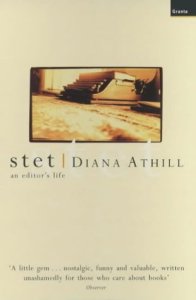 When encouraged to write about her long career as a literary editor, she initially thought she couldn’t do it; she only wrote to “cure nasty things” by getting to the bottom of them as honestly as possible. However, she managed to convince herself she could also write for fun, and Stet, about her work with André Deutsch, was the delightful result. Asked for some of her favorite authors, she named Molly Keane (as a person as well as a writer), Jean Rhys, and Philip Roth (not as a person, she hastened to add!). Rhys and V.S. Naipaul, two of her illustrious clients, never needed a word editing, she recalled; however, they did occasionally need a nanny.
Having seen publishing from the other side now, as an author, Athill believes that being read with absolute attention by an editor – as opposed to getting halfway through a review and finding one’s work hasn’t been understood at all – is heaven. So although she was initially surprised that she would be given an editor, she joked, in the end she was grateful. Publishing is now much more of a business, she acknowledges, but she still feels that many people are in it for the right reason: simply because they love books.
 In the wider world, so much has changed for the worse over the past near-century she’s been alive, but medicine and education are two things that have gotten better. “Long live the National Health!” she cried. (Hear, hear!) On the other hand, it was particularly interesting to hear Athill sigh that she hasn’t been a very good feminist; although she supports the idea, she feels she should have been more engaged. For example, she knew very well that she earned less than a man in her position would have at André Deutsch, but never made anything of it.
In the end, Athill thinks of luck as what’s given to you rather than something you make. “On the whole, I have been so lucky in my life,” she marveled towards the close of last night’s wonderful event. “I can’t really complain about anything.”
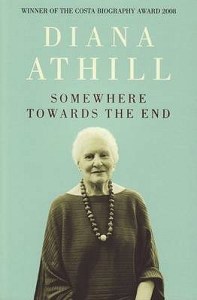
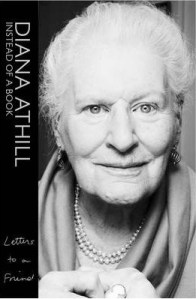 I’ve now read all Athill’s work, even her rather obscure novel and short story collection. Her latest book doesn’t live up to her few best memoirs, but it’s an essential read for a devoted fan. For readers new to her work, I’d recommend starting with Somewhere Towards the End, followed by Stet. From there you might try her book of correspondence with American poet Edward Field, Instead of a Book, or her memoir of childhood, Yesterday Morning.
Psssssst! I have the dirt on a forthcoming Athill publication – and here I thought Alive, Alive Oh! would be her last book for sure. It will be the diary of a trip she took to Florence in 1948. Italy seemed to have bounced back from six years of wartime much more quickly than England, so after that sense of imprisonment it was a chance to enjoy life once again. I’ll be keen to read this rare ‘found document’.
Irmina by Barbara Yelin (Graphic Novel)
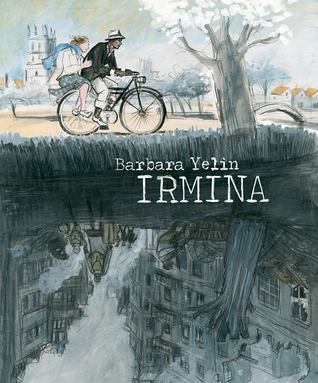 Barbara Yelin’s Irmina is one of the most visually stunning graphic novels I’ve ever come across. Not only that, but it’s based on a fascinating family story: after her grandmother’s death Yelin, a Munich-based artist, found a box of diaries and letters that told the story of a budding love affair that was not to be and charted a young woman’s gradual capitulation to Nazi ideology. How could her grandmother go from being a brave rule-breaker to a cowed regime supporter in just a few short years, she wondered? This fictionalized biography is her attempt to reconcile the ironies and hard facts of her ancestor’s life.
In 1934 Irmina von Behdinger arrives in London for a cultural exchange, attending a commercial school to train as a typist. One night she accompanies a friend to a fancy party and meets Howard, a young Barbados native she initially assumes to be a bartender. It turns out he actually has a scholarship to study law at Oxford. He’s learned, dignified and charming, and soon he and Irmina begin spending a lot of time together. Although she wishes she, too, could study at a proper university, women’s education is not valued in Germany.
Irmina and Howard’s carefree explorations of Oxford and London contrast with the increasingly bleak news coming from Germany about Hitler and his treatment of Jews. As her host family decries Nazism, Irmina tries to protest: “they are not MY Germans … this is politics! It doesn’t affect the average person.” She dreams of being an independent working woman and pursuing a relationship with Howard, but a change in her financial circumstances means she has to go back to Stuttgart instead. Promising to return to England as soon as she can raise some money, Irmina bids farewell to Howard at Portsmouth harbor in April 1935.
Back in Germany, she finds a translation job with the Ministry of War, hoping desperately to be transferred to the German consulate in London once she proves herself. But as the years pass and German relations with the rest of Europe grow strained, her dream seems increasingly unlikely. Having recently lost touch with Howard, she meets Gregor Meinrich, an architect for the SS, and gives up work when they marry and have a son. With the rare exception of a shocking event like Kristallnacht, it’s all too easy to ignore what’s happening to the nation’s Jews and absorb the propaganda that says they have earned their misfortune.
The novel is in three parts: London, Berlin and Barbados – Irmina gets a brief, late chance to see what her life might have been like with Howard. Yelin’s usual palette is muted and melancholy: grays, charcoal, slate blue, browns and flesh tones. However, in each section she chooses one signature color that adds symbolic flashes of life. For London it’s the bright blue of Irmina’s scarf, mirrored in Oxford’s sky and river, as well as in the occasional shopfront and lady’s dress.
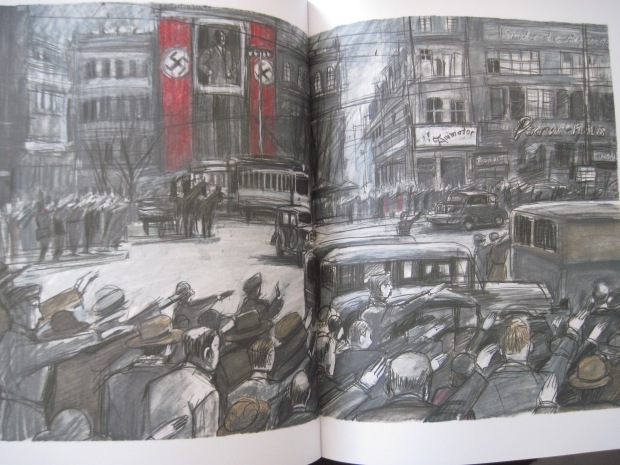
In Berlin the red of the Nazi flag crops up in lipstick, dress patterns, flowers, wine and the décor of a ballroom. In the most poignant scene of all, though, red is equated with the spilling of Jewish blood. As a friend discusses what she doesn’t want to hear – “they’re taking them all to the East now, where they kill them” – Irmina is getting a jar of berry preserves down from a high shelf and drops it, spattering scarlet everywhere. On the other hand, to evoke the calm and natural beauty of 1980s Barbados, the featured hue is a seafoam green.
I was particularly impressed with the two-page spreads showing city scenes. They range from Impressionist fog to Modernist detail, reminding me of everything from Monet to Modigliani. Although the artwork stands out a bit more than the story, this still strikes me as a fresh look at the lives of ordinary Germans who were kept in the dark (by themselves and others) about Hitler’s activities. In an afterword, Dr. Alexander Korb, Director of the University of Leicester’s Stanley Burton Centre for Holocaust and Genocide Studies, reflects on Irmina’s motivation:
Irmina had a full range of possibilities. Yet the fact that she chose the Nazi path from the wide variety in front of her, encompassing feminism, internationality and individuality, makes her story typical of this time. It was just as typical that she failed to find happiness in fascism, like millions of others.
For the out-of-the-ordinary window onto Third Reich history and the excellent illustrations, I highly recommend Irmina to graphic novel lovers and newbies alike.
With thanks to the publisher, SelfMadeHero, for the free copy. Translated from the German by Michael Waaler.
My rating:
Mixed Feelings about Elena Ferrante
I paid my 40 pence and waited in what felt like an endless holds queue to get my hands on a public library copy of My Brilliant Friend, the first of Elena Ferrante’s four Neapolitan novels. For months I’d been eager to try out this literary phenomenon in translation. I read about the first 100 pages and then my interest started to tail off. Aware of the impending due date, I skimmed the rest – so this doesn’t count towards my year’s reading list.
What went wrong? I didn’t dislike the book; in fact, I found it to be an accomplished psychological study of a female friendship and how it changes over time. Yet there were some factors that kept me at a distance. I’ll give a quick synopsis before listing pros and cons.
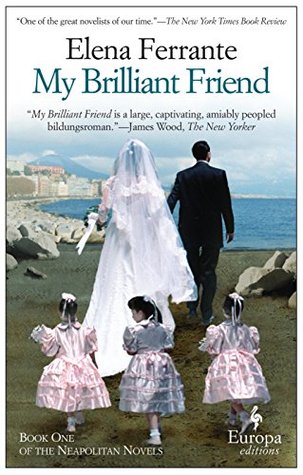 The Story:
Elena, in her sixties, gets a call from the son of her childhood best friend, Lila. His mother and all her possessions have vanished from her home. Elena recalls Lila’s longtime desire to disappear without a trace, and decides she won’t let her: she sits down to her computer to write the story of their friendship, a bulwark against failing memory and deliberate sabotage.
From here Elena, a novelist in her own right (often assumed to be an autobiographical stand-in for Ferrante), returns to the girls’ childhood in 1940s and 1950s Naples, a place of organized crime, domestic violence, and what seems like surprising social backwardness. Neapolitan dialect contrasts with educated Italian. Lila and Elena have a low-key academic rivalry until Lila has to quit school to help her father, a shoemaker. Even then Lila finds ways to show her friend up, maxing out her whole family’s library cards and learning Latin and Greek on her own time. Lila is always one step ahead of Elena, whether in her studies or in attracting boys’ attention. This volume concludes with Lila’s wedding at the age of 16.
What I Loved:
- The psychological acuity Ferrante brings to the relationship between Elena and Lila. Their friendship has a shifting dynamic, vacillating between jealousy and support as they move from childhood through puberty. The novel powerfully captures Elena’s hesitation and Lila’s brazenness, often in piercing one-liners:
she did her best to make me understand that I was superfluous in her life.
In general I was the pretty one, while she was skinny, like a salted anchovy, she gave off an odor of wildness
Lila acted … on me like a demanding ghost
only what Lila touched became important.
- The choice between education and a trade. Money and class have a lot to do with it, but both girls long for a Woolfian “room of one’s own” and even talk of writing novels together one day. Although Lila finds fulfillment designing shoes, it’s plain she envies Elena’s chance to complete high school. “My brilliant friend” is what Lila calls Elena late on in the novel, but it’s what Elena has always thought of Lila too.
- The Naples setting: Don Achille’s murder; setting off fireworks on New Year’s; the sense that the community is on the up and up when someone they know publishes a book. A few of my favorite lines describe the girls’ neighborhood:
We didn’t know the origin of that fear-rancor-hatred-meekness that our parents displayed toward the Carraccis and transmitted to us, but it was there, it was a fact, like the neighborhood, its dirty-white houses, the fetid odor of the landings, the dust of the streets.
What I Struggled with:
- A lack of context. Footnotes would have been intrusive, but perhaps a short introduction from the translator or an English-language critic could have helped set the scene and given some sociological details that would aid in my understanding of mid-twentieth-century Italy. Even just within the first chapter of Only in Naples by Katherine Wilson, a memoir I’m currently reading, there’s more basic information about Italy to help orient foreigners.
- The confusing names. The central characters are known by multiple names – for example, Lila’s full name is Raffaella Cerullo – and nicknames aren’t always intuitive; it reminded me of the variations in War & Peace. Thank goodness for the three-page index of characters.
- Short shrift given to Elena’s odd relationship with her mother. I felt there was a lot more that could have been explored. Perhaps that is a matter for another volume.
- Repetition in the day to day, especially regarding Elena’s schooling. I wondered whether all four, or at least two, of the books might have been condensed into one 400-page novel.
- Minor punctuation and translation issues. I only marked out one passage that sounded false to my ear (“I’ve kept a place for you.” / “Go away, my mother has understood everything.”), but the punctuation drove me a little nutty. I dislike lots of phrases being strung together with commas – as in the anchovy sentence above; I always look for a semicolon!
In general, I avoid series fiction. I hate being saddled with a sense of obligation, and I don’t like feeling that a story is unfinished. That doesn’t mean a book’s last pages can’t be open-ended, but I’d prefer to imagine my own future for the characters rather than have to read about it in another book or three or 14. While I seriously doubt I will pick up another of the Neapolitan novels, I could possibly be persuaded to pick up one of her stand-alone novellas. Naomi at Consumed by Ink wrote a very appealing review of The Lost Daughter, for instance. Although this long-awaited literary experiment was a touch disappointing, I’m still eager to try another model of “autofiction” in translation, Karl Ove Knausgaard.
My rating:
Further reading: Meghan O’Rourke’s 2014 Guardian article about Elena Ferrante’s growing popularity and mysterious persona.
 Bookish Beck = Rebecca Foster. American transplant to England. Freelance proofreader and book reviewer.
