Final 2019 Review Books: Brodesser-Akner, Cregan & McCulloch
The final three review books of the year (not counting DNFs, which will be briefly dispatched on Sunday): a much-hyped novel set in contemporary New York City, a memoir of suicidal depression and recuperation, and a study of linguistics in the Internet era.
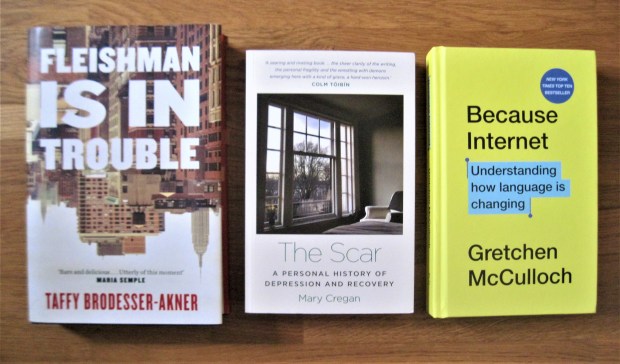
Fleishman Is in Trouble by Taffy Brodesser-Akner
According to the aggregated best-of lists (which Kate has surveyed here), this was one of the top two novels of 2019. I’m going to have to shrug my shoulders and admit, I don’t get it. To me this didn’t stand out at all from the sea of fiction about crumbling marriages and upper-middle-class angst. Toby Fleishman is 41-year-old head of hepatology at a New York City hospital. He recently split from his wife, Rachel, agent to the creator of a Hamilton-style phenomenon. Not content with their comfortable lifestyle, Rachel hankers for true wealth.
 When Rachel goes AWOL at a yoga retreat, Toby is left in charge of their children: Hannah, 11, and Solly, nine. He ferries them to and from summer camp, all the while bombarded with dirty texts and semi-nude selfies from the women he’s flirting with via a dating app. Had this novel been written by a man, people would have been up in arms about the unpleasant sexual content. But this is not just written by a woman; it’s also narrated by a woman: Elizabeth Epstein Slater, a former journalist turned stay-at-home mom. She and Toby became friends on their junior year abroad in Israel and have started hanging out more after his divorce.
So this is a book within a book Elizabeth is writing about one turbulent summer in her friends’ lives, but also her own – she’s dissatisfied with her staid marriage. It’s also Brodesser-Akner’s winking commentary on macho or moralizing fiction: “this was the only way to get someone to listen to a woman—to tell her story through a man” and “none of my characters were likable,” Elizabeth thinks. But attempts to humanize Toby and Rachel fell flat for me. Sadness over the loss of one patient was insufficient to endear me to the randy Toby, and early life with a grim grandmother and severe postpartum trauma couldn’t make me care about whether Rachel was coming back. I also never fully suspended disbelief about Elizabeth’s intimate knowledge of the Fleishmans.
This very New York novel started out promising, with echoes of Where’d You Go, Bernadette? or The Nest. There are some perceptive passages about marriage, and the writing in general is more than capable. But the story didn’t feel nearly fresh enough to justify all that acclaim, or the 373-page length.
With thanks to Wildfire for the free copy for review.
The Scar: A Personal History of Depression and Recovery by Mary Cregan
 Cregan has a scar that reminds her, every time she notices it, of how close she came to taking her own life decades ago. In 1983, at the age of 27, she gave birth to a baby girl, Anna, who died two days later of a heart defect. The loss plunged her into a depression so severe that she made a halfhearted suicide attempt some weeks later and was admitted to a psychiatric hospital, where she was given electroconvulsive therapy. One morning in the hospital, she brought a glass jar of lotion into the shower with her, smashed it, and took a shard to her throat. She only narrowly missed her carotid artery. Cregan wonders if, had she been given appropriate medication, all this heartache could have been avoided.
“I’ve often wished I could undo my own act (if indeed ‘I’ and ‘my’ are accurate words for a self in the condition I was in.)”
“It took a long time to work all of this out, because it’s very hard to see yourself clearly when depressed. The problem is that you think with your mind, but your mind is ill and untrustworthy. Your mind is your enemy.”
Alongside her own winding story, the author surveys the history of mental health treatment in the United States. This felt more familiar and thus engaged me less than the personal material. Nevertheless, I would recommend this forthright memoir to anyone keen to read about the experience of mental illness.
With thanks to the author for arranging my free copy from Lilliput Press, Dublin.
Because Internet: Understanding how language is changing by Gretchen McCulloch
 I’m surprised by how fascinating I found this: I’m a late adopter when it comes to technology (I’m still resisting a smartphone) and I haven’t given linguistics a thought since that one class I took in college, but it turns out that my proofreader’s interest in the English language and my daily use of e-mail and social media were enough to make it extremely relevant. The Montreal linguist’s thesis is that the Internet popularized informal writing and quickly incorporates changes in slang and cultural references. At the same time, it still reflects regional and age-specific differences in the way that people speak (write conversationally).
The book goes deep into topics you may never have considered, like how we convey tone of voice through what we type and how emoji function as the gestures of the written word. You’ll get a breakdown of current generations in terms of when the Internet became the default in their life (I belong to what the author calls “Semi Internet People”: I remember first using the Internet in a classroom in seventh grade, getting dial-up AOL at home not long thereafter, and opening my own Hotmail account in high school), a history of lolcats, and musings on the metaphorical use of periods and capital letters. If you are among the unconvinced, you’ll also be schooled in the appeal of gifs and memes.
Some trivia I picked up:
- In 2015 the tears of joy emoji became the most popular emoji, more used than the smiley-face emoticon.
- For many of us the Internet serves as what sociologists call a “third place” besides home and work where we can socialize.
- Only 5–8% of Internet users are bloggers.
- “Subtweeting” (as in subliminal) and “vaguebooking” are when you post about a situation without giving any specifics.
- Parents often refer to a child by an initial or nickname so the child won’t have a searchable social media presence.
- The Library of Congress now archives memes (The Lolcat Bible, Urban Dictionary, etc.).
McCulloch portrays language as a constantly changing network, such that terms like “standard” and “correct” no longer apply. She writes with such geeky enthusiasm that you’ll happily accompany her down any linguistic alley.
With thanks to Harvill Secker for the free copy for review.
Imitation Is the Sincerest Form of Flattery: Costello, O’Shaughnessy & Smyth
These three books – two novels and a memoir – pay loving tribute to a particular nineteenth- or twentieth-century writer. In each case, the author incorporates passages of pastiche, moving beyond thematic similarity to make their language an additional homage.
Although I enjoyed the three books very much, they differ in terms of how familiar you should be with the source material before embarkation. So while they were all  reads for me, I have added a note below each review to indicate the level of prior knowledge needed.
The River Capture by Mary Costello
 Luke O’Brien has taken a long sabbatical from his teaching job in Dublin and is back living at the family farm beside the river in Waterford. Though only in his mid-thirties, he seems like a man of sorrows, often dwelling on the loss of parents, aunts and romantic relationships with both men and women. He takes quiet pleasure in food, the company of pets, and books, including his extensive collection on James Joyce, about whom he’d like to write a tome of his own. The novel’s very gentle crisis comes when Luke falls for Ruth and it emerges that her late father ruined his beloved Aunt Ellen’s reputation.
At this point a troubled Luke is driven into 100+ pages of sinuous contemplation, a bravura section of short fragments headed by questions. Rather like a catechism, it’s a playful way of organizing his thoughts and likely more than a little Joycean in approach – I’ve read Portrait of the Artist and Dubliners but not Ulysses or Finnegans Wake, so I feel less than able to comment on the literary ventriloquism, but I found this a pleasingly over-the-top stream-of-consciousness that ranges from the profound (“What fear suddenly assails him? The arrival of the noonday demon”) to the scatological (“At what point does he urinate? At approximately three-quarters of the way up the avenue”).
While this doesn’t quite match Costello’s near-perfect novella, Academy Street, it’s an impressive experiment in voice and style, and the treatment of Luke’s bisexuality struck me as sensitive – an apt metaphorical manifestation of the novel’s focus on fluidity. (See also Susan’s excellent review.)
Why Joyce? “integrity … commitment to the quotidian … refusal to take conventions for granted”
Familiarity required: Moderate
Also recommended: The Sixteenth of June by Maya Lang
With thanks to Canongate for the free copy for review.
In Love with George Eliot by Kathy O’Shaughnessy
Many characters, fictional and historical, are in love with George Eliot over the course of this debut novel by a literary editor. The whole thing is a book within a book – fiction being written by Kate, an academic at London’s Queen Elizabeth College who’s preparing for two conferences on Eliot and a new co-taught course on life writing at the same time as she completes her novel, which blends biographical information and imagined scenes.
 1857: Eliot is living with George Henry Lewes, her common-law husband, and working on Adam Bede, which becomes a runaway success, not least because of speculation about its anonymous author. 1880: The great author’s death leaves behind a mentally unstable widower 20 years her junior, John Walter Cross, once such a close family friend that she and Lewes called him “Nephew.”
Between these points are intriguing vignettes from Eliot’s life with her two great loves, and insight into her scandalous position in Victorian society. Her estrangement from her dear brother (the model for Tom in The Mill on the Floss) is a plangent refrain, while interactions with female friends who have accepted the norms of marriage and motherhood reveal just how transgressive her life is perceived to be.
In the historical sections O’Shaughnessy mimics Victorian prose ably, yet avoids the convoluted syntax that can make Eliot challenging. I might have liked a bit more of the contemporary story line, in which Kate and an alluring colleague make their way to Venice (the site of Eliot’s legendarily disastrous honeymoon trip with Cross), but by making this a minor thread O’Shaughnessy ensures that the spotlight remains on Eliot throughout.
Highlights: A cameo appearance by Henry James; a surprisingly sexy passage in which Cross and Eliot read Dante aloud to each other and share their first kiss.
Why Eliot? “As an artist, this was her task, to move the reader to see people in the round.”
Familiarity required: Low
Also recommended: 142 Strand by Rosemary Ashton, Sophie and the Sibyl by Patricia Duncker, and My Life in Middlemarch by Rebecca Mead
With thanks to Scribe UK for the free copy for review.
All the Lives We Ever Lived: Seeking Solace in Virginia Woolf by Katharine Smyth
 Smyth first read To the Lighthouse in Christmas 2001, during her junior year abroad at Oxford. Shortly thereafter her father had surgery in Boston to remove his bladder, one of many operations he’d had during a decade battling cancer. But even this new health scare wasn’t enough to keep him from returning to his habitual three bottles of wine a day. Woolf was there for Smyth during this crisis and all the time leading up to her father’s death, with Lighthouse and Woolf’s own life reflecting Smyth’s experience in unanticipated ways. The Smyths’ Rhode Island beach house, for instance, was reminiscent of the Stephens’ home in Cornwall. Woolf’s mother’s death was an end to the summer visits, and to her childhood; Lighthouse would become her elegy to those bygone days.
Often a short passage by or about Woolf is enough to launch Smyth back into her memories. As an only child, she envied the busy family life of the Ramsays in Lighthouse. She delves into the mystery of her parents’ marriage and her father’s faltering architecture career. She also undertakes Woolf tourism, including the Cornwall cottage, Knole, Charleston and Monk’s House (where Woolf wrote most of Lighthouse). Her writing is dreamy, mingling past and present as she muses on time and grief. The passages of Woolf pastiche are obvious but short enough not to overstay their welcome; as in the Costello, they tend to feature water imagery. It’s a most unusual book in the conception, but for Woolf fans especially, it works. However, I wished I had read Lighthouse more recently than 16.5 years ago – it’s one to reread.
Why Woolf? “I think it’s Woolf’s mastery of moments like these—moments that hold up a mirror to our private tumult while also revealing how much we as humans share—that most draws me to her.”
Undergraduate wisdom: “Woolf’s technique: taking a very complex (usually female) character and using her mind as an emblem of all minds” [copied from notes I took during a lecture on To the Lighthouse in a “Modern Wasteland” course during my sophomore year of college]
Familiarity required: High
Also recommended: Virginia Woolf in Manhattan by Maggie Gee, Vanessa and Her Sister by Priya Parmar, and Adeline by Norah Vincent
With thanks to Atlantic Books for the free copy for review.
Nonfiction Review Books Roundup: Hay, Hope et al., Lee, Long, McLaren, Zuckerman
I’m continuing with the Nonfiction November focus by catching up on six nonfiction review books I’ve been sent over the last half a year. We’ve got a record of elderly parents’ decline, letters and poems written about the climate crisis, a family memoir set between Taiwan and Canada, a widow’s mushroom-hunting quest, a work of ecotheology that reflects on travels in the Galápagos Islands, and a defense of an entirely secular basis for morality. You can’t say I don’t read a variety, even within nonfiction! See if one or more of these tempts you.
All Things Consoled: A Daughter’s Memoir by Elizabeth Hay
 Gordon and Jean Hay stumbled into their early nineties in an Ottawa retirement home starting in 2009. Elizabeth Hay is one of four children, but caregiving fell to her for one reason and another, and it was a fraught task because of her parents’ prickly personalities: Jean was critical and thrifty to the point of absurdity, spooning thick mold off apple sauce before serving it and needling Elizabeth for dumping perfectly good chicken juice a year before; Gordon had a terrible temper and a history of corporal punishment of his children and of his students when he was a school principal. Jean’s knee surgery and subsequent infection finally put paid to their independence; her mind was never the same and she could no longer paint.
There are many harsh moments in this memoir, but almost as many wry ones, with Hay picking just the right anecdotes to illustrate her parents’ behavior and the shifting family dynamic. She never looks away, no matter how hard it all gets. Her father’s rage against the dying of the light contrasts with her mother’s fade into confusion – lightened by the surprisingly poetic turns of phrase she came out with despite her dementia and aphasia. The title phrase, for instance, was her attempt at “all things considered.” I would wholeheartedly recommend this to readers of Hay’s novels, but anyone can appreciate the picture of complicated love and grief. (See also Susan’s review.)
With thanks to MacLehose Press for the free copy for review.
Letters to the Earth: Writing to a Planet in Crisis, edited by Anna Hope et al.
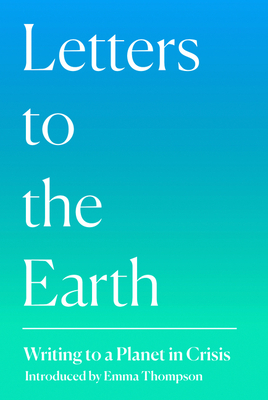 Culture Declares Emergency launched in April to bring the arts into the conversation about the climate emergency. Letters to the Earth compiles 100 short pieces by known and unknown names alike. Alongside published authors, songwriters, professors and politicians are lots of ordinary folk, including children as young as seven. The brief was broad: to write a letter in response to environmental crisis, whether to or from the Earth, to future generations (there are wrenching pieces written to children: “What can I say, now that it’s too late? … that I’m sorry, that I tried,” writes Stuart Capstick), to the government or to other species.
There are certainly relatable emotions here, especially the feeling of helplessness. “We take the train, go vegan, refuse plastic, buy less and less. But that is tiny. We are tiny,” novelist Jo Baker writes. I loved retired bishop Richard Holloway’s wry letter calling the author of Genesis to account for unhelpful language of dominion, Rob Cowen’s poem to a starling, and Anna Hope’s essay about parenting in a time of uncertainty. Unfortunately, much of the rest is twee or haranguing, e.g. “Forest fires are scorching INNOCENT wildlife. Plastic is strangling INNOCENT turtles and dolphins,” a 12-year-old writes. This was put together in a matter of months, and it shows. There is not enough tonal variety, a lot of overwriting has crept through, and errors, especially in the kids’ work, remain uncorrected. Perhaps six to 10 pieces stood out to me overall. I’d recommend the Extinction Rebellion handbook instead.
With thanks to Alison Menzies / William Collins for the free copy for review.
Two Trees Make a Forest: On Memory, Migration and Taiwan by Jessica J. Lee
 I loved Turning, Lee’s 2017 memoir about swimming in one of Berlin’s lakes per week for a year, so I jumped at the chance to read her follow-up, which delves into her maternal line’s history in Taiwan. She travels to Taipei for three months to brush up on her Chinese, write and hike. Interspersed with the lush descriptions of her walks are reflections on Taiwan’s history and on the hidden aspects of her grandfather Gong’s past that only came to light after Lee’s grandmother, Po, died and she and her mother discovered an autobiographical letter he’d written before he drifted into dementia. Nature, language, history and memory flow together in a delicate blend of genres – “I moved from the human timescale of my family’s story through green and unfurling dendrological time,” she writes.
This has got to be one of the most striking title and cover combinations of the year. Along with Chinese characters, the book includes some looping text and Nico Taylor’s maps and illustrations of Taiwanese flora and fauna. While you will likely get more out of this if you have a particular interest in Asian history, languages and culture, it’s impressive how Lee brings the different strands of her story together to form a hybrid nature memoir that I hope will be recognized by next year’s Wainwright Prize and Young Writer of the Year Award shortlists. She’d also be a perfect New Networks for Nature speaker.
With thanks to Virago for the free copy for review.
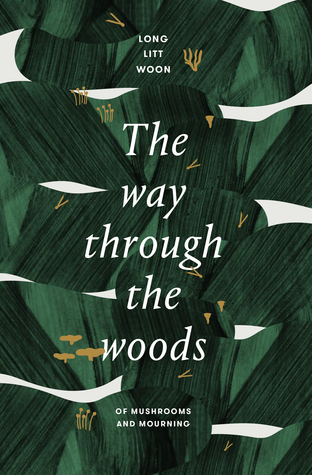
The Way through the Woods: Of Mushrooms and Mourning by Long Lit Woon
 [Trans. from the Norwegian by Barbara J. Haveland]
I couldn’t resist the sound of a bereavement memoir crossed with a mushroom hunting guide. When Long met her husband, Eiolf Olsen, she was an 18-year-old Malaysian exchange student in Stavanger, Norway. Meeting Eiolf changed the whole course of her life, keeping her in Europe for good; decades later, her life changed forever once again when Eiolf dropped dead at work one morning. “If anyone had told me that mushrooms would be my lifeline, the thing that would help me back onto my feet and quite literally back onto life’s track, I would have rolled my eyes. What had mushrooms to do with mourning?” she writes.
 The answer to that rhetorical question is nothing much, at least not inherently, so this ends up becoming a book of two parts, with the bereavement strand (printed in green and in a different font – green is for grief? I suppose) engaging me much more than the mushroom-hunting one, which takes her to Central Park and the annual Telluride, Colorado mushroom festival as well as to Norway’s woods again and again – “In Norway, outdoor life is tantamount to a religion.” But the quest for wonder and for meaning is a universal one. In addition, if you’re a mushroom fan you’ll find gathering advice, tasting notes, and even recipes. I fancy trying the “mushroom bacon” made out of oven-dried shiitakes.
With thanks to Scribe for the free copy for review.
God Unbound: Theology in the Wild by Brian McLaren
 McLaren was commissioned to launch a series that was part travel guide, part spiritual memoir and part theological reflection. Specifically, he was asked to write about the Galápagos Islands because he’d been before and they were important to him. He joins a six-day eco-cruise that tours around the island chain off Ecuador, with little to do except observe the birds, tortoises and iguanas, and swim with fish and sea turtles. For him this is a peaceful, even sacred place that reminds him of the beauty that still exists in the world despite so much human desecration. Although he avoids using his phone except to quickly check in with his wife, modernity encroaches unhelpfully through a potential disaster with his laptop.
I was surprised to see that McLaren leaves the Galápagos at the midpoint – whatever could fill the rest of the book, I wondered? He starts by reassessing Darwin, so often painted as a villain by Evangelical Christianity but actually a model of close, loving attention to nature. He also recalls how some of his most intense spiritual experiences have arisen from time in nature. McLaren’s books have been pivotal to my spiritual journey as we’ve both gradually become more liberal and environmentalist. His definition of God might horrify traditionalists, but holds appeal for me: “a centering singularity whose gravity holds me in insistent orbit, pulling me deeper into mystery, pondering who I am and what my life means.” This is an unusual but gently entrancing book full of photos and quotes from other thinkers including John Muir, Pope Francis and Richard Rohr. It’s an ideal introduction to ecotheology.
With thanks to Canterbury Press for the free copy for review.
What It Means to Be Moral: Why Religion Is Not Necessary for Living an Ethical Life by Phil Zuckerman
 From one end of the spectrum (progressive Christianity) to the other (atheism). Here’s a different perspective from a sociology professor at California’s Pitzer College. Zuckerman’s central argument is that humanism and free choice can fuel ethical behavior; since there’s no proof of God’s existence and theists have such a wide range of beliefs, it’s absurd to slap a “because God says so” label on our subjective judgments. Morals maintain the small communities our primate ancestors evolved into, with specific views (such as on homosexuality) a result of our socialization. Alas, the in-group/out-group thinking from our evolutionary heritage is what can lead to genocide. Instead of thinking in terms of ‘evil’, though, Zuckerman prefers Dr. Simon Baron-Cohen’s term, “empathy erosion.”
To tackle violent crime, Zuckerman contends, we need a more equal society, with the Scandinavian countries a model of how to achieve that through higher taxes, social services and the rehabilitation of prisoners. He uses a lot of relatable examples from history and from his own experience, as well as theoretical situations, to think through practical morality. I found his indictment of American Christianity accurate – how does it make sense for people who say they follow the way of Jesus to fight against equality, tolerance and scientific advances and instead advocate guns, the death penalty and Trump? Well, indeed.
It might seem odd for me to recommend this alongside the McLaren, but there is much to be gained from both viewpoints. Zuckerman’s work overlaps a fair bit with another I’ve read on the topic, Richard Holloway’s Godless Morality – even a bishop agrees we needn’t take our societal ethics straight from the Bible! I can’t go along fully with Zuckerman because I think progressive religion has been and can continue to be a force for good, but I would agree that atheists can be just as moral as people of faith – and often more so.
With thanks to Counterpoint Press for sending a proof copy for review.
Would you be interested in reading one or more of these?
Five Nonfiction Review Books: Hammond, Iorio, Rault, Riley & Rutt
A diagnosis of motor neurone disease; a father’s dispiriting experience of censorship trials. An illustrated history of fonts; an essay on grief; a cold weather-appropriate record of geese-watching. I gear up for Nonfiction November by catching up on five nonfiction review books I’ve been sent over the last couple of months. You can’t say that I don’t read a variety, even within nonfiction! See if one or more of these tempts you.
A Short History of Falling: Everything I Observed about Love whilst Dying by Joe Hammond
 Hammond, a playwright, takes a wry, clear-eyed approach to his diagnosis of motor neurone disease (ALS) and the knowledge that his physical capacities will only deteriorate from here on out. “New items arrive almost daily and I am unexpectedly becoming the curator of the Museum of my own Decline.” Yet he also freezes funnier moments, like blowing his nose on a slice of bread because he couldn’t reach a tissue box, or spending “six hours of my fiftieth birthday sat on this hospice toilet, with a bottle of good Scotch wedged between my knees.”
Still, Hammond regrets that he’s become like a third small child for his wife Gill to look after, joining his sons Tom and Jimmy, and that he won’t see his boys grow up. (This book arose from an article he wrote for the Guardian in 2018 about making 33 birthday cards for his sons to open in the years after his death.) Although I wasn’t as interested in the details of Hammond’s earlier life, or his relationship with his narcissistic father, I appreciated his quiet acceptance of disability, help and impending death. 
Favorite lines:
“I’ve waited all my life to know this peace. To know that I am nothing more than this body.”
“my place in all of this is becoming smaller, historic and just the right size of important.”
With thanks to 4th Estate for the free copy for review.
An Author on Trial: The Story of a Forgotten Writer by Luciano Iorio
 The author’s father, Giuseppe Jorio, was a journalist and schoolteacher who wrote an infamous novel based on an affair he had in the 1930s. Using italicized passages from his father’s diary and letters to Tina, who was 19 when their affair started, Iorio reconstructs the sordid events and unexpected aftermath in fairly vivid detail. Tina fell pregnant and decided to abort the baby. Meanwhile, Giuseppe’s wife, Bruna, got the truth out of him and responded with more grace than might be expected. Giuseppe was devastated at the loss of his potential offspring, and realized he wanted to have a child with Bruna. He bid Tina farewell and the family moved to Rome, where the author was born in 1937.
Giuseppe’s novel inspired by the affair, Il Fuoco del Mondo (The Fire of the World) was rejected by all major publishers and accused of obscenity in a series of five trials that threatened his reputation and morale. It’s a less familiar echo of the Lady Chatterley’s Lover trial, and a poignant portrait of a man who felt he never lived up to his potential because of bad luck and societal disapproval. I enjoyed learning a bit about Italian literature. However, inconsistent use of tenses and shaky colloquial English (preposition issues, etc.) suggest that a co-writer or translator was needed to bring this self-published work up to scratch. 
With thanks to the publicist for the free copy to review as part of a blog tour.
ABC of Typography by David Rault
[Translated from the French by Edward Gauvin]
 From cuneiform to Gutenberg to Comic Sans, this history of typography is delightful. Graphic designer David Rault wrote the whole thing, but each chapter has a different illustrator, so the resulting book is like a taster course in comics styles. As such, I would highly recommend it to those who are fairly new to graphic novels and want to see whose work appeals to them, as well as to anyone who enjoyed Simon Garfield’s book about fonts, Just My Type.
I found it fascinating to explore the technical characteristics (serif vs. sans serif, etc.) and aesthetic associations of various fonts. For instance, I didn’t realize that my mainstay – Times New Roman – is now seen as a staid choice: “Highly readable, but overexposed in the early days of the Internet, it took on a reputation for drabness that it hasn’t shed since the ’90s.” Nowadays, some newspapers and brands pay typeface creators to make a font for their exclusive use. Can you name the typeface that is used on German road signs, or in Barack Obama’s campaign materials? (You’ll be able to after you read this.) 


With thanks to SelfMadeHero for the free copy for review.
Time Lived, Without Its Flow by Denise Riley
 What Virginia Woolf’s essay “On Being Ill” does for sickness, this does for bereavement. Specifically, Riley, whose son Jake died suddenly of a heart condition, examines how the experience of time changes during grief. “I’ll not be writing about death, but about an altered condition of life,” she opens. In short vignettes written from two weeks to three years after her son’s death, she reflects on how her thinking and feelings have morphed over time. She never rests with an easy answer when a mystery will do instead. “What if” questions and “as if” imaginings proliferate. Poetry – she has also written an exquisite book of poems, Say Something Back, responding to the loss of Jake – has a role to play in the acceptance of this new reality: “rhyme may do its minute work of holding time together.”
Max Porter provides a fulsome introduction to this expanded version of Riley’s essay, which first appeared in 2012. This small volume meant a lot more to him than it did to me; I preferred Riley’s poetic take on the same events. Still, this is sure to be a comfort for the bereaved.
Favorite passages:
“I’ll try to incorporate J’s best qualities of easy friendliness, warmth, and stoicism, and I shall carry him on in that way. Which is the only kind of resurrection of the dead that I know about.”
“I don’t experience him as in the least dead, but simply as ‘away’. Even if he’ll be away for my remaining lifetime. My best hope’s to have a hallucination of his presence when I’m dying myself.”
With thanks to Picador for the free copy for review.
Wintering: A Season with Geese by Stephen Rutt
 Rutt’s The Seafarers: A Journey among Birds, one of my favorite recent nature/travel books, came out in May. What have we done to deserve another publication from this talented young author just four months later?! I didn’t enjoy this as much as The Seafarers, yet it does a lot of the same things well: it provides stunning word portraits of individual bird species, explores the interaction between nature and one’s mental state, and gathers evidence of the cultural importance of birds through legends and classical writings.
Here the focus is on geese, which the author had mostly overlooked until the year he moved to southern Scotland. Suddenly they were impossible to ignore, and as he became accustomed to his new home these geese sightings were a way of marking the seasons’ turn. Ethical issues like hunting, foie gras and down production come into play, and, perhaps ironically, the author eats goose for Christmas dinner!
Rutt’s points of reference include Paul Gallico (beware plot spoilers!), Aldo Leopold, Mary Oliver and Peter Scott. The writing in this short book reminded me most of Horatio Clare (especially The Light in the Dark) and Jim Crumley (who’s written many short seasonal and single-species nature books) this time around.
A favorite passage (I sympathize with the feelings of nomadism and dislocation):
“I envy the geese their certainty, their habits of home. I am forever torn between multiple places that feel like home. Scotland where I live or Suffolk, Essex, Norfolk: the flatlands of golden evenings and reeds, mud and water and sand. The distant horizon and all the space in between I grew up with, which seems to lurk somewhere, subconsciously calling me back.”
[Neat aside: My husband and I both got quotes (about The Seafarers) on the press release for this book!]

With thanks to Elliott & Thompson for the free copy.
Would you be interested in reading one or more of these?
The Lost Properties of Love by Sophie Ratcliffe
Everything was in its place.
Particulars moved
along designated rails.
Even the arranged meeting
occurred. […]
In paradise lost
of probability.
From “Railway station” by Wisława Szymborska
The art of losing isn’t hard to master;
so many things seem filled with the intent
to be lost that their loss is no disaster.
From “One Art” by Elizabeth Bishop
 This is not your average memoir. For one thing, it ends with 34 pages of notes and bibliography. Sophie Ratcliffe is an associate professor of English at the University of Oxford, and it’s clear that her life and the narrative have been indelibly shaped by literature. In this work of creative nonfiction she is particularly interested in the lives and works of Leo Tolstoy and Anthony Trollope and the women they loved. For another, the book is based around train journeys – real and fictional, remembered and imagined. Trains are appropriate symbols for many of the book’s dichotomies: scheduling versus unpredictability, having or lacking a direction in life, monotony versus momentous events, and fleeting versus lasting connections.
Each chapter, marked with a location and a year, functions as a mini-essay; as the nonchronological pieces accrete you develop a sense of what have been the most important elements of Ratcliffe’s life. One was her father’s death from cancer when she was 13, an early loss that inevitably affected the years that followed. Another was a love affair with a married photographer 30 years her senior. A number of chapters are addressed directly to this ex-lover in the second person. Although they’ve had no contact since she got married, she still thinks about him – and wonders if she’ll have a right to mourn him when he dies.
Could she have been his muse, as Kate Field was for Trollope? Field appeared in fictional guises in much of his work and thereby inspired Anna Karenina, for Tolstoy was a devoted reader of Trollope and gave his heroine a penchant for reading English novels, too. Ratcliffe seems to see herself in Anna, a wife and mother who longs for a life of her own: she writes of her love for her two children but also of the boredom that comes with motherhood’s minutiae.

Sophie Ratcliffe
Much of life’s daily tedium is bound up in physical objects, like the random objects that litter the cover. “I am a lover of small things – and of clutter,” Ratcliffe confesses. She notes that generations of literary critics have asked what was in the red handbag Anna Karenina left behind, too. What does such lost property say about its owner? What can be saved from a life in which loss is so prevalent? These are questions the book explores through its metaphors, stories and memories. It ends with the hope that writing things down gives them meaning.
If you enjoy nonstandard memoirs (like Jean Hannah Edelstein’s This Really Isn’t About You) and books about how what we read makes us who we are (such as Samantha Ellis’s How to Be a Heroine and Lucy Mangan’s Bookworm), you have a real treat in store here.
Some favorite lines:
“Life is in the between-ness, the space in the margins – not in the headlines.”
“Books, like trains, are another way of tricking time, of moving to a different beat, a different space.”
“Has my reading been a way of keeping me company – of helping me through the worlds of nearlys and barelys and the feelings of missing, and the hopeless messiness?”
“Writing is better than nothing. Better than thin air.”
My rating:
With thanks to William Collins for the free copy for review.
I first heard of the author when she was a Wellcome Book Prize judge in 2018. I was delighted to be invited to take part in the blog tour for The Lost Properties of Love.
America Reading & Book Haul, Etc.
The wedding of a college friend – who I calculated I’ve known at least half my life – was the excuse we needed to book a trip back to the States for the last two weeks of May. Along with the classy nuptials in the Fell’s Point area of Baltimore, we enjoyed a day’s sightseeing in Philadelphia, a couple of outings to watch birds and other wildlife on Cape May (a migration hotspot in New Jersey), two meet-ups with other friends, and plenty of relaxation time with my mom and sister, including a Memorial Day picnic at my mom’s retirement community and a tour of Antietam Battlefield. It was much hotter than anticipated, including some days in the high 80s or even 90s, and the hayfever, ticks and mosquitoes were bad, too, but we survived.


While back in Maryland I continued the intermittent downsizing process I’ve been going through for a while now. After being on the market for nearly a year, my family home finally sold and went to closing while we were over there. So that provided a scrap of closure, but my current estrangement from my father (we don’t even know where he’s living) means there’s a lot of continuing uncertainty.
In any case, I managed to reduce the number of boxes I’m storing with my sister from 29 to 20 by recycling lots of my old schoolwork, consolidating my mementos, reselling one box of books and donating another, donating a box of figurines and decorative bottles to a thrift store, displaying some at my mom’s place, giving away a few trinkets to a friend’s kids, and packing a bunch of stuff – photo albums and decorations as well as 64 books – in our various suitcases and hand luggage to take back to the UK.


And I also acquired more books, of course! A whopping 46 of these were free: eight review copies were waiting for me at my mom’s place; three were from the outdoor free bin at 2nd & Charles, a secondhand bookstore; one was found in a Little Free Library near our friends’ place in New Jersey (Emerald City by Jennifer Egan, not pictured); and the rest were from The Book Thing of Baltimore, a legendary volunteer-run free bookshop. I mostly raided the biography section for an excellent selection of women’s life writing; the fiction is unalphabetized so harder to find anything in, but I picked up a few novels, too. My only purchases were new (remainder) copies of one novel and one memoir from Dollar Tree. Total book spending on the trip: just $2.12.
What I Read:
Two that I’d already started but finished on the plane ride over:
 The Florist’s Daughter by Patricia Hampl: (As featured in my spring reading list.) “Love and flowers, death and flowers.” Poetic writing about small-town Minnesota life, a tense relationship with her late mother, and her late father’s flower shop.
 - The Girls by Lori Lansens: I love reading about sister relationships, and the Darlen girls’ situation is an extreme case of love and jealousy given that they literally can’t get away from each other. Not as good as the two other conjoined-twin novels I’ve read, Chang and Eng by Darin Strauss and Cutting for Stone by Abraham Verghese, but I would read more from Lansens, a solid Oprah Book Club sort of author.
Three review books that will be featuring here in the near future:
- Goulash by Brian Kimberling
- Sorry I’m Late, I Didn’t Want to Come: An Introvert’s Year of Living Dangerously by Jessica Pan
- Mother Ship by Francesca Segal
A few quick reads:
 A Certain Loneliness: A Memoir by Sandra Gail Lambert: (A proof copy passed on by an online book reviewing friend.) A memoir in 29 essays about living with the effects of severe polio. Most of the pieces were previously published in literary magazines. While not all are specifically about the author’s disability, the challenges of life in a wheelchair seep in whether she’s writing about managing a feminist bookstore or going on camping and kayaking adventures in Florida’s swamps. I was reminded at times of Constellations by Sinéad Gleeson.
  No Happy Endings: A Memoir by Nora McInerny: (Borrowed from my sister.) I didn’t appreciate this as much as the author’s first memoir, It’s Okay to Laugh, though it’s in the same style: lots of short, witty but bittersweet essays reflecting on life’s losses. Within a year of being widowed by cancer, she met a new partner and soon was – surprise! – pregnant with his baby. Together they formed a blended family of four children ranging from 0 to 15 and two wounded adults. McInerny also writes about her newfound spirituality and feminism. The problem with the essay format is that she cycles through aspects of the same stories multiple times.
  Native Guard by Natasha Trethewey: (Free from 2nd & Charles.) Trethewey writes beautifully disciplined verse about her mixed-race upbringing in Mississippi, her mother’s death and the South’s legacy of racial injustice. She occasionally rhymes, but more often employs forms that involve repeated lines or words. The title sequence concerns a black Civil War regiment in Louisiana. Two favorites from this Pulitzer-winning collection by a former U.S. poet laureate were “Letter” and “Miscegenation”; stand-out passages include “In my dream, / the ghost of history lies down beside me, // rolls over, pins me beneath a heavy arm” (from “Pilgrimage”) and “I return / to Mississippi, state that made a crime // of me — mulatto, half-breed” (from “South”).
 I also read the first half or more of: The Music Shop by Rachel Joyce, my June book club book; Hungry by Jeff Gordinier, a journalist’s travelogue of his foodie journeys with René Redzepi of Noma fame, coming out in July; and the brand-new novel In West Mills by De’Shawn Charles Winslow – these last two are for upcoming BookBrowse reviews.
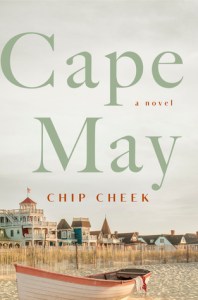
But the book I was most smug to have on my reading list for the trip was the recent novel Cape May by Chip Cheek. What could be more perfect for reading on location? I asked myself. Unfortunately, it stood out for the wrong reasons. In October 1957 a young pair of virgins, Effie and Henry, travel from Georgia to New Jersey for an off-season honeymoon in her uncle’s vacation home. They’re happy enough with each other but underwhelmed with the place (strangely, this matched my experience of Cape May), and even consider going home early until they fall in with Clara, a friend of Effie’s cousin; Clara’s lover, Max; and Max’s younger sister, Alma. Effie and Henry join the others for nightly drunken revelry.
[SPOILERS!] As the weeks pass Effie, ill and dejected, almost seems to disappear as Cheek delves into Henry’s besotted shenanigans, described in unnecessarily explicit sexual detail. When Effie makes a bid or two for her own sexual freedom late on, it only emphasizes the injustice of spending so much time foregrounding Henry’s perspective. Despite the strength of the period atmosphere and seaside location, this ends up being dull and dated. If you’re after a typically ‘trashy’ beach read and don’t mind lots of sex scenes, you may get on with it better than I did. 

Reading a few pages of Cape May over an ice-cold G&T at the wedding reception.
Bonus bookishness:
Vineland, New Jersey was on the way from our friends’ house to Cape May, so we stopped to take my proof copy of Barbara Kingsolver’s Unsheltered to its spiritual home. Alas, Vineland is an utterly boring small American town. However, Mary Treat at least appears on a painted mural on a building on the main street. The Historical Society, where Kingsolver did her research, was closed, but we photographed the outside.


What’s the last book you read ‘on location’? Did it work out well for you?
Re-Reading Modern Classics: Fiction Advocate’s “Afterwords” Series
I didn’t manage a traditional classic this month: I stalled on Cider with Rosie and gave up on Evelyn Waugh’s A Handful of Dust after just 16 pages. Instead, I’m highlighting three books from Fiction Advocate’s new series about re-reading modern classics, “…Afterwords.” Their tagline is “Essential Readings of the New Canon,” and the concept is to have “acclaimed writers investigate the contemporary classics.”
As Italo Calvino notes in his invaluable essay “Why Read the Classics?”, “The classics are those books about which you usually hear people saying: ‘I’m rereading…’, never ‘I’m reading…’.” Harold Bloom agrees in The Western Canon: “One ancient test for the canonical remains fiercely valid: unless it demands rereading, the work does not qualify.” But readers will also encounter books that strike such a chord with them that they become personal classics. Calvino exhorts readers that “during unenforced reading … you will come across the book which will become ‘your’ book…‘Your’ classic is a book to which you cannot remain indifferent, and which helps you define yourself in relation or even in opposition to it.”
For the Afterwords series, the three writers below have each chosen a modern classic that they can’t stop reading for all it has to say to their own situation and on humanity in general.
I Meant to Kill Ye: Cormac McCarthy’s Blood Meridian by Stephanie Reents (2018)
Blood Meridian must be one of the two or three bleakest books I’ve ever read. I was led to it by Bloom, who speaks about it as a, if not the, Great American Novel. It’s over 10 years since I’ve read it now, but I still remember some of the specific incidences of violence, like skewering babies and sodomizing corpses on a battlefield, as well as the overall feeling of nihilism: there’s no reason for the evil promulgated by characters like the Judge; it is simply a reality – perhaps the human condition.
 Reents, who teaches English at the College of the Holy Cross, returns to Blood Meridian, a novel she has re-read compulsively over the years, to ask why it continues to have such a hold over her. Its third-person perspective is so distant that we never understand characters’ motivations or glimpse their inner lives, she notes; everyone seems like a pawn in a fated course. She usually shies away from violence and long descriptive passages; she has an uneasy relationship with the West, having moved away from Idaho to live on the East coast. So why should this detached, brutal Western based on the Glanton Gang’s Mexico/Texas killing spree have so captivated her? “Often, we most admire the books that we could never produce, the writing styles or intellects so different from our own that we aren’t even tempted to try imitating them,” she offers as explanation. “It’s a pure kind of admiration, unsullied by envy.” (I feel that way about Faulkner and Steinbeck.)
As part of her quest, Reents recreated some of the Gang’s desert route and traveled to the Texas State University library near Austin to look at McCarthy’s early drafts, notes and correspondence. She was intrigued to learn that the Kid was a more conventional POV character to start with, and McCarthy initially included more foreshadowing. By cutting all of it, he made it so that the book’s extreme violence comes out of nowhere. Reents also explores the historical basis for the story via General Samuel Chamberlain’s dubious memoir. Pondering the volatility of the human heart as she drives along the Mexican border, she ends on the nicely timely note of a threatened Trump-built wall. I doubt I could stomach reading Blood Meridian again (though I’ve read another two McCarthy novels since), but I enjoyed revisiting it with Reents as she finds herself “re-bewildered by its beauty and horror.”
A Little in Love with Everyone: Alison Bechdel’s Fun Home by Genevieve Hudson (2018)
Alison Bechdel is one of Hudson’s queer heroes (along with James Baldwin, Tracy Chapman, and seven others), portrayed opposite the first page of each chapter in black and white drawings by Pace Taylor – the sort of people who gave her the courage to accept her lesbian identity after a conventional Alabama upbringing.
 As portrayed in her landmark graphic memoir Fun Home, Bechdel was in college and finally coming to terms with her sexuality at the same time that she learned that her father was gay and her parents were about to divorce. Her father died in an accident just a few months later and, though he had many affairs, had never managed to live out his homosexuality openly. As Bechdel’s mother scoffed, “Your father tell the truth? Please!” By contrast, Hudson appreciates Bechdel so much because of her hard-won honesty: “In her work, Bechdel does the opposite of lying. She excavates the real. She dredges up the stuff of her life, embarrassing parts and all.”
Hudson looks at how people craft their own coming-out narratives, the importance of which cannot be overemphasized, in her experience. “Coming out was a tangible thing with tangible effects. For every friend who left my life, a new person arrived—usually someone with broader horizons, exciting stories, and a deviance that seemed sweet and sexy and sincere. After I came out, roaming the streets of Charleston in fat sunglasses and thin dresses, a group of beautiful lesbians appeared out of nowhere. … Everyone was a little in love with everyone.”
A Cool Customer: Joan Didion’s The Year of Magical Thinking by Jacob Bacharach (2018)
 I made the mistake of not taking any notes on, or even marking out any favorite passages in, this, so all I can tell you is that for me it was the most powerful of the three I’ve tried from the series. The author re-examines Didion’s work in the light of his own encounter with loss – his brother’s death from a drug overdose – and ponders why it has become such a watershed in bereavement literature. Didion really is the patron saint of grief thanks to her two memoirs, Magical Thinking and Blue Nights – after she was widowed she also lost her only daughter – even though she writes with a sort of intellectual detachment; you have to intuit the emotion between the lines. Bacharach smartly weaves his family story with a literate discussion of Didion’s narratives and cultural position to make a snappy and inviting book you could easily read in one sitting.
Indeed, all of the Afterwords books are 120–160-page, small-format paperbacks that would handily slip into a pocket or purse.
My thanks to the publisher for the free copies for review.
The other titles in the series are An Oasis of Horror in a Desert of Boredom by Jonathan Russell Clark (on 2666 by Roberto Bolaño), New Uses for Failure by Adam Colman (on 10:04 by Ben Lerner, and Bizarro Worlds by Stacie Williams (on The Fortress of Solitude by Jonathan Lethem).
Next month’s plan: The Leopard by Giuseppe di Lampedusa will be my classic to get me in the mood for traveling to Italy for the first week of July.
Four Recent Review Books: Flanery, James, Tota and Yuknavitch
Memoirs of adoption and a life steeped in trauma and sex; a metafictional mystery about an inscrutable artist and his would-be biographer; and a European graphic novel about a thief. You can’t say I don’t read a wide variety of books! See if one or more of these can tempt you.
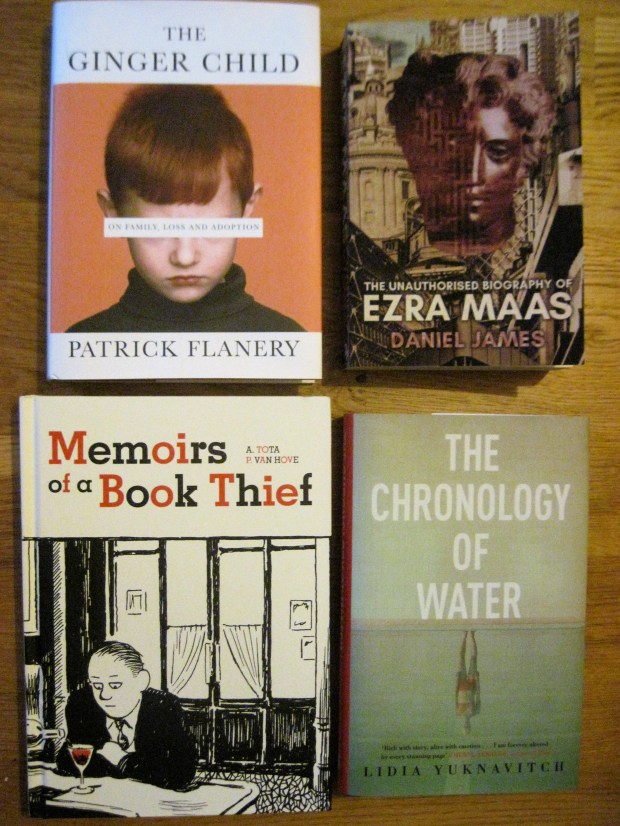
The Ginger Child: On Family, Loss and Adoption by Patrick Flanery
Patrick Flanery is a professor of creative writing at Queen Mary University of London and the author of four novels. In his first nonfiction book, he chronicles the arduous four-year journey he and his husband took to try and become parents. For a short time they considered surrogacy, but it’s so difficult in the UK that they switched tracks to domestic adoption.
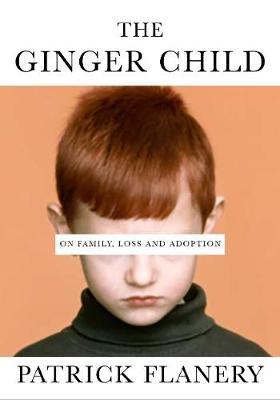 The resulting memoir is a somber, meditative book that doesn’t gloss over the difficulties of queer family-making, but also sees some potential advantages: to an extent, one has the privilege of choice – he and Andrew specified that they couldn’t raise a child with severe disabilities or trauma, but were fine with one of any race – whereas biological parents don’t really have any idea of what they’re going to get. However, same-sex couples are plagued by bureaucracy and, yes, prejudice still. Nothing comes easy. They have to fill out a 50-page questionnaire about their concerns and what they have to offer a child. A social worker humiliates them by forcing them to do a dance-off video game to prove that a pair of introverted, cultured academics can have fun, too.
Eventually there’s a successful match and they have tentative meetings with four-year-old O—, his parents’ fifth child, now in foster care. But this is not a blithe story of everything going right. I enjoyed the glimpses of Flanery’s growing-up years in Nebraska and the occasional second-person address to O—, but there is a lot more theory and cultural criticism than I expected, and much of the film talk, at least, feels like irrelevant asides.
With thanks to Atlantic Books for the free copy for review.
The Unauthorised Biography of Ezra Maas by Daniel James
This is a twisty, clever meta novel about “Daniel James” desperately trying to write a biography of Ezra Maas, an enigmatic artist who grew up a child prodigy in Oxford and attracted a cult following in 1960s New York City, where he was a friend of Warhol et al. But, with rumors abounding that The Maas Foundation is preparing to announce Ezra’s death in 2011, James finds that his subject’s story keeps shifting shape and even disappearing around him – as one interviewee tells him, “Maas is a black hole. His presence draws everything in, warps, destroys, changes, and rewrites it.”
 The book’s epistolary style deftly combines fragments of various document types: James’s biography-in-progress and an oral history he’s assembled from conversations with those who knew Maas, his narrative of his quest, transcripts of interviews and phone conversations, e-mails and more. All of this has been brought together into manuscript form by an anonymous editor whose presence is indicated through coy but increasingly tiresome long footnotes.
Look at the sort of authors who get frequent mentions in the footnotes, though, and you’ll get an idea of whether this might appeal to you: Paul Auster, Samuel Beckett, George Orwell and Thomas Pynchon. I enjoyed the noir atmosphere – complete with dream sequences and psychiatric evaluations – and the way that James the “writer-detective” has to careen around Europe and America looking for answers; it all feels rather like a superior Jason Bourne film.
My thanks to the author for sending a free signed copy for review.
Memoirs of a Book Thief by Alessandro Tota (illustrated by Pierre Van Hove)
[translated from the French by Edward Gauvin]
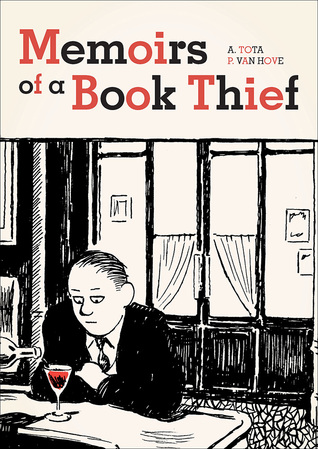 In April 1953, Daniel Brodin translates an obscure Italian poem in his head to recite at a poetry reading but, improbably, someone recognizes it. Soon afterwards, he’s also caught stealing a book from a shop. Just a little plagiarism and shoplifting? It might have stayed that way until he met Gilles and Linda, fellow thieves, and their bodyguard, Jean-Michel, a big blond goon with Gérard Dépardieu’s nose and haircut. Now he’s known as “Klepto” and is part of a circle that drinks at the Café Sully and mixes with avant-garde and Existentialist figures. He’s content with being a nobody and writing his memoirs (the book within the book) – until Jean-Michel makes him a proposition.
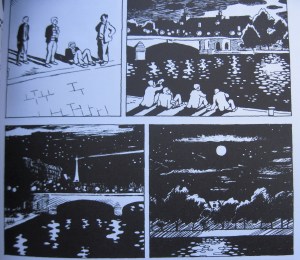
The book is entirely in black and white, which makes it seem unfinished, and the style is a little grotesque. For instance, Brodin is almost always depicted with beads of sweat rolling off his head. The intricate outdoor scenes were much more to my taste than the faces. The plot is also slightly thin and the ending abrupt. So, compared with many other graphic novels, this is not one I’m likely to recommend. 
With thanks to SelfMadeHero for the free copy for review.
The Chronology of Water by Lidia Yuknavitch
This really blew me away. “Out of the sad sack of sad shit that was my life, I made a wordhouse,” Yuknavitch writes. Her nonlinear memoir ranges from her upbringing with an alcoholic, manic-depressive mother and an abusive father via the stillbirth of her daughter and her years of alcohol and drug use through to the third marriage where she finally got things right and allowed herself to feel love again after so much numbness. Reading this, you’re amazed that the author is still alive, let alone thriving as a writer.
 Ken Kesey, who led a collaborative novel-writing workshop in which she participated in the late 1980s, once asked her what the best thing was that ever happened to her. Swimming, she answered, because it felt like the only thing she was good at. In the water she was at home and empowered. Kesey reassured her that swimming wasn’t her only talent: there is some truly dazzling writing here, veering between lyrical stream-of-consciousness and in-your-face informality.
There are so many vivid sequences, but two that stood out for me were cutting down a tree the Christmas she was four and the way her mother turned her teeth-chattering crisis into a survival game, and the drunken collision she had after her second ex-husband told her he was seeing a 23-year-old. With the caveat that this is extremely explicit stuff (the author is bisexual; there’s an all-female threesome and S&M parties), I would still highly recommend it to readers of Joan Didion, Anne Lamott and Maggie Nelson. The watery metaphor flowing through, as one woman learns to float free of what once threatened to drown her, is only part of what makes it unforgettable. You’ll marvel at what a memoir can do. 
A couple of favorite passages:
“It is possible to carry life and death in the same sentence. In the same body. It is possible to carry love and pain. In the water, this body I have come to slides through the wet with a history. What if there is hope in that?”
“Make up stories until you find one you can live with. Make up stories as if life depended on it.”
With thanks to Canongate for the free copy for review.
Would you be interested in reading one or more of these?
A Bouquet of Spring Reading
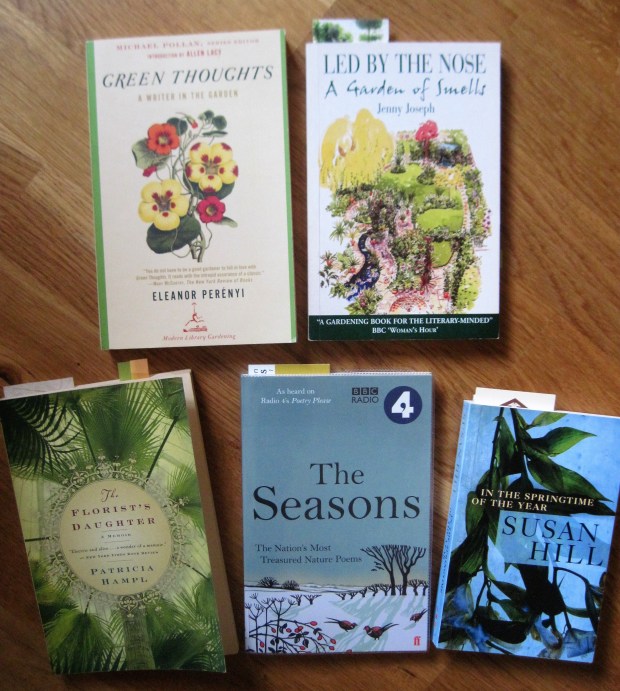
In March through May I often try to read a few gardening-themed books and/or ones with “spring” in the title. Here are some of the ones that I have on the go as occasional reading:
Flowers and gardens
The Florist’s Daughter by Patricia Hampl: Her mother’s final illness led Hampl to reflect on her upbringing in St. Paul, Minnesota as the daughter of an Irish Catholic library clerk and a Czech florist. I love how she writes about small-town life and helping out in her father’s flower shop:
“These apparently ordinary people in our ordinary town, living faultlessly ordinary lives … why do I persist in thinking—knowing—they weren’t ordinary at all? … Nostalgia is really a kind of loyalty”
“it was my father’s domain, but it was also marvelously other, this place heavy with the drowsy scent of velvet-petaled roses and Provençal freesias in the middle of winter, the damp-earth spring fragrance of just-watered azaleas and cyclamen”
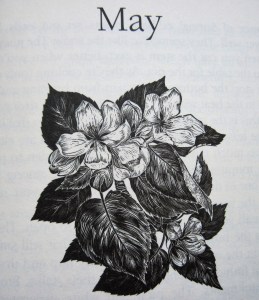 Led by the Nose: A Garden of Smells by Jenny Joseph: Joseph’s name might not sound familiar, but she was the author of the famous poem “Warning: When I Am an Old Woman I Shall Wear Purple” and died early last year. This is a pleasant set of short pieces about what you might see and sense in your garden month by month. “Gardeners do indeed look before and after, at the same time living, as no one else, in the now of the nose,” she maintains. I’m particularly fascinated by the sense of smell and how a writer can describe odors, so I was delighted to find this in a charity shop in Edinburgh last year and have been reading it a few pages at a time as a bedside book. I especially like the wood engravings by Yvonne Skargon that head each chapter.
Green Thoughts: A Writer in the Garden by Eleanor Perényi: A somewhat dense collection of few-page essays, arranged in alphabetical order, on particular plants, tools and techniques. I tried reading it straight through last year and only made it as far as “Beans.” My new strategy is to keep it on my bedside shelves and dip into whichever pieces catch my attention. I don’t have particularly green fingers, so it’s not a surprise that my eye recently alighted on the essay “Failure,” which opens, “Sooner or later every gardener must face the fact that certain things are going to die on him. It is a temptation to be anthropomorphic about plants, to suspect that they do it to annoy.”
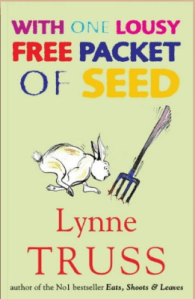 With One Lousy Free Packet of Seed by Lynne Truss (DNF at page 131 out of 210): A faltering gardening magazine is about to be closed down, but Osborne only finds out when he’s already down in Devon doing the research for his regular “Me and My Shed” column with a TV actress. Hijinks were promised as the rest of the put-out staff descend on Honiton, but by nearly the two-thirds point it all still felt like preamble, laying out the characters and their backstories, connections and motivations. My favorite minor character was Makepeace, a pugnacious book reviewer: “he used his great capacities as a professional know-all as a perfectly acceptable substitute for either insight or style.”
Spring
The Seasons, a Faber & Faber / BBC Radio 4 poetry anthology: From Chaucer and other Old English poets to Seamus Heaney (“Death of a Naturalist”) and Philip Larkin (“The Trees”), the spring section offers a good mixture of recent and traditional, familiar and new. A favorite passage was “May come up with fiddle-bows, / May come up with blossom, / May come up the same again, / The same again but different” (from “Nuts in May” by Louis MacNeice). Once we’re back from America I’ll pick up with the summer selections.
In the Springtime of the Year by Susan Hill: Early one spring, Ruth Bryce’s husband, Ben, dies in a forestry accident. They had only been married a year and here she is, aged twenty-one and a widow. Ben’s little brother, 14-year-old Jo, is a faithful visitor, but after the funeral many simply leave Ruth alone. I’m 100 pages in and still waiting for there to be a plot as such; so far it’s a lovely, quiet meditation on grief and solitude amid the rhythms of country life. Ben’s death is described as a “stone cast into still water,” and here at nearly the halfway point we’re seeing how some of the ripples spread out beyond his immediate family. I’m enjoying the writing more than in the three other Hill books I’ve read.
 Absent in the Spring by Mary Westmacott: (The title doesn’t actually have anything to do with the season; it’s a quotation from Shakespeare’s Sonnet 98: “From you have I been absent in the spring.”) From 1944, this is the third of six novels Agatha Christie published under the alias Mary Westmacott. Joan Scudamore, traveling back to London from Baghdad after a visit to her adult daughter, encounters bad weather and misses her train, which leaves her stranded in the desert for days that feel more like weeks. We’re led back through scenes from Joan’s earlier life and realize that she’s utterly clueless about what those closest to her want and think. Rather like Olive Kitteridge, Joan is difficult in ways she doesn’t fully acknowledge. Like a desert mirage, the truth of who she’s been and what she’s done is hazy, and her realization feels a little drawn out and obvious. Once she gets back to London, will she act on what she’s discovered about herself and reform her life, or just slip back into her old habits? This is a short and immersive book, and a cautionary tale to boot. It examines the interplay between duty and happiness, and the temptation of living vicariously through one’s children.
Have you been reading anything particularly appropriate for spring this year?
Continuing the Story: Why I’m Wary of Sequels and Series, with Some Exceptions
Most of the time, if I learn that a book has a sequel or is the first in a series, my automatic reaction is to groan. Why can’t a story just have a tidy ending? Why does it need to sprawl further, creating a sense of obligation in its readers? Further adventures with The Hundred-Year-Old Man Who Climbed Out the Window? Returning to the world of The Handmaid’s Tale? No, thank you.
It was different when I was a kid. I couldn’t get enough of series: the Little House on the Prairie books, Encyclopedia Brown, Nancy Drew, the Saddle Club, Redwall, the Baby-Sitters Club, various dragon series, Lilian Jackson Braun’s Cat Who mysteries, the Anne of Green Gables books… You name it, I read it. I think children, especially, gravitate towards series because they’re guaranteed more of what they know they like. It’s a dependable mold. These days, though, I’m famous for trying one or two books from a series and leaving the rest unfinished (Harry Potter: 1.5 books; Discworld: 2 books at random; Jim Butcher’s Dresden Files: 1 book; the first book of crime series by M.J. Carter, Judith Flanders and William Shaw).
But, like any reader, I break my own rules all the time – even if I sometimes come to regret it. I recently finished reading a sequel and I’m now halfway through another. I’ve even read a few high-profile sci fi/fantasy trilogies over the last eight years, even though with all of them I liked each sequel less than the book that went before (Margaret Atwood’s MaddAddam books, Chris Beckett’s Dark Eden series and Deborah Harkness’s All Souls Trilogy).
A later book in a series can go either way for me – surpass the original, or fail to live up to it. Nonfiction sequels seem more reliable than fiction ones, though: if I discover that a memoirist has written a follow-up volume, I will generally rush to read it.
So, what would induce me to pick up a sequel?
I want to know what happens next.
WINNERS:
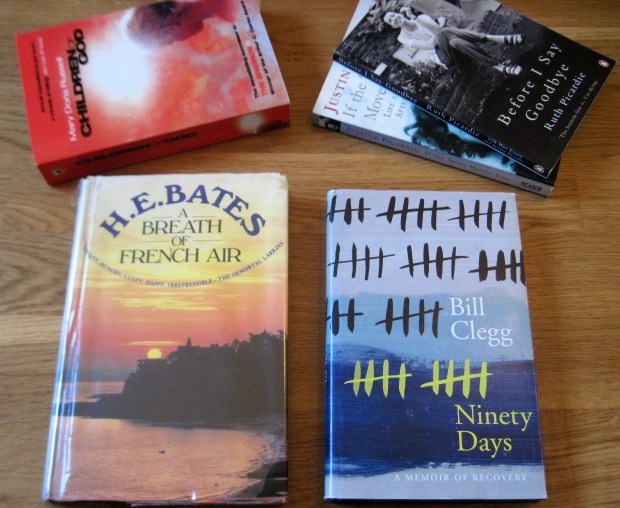
After reading Ruth Picardie’s Before I Say Goodbye, I was eager to hear from her bereaved sister, Justine Picardie. Ruth died of breast cancer in 1997; Justine writes a journal covering 2000 to 2001, asking herself whether death is really the end and if there is any possibility of communicating with her sister and other loved ones she’s recently lost. If the Spirit Moves You: Life and Love after Death is desperately sad, but also compelling.
 Graeme Simsion’s Rosie series has a wonderfully quirky narrator. When we first meet him, Don Tillman is a 39-year-old Melbourne genetics professor who’s decided it’s time to find a wife. Book 2 has him and Rosie expecting a baby in New York City. I’m halfway through Book 3, in which in their son is 11 and they’re back in Australia. Though not as enjoyable as the first, it’s still a funny look through the eyes of someone on the autistic spectrum.
Edward St. Aubyn’s Never Mind, the first Patrick Melrose book, left a nasty aftertaste, but I was glad I tried again with Bad News, a blackly comic two days in the life of a drug addict.
LOSERS:
Joan Anderson’s two sequels to A Year by the Sea are less engaging, and her books have too much overlap with each other.
Perhaps inevitably, Bill Clegg’s Ninety Days, about getting clean, feels subdued compared to his flashy account of the heights of his drug addiction, Portrait of an Addict as a Young Man.
 Patrick Leigh Fermor’s Between the Woods and the Water was an awfully wordy slog compared to A Time of Gifts.
Mary Doria Russell’s The Sparrow was one of my favorite backlist reads last year. I only read the first 60 pages of Children of God, though. It was a recent DNF after leaving it languishing on my pile for many months. While I was, of course, intrigued to learn that (SPOILER) a character we thought had died is still alive, and it was nice to see broken priest Emilio Sandoz getting a chance at happiness back on Earth, I couldn’t get interested in the political machinations of the alien races. Without the quest setup and terrific ensemble cast of the first book, this didn’t grab me.
I want to spend more time with these characters.
WINNERS:
Simon Armitage’s travel narrative Walking Away is even funnier than Walking Home.
 I’m as leery of child narrators as I am of sequels, yet I read all 10 Flavia de Luce novels by Alan Bradley: quaint mysteries set in 1950s England and starring an eleven-year-old who performs madcap chemistry experiments and solves small-town murders. The Dead in Their Vaulted Arches (#6) was the best, followed by Thrice the Brinded Cat Hath Mew’d (#8).
Roald Dahl’s Going Solo is almost as good as Boy.
Alexandra Fuller’s Leaving Before the Rains Come is even better than Don’t Let’s Go to the Dogs Tonight.
Likewise, Sarah Moss’s Signs for Lost Children, about a female doctor in the 1880s, is even better than Bodies of Light.
Doreen Tovey’s Cats in May is just as good as Cats in the Belfry.
LOSERS:
H. E. Bates’s A Breath of French Air revisits the Larkins, the indomitably cheery hedonists introduced in The Darling Buds of May, as they spend a month abroad in the late 1950s. France shows off its worst weather and mostly inedible cuisine; even the booze is barely tolerable. Like a lot of comedy, this feels slightly dated, and maybe also a touch xenophobic.
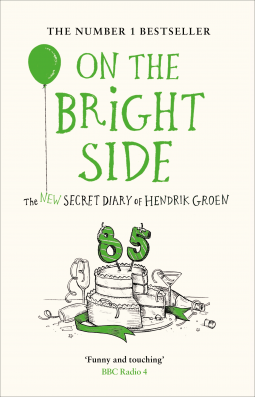 The first Hendrik Groen diary, about an octogenarian and his Old-But-Not-Dead club of Amsterdam nursing home buddies, was a joy, but the sequel felt like it would never end.
I loved Marilynne Robinson’s Gilead; I didn’t need the two subsequent books.
The Shakespeare Requirement, Julie Schumacher’s sequel to Dear Committee Members, a hilarious epistolary novel about an English professor on a Midwest college campus, was only mildly amusing; I didn’t even get halfway through it.
I finished Jane Smiley’s Last Hundred Years trilogy because I felt invested in the central family, but as with the SFF series above, the later books, especially the third one, were a letdown.
What next? I’m still unsure about whether to try the other H. E. Bates and Edward St. Aubyn sequels. I’m thinking yes to Melrose but no to the Larkins. Olive Kitteridge, which I’ve been slowly working my way through, is so good that I might make yet another exception and seek out Olive, Again in the autumn.
 Bookish Beck = Rebecca Foster. American transplant to England. Freelance proofreader and book reviewer.
