Some Peripheral Reading for Joyce Carol Oates’s Birthday
June 16th is Bloomsday, of course, and was Paul Auster and Siri Hustvedt’s wedding anniversary – as I learned from Ghost Stories. It’s also the 88th birthday of one of our most prolific authors, Joyce Carol Oates. As I wrote in my introductory post for 20 Books of Summer, Marcie (of Buried in Print) and I have embarked on a casual Oates buddy reading project starting this summer and extending into autumn’s spooky selections. (See her post from today on her early and recent experiences with JCO.)
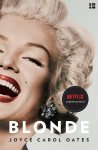 First, an update: I’m now on page 101 of Blonde! It’s such a mammoth doorstopper that I will celebrate my every milestone.
When I scoured the public library and university library catalogues for Oates’s work, I found two oddities to explore further. One is an essay contributed to an anthology on tear-jerking poems; the other is her introduction to an art book on a particular genre of funerary sculpture.
For Poems that Make Grown Women Cry: 100 Women on the Words that Move Them (2016; ed. Anthony and Ben Holden), Oates chose “City Horse” by Henri Cole (I’ve read his 2025 collection The Other Love). It’s a melodramatic portrait of a dead horse overcome by a natural disaster. We know from the title who the poem is about, though not until over halfway through do we get an actual identification: “O, wondrous horse; O, delicate horse – dead, dead”; before that, the unnamed “she” has been simply one more element of the flood detritus (“sucked out to sea and washed up again – / with uprooted trees, crumpled cars, and collapsed houses –”), with evidence of human abuse before that (“facedown in dirt, and tied to a telephone pole, / as if trying to raise herself still, though one leg is broken”). It gets more mawkish before the end: “‘She was more smarter than me, / she just wait,’ a boy sobs”. So I didn’t love the poem as a whole, but the first line of this elegy is incredible: “At the end of the road from concept to corpse”.
In her prefatory essay, Oates extrapolates from one suffering creature to pity “for us all”: “we have been made unnatural by our increasingly mechanized and impersonal society,” and we, too, will be “used up and discarded eventually … by nature, and by time.”
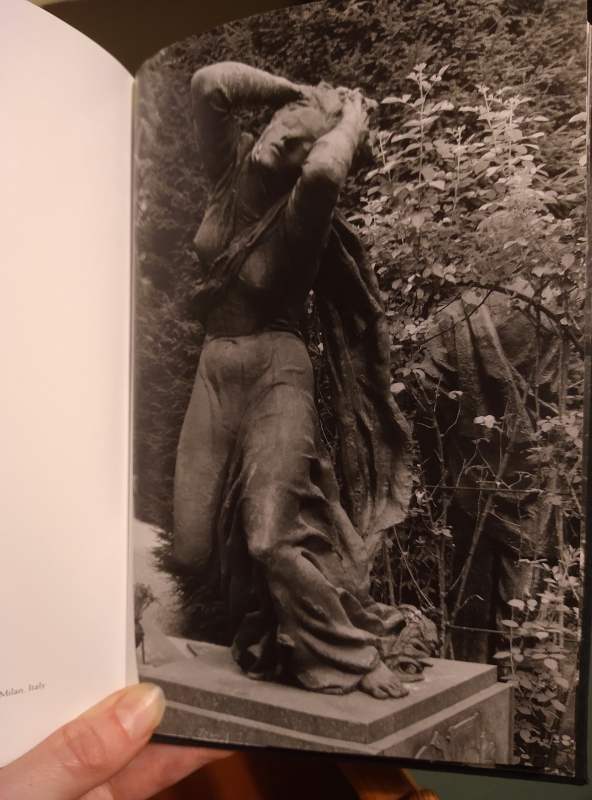
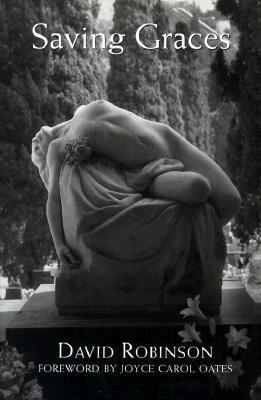 From a dead horse to cities full of dead humans … I think we can safely conclude Oates is not the most cheerful of writers. Saving Graces by David Robinson (1995) is a black-and-white photographic tour through European cemeteries, mostly in London, Milan, and Paris, with a focus on a specific class of 19th-century statuary. These are mourning women: generally semi-nude or flimsily draped and often in the throes of full-body, abandoned weeping that looks like a sexual swoon. They are not angels, Robinson insists; instead, he came to believe that they represented the meeting of the Romantic infatuation with death and “the emergence of the family as the primary focus of affection” in the Victorian period. The women emphasize the finality of death and the overwhelming nature of grief, but those who commissioned the statues may also have envisioned them as “escorts on the journey ahead … posted there to watch over and take care of the deceased.” As photographs go, they’re not hugely interesting; there’s only so much one can do, composition-wise, with gravestones, and I wish he or Oates had done more to subvert the exploitation of the sensual female image.
Oates’s foreword contrasts the photography of life with “the photography of stillness—of the arrested, meditative image.” Robinson’s are the latter type, of course. She describes the book as follows:
“an assemblage of strikingly beautiful photographs that tells us much, and hints at far more, of our collective desire that death be not mere deadness—biological decay, cellular decomposition, the extinction of the ‘unique’ human personality—but Death: mysterious, ethereal, mourned, and therefore celebrated by the most attractive among us. Contemplating these images, we realize how human anxiety, human vanity, human terror of the unknown, whether male or female, may well be the unacknowledged origin of our greatest artworks”.
I’ve already encountered Death in the first chapter of Blonde, and I reckon he’ll be a common figure in much of Oates’s work to come, whether realist, Gothic or gory.
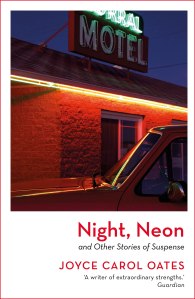 Today I picked up Night, Neon (2021), one of Oates’s many collections of suspense stories, from the library and, based on online reviews, chose two stories to read. I started with the first one, “Detour,” in which a road sign reroutes Abigail from her usual commute when she’s a mile from home. Disoriented, she ends up driving into a ditch and stumbles to the nearest dwelling for help. No one answers the door, so she lets herself in and, Goldilocks-like, makes herself at home, using the toilet and settling into a bed for a nap. When she wakes up, she’s been put into a nightgown and is locked into the bedroom by a man who claims to be her husband of 30 years and is concerned about her health. How has she entered into someone else’s life, and will she be able to get back to her own? The story ends on a note of (hopeful) uncertainty.
“Miss Golden Dreams 1949” proved to be a great companion to Blonde in that it’s voiced by a Marilyn Monroe clone/sex robot being auctioned off at Sotheby’s. Creepily, it’s addressed from her to “Daddy,” a wealthy potential buyer. Even in Oates’s short fiction, I’m finding that she uses three sentences where one would do the job, but at least the stories pass quickly.
Guardian reviewer Ben East sums up her approach nicely (“You tend to know what you’re getting with an Oatesian short – a disquieting snapshot of American life on the verge of individual or ideological collapse”) and describes her short fiction in general as “nuanced rather than neat.” This collection seems promising, so I’ll probably go ahead and read its six more stories and a novella before the summer is out.
Adventures in Rereading: The Sixteenth of June by Maya Lang
Last year I reviewed Tenth of December by George Saunders on its title date; this year I couldn’t resist rereading one of my favorites from 2014 for today’s date (which just so happens to be Bloomsday, made famous by James Joyce’s Ulysses), The Sixteenth of June.
I responded to the novel at length when it first came out. No point in reinventing the wheel, so here are mildly edited paragraphs of synopsis from my review for The Bookbag:
 Maya Lang’s playful and exquisitely accomplished debut novel, set on the centenary of the original Bloomsday, transplants many characters and set pieces from Ulysses to near-contemporary Philadelphia. Don’t fret, though – even if, like me, you haven’t read Ulysses, you’ll have no trouble following the thread. In fact, Lang dedicates her book to “all the readers who never made it through Ulysses (or haven’t wanted to try).” (Though if you wish to spot parallels, pull up any online summary of Ulysses; there is also a page on Lang’s website listing her direct quotations from Joyce.)
On June 16, 2004, brothers Leopold and Stephen Portman have two major commitments: their grandmother Hannah’s funeral is happening at the local synagogue in the morning; and their parents’ annual Bloomsday party will take place at their opulent Delancey Street home in the evening. Around those two thematic poles – the genuine emotions of grief and regret on the one hand, and the realm of superficial entertainment on the other – the novel expands outward to provide a nuanced picture of three ambivalent twenty-something lives.
The third side of this atypical love triangle is Nora, Stephen’s best friend from Yale – and Leo’s fiancée. Nora, a trained opera singer, is still reeling from her mother’s death from cancer one year ago. She’s been engaging in self-harming behavior, and Leo – a macho, literal-minded IT consultant – just wants to fix her. Nora and Stephen, by contrast, are sensitive, artistic souls who seem better suited to each other. Stephen, too, is struggling to find a meaning in death, but also to finish his languishing dissertation on Virginia Woolf.
Literature is almost as potent a marker of upper-class status as money here: some of the Portmans might not have even read Joyce’s masterpiece, but that doesn’t stop them name-dropping and maintaining the pretense of being well-read. While Lang might not mimic the extremes of Joyce’s stream-of-consciousness style, she prioritizes interiority over external action by using a close third-person voice that shifts between her main characters’ points of view. Their histories and thoughts are revealed mostly through interior monologues and conversations. Lang’s writing is full of mordant shards of humor; one of my favorite lines was “No one in a eulogy ever said, She watched TV with the volume on too loud.”
During my rereading, I was captivated more by the portraits of grief than by the subtle intellectual and class differences. I appreciated the characterization and the Joycean peekaboo, and the dialogue and shifts between perspectives still felt fresh and effortless. I could relate to Stephen and Nora’s feelings of being stuck and unsure how to move on in life. And the ending, which I’d completely forgotten, was perfect. I didn’t enjoy this quite as much the second time around, but it’s still a treasured signed copy on my shelf.
My original rating (June 2014): 
My rating now: 
Readalikes: Writers & Lovers by Lily King and The Emperor’s Children by Claire Messud (my upcoming Doorstopper of the Month).
(See also my review of Lang’s recent memoir, What We Carry.)
Alas, I’ve also had a couple of failed rereading attempts recently…
Everything Is Illuminated by Jonathan Safran Foer (2002)
 I remembered this as a zany family history quest turned into fiction. A Jewish-American character named Jonathan Safran Foer travels to (fictional) Trachimbrod, Ukraine to find the traces of his ancestors and, specifically, the woman who hid his grandfather from the Nazis. I had totally forgotten about the comic narration via letters from Jonathan’s translator/tour guide, Alexander, who fancies himself a ladies’ man and whose English is full of comic thesaurus use (e.g. “Do not dub me that,” “Guilelessly yours”). This was amusing, but got to be a bit much. I’d also forgotten about the dense magic realism of the historical sections. As with A Visit from the Goon Squad, what felt dazzlingly clever on a first read (in January 2011) failed to capture me a second time. [35 pages]
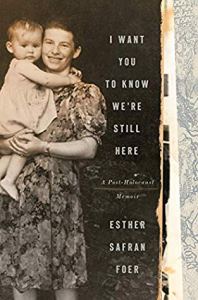 Interestingly, Foer’s mother, Esther, released a memoir earlier this year, I Want You to Know We’re Still Here. It’s about the family history her son turned into quirky autofiction: a largely fruitless trip he took to Ukraine to research his maternal grandfather’s life for his Princeton thesis, and a more productive follow-up trip she took with her older son in 2009. Esther Safran Foer was born in Poland and lived in a German displaced persons camp until she and her parents emigrated to Washington, D.C. in 1949. Her father committed suicide in 1954, making him almost a belated victim of the Holocaust. The stories she hears in Ukraine – of the slaughter of entire communities; of moments of good luck that allowed her parents to, separately, survive and find each other – are remarkable, but the book’s prose, while capable, never sings. Plus, she references her son’s novel so often that I wondered why someone would read her book when they could read his instead.
On Beauty by Zadie Smith (2005)
 This was an all-time favorite when it first came out. I remembered a sophisticated homage to E.M. Forster’s Howards End, featuring a biracial family in Cambridge, Mass. I remembered no specifics beyond a giant music store and (embarrassingly) an awkward sex scene. Howard Belsey’s long-distance rivalry with a fellow Rembrandt scholar gets personal when the Kipps family relocates from London to the Boston suburbs for Monty to be the new celebrity lecturer at the same college. Howard is in the doghouse with his African-American wife, Kiki, after having an affair. The Belsey boy and Kipps girl have an awkward romantic history. Zora Belsey is smitten with a lower-class spoken word poet she meets after a classical concert in the park when they pick up each other’s Discmans by accident (so dated!). All of the portraits felt like stereotypes to me, and there was so much telling, so much backstory, so many unnecessary secondary characters. Before I would have said this was my obvious Women’s Prize winner of winners, but now I have no idea what I’ll vote for. [107 pages]
Currently rereading: Watership Down by Richard Adams, Ella Minnow Pea by Mark Dunn, Dreams from My Father by Barack Obama
To reread soon: Heaven’s Coast by Mark Doty & Animal, Vegetable, Miracle by Barbara Kingsolver
 Bookish Beck = Rebecca Foster. American transplant to England. Freelance proofreader and book reviewer.
