Summer 2021 Reading, Part II & Transitioning into Autumn
In the past couple of weeks, we’ve taken advantage of the last gasp of summer with some rare chances at socializing, outdoors and in. Our closest friends came to visit us last weekend and accompanied us to a beer festival held in a local field, and this weekend we’ve celebrated birthdays with a formal-wear party at a local arts venue and a low-key family meal.


After my first installment of summer reads, I’ve also finished Klara and the Sun (a bust with me, alas) and the three below: a wildlife photographer’s memoir of lockdown summer spent filming in the New Forest, a record of searching for the summer’s remnants of snow in the Highlands, and an obscure 1950s novel about the psychological connections between four characters in one Irish summer. I close with a summer-into-autumn children’s book.
Goshawk Summer: A New Forest Season Unlike Any Other by James Aldred (2021)
My second nature book about the New Forest this year (after The Circling Sky by Neil Ansell) has only sharpened my hankering to get back there and have a good wander after many years away. In March 2020, Aldred had recently returned from filming cheetahs in Kenya when the UK went into its first national lockdown. He had the good fortune to obtain authorization from Forestry England that allowed him to travel regularly from his home in Somerset to the New Forest to gather footage for a documentary for the Smithsonian channel.
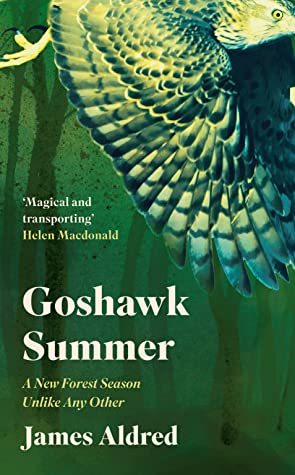 Zooming up on empty roads and staying in local cottages so he can start at 4 each morning, he marvels at the peace of a place when humans are taken out of the equation. His diary chronicles a few months of extraordinary wildlife encounters – not only with the goshawks across from whose nest he built a special treetop platform, but also with dragonflies, fox cubs, and rare birds like cuckoo and Dartford warbler. The descriptions of animal behaviour are superb, and the tone is well balanced: alongside the delight of nature watching is anger at human exploitation of the area after the reopening and despair at seemingly intractable declines – of 46 curlew pairs in the Forest, only three chicks survived that summer.
Despite the woe at nest failures and needless roadkill, Aldred is optimistic – in a similar way to Ansell – that sites like the New Forest can be a model of how light-handed management might allow animals to flourish. “I believe that a little space goes a long way and sometimes all we really need to do is take a step back to let nature do its thing. … It is nature’s ability to help itself, to survive in spite of us in fact, that gives me tentative hope”. (Unsolicited review copy) 
With thanks to Elliott & Thompson for the free copy.
Among the Summer Snows by Christopher Nicholson (2017)
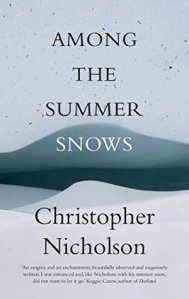 After the death from cancer of his wife Kitty, a botanical illustrator, Nicholson set off for Scotland’s Cairngorms and Ben Nevis in search of patches of snow that persist into summer. “Summer snow is a miracle, a piece of out-of-season magic: to see it is one thing, to make physical contact with it is another.” His account of his travels washed over me, leaving little impression. I appreciated the accompanying colour photographs, as the landscape is otherwise somewhat difficult to picture, but even in these it is often hard to get a sense of scale. I think I expected more philosophical reflection in the vein of The Snow Leopard, and, while Nicholson does express anxiety over what happens if one day the summer snows are no more, I found the books on snow by Charlie English and Marcus Sedgwick more varied and profound. (Secondhand, gifted)
A Shower of Summer Days by May Sarton (1952)
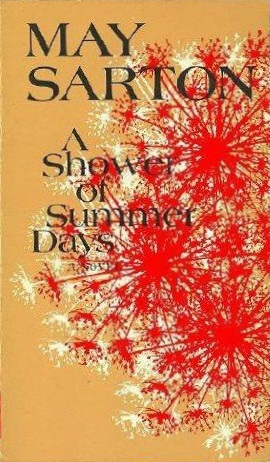 Although I’m more a fan of Sarton’s autobiographical material, especially her journals, I’ve also enjoyed exploring her fiction. This was my seventh of her novels. It’s set in Ireland at Dene’s Court, the grand house Violet inherited. She and her husband Charles have lived in Burma for two decades, but with the Empire on the wane they decide to settle in Violet’s childhood home. Gardening and dressing for dinner fill their languid days until word comes that Violet’s 20-year-old niece, Sally, is coming to stay.
The summer is meant to cure Sally of her infatuation with an actor named Ian. Violet reluctantly goes along with the plan because she feels so badly about the lasting rivalry with her sister, Barbara. Sally is a “bolt of life” shaking up Violet and Charles’s marriage, and when Ian, too, flies out from America, a curious love triangle is refashioned as a quadrilateral. The house remains the one constant as the characters wrestle with their emotional bonds (“the kaleidoscope of feelings was being rather violently shaken up”) and reflect on the transitory splendour of the season (“a kind of timelessness, the warm sun in the enclosed garden in the morning, the hum of bees, and the long slow twilights”). This isn’t one of my favourites from Sarton, but it has low-key charm. I saw it as being on a continuum from Virginia Woolf to Tessa Hadley (e.g. The Past) via Elizabeth Bowen. (Secondhand purchase from Awesomebooks.com) 
And finally, one for the seasons’ transition:
Goodbye Summer, Hello Autumn by Kenard Pak (2016)
 A child and dog pair set out from home, through the woods, by a river, and into town, greeting other creatures and marking the signs of the season. “Hello!” the beavers reply. “We have no time to play because we’re making cozy nests and dens. It will be cold soon, and we want to get ready.” The quaint Americana setting and papercut-style illustrations reminded me of Vermont college towns and Jon Klassen’s work. I liked the focus on nature. (Free from a neighbour)
What books are accompanying you from summer into autumn this year?
Snow and Winter Reads, Part I
We’ve only had a couple of inches of snow, plus another afternoon of flurries, so far this winter, but January was the UK’s coldest month since 2013. As usual, I’m charting the season’s passage through books as well as by taking walks and looking out the window. I have a few more wintry books on the go that I’ll hope to report on at the end of the month. Today I have a few short works, ranging from poetry to nonfiction, plus a novel set partly in frigid Nebraska.

“The Snows of Kilimanjaro” by Ernest Hemingway (1936)
 During a laughably basic New Testament class in college, a friend and I passed endless notes back and forth, discussing everything but the Bible. I found these the last time I was back in the States going through boxes. My friend’s methodical cursive looked so much more grown-up than my off-topic scrawls. Though she was only two years older, I saw her as a kind of mentor, and when she told me the gist of this Hemingway story I took heed. We must have been comparing our writing ambitions, and I confessed a lack of belief in my ability. She summed up the point of this story more eloquently than Hem himself: if you waited until you were ready to write something perfectly, you’d never write it at all. Well, 19 years later and I’m still held back by lack of confidence, but I have, finally, read the story itself. It’s about a writer on safari in Africa who realizes he is going to die of this gangrene in his leg.
Now he would never write the things that he had saved to write until he knew enough to write them well. Well, he would not have to fail at trying to write them either. Maybe you could never write them, and that was why you put them off and delayed the stating. Well, he would never know, now.
he had always thought that he would write it finally. There was so much to write. He had seen the world change; not just the events; although he had seen many of them and had watched the people, but he had seen the subtler change and he could remember how the people were at different times. He had been in it and he had watched it and it was his duty to write of it; but now he never would.
This duty: to be a witness, to crystallize your perspective and experience as a way of giving back to the world that has sustained you – it’s a compelling vision. Of course, Hemingway was a chauvinist and so the protagonist is annoyingly dismissive of the woman in his life; she might as well be a servant. I still found this everyday tragedy affecting. I couldn’t, however, be bothered to read any further in the volume (mostly Nick Adams autobiographical stories).
The World Before Snow by Tim Liardet (2015)
 I couldn’t resist the title and creepy Magritte cover, so added this to my basket during the Waterstones online sale at the start of the year. Liardet’s name was unfamiliar to me, though this was the Bath University professor’s tenth poetry collection. Most of the unusual titles begin with “Self-Portrait” – for instance, “Self-Portrait as the Nashua Girl’s Reverse Nostalgia” and “Self-Portrait with Blind-Hounding Viewed in Panoramic Lens.” Apparently there is a throughline here, but if it weren’t for the blurb I would have missed it entirely. (“During a record-breaking blizzard in Boston, two poets met, one American and one English. This meeting marked the beginning of a life-transforming love affair.”) There were some turns of phrase and alliteration I liked, but overall I preferred the few poems that were not part of that pretentious central plot, e.g. “Ommerike” (part I) about mysterious mass deaths of birds and fish, “Nonagenaria,” a portrait of an old woman, and “The Guam Fever,” voiced by an ill soldier.
The Magician’s Assistant by Ann Patchett (1997)
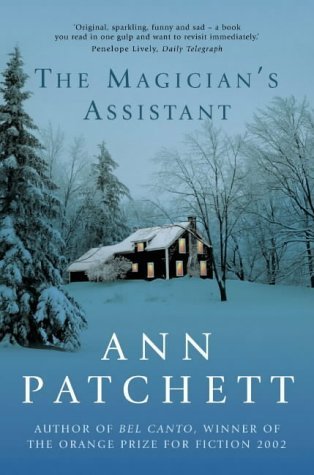 I’d only seen covers with a rabbit and top hat, so was confused that the secondhand copy I ordered with a birthday voucher featured a lit-up farmhouse set back into snowy woods. The first third of the novel takes place in Los Angeles, where Sabine lived with her husband Parsifal, the magician she assisted for 20 years, but the rest is set in winter-encased Nebraska. The contrast between the locations forms a perfect framework for a story of illusions versus reality.
SPOILERS FOLLOW – impossible to avoid them.
Patchett opens with the terrific lines “Parsifal is dead. That is the end of the story.” Ironically, his brain aneurysm burst while he was inside a hospital MRI machine, but it’s a mercy that he died quickly; he could have lingered for years with AIDS – like his lover, Phan, who died 14 months before. You see, while Parsifal while Sabine’s best friend, and in some ways the love of her life, their marriage was only a formality so that she could receive his assets. She knows little of his past; in taking on the name and persona of Parsifal the magician, he created a new life for himself. Only after his death does she learn from the will that his real name was Guy Fetters and that he has a mother, Dot, and sisters, Kitty and Bertie, back in Nebraska.
Dot and Bertie come out to L.A. to see how Guy lived and pay their respects at the cemetery, and then Sabine, lost without a magician to assist, flies out to Nebraska to stay with them for the week leading up to Bertie’s wedding. There is a tacit understanding among the family that Guy was gay, and Sabine assumes that’s why he was sent off to a boys’ reformatory. In fact, it’s because he was involved in his father’s accidental death. This kitchen has seen more than its fair share of climactic events.
END OF SPOILERS
The long section set in Nebraska went in directions I wasn’t expecting. It’s mostly based around late-night kitchen table and bedroom conversations; it’s a wonder it doesn’t become tedious. Patchett keeps the tension high as revelations emerge about what went on in this family. There are two moments when threat looks poised to spill into outright violence, in an echo of previous domestic violence.
For a long time I didn’t know what to make of the novel. It’s odd that all the consequential events happened before the first page and that we never truly meet Parsifal. Yet I loved the way that Sabine’s dreams and flashbacks widen the frame. Magic initially appears to be an arbitrary career choice, but gradually becomes a powerful metaphor of deception and control. Parsifal’s family are obsessed with a Johnny Carson performance he and Sabine once gave: they watch the video recording nightly, longing for the magic to be real. Maybe it is in the end? 
Snow by Marcus Sedgwick (2016)
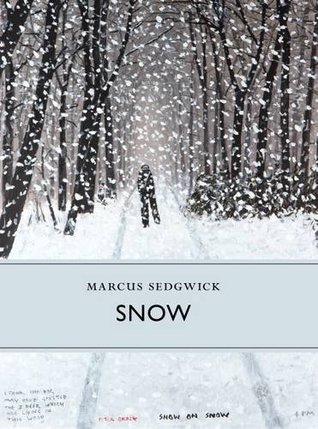 This Little Toller book is, at just over 100 pages, the perfect read for a wintry afternoon. It’s a lot like The Snow Tourist by Charlie English, though that book is travel-based, whereas for this one Sedgwick stayed put at his home in the Haute-Savoie, an alpine region of eastern France (and was even snowed in for part of the time), and wandered in his memory instead.
He writes that snow is “a form of nostalgia” for him, bringing back childhood days off school when he could just stay home and play – he loves it for “the freedom it represented.” He asks himself, “did it snow more when I was young, or is it just my desire and recreated memory?” Looking at weather statistics from Kent, he is able to confirm that, yes, it really did snow more in the 1960s and 70s.
Sedgwick briefly considers the science, history, art, and literature of snow, including polar expeditions and film, music, and paintings as well as Thomas Mann’s The Magic Mountain et al. He also likens the blank page to a snow-covered field, such that writers should not be daunted by it but excited by the possibility of creation.
In the Winter Dark by Tim Winton (1988)
 A taut early novella (just 110 pages) set in an Australian valley called the Sink. Animals have been disappearing: a pet dog snatched from its chain; livestock disemboweled. Four locals are drawn together by fear of an unidentified killer. Maurice Stubbs is the only one given a first-person voice, but passages alternate between his perspective and those of his wife Ida, Murray Jaccob, and Veronica, a pregnant teen. These are people on the edge, reckless and haunted by the past. The malevolent force comes to take on a vengeful nature. I was reminded of Andrew Michael Hurley’s novels. My first taste of Winton’s fiction has whetted my appetite to read more by him – I have Cloudstreet on the shelf.
Have you been reading anything particularly wintry this year?
Book Serendipity: 2020, Part I
I call it serendipitous when two or more books that I’m reading at the same time or in quick succession have something pretty bizarre in common. Because I have so many books on the go at once – usually between 10 and 20 – I guess I’m more prone to such incidents. I also post these occasional reading coincidences on Twitter. (The following are in rough chronological order.)
- A Wisconsin setting in three books within a month (Shotgun Lovesongs by Nickolas Butler, This Is How It Always Is by Laurie Frankel and Crossing to Safety by Wallace Stegner)
- I came across a sculpture of “a flock of 191 silver sparrows” in Dear Edward by Ann Napolitano while also reading Silver Sparrow by Tayari Jones.
- Characters nearly falling asleep at the wheel of a car in Crossing to Safety by Wallace Stegner and In the Dream House by Carmen Maria Machado
- There’s no escaping Henry David Thoreau! Within the span of a week I saw him mentioned in The Library of Ice by Nancy Campbell, The Snow Tourist by Charlie English, Losing Eden by Lucy Jones and Crossing to Safety by Wallace Stegner. Plus I’d just read the whole graphic novel Thoreau and Me by Cédric Taling.


- Discussions of the work of D.H. Lawrence in Unfinished Business by Vivian Gornick and The Offing by Benjamin Myers
- That scientific study on patient recovery in hospital rooms with a window view vs. a view of a brick wall turns up in both Dear Life by Rachel Clarke and Losing Eden by Lucy Jones.
- The inverted teardrop shapes mirror each other on these book covers:
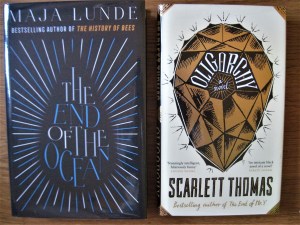
- Punchy, one-word titles on all these books I was reading simultaneously:

- Polio cases in The Golden Age by Joan London, Nemesis by Philip Roth and Crossing to Safety by Wallace Stegner
- An Italian setting and the motto “Pazienza!” in Dottoressa by Susan Levenstein and Crossing to Safety by Wallace Stegner
- Characters named Lachlan in The Ninth Child by Sally Magnusson and The Inland Sea by Madeleine Watts


- Mentions of the insecticide Flit in Nemesis by Philip Roth and Sacred Country by Rose Tremain
- A quoted Leonard Cohen lyric in Traveling Mercies by Anne Lamott; Cohen as a character in A Theatre for Dreamers by Polly Samson
- Plague is brought to an English village through bolts of cloth from London in Year of Wonders by Geraldine Brooks and Hamnet by Maggie O’Farrell; both also feature a woman who is a herbal healer sometimes mistaken for a witch (and with similar names: Anys versus Agnes)

- Gory scenes of rats being beaten to death in Hamnet by Maggie O’Farrell and Nemesis by Philip Roth
- Homemade mobiles in a baby’s room in A Theatre for Dreamers by Polly Samson and Sacred Country by Rose Tremain
- Speech indicated by italics rather than the traditional quotation marks in Pew by Catherine Lacey and Red at the Bone by Jacqueline Woodson
What’s the weirdest reading coincidence you’ve had lately?
Farewell to Winter with Some Snowy and Icy Reads
Although we got plenty of cold, damp weather and gray skies, it feels like we were cheated out of winter in my part of England this year. We had just one snow flurry on the 27th of February; that will have to suffice as my only taste of proper winter for the year. Not to worry, though: I’ve been getting my fix of snow and ice through my reading, starting with two animal tales and moving on to a few travel and adventure books.
Fiction:
The Snow Goose by Paul Gallico (1941)
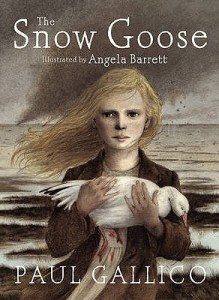 Philip Rhayader is a lonely bird artist on the Essex marshes by an abandoned lighthouse. “His body was warped, but his heart was filled with love for wild and hunted things. He was ugly to look upon, but he created great beauty.” One day a little girl, Fritha, brings him an injured snow goose and he puts a splint on its wing. The recovered bird becomes a friend to them both, coming back each year to spend time at Philip’s makeshift bird sanctuary. As Fritha grows into a young woman, she and Philip fall in love (slightly creepy), only for him to leave to help with the evacuation of Dunkirk. This is a melancholy and in some ways predictable little story. It was originally published in the Saturday Evening Post in 1940 and became a book the following year. I read a lovely version illustrated by Angela Barrett. It’s the second of Gallico’s animal fables I’ve read; I slightly preferred The Small Miracle.
The Snow Cat by Holly Webb (2016)

Most twee cover ever?
My second from Holly Webb, and while I enjoyed it a lot, if not quite as much as Frost, I probably don’t need to read any more by her now because these two were so similar as to reveal a clear formula: a young girl of about nine years old who plays alone (because she’s an only child or left out of her siblings’ games) goes for an outdoor adventure and meets a cute animal who leads her back into the past. For a time it’s unclear whether she’s dreaming or really experiencing the history, but at the end there’s some physical token that proves she has been time travelling.
In this case, Bel goes to play in the snowy garden of her grandmother’s retirement complex and meets a white cat named Snow who belongs to Charlotte, the daughter of the family who owned this manor house 150 years ago. Bel has to protect Snow from a threatening dog so the cat can be brought in to visit Charlotte’s sister Lucy, who lies ill with influenza. For me the Victorian setting wasn’t quite as authentic or interesting as the seventeenth-century frost fair was in Frost, but I can see how it’s a good way of introducing kids to what was different in the past: everything from clothing and speech to the severity of illness.
Nonfiction:
The Snow Tourist by Charlie English (2008)
 “A Search for the World’s Purest, Deepest Snowfall” reads the subtitle on the cover. English set out from his home in London for two years of off-and-on travel in snowy places, everywhere from Greenland to Washington State. In Jericho, Vermont, he learns about Wilson Bentley, an amateur scientist who was the first to document snowflake shapes through microscope photographs. In upstate New York, he’s nearly stranded during the Blizzard of 2006. He goes skiing in France and learns about the deadliest avalanches – Britain’s worst was in Lewes in 1836. In Scotland’s Cairngorms, he learns how those who work in the ski industry are preparing for the 60–80% reduction of snow predicted for this century. An appendix dubbed “A Snow Handbook” gives some technical information on how snow forms, what the different crystal shapes are called, and how to build an igloo, along with whimsical lists of 10 snow stories (I’ve read six), 10 snowy films, etc.
I found all of the science and history interesting, but especially liked a chapter on depictions of snow in art, such as Pieter Bruegel the Elder’s The Hunters in the Snow. The author also subtly threads in his own story, noting that this quest probably began with the 1960s photograph of himself on skis at a snowy Austrian resort that his father gave him a few weeks before he committed suicide. Twelve years later, it feels like this book doesn’t go far enough in cautioning about all that will be lost with climate change. I was left with the sense that nature is majestic and unpredictable, and we pay the price for not respecting it.

Hunters in the Snow. Pieter Bruegel the Elder / Public domain.
[Breaking from alphabetical order to include this one as a footnote to the previous book.]
The Library of Ice by Nancy Campbell (2018)
 This has a very similar format and scope to The Snow Tourist, with Campbell ranging from Greenland and continental Europe to the USA in her search for the science and stories of ice. For English’s chapter on skiing, substitute a section on ice skating. I only skimmed this one because – in what I’m going to put down to a case of reader–writer mismatch – I started it three times between November 2018 and now and could never get further than page 60. See these reviews from Laura and Liz for more enthusiasm.
My thanks to Scribner UK for the free copy for review.
Winterdance: The Fine Madness of Running the Iditarod by Gary Paulsen (1994)
Paulsen’s name was familiar to me from his children’s books – a tomboy, I spent my childhood fascinated by Native American culture, survival skills and animals, and Hatchet was one of my favorite novels. I had no idea he had written books for adults, including this travelogue of competing in the Iditarod sled dog race across the frozen Alaska wilderness. Nearly half the book is devoted to his preparations, before he ever gets to Alaska. He lived in Minnesota and took time assembling what he thought of as a perfect team of dogs, from reliable Cookie, his lead dog, to Devil, whose name says it all. He even starts sleeping in the kennel with the dogs to be fully in tune with them.
 The travails of his long trial runs with the dogs – the sled flipping over, having to walk miles after losing control of the dogs, being sprayed in the face by multiple skunks – sound bad enough, but once the Iditarod begins the misery ramps up. The course is nearly 1200 miles, over 17 days. It’s impossible to stay warm or get enough food, and a lack of sleep leads to hallucinations. At one point he nearly goes through thin ice. At another he’s run down by a moose. He also watches in horror as a fellow contestant kicks a dog to death.
Paulsen concludes that you would have to be insane to run the Iditarod, and there’s an appropriately feverish intensity running through the book. The way he describes the bleak beauty of the landscape, you can see how attractive and forbidding it was all at the same time. This is just the kind of adventurous armchair traveling I love (see also This Cold Heaven) – someone else did this, so now I don’t have to!
(Note: The author completed two races and was training for his third when a diagnosis of coronary heart disease ended his Iditarod career in his mid-forties. More than the obsession, more than the competition, he knows that he’ll miss the constant company of dogs. In fact, his last line is “How can it be to live without the dogs?”)
See also these recent releases:
- Snow, Dog, Foot by Claudio Morandini, an avalanche novel set in the Italian Alps
 Two nonfiction books entitled Wintering: Katherine May’s is about depression and Stephen Rutt’s is about geese
And a snowy passage from Winter Journal by Paul Auster:
Snow, so much snow these past days and weeks that fifty-six inches have fallen on New York in less than a month. Eight storms, nine storms, you have lost track by now, and all through January the song heard most often in Brooklyn has been the street music made by shovels scraping against sidewalks and thick patches of ice. Intemperate cold (three degrees one morning), drizzles and mizzles, mist and slush, ever-aggressive winds, but most of all the snow, which will not melt, and as one storm falls on top of another, the bushes and trees in your back garden are all wearing ever-longer and heavier beards of snow. Yes, it seems to have turned into one of those winters, but in spite of the cold and discomfort and your useless longing for spring, you can’t help admiring the vigor of these meteorological dramas, and you continue to look at the falling snow with the same awe you felt when you were a boy.
 Bookish Beck = Rebecca Foster. American transplant to England. Freelance proofreader and book reviewer.
 Bookish Beck