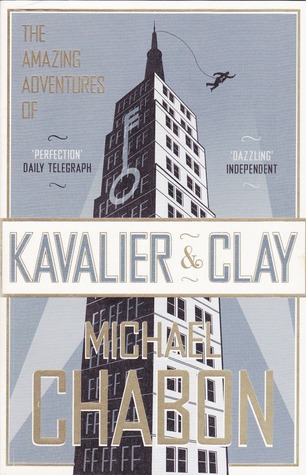
The Amazing Adventures of Kavalier & Clay by Michael Chabon (Doorstopper of the Month)
Annabel and I did a buddy read of The Amazing Adventures of Kavalier & Clay by Michael Chabon; at 636 pages, it worked out to roughly 21 pages a day for the whole month of May. As I went along I summarized each day’s reading on Twitter, so to make things super-easy for myself, especially while I’m away in the States, I’ve put this post together as a collection of tweets.
There’s a lot of plot summary here, and perhaps some spoilers, so if you plan to read the novel you might not want to read too closely. I’ve set out my more general reactions in bold.
6:12 am – 1 May 2019
Kavalier & Clay, #1: Oct. 1939. Teen cousins Sam (American) and Josef (Czech) meet up in Brooklyn. Both dream of fame and fortune, Josef through drawing; Sam through any old scheme. Lots of ref’s to illusionists. Great adjectives and metaphors. Reminds me of The Invisible Bridge.
(Coincidentally, while I was at the Wellcome Collection yesterday I browsed their current exhibit on magic and illusions and there was a vintage Houdini poster advertising one of his famous escapes.)
K&C, #2: Flashback to Josef’s illusionist training under Bernard Kornblum c. 1935. Goaded by his little brother, Thomas, Josef practiced a Houdini-style underwater escape after jumping off a bridge tied up in a laundry bag. Disaster nearly ensued. Madcap and sobering all at once.
K&C, #3: Josef escapes Prague in a coffin housing a golem [animated humanoid figure made of clay]. He has a premonition of the horror to come for the Jews. Close shaves, but he makes it to Brooklyn — as we already know. Looking forward to getting back to NYC and Sam in Part II.
K&C, #4: Brief history of comics in America. Superman was a watershed in 1938. Sam pitches an idea to half-dressed boss Sheldon Anapol and shows Joe’s quick sketch of a golem-like hero. Though skeptical, he decides to give them the weekend to come up with a complete 12-page comic.
K&C, #5: Sam enlists the Glovsky brothers to work for him. We get the story of his late father, a vaudeville strong man named ‘The Mighty Molecule’. Joe breaks into locked premises with a flourish, inspiring The Escapist. Over 1/6 through! Hankering for a proper female character.
K&C, #6: Well, we got a female, Rosa Luxembourg Saks, but so far she hasn’t said a word and is only an object of the male gaze. J draws her nude for $3. My interest waned in Ch. 8 as S and J develop a backstory for The Escapist. He is to free the oppressed with his Golden Key.
K&C, #7: With 5 helpers, S&J pull all-nighters to piece together a 1st issue of Masked Men with mult. 12-pp stories. J draws the Escapist punching Hitler for the cover. Anapol makes them a good offer but wants a new cover. It’s a deal breaker; S&J walk out. Great period dialogue.
K&C, #8: Part III, Oct. 1940. Empire Comics is a phenomenon. Anapol is now so rich he bought a house in FL. Joe toils away at his violent, audacious scenes and pesters the German consulate re: his family. After some bad news, he decides to move to Montreal so he can join the RAF.
K&C, #9: Joe has 2nd thoughts re: RAF. He now seems to cross paths with every pugilistic German in the city. He stumbles on the offices of the “Aryan-American League,” breaks in and learns that he has in Carl Ebling a fan in spite of himself. Sure I’ve heard that name before…
K&C, #10: Joe is so confident a ‘bomb’ on 25th fl. of Empire State Bldg is a bluff by his nemesis, Ebling, that he chains himself to his desk to keep working. S&J realize how foolish it was to sell rights to the Escapist: they won’t make a penny on the upcoming radio adaptation.
K&C, #11: S&J attend a party at which Salvador Dali is in a breathing apparatus. Rosa reappears, saying the F word. She’s empathetic re: J’s family. J plays the hero and saves Dali when he runs out of oxygen. Rosa invites him up to see her paintings (not a euphemism — I think!).
K&C, #12 (catch-up): Rosa paints still lifes and has a room full of moths, a sort of family plague. She sets Joe’s dislocated finger and, via her work for the Transatlantic Rescue Agency, may be able to help him save his brother. They share a kiss before Sam interrupts them.
K&C, #13: Rosa’s boss agrees to help Joe if he pays 3x the regular fare for Thomas … and is the magician for his son’s bar mitzvah. Joe’s new idea for a sexy female superhero is inspired by a Luna moth. He and Sam try to bargain for a greater share of the rights to their work.
K&C, #14-15 (somehow got ahead!): 1941. S&J so rich they don’t know what to do with the $. Sharing apt. with Rosa, who keeps trying to find S a girlfriend. J is performing magic at parties; S is writing a novel, takes a radio actor auditioning for Escapist home to Shabbos dinner.
Some general thoughts at the halfway point, while I’m ahead: delighted to have a solid female character in Rosa, and more interiority with Sam in Part IV. (There are also intriguing hints about his sexuality.) Chabon is an exuberant writer; the novel could definitely be shorter.
K&C, #16: Joe is carrying around an unopened letter from his mother. At one of his bar mitzvah magician gigs, Ebling attacks him with an explosive and both incur minor injuries. The letter mysteriously disappears…
K&C, #17: Sam is a volunteer plane spotter for the war effort, giving him a vantage point high above NYC. Actor Tracy Bacon surprises him by joining him up there at 1 a.m. one day. Literal sparks fly.
K&C, #18: Sam meets Orson Welles, whose “Citizen Kane” is a huge influence on the lads’ work — they want to write for adults more than kids now. Tracy accompanies Sam to his favorite place in NYC: the site of the former World’s Fair. (Traveling tomorrow but will catch up soon.)
Sigh. I hugely lost momentum after we arrived in the States on Sunday. I’ve caught up, but (confession time) have had to do a lot of skimming. I find the dialogue a lot more engaging than the expository prose, unfortunately.
K&C #19-25: Awful news about the ship bearing Joe’s brother. Both Joe and Rosa decide to take drastic action. Carl Ebling is imprisoned for 12 years for the bar mitzvah bombing. J is stationed near the Antarctic as a radioman. JUMP to 1954, with S raising a 12yo kid named Tommy.
K&C, #26: We realize Sam and Rosa have formed an unusual family with her child Tommy, who’s learning magic tricks from Joe, who makes a failed jump…
K&C wrap-up: Joe’s living in the Empire State Building, writing a novel about a golem. Anapol kills off the Escapist. In ’54, Sam appears at a televised hearing about whether comic books create delinquents. He decides to start over in CA, leaving Joe, Rosa and Tommy a family of 3
K&C wrap-up (cont.): I did occasional skimming starting at ~p. 120 and mostly skimmed from p. 400 onwards, so I’ve marked the whole thing as ‘skimmed’ rather than ‘read’. Slightly disappointed with myself for lacking staying power, but I do think the book overlong.
The action should have been condensed, rather than sprawling over 15 years. I often lost patience with the expository prose and wanted more scenes and dialogue. It took too long for Rosa to appear, and too long to get initiated into Sam’s private life.
However, Chabon does have some wonderful turns of phrase. Here’s a few faves. “The view out the windows was pure cloud bank, a gray woolen sock pulled down over the top of the building.”
“Orderly or chaotic, well inventoried and civil or jumbled and squabbling, the Jews of Prague were dust on the boots of the Germans, to be whisked off with an indiscriminate broom.”
“Sammy felt that he was standing on the border of something wonderful, a land where wild cataracts of money and the racing river of his own imagination would, at last, lift his makeshift little raft and carry it out to the boundless freedom of the open sea.”
My favorite passage of all: “Dinner was a fur muff, a dozen clothespins, and some old dish towels boiled up with carrots. The fact that the meal was served with a bottle of prepared horseradish enabled Sammy to conclude that it was intended to pass for braised short ribs of beef”
I also discovered that Chabon coined a word in the novel: “aetataureate,” meaning related to a golden age. It’s a good indication of the overall tone.
My rating: 
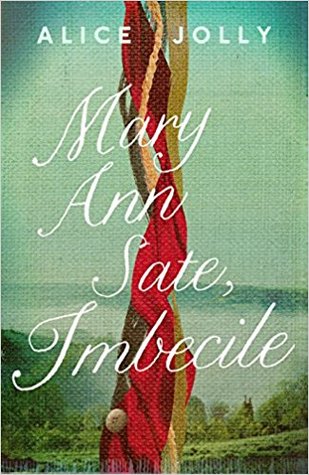 The other doorstopper I finished reading this month was Mary Ann Sate, Imbecile by Alice Jolly, which I reviewed for Nudge. I had heard about this Unbound release before, but my interest was redoubled by its shortlisting for the Rathbones Folio Prize and the RSL Ondaatje Prize. Although I was initially intimidated by the heft of the 600+-page hardback that came through my door for review, I found that I could easily settle into the rhythm and – provided I had no distractions – read 40 or 50 pages of it at a sitting.
As an elderly woman in Gloucestershire in the 1880s, Mary Ann Sate looks back at the events of the 1820s and 1830s, a time of social turmoil and upheaval in the family for whom she worked as a servant. Writing is a compulsion and a form of confession for her. The book has no punctuation, not even apostrophes, and biblical allusions, spelling errors, archaisms and local pronunciation (such as “winder” for window and “zummer” for summer) make it feel absolutely true to the time period and to the narrator’s semi-literate status.
There are no rhymes in this free verse epic, but occasionally Mary Ann comes out with some alliteration, perhaps incidental, or particularly poetic lines (“The road ahead unravel / Like a spool of canary thread / Taking me always away”) that testify to her gifts for storytelling and language, even though she made her living by manual labor for some seven decades.
The manner of the telling makes this a unique work of historical fiction, slightly challenging but very worthwhile. I would particularly recommend it to fans of Jane Harris’s The Observations.
My rating: 
Next month’s plan: The Stillness The Dancing by Wendy Perriam, passed on to me by Liz Dexter.
4 Reasons to Love Kayla Rae Whitaker’s The Animators
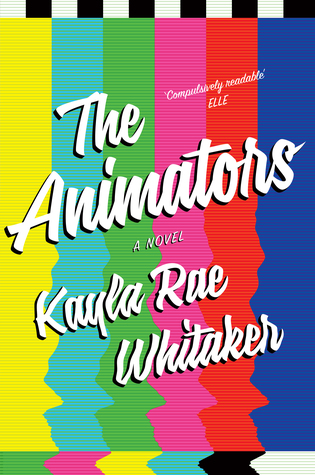 I have way too much to say about this terrific debut novel, and there’s every danger of me slipping into plot summary because, though it seems lighthearted on the surface, there’s a lot of meat to this story of the long friendship between two female animators. So I’m going to adapt a format that has worked well for other bloggers (e.g. Carolyn at Rosemary and Reading Glasses) and pull out four reasons why you must be sure not to miss this book.
- Bosom Friends. Have you ever had, or longed for, what Anne Shirley calls a “bosom friend”? If so, you’ll love watching the friendship develop between narrator Sharon Kisses and her business partner, Mel Vaught. In many ways they are opposites. Lanky, blonde Mel is a loud, charismatic lesbian who uses drugs and alcohol to fuel a manic pace of life. She’s the life of every party. Sharon, on the other hand, is a curvy brunette and neurotic introvert who’s always falling in love with men but never achieving real relationships. They meet in Professor McIntosh’s Introduction to Sketch class at a small college and a decade later are still working together. They win acclaim for their first full-length animated feature, Nashville Combat, based on Mel’s dysfunctional upbringing in the Central Florida swamps. But they see each other through some really low lows, too, like the death of Mel’s mother and Sharon’s punishing recovery from a stroke at the age of 32.
She was the first person to see me as I had always wanted to be seen. It was enough to indebt me to her forever.
- The Value of Work. Kayla Rae Whitaker was inspired by her childhood obsession with dark, quirky cartoons like Beavis and Butthead and Ren and Stimpy. Books about artists sometimes present the work as magically fully-formed, rather than showing the arduous process behind it. Here, though, you track Mel and Sharon’s next film from a set of rough sketches in a secret notebook to a polished comic, following it through storyboarding, filling-in and final edits. It’s a year of all-nighters, poor diet and substance abuse. But work – especially the autobiographical projects these characters create – is also saving. Even when it seems the well has run dry, creativity always resurges. I also appreciated how the novel contrasts the women’s public and private personas and imagines their professional legacy.
The work will always be with you, will come back to you if it leaves, and you will return to it to find that you have, in fact, gotten better, gotten sharper. It happens to you while you are asleep inside.
- Road Trips and Rednecks. I love a good road trip narrative, and this novel has two. First there’s the drive down to Florida for Mel to identify her mother, and then there’s Sharon’s sheepish return to her hometown of Faulkner, Kentucky. Here’s where the book really takes off. The sharp, sassy dialogue sparkles throughout, but the scenes with Sharon’s mom and sister are particularly hilarious. What’s more, the contrast between the American heartland and the flashy New York City life Mel and Sharon have built works brilliantly. Although in the Kentucky section Whitaker portrays some obese Americans you’d be tempted to call white trash, she never resorts to cruel hillbilly stereotypes. The author herself is from rural eastern Kentucky and paints the place in a tender light. She even makes Louisville – where the friends go to meet up with Sharon’s old neighbor and first crush, Teddy Caudill – sound like quite an appealing tourist destination!
I used it to hate it here. How could I have possibly hated this? This is me. I sprang from this place.
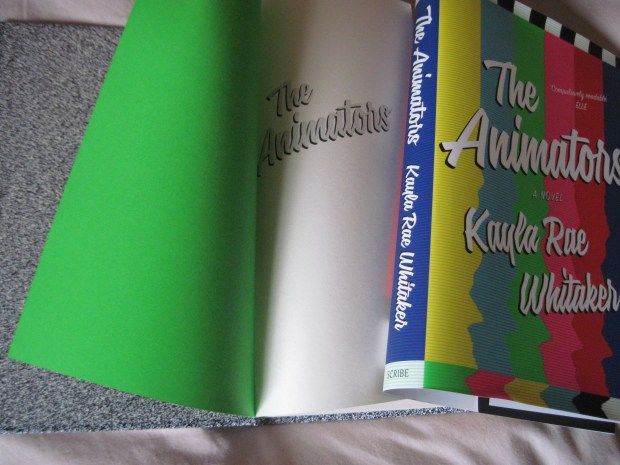
I love the attention to detail evident in the book design, especially the black-and-white TV fuzz of the covers under the dust jacket, and the pop of neon green on the inside of the endpapers.
- Open Your Trunk. This is a mantra arising from Mel and Sharon’s second movie, Irrefutable Love, which is autobiographical for Sharon this time – revolving around a traumatic incident from her shared past with Teddy, her string of crushes, and her stroke recovery. One powerful message of the novel is that you can’t move on in life unless you confront the crap that’s happened to you. As humorous as it is, it’s also a weighty book in this respect. It has three pivot points, moments so grim and surprising that I could hardly believe Whitaker dared to put them in. (The first is Sharon’s stroke; the others I won’t spoil.) This means the ending is not the super-happy one I might have wanted, but it’s realistic.
Anything that makes you in that way, anything that makes you hurt and hungry in that way, is worth investigating. … When you take the things that happen to you, the things that make you who are, and you use them, you own them.
I thought the timeline could be a little tighter and the novel was unnecessarily crass in places. For me, the road trips were the best bits and the rest never quite matched up. But this is still bound to be one of my top novels of the year. I think every reader will see him/herself in Sharon, and we all know a Mel; for some it might be the other way around. Like A Little Life and even The Essex Serpent, this asks how friendship and work can carry us through. Meanwhile, the cartooning world and the Kentucky–New York City dichotomy together feel like a brand new setting for a literary tragicomedy.
An early favorite for 2017. Don’t miss it.
The Animators was published by Random House and Scribe UK on January 31st. My thanks to Sophie Leeds of Scribe for sending a free copy for review.
My rating: 
 Bookish Beck = Rebecca Foster. American transplant to England. Freelance proofreader and book reviewer.
 Bookish Beck