Most Anticipated Books of the First Half of 2025
As I said the other week, I sometimes wonder if designating a book as “Most Anticipated” is a curse – if the chosen books are doomed to fail to meet my expectations. Nonetheless, I can’t resist compiling such a list at least once each year.
Also on my radar: fiction by Claire Adam, Amy Bloom, Emma Donoghue, Sarah Hall, Michelle Huneven, Eowyn Ivey, Rachel Joyce, Heather Parry and Torrey Peters; nonfiction by Melissa Febos, Robert Macfarlane, Lucy Mangan, Suzanne O’Sullivan and Sophie Pavelle. (Further ahead, I’ll seek out I Want to Burn This Place Down: Essays by Maris Kreizman and The Girls Who Grew Big by Leila Mottley in July, The Savage Landscape by Cal Flyn in Oct. and Tigers between Empires by Jonathan C. Slaght in Nov.)
However, below I’ve narrowed it down to the 25 books I’m most looking forward to for the first half of 2025, 15 fiction and 10 nonfiction. I’m impressed that 4 are in translation! And 22/25 are by women (all the fiction is). In release date order, with UK publication info given first if available. The blurbs are adapted from Goodreads. I’ve taken the liberty of using whichever cover is my favourite (almost always the U.S. one).

Fiction
 Live Fast by Brigitte Giraud (trans. from the French by Cory Stockwell) [Feb. 11, Ecco]: I found out about this autofiction novella via an early Shelf Awareness review. It “follows one woman’s quest to comprehend the motorcycle accident that took the life of her partner Claude at age 41. The narrator … recounts the chain of events that led up to the fateful accident, tracing the tiny, maddening twists of fate that might have prevented its tragic outcome. Each chapter asks the rhetorical question, ‘what if’ … A sensitive elegy to her husband”.
 The Unworthy by Agustina Bazterrica (trans. from the Spanish by Sarah Moses) [13 Feb., Pushkin; March 4, Scribner]: I wasn’t enamoured of the Argentinian author’s short stories, but Tender Is the Flesh was awesome. This is a short dystopian horror set in a convent. “In the House of the Sacred Sisterhood, the unworthy live in fear of the Superior Sister’s whip. … Risking her life, one of the unworthy keeps a diary in secret. Slowly, memories surface from a time before the world collapsed, before the Sacred Sisterhood became the only refuge. Then Lucía arrives.” (PDF copy for Shelf Awareness review)
 Victorian Psycho by Virginia Feito [13 Feb., Fourth Estate; Feb. 4, Liveright]: Feito’s debut, Mrs March, was deliciously odd, and I love the (U.S.) cover for this one. It sounds like a bonkers horror take on Henry James’s The Turn of the Screw, “a gruesome and gleeful new novel that probes the psyche of a bloodthirsty governess. Winifred Notty arrives at Ensor House prepared to play the perfect Victorian governess—she’ll dutifully tutor her charges, Drusilla and Andrew, tell them bedtime stories, and only joke about eating children.”

Three Days in June by Anne Tyler [13 Feb., Chatto & Windus (Penguin) / Feb. 11, Knopf]: I’m not a Tyler completist, but she’s reliable and this is a novella! “It’s the day before her daughter’s wedding and things are not going well for Gail Baines. First …, she loses her job … Then her ex-husband Max turns up at her door expecting to stay for the festivities. He doesn’t even have a suit. Instead, he’s brought memories, a shared sense of humour – and a cat looking for a new home. … [And] daughter Debbie discovers her groom has been keeping a secret.” Susan vouches for this. (Edelweiss download / on order from library)
 The Swell by Kat Gordon [27 Feb., Manilla Press (Bonnier Books UK)]: I got vague The Mercies (Kiran Millwood Hargrave) vibes from the blurb. “Iceland, 1910. In the middle of a severe storm two sisters, Freyja and Gudrun, rescue a mysterious, charismatic man from a shipwreck near their remote farm. Sixty-five years later, a young woman, Sigga, is spending time with her grandmother when they learn a body has been discovered on a mountainside near Reykjavik, perfectly preserved in ice.” (NetGalley download)
 Dream Count by Chimamanda Ngozi Adichie [4 March, Fourth Estate/Knopf]: This is THE book I’m most looking forward to; I’ve read everything Adichie has published and Americanah was a 5-star read for me. So I did something I’ve never done before and pre-ordered the signed independent bookshop edition from my local indie, Hungerford Bookshop. “Chiamaka is a Nigerian travel writer living in America. Alone in the midst of the pandemic, she recalls her past lovers and grapples with her choices and regrets.” The focus is on four Nigerian American women “and their loves, longings, and desires.” (New purchase)
 Kate & Frida by Kim Fay [March 11, G.P. Putnam’s Sons]: “Frida Rodriguez arrives in Paris in 1991 … But then she writes to a bookshop in Seattle … A friendship begins that will redefine the person she wants to become. Seattle bookseller Kate Fair is transformed by Frida’s free spirit … [A] love letter to bookshops and booksellers, to the passion we bring to life in our twenties”. Sounds like a cross between The Paris Novel and 84 Charing Cross Road – could be fab; could be twee. We shall see! (Edelweiss download)
 The Antidote by Karen Russell [13 March, Chatto & Windus (Penguin) / March 11, Knopf]: I love Russell’s Swamplandia! but haven’t gotten on with her other work I’ve tried, so I’m only tentatively enthusiastic about the odd Wizard of Oz-inspired blurb: “a historic dust storm ravages the fictional town of Uz, Nebraska. But Uz is already collapsing—not just under the weight of the Great Depression … but beneath its own violent histories. The Antidote follows a ‘Prairie Witch,’ … a Polish wheat farmer …; his orphan niece, a … witch’s apprentice …; a voluble scarecrow; and a New Deal photographer”. (Requested from publisher)
 Elegy, Southwest by Madeleine Watts [13 March, ONE (Pushkin) / Feb. 18, Simon & Schuster]: Watts’s debut, The Inland Sea, was a hidden gem. Given the news from L.A., this seems all the more potent: “In November 2018, Eloise and Lewis rent a car in Las Vegas and take off on a two-week road trip across the American southwest … [w]hile wildfires rage. … Lewis, an artist working for a prominent land art foundation, is grieving the recent death of his mother, while Eloise is an academic researching the past and future of the Colorado River … [and] beginning to suspect she might be pregnant”. (Edelweiss download)
 O Sinners! by Nicole Cuffy [March 18, One World (Random House)]: Cuffy’s Dances, which was longlisted for the Carol Shields Prize, was very good. The length of this sophomore novel (464 pages) gives me pause, but I do generally gravitate towards stories of cults. “Faruq Zaidi, a young journalist reeling from the recent death of his father, a devout Muslim, takes the opportunity to embed in a cult called The Nameless [b]ased in the California redwoods and shepherded by an enigmatic [Black] Vietnam War veteran.”
 The Accidentals: Stories by Guadalupe Nettel (trans. from the Spanish by Rosalind Harvey) [10 April, Fitzcarraldo Editions / April 29, Bloomsbury]: I really enjoyed Nettel’s International Booker-shortlisted novel Still Born. “When an albatross strays too far from its home, or loses its bearings, it becomes an ‘accidental’, an unmoored wanderer. The protagonists of these eight stories each find the ordinary courses of their lives disrupted by an unexpected event. … Deft and disquieting, oscillating between the real and the fantastical”. (PDF copy for Shelf Awareness review)
 Ordinary Saints by Niamh Ni Mhaoileoin [24 April, Manilla Press (Bonnier Books UK)]: “Brought up in a devout household in Ireland, Jay is now living in London with her girlfriend, determined to live day to day and not think too much about either the future or the past. But when she learns that her beloved older brother, who died in a terrible accident, may be made into a Catholic saint, she realises she must at last confront her family, her childhood and herself.” Winner of the inaugural PFD Queer Fiction Prize and shortlisted for the Women’s Prize Discoveries Award.
 Heartwood by Amity Gaige [1 May, Fleet / April 1, Simon & Schuster]: I loved Gaige’s Sea Wife. “In the heart of the Maine woods, an experienced Appalachian Trail hiker goes missing. She is forty-two-year-old Valerie Gillis, who has vanished 200 miles from her final destination. … At the centre of the search is Beverly, the determined Maine State Game Warden tasked with finding Valerie, who is managing the search on the ground. While Beverly is searching, Lena, a seventy-six-year-old birdwatcher in a retirement community, becomes an unexpected armchair detective.”
 Are You Happy?: Stories by Lori Ostlund [May 6, Astra House]: Ostlund is not so well known, especially outside the USA, but I enjoyed her debut novel, After the Parade, back in 2015. “Nine masterful stories that explore class, desire, identity, and the specter of violence in America–and in American families–against women and the LGBTQ+ community. … [W]e watch Ostlund’s characters as they try—and often fail—to make peace with their pasts while navigating their present relationships and responsibilities.” (Edelweiss download)
 Ripeness by Sarah Moss [22 May, Picador / Sept. 9, Farrar, Straus and Giroux]: Though I was disappointed by her last two novels, I’ll read anything Moss publishes and hope for a return to form. “It is the [19]60s and … Edith finds herself travelling to rural Italy … to see her sister, ballet dancer Lydia, through the final weeks of her pregnancy, help at the birth and then make a phone call which will seal this baby’s fate, and his mother’s.” Promises to be “about migration and new beginnings, and about what it is to have somewhere to belong.”
Nonfiction
 The Forgotten Sense: The New Science of Smell by Jonas Olofsson [Out now! 7 Jan., William Collins / Mariner]: Part of a planned deep dive into the senses. “Smell is … one of our most sensitive and refined senses; few other mammals surpass our ability to perceive scents in the animal kingdom. Yet, as the millions of people who lost their sense of smell during the COVID-19 pandemic can attest, we too often overlook its role in our overall health. … For readers of Bill Bryson and Steven Pinker”. (On order from library)
 Bread and Milk by Karolina Ramqvist (trans. from the Swedish by Saskia Vogel) [13 Feb., Bonnier Books / Feb. 11, Coach House Books]: I think I first found about this via the early Foreword review. “Bread and Milk traces a life through food, from carefully restricted low-fat margarine to a bag of tangerines devoured in one sitting to the luxury of a grandmother’s rice pudding. In this radiant memoir from one of Northern Europe’s most notable literary stylists, we follow several generations of women and their daughters as they struggle with financial and emotional vulnerability, independence, and motherhood.”
 My Mother in Havana: A Memoir of Magic & Miracle by Rebe Huntman [Feb. 18, Monkfish]: I found out about this from Rebecca Moon Ruark and by the time the publisher offered it to me I’d already downloaded it. The themes of bereavement and religion are right up my street. “As she explores the memory of her own mother, interlacing it with her search for the sacred feminine, Huntman leads us into a world of séance and sacrifice, pilgrimage and sacred dance, which resurrect her mother and bring Huntman face to face with a larger version of herself.” (Edelweiss download)
 Mother Animal by Helen Jukes [27 Feb., Elliott & Thompson]: This may be the 2025 release I’ve known about for the longest. I remember expressing interest the first time the author tweeted about it; it’s bound to be a good follow-up to Lucy Jones’s Matrescence. “When Helen Jukes falls pregnant, … she widens her frame of reference, looking beyond humans to ask what motherhood looks like in other species. … As she enters the sleeplessness, chaos and intimate discoveries of life with a newborn, these animal stories become … companions and guides.” (Requested from publisher)
 Alive: An Alternative Anatomy by Gabriel Weston [6 March, Vintage (Penguin) / March 4, David R. Godine]: I’ve read Weston’s Direct Red and appreciate her perspective. “As she became a surgeon, a mother, and ultimately a patient herself, Weston found herself grappling with the gap between scientific knowledge and unfathomable complexity of human experience. … Focusing on our individual organs, not just under the intense spotlight of the operating theatre, but in the central role they play in the stories of our lives.”
 The Lost Trees of Willow Avenue: A Story of Climate and Hope on One American Street by Mike Tidwell [March 25, St. Martin’s Press]: A must-read for me because it’s set in Takoma Park, Maryland, where I was born. “A love letter to the magnificent oaks and other trees dying from record heat waves and bizarre rain, [activist] Tidwell’s story depicts the neighborhood’s battle to save the trees and combat climate change. … Tidwell chronicles people on his block sick with Lyme disease, a church struggling with floods, and young people anguishing over whether to have kids, … against the global backdrop of 2023’s record heat domes and raging wildfires and hurricanes.”
 Breasts: A Relatively Brief Relationship by Jean Hannah Edelstein [3 April, Phoenix (W&N)]: I loved Edelstein’s 2018 memoir This Really Isn’t About You, and I regularly read her Substack. “As [Edelstein] comes of age, she learns that breasts are a source of both shame and power. In early motherhood, she sees her breasts transform into a source of sustenance and a locus of pain. And then, all too soon, she is faced with a diagnosis and forced to confront what it means to lose and rebuild an essential part of yourself.”
 Poets Square: A Memoir in Thirty Cats by Courtney Gustafson [8 May, Fig Tree (Penguin) / April 29, Crown]: Gustafson became an Instagram and TikTok hit with her posts about looking after a feral cat colony in Tucson, Arizona. The money she raised via social media allowed her to buy her home and continue caring for animals. “[Gustafson] had no idea about the grief and hardship of animal rescue, the staggering size of the problem in neighborhoods across the country. And she couldn’t have imagined how that struggle … would help pierce a personal darkness she’d wrestled for with much of her life.” (Proof copy from publisher)
 Lifelines: Searching for Home in the Mountains of Greece by Julian Hoffman [15 May, Elliott & Thompson]: Hoffman’s Irreplaceable was my book of 2019. “In the summer of 2000, Julian Hoffman and his wife Julia found themselves disillusioned with city life. Overwhelmed by long commutes, they stumbled upon a book about Prespa, Greece – a remote corner of Europe filled with stone villages, snow-capped mountains and wildlife. What began as curiosity soon transformed into a life-changing decision: to make Prespa their home.” I know next to nothing about Greece and this is a part of it that doesn’t fit the clichés.
 Spent: A Comic Novel by Alison Bechdel [22 May, Jonathan Cape (Penguin) / May 20, Mariner Books]: Bechdel’s Fun Home is an absolute classic of the graphic memoir. I’ve lost track of her career a bit but like the sound of this one. “A cartoonist named Alison Bechdel, running a pygmy goat sanctuary in Vermont, is existentially irked by a climate-challenged world and a citizenry on the brink of civil war.” After her partner’s wood-chopping video goes viral, she decides to create her own ethical-living reality TV show. Features cameos from some characters from her Dykes to Watch Out For series.
Other lists of anticipated books:
Clare – we overlap on a couple of our picks
Kate – one pick in common, plus I’ve already read a couple of her others
Laura – we overlap on a couple of our picks
Paul (mostly science and nature)
What catches your eye here? What other 2025 titles do I need to know about?
Book Serendipity, April to May 2024
I call it “Book Serendipity” when two or more books that I read at the same time or in quick succession have something in common – the more bizarre, the better. Of course, the truer term would be synchronicity, but the branding has stuck. In Liz Jensen’s Your Wild and Precious Life, she mentions that Carl Jung coined the term “synchronicity” for what he described as “a meaningful coincidence of two or more events where something other than the probability of chance is involved.” I like thinking that it’s not just a matter of luck.
This is a regular feature of mine every couple of months. I would normally have waited until the end of June, but I had way too many coincidences stored up! Because I usually have 20–30 books on the go at once, I suppose I’m more prone to finding them. People frequently ask how I remember all of these incidents. The answer is: I jot them down on scraps of paper or input them immediately into a file on my PC desktop; otherwise, they would flit away.
The following are in roughly chronological order.
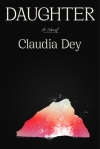
- Reading two King Lear updates at the same time: Private Rites by Julia Armfield and Daughter by Claudia Dey. The former has been specifically marketed as a “lesbian Lear,” but I had no idea that the latter also features two sisters plus a younger half-sister and their interactions with a larger-than-life father.

- Eating beans straight out of the tin in The Waterfall by Margaret Drabble and Of Mice and Men by John Steinbeck.
- Dead mice in Of Mice and Men by John Steinbeck and Stone Yard Devotional by Charlotte Wood.

-

- Screenshot
- Cloth holding the jaw of a corpse closed in one story from Barcelona by Mary Costello and A Woman’s Story by Annie Ernaux.
- Others see a character’s wife as a whore but the husband is oblivious in The Shipping News by E. Annie Proulx and Of Mice and Men by John Steinbeck.
 Setting up a game of solitaire in The Snow Hare by Paula Lichtarowicz and Of Mice and Men by John Steinbeck.
- Main character called Mona in Daughter by Claudia Dey and Mona of the Manor by Armistead Maupin.
- Being surprised at an older man still having his natural hair colour in one story of Barcelona by Mary Costello (where he’s aged 76) and Life in the Balance by Jim Down (where it’s Alan Bennett, at 84!).
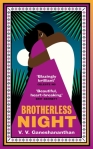
- A character named Anjali in Brotherless Night by V.V. Ganeshananthan and Moral Injuries by Christie Watson.

- A character named Cherry in Daughter by Claudia Dey and one story of This Is Why We Can’t Have Nice Things by Naomi Wood.
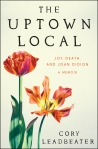
- My second memoir in two months in which a twentysomething son dies suddenly of a presumed heart problem: Fi by Alexandra Fuller, followed by Your Wild and Precious Life by Liz Jensen. (And a third in which his young friend died in the same way: The Uptown Local by Cory Leadbeater.) Also, Fuller and Jensen both see signs of their sons’ continued presence in bird sightings.
- Scratches on the inside of a coffin as proof of being buried alive in one story of Barcelona by Mary Costello and Life in the Balance by Jim Down.


- Surprise that one didn’t know the exact moment that a loved one died in one story of Barcelona by Mary Costello and Your Wild and Precious Life by Liz Jensen.
- Discussion of the meaning of brain stem death and a mention of meningococcal sepsis in Life in the Balance by Jim Down and Moral Injuries by Christie Watson.
- A scene set in a Denny’s diner in The Whole Staggering Mystery by Sylvia Brownrigg and After Dark by Haruki Murakami.


- A description of halal butchery in Barcelona by Mary Costello and Between Two Moons by Aisha Abdel Gawad.
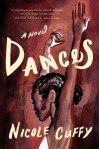
- A mention of ballet choreographer George Balanchine in Dances by Nicole Cuffy and The Uptown Local by Cory Leadbeater.
- A woman has an affair with a female postal worker in Mona of the Manor by Armistead Maupin and The Shipping News by Annie Proulx, both of which I DNFed.
- A character named Magdalena in Cloistered by Catherine Coldstream and The Snow Hare by Paula Lichtarowicz. The latter goes by Lena, which is also the name of the main character in Jungle House by Julianne Pachico. And there’s a character named Lina in Between Two Moons by Aisha Abdel Gawad.


- Being presented with powdered milk in Cloistered by Catherine Coldstream and Whale Fall by Elizabeth O’Connor.
- First I read a novel about a convent plagued by mice (Stone Yard Devotional by Charlotte Wood). Then I read a memoir about a convent plagued by feral cats (Cloistered by Catherine Coldstream).
- Buffalo, New York as a setting in Consent by Jill Ciment and The Age of Loneliness by Laura Marris. It’s also mentioned in Enter Ghost by Isabella Hammad.

- Watching pigeons on one’s balcony in Keep by Jenny Haysom, Your Wild and Precious Life by Liz Jensen, and The Uptown Local by Cory Leadbeater.
 The family’s pet chicken is cooked for dinner in Coleman Hill by Kim Coleman Foote and The Snow Hare by Paula Lichtarowicz.
- The mother is named Gloria in Consent by Jill Ciment and Cold Spring Harbor by Richard Yates (and The War for Gloria by Atticus Lish, a DNF).
- A character named Anton in The Snow Hare by Paula Lichtarowicz and Jungle House by Julianne Pachico.
- A cat named Dog in The Door-to-Door Bookstore by Carsten Henn and a dog named Tiger in Jungle House by Julianne Pachico.
- Two nature books that feature wild cold-water swimming (though don’t they all these days?!): In All Weathers by Matt Gaw and Your Wild and Precious Life by Liz Jensen.

- Two nature books that mention W.H. Hudson: In All Weathers by Matt Gaw and North with the Spring by Edwin Way Teale.
 A large anonymous donation to a church in Slammerkin by Emma Donoghue and Excellent Women by Barbara Pym (£10–11, which was much more in the 18th century of the former than in the 1950s of the latter).
- A mention of Poughkeepsie, New York in Birdeye by Judith Heneghan and Woman of Interest by Tracy O’Neill.
- A 1950s scene of perusing a lipstick display in Recipe for a Perfect Wife by Karma Brown and Excellent Women by Barbara Pym.

- A woman with a broken leg worries about how her garden will fare in Recipe for a Perfect Wife by Karma Brown and Remarkably Bright Creatures by Shelby Van Pelt.
- The same silent film image of a spaceship entering the moon’s eye (from Georges Méliès’s A Trip to the Moon) appears in Knife by Salman Rushdie and The Invention of Hugo Cabret by Brian Selznick. (I think this is the uncanniest coincidence of all this time!)

- A cleric who wears a biretta in Excellent Women by Barbara Pym and Daughters of the House by Michèle Roberts.
- A Black single mother who believes in the power of crystals in Company by Shannon Sanders and Another Word for Love by Carvell Wallace.


- An older woman really doesn’t want to leave her home but is moving into a retirement facility in Keep by Jenny Haysom and Remarkably Bright Creatures by Shelby Van Pelt. (There’s also a young woman who refuses to leave her house in Recipe for a Perfect Wife by Karma Brown.)
 A man throws his tie over his shoulder before eating in Recipe for a Perfect Wife by Karma Brown and Keep by Jenny Haysom.
- A mother writing a bad check becomes an important plot point in Remarkably Bright Creatures by Shelby Van Pelt and Another Word for Love by Carvell Wallace.
 A scene of self-induced abortion in Recipe for a Perfect Wife by Karma Brown and Sleeping with Cats by Marge Piercy.
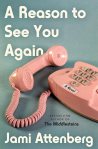
- The Yiddish word feh (an expression of disappointment) appears in Feh by Shalom Auslander (no surprise there!) but also in A Reason to See You Again by Jami Attenberg, both of which are pre-release books I am reading for Shelf Awareness reviews.

What’s the weirdest reading coincidence you’ve had lately?
Love, Etc. – Some Thematic Reading for Valentine’s Day
Even though we aren’t big on Valentine’s Day (we went out to a “Flavours of Africa” supper club last weekend and are calling it our celebration meal), for the past three years I’ve ended up doing themed posts featuring books that have “Love” or a similar word in the title or that consider romantic or familial love in some way. (Here are my 2017, 2018 and 2019 posts.) These seven selections, all of them fiction, sometimes end up being more bittersweet or ironic than straightforwardly romantic, but see what catches your eye anyway.
Shotgun Lovesongs by Nickolas Butler (2014)
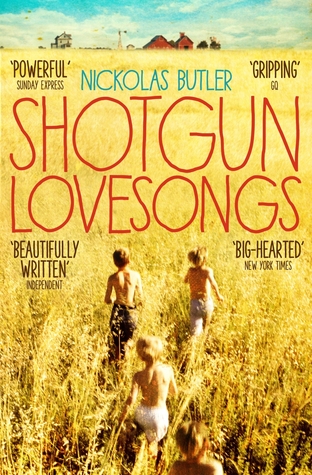 Four childhood friends from Little Wing, Wisconsin; four weddings (no funeral – though there are a couple of close calls along the way). Which bonds will last, and which will be strained to the breaking point? Henry is the family man, a dairy farmer who married his college sweetheart, Beth. Lee* is a musician, the closest thing to a rock star Little Wing will ever produce. He became famous for Shotgun Lovesongs, a bestselling album he recorded by himself in a refurbished chicken coop for $600, and now lives in New York City and hobnobs with celebrities. Kip gave up being a Chicago commodities trader to return to Little Wing and spruce up the old mill into an events venue. Ronny lived for alcohol and rodeos until a drunken accident ended his career and damaged his brain.
The friends have their fair share of petty quarrels and everyday crises, but the big one hits when one guy confesses to another that he’s in love with his wife. Male friendship still feels like a rarer subject for fiction, but you don’t have to fear any macho stylings here. The narration rotates between the four men, but Beth also has a couple of sections, including the longest one in the book. This is full of nostalgia and small-town (especially winter) atmosphere, but also brimming with the sort of emotion that gets a knot started in the top of your throat. All the characters are wondering whether they’ve made the right decisions. There are a lot of bittersweet moments, but also some comic ones. The entire pickled egg sequence, for instance, is a riot even as it skirts the edge of tragedy. 
*Apparently based on Bon Iver (Justin Vernon), whose first album was a similarly low-budget phenomenon recorded in Wisconsin. I’d never heard any Bon Iver before and expected something like the more lo-fi guy-with-guitar tracks on the Garden State soundtrack. My husband has a copy of the band’s 2011 self-titled album, so I listened to that and found that it has a very different sound: expansive, trance-like, lots of horns and strings. (But NB, the final track is called “Beth/Rest.”) For something more akin to what Lee might play, try this video.
Mr Loverman by Bernardine Evaristo (2013)
 Barry came to London from Antigua and has been married for 50 years to Carmel, the mother of his two adult daughters. For years Carmel has been fed up with his drinking and gallivanting, assuming he has lots of women on the side. Little does she know that Barry’s best friend, Morris, has also been his lover for 60 years. Morris divorced his own wife long ago, and he’s keen for Barry to leave Carmel and set up home with him, maybe even get a civil partnership. When Carmel goes back to Antigua for her father’s funeral, it’s Barry’s last chance to live it up as a bachelor and pluck up his courage to tell his wife the truth.
Barry’s voice is a delight: a funny mixture of patois and formality; slang and Shakespeare quotes. Cleverly, Evaristo avoids turning Carmel into a mute victim by giving her occasional chapters of her own (“Song of…” versus Barry’s “The Art of…” chapters), written in the second person and in the hybrid poetry style readers of Girl, Woman, Other will recognize. From these sections we learn that Carmel has her own secrets and an equal determination to live a more authentic life. Although it’s sad that these two characters have spent so long deceiving each other and themselves, this is an essentially comic novel that pokes fun at traditional mores and includes several glittering portraits. 
Mariette in Ecstasy by Ron Hansen (1991)
 Set in an upstate New York convent mostly in 1906–7, this is a story of religious fervor, doubt and jealousy. Mariette Baptiste is a 17-year-old postulant; her (literal) sister, 20 years older, is the prioress here. Mariette is given to mystical swoons and, just after the Christmas mass, also develops the stigmata. Her fellow nuns are divided: some think Mariette is a saint who is bringing honor to their organization; others believe she has fabricated her calling and is vain enough to have inflicted the stigmata on herself. A priest and a doctor both examine her, but ultimately it’s for the sisters to decide whether they are housing a miracle or a fraud.
The short sections are headed by the names of feasts or saints’ days, and often open with choppy descriptive phrases that didn’t strike me as quite right for the time period (versus Hansen has also written a Western, in which such language would seem appropriate). Although the novella is slow to take off – the stigmata don’t arrive until after the halfway point – it’s a compelling study of the psychology of a religious body, including fragments from others’ testimonies for or against Mariette. I could imagine it working well as a play. 
Bizarre Romance by Audrey Niffenegger and Eddie Campbell (2018)
 Most of these pieces originated as text-only stories by Niffenegger and were later adapted into comics by Campbell. By the time they got married, they had been collaborating long-distance for a while. Some of the stories incorporate fairies, monsters, ghosts and other worlds. A young woman on her way to a holiday party travels via a mirror to another land where she is queen; a hapless bar fly trades one fairy mistress for another; Arthur Conan Doyle’s father sketches fairies in an asylum; a middle-aged woman on a cruise decides to donate her remaining years to her aged father.
My favorite of the fantastical ones was “Jakob Wywialowski and the Angels,” a story of a man dealing with an angel infestation in the attic; it first appeared as a holiday story on the Amazon homepage in 2003 and is the oldest piece here, with the newest dating from 2015. I also liked “Thursdays, Six to Eight p.m.,” in which a man goes to great lengths to assure two hours of completely uninterrupted reading per week. Strangely, my two favorite pieces were the nonfiction ones: “Digging up the Cat,” about burying her frozen pet with its deceased sibling; and “The Church of the Funnies,” a secular sermon about her history with Catholicism and art that Niffenegger delivered at Manchester Cathedral as part of the 2014 Manchester Literary Festival. 
The Nine-Chambered Heart by Janice Pariat (2017)
 I find second-person narration intriguing, and I like the idea of various people’s memories of a character being combined to create a composite portrait (previous books that do this that I have enjoyed are The Life and Death of Sophie Stark and Kitchens of the Great Midwest). The protagonist here, never named, is a young Indian writer who travels widely, everywhere from the Himalayas to Tuscany. She also studies and then works in London, where she meets and marries a fellow foreigner. We get the sense that she is restless, eager for adventure and novelty: “You seem to be a woman to whom something is always about to happen.”
An issue with the book is that most of the nine viewpoints belong to her lovers, which would account for the title but makes their sections seem repetitive. By contrast, I most enjoyed the first chapter, by her art teacher, because it gives us the earliest account of her (at age 12) and so contributes to a more rounded picture of her as opposed to just the impulsive, flirtatious twentysomething hooking up on holidays and at a writers’ residency. I also wish Pariat had further explored the main character’s relationship with her parents. Still, I found this thoroughly absorbing and read it in a few days, steaming through over 100 pages on one.
Kinds of Love by May Sarton (1970)
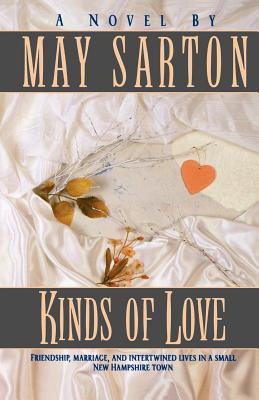 Christina and Cornelius Chapman have been “summer people,” visiting Willard, New Hampshire each summer for decades, but in the town’s bicentennial year they decide to commit to it full-time. They are seen as incomers by the tough mountain people, but Cornelius’s stroke and their adjustments to his disability and older age have given them the resilience to make it through a hard winter. Sarton lovingly builds up pictures of the townsfolk: Ellen Comstock, Christina’s gruff friend; Nick, Ellen’s mentally troubled son, who’s committed to protecting the local flora and fauna; Jane Tuttle, an ancient botanist; and so on. Willard is clearly a version of Sarton’s beloved Nelson, NH. She’s exploring love for the land as well as love between romantic partners and within families.
It’s a meandering novel pleasant for its atmosphere and its working out of philosophies of life through conversation and rumination, but Part Three, “A Stranger Comes to Willard,” feels like a misstep. A college dropout turns up at Ellen’s door after his car turns over in a blizzard. Before he’s drafted into the Vietnam War, he has time to fall in love with Christina’s 15-year-old granddaughter, Cathy. There may only be a few years between the teens, but this still didn’t sit well with me.
I liked how each third-person omniscient chapter ends with a passage from Christina’s journal, making things personal and echoing the sort of self-reflective writing for which Sarton became most famous. The book could have been closer to 300 pages instead of over 460, though.
The Dearly Beloved by Cara Wall (2019)
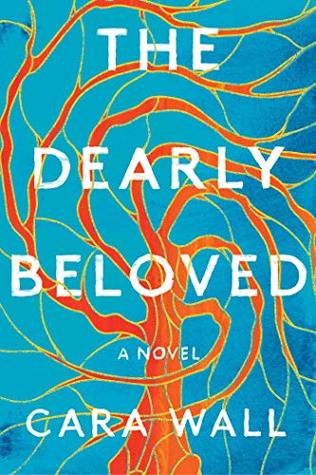 An elegant debut novel about two couples thrown together in 1960s New York City when the men are hired as co-pastors of a floundering Presbyterian church. Nearly the first half is devoted to the four main characters’ backstories and how each couple met. It’s a slow, subtle, quiet story (so much so that I only read the first half and skimmed the second), and I kept getting Charles and James, and Lily and Nan confused.
So here’s the shorthand: Charles is the son of an atheist Harvard professor and plans to study history until a lecture gets him thinking seriously about faith. Lily has closed herself off to life since she lost her parents in a car accident; though she eventually accedes to Charles’s romantic advances, she warns him she won’t bend where it comes to religion. James grew up in a poor Chicago household with an alcoholic father, while Nan is a Southern preacher’s daughter who goes up to Illinois to study music at Wheaton.
James doesn’t have a calling per se, but is passionate about social justice. As co-pastor, his focus will be on outreach and community service, while Charles’s will be on traditional teaching and ministry duties. Nan is desperate for a baby but keeps having miscarriages; Lily has twins, one of whom is autistic (early days for that diagnosis; doctors thought the baby should be institutionalized). Although Lily remains prickly, Nan and James’s friendship is a lifeline for them. The “dearly beloved” term thus applies outside of marriage as well, encompassing all the ties that sustain us – in the last line, Lily thinks, “these friends would forever be her stitches, her scaffold, her ballast, her home.”
 Bookish Beck = Rebecca Foster. American transplant to England. Freelance proofreader and book reviewer.
 Bookish Beck