Three on a Theme for Mother’s Day: Baker, Diski and Sampson
It’s Mothering Sunday in the UK today, so, like last year, I’m featuring three very different books about mothers and motherhood: a memoir, a novel and a poetry anthology. There are complex emotions at play in the first two due to grief, abuse and disability. The poems are cheerier (thankfully) and reflect on the experience of motherhood but also of being mothered. On that last point, I’ve added my response to a relevant short story I happened to read today.
Reading My Mother Back: A memoir in childhood animal stories by Timothy C. Baker (2022)
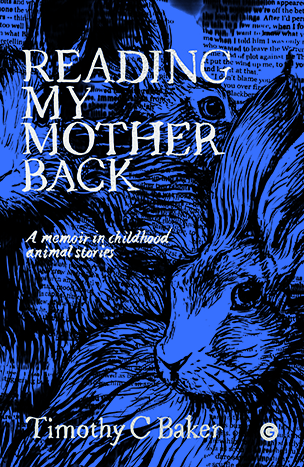 Baker is a lecturer in Scottish literature at the University of Aberdeen. His first non-academic publication is a curiously beguiling novella-length reappraisal of favourite children’s books. “To misquote Heraclitus, you cannot read the same book twice.” While he’s sheepish about including so many 19th- and early-20th-century white male authors, he can’t do otherwise as these are the texts that first taught him about death, loneliness and friendship: Charlotte’s Web, The Wind in the Willows, The Magician’s Nephew and Watership Down. (Also The Secret Garden.) Baker grew up in Maryland and Vermont, lonesome and closeted, with parents who briefly joined a cult. In his memory, his mother (who had been abused) always suffered with chronic illness and pain. In each chapter, he weaves together a discussion of a plot with stories from his early life and critical opinion on the value of rereading. It helped that I was familiar with six of the nine books Baker features (and others by Gallico, though not The Man Who Was Magic); I’d not even heard of Merle the High Flying Squirrel or The Book of the Dun Cow.
I spotted this in the Wigtown Festival Shop* on our 2023 visit to Scotland’s Book Town and could hardly believe it existed because it seemed so perfectly suited to me: I loved animal books, especially Watership Down, as a child; I’ll read any bereavement memoir going; I grew up 30 miles from Baltimore, where Baker spent his early life; he and I both had strict religious upbringings; and his mother experienced kidney failure (after eating a foxglove??), a link to my family’s history of kidney disease. There are plentiful differences, too, of course, but Baker emphasises connection. “If reading these books has taught me anything,” he concludes, “it is that all of my stories are individual, and all of them are universal. What we share is the unshareability of our grief … [but also] the joy of knowing that we have loved.” And for such a seemingly niche book (from Goldsmiths Press), I have actually found myself mentioning it to two blogger friends in recent days, so that’s proof he was right. 
[*As to how the book finally came into my possession: I added it to my wishlist and an acquaintance (a former mayor of Newbury, in fact) bought it for me for my 40th birthday. However, he forgot to bring the gift to our joint party and it took another 2+ years to extract it from him – through explicit reminders when we invited him to join us on a quiz team.]
Like Mother by Jenny Diski (1988)
I’ve enjoyed the late Jenny Diski’s travel memoirs (Skating to Antarctica and Stranger on a Train) and essays (On Trying to Keep Still). This novella was my first taste of her fiction and, while it’s dark as hell, I admired the psychological acuity and playfulness with narration. Occasional chapters introduce a dialogue between Nony and an imaginary interlocutor whose role is to listen to the story of her mother, Frances, a former dancer. That family history is the substance of the rest of the book, which is in an omniscient third person. The artificiality of the setup is blatant, though; Nony can neither think nor speak, having been born without a brain (hydranencephaly). Nony’s full name is thus Frances’s cruel joke.
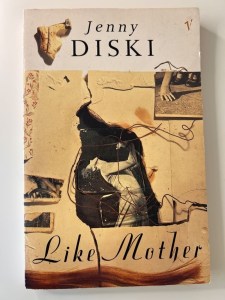
By necessity, the story stretches back to Frances’s parents, Ivy and Gerald, whose postwar optimism soon ceded to the reality of addiction, adultery and the attrition of love. A semiferal Frances escaped her unhappy home for the streets of London and engaged in sex play with Stuart on a bombsite. This went on for years. For Stuart, it blossomed into genuine love, but the numb Frances could never return his feelings and only used him. There are some really painful scenes here, such as Stuart stealing ether from the chemistry supply cupboard so she can huff herself into temporary oblivion, and a drunk Ivy molesting adolescent Frances. “Like mother, like daughter” is a bitter confirmation of inherited trauma. Nony might well be a symbolic manifestation of Frances’s desire to cultivate nothingness. To the extent that she is a literal baby – I’m really not sure – Frances does seem to love her and care for her physical needs, even as she’s grateful that the relationship will be short-lived.
Diski draws attention to the falsity of her narrative technique at the very end. It’s a disturbing yet intriguing novel that I think must be trying to make a wider point about postwar disillusionment. (Enough to make one question one’s growing antipathy towards Boomers?) I was reminded faintly of Nutshell by Ian McEwan, which is from the perspective of a fetus, and I Am Clarence by Elaine Kraf, a troubling story of a mentally ill mother and her disabled son. I have another novella plus a short story collection by Diski on the shelf, and I daresay after those I’ll have to seek out everything else she wrote. (University library) 
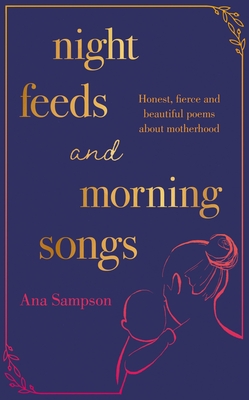
Night Feeds and Morning Songs, ed. Ana Sampson (2021)
“I crossed the border into the Republic of Motherhood
and found it a queendom, a wild queendom.”
~Liz Berry
It would have been easy to make such an anthology samey and sentimental, so kudos to Sampson for curating a solid mix of contemporary and period work. The poems are grouped into loose categories covering pregnancy, the sleepless nights of early motherhood, the power of womanly solidarity, the legacy (or absence) of one’s own mother, and the milestones of life as a child grows up and moves away. (Jackie Kay marvels that her baby boy is now a 6-foot-2 world traveller.) However, there are almost as many emotional approaches and poetic forms as there are contributors. Exhilaration meets exhaustion; guilt and grief threaten to overwhelm the good times. Sometimes the infant is addressed directly. The tone might be sombre, outraged or satirical. A few excerpts:
from “Labour Ward Prayer” by Vicky Thomas
Give us this day our daily miracle.
Exchange our offering of sweat and tears
and, most of all, of blood,
for new life, crumpled as a new leaf bud.
 from “The Visitor” by Idra Novey
…more dragon
than spaniel, more flammable
than fluid …
All wet mattress to my analysis,
he’s stayed the loudest and longest
of any houseguest
from “What My Kids Will Write about Me in Their Future Tell-All Book” by January Gill O’Neil
They will say that no was my favourite word,
More than stop, or eat, or love.
That some morning, I’d rather stay in bed,
laptop on lap, instead of making breakfast
…
They will say they have seen me naked.
Front side, back side – none of which
were my good side.
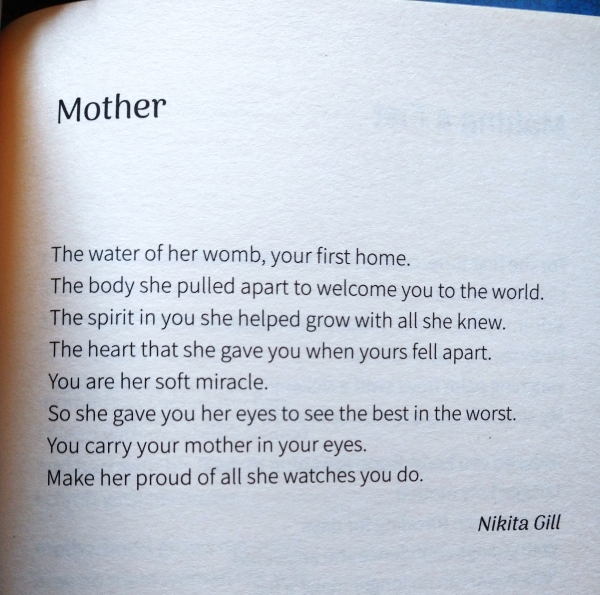
I enjoyed re-encountering work by some personal favourite poets such as Caroline Bird, though most entries were new to me. Sampson’s section introductions aren’t particularly illuminating and often reference poems that aren’t actually in the part in question. Some of the 19th-century and earlier material is quaintly twee, but I did love discovering Christina Rossetti’s “To My First Love, My Mother.” This is the poem that made me cry, though:
(Little Free Library)
And a bonus short story:
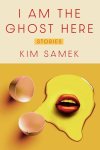 “Egg Mother” by Kim Samek (from I Am the Ghost Here): I’m two stories into Samek’s gently surreal collection. This second story combines the themes of parenting and grief prevalent above. Her openings are knockout: “At thirty-six I turn into a scrambled egg. It happens a few months after I give birth.” In therapy, the narrator discovers that she’s been repressing her grief over her mother, who died of cancer when the narrator was 13. The therapist suggests that she and her husband hold a joint ‘funeral’ for her mother and her younger self in a graveyard. But even after the ritual, she doesn’t return to herself. It’s a sobering but realistic message: some things one just doesn’t get over.
“Every story that I read becomes the story of my mother.”
~Timothy C. Baker
Last night, we saw Brooklyn expat singer-songwriter Annie Dressner (and Sean Duggan of Steady Habits) in concert at a church hall. I was mostly underwhelmed by her quirky confessional songs and little-girl voice, but a couple of songs stood out for me. One, “I Just Realized,” includes the line “And I hope that I can be just like my mother.”
Today was a more emotional day than I was expecting. I got a sweet posy from church, but having a whole service focussed on mothers and mothering was hard for me. I had to mostly switch off to get through it.
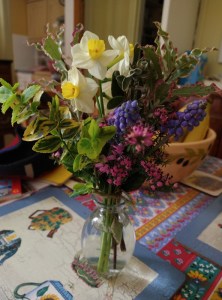
Just in my current stack, there are so many books about mothers or mothering…
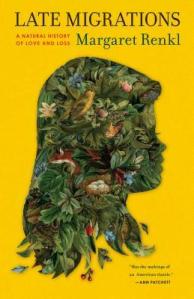 the loss of a mother (Eva Luna by Isabel Allende; The Memory of Borrowed Books by Meg Anderson; The Curious Incident of the Dog in the Night-Time by Mark Haddon; Late Migrations by Margaret Renkl; I Capture the Castle by Dodie Smith) – so common an element in novels that I have to think it’s shorthand for a character who has to pluckily rely on their own psychological resources
- mothers’ protective instinct (The Benefactors by Wendy Erskine)
- emotional distance from an unstable mother (Carrie by Stephen King; First Rain in Paradise by Gwyneth Lewis; Blonde by Joyce Carol Oates; The First Day of Spring by Nancy Tucker, which also includes the struggle to be a good mother in turn)
- mixed feelings about the inability to have a child (Mare by Emily Haworth-Booth)
- a mother’s grief at the loss of a child (Ordinary Saints by Niamh Ni Mhaoileoin)
I know it’s a subject I’ll be reading and thinking about for the rest of my life.
Carol Shields Prize Reads: Pale Shadows & All Fours
Later this evening, the Carol Shields Prize will be announced at a ceremony in Chicago. I’ve managed to read two more books from the shortlist: a sweet, delicate story about the women who guarded Emily Dickinson’s poems until their posthumous publication; and a sui generis work of autofiction that has become so much a part of popular culture that it hardly needs an introduction. Different as they are, they have themes of women’s achievements, creativity and desire in common – and so I would be happy to see either as the winner (more so than Liars, the other one I’ve read, even though that addresses similar issues). Both: 
Pale Shadows by Dominique Fortier (2022; 2024)
[Translated from French by Rhonda Mullins]
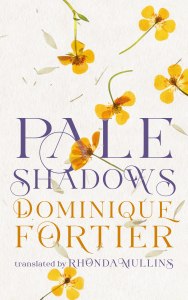 This is technically a sequel to Paper Houses, which is about Emily Dickinson, but I had no trouble reading this before its predecessor. In an Author’s Note at the end, Fortier explains how, during the first Covid summer, she was stalled on multiple fiction projects and realized that all she wanted was to return to Amherst, Massachusetts – even though her subject was now dead. The poet’s presence and language haunt the novel as the characters (which include the author) wrestle over her words. The central quartet comprises Lavinia, Emily’s sister; Susan, their brother Austin’s wife; Mabel, Austin’s mistress; and Millicent, Mabel’s young daughter. Mabel is to assist with editing the higgledy-piggledy folder of handwritten poems into a volume fit for publication. Thomas Higginson’s clear aim is to tame the poetry through standardized punctuation, assigned titles, and thematic groupings. But the women are determined to let Emily’s unruly genius shine through.
The short novel rotates through perspectives as the four collide and retreat. Susan and Millicent connect over books. Mabel considers this project her own chance at immortality. At age 54, Lavinia discovers that she’s no longer content with baking pies and embarks on a surprising love affair. And Millicent perceives and channels Emily’s ghost. The writing is gorgeous, full of snow metaphors and the sorts of images that turn up in Dickinson’s poetry. It’s a lovely tribute that mingles past and present in a subtle meditation on love and legacy.
Some favourite lines:
“Emily never writes about any one thing or from any one place; she writes from alongside love, from behind death, from inside the bird.”
“Maybe this is how you live a hundred lives without shattering everything; maybe it is by living in a hundred different texts. One life per poem.”
“What Mabel senses and Higginson still refuses to see is that Emily only ever wrote half a poem; the other half belongs to the reader, it is the voice that rises up in each person as a response. And it takes these two voices, the living and the dead, to make the poem whole.”
With thanks to The Carol Shields Prize Foundation for the free e-copy for review.
All Fours by Miranda July (2024)
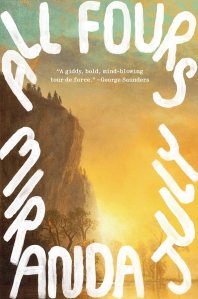 Miranda July’s The First Bad Man is one of the first books I ever reviewed on this blog back in 2015, after an unsolicited review copy came my way. It was so bizarre that I didn’t plan to ever read anything else by her, but I was drawn in by the hype machine and started this on my Kindle in September, later switching to a library copy when I got stuck at 65%. The narrator sets off on a road trip from Los Angeles to New York to prove to her husband, Harris, that she’s a Driver, not a Parker. But after 20 minutes she pulls off the highway and ends up at a roadside motel. She blows $20,000 on having her motel room decorated in the utmost luxury and falls for Davey, a younger man who works for a local car rental chain – and happens to be married to the decorator. In his free time, he’s a break dancer, so the narrator decides to choreograph a stunning dance to prove her love and capture his attention.
I got bogged down in the ridiculous details of the first two-thirds, as well as in the kinky stuff that goes on (with Davey, because neither of them is willing to technically cheat on a spouse; then with the women partners the narrator has after she and Harris decide on an open marriage). However, all throughout I had been highlighting profound lines; the novel is full to bursting with them (“maybe the road split between: a life spent longing vs. a life that was continually surprising”). I started to appreciate the story more when I thought of it as archetypal processing of women’s life experiences, including birth trauma, motherhood and perimenopause, and as an allegory for attaining an openness of outlook. What looks like an ending (of career, marriage, sexuality, etc.) doesn’t have to be.
Whereas July’s debut felt quirky for the sake of it, showing off with its deadpan raunchiness, I feel that here she is utterly in earnest. And, weird as the book may be, it works. It’s struck a chord with legions, especially middle-aged women. I remember seeing a Guardian headline about women who ditched their lives after reading All Fours. I don’t think I’ll follow suit, but I will recommend you read it and rethink what you want from life. It’s also on this year’s Women’s Prize shortlist. I suspect it’s too divisive to win either, but it certainly would be an edgy choice. (NetGalley/Public library)
(My full thoughts on both longlists are here.) The other two books on the Carol Shields Prize shortlist are River East, River West by Aube Rey Lescure and Code Noir by Canisia Lubrin, about which I know very little. In its first two years, the Prize was awarded to women of South Asian extraction. Somehow, I can’t see the jury choosing one of three white women when it could be a Black woman (Lubrin) instead. However, Liars and All Fours feel particularly zeitgeist-y. I would be disappointed if the former won because of its bitter tone, though Manguso is an undeniable talent. Pale Shadows? Pure literary loveliness, if evanescent. But honouring a translation would make a statement, too. I’ll find out in the morning!
20 Books of Summer, 5: A House Full of Daughters by Juliet Nicolson
Journalist and popular historian Juliet Nicolson is Vita Sackville-West’s granddaughter and one of the few remaining guardians of her living memory. This 2015 family memoir chronicles the lives of seven (eight, really) generations of women and travels from Malaga in the 1830s to present-day England. Nicolson acknowledges the inherited privilege that has typified this clan since the time of Vita’s grandmother but prefers to emphasize the roles that place and talent have played. It is enough of a biography of Vita to have won a Bisexual Book Award but, even though Vita only had sons, the focus is on mother–daughter bonds and how values and experiences have recurred across nearly two centuries.
First came Pepita, who rose from poverty in southern Spain to be a legendary dancer (“the Beyoncé of her day,” Nicolson quipped at an online event I attended – see below) and catch the eye of an English diplomat, Lionel Sackville-West, at a performance in Paris. Although Pepita was already married to her dancing teacher, she shook off her controlling mother and became Sackville-West’s longtime mistress, bearing him seven children. They could all have been disinherited for illegitimacy, however, had Pepita’s daughter Victoria not secured the link – and access to the family estate, Knole – by marrying her cousin, young Lionel Sackville-West. Vita wrote in Pepita, her joint biography of her mother and grandmother, “My mother appears to have been born with the faculty of attracting the most peculiar and improbable happenings,” such as a proposal of marriage from the recently widowed U.S. president, Chester Arthur, when she accompanied her father to Washington, DC.

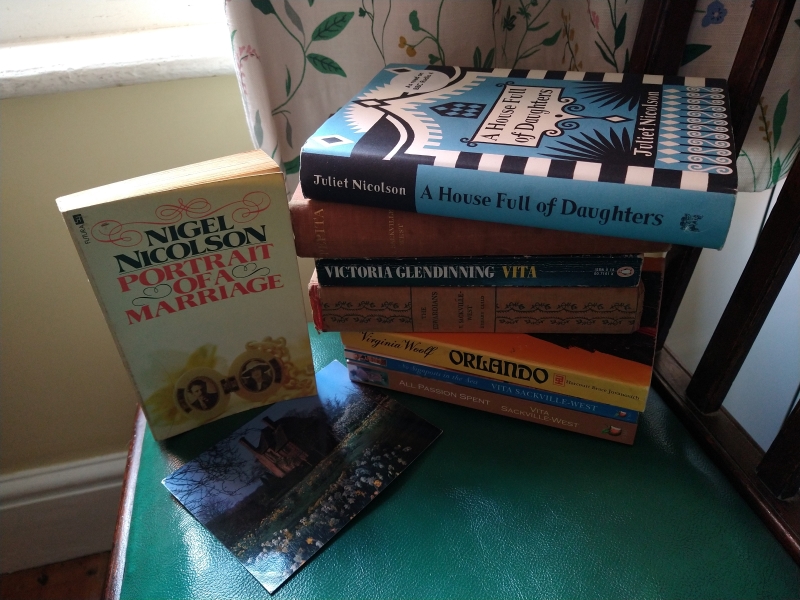
Vita is the book’s presiding spirit and pivot point, but I already knew a lot about her from reading Victoria Glendinning’s biography plus two of her novels, so this material was too familiar. The fact that we then leap from daughters to a daughter-in-law (Nicolson’s mother, Philippa Tennyson-d’Eyncourt – these figures are all posher than posh!) is unfortunate as it dilutes the theme. However, Nicolson gives a behind-the-scenes look at Sissinghurst and the marriages between Vita and Harold, loving but also a cover for same-sex relationships for both of them; and Nigel and Philippa, which was a disaster almost from the start. Nicolson is also brave to admit the alcoholism that she subconsciously received from her mother. Philippa died at 58, but by admitting she had a problem Nicolson was able to get help and turn things around. Two generations followed: her two daughters and one granddaughter, who is now 11.
Nicolson sees patterns repeating across the generations: emotional abandonment by parents, “the lack of confidence, the fear of failure, and the seeking of approval where there was none” as well as “writing about the life and work of an earlier generation.” She hopes that with this book she has marked the arrival of “an increasingly tolerant and accepting generation, one that is not afraid to learn from the mistakes of the past and is determined not to repeat them”. (Fun but unrelated fact: Penelope Fitzgerald was one of Nicolson’s teachers.)

On the staircase leading up to Vita’s study in the tower, September 2009.
I visited Sissinghurst in 2009 – I can’t believe I haven’t been back in the past 15 years – and when we briefly lived in Sevenoaks in 2012 we also went to Knole. Both are magical places, especially Sissinghurst. For a few years there I was on a kick of reading a lot by and about Vita (I can recommend No Signposts in the Sea) and I also absorbed a fair bit via Adam Nicolson’s books (that’s Juliet’s brother) and his wife Sarah Raven’s – her recipes are to die for, and she’s kept up the gardens in a way that would make Vita proud. So I’d say it probably helps to have an existing interest in the family, but it should be a reasonably engrossing read in any case. (Free from a neighbour)
Yesterday I watched “The Inspiration of Vita Sackville-West,” a recording of an RSL event held at the London Library in October that was aired to tie in with their annual Dalloway Day as well as the 95th anniversary of the publication of Virginia Woolf’s Orlando (for which Vita was a model) and, of course, Pride Month. The panelists were Juliet Nicolson; trans novelist Shola von Reinhold, whose LOTE (2020) won the Republic of Consciousness and James Tait Black Memorial Prizes; fashion critic Charlie Porter; and writer Olivia Laing. The discussion was expertly chaired by Shahidha Bari, an academic, fashion writer and presenter of BBC Two’s Inside Culture. She opened by asking each speaker to define Vita in one word. Nicolson chose “lover,” which von Reinhold echoed. Porter said “physical.” Laing cheated with a made-up compound word: “androgynous-aristocratic-aesthete.”
And the conversation went on from there. Nicolson spoke of her grandmother as a formidable woman, tall and tobacco-scented, and remembered the exotic treasures she and her siblings found in Vita’s tower study, such as a bottle of emerald-green nail polish. She described Vita as enigmatic and representing duality: she was born a Victorian but has been embraced by modernist and queer studies; she was conventional in some ways, but also a rebel. Porter has written about fashion and the Bloomsbury circle, with Woolf as one of his subjects, so he thinks about Vita mostly as a muse. He read from Vita’s letter to Harold describing meeting Woolf, whom she thought “quite old” and “atrociously dressed.” Nonetheless, she’d lost her heart. Woolf in her turn commented on Vita’s moustache, which was likely a sign of her Spanish heritage rather than excess testosterone as some have theorized.
For von Reinhold, Vita is an early example of androgyny, a precursor to today’s trans and nonbinary identities. Laing, who has recently published a book on gardening, focused on Vita as a garden writer and designer. She said she doesn’t really value Vita’s novels but thinks her garden books (collections of her Observer columns) are extraordinary and read a passage in which she dreamt up the famous White Garden she would create at Sissinghurst (I read a kinda crummy novel about it a few years ago, The White Garden by Stephanie Barron).
The event gave a very good sense of Vita as a person but not as a writer. Audience questions brought up her poetry (oh God, it’s awful!) and travel books but that was as far as it went, and there was no discussion of the novels. Nicolson mentioned Pepita in passing but mostly talked about Portrait of a Marriage, which was half written by Vita and then finished by Nigel, a publisher (he was half of Weidenfeld and Nicolson, aka W&N). He had the courage to reveal his mother’s sexuality and Nicolson said that she believes Vita’s legacy is courage – to create a garden from scratch as a self-taught amateur, yes; but mostly to be oneself.
Reading the Rathbones Folio Prize Poetry Shortlist
I borrowed the whole of this year’s Rathbones Folio Prize poetry shortlist from my local library and have enjoyed reading through it to see what the judges felt was worthy of recognition from 2022’s releases. Of course, personal taste comes into the appreciation of poetry, perhaps more so than for fiction or nonfiction, so I liked some of these more than others and suspect the judges’ final decision may differ from mine. Still, it’s always a pleasure to discover new-to-me poets and/or debut authors.
Ephemeron by Fiona Benson
 This is Benson’s third collection but my first time reading her. I was fully engaged with her exquisite poems about the ephemeral, whether that be insect lives, boarding school days, primal emotions or moments from her children’s early years. The book is in four discrete corresponding sections (“Insect Love Songs,” “Boarding-School Tales,” “Translations from the Pasiphaë” and “Daughter Mother”) but the themes and language bleed from one into another and the whole is shot through with astonishing corporeality and eroticism.
The form varies quite a lot – bitty lines, stanzas, blocky paragraph-like stories – and alliteration, slant rhymes and unexpected metaphors (a wasp’s nest as “a piñata of stings,” “this avant-garde chandelier” and an “electric hotel / of spit-balled papier mâché”) make each poem glisten. I’ll even let her off for the long section inspired by my pet hate, Greek mythology (so gruesome, so convoluted), because of how she uses these melodramatic situations to explore universal emotions. She does something interesting with the story of the Minotaur (Asterios), suggesting that instead of being born a literal bull he was born deformed or disabled and no one knew what to make of him, but even so he had a mother’s love. 
Here’s one section of “Magicicadas” as an example:
Warm rain
summons them up
through loam
like Lazarus
after seventeen years,
cases splitting
down their backs
emerging
like the wet head
of a baby,
wrestling out
of their tight old skin
arching back
like an orgasm,
like an ecstatic gymnast
on the high trapeze;
sap-green, bunker-pale,
their damp wings lemon
before they stiffen
and straighten, lattice brown.
Quiet by Victoria Adukwei Bulley
 Protest doesn’t have to be loud; sometimes it can even be silent. In her debut, Bulley, a British-born Ghanaian poet, makes that especially clear with the pair “[ ] noise” (= white noise, inescapable) and “black noise” (an erasure poem). She models how language might be decolonized (particularly in “revision”) and how Black femininity might be reimagined (“fabula”). Along with her acknowledged debts to Lucille Clifton, bell hooks, Mary Oliver et al., I spotted echoes of Kei Miller (her “there is dark that moves” sounds like his “there is an anger that moves”) and Toni Morrison (Bulley includes the line “Quiet as it’s kept,” which is the opening of The Bluest Eye).
The collection is bold but never heavy-handed, and the seriousness of its topics (also including an early miscarriage) is lightened by poems about cats and snails. My two favourites were “not quiet as in quiet but,” which juxtaposes peacefulness and the comfortable life with the perils of not speaking out about injustice; and “Epigenetic,” about generations of traumatized bodies (“if your pain is alive in me / so too must be your joy.”). 
Cane, Corn & Gully by Safiya Kamaria Kinshasa
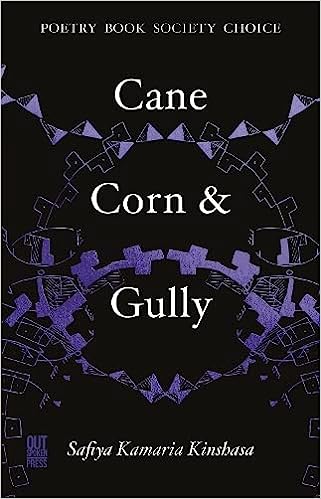 Kinshasa is also a dancer, and in her debut the British-born Barbadian intersperses poems with choreographed dances, transcribed via hand-drawn symbols explained in a key at the end. I confess I couldn’t picture them at all, though they make attractive patterns on the page – you can see one in purple on the cover. This and the Caribbean patois in which she voices narratives of historical atrocities and contemporary microaggressions against Black people (particularly women) are the collection’s claims to novelty and probably impressed the judges. Yet I found both strategies to be affected and looked forward to those poems in standard language. Some of the events are given specific dates and places in Barbados while others are more generic. Female victims of sexual oppression seek revenge, as in the gruesome “Miss Barbados Is No Longer Vegan.” This probably works best aloud, to allow one to appreciate the musicality of the voice and the alliterative lines.
Some lines I liked:
we gambled all our wishes on dandelions,
now we celebrate de little tings
every unburnt rice grain & regrown eyelash
vaulting between lemon vines and dog friendly cafés.
just because we do what needs to be done,
it doan mean we nah ready, we just aware
there are too many of us to be martyrs
(from “Sometimes Death Is a Child Who Plays With Rubber Bands”)
The work is dangerous; writing into history is like feeding unknown seeds while attempting to control the rate of their growth. Sometimes when I danced, I inhaled the language of my ancestors’ captors, and they became mine.
(from “Preface: And if by Some Miracle”)
if you want something to become extinct
doan give it attention.
(from “Choreography: She, My Nation”)
England’s Green by Zaffar Kunial
 A collection in praise of the country’s natural and cultural heritage, with poems about hedgerows and butterflies; cricket and the writings of the Brontë sisters. There are autobiographical reminiscences as well, most notably “The Crucible,” which describes the meeting between his Kashmiri father and his English mother’s father, who had refused to acknowledge the relationship for its first three years.
Kunial clearly delights in language, with wordplay and differing pronunciations fuelling “Foregrounds” et al. I particularly liked “Foxgloves” (“Sometimes I like to hide in the word / foxgloves – in the middle of foxgloves. The xgl is hard to say”) and “The Wind in the Willows,” where he wonders if the book title appeals to him just for its sound. This wasn’t as immediately cohesive and impressive as his first book, Us, but still well worth reading. 
Some favourite lines:
“Prayer is not the words / but having none and staying” (from “Empty Words”)
“Life // is wider than its page. And days are a cut field, clipped and made to run on” (from “The Groundsman”)
Manorism by Yomi Sode
Like Surge or Poor (or what little I read of Citizen), this is driven by outrage and a longing for justice for Black people. I suspect that, like those precursors, it is a book best heard in performance, given that Sode honed his skills on London’s open mic circuit.
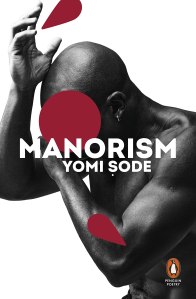 The first third of the book is under the heading “Aneephya,” a word Sode coined and defines as “the stress toxin of inherited trauma” – from slave ships to police checks. My two favourites were from this section: “L’Appel du Vide,” in which he ponders microaggressions while cooking a traditional West African mackerel and okra stew; and “A Plate of Artichokes,” about the time a waiter made him pre-pay for his meal and he went along with it even though he suspected other customers weren’t being asked to do the same.
Nigerian culture, rap music, being a father, and Black brotherhood are other themes, with recurring allusions to the work of Caravaggio. I also liked the long section on the decline and death of his great-aunt (“Big Mummy”) from cancer.
This was a book that made me feel super-white, but that’s not a problem: I can recognize its importance and appeal while also accepting that it’s not necessarily supposed to be for me. 
Which of these poetry collections interest you?
 Bookish Beck = Rebecca Foster. American transplant to England. Freelance proofreader and book reviewer.
 Bookish Beck