20 Books of Summer, 12–13: Strange Weather in Tokyo (#WITMonth) & Mitz
Two terrific novellas I’m belatedly writing up today, one my first selection for Women in Translation month and the other a contribution to Virago’s “Summer of Sigrid.” Both: 
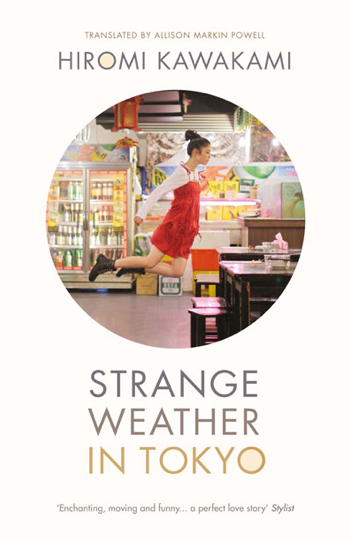
Strange Weather in Tokyo by Hiromi Kawakami (2001; 2012)
[Translated from Japanese by Allison Markin Powell]
 Tsukiko is a lonely barfly in her late thirties when she bumps into her secondary school Japanese teacher, Harutsuna Matsumoto, again. She calls him simply “Sensei,” and they start meeting up for low-key adventures: sharing tofu and saké at Satoru’s bar, marking annual holidays, and leaving the city to forage for mushrooms and visit his late wife’s island grave. Sensei quotes poetry and, ever the teacher, gently corrects his former pupil’s language. Tsukiko is an impassive young woman who never seemed to grow up (“I … still might not be considered a proper adult. … I just wasn’t able to ally myself with time”) and is prone to drinking too much, but finally starts to get a grip on her emotions thanks to this new connection.
Each chapter is discrete, building into a linked short story collection. The erratic (non)use of speech marks somehow didn’t bother me as it seems to suit Tsukiko’s slight disorientation. Kawakami infuses the book with attention to the seasons’ changes and everyday sensual pleasures like food. A drunk at the bar speaks for us readers when he asks the main characters, “You two, just what are you?” The nature of their bond is hard to pin down. Tsukiko is also courted by Kojima, a more age-appropriate boyfriend, but she feels nothing for him. Instead, a May–December relationship unfolds like cherry blossom, ever so gradually, from friendship into something deeper. Powell manages to fit some wordplay into her translation, as in this gently erotic passage:
At some point, sitting beside Sensei, I began to notice the heat that radiated from his body. Through his starched shirt, there came a sense of Sensei. A feeling of nostalgia. This sense of Sensei retained the shape of him. It was dignified, yet tender, like Sensei.
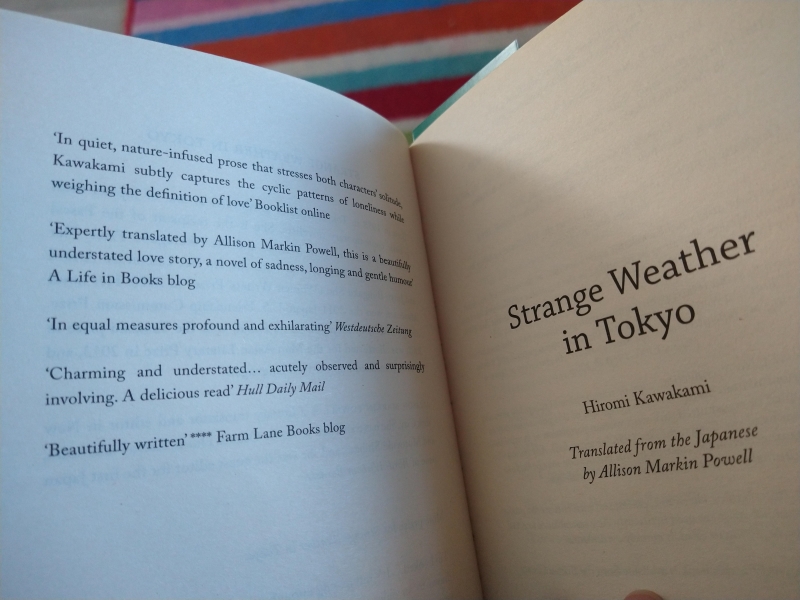
From the title and cover image, I might have expected the magic realism so common to Japanese literature, but this is something different: a lovely, subtle romance. It’s a reminder that it doesn’t have to be torrid passion to be true love. “Even a chance meeting is the result of a karmic connection,” as Sensei quotes. Susan (A life in books), whose review is excerpted in my paperback copy, is quite right. Kawakami was a great new discovery and I’ve got my eye on several more of her books: The Nakano Thrift Shop from the library and Record of a Night Too Brief and Far from Everywhere (forthcoming in February) on my e-reader. (Secondhand – Community Furniture Project, Newbury)
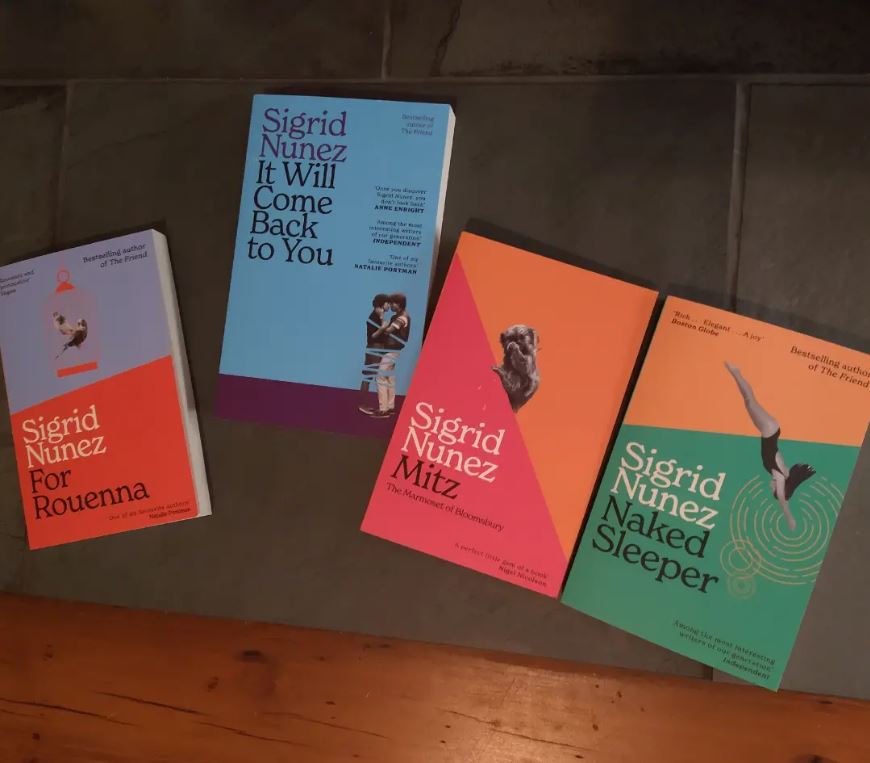
Mitz: The Marmoset of Bloomsbury by Sigrid Nunez (1998)
 What a fun little book from Nunez’s back catalogue! On the one hand, a fictional mini-biography of the Woolfs by way of their pet marmoset might seem like a random choice of topic; on the other hand, you can see the seeds of her future autofiction in which human–animal connection is a starting point for wide-ranging meditations on life and death (a dog in The Friend; a parrot in The Vulnerables; and even, to a lesser extent, the cat in What Are You Going Through).
Mitz is a small monkey who induces strong, conflicting reactions: “You looked at her and thought, How grotesque. And the very next instant, How adorable. And then, How grotesque, again.” She takes a shine to Leonard on a visit the Woolfs pay to their friends the Rothschilds in 1934, and before long they’ve offered to take Mitz home to share their London and Sussex life, along with Pinka and Sally, the spaniels they had in succession. Mitz’s favourite spot thereafter was sat on Leonard’s shoulders, or napping on his feet. She accompanied the couple on their travels, too, so distracting people in Germany that Virginia would write in a letter that “the marmoset saved us from Hitler” (Leonard was Jewish). Visitors were less enamoured, thinking Mitz dirty and bad-tempered.
In any case, the creature was a lucky accessory to genius, and Nunez makes her our eyewitness to the composition of works such as Roger Fry and The Years:
From a distance, then, Mitz observed Virginia. And she saw how this mysterious activity that could bring such a flush to Virginia’s cheek could also have quite the opposite effect: Virginia was as white as her own writing paper. She scribbled and slashed; she muttered and she groaned and she cursed. She jumped up from the chair and wandered in circles about the room.
How much Mitz understands of ageing, death, and conflict, can never be known. These were tumultuous pre-war years, during which Virginia lost a nephew and fascism loomed large. Nunez sets personal cataclysms against international ones, imagining Mitz’s journey from a Brazilian forest, via a hellish ship, to the London junk shop where she was made to sit in a draughty window to drum up business. That she spent her last five years so loved and cosseted was a stroke of good fortune. Her death ends up feeling like a more general omen, as in the book’s final line: “It was Christmas Day, the last year of peace.”
I was reminded of the complications of keeping an exotic pet in My Animals and Other Family by Julia Blackburn, in which she buys Congo the bushbaby from Harrods (and there is also a family spaniel). As part of the backmatter of this reissue, a thank-you letter from Nigel Nicolson to Nunez and a 2019 afterword by Peter Cameron note the undeniable inspiration of Virginia Woolf’s Flush, a playful short biography of Elizabeth Barrett Browning’s cocker spaniel (for whom Pinka, a gift from Vita Sackville-West, was a model). I fancied rereading Flush so have picked that up as one of my substitute Books of Summer and am enjoying discovering the connections between it and Mitz. More anon.
With thanks to Virago for the free copy for review, one of several matching reissues they sent me as part of their “Summer of Sigrid.”
20 Books of Summer, 5: A House Full of Daughters by Juliet Nicolson
Journalist and popular historian Juliet Nicolson is Vita Sackville-West’s granddaughter and one of the few remaining guardians of her living memory. This 2015 family memoir chronicles the lives of seven (eight, really) generations of women and travels from Malaga in the 1830s to present-day England. Nicolson acknowledges the inherited privilege that has typified this clan since the time of Vita’s grandmother but prefers to emphasize the roles that place and talent have played. It is enough of a biography of Vita to have won a Bisexual Book Award but, even though Vita only had sons, the focus is on mother–daughter bonds and how values and experiences have recurred across nearly two centuries.
First came Pepita, who rose from poverty in southern Spain to be a legendary dancer (“the Beyoncé of her day,” Nicolson quipped at an online event I attended – see below) and catch the eye of an English diplomat, Lionel Sackville-West, at a performance in Paris. Although Pepita was already married to her dancing teacher, she shook off her controlling mother and became Sackville-West’s longtime mistress, bearing him seven children. They could all have been disinherited for illegitimacy, however, had Pepita’s daughter Victoria not secured the link – and access to the family estate, Knole – by marrying her cousin, young Lionel Sackville-West. Vita wrote in Pepita, her joint biography of her mother and grandmother, “My mother appears to have been born with the faculty of attracting the most peculiar and improbable happenings,” such as a proposal of marriage from the recently widowed U.S. president, Chester Arthur, when she accompanied her father to Washington, DC.

Vita is the book’s presiding spirit and pivot point, but I already knew a lot about her from reading Victoria Glendinning’s biography plus two of her novels, so this material was too familiar. The fact that we then leap from daughters to a daughter-in-law (Nicolson’s mother, Philippa Tennyson-d’Eyncourt – these figures are all posher than posh!) is unfortunate as it dilutes the theme. However, Nicolson gives a behind-the-scenes look at Sissinghurst and the marriages between Vita and Harold, loving but also a cover for same-sex relationships for both of them; and Nigel and Philippa, which was a disaster almost from the start. Nicolson is also brave to admit the alcoholism that she subconsciously received from her mother. Philippa died at 58, but by admitting she had a problem Nicolson was able to get help and turn things around. Two generations followed: her two daughters and one granddaughter, who is now 11.
Nicolson sees patterns repeating across the generations: emotional abandonment by parents, “the lack of confidence, the fear of failure, and the seeking of approval where there was none” as well as “writing about the life and work of an earlier generation.” She hopes that with this book she has marked the arrival of “an increasingly tolerant and accepting generation, one that is not afraid to learn from the mistakes of the past and is determined not to repeat them”. (Fun but unrelated fact: Penelope Fitzgerald was one of Nicolson’s teachers.)

On the staircase leading up to Vita’s study in the tower, September 2009.
I visited Sissinghurst in 2009 – I can’t believe I haven’t been back in the past 15 years – and when we briefly lived in Sevenoaks in 2012 we also went to Knole. Both are magical places, especially Sissinghurst. For a few years there I was on a kick of reading a lot by and about Vita (I can recommend No Signposts in the Sea) and I also absorbed a fair bit via Adam Nicolson’s books (that’s Juliet’s brother) and his wife Sarah Raven’s – her recipes are to die for, and she’s kept up the gardens in a way that would make Vita proud. So I’d say it probably helps to have an existing interest in the family, but it should be a reasonably engrossing read in any case. (Free from a neighbour) 
Yesterday I watched “The Inspiration of Vita Sackville-West,” a recording of an RSL event held at the London Library in October that was aired to tie in with their annual Dalloway Day as well as the 95th anniversary of the publication of Virginia Woolf’s Orlando (for which Vita was a model) and, of course, Pride Month. The panelists were Juliet Nicolson; trans novelist Shola von Reinhold, whose LOTE (2020) won the Republic of Consciousness and James Tait Black Memorial Prizes; fashion critic Charlie Porter; and writer Olivia Laing. The discussion was expertly chaired by Shahidha Bari, an academic, fashion writer and presenter of BBC Two’s Inside Culture. She opened by asking each speaker to define Vita in one word. Nicolson chose “lover,” which von Reinhold echoed. Porter said “physical.” Laing cheated with a made-up compound word: “androgynous-aristocratic-aesthete.”
And the conversation went on from there. Nicolson spoke of her grandmother as a formidable woman, tall and tobacco-scented, and remembered the exotic treasures she and her siblings found in Vita’s tower study, such as a bottle of emerald-green nail polish. She described Vita as enigmatic and representing duality: she was born a Victorian but has been embraced by modernist and queer studies; she was conventional in some ways, but also a rebel. Porter has written about fashion and the Bloomsbury circle, with Woolf as one of his subjects, so he thinks about Vita mostly as a muse. He read from Vita’s letter to Harold describing meeting Woolf, whom she thought “quite old” and “atrociously dressed.” Nonetheless, she’d lost her heart. Woolf in her turn commented on Vita’s moustache, which was likely a sign of her Spanish heritage rather than excess testosterone as some have theorized.
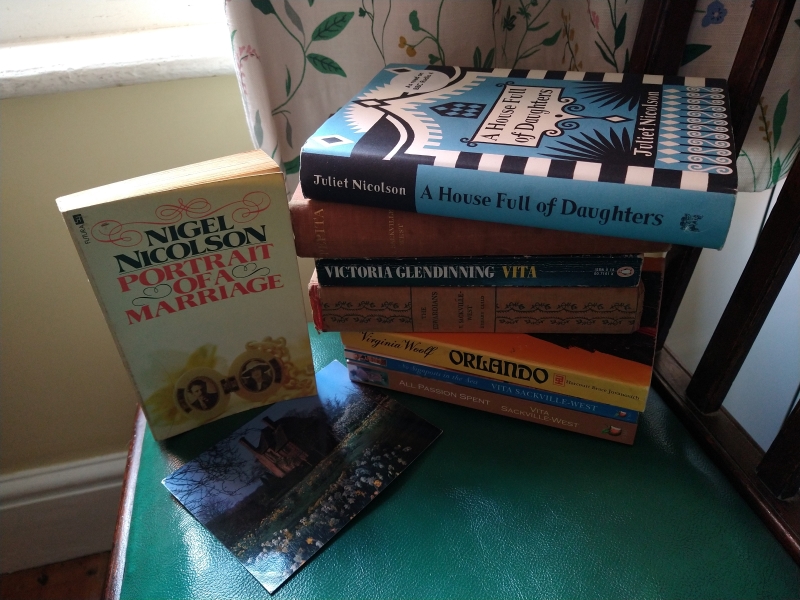
For von Reinhold, Vita is an early example of androgyny, a precursor to today’s trans and nonbinary identities. Laing, who has recently published a book on gardening, focused on Vita as a garden writer and designer. She said she doesn’t really value Vita’s novels but thinks her garden books (collections of her Observer columns) are extraordinary and read a passage in which she dreamt up the famous White Garden she would create at Sissinghurst (I read a kinda crummy novel about it a few years ago, The White Garden by Stephanie Barron).
The event gave a very good sense of Vita as a person but not as a writer. Audience questions brought up her poetry (oh God, it’s awful!) and travel books but that was as far as it went, and there was no discussion of the novels. Nicolson mentioned Pepita in passing but mostly talked about Portrait of a Marriage, which was half written by Vita and then finished by Nigel, a publisher (he was half of Weidenfeld and Nicolson, aka W&N). He had the courage to reveal his mother’s sexuality and Nicolson said that she believes Vita’s legacy is courage – to create a garden from scratch as a self-taught amateur, yes; but mostly to be oneself.
 Bookish Beck = Rebecca Foster. American transplant to England. Freelance proofreader and book reviewer.
