Best Books from 2023
Keeping it simple again this year with one post covering all genres: the 24 (or, actually 26) current-year releases that stood out the most for me. (No rankings; anything from my Best of First Half that didn’t make it through can be considered a runner-up, along with The Librarianist.)


Fiction
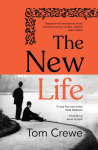 The New Life by Tom Crewe: Two 1890s English sex researchers (based on John Addington Symonds and Havelock Ellis) write a book called Sexual Inversion drawing on ancient Greek history and containing case studies of homosexual behaviour. Oscar Wilde’s trial puts everyone on edge; not long afterwards, their own book becomes the subject of an obscenity trial, and each man has to decide what he’s willing to give up in devotion to his principles. This is deeply, frankly erotic stuff, and, on the sentence level, just exquisite writing.
 The Vaster Wilds by Lauren Groff: Groff’s fifth novel combines visceral detail and magisterial sweep as it chronicles a runaway Jamestown servant’s struggle to endure the winter of 1610. Flashbacks to traumatic events seep into her mind as she copes with the harsh reality of life in the wilderness. The style is archaic and postmodern all at once. Evocative and affecting – and as brutal as anything Cormac McCarthy wrote. A potent, timely fable as much as a historical novel.
Counting as one this thematic trio of women’s true crime pastiches; I liked the Makkai best.
Penance by Eliza Clark: A compelling account of teenage feuds and bullying that went too far and ended in murder. It’s a pretty gruesome crime, but memorable, not least because it coincided with the day of the Brexit vote. I loved Clark’s portrait of Crow-on-Sea, a down-at-heel seaside town near Scarborough, and the depth of character that comes through via interviews and documents. She also nails teenage dialogue and social media use, podcasts, true crime obsession and so on.


 Bright Young Women by Jessica Knoll: An engrossing story of a Type A sorority president whose perfect life goes askew when a serial killer targets the house and kills two of her friends. She and the domestic partner of one of his previous victims are determined to see “the Defendant” brought to justice. 1970s Florida/Washington were interesting settings, and I liked the focus on the victims. The judge in the Defendant’s case lamented that such a bright young man would come to grief; think of the bright young women he extinguished instead.
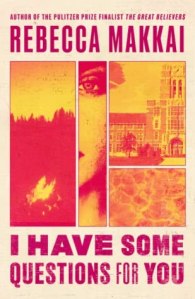
I Have Some Questions for You by Rebecca Makkai: When an invitation comes from her boarding school alma mater, Granby, to teach a two-week course on podcasting, Bodie indulges her obsession with the 1995 murder of her former roommate. Makkai has taken her cues from the true crime genre and constructed a convincing mesh of evidence and theories. She so carefully crafts her pen portraits, and so intimately involves us in Bodie’s psyche, that it’s impossible not to get invested. This is timely, daring, intelligent, enthralling storytelling.
 Sidle Creek by Jolene McIlwain: In this debut collection of 22 short stories, loosely linked by their location in the Appalachian hills in western Pennsylvania and a couple of recurring minor characters, McIlwain softens the harsh realities of addiction, poverty and violence with the tender bruises of infertility and lost love. Grief is a resonant theme in many of the stories, with pregnancy or infant loss a recurring element. At times harrowing, always clear-eyed, these stories are true to life and compassionate about human foibles and animal pain.
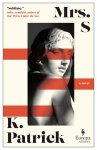 Mrs S by K Patrick: Patrick’s unnamed narrator is an early-twenties Australian butch lesbian who has come to England to be a matron at a girls’ boarding school. Mrs S is the headmaster’s wife, perhaps 20 years her senior. A heat wave gives a sultry atmosphere as hints of attraction between them give way to explicit scenes. Summer romances never last, but their intensity is legendary, and this feels like an instant standard. Not your average coming-of-age story, seduction narrative or cougar stereotype. It’s a new queer classic.
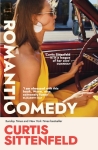 Romantic Comedy by Curtis Sittenfeld: Through her work as a writer for a sketch comedy show modelled on Saturday Night Live, Sally Milz meets Noah Brewster, a pop star with surfer-boy good looks. Plain Jane getting the hot guy – that never happens, right? In fact, Sally has a theory about this very dilemma… As always, Sittenfeld’s inhabiting of a first-person narrator is flawless, and Sally’s backstory and Covid-lockdown existence endeared her to me. Could this be called predictable? Well, what does one want from a romcom?
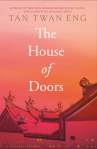 The House of Doors by Tan Twan Eng: In 1921, “Willie” Somerset Maugham and his secretary/lover, Gerald, stay with old friends Robert and Lesley Hamlyn in Penang, Malaysia. Willie’s marriage is floundering and he faces financial ruin. He needs a story that will sell and gets one when Lesley starts recounting the momentous events of 1910: volunteering at the party office of Dr Sun Yat Sen and trying to save her friend from a murder charge. Tan weaves it all into a Maugham-esque plot with sumptuous scene-setting and atmosphere.
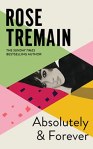 Absolutely and Forever by Rose Tremain: At age 15, Marianne falls in love. She imagines her romance with Simon as a grand adventure (and escape from her parents’ ordinariness), but his post-school life in Paris doesn’t have room for her. Much changes over the next 15 years, but never her attachment to her first love. This has the chic, convincing 1960s setting of Tessa Hadley’s work, and Marianne’s droll narration is a delight. It put me through an emotional wringer – no cheap tear-jerker but a tender depiction of love in all its forms.
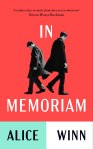 In Memoriam by Alice Winn: Heartstopper on the Western Front; swoon! Will Sidney Ellwood and Henry Gaunt both acknowledge that this is love and not just sex, as it is for so many teenage boys at their English boarding school? And will one or both survive the trenches of the First World War? Winn depicts the full horror of war, but in between there is banter, friendship and poetry. Some moments are downright jolly. This debut is obsessively researched, but Winn has a light touch with it. Engaging, thrilling, and, yes, romantic.
Nonfiction
 All My Wild Mothers by Victoria Bennett: A lovely memoir about grief and gardening, caring for an ill child and a dying parent. The book is composed of dozens of brief autobiographical, present-tense essays, each titled after a wildflower with traditional healing properties. The format realistically presents bereavement and caring as ongoing, cyclical challenges rather than one-time events. Sitting somewhere between creative nonfiction and nature essays, it’s a beautiful read for any fan of women’s life writing.
 Monsters by Claire Dederer: The question posed by this hybrid work of memoir and cultural criticism is “Are we still allowed to enjoy the art made by horrible people?” It begins, in the wake of #MeToo, by reassessing the work of film directors Roman Polanski and Woody Allen. The book is as compassionate as it is incisive. While there is plenty of outrage, there is also much nuance. Dederer’s prose is forthright and funny; lucid even when tackling thorny issues. Erudite, empathetic and engaging from start to finish.
 Womb by Leah Hazard: A wide-ranging and accessible study of the uterus, this casts a feminist eye over history and future alike. Blending medical knowledge and cultural commentary, it cannot fail to have both personal and political significance for readers of any gender. The thematic structure of the chapters also functions as a roughly chronological tour of how life with a uterus might proceed: menstruation, conception, pregnancy, labour, caesarean section, ongoing health issues, menopause. Inclusive and respectful of diversity.
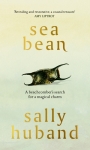 Sea Bean by Sally Huband: Stories of motherhood, the quest to find effective treatment in a patriarchal medical system, volunteer citizen science projects, and studying Shetland’s history and customs mingle in a fascinating way. Huband travels around the archipelago and further afield, finding vibrant beachcombing cultures. In many ways, this is about coming to terms with loss, and the author presents the facts about climate crisis with sombre determination. She writes with such poetic tenderness in this radiant debut memoir.
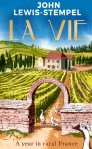 La Vie by John Lewis-Stempel: The author has written much about his Herefordshire haunts, but he’s now relocated permanently to southwest France (La Roche, in the Charente). He proudly calls himself a peasant farmer, growing what he can and bartering for much of the rest. La Vie chronicles a year in his quest to become self-sufficient. It opens one January and continues through the December, an occasional diary with recipes. It’s a peaceful, comforting read that’s attuned to the seasons and the land. Lewis-Stempel’s best book in an age.
 All of Us Together in the End by Matthew Vollmer: In 2019, Vollmer’s mother died of complications of Alzheimer’s and Parkinson’s. Months later, his father reported blinking lights in the woods near the family cemetery. Although Vollmer had left the Seventh-Day Adventist Church in college, his religious upbringing influenced his investigation, which overlapped with COVID-19. Grief, mysticism, and acceptance of the unexplained are resonant themes. An unforgettable record of “a collision with the ineffable.”
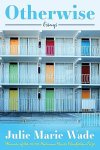 Otherwise by Julie Marie Wade: Nine intricate autobiographical essays reflect on risk, bodily autonomy, and poetry versus prose. A series of meditations composed across Wade’s thirties arranges snapshots of her growing frustration with gendered stereotypes. In particular, she interrogates her rosy childhood notions of marriage. As she explored feminism and accepted her lesbian identity—though not before leaving a man at the altar—she found ways to be “a secular humanist by day and a hopeless romantic by night.” Superb.
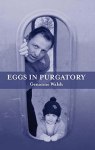 Eggs in Purgatory by Genanne Walsh: This autobiographical essay tells the story of the last few months of her father’s life. Aged 89, he lived downstairs from Walsh and her wife in San Francisco. He was quite the character: idealist, stubborn, outspoken; a former Catholic priest. Although he had no terminal conditions, he was sick of old age and its indignities and ready to exit. The task of a memoir is to fully mine the personal details of a situation but make of it something universal, and that’s just what she does here. Stunning.
Poetry
 More Sky by Joe Carrick-Varty: In this debut collection, the fact of his alcoholic father’s suicide is inescapable. The poet alternates between an intimate “you” address and third-person scenarios, auditioning coping mechanisms. His frame of reference is wide: football, rappers, Buddhist cosmology. The word “suicide” itself is repeated to the point where it becomes just a sibilant collection of syllables. The tone is often bitter, as is to be expected, but there is joy in the deft use of language.
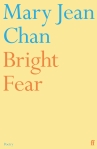 Bright Fear by Mary Jean Chan: This follow-up to Flèche takes up many of the same foundational subjects: race, family, language and sexuality. But this time, the pandemic is the lens through which all is filtered. At a time when Asian heritage merited extra suspicion, English was both a means of frank expression and a source of ambivalence. At the centre of the book, “Ars Poetica,” a multi-part collage incorporating lines from other poets, forms a kind of autobiography in verse. Chan also questions the lines between genres. Excellent.
 Lo by Melissa Crowe: This incandescent autobiographical collection delves into the reality of sexual abuse and growing up in rural poverty. Guns are insidious, used for hunting or mass shootings. Trauma lingers. “Maybe home is what gets on you and can’t / be shaken loose.” The collection is so carefully balanced in tone that it never feels bleak. In elegies and epithalamiums (poems celebrating marriage), Crowe honors family ties that bring solace. The collection has emotional range: sensuality, fear, and wonder at natural beauty.
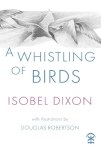 A Whistling of Birds by Isobel Dixon: I was drawn to this for its acknowledged debt to D.H. Lawrence’s Birds, Beasts and Flowers. Snakes, bees, bats and foxes are some of the creatures that scamper through the text. There are poems for marine life, fruit and wildflowers. You get a sense of the seasons turning, and the natural wonders to prize from each. Dixon’s poetry is formal yet playful, the structures and line and stanza lengths varying. There are portraits and elegies. The book is in collaboration with Scottish artist Douglas Robertson. A real gem.
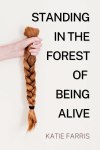 Standing in the Forest of Being Alive by Katie Farris: This debut collection addresses the symptoms and side effects of breast cancer treatment at age 36, but often in oblique or cheeky ways – it can be no mistake that “assistance” appears two lines before a mention of hemorrhoids, for instance, even though it closes an epithalamium distinguished by its gentle sibilance (Farris’s husband is Ukrainian American poet Ilya Kaminsky.) She crafts sensual love poems, and exhibits Japanese influences. (Discussed in my review essay for The Rumpus.)
 The House of the Interpreter by Lisa Kelly: Kelly is half-Danish and has single-sided deafness, and her second collection engages with questions of split identity. One section ends with the Deaf community’s outrage that the Prime Minister’s Covid briefings were not translated into BSL. Bizarre but delightful is the sequence of alliteration-rich poems about fungi, followed by a miscellany of autobiographical poems full of references to colour, language, nature and travel.
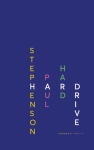 Hard Drive by Paul Stephenson: This wry, wrenching debut collection is an extended elegy for his partner, Tod Hartman, an American anthropologist who died of heart failure at 38. There’s every style, tone and structure imaginable here. Stephenson riffs on his partner’s oft-misspelled name (German for death), and writes of discovery, autopsy, sadmin and rituals. In “The Only Book I Took” he opens up Tod’s copy of Joan Didion’s The Year of Magical Thinking – which came from Wonder Book, the bookstore chain I worked at in Maryland!
Okay, twist my arm … if I had to pick my overall books of the year, I’d concur with the Times in picking The New Life. In nonfiction: Monsters. In poetry: Standing in the Forest of Being Alive.


Have you read any of my favourites? What 2023 releases do I need to catch up on right away?
Novellas in November, Week 1: My Year in Novellas (#NovNov23)
Novellas in November begins today! Cathy (746 Books) and I are delighted to be celebrating the art of the short book with you once again. Remember to let us know about your posts here, via the Inlinkz service or through a comment. How impressive is it that before November even started we were already up to 20 blog and social media posts?! I have a feeling this will be a record-breaking year for participation.

I’m kicking off our first weekly prompt:
Week 1 (starts Wednesday 1 November): My Year in Novellas
- During this partial week, tell us about any novellas you have read since last NovNov.

(See the announcement post for more info about the other weeks’ prompts and buddy reads.)
I relish building rather ludicrous stacks of novellas through the year. When I’m standing in front of a Little Free Library, browsing in secondhand bookstores and charity shops, or perusing the shelves at the public library where I volunteer, I’m always thinking about what I could add to my piles for November.
But I do read novella-length books at other times of year, too. Forty-six of them so far this year, according to my Goodreads shelves. That seems impossible, but I guess it reflects the fact that I often choose to review novellas for BookBrowse, Foreword and Shelf Awareness. I’ve read a real mixture, but predominantly literature in translation and autobiographical works. Here are seven highlights:
Fiction
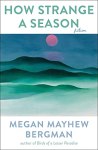


How Strange a Season by Megan Mayhew Bergman: A strong short story collection with the novella-length “Indigo Run” being a Southern Gothic tale of betrayal and revenge.
Loved and Missed by Susie Boyt: The heart-wrenching story of a woman who adopts her granddaughter due to her daughter’s drug addiction. Its brevity speaks emotional volumes.
Crudo by Olivia Laing: A wry, all too relatable take on recent events and our collective hypocrisy and sense of helplessness. Biography + autofiction + cultural commentary.
Nonfiction
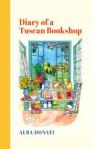
Diary of a Tuscan Bookshop by Alba Donati: Lovely snapshots of a bookseller’s personal and professional life.
La Vie: A Year in Rural France by John Lewis-Stempel: A ‘peasant farmer’ chronicles a year in the quest to become self-sufficient. His best book in an age, ideal for armchair travel.

My Neglected Gods by Joanne Nelson: The poignant microessays locate epiphanies in the everyday.
Eggs in Purgatory by Genanne Walsh: A stunning autobiographical essay about the last few months of her father’s life.
I currently have five novellas underway, and I’ve laid out a pile of potential one-sitting reads for quiet mornings in the weeks to come.
Here’s hoping you all are as excited about short books as I am!
Why not share some recent favourites with us in a post of your own?
The Best Books from the First Half of 2023
Yes, it’s that time of year already! It remains to be seen how many of these will make it onto my overall best-of year list, but for now, these are my 20 highlights. Plus, I sneakily preview another great novel that won’t release until September. (For now I’m highlighting 2023 releases, whereas at the end of the year I divide my best-of lists into current year and backlist. I’ve read 86 current-year releases so far and am working on another 20, so I’m essentially designating a top 20% here.) I give review excerpts and link to the full text from this site or elsewhere. Pictured below are the books I read in print; all the others were e-copies.

Fiction
 Shoot the Horses First by Leah Angstman: In 16 sumptuous historical stories, outsiders and pioneers face disability and prejudice with poise. The flash entries crystallize moments of realization, often about health. Longer pieces shine as their out-of-the-ordinary romances have space to develop. In the novella Casting Grand Titans, a botany professor in 1850s Iowa learns her salary is 6% of a male colleague’s. She strives for intellectual freedom, reporting a new-to-science species of moss, while working towards liberation for runaway slaves.
 The House Is on Fire by Rachel Beanland: Moving at a propulsive pace, Beanland’s powerful second novel rotates through the perspectives of these main characters – two men and two women; two white people and two enslaved Black people – caught up in the Richmond Theater Fire of 1811 (one of the deadliest events in early U.S. history) and its aftermath. Painstakingly researched and full of historical detail and full-blooded characters, it dramatizes the range of responses to tragedy and how people rebuild their lives.
The New Life by Tom Crewe: Two 1890s English sex researchers (based on John Addington Symonds and Havelock Ellis) write a book called Sexual Inversion drawing on ancient Greek history and containing case studies of homosexual behaviour. Oscar Wilde’s trial puts everyone on edge; not long afterwards, their own book becomes the subject of an obscenity trial, and each man has to decide what he’s willing to give up in devotion to his principles. This is deeply, frankly erotic stuff, and, on the sentence level, just exquisite writing.
 Daughters of Nantucket by Julie Gerstenblatt: (Yes, another historical fire novel, and I reviewed both for Shelf Awareness!) This engrossing debut explores the options for women in the mid-19th century. Metaphorical conflagrations blaze in the background in the days leading up to the great Nantucket fire of 1846: each of three female protagonists (a whaling captain’s wife, a museum curator, and a pregnant Black entrepreneur) holds a burning secret and longs for a more expansive, authentic life. Tense and sultry; for Sue Monk Kidd fans.
 I Have Some Questions for You by Rebecca Makkai: When an invitation comes from her boarding school alma mater, Granby, to teach a two-week course on podcasting, Bodie indulges her obsession with the 1995 murder of her former roommate. Makkai has taken her cues from the true crime genre and constructed a convincing mesh of evidence and theories. She so carefully crafts her pen portraits, and so intimately involves us in Bodie’s psyche, that it’s impossible not to get invested. This is timely, daring, intelligent, enthralling storytelling.
Sidle Creek by Jolene McIlwain: In this debut collection of 22 short stories, loosely linked by their location in the Appalachian hills in western Pennsylvania and a couple of recurring minor characters, McIlwain softens the harsh realities of addiction, poverty and violence with the tender bruises of infertility and lost love. Grief is a resonant theme in many of the stories, with pregnancy or infant loss a recurring element. At times harrowing, always clear-eyed, these stories are true to life and compassionate about human foibles and animal pain.
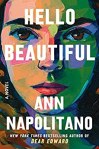 Hello Beautiful by Ann Napolitano: Oprah’s 100th book club pick. It’s a family story spanning three decades and focusing on the Padavanos, a working-class Italian American Chicago clan with four daughters. Julia meets melancholy basketball player William Waters while at Northwestern in the late 1970s. There is such warmth and intensity to the telling, and brave reckoning with bereavement, mental illness, prejudice and trauma. I love sister stories in general, and the subtle echoes of Leaves of Grass and Little Women add heft.
Romantic Comedy by Curtis Sittenfeld: Through her work as a writer for a sketch comedy show modelled on Saturday Night Live, Sally Milz meets Noah Brewster, a pop star with surfer-boy good looks. Plain Jane getting the hot guy – that never happens, right? In fact, Sally has a theory about this very dilemma… As always, Sittenfeld’s inhabiting of a first-person narrator is flawless, and Sally’s backstory and Covid-lockdown existence endeared her to me. Could this be called predictable? Well, what does one want from a romcom?
In Memoriam by Alice Winn: Heartstopper on the Western Front; swoon! Will Sidney Ellwood and Henry Gaunt both acknowledge that this is love and not just sex, as it is for so many teenage boys at their English boarding school? And will one or both survive the trenches of the First World War? Winn depicts the full horror of war, but in between there is banter, friendship and poetry. Some moments are downright jolly. This debut is obsessively researched, but Winn has a light touch with it. Engaging, thrilling, and, yes, romantic.
A bonus:
The Vaster Wilds by Lauren Groff (Riverhead/Hutchinson Heinemann, 12 September): Groff’s fifth novel combines visceral detail and magisterial sweep as it chronicles a runaway Jamestown servant’s struggle to endure the winter of 1610. Flashbacks to traumatic events seep into her mind as she copes with the harsh reality of life in the wilderness. The style is archaic and postmodern all at once. Evocative and affecting – and as brutal as anything Cormac McCarthy wrote. A potent, timely fable as much as a historical novel. (Review forthcoming for Shelf Awareness.)
Nonfiction
All My Wild Mothers by Victoria Bennett: A lovely memoir about grief and gardening, caring for an ill child and a dying parent. The book is composed of dozens of brief autobiographical, present-tense essays, each titled after a wildflower with traditional healing properties. The format realistically presents bereavement and caring as ongoing, cyclical challenges rather than one-time events. Sitting somewhere between creative nonfiction and nature essays, it’s a beautiful read for any fan of women’s life writing.
Monsters by Claire Dederer: The question posed by this hybrid work of memoir and cultural criticism is “Are we still allowed to enjoy the art made by horrible people?” It begins, in the wake of #MeToo, by reassessing the work of film directors Roman Polanski and Woody Allen. The book is as compassionate as it is incisive. While there is plenty of outrage, there is also much nuance. Dederer’s prose is forthright and droll; lucid even when tackling thorny issues. Erudite, empathetic and engaging from start to finish.
Womb by Leah Hazard: A wide-ranging and accessible study of the uterus, this casts a feminist eye over history and future alike. Blending medical knowledge and cultural commentary, it cannot fail to have both personal and political significance for readers of any gender. The thematic structure of the chapters also functions as a roughly chronological tour of how life with a uterus might proceed: menstruation, conception, pregnancy, labour, caesarean section, ongoing health issues, menopause. Inclusive and respectful of diversity.
Sea Bean by Sally Huband: Stories of motherhood, the quest to find effective treatment in a patriarchal medical system, volunteer citizen science projects, and studying Shetland’s history and customs mingle in a fascinating way. Huband travels around the archipelago and further afield, finding vibrant beachcombing cultures. In many ways, this is about coming to terms with loss, and the author presents the facts about climate crisis with sombre determination. She writes with such poetic tenderness in this radiant debut memoir.
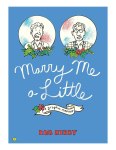 Marry Me a Little by Robert Kirby: Hopping around in time, this graphic memoir tells the story of how the author and his partner John decided to get married in 2013. The blue and red color scheme is effective at evoking a polarized America and the ebb and flow of emotions, with blue for calm, happy scenes and concentrated red for confusion or anger. This is political, for sure, but it’s also personal, and it balances those two aims well by tracing the history of gay marriage in the USA and memorializing his own relationship.
All of Us Together in the End by Matthew Vollmer: In 2019, Vollmer’s mother died of complications of Alzheimer’s and Parkinson’s. Months later, his father reported blinking lights in the woods near the family cemetery. Although Vollmer had left the Seventh-Day Adventist Church in college, his religious upbringing influenced his investigation, which overlapped with COVID-19. Grief, mysticism, and acceptance of the unexplained are resonant themes. An unforgettable record of “a collision with the ineffable.”
Eggs in Purgatory by Genanne Walsh: This autobiographical essay tells the story of the last few months of her father’s life. Aged 89, he lived downstairs from Walsh and her wife in San Francisco. He was quite the character: idealist, stubborn, outspoken; a former Catholic priest. Although he had no terminal conditions, he was sick of old age and its indignities and ready to exit. The task of a memoir is to fully mine the personal details of a situation but make of it something universal, and that’s just what she does here. Stunning.
Poetry
More Sky by Joe Carrick-Varty: In this debut collection, the fact of his alcoholic father’s suicide is inescapable. The poet alternates between an intimate “you” address and third-person scenarios, auditioning coping mechanisms. His frame of reference is wide: football, rappers, Buddhist cosmology. The word “suicide” itself is repeated to the point where it becomes just a sibilant collection of syllables. The tone is often bitter, as is to be expected, but there is joy in the deft use of language.
Lo by Melissa Crowe: This incandescent autobiographical collection delves into the reality of sexual abuse and growing up in rural poverty. Guns are insidious, used for hunting or mass shootings. Trauma lingers. “Maybe home is what gets on you and can’t / be shaken loose.” The collection is so carefully balanced in tone that it never feels bleak. In elegies and epithalamiums (poems celebrating marriage), Crowe honors family ties that bring solace. The collection has emotional range: sensuality, fear, and wonder at natural beauty.
Standing in the Forest of Being Alive by Katie Farris: This debut collection addresses the symptoms and side effects of breast cancer treatment at age 36, but often in oblique or cheeky ways – it can be no mistake that “assistance” appears two lines before a mention of haemorrhoids, for instance, even though it closes an epithalamium distinguished by its gentle sibilance (Farris’s husband is Ukrainian American poet Ilya Kaminsky.) She crafts sensual love poems, and exhibits Japanese influences. (Review forthcoming at The Rumpus.)
The House of the Interpreter by Lisa Kelly: Kelly is half-Danish and has single-sided deafness, and her second collection engages with questions of split identity. One section ends with the Deaf community’s outrage that the Prime Minister’s Covid briefings were not translated into BSL. Bizarre but delightful is the sequence of alliteration-rich poems about fungi, followed by a miscellany of autobiographical poems full of references to colour, nature and travel.
What are some of the best books you’ve read so far this year?
What 2023 releases should I catch up on right away?
Recommended March Releases by Jane Aldous, Danielle Evans, Katherine May & Genanne Walsh
Sonnets, short stories, nature-fuelled wonder, and an autobiographical essay about a father’s death … from postwar Edinburgh to modern-day San Francisco and from fiction about young African American women to pilgrimages along the English coast, I have a real variety to recommend this month. (And coming up in a separate post: Womb by Leah Hazard.)
More Patina than Gleam by Jane Aldous
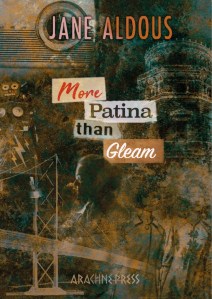 This was my second Arachne Press collection after Routes by Rhiya Pau. Intriguingly, it’s a story composed of 70 sonnets, untraditional in that they do not follow a particular rhyme scheme apart from the odd couplet. There is scant punctuation, with within-line spaces separating the phrases. Aldous, who has recently been featured in a Guardian article on debut authors over 60, imagines a sort of alternative future for her mother had she run away with her when she was a baby. Here, Linda escapes her abusive common-law husband, Vernon, and travels from England to Edinburgh with her 11-year-old daughter, Angie. They settle with an eccentric older woman named Elsie Datlow, who hires Linda as a lady’s companion and keeps her on as a housekeeper when financial struggles force her to accept paying guests. It’s impressive how much Aldous fits into comparatively little text, including Angie’s coming of age, the ups and downs of the Datlows’ picture restoring business, and transgressive romance as both Elsie and Linda fall in love across accepted gender or racial boundaries. This was a pleasant surprise that called to mind works by Muriel Spark and Sarah Waters.
With thanks to Arachne Press for the free copy for review.
Before You Suffocate Your Own Fool Self by Danielle Evans (2010)
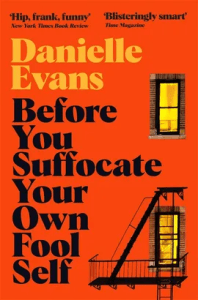 A couple of years ago I reviewed Evans’s second short story collection, The Office of Historical Corrections. This was her first book but has only just been published in the UK. Six of the eight stories are in the first person, the other two in third person. The protagonists tend to be young African American women in moments of transition or clinging to unhealthy relationships. In “Virgins,” 15-year-old Erica and Jasmine want to shed their innocence but can’t necessarily control how it happens. “Snakes” has Tara, a transracial adoptee, spending her ninth summer with her white cousin, Allison, down at their grandmother’s home in Florida. The response to a series of accidents makes it clear to her who is valued in this family. The college girls in “Harvest” consider a variety of reproductive experiences, from selling their eggs to abortion. In “The King of a Vast Empire,” a brother and sister decide to track down a survivor of a car accident their family had when they were children. “Jellyfish” sees a father and daughter meeting for lunch in Harlem and pondering their separate futures.
Many settings were familiar to me from the Delmarva area where I grew up. Here on the cusp of the South, Confederate sympathy still exists, as high schoolers Crystal and Geena discover in “Robert E. Lee Is Dead.” The best friends collaborate on pranks, but Crystal’s grades point to a promising future whereas everyone has given up on Geena, including herself. Along with that one, my two favourites were “Someone Ought to Tell Her There’s Nowhere to Go” and “Wherever You Go, There You Are.” In the former, military veteran Georgie tries to ingratiate himself with his ex-girlfriend by treating her daughter to a princess experience; in the latter, Carla takes her would-be-sexpot 14-year-old niece, Chrissie, on a road trip to North Carolina to meet her ex’s fiancée. Both are exemplary of the assets of the whole collection: strong characters, natural dialogue, and subtle treatment of themes of class and race. I’d proffer this for fans of Sidik Fofana, and as a better option than Dantiel Moniz’s stories.
With thanks to Picador for the proof copy for review.
Enchantment: Reawakening wonder in an exhausted age by Katherine May
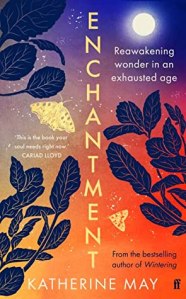 I was a big fan of Katherine May’s Wintering, which published just before the pandemic and, as if presciently, offers strategies for coping with seasons of depression. Coming after a few years of upheaval and disconnection, this follow-up voices May’s longing for rituals of the transcendent that will allow her to live in harmony and close attention to the world around her. Her usual way of communing with nature and other people was group swims in the sea, but that temporarily stopped with lockdown. She sought alternatives, such as visiting a sacred well with a friend, beekeeping, cultivating a wild garden, and chasing a meteor shower. The Earth – Water – Fire – Air structure is sometimes forced, and the content sparse; like Raynor Winn, May, I feel, was pressured to capitalize on the success of her previous work and quickly publish unfinished and rather nebulous material. It’s all surprisingly woo-woo from an English author. Yet May’s writing is unfailingly lovely and this went down easy a chapter at a time. It’s a comparable read to Wanderland by Jini Reddy.
With thanks to Faber for the proof copy for review.
Eggs in Purgatory by Genanne Walsh
I reviewed Genanne Walsh’s novel Twister as part of my summer reading in 2018. This autobiographical essay, recently published by WTAW Press and a finalist in their Alcove Chapbook Series Open, tells the story of the last few months of her father’s life. Aged 89, he lived downstairs from Walsh and her wife in San Francisco. He was quite the character: idealist, stubborn, outspoken; a former Catholic priest influenced by A Course in Miracles and convinced of the oneness of everything. Although he had no terminal conditions, he was sick of old age and its indignities and ready to exit. (“He wanted to be put on an ice floe and pushed offshore. The problem was, I lived above him on the iceberg and would be tasked with shoving him off.”) However, there was confusion about California state laws and whether doctors could help him with this, and at one point the police showed up at the door.
 The title refers to a Middle Eastern dish (see this Nigella Lawson recipe) I’ve known as shakshuka. It was the last proper meal her father ate, Christmas morning 2017 with her and her wife, before he went on his final hunger strike. Later Walsh writes, “Mourning is a kind of purgatory. You exist between worlds. For a long time I walked through, not fully feeling the world of the living or the world of the dead but aware of both.”
The task of a memoir is to fully mine the personal details of a situation but make of it something universal, and that’s just what she does here. Her father’s past with her mother (who died decades before, following a stroke) renders the family dynamic a backdrop to a final pyrrhic battle. Aware that she doesn’t come out of this a saint, Walsh admits to contradictory feelings, including “my life will be so much easier when he dies.” The prediction, no less than its reality, makes her feel guilty. Though she has no faith as such, she senses her father’s influence in her very desire to keep communing with him after his death.
This stunning little book met me at a deep place and I can highly recommend it, especially if you were a fan of In Love by Amy Bloom and All Things Consoled by Elizabeth Hay. (See also The Inevitable – one of its case studies reminded me of this.)
With thanks to the author for the free e-copy for review.
And one dud:
 Birnam Wood by Eleanor Catton – This year’s Klara and the Sun for me: I have trouble remembering why I was so excited about Catton’s third novel that I put it on my Most Anticipated list for 2023, especially given my decidedly mixed feelings about The Luminaries. I’d read a lot about Birnam Wood so its plot held no surprises for me. An American tech billionaire is up to no good on a New Zealand nature reserve; though the members of a guerrilla gardening group summon courage to fight back, his drones see all.
From early on I had little interest in the cast and their doings, especially the buzzword-filled dialogues, and skimmed the rest. Literary fiction usually distinguishes itself from commercial genre fiction by its focus on character depth (and prose quality), but in Catton’s case that was achieved through endless backstory. Her attempt at edginess entails adding at least one F-word to each spoken sentence. (The Bookshop Band, usually so mild-mannered, reflected this by dropping an F-bomb in their song based on the book – see the music video, which cleverly employs a derelict greenhouse and drones.) I’d heard that the ending was a knockout, so I skipped ahead and did find the last 40 pages gripping and the gruesome final tableau worthy of the Shakespearean allusions, but there’s a lot of blah to wade through before that.
With thanks to Granta for the free copy for review.
Would you be interested in reading one or more of these?
20 Books of Summer #15: Twister by Genanne Walsh
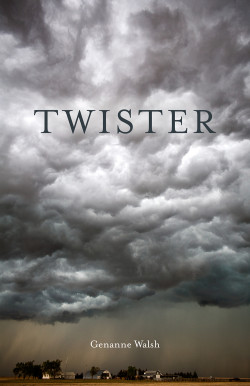 As the members of a small Midwestern town go about their daily business, it’s impossible to forget that a tornado is on its way. We begin with Rose, an ornery woman who, especially after the death of her soldier son Lance shook the town, has kept herself to herself. Perry Brown repeatedly proposes buying her farm so that he can expand his own operation, but she spurns all offers. Estranged from her stepsister Stella, Rose only has her dog Fergus for company. Short meteorological and historical overviews serve as tense interludes, moving from the general to the particular and providing brief transitions between character portraits.
The successive chapters are simultaneous, interlocking stories that all take place in the immediate run-up to the storm touching down. We meet Scottie Dunleavy, an odd fellow who runs a shoe repair shop and leaves secret messages on the soles of people’s footwear. From Louise Logan, a gossipy bank teller, we learn how Rose and Stella fell out; through the eyes of Perry’s wife Nina we see just how tenuous Rose’s solitary existence has become.
After cycling through the perspectives of eight main characters, the book returns to the past in Part II, which starts with the meeting and marriage of Stella’s mother and Rose’s father and moves forward to the near present. The chapters turn choppier as the news of Lance’s death approaches. “Everyone shrank” after the loss of this hometown boy, Walsh writes; like the tornado, his death is an inescapable reality the narrative keeps moving towards.
I love small-town tales where you get to know all the neighbors and their secrets. Twister called to mind for me works by Jane Smiley and Anne Tyler, with Rose also somewhat reminiscent of Hagar in Margaret Laurence’s The Stone Angel. Casualties by Elizabeth Marro is another readalike, focusing on a bereaved mother and her soldier son’s backstory.
Twister was a novel I read slowly, just 10 or 15 pages at a sitting, to savor Walsh’s prose. It’s not a book to race through for the plot but one to linger over as you appreciate the delicacy of the characterization and the electric descriptions of the impending storm:
“If all warnings fail, here is what to look for: the sky turns green, greenish black, brackish. Hail falls. There is a sound that some liken to a freight train, a jet engine, a thousand souped-up Buicks drag racing across a sky. Debris falls from on high—frogs, playing cards, plywood, mud, rock.”
“Warm air rushes ecstatic through the center, pulling and turning, forcing cold air out and down in waves, feeding the dance. Cold coils, pulling inward, more of it and stronger until the warm air snuffs out, the funnel choked, thinning and lifting away. It stretches into a long ribbon, harmless now, twirling across the sky.”
My rating: 
Twister, Genanne Walsh’s debut novel, was published by Black Lawrence Press in 2015 and won the publisher’s Big Moose Prize. My thanks to the author for sending a free copy for review.
20 Books of Summer #4 + Substitutes & Plane Reading
You’ll have to excuse me posting twice in one day. I’ve just finished packing the last few things for my three weeks in America, and want to get my latest #20BooksofSummer review out there before I fly early tomorrow. What with a layover in Toronto, it will be a very long day of travel, so I think the volume of reading material I’m taking is justified! (See the last photo of the post.)
Four Wings and a Prayer: Caught in the Mystery of the Monarch Butterfly by Sue Halpern (2001)
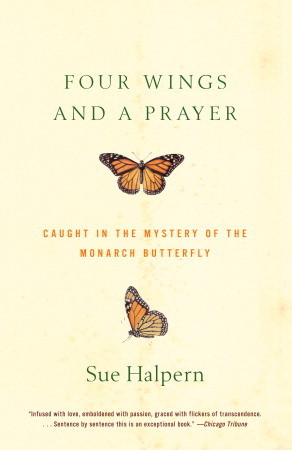 I admire nonfiction books that successfully combine lots of genres into a dynamic narrative. This one incorporates travel, science, memoir, history, and even politics. Halpern spent a year tracking monarch butterflies on their biannual continent-wide migrations, which were still not well understood at that point. She rides through Texas into Mexico with Bill Calvert, field researcher extraordinaire; goes gliding with David Gibo, a university biologist, in fields near Toronto; and hears from scientists and laymen alike about the monarchs’ habits and outlook. It happened to be a worryingly poor year for the butterflies, yet citizen science initiatives provided valuable information that could be used to predict their future.
The book is especially insightful about clashes between environmentalist initiatives and local livelihoods in Mexico (tree huggers versus subsistence loggers) and the joy of doing practical science with simple tools you make yourself. It’s also about how focused attention becomes passion. “Science, like belief, starts with wonder, and wonder starts with a question,” Halpern writes.
The style is engaging, though at nearly 20 years old the book feels a bit dated, and I might have liked more personal reflections than interviews with (middle-aged, white, male) scientists. I only realized on the very last page, through the acknowledgments, that the author is married to Bill McKibben, a respected environment writer. [She frequently mentions Fred Urquhart, a Toronto zoology professor; I wondered if he could be related to Jane Urquhart, a Canadian novelist whose novel Sanctuary Line features monarchs. (Turns out: no relation. Oh well!)]
Readalikes: Farther Away by Jonathan Franzen & Ruins by Peter Kuper
My rating: 
I’ve already done some substituting on my 20 Books of Summer. I decided against reading Vendela Vida’s Girls on the Verge after perusing the table of contents and the first few pages and gauging reader opinions on Goodreads. I have a couple of review books, Twister by Genanne Walsh and The Life and Loves of Lena Gaunt by Tracy Farr, that I’m enjoying but will have to leave behind while I’m in the States, so I may need that little extra push to finish them once I get back. I’ve also been rereading a favorite, Paulette Bates Alden’s memoir Crossing the Moon, which has proved an excellent follow-up to Sheila Heti’s Motherhood.
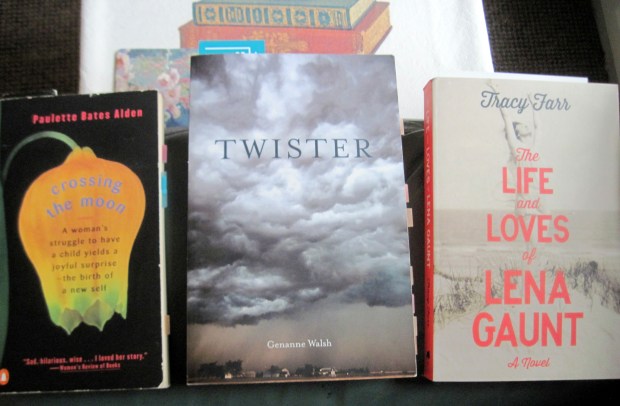
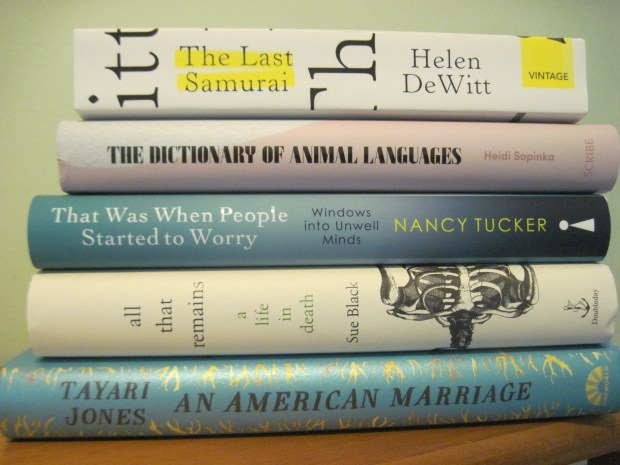
(What I haven’t determined yet is which books these will be standing in for.) Waiting in the wings in case further substitutions are needed is this stack of review books:
Also from the #20Books list and coming with me on the flight are Madeleine L’Engle’s The Summer of the Great-Grandmother and Janet Fitch’s White Oleander, which are both terrific thus far. The final print book joining me for the journey is Transit by Rachel Cusk. I have attempted to read her twice before and failed to get through a whole book, so we’ll see if it’s third time lucky. It seems like the perfect book to read in transit to Canada, after all.
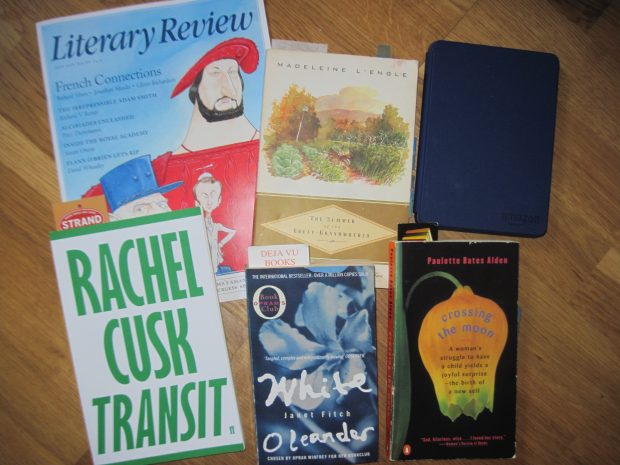
Finally, in progress on the Kindle are Summer by Karl Ove Knausgaard, the last in his set of four seasonal essay collections, and The Late Bloomers’ Club by Louise Miller, another cozy novel set in fictional Guthrie, Vermont, which she introduced in her previous book, The City Baker’s Guide to Country Living.
It’ll be a busy few weeks helping my parents pack up their house and moving my mom into her new place, plus doing a reduced freelance work load for the final two weeks. It’s also going to be a strange time because I have to say goodbye to a house that’s been a part of my life for 13 years, and sort through box after box of mementoes before putting everything into medium-term storage.
I won’t be online all that much, and can’t promise to keep up with everyone else’s blogs, but I’ll try to pop in with a few reviews.
 Bookish Beck = Rebecca Foster. American transplant to England. Freelance proofreader and book reviewer.
 Bookish Beck