Book Serendipity, Mid-February to Mid-April
I call it “Book Serendipity” when two or more books that I read at the same time or in quick succession have something in common – the more bizarre, the better. This is a regular feature of mine every couple of months. Because I usually have 20–30 books on the go at once, I suppose I’m more prone to such incidents. The following are in roughly chronological order.
Last time, my biggest set of coincidences was around books set in or about Korea or by Korean authors; this time it was Ghana and Ghanaian authors:
- Reading two books set in Ghana at the same time: Fledgling by Hannah Bourne-Taylor and His Only Wife by Peace Adzo Medie. I had also read a third book set in Ghana, What Napoleon Could Not Do by DK Nnuro, early in the year and then found its title phrase (i.e., “you have done what Napoleon could not do,” an expression of praise) quoted in the Medie! It must be a popular saying there.
- Reading two books by young Ghanaian British authors at the same time: Quiet by Victoria Adukwei Bulley and Maame by Jessica George.


And the rest:
- An overweight male character with gout in Where the God of Love Hangs Out by Amy Bloom and The Secret Diaries of Charles Ignatius Sancho by Paterson Joseph.
- I’d never heard of “shoegaze music” before I saw it in Michelle Zauner’s bio at the back of Crying in H Mart, but then I also saw it mentioned in Pulling the Chariot of the Sun by Shane McCrae.
- Sheila Heti’s writing on motherhood is quoted in Without Children by Peggy O’Donnell Heffington and In Vitro by Isabel Zapata. Before long I got back into her novel Pure Colour. A quote from another of her books (How Should a Person Be?) is one of the epigraphs to Lorrie Moore’s I Am Homeless If This Is Not My Home.


- Reading two Mexican books about motherhood at the same time: Still Born by Guadalupe Nettel and In Vitro by Isabel Zapata.
- Two coming-of-age novels set on the cusp of war in 1939: The Inner Circle by T.C. Boyle and Martha Quest by Doris Lessing.
- A scene of looking at peculiar human behaviour and imagining how David Attenborough would narrate it in a documentary in Notes from a Small Island by Bill Bryson and I Have Some Questions for You by Rebecca Makkai.
- The painter Caravaggio is mentioned in a novel (The Things We Do to Our Friends by Heather Darwent) plus two poetry books (The Fourth Sister by Laura Scott and Manorism by Yomi Sode) I was reading at the same time.


- Characters are plagued by mosquitoes in The Last Animal by Ramona Ausubel and Through the Groves by Anne Hull.
- Edinburgh’s history of grave robbing is mentioned in The Things We Do to Our Friends by Heather Darwent and Womb by Leah Hazard.
- I read a chapter about mayflies in Lev Parikian’s book Taking Flight and then a poem about mayflies later the same day in Ephemeron by Fiona Benson.
- Childhood reminiscences about playing the board game Operation and wetting the bed appear in Homesick by Jennifer Croft and Through the Groves by Anne Hull.

- Fiddler on the Roof songs are mentioned in Through the Groves by Anne Hull and We All Want Impossible Things by Catherine Newman.
- There’s a minor character named Frith in Shadow Girls by Carol Birch and Rebecca by Daphne du Maurier.
- Scenes of a female couple snogging in a bar bathroom in Through the Groves by Anne Hull and The Garnett Girls by Georgina Moore.

- The main character regrets not spending more time with her father before his sudden death in Maame by Jessica George and Pure Colour by Sheila Heti.
- The main character is called Mira in Birnam Wood by Eleanor Catton and Pure Colour by Sheila Heti, and a Mira is briefly mentioned in one of the stories in Before You Suffocate Your Own Fool Self by Danielle Evans.
- Macbeth references in Shadow Girls by Carol Birch and Birnam Wood by Eleanor Catton – my second Macbeth-sourced title in recent times, after Tomorrow and Tomorrow and Tomorrow by Gabrielle Zevin last year.


- A ‘Goldilocks scenario’ is referred to in Womb by Leah Hazard (the ideal contraction strength) and Taking Flight by Lev Parikian (the ideal body weight for a bird).
- Caribbean patois and mention of an ackee tree in the short story collection If I Survive You by Jonathan Escoffery and the poetry collection Cane, Corn & Gully by Safiya Kamaria Kinshasa.
- The Japanese folktale “The Boy Who Drew Cats” appeared in Our Missing Hearts by Celeste Ng, which I read last year, and then also in Enchantment by Katherine May.


- Chinese characters are mentioned to have taken part in the Tiananmen Square massacre/June 4th incident in Dear Chrysanthemums by Fiona Sze-Lorrain and Oh My Mother! by Connie Wang.
- Endometriosis comes up in What My Bones Know by Stephanie Foo and Womb by Leah Hazard.

What’s the weirdest reading coincidence you’ve had lately?
March Paperback Releases: Fledgling, Theatre of Marvels, What My Bones Know
I’m catching up on three 2022 books I was sent for review and didn’t read at their initial publication. Today I have a memoir of living between Ghana and England and hand-raising two birds, a Victorian pastiche starring a mixed-race actress in London, and an account of being diagnosed with complex PTSD and working towards healing of childhood trauma.
Fledgling by Hannah Bourne-Taylor
Nature-lover Hannah Bourne-Taylor lived in Ghana for eight years for her husband’s job. As a dependent spouse, she was not permitted to work and, in their rural setting, she felt cut off from any expatriate community. From childhood she’d been an obsessive animal rescuer – fishing ants out of swimming pools, for instance – and when she found a swift that had been displaced from its nest, her protective instincts went into overdrive. Collecting hundreds of termites, she fed the bird to a demanding schedule for two weeks before releasing it. This went as disastrously as it could, but she soon got another chance when she found a grounded bronze-winged mannikin finch fledgling after a storm. Their bond was even closer: the bird climbed her body and nested in her hair (she wrote a Guardian article about the experience), and they developed a mutual language of chirps. The care routine sounds like it was not so different from having an infant. She even calls the finch her daemon.
 There is something very insular about this narrative, such that I had trouble gauging the passage of time. Raising the two birds, adopting street dogs, going on a pangolin patrol with a conservation charity – was this a matter of a couple of months, or were events separated by years? Ghana is an intriguing setting, yet because there is no attempt to integrate, she can only give a white outsider’s perspective on the culture, and indigenous people barely feature. I was sympathetic to the author’s feelings of loneliness and being trapped between countries, not belonging in either, but she overstates the lessons of compassion and freedom the finch taught. The writing, while informed and passionate about nature, needs a good polish (many misplaced modifiers, wrong prepositions, errors in epigraph quotes, homonym slips – “sight” instead of “site”; “balled” in place of “bawled”; “base” where it should be “bass,” twice – and so on). Still, it’s a promising debut from a valuable nature advocate, and I share her annual delight in welcoming England’s swifts, as in the scenes that open and close the book.
With thanks to Aurum for the free copy for review. Fledgling came out in paperback on 9 March.
Theatre of Marvels by Lianne Dillsworth
Lianne Dillsworth is a Black British author with MAs in creative writing and Victorian studies, interests she combines in this debut novel set in Victorian London. Zillah’s mother, a slave from Barbados, was forced to abandon her seven-year-old daughter. Zillah is mixed-race and grew up in St Giles slum. Too light-skinned to convince as a “savage” when she headlines Crillick’s Variety Theatre show as “Amazonia,” she has to coat herself with greasepaint and soot. As mistress to a viscount, she has access to a life of luxury, but instead chooses to try to free her fellow Black performers, including the “Leopard Lady,” who is exhibited for her skin condition and confined in conditions little better than slavery.
 Through secondary characters, we glimpse other options for people of colour: one, Lucien Winters, is a shopkeeper (reminding me of the title character of The Secret Diaries of Charles Ignatius Sancho, a historical figure) but intends to move to Sierra Leone via a colonisation project; another passes as white to have a higher position in the theatre world. It felt odd, though, how different heritages were conflated, such that Zillah, of Caribbean descent, learns a few words of “Zulu” to speak to the Leopard Lady, and Lucien explains Africanness to her as if it is one culture. Perhaps this was an attempt to demonstrate solidarity among oppressed peoples.
There are rivalries with fellow actresses, and well-meaning Quakers who work toward a better society. Much of the characterisation is tissue-thin, however, and a few turns of phrase felt not of the time period (describing someone as being in a “pissy mood”; “If he was in this much of a funk there’d be no getting through to him. I might as well go to bed before he killed my mood completely.”). All told, this never lived up to its first paragraph –
Go to the theatre much? No, nor me. At least not before I became an actress. I know what you’re thinking. Actress, eh? But you can keep your dirty-minded thoughts to yourself. I trod the boards and no more. Doesn’t mean I don’t have a story or two to tell, mind. Would you be kind enough to indulge me if I talked about the old days? Hard as it was back then, I can’t say that if I had my time again I’d change it.
– which promised a much more original voice than we ever get from Zillah. It’s only worth writing in the first person if the narration is remarkable in some way, so this could easily have been in third person limited instead. This was a nicely undemanding selection to start on the ferry ride back from Spain last year, but took much effort to finish because of the 400+ page count and despite the jejune prose (some have labelled this YA for that reason). Fans of Stacey Halls may enjoy it. It’s certainly what I’d call an easy read. 
Hutchinson Heinemann sent a proof copy. Theatre of Marvels came out in paperback on 2 March.
What My Bones Know: A Memoir of Healing from Complex Trauma by Stephanie Foo
It’s okay to have some things you never get over.
Radio producer Stephanie Foo was diagnosed with complex PTSD at age 30. Although she briefly delves into the parental abuse that accounts for her trauma, this is – thankfully – mostly about the four years she spent trying to get better. The Malaysian Chinese Foo family moved to San Francisco when she was two years old. Her mother nagged and beat her, and both parents made credible threats to kill her and/or themselves, such as by driving off the road. It’s hard to read this material, but by proportion it doesn’t take up much of the book. Foo’s mother left when she was 13; she later gave her father an ultimatum one day (while wielding an axe!) that also saw him move out. This left her, then a high school student, living alone and in squalor. Unsurprisingly, she engaged in disordered eating and self-harm.
 A love of journalism kept Foo from committing suicide, got her into college and landed her podcast roles followed by her dream job with public radio programme This American Life in New York City. However, she struggled with a horrible, exacting boss and, when her therapist issued the diagnosis, she left to commit to the healing process, aided by her new partner, Joey. C-PTSD was named in the 1990s but is not recognised in the DSM; The Body Keeps the Score by Bessel van der Kolk is its alternative bible. Repeated childhood trauma, as opposed to a single event, rewires the brain to identify threats that might not seem rational, leading to self-destructive behaviour and difficulty maintaining healthy relationships.
All that Foo discovers in her research into C-PTSD feels damning, but she focuses on what she can control: sleep, diet, exercise, yoga, meditation, acupuncture, and seeing various therapists. She tries everything from hallucinogenic mushrooms and a gratitude journal to EMDR (like hypnosis but based on eye movement). Working with a therapist from the Center for Child Trauma and Resilience helped her to address the root cause rather than the symptoms. There came a point where I would have been okay with a condensed version of events instead of a blow-by-blow of every therapy attempted, but Foo writes with bravery and clarity, adroitly recreating scenes and dialogue and displaying impressive memory and self-knowledge. The detail and overall optimism should make this helpful to many. 
With thanks to Allen & Unwin for the free copy for review. What My Bones Know came out in paperback on 3 March.
Reading the Rathbones Folio Prize Poetry Shortlist
I borrowed the whole of this year’s Rathbones Folio Prize poetry shortlist from my local library and have enjoyed reading through it to see what the judges felt was worthy of recognition from 2022’s releases. Of course, personal taste comes into the appreciation of poetry, perhaps more so than for fiction or nonfiction, so I liked some of these more than others and suspect the judges’ final decision may differ from mine. Still, it’s always a pleasure to discover new-to-me poets and/or debut authors.
Ephemeron by Fiona Benson
 This is Benson’s third collection but my first time reading her. I was fully engaged with her exquisite poems about the ephemeral, whether that be insect lives, boarding school days, primal emotions or moments from her children’s early years. The book is in four discrete corresponding sections (“Insect Love Songs,” “Boarding-School Tales,” “Translations from the Pasiphaë” and “Daughter Mother”) but the themes and language bleed from one into another and the whole is shot through with astonishing corporeality and eroticism.
The form varies quite a lot – bitty lines, stanzas, blocky paragraph-like stories – and alliteration, slant rhymes and unexpected metaphors (a wasp’s nest as “a piñata of stings,” “this avant-garde chandelier” and an “electric hotel / of spit-balled papier mâché”) make each poem glisten. I’ll even let her off for the long section inspired by my pet hate, Greek mythology (so gruesome, so convoluted), because of how she uses these melodramatic situations to explore universal emotions. She does something interesting with the story of the Minotaur (Asterios), suggesting that instead of being born a literal bull he was born deformed or disabled and no one knew what to make of him, but even so he had a mother’s love. 
Here’s one section of “Magicicadas” as an example:
Warm rain
summons them up
through loam
like Lazarus
after seventeen years,
cases splitting
down their backs
emerging
like the wet head
of a baby,
wrestling out
of their tight old skin
arching back
like an orgasm,
like an ecstatic gymnast
on the high trapeze;
sap-green, bunker-pale,
their damp wings lemon
before they stiffen
and straighten, lattice brown.
Quiet by Victoria Adukwei Bulley
 Protest doesn’t have to be loud; sometimes it can even be silent. In her debut, Bulley, a British-born Ghanaian poet, makes that especially clear with the pair “[ ] noise” (= white noise, inescapable) and “black noise” (an erasure poem). She models how language might be decolonized (particularly in “revision”) and how Black femininity might be reimagined (“fabula”). Along with her acknowledged debts to Lucille Clifton, bell hooks, Mary Oliver et al., I spotted echoes of Kei Miller (her “there is dark that moves” sounds like his “there is an anger that moves”) and Toni Morrison (Bulley includes the line “Quiet as it’s kept,” which is the opening of The Bluest Eye).
The collection is bold but never heavy-handed, and the seriousness of its topics (also including an early miscarriage) is lightened by poems about cats and snails. My two favourites were “not quiet as in quiet but,” which juxtaposes peacefulness and the comfortable life with the perils of not speaking out about injustice; and “Epigenetic,” about generations of traumatized bodies (“if your pain is alive in me / so too must be your joy.”). 
Cane, Corn & Gully by Safiya Kamaria Kinshasa
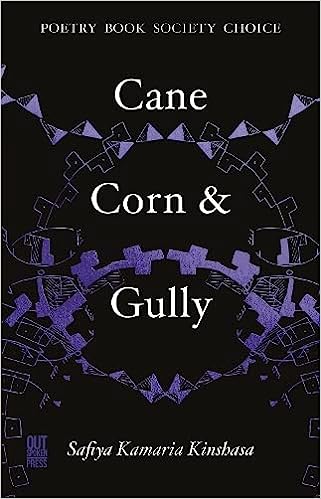 Kinshasa is also a dancer, and in her debut the British-born Barbadian intersperses poems with choreographed dances, transcribed via hand-drawn symbols explained in a key at the end. I confess I couldn’t picture them at all, though they make attractive patterns on the page – you can see one in purple on the cover. This and the Caribbean patois in which she voices narratives of historical atrocities and contemporary microaggressions against Black people (particularly women) are the collection’s claims to novelty and probably impressed the judges. Yet I found both strategies to be affected and looked forward to those poems in standard language. Some of the events are given specific dates and places in Barbados while others are more generic. Female victims of sexual oppression seek revenge, as in the gruesome “Miss Barbados Is No Longer Vegan.” This probably works best aloud, to allow one to appreciate the musicality of the voice and the alliterative lines.
Some lines I liked:
we gambled all our wishes on dandelions,
now we celebrate de little tings
every unburnt rice grain & regrown eyelash
vaulting between lemon vines and dog friendly cafés.
just because we do what needs to be done,
it doan mean we nah ready, we just aware
there are too many of us to be martyrs
(from “Sometimes Death Is a Child Who Plays With Rubber Bands”)
The work is dangerous; writing into history is like feeding unknown seeds while attempting to control the rate of their growth. Sometimes when I danced, I inhaled the language of my ancestors’ captors, and they became mine.
(from “Preface: And if by Some Miracle”)
if you want something to become extinct
doan give it attention.
(from “Choreography: She, My Nation”)
England’s Green by Zaffar Kunial
 A collection in praise of the country’s natural and cultural heritage, with poems about hedgerows and butterflies; cricket and the writings of the Brontë sisters. There are autobiographical reminiscences as well, most notably “The Crucible,” which describes the meeting between his Kashmiri father and his English mother’s father, who had refused to acknowledge the relationship for its first three years.
Kunial clearly delights in language, with wordplay and differing pronunciations fuelling “Foregrounds” et al. I particularly liked “Foxgloves” (“Sometimes I like to hide in the word / foxgloves – in the middle of foxgloves. The xgl is hard to say”) and “The Wind in the Willows,” where he wonders if the book title appeals to him just for its sound. This wasn’t as immediately cohesive and impressive as his first book, Us, but still well worth reading.
Some favourite lines:
“Prayer is not the words / but having none and staying” (from “Empty Words”)
“Life // is wider than its page. And days are a cut field, clipped and made to run on” (from “The Groundsman”)
Manorism by Yomi Sode
Like Surge or Poor (or what little I read of Citizen), this is driven by outrage and a longing for justice for Black people. I suspect that, like those precursors, it is a book best heard in performance, given that Sode honed his skills on London’s open mic circuit.
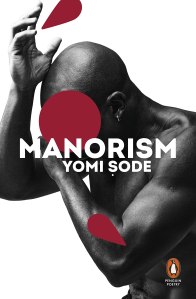 The first third of the book is under the heading “Aneephya,” a word Sode coined and defines as “the stress toxin of inherited trauma” – from slave ships to police checks. My two favourites were from this section: “L’Appel du Vide,” in which he ponders microaggressions while cooking a traditional West African mackerel and okra stew; and “A Plate of Artichokes,” about the time a waiter made him pre-pay for his meal and he went along with it even though he suspected other customers weren’t being asked to do the same.
Nigerian culture, rap music, being a father, and Black brotherhood are other themes, with recurring allusions to the work of Caravaggio. I also liked the long section on the decline and death of his great-aunt (“Big Mummy”) from cancer.
This was a book that made me feel super-white, but that’s not a problem: I can recognize its importance and appeal while also accepting that it’s not necessarily supposed to be for me. 
Which of these poetry collections interest you?
Literary Wives Club: His Only Wife by Peace Adzo Medie
(My fourth read with the Literary Wives online book club; see also Kay’s review and Naomi’s review.)
{SPOILERS IN THIS ONE}
Peace Adzo Medie’s 2020 debut novel was the first disappointment I’ve had from Reese Witherspoon’s book club. The Kirkus review excerpt inside the paperback’s front cover should have given me an idea of what to expect: “A Cinderella story set in Ghana … A Crazy Rich Asians for West Africa.” While both slightly reductive, those comparisons do give some sense of the book’s tone and superficiality.
Afi Tekple is a seamstress whose family arranges for her to marry Elikem Ganyo, a rich international businessman who has properties all over Ghana. In a neat bit of symmetry, I read a novel earlier this year that opened with a traditional Ghanaian divorce ceremony where the husband was in absentia (What Napoleon Could Not Do); this opens with a traditional wedding ceremony where, again, the groom isn’t there. The giving of schnapps as part of a dowry is a customary element of both.
The first half of the novel was agonizingly slow. Afi and her mother do little but sit in an opulent Accra flat, waiting for Eli to grace them with his presence. When he does appear, what luck! (eye roll) he and Afi have a magical sexual connection, described in romance novel language. But he’s only there part time, dividing his attentions between households. Afi enrols in fashion school, cooks and keeps house for Eli, and falls pregnant with his son, Selorm. (In another instance of poor pacing, we then jump to a year after the birth.) It should be a perfect life, yet she’s not happy because there is a rival for her husband’s affections.

You see, Eli’s family chose Afi in the hope that she’d get him to give up the Liberian woman who gave birth to his sickly daughter. They despise Muna for her independent spirit and transgressive behaviour. Although Afi knew about Muna, she doesn’t realize the extent to which she was the Ganyos’ pawn until late on. Meanwhile, Afi has gone from a timid country girl to a confident, high-class boutique owner accustomed to modern conveniences. She won’t ignore her longing to move into Eli’s house and get their marriage legally recognized. She issues an ultimatum: either she’s the only, official wife or she’s out of there.
I kept expecting a showdown between Afi and Muna; then, the further I got, the more I feared Muna wouldn’t appear at all. She does have a scene, 20 pages from the end, and instantly takes on more contours than the evil stereotype the Ganyos have spread, yet it doesn’t change Afi’s jealousy and determination to live independently. I hoped for more of a message of understanding and sisterhood. Initially, the arranged marriage plot reminded me of a particular Chimamanda Ngozi Adichie short story, but Afi’s narration was only so-so and there were more grammar and vocabulary errors than I’m used to encountering in conventionally published work. This might appeal to readers of Ayobami Adebayo’s Stay with Me. (Public library)
The main question we ask about the books we read for Literary Wives is:
What does this book say about wives or about the experience of being a wife?
My main takeaway from His Only Wife is that a marriage doesn’t work if there’s someone interfering – and that refers to Afi’s mother-in-law probably more so than it does to Muna.
Eli just wants to have his cake and eat it. He thinks he should be free to accumulate as many cars and houses and women as he wants. He never intended to leave that woman and you all knew it … I want him to be mine only. Is that too much to ask? I’m sorry that I’m not like other wives who are able to happily share their husbands with co-wives and mistresses and girlfriends. That’s just not me. I’m not built like that.
I was a little uncomfortable that Medie presents legal marriage and monogamy as the only viable option, with Afi coming to disparage the village ceremony she had and wanting the fairy tale proposal in Paris and church wedding instead. Polygamy has a long tradition in countries including Ghana and Nigeria; it might have been interesting for Medie to explore contrasting attitudes toward it. Instead, this feels like pandering to Western tastes.
Next book: The Harpy by Megan Hunter in June
The 2023 Releases I’ve Read So Far
Some reviewers and book bloggers are constantly reading three to six months ahead of what’s out on the shelves, but I tend to get behind on proof copies and read from the library instead. (Who am I kidding? I’m no influencer.)
In any case, I happen to have read a number of pre-release books, generally for paid review for Foreword, Shelf Awareness, etc. Most of my reviews haven’t been published yet; I’ll give very brief excerpts and ratings here to pique the interest.
Early in January I’ll follow up with my 20 Most Anticipated titles of the coming year.
My top recommendations so far:
(In alphabetical order)
 Shoot the Horses First by Leah Angstman [Feb. 28, Kernpunkt Press]: Sixteen sumptuous historical stories ranging from flash to novella length depict outsiders and pioneers who face disability and prejudice with poise.
 The House Is on Fire by Rachel Beanland [April 4, Simon & Schuster]: Four characters – two men and two women; two white people and two Black slaves – are caught up in the Richmond Theater Fire of 1811. Painstakingly researched and a propulsive read.
 Tell the Rest by Lucy Jane Bledsoe [March 7, Akashic Books]: A high school girl’s basketball coach and a Black poet, both survivors of a conversion therapy camp in Oregon, return to the site of their spiritual abuse, looking for redemption.
 All of Us Together in the End by Matthew Vollmer [April 4, Hub City Press]: A pensive memoir investigates the blinking lights that appeared in his family’s woods soon after his mother’s death from complications of Alzheimer’s and Parkinson’s in 2019.
Other 2023 releases I’ve read:
(In publication date order; links to the few reviews that are already available online)
 Pusheen the Cat’s Guide to Everything by Claire Belton [Jan. 10, Gallery Books]: Good-natured and whimsical comic scenes delight in the endearing quirks of Pusheen, everyone’s favorite cartoon cat since Garfield. Belton creates a family and pals for her, too.
 Everything’s Changing by Chelsea Stickle [Jan. 13, Thirty West]: The 20 weird flash fiction stories in this chapbook are like prizes from a claw machine: you never know whether you’ll pluck a drunk raccoon or a red onion the perfect size to replace a broken heart.
 Decade of the Brain by Janine Joseph [Jan. 17, Alice James Books]: With formal variety and thematic intensity, this second collection by the Philippines-born poet ruminates on her protracted recovery from a traumatic car accident and her journey to U.S. citizenship.
 For Thy Great Pain Have Mercy on My Little Pain by Victoria Mackenzie [Jan. 19, Bloomsbury]: Two female medieval mystics, Julian of Norwich and Margery Kempe, are the twin protagonists of Mackenzie’s debut. She allows each to tell her life story through alternating first-person strands that only braid together very late on.
 The Faraway World by Patricia Engel [Jan. 24, Simon & Schuster]: These 10 short stories contrast dreams and reality. Money and religion are opposing pulls for Latinx characters as they ponder whether life will be better at home or elsewhere.
 Your Hearts, Your Scars by Adina Talve-Goodman [Jan. 24, Bellevue Literary Press]: The author grew up a daughter of rabbis in St. Louis and had a heart transplant at age 19. This posthumous collection gathers seven poignant autobiographical essays about living joyfully and looking for love in spite of chronic illness.
 God’s Ex-Girlfriend: A Memoir About Loving and Leaving the Evangelical Jesus by Gloria Beth Amodeo [Feb. 21, Ig Publishing]: In a candid memoir, Amodeo traces how she was drawn into Evangelical Christianity in college before coming to see it as a “common American cult” involving unhealthy relationship dynamics and repressed sexuality.
 Zig-Zag Boy: A Memoir of Madness and Motherhood by Tanya Frank [Feb. 28, W. W. Norton]: A wrenching debut memoir ranges between California and England and draws in metaphors of the natural world as it recounts a decade-long search to help her mentally ill son.
 The Distance from Slaughter County by Steven Moore [March 7, The University of North Carolina Press]: An Iowan now based in Oregon, Moore balances nostalgia and critique to craft nuanced, hypnotic autobiographical essays about growing up in the Midwest. The piece on Shania Twain is a highlight.
Currently reading:
(In release date order)
 My What If Year: A Memoir by Alisha Fernandez Miranda [Feb. 7, Zibby Books]: “On the cusp of turning forty, Alisha Fernandez Miranda … decides to give herself a break, temporarily pausing her stressful career as the CEO of her own consulting firm … she leaves her home in London to spend one year exploring the dream jobs of her youth.”
 Sea Change by Gina Chung [April 11, Vintage]: “With her best friend pulling away to focus on her upcoming wedding, Ro’s only companion is Dolores, a giant Pacific octopus who also happens to be Ro’s last remaining link to her father, a marine biologist who disappeared while on an expedition when Ro was a teenager.”
Additional pre-release books on my shelf:
(In release date order)
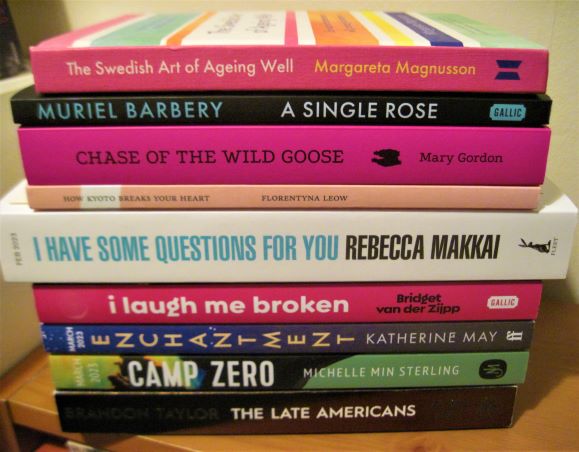
Will you look out for one or more of these?
Any 2023 reads you can recommend already?
Spring Reading, Part II: May, Moving and Swifts
Eight days after our move, there are still piles of boxes, but the furniture is in place and there are clear walkways, so we’ll call that progress. We got a lot of help on moving day from neighbours, one of whom built a tower of book boxes in the corner of the dining room! I had fun dismantling it last week and assigning each box to a particular bookcase. Arranging the contents on shelves will be for once we’re back from Spain.
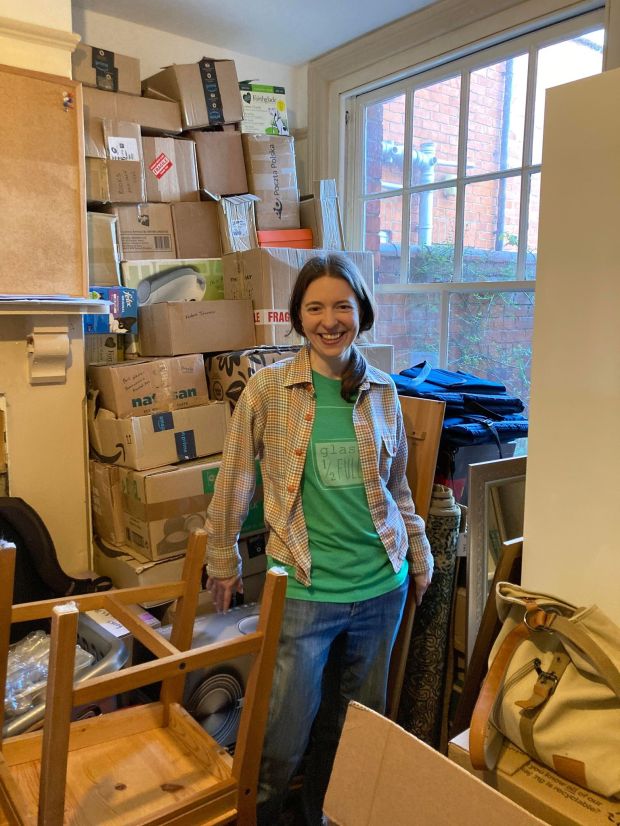
What with moving and DIY, I haven’t had a lot of time for reading lately, so didn’t finish any more of the spring books I’d intended to include – except for one children’s book from the library. I’ll give a little rundown of some of what has been on my coffee table stack.
Busy Spring: Nature Wakes Up by Sean Taylor and Alex Morss; illus. Cinyee Chiu (2021)
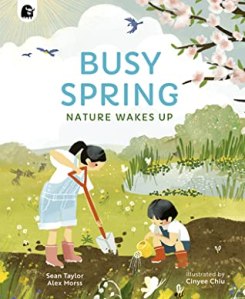 This was a cute read about two little girls helping their father in the garden and discovering the natural wonders of the season, like tadpoles in a pond, birds building nests, and insects and worms in the compost heap. A section at the end gives more information about the science of spring – unfortunately, it mislabels one bird and includes North American species without labelling them as such, whereas the rest of the book was clearly set in the UK. The strategy reminded me of that in Wild Child by Dara McAnulty. This year is the first time a children’s book Wainwright Prize will be awarded, so we’ll see this kind of book being recognized more.
May reads:
 Encore is my last unread journal of May Sarton’s. It begins in May 1991, when she’s 79 and in recovery from major illness. She’s still plagued by pain and fatigue, but her garden and visits from friends are a solace. Although she has to lie down to garden, “to put my hands in the earth to dig is life giving … it is almost as if the earth were nourishing me at the moment.” As usual, there are lovely reflections on the freedoms as well as the losses of ageing. This book, like the previous, was dictated, so there is a bit of repetition. I’ve been amused to see how pretentious she found A.S. Byatt’s Possession! An entry or two at a sitting helped calm my mind during the stress of moving week.
“In a funny way what drives me is the spring, the fleeting spring. Because of the enormous wind and rain we have had, a lot of the daffodils have blown down, though not as many as I feared. But the truth is that their peak is past. We shall have them for another week and then they will be gone. It seems quite unbearable but that is what spring is—the letting go. The waiting and waiting and waiting, and then the letting go.”
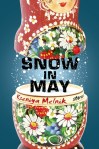
I started a reread of Snow in May by Kseniya Melnik and am partway through the second story. It’s a linked short story collection set in Magadan in northeast Russia – known for Stalin’s forced-labour camps. In “Love, Italian Style, or in Line for Bananas,” it’s 1975 and Tanya is on a shopping spree in Moscow. At a time of deprivation, she buys even things she doesn’t need or that aren’t quite right. Propositioned by an Italian football player on the plane ride over, she fantasizes about the exotic and romantic, juxtaposed against her everyday life.
“The pollen swirled around her like snow. There was a time when the distinctions between right and wrong seemed indisputable, and doing right felt good. When all the decisions had been premade and in her best interest. Back when she didn’t need so much to be happy.”
Belonging
 I saw it on shelf at the library and knew now was the perfect time to read My Life in Houses by Margaret Forster, a memoir via the places she’s lived, starting with the house where she was born in 1938, on a council estate in Carlisle. There’s something appealing to me about tracing a life story through homes – Paul Auster did the same in part of Winter Journal. I’d be tempted to undertake a similar exercise myself someday.
 The swifts come screeching down our new street and we saw one investigating a crevice in our back roof for a nest! In Fledgling by Hannah Bourne-Taylor, she is lonely in rural Ghana, where she and her husband had moved for his work, and takes in a young swift displaced from its nest. I’m only in the early pages, but can tell that her care for the bird will be a way of exploring her own feeling of displacement and the desire to belong. “Although I was unaware of it at the time, the English countryside and the birds had turned into my anchor of home.”
Six Degrees of Separation: From How to Do Nothing to Genie and Paul

It’s my seventh month in a row doing Six Degrees. This time (see Kate’s introductory post) we all start with How to Do Nothing by Jenny Odell, about time and mindfulness. I’ve not read this 2019 release, but its premise reminds me of two books I reviewed a couple of years ago for this Los Angeles Review of Books article on the benefits of “wasting time.”
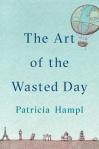
#1 One of those books was The Art of the Wasted Day by Patricia Hampl. The book blends memoir with travel and biographical information about some of Hampl’s exemplars of solitary, introspective living. Her book wanders along with her mind, in keeping with her definition of memoir as “lyrical quest literature,” where meaning always hovers above the basics of plot.
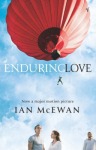
#2 The hot air balloon on the cover takes me to Enduring Love by Ian McEwan. It opens, famously, with a fatal ballooning accident that leaves the witnesses guiltily wondering whether they could have done more. Freelance science journalist Joe Rose – on a picnic with his partner, Keats scholar Clarissa – rushed to help, as did Jed Parry, a young Christian zealot who fixates on Joe. I recently borrowed a DVD of the film from a neighbor and it somehow felt even darker and creepier. (Strangely, the two main characters’ jobs were changed to philosophy professor and sculptor – were those considered easier to show on film?)
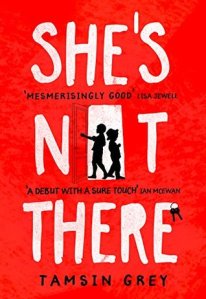 #3 A quote from McEwan on the cover convinced my book club to read the mediocre She’s Not There by Tamsin Grey. (I think the author was also a friend of a friend of someone in the group.) One morning, nine-year-old Jonah wakes up to find the front door of the house open and his mum gone. It takes just a week for the household to descend into chaos as Jonah becomes sole carer for his foul-mouthed little brother, six-year-old Raff. In this vivid London community, children are the stars and grown-ups, only sketchily drawn, continually fail them.
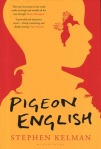
#4 The readalike that came to mind when reading Grey’s novel was Pigeon English by Stephen Kelman, set on a similarly rough London estate. It was on the notorious 2011 Man Booker Prize shortlist (a judge spoke of looking for books that “zip along”; the right author won – Julian Barnes – but for a book I did not particularly enjoy, The Sense of an Ending). The novel is narrated by eleven-year-old Harrison Opoku, who is newly arrived in England from Ghana and turns sleuth when one of his young acquaintances is found murdered.
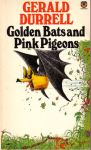
#5 According to my Goodreads library, the only other book I’ve read with “pigeon” in the title is Golden Bats and Pink Pigeons by Gerald Durrell. I love his animal-collecting adventure books, although this one set on Mauritius did not particularly stand out.
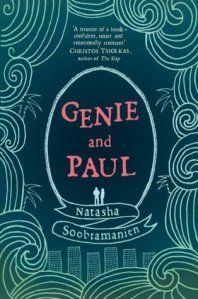 #6 The Mauritius location, plus a return to the “pigeon/pidgin” pun of the Kelman title, leads me to my final book, Genie and Paul by Natasha Soobramanien, about a brother and sister pair who left Mauritius for London as children and still speak Creole when joking. I reviewed this postcolonial response to Paul et Virginie (1788), the classic novel by Jacques-Henri Bernardin de Saint-Pierre, for Wasafiri literary magazine in 2013. It was among my first professional book reviews, and I’ve enjoyed reviewing occasionally for Wasafiri since then – it gives me access to small-press books and BAME authors, which I otherwise don’t read often enough.
Join us for #6Degrees of Separation if you haven’t already! Next month’s starting book will be Rodham by Curtis Sittenfeld (see my review).
 Bookish Beck = Rebecca Foster. American transplant to England. Freelance proofreader and book reviewer.
 Bookish Beck