R.I.P. Part II: Wakenhyrst by Michelle Paver
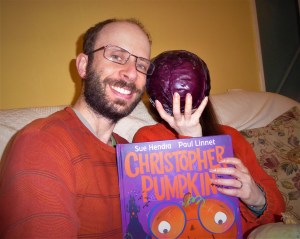
A rainy and blustery Halloween here in southern England, with a second lockdown looming later in the week. I haven’t done anything special to mark Halloween since I was in college, though this year a children’s book inspired me to have some fun with our veg box vegetables for this photo shoot. Just call us Christopher Pumpkin and Rebecca Red Cabbage.
It’s my third year participating in R.I.P. (Readers Imbibing Peril). In each of those three years I’ve reviewed a novel by Michelle Paver. First it was Thin Air, then Dark Matter – two 1930s ghost stories of men undertaking an adventure in a bleak setting (the Himalayas and the Arctic, respectively). I found a copy of her latest in the temporary Little Free Library I started to keep the neighborhood going while the public library was closed during the first lockdown.

Wakenhyrst by Michelle Paver (2019)
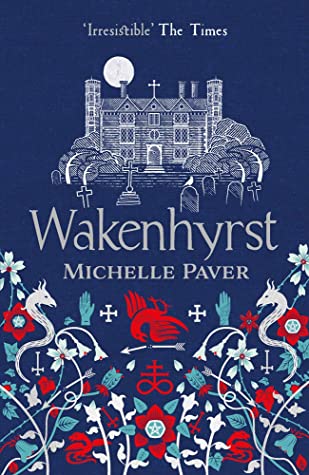 There’s a Gothic flavor to this story of a mentally unstable artist and his teenage daughter. Edmund Stearne is obsessed with the writings of Medieval mystic Alice Pyett (based on Margery Kempe) and with a Bosch-like Doom painting recently uncovered at the local church. Serving as his secretary after her mother’s death, Maud reads his journals to follow his thinking – but also uncovers unpleasant truths about his sister’s death and his relationship with the servant girl. As Maud tries to prevent her father from acting on his hallucinations of demons and witches rising from the Suffolk Fens, she falls in love with someone beneath her class. Only in the 1960s framing story, which has a journalist and scholar digging into what really happened at Wake’s End in 1913, does it become clear how much Maud gave up.
There are a lot of appealing elements in this novel, including Maud’s pet magpie, the travails of her constantly pregnant mother (based on the author’s Belgian great-grandmother), the information on early lobotomies, and the mixture of real (eels!) and imagined threats encountered at the fen. The focus on a female character is refreshing after her two male-dominated ghost stories. But as atmospheric and readable as Paver’s writing always is, here the plot sags, taking too much time over each section and filtering too much through Stearne’s journal. After three average ratings in a row, I doubt I’ll pick up another of her books in the future.
My rating: 
My top R.I.P. read this year was Sisters by Daisy Johnson, followed by 666 Charing Cross by Paul Magrs (both reviewed here).
Have you been reading anything spooky for Halloween?
Doorstopper of the Month: The Cider House Rules by John Irving (A Reread)
Next month will be all about the short books (#NovNov!), but first it was time to get this excessively long one out of the way. My husband’s and my reading tastes don’t overlap in many areas, but John Irving is our mutual favorite author. I first started The Cider House Rules (1985) on our second honeymoon – being from two different countries, we had two nuptial ceremonies and two honeymoons, one per continent – which was a road trip through New England. We drove from Maryland to Maine and back; I have a specific memory of reading the chunky Irving hardback at our B&B in Stowe, Vermont. I was a much less prolific reader in those days, so I had to return my American library copy partially read and then pay to reserve one from the Hampshire Libraries system once we were back in the UK.
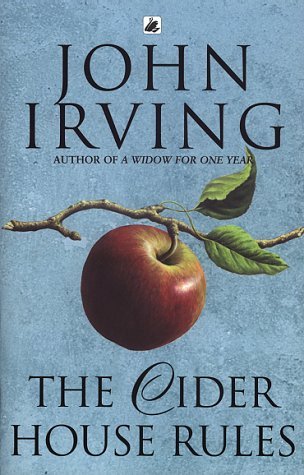
Thirteen years on, I remembered the orphanage and cider farm settings, the dynamic between Doctor Wilbur Larch and his protégé, Homer Wells, and Homer’s love for his best friend’s girl, Candy. I also remembered that this is a Trojan horse of a novel: it advocates, not very subtly, for abortion rights through pictures of women in desperate situations. Luckily, by the time I first read it I was no longer slavishly devoted to the American Religious Right. But this time I felt that even readers who consider themselves pro-choice might agree Irving over-eggs his argument. My memory of the 1999 film version is clearer. It severely condenses the book’s 40 years or so of action, cutting subplots and allowing Tobey Maguire and Charlize Theron to play the leads all the way through. A shorter timeframe also more neatly draws a line between Rose Rose’s experience and Homer’s change of heart about offering abortions.
I had a strong preference for the scenes set at St. Cloud’s orphanage in Maine. Dr. Larch is celibate and addicted to ether – all a result of his first sexual encounter with a prostitute. He has an ironclad conviction that he is doing the Lord’s work for the pregnant women who get off the train at St. Cloud’s, whether they come for an abortion or to leave a live baby behind. Homer Wells is the one orphan who never finds an adoptive home; he stays on and becomes Larch’s trainee in obstetrics, but vows that he won’t perform abortions. As a young adult, Homer is pulled away from the orphanage by his puppy love for Wally and Candy, a couple-in-trouble who come up from his family’s apple farm. Homer thinks he’ll go back with his new friends for a month or two, but instead he stays at Ocean View orchard for decades, his relationship with Candy changing when Wally goes off to war and comes back disabled.
I had forgotten the bizarre scenario Larch has to set up for the orphanage’s board of trustees to accept his chosen successor, and the far-fetched family situation Homer, Candy and Wally end up in. The orchard sections could feel endless, so I always thrilled to mentions of what was happening for Dr. Larch and the nurses back at St. Cloud’s.

Oktoberfest reading and snacking.
The Dickensian influence – lots of minor characters and threads tying up nicely by the end; quirks of speech and behavior – has generally been the aspect I like the most about Irving’s work, and while I loved the explicit references to David Copperfield here (a few kids get their names from it, it’s read aloud to the boy orphans every night, and its opening question about whether the protagonist will be the hero of his own life or not applies to Homer, too), I did find the novel awfully baggy this time. I even put in a slip of paper where I felt that things started to drift: page 450.
One further note to make about the film: it, rather unforgivably, eliminates Melony, a larger-than-life character and necessary counterpart to the book’s multiple passive females. She’s the de facto head of the girl orphans, as Homer is for the boys, and initiates Homer into sex. But her feelings for him are more of hero worship than of romantic love, and when he breaks his promise and leaves St. Cloud’s without her, she sets off to hunt him down. Her odyssey, delivered in parallel, is nearly as important as Homer’s (see what I/Irving did there?).
While I loved the medical history material and Dr. Larch’s moral fiber, this time I found Homer a little insipid and annoying (he answers nearly every question with “Right”), and the plot somewhat slack and obvious. In my memory this is probably #3 out of the Irving novels I’ve read, below A Prayer for Owen Meany and The World According to Garp – both of which I’d also like to reread to see if they’ve retained their power.
Page count: 731
My original rating (July–September 2007): 
My rating now: 
Done any rereading, or picked up any very long books, lately?
Catching Up on Review Books: Antlers, Arnett, E. Williams, Yamboliev
Four July–August releases: Scottish nature writing, the quirky story of a family taxidermy business in Florida, a dual-timeline novel set at an unusual dictionary’s headquarters, and a critical and personal response to Jeffrey Eugenides’ Middlesex.
Antlers of Water: Writing on the Nature and Environment of Scotland, edited by Kathleen Jamie
 This nature writing anthology of essays, poems and visual art drew me because of contributor names like GP Gavin Francis (reviewed: Shapeshifters), Amy Liptrot (the Wainwright Prize-winning memoir The Outrun), singer/songwriter Karine Polwart, and Shetland chronicler Malachy Tallack (reviewed: The Un-Discovered Islands and The Valley at the Centre of the World), not to mention editor Kathleen Jamie. Archaeology and folk music evoke the past, while climate change scenarios inject a sense of a menacing future. Seabirds circle and coastal and island scenery recurs. Entries from Alec Finlay’s “A Place-Aware Dictionary” disguise political points under tongue-in-cheek language, as in a definition of foraging: “Later sometimes referred to as the Brexit Diet.” The (sub)urban could be more evident, and I didn’t need two bouts of red deer sex, but there’s still a nice mix of tones and approaches here.
Six best pieces (out of 24): Chris Powici on wind turbines and red kites at the Braes of Doune; Jacqueline Bain on how reduced mobility allows her to observe wasps closely; Jim Crumley on sea eagle reintroductions and the ancient sky burials that took place at the Tomb of the Eagles; Jen Hadfield on foraging for whelks at the ocean’s edge, in a run-on hybrid narrative; Sally Huband on how persecution of ravens and of women (still not allowed to take part in Up Helly Aa festivities) continues on Shetland; and Liptrot on how wild swimming prepared her for childbirth and helped her to recover a sense of herself separate from her baby. And if I had to pick just one, the Huband – so brave and righteously angry.
Favorite lines:
“Compromises need to be made. An overlap between the wild and the human has to be negotiated and managed. … So let’s play merry hell with the distinction between what counts as wild and what counts as human, between what’s condemned as a visual obscenity and what’s seen as a marvel of the age. Let’s mess up the boundaries and get a new measure of ourselves as a species.” (Powici)
inspiration to get out walking again: “Don’t wait / thinking you’ve seen it all already … don’t wait thinking you need better boots / or a waterproof that’ll keep out the rain. / It won’t. Don’t wait.” (“Water of Ae” by Em Strang)
My rating:
My thanks to Canongate for the free copy for review.
Mostly Dead Things by Kristen Arnett
“We couldn’t ever leave roadkill behind. Something inside us always made us stop to pick up dead things.”
 After her father’s suicide, Jessa-Lynn Morton takes over the family taxidermy business in central Florida. Despite her excessive drinking and grief over both her father and her best friend and long-time on-and-off girlfriend (also, inconveniently, her brother’s wife) Brynn, who recently took off, she’s just about holding it together. That is, until 1) her mother takes to composing interspecies orgies and S&M scenes in the shop window and 2) her niece and nephew, Lolee and Bastien, start bringing in specimens for taxidermy that they haven’t exactly obtained legally. Gallery owner Lucinda Rex takes an interest in her mother’s ‘art’ and is soon a new romantic interest for Jessa. But the entire family is going to have to face its issues before her professional and love life can be restored.
This debut novel’s title, cover and premise were utterly irresistible to me, and though I loved the humid Florida setting, it was all a bit too much. At 200 pages this could have been a razor-sharp new favorite, but instead there was a lot of sag in its 350+ pages. Alternating chapters based around mounting particular animals give glimpses into the family’s past but mostly have Jessa mooning over Brynn. Her emotional journey starts to feel belabored; it’s as if an editor tried to rein in Arnett’s campy glee at the dysfunctional family’s breakdown and made her add in some amateur psychoanalysis, and for me this diluted the quirky joy.
Skinning and sex scenes are equally explicit here. This never bothered me, but it should go without saying that it is not a book for the squeamish. It’s when sex and taxidermy mix that things get a little icky, as in her mother’s X-rated tableaux and a line like “Often I found myself comparing the limber body of a deer with the long line of [Lucinda’s] legs or the strong cord of her neck.” Believe it or not, this is not the first queer taxidermy novel I’ve read. The other one, English Animals by Laura Kaye, was better. I’d wanted another Swamplandia! but got something closer to Black Light instead.
My rating: 
My thanks to Corsair for the free copy for review.
The Liar’s Dictionary by Eley Williams
 Mallory is five years into an internship at Swansby House, the London headquarters of Swansby’s dictionary. The dictionary is known for being unfinished – too many of its lexicographers left for WWI and never returned – and for having made-up words. In 1899, Peter Winceworth, the butt of jokes among his colleagues, started composing mountweazels (fake entries) and inserting them into the dictionary. In the contemporary story line, Mallory’s job is to remove the mountweazels as the dictionary is prepared for digitization. But her attention is distracted by anonymous bomb threats and by lingering shame about her sexuality – Mallory thinks she’s “out enough,” but her girlfriend Pip begs to differ.
Chapters are headed with vocabulary words running from A to Z, and alternate between Mallory’s first-person narration and a third-person account of Winceworth’s misadventures at the turn of the twentieth century. In any book with this kind of structure I seem to prefer the contemporary strand and itch to get back to it, though there is a quite astounding scene in which Winceworth intervenes to help a choking pelican. Events at Swansby House resonate and mirror each other across the dozen decades, with both main characters emerging with a new sense of purpose after an epiphany that life is about more than work. Though silly in places, this has a winning love of words and characters you’ll care about.
A favorite made-up word: “Mammonsomniate: to dream that money might make anything possible.”
Readalikes: Enter the Aardvark by Jessica Anthony and Boxer, Beetle by Ned Beauman
My rating:
My thanks to William Heinemann for the proof copy for review.
Looking Was Not Enough: Jeffrey Eugenides’ Middlesex by Irena Yamboliev
 When I worked in a university library and read Middlesex during quiet evenings on the circulation desk in 2009, a colleague asked me, “Is that about the London borough?” My reply: “Er, no, it’s about a hermaphrodite.” That’s an off-putting, clinical sort of word, but it does appear in the first paragraph of this family saga with a difference, after the mythological intensity and medical necessity implied by the killer opening line: “I was born twice: first, as a baby girl, on a remarkably smogless Detroit day in January of 1960; and then again, as a teenage boy, in an emergency room near Petoskey, Michigan, in August of 1974.”
Cal, born Calliope but now living as a man and working in the Foreign Service, recounts three generations of family history, from Greece to Detroit to Berlin. “Because … their parents were dead and their village destroyed, because no one in Smyrna knew who they were,” brother and sister Lefty and Desdemona became lovers and got married on the boat over to America. They were his grandparents. Add to that his parents’ first-cousin marriage and you see how inbreeding played genetic havoc and made way for Callie/Cal.
 I intended to reread Middlesex, which I consider one of my all-time favorite books, but only made it through 60 pages on this occasion. Still, Yamboliev, a Bulgarian-American who teaches at Stanford, reminded me of everything I love about it: the medical theme, the exploration of selfhood, the playful recreation of the past. Drawing parallels with her own family’s move to America, she ponders the disconnection from the home country and the creation of a new life story. “To tell ourselves where we come from—to narrate—is to find a pattern retroactively.” She also looks at literary precursors like Ovid’s Metamorphoses, Herculine Barbin’s memoir, and Balzac’s and Barthes’s writings on a castrato. “Does transformation make the self discontinuous?” is one of her central questions, and she likens Cal’s situation to that of trans men who have to train themselves to speak, dress and act in a convincingly masculine way.
This is part of Fiction Advocate’s “Afterwords” series; all its monographs do a wonderful job of blending literary criticism, enthusiastic appreciation, and autobiographical reflection as life dovetails with (re)reading. I’ve previously reviewed the Fiction Advocate books on Blood Meridian, Fun Home, and The Year of Magical Thinking in this post, and the ones on Karl Ove Knausgaard’s My Struggle and Cheryl Strayed’s Wild in this one.
My rating:
My thanks to Fiction Advocate for the free e-copy for review.
What recent releases can you recommend?
Women’s Prize Winners Reading Project: Grant, Martin, Shields et al.
In this 25th anniversary year of the Women’s Prize, readers are being encouraged to catch up on all the previous winners. I’d read 14 of them (including Hamnet) as of mid-April and have managed five more since then – plus a reread, a DNF and a skim. I recently reviewed Fugitive Pieces by Anne Michaels, and Half of a Yellow Sun by Chimamanda Ngozi Adichie and A Crime in the Neighborhood by Suzanne Berne as part of this summer reading post. This leaves just four more for me to read before voting for my all-time favorite in November.
When I Lived in Modern Times by Linda Grant (2000)
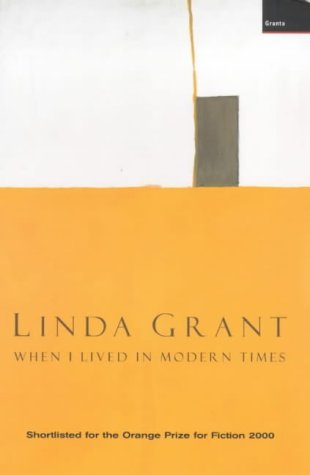 Some settings have been done to death, but here’s one I don’t think I’d ever encountered before: Israel in the final year before statehood. Grant dramatizes the contrast between Palestine, a doomed British colony, and the Jewish hope of a homeland. In 1946 twenty-year-old Evelyn Sert leaves her home in London, masquerading as a Gentile tourist (though she has Latvian Jewish ancestry) so as to jump ahead of thousands of displaced persons awaiting entry visas. With her mother recently dead of a stroke, she takes advice and money from her mother’s married boyfriend, “Uncle Joe,” a Polish Jew and Zionist, and heads to Palestine.
After six weeks on a kibbutz, Evelyn sets out to make her own life in Tel Aviv as a hairdresser and falls in with Johnny, a Jew who fought for the British. It’s safer to be part of the colonial structure here, so she once again passes as Gentile, dyeing her hair blonde and going by Priscilla Jones. In a land where all kinds of people have been thrown together by the accident of their ethnicity and the suffering it often entailed, one man’s terrorist is another’s freedom fighter. For Evelyn, who’s never known anywhere apart from suburban London and arrived in Palestine a virgin, the entire year is a journey of discovery. Will a place of ancient religious significance embrace modern architecture, technology and government? Grant really captures this period of transition for an individual and for a nascent nation of exiles. I loved the supporting characters and the nostalgic look back from half a century on.
Favorite passages:
In a country with its face turned towards the future, our stories sat on our shoulders like a second head, facing the way we had come from. We were the tribe of Janus, if there is such a thing.
With hindsight it always seems easy to do the right thing, but we were trying to decide something in those days that people don’t often get a chance to have a say in and it was this: would we be a free nation after two thousand years of wandering or would we always be a subject race? Would we be ghetto Jews or new Jews?
Property by Valerie Martin (2003)
 A compact study of slavery that unfolds through the relationship between a New Orleans plantation owner’s wife and her husband’s mistress. Manon Gaudet has never been happy in her marriage, but when their slave girl, Sarah, bears her husband a second child, she decides she has had enough of silently condoning his behavior. A slave uprising and cholera and yellow fever outbreaks provide some welcome drama, but the bulk of this short novel is an examination of the psyche of a woman tormented by hatred and jealousy. Ownership of another human being is, if not technically impossible, certainly not emotionally tenable. Manon’s situation is also intolerable because she has no rights as a woman in the early nineteenth century: any property she inherits will pass directly to her husband. Though thoroughly readable, for me this didn’t really add anything to the corpus of slavery fiction.
A reread (as well as a buddy read with Buried in Print):
Larry’s Party by Carol Shields (1997)
“The whole thing about mazes is that they make perfect sense only when you look down on them from above.”
 Larry Weller is an Everyman: sometimes hapless and sometimes purposeful; often bewildered with where life has led him, but happy enough nonetheless. From the start, Shields dwells on the role that “mistakes” have played in making Larry who he is, like a floral arts catalogue coming in the mail from the college instead of one on furnace repair and meeting Dorrie at a Halloween party he attended with a different girl. Before he knows it he and a pregnant Dorrie are getting married and he’s been at his flower shop job for 12 years. A honeymoon tour through England takes in the Hampton Court Palace maze and sparks an obsession that will change the course of Larry’s life, as he creates his first maze at their Winnipeg home and gradually becomes one of a handful of expert maze-makers.
The sweep of Larry’s life, from youth to middle age, is presented roughly chronologically through chapters that are more like linked short stories: they focus on themes (family, friends, career, sex, clothing, health) and loop back to events to add more detail and new insight. I found the repetition of basic information about Larry somewhat off-putting in that it’s as if we start over with this character with each chapter – the same might be said of Olive Kitteridge, but that book’s composition was drawn out and it involves a multiplicity of perspectives, which explains the slight detachment from Olive. Here the third-person narration sticks close to Larry but gives glimpses into other points of view, tiny hints of other stories – a man with AIDS, a woman trying to atone for lifelong selfishness, and so on.
From my first reading I remembered a climactic event involving the Winnipeg maze; a ribald chapter entitled “Larry’s Penis,” about his second marriage to a younger woman and more; and the closing dinner party, a masterful sequence composed almost entirely of overlapping dialogue (like the final wedding reception scene in her earlier novel, The Box Garden) as Larry hosts his two ex-wives, his current girlfriend, his sister and his partner, and a colleague and boss. What is it like to be a man today? someone asks, and through the responses Shields suggests a state of uneasiness, of walking on eggshells and trying not to be a chauvinist in a world whose boundaries are being redrawn by feminism. That process has continued in the decades since, though with predictable backlash from those who consider women a threat.
It seems slightly ironic that Shields won the Women’s Prize for this episodic fictional biography of a man, but I found so much to relate to in Larry’s story – the “how did I get here?” self-questioning, the search for life’s meaning, “the clutter of good luck and bad” – that I’d say Larry is really all of us.
One of Shields’s best, and quite possibly my winner of winners.
My original rating (2008?):
My rating now: 
Currently rereading: Gilead by Marilynne Robinson
A skim:
A Spell of Winter by Helen Dunmore (1995)
 An annoying thing happened with this one: the back cover blurb gave away a central theme. It’s one I’m keen to avoid yet feel I have encountered disproportionately often in fiction, especially recently (I won’t name any titles as that would give it away instantly). Dunmore writes nicely – from my quick skim of this one it seemed very atmospheric – but I am not particularly drawn to her plots. I’ve read Exposure for book club and own two more of her novels, Talking to the Dead and Zennor in Darkness, so by the time I’ve read those I will have given her a solid try. So far I’ve preferred her poetry – I’ve read three of her collections.
A favorite passage:
“It is winter in the house. This morning the ice on my basin of water is so thick I can not break it. The windows stare back at me, blind with frost. … I can see nothing through the frost flowers on the glass. I wonder if it is snowing yet, but I think it is too cold. … I look at the house, still and breathless in the frost. I have got what I wanted. A spell of winter hangs over it, and everyone has gone.”
And a DNF:
The Song of Achilles by Madeline Miller (2011)
 Patroclus is a disappointment of a prince. He has no chance of winning Helen of Troy’s hand in marriage, and exile awaits him when he is responsible for an accidental death. As a foster child in the household of another king, he becomes obsessed with Achilles. The two young men take part in music lessons and military training, and Patroclus follows Achilles away from the palace to be taught by a centaur. That’s as far as I got before I couldn’t bear any more. The homoerotic hints are laughably unsubtle: (of a lyre) “‘You can hold it, if you like.’ The wood would be smooth and known as my own skin” & (fighting) “he rolled me beneath him, pinning me, his knees in my belly. I panted, angry but strangely satisfied.”
I got a free download from Emerald Street, the Stylist magazine e-newsletter. The ancient world, and Greek mythology in particular, do not draw me in the least, and I have had bad experiences with updates of Greek myths before (e.g. Bright Air Black by David Vann). I never thought this would be a book for me, but still wanted to attempt it so I could complete the set of Women’s Prize winners. I read 77 pages out of 278 in the e-book, but when I have to force myself to pick up a book, I know it’s a lost cause. As with the Dunmore, I think it’s safe to say this one never would have gotten my vote anyway.
The final four to complete my project:
(On the stack to read soon)
The Idea of Perfection by Kate Grenville – free from mall bookshop
The Glorious Heresies by Lisa McInerney – public library copy
How to Be Both by Ali Smith – public library copy; a planned buddy read with B.I.P.
(To get from the university library)
A Girl Is a Half-formed Thing by Eimear McBride
Read any Women’s Prize winners lately?
Summery Classics by J. L. Carr and L. P. Hartley
“Do you remember what that summer was like? – how much more beautiful than any since?”
These two slightly under-the-radar classics made for perfect heatwave reading over the past couple of weeks: very English and very much of the historical periods that they evoke, they are nostalgic works remembering one summer when everything changed – or could have.
A Month in the Country by J. L. Carr (1980)
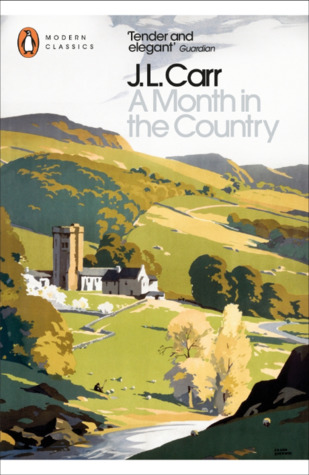 Summer 1920, North Yorkshire. Tom Birkin, a First World War veteran whose wife has left him, arrives in Oxgodby to uncover the local church’s wall painting of the Judgment Day, assumed to be the work of a medieval monk and long since whitewashed over. With nothing waiting for him back in London and no plans beyond this commission, he gives himself over to the daily rhythms of working, eating and sleeping – “There was so much time that marvelous summer.” This simple life is punctuated by occasional incidents like a Sunday school hayride and picnic, and filling in as a lay preacher at a nearby chapel. Also embarked on a quest into the past is Charles Moon, who is searching for the grave of their patroness’ ancestor in the churchyard. Moon, too, has a war history he’d rather forget.
Though it barely exceeds 100 pages, this novella is full of surprises – about Moon, about the presumed identity and fate of the centuries-dead figures he and Birkin come to be obsessed with, and about the emotional connection that builds between Birkin and Reverend Keach’s wife, Alice. “It is now or never; we must snatch at happiness as it flies,” Birkin declares, but did he take his own advice? There is something achingly gorgeous about this not-quite-love story, as evanescent as ideal summer days. Carr writes in a foreword that he intended to write “a rural idyll along the lines of Thomas Hardy’s Under the Greenwood Tree.” He indeed created something Hardyesque with this tragicomic rustic romance; I was also reminded of another very English classic I reviewed earlier in the year: Cider with Rosie by Laurie Lee.
Source: Free bookshop
My rating: 
A contemporary readalike: The Offing by Benjamin Myers
The Go-Between by L. P. Hartley (1953)
Summer 1900, Norfolk. Twelve-year-old Leo Colston is invited to spend the several July weeks leading up to his birthday at his school friend Marcus Maudsley’s home, Brandham Hall. Although the fatherless boy is keenly aware of the class difference between their families, in a year of learning to evade bullies he’s developed some confidence in his skills and pluck, fancying himself an amateur magician and gifted singer. Being useful makes him feel less like a charity case, so he eagerly agrees to act as “postman” for Marcus’s older sister, Marian, who exchanges frequent letters with their tenant farmer, Ted Burgess. Marian, engaged to Hugh, a viscount and injured Boer War veteran, insists the correspondence is purely business-related, but Leo suspects he’s abetting trysts the family would disapprove of.
 Leo is right on the cusp of adolescence, a moment of transition that mirrors the crossing into a new century. As he glories in the summer’s mounting heat, “a liberating power with its own laws,” and mentally goads the weather into hitting ever greater extremes, he pushes against the limits of his innocence, begging Ted to tell him about “spooning” (that is, the facts of life). The heat becomes a character in its own right, gloweringly presiding over the emotional tension caused by secrets, spells and betrayals. And yet this is also a very funny novel: I loved Leo’s Franglais conversations with Marcus, and the confusion over mispronouncing “Hugh” as “you.” In places the tone even reminded me of Cold Comfort Farm.
Like A Month in the Country, this autobiographical story is an old man’s reminiscences, going back half a century in memory – but here Leo gets the chance to go back in person as well, seeing what has become of Brandham Hall and meeting one of the major players from that summer drama that branded him for life. I thought this masterfully done in every way: the class divide, the picture of childhood tipping over into the teenage years, the oppressive atmosphere, the comical touches. You know from the famous first line onwards (“The past is a foreign country: they do things differently there”) that this will juxtapose past and present – which, of course, has now become past and further past – in a powerful way, similar to Moon Tiger, my favorite fiction read of last year. I’ll be exploring more of Hartley’s work.
(Note: Although I am a firm advocate of DNFing if a book is not working for you, I would also like to put in a good word for trying a book again another time. Ironically, this had been a DNF for me last summer: I found the prologue, with all its talk of the zodiac, utterly dull. I had the same problem with Cold Comfort Farm, literally trying about three times to get through the prologue and failing. So, for both, I eventually let myself skip the prologue, read the whole novel, and then go back to the prologue. Worked a treat.)
Source: Ex-library copy bought from Lambeth Library when I worked in London
My rating: 
A contemporary readalike: Atonement by Ian McEwan
Recommended July Releases: Donoghue, Maizes, Miller, Parikian, Trethewey
My five new releases for July include historical pandemic fiction, a fun contemporary story about a father-and-daughter burglar team, a new poetry collection from Carcanet Press, a lighthearted nature/travel book, and a poetic bereavement memoir about a violent death.
The Pull of the Stars by Emma Donoghue
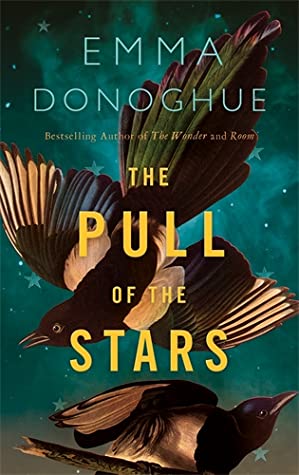 Donoghue’s last two novels, The Wonder and Akin, were big hits with me. Less than a year after the contemporary-set Akin, she’s back to a historical setting – and an uncannily pertinent pandemic theme – with her latest. In 1918, Julia Power is a nurse on a Dublin maternity ward. It’s Halloween and she is about to turn 30, making her a spinster for her day; she lives with her mute, shell-shocked veteran brother, Tim, and his pet magpie.
Because she’s already had “the grip” (influenza), she is considered immune and is one of a few staff members dealing with the flu-ridden expectant mothers in quarantine in her overcrowded hospital. Each patient serves as a type, and Donoghue whirls through all the possible complications of historical childbirth: stillbirth, obstructed labor, catheterization, forceps, blood loss, transfusion, maternal death, and so on.
It’s not for the squeamish, and despite my usual love of medical reads, I felt it was something of a box-ticking exercise, with too much telling about medical procedures and recent Irish history. Because of the limited time frame – just three days – the book is far too rushed. We simply don’t have enough time to get to know Julia through and through, despite her first-person narration; the final 20 pages, in particular, are so far-fetched and melodramatic it’s hard to believe in a romance you’d miss if you blinked. And the omission of speech marks just doesn’t work – it’s downright confusing with so many dialogue-driven scenes.
Donoghue must have been writing this well before Covid-19, but I wouldn’t be surprised if the publication was hurried forward to take advantage of the story’s newfound relevance. It shows: what I read in May and June felt like an unpolished draft, with threads prematurely tied up to meet a deadline. This was an extremely promising project that, for me, was let down by the execution, but it’s still a gripping read that I wouldn’t steer you away from if you find the synopsis appealing. (Some more spoiler-y thoughts here.)
Prescient words about pandemics:
“All over the globe … some flu patients are dropping like flies while others recover, and we can’t solve the puzzle, nor do a blasted thing about it. … There’s no rhyme or reason to who’s struck down.”
“Doctor Lynn went on, As for the authorities, I believe the epidemic will have run its course before they’ve agreed to any but the most feeble action. Recommending onions and eucalyptus oil! Like sending beetles to stop a steamroller.”
Why the title?
Flu comes from the phrase “influenza delle stelle” – medieval Italians thought that illness was fated by the stars. There’s also one baby born a “stargazer” (facing up) and some literal looking up at the stars in the book.
My rating:
My thanks to Picador for the proof copy for review.
Other People’s Pets by R.L. Maizes
 This is Maizes’ debut novel, after her 2019 short story collection We Love Anderson Cooper. Louise “La La” Fine and her father, Zev, share an unusual profession: While outwardly they are a veterinary student and a locksmith, respectively, for many years they broke into homes and sold the stolen goods. Despite close shaves, they’ve always gotten away with it – until now. When Zev is arrested, La La decides to return to her criminal ways just long enough to raise the money to post bail for him. But she doesn’t reckon on a few complications, like her father getting fed up with house arrest, her fiancé finding out about her side hustle, and her animal empathy becoming so strong that when she goes into a house she not only pilfers valuables but also cares for the needs of ailing pets inside.
Flashbacks to La La’s growing-up years, especially her hurt over her mother leaving, take this deeper than your average humorous crime caper. The way the plot branches means that for quite a while Zev and La La are separated, and I grew a bit weary of extended time in Zev’s company, but this was a great summer read – especially for animal lovers – that never lost my attention. The magic realism of the human‒pet connection is believable and mild enough not to turn off readers who avoid fantasy. Think The Twelve Lives of Samuel Hawley meets Hollow Kingdom.
My rating: 
My thanks to the author and Celadon Books for the free e-copy for review.
The Long Beds by Kate Miller
 Here and there; now and then: the poems in Miller’s second collection enlarge such dichotomies by showcasing the interplay of the familiar and the foreign. A scientist struggles to transcribe birdsong, and a poppy opens in slow motion. “Flag” evokes the electric blue air and water of a Greek island, while “The Quarters” is set in the middle of the night in a French village. A few commissions, including “Waterloo Sunrise,” stick close to home in London or other southern England locales.
Various poems, including the multi-part “Album Without Photographs,” are about ancestor Muriel Miller’s experiences in India and Britain in the 1910s-20s. “Keepers of the States of Sleep and Wakefulness, fragment from A Masque,” patterned after “The Second Masque” by Ben Jonson, is an up-to-the-minute one written in April that names eight nurses from the night staff at King’s College Hospital (and the short YouTube film based on it is dedicated to all NHS nurses).
My two favorites were “Outside the Mind Shop,” in which urban foxes tear into bags of donations outside a charity shop one night while the speaker lies awake, and “Knapsack of Parting Gifts” a lovely elegy to a lost loved one. I spotted a lot of alliteration and assonance in the former, especially. Thematically, the collection is a bit scattered, but there are a lot of individual high points.
My rating:
My thanks to Carcanet Press for the free e-copy for review.
Into the Tangled Bank: In Which Our Author Ventures Outdoors to Consider the British in Nature by Lev Parikian
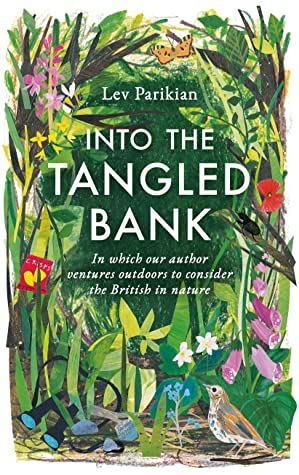 In the same way that kids sometimes write their address by going from the specific to the cosmic (street, city, country, continent, hemisphere, planet, galaxy), this book, a delightfully Bryson-esque tour, moves ever outwards, starting with the author’s own home and garden and proceeding to take in his South London patch and his journeys around the British Isles before closing with the wonders of the night sky. By slowing down to appreciate what is all around us, he proposes, we might enthuse others to engage with nature.
With the zeal of a recent convert, he guides readers through momentous sightings and everyday moments of connection. As they were his gateway, many of these memories involve birds: looking for the year’s first swifts, trying to sketch a heron and realizing he’s never looked at one properly before, avoiding angry terns on the Farne Islands, ringing a storm petrel on Skokholm, and seeing white-tailed eagles on the Isle of Skye. He brings unique places to life, and pays tribute to British naturalists who paved the way for today’s nature-lovers by visiting the homes of Charles Darwin, Gilbert White, Peter Scott, and more.
I was on the blog tour for Parikian’s previous book, Why Do Birds Suddenly Disappear?, in 2018. While the books are alike in levity (pun intended!), being full of self-deprecation and witty asides along with the astute observations, I think I enjoyed this one that little bit more for its all-encompassing approach to the experience of nature. I fully expect to see it on next year’s Wainwright Prize longlist (speaking of the Wainwright Prize, in yesterday’s post I correctly predicted four on the UK nature shortlist and two on the global conservation list!).
Readalikes (that happen to be from the same publisher): Under the Stars by Matt Gaw and The Seafarers by Stephen Rutt
My rating:
My thanks to Elliott & Thompson for the free copy for review.
Memorial Drive: A Daughter’s Memoir by Natasha Trethewey
 Trethewey grew up in 1960s Mississippi with a Black mother and a white Canadian father, at a time when interracial marriage remained illegal in parts of the South. After her parents’ divorce, she and her mother, Gwen, moved to Georgia to start a new life, but her stepfather Joel was physically and psychologically abusive. Gwen’s murder opens and closes the book. Trethewey only returned to that Atlanta apartment on Memorial Drive after 30 years had passed. The blend of the objective (official testimonies and transcripts) and the subjective (interpreting photographs, and rendering dream sequences in poetic language) makes this a striking memoir, as delicate as it is painful. I recommend it highly to readers of Elizabeth Alexander and Dani Shapiro. (Full review forthcoming at Shiny New Books.)
My rating: 
My thanks to Bloomsbury for the proof copy for review.

 I’m reading two more July releases, Mostly Dead Things by Kristen Arnett (Corsair, 2 July; for Shiny New Books review), about a family taxidermy business in Florida, and The Liar’s Dictionary by Eley Williams (William Heinemann, 2 July), about an unusual dictionary being compiled in the Victorian period and digitized in the present day.
What July releases can you recommend?
Asking What If? with Rodham by Curtis Sittenfeld
Early on in Curtis Sittenfeld’s sixth novel, a work of alternative history narrated entirely by Hillary Rodham and covering the years between 1970 and the recent past, the character describes the method of decision-making she’s used since the third grade:
I thought of it as the Rule of Two: If I was unsure of a course of action but could think of two reasons for it, I’d do it. If I could think of two reasons against it, I wouldn’t.
Here’s the Rule of Two as applied to Rodham:
- You are likely to enjoy this novel if:
- You (if American) voted for Hillary Clinton or (if not) admire her and think she should have won the 2016 presidential race.
- You are a devoted fan of Curtis Sittenfeld’s writing and, in particular, loved American Wife (her 2008 masterpiece from the perspective of a fictionalized Laura Bush) and/or “The Nominee,” a short story voiced by HRC that appeared in the UK edition of You Think It, I’ll Say It.
- You will probably want to avoid this novel if:
- The idea of spending hours in Hillary’s head – hearing about everything from how Bill Clinton makes her feel in bed to her pre-debate nervous diarrhea – causes you to recoil.
- You’re not particularly interested in “What if?” questions, or would prefer that they were answered in one sentence rather than 400 pages.
 Sittenfeld is one of my favorite authors and I’ve read everything she’s published, so I was predisposed to like Rodham and jumped at the chance to read it early. She has a preternatural ability to get inside other minds and experiences, channeling a first-person voice with intense detail and intimacy. It’s almost like she’s a medium instead of a novelist. As in “The Nominee,” the narration here is perfectly authentic based on what I’d read from HRC’s memoirs. However, a problem I had was that the first third of the novel sticks very closely to the plodding account of her early years in Living History, which I’d read in 2018. I liked coming across instances when she was told she was too strong-willed and outspoken for a girl, but felt the need for a layer of fiction as in American Wife.
So I was looking forward to the speculative material, which begins in 1974 when evidence of Bill Clinton’s chronic infidelity and sex addiction comes to light. He warns Hillary that he’ll never get over his issues and will only hold her back in the future, so she’s better off without him. She takes him at his word and leaves Arkansas a single woman. I’m going to leave it there for plot summary. IF you want the juicy specifics and don’t mind spoilers, or you don’t think you’ll read the novel itself but are still curious to learn what Sittenfeld does with her what-if future scenario, you can continue reading in the marked section below. There’s a lot to think about, so I would welcome comments from others who have read the book.
 As to my own general reaction, though: I was fully engaged in the blend of historical and fictional material and read the novel in big chunks of 50+ pages at a time. The made-up characters are as convincing as the real-life ones, and there are a few relationships I found particularly touching. To my relief, there’s a satisfying ending and a couple of central figures get a pleasing comeuppance. But the chronology has an abrupt start and stop pattern, going deep into one time period or scene and then rushing forward, and I was left wondering what happened next, even if it would require another 400 pages. This would almost be better suited to some kind of serial format – it’s like the best kind of summer binge reading/watching.
My rating:
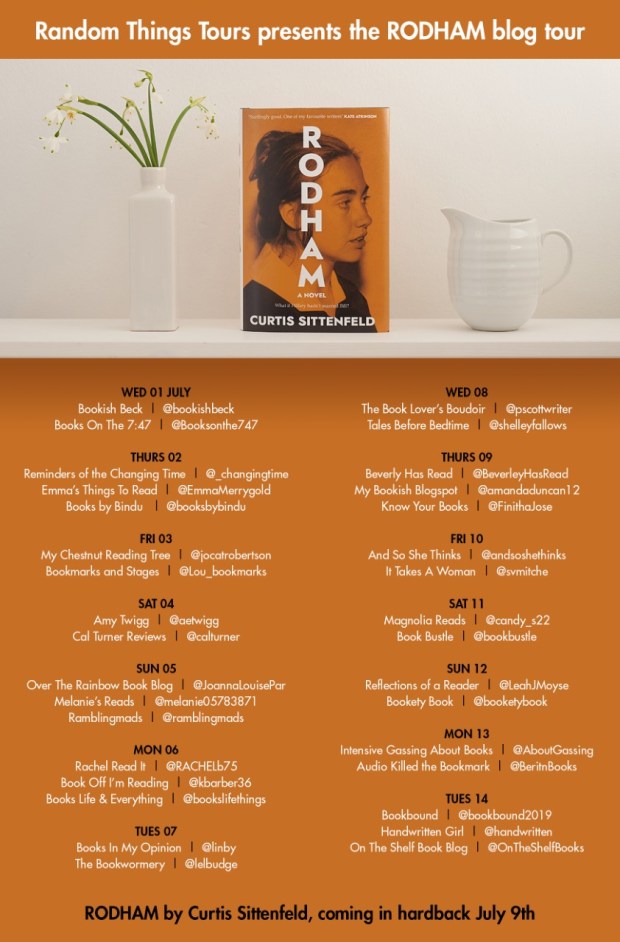
Rodham will be published in the UK on July 9th by Doubleday. I read an advanced e-copy via NetGalley. My thanks to the publisher and publicists for arranging my early access.
I was delighted to be invited to help kick off the blog tour for Rodham. See below for details of where other reviews will be appearing soon.
SPOILERS ENSUE; YOU HAVE BEEN WARNED.
The alternative history section of the novel picks up in 1991, when Hillary Rodham is on the law faculty at Northwestern University in Illinois, not far from where she grew up. She and James, a married colleague with whom she flirts harmlessly, are glued to the TV as news of Thurgood Marshall’s retirement from the Supreme Court and replacement by conservative African-American judge Clarence Thomas is complicated by a sexual harassment claim brought by Anita Hill. (It’s impossible not to see history repeating itself with Christine Blasey Ford’s testimony at Brett Kavanaugh’s confirmation hearing.) In the wake of this scandal, Rodham’s gay friend Greg Rheinfrank, a Democratic strategist and all-round great character, suggests that she run for the U.S. Senate – Washington, D.C. could clearly use more of a progressive female presence. Even though it eventually involves running against a (real-life) Black female, she agrees and wins in 1992, becoming a multi-term senator and running for president three times, starting with the 2004 race and culminating with 2016.
Meanwhile, Bill Clinton has married and divorced twice and is now a tech billionaire living in California and rumored to attend sex parties. A sex scandal quickly derailed his first presidential campaign in 1992, but in 2015 he decides to run again, thereby competing with his own ex-girlfriend for the Democratic nomination (at his rallies, “Shut her up!” becomes a popular chant that he tolerates from the crowd). Rodham makes it clear to her staff that he should not become president because he is a sexual predator.

Hillary Rodham Clinton speaking in Iowa, January 2016. Gage Skidmore / CC BY-SA (https://creativecommons.org/licenses/by-sa/3.0).
But here a curious compromise comes into play: Donald Trump has a bone to pick with Clinton, so after some rigorous courting from Rodham and her staffers, he agrees to endorse her. In the novel, then, Clinton and Trump are like villainous twins: wealthy narcissists who devalue women. Trump is only differentiated by his lack of class and intelligence. He still tweets, spouts odious opinions and comes across as a buffoon, but – crucially – doesn’t run on the Republican ticket. Instead, it’s Jeb Bush, and Rodham beats him by 2.9 million votes.
So, whew! – a satisfying ending. At points I feared that Sittenfeld would conclude that, despite all that was different after Rodham rejecting Clinton, she still would have lost to Donald Trump. Instead, the novel envisions defeat for Clinton and comeuppance for Trump when he’s indicted for tax fraud in New York. It’s, of course, a vision of “what should have happened” (versus Hillary’s own account in What Happened). But in the back of my mind was the thought that, really, you could have just printed one sentence, “What if the USA didn’t still use that stupid electoral college system?” and you would have gotten the same outcome, because in 2016 HRC won the popular vote by that same 2.9 million.
Specific scenes and elements that I loved:
- Through her (fictional) childhood best friend, Maureen Gurski, we get an alternative vision of what life could have been like had Rodham married and had children; Maureen’s daughter Meredith becomes like a surrogate daughter for her.
- In 2015 Rodham becomes close to Misty, a supporter who’s battling breast cancer, and has her speak to open a rally for her.
- She goes on a stoned bonehead’s radio show and storms out in protest at his sexism – I totally got vibes of Leslie Knope on Crazy Ira and The Douche’s radio show (that’s a Parks and Recreation reference, in case you’re not familiar with it).
- Rodham gets a late chance at romance: there’s a “First Boyfriend” who seems just right for her.
- This isn’t a hagiography: Sittenfeld includes instances when Rodham is tone-deaf about race and chooses pragmatism over the moral high road (e.g. campaign funding).
- Sittenfeld found ways to incorporate real speech from press conferences, campaign announcements, etc. I also recognized two verbatim lines from the infamous “baking cookies” remarks HRC gave to reporters in 1992 (in the novel this happens in 2004).
 Ultimately, I think Rodham doesn’t work as well as American Wife because we already know too much about Hillary, from her three published (ghostwritten) memoirs and from her being so much in the public eye since 1992. Whereas Laura Bush was something of a mystery, and American Wife introduced a comfortable cushion of fiction, Rodham is a little too in-your-face with its contemporary history and its message. But it’s a lot of fun nonetheless.
If you have made it all the way to the end of this extended review, give yourself a pat on the back!
The Book of Longings by Sue Monk Kidd (& Audiobook Blog Tour)
~This review contains plot spoilers.~
Sue Monk Kidd’s bold fourth novel started as a what-if question: What if Jesus had a wife? Church tradition has always insisted that he remained unmarried, but she felt that, given the cultural norms of the Middle East at that time, it would have been highly unusual for him not to marry. Musing on the motivation for airbrushing a spouse out of the picture, on the last page of the novel Kidd asks, “Did [early Christians] believe making him celibate rendered him more spiritual?” Or “Was it because women were so often invisible?” Although The Book of Longings retells biblical events, it is chiefly an attempt to illuminate women’s lives in the 1st century CE and to chart the female contribution to sacred literature and spirituality.
Fourteen-year-old Ana is a headstrong young woman with a forthright voice and a determination to choose her own life. Privilege and luck are on her side: her father is the head scribe to Herod Antipas, the ruler of Galilee; and the repulsive widower to whom she’s been betrothed dies, freeing her to marry Jesus, a travelling craftsman who caught her eye at the market. Ana’s aunt, Yaltha from Alexandria, is a major influence in her life. She had a rare chance at education and encourages her niece in her writing. Ana knows several ancient languages and fills every papyrus scroll she can get her hands on with stories of the women in the Bible. Yaltha also gives her an incantation bowl in which to write her deeply held prayers.
If you’re familiar with Kidd’s other work (such as The Secret Life of Bees and Traveling with Pomegranates), you know that she often explores the divine feminine and matriarchal units. Historically, Christianity has a poor record of acknowledging its patriarchal tendencies and redressing the balance. But Kidd imagines that, right at the beginning, Jesus valued women and was open to them having a life beyond domestic chores and childrearing. He involves Ana in his discussions about God and the nature of the Kingdom; they both see and take compassion on people’s suffering; together they are baptized by John the Baptist. And when Ana tells Jesus she doesn’t believe she is meant to be a mother – her mother and aunt took herbal potions and have passed on their contraceptive knowledge to her – he accepts her choice, even though childlessness could bring shame on both of them.

I appreciated this picture of a woman who opts for writing and the spiritual life over motherhood. However, Kidd portrays a whole range of women’s experiences: Jesus’s mother and sister-in-law submit to the drudgery of keeping a household going; Ana’s friend is raped and has her tongue cut out in an attempt to silence her, yet finds new ways to express herself; and another major character is a servant involved in the healing rituals at a temple to Isis. A practicing Jew, Ana finds meaning in other religious traditions rather than dismissing them as idolatry. She also participates in wider intellectual life, such as by reading The Odyssey.
Some descriptions make this novel sound like alternative history. If you’re expecting Ana to save the day and change the course of history, you will be disappointed. Ana is simply an observer of the events documented in the Bible. While she recounts the inspirations for some parables and healing incidents, during two years in exile with her aunt she only hears secondhand accounts of Jesus’s ministry. Her brother, a Zealot, disagrees with Jesus on how to usher in the Kingdom of God. By the time Ana returns to Jerusalem, the events leading to the crucifixion have already been set in motion; she can only bear witness. For her, life will continue after Jesus’s death, in a women-led spiritual community. From avoiding motherhood to choosing a monastic-type life, Ana has a lot of freedom. Some readers may be skeptical about how realistic this life course is, but the key, I think, is to consider Ana as an outlier.
Kidd has made wise decisions here: for the most part she makes her story line parallel or tangential to the biblical record, rather than repeating material many will find overly familiar. She takes Jewish teaching as a starting point but builds a picture of a more all-encompassing spirituality drawn from multiple traditions. Her Jesus is recognizable and deeply human; Ana calls him “a peacemaker and a provocateur in equal measures” and remembers him telling her what it was like growing up with the stigma of his illegitimate birth. The novel is rooted in historical detail but the research into the time and place never takes over. Engrossing and convincing, this is a story of women’s intuition and yearning, and of the parts of history that often get overlooked. It wouldn’t be out of place on next year’s Women’s Prize longlist.
My rating:
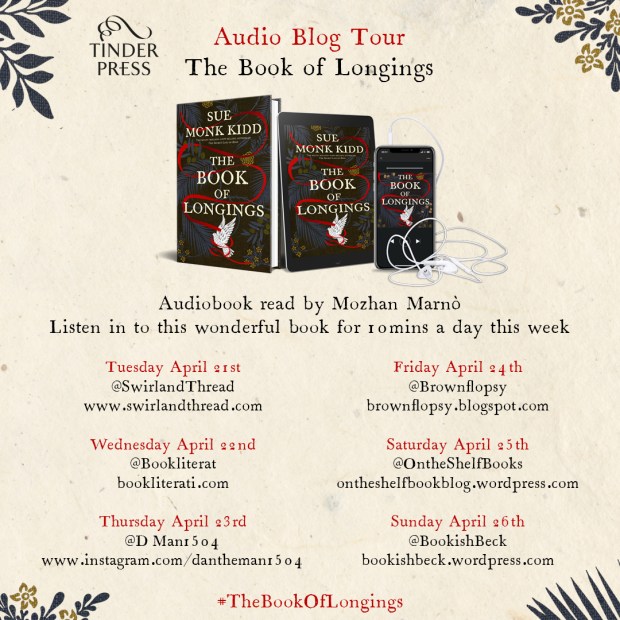
The Book of Longings was released on Tuesday the 21st. My thanks to Tinder Press for the proof copy for review.
I’m the last stop on a small blog tour for the audiobook release: if you’re interested in listening to the first hour of The Book of Longings, visit the blogs below and follow the links. Each one is hosting a 10-minute excerpt. The final one is available here.
Polio and the Plague: Epidemics in Fiction
Back in January I had the idea to catch up as much as I can on previous Wellcome Book Prize long- and shortlists while the Prize is on hiatus. I decided to start with a pair of novels about polio from my public library system: The Golden Age by Joan London and Nemesis by Philip Roth. The latter, especially, has taken on new significance due to its evocation of a time of panic over a public health crisis (see this article, but beware spoilers). On a fellow book reviewer’s recommendation, I also took Year of Wonders by Geraldine Brooks off the shelf and read it at the same time as the Roth.
The Golden Age by Joan London (2014)
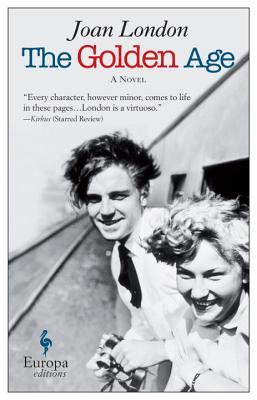 [First published in the UK in 2016; on the Wellcome Book Prize 2017 longlist]
The Golden Age was a real children’s polio hospital in Western Australia, but London has peopled it with her own fictional cast. In 1953–4, Frank Gold and Elsa Briggs, polio patients aged 12 going on 13, fall in love in the most improbable of circumstances: “The backs of their hands brushed as they walked side by side on their crutches. Their bloodstreams recharged by exercise and fresh air, they experienced a fiery burst of pleasure.”
Frank is much the more vibrant character thanks to his family’s wartime past in Hungary and his budding vocation as a poet, which was spurred on by his friendship with Sullivan, a fellow inmate at his previous rehabilitation center. The narrative spends time with the nurses, parents and other patients but keeps coming back to Frank and Elsa. However, Chapter 7, with Frank and his mother Ida still back in Budapest, was my favorite.
I was reminded of Tracy Farr’s work (The Life and Loves of Lena Gaunt), especially the look back from decades later. This has a strong premise and some great lines, but for me there was something slightly lacking in the execution.
Favorite lines:
There was beauty everywhere, strange beauty, even—especially?—in a children’s polio hospital.
Polio is like love, Frank says … Years later, when you think you have recovered, it comes back.
My rating:
Nemesis by Philip Roth (2010)
[On the Wellcome Book Prize 2011 shortlist]
 In the summer of 1944 Newark, New Jersey is hit hard by polio. As a local playground director, 23-year-old Bucky Cantor is distressed when several of his charges become ill; a couple of them even die within a matter of days.
At first Bucky, whose poor eyesight kept him out of the War, sees his job as his own field of duty, but gradually fear and helplessness drive him away. He escapes to the Pocono Mountains to join his fiancée, Marcia, as a summer camp counselor, but soon realizes the futility of trying to outrun a virus. Unable to accept the randomness of bad luck, he blames God – and himself – for the epidemic’s spread.
Despite our better general understanding of epidemiology today, there were still many passages in this novel that rang true for me as they picture life proceeding as normal until paranoia starts to take hold:
Despite polio’s striking in the neighborhood, the store-lined main street was full of people out doing their Saturday grocery shopping…
(Bucky) Look, you mustn’t be eaten up with worry … What’s important is not to infect the children with the germ of fear. We’ll come through this, believe me. We’ll all do our bit and stay calm and do everything we can to protect the children, and we’ll all come through this together.
The important thing, he said, was always to wash your hands after you handled paper money or coins. What about the mail, someone else said … What are you going to do, somebody retorted, suspend delivering the mail? The whole city would come to a halt. Six or seven weeks ago they would have been talking about the war news.
Roth really captures the atmosphere of alarm and confusion, but doesn’t always convey historical and medical information naturally, sometimes resorting to paragraphs of context and representative conversations like in the last quote above. I also wasn’t sure about the use of a minor character (revealed on page 108 to be one of Bucky’s playground kids and a polio patient) as the narrator. This seemed to me to make Bucky more of a symbolic hero than a genuine character. Still, this was a timely and riveting read.
My rating:

A period warning about polio reprinted at the back of Paul Auster’s Report from the Interior.
Year of Wonders by Geraldine Brooks (2001)
 In 1665, with the Derbyshire village of Eyam in the grip of the Plague, the drastic decision was made to quarantine it. A benevolent landowner arranged for regular deliveries of food and other supplies to just outside the parish boundaries. The villagers made an oath that no one would leave until the pestilence was eradicated. One year later, two-thirds of its residents were dead. Brooks imagines that the “plague seeds” came to the village in a bolt of cloth that was delivered from London to the tailor George Viccars, who lodged with widow Anna Frith. Viccars is the first victim and the disease quickly spreads outward from Anna’s home.
Anna barely has time to grieve her own losses before she’s called into service: along with the minister’s wife, Elinor Mompellion, she steps in as a midwife, herbal healer and even a miner. The village succumbs to several sobering trajectories. Suspicion of women’s traditional wisdom leads some to take vigilante action against presumed witches. Unscrupulous characters like Anna’s father, who sets up as a gravedigger, try to make a profit out of others’ suffering. Frustration with the minister’s apparent ineffectuality attracts others to forms of religious extremism. Like Bucky, people cannot help but see the hand of God here.
Perhaps what I was most missing in the London and Roth novels (and in Hamnet, which bears such striking thematic similarities to Year of Wonders) was intimate first-person narration, which is just what you get here from Anna. The voice and the historical recreation are flawless, and again there were so many passages that felt apt:
Stay here, in the place that you know, and in the place where you are known. … Stay here, and here we will be for one another.
the current times did seem to ask us all for every kind of sacrifice
(once they start meeting for church in a meadow) We placed ourselves so that some three yards separated each family group, believing this to be sufficient distance to avoid the passing of infection.
Yet it is a good day, for the simple fact that no one died upon it. We are brought to a sorry state, that we measure what is good by such a shortened yardstick.
I’ve docked a half-star only because of a far-fetched ending that reminded me of that to The Wonder by Emma Donoghue. Apart from that, this is just what I want from my historical fiction.
My rating:
Are you doing any reading about epidemics?
A Theatre for Dreamers by Polly Samson (Blog Tour Review)
In the 1950s the Greek island of Hydra became a magnet for artists and writers, including Lawrence Durrell, Patrick Leigh Fermor and Henry Miller. Polly Samson’s fifth work of fiction, set in this makeshift artists’ colony in 1960, zeroes in on the married Australian authors Charmian Clift and George Johnston, Norwegian novelist Axel Jensen, his wife Marianne Ihlen, and an unknown young poet from Canada named Leonard Cohen.
We see all of these real-life characters from the perspective of our starry-eyed narrator, Erica, a seventeen-year-old outsider. In a framing story set c. late 2016, after she hears of Leonard’s death, Erica has returned to Hydra as an old woman. Yet that first gold summer is still intensely alive in her memory. She decided to decamp to Hydra just before Easter in 1960, with her boyfriend Jimmy and her brother Bobby, because Charmian was once their late mother’s closest friend back in London. Erica’s inheritance would go far here: “people like us … can live for a year in the sun on what it’d cost us for a month in a dingy bedsit at home.”

Love triangles abound and emotions run high on Hydra. Gradually Erica learns that just about everyone has slept with, or is currently sneaking around with, someone they aren’t married to. Meanwhile, Bobby and friends sleep late and paint, then party well into the night. While Erica is the responsible mother hen at their villa, seeing that everyone gets fed, she indulges her hedonistic side, too – going to every bash and spending half the day in bed with Jimmy.
Charmian becomes a kind of surrogate mother to Erica, but remains spiky due to her jealousy over George’s greater literary success while she has to care for the children and act as his amanuensis. “They’re the closest thing I have to a family,” Erica writes of Charmian and George and the wider expatriate circle. “I love them all: their banter and moods and tears and wild laughter, all of it, every chaotic bit of it.” But there’s a sense that the idyll can’t last.
This is a novel simply dripping with atmosphere. You can feel the Mediterranean heat soaking up through your sandals; see the piercing sunlight reflecting off white-washed buildings; smell the ripening fruit and herbs and fresh-caught fish. There are dozens of evocative passages I could quote from, but here is part of one of my favourites:
The port throbs with tourists and the street cats grow fat. The cicadas are busy breaking a hundred hearts with their songs. We pull our mattresses out to the terrace and sleep beneath the stars, wake with the sun … We pick over platters of fish at taverna tables, or drift from courtyard to courtyard with our records and poems, or take bottles of beer and eat bread and meatballs beneath the tumbling vines of the outdoor cinema … We have all become leaner, our legs muscled from the steps, Bobby and Jimmy’s shoulders almost amphibian from swimming. Sometimes we take a bag of peaches and a flask of coffee to the cave and grab a dip before the port is fully awake, other times we swim late at night and lie naked between the moon and the tide on the still-warm rocks.
If you’re getting cabin fever and are hankering for some armchair travelling, I can’t recommend a trip to 1960 Hydra enough. There are two prizes that specifically recognize literature with a strong sense of place: The Royal Society of Literature’s Ondaatje Prize is “for a distinguished work of fiction, non-fiction or poetry, evoking the spirit of a place,” as is the Cicerone (fiction) prize, part of the Edward Stanford Travel Writing Awards. I’d be willing to bet that A Theatre for Dreamers will be shortlisted for one or both of those next year.
My thanks to Bloomsbury Circus for the free copy for review.
 Bookish Beck = Rebecca Foster. American transplant to England. Freelance proofreader and book reviewer.
