Nonfiction and Poetry Review Catch-Up: Carson, Dixon, McLaren, Sharpe
Today I’m finally writing up four review copies that came my way quite a while ago (last year in one case). A bereavement memoir about a friend lost to opiate addiction, a nature-rich poetry collection, a practical book about being part of positive movements whether led by religion or not, and an eye-opening work of cultural criticism about Black art and suffering.
The Dead Are Gods: A Memoir by Eirinie Carson (2023)
When I was back in the States in May for my sister’s nursing school graduation, I got a chance to talk to her best friend, who is a library assistant. During the never-ending reading-out of names (it was a whole-college ceremony, as opposed to the one earlier in the day just for the nursing cohort), I read Hello Beautiful on my Kindle, tucked inside the graduation program; this friend openly read a library copy of The Dead Are Gods on her lap. When I teased her that at least I kept my book hidden, like I do at church inside the hymn book, she said (re: church), “Or you could just … not go?” (On which, see the McLaren review below!)
 Anyway, it was nice to see this book out and about in the world, and it reminded me to belatedly pick up my review copy once I got back. As a bereavement memoir, the book is right in my wheelhouse, though I’ve tended to gravitate towards stories of the loss of a family memoir or spouse, whereas Carson is commemorating her best friend, Larissa, who died in 2018 of a heroin overdose, age 32, and was found in the bath in her Paris flat one week later.
Carson wrote this three years afterward, yet the feeling is still raw. Addressing Larissa as “you” for much of the book, she loops through their history in short chapters that hop around like memory does. They met as teenagers in London and bonded over being Black models and rock music fans. After their wild years, their paths started to drift apart. Carson moved to California and married and had children; Larissa relocated to Paris and, apparently, kept partying. Her dependency came as news to Carson – all the more ironic because her father, too, is a heroin addict and mostly not present in her life.
Anyone who has suffered a loss will find much that resonates here, no matter the circumstances or timing. Carson puzzles over the difficulty of making a narrative out of death and grief (“How should I remember you? Am I doing it right? Is this enough?”), of even comprehending the bare facts of permanent absence. She’s working towards understanding, and desperate to let people know about the marvel that was Larissa. Apart from in the title chapter, the language does not stand out so much as the relatable emotion. (And it’s hard to take their pet name- and typo-strewn e-mails seriously.) Still, I marked out lots of passages to save: “It is frustrating when the one person who could answer all of your many, many questions is the dead person. … Searching for meaning in the most meaningless event in our lives feels a little stupid but I still search.”
With thanks to Melville House for the proof copy for review.
A Whistling of Birds by Isobel Dixon (illus. Douglas Robertson) (2023)
 Dixon was a new name for me, but the South African poet, now based in Cambridge, has published five collections. I was drawn to this latest one by its acknowledged debt to D.H. Lawrence: the title phrase comes from one of his essays, and the book as a whole is said to resemble his Birds, Beasts and Flowers, which is in its centenary year. I’m more familiar with Lawrence’s novels than his verse, but I do own his Collected Poems and was fascinated to find here echoes of his mystical interest in nature as well as his love for the landscape of New Mexico. England and South Africa are settings as well as the American Southwest.
Snakes, bees, bats and foxes are some of the creatures that scamper through the text. There are poems for marine life, fruit and wildflowers. You get a sense of the seasons turning, and the natural wonders to prize from each. Dixon’s poetry is formal yet playful, the structures and line and stanza lengths varying. “Tirrick” is full of wordplay relating to Arctic terns; phrases flit across the page to mimic flight in “the bats”; “Hummingbird ~” mixes Latin names with vivid descriptions: “the oil spill of God’s glory / taking wing” and “sweet-wrapper glamour scrap / hovering shadow-gloss”.
There are portraits and elegies; moments where the speaker is present versus fable-like omniscient warnings or teasing. I particularly loved “River Mother” (an ode to a pregnant crab), “The Guests” (about a “festival of frogs” after rain), the praying mantis depicted in “A Missionary in Neon Green” (“Soul on stilts, / a gog-eyed alien”), and the everyday ecstasy of “On First Spotting a Snake’s Head Fritillary.” The book is in collaboration with Scottish artist Douglas Robertson, who provided 12 black-and-white illustrations, and is a real gem.
With thanks to Nine Arches Press for the free copy for review.
Do I Stay Christian? A Guide for the Doubters, the Disappointed and the Disillusioned by Brian McLaren (2022)
McLaren is one of the important gurus in my life. This follows on closely from his previous book, Faith after Doubt, which I reviewed last year. You might think that the title question is only rhetorical and the answer is a firmly implied Yes. But what’s refreshing is that the author genuinely does not have a secret agenda. He doesn’t mind whether you continue to consider yourself Christian or not; what he does care about is inviting people into a spiritual life that includes working towards a regenerative future, the only way the human race is going to survive. And he believes that people of all faiths and none can be a part of that.
 But first to address the central question: Part One is No and Part Two is Yes; each is allotted 10 chapters and roughly the same number of pages. McLaren has absolute sympathy with those who decide that they cannot in good conscience call themselves Christians. He’s not coming up with easily refuted objections, straw men, but honestly facing huge and ongoing problems like patriarchal and colonial attitudes, the condoning of violence, intellectual stagnation, ageing congregations, and corruption. From his vantage point as a former pastor, he acknowledges that today’s churches, especially of the American megachurch variety, feature significant conflicts of interest around money. He knows that Christians can be politically and morally repugnant and can oppose the very changes the world needs.
And yet. He believes Christianity can still be a force for good, and it would be a shame to give up on the wealth of its (comparatively short) history and the paragon that is Jesus (whom he provocatively describes as “an indigenous man who prepared for his public ministry with a forty-day vision quest”). The arguments in this section are more emotional, whereas in the previous section they were matter-of-fact. However, McLaren poses a middle option between leaving the religion dramatically and remaining meekly; he calls it “staying defiantly.” My husband and I read this as a buddy read, and that will be an important concept for us: how can we challenge the status quo of our church, our denomination, this too often staid faith?
Part Three, “How,” offers ideas for how to build a resilient faith that prioritizes harmony with the environment and with others while sidelining economic concerns. He may not believe in literal hell, but he’s as end-times-oriented as any fire-and-brimstone preacher when he insists, “we have to prepare ourselves to live good lives of defiant joy in the midst of chaos and suffering. This can be done. It has been done by billions of our ancestors and neighbours.” He ends with a supremely practical piece of advice: ask yourself “whether your current context will allow the highest and best use of your gifts and time.” Lucid and well argued, this is a book I’d recommend to anyone questioning the value of Christianity.
With thanks to Hodder & Stoughton for the free copy for review.
Ordinary Notes by Christina Sharpe (2023)
This work of cultural criticism takes the form of 248 numbered micro-essays, some as short as one line and others up to a few pages. The central topics are Black art and Black suffering – specifically, how the latter is depicted. The book kept slapping me awake, because her opinions were not what I was expecting. Her responses to her 2018 visits to two landmarks in Montgomery, Alabama, the Legacy Museum and the National Memorial for Peace and Justice, give a taste of her outlook. The museum draws a direct line between slavery and mass incarceration; the memorial documents all known cases of lynching, and she’s in its graveyard when a white woman comes up to her, crying and apologizing. When people ask Sharpe why she didn’t reply, she says, “she tries to hand me her sorrow … to super-add her burden to my own. It is not mine to bear.”
 Many of these early notes question the purpose of reliving racial violence. For instance, Sharpe is appalled to watch a Claudia Rankine video essay that stitches together footage of beatings and murders of Black people. “Spectacle is not repair.” She later takes issue with Barack Obama singing “Amazing Grace” at the funeral of slain African American churchgoers because the song was written by a slaver. The general message I take from these instances is that one’s intentions do not matter; commemorating violence against Black people to pull at the heartstrings is not just in poor taste, but perpetuates cycles of damage.
The book is a protest, strident yet calm, but also a celebration of the Black humanities and an elegy to her late mother, who prepared her to live as a confident, queer woman of colour in a white world. Sharpe decries the notion that art by BIPOC is only of sociological interest, to inform white people about “identity” – this is both a simplification and a means of othering.
Books—poetry, fiction, nonfiction, theory, memoir, biography, mysteries, plays—have always helped me locate myself, tethered me, helped me to make sense of the world and to act in it. I know that books have saved me. By which I mean that books always give me a place to land in difficult times. They show me Black worlds of making and possibility.
And she mainly credits her mother for introducing her to the literature that would sustain her: “My mother wanted me to build a life that was nourishing and Black. … My mother gifted me a love of beauty, a love of works. She gave me every Black book that she could find.” I loved the account of their Sunday afternoon teas, when they had cake and each read aloud a short piece they had memorized by the likes of Gwendolyn Brooks or Langston Hughes.
I found the straightforward autobiographical material, particularly the grief over the loss of her mother, more emotionally resonant than much of the book’s theorizing. The scholarly register can occasionally be off-putting, e.g., “I write these ordinary things to detail the everyday sonic and haptic vocabularies of living life under these brutal regimes.” The other media include letters, headlines, lists, and photographs, creating an overall collage effect. That the book occasionally made me uncomfortable is, no doubt, proof that I needed to read it.
With thanks to Daunt Books for the free copy for review.
Review Catch-Up: Brackenbury, McLaren, Wellcome Collection
As usual, I have a big backlog of 2021–22 releases I’m working my way through. I’ll get there eventually! Today I’m reporting on a poetry collection about English ancestry and wildlife, a vision of post-doubt Christian faith, and a set of essays on connection to nature, specifically flora. (I also take a brief look at some autofiction that didn’t work for me.)
Thorpeness by Alison Brackenbury (2022)
 I’m familiar with Brackenbury from her appearance at New Networks for Nature in 2016 and her latest selected poems volume, Gallop. This, her tenth stand-alone collection, features abundant imagery of animals and the seasons, as in “Cucu” and “Postcard,” which marks the return of swifts. Alliteration is prominent, but there is also a handful of rhymes, like in “Fern.” Family history and the perhaps-idyllic rural underpin the verse set in Lincolnshire and Gloucestershire as Brackenbury searches for ancestral graves and delivers elegies.
I especially loved “Aunt Margaret’s Pudding,” a multipart poem about her grandmother’s life as a professional cook and then a mother of four, and “My Grandmother Waits for Christmas,” about a simple link between multiple generations’ Christmases: a sugar mouse. Caring for horses is another recurring theme; a 31-year-old blind pony receives a fond farewell.
There are also playful meetings between historical figures (“Purple Haze,” a dialogue between George Frideric Handel and Jimi Hendrix, who saw the composer’s ghost in their shared London home) and between past and contemporary, like “Thomas Hardy sends an email” (it opens “I need slide no confessions under doors”). “Charles Dickens at Home” was another favourite of mine. The title is the never-to-be-reached destination in the final poem, “Shingle.” A number of these poems were first broadcast on BBC Radio. 
With thanks to Carcanet Press for the e-copy for review.
Faith after Doubt: Why Your Beliefs Stopped Working and What to Do about It by Brian McLaren (2021)
I’ve explained before how McLaren’s books were pivotal to my spiritual journey, even before I attended the church he founded in Maryland. (I’ve also reviewed his previous book, God Unbound). His progressive, environmentalist theology is perfect for continuing searchers like me. At one of last year’s online Church Times Festival events, I saw him introduce the schema that underpins this book. He proposes that the spiritual life (not just Christian) has four stages that may overlap or repeat: simplicity, complexity, perplexity and harmony. The first stage is for new zealots who draw us–them divisions and are most concerned with orthodoxy. In the second, practitioners are more concerned with practicalities: what works, what makes life better. Perplexity is provoked by cynicism about injustice and hypocrisy, while harmony moves beyond dualism and into connection with other people and with nature.
 McLaren suggest that honest doubting, far from being a problem, might present an opportunity for changing in the right direction, getting us closer to the “revolutionary love” at the heart of the gospel. He shares stories from his own life, in and out of ministry, and from readers who have contacted him remotely or come up to him after events, caught in dilemmas about what they believe and whether they want to raise their children into religion. Though he’s fully aware of the environmental crisis and doesn’t offer false hope that we as a species will survive it, he isn’t ready to give up on religion; he believes that a faith seasoned by doubt and matured into an understanding of the harmony of all things can be part of a solution.
It’s possible some would find McLaren’s ideas formulaic and his prose repetitive. His point of view always draws me in and gives me much to think about. I’ve been stuck in perplexity for, ooh, 20 years? I frequently ask myself why I persist in going to church when it’s so boring and so often feels like a social club for stick-in-the-mud white people instead of a force for change. But books like this and Robin Wall Kimmerer’s Braiding Sweetgrass, my current soul food, encourage me to keep pursuing spiritual connection as a worthwhile path. I’ll be seeking out his forthcoming book (due out in May), Do I Stay Christian?, too.
Some favourite lines:
“only doubt can save the world. Only doubt will open a doorway out of hostile orthodoxies – whether religious, cultural, economic or political. Only through the difficult passage of doubt can we emerge into a new stage of faith and a new regenerative way of life. Everything depends on making this passage.”
“Among all the other things doubt is – loss, loneliness, crisis, doorway, descent, dissent [these are each the subject of individual chapters early on in the book] – it is also this: a crossroads. At the crossroads of doubt, we either become better or bitter. We either break down or break through. We become cynics or sages, hollow or holy. We choose love or despair.”
“Blessed are the wonderers, for they shall find what is wonderful. … Blessed are the doubters, for they shall see through false gods. Blessed are the lovers, for they shall see God everywhere.”
With thanks to Hodder & Stoughton for the free copy for review.
This Book Is a Plant: How to Grow, Learn and Radically Engage with the Natural World (2022)
 This collection of new essays and excerpts from previously published volumes accompanies the upcoming Wellcome Collection exhibition Rooted Beings (a collaboration with La Casa Encendida, Madrid, it’s curated by Bárbara Rodríguez Muñoz and Emily Sargent and will run from 24 March to 29 August). The overarching theme is our connection with plants and fungi, and the ways in which they communicate. Some of the authors are known for their nature writing – there’s an excerpt from Merlin Sheldrake’s Entangled Life, Jessica J. Lee (author of Turning and Two Trees Make a Forest) contributes an essay on studying mosses, and a short section from Kimmerer’s Braiding Sweetgrass closes the book – while others are better known in other fields, like Susie Orbach and Abi Palmer (author of Sanatorium).
I especially enjoyed novelist Rowan Hisayo Buchanan’s “Wilder Flowers,” which is about landscape painting, balcony gardening in pots, and what’s pretty versus what’s actually good for nature. (Wildflowers aren’t the panacea we are sometimes sold.) I was also interested to learn about quinine, which comes from the fever tree, in Kim Walker and Nataly Allasi Canales’ “Bitter Barks.” Sheila Watt-Cloutier’s essay on the Western influence on Inuit communities in northern Canada, reprinted from Granta, is one of the best individual pieces – forceful and with a unique voice, it advocates reframing the climate change debate in terms of human rights as opposed to the economy – but has nothing to do with plants specifically. There are also a couple of pieces that go strangely mystical, such as one on plant metaphors in the Kama Sutra. So, a mixed bag that jumbles science, paganism and postcolonial thought, but if you haven’t already encountered the Kimmerer and Sheldrake (or, e.g., Rooted by Lyanda Lynn Haupt and Losing Eden by Lucy Jones) you might find this a good primer. 
With thanks to Profile Books / Wellcome Collection for the free copy for review.
And one that really didn’t work for me; my apologies to the author and publisher.
I Love You but I’ve Chosen Darkness by Claire Vaye Watkins (2021)
 What a letdown after Gold Fame Citrus, one of my favourite novels of 2015. I’d also read Watkins’s debut short story collection, Battleborn, which won the Dylan Thomas Prize. Despite the amazing title and promising setup – autofiction that reflects on postpartum depression and her Mojave Desert upbringing as a daughter of one of the Manson Family cult members – this is indulgent, misguided, and largely unreadable.
A writer named Claire Vaye Watkins flies to Nevada to give a lecture and leaves her husband and baby daughter behind – for good? To commemorate her mother Martha, who died of an opiate overdose, she reprints Martha’s 1970s letters, which are unspeakably boring. I feel like Watkins wanted to write a memoir but didn’t give herself permission to choose nonfiction, so tried to turn her character Claire’s bad behaviour into a feminist odyssey of sexual freedom and ended up writing such atrocious lines as the below:
“I mostly boinked millennial preparers of beverages and schlepped to book festivals to hook up with whatever adequate rando lurked at the end of my signing line. This was what our open marriage looked like”
“‘Psychedelics tend to find me when I need them,’ she said, sending a rush of my blood to my vulva.”
Her vagina dentata (a myth, or a real condition?!) becomes a bizarre symbol of female power and rage. I could only bear to skim this. 
Some lines I liked:
Listen: I am a messenger from the future. I am you in ten years. Pay attention! Don’t fetishize marriage and babies. Don’t succumb to the axial tilt of monogamy! I don’t pretend to know the details of your…situation, but I guarantee you, you’re as free as you’ll ever be. Have sex with anyone you want. Enjoy the fact that it might happen any minute. You could have sex with a man, a woman, both—tonight!
I went from being raised by a pack of coyotes to a fellowship at Princeton where I sat next to John McPhee at a dinner and we talked about rocks and he wasn’t at all afraid of me.
With thanks to riverrun for the proof copy for review.
Would you be interested in reading one or more of these?
Review Book Catch-Up: Motherhood, Nature Essays, Pandemic, Poetry
July slipped away without me managing to review any current-month releases, as I am wont to do, so to those three I’m adding in a couple of other belated review books to make up today’s roundup. I have: a memoir-cum-sociological study of motherhood, poems of Afghan women’s experiences, a graphic novel about a fictional worst-case pandemic, seasonal nature essays from voices not often heard, and poetry about homosexual encounters.
(M)otherhood: On the choices of being a woman by Pragya Agarwal
“Mothering would be my biggest gesture of defiance.”
 Growing up in India, Agarwal, now a behavioural and data scientist, wished she could be a boy for her father’s sake. Being the third daughter was no place of honour in society’s eyes, but her parents ensured that she got a good education and expected her to achieve great things. Still, when she got her first period, it felt like being forced onto a fertility track she didn’t want. There was a dearth of helpful sex education, and Hinduism has prohibitions that appear to diminish women, e.g. menstruating females aren’t permitted to enter a temple.
Married and unexpectedly pregnant in 1996, Agarwal determined to raise her daughter differently. Her mother-in-law was deeply disappointed that the baby was a girl, which only increased her stubborn pride: “Giving birth to my daughter felt like first love, my only love. Not planned but wanted all along. … Me and her against the world.” No element of becoming a mother or of her later life lived up to her expectations, but each apparent failure gave a chance to explore the spectrum of women’s experiences: C-section birth, abortion, divorce, emigration, infertility treatment, and finally having further children via a surrogate.
While I enjoyed the surprising sweep of Agarwal’s life story, this is no straightforward memoir. It aims to be an exhaustive survey of women’s life choices and the cultural forces that guide or constrain them. The book is dense with history and statistics, veers between topics, and needed a better edit for vernacular English and smoothing out academic jargon. I also found that I wasn’t interested enough in the specifics of women’s lives in India.
With thanks to Canongate for the free copy for review.
Forty Names by Parwana Fayyaz
“History has ungraciously failed the women of my family”
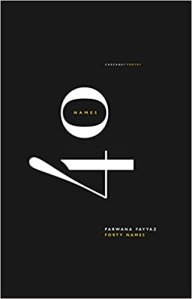 Have a look at this debut poet’s journey: Fayyaz was born in Kabul in 1990, grew up in Afghanistan and Pakistan, studied in Bangladesh and at Stanford, and is now, having completed her PhD, a research fellow at Cambridge. Many of her poems tell family stories that have taken on the air of legend due to the translated nicknames: “Patience Flower,” her grandmother, was seduced by the Khan and bore him two children; “Quietude,” her aunt, was a refugee in Iran. Her cousin, “Perfect Woman,” was due to be sent away from the family for infertility but gained revenge and independence in her own way.
Fayyaz is bold to speak out about the injustices women can suffer in Afghan culture. Domestic violence is rife; miscarriage is considered a disgrace. In “Roqeeya,” she remembers that her mother, even when busy managing a household, always took time for herself and encouraged Parwana, her eldest, to pursue an education and earn her own income. However, the poet also honours the wisdom and skills that her illiterate mother exhibited, as in the first three poems about the care she took over making dresses and dolls for her three daughters.
As in Agarwal’s book, there is a lot here about ideals of femininity and the different routes that women take – whether more or less conventional. “Reading Nadia with Eavan” was a favourite for how it brought together different aspects of Fayyaz’s experience. Nadia Anjuman, an Afghan poet, was killed by her husband in 2005; many years later, Fayyaz found herself studying Anjuman’s work at Cambridge with the late Eavan Boland. Important as its themes are, I thought the book slightly repetitive and unsubtle, and noted few lines or turns of phrase – always a must for me when assessing a poetry collection.
With thanks to Carcanet Press for the free copy for review.
Resistance by Val McDermid; illus. Kathryn Briggs
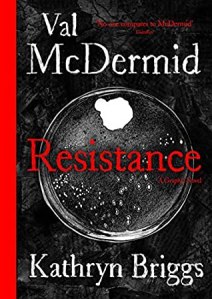 The second 2021 release I read in quick succession in which all but a small percentage of the human race (here, 2 million people) perishes in a pandemic – the other was Under the Blue. Like Aristide’s novel, this story had its origins in 2017 (in this case, on BBC Radio 4’s “Dangerous Visions”) but has, of course, taken on newfound significance in the time of Covid-19. McDermid imagines the sickness taking hold during a fictional version of Glastonbury: Solstice Festival in Northumberland. All the first patients, including a handful of rockstars, ate from Sam’s sausage sandwich van, so initially it looks like food poisoning. But vomiting and diarrhoea give way to a nasty rash, listlessness and, in many cases, death.
Zoe Beck, a Black freelance journalist who conducted interviews at Solstice, is friends with Sam and starts investigating the mutated swine disease, caused by an Erysipelas bacterium and thus nicknamed “the Sips.” She talks to the festival doctor and to a female Muslim researcher from the Life Sciences Centre in Newcastle, but her search for answers takes a backseat to survival when her husband and sons fall ill.
The drawing style and image quality – some panes are blurry, as if badly photocopied – let an otherwise reasonably gripping story down; the best spreads are collages or borrow a frame/backdrop (e.g. a medieval manuscript, NHS forms, or a 1910s title page).


SPOILER
{The ending, which has an immune remnant founding a new community, is VERY Parable of the Sower.}
With thanks to Profile Books/Wellcome Collection for the free copy for review.
Gifts of Gravity and Light: A Nature Almanac for the 21st Century, ed. Anita Roy and Pippa Marland
I hadn’t heard about this upcoming nature anthology when a surprise copy dropped through my letterbox. I’m delighted the publisher thought of me, as this ended up being just my sort of book: 12 autobiographical essays infused with musings on landscapes in Britain and elsewhere; structured by the seasons to create a gentle progression through the year, starting with the spring. Best of all, the contributors are mostly female, BIPOC (and Romany), working class and/or queer – all told, the sort of voices that are heard far too infrequently in UK nature writing. In momentous rites of passage, as in routine days, nature plays a big role.
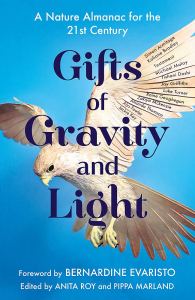 A few of my favourite pieces were by Kaliane Bradley, about her Cambodian heritage (the Wishing Dance associated with cherry blossom, her ancestors lost to genocide, the Buddhist belief that people can be reincarnated in other species); Testament, a rapper based in Leeds, about capturing moments through photography and poetry and about the seasons feeling awry both now and in March 2008, when snow was swirling outside the bus window as he received word of his uni friend’s untimely death; and Tishani Doshi, comparing childhood summers of freedom in Wales with growing up in India and 2020’s Covid restrictions.
Most of the authors hold two places in mind at the same time: for Michael Malay, it’s Indonesia, where he grew up, and the Severn estuary, where he now lives and ponders eels’ journeys; for Zakiya McKenzie, it’s Jamaica and England; for editor Anita Roy, it’s Delhi versus the Somerset field her friend let her wander during lockdown. Trees lend an awareness of time and animals a sense of movement and individuality. Alys Fowler thinks of how the wood she secretly coppices and lays on park paths to combat the mud will long outlive her, disintegrating until it forms the very soil under future generations’ feet.
A favourite passage (from Bradley): “When nature is the cuddly bunny and the friendly old hill, it becomes too easy to dismiss it as a faithful retainer who will never retire. But nature is the panic at the end of a talon, and it’s the tree with a heart of fire where lightning has struck. It is not our friend, and we do not want to make it our enemy.”
Also featured: Bernardine Evaristo (foreword), Raine Geoghegan, Jay Griffiths, Amanda Thomson, and Luke Turner.
With thanks to Hodder & Stoughton for the free copy for review.
Records of an Incitement to Silence by Gregory Woods
 Woods is an emeritus professor at Nottingham Trent University, where he was appointed the UK’s first professor of Gay & Lesbian Studies in 1998. Much of his sixth poetry collection is composed of unrhymed sonnets in two stanzas (eight lines, then six). The narrator is often a randy flâneur, wandering a city for homosexual encounters. One assumes this is Woods, except where the voice is identified otherwise, as in “[Walt] Whitman at Timber Creek” (“He gives me leave to roam / my idle way across / his prairies, peaks and canyons, my own America”) and “No Title Yet,” a long, ribald verse about a visitor to a stately home.
Other times the perspective is omniscient, painting a character study, like “Company” (“When he goes home to bed / he dare not go alone. … This need / of company defeats him.”), or of Frank O’Hara in “Up” (“‘What’s up?’ Frank answers with / his most unseemly grin, / ‘The sun, the Dow, my dick,’ / and saunters back to bed.”). Formalists are sure to enjoy Woods’ use of form, rhyme and meter. I enjoyed some of the book’s cheeky moments but had trouble connecting with its overall tone and content. That meant that it felt endless. I also found the end rhymes, when they did appear, over-the-top and silly (Demeter/teeter, etc.).
Two favourite poems: “An Immigrant” (“He turned away / to strip. His anecdotes / were innocent and his / erection smelled of soap.”) and “A Knot,” written for friends’ wedding in 2014 (“make this wedding supper all the sweeter / With choirs of LGBT cherubim”).
With thanks to Carcanet Press for the free copy for review.
Would you be interested in reading one or more of these?
Fairy Tales, Outlaws, Experimental Prose: Three More January Novels
Today I’m featuring three more works of fiction that were released this month, as a supplement to yesterday’s review of Mrs Death Misses Death. Although the four are hugely different in setting and style, and I liked some better than others (such is the nature of reading and book reviewing), together they’re further proof – as if we needed it – that female authors are pushing the envelope. I wouldn’t be surprised to see any or all of these on the Women’s Prize longlist in March.
The Charmed Wife by Olga Grushin
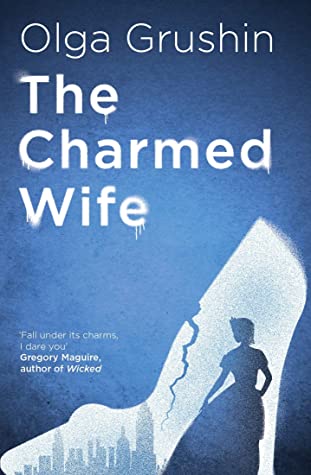 What happens next for Cinderella?
Grushin’s fourth novel unpicks a classic fairy tale narrative, starting 13.5 years into a marriage when, far from being starry-eyed with love for Prince Roland, the narrator hates her philandering husband and wants him dead. As she retells the Cinderella story to her children one bedtime, it only underscores how awry her own romance has gone: “my once-happy ending has proved to be only another beginning, a prelude to a tale dimmer, grittier, far more ambiguous, and far less suitable for children”. She gathers Roland’s hair and nails and goes to a witch for a spell, but her fairy godmother shows up to interfere. The two embark on a good cop/bad cop act as the princess runs backward through her memories: one defending Roland and the other convinced he’s a scoundrel.
Part One toggles back and forth between flashbacks (in the third person and past tense) and the present-day struggle for the narrator’s soul. She comes to acknowledge her own ignorance and bad behaviour. “All I want is to be free—free of him, free of my past, free of my story. Free of myself, the way I was when I was with him.” In Part Two, as the princess tries out different methods of escape, Grushin coyly inserts allusions to other legends and nursery rhymes: a stepsister lives with her many children in a house shaped like a shoe; the witch tells a variation on the Bluebeard story; the fairy godmother lives in a Hansel and Gretel-like candy cottage; the narrator becomes a maid for 12 slovenly sisters; and so on.
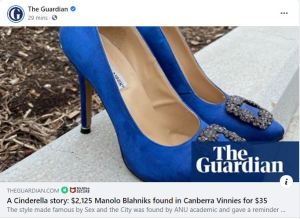 The plot feels fairly aimless in this second half, and the mixture of real-world and fantasy elements is peculiar. I much preferred Grushin’s previous book, Forty Rooms (and Angela Carter’s The Bloody Chamber, one of her chief inspirations). However, her two novels share a concern with how women’s ambitions can take a backseat to their roles, and both weave folktales and dreams into a picture of everyday life. But my favourite part of The Charmed Wife was the subplot: interludes about Brie and Nibbles, the princess’s pet mice; their lives being so much shorter, they run through many generations of a dramatic saga while the narrator (whose name we do finally learn, just a few pages from the end) is stuck in place.
With thanks to Hodder & Stoughton for the free copy for review.
Outlawed by Anna North
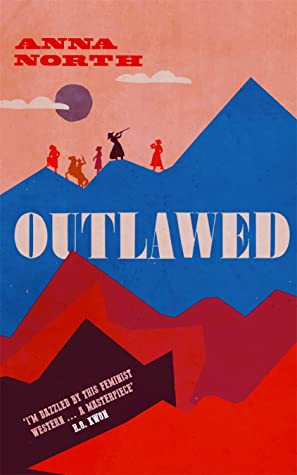 I was a huge fan of North’s previous novel, The Life and Death of Sophie Stark, which cobbles together the story of the title character, a bisexual filmmaker, from accounts by the people who knew her best. Outlawed, an alternative history/speculative take on the traditional Western, could hardly be more different. In a subtly different version of the United States, everyone now alive in the 1890s is descended from those who survived a vicious 1830s flu epidemic. The duty to repopulate the nation has led to a cult of fertility and devotion to the Baby Jesus. From her mother, a midwife and herbalist, Ada has learned the basics of medical care, but the causes of barrenness remain a mystery and childlessness is perceived as a curse.
Ada marries at 17 and fails to get pregnant within a year. After an acquaintance miscarries, rumours start to spread about Ada being a witch. Kicked out by her mother-in-law, she takes shelter first at a convent and then with the Hole in the Wall gang. She’ll be the doctor to this band of female outlaws who weren’t cut out for motherhood and shunned marriage – including lesbians, a mixed-race woman, and their leader, the Kid, who is nonbinary. The Kid is a mentally tortured prophet with a vision of making the world safe for people like them (“we were told a lie about God and what He wants from us”), mainly by, Robin Hood-like, redistributing wealth through hold-ups and bank robberies. Ada, who longs to conduct proper research into reproductive health rather than relying on religious propaganda, falls for another gender nonconformist, Lark, and does what she can to make the Kid’s dream a reality.
Reese Witherspoon choosing this for her Hello Sunshine book club was a great chance for North’s work to get more attention. However, I felt that the ideas behind this novel were more noteworthy than the execution. The similarity to The Handmaid’s Tale is undeniable, though I liked this a bit more. I most enjoyed the medical and religious themes, and appreciated the attention to childless and otherwise unconventional women. But the setup is so condensed and the consequences of the gang’s major heist so rushed that I wondered if the novel needed another 100 pages to stretch its wings. I’ll just have to await North’s next book.
With thanks to W&N for the proof copy for review.
little scratch by Rebecca Watson
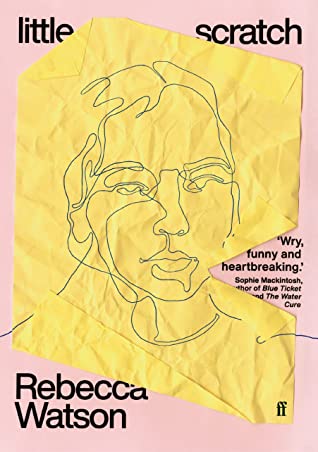 I love a circadian narrative and had heard interesting things about the experimental style used in this debut novel. I even heard Watson read a passage from it as part of the Faber Live Fiction Showcase and found it very funny and engaging. But I really should have tried an excerpt before requesting this for review; I would have seen at a glance that it wasn’t for me. I don’t have a problem with prose being formatted like poetry (Girl, Woman, Other; Stubborn Archivist; the prologue of Wendy McGrath’s Santa Rosa; parts of Mrs Death Misses Death), but here it seemed to me that it was only done to alleviate the tedium of the contents.
A young woman who, like Watson, works for a newspaper, trudges through a typical day: wake up, get ready, commute to the office, waste time and snack in between doing bits of work, get outraged about inconsequential things, think about her boyfriend (only ever referred to as “my him” – probably my biggest specific pet peeve about the book), and push down memories of a sexual assault. Thus, the only thing that really happens happened before the book even started. Her scratching, to the point of open wounds and scabs, seems like a psychosomatic symptom of unprocessed trauma. By the end, she’s getting ready to tell her boyfriend about the assault, which seems like a step in the right direction.
I might have found Watson’s approach captivating in a short story, or as brief passages studded in a longer narrative. At first it’s a fun puzzle to ponder how these mostly unpunctuated words, dotted around the pages in two to six columns, fit together – should one read down each column, or across each row, or both? – but when all the scattershot words are only there to describe a train carriage filling up or repetitive quotidian actions (sifting through e-mails, pedalling a bicycle), the style soon grates. You may have more patience with it than I did if you loved A Girl Is a Half-Formed Thing or books by Emma Glass.


A favourite passage: “got to do this thing again, the waking up thing, the day thing, the work thing, disentangling from my duvet thing, this is something, this is a thing I have to do then,” [appears all as one left-aligned paragraph]
With thanks to Faber & Faber for the free copy for review.
Tomorrow I’ll review three nonfiction works published in January, all on a medical theme.
 Bookish Beck = Rebecca Foster. American transplant to England. Freelance proofreader and book reviewer.
 Bookish Beck