Reading Ireland Month, Part I: Wendy Erskine and Niamh Ní Mhaoileoin
St. Patrick’s Day is a good occasion for my first set of contributions to Cathy’s Reading Ireland Month. Today I have two 2025 debut novels by women, one about the ripples caused by a sexual assault; the other about grief, queerness and unease with the Catholic Church. Both come with a Women’s Prize seal of approval. As I write, I happen to be listening to the new Foy Vance album I picked up today, which has inspired me to choose a few relevant (Northern) Irish songs to accompany each book.
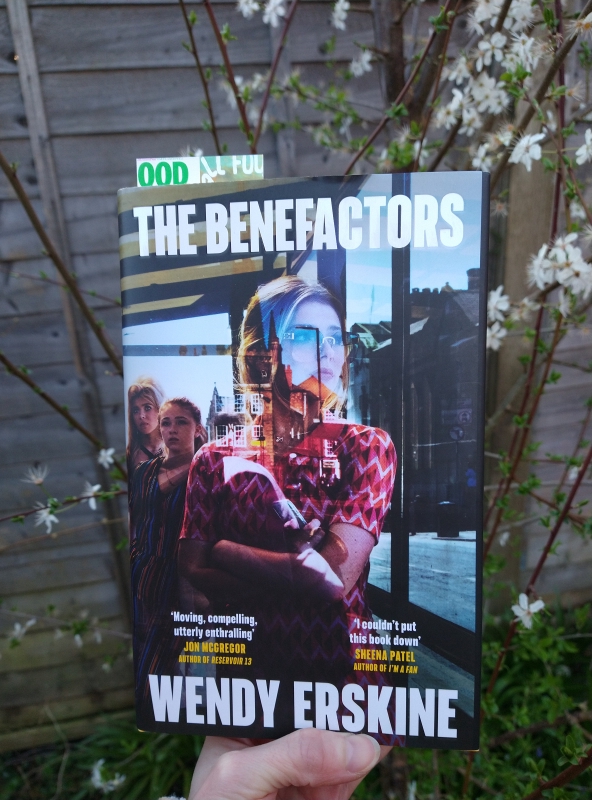
The Benefactors by Wendy Erskine
I loved Erskine’s short story collection Dance Move so was looking forward to this before it appeared on the Women’s Prize longlist. We’re introduced to three middle-aged Belfast women whose 18-year-old sons are charged with sexual assault: Frankie Levine, stepmother to Chris; Miriam Abdel Salam, mother of Rami; and Bronagh Farrell, mum of Lyness or “Line-up.” Frankie grew up in care but is now rich beyond her wildest dreams, Miriam was recently widowed by a car accident, and Bronagh heads a children’s services charity. Misty, the classmate who accused the boys of the assault at a party, lives with her stepfather, cab driver Boogie. As rumours spread, the mothers have confabs to prepare a united front. At one level they’re horrified by what their sons were capable of (Rami used a bottle), but on another they’ve decided that it’s just a hullabaloo – Bronagh’s word – that will die down soon.
Slut-shaming of Misty starts early: she has a “Bennyz” amateur porn account and did phone or video chats, very mild stuff, with men all over the world. It’s uncomfortable, though realistic, how money and class steer what happens next. The book’s title comes from the soft-porn site, but in a wider sense invites the question of who funds lifestyles and so who’s really in control. People who have compassion in general can’t find it in this situation. Erskine intersperses short sections from anonymous voices, such as policemen and partygoers, with the narrative. These are well done, and sometimes quite funny, but Erskine’s meta joke – “There can be just too many perspectives” – proves true in that the interludes add little we haven’t already grasped about the direction of the local gossip. Apart from Misty, I felt I’d hardly gotten to know any of the characters by the end. The novel also suffered from being the second novel about the aftermath of a gang rape I’ve read in three months (after Who Killed Bambi? by Monika Fagerholm, translated from Swedish). But I reckon its blend of grit and heart is likely to please readers of Colin Barrett and Lisa McInerney.
Northern Irish songs for Misty:
- “Collect Yourself” by Iain Archer
- “At Least My Heart Was Open” by Foy Vance (beware the F-bomb)
& an Irish one: “The Blower’s Daughter” by Damien Rice
Ordinary Saints by Niamh Ní Mhaoileoin
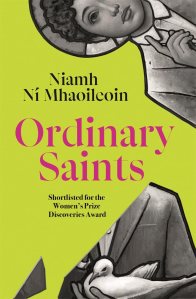 This was one of my Most Anticipated titles in 2025. It was shortlisted for the Women’s Prize Discoveries Award (for manuscripts in progress) in 2022 and won the PFD Queer Fiction Prize. Jacinta, who prefers to be known as Jay, is in her late twenties, living in London, working in marketing and half-serious about her relationship with her girlfriend, Lindsay. She tries not to think about Ireland, religion, or the past: her mother’s mental health struggles, her extended family’s casual homophobia, and the fact that her older brother, Ferdia, who was a trainee Catholic priest in Rome, died in a freak accident when she was 16. But it all comes back for her when her parents tell her that there is a campaign to have Ferdia canonized. While her mother scurries around making speeches and verifying miracles, Jay seeks the opposite for her brother: to be remembered as a normal, flawed and perhaps closeted human.
It took me ages to read this, despite the undemanding first-person, present-tense narration, because the early London material is so monotonous. Unlike the Erskine (probably because that is her third book), this felt very much like a debut, where a lot of earnest apprentice work has had to go into getting characters from A to B, literally and emotionally. Any time the author wants to advance the plot, she has Jay meet someone in a bar for a conversation. Without fail, there will be drinks involved. This felt to me like a stereotype of the Irish. It’s only really in the last quarter, as Jay has honest conversations with both parents, deals with her grief over Ferdia and accepts how much Lindsay means to her, that the book soars. For me, that was too little too late, even though the themes were irresistible.
A Northern Irish song for Jay:
- “Freewheel” by Duke Special
- and (for Jay and Lindsay) “Crack the Shutters” by Snow Patrol
& an Irish one: “The Trailing Skirts of God” by Bell X1
I loved the premise of both of these novels, but the execution left me slightly disappointed. Still, I wouldn’t discourage you from picking them up if they’ve caught your eye; I know that some blogger friends have liked one or the other much better than I did.
I’ll raise a cheeky glass of Bailey’s tonight to the greatness of Irish literature. Speaking of which, I’ll have another, bigger batch of reviews coming up before the end of the month!
Most Anticipated Books of 2026
Later than intended, but here we are. I’ve narrowed it down to the 25 books I’m most looking forward to in January–September, though no doubt I’ll have heard of many more unmissable titles before that time is up. My list is dominated by fiction, which I tend to find out about earlier. Also on my radar are novels by Sharon Bala, Freya Bromley, Mary Costello, Louise Kennedy, Ben Lerner, Paula McLain, Liz Nugent and Tom Perrotta; short stories by Jess Gibson (Margaret Atwood’s daughter); and nonfiction from Margaret Drabble, Cal Flyn, Siri Hustvedt and Anne Lamott.
In release date order, with UK publication info given first if available. The blurbs are adapted from Goodreads. I’ve taken the liberty of using whichever cover I prefer.
Fiction
 Departure(s) by Julian Barnes [20 Jan., Vintage (Penguin) / Knopf]: (Currently reading) I get more out of rereading Barnes’s classics than reading his latest stuff, but I’ll still attempt anything he publishes. He’s 80 and calls this his last book. So far, it’s heavily about memory. “Julian played matchmaker to Stephen and Jean, friends he met at university in the 1960s; as the third wheel, he was deeply invested in the success of their love”. Sounds way too similar to 1991’s Talking It Over, and the early pages have been tedious. (Review copy from publisher)
 Half His Age by Jennette McCurdy [20 Jan., Fourth Estate / Ballantine]: McCurdy’s memoir, I’m Glad My Mom Died, was stranger than fiction. I was so impressed by her recreation of her childhood perspective on her dysfunctional Mormon/hoarding/child-actor/cancer survivor family that I have no doubt she’ll do justice to this reverse-Lolita scenario about a 17-year-old who’s in love with her schlubby creative writing teacher. (Library copy on order)
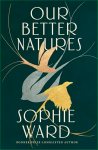 Our Better Natures by Sophie Ward [5 Feb., Corsair]: I loved Ward’s Booker-longlisted Love and Other Thought Experiments (though the follow-up, The Schoolhouse, was a letdown). “Amid the chaos and political upheaval of 1970s America, three very different women must accept the world as it is, or act to change it. Phyllis Patterson is a housewife in White Plains, Illinois. … Andrea Dworkin is an activist in Amsterdam. … Muriel Rukeyser is a poet in New York.” (Library copy on order)
 Brawler: Stories by Lauren Groff [Riverhead, Feb. 24]: (Currently reading) Controversial opinion: Short stories are where Groff really shines. Three-quarters in, this collection is just as impressive as Delicate Edible Birds or Florida. “Ranging from the 1950s to the present day and moving across age, class, and region (New England to Florida to California) these nine stories reflect and expand upon a shared the ceaseless battle between humans’ dark and light angels.” (For Shelf Awareness review) (Edelweiss download)
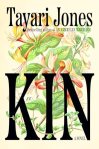 Kin by Tayari Jones [24 Feb., Oneworld / Knopf]: I’m a big fan of Leaving Atlanta and An American Marriage. This sounds like Brit Bennett meets Toni Morrison. “Vernice and Annie, two motherless daughters raised in Honeysuckle, Louisiana, have been best friends and neighbors since earliest childhood, but are fated to live starkly different lives. … A novel about mothers and daughters, about friendship and sisterhood, and the complexities of being a woman in the American South”. (Edelweiss download)
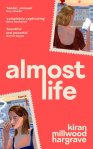 Almost Life by Kiran Millwood Hargrave [12 March, Picador / March 24, S&S/Summit Books]: There have often been queer undertones in Hargrave’s work, but this David Nicholls-esque plot sounds like her most overt. “Erica and Laure meet on the steps of the Sacré-Cœur in Paris, 1978. … The moment the two women meet the spark is undeniable. But their encounter turns into far more than a summer of love. It is the beginning of a relationship that will define their lives and every decision they have yet to make.” (Edelweiss download)
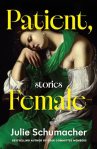 Patient, Female: Stories by Julie Schumacher [May 5, Milkweed Editions]: I found out about this via a webinar with Milkweed and a couple of other U.S. indie publishers. I loved Schumacher’s Dear Committee Members. “[T]his irreverent collection … balances sorrow against laughter. … Each protagonist—ranging from girlhood to senescence—receives her own indelible voice as she navigates social blunders, generational misunderstandings, and the absurdity of the human experience.” The publicist likened the tone to Meg Wolitzer.
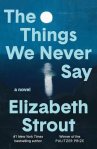 The Things We Never Say by Elizabeth Strout [7 May, Viking (Penguin) / May 5, Random House]: Hurrah for moving on from Lucy Barton at last! “Artie Dam is living a double life. He spends his days teaching history to eleventh graders … and, on weekends, takes his sailboat out on the beautiful Massachusetts Bay. … [O]ne day, Artie learns that life has been keeping a secret from him, one that threatens to upend his entire world. … [This] takes one man’s fears and loneliness and makes them universal.”
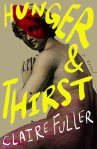 Hunger and Thirst by Claire Fuller [7 May, Penguin / June 2, Tin House]: I’ve read everything of Fuller’s and hope this will reverse the worsening trend of her novels, though true crime is overdone. “1987: After a childhood trauma and years in and out of the care system, sixteen-year-old Ursula … is invited to join a squat at The Underwood. … Thirty-six years later, Ursula is a renowned, reclusive sculptor living under a pseudonym in London when her identity is exposed by true-crime documentary-maker.” (Edelweiss download)
 Little Vanities by Sarah Gilmartin [21 May, ONE (Pushkin)]: Gilmartin’s Service was great. “Dylan, Stevie and Ben have been inseparable since their days at Trinity, when everything seemed possible. … Two decades on, … Dylan, once a rugby star, is stranded on the sofa, cared for by his wife Rachel. Across town, Stevie and Ben’s relationship has settled into weary routine. Then, after countless auditions, Ben lands a role in Pinter’s Betrayal. As rehearsals unfold, the play’s shifting allegiances seep into reality, reviving old jealousies and awakening sudden longings.”
 Said the Dead by Doireann Ní Ghríofa [21 May, Faber / Sept. 22, Farrar, Straus and Giroux]: A Ghost in the Throat was brilliant and this sounds right up my street. “In the city of Cork, a derelict Victorian mental hospital is being converted into modern apartments. One passerby has always flinched as she passes the place. Had her birth occurred in another decade, she too might have lived within those walls. Now, … she finds herself drawn into an irresistible river of forgotten voices”.
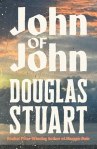 John of John by Douglas Stuart [21 May, Picador / May 5, Grove Press]: I DNFed Shuggie Bain and haven’t tried Stuart since, but the Outer Hebrides setting piqued my attention. “[W]ith little to show for his art school education, John-Calum Macleod takes the ferry back home to the island of Harris [and] begrudgingly resumes his old life, stuck between the two poles of his childhood: his father John, a sheep farmer, tweed weaver, and pillar of their local Presbyterian church, and his maternal grandmother Ella, a profanity-loving Glaswegian”. (For early Shelf Awareness review) (Edelweiss download)
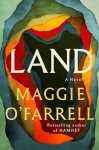 Land by Maggie O’Farrell [2 June, Tinder Press / Knopf]: I haven’t fully loved O’Farrell’s shift into historical fiction, but I’m still willing to give this a go. “On a windswept peninsula stretching out into the Atlantic, Tomás and his reluctant son, Liam [age 10], are working for the great Ordnance Survey project to map the whole of Ireland. The year is 1865, and in a country not long since ravaged and emptied by the Great Hunger, the task is not an easy one.” (Edelweiss download)
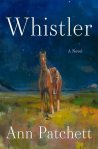 Whistler by Ann Patchett [2 June, Bloomsbury / Harper]: Patchett is hella reliable. “When Daphne Fuller and her husband Jonathan visit the Metropolitan Museum of Art, they notice an older, white-haired gentleman following them. The man turns out to be Eddie Triplett, her former stepfather, who had been married to her mother for a little more than year when Daphne was nine. … Meeting again, time falls away; … [in a story of] adults looking back over the choices they made, and the choices that were made for them.” (Edelweiss download)
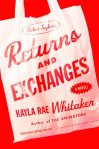 Returns and Exchanges by Kayla Rae Whitaker [2 June, Scribe / May 19, Random House]: Whitaker’s The Animators is one of my favourite novels that hardly anyone else has ever heard of. “A sweeping novel of one [discount department store-owning] Kentucky family’s rise and fall throughout the 1980s—a tragicomic tour de force about love and marriage, parents and [their four] children, and the perils of mixing family with business”. (Edelweiss download)
 The Great Wherever by Shannon Sanders [9 July, Viking (Penguin) / July 7, Henry Holt]: Sanders’s linked story collection Company left me keen to follow her career. Aubrey Lamb, 32, is “grieving the recent loss of her father and the end of a relationship.” She leaves Washington, DC for her Black family’s ancestral Tennessee farm. “But the land proves to be a burdensome inheritance … [and] the ghosts of her ancestors interject with their own exasperated, gossipy commentary on the flaws and foibles of relatives living and dead”. (Edelweiss download)
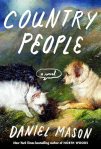 Country People by Daniel Mason [14 July, John Murray / July 7, Random House]: It doesn’t seem long enough since North Woods for there to be another Mason novel, but never mind. “Miles Krzelewski is … twelve years late with his PhD on Russian folktales … [W]hen his wife Kate accepts a visiting professorship at a prestigious college in the far away forests of Vermont, he decides that this will be his year to finally move forward with his life. … [A] luminous exploration of marriage and parenthood, the nature of belief and the power of stories, and the ways in which we find connection in an increasingly fragmented world.”
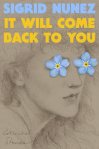 It Will Come Back to You: Collected Stories by Sigrid Nunez [14 July, Virago / Riverhead]: Nunez is one of my favourite authors but I never knew she’d written short stories. The blurb reveals very little about them! “Carefully selected from three decades of work … Moving from the momentous to the mundane, Nunez maintains her irrepressible humor, bite, and insight, her expert balance between intimacy and universality, gravity and levity, all while entertainingly probing the philosophical questions we have come to expect, such as: How can we withstand the passage of time? Is memory the greatest fiction?” (Edelweiss download)
 Exit Party by Emily St. John Mandel [17 Sept., Picador / Sept. 15, Knopf]: The synopsis sounds a bit meh, but in my eyes Mandel can do no wrong. “2031. America is at war with itself, but for the first time in weeks there is some good news: the Republic of California has been declared, the curfew in Los Angeles is lifted, and everyone in the city is going to a party. Ari, newly released from prison, arrives with her friend Gloria … Years later, living a different life in Paris, Ari remains haunted by that night.”
The Housekeeper by Rose Tremain [17 Sept., Vintage (Penguin); no cover image yet]: “Set in 1930s England and fictionalises the inspiration behind Daphne du Maurier’s famous novel, Rebecca.” Strangely, this started life as a short story (in The American Lover), then become a screenplay authored by Tremain (the film is in production and stars Uma Thurman and Anthony Hopkins), and is now being expanded into a novel. Tremain is 82 and a survivor of major cancer; I do wonder if this is the last book we can expect from her.
Nonfiction
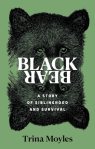 Black Bear: A Story of Siblinghood and Survival by Trina Moyles [Jan. 6, Pegasus Books]: Out now! “When Trina Moyles was five years old, her father … brought home an orphaned black bear cub for a night before sending it to the Calgary Zoo. … After years of working for human rights organizations, Trina returned to northern Alberta for a job as a fire tower lookout, while [her brother] Brendan worked in the oil sands … Over four summers, Trina begins to move beyond fear and observe the extraordinary essence of the maligned black bear”. (For BookBrowse review) (Review e-copy)
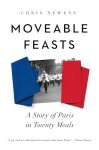 Moveable Feasts: A Story of Paris in Twenty Meals by Chris Newens [Feb. 3, Pegasus Books; came out in the UK in July 2025 but somehow I missed it!]: I’m a sucker for foodie books and Paris books. A “long-time resident of the historic slaughterhouse quartier Villette takes us on a delightful gastronomic journey around Paris … From Congolese catfish in the 18th to Middle Eastern falafels in the 4th, to the charcuterie served at the libertine nightclubs of Pigalle in the 9th, Newens lifts the lid on the city’s ever-changing, defining, and irresistible food culture.” (Edelweiss download)
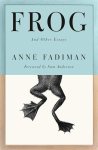 Frog: And Other Essays by Anne Fadiman [Feb. 10, Farrar, Straus and Giroux]: Fadiman publishes rarely, and it can be difficult to get hold of her books, but they are always worth it. “Ranging in subject matter from her deceased frog, to archaic printer technology, to the fraught relationship between Samuel Taylor Coleridge and his son Hartley, these essays unlock a whole world—one overflowing with mundanity and oddity—through sly observation and brilliant wit.”
 The Beginning Comes after the End: Notes on a World of Change by Rebecca Solnit [March 3, Haymarket Books]: A sequel to Hope in the Dark. Hope is a critically endangered species these days, but Solnit has her eyes open. “While the white nationalist and authoritarian backlash drives individualism and isolation, this new world embraces antiracism, feminism, a more expansive understanding of gender, environmental thinking, scientific breakthroughs, and Indigenous and non-Western ideas, pointing toward a more interconnected, relational world.” (Edelweiss download)
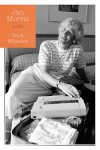 Jan Morris: A Life by Sara Wheeler [7 April, Faber / April 14, Harper]: I didn’t get on with the mammoth biography Paul Clements published in 2022 – it was dry and conventional; entirely unfitting for Morris – but hope for better things from a fellow female travel writer. “Wheeler uncovers the complexity of this twentieth-century icon … Drawing on unprecedented access to Morris’s papers as well as interviews with family, friends and colleagues, Wheeler assembles a captivating … story of longing, traveling and never reaching home.” (Edelweiss download)
Others’ lists whence a few of my ideas came!
What catches your eye here? What other 2026 titles do I need to know about?
Three on a Theme: Armchair Travels at the Italian Coast (Rachel Joyce, Sarah Moss and Jess Walter – #18 of 20 Books)
I’ve done a lot of journeying through Italy’s lakes and islands this summer. Not in real life, thank goodness – it would be far too hot! – but via books. I started with the Moss, then read the Joyce, and rounded off with the Walter, a book that had been on my TBR for 12 years and that many had heartily recommended, so I was delighted to finally experience it for myself.
The Homemade God by Rachel Joyce (2025)
Joyce has really upped her game. I’ve somehow read all of her books though I often found them, from Harold Fry onward, disappointingly sentimental and twee. But with this she’s entering the big leagues, moving into the more expansive, elegant and empathetic territory of novels by Anne Enright (The Green Road), Patrick Gale (Notes from an Exhibition), Maggie O’Farrell (Instructions for a Heatwave) and Tom Rachman (The Italian Teacher). It’s the story of four siblings, initially drawn together and then dramatically blown apart by their father’s death. Despite weighty themes of alcoholism, depression and marital struggles, there is an overall lightness of tone and style that made this a pleasure to read.
Vic Kemp, the title figure, was a larger-than-life, womanizing painter whose work divided critics. After his first wife’s early death from cancer, he raised three daughters and a son with the help of a rotating cast of nannies (whom he inevitably slept with). At 76 he delivered the shocking news that he was marrying again: Bella-Mae, an artist in her twenties – much younger than any of his children. They moved from London to his second home in Italy just weeks before he drowned in Lake Orta. Netta, the eldest daughter, is sure there’s something fishy; he knew the lake so well and would never have gone out for a swim with a mist rolling in. Did Bella-Mae kill him for his money? And where is his last painting? Funny how waiting for an autopsy report and searching for a new will and carping with siblings over the division of belongings can ruin what should be paradise.
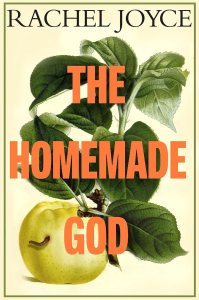
The interactions between Netta, Susan, Goose (Gustav) and Iris, plus Bella-Mae and her cousin Laszlo, are all flawlessly done, and through flashbacks and surges forward we learn so much about these flawed and flailing characters. The derelict villa and surrounding small town are appealing settings, and there are a lot of intriguing references to food, fashion and modern art.
My only small points of criticism are that Iris is less fleshed out than the others (and her bombshell secret felt distasteful), and that Joyce occasionally resorts to delivering some of her old obvious (though true) messages through an omniscient narrator, whereas they could be more palatable if they came out organically in dialogue or indirectly through a character’s thought process. Here’s an example: “When someone dies or disappears, we can only tell stories about what might have been the case or what might have happened next.” (One I liked better: “There were some things you never got over. No amount of thinking or talking would make them right: the best you could do was find a way to live alongside them.”) I also don’t think Goose would have been able to view his father’s body more than two months after his death; even with embalming, it would have started to decay within weeks.
You can tell that Joyce got her start in theatre because she’s so good at scenes and dialogue, and at moving people into different groups to see what they’ll do. She’s taken the best of her work in other media and brought it to bear here. It’s fascinating how Goose starts off seeming minor and eventually becomes the main POV character. And ending with a wedding (good enough for a Shakespearean comedy) offers a lovely occasion for a potential reconciliation after a (tragi)comic plot. More of this calibre, please! (Public library) 
Ripeness by Sarah Moss (2025)
One sneaky little line, “Ripeness, not readiness, is all,” a Shakespeare mash-up (“Ripeness is all” is from King Lear vs. “the readiness is all” is from Hamlet), gives a clue to how to understand this novel: As a work of maturity from Sarah Moss, presenting life with all its contradictions and disappointments, not attempting to counterbalance that realism with any false optimism. What do we do, who will we be, when faced with situations for which we aren’t prepared?
Now that she’s based in Ireland, Moss seems almost to be channelling Irish authors such as Claire Keegan and Maggie O’Farrell. The line-up of themes – ballet + sisters + ambivalent motherhood + the question of immigration and belonging – should have added up to something incredible and right up my street. While Ripeness is good, even very good, it feels slightly forced. As has been true with some of Moss’s recent fiction (especially Summerwater), there is the air of a creative writing experiment. Here the trial is to determine which feels closer, a first-person rendering of a time nearly 60 years ago, or a present-tense, close-third-person account of the now. [I had in mind advice from one of Emma Darwin’s Substack posts: “What you’ll see is that ‘deep third’ is really much the same as first, in the logic of it, just with different pronouns: you are locking the narrative into a certain character’s point-of-view, but you don’t have a sense of that character as the narrator, the way you do in first person.” Except, increasingly as the novel goes on, we are compelled to think about Edith as a narrator, of her own life and others’.
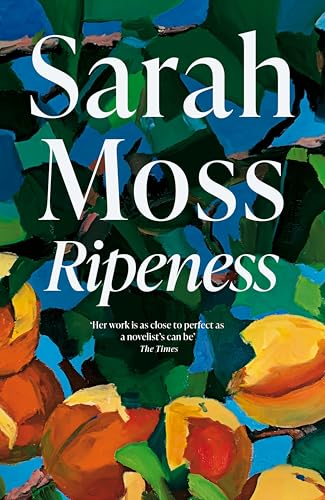
In the current story line, everyone in rural West Ireland seems to have come from somewhere else (e.g. Edith’s lover Gunter is German). “She’s going to have to find a way to rise above it, this tribalism,” Edith thinks. She’s aghast at her town playing host to a small protest against immigration. Fair enough, but including this incident just seems like an excuse for some liberal handwringing (“since it’s obvious that there is enough for all, that the problem is distribution not supply, why cannot all have enough? Partly because people like Edith have too much.”). The facts of Maman being French-Israeli and having lost family in the Holocaust felt particularly shoehorned in; referencing Jewishness adds nothing. I also wondered why she set the 1960s narrative in Italy, apart from novelty and personal familiarity. (Teenage Edith’s high school Italian is improbably advanced, allowing her to translate throughout her sister’s childbirth.)
Though much of what I’ve written seems negative, I was left with an overall favourable impression. Mostly it’s that the delivery scene and the chapters that follow it are so very moving. Plus there are astute lines everywhere you look, whether on dance, motherhood, or migration. It may simply be that Moss was taking on too much at once, such that this lacks the focus of her novellas. Ultimately, I would have been happy to have just the historical story line; the repeat of the surrendering for adoption element isn’t necessary to make any point. (I was relieved, anyway, that Moss didn’t resort to the cheap trick of having the baby turn out to be a character we’ve already been introduced to.) I admire the ambition but feel Moss has yet to return to the sweet spot of her first five novels. Still, I’m a fan for life. (Public library) 
#18 of my 20 Books of Summer
(Completing the second row on the Bingo card: Book set in a vacation destination)


Beautiful Ruins by Jess Walter (2012)
 I loved how Emma Straub described the ideal summer read in one of her Substack posts: “My plan for the summer is to read as many books as possible that make me feel that drugged-up feeling, where you just want to get back to the page.” I wish I’d been able to read this faster – that I hadn’t had so much on my plate all summer so I could have been fully immersed. Nonetheless, every time I returned to it I felt welcomed in. So many trusted bibliophiles love this book – blogger friends Laila and Laura T.; Emma Milne-White, owner of Hungerford Bookshop, who plugged it at their 2023 summer reading celebration; and Maris Kreizman, who in a recent newsletter described this as “One of my favorite summer reading novels ever … escapist magic, a lush historical novel.”
I’m relieved to report that Beautiful Ruins lived up to everyone’s acclaim – and my own high expectations after enjoying Walter’s So Far Gone, which I reviewed for BookBrowse earlier in the summer. I was immediately captivated by the shabby glamour of Pasquale’s hotel in Porto Vergogna on the coast of northern Italy. With refreshing honesty, he’s dubbed the place “Hotel Adequate View.” In April 1962, he’s attempting to build a cliff-edge tennis court when a boat delivers beautiful, dying American actress Dee Moray. It soon becomes clear that her condition is nothing nine months won’t fix and she’s been dumped here to keep her from meddling in the romance between the leads in Cleopatra, filming in Rome. In the present day, an elderly Pasquale goes to Hollywood to find out whatever happened to Dee.
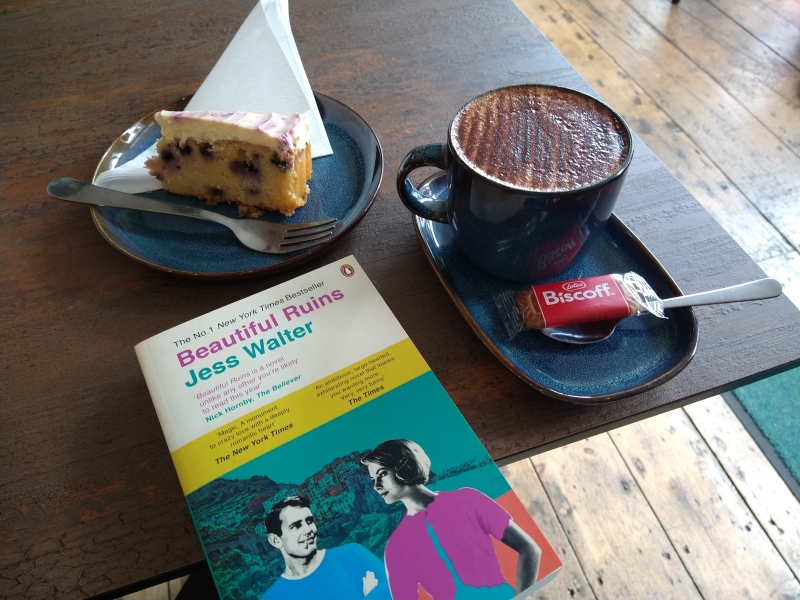
A myriad of threads and formats – a movie pitch, a would-be Hemingway’s first chapter of a never-finished wartime masterpiece, an excerpt from a producer’s autobiography and a play transcript – coalesce to flesh out what happened in that summer of 1962 and how the last half-century has treated all the supporting players. True to the tone of a novel about regret, failure and shattered illusions, Walter doesn’t tie everything up neatly, but he does offer a number of the characters a chance at redemption. This felt to me like a warmer and more timeless version of A Visit from the Goon Squad. There are so many great scenes, none better than Richard Burton’s drunken visit to Porto Vergogna, which had me in stitches. Fantastic. (Hungerford Bookshop – 40th birthday gift from my husband from my wish list) 
Reading Ireland Month, I: Donoghue, Longley, Tóibín
St. Patrick’s Day is a good occasion to compile my first set of contributions to Cathy’s Reading Ireland Month. Today I have an early novel by a favourite author, a poetry collection inspired by nature and mythology, and a sequel that I read for book club.
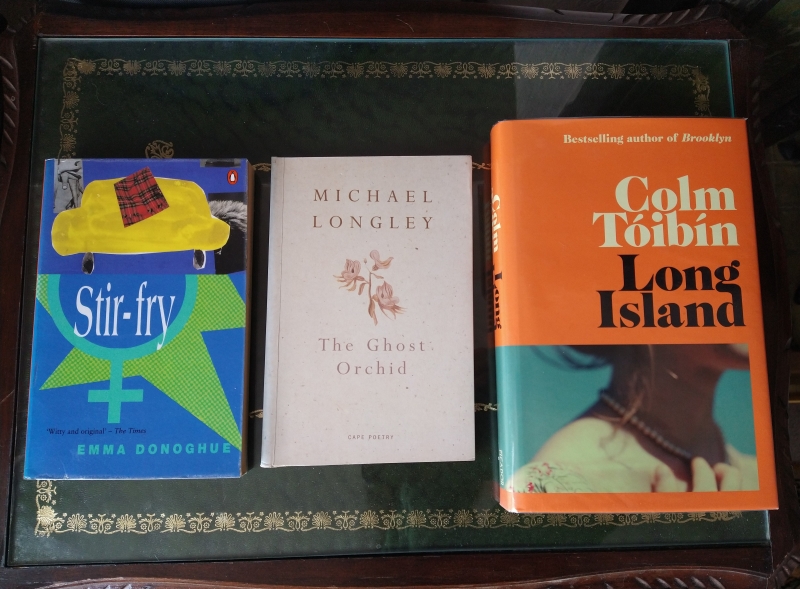
Stir-Fry by Emma Donoghue (1994)
After enjoying Slammerkin so much last year, I decided to catch up on more of Donoghue’s way-back catalogue. She tends to alternate between contemporary and historical settings. I have a slight preference for the former, but she can excel at both; it really depends on the book. I reckon this was edgy for its time. Maria (whose name rhymes with “pariah”) arrives in Dublin for university at age 17, green in every way after a religious upbringing in the countryside. In response to a flat-share advert stipulating “NO BIGOTS,” she ends up living with Ruth and Jael (pronounced “Yale”), two mature students. Ruth is the mother hen, doing all the cooking and fretting over the others’ wellbeing; Jael is a wild, henna-haired 30-year-old prone to drinking whisky by the mug-full. Maria attends lectures, takes a job cleaning office buildings, and finds a friend circle through her backstage student theatre volunteering. She’s mildly interested in American exchange student Galway and then leather-clad Damien (until she realizes he has a boyfriend), but nothing ever goes further than a kiss.
 It’s obvious to readers that Ruth and Jael are a couple, but Maria doesn’t work it out until a third of the way into the book. At first she’s mortified, but soon the realization is just one more aspect of her coming of age. Maria’s friend Yvonne can’t understand why she doesn’t leave – “how can you put up with being a gooseberry?” – but Maria insists, “They really don’t make me feel left out … I think they need me to absorb some of the static. They say they’d be fighting like cats if I wasn’t around to distract them.” Scenes alternate between the flat and the campus, which Donoghue depicts as a place where radicalism and repression jostle for position. Ruth drags Maria to a Tuesday evening Women’s Group meeting that ends abruptly: “A porter put his greying head in the door to comment that they’d have to be out in five minutes, girls, this room was booked for the archaeologists’ cheese ’n’ wine.” Later, Ruth’s is the Against voice in a debate on “That homosexuality is a blot on Irish society.”
Mostly, this short novel is a dance between the three central characters. The Irish-accented banter between them is a joy. Jael’s devil-may-care attitude contrasts with Ruth and Maria’s anxiety about how they are perceived by others. Ruth and Jael are figures in the Hebrew Bible and their devotion/boldness dichotomy is applicable to the characters here, too. The stereotypical markers of lesbian identity haven’t really changed, but had Donoghue written this now I think she would at least have made Maria a year older and avoided negativity about Damien and Jael’s bisexuality. At heart this is a sweet romance and an engaging picture of early 1990s feminism, but it doesn’t completely steer clear of predictability and I would have happily taken another 50–70 pages if it meant she could have fleshed out the characters and their interactions a little more. [Guess what was for my lunch this afternoon? Stir fry!] (Secondhand – Awesomebooks.com)
The Ghost Orchid by Michael Longley (1995)
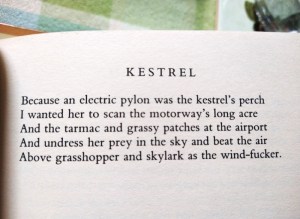
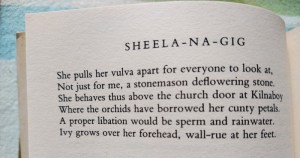
 Longley’s sixth collection draws much of its imagery from nature and Greek and Roman classics. Seven poems incorporate quotations and free translations of the Iliad and Odyssey; elsewhere, he retells the story of Baucis and Philemon and other characters from Ovid. The Orient and the erotic are also major influences; references to Hokusai bookend poems about Chinese artefacts. Poppies link vignettes of the First and Second World Wars. Longley’s poetry is earthy in its emphasis on material objects and sex. Alliteration and slant rhymes are common techniques and the vocabulary is always precise. This was the third collection I’ve read by the late Belfast poet, and with its disparate topics it didn’t all cohere for me. My two favourite poems are naughty indeed:
(Secondhand – Green Ink Booksellers, Hay-on-Wye) 
Long Island by Colm Tóibín (2024)
{SPOILERS in this one}
 I read Brooklyn when it first came out and didn’t revisit it (via book or film) before reading this. While recent knowledge of the first book isn’t necessary, it probably would make you better able to relate to Eilis, who is something of an emotional blank here. She’s been married for 20 years to Tony, a plumber, and is a mother to two teenagers. His tight-knit Italian American family might be considered nurturing, but for her it is more imprisoning: their four houses form an enclave and she’s secretly relieved when her mother-in-law tells her she needn’t feel obliged to join in the Sunday lunch tradition anymore.
When news comes that Tony has impregnated a married woman and the cuckolded husband plans to leave the baby on the Fiorellos’ doorstep when the time arrives, Eilis checks out of the marriage. She uses her mother’s upcoming 80th birthday as an excuse to go back to Ireland for the summer. Here Eilis gets caught up in a love triangle with publican Jim Farrell, who was infatuated with her 20 years ago and still hasn’t forgotten her, and Nancy Sheridan, a widow who runs a fish and chip shop and has been Jim’s secret lover for a couple of years. Nancy has a vision of her future and won’t let Eilis stand in her way.
I felt for all three in their predicaments but most admired Nancy’s pluck. Ironically given the title, the novel spends more of its time in Ireland and only really comes alive there. There’s also a reference to Nora Webster – cute that Tóibín is trying out the Elizabeth Strout trick of bringing multiple characters together in the same fictional community. But, all told, this was just a so-so book. I’ve read 10 or so works by Tóibín now, in all sorts of genres, and with its plain writing this didn’t stand out at all. It got an average score from my book club, with one person loving it, a couple hating it, and most fairly indifferent. (Public library)
Another batch will be coming up before the end of the month!
#NovNov24 Halfway Check-In & Small Things Like These Film Review
Somehow half of November has flown by. We hope you’ve been enjoying reading and reviewing short books this month. So far we have had 40 participants and 84 posts! Remember to add your posts to the link-up, or alert us via a comment here or on Bluesky (@cathybrown746.bsky.social / @bookishbeck.bsky.social), Instagram (@cathy_746books / @bookishbeck), or X (@cathy746books / @bookishbeck).

If you haven’t already, there’s no better time to pick up our buddy read, Orbital by Samantha Harvey, which won the Booker Prize on Tuesday evening. Chair of judges Edmund de Waal said it is “about a wounded world” and that the panel’s “unanimity about Orbital recognises its beauty and ambition.” I was surprised to learn that it is only the second-shortest Booker winner; Offshore by Penelope Fitzgerald is even shorter.

Another popular novella many of us have read is Small Things Like These by Claire Keegan (my latest review is here). I went to see the excellent film adaptation, with a few friends from book club, at our tiny local arthouse cinema on Wednesday afternoon. I’ve read the book twice now – I might just read it a third time before Christmas – and from memory the film is remarkably faithful to its storyline and scope. (The only significant change I think of is that Bill doesn’t visit Ned in the hospital, but there are still flashbacks to the role that Ned played in Bill’s early life.)
 The casting and cinematography are exceptional. Cillian Murphy portrays Bill with just the right blend of stoicism, meekness, and angst. Emily Watson is chilling as Sister Mary, the Mother Superior of the convent, which is suitably creepy with dim brick hallways and clinical laundry rooms. The grimy cobbles and dull streetlamps of the town contrast with the warm light in the scenes of Bill’s remembered childhood at Mrs Wilson’s. Repeated shots – of Bill’s truck setting off across the bridge in the early morning, of him scrubbing coal dust from his hands with carbolic soap, of his eyes wide open in the middle of the night – are not recursive but a way of establishing the gruelling nature of his tasks and the unease that plagues him. A life of physical labour has aged him beyond 39 (cf. Murphy is 48) and he’s in pain from shouldering sacks of coal day in and day out.
Both book and film are set in 1985 but apart from the fashions and the kitschy Christmas decorations and window dressings you’d be excused for thinking it was the 1950s. Bill’s business deals in coal, peat and tinder; rural Ireland really was that economically depressed and technologically constrained. (Another Ireland-set film I saw last year, The Miracle Club, is visually very similar – it even features two of the same actors – although it takes place in 1967. It’s as if nothing changed for decades.)
 By its nature, the film has to be a little more overt about what Bill is feeling (and generally not saying, as he is such a quiet man): there are tears at Murphy’s eyes and anxious breathing to make Bill’s state of mind obvious. Yet the film retains much of the subtlety of Keegan’s novella. You have to listen carefully during the conversation between Bill and Sister Mary to understand she is attempting to blackmail him into silence about what goes on at the convent.
At the end of the film showing, you could have heard a pin drop. Everyone was stunned at the simple beauty of the final scene, and the statistics its story is based on. It’s truly astonishing that Magdalene Laundries were in operation until the late 1990s, with Church support. Rage and sorrow build in you at the very thought, but Bill’s quietly heroic act of resistance is an inspiration. What might we, ordinary people all, be called on to do for women, the poor, and the oppressed in the years to come? We have no excuse not to advocate for them.
(Arti of Ripple Effects has also reviewed the film here.)
So far this month I’ve read nine novellas and reviewed eight. One of these was a one-sitting read, and I have another pile of ones that I could potentially read of a morning or evening next week. I’m currently reading another 16 … it remains to be seen whether I will average one a day for the month!
Short Stories in September Roundup: Alexie, Donoghue, Groff Anthology, Houston, McCracken, Moore, Svoboda, Walker
I gave myself an extra week to finish up the story collections I was in the middle of, so I’ve managed to read 13 during this challenge to self (including my first and second posts). Again I’m borrowing Marcie’s five-sentence review format to keep things simple.
The Lone-Ranger and Tonto Fistfight in Heaven by Sherman Alexie (1993)
 There are 22 stories in this fairly short book, so most top out at no more than 10 pages: little slices of life on and around the reservation at Spokane, Washington. Some central characters recur, such as Victor, Thomas Builds-the-Fire and James Many Horses, but there are so many tales that I couldn’t keep track of them across the book even though I read it quickly. My favourite was “This Is What It Means to Say Phoenix, Arizona,” in which Victor and Thomas fly out to collect the ashes of Victor’s father. Some of the longer titles give a sense of the tone: “Because My Father Always Said He Was the Only Indian Who Saw Jimi Hendrix Play ‘The Star-Spangled Banner’ at Woodstock” and “Jesus Christ’s Half-Brother Is Alive and Well on the Spokane Indian Reservation.” I couldn’t help but think of it as a so-so rehearsal for The Absolutely True Diary of a Part-Time Indian because a similar cast of drunks, jokers, relatives and basketball players populates the stories and a comparable voice prevails. (University library)
The Woman Who Gave Birth to Rabbits by Emma Donoghue (2002)
 The title story is about Mary Toft – I thought of making her hoax the subject of a Three on a Theme post because I actually have two novels about her downloaded from NetGalley and Edelweiss (Mary and the Rabbit Dream by Noémi Kiss-Deáki and Mary Toft; or, The Rabbit Queen by Dexter Palmer), but the facts as conveyed here don’t seem like nearly enough to fuel a whole book, so I doubt I’ll read those. Donoghue has a good eye for historical curios and incidents and an academic’s gift for research, yet not many of these 17 stories, most of which are in the third person, rise above the novelty. Many protagonists are British or Irish women who were a footnote in the historical record: an animal rights activist, a lord’s daughter, a cult leader, a blind poet, a medieval rioter, a suspected witch. There are mild homoerotic touches, too. I enjoyed “Come, Gentle Night,” about John Ruskin’s honeymoon, and “Cured,” which reveals a terrifying surgical means of controlling women’s moods but, as I found with Astray and Learned by Heart, Donoghue sometimes lets documented details overwhelm other elements of a narrative. (Secondhand – Awesomebooks.com)
The Best Short Stories 2023: The O. Henry Prize Winners, ed. Lauren Groff (2023)
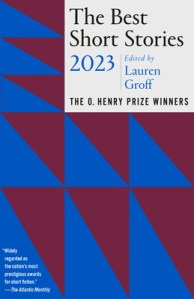 Hard to convey the variety of this 20-story anthology in a concise way because they run the gamut from realist (Nigerian homosexuality in “Happy Is a Doing Word” by Arinze Ifeakandu; Irish gangsters in “The Blackhills” by Eamon McGuinness) to absurd (Ling Ma’s “Office Hours” has academics passing through closet doors into a dream space; the title of Catherine Lacey’s “Man Mountain” is literal; “Ira and the Whale” is Rachel B. Glaser’s gay version of the Jonah legend). Also difficult to encapsulate my reaction, because for every story I would happily have seen expanded into a novel (the gloomy character study “The Locksmith” by Grey Wolfe LaJoie, the teenage friends’ coming-of-age in “After Hours at the Acacia Park Pool” by the marvellous Kirstin Valdez Quade), there was another I thought might never end (“Dream Man” by Cristina Rivera-Garza and “Temporary Housing” by Kathleen Alcott). Three are in translation. I admired Lisa Taddeo’s tale of grief and revenge, “Wisconsin,” and Naomi Shuyama-Gómez’s creepy Colombian-set “The Commander’s Teeth.” But my two favourites were probably “Me, Rory, and Aurora” by Jonas Eika (Danish), which combines an uneasy threesome, the plight of the unhoused and a downright chilling Ishiguro-esque ending; and “Xífù,” K-Ming Chang’s funny, morbid take on daughter/mother-in-law relations in China. (PDF review copy)
Waltzing the Cat by Pam Houston (1998)
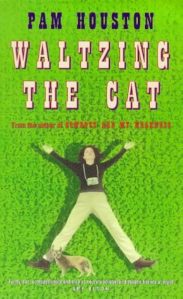 The novel-in-stories is about Lucy, a photographer in her early thirties with a penchant for falling for the wrong men – alcoholics or misogynists or ones who aren’t available. When she’s not working she’s thrill-seeking: rafting in Colorado, travelling in the Amazon, sailing in the Caribbean, or gliding. “Everything good I’ve gotten in life I’ve gotten by plunging in,” she boasts, to which a friend replies, “Sure, and everything bad you’ve gotten in your life you’ve gotten by plunging in.” Ultimately she ‘settles down’ on the Colorado ranch she inherits from her grandmother with a dog, making this – based on what I learned from the autobiographical essays in Deep Creek – even more autofiction for Houston than her debut, Cowboys Are My Weakness, was. Although the final magic realist touch of having her child-self come to her with a box of photographs of traumatic memories is overdone, the themes of accepting vulnerability, seeking to freeze time and creating a home for yourself resonated, and the title story, about the death of Lucy’s mother, is a brilliant and heart-wrenching standalone. (Secondhand – British Red Cross, Berwick)
The Souvenir Museum by Elizabeth McCracken (2021)
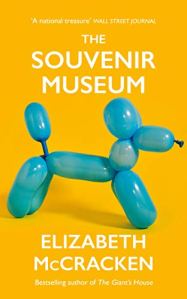 McCracken is terrific in short forms: The Hero of This Book, a novella, was one of my top books of 2022, and I also loved her previous story collection, Thunderstruck. Five of these dozen stories are taken from different points in the lives of Jack and Sadie, English and American academics (who I inevitably read as McCracken and her husband, Edward Carey) who come from large-family zaniness versus claustrophobic mother–daughter melancholy. I kept thinking that McCracken’s are just the sorts of scenarios Lucy and Olive would have told stories about in Tell Me Everything: accidents, misfortunes; random connections. Travel is a major element in many of the stories, including to Denmark (in the title story) and Amsterdam. I couldn’t decide whether I preferred the Jack-and-Sadie material or the rest, but I had a favourite from each: “The Irish Wedding” cracked me up as much as it did Sadie with the accidental use of crass American slang, while “Proof,” about a man communing with his father despite his early dementia, is set on a boat trip I’ve made (in 2004!) to see puffins on the Treshnish islands of Scotland. (Secondhand – Dogs Trust charity shop, Marlborough)
Like Life by Lorrie Moore (1990)
 Compared to Birds of America, this feels a little dated and the plots are overall less memorable. Still, the eight stories of Moore’s second collection are chewy with insight into relationships and the mindsets of youngish and middle-aged women, and there’s an effortless wry wit to her turns of phrase. Her exasperated would-be feminist characters remind me of Helen Simpson’s, while the cheese-selling protagonist of “Joy” made me think of an early Carol Shields story; and who knew a “cute meet” (aka a meet-cute) was a thing back then? New York City contrasts with the Midwest, most notably in “You’re Ugly, Too” and “The Jewish Hunter.” The title story, which comes last, crafts a weirdly muted dystopia built around shortages and marital misery; I preferred the (comparative lightness) of “Vissi d’Arte,” about a lonely playwright, and “Places to Look for Your Mind,” in which an empty-nest entrepreneur hosts an aimless young Englishman her daughter met on her study abroad year. (Secondhand – Bark charity shop, Berwick)
The Long Swim by Terese Svoboda (2023)
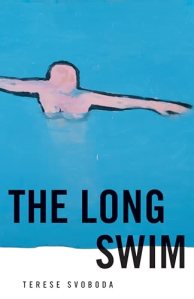 These 44 stories, mostly of flash fiction length, combine the grit of Denis Johnson with the bite of Flannery O’Connor. Siblings squabble over a late parent’s effects or wishes, marriages go wrong, the movie business isn’t as glittering as it’s cracked up to be, and drugs and alcohol complicate everything. The settings range through North America and the Caribbean, with a couple of forays to Europe. There are no speech marks and, whether the narrative is in first person or third, all the voices are genuine and distinctive yet flow together admirably. Svoboda has a poet-like talent for compact, zingy lines; two favourites were “my laziness is born of generalized-looking-to-get-specific grief, like an atom trying to make salt” (“Niagara”) and “Ditziness, a kind of Morse code of shriek-and-stop, erupts around the girls” (“Orphan Shop”).
Winner of the Juniper Prize for Fiction. Published by University of Massachusetts Press. With thanks to the author for the free PDF copy for review.
In Love and Trouble by Alice Walker (1973)
 I’d only ever read The Color Purple, so when I spotted this in a bookshop on our Northumberland holiday it felt like a good excuse to try something else by Walker. I had actually encountered one of the stronger stories before: “Everyday Use” is in the Close Company Virago anthology. In these Southern scenes (“a hate-filled state complete with magnolias, tornadoes and broken-tongued field hands”), Black women oppressed by fathers and partners gain what few advantages they can through deception or folk medicine. I liked “Entertaining God,” which opens with a boy abducting a gorilla from a zoo, and “To Hell with Dying,” about a friendship with an elderly neighbour in cotton country. Setting, style, characters; nothing drew me to any of the others or made me think I’ll read Walker again in the future. (Secondhand – Berrydin Books, Berwick)
Which of these would you read?
Currently reading: I’m not good at picking up short stories in the rest of the year, but I’ve discovered that I really enjoy reviewing them for Shelf Awareness – the length and format of their reviews really suits essay and story collections. So I’m now partway through Save Me, Stranger by Erika Krouse (2025) for an early Shelf Awareness review. Another book I started in Northumberland, Dreams of Dead Women’s Handbags by Shena Mackay, I didn’t finish in time for this challenge but will either continue or set aside and pick back up next year. Both are fantastic!
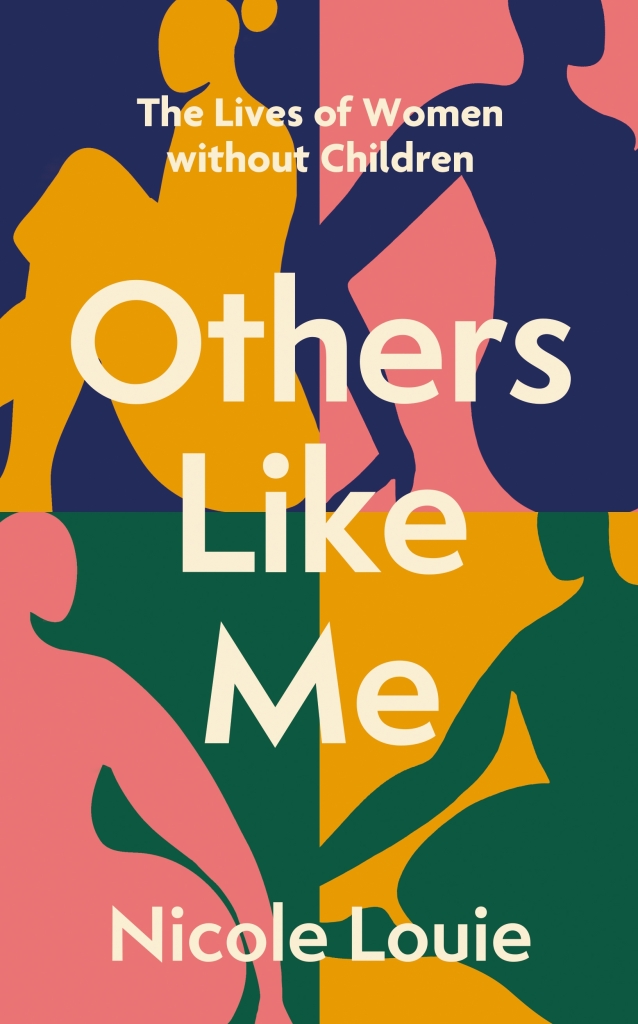
Others Like Me: The Lives of Women without Children by Nicole Louie
I’ve read quite a lot about matrescence and motherhood so far this year, and I value these women authors’ perspectives on their experiences. There is much that resonates with me as I look back to my relationships with my parents and observe how my sister, brother-in-law and friends are raising their children. Yet as I read of the joys and struggles of parenthood, I do sometimes think, what about the rest of us? That’s the question that drove Nicole Louie to write this impassioned book, which combines the strengths of an oral history, a group biography and a fragmented memoir. Like me, she was in search of role models, and found plenty of them – first on the library shelves and then in daily life by interviewing women she encountered through work or via social media.
The 14 Q&As, shaped into first-person narratives, are interspersed with Louie’s own story, creating a chorus of voices advocating for women’s freedom. The particulars of their situations vary widely. A Venezuelan graphic designer with MS doesn’t want to have a baby to try to fill a perceived lack. A blind Canadian writer hopes for children but knows it may be too complicated on her own. A Ghanaian asexual woman confronts her culture’s traditional expectations of woman. A British nurse in her sixties is philosophical about not having a long-term relationship at the right time, and focuses instead on the thousands of people she’s been able to care for.
The subjects come from Iceland, Peru, the Isle of Man; they are undecided, living with illness or disability, longing but unpartnered, or utterly convinced that motherhood is not for them. Their reasons are logical, psychological, personal and/or environmental, and so many of their conclusions rang true for me:
I just want to make the most of what’s here now instead of always having to long for something else I don’t already have.
I have this strong core intent to be useful to society. To channel as much energy into it as I would put into raising two children … You can’t experience everything available to you in life. So you make choices, and you decide which paths to take and which ones to leave behind without trying. And that’s okay. What’s important is to move forward with intent.
Louie herself has an interesting background: she’s Brazilian but has lived in Sweden, the UK and Ireland. Her work as a copywriter and translator has taken her behind the scenes in training AI. She first had to give serious thought to the question of becoming a mother in 2009, when it became an issue in her first marriage. But, really, she’d known for a long time that it didn’t appeal to her – at age six she was given a doll whose tummy opened to reveal a baby and quickly exchanged that toy for another. A late diagnosis of PCOS and a complicated relationship with her own mother only reinforced a clear conviction.
Other works that I’ve encountered on childlessness, such as Childless Voices by Lorna Gibb (2019) and No One Talks about This Stuff: Twenty-Two Stories of Almost Parenthood, ed. Kat Brown (2024), are heavily weighted towards infertility. Here the spotlight is much more on being childfree, although the blurb is inclusive, speaking of “women who are not mothers by choice, infertility, circumstance or ambivalence.” (I love the inclusion of that final word.)
“Motherhood as the epicentre of women’s lives was all I’d ever witnessed” via her mother and grandmother, Louie writes, so finding examples of women living differently was key for her. As readers, then, we have the honour of watching her life, her thinking and the book all take shape simultaneously in the narrative. A lovely point to mention is that Molly Peacock (The Analyst and A Friend Sails in on a Poem) mentored her throughout the composition process.
Intimate and empathetic, Others Like Me is also elegantly structured, with layers of stories that reflect diversity and the intersectionality of challenges. This auto/biographical collage of life without children will be reassuring for many, and a learning opportunity for others. I’m so glad it exists.
With thanks to Nicole Louie and Dialogue Books for the proof copy for review.
Buy Others Like Me from Bookshop.org in the UK [affiliate link]
Reading Ireland Month: Seán Hewitt, Maggie O’Farrell
Reading Ireland Month is hosted each year by Cathy of 746 Books. I’m wishing you all well on St. Patrick’s Day with this first of two planned tie-in posts. Today I have a poetry collection that sets grief and queer longing amid nature, and my last unread novel – a somewhat middling one, unfortunately – by one of my favourite authors.

Rapture’s Road by Seán Hewitt (2024)
 The points of reference are so similar to his 2020 debut collection, Tongues of Fire, that parts of what I wrote about that one are fully applicable here: “Sex and grief, two major themes, are silhouetted against the backdrop of nature. Fields and forests are loci of meditation and epiphany, but also of clandestine encounters between men.” Perhaps inevitably, then, this felt less fresh, but there was still much to enjoy. I particularly loved two poems about moths (the merveille du jour as an “art-deco mint-green herringbone. Soft furred little absinthe warrior”), “To Autumn,” and “Alcyone,” which likens a kingfisher to “a rip / in the year’s old fabric”.
In “Two Apparitions,” the poet’s late father seems visible again. Many of the scenes take place at dusk or dark. There’s a layer of menace to “Night-Scented Stock,” about an abusive relationship, and the account of a slaughter in “Pig.” But the stand-out is “We Didn’t Mean to Kill Mr Flynn,” based on the 1982 murder of a gay man in a Dublin park. Hewitt drew lines from court proceedings and periodicals in the Irish Queer Archive at the National Library of Ireland, where he was poet in residence. He voices first the gang of killers, then Flynn himself. The trial kickstarted Ireland’s Pride movement.
More favourite lines:
Come out, make a verb of me, let
my body do your speaking tonight —
(from “A Strain of the Earth’s Sweet Being”)
awestruck, bright,
a child in the bell-tower of beauty —
(from “Skylarks”)
Love, the world is failing:
come and fail with me.
(from “Nightfall”)
With thanks to Jonathan Cape (Penguin) for the free copy for review.
My Lover’s Lover by Maggie O’Farrell (2002)
I was so excited, a few years ago, to find battered copies of this and After You’d Gone in a local charity shop for 50 pence each, even though it appears a mouse had a nibble on one corner here. They were her first two books, but the last that I managed to source. Whereas After You’d Gone is a surprisingly confident and elegant debut novel about a woman in a coma and the family and romantic relationships that brought her to this point, My Lover’s Lover ultimately felt like a pretty run-of-the-mill story about two women finding out that (some) men are dogs and they need to break free.
 Lily meets Marcus, an architect, at a party and almost before she knows it has moved into the spare room of his apartment, a Victorian factory space he renovated himself, and become his lover. But there’s an uncomfortable atmosphere in the flat: She can still smell perfume from Marcus’s ex, Sinead; one of her dresses hangs in the closet. We, along with Lily, get the impression Sinead has died. She haunts not just the flat but also the streets of London. It becomes Lily’s obsession to find out what happened to Sinead and why Marcus is so morose. Part Two gives Sinead’s side of things, in a mix of third person/present tense and first person/past tense, before we return to Lily to see what she’ll do with her new knowledge.
As in some later novels, there are multiple locales (here, NYC, the Australian desert, and China – a country O’Farrell often revisits in fiction) and complicated point-of-view shifts, but I felt the sophisticated craft was rather wasted on a book that boils down to a self-explanatory maxim: past relationships always have an effect on current ones. I also found the writing overmuch in places (“the grass swooshing, sussurating, cleaving open to her steps”; “letting fall a box of cereal into its [a shopping trolley’s] chrome meshing”; “her fingertips meeting the ceraceous, heated skin of his cheek”). However, this was an engrossing read – I read most of it in two days. It’s bottom-tier O’Farrell, though, along with The Distance Between Us and Hamnet – sorry, I know many adore it. (If you’re interested: middle tier = The Vanishing Act of Esme Lennox, Instructions for a Heatwave, her two children’s books, and The Marriage Portrait; top tier = After You’d Gone, The Hand that First Held Mine, This Must Be the Place, and I Am, I Am, I Am.)
I’ve gotten in the habit of reading one of Maggie O’Farrell’s works per year, so I will just have to reread my favourites until we get a new one. I’m already tapping a foot in impatience. (Secondhand from Bas, Newbury) 
Have you read any Irish literature this month?
Three on a Theme: Matrescence Memoirs (and a Bonus Novel)
I think of pregnancy and childbirth like any extreme adventure (skydiving, polar exploration): wholly extraordinary experiences with much to recommend them – though better appreciated retrospectively than in the moment – to which my response is a hearty “no, thanks.” But just as books have taken me to deserts and the frozen north, miles above or below the earth, into many eras and cultures, they’ve long been my window onto motherhood.
Matrescence, a word coined by anthropologist Dana Raphael in the 1970s, is the process of becoming a mother. It’s a transition period, like adolescence, that involves radical physical and mental changes and has lasting effects. And as Lucy Jones reports, up to 45% of women describe childbirth as traumatic. That’s not a niche experience; it’s an epidemic. If it was men going through this, you can bet it would be at the top of international research agendas.
These three memoirs (and a bonus novel) are bold, often harrowing accounts of the metamorphosis involved in motherhood. They’re personal yet political in how they expose the lack of social support for creating and raising the next generation. All four of these 2023 releases are eye-opening, lyrical and vital; they deserve to be better known.
Matrescence: On the Metamorphosis of Pregnancy, Childbirth and Motherhood by Lucy Jones
Like Jones’s previous book, Losing Eden, about climate breakdown and the human need for nature, Matrescence is a potent blend of scientific research and stories from the frontline. She has synthesized a huge amount of information into a tight 260-some pages that are structured thematically but also proceed roughly chronologically through her own matrescence. Not long into her pregnancy with her first child, a daughter, she realised the extent to which outdated and sexist expectations still govern motherhood: concepts like “natural childbirth” and “maternal instinct,” the judgemental requirement for exclusive breastfeeding, the idea that a parent should “enjoy every minute” of their offspring’s babyhood rather than admitting depression or overwhelm. After the cataclysm of birth, loneliness set in. “Matrescence was another country, another planet. I didn’t know how to talk about the existential crisis I was facing, or the confronting, encompassing relationship I was now in.”
 Jones is now a mother of three. You might think delivery would get easier each time, but in fact the birth of her second son was worst, physically: she had to go into immediate surgery for a fourth-degree anal sphincter tear. In reflecting on her own experiences, and speaking with experts, she has become passionate about fostering open discussion about the pain and risk of childbirth, and how to mitigate them. Women who aren’t informed about what they might go through suffer more because of the shock and isolation. There’s the medical side, but also the equally important social implications: new mothers need so much more practical and mental health support, and their unpaid care work must be properly valued by society. “Yet the focus remains on individual responsibility, maintaining the illusion that we are impermeable, impenetrable machines, disconnected from the world around us.”
The hybrid nature of the book is its genius. A purely scientific approach might have been dry; a social history well-trod and worthy; a memoir too inward-looking to make wider points. Instead it’s equally committed to all three purposes. I appreciated the laser focus on her own physical and emotional development, but the statistical and theoretical context gives a sense of the universal. The literary touches – lists and word clouds, verse-like meditations and flash vignettes about natural phenomena – are not always successful, but there is a thrill to seeing Jones experimenting. Like Leah Hazard’s Womb, this is by no means a book that’s just for mothers; it’s for anyone who’s ever had a mother.
With thanks to Allen Lane (Penguin) for the free copy for review.
Milk: On Motherhood and Madness by Alice Kinsella
 Kinsella is an Irish poet who became a mother in her mid-twenties; that’s young these days. In unchronological vignettes dated in relation to her son’s birth – the number of months after; negative numbers to indicate that it happened before – she explores her personality, mental health and bodily experiences, but also comments more widely on Irish culture (the stereotype of the ‘mammy’; the only recent closure of Magdalene laundries and overturning of anti-abortion laws) and theories about motherhood.
I liked this most when the author stuck close to her own sensory and emotional life; overall, the book felt too long and I thought a late segue into an argument against the dairy industry was unnecessary. Had I been the editor, I would have cut the titled essays and just stuck to the time-stamped pieces. At its best, though, this is a poetic engagement with the tropes and reality of motherhood, sometimes delivered in paragraphs that more closely resemble verse:
+1 I have become the common myth. Mother. The sleepy hum of early memories. The smell of shampoo, of Olay, of lavender. The feeling of safety. The absence of fear.
+2 There’s a possibility,
that we are among the happiest
people in the world:
mothers.[Record freeze preserve.] Fighting death by reproducing our days. Fighting death by reproducing. Here: your life on paper. Here: their life to come.
We’re expected to be mothers the instant we lock eyes with our baby. To shed everything we were and be reborn: Madonnas.
The baby’s favourite thing to do is sit on my lap and interact with other people. This is what mothers are for, I think. Comfort, security, a place to get to know the world from.
The language is gorgeous, and while Kinsella complains of disorientation to the point of worrying about losing herself (although she had struggled with mental health earlier in life, the subtitle’s reference to ‘madness’ seemed to me like overkill compared to other memoirs I’ve read of postpartum depression, trauma or psychosis, such as Inferno by Catherine Cho and Birth Notes by Jessica Cornwell), she comes across as entirely lucid. Her goal here is to find and add to the missing literature of motherhood, in much the same way that Jazmina Barrera, another young mother and writer, attempted with Linea Nigra. This would also make a good companion read to A Ghost in the Throat by Doireann Ní Ghríofa.
Kinsella is among my predictions for the Sunday Times Charlotte Aitken Young Writer of the Year Award shortlist, along with Eliza Clark (Penance) and Tom Crewe (The New Life). (Public library)
The Unfamiliar: A Queer Motherhood Memoir by Kirsty Logan
 I’ve read one of Kirsty Logan’s novels and dipped into her short stories. I immediately knew her parenting memoir would be up my street, but wondered how her fantasy/horror style might translate into nonfiction. Second-person narration is perfect for describing her journey into motherhood: a way of capturing the bewildering weirdness of this time but also forcing the reader to experience it firsthand. It is, in a way, as feminist and surreal as her other work. “You and your partner want a baby. But your two bodies can’t make a baby together. So you need some sperm.” That opening paragraph is a jolt, and the frank present-tense storytelling carries all through.
To start with, Logan’s wife Annie tried getting pregnant. They had a known sperm donor and did home insemination, then advanced to IVF. But after three miscarriages and a failed cycle, they took a doctor’s advice and switched to the younger womb – Logan’s, by four years. As “The Planning” makes way for “The Growing,” it helps that Annie knows exactly what she’s going through. The pregnancy sticks, though the fear of something going wrong never abates, and after the alternating magic and discomfort of those nine months (“You’ve reached the ‘shoplifting a honeydew’ stage”) it’s time for “The Birth,” as horrific an account as I’ve read. The baby had shifted to be back-to-back, which required an emergency C-section, but before that there was a sense of total helplessness, abandonment to unmanaged pain.
Finally the doctor comes. She asks what you would like, and you, shaking shitting pissing bleeding, unable to see when the pain reaches its peak, not screaming, not swearing, not being rude to anyone, not begging for an epidural, … say: I’d like to try some gas and air, if that’s okay, please.
What is remarkable is how Logan recreates this time so intensely – she took notes all through the pregnancy, plus on her phone in hospital and in the early days after bringing the baby home – but can also see how, even in the first hours, she was shaping it into a narrative. “You like that it’s a story. You like that it’s Gothic and gory … and funny.” Except it wasn’t. “You thought you were going to die.” And yet. “How can the lucid, everyday world explain this? The wonder, the curiosity, the recognition. The baby has lived inside your body, and you’ve only just met. The baby is your familiar, and deeply unfamiliar.”
This reminded me of other memoirs I’ve read about queer family-making, especially small by Claire Lynch, which similarly turns on the decision about which female partner will carry the pregnancy and is written in an experimental style. The Unfamiliar is utterly absorbing and conveys so much about the author and her family, even weaving in her father’s death seven years before. I’ve signed up for Logan’s online memoir-writing course (“Where to Start and Where to End”) organised by Writers & Artists (part of Bloomsbury) for next month.
With thanks to Virago Press for the free copy for review.
And, as a bonus, a short novel that deals with many of these same themes:
Reproduction by Louisa Hall
 Procreation. Duplication. Imitation. All three connotations are appropriate for the title of an allusive novel about motherhood and doppelgangers. A pregnant writer starts composing a novel about Mary Shelley and finds the borders between fiction and (auto)biography blurring: “parts of her story detached themselves from the page and clung to my life.” The first long chapter, “Conception,” is full of biographical information about Shelley and the writing and plot of Frankenstein, chiming with Mary and the Birth of Frankenstein by Anne Eekhout, which I read last year. It’s a recognisable piece of autofiction, moving with Hall from Texas to New York to Montana to Iowa as she marries, takes on various university teaching roles and goes through two miscarriages and then, in the “Birth” section, the traumatic birth of her daughter, after which she required surgery and blood transfusions.
These first two sections are exceptional. There’s a sublime clarity to them, like life has been transcribed to the page exactly as it was lived. The change of gears to the third section, “Science Fiction,” put me off, and it took me a long time to get back into the flow. In this final part, the narrator reconnects with a friend and colleague, Anna, who is determined to get pregnant on her own and genetically engineer her embryos to minimise all risk. Here she is more like a Rachel Cusk protagonist, eclipsed by another’s story and serving primarily as a recorder. I found this tedious. It all takes place during Trump’s presidency [Laura F. told me I accidentally published with that saying pregnancy – my brain was definitely saturated with the topic after these reads!] and the Covid pandemic, heightening the strangeness of matrescence and of the lengths Anna goes to. “What, after all, in these end times we lived in, was still really ‘natural’ at all?” the narrator ponders. She casts herself as the narrating Walton, and Anna as Dr. Frankenstein (or sometimes his monster), in this tale of transformation – chosen or not – and peril in a country hurtling toward self-implosion. It’s brilliantly envisioned, and – almost – flawlessly executed. (Public library)
Additional related reading:
Notes Made while Falling by Jenn Ashworth
After the Storm by Emma Jane Unsworth
And coming out in 2025: Mother, Animal by Helen Jukes (Elliott & Thompson)
Preposterous #NovNov23 Catch-Up Post
I have a big pile of novellas I read last month but never wrote about, plus a few more I’ve sneaked in by finishing them over the past couple of days. I tweaked my shoulder last weekend and the discomfort has moved into my neck, making daily life, and sleep, difficult. A taste of what it’s like to live with chronic pain, I suppose. Add in the freezing temperatures of recent days and I’ve been feeling pretty sorry for myself and haven’t succeeded in sitting at a computer for the time required to write at least a bit about these short books. But as today is the day our link-up finishes, I’m tucked up in bed with laptop, electric blanket, heater, cat, cup of tea and ice pack, ready to do all 16 the best justice I can through a paragraph each.
Fiction:
In the Sweep of the Bay by Cath Barton (2020)
 Susan put this on my radar and I bought it in publisher Louise Walters Books’ closing-down sale. Set in Morecambe, this bittersweet story of a half-century marriage and the figures on its margins – co-workers, children, even strangers – is both ambitious and intimate. Ted and Rene Marshall marry in the 1950s and soon drift into drudgery and traditional gender roles; “They forgot the happiness. Or rather, they pushed it away.” While Ted becomes a celebrated ceramics designer in the family company, Rene stagnates at home. It is not so much suspected infidelity as simply taking each other for granted that threatens their relationship. Barton moves through the decades and varies the perspective, letting us hear from one of the Marshalls’ daughters and giving kind attention to a gay couple. Strictly Come Dancing fans and those familiar with the northwest might take particular pleasure, but I enjoyed this quiet book reminiscent of Anne Tyler’s French Braid and (though less political) Jonathan Coe’s Bournville. (New purchase) [104 pages]
The Visitor by Maeve Brennan (2000)
 This posthumous novella was written in the 1940s but never published in Brennan’s lifetime. From Dublin, she was a longtime New Yorker staff member and wrote acclaimed short stories. After her mother’s death, Anastasia King travels from Paris, where the two set up residence after leaving her father, to Ireland to stay in the family home with her grandmother. Anastasia considers it a return, a homecoming, but her spiteful grandmother makes it clear that she is an unwelcome interloper. Mrs King can’t forgive the wrong done to her son, and so won’t countenance Anastasia’s plan to repatriate her mother’s remains. Rejection and despair eat away at Anastasia’s mental health (“She saw the miserable gate of her defeat already open ahead. There only remained for her to come up to it and pass through it and be done with it”) but she pulls herself together for an act of defiance. Most affecting for me was a scene in which we learn that Anastasia is so absorbed in her own drama that she does not fulfill the simple last wish of a dying friend. This brought to mind James Joyce’s The Dead. (Secondhand purchase – The Bookshop, Wigtown) [81 pages]
Bear by Marian Engel (1976)
 If you’ve heard of this, it’ll be for the fact that the main character – Lou, a librarian sent to archive the holdings of an octagonal house on an island one summer – has sex with a bear. That makes it sound much more repulsive and/or titillating than it actually is. The further I read the more I started to think of it as an allegory for women’s awakening; perhaps the strategy inspired Melissa Broder’s The Pisces (stuffed full of sex with a merman). “I have an odd sense of being reborn,” Lou writes to her boss, the Institute director, with whom she’d been having an affair. The bear lives in an outbuilding and at first Lou is indifferent, only feeding him as necessary. Then he becomes a friend, joining her for swims. Then he comes into the house. Bestiality is a taboo for a reason, but what mostly bothers me is the lack of mutuality, the sense of taking advantage. I’m also wary of stories in which animals have a primarily instrumental or metaphorical role. Still, this was a solid read, offbeat and nearly as shocking today as when it first appeared. (Secondhand purchase online) [167 pages]
So Late in the Day by Claire Keegan (2023)
 Several of us reviewed this for #NovNov though unsure it counts: in the UK the title story (originally for the New Yorker) was published in a standalone volume by Faber, while the U.S. release includes two additional earlier stories; I read the latter. The title story has Cathal spending what should have been his wedding weekend moping about Sabine calling off their engagement at the last minute. It’s no mystery why she did: his misogyny, though not overt, runs deep, most evident in the terms in which he thinks about women. And where did he learn it? From his father. (“The Long and Painful Death” is from Keegan’s second collection, Walk the Blue Fields, and concerns a woman on a writing residency at an author’s historic house in Ireland. She makes a stand for her own work by refusing to cede place to an entitled male scholar. The final story is “Antarctica,” the lead story in that 1999 volume and a really terrific one I’d already experienced before. It’s as dark and surprising as an early Ian McEwan novel.) Keegan proves, as ever, to be a master at portraying emotions and relationships, but the one story is admittedly slight on its own, and its point obvious. (Read via Edelweiss) [64 pages]
Swallowing Geography by Deborah Levy (1993)
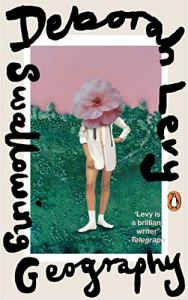 “She is Europe’s eerie child, and she is part of the storm.” J.K. is a young woman who totes her typewriter around different European locations, sleeps with various boyfriends, hears strangers’ stories, and so on. Many of the people she meets are only designated by an initial. By contrast, the most fully realized character is her mother, Lillian Strauss. The chapters feel unconnected and the encounters within them random, building to nothing. Though a bit like Crudo, this has very little detail to latch onto and so was pretentious in its opacity. I’ve generally gotten on much better with Levy’s nonfiction (see below) than her fiction. This, along with the Keegan (above), was my chosen train entertainment for the Booker Prize evening. I got so little out of it that it seemed like wasted reading time. Here’s a decent excerpted passage: “The arrogance of metaphor when facts save people’s lives. The succour of metaphor when facts inadequately describe people’s lives.” (Public library) [83 pages]
Nonfiction:
Starting with two from the Bloomsbury Object Lessons series, a great source of short monographs. These have been among my favourites so far.
Grave by Allison C. Meier (2023)
 Meier is a cemetery tour guide in Brooklyn, where she lives. She surveys American burial customs in particular, noting the lack of respect for Black and Native American burial grounds, the Civil War-era history of embalming, the increasing popularity of cremation, and the rise of garden cemeteries such as Mount Auburn in Cambridge, Massachusetts, which can serve as wildlife havens. The mass casualties and fear of infection associated with Covid-19 brought back memories of the AIDS epidemic, especially for those in New York City. Meier travels to a wide range of resting places, from potter’s fields for unclaimed bodies to the most manicured cemeteries. She also talks about newer options such as green burial, body composting, and the many memorial objects ashes can be turned into. I’m a dedicated reader of books about death and so found this fascinating, with the perfect respectful and just-shy-of-melancholy tone. It’s political and philosophical in equal measures. (Read via NetGalley) [168 pages]
Pregnancy Test by Karen Weingarten (2023)
 Laboratory pregnancy tests have been available since the 1930s and home pregnancy tests – the focus here – since the 1970s. All of them work by testing urine for the hormone hCG (human chorionic gonadotropin). What is truly wild is that pregnancy used to be verifiable only with laboratory animals – female mice and rabbits had to be sacrificed to see if their ovaries had swelled after the injection of a woman’s urine; later, female Xenopus toads were found to lay eggs in response, so didn’t need to be killed. Home pregnancy kits were controversial and available in Canada before the USA because it was thought that they could be unreliable or that they would encourage early abortions. Weingarten brings together the history, laypeople-friendly science, and cultural representations (taking a pregnancy test is excellent TV shorthand) in a readable narrative and makes a clear feminist statement: “the home pregnancy test gave back to women what should have always been theirs: first-hand knowledge about how their bodies worked” and thus “had the potential to upend a paternalistic culture.” (Read via NetGalley) [160 pages]
And from a different Bloomsbury series for monographs about seminal albums, 33 1/3:
Jesus Freak by Will Stockton and D. Gilson (2019)
 The dc Talk album Jesus Freak (1995) is the first CD I ever owned. My best friend and I listened to it (along with Bloom by Audio Adrenaline and Take Me to Your Leader by Newsboys) so many times that we knew every word and note by heart. So it’s hard for me to be objective rather than nostalgic; I was intrigued to see what two secular academics would have to say. Crucially, they were teenage dc Talk fans, now ex-Evangelicals and homosexual partners. As English professors, their approach is to spot musical influences (Nirvana on the title track; R&B and gospel elsewhere), critically analyse lyrics (with “Colored People” proving problematic for its “neoliberal multiculturalism and its potential for post-racial utopianism”), and put a queer spin on things. For those who don’t know, dc Talk were essentially a boy band with three singers, one Black and two white – one of these a rapper. Stockton and Gilson chronicle the confusion of living with a same-sex attraction they couldn’t express as teens, and cheekily suggest there may have been something going on between dc Talk members Toby McKeehan and Michael Tait, who were roommates at Liberty University and apparently dismantled their bunk beds so they could sleep side by side. Hmmm! I was interested enough in the subject matter to overlook the humanities jargon. (Birthday gift from my wish list last year) [132 pages]
And the rest:
Fifty Days of Solitude by Doris Grumbach (1994)
 Grumbach died last year at age 104. This was my third of her books; I read two previous memoirs, Extra Innings and The Presence of Absence, when they were brought back into print as Open Road Media e-books. I knew of Grumbach through her association with May Sarton, and the two in fact had a lot in common, including lesbianism, living in Maine and writing about older age. I was expecting something on a par with Sarton’s Journal of a Solitude, one of my favourite books, but this fell short in comparison. Grumbach spent a month and a half alone in Maine during the winter of 1993 while her partner, Sybil, was away amassing stock for their bookstore. The book is a collection of unconnected meditations about nature, the cold, creativity and so on. She finds herself writing fiction so the characters can keep her company, and notes “how much more I was aware of my vices.” Although she tries to avoid the news, word reaches her of acquaintances’ demises, and she recalls the recent death from AIDS of a young local man. Amusingly, she rereads Bear (see above) during the 50 days. Some atmosphere, but low on insight. (Secondhand purchase – Wonder Book and Video, Hagerstown) [114 pages]
Things I Don’t Want to Know: On Writing by Deborah Levy (2013)
 It feels like I made an error by reading Levy’s “Living Autobiography,” out of order. I picked up the middle volume of the trilogy, The Cost of Living, for #NovNov in 2021 and it ended up being my favourite nonfiction read of that year. I then read part of the third book, Real Estate, last year but set it aside. And now I’ve read the first because it was the shortest. It’s loosely structured around George Orwell’s four reasons for writing: political purpose, historical impulse, sheer egoism and aesthetic enthusiasm. The frame story has her flying to Majorca at a time when she was struggling with her mental health. She vaguely follows in the footsteps of George Sand and then pauses to tell a Chinese shopkeeper the story of her upbringing in apartheid-era South Africa and the family’s move to London. Although I generally admire recreations of childhood and there are some strong pen portraits of minor characters, overall there was little that captivated me here and I was too aware of the writerly shaping. (Secondhand purchase – 2nd & Charles, Hagerstown) [111 pages]
The Private Life of the Hare by John Lewis-Stempel (2019)
 I reviewed a couple of JLS’s species-specific monographs for #NovNov in 2018: The Secret Life of the Owl and The Glorious Life of the Oak. There’s a similar range of material here: anatomy, natural history and cultural significance, including in poetry. There are chapters on hunting, the hare as food, and its appearances in myth and religion. I was engaged about half of the time; I tended to skip over longer excerpts from historical documents. The reliance on lengthy quotations and use of bullet points make it feel like a half-finished research project, with the kind of information you could find anywhere else. Too many of his recent books have felt like they were rushed into print. I would only pick this up if you’re particularly fascinated by hares. (Public library) [99 pages]
The Cancer Journals by Audre Lorde (1980)
 I’ve read so many cancer stories that it takes a lot to make one stand out. This feels like a random collection of documents rather than a coherent memoir. One of the three essays was originally a speech, and two were previously printed in another of her books. Lorde was diagnosed with breast cancer in 1978 and had a mastectomy. A Black lesbian feminist, she resisted wearing prostheses and spoke up about the potential environmental causes of breast cancer that need to be addressed in research (“I may be a casualty in the cosmic war against radiation, animal fat, air pollution, McDonald’s hamburgers and Red Dye No. 2”). Her actual journal entries make up little of the text, which is for the best because fear and pain can bring out the cliches in us – but occasionally a great quote like “if bitterness were a whetstone, I could be sharp as grief.” Another favourite line: “Pain does not mellow you, nor does it ennoble, in my experience.” I’m keen to read her memoir Zami. (University library) [77 pages]
A Month in Siena by Hisham Matar (2019)
 I’d not read Matar before I spotted this art book-cum-memoir and thought, why not. A Libyan American novelist who lives in London, Matar had long been fascinated by the Sienese School of painting (13th to 15th centuries), many of whose artists depicted biblical scenes or religious allegories – even though he’s not a Christian. He spent a month in Italy immersed in the art he loves; there are 15 colour reproductions here. His explications of art history are generalist enough to be accessible to all readers, but I engaged more with the glimpses into his own life. For instance, he meets a fellow Arabic speaker and they quickly form a brotherly attachment, and a Paradise scene gives him fanciful hope of being reunited with his missing father – the subject of his Folio Prize-winning memoir The Return, which I’d like to read soon. His prose is beautiful as he reflects on history, death and how memories occupy ‘rooms’ in the imagination. A little more interest in the art would have helped, though. (Little Free Library) [118 pages]
A Childhood in Scotland by Christian Miller (1981)
 I had high hopes for this childhood memoir that originally appeared in the New Yorker and was reprinted as part of the Canongate Classics series. But I soon resorted to skimming as her recollections of her shabby upper-class upbringing in a Highlands castle are full of page after page of description and dull recounting of events, with few scenes and little dialogue. This would be of high historical value for someone wanting to understand daily life for a certain fraction of society at the time, however. When Miller’s father died, she was only 10 and they had to leave the castle. I was intrigued to learn from her bio that she lived in Newbury for a time. (Secondhand purchase – Barter Books) [98 pages]
Here and Now: Living in the Spirit by Henri J.M. Nouwen (1994)
 This collection of micro-essays under themed headings like “Living in the Present” and “Suffering” was a perfect introduction to Nouwen’s life and theology. The Dutch Catholic priest lived in an Ontario community serving the physically and mentally disabled, and died of a heart attack just two years after this was published. I marked out many reassuring or thought-provoking passages. Here’s a good pre-Christmas one:
“God became a little child in the midst of a violent world. Are we surprised by joy or do we keep saying: ‘How nice and sweet, but the reality is different.’ What if the child reveals to us what is really real?”
I was taken by the ideas that the life of compassion is one of “downward mobility” and that inner freedom only comes when you don’t judge anyone. He encourages readers to not live in a past of shame and regret, but to be grateful for opportunities for God’s mercy and guidance. Very peaceful and readable; a good bedside devotional book. (Free from my stepfather) [175 pages] 
De Profundis by Oscar Wilde (1897)
 My only reread for the month. Wilde wrote this from prison. No doubt he had a miserable time there, but keeping in mind that he was a flamboyant dramatist and had an eye to this being published someday, this time around I found it more exaggerated and self-pitying than I had before. “Suffering is one very long moment. … Where there is sorrow there is holy ground,” he writes, stating that he has found “harmony with the wounded, broken, and great heart of the world.” He says he’s not going to try to defend his behaviour … but what is this but one extended apologia and humble brag, likening himself to a Greek tragic hero (“The gods had given me almost everything. But I let myself be lured into long spells of senseless and sensual ease. I amused myself with being a flâneur, a dandy, a man of fashion”) and even to Christ in his individuality as well as in his suffering at the hands of those who don’t understand him (the scene where he was pilloried consciously mimics a crucifixion tableau). As a literary document, it’s extraordinary, but I didn’t buy his sincerity. He feigns remorse but, really, wasn’t sorry about anything, merely sorry he got caught. (Free from a neighbour) [151 pages]
Original rating (2011):
Rating now:
Average:
Which of these have you read?
And which do you want to read? (You may choose no more than 4!)
In total, I read 27 novellas this November – close to my 2021 record of 29. The highlights included the Barton, Meier, Nouwen and Weingarten above plus Train Dreams by Denis Johnson and Western Lane by Chetna Maroo, but the best of the lot was Absolutely and Forever by Rose Tremain.
Coming right up, final statistics on the month’s participants and posts!
 Bookish Beck = Rebecca Foster. American transplant to England. Freelance proofreader and book reviewer.
 Bookish Beck